Article Contents:
- MN-116 or MN-143: confirmed specifications
- Why the same cross-section does not mean the same application
- Difference of 380 mm: how it changes the final height
- When to choose MN-116 for a console
- MN-116 for a writing and work desk
- MN-116 for a vanity table
- When to choose MN-143 for a bar counter
- MN-143 for a high console and standing work
- MN-143 for reception and showroom
- MN-116 for seated work or MN-143 for high seating
- How to choose a chair for legs 720 or 1100 mm
- How to calculate the final tabletop height
- How many legs are needed for a console or stand
- When a crossbar, frame, or longitudinal ties are needed
- How to check stability before manufacturing
- How to match legs with the tabletop
- Beech for enamel
- Oak for tinting
- Prestige sanding and preparation for finishing
- FUR-001-1, FUR-044, or FUR-012: which to choose
- How to choose a glider and protect the floor
- What to buy together with MN-116 or MN-143
- How to make a full-size furniture layout
- How to check the stability and assembly of tall furniture
- MN-116 in the hallway, bedroom, and study
- Entry Hall
- Bedroom
- Office
- Living Room
- Kitchen-living room
- Showroom
- Reception desk
- Salon, cafe, and hotel
- Consider 720 mm as the finished table height
- Not accounting for the width of the turned profile
- Using MN-116 for a bar counter without a mockup
- Buying four legs without a frame project
- Choosing fasteners after making the tabletop
- Choosing 1100 mm only for the spectacular look
- Do not add tabletop thickness
- Use a standard chair
- Do not design lateral rigidity
- Promise universal load
- Do not check delivery route
- 1. Which leg is suitable for a console?
- 2. Which model is suitable for a bar counter?
- 3. Can MN-116 be used for a writing desk?
- 4. Can MN-143 be placed on a regular writing desk?
- 5. How much taller is MN-143 than MN-116?
- 6. Are the dimensions of the turned profile the same?
- 7. Can MN-143 be shortened?
- 8. What material to choose for white enamel?
- 9. What material to choose for tinting?
- 10. How many legs to buy?
- 11. Is a crossbar needed for MN-143?
- 12. Is FUR-044 suitable for both models?
- 13. What is FUR-012?
- 14. Is a footrest needed?
- 15. How to choose a chair for MN-143?
- 16. Is MN-116 suitable for a vanity table?
- 17. Can MN-143 be used for a reception desk?
- 18. How to check stability?
- 19. When to paint the legs?
- 20. Where to see other models?
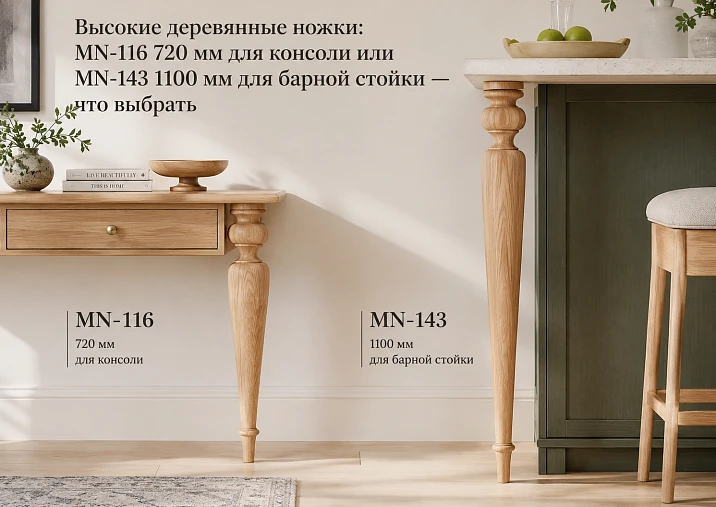
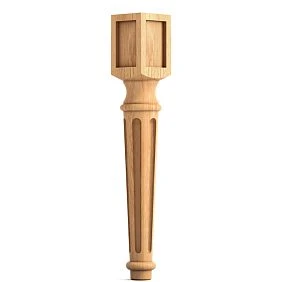
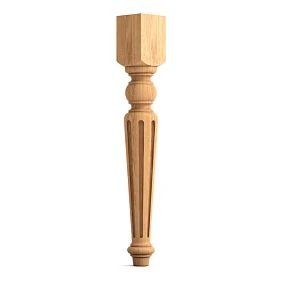
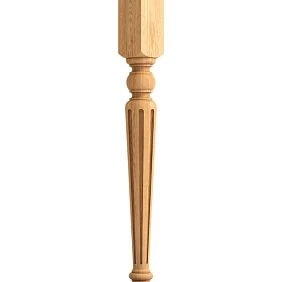
When you need to buy high wooden furniture legs for a console, desk, bar counter, or display furniture, the height cannot be chosen based solely on a photo. MN-116 and MN-143 have the same maximum width of 140 mm and the same bottom size of 97 mm, are made from beech or oak, and come with a "Prestige" sanding finish. The main difference is the height: 720 mm for MN-116 and 1100 mm for MN-143.
The 380 mm difference completely changes the future furniture. MN-116 is suitable for a console, desk, vanity, or decorative table used with a standard chair or as a regular high surface. MN-143 creates a bar or display height: it is appropriate in a kitchen-living room, at a reception desk, in a showroom, for a high console or counter where people work standing or sit on a bar stool.
The same cross-section does not mean the same stability of the finished item. The higher the legs and the longer the tabletop, the more important the structural design: the number of supports, the distance between them, the presence of an apron or longitudinal ties, the fastening method, and the rigidity of the top part. The product cards confirm the mounting hardware options but do not guarantee universal compatibility or permissible load without calculating the entire piece of furniture.
The article covers the exact specifications of MN-116 and MN-143, calculating the final height considering the tabletop, choosing for sitting or standing work, application in hallways, offices, kitchens, and commercial interiors, beech under enamel, oak for tinting, mounting hardware, glides, dry assembly, mistakes, and the commercial ordering route on STAVROS.
Buy MN-116 720 mm Buy MN-143 1100 mm View furniture legs
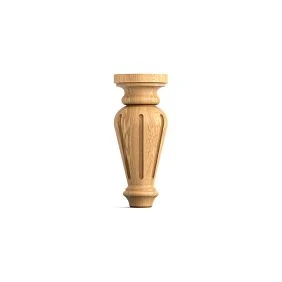
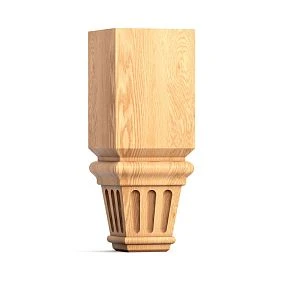
MN-116 or MN-143: confirmed specifications
| Criterion | MN-116 | MN-143 | Practical Meaning |
|---|---|---|---|
| Size | 720 × 140 × 97 mm | 1100 × 140 × 97 mm | The models create different furniture heights with the same width and bottom size. |
| Height difference | Base height 720 mm | 380 mm higher | Seating position, chair type, and usage scenario change. |
| Maximum width | 140 мм | 140 мм | The turned profile has a comparable visual scale. |
| Bottom size D | 97 мм | 97 мм | The same base size does not guarantee the same stability for the entire furniture. |
| Material | Beech or oak | Beech or oak | Beech is chosen for enamel, oak for tinting. |
| Sanding | «Prestige» | «Prestige» | Both models are prepared for further finishing. |
| Main scenario | Console, writing or decorative table | Bar counter, high console, reception desk, display table | The choice is determined by function, not just pattern. |
| Fastening by cards | FUR-001-1, FUR-044 or FUR-012 | FUR-001-1, FUR-044 or FUR-012 | Compatibility is checked by the underframe design. |
| Glide | FUR-027 | Option is specified by card and project | The type of floor protection is chosen based on the covering and method of use. |
The table shows the main point: MN-143 is not just an elongated decorative version of MN-116. With the same profile, the height changes the ergonomics, tabletop position, seating style, requirements for connections, and the overall scale of the furniture. The buyer chooses the ready-made function of the future item.




Why the same cross-section does not mean the same application
MN-116 and MN-143 have the same maximum width of 140 mm and a bottom dimension of 97 mm. In the image, this creates the impression of almost identical geometry. However, a tall leg works as a longer lever: any lateral impact on the tabletop is more pronounced in the overall structure. Therefore, the mounting scheme of a low console cannot be transferred to a bar counter without verification.
Stability depends on the distance between legs, the length and width of the tabletop, the material of the top part, connections, the presence of an apron, longitudinal ties or an internal frame, floor quality, and usage method. Four identical supports can behave differently under a narrow console and under a long counter. The article helps choose a model but does not replace structural calculation.
The same cross-section is useful from a design perspective. If the project includes a regular console MN-116 and a tall counter MN-143, the turned pattern and base proportions can support a unified furniture language. However, combining models in one item or considering them interchangeable is not possible without a separate scheme.
Our factory also produces:
The 380 mm difference: how it changes the final height
The leg height is not the final surface height. The thickness of the tabletop, underframe, mounting plate, apron, frame, or another layer placed on top is added to it. If MN-116 has a height of 720 mm, the finished surface will be higher than 720 mm. If MN-143 has 1100 mm, the tabletop will raise the final level even more.
Before purchasing, you need to draw a vertical cross-section of the furniture. On it, separately mark the leg, fastening, underframe, and tabletop. Such a drawing helps avoid two mistakes: choosing MN-116 for a too-low bar function or MN-143 for a surface that, in its finished form, will be higher than the expected level.
The name of the furniture does not replace calculation. A console can be decorative, working, vanity, or display. A counter can be used standing, with a bar stool, as a kitchen-living room divider, or as a demonstration table. For each scenario, check the position of hands, feet, equipment, and items on the tabletop.
Get Consultation
When to choose MN-116 for a console
MN-116 is suitable for a console under a mirror, a key holder, or a wall composition. The height of 720 mm creates a base for furniture used while standing briefly, but which, after adding a tabletop, remains close to the usual height of a regular table. On such a console, it is convenient to place small items without turning it into a bar counter.
In the hallway, depth and traffic route are especially important. The turned leg, up to 140 mm wide, must fit within the contour of the tabletop and not narrow the passage. Before ordering, make a top view plan, noting the opening of the front door, cabinets, and drawers. If the console is narrow, the position of the legs may require an internal frame.
Before purchasing, you can go to the product page and buy the wooden leg MN-116, 720 mm high, after checking the material, sanding, and mounting options.
MN-116 for a writing and work desk
MN-116 can be considered for a writing or decorative work desk. The main check is the final height including the tabletop and the legroom. The apron or mounting frame should not drop so low as to interfere with the knees. The leg width of 140 mm also reduces the free space between supports, especially on a compact desk.
Work furniture experiences regular lateral loads: the user leans on the edge, moves the chair, places equipment. Therefore, one decorative support is not enough to ensure stability. A well-thought-out connection of the legs to the top part and a check of the entire structure by a furniture maker are needed.
The position of cables, sockets, and drawers is planned in advance. If the desk has a cabinet or a hanging drawer, it may change the support layout. In this case, the number and position of MN-116 are chosen based on the overall drawing, not on the symmetry of a photo.
MN-116 for a dressing table
For the MN-116 dressing table, it matches the scale and helps create expressive classic or eclectic furniture. It is important to consider the drawers under the tabletop. If they take up significant height, the legroom decreases. Before ordering, it is useful to assemble a vertical cross-section: floor, foot, leg, fastener, drawer, tabletop.
The mirror and lighting also affect the result. Turned legs can be painted in the body color or tinted to match a wood surface. Beech under enamel is convenient for an opaque coating, oak is used when the texture is to be preserved.
If the table is installed between walls or next to a cabinet, check the opening of the fronts and the chair. The decorative shape should not interfere with movement and cleaning.
When to choose MN-143 for a bar counter
MN-143 is designed for tall furniture and is especially logical in a bar area. The 1100 mm leg itself forms a high level, and the tabletop adds additional height. Therefore, bar stools are chosen only after calculating the finished surface, not by the leg height alone.
The counter is often used as a boundary between the kitchen and living room. People lean on it, move around it, and walk nearby. The longer the tabletop, the more important the longitudinal rigidity and the position of the supports. A tall leg should not work without ties just because it visually looks massive.
In the card, you can buy a tall leg MN-143 for a bar counter, and then coordinate the quantity, fasteners, and design of the upper part.
MN-143 for a tall console and standing work
MN-143 is suitable for a tall console used while standing: in a hall, showroom, salon, or waiting area. Such furniture can serve as a place for filling out documents, displaying materials, or short-term work. For it, not only the height and appearance are important, but also stability when leaning on hands.
Convenience depends on user height, tabletop thickness, and the nature of operations. Different levels may be required for writing, using a laptop, packaging goods, and displaying samples. If the furniture is designed for multiple people, a compromise height is tested with a mockup.
If a high console is installed against a wall, wall mounting or an internal frame can become part of the project. The method of fixation depends on the wall, the body, the size of the tabletop, and operational requirements.
MN-143 for reception and showroom
In a commercial interior, MN-143 can be used for a reception desk, demonstration table, or high surface in a showroom. Here, the furniture undergoes more intensive use, so the structural scheme is agreed upon with particular care. A random assembly of four high legs and a heavy tabletop without ties may prove insufficiently rigid.
The advantage of a turned wooden support is the ability to connect a functional stand with a decorative interior. Beech is painted to match the furniture color, oak is tinted to match panels, doors, or other wooden elements. For large batches, the finish is approved on a sample and executed according to a unified system.
In a reception area, equipment, wiring, the employee's work surface, and visitor access are additionally considered. MN-143 is responsible for the decorative support but does not replace the desk body.
MN-116 for seated work or MN-143 for high seating
| Scenario | MN-116 | MN-143 | What to Check |
|---|---|---|---|
| Working with a standard chair | Main option | Not suitable without high seating | Final height and legroom |
| Bar stool | Usually too low | Main Scenario | Difference between seat and finished countertop |
| Standing work | Can be low | Fits better | User height and task nature |
| Decorative console | Suitable | Only for intentionally high composition | Position of mirror, outlets, and furniture |
| Reception or showroom | Regular work surface | High display surface | Equipment and intensity of use |
Even the correct furniture category does not eliminate the need for a mock-up. The thickness of the tabletop and under-table structure varies, so it is better to place a temporary horizontal plane at the calculated level and test it in the actual room. The mock-up shows whether it is comfortable to sit, stand, use drawers, approach the counter, and place chairs.
How to choose a chair for legs 720 or 1100 mm
A chair is chosen based on the finished tabletop height, not the leg length. For MN-116, the 720 mm is increased by the mounting and tabletop. For MN-143, the 1100 mm is also increased by the upper layers. Therefore, two items with the same legs may have different final heights if the under-table structure differs.
For MN-116, standard seating is usually considered, but knees, apron, and drawer height are checked. For MN-143, a bar or high stool is needed, or the furniture is used standing. Before buying chairs, a mock-up is made: the intended tabletop and seat levels are fixed, then the position of legs and elbows is checked.
If the counter will be used by people of different heights, the compromise is evaluated with several users. In a commercial interior, the comfort of visitors and employees is important, not just an expressive height. For prolonged work, it is especially important that the furniture does not force constant shoulder raising or bending.
How to calculate the final tabletop height
The calculation starts with the leg height. All elements between the top of the leg and the work surface are added: mounting plate, frame, apron, under-table structure, drawer base, and tabletop. If part of the fastening is recessed, this is reflected in the drawing. The final height is the sum of the actually protruding layers.
For MN-116, it cannot be automatically assumed that the finished table will be 720 mm high. For MN-143, a finished level of exactly 1100 mm cannot be guaranteed. These figures refer to the legs. The difference between the product parameter and the size of the entire furniture must be preserved in the project and in the order specification.
A convenient way to check is to assemble a mock-up from boxes, slats, or a temporary support. A plane simulating the tabletop is placed at the calculated level. Then, sit on the chosen chair or approach standing, check the position of elbows, view, access to outlets and adjacent furniture.
If a drawer or concealed wiring is planned, they are also shown in the section. A drawer can reduce legroom, and a cable channel can occupy the area where the mounting plate should be located. The earlier these conflicts are found, the lower the likelihood of rework.
How many legs are needed for a console or stand
The number of supports depends on the length, width, mass, and design of the top part. Four legs is a common scheme, but not a universal rule. A narrow console may have a different underframe, and a long bar counter may require intermediate supports, wall mounting, or an internal frame.
The tall MN-143 increases requirements for lateral rigidity. Even with four supports, a long tabletop may need longitudinal ties. The quantity cannot be determined solely by appearance or by analogy with a low table. The project is coordinated with the furniture maker, who sees all dimensions and materials.
For ordering, a list is compiled: model, quantity, material, finish, fasteners, glides, and the purpose of each leg. If the project includes multiple items, product numbers are added. This reduces the risk of mixing batches and simplifies reordering.
When a stretcher, frame, or longitudinal ties are needed
A stretcher or internal frame connects the legs and helps distribute loads. Not all furniture must have the same design, but a tall stand without rigid connections requires particularly careful checking. MN-143 is positioned for tall furniture, but this does not eliminate the need to design the entire system.
Longitudinal ties become more important with a long tabletop, narrow base, intensive use, and high seating. If the user leans on the edge, the structure receives lateral force. A single threaded connection can be part of the system, but does not always replace the frame.
For MN-116, requirements are usually milder due to the lower height, but a work desk, long console, or heavy tabletop also needs calculation. External massiveness does not equal structural rigidity. The turned profile is responsible for the shape, while the entire furniture assembly creates stability.
How to check stability before manufacturing
First, a drawing is made in three views. The plan shows the position of the legs relative to the edges of the tabletop, the distances between supports, and possible connections. The front view shows the height, apron, and lower elements. The side view shows the depth and overhang of the upper part.
Then, the usage scenario is assessed. Will someone lean on the edge? Which side do they approach from? Does the furniture need to be moved? Are there any equipment or heavy objects? The answers help the furniture maker choose the fastening scheme and the need for an additional frame.
For a tall stand, a full-size mockup of one corner is useful: a leg, a joint, and a fragment of the under-table. It shows tool access, plate position, and the appearance of the fastener. Final stability is confirmed by the specialist responsible for furniture manufacturing.
How to coordinate legs with the tabletop
The tabletop affects not only thickness. Its width, length, mass, overhang beyond the legs, material, and fastening method are important. A narrow console with a small overhang and a long bar counter create different impacts on the supports. Therefore, the same item cannot be automatically transferred from a small project to a large one.
The position of the legs is marked on the underside of the tabletop before finishing. If the support has a maximum width of 140 mm, enough material must remain around the mounting unit for fasteners. A thin edge, cutout, drawer, or cable channel may conflict with the plate.
For natural wood, the direction of the fibers and possible material movement are considered. For a panel tabletop, the base type and permissible fasteners are considered. These issues are resolved by the furniture maker, while the leg card provides the parameters of the support itself.
Beech under enamel
Beech is chosen when the legs need to be painted white, black, the color of the body, or another opaque shade. Preparation for enamel helps achieve a unified look with MDF facades, painted tabletops, or bodies. It is better to finish all legs at the same time so that the color and gloss match.
A turned profile has transitions, grooves, and convexities. A thick layer of coating can soften the pattern, so finishing is done in controlled layers. Before the main batch, a test coating is done on material with comparable preparation.
Mounting areas are protected from coating if it could interfere with fastener seating. After painting, the legs are transported and assembled with soft relief protection. It is useful to save the enamel code and gloss level for repair or reorder.
Oak under tinting
Oak is suitable for tinting when it is necessary to preserve the wood grain. On MN-116, the texture supports a console, tabletop, or cabinet. On MN-143, the vertical direction of the fibers enhances the height of the stand. The tone is coordinated with adjacent oak elements under real lighting.
If the tabletop is made from a different batch of oak, an exact match of the natural grain cannot be expected. The task of finishing is to create a harmonious combination in terms of shade and gloss level, not to mechanically repeat every fiber.
In one item, it is better to order all supports from the same wood species. Mixing beech and oak complicates finishing and makes differences noticeable on symmetrical elements. If the project includes several items, the tinting sample is approved immediately for the entire group.
"Prestige" sanding and preparation for finishing
Both models have "Prestige" sanding. This is important for a turned profile, where the surface consists of many transitions. Before finishing, the legs are inspected, cleaned, and checked during a dry assembly. Mounting areas are protected from excess coating if it may interfere with the fit of the hardware.
It is convenient to paint the legs before final assembly because access to the relief is easier. However, the finished coating must be protected during installation. An alternative option is to first assemble the furniture, then finish the entire set. The decision depends on the workshop's technology.
For oak, a test tint is mandatory if matching with the tabletop is required. For beech, the opacity of the enamel, primer, and gloss level are checked. Do not apply a thick layer of coating to the relief: the turned pattern will lose its expressiveness.
FUR-001-1, FUR-044 or FUR-012: what to choose
The cards MN-116 and MN-143 indicate several options for mounting hardware. This does not mean that any option automatically fits any tabletop. The stud, plate, and kit with stud work in different schemes, and the choice depends on the top part of the leg, the body material, and access to the joint.
| Hardware | Purpose | What to Check | Link |
|---|---|---|---|
| FUR-001-1 | Metric self-tapping stud M8 × 60 | Mounting point and tightening access | Buy M8 × 60 stud |
| FUR-044 | Square mounting plate | Platform size and base fastening | Buy FUR-044 plate |
| FUR-012 | Kit with plate and stud | Compatibility with leg and base thickness | buy FUR-012 kit |
| FUR-027 | Felt foot pad 24 mm diameter | Floor type and stability after installation | Buy FUR-027 base plate |
The final fastening assembly is approved before drilling and finishing. For MN-143, it is especially important that the scheme provides not only vertical connection but also overall lateral rigidity of the furniture. If the fastening is concealed after assembly, tool access is checked in advance.
How to choose a floor protector and protect the floor
The floor protector protects the floor surface from direct contact with the wooden support and minor furniture movements. Card MN-116 indicates FUR-027. For MN-143, the option needs to be checked against the card and the project, because the original scheme mentions several solutions. You cannot automatically transfer one floor protector to any tall stand.
Felt is not suitable for every task. Behavior differs on soft flooring, tiles, stone, or uneven floors. The floor protector does not correct misalignments and does not replace leveling the structure. If furniture wobbles, first check the floor geometry, leg length, and attachment points.
For a heavy or frequently moved stand, a specialist may suggest a different floor protection system. The decision is made together with the furniture design, not after scratches or pressure marks appear.
What to buy together with MN-116 or MN-143
| Position | What it's for | Scenario | Check |
|---|---|---|---|
| console legs | Compare MN-116 with other supports | Console, writing or vanity table | Height, quantity and style |
| — tall and stylish elements that highlight the elegance and sophistication of bar structures. These legs make the bar counter stable and give it a refined look, perfectly suited for kitchens and living rooms with bar-style decor. | Compare MN-143 with other tall supports | Stand, reception desk, demonstration table | Final height and structural scheme |
| Stud FUR-001-1 | Threaded connection | Project with confirmed fit | Compatibility with the upper part |
| Plate FUR-044 | Attachment to the underframe | Console and tall furniture | Base material |
| FUR-012 Set | Plate and stud in one node | Approved project | Drawing and base thickness |
| foot cap FUR-027 | Protection of the suitable floor | MN-116 and approved projects MN-143 | Coating type |
The purchase kit starts with a drawing. First, choose the height and number of legs, then design the underframe, after that select the fastening and glides. The reverse order creates a risk of buying hardware that does not match the design.
How to make a full-size furniture mockup
For MN-116, mark the level at 720 mm, then add the expected thickness of the top layers. For MN-143, do the same with the level at 1100 mm. Temporarily mark the horizontal plane with a batten, cardboard, or sheet on safe supports.
On the floor, mark the contour of the tabletop and the position of the legs with a maximum width of 140 mm. This shows whether there is enough passage, whether the support catches the chair, and whether it is convenient to approach the counter. For a console, check the door and cabinet; for a kitchen, check the drawers and the route between zones.
The tall mockup MN-143 is needed to check ergonomics and scale, not to prove the stability of future furniture. Strength is confirmed by calculation. The mockup also helps to choose chairs and assess whether the counter blocks the view between the kitchen and living room.
How to check the delivery and assembly of tall furniture
A counter on 1100 mm legs may be inconvenient to deliver assembled. Before manufacturing, check doorways, corridor turns, elevator, stairs, and the ability to lift the furniture vertically. Sometimes it is wiser to deliver the tabletop, legs, and frame separately, and perform final assembly on site.
A collapsible structure requires accessible fasteners and repeatable assembly. If the joint is hidden after finishing, plan the tool and sequence in advance. For MN-116, this issue is also relevant for a long console or wide table.
Packaging must protect the turned profile and finished coating. Legs should not be tied so that protruding parts press against each other. On site, store parts away from walkways and finishing contaminants.
MN-116 in the hallway, bedroom, and study
Hallway
In the hallway, MN-116 helps create a console for a mirror, sconce, or decorative panel. Beech under enamel can be paired with painted cabinet fronts, oak with a door or panels. The depth of the tabletop is chosen so that the furniture does not narrow the passage. Legs are placed inside the contour to avoid catching on them while moving.
Bedroom
In the bedroom, the legs are suitable for a vanity table, desk area, or decorative console. Before ordering, check the space for a chair, drawers, outlets, and the mirror's position. If the table is used daily, structural rigidity is more important than decorative effect.
Cabinet
In the study, MN-116 can serve as the base for a desk or an auxiliary console. Oak tinting complements the library and panels, beech under enamel complements painted furniture. The tabletop size and equipment are considered in the frame design, not after purchasing the supports.
Living room
In the living room, the model is suitable for a console behind the sofa, against a wall, or in a niche. If the tabletop is long, additional connections are needed. Do not assume four legs are sufficient just because the furniture is decorative: people may lean on it or place heavy objects on it.
MN-143 in the kitchen, showroom, and hotel
Kitchen-living room
In the kitchen-living room, MN-143 is suitable for a bar counter separating functional zones. The height is coordinated with kitchen furniture, chairs, and pendant lights. The legs can be painted to match the cabinet fronts or tinted to match the wooden tabletop.
Showroom
In the showroom, a high surface allows viewing samples while standing. MN-143 makes the counter expressive, but the internal frame is designed for regular contact and movement of items. If the samples are heavy, the load is calculated separately.
Reception
In the visitor reception area, a high console can serve as the outer part of the counter. Before designing, check the equipment, wiring, employee workspace, and visitor access. MN-143 is responsible for the decorative support but does not replace the reception desk body.
Salon, cafe, and hotel
In commercial spaces, tall furniture is used more intensively than in homes. The material and finish must match the overall concept, and the fastening must suit the operating mode. An attractive turned profile does not replace professional assembly and stability testing.
How not to confuse MN-116 and MN-143 with other legs
MN-116 and MN-143 are tall turned wooden supports. They are not low legs for sofas, beds, dressers, or coffee tables. They cannot be selected by the general term "furniture leg" without checking the height. Also, they are not metal adjustable supports or a ready-made frame.
How to accept a set of legs before assembly
After receiving, check the article number, quantity, material, dimensions, and surface quality. Lay out the legs next to each other and compare the turned profile. For one item, it is important that the set visually appears uniform after finishing.
Before painting, perform a dry assembly or test fit of the fasteners. If using a stud, plate, or FUR-012 kit, check the fit without excessive force. Record all observations before applying enamel or tinting.
For multiple tables, mark the legs by sets. This helps avoid mixing parts after finishing and maintains consistency for each item. Also, arrange fasteners and glides according to the list.
How to store MN-116 and MN-143 before installation
Turned legs protect against impacts, dirt, and pressure on protruding areas. MN-143 is longer, so it is especially important to store it so that it is not in the way and does not rest on the thin part of the profile.
Conditions at the site are coordinated with the manufacturer and the finisher. Do not leave wooden parts near wet processes, open heating equipment, or in an unprotected area. The packaging is kept until inspection and safe preparation.
After painting, use soft pads between the legs that do not leave marks. The finished set is carried by stable areas, not by thin decorative transitions.
MN-116 and MN-143 in one interior project
The same cross-section allows the models to be used in different items of the same collection. For example, MN-116 for a console in the hallway, MN-143 for a bar counter in the kitchen-living room. A single wood species, finish, and turned pattern connect the furniture, while different heights serve different functions.
Mixing legs of different heights in one item without a special project is not allowed. This will create a tilt or require a complex multi-level tabletop. Even a decorative combination must be structurally justified.
For consistency, maintain the same color, gloss level, and type of protective elements. If the furniture is in adjacent rooms, compare finish samples under different lighting.
How to estimate the budget without made-up prices
The project cost consists of legs, quantity, material, finish, fasteners, glides, tabletop, underframe, and assembly. Comparing only the price of MN-116 and MN-143 is not enough: a tall stand may require a more complex frame and additional ties.
The current price is checked in the selected material's card. Then the set is assembled and the work is evaluated. If several identical tables are being designed, it is useful to calculate the cost of one item and the entire batch separately.
The most expensive scenario is to buy supports before calculating the height and then change the model. The layout and drawing reduce this risk and allow you to see the full budget before ordering.
Errors when purchasing MN-116
Consider 720 mm as the finished table height
The tabletop and underframe add height. All vertical dimensions are added up in advance, otherwise the furniture may end up higher than expected.
Not accounting for the width of the turned profile
The maximum width of 140 mm reduces the space between the legs, especially for a small table. The actual outline of each support is marked on the plan.
Using MN-116 for a bar counter without a layout
The model may be too low for a high seating position. First, compare the calculated surface with MN-143.
Buying four legs without a frame project
The number of supports does not guarantee rigidity and stability. The underframe is designed before placing the order.
Choose fasteners after manufacturing the tabletop
The mounting location may not match the plate or stud. The assembly is approved before drilling and finishing.
Errors when purchasing MN-143
Choosing 1100 mm only for a striking appearance
A high leg creates a bar or standing surface and requires a corresponding scenario. It will be uncomfortable for a regular desk.
Do not add the tabletop thickness
The finished stand will be higher than 1100 mm. The final level is determined by the vertical section.
Use a standard chair
The seating will be misaligned. The chair is selected after calculating the surface and checking the mockup.
Do not design lateral stiffness
A tall structure is more sensitive to lateral forces. A frame, apron, or other connections are needed per the design.
Promise universal load capacity
The leg card does not describe the strength of the entire piece of furniture. The tabletop, fasteners, and frame are calculated as a single system.
Do not check the delivery route
The assembled stand may not fit through the doorway. Before manufacturing, decide whether the furniture will be delivered disassembled.
Who MN-116 is suitable for and who should choose a different height
MN-116 is suitable for customers assembling a console, writing desk, vanity, decorative table, or small table at standard sitting height. It makes sense when the furniture is used with a standard chair or as a typical console against a wall. The model is especially useful when a turned wooden profile in beech for enamel or oak for tinting is needed.
MN-116 is not suitable if a full bar counter, high reception desk, or surface for prolonged standing work is required. It may be too low. Also, the model does not solve the problem of a ready-made frame: the customer still needs a tabletop, connections, and a structural scheme.
If there is doubt in the project between standard and high seating, it is useful to assemble two mock-ups. The 380 mm difference is so noticeable that the choice becomes clearer after a real trial. Do not compensate for unsuitable height with an excessively thick tabletop or a random add-on.
Who MN-143 is suitable for and who will find it uncomfortable
MN-143 is suitable for bar counters, high consoles, reception desks, showrooms, and display furniture. It is especially useful when a height of 720 mm is insufficient and the project requires a pronounced vertical. The model can be used in both home and commercial interiors with a professionally designed underframe.
MN-143 will be uncomfortable for a regular desk, vanity table, or furniture with a standard chair. It is also not suitable for projects where lateral rigidity cannot be ensured. The high leg requires more attention to stability, sway, and assembly.
If the surface is to be used both sitting and standing, a single fixed height may not satisfy both scenarios. In that case, two different zones are designed, or another structural solution is chosen. MN-143 is not an adjustable support.
MN-116 for a long console
A long console may look light, but its tabletop experiences deflection and lateral forces. The position of MN-116 is determined not only at the edges: sometimes additional support or an internal frame is required. The greater the overhang of the tabletop beyond the leg, the more carefully the fastening is checked.
If the console is placed against a wall, a wall connection can increase stability, but the method depends on the base. Decorative legs do not replace reliable body fastening. Different solutions are applied for drywall, brick, concrete, or wooden walls, which are chosen by the installer.
Before ordering, it is useful to mark the length of the tabletop on the wall and all supports on the floor. This shows whether the legs interfere with passage and cleaning, whether an adjacent cabinet can be opened, and whether there is enough space for a chair. If the console is used as a work desk, the free width between the legs is checked separately.
MN-143 for a long bar counter
A long counter is especially sensitive to longitudinal rocking. MN-143 is positioned according to calculations, and the distance between supports is linked to the tabletop structure. If necessary, an intermediate leg, frame, or wall support is added.
A bar counter is often used from both sides, so space for knees and stools is checked. A leg 140 mm wide should not fall into the main seating area. If the supports are too close to the center, they interfere with legs; if too close to the edge, the tabletop overhang increases.
Lighting fixtures, sockets, and appliances are also included in the project. The height of the supports determines the position of the countertop, and therefore the entire vertical composition of the kitchen-living room. A pendant light that was convenient over a regular table may be too low over a high counter.
Repair, replacement, and reordering of legs
If one leg is damaged, reordering begins with checking the article number, material, and finish. Even with the same model, the shade of the new part may differ from the old coating. Therefore, the enamel or tinting code, primer name, and gloss level are preserved.
Before replacement, check the fasteners. The cause of the problem may not be in the support itself, but in the plate, stud, frame, or countertop. A new leg cannot be installed into a damaged assembly without repairing the base. Otherwise, the defect will quickly recur.
For commercial furniture, it is useful to keep a list of components and photographs of assemblies. This speeds up maintenance, helps order the necessary fittings, and avoids confusing MN-116 with MN-143. When replacing a high support, the furniture is temporarily taken out of service until stability is checked.
How to buy MN-116 or MN-143 on STAVROS
First, determine the function of the furniture. For a console and a regular table, open the MN-116 card. For a bar counter, reception desk, or high display surface, use MN-143. Then calculate the finished height considering the countertop and under-table.
After selecting the model, determine the number of supports and the connection scheme. Choose the material: beech for enamel or oak for tinting. Check fittings FUR-001-1, FUR-044, or FUR-012 only in the context of a specific assembly. Add glides if they match the floor and project.
If comparing other models, open catalog of console supports or a section where you can buy legs for bar counter. This route allows you to choose the finished height consciously, rather than reworking an unsuitable support after purchase.
For individual finishing, it is useful to look at unpainted wooden legs. In one order, the article, wood species, quantity, fasteners, foot pads, and finishing scenario are fixed. This is more convenient than buying items separately without a common specification.
Checklist before ordering
| Check | MN-116 | MN-143 | Action |
|---|---|---|---|
| Function | Console or table | Bar or high counter | Do not choose only by appearance |
| Final height | 720 mm plus top layers | 1100 mm plus top layers | Make a vertical section |
| Installation | Standard after check | Bar or standing | Make a layout |
| Quantity | According to the countertop design | According to the design and connections | Do not consider four supports as a universal rule |
| Material | Beech or oak | Beech or oak | Choose enamel or tint |
| Hardware | By scheme | By scheme | Check fit before drilling |
| Durability | Check the under-table | Especially check lateral rigidity | Coordinate with the furniture maker |
| Delivery access | Check dimensions | Consider on-site assembly | Measure the route |
FAQ: MN-116 or MN-143
1. Which leg is suitable for a console?
For a regular console, MN-116 with a height of 720 mm is often chosen. MN-143 is needed if the console is intentionally tall and used standing or with a bar stool. In both cases, the tabletop is added to the leg height.
2. Which model is suitable for a bar counter?
MN-143 is 1100 mm high. The tabletop adds to its height, so the final level is calculated separately. The length of the leg and the method of use determine the need for a frame and additional ties.
3. Can MN-116 be used for a writing desk?
Yes, with a suitable design. You need to check the final height, legroom, apron, drawers, and stability. A standard chair is selected after calculating the finished surface.
4. Can MN-143 be placed on a regular writing desk?
It will result in a high surface, so the model is usually not suitable for standard seating. It is chosen for a bar stool or standing use.
5. How much taller is MN-143 than MN-116?
By 380 mm: 1100 mm vs 720 mm. This difference changes not only the appearance but also the entire ergonomics of the furniture.
6. Are the dimensions of the turned profile the same?
Yes, the maximum width of both models is 140 mm, the bottom size is 97 mm. However, the same cross-section does not mean the same stability of the finished furniture.
7. Can MN-143 be shortened?
Without checking the drawing and approval, it's not allowed. Trimming can disrupt the turned profile, seating, proportions, and compatibility with fasteners.
8. Which material to choose for white enamel?
In the confirmed configuration, beech is prepared for enamel. It's better to paint all legs of one item simultaneously using the same technique.
9. Which material to choose for tinting?
Oak, if you need to preserve the visible wood texture. Before finishing, do a test coat and compare it with the tabletop.
10. How many legs to buy?
The quantity is determined by the design of the tabletop and underframe. Four legs are common but not a universal rule for a long console or bar counter.
11. Is a stretcher needed for MN-143?
This depends on the project, but tall furniture requires special attention to lateral rigidity. A stretcher, frame, longitudinal ties, or wall mounting may be necessary.
12. Is FUR-044 suitable for both models?
The cards indicate this mounting plate among the options, but compatibility is checked by the attachment point, table base material, and tool access.
13. What is FUR-012?
In the original diagram, it is listed as a mounting kit with a mounting plate and stud. The actual configuration and compatibility should be verified in the product card.
14. Is a footrest needed?
It helps protect the suitable floor, but does not fix wobbling or replace leveling. For MN-143, the footrest option is additionally checked according to the project.
15. How to choose a chair for MN-143?
After calculating the finished tabletop height. Usually, a bar seating or standing desk use is required. Checking with a mockup helps avoid mistakes.
16. Is MN-116 suitable for a vanity table?
Yes, if the final height, drawers, and legroom are convenient for the user. The mirror, outlets, and lighting are also considered in advance.
17. Can MN-143 be used for a reception desk?
Yes, as decorative supports for the upper part, provided there is a professionally designed body and connections. The legs do not replace the load-bearing frame of the stand.
18. How to check stability?
A drawing of the entire piece of furniture, calculation of joints, and verification by a specialist are needed. A card for an individual leg does not confirm the load capacity of the finished item.
19. When to paint the legs?
Before or after assembly, depending on the technology. Before installation, it is more convenient to work with the relief; after, it is easier to match the color with the body. The coating and fasteners provide protection.
20. Where to see other models?
In the general category of furniture legs, in the selection of unpainted supports, as well as in sections for console and bar tables. You need to compare height, geometry, and purpose.
Result: MN-116 720 mm or MN-143 1100 mm
MN-116 and MN-143 have the same maximum width of 140 mm, bottom size of 97 mm, are made of beech and oak, and have a "Prestige" sanding. But the height difference of 380 mm makes them products for different types of furniture. MN-116 is for a console and a table of normal sitting height. MN-143 is for a bar counter, high console, reception desk, and display surface.
Before ordering, calculate the final height considering the tabletop, choose a chair, determine the number of legs, design an apron or frame, check for clearance and mounting hardware. Do not promise load capacity without calculating the entire structure, and do not choose a long support just because it looks more impressive.
On STAVROS you can go to the product cards select MN-116 for the console и select MN-143 with a height of 1100 mm, then add confirmed fasteners and foot pads. This approach helps to buy a coordinated set for specific furniture.
How tabletop size changes the perception of MN-116 and MN-143
The same leg looks different under a narrow and wide tabletop. MN-116 under a compact console is perceived as a noticeable turned support, but under a long table it can visually get lost if the distance between the legs is too large. MN-143 under a narrow stand looks slender and architectural, but under a massive wide tabletop it may seem insufficiently connected to the upper part without a pronounced frame.
Before ordering, it is useful to draw a front view of the furniture to scale. It shows not only the height, but also the width of the legs 140 mm, the distance between them, the tabletop overhang, and the thickness of the upper part. If the legs are too close to the edge, the furniture may look heavy and random. If too far inward, a large overhang increases structural requirements and reduces seating comfort.
On the top view plan, the depth is checked. For a console, the legs should not protrude beyond the outline and obstruct passage. For a bar counter, they should not take up space for knees and chairs. Therefore, compositional fitting is always linked to constructive fitting: a beautiful position must remain comfortable and technically justified.
How light and color affect the turned profile
The turned shape is read due to chiaroscuro. With side lighting, the transitions of MN-116 and MN-143 become more contrasting; with frontal diffused light, the relief looks calmer. On the tall MN-143, light is distributed along a long vertical, so uneven lighting can visually divide the leg into several sections. On MN-116, the shadow is more compact and concentrates more under the tabletop.
Light enamel usually makes the profile lighter and closer to the body color. Dark enamel enhances the silhouette and emphasizes the 140 mm width. Tinted oak adds a natural pattern, so when choosing a shade, you need to consider not only the color of the tabletop but also the direction of light in the room. The same sample can look different near a window, under a warm lamp, and in the back of the room.
Before finishing, it is useful to place one leg or sample vertically, rather than evaluating it only on a horizontal workshop table. The vertical position shows real highlights, shadows, and texture readability. For a batch of legs, one sample is approved and the coating composition is fixed so that all supports look uniform.
How to prepare a furniture assembly map
An assembly map is a simple document that indicates where each leg is placed, which fasteners are used, the depth of installation, and the sequence of furniture assembly. For MN-116, the map helps avoid confusing the position of supports for drawers, cabinets, or cable channels. For MN-143, it is especially important due to the height and the need for connections.
The map marks the front and inner sides, the direction of the turned pattern, the leg number, the position of the plate and the foot cap. If the furniture is disassembled for delivery, the order of disassembly and reassembly is added. Such information is useful not only for the installer but also for the owner during repairs or moving.
The assembly map does not replace the working drawing, but it reduces the number of random decisions on site. It helps verify that the hardware is ordered in the required quantity, the holes do not conflict with other parts, and the finished coating does not need to be drilled or redone after delivery.
What not to do from scratch when ready-made MN-116 and MN-143 are available
The buyer does not need to independently turn a long profile, select a random baluster, or try to assemble a furniture leg from several mismatched parts. Ready-made MN-116 and MN-143 have confirmed dimensions, material, and sanding, so you can focus on designing the tabletop, underframe, fastening, and finishing.
A random blank often creates additional issues: unknown geometry of the top part, lack of compatible fasteners, differences between four parts, complex sanding, and unpredictable finishing. A ready-made model does not solve the entire structural calculation, but it eliminates the need to recreate the decorative form and repeat it manually.
The commercial route looks sequential: choose MN-116 or MN-143 by height, determine the quantity, develop the frame, select confirmed hardware, perform a trial assembly, approve the finish, and only then proceed to final installation. This order is more reliable than buying individual parts without an overall scheme.
Care for painted and tinted legs
Care depends on the finish coating, not just the wood species. A surface painted with enamel is cleaned with products compatible with the specific system. Tinted oak also requires care according to the coating manufacturer's recommendations. Abrasives, hard brushes, or active compounds should not be automatically used on complex turned profiles.
Special attention is paid to the lower part. The foot pads are checked periodically: felt can collect sand and hard particles that scratch the floor. If furniture has been moved, after installation, check verticality, fasteners, and the absence of wobbling. The tall MN-143 is not used as a handrail and should not be pulled when moving the stand.
It is better to repair coating damage before moisture and dirt reach the wood. For repairs, keep the enamel or tinting code. On a commercial site, regular visual inspection of fasteners is useful, especially if visitors often lean on the countertop.
How to choose between one tall surface and two levels
Sometimes a buyer tries to choose one leg model for all functions: cooking, working, sitting on a regular chair, and eating at bar height. MN-116 and MN-143 show why one level is not always convenient. The 380 mm difference reflects two different scenarios, and a compromise design may not fully solve either.
In a kitchen-living room, it is reasonable to separate a regular work or dining surface on MN-116 and a separate bar section on MN-143. In a showroom, you can use a regular table for long-term work and a tall display stand for visitors. The same turned profile helps visually connect these items.
If two heights are combined in one composition, the transition is designed in advance. Countertops should not accidentally collide, fasteners should not interfere with each other, and chairs should not block the passage. This is already a furniture system, not a simple leg replacement. The ready sizes of MN-116 and MN-143 provide clear starting points for such a project.
How to check the project before paying for the order
Before placing the order, double-check the article number, height, material, quantity, and selected fittings. In the specification, MN-116 and MN-143 should be recorded separately: a similar profile increases the risk of accidental substitution. For each model, indicate the furniture item and installation location.
Check that the tabletop drawing matches the actual fasteners, and that mounting plates do not fall into drawers, cable channels, or thin areas. The finish sample must be approved before painting the entire batch. If legs are ordered at different times, coordinate possible differences in material and coating.
The final check is logistics. You need to understand who assembles the furniture, where the finishing is done, how the legs are transported, and whether the finished item fits through the doorway. After this, the order ceases to be a set of individual items and becomes a manageable project with a clear sequence of actions.
Final choice: a regular console or a bar counter
MN-116 and MN-143 are similar in turned profile, materials, and width, but are purchased for different furniture tasks. MN-116 with a height of 720 mm is suitable for a console, writing desk, vanity, or decorative table where a standard seating height and compatibility with a regular chair after calculating the tabletop are needed. MN-143 with a height of 1100 mm is intended for a bar counter, high console, reception desk, showroom, and surfaces used while standing or with a bar stool.
The main mistake is choosing a longer leg only because it looks more expressive. A height of 1100 mm changes the position of the work surface, requirements for chairs, traffic flow, frame design, and stability. It is equally dangerous to buy MN-116 for a bar function, hoping to compensate for the missing height with a randomly selected underframe or an excessively thick tabletop.
Before ordering, four checks must be done: calculate the final height, create a leg placement plan, determine the apron or inner frame, and approve the mounting assembly. After that, choose beech for enamel or oak for tinting, add compatible hardware and glides, perform a dry assembly, and only then proceed to finishing.
In the STAVROS catalog you can view MN-116 specifications, view MN-143 dimensions and compare them with the actual project. A conscious choice of height allows you to get not just decorative wooden supports, but comfortable and structurally clear furniture for a specific scenario.