
























Article Contents:
- First, a short answer: which NPU-383 size to choose
- Why a tall stair wall seems empty even after good finishing
- The full wall height and the decorative field are not the same thing
- How to find the boundaries of the real field on the landing
- A simple formula that immediately shows the scale of NPU-383
- Example: free field 900 × 1500 mm
- NPU-383 298 × 642 mm
- NPU-383 347 × 650 mm
- Step 1. Is the free field already 700 mm?
- Step 2. Is the field wider than 900 mm?
- Step 3. Will there be a molding frame?
- Step 4. Is the overlay mainly visible from afar?
- Step 5. Is the main viewing from the site up close?
- Step 6. Is a contrasting color planned?
- Step 7. Will the overlay be painted to match the wall?
- Step 8. Do you need a pair?
- Which size is smaller, NPU-383?
- Which size is larger?
- How much wider is the larger model?
- How much taller is it?
- Why do the two options look noticeably different then?
- How does the relief differ?
- Which size is better for a tall wall?
- If the wall is very tall, is it necessary to take 347 mm?
- How can you tell that 298 mm is too small?
- How to make a template?
- Can you just use a rectangle?
- Where to view the template?
- What size is best for a molding frame?
- Can the NPU-383 be placed in a molding frame?
- Is a frame required?
- Can two NPU-383 units be installed?
- How to choose the size for a pair?
- Can two different sizes be used together?
- How much does the smaller NPU-383 cost?
- How much does the larger one cost?
- What is the price difference?
- Is it worth buying a large one just because of a small price difference?
- Can NPU-383 be painted to match the wall color?
- What happens with contrasting painting?
- Where is the relief especially visible?
- Should wall sconces be taken into account?
- What to do if NPU-383 is too large?
- What to do if one NPU-383 is too small?
- Where can I see other wall decor?
- Is NPU-383 suitable only for stairs?
- Should NPU-383 be centered along the entire height of the stair wall?
- What is more important: the total height of the wall or the width of the free field?
- How to calculate the side offset?
- Can the NPU-383 be placed next to a door?
- How to determine the installation height next to a door?
- Can the cover be installed above the handrail?
- Should it be aligned with the handrail slope?
- What to do on a wall with a window?
- Will 347 × 650 mm fit a narrow wall?
- Which option is better visible from a distance?
- What is better for close viewing?
- Can I buy NPU-383 as a single piece?
- What should you check right before ordering?
- Where can I order NPU-383?
- Should I choose the size or color first?
- Do I need to buy moldings at the same time?
- Where can I see the full catalog of stucco molding?
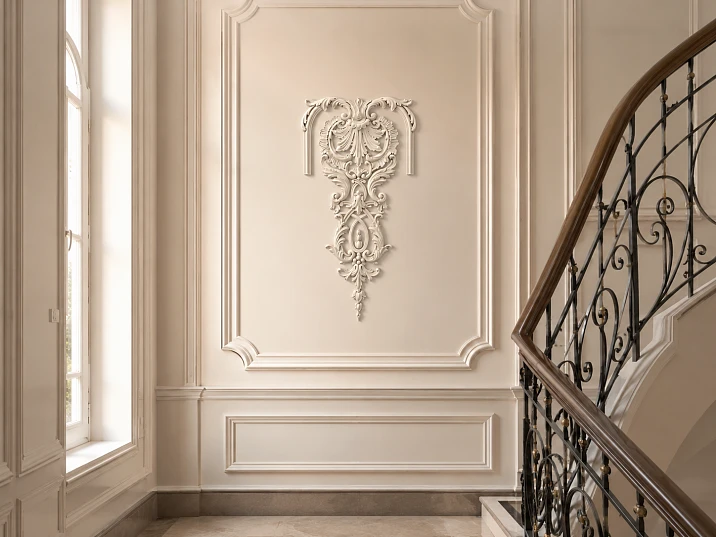
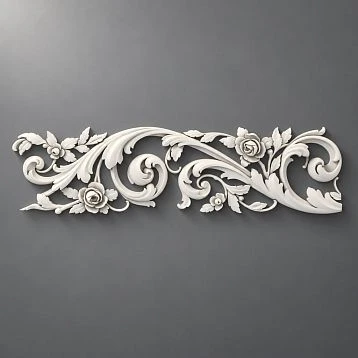
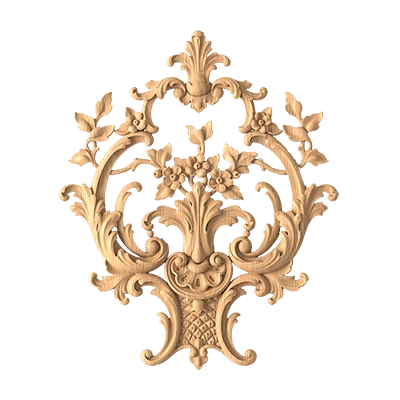
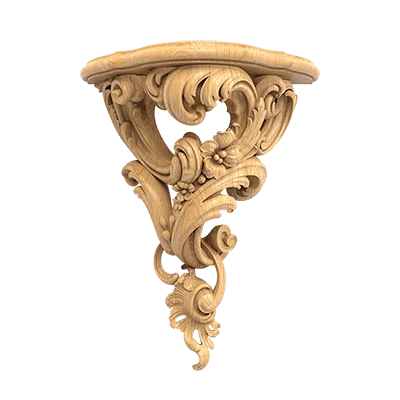
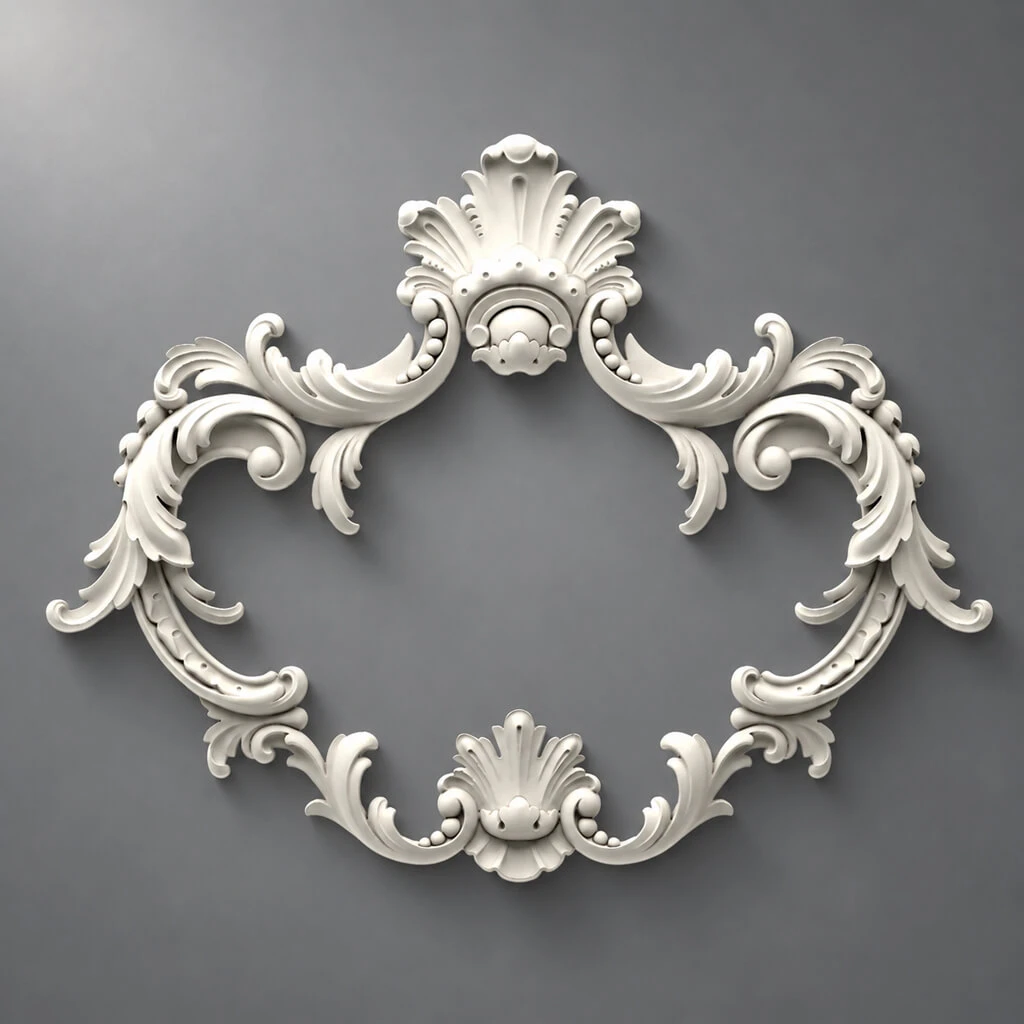
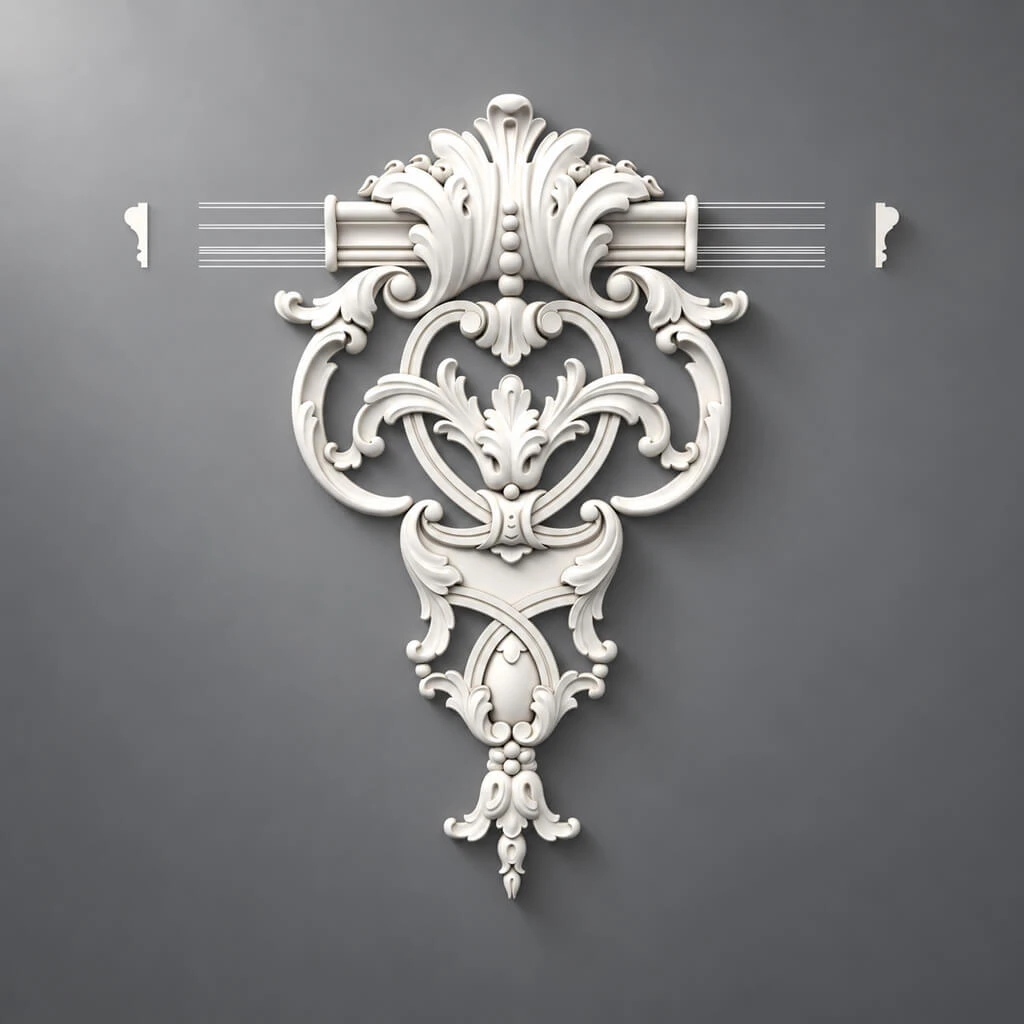
A high wall on a stair landing can be neatly painted, well lit, and still look as if the interior simply ended on it. The reason is clear: a large vertical surface requires an element that reads not only up close, but also from the lower flight, the opposite landing, or the stair hall. A small decorative overlay on such a wall is easily lost, while an overly complex stucco composition may be excessive. Therefore, the buyer's question here is quite specific: which size of the carved polyurethane overlay NPU-383 should be ordered for a high wall — 298 × 642 × 20 mm or 347 × 650 × 22 mm?
For NPU-383, the difference between the two options is arranged unusually. The second overlay is 49 mm wider than the first, but adds only 8 mm in height. The relief increases from 20 to 22 mm. That is, these are not two almost identical parts, one of which is simply slightly larger than the other. The larger option takes up noticeably more wall space in width and works more with volume, although the vertical size practically does not change.
Therefore, the rule "the higher the wall, the larger the overlay" is not sufficient here. You need to measure not the total height of the stair flight, but the free decorative field in which NPU-383 will actually be located. Then — make two templates at a 1:1 scale, look at them from the points where the wall is most often seen, and only after that order NPU-383 in the required size.
There is another important feature of the stairwell space. A person usually perceives an ordinary wall in a room from roughly one level. A stairwell wall — from several. From below, the overlay may seem small and located high up. From the landing — it may turn out to be almost right in front of your eyes. From the upper flight — it may be perceived at a different angle. Therefore, a good choice between 298 × 642 and 347 × 650 mm starts not with a catalog photo, but with the actual geometry of the wall and the route of the person on the stairs.
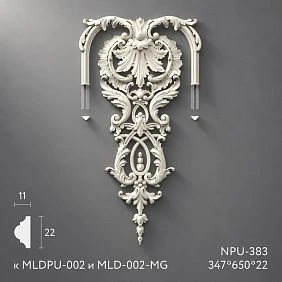
First, a short answer: which size of NPU-383 to choose
If the free field is relatively compact, with moldings, lights, a doorway, or other stucco nearby, 298 × 642 × 20 mm usually leaves more free wall around the ornament and fits more easily into a framed composition.
If the field is wide, the overlay is visible from several meters away, and one decorative element must independently hold a large empty plane, it is worth first trying 347 × 650 × 22 mm.
But you should choose only after checking the dimensions of the field.
The two options have almost the same height:
-
642 mm;
-
650 mm.
The difference is only 8 mm.
But the width differs much more:
-
298 mm;
-
347 mm.
The difference is 49 mm.
In percentage terms, the second option is approximately 16.4% wider than the first. The overall rectangle that the overlay fits into increases by about 18%. This is why, with the same position on the wall, the two sizes feel noticeably different.
| Parameter | NPU-383, smaller option | NPU-383, larger option | What changes for the wall |
|---|---|---|---|
| Size | 298 × 642 × 20 mm | 347 × 650 × 22 mm | The second option is noticeably wider and more prominent |
| Width | 298 мм | 347 мм | Difference of 49 mm |
| Height | 642 мм | 650 мм | The difference is only 8 mm |
| Relief | 20 мм | 22 мм | The larger option is slightly more active in volume |
| Price at time of check | 14 050 ₽ | 15 670 ₽ | The difference is 1,620 ₽ |
| Main Scenario | More free space around the part | Denser wall filling | The choice depends on the scale of the place |
| Material | Polyurethane | Polyurethane | The material is the same |
If your eye catches the word "650 mm" and it seems that the large model is much taller, that's a visual trap. The main increase here happens horizontally.

Why a tall stair wall seems empty even after good finishing
A stair wall has an unusual geometry of perception. It can rise two floors, but a significant part of the surface remains without functional items. There is no sofa, TV, tall cabinet, or group of furniture that would fill the lower field in a regular room. As a result, the eye sees a large plane almost entirely.
The emptiness is especially noticeable if:
-
the stair flight is open;
-
the landing has a high ceiling;
-
the wall is well lit by daylight;
-
railings, doors, steps, or ceiling are already finished nearby;
-
the surface is visible immediately from the hall;
-
there is no window on it.
An ordinary painting or small wall decor sometimes solves the problem, but a classic interior imposes a different requirement. It is not enough to simply occupy the empty space with an object; the wall must be connected to the architecture of the staircase.
This is where a carved polyurethane overlay comes in.
It does not require turning the entire surface into a complex system of stucco panels. A single large ornament can become the focal point if its scale is coordinated with the wall.
That is why choosing NPU-383 is wiser to start not with the question "which one is prettier," but with the question:
what free field actually needs to be designed?
Our factory also produces:
The full height of the wall and the decorative field are not the same thing
Suppose the stair hall has a wall several meters high.
This does not mean that NPU-383 should be centered across the entire height from the floor of the lower level to the ceiling of the upper one.
On the surface there may be:
-
handrail;
-
flight of stairs;
-
a light fixture;
-
a doorway;
-
baseboard;
-
ceiling cornice;
-
molding frame;
-
upper platform;
-
a window;
-
a switch.
All of them visually cut the large surface into separate fields.
Therefore, first they find the very rectangle or conditional zone in which the decorative wall panel should be located.
Only its width and height make sense to compare with 298 × 642 and 347 × 650 mm.
Get Consultation
How to find the boundaries of the real field on the stair landing
Stand at the point from which the wall is most fully visible.
Do not rush to measure.
First, determine where the eye itself perceives the beginning and end of the free zone.
For example, from below, the field may be limited by a handrail.
From above — by a ceiling cornice.
On the left — by a door.
On the right — by the corner of the wall.
Having obtained such a mental rectangle, you can proceed to the roulette.
Measure:
W — the width of the free decorative field;
H — its height.
These two values are much more useful than the full height of the stair wall.
A simple formula that immediately shows the scale of NPU-383
If the overlay should be centered in the field, the free space on the sides can be pre-calculated as follows:
side field = (wall width − overlay width) ÷ 2.
For vertical indents:
top and bottom field = (field height − overlay height) ÷ 2.
This is not a design standard.
This is a tool for comparing two sizes with each other.
Example: free field 900 × 1500 mm
Let's take a wall field with a width of 900 mm and a height of 1500 mm.
NPU-383 298 × 642 mm
By width:
900 − 298 = 602 mm.
When centering:
602 ÷ 2 = 301 mm on each side.
By height:
1500 − 642 = 858 mm.
858 ÷ 2 = 429 mm from top and bottom.
NPU-383 347 × 650 mm
By width:
900 − 347 = 553 mm.
553 ÷ 2 = 276.5 mm.
By height:
1500 − 650 = 850 mm.
850 ÷ 2 = 425 mm.
What happened?
Vertically, the two options are almost identical: the difference in free space is only 4 mm at the top and bottom.
Horizontally, the difference is more noticeable:
301 mm versus 276.5 mm.
That is, the larger NPU-383 makes the composition noticeably denser specifically in width.
Example: field 700 × 1200 mm
Now let's take a narrower section.
For 298 × 642 mm:
700 − 298 = 402 mm;
402 ÷ 2 = 201 mm on each side.
By height:
1200 − 642 = 558 mm;
558 ÷ 2 = 279 mm.
For 347 × 650 mm:
700 − 347 = 353 mm;
353 ÷ 2 = 176.5 mm.
By height:
1200 − 650 = 550 mm;
Here the difference is already more noticeable.
If a molding frame is planned around the overlay, every additional 20–30 mm of free space can be useful.
Example: field 600 × 1000 mm
Smaller option:
600 − 298 = 302 mm;
151 mm on the left and right.
1000 − 642 = 358 mm;
179 mm on the top and bottom.
Larger:
Larger:
600 − 347 = 253 mm;
126.5 mm on each side.
1000 − 650 = 350 mm;
175 mm on top and bottom.
On such a field, the large NPU-383 takes up a significantly more noticeable share of the width.
If there is no frame nearby, this might be exactly the effect needed.
If molding framing is planned, the space becomes much tighter.
It is more convenient to compare two sizes by the free field, rather than by the millimeters themselves.
The buyer looks at:
298 and 347 mm.
The difference seems to be only 49 mm.
But in the composition, it is distributed on both sides.
On a 600 mm field, the smaller overlay leaves 151 mm.
The larger one — 126.5 mm.
This is exactly what the eye sees.
Therefore, before buy carved overlay NPU-383, it is useful to calculate not only the dimensions of the product, but also how much wall will remain around it.
First option NPU-383: 298 × 642 × 20 mm
The size 298 × 642 × 20 mm cannot automatically be called "small."
A height of more than 640 mm is already a large wall ornament.
On an ordinary wall segment, it can become the main decorative element.
The advantage of the 298 mm wide option is that it leaves more calm surface around it.
This is especially useful:
if the NPU-383 fits within the frame;
if other moldings run nearby;
if there is a wall sconce on the wall;
if the field is not very wide;
if the overlay should be perceived as an elegant center rather than dense filling.
On a stair landing, this option often proves successful precisely when viewed up close.
A person climbs the flight, approaches the landing, and sees the ornament from a short distance. Excessive scale is not needed here: the carving itself already creates decorative richness.
Where the 298 × 642 mm option is especially logical
Imagine a pier between two doors.
Free width 650–750 mm.
If you install a 347 mm overlay, it will take up most of the central field.
298 mm will leave more space.
Another scenario is NPU-383 inside a rectangular frame.
The frame has its own profile width.
Internal indents are needed.
The smaller option gives more freedom for this geometry.
Another case is when there is already a light fixture on the stair wall.
The overlay should be positioned below or above.
A large ornament may come too close to the base of the sconce.
298 × 642 mm is easier to separate from the adjacent object.
The second option NPU-383: 347 × 650 × 22 mm
The large model adds almost no height, but becomes significantly wider.
That is why it is worth considering where the free plane looks too large relative to the first size.
347 mm is already almost 35 cm.
On a tall smooth wall, this width helps the ornament not get lost.
The 22 mm relief also slightly increases the volume.
With side lighting, shadows become more noticeable.
This is especially interesting on a staircase, where light often falls from above or from the side.
The large NPU-383 is needed not only for a "very large wall"
A wider option may be the right choice even on a relatively compact field, if the interior requires a dense center.
For example:
inside a very wide molding frame;
above the console on the stair landing;
on the axis between two light fixtures;
on the end wall, which is visible from afar;
in a hall with large architectural details.
The main criterion is the ratio of scale.
Why the difference of 642 and 650 mm hardly matters
It is useful to realize this before purchasing.
If you have determined that a model with a height of 642 mm fits, almost certainly the issue will not be the additional 8 mm of the second size.
The vertical difference is too small to radically change the entire composition.
The choice is determined primarily by:
width of 298 or 347 mm;
relief of 20 or 22 mm;
free space on the sides;
viewing distance;
presence of a frame.
The overall field of the second option is approximately 18% larger
If we compare the rectangles that fit around the two products:
298 × 642 = 191,316 mm²;
347 × 650 = 225,550 mm².
The difference is about 34,234 mm², which is approximately 18% relative to the first dimension.
This is not the area of the ornament itself — the shape of the plate is more complex than a rectangle.
But this figure explains well why the second option is perceived as noticeably more massive, even though the height increased almost imperceptibly.
The price differs less than the scale in width
At the time of checking:
298 × 642 × 20 mm — 14,050 ₽;
347 × 650 × 22 mm — 15,670 ₽.
The difference is 1,620 ₽.
That's about 11.5% of the cost of the smaller option.
But price cannot be used as the main criterion.
If the larger piece fits the wall better, saving 1,620 ₽ won't fix an insufficient scale.
If 298 mm looks more accurate, there's no point in paying extra just to buy the "biggest" one.
A 1:1 paper template solves more than ten visualizations.
Choosing the NPU-383 doesn't require a complex 3D model.
You need two templates.
First:
298 × 642 mm.
Second:
347 × 650 mm.
You can cut them out of thick paper, cardboard, or assemble them from several sheets.
On each one, mark:
central vertical axis;
the central horizontal axis;
Size.
If an image of the NPU-383 silhouette is available, it is useful to roughly transfer its shape.
A simple rectangle is needed primarily to check the overall size. It will visually appear heavier than the actual carved overlay, so a final decision should not be made based solely on the solid rectangle.
First, hang the smaller template and then remove it.
Do not place two templates side by side.
Then the comparison turns into a competition of sizes.
Hang 298 × 642 mm.
Take a look.
Take a photo.
Take it off.
Place 347 × 650 mm in the same spot.
Look again and take a photo.
Only after this, compare the frames.
You need to check from at least three points on the staircase.
The first point is from below, where a person first sees the wall.
The second is directly from the landing.
The third is from the upper flight or from the hall.
If NPU-383 looks good from only one point, the choice is not yet final.
On the staircase, the element constantly changes scale relative to the observer.
Viewing distance changes the choice more than it seems.
At a distance of several meters, small details of the ornament merge into a general silhouette.
Therefore, a wider model may read more confidently.
Up close, the opposite happens: a person sees every relief detail, and an overly large overlay takes up most of the field of view.
Hence the practical rule:
don't measure just the wall — measure the path of the gaze.
A tall wall along the flight and a wall on the landing are different tasks
On the wall along the staircase, a person looks at an angle and while moving.
Decor can be placed above the handrail and accompany the ascent.
The wall directly on the landing is perceived almost frontally.
There, NPU-383 can work as a central wall element.
For frontal placement, symmetry and side margins are especially important.
For the wall along the flight — a connection with the inclined line of the staircase.
Do not align the overlay with the slope of the staircase
NPU-383 itself has its own vertical orientation.
There is no need to tilt it to follow the flight of stairs just because a handrail runs alongside.
If the architectural design does not require otherwise, it is better to align the decorative element with the vertical of the wall.
Otherwise, the ornament starts to look randomly rotated.
The center of the entire wall is not always the correct center for the overlay
Imagine a wall two stories high.
The geometric center is somewhere between the levels of the staircase.
But that is exactly where a flight of stairs or a handrail may pass.
If you mechanically place NPU-383 at the mathematical center of the entire plane, it will be inconveniently positioned relative to a person.
It is better to look for the center of the decorative field that is perceived from the landing.
The landing itself can serve as a reference point.
The landing creates a horizontal architectural level.
If the NPU-383 is on the opposite wall, its position can be linked to this level.
For example, the lower part of the composition starts above the landing line, leaving sufficient free space around it.
The specific offset is determined by the layout, not by a universal number.
If there is a wall sconce on the wall, arrange the lighting first.
A wall sconce is already a decorative object.
It has its own base, light halo, and visual center.
If you place the NPU-383 first and then try to insert a sconce next to it, the elements may conflict.
It is better to apply both dimensions to the wall at the same time.
One sconce above NPU-383
This option can work if a free zone is maintained between the two objects.
Light from above can advantageously emphasize the relief.
But the exact distance should be determined by the dimensions of the specific fixture and the actual light spot.
Two sconces on the sides
Here, the central NPU-383 becomes part of a symmetrical three-part scheme.
In this case, the wider option of 347 mm often needs to be checked first, because two fixtures expand the entire composition.
But if the wall section is narrow, 298 mm will leave more breathing room.
Mount near the window
The window itself creates a strong vertical field.
There is no need to place the NPU-383 too close to the slope just to fill the remaining strip.
Measure the clear space between the window and the corner or door.
It is this width that determines the choice.
Chiaroscuro: the difference between 20 and 22 mm reliefs
Two millimeters do not turn the second model into a completely different type of decor.
But in side light, the deeper option can produce a slightly more pronounced pattern.
This is especially noticeable when:
the wall is monochromatic;
the overlay is painted in the same color;
Lighting runs along the surface.
In this case, the ornament is almost fully readable thanks to shadows.
Painting NPU-383 in the wall color
This is one of the most versatile ways to use large carved decor on a stair landing.
From a distance, the wall looks solid.
As you move along the stairs, the relief begins to show.
This way, you can use a fairly large overlay without turning it into a contrasting panel.
Contrasting NPU-383
If the overlay color noticeably differs from the wall, even the 298 mm option visually becomes larger.
Contrast enhances the boundaries.
Therefore, a buyer planning gold, dark, bronze, or other contrasting finishes should check the template especially carefully.
Color can change the perception of scale as much as a 49 mm difference in width.
One NPU-383 or two: a tall wall allows both scenarios
A large stair wall does not always require a single central element.
Sometimes two overlays work better.
But repeating NPU-383 is not because the wall is large.
The pair must have a compositional reason.
Two overlays one above the other
This can fill a very tall vertical field.
But you need to decide:
where is the center between them;
are the distances from top and bottom the same;
is there a sufficient pause between the elements;
does the wall not turn into a column of two identical motifs.
On a stair flight, two elements can also relate to different levels.
One is perceived from the lower flight.
The other — from the upper landing.
This is already more interesting than mechanical duplication.
Two NPU-383 side by side
This option requires a wide wall.
Consider a field with a width of 1400 mm.
Two smaller overlays:
298 × 2 = 596 mm.
remains:
1400 − 596 = 804 mm.
If we conditionally distribute the free space into three equal intervals — on the left, between elements, and on the right:
804 ÷ 3 = 268 mm.
For two large ones:
347 × 2 = 694 mm.
1400 − 694 = 706 mm.
706 ÷ 3 ≈ 235 mm.
Both schemes look quite free in terms of pure geometry.
But the real choice depends on the ornament, furniture, lighting fixtures, and overall height.
The pair requires almost twice the budget.
If using two identical overlays:
2 × 14,050 = 28,100 ₽ for the smaller model;
2 × 15,670 = 31,340 ₽ for the larger one.
Therefore, it's better to first check whether one element inside a well-designed molding frame solves the task.
When one overlay is stronger than two
If the field has a clear central axis.
If there is already a sconce nearby.
If the stair hall is not very wide.
If the ornament should be perceived as a medallion.
If the wall is additionally divided by moldings.
One NPU-383 leaves more calm surface and often looks more architectural than mechanical repetition.
When two can be justified
If the wall is really very high.
If there are two independent visual levels.
If a symmetrical composition is required on a wide landing.
If one overlay objectively looks lost even in the size of 347 × 650 mm.
Then the second element becomes part of the solution, not a way to "add more decor".
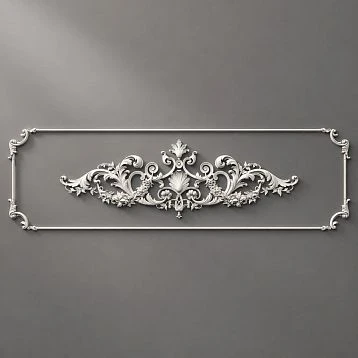
NPU-383 inside a molding frame
This is one of the most understandable ways to decorate a tall wall.
Molding creates geometry.
The overlay is the ornamental center.
If this option seems suitable, you can buy polyurethane moldings after determining the frame dimensions.
The frame changes the choice between 298 and 347 mm
Without a frame, the overlay is surrounded by the entire wall.
In a frame, it gets a much closer boundary.
For example, the free field inside the frame is 700 × 1200 mm.
We have already calculated:
for 298 mm — 201 mm on each side;
for 347 mm — 176.5 mm.
If the molding profile itself is wide and expressive, the smaller NPU-383 can maintain a calmer inner field.
If the frame is very large and thin, the larger option can better fill the center.
Do not design the frame along the exterior wall
First, the size of the inner field is determined.
Then, two NPU-383 are compared.
Only after that is the outer perimeter of the molding selected.
Otherwise, it is easy to get a frame inside which the overlay is cramped.
An overlay without a frame looks freer
On a large solid-color wall, NPU-383 can be used independently.
This is especially convenient if the interior already has strong architecture:
handrails;
cornices;
door trims;
balusters;
stair flight.
Another frame might be redundant.
How to understand whether a frame is needed
Take the first photo of the wall with only the NPU-383 template.
Then use painter's tape to mark the proposed frame.
If without it the overlay seems randomly hanging, the geometric field helps.
If the carved shape itself already confidently holds the wall, a frame is not necessary.
Decor for moldings is a separate category, and this is useful for the project.
NPU-383 is in a product group related to the design of molding systems. Therefore, if one overlay grows into a more complex wall composition, you can buying polyurethane molding decor and look at neighboring elements.
But you don't need to automatically add them to NPU-383.
Each new detail must have a function.
How NPU-383 differs from a regular small decorative overlay
Many polyurethane overlays are designed for furniture, doors, or small wall panels.
NPU-383 has a height of about 650 mm.
This is already a different scale.
It can work as a standalone wall ornament.
Therefore, choosing it for a small door just because you like the pattern would be wrong.
If you need a more compact piece, you should Buy decorative polyurethane overlays and compare products of the appropriate scale.
Decorative overlay or a ready-made wall kit
For a stair hall, you can go two ways.
The first is one NPU-383 and a minimum of other elements.
The second is a ready-made, more complex wall decor system.
If the space is large and requires not just a separate ornament, but full architectural decoration, it makes sense to look at where you can buy wall decor.
The difference in the task is fundamental.
NPU-383 solves a specific point on the wall.
Ready-made wall decor can shape the entire plane.
NPU-383 or a painting
A painting adds an image and color.
A carved overlay works with relief and light.
This is especially noticeable on the stairs.
A painting usually has a pronounced rectangular border.
NPU-383 can be perceived as part of the wall itself.
If the interior is classic and the walls already have stucco details, the overlay often blends with the architecture more naturally.
But in a modern interior, a painting may be more appropriate.
NPU-383 or a mirror
A mirror is functional and visually expands the space.
But on a stair landing, it must have a justified position.
If the reflection is awkward or the mirror hangs too high, there is little practical benefit.
NPU-383 does not require a functional height.
It can be placed where it is best perceived compositionally.
NPU-383 or a molding panel
If the main problem with the wall is a lack of geometry, moldings can solve it without a large central ornament.
If the frame already exists but is empty inside, the NPU-383 becomes a logical next element.
Therefore, the selection order should be as follows:
first, determine the wall structure;
then, whether central decor is needed.
What to buy together with NPU-383
Related products are not always necessary. For a standalone overlay, a well-calculated space is sufficient.
But if the project is evolving, it makes sense to consider several categories nearby.
| What to consider | Why | When this is useful | Link |
|---|---|---|---|
| NPU-383 | Central carved element | Need to decorate a tall empty wall | buy carved overlay NPU-383 |
| Moldings | Create a frame | The overlay lacks a geometric field | buy polyurethane moldings |
| Decor for moldings | Develop a framework system | Need a more saturated composition | buying polyurethane molding decor |
| Decorative overlays | Compare other scales | NPU-383 is too large | Buy decorative polyurethane overlays |
| Decor for Walls | Move from a single element to a system | Need to design the entire wall | buy wall decor |
| General catalog of moldings | Connect the staircase with the rest of the rooms | Several zones of the house are being designed | You can buy ready-made stucco matching the Baroque style. Calculate the quantity: linear meters of cornices and moldings, number of rosettes, pilasters, consoles, corner elements. Add a ten to fifteen percent allowance for trimming. |
The main mistake here is buying everything at once.
First, the NPU-383 in the template.
Then the frame.
Then, if really needed, the adjacent elements.
The height of the stair hall does not mean there should be a lot of decor.
A tall wall provokes filling the entire space.
A desire appears:
two overlays;
three frames;
wall sconce;
cornice;
decorative corners.
As a result, the plane ceases to be a background for the stairs and starts competing with it.
A large wall should have a free field.
It is this that helps the large NPU-383 look significant.
The "one main element" rule is useful to check first
Start with one overlay.
If the smaller one gets lost, try the larger one.
If the larger one still seems lonely, add a frame.
Only if the frame is not enough, consider a second overlay.
Thus, the project becomes more complex sequentially, not all at once.
What a high ceiling changes
Greater height increases the amount of free surface above the element.
Therefore, NPU-383 may seem lower than expected.
But there is no need to raise it to the ceiling just to fill the upper zone.
A person perceives the wall from the level of the stairs.
If the decorative center is placed too high, it stops interacting with the person.
Low ceiling on the landing
Here both NPU-383 options are almost the same in height, so the choice again shifts to width.
With a relatively low ceiling, the larger option may seem denser specifically horizontally.
298 mm leaves more air to the wall.
Narrow stair hall
If the opposite wall is close, NPU-383 is constantly viewed from a short distance.
In such a space, there is no need to choose 347 mm just because it is larger.
The smaller model can be perceived as quite expressive.
Spacious stair hall
If the distance from the opposite point is large, the wider option is worth checking first.
When viewed from a distance, the 298 mm dimension may seem more modest.
But the final decision is still made by the template.
Staircase with large balusters and a massive handrail
The scale of the railing itself is already high.
A too-small wall detail nearby may look random.
347 × 650 mm will more often have enough visual strength for comparison.
But if the overlay is inside a frame, the smaller option gains an advantage again.
Light modern staircase
Glass railing, thin lines, minimal classical decor.
Here, the very necessity of NPU-383 requires verification.
If the carved ornament contrasts too much with the staircase style, it may be better to choose a calmer wall solution.
Expert choice sometimes means not buying the product.
Classic staircase
Carved balusters, expressive handrail, cornices, paneled doors create an environment where NPU-383 looks natural.
Then the choice between the two sizes is determined primarily by the scale of the field.
Neoclassical staircase
Here, the combination of simple molding geometry and one carved center works especially well.
NPU-383 can be placed inside a fairly large frame painted together with the wall.
The smaller variant makes the composition calmer.
The larger one is more solemn.
Staircase landing near the door
The door has its own height and vertical axis.
If the NPU-383 is hanging nearby, it is advisable to check its position relative to the top edge of the trim.
A random offset of 50–100 mm can look worse than significantly different levels.
There is no need to strive to necessarily align the top of the overlay with the door. But the connection should be deliberate.
Long narrow wall of the stair flight
If the surface is not wide, a size of 347 mm can take up too large a share.
Here, 298 mm is often more convenient.
Especially if there is a handrail nearby.
Square wall on the landing
A wide, almost square plane allows for a larger size.
If there is a single decorative element, 347 × 650 mm creates a more confident center.
Wall with a window
The window already occupies a significant part of the field.
NPU-383 is better placed in a separate free zone rather than trying to balance the window with a symmetrical overlay without sufficient space.
Complex wall with multiple levels
If the staircase turns, the same plane can be perceived from two landings.
Then it is useful to take several photos with the template.
Sometimes the ideal position for the lower level looks too low from the upper one.
You need to find a compromise.
Installation at height: design must precede mounting
A high stair wall is inconvenient because fixing a mistake is more difficult than in a regular room.
If after installation it turns out that the overlay is 15 cm below the required level, repositioning will require repeated access to the height and restoration of the wall.
Therefore, the following are especially useful:
full-size template;
photographs;
markup;
checking by several people;
coordination before finishing work.
The method of access and installation at height itself must be safe and match the site conditions. For complex stair geometry, it is reasonable to entrust installation to specialists with suitable equipment.
Do not choose the mounting compound "out of habit"
NPU-383 is made of polyurethane, but the wall base can vary.
Painted plaster.
Putty.
Panel.
Other coating.
Therefore, the specific method of preparation and fixation should be selected based on the surface and recommendations for the product.
Do not invent a universal installation just because another polyurethane part was once attached in a certain way.
Before painting, first determine the final position
If NPU-383 will be painted together with the wall, it's convenient to understand the entire composition in advance.
Where is the center.
Is there a frame.
Will there be sconces.
What size is chosen.
Otherwise, after the final painting, you will have to return to marking and local surface preparation.
The two models have different relief thicknesses — this needs to be taken into account near the frame.
20 and 22 mm seem like close values.
But if the molding has its own projection from the wall, the ratio of reliefs affects which element visually comes forward.
NPU-383 should remain a readable central ornament, not get lost among deeper neighboring profiles.
Therefore, it is better to choose the frame after
Mistake #18: not considering furniture on the site
A console, armchair, sculpture, or tall vase changes the lower part of the field.
Mistake #19: considering NPU-383 universal for any wall
Sometimes a simpler overlay or just moldings work better.
Mistake #20: buying before final marking
First, you need to choose the size.
Only then place the order.
Practical decision tree between two NPU-383
If in doubt, you can go through a short sequence.
Step 1. Is the free field already 700 mm?
First, try 298 × 642 mm.
347 mm may also fit, but the side space noticeably decreases.
Step 2. Is the field wider than 900 mm?
Be sure to compare both.
At this width, the larger option gets enough air and can look more confident.
Step 3. Will there be a molding frame?
You need to count its internal size, not the entire wall.
Step 4. Is the overlay mainly visible from afar?
First, check 347 × 650 mm.
Step 5. Is the main viewing from the platform up close?
298 × 642 mm may turn out to be quite large.
Step 6. Is a contrasting color planned?
Start with the smaller option and compare, because contrast enhances scale.
Step 7. Will the overlay be painted to match the wall?
A larger size may be perceived as calmer than the catalog suggests.
Step 8. Need a pair?
Immediately make two templates of the required size and check the overall composition.
Who is NPU-383 298 × 642 × 20 mm suitable for?
For those who need large but not maximally wide wall decor.
For those planning a frame.
For those with a relatively narrow field.
For those who see the overlay up close.
For those who want to leave more free wall space around.
For those who already have other decorative elements nearby.
Who should first check 347 × 650 × 22 mm
For the owner of a spacious stair hall.
For a wide wall without a frame.
For a distant viewing point.
If one smaller NPU-383 looks lost.
If the ornament should become an independent center.
If the architectural elements of the staircase themselves are large in scale.
When NPU-383 is not needed at all
If the emptiness of the wall is part of a minimalist design.
If there is already a large painting nearby.
If the surface is occupied by a window.
If the molding geometry is sufficient.
If the carved ornament conflicts with the style of the staircase.
If the decor has to be placed too close to the railing, light fixture, or door.
Refusing an unnecessary element is as professional a choice as buying.
How to buy NPU-383 on STAVROS after trying it on
After choosing the size, double-check the product card.
For the smaller option:
298 × 642 × 20 mm.
For the large one:
347 × 650 × 22 mm.
Material — polyurethane.
At the time of writing the article, prices are:
14 050 ₽;
15 670 ₽.
Before ordering, it is better to check the current price directly on the product page.
After final marking, you can order NPU-383 in the required size.
If NPU-383 is too large — don't change the whole idea
In the catalog you can Buy decorative polyurethane overlays and choose a more compact model.
The project's meaning will remain:
a carved center on a high wall.
Only the scale will change.
If one overlay is not enough — don't rush to buy a second one
First, try the frame.
For this, you can buy polyurethane moldings and define a large architectural field.
Sometimes a single NPU-383 inside a correctly calculated rectangle looks much more convincing than two separate elements.
If you need to decorate the entire stair hall
Then one overlay ceases to be the only point of the project.
A system may be needed:
moldings;
wall compositions;
other decorative details.
In this case, it is convenient to first You can buy ready-made stucco matching the Baroque style. Calculate the quantity: linear meters of cornices and moldings, number of rosettes, pilasters, consoles, corner elements. Add a ten to fifteen percent allowance for trimming. after designing all walls together, rather than purchasing elements one card at a time.
Practical scenario No. 1: narrow wall section 650 × 1100 mm
For 298 mm:
650 − 298 = 352;
176 mm of side margin each.
For 347 mm:
650 − 347 = 303;
151.5 mm each.
Both options fit freely in height.
If a frame is needed, the smaller option is preferable to check first.
Scenario #2: wide field 1100 × 1600 mm
298 mm leaves:
(1100 − 298) ÷ 2 = 401 mm.
347 mm:
(1100 − 347) ÷ 2 = 376.5 mm.
Both have a lot of air.
On such a wall, the large NPU-383 can look more confident.
Scenario #3: two sconces side by side
Free width between the inner edges of the fixtures is 800 mm.
The smaller plate leaves:
(800 − 298) ÷ 2 = 251 mm.
The larger one:
(800 − 347) ÷ 2 = 226.5 mm.
Both fit.
Further choice depends on the sizes of the sconces themselves and the light.
Scenario #4: frame 600 × 1000 mm
We have already calculated:
298 mm — 151 mm on each side;
347 mm — 126.5 mm each.
If the molding inside the frame looks visually massive, the second option may seem cramped.
Scenario #5: huge wall without frames
The field is actually very wide.
298 mm looks like a small single piece.
347 mm provides more mass, but it may still not be enough.
Instead of buying two pads, it's useful to first try one 347 mm inside a large frame.
Scenario #6: NPU-383 above the console on the platform
Here, the size needs to be matched not only with the wall, but also with the width of the furniture.
If the console is wide, 298 mm may look too narrow relative to it.
347 mm sometimes connects better with the furniture axis.
If the console is small — the opposite.
Scenario #7: wall opposite the stairs
A person sees it frontally when going up.
This is a convenient position for a central NPU-383.
Strict symmetry can be used.
Scenario No. 8: side wall of the flight
The overlay is seen at an acute angle.
The width is visually reduced.
A larger model may read more confidently, but a real check with the template is mandatory.
Scenario No. 9: the wall is visible from the adjacent living room
Now the main viewing is not from the stairs, but from another room.
It is this far point that should be considered the main one when choosing the scale.
Scenario No. 10: two stair landings
Two NPU-383 units can be used at different levels, but not necessarily on a common vertical line.
Each one can relate to their own platform.
This sometimes looks more natural than a pair mechanically centered on a two-story wall.
FAQ: choosing the carved overlay NPU-383 for a tall wall
Which size of NPU-383 is smaller?
The smaller option is 298 × 642 × 20 mm.
Which size is larger?
The large one is 347 × 650 × 22 mm.
How much wider is the large model?
By 49 mm.
How much taller is it?
Only by 8 mm.
Why do the two options look noticeably different then?
Because the main increase is in width, and the overall field of the second option is about 18% larger.
How does the relief differ?
20 mm for the smaller model and 22 mm for the larger one.
Which size is better for a tall wall?
Wall height alone is not enough to answer. You need to measure the free field and compare the two templates 1:1.
If the wall is very tall, is it mandatory to take 347 mm?
No. If the field is narrow or the overlay is in a frame, 298 mm may be more proportional.
How can you tell that 298 mm is too small?
Hang the template and look from the main distance. If the ornament visually gets lost, compare 347 mm in the same position.
How to make a template?
Cut out a piece measuring 298 × 642 mm and a second one measuring 347 × 650 mm from paper or cardboard.
Can I just use a simple rectangle?
For checking the overall size — yes. For a final decision, it's useful to consider that a real carved shape is lighter than a solid rectangle.
Where should I look at the template?
From the bottom of the stairs, directly from the landing, and from the upper level.
Which size is better for a molding frame?
Often it's easier to fit 298 mm, because it leaves more inner margin. But the final decision depends on the frame size.
Can the NPU-383 be placed in a molding frame?
Yes, if such a layout suits the wall. For this, you can buy polyurethane moldings.
Is a frame mandatory?
No. The NPU-383 can be used as a standalone wall element.
Can two NPU-383 units be installed?
Yes, if the wall truly requires a paired or multi-level composition.
How to choose the size for a pair?
Make two full-size templates at once and check the entire group, not just one piece.
Can two different sizes be used together?
Technically, these are two versions of the same item, but an asymmetrical combination requires separate design justification. For a standard paired layout, identical sizes are more logical.
How much does the smaller NPU-383 cost?
As of the check, it is 14,050 ₽.
How much does the larger one cost?
At the time of checking — 15,670 RUB.
What is the price difference?
1 620 ₽.
Is it worth buying the large one just because of a small price difference?
No. The size should match the wall.
Can NPU-383 be painted to match the wall color?
This option works well for architectural wall decor: the pattern is read through the relief.
What happens with contrasting painting?
The overlay will visually become more noticeable and larger, so the size needs to be checked especially carefully with a template.
Where is the relief especially well visible?
With side lighting or lighting directed along the wall.
Should wall sconces be considered?
Yes. The base of the lamp, its light spot, and the overlay should not accidentally compete.
What to do if the NPU-383 is too large?
You can Buy decorative polyurethane overlays and choose a different scale.
What to do if one NPU-383 is too small?
First compare the larger option, then try a molding frame, and only after that decide on a second overlay.
Where can I see other wall decor?
You can buy wall decor and compare a single overlay with ready-made wall compositions.
Is the NPU-383 only suitable for a staircase?
No. In the scenario in question, it is used on a stair wall, but the decorative element itself can also be used in other interior compositions if dimensions and purpose match.
Should the NPU-383 be centered along the entire height of the stair wall?
No. It's better to determine the center of the specific decorative field that a person actually perceives from the landing or flight.
What is more important: the total height of the wall or the width of the free field?
For choosing between two NPU-383 units, the field width is especially important because the options themselves are nearly identical in height.
How to calculate the side offset?
Subtract the width of the overlay from the width of the free field and divide the result by two.
Can the NPU-383 be installed next to a door?
Yes, if the free field allows it and the overlay does not look squeezed between the trim and the corner.
How to determine the installation height next to the door?
Make a template and align it with the top line of the trim, the landing, and other horizontal levels of the wall.
Can a plate be installed above the handrail?
Yes, if there is enough free space and such a position is well perceived from the main points of the staircase.
Should it be oriented according to the slope of the handrail?
No, you should not tilt the plate automatically following the stair flight.
What to do on a wall with a window?
First, determine a separate free space between the window and adjacent boundaries.
Will 347 × 650 mm fit for a narrow wall?
It may fit, but it is necessary to calculate the side margins. On a narrow field of 298 mm, it usually leaves more air.
Which option is better visible from a distance?
All else being equal, the wider 347-millimeter option has a larger silhouette, but actual readability needs to be checked at a specific distance.
What is better for close viewing?
Often 298 × 642 mm already looks quite large, especially if the ornament is at the platform level.
Can I buy NPU-383 as a single piece?
The card allows you to select a specific product variant from a single piece.
What should be checked right before ordering?
SKU, selected size, price, material, quantity, and dimensions of the free space on the wall.
Where to order NPU-383?
After fitting, you can order NPU-383 in the required size.
Should I choose the size or color first?
First the size and position. Then the final finish, because contrast additionally changes the perception of scale.
Should moldings be purchased at the same time?
Only if the frame composition is already designed. Don't buy them "just in case."
Where can I see the general catalog of stucco molding?
If more than one wall is being decorated, it is possible You can buy ready-made stucco matching the Baroque style. Calculate the quantity: linear meters of cornices and moldings, number of rosettes, pilasters, consoles, corner elements. Add a ten to fifteen percent allowance for trimming. after developing the overall decor system.
How to make a decision without guessing: the final selection scheme for NPU-383
NPU-383 has a favorable situation for a conscious purchase: the buyer doesn't choose between dozens of nearly identical items. There is one specific carved polyurethane overlay and two sizes:
298 × 642 × 20 mm;
347 × 650 × 22 mm.
The difference in height is minimal — 8 mm.
The main change occurs in width — 49 mm — and it should determine most of the decision.
If the free field is compact, with a frame, lights, doors, or other elements nearby, first check 298 × 642 mm.
If the wall is wide, empty, and the overlay is perceived mainly from a large distance, be sure to try 347 × 650 mm.
But none of these recommendations replaces a template.
The correct sequence is simple.
First, find not the entire stair wall, but a specific free area.
Measure its width and height.
Calculate how much space will remain around each NPU-383.
Make two full-size templates.
Show each one in turn in the same place.
Look from below, from the landing, and from above.
Only after this decide whether a frame, a second element, or additional wall decor is needed.
If one overlay solves the task, do not complicate the wall.
If the size is chosen, you can buy carved overlay NPU-383 exactly in the required version, rather than automatically ordering a larger one just because the stair hall is tall.
If even 347 × 650 mm looks lost, the next step is smarter to check a larger molding frame or a full Wall Decor, rather than simply multiplying one ornament.
STAVROS company allows you to assemble this stair composition from the central overlay to a system of moldings and other polyurethane elements. But a strong interior starts not with the amount of purchased stucco. It starts with precise scale. For NPU-383, this means a specific choice between 298 and 347 mm in width, tested on a real wall, in real lighting, and from the distance from which a person will actually see the decor every day.