

























Article Contents:
- Carved frame RM-014: what is confirmed and what needs to be agreed upon
- Checking the wall section: how much space will actually remain
- Why you cannot order a mirror sized 921 × 1715 mm
- How to get a DWG template and provide it to the glass workshop
- Buy a mirror in a wooden frame or order the frame separately
- Beech, oak, "Standard" and "Prestige": four solutions, not one
- Price of RM-014 and budget for a finished mirror
- Full-size fitting: doors, console, and useful reflection
- Lighting and Finishing: What to Decide Before Drilling the Wall
- Mounting the Frame with Mirror: Hinges Do Not Replace the Suspension Design
- Order Lead Time and Delivery: How Not to Delay the Salon Opening
- What to Compare RM-014 With If Project Conditions Have Changed
- Order Request for RM-014: Text You Can Send to the Seller
- Receiving the Frame and Handing It Over for Finishing
- Mistakes that cause the order to be redone
- When to Order RM-014 and When to Choose Another Solution
- Frequently Asked Questions Before Buying a Frame for a Salon
- Can an Existing Mirror Be Installed in RM-014?
- Can RM-014 Be Reduced by a Few Centimeters?
- What to do if the mirror workshop does not open DWG?
- Can a thicker mirror be installed instead of a 5 mm one?
- Can I order two identical frames for adjacent piers at once?
- Can RM-014 be used as a floor mirror, leaning it against the wall?
- Can lighting be added behind the frame after purchase?
- Is the frame suitable for a hair washing area?
- Can painting be ordered directly from STAVROS?
- Which documents should be kept after completing the order?
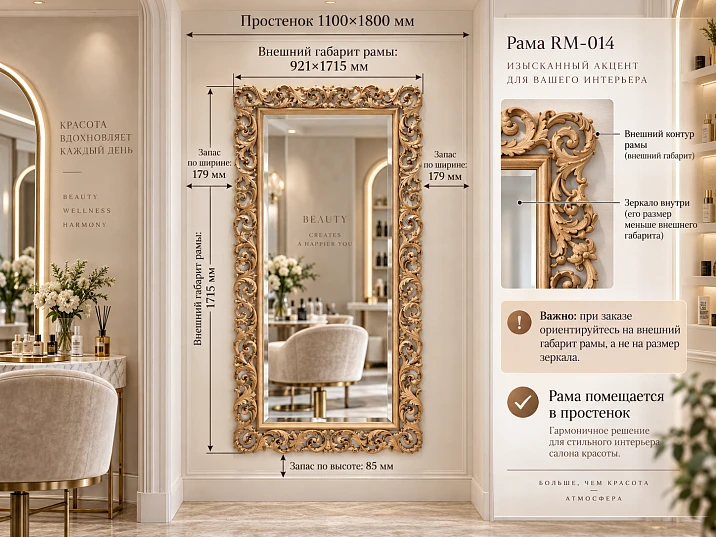
Between the door portals in a beauty salon, there is a field 1100 mm wide and 1800 mm high. For it, the carved frame RM-014 was chosen: an elongated composition that should work as a mirror in the waiting area. When placing the sides 921 mm horizontally and 1715 mm vertically, the outer contour fits: after centering, 89.5 mm remains on the sides and 42.5 mm on the top and bottom. But this is not yet permission to order the mirror or schedule installation.
Before payment, two different issues need to be resolved. The first is to confirm from the drawing exactly this orientation of the frame and its hangers. The second is to obtain a separate specification for the mirror glass. The size 921 × 1715 mm in the considered scheme refers to the outer contour of the product, not to the glass, which is installed on the back side.
Below is a design scenario, not a completed object: how to check the wall pier, choose the material and finish, coordinate the set, calculate the budget, and provide the glass workshop with the correct data. All additional numerical examples are explicitly marked as conditional.
Carved frame RM-014: what is confirmed and what needs to be coordinated
In the STAVROS card, verified on September 5, 2026, two dimensional versions of RM-014 are specified:
| Version according to table A × B × C × D | Materials | Sanding | Value for the project under consideration |
|---|---|---|---|
| 921 × 1715 × 32 × 141 mm | Beech, oak | "Standard", "Prestige" | Checking placement with the short side across the width of the wall pier |
| 1200 × 1240 × 31 × 141 mm | Beech, oak | "Standard", "Prestige" | Both main sides are larger than the field width of 1100 mm |
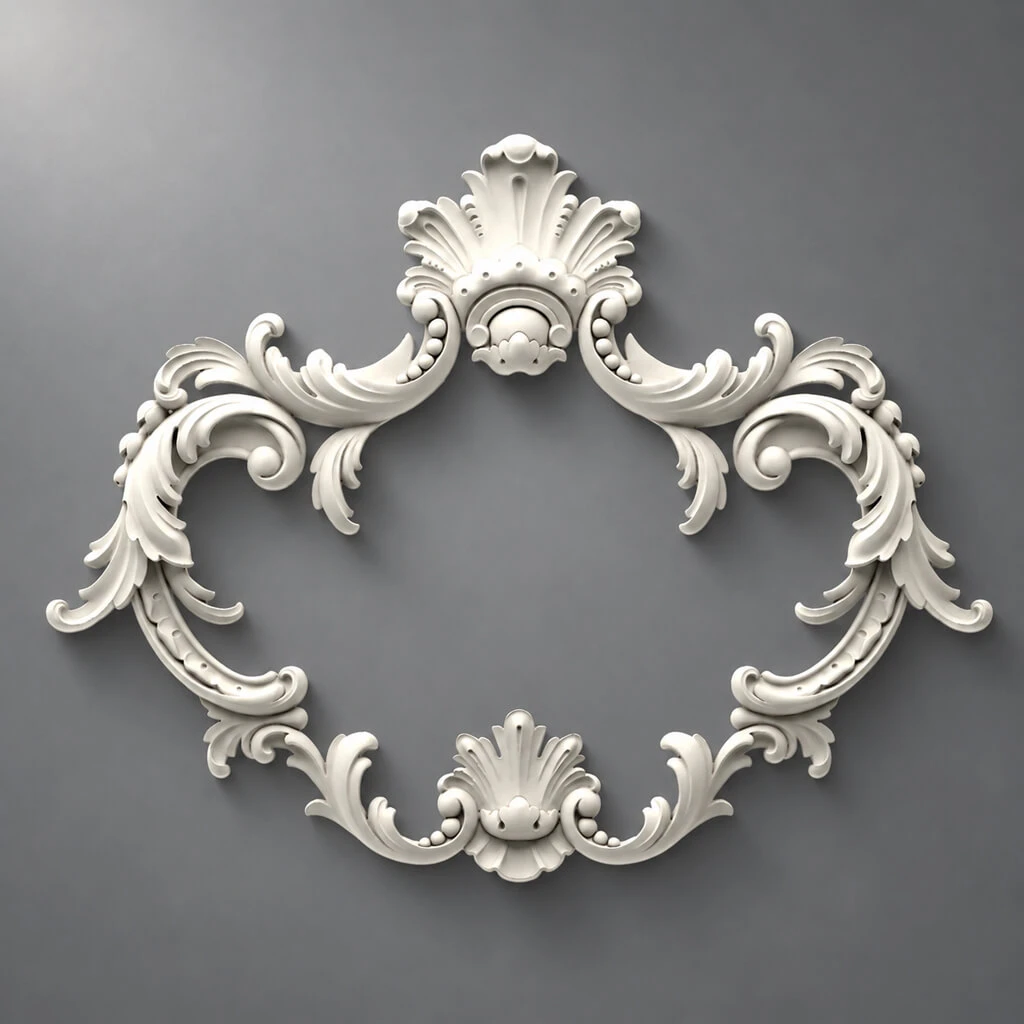
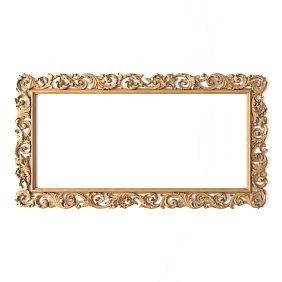
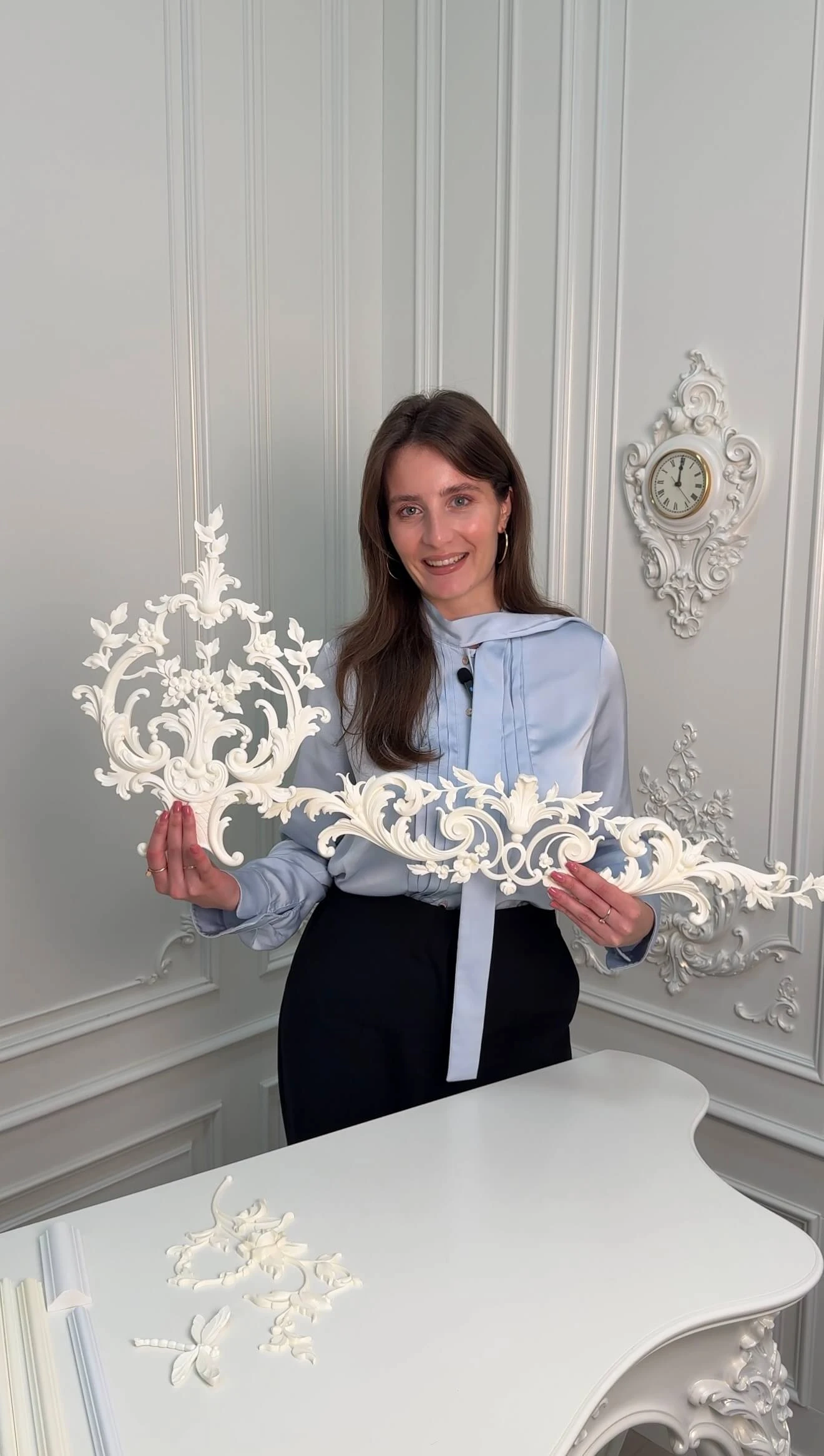
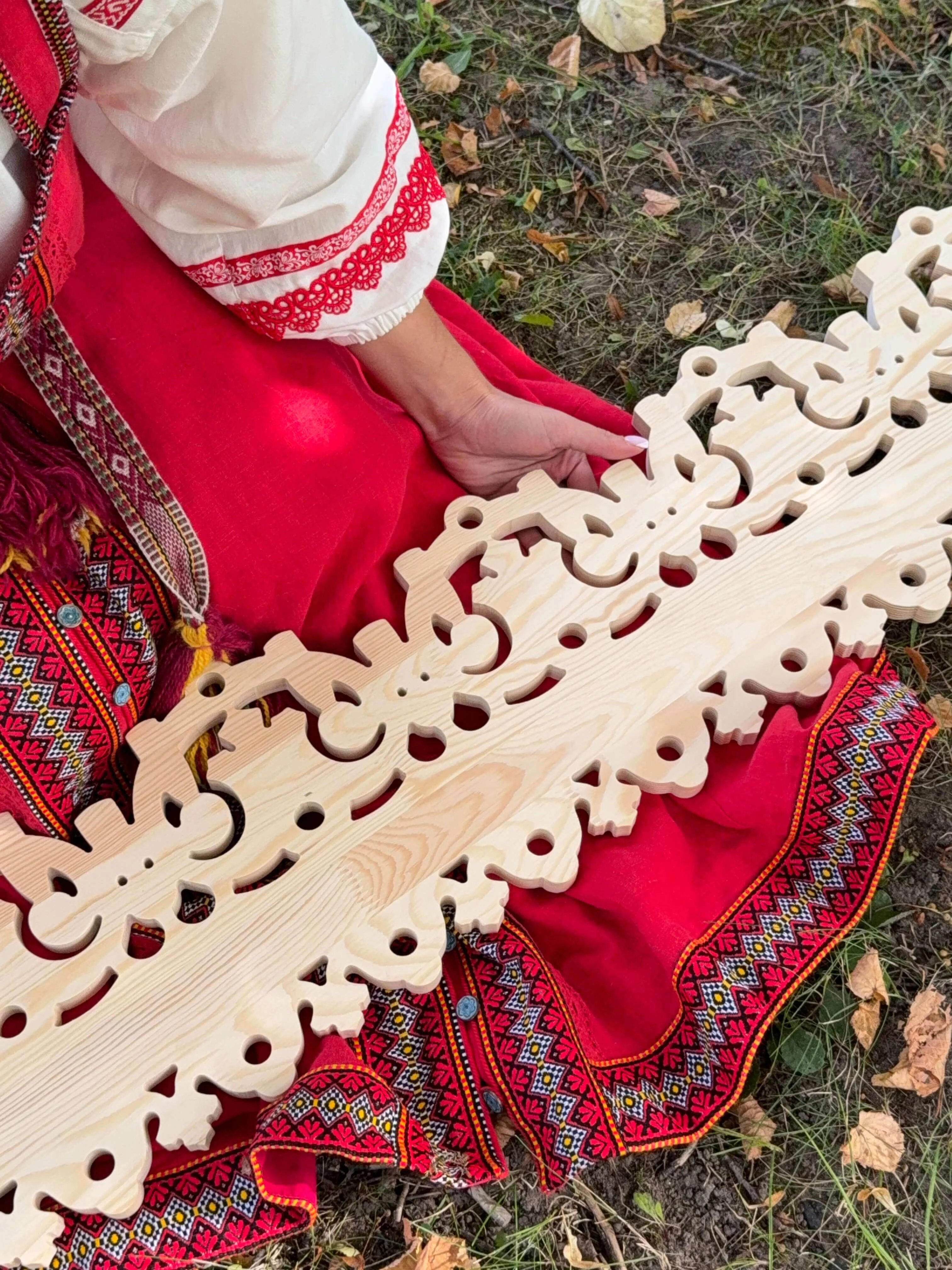
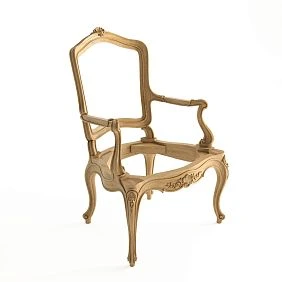
The manufacturer describes the model as a wooden frame with a plant ornament in the Baroque style. For our project, what matters more is not the stylistic name, but what contour will be on the wall and where the hanging points are provided.
There is an ambiguity in the site's notation. The card shows the sequence A × B × C × D, but in the section filter, A is labeled as height and B as width. Therefore, based on the four numbers alone, it cannot be claimed that the factory orientation of the 921 × 1715 mm version already matches the vertical installation from this project. In the request, it must be stated in words: "The wall requires a width of 921 mm and a height of 1715 mm; please confirm the position of the ornament and the possibility of standard hanging."
If the working drawing specifies a width of 1715 mm and a height of 921 mm, the product in that position exceeds the width of the wall section by 615 mm. It can only be rotated after confirming the permissible orientation and mounting. The decorative frame cannot be considered automatically universal in terms of hanging direction.
The 1200 × 1240 mm format does not solve the problem by changing orientation: even the smaller side exceeds the available width by 100 mm. It is suitable for a different wall area, not for saving a few centimeters in the existing one.
Checking the wall section: how much space will actually remain
The dimensions of 1100 × 1800 mm should describe the free area after finishing. This is not the width between structural openings or the height from the subfloor. If trim, cornices, or furniture extend into the selected rectangle, the space for the frame is already smaller.
Measure the width at the bottom, middle, and top, and the height at both edges and along the intended axis of the mirror. Separately mark protruding elements on the elevation. With uneven boundaries, the position of the entire contour is checked: a single minimum measurement does not indicate at what height the obstacle is located.
For the agreed orientation of 921 mm in width and 1715 mm in height, the calculation is as follows:
| Direction | Field size | Frame size in the design position | Total remainder | Indent when centering |
|---|---|---|---|---|
| Horizontally | 1100 мм | 921 мм | 179 мм | 89.5 mm left and right |
| vertically | 1800 мм | 1715 мм | 85 мм | 42.5 mm top and bottom |
These are geometric margins, not manufacturer-recommended mounting clearances. The calculation cannot conclude that there is necessarily enough space above the frame for hanging, backlight maintenance, or product removal.
Suppose the hanger chosen by the installer requires a lift of 50 mm before lowering onto the mounts. This is a hypothetical example, not a characteristic of RM-014. With a top margin of 42.5 mm, the lift cannot be performed: 7.5 mm is missing. Shifting the frame down by 15 mm increases the top margin to 57.5 mm but reduces the bottom to 27.5 mm. After such a change, the bottom edge, furniture, and access to the mount must be rechecked. Additional working clearance is determined by the installer, not by this arithmetic.
A similar situation arises with the console axis. If the frame is shifted 20 mm to the right relative to the center of the wall segment, 109.5 mm remains on the left and 69.5 mm on the right. The composition may become more convincing, but the door on the right will be closer. The elevation view requires actual coordinates, not a note saying "approximately centered."
Our factory also produces:
Why a mirror sized 921 × 1715 mm cannot be ordered
A mirror in a frame has several different contours. The outer one determines the product's position on the wall. The light opening is the visible part of the reflective surface. The mounting zone on the back side defines the space where the panel is secured. Finally, the size of the glass itself accounts for the approved mounting design and technological gaps.
These dimensions cannot be substituted for one another. The panel may extend behind the front part of the framing, so its contour does not match the visible opening. But the outer frame size also does not provide a ready answer: between the outer edge of the thread and the glass edge lies a profile of variable shape.
Particularly dangerous is the attempt to subtract 141 mm from both sides. Such arithmetic would yield 639 × 1433 mm, but this is not the mirror size for RM-014. In the table, 141 mm is denoted by the letter D; without a working drawing, it cannot be considered a constant width of the profile covering the glass along the entire perimeter. Similarly, 32 mm should not be declared as the depth of the rebate.
A technically correct order to a glazier begins with a separate outline of the panel. It must specify units of measurement, thickness, tolerances, edge processing, and installation requirements. If the opening is shaped, a single pair of "width × height" is insufficient: an accurate shape template is needed.
Do not send dimensions taken independently from a photograph to production. Perspective, image scale, and protruding threads do not allow for reliable seating geometry. Even a successful match of two extreme dimensions does not confirm intermediate sections of the contour.
Get Consultation
How to obtain a DWG template and submit it to a glass workshop
On the frame section page, the manufacturer indicates an electronic DWG template for cutting the mirror among the standard package items. Therefore, the first question to the seller should be specific: is the file provided for the selected RM-014 configuration, when can it be obtained, and what exactly is shown in the file.
Ask to specify the article number, size variant, and purpose of each contour. The external framing diagram, decorative 3D model, and glass contour are different documents. The presence of a "Product Drawings" link does not in itself confirm that the buyer has already received a task suitable for cutting.
Before transferring the file, agree with the glazier whether it contains a ready cutting size or only a seating contour to which gaps still need to be applied. Otherwise, double adjustment is possible: the manufacturer has already reduced the panel size, and the workshop additionally subtracted its own allowance. As a result, the glass will be smaller than intended.
For verification, ask the workshop to generate a readable control sheet from the DWG. It must include the file number, overall dimensions, mirror thickness, designation of the front side, and the date of approval. This is not a replacement for the original drawing, but a way to ensure that all order participants understand the task identically.
Two working routes are possible. The first is manufacturing according to the official template, if the manufacturer and assembler confirm its applicability and tolerances. The second is a control measurement of the received frame before cutting the glass. The second route adds a step but allows checking the actual fit. The choice is fixed in advance; simultaneous readiness of the frame and mirror cannot be promised when the glazier will start only after receiving it.
Assign one person responsible for the final approval of the panel size. This could be the manufacturer, the workshop, or the assembler who accepted the frame for measurement. Clear confirmation must remain in the correspondence: which file was approved and based on what data the cutting was performed.
Buy a mirror in a wooden frame or order the frame separately
A buyer who wants to purchase a mirror in a wooden frame for a salon usually envisions a finished product: it will be delivered, lifted, and hung. Card RM-014 refers to the frame. Therefore, the order composition should be aligned with the desired outcome, rather than assuming all work is included by default.
In the section where you can buy a wooden mirror frame, a standard composition has been published: a frame with a seat for a 5 mm thick mirror, a 6 mm thick MDF backing, screwed-in hanging hinges, and an electronic DWG template. The mirror glass itself is not listed in this set.
These are general category conditions, not an individual specification for RM-014. They should be confirmed for the selected size and orientation. In particular, the presence of hinges does not answer whether their position is designed for the vertical composition of our project, and the 5 mm thickness does not replace agreeing on the glass dimensions.
In writing, separate the set into product supply and services. What does STAVROS provide? Who orders the glass? Who performs finishing, assembly, and hanging? Who checks that the template matches the frame? Which details are already included in the price, and which are paid for separately?
Such a separation also protects against unnecessary expenses. If the backing and hinges are part of the confirmed configuration, they do not need to be included again in the estimate of a third-party workshop. However, wall anchors cannot be considered included just because the frame has hinges: these are different parts of the mounting.
It is convenient to compare offers based on the final result—a finished, trimmed, and installed mirror. The price of one wooden frame and the price of an assembled mirror with installation do not show the difference in value until the scope of work is brought to a common form.
Beech, oak, "Standard," and "Prestige": four solutions, not one
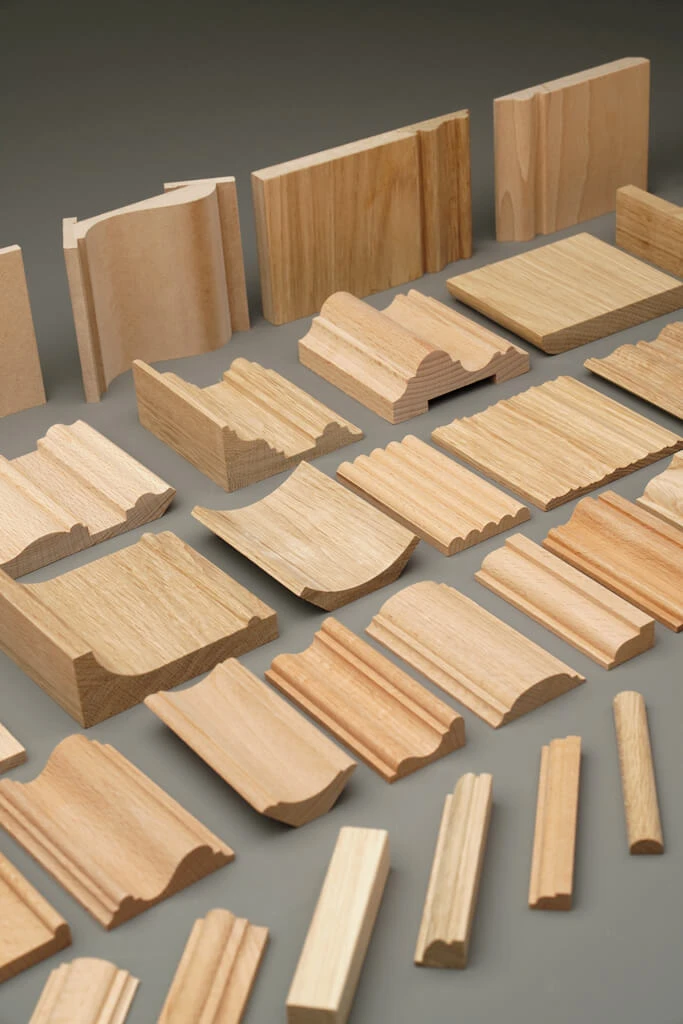
When purchasing a frame, you need to independently select the wood species, lamination quality, sanding, and future finishing. The word "oak" does not mean a clear coating, and "Prestige" does not mean the product is already painted.
In STAVROS reference information, beech is primarily considered a material for enamel, while oak is wood with a pronounced texture that is often preserved with a translucent finish. For a salon, this is a convenient starting point: a beech frame can be considered for a solid brand color, and an oak frame when the wood grain is part of the project.
But the selected wood species does not replace the grade of lamella matching. In the open product card RM-014, the option "Under enamel" is shown. For such a blank, lamellas are not matched for color and texture consistency. Under a transparent coating, differences may remain visible. The availability of a finish suitable specifically for tinting must be confirmed separately; it cannot be promised for any combination of size and material.
Before approving the finish, it is useful to check the quality of the wooden frame according to the manufacturer's description. "Standard" includes machine sanding; "Prestige" also provides detailed hand processing. For a carved profile, this difference is significant: complex areas are harder to prepare than a flat surface.
Compare not only the surcharge for the category, but also the estimates from the painting workshop. Ask to evaluate both versions for the same result — the same color, gloss level, and surface quality. If the finisher does not account for the initial preparation, the advantage of a more thoroughly sanded product may not be reflected in the proposal at all.
"Prestige" does not exempt from acceptance and compliance with coating technology. Even a well-prepared frame needs to be checked before finishing, and technological operations should be assigned based on the selected materials. You should not automatically pay for a full re-sanding, but demanding a finish without inspecting the surface would also be incorrect.
For the final choice, a stain sample agreed upon under showroom lighting is needed. It should show not only the color, but also the gloss, depth of tinting, visibility of lamella joints, and the behavior of the coating in the recesses of the ornament. A sample from a different wood species or with a different grade of lamella matching does not confirm the result on the ordered frame.
Price of RM-014 and budget of the finished mirror
In the open product table dated September 5, 2026, for the version 921 × 1715 × 32 × 141 mm, the following prices are indicated:
| Material and sanding | Frame price | Difference relative to the "Standard" beech |
|---|---|---|
| Beech, "Standard" | 108 640 ₽ | Base comparison option |
| Beech, "Prestige" | 130 830 ₽ | +22 190 ₽ |
| Oak, "Standard" | 144 760 ₽ | +36 120 ₽ |
| Oak, "Prestige" | 166 950 ₽ | +58 310 ₽ |
The surcharge for switching from "Standard" to "Prestige" is 22,190 ₽ for both beech and oak. This allows you to request a clear comparison from the finisher: what difference in preparatory work the higher category will provide for a specific coating.
Do not use the minimum price RM-014 from the general catalog output for this option. The value of 102,890 ₽ refers to a different size — 1200 × 1240 × 31 × 141 mm made of beech in "Standard". It is not the starting price of the elongated frame in question.
Current options can be checked before you buy the carved frame RM-014The price in the article is fixed as of the verification date; the final invoice must include the selected format, material, sanding, and confirmed configuration.
It is convenient to assemble the full budget using the following scheme:
Cost of installed mirror = frame + missing components + mirror panel + finishing + assembly + wall mounting + delivery and lifting + installation.
The "missing components" line includes only what is truly not included in the delivery. The cost of glass is requested after confirming its contour and thickness; the cost of the hanger is requested after determining the total weight and the wall. Protective solutions for the panel, edge treatment, and additional operations must be specified, not hidden in the phrase "standard mirror".
Without this initial data, it is impossible to honestly name the price of a finished set. At the same time, the uncertainty of the estimate can be reduced even before payment: provide contractors with one agreed specification and receive proposals for the same scope of work.
Full-size fitting: doors, console, and useful reflection
First, mark the design rectangle 921 × 1715 mm on the wall. For this, removable marking or a paper template is suitable, if the method of temporary attachment is safe for the finish. It shows the maximum external dimension but does not reproduce the carved contour. The exact shape of the ornament is transferred only from an appropriate drawing.
Check the doors in real movement. A collision may occur not with the leaf, but with the handle, door closer, or protruding casing. Open the door to the actual stop and consider that the frame will protrude from the wall plane. A front view alone is not enough for such a check.
Then evaluate the composition together with the furniture. If there is a console under the mirror, access to its tabletop and outlets is needed. If an waiting chair is nearby, the visitor should not touch the relief with a shoulder or bag. Do not assign an arbitrary "safe gap" based on a photo: check the actual trajectory of a person and the protrusion of the assembled product.
Separately evaluate the useful reflection. The height of the outer contour of 1715 mm does not guarantee that a visitor will see themselves full-length or that the mirror will suit a craftsman for work. The result depends on the light opening, installation mark, position of the person, and furniture in front of the wall.
For the waiting area, check the view from the chairs and from the entrance. For a workspace, check the client's position in the chair and the view needed by the specialist. Until the internal opening is confirmed, the model cannot be sold as guaranteed suitable for both scenarios. A mirror that is successful in a decorative composition may turn out to be inconvenient for a specific work operation.
Record the agreed position on the elevation: coordinates of extreme points, axis, mark from the finished floor, and zones where fasteners should not fall. Such a diagram is more useful than several photos without dimensions.
Lighting and finishing: what to decide before drilling the wall
Lighting fixtures need to be placed simultaneously with the frame, not in the gaps left after installation. With a top field of 42.5 mm, one cannot count in advance on free space for the backlight housing, cable outlet, and service access. The side fields are also limited, especially after shifting the composition relative to the center.
On the general layout, show the dimensions of the luminaires, cable outlets, positions of power supplies, and areas required for equipment replacement. The electrician and the mirror installer must use one agreed-upon version. Otherwise, the sconce outlet may end up at the mounting point or behind an inaccessible section of the frame.
It is better to evaluate lighting on a mockup or temporary fitting with real equipment. Check what falls into the reflection from the waiting area: a bright lamp, a service door, a rack with consumables, or a passage. Sometimes the desired effect is achieved by changing the position of the luminaire, not by moving the entire frame with the loss of side clearance.
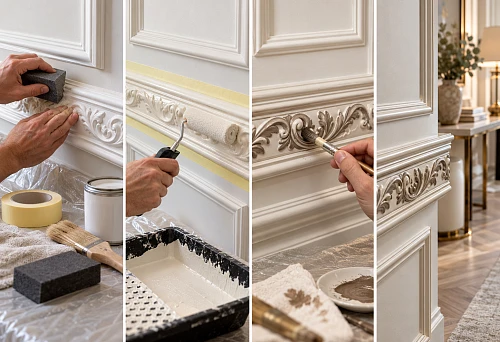
Regarding finishing, the manufacturer publishes a general sequence of preparation, priming, and coating application. You can study tips on finishing and mirror installation, considering the boundaries of this page: it is primarily dedicated to decor and its finishing, not to calculating the load-bearing suspension of a large mirror assembly. Recommendations for gluing decorative parts cannot be automatically transferred to RM-014 with a mirror.
In the order to the painting workshop, specify which surfaces are being finished and which mounting areas must retain working geometry. Do not assign the coating system and drying modes based on a general description: they depend on the selected paint and varnish materials. Assembly with glass and packaging should be planned after the coating is ready for the corresponding operations, not just after the stickiness disappears from the surface.
Mounting the frame with mirror: hinges do not replace the suspension design
Hinges on the frame and fasteners in the wall perform different tasks. The former are part of the product; the latter must correspond to the base, total mass, and load transfer scheme. Even confirmed presence of hinges does not mean that any set of dowels from the store will fit them.
Before choosing fasteners, request the mass of the frame, mirror parameters, mass of the backing, and additional parts. The entire assembled set is included in the calculation. The mass of the RM-014 itself is not given in the available table, so in this project the number of anchors or allowable load cannot be assigned without additional data.
The installer needs to know the wall material, cladding thickness, and position of the load-bearing base. The finishing surface does not always coincide with the base to which the product can be attached. For a partition with a hidden frame, it is necessary to check the possibility of transferring load to suitable elements, rather than considering any point of the sheet cladding as equivalent.
The method of fixing the canvas itself within the frame is also agreed upon. The mirror, backing, and hardware must be assembled according to the intended design; a random combination of clamps and glue does not replace the technical solution. The compatibility of materials with the mirror coating is confirmed by the manufacturer of the respective materials or a specialized workshop.
Check the possibility not only to hang but also to remove the set. The upper boundary of the field may be a purely compositional line, or it may turn out to be a physical obstacle—a cornice, ceiling, or furniture. In the first case, exceeding it during installation is sometimes acceptable; in the second, it is not. These situations cannot be combined into one value of "42.5 mm from the top."
Before drilling, the routes of hidden utilities are agreed upon. After installation, the position, fixation, and absence of movement of the canvas in its seat are checked. Testing the mounting independently with additional weight or jerks should not be done: acceptance is carried out according to the installer's decision and the requirements of the applied system.
Order lead time and delivery: how not to delay the salon's opening
In the RM-014 card for the considered configurations, the lead time is stated as 5 to 10 days; in the manufacturer's notes, the average production time for custom orders is stated as 5–10 working days. The specific readiness date must be agreed upon in the order. It is not equal to the date the installed mirror appears in the salon.
After manufacturing, delivery of the frame, control measurement, mirror cutting, finishing, coating drying, assembly, and installation may be required. Some stages allow parallel execution, while others depend on previous ones. For example, the canvas based on actual measurements cannot be manufactured before the frame is received, and installation cannot be finally scheduled until the readiness of the assembled set is confirmed.
Create a schedule backward from the opening date. For each contractor, clarify what is considered the start of the lead time: receipt of payment, issuance of the drawing, receipt of the frame, or approval of the color sample. Separately, allocate time for addressing comments during acceptance. This is a project reserve, not a promise of expedited manufacturing from the seller.
Before payment, it is useful to check the payment and delivery of the carved frame. To calculate transportation, provide the address, floor, elevator availability, and unloading conditions. The packaging dimensions are requested separately: the size of the wooden product does not indicate whether the protected cargo will fit through the entrance door.
Check the entire route: vestibule, stair landing, elevator, corridor turn, and the last door before the partition wall. On a difficult section, the carrier needs dimensions and photos, not a verbal "furniture was brought in here." The method of transfer must match the packaging and construction; a carved protrusion should not be used as a handle.
If the glass and frame come from different contractors, specify where they will meet for assembly and who is responsible for interim storage. In an operating showroom, the unloading route is separated from visitor traffic. Large fragile items cannot be scheduled for delivery during peak appointment hours without providing free space for work.
What to compare RM-014 with if project conditions have changed
Alternatives are chosen based on the task, not just price. For this partition wall, the external width, useful opening, orientation, hanging method, and the ability to obtain an approved mirror are important. Even a cheaper frame does not help if it requires changing the partition wall.
For example, you can compare mirror frame RM-056, but its card indicates pine and dimensions 1873 × 1273 × 44 × 240 mm. The smaller of the two main sides — 1273 mm — is 173 mm larger than the field width. Therefore, the model cannot be offered instead of RM-014 for the same 1100 × 1800 mm rectangle without changing the project.
Another option is compare carved frame RM-044. It is made of MDF, not solid beech or oak; the card lists versions 954 × 604 × 24 × 125 mm and 954 × 954 × 24 × 125 mm. This is a significantly different composition in material and scale. Both outer rectangles can be geometrically placed within the given field, but this does not yet confirm reflection convenience or the required orientation of a specific version.
If a tree array is a mandatory project requirement, it is worth considering a section where you can buy frames made of solid wood. First, a suitable outer contour is selected, then the opening and suspension are checked. The search result should not turn into an attempt to fit already purchased glass to a randomly chosen frame.
RM-014 makes sense to keep in the project when this particular carved pattern is needed and its operation in the required orientation is confirmed. The priority of maximum reflective area, different geometry, or the need for a ready-made set by the nearest date may lead to a different decision.
Order request for RM-014: text that can be sent to the seller
The request needs not only the article number and phone. The seller must see the limitations that affect the possibility of using the product. Below is the basis of the request for our scenario; the material and sanding are selected after agreeing on the finish.
Need one mirror frame RM-014 in the version 921 × 1715 × 32 × 141 mm for a beauty salon. The free wall space after finishing is 1100 mm in width and 1800 mm in height. Required position on the wall: 921 mm horizontally, 1715 mm vertically. We ask to confirm the acceptability of such an orientation of the ornament and the standard suspension and provide the corresponding drawing.
Please calculate the selected material and sanding, indicate the quality of lamination and the possibility of agreed finishing. Separately confirm the composition of the set: frame, backing, hinges, DWG template, mirror glass, wall mounting hardware, and assembly. For each item, indicate whether it is included in the offer.
Need data on the light opening, seating area, agreed contour and mirror thickness, frame weight, and glass installation scheme. Clarify when the template is provided and whether a control measurement of the actual frame is required before manufacturing the glass.
Please inform the readiness date, packaging dimensions, delivery conditions, and separately the cost of additional work. Before starting mirror production, the final specification must be agreed upon.
Attach a wall layout with trims, furniture, and lighting fixtures. In correspondence, it is better to use one project file with a version date. If the frame position has changed after discussion, the old sketch must be explicitly replaced: otherwise, the seller, glazier, and installer will work with different source data.
The response "we will select everything necessary" does not close the request. Confirmed specifications and distribution of work are needed. If a parameter becomes known only after the frame is manufactured, that is a normal stage of the order — provided that the dependency is reflected in the timeline and the glass has not yet been sent to production.
Acceptance of the frame and transfer to finishing
Upon receipt, first verify the marking, article number, size version, material, and selected sanding. Then check the completeness against the order, the condition of the packaging, and the integrity of accessible areas of the product. Detected damage is recorded before transfer to the next contractor.
For a carved profile, inspect not only the large surfaces but also protruding elements, internal areas of the ornament, and the back side. Acceptance is carried out under suitable lighting, without attempting to hold a large frame by its thin decorative parts. The unpacking method is coordinated with the carrier or assembler so that the inspection does not cause damage.
Before painting, compare the received frame with the approved drawing. Check the position of the hangers, mounting elements, and the document for manufacturing the mirror. If a discrepancy is found, it must be resolved before irreversible processing, rather than trying to hide it with finishing.
After assembly, verify that the panel is installed in the intended position, the backing is secured according to the design, and the hardware is accessible for routine maintenance. Geometry control does not replace finishing inspection: the appearance is accepted according to the approved sample, not from memory of a photo from correspondence.
For operation, request care recommendations for the selected coating and mirror. It is useful for the salon to retain data on the finishing, the panel template, and photos of the back assembly. Then, when moving the product or replacing the glass, there will be no need to reconstruct the structure from its appearance.
Mistakes that cause the order to be redone
| Mistake | Why it occurs | Possible consequence | How to prevent |
|---|---|---|---|
| Take 921 × 1715 mm as the mirror size | Frame dimensions were transferred to the glazier's order | The panel does not match the fit | Use the agreed glass contour |
| Assign orientation by number order | A and B were read as the usual width and height | The frame or suspension does not match the project | Label the sides on the layout and confirm the drawing |
| Subtract 141 mm from each side | D was taken as the constant profile width | Invalid cut size received | Do not calculate fit without its geometry |
| Calculate gaps based on rough dimensions | Did not account for trims and finishing | Actual free space is smaller | Repeat measurement after determining all boundaries |
| Mount flush to the upper obstacle | Checked only the final position | Unable to lift or remove the product | Check the installation trajectory |
| Order oak under clear varnish without specifying re-gluing | The wood species was accepted as readiness for the required finish | Visible differences in lamellas do not match expectations | Agree on re-gluing and color sample |
| Pay for the underlay and hinges twice | Did not review the standard configuration | The estimate contains extra items | Match the delivery with the assembler's work |
| Buy wall mounting hardware in advance | Mass and base are unknown | Fastener does not match the task | Pass the initial data to the installer |
Behind each such error is a specific document or check that was not done before payment. Therefore, it is more useful to close the missing item in the specification than to add a general reserve of money for possible rework.
When RM-014 is worth ordering, and when to choose another solution
The order is justified when the required orientation, clear field, position of hangers, and useful reflection size are confirmed. The material and preparation must match the chosen finish, and the mirror must be made according to agreed data. Clear assembly and installation performers and a realistic schedule before the salon opening are also needed.
It is too early to pay for the purchase as a finally agreed set if only the article number is known and the vertical position is assumed by guess. Glass cannot be launched when instead of its contour there is only the outer size of the frame. A separate reason to reconsider the model is the inability to service or remove the product in the available space.
If only a large working opening is needed and the carved pattern is not an interior requirement, compare a simpler framing as well. If a ready-made mirror with single responsibility for delivery is required, request a comprehensive quote rather than assembling random services around the price of a wooden part.
For this partition, the correct order result is not just RM-014 of the required wood species, but an agreed system: frame position, glass contour, configuration, finish, and hanger. The calculation of 89.5 mm on the sides and 42.5 mm on the top and bottom is useful only within such a verified scheme.
Frequently asked questions before buying a frame for a salon
Can an existing mirror be installed in RM-014?
Only after matching its actual contour, thickness, and edge condition with the fit of a specific frame. Matching external proportions confirms nothing. Pass the dimensions and photos of the mirror to the assembler, but do not expect that the frame can be widened or trimmed to fit the finished panel without approval. Sometimes a new glass is a more predictable solution than reworking the framing.
Can RM-014 be reduced by a few centimeters?
In general STAVROS responses, resizing products is related to batch orders; the service of filing down a finished product is not offered separately. Therefore, for a single frame, reduction cannot be considered a standard option. You need to obtain individual confirmation of feasibility, price, and drawing, or choose another model. Trimming the carved contour on site is not an equivalent substitute for a design change.
What to do if the mirror workshop does not open DWG?
Ask the manufacturer or a specialist working with the drawing to provide an agreed representation in a format that the workshop accepts. During conversion, units of measurement, geometry, and the purpose of contours must be preserved. A screenshot without scale is not suitable for starting cutting. Before manufacturing, the workshop must confirm that the received file and control dimensions match.
Can a thicker mirror be installed instead of a 5 mm one?
The 5 mm thickness is specified in the standard category description, but applicability to your configuration needs to be confirmed. A thicker panel may change the position of the backing, the operation of clamps, and the weight of the set. Therefore, replacement is coordinated simultaneously with the frame manufacturer and the assembler. You cannot draw conclusions about the allowable glass thickness from the number 32 mm in the external dimension line.
Can I order two identical frames at once for adjacent wall sections?
Yes, an order can be placed for two items, but each wall section must be checked separately. Adjacent areas may differ in trim, wiring, and furniture placement. For a paired composition, material, preparation, finish, and visual consistency of samples are also agreed upon. If a translucent finish is chosen, wood selection conditions must be documented before manufacturing.
Can RM-014 be used as a floor mirror, leaning it against a wall?
This method cannot be considered confirmed just because the frame is high enough. For it, the support sections, protection of the lower edge, and prevention of tipping are checked separately. The project in question refers to wall placement; it is not a permit for free installation in the walk-through area of the salon. An agreed decision from the manufacturer and installer will be required.
Can lighting be added behind the frame after purchase?
The possibility depends on the rear structure, the mounting, the space for equipment and maintenance. You should not assume in advance that there will be the necessary cavity between the frame and the wall. Before purchasing, provide the seller with a sketch of the lighting, and the electrician with the installation diagram of the product. Independent removal of material on the rear side may affect structural sections and must be excluded without approval.
Is the frame suitable for a hair washing area?
This area should be considered separately from the dry waiting area. Direct splashes, cleaning mode, used products, and the properties of the selected coating matter. The mere fact of being made from beech or oak does not confirm the acceptability of such conditions. Before ordering, describe the actual installation location to the manufacturer and finisher and get recommendations specifically for it.
Can painting be ordered directly from STAVROS?
The general answers on the website indicate the possibility of painting when ordering products worth from 150,000 ₽. This does not mean that painting is included in the price of the frame or is automatically provided when choosing an expensive version. For a specific order, you need to clarify the application of the condition, the available coating system, cost, timelines, and the procedure for approving the sample.
What documents should be kept after completing an order?
Keep the final specification, the agreed glass file, the installation drawing, coating information, and photos of the rear structure before hanging. Add the contacts of the workshop that performed the assembly. These materials will be useful when replacing the mirror, moving the frame, or servicing the lighting: a new contractor will see the actual solution rather than reconstructing it from the general model name.