








































































Article Contents:
- Wooden baguette K-081: what exactly the product card confirms
- Why a 70 mm wooden frieze does not replace a 130 mm profile sample
- Carved molding 130×23×2000 mm: how to check the scale without buying four strips
- Buy a wooden baguette or order carved molding: how not to confuse the purpose
- Wooden baguette 130 mm for the TV zone: what to check on site
- Beech or oak baguette: the choice depends on the future finish
- Standard or Prestige sanding for a wooden frieze with rich ornament
- K-081 130 mm without an exact short sample: how to do a three-layer scale check
- Layer 1. Width 130 mm
- Layer 2. Thickness 23 mm
- Layer 3. Material and finish
- Why inner and outer perimeters differ with a frame
- Difference between Standard and Prestige
- Is there a K-081 size 130×23×300 mm?
- What short variants of K-081 are available?
- Can a 70 mm sample accurately assess the 130 mm profile?
- How to check the 130 mm width without buying a long plank?
- What wood species is K-081 made from?
- What to choose for opaque enamel?
- What to choose if you need to show the texture of wood?
- How does Standard differ from Prestige?
- How much do four beech planks with Standard sanding cost?
- Does the manufacturer perform cutting to size?
- Can four planks be considered a finished frame?
- Where to compare other profiles?
- Can I order a single piece?
- How long does custom production take?
- What should I check before paying for delivery?
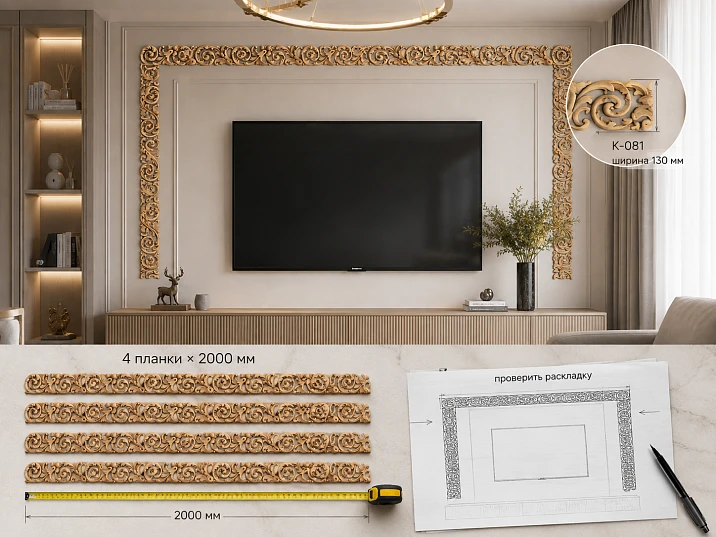
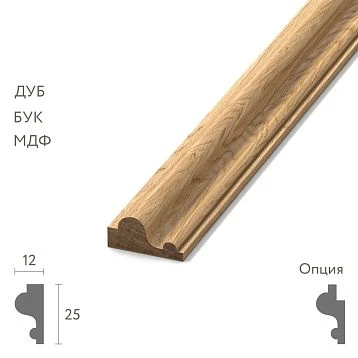
The visualization is approved: around the central TV panel, an expressive baroque molding strip 130 mm wide should run. On a computer screen, such decor looks convincing, but the customer wants to see it in person — to apply it to the wall panel, assess the depth of the relief, compare beech and oak, and check the future color. Here, an important feature of this specific product is revealed. The wooden baguette K-081 has short elements 300 mm long, but they are only available in widths of 70 and 90 mm. The selected profile 130×23 mm is available in a length of 2000 mm.
So, you can't buy "the exact same short sample 130 mm" under the current product card. But that's no reason to blindly order four expensive two-meter strips. Before payment, you can check the drawing, print the profile at 1:1 scale, make a full-size template of the strip, agree on the material and finishing system, and then lock these decisions into the specification. This procedure is especially important for a wide carved frieze: the error is noticeable not only in millimeters, but also in the overall character of the TV area.
Below is a practical algorithm for a project that requires four K-081 130×23×2000 mm elements. Prices are given according to the product card as of August 30, 2026. Before placing an order, they must be re-checked.
Wooden baguette K-081: what exactly the product card confirms
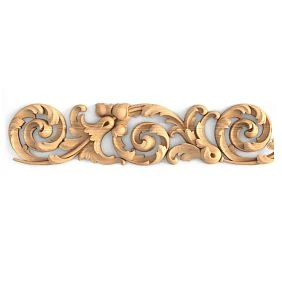
You should start not with a photo in the selection or a similar product, but with the current card of the selected article. In it, K-081 is called a wooden baguette; the description also uses another precise designation — carved frieze. The manufacturer classifies the model as Baroque style, indicates a floral ornament, and suggests using it in furniture, staircases, kitchens, bedrooms, studies, living rooms, church projects, as well as in decorating TV areas and mirror frames.
The size range consists of six options:
-
70×12×300 mm;
-
90×16×300 mm;
-
70×12×2000 mm;
-
90×16×2000 mm;
-
110×19×2000 mm;
-
130×23×2000 mm.
The first value is the width of the visible strip, the second is the thickness, and the third is the length. These parameters cannot be rearranged. For the selected TV zone, the widest and most voluminous standard option is needed: 130×23×2000 mm. The card has neither 130×23×300 mm nor 130×23×1000 mm.
The customer can buy wooden baguette K-081 made of beech or oak, with Standard or Prestige sanding. These are four different commercial items in terms of price and surface preparation level. The wording "K-081 with a width of 130 mm" is insufficient for a request: the manager needs the length, material, sanding quality, re-gluing quality for the selected finish, and quantity.




Why a 70 mm wooden frieze does not replace a 130 mm profile sample
It is easy to reason like this: the ornament is called the same, so it is enough to buy a short K-081 with a width of 70 or 90 mm, and the wide version will look the same, only larger. For a responsible order, this assumption is not enough. The card confirms the overall model and dimensions, but a photo does not replace comparing full-size drawings of all variants.
The thickness also changes with the width: the 70-mm profile has a thickness of 12 mm, the 90-mm — 16 mm, the 110-mm — 19 mm, and the 130-mm — 23 mm. Consequently, a short fragment of 70×12×300 mm does not show the actual projection of the future decor from the surface. At the junction with the screen, lighting, socket, acoustic panel, or adjacent molding, the 11 mm difference in thickness can be noticeable.
The visual rhythm cannot be automatically considered identical either. Until viewing the drawing, it is unknown how exactly the ornament is adapted to each width, where the pattern axis runs, and which zones are acceptable to trim. Therefore, a short K-081 of a smaller size can be used to get acquainted with the wood, carving quality, and sanding principle, but it cannot be presented as an exact physical copy of the 130×23 mm version.
The correct wording for approval is: "A short element helps to assess the class of the product, but the scale and projection of the 130 mm profile are checked against its own drawing and a full-size mockup."
Our factory also produces:
Carved molding 130×23×2000 mm: how to check the scale without buying four planks
The check should answer not the abstract question "is it beautiful," but five specific questions: is the strip too wide for the composition, does the thickness conflict with adjacent parts, is the ornament readable from the usual viewing point, is there enough calm background around the decor, and can neat endings be executed.
The first step is to download or request the drawing specifically for K-081 130×23×2000 mm. The size on the monitor is not a 1:1 scale. The drawing is printed with scale control: the sheet must have a check line of known length. After printing, it is measured with a ruler. If 100 mm on the drawing turned into 96 or 104 mm, such a sheet cannot be used as a physical template.
The second step is to make a strip 130 mm wide from thick paper, foam board, or another stable mock-up material. To check the overall mass of the decor, it is not necessary to reproduce the carving: it is enough to see the real width of the strip on the wall. The template is placed not on an empty table, but in the design position—next to the TV, panel, lighting, and furniture.
The third step is to indicate the thickness of 23 mm. Flat paper shows the width but hides the protrusion. A small end mock-up helps check whether the protruding frieze will be closer to the screen than intended, whether it will create an extra shadow, and whether it will interfere with access to the hidden mounting of the panel.
The fourth step is to view the composition from three distances: close up, from the usual TV viewing spot, and from the room entrance. A wide baroque baguette may be appropriate in a large living room and too active in a small room. The decision is made based on the actual room, not on an enlarged fragment of a visualization.
If the project is complex, it is rational to order a design project for the TV zone or provide the designer with an accurate drawing of the product. This way, the article number, width, and protrusion will go into the working documentation, rather than remaining an approximate picture.
Get Consultation
Buy a wooden baguette or order carved molding: how not to confuse the purpose
In search, the same assortment is called wooden baguette, carved molding, decorative batten, and frieze. For K-081, these words describe a similar product task, but do not mean a ready-made TV frame kit. The listing sells a separate linear element of a fixed length. It does not include ready-made corner joints, fasteners, mounting kit, backlighting, or cutting to size.
Therefore, the transition to the section Buy wooden picture frame molding is needed to compare models, widths, and ornaments. And the query buy carved wooden molding reflects the delivery method: the buyer receives strips and hands them over to a carpentry or finishing workshop for preparation for a specific project.
This difference is important for the budget. The product price is not the price of a fully finished TV zone. Design, delivery, cutting, trial assembly, edge preparation, finishing, mounting base, and craftsman labor may be required separately. Which operations are actually needed is determined after the node and drawing.
Wooden baguette 130 mm for a TV zone: what to check on site
A 130 mm wide template is applied along the entire planned side, not just a small rectangle in the center. On the project surface, mark the outer edge of the decor, the inner edge, and the axis. Then check:
-
The distance from the inner edge of the frieze to the TV body.
-
The position of ventilation zones and access to connectors.
-
The ability to remove the TV from the bracket after installing the decor.
-
Positioning of sockets, cable channels, acoustics, and lighting.
-
Intersection with a furniture console or a hanging cabinet.
-
The difference in levels between the wall, panel, and 23 mm thick molding.
-
Visibility of the end face from the side entrance to the room.
-
Symmetry of the left and right sides.
-
Reserve of calm surface around a rich botanical ornament.
-
Access for the installer to the base.
It is especially dangerous to approve only the frontal view. It does not show the 23 mm thickness and side junctions. If the TV zone is located near a door or passage, the side angle may be the primary one.
The manufacturer explicitly states that cutting-to-size service is not provided. Therefore, before ordering, it is necessary to find a contractor who will study the profile, confirm the cutting method, and take responsibility for assembly. You cannot first buy expensive material and then look for a workshop capable of carefully processing a carved oak or beech frieze.
Beech or oak molding: the choice depends on the future finish.
The material is chosen not by the rule "oak is always better," but by what result the client should see. On the STAVROS information page, beech is described as a dense, non-porous wood, often used under enamel. Oak is a dense, porous wood with a pronounced natural texture, which is often emphasized with a translucent coating.
If the TV zone should become solid-colored — for example, the frieze is painted in the color of the wall panel — beech under enamel may be a logical option. If the concept is based on visible texture and tinting, oak and the appropriate quality of lamination are considered. But the decision is finalized only after a test paint-out on comparable wood and approval of the technological map.
Not only the wood species matters. "Under enamel" and "under tinting" characterize the selection of lamellas. Under opaque paint, color differences of the workpiece are hidden; under translucent finishing, they remain visible. Therefore, in the order, you cannot simply write "oak K-081": it is necessary to specify the future coating system and confirm the suitable lamination option.
Before choosing, it is useful check the quality of sanding and lamination of the wood. This page explains the difference in the manufacturer's terms and helps avoid the expectation that any workpiece is equally prepared for any finish.
Sanding Standard or Prestige for a wooden frieze with a rich ornament
The card offers two degrees of sanding. Standard is machine sanding at a more affordable price. Prestige is detailed manual sanding; the manufacturer states that the product does not require additional finishing. For a rich plant relief, the difference affects not only the price but also the labor costs of the finishing workshop.
Standard may be justified if the contractor has experience in finishing carved wood, this operation is included in the estimate, and the craftsman has seen the actual profile. Buying Standard only because it is cheaper and then unexpectedly paying for a lot of manual work is an incorrect way to save.
Prestige should be considered when high surface readiness is required, deadlines are tight, or the workshop does not plan separate detailed finishing. However, the word "Prestige" does not mean a ready finish coating. In the card, this is the quality of sanding, not painting, varnish, or tinting.
The best calculation compares two complete estimates:
-
cost of four Standard planks plus finishing by the contractor;
-
cost of four Prestige planks plus further finishing system.
Only after this can you see which option is truly more advantageous.
K-081 130 mm without an exact short sample: how to do a three-layer scale check
The absence of K-081 130×23×300 mm does not mean the buyer must choose between "trusting the visualization" and "buying four long planks for fitting." The check can be divided into three independent layers: width, projection, and material.
Layer 1. Width 130 mm
A 130 mm strip should be applied to the wall at full scale. For this, it is enough:
-
painter's tape;
-
thick paper;
-
foam board;
-
thin sheet material.
If the future baguette forms a frame around the TV panel, it is useful to assemble not just one 300 mm long fragment, but the entire conditional contour. Even without ornament, such a mockup shows how much calm flat surface remains around the television.
For example, the width of the front strip of K‑081 130 mm compared to the 90 mm option is greater by:
130 − 90 = 40 mm.
Relative to the 90 mm version, this is:
40 / 90 × 100 ≈ 44,4%.
Therefore, the short K‑081 90 mm can give an idea of the wood and carving, but in visual mass it is significantly narrower than the approved version.
Compared to 70 mm, the difference is even more noticeable:
130 − 70 = 60 mm;
60 / 70 × 100 ≈ 85,7%.
That is, the 130 mm profile is almost twice as wide as the 70 mm one in terms of the front strip.
Layer 2. Thickness 23 mm
A flat paper template does not show the protrusion from the wall.
The K-081 has a thickness of 23 mm at 130 mm. The 90-mm variant has 16 mm, and the 70-mm has 12 mm.
The difference of 130×23 versus 90×16:
23 − 16 = 7 mm,
or approximately 43.8% in thickness.
Compared to 70×12:
23 − 12 = 11 mm,
that is, about 91.7%.
For the TV zone, these millimeters affect:
-
the side view;
-
the shadow from the decorative strip;
-
the transition between the frieze and the wall panel;
-
frame depth relative to the screen;
-
access to hidden mounts;
-
backlight adjacency.
Therefore, the second mockup must have not only a width of 130 mm, but also an end thickness of 23 mm.
The simplest option is to add foam board spacer elements to the paper strip so that the edge of the mockup stands 23 mm away from the wall.
Layer 3. Material and finish
Short K-081 70 or 90 mm, if available in the required wood species and preparation, can only be used as a material test.
It helps to evaluate:
-
real wood;
-
thread quality;
-
surface character;
-
a test enamel;
-
kill room;
-
lacquer;
-
manual finishing work.
But this fragment cannot be passed off as a full-size model of 130×23 mm.
Correct marking of the sample on the project:
“K‑081, short version of smaller width — only for material and finish; geometry 130×23 is checked with a separate mock-up.”
This way the designer, client, and workshop do not mix two different tasks.
Why one 3D render does not replace these three checks
Visualization can be accurate, but the screen does not provide physical scale. In addition, a perspective angle can visually reduce or increase the width of the decorative belt.
On a real wall, 130 mm is perceived relatively:
-
TV diagonal;
-
the width of the panel;
-
console heights;
-
room dimensions;
-
distance to the sofa.
Therefore, a full pre-order test consists of:
1:1 width + 23 mm offset + real material/finish.
How to record the result to avoid disputes after ordering
After the fitting, it is useful to take four photos:
-
frontally from the TV viewing spot;
-
from the entrance;
-
from the side, so the 23 mm offset is visible;
-
close-up of the junction with the wall panel.
In the working documentation, the following is written nearby:
-
K‑081;
-
130×23×2000 mm;
-
material;
-
sanding;
-
type of finish;
-
the approved template width;
-
approval date.
If after this four slats are ordered, the decision is based not on the card photo, but on a verified composition.
Four K-081 slats 2000 mm: how to check if they are really enough for the TV zone
The phrase "need four slats" must be confirmed by geometry. Four two-meter elements give a total of:
4 × 2000 = 8000 mm of initial length.
But eight linear meters do not automatically mean a ready-made frame of any size.
You need to understand in advance what exactly is being made:
-
four independent vertical/horizontal strips;
-
rectangular frame;
-
U-shaped portal;
-
combination of four decorative segments;
-
frame with additional joints.
Scenario 1. Four independent strips
If each design part is shorter than 2000 mm and does not require joining along the length, four strips may be sufficient.
For example:
-
L1 = 1840 mm;
-
L2 = 1840 mm;
-
L3 = 1260 mm;
-
L4 = 1260 mm.
Each piece gets its own whip.
Remainders:
-
160;
-
160;
-
740;
-
740 mm.
Total useful length:
6200 mm.
Originally purchased:
8000 mm.
But two remnants of 740 mm can be useful for adjacent short elements, test corners, or repair reserve.
Scenario 2. Rectangular frame 1800×1200 mm by external long point
If the workshop confirms that the top and bottom pieces should be 1800 mm each, and the sides 1200 mm each, four slats look logical:
-
top — 1800;
-
bottom — 1800;
-
left — 1200;
-
right — 1200.
Nominal leftovers:
-
200;
-
200;
-
800;
-
800 mm.
But this is only an example of blank distribution. The actual length depends on:
-
which edge the dimension is set to;
-
corner joint;
-
carved ornament bevel;
-
allowance for test cutting.
Therefore, the frame size must be confirmed by the executor.
Scenario 3. External size 1950×1300 mm
Two horizontal parts of 1950 mm each leave only:
50 mm from each two-meter rod goes to process waste.
Such a map cannot be considered free.
It can work if the workshop confirms:
-
a precise measurement system;
-
sufficient allowance for trimming;
-
stability of the workpiece;
-
the position of the ornament in the corner.
But four slats here are already a borderline basket.
Scenario 4. One side needs 2050 mm
Then a single solid piece from K-081 2000 mm is physically impossible.
It is necessary to:
-
introduce a direct joint;
-
change the design size;
-
order more material and assemble a composite part;
-
or choose a different product format, if it exists.
Card K-081 does not show a length of 2400 or 2600 mm for the 130×23 option.
Therefore, a project with a solid side >2000 mm must be stopped until four slats are paid for.
Why are the inner and outer perimeters different for a frame?
The width of K-081 is 130 mm.
If the outer rectangle is conventionally 1800×1200 mm, the inner light opening after subtracting two profile widths will be approximately:
By width:
1800 − 2×130 = 1540 mm;
By height:
1200 − 2×130 = 940 mm.
This is a geometric example for a straight frame, not a ready-made drawing of a specific ornament.
It shows why the phrase “frame 1800×1200” should clarify whether it refers to:
-
the external dimension;
-
the internal opening;
-
the centerline.
If the designer says 1800 mm, but the carpenter calculates 1800 based on a different reference, the final TV area will change by hundreds of millimeters.
Why the ornament can change the cutting location
The card confirms a floral baroque pattern, but does not provide the exact repeat step of the ornament in accessible text.
Therefore, it cannot be stated in advance:
-
that any 45-degree cut beautifully falls into the same part of the motif;
-
that four strips give mirror angles without offset;
-
that the remainder can be mindlessly moved to the opposite side.
The workshop must examine the actual strip or working drawing and determine acceptable cutting zones.
Document that must appear before payment
Minimum map:
| Detail | Finished length | Source strip | Left end | Right end | Remainder |
|---|---|---|---|---|---|
| A | ___ | K1 | ___ | ___ | ___ |
| B | ___ | K2 | ___ | ___ | ___ |
| C | ___ | K3 | ___ | ___ | ___ |
| D | ___ | K4 | ___ | ___ | ___ |
If the table is not filled in, the figure "4 strips" is not yet a verified quantity.
Beech or oak, Standard or Prestige: four configurations of K-081 according to the current card
In fact, the buyer chooses not one product, but one of four commercial combinations of K-081 130×23×2000 mm:
-
beech, Standard;
-
beech, Prestige;
-
oak, Standard;
-
oak, Prestige.
At the time of the current check, the direct card shows:
| Configuration | Price of 1 slat | 4 slats | + frame 390 RUB |
|---|---|---|---|
| Beech, Standard | 17,220 RUB | 68,880 RUB | 69,270 RUB |
| Beech, Prestige | 25,990 RUB | 103,960 RUB | 104,350 RUB |
| Oak, Standard | 24,410 RUB | 97,640 RUB | 98,030 RUB |
| Oak, Prestige | 31,530 RUB | 126 120 RUB | 126 510 RUB |
Delivery, finishing, cutting, and installation are not included here.
Difference between Standard and Prestige
For beech:
103,960 − 68,880 = 35,080 RUB
For oak:
126,120 − 97,640 = 28,480 RUB
This is the price difference specifically in the product configuration for the current listing.
To understand the real savings, you need to add the cost of manual finishing by the workshop to the Standard, if a specific project requires it.
Difference between beech and oak
Standard:
97,640 − 68,880 = 28,760 RUB.
Prestige:
126,120 − 103,960 = 22,160 RUB.
This difference does not mean that beech is “more profitable.” The material is chosen based on the finish and the visual task.
Why the rigid packaging frame cannot be multiplied by four automatically
The card says that a rigid frame of 390 RUB is added to the order cost for safe transportation.
From this, one cannot deduce:
390 × 4 slats.
For one batch of four elements, you need to check with the manager how the packaging for a specific order is formed.
Therefore, in the table, 390 RUB is added once to the order scenario, in accordance with the current card description, but before payment, the packaging total must be confirmed.
Why current prices differ from the preliminary editorial passport
Prices for K-081 are changing.
Therefore, the published article should use the current direct card, not the old calculation.
Before publication or payment, the four amounts are checked again.
How to choose between four options without overpaying
First, answer the questions:
-
Is visible wood texture needed?
-
Which finishing system is approved?
-
Will the workshop separately refine the relief?
-
How much does this refinement cost?
-
What are the deadlines?
-
How critical is the surface evenness before coating?
After that, the full estimate is compared, not just the product line.
Four K-081 slats: what else is included in the budget besides the baguette itself
The price of four slats is only the first line of the TV area budget. Before ordering, you need to understand which operations STAVROS performs and which are transferred to the designer, joinery, or finishing workshop.
The following are confirmed in the current card:
-
the wooden baguette K-081 itself;
-
length 2000 mm for the 130×23 mm option;
-
beech or oak;
-
Standard or Prestige sanding;
-
production to order on average 5–10 working days;
-
rigid packaging frame 390 RUB;
-
Contact us to confirm shipping to your destination.
The card also directly states that cutting or sizing services are not provided. Therefore, the finished TV zone requires a separate contractor.
What usually remains outside the price of four slats
In the project estimate, check the following as separate line items:
-
development of joints and part maps;
-
full-size trial mock-up;
-
cutting;
-
corner joints;
-
pattern fitting;
-
manual finishing, if Standard is selected and it is needed;
-
primer/stain/enamel/varnish;
-
test coating;
-
preparation of the base;
-
installation;
-
possible hidden mechanical fixation;
-
delivery to the workshop and then to the site, if production is separated.
It cannot be stated in advance that all these operations will necessarily be required. But they also cannot be considered included in the price of the card.
Four product scenarios at the current price
At the time of verification, the four planks themselves cost:
-
beech, Standard — 68,880 RUB;
-
beech, Prestige — 103,960 RUB;
-
oak, Standard — 97,640 RUB;
-
oak, Prestige — 126,120 RUB.
With a rigid packaging frame 390 rubles, the current known part of the order is respectively:
-
69,270 rubles;
-
104,350 rubles;
-
98,030 rubles;
-
126,510 rubles.
This is not yet the price of the finished TV zone.
Why a cheap plank can give a more expensive finished result
Suppose the workshop says:
"We'll take the standard, but the carved relief will be additionally finished by hand."
Then you need to compare:
4×Standard + finishing
с
4×Prestige + standard preparation for finishing.
If the cost of Standard finishing exceeds the difference between the two product variants, the savings in the listing disappear.
The article does not substitute a made-up cost for the work: it must be provided by a specific contractor after inspecting the profile.
Why Prestige is not a ready-painted product
The quality of sanding and the finish coating are different stages.
Prestige reduces the amount of surface preparation, but does not mean that the baguette is already:
-
painted;
-
tinted;
-
lacquered;
-
ready for installation without a technological finishing system.
This needs to be discussed before ordering, especially if the designer writes briefly in the specification:
“K‑081, oak, Prestige.”
Such a record is not enough for the finisher.
How to prepare a budget to avoid hidden costs
Convenient table:
| Line | Who confirms | Total |
|---|---|---|
| K‑081, 4 planks | STAVROS | ___ |
| Packaging | STAVROS | ___ |
| Delivery | manager/technical consultant | ___ |
| Layout | Workshop | ___ |
| trial assembly | Workshop | ___ |
| finishing | Workshop | ___ |
| Finishing | painter/carpenter | ___ |
| Installation | contractor | ___ |
While the table is only filled with the first row, the choice between Standard and Prestige cannot be considered economically complete.
If the budget doesn't add up after the full estimate
Don't automatically:
-
change oak to beech;
-
reduce the width;
-
choose Standard instead of Prestige;
-
give up the trial mockup.
First, you need to understand which line causes the excess.
For example, if the main problem is expensive manual finishing, Prestige may be more reasonable. If the material itself is expensive, you can go back to the designer and compare beech under enamel with oak under tinting. If the project cannot withstand the 130 mm scale itself, then a different article is considered.
The cost of a mistake with four slats is higher than the cost of checking.
Even the most affordable current scenario is 68,880 RUB for just four slats before packaging and work. Therefore:
-
1:1 print;
-
a paper mockup;
-
end mock-up 23 mm;
-
preliminary cutting map;
-
finishing approval
are not excessive bureaucracy.
These are cheap stages relative to the cost of material that cannot be "reduced to 90 mm" after production and cannot be returned to its original two-meter length after an erroneous cut.
Why four planks of 2000 mm cannot automatically be considered a 2000×2000 mm frame
Four planks with a total length of eight meters do not yet form a ready-made square with a side of two meters. When joining corners, part of the length is used in the cut; the result depends on the profile geometry, measurement point, joint type, and ornament placement. In addition, the outer and inner sides of a wide strip have different perimeters.
You cannot promise a finished size without a cutting plan. The craftsman must determine:
-
along which line the design dimension is specified;
-
which angle and joining method are used;
-
how the floral pattern is aligned;
-
where joints are acceptable;
-
what allowance is needed for equipment setup;
-
whether offcuts can be used in other areas;
-
whether test cuts on a separate material are needed.
If four planks are chosen for four vertical strips, the calculation is different: each two-meter blank can be used as a separate piece. But even then, you cannot order without a list: the wall construction size, the finished decor length, and the blank length are different values.
Before payment, the workshop must sign the cutting map or at least confirm that a length of 2000 mm is sufficient for each whole piece. A verbal "should be enough" for expensive carved molding is a weak basis for a purchase.
Samples of carved molding: what they can confirm and what they cannot
The catalog has a separate option to order samples of carved molding. Such a set is useful for general comparison of ornaments, wood, and manufacturing quality. But the presence of a separate samples page does not prove that the set includes K-081 130×23 mm. The composition and availability of the needed fragment must be clarified before ordering.
Short versions of the K-081 itself, 70 or 90 mm wide, allow you to evaluate the actual material and relief of a specific model. They are useful for trial priming, painting, or tinting if the technologist approves the use of such a fragment. However, the finishing result on beech cannot be transferred to oak, and the result on a blank for enamel cannot be transferred to a version for tinting.
What a short element does not confirm:
-
the actual width of 130 mm;
-
the thickness of 23 mm;
-
the behavior of a long two-meter plank;
-
drawing of all sections of the long element;
-
final quality of corners and joints;
-
suitability of the chosen fastening;
-
readiness of the TV zone base.
Therefore, a smaller physical sample and a 130 mm paper template solve different tasks. The first shows the material and the thread work, the second shows the scale of the composition. For an expensive order, it is reasonable to use both tools without substituting one for the other.
Verification matrix: which tool actually confirms what
In the absence of K‑081 130×23×300 mm, it is especially important not to mix evidence.
| Tool | What confirms | What it does not confirm |
|---|---|---|
| short K‑081 70/90 mm | wood, real thread, surface, trial finish | width 130 mm and thickness 23 mm |
| paper strip 130 mm | visual scale on the wall | relief and protrusion |
| end mockup 23 mm | depth/shadow/adjacency | real wood |
| drawing 130×23 | geometry of a specific profile | perception in the room without 1:1 printing |
| 3D visualization | project composition | physical scale without control |
| workshop cutting map | suitability of 4×2000 mm for parts | color and finish quality |
| short sample of another model | overall assortment level | specific K-081 |
This table allows you to assemble a check from multiple sources and not demand the impossible from a single sample.
Can I first order one 2000 mm plank instead of four?
This is an acceptable fallback scenario if the customer still doesn't trust the mockup and wants to see the K‑081 130×23 physically.
Advantages:
-
a real profile of the required width appears;
-
the relief can be checked along the entire length;
-
the workshop receives material for a test corner;
-
a full paint test can be performed;
-
the Standard/Prestige quality becomes clearer.
Disadvantages:
-
a full two-meter plank is paid for;
-
a separate delivery/lead time appears;
-
the remaining three may arrive later;
-
For natural wood, possible differences between batches must be taken into account;
-
The first plank after tests may be partially used up and no longer fit into the final set of four.
Therefore, the scheme "1 + then 3" should not be considered a free sample.
If it is chosen, the workshop decides in advance whether the first plank will be:
-
final K1;
-
test material;
-
reserve.
When one plank as a physical prototype is rational
For example, the cost of the full set is high, the finish is complex, the project is unique, and the decision on the 130 mm width after the paper mock-up still raises doubts.
Then losing the cost of one test plank is potentially cheaper than getting four unsuitable ones.
But this is a commercial decision of the customer. The article does not claim that the first plank can be returned or that the next batch will be identical in wood — such conditions need to be confirmed with the seller.
When it's better not to place even a single order
If the problem is not in the material, but in the scale of the TV zone itself.
For example, the designer is still changing:
-
TV size;
-
width of the central panel;
-
height of the console;
-
position of the backlight.
In such a situation, even an accurate physical K-081 does not answer the question of what the final composition will be.
First, the architecture is frozen.
How to use a short 70/90 mm K-081 most effectively
If the customer still orders a short version of a smaller width, specific tests need to be assigned to it.
For the material:
-
evaluate beech/oak;
-
compare the pattern;
-
look at the pores;
-
check the reaction to the selected finish.
For the surface:
-
evaluate Standard;
-
evaluate Prestige, if a comparable option is available;
-
show the sample to the future painter/carpenter.
For carving:
-
see the depth of the plant pattern;
-
understand how difficult it will be to work manually in the recesses.
But on the wall next to it, a separate strip of 130 must remain
Installing a wooden baguette: which decisions cannot be made from a photo
The card confirms the product but does not design the specific wall joint. From a photo, you cannot determine the base material, type of adhesive, need for mechanical fastening, allowable fixing spacing, or corner finishing method. These decisions are made by a competent installer considering the weight, wood, finish, and TV-zone construction.
Before ordering, you should get answers:
-
What is the frieze attached to — the wall, furniture panel, embedded insert, or a separate frame?
-
Is the selected compound compatible with the wood and the base's finish coating?
-
Is hidden mechanical fastening required?
-
Where do cables and other communications run?
-
How are base irregularities compensated?
-
When is finishing done — before or after assembly?
-
How are ends and corners finished?
-
How is access to the TV and wiring ensured?
-
Who is responsible for the trial assembly?
-
Under what conditions is the wood stored before installation?
The manufacturer publishes general recommendations; before work, it is useful to study tips on finishing and installing wooden moldingBut the general instruction does not override the node project and the recommendations of the suppliers of the specific adhesive, primer, and coating.
Mistakes when ordering a wide carved frieze K-081
The first mistake is to assume that the 300-mm K-081 with a width of 70 mm is a reduced copy of the 130 mm profile in all details. This needs to be checked against drawings, not assumed.
The second is to look at the width only on the screen. The visualization may be shown in perspective, and the monitor may scale the image. A physical 130 mm template gives a more honest feel.
The third is to forget about the 23 mm thickness. For a TV area, the protrusion affects shadows, side views, junctions, and access to equipment.
The fourth is to order material without a finishing system. Beech under enamel and oak under tinting solve different visual tasks.
The fifth is to compare only the prices of the slats. The estimate includes preparation, coating, cutting, assembly, and installation.
The sixth is to plan cutting at the manufacturer. The card's FAQ directly states that trimming and cutting to size are not provided.
The seventh is to consider four slats as a ready-made frame kit. Corners, joints, and fasteners are designed separately.
The eighth is to order Standard without assessing the cost of manual finishing. Cheaper in the card is not always cheaper in the finished product.
The ninth is to approve the color based on a photograph of the wood. The shade depends on the species, re-gluing, preparation, primer, and finish; a test sample is needed.
The tenth is not to check the delivery of two-meter elements. Packaging, route, unloading, and storage location must be agreed upon in advance.
Final project freeze before the four milestones
Before placing an order, it is useful to define a point after which TV zone parameters do not change without recalculation.
The freeze list records:
| Parameter | Approved |
|---|---|
| K‑081 | Yes |
| 130×23×2000 mm | Yes |
| quantity 4 | Yes |
| external/internal dimension of the TV zone | ___ |
| Material | Beech / Oak |
| Sanding | Standard / Prestige |
| re-lamination/preparation for finish | ___ |
| color/tinting | ___ |
| cutting workshop | ___ |
| corner map | ___ |
| access to TV and cables | Confirmed |
| delivery and storage location | confirmed |
If after payment the external frame size changes, for example, you need to check again whether the design parts fit within 2000 mm.
Why changing the TV diagonal after agreeing on the baguette is especially dangerous
The width of 130 mm itself does not change, but the ratio changes:
-
screen;
-
inner opening of the decorative zone;
-
width of the calm background;
-
furniture console.
If a significantly larger TV is installed instead of the conventional 65", the old layout no longer supports the composition.
The same applies to replacing the wall panel with a wider or narrower one.
Access check after the frame is ready
Before ordering, the workshop must model not only the appearance but also the maintenance of the equipment.
You need to answer:
-
can the TV be removed from the bracket;
-
can the cables be disconnected;
-
is the power outlet accessible;
-
is the service hatch not blocked;
-
can the LED strip/power supply be replaced, if present;
-
is it not necessary to dismantle K-081 for routine maintenance.
If the answer is "the frame can be disassembled later," this must be confirmed by an actual joint, not an assumption.
Storage conditions for two-meter lumber before installation
Four K-081 pieces, 2000 mm long, must be protected after receipt from:
-
impacts on the relief;
-
accidental bending;
-
a damp floor;
-
construction dust;
-
mixing with offcuts of other trim.
On site, it is better to allocate a separate horizontal or contractor-provided storage area where the slats are marked K1–K4.
For oak and beech, this additionally helps avoid mixing up the distribution of parts after sorting by pattern.
Why K1–K4 are assigned before the first cut
If the TV zone is symmetrical, the master can distribute in advance:
-
K1 — top;
-
K2 — bottom;
-
K3 — left side;
-
K4 — right.
Or another scheme according to the map.
If two planks match better in tone, they are placed on visually paired sides.
After the first cut, the freedom of rearrangement decreases.
Acceptance before painting
Before irreversible finishing, it is worth checking:
-
exact size 130×23×2000 mm;
-
material;
-
sanding quality;
-
absence of transport damage;
-
straightness;
-
condition of the relief;
-
compliance of four slats with the stated package.
If there is a chip or defect, it is first recorded with a photo and agreed with the supplier. Do not mask the damage with putty or paint until the issue is resolved.
When it is better not to buy four slats yet
The order is premature if:
-
the designer has not fixed the size of the TV area;
-
there is no 1:1 check of 130 mm;
-
the 23 mm protrusion in the real assembly is unknown;
-
the material has not been chosen;
-
no cutting contractor;
-
the master did not confirm the length of the parts;
-
angles are not resolved;
-
the budget only accounts for the price of the product;
-
access to the TV after installation has not been checked.
The mere absence of a short sample is not a reason to refuse K-081. The reason to stop the order is the lack of an equivalent verification system.
How to order a wooden baguette K-081 130 mm: sequence of actions
-
Record the article K-081 and the option 130×23×2000 mm.
-
Download or request a drawing of exactly this size.
-
Print the cross-section at 1:1 scale and check the control dimension with a ruler.
-
Create a strip template 130 mm wide and an end layout 23 mm thick.
-
Place the layout in the TV area together with the TV, cabinet, lighting, and outlets.
-
View the composition from a normal viewing point and from the entrance.
-
Send the drawing to the workshop that will cut and install the moldings.
-
Obtain a parts map and confirmation of the quantity of four slats.
-
Choose beech or oak according to the finishing project.
-
Specify re-gluing for enamel or for tinting.
-
Compare the total cost of Standard and Prestige sanding, including finishing.
-
Order comparable material for a test finish or agree on an available sample.
-
Confirm the current price, production time, and availability.
-
Account for the rigid packaging frame and calculate delivery separately.
-
Check the room for receiving and storing two-meter parts.
-
Place the order only after the specification is documented in writing.
This process seems long, but most steps are done once at the project stage. It is cheaper than re-purchasing and reworking the finished TV area.
Final specification of four K-081 slats
Before payment, it is convenient to condense the decision into a single line that the designer, manager, and workshop read the same way:
K‑081 / 130×23×2000 mm / 4 pcs / material ___ / sanding ___ / glue joint quality and future finish ___ / parts A–D per map ___ / corners ___ / packaging confirmed / delivery confirmed.
Additionally attached:
-
1:1 mockup of 130 mm width;
-
photo of the mockup on the TV area;
-
drawing of a specific profile;
-
map of four finished parts;
-
workshop confirmation for cutting;
-
test swatch or material sample.
If the slats are to form a frame, the specification cannot just say "4×2000". It is necessary to specify along which line the frame size is defined: outer, inner, or centerline. Otherwise, one project participant may consider 1800 mm as the outer dimension, another as the inner opening.
Check before payment for the current card
On the day of ordering, re-check:
-
whether 130×23×2000 mm is available in the selected material;
-
current price;
-
Standard/Prestige;
-
production 5–10 working days;
-
packaging cost;
-
delivery conditions;
-
lack of cutting-to-size service.
Prices in the article are a snapshot as of the review date, not a fixed commercial offer.
After this check, ordering four slats becomes clear: the buyer knows not only what to buy, but also why each two-meter blank is needed in a specific TV zone.
If the project involves a symmetrical frame, it is useful to separately mark the direction of each slat and not change it after a trial layout. For natural oak, this helps distribute the wood grain pattern in pairs: top and bottom, left and right sides. If the workshop discovers after acceptance that one slat visually differs more than the others, the decision on its position is made before cutting and tinting. After corner trimming, the freedom of rearrangement noticeably decreases.
When K-081 130×23×2000 mm can be purchased, and when ordering is premature
The purchase is justified if the specific baroque floral ornament is chosen, the 130 mm strip is verified with a full-size template, the 23 mm thickness does not interfere with equipment, the material and finish are agreed upon, the workshop has accepted the profile for work, and the four slats are confirmed by the itemized list.
Ordering is premature if the decision is made only based on a card on the phone; the short 70 mm element is mistakenly considered an exact sample of the 130 mm version; it is unknown who will perform the cutting; the base material is not defined; joints are not agreed upon; the customer chooses oak but wants to completely cover the texture with opaque paint without discussing the technology; or the budget only accounts for the cost of linear footage.
A separate reason to pause is the lack of access to the drawing. With four slats costing from 68,880 to 126,120 rubles before packaging, delivery, and work, buying an “approximately suitable” profile is irrational.
Frequently asked questions about wooden baguette and carved molding K-081
Is there a K-081 in size 130×23×300 mm?
In the verified card, this option is not available. The width of 130 mm is represented by a length of 2000 mm.
What short options of K-081 are available?
The card specifies 70×12×300 and 90×16×300 mm.
Can the 70 mm sample accurately assess the 130 mm profile?
It helps to see the wood, carving, and quality of processing, but does not replace checking the actual width of 130 mm and thickness of 23 mm.
How to check the width of 130 mm without buying a long plank?
Print a drawing with scale control and apply a full-size template of a 130 mm wide strip to the project surface.
What wood species is K-081 made from?
The card suggests beech and oak.
What to choose for opaque enamel?
The manufacturer more often recommends beech and gluing under enamel for opaque finishing, but the final system must be approved by a technologist.
What to choose if you need to show the wood texture?
Usually oak and a tinting option are considered, then a test coat is done.
How does Standard differ from Prestige?
Standard is machine sanding, Prestige is detailed hand sanding. Prestige does not mean a finished topcoat is applied.
How much do four beech planks with Standard sanding cost?
According to the current card at the time of check — 68,880 rubles, or 69,270 rubles with the rigid packaging frame specified in the card. Delivery and work are not included.
Does the manufacturer perform cutting to size?
No, the card's FAQ states that the service of trimming or cutting is not provided.
Can four planks be considered a finished frame?
No. A project of angles and joints, cutting map, finishing, and installation are required.
Where to compare other profiles?
In the section of wooden baguette and carved molding, where models can be compared by width, thickness, ornament, and price.
Can I order one piece?
The site's FAQ states shipment of products from one piece, but the current lead time and availability of the selected configuration need to be confirmed at checkout.
How long does custom production take?
The card indicates an average time of 5–10 business days. This does not include delivery and contractor work.
What should I check before paying for delivery?
Package length, address, cost, unloading method, and absence of obstacles for bringing in two-meter elements. Before placing an order, you should check payment and delivery terms.
Conclusion: a wide wooden baguette is ordered after checking the scale, not instead of it.
K-081 130×23×2000 mm cannot be physically tried on with a short plank of the same size, because such a position is not in the card. But the buyer has access to an accurate drawing, a full-size template, an end mock-up, wood and finish samples, as well as coordination with the workshop. Together, they provide a more reliable solution than a photo or a short K-081 of a different width.
For four slats, six parameters must be documented in writing: article number, size 130×23×2000 mm, material, sanding quality, re-gluing option, and quantity. Then the current price, packaging, delivery, and the contractor for cutting and installation are confirmed. Such an order remains commercial and practical: the buyer does not just choose a beautiful baroque frieze, but checks in advance how a specific wide carved molding will work in a specific TV zone.