










































































Article Contents:
- One line in the cart does not necessarily mean one physical part
- What is confirmed for NPU.VRS-003.1
- What does the size 476 × 364 × 16 mm mean
- How to check the space on the wall before ordering
- On a separate wall panel
- On the furniture facade
- On the door
- In pair with the external molding
- Practical scenario: one frame on a small wall panel
- Practical scenario: two frames on a tall panel
- Practical scenario: two identical cabinet doors
- Practical scenario: one large door
- Practical scenario: a furniture facade almost the same size as the frame
- Practical scenario: a wide wall and four identical modules
- Step 1. Confirm that a frame module is exactly what is needed
- Step 2. Check the dimensions on the actual object
- Step 3. Determine the number of finished frames
- Step 4. Get confirmation of completeness
- Step 5. Separately compile a list of additional items
- Step 6. Upon receipt, assemble one set dry
- Step 7. Make a template only after a test assembly
- Step 8. Transfer the axes to the object
- Step 9. Separate the mounting from the decorative composition once again
- Step 10. Finally approve the composition before painting

On the product page, everything looks simple: one SKU NPU.VRS-003.1, one "Buy" button, one size 476 × 364 × 16 mm, and one price. But the description contains a phrase that naturally raises a question before ordering: the overlay is composite, made of two or more parts.
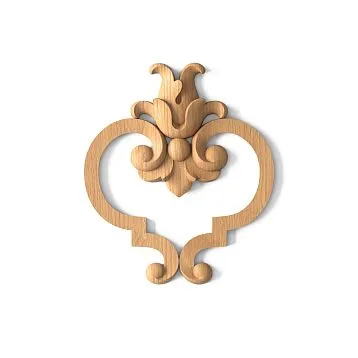
What does this mean in practice? You are not buying a random set of separate decorative fragments or several independent products. NPU.VRS-003.1 is one product item that, after proper layout, forms a frame ornamental composition with an overall dimension of 476 × 364 × 16 mm. At the same time, the public product card does not specify the exact number of physical parts inside this product item, so you cannot count them from a photo or invent the set contents. Before installation, you need to verify the set against the drawing and the STAVROS packing information.
This is exactly where a buyer can easily make two opposite mistakes. The first is expecting one solid frame measuring 476 × 364 mm from the box. The second is deciding that each visible part of the frame needs to be added to the cart separately. Both logics are incorrect. You add one NPU.VRS-003.1 to the cart, and inside this product item there is a composite decor that is assembled into the intended composition.
If you need exactly this frame element, you can buy the stucco decor NPU.VRS-003.1 as a single product line. But before payment, it is useful to understand what the overall size means, how to check the composition, where the set of the article itself ends and related products begin.

One line in the cart is not necessarily one physical part
In the online store, the buyer is used to simple logic:
one product → one part.
For a composite decorative product, this rule does not work.
NPU.VRS-003.1 is sold as one article, but the structure itself is composite. This means that the commercial unit and the physical number of fragments are not the same thing.
Conventionally, three levels can be imagined:
-
article — NPU.VRS-003.1;
-
trade unit — one item in the cart;
-
physical parts — elements from which the final frame composition is formed on the object.
The public card confirms the first two levels and directly states the composite structure, but does not disclose the exact number of physical parts. Therefore, in a regular article, one cannot write “two,” “four,” or “six pieces included” if this is not in the confirmed assembly scheme.




What is confirmed by NPU.VRS-003.1
| Parameter | Confirmed value | What this means for the buyer |
|---|---|---|
| Article number | NPU.VRS-003.1 | One trade item |
| Overall dimensions | 476 × 364 × 16 mm | Dimension of the frame composition that the project is based on |
| Material | Polyurethane | Decorative element made of polyurethane |
| Construction | Composite | The product consists of two or more physical parts |
| Exact number of parts | Not specified publicly | Need to check against the drawing/assembly information |
| Purpose | Walls, furniture, doors | Can be used not only inside a large wall kit |
| Collection | "Versailles" | The element is part of the overall ornamental system |
| Price at the time of writing the article | 7 750 ₽ | Before payment, the price needs to be re-checked |
This table separates fact from assumption. The row 'exact number of parts' is especially important. A composite structure does not give the right to automatically assign the number of elements.
Our factory also produces:



What does the size 476 × 364 × 16 mm mean
Before ordering, you need to determine exactly what the size in the card refers to.
NPU.VRS-003.1 is presented as one frame decorative overlay, and the size of the product item is specified as 476 × 364 × 16 mm. For project layout, this dimension should be perceived as the size of the assembled composition, not as the size of each individual physical fragment.
Otherwise it would be illogical: if each part had a size of 476 × 364 mm, the final frame would be much larger than the declared product.
But there is an important caveat: the exact seam lines and the position of each physical part must be determined from the drawing, not by guesswork.
Get Consultation
How to check the space on the wall before ordering
Make a paper rectangle with dimensions:
476 × 364 mm.
This is not an exact copy of the ornament, but a good overall template.
Hold it against the wall, furniture front, or door and check:
-
whether the frame fits in width;
-
whether the height is sufficient;
-
whether it conflicts with the molding;
-
whether it falls on the handle;
-
whether it hits the panel;
-
doesn't it look too small for a large panel;
-
is there free space left around it.
16 mm thickness won't be visible in paper, so the volume needs to be assessed separately from the drawing and the actual relief.
Why you can't measure only one fragment from a photo
On the card, the composite decor is visually perceived as a single frame. Because of this, it's easy to start measuring one corner, one branch, or one side fragment.
This approach is unreliable.
Photo:
-
may be shown at an angle;
-
doesn't provide an accurate scale;
-
doesn't show the actual separation lines of the set;
-
does not replace the drawing.
Therefore, the buyer should rely not on a visual assessment of individual parts, but on the overall confirmed dimension of 476 × 364 × 16 mm.
One NPU.VRS-003.1 is already a standalone product, not a "half of Versailles"
The "Versailles" collection is built as a system where individual elements are part of larger compositions. But this does not mean that NPU.VRS-003.1 is sold only within the CPU kit.
Elements of the NPU.VRS series are available for independent purchase.
Therefore, the buyer can order NPU.VRS-003.1 made of polyurethane separately, if they need exactly a framed ornamental niche measuring 476 × 364 mm.
This is especially convenient when:
-
the large wall composition is already assembled;
-
one additional frame accent is needed;
-
a furniture facade is being finished;
-
door decor is required;
-
I want to use the Versailles motif locally, not on the entire wall.
But a standalone product does not mean 'the kit includes everything for a full wall panel'
NPU.VRS-003.1 is a standalone frame decorative overlay.
It does not thereby become a full wall set with moldings, belts, medallions, and corner elements.
If other products are offered nearby on the card, they should be perceived as related items unless the opposite is explicitly confirmed.
This is an important boundary.
The composition of NPU.VRS-003.1 and related products are not the same thing
The following may be suggested next to the card:
-
NPU.VRS-002-1;
-
MLD-001-MG;
-
NPU.VRS-008.1L;
-
NPU.VRS-008.1R;
-
KUDO HIGH TACK adhesive.
They are useful for building a broader composition or mounting.
But you cannot write:
"NPU.VRS-003.1 consists of NPU.VRS-002-1, MLD-001-MG, and NPU.VRS-008.1L/R."
There is no such confirmation.
The correct wording is:
NPU.VRS-003.1 itself is a composite product, and the listed items are sold separately and can be used alongside it in other compositions.
What a correct order line looks like
Bad entry:
"Versailles Frame — 1 pc."
Too vague.
Better:
NPU.VRS-003.1 — 476 × 364 × 16 mm — polyurethane — 1 unit — composite structure, kit to be checked against the drawing.
If two such frames are needed:
NPU.VRS-003.1 — 2 units.
There is no need to multiply the quantity of internal fragments yourself if they are already part of the kit for one item.
What exactly needs to be checked upon receipt
A composite item is better received not on the principle of “the box arrived — so everything is there.”
Check:
-
article number on the packaging;
-
quantity of ordered units;
-
presence of all parts according to the kit information;
-
absence of damage;
-
compliance of parts with the drawing;
-
general character of the ornament;
-
possibility to fold the set into dimensions 476 × 364 mm.
If one NPU.VRS-003.1 was purchased, the completeness of one composite product unit is checked, not just the presence of one random decorative fragment.
Why it is more convenient to check composite decor on the floor or table
Before installation, lay out all received parts on a flat surface.
Do not apply glue.
Assemble the frame composition "dry" (without adhesive).
Check:
-
whether the overall dimensions match;
-
whether the pattern comes together;
-
whether the pairs and sides are clear;
-
is there any mirror confusion;
-
is one of the parts missing;
-
what the joints look like.
This is a simple way to catch a mistake before the first piece is glued to the wall.
First assemble on a flat surface, then transfer to the wall
A composite structure requires a different order than a solid overlay.
For a solid piece, you can find the center and transfer it to the base.
For a composite piece, you first need to understand how the parts form a single rectangular footprint.
After a dry layout, you can determine:
-
central vertical axis;
-
the central horizontal axis;
-
extreme points;
-
position of each fragment;
-
control lines.
Only after this is the scheme transferred to the object.
Central axes are more important than a random start from one corner
If you start installing NPU.VRS-003.1 from the upper-left fragment "because it's more convenient," the error can accumulate toward the opposite side.
It's better to first mark out the overall rectangle of 476 × 364 mm and its axes.
After that, each physical part gets its place within the finished geometry.
How to mark out the overall dimension
Let us denote:
W = 476 mm — width;
H = 364 mm — height.
The vertical axis passes through:
W / 2 = 238 mm from the side edge.
Horizontal axis:
H / 2 = 182 mm from the top or bottom edge.
These figures refer to the overall frame area, not to individual elements of the set.
They are useful for centering the composition on a wall, panel, or facade.
On a furniture facade, the center of the frame and the center of the door should be meaningfully aligned.
If NPU.VRS-003.1 is installed on furniture, first determine what the actual decorative field is.
This could be:
-
the entire facade;
-
inner panel;
-
area between the handle and the edge;
-
specially designated panel.
It is not possible to automatically center the frame on the outer width of the door if the composition itself is located inside the panel.
On the door, the handle and the work area need to be taken into account
The size of 476 × 364 mm is quite noticeable.
If the frame is placed on the door leaf, it must not conflict:
-
with the handle;
-
with the lock;
-
the panel;
-
with the architraves;
-
an area of frequent hand contact.
Before ordering, a paper template is especially useful: it immediately shows whether the frame composition is too large for a specific canvas.
On the wall, not only the frame size matters, but also the scale of the panel.
One NPU.VRS-003.1 can look very expressive in a small niche and too compact on a huge wall section.
Therefore, the size 476 × 364 mm should be evaluated not by itself, but relatively:
-
the width of the panel;
-
the height of the wall;
-
neighboring frames;
-
moldings;
-
furniture;
-
the central medallion, if provided.
One frame or two: repeating the module instead of stretching.
If you need to fill a taller wall panel, there is a temptation to "stretch" one NPU.VRS-003.1.
But the composite overlay has a set pattern and overall dimensions.
In ready-made "Versailles" systems, a different principle is used: repeating a ready-made module.
For example, in a large composition, two NPU.VRS-003.1 can be used one above the other.
This is an important buyer takeaway: it is wiser to scale a system by the number of ready-made frame modules rather than by arbitrarily modifying one.
When to buy one NPU.VRS-003.1
One product unit makes sense if you need:
-
one frame accent;
-
one decorative niche;
-
one furniture facade of a suitable size;
-
one door leaf;
-
one central part of the wall panel.
Before ordering, only one dimension 476 × 364 mm and one installation area are checked.
When to buy two NPU.VRS-003.1
Two are needed when the project contains two separate identical frames.
For example:
-
two panels side by side;
-
two frames one above the other;
-
two symmetrical wall zones;
-
two identical furniture fronts;
-
two doors.
Then 2 units of NPU.VRS-003.1 are added to the cart.
There is no need to try to assemble two frames from one kit if one item is designed for one final frame composition.
Quantity table
| Number of finished frames | NPU.VRS-003.1 in cart | Final frame modules |
| 1 | 1 | 1 |
| 2 | 2 | 2 |
| 3 | 3 | 3 |
| 4 | 4 | 4 |
| 6 | 6 | 6 |
This is a simple but important table: the composition of the product does not change the number of units needed for the number of finished frames.
Why you cannot count by the number of visible corners
In the image, the buyer may see four corner ornamental accents and decide:
"Four pieces of NPU.VRS-003.1 are needed for the frame."
No.
NPU.VRS-003.1 itself is a product frame composition.
The number of individual physical parts inside it is determined by the kit, and the number of NPU.VRS-003.1 in the order is determined by the number of finished frames.
The "Versailles" collection helps to understand the role of the product.
В of the Versailles stucco decor collection NPU.VRS-003.1 works as a frame decorative overlay, creating a separate ornamental niche.
This helps to understand its function.
It does not replace the entire panel.
It creates an inner decorative level within a larger system.
But it can also be used separately if the project needs exactly such a frame.
Why the word "frame" does not mean that there must necessarily be a medallion inside.
In large compositions, a frame niche can surround other decor.
However, standalone use does not automatically require adding a central medallion.
If the inner zone looks complete on its own, NPU.VRS-003.1 can function as a separate ornamental contour.
Additional decor is needed only when the sketch requires it.
What to buy together with NPU.VRS-003.1
Related products should be divided by function.
| Product | Role | Is it automatically included in NPU.VRS-003.1 |
| NPU.VRS-003.1 | Main composite frame overlay | This is the product itself |
| NPU.VRS-002-1 | Separate horizontal ornamental element | No |
| MLD-001-MG | Separate primed molding | No |
| NPU.VRS-008.1L/R | Individual corner/small decorative elements | No |
| KUDO HIGH TACK | Mounting compound | No |
The main value of this table is the word "no" in the last column. The "bought with this product" block cannot be turned into a configuration list.
NPU.VRS-002-1 is not the "top part of NPU.VRS-003.1"
If the project needs an additional horizontal belt, you can buy NPU.VRS-002-1 separately.
This is a standalone product with its own size and purpose.
It cannot be recorded as a physical part of the NPU.VRS-003.1 frame just because both items are in the "Versailles" collection.
MLD-001-MG is a separate molding, not a hidden side of the frame
If the project requires a geometric contour around the ornament, you can buy molding MLD-001-MG.
But its role is different.
MLD-001-MG — primed MDF molding measuring 10 × 6 × 2600 mm.
It can participate in the overall frame system, but is not automatically part of the NPU.VRS-003.1 delivery.
KUDO is a mounting material, not a decorative component.
For installing the STAVROS profile, compatible compounds are often recommended.
If you need a specific product, you can buy KUDO adhesive for moldings separately.
Adhesive is a consumable mounting material.
It cannot be considered a physical part of the decorative frame.
How not to confuse completeness with composition
Composite decor has two different things:
Completeness — the physical parts that belong to one product unit;
Composition — how this product unit combines with other products on the wall, furniture, or door.
The buyer needs to check them separately.
Completeness answers the question:
"Did they give me everything for one NPU.VRS-003.1?"
Composition answers:
"What else do I want to add around it?"
If you mix these questions, the cart quickly grows with unnecessary items.
The drawing is more important than photos of "bought with this product"
The recommendation block on the product card is useful for upselling and building a more complex system.
But it does not replace the assembly drawing.
If you need to understand which parts make up NPU.VRS-003.1, refer to:
-
a drawing;
-
the assembly list;
-
marking;
-
STAVROS information for the specific article.
If you need to understand what to add to the frame, then look at related products.
Why the exact number of parts cannot be determined by the joints in the photo
The ornament may have:
-
technological lines;
-
visual separations;
-
mirror elements;
-
decorative transitions.
Not every visible line means a separate physical part.
Conversely, the connection of two parts can be almost invisible in a photo.
Therefore, the public wording "of two or more parts" is an honest boundary of information that cannot be crossed without an additional assembly diagram.
How to check one product unit upon receipt
Let's imagine that the order contains:
NPU.VRS-003.1 — 1 pc.
There is no need to look for one large solid object.
The acceptance procedure is different:
-
find the item marking;
-
open the packaging;
-
compare all physical elements with the set;
-
lay them out according to the diagram;
-
make sure that one frame composition is obtained;
-
check the external dimension;
-
only after this make a decision about installation.
If something is missing, the issue is resolved before gluing.
If the order contains four NPU.VRS-003.1
Then the task becomes more complicated.
It is necessary not just to count all physical parts in one pile.
It is better to divide the packaging into four product sets.
Check each set separately.
This is especially important for mirror or similar parts: if all parts are mixed, the installer may accidentally take an element from another set and decide that something is missing in the first set.
It is better to label composite decor in sets
For a large order, you can use simple temporary labeling:
-
set A;
-
set B;
-
set C;
-
set D.
Inside each one are all elements of the same NPU.VRS-003.1.
This way, installation becomes not a search for parts among a common box, but a repetition of one proven operation.
Why one NPU.VRS-003.1 does not stretch to any width
Size 476 × 364 mm is the specified dimension.
Compositeness means the ability to assemble a product from several parts.
It does not mean that the frame can be arbitrarily stretched to 600 or 700 mm.
If a different field is needed, first check the drawing and the permissible scheme.
You cannot add molding between parts and still call the resulting structure standard NPU.VRS-003.1.
Can the frame be reduced
The public card does not provide a confirmed range for changing the dimension of NPU.VRS-003.1.
Therefore, you cannot write:
"Trim to any size."
If the project requires a reduction, a separate check against the drawing and specific elements is needed.
A composite construction itself is not permission for arbitrary trimming.
What to do if 476 × 364 mm doesn't quite fit
Don't cut before checking.
First, find out:
-
where the border of the ornament runs;
-
which parts are composite;
-
whether adjustment is provided;
-
whether the object's frame itself can be changed;
-
whether there is an alternative decor of a smaller size.
Sometimes it's easier to adjust the molding frame around it than to interfere with the ornamental overlay.
What to do if 476 × 364 mm seems too small
Do not try to stretch one NPU.VRS-003.1.
There are more correct options:
-
repeat the module;
-
add an external molding contour;
-
include the frame in a larger composition "Versailles";
-
use adjacent ornamental elements;
-
change the scale of the entire panel.
This preserves the original pattern.
A frame overlay and a molding frame are different things
NPU.VRS-003.1 already creates an ornamental frame motif.
MLD-001-MG or another molding creates a geometric linear contour.
These two levels can be combined.
For example:
the outer rectangle is a molding;
inside — NPU.VRS-003.1;
even deeper — a central medallion or a free field.
But you cannot assume that one automatically replaces the other.
First, decide whether a second contour is needed at all.
On a small wall panel, a single NPU.VRS-003.1 can be quite expressive.
On a large panel without an outer molding, it may look too isolated.
Therefore, before adding MLD-001-MG, look at the composition at the wall scale.
If an external contour is needed, we add it.
If not, we don't increase the basket for a formal "set".
NPU.VRS-008.1L and NPU.VRS-008.1R: when small angular accents are needed
The collection includes separate left and right small elements.
They help detail the corner nodes of molding frames.
But again, it's important to separate the roles.
NPU.VRS-008.1L/R are not a proven part of NPU.VRS-003.1 itself.
If they are needed per the project, they are counted separately.
This is especially important for serial orders: the quantity of small corner elements is determined by the number of nodes where they are actually used, not automatically by the number of NPU.VRS-003.1.
How to count related products
Cannot use the formula:
1 NPU.VRS-003.1 = 1 NPU.VRS-002-1 + 1 MLD-001-MG + 2 NPU.VRS-008.1 + 1 KUDO.
This kit is not confirmed.
Correct logic:
main product — NPU.VRS-003.1;
project additions — calculated according to a separate layout;
installation materials — according to technology and consumption.
What to put in the cart for a simple scenario
If you need one independent frame overlay on the wall:
-
NPU.VRS-003.1 — 1 product unit;
-
installation compound — according to the selected technology;
-
finishing materials — according to the project.
That's all.
No additional Versailles elements are required just because they exist in the collection.
What to put in the cart for a complex wall panel
If the project involves:
-
NPU.VRS-003.1;
-
external molding;
-
horizontal ornamental belt;
-
corner accents;
each item must be a separate line.
Such an order may look, for example, like this:
| Position | Quantity | Basis of calculation |
| NPU.VRS-003.1 | 1 | One frame niche |
| NPU.VRS-002-1 | According to sketch | Separate horizontal belt |
| MLD-001-MG | along the perimeter | External geometric contour |
| NPU.VRS-008.1L/R | By nodes | Corner decorative accents |
| KUDO | According to technology | Installation |
This is already a real list, not a mix of configuration and recommendations.
Why MLD-001-MG is calculated in linear dimensions separately
MLD-001-MG has a length of 2600 mm.
If it is used around a panel, the quantity is determined by the total length of the sides, joints, cuts, and allowance according to the project.
You cannot consider:
"one NPU.VRS-003.1 frame = one MLD-001-MG molding".
Sometimes one strip is enough.
Sometimes two are needed.
Sometimes this molding is not used at all.
How to calculate the external molding without reference to the NPU.VRS-003.1 composition
First, the size of the external frame is set.
Suppose the external field has width W and height H.
Theoretical perimeter:
P = 2 × (W + H).
Then the actual cuts, angles, joining, and the length of the whip of a specific molding are taken into account.
But this math applies to MLD-001-MG.
It does not change the composition of the NPU.VRS-003.1 itself.
The composite construction is especially convenient where a solid large decor would be inconvenient to install.
Several parts are easier to lay out and position on the site.
But this advantage has a downside: installation requires more precise marking.
If a solid overlay can be applied as a single shape, a composite one needs to be assembled with correct distances and orientation.
Therefore, it is important for the buyer to understand the nature of the product in advance.
Polyurethane molding and precision of repetition
If two NPU.VRS-003.1 are used side by side, they must create the same ornamental rhythm.
A composite structure does not mean that each one can be assembled "by eye" differently.
For a series, it is better to use one control template.
How to make a mounting template for repeating frames
After the first dry layout:
-
mark the overall rectangle 476 × 364 mm;
-
fix the position of the parts;
-
mark the axes;
-
transfer key points to paper, cardboard, or a mounting diagram;
-
use the same template on the following panels.
This way, four identical frames will truly be identical.
Why the template should be made after checking the real kit
Don't build a detailed template based only on site photos.
You need to see the physical parts first.
Then the template will reflect:
-
real joints;
-
real shape;
-
mirroring;
-
exact alignment points.
What to do if a part seems "extra"
Don't set it aside.
The composite set is checked as a whole.
If one part does not find an obvious place, three options are likely:
-
the layout is assembled incorrectly;
-
the element is mirrored and the side is mixed up;
-
a check of the assembly scheme is needed.
The phrase "probably, it's a spare" without confirmation is bad practice.
What to do if a part is missing
Do not replace it with random decor.
Do not start installation.
Verify:
-
article number;
-
packaging;
-
the assembly list;
-
the number of ordered product units.
If a part is truly missing, the issue must be resolved before installation.
Why the article cannot promise "everything necessary is already inside"
Because "everything necessary" can mean different things.
To assemble the NPU.VRS-003.1 itself, the kit must contain its physical parts.
For wall mounting, a mounting compound is needed.
For a full Versailles panel, moldings and other overlays may be required.
Therefore, an honest formulation:
one product unit NPU.VRS-003.1 contains the composite decor of this article; other elements of the composition and mounting materials are counted separately.
When a wide catalog really helps
If you are just choosing a direction and want to buy molding, it is useful to first write down:
-
composite frame decor is needed;
-
dimensions about 476 × 364 mm;
-
material — polyurethane;
-
application — wall, furniture, or door;
-
need a standalone module or part of a large panel.
With such parameters, the catalog ceases to be an endless ribbon of decorative items.
Choose decor by function, not just by pattern
In the section Relief Decoration you can find medallions, vertical elements, frame overlays, and other shapes.
NPU.VRS-003.1 is needed when the task is to create a framed ornamental niche.
If a central single accent is needed, another type of decor may be more precise.
If a long horizontal band is needed, look at another group.
Buying polyurethane molding does not obligate you to assemble the entire "Versailles"
When the buyer wants You can buy ready-made stucco matching the Baroque style. Calculate the quantity: linear meters of cornices and moldings, number of rosettes, pilasters, consoles, corner elements. Add a ten to fifteen percent allowance for trimming., the collection helps select a compatible ornament language.
But no one is obligated to buy the entire system as a whole.
You can use one NPU.VRS-003.1 as a standalone object.
You can use two frames.
You can use a full wall set.
The choice is determined by the project.
Additional decor is needed only according to the sketch.
If you need to expand the composition, you can look at decorative polyurethane elements.
But you should add them not because it's "richer," but because each has a specific place:
-
horizontal belt;
-
corner accent;
-
central insert;
-
molding finish.
Standalone frame on wall panel
In the section Polyurethane wall decor you can build a composition by levels.
The first level is the overall wall geometry.
The second is moldings.
The third is ornamental frame elements.
The fourth is additional accents.
NPU.VRS-003.1 refers specifically to the ornamental frame level.
If the main module does not fit the scale
Where one NPU.VRS-003.1 looks appropriate
On a separate wall panel
If the panel is not too large, one frame overlay can become the centerpiece without additional medallions.
On a furniture facade
Provided that 476 × 364 mm fits into the clean decorative field and does not interfere with the handle.
On the door
If the size of the leaf and panel allows keeping free margins around.
Paired with an external molding
When a more complex two-contour pattern is needed.
Where one frame can look lost
On a very wide, tall wall.
On a large panel with several meters of empty space around it.
In such cases, you should either repeat the module or include it in a larger composition.
But do not stretch the product itself arbitrarily.
How to understand if repetition is needed
Make one template 476 × 364 mm.
Place it in the project.
If it reads as a standalone accent, one frame is enough.
If it seems small, try a second identical template.
Thus, the decision on quantity is made before ordering.
Two frames one above the other
This is a natural way to increase vertical saturation.
But a meaningful interval must be left between them.
You cannot simply place two 364 mm dimensions side by side if the ornament turns into a dense mass as a result.
Two frames side by side
On a wide wall, this creates a horizontal rhythm.
Important:
-
same height;
-
identical intervals;
-
identical external margins;
-
one molding system.
Four frames in a 2 × 2 grid
This scenario is possible on a large panel.
Then NPU.VRS-003.1 becomes a repeatable module.
The quantity in the cart is four.
The internal composition of each module does not need to be multiplied manually.
Main quantity formula
If each finished frame requires one product unit:
Q = R,
Where:
Q is the quantity of NPU.VRS-003.1 in the cart;
R is the number of finished frame modules in the project.
That's all.
This is much more reliable than counting by physical fragments.
The price of one frame item and the price of the entire wall are different things
At the time of writing the article, one NPU.VRS-003.1 costs 7,750 ₽.
If you need two:
15 500 ₽.
Four:
31 000 ₽.
Six:
46 500 ₽.
This is the cost of the product units NPU.VRS-003.1 themselves, without accompanying products and installation materials.
If moldings, corner elements, and glue are added, the estimate is calculated separately.
Table of the cost of the decor itself
| Quantity of NPU.VRS-003.1 | Cost at 7,750 ₽* |
| 1 | 7 750 ₽ |
| 2 | 15 500 ₽ |
| 3 | 23 250 ₽ |
| 4 | 31 000 ₽ |
| 6 | 46 500 ₽ |
*The price is current at the time of preparing the material and should be verified before payment.
Why the estimate cannot be built only on the price of the main frame
A complex panel may include:
-
molding;
-
horizontal belt;
-
corner elements;
-
mounting compound;
-
painting;
-
work.
Therefore, 7,750 ₽ is the price of one main product, not the "price of a finished wall."
Mounting compound is calculated separately
Consumption depends on:
-
the base;
-
contact area;
-
number of elements;
-
chosen technology;
-
installation conditions.
It is impossible to write universally:
"One tube is needed for one NPU.VRS-003.1."
If the card recommends
Mistakes that turn one product item into confusion on the site
Mistake 1. Expecting one solid frame.
The card directly states that NPU.VRS-003.1 is composite.
Mistake 2. Deciding that each physical part is purchased separately.
One product item NPU.VRS-003.1 is added to the cart for one finished frame composition.
Mistake 3. Inventing the exact number of parts based on a photo.
The public card only reports "two or more details." The exact number must be checked against the kit and drawing.
Error 4. Counting accompanying products as part of NPU.VRS-003.1.
NPU.VRS-002-1, MLD-001-MG, NPU.VRS-008.1L/R, and KUDO are separate items.
Error 5. Starting installation before dry assembly.
The composite pattern must first be fully laid out.
Error 6. Starting from one corner without overall marking.
This way the error shifts across the entire frame.
Error 7. Not marking the central axes.
For the dimension 476 × 364 mm, the center of the composition must be known in advance.
Error 8. Trying to stretch the composite frame to an arbitrary size.
Compositeness does not mean a variable size.
Error 9. Arbitrarily trim the ornament.
The range of acceptable fitting is not publicly confirmed.
Error 10. Buy one NPU.VRS-003.1 for two separate frames.
One product unit corresponds to one finished frame composition.
Error 11. Consider the price of 7,750 ₽ as the cost of the full wall panel.
This is the price of the NPU.VRS-003.1 itself, without mandatory design additions.
Error 12. Add all items from the recommendations block 'just in case'.
The cart must follow the sketch.
Error 13. Consider MLD-001-MG as part of the frame delivery.
Molding is sold separately.
Error 14. Consider KUDO a component part.
This is mounting material.
Error 15. Mix physical parts of multiple kits.
For large orders, it's better to separate kits by product units.
Error 16. Not checking the kit upon receipt.
After installation, it's too late to deal with a missing part.
Error 17. Estimating size from a photo.
The project requires a confirmed dimension of 476 × 364 × 16 mm.
Error 18. Ignoring the 16 mm thickness.
On furniture and doors, the relief must be compatible with handles and adjacent elements.
Error 19. Center on the outer facade when the frame is inside the panel.
You need to choose one coordinate system.
Error 20. Trying to hide an installation error with paint.
Finish does not fix incorrect geometry.
Practical situations: how many frames to buy and how to place them
Practical scenario: one frame on a small wall panel
The panel is already limited by moldings.
The center remains a free field.
A paper template 476 × 364 mm fits with confident margins.
In such a situation, one NPU.VRS-003.1 can work independently.
The buyer does not necessarily need to add the medallion, belt, and corner elements just because they belong to the same collection.
Order:
-
NPU.VRS-003.1 — 1;
-
mounting material — according to the technology;
-
additional items — only if they are present in the sketch.
Practical scenario: two frames on a tall panel
A tall wall area is visually divided into two ornamental levels.
One module 476 × 364 mm seems too small.
Instead of stretching one frame, you can place two identical NPU.VRS-003.1 one above the other.
Order:
NPU.VRS-003.1 — 2 units.
Then the interval between the frames and the external molding is calculated separately.
Practical scenario: two identical cabinet doors
Each facade has its own decorative field.
If each door leaf needs one frame:
-
NPU.VRS-003.1 — 2;
-
Each product unit is checked as a separate set;
-
The overall pattern can be repeated on both doors.
The two leaves must not be perceived as one wide surface, and an attempt to split a single composite frame between them is not allowed.
Practical scenario: one large door
The 476 × 364 mm template fits in the upper half of the panel.
The handle is located below.
Here, NPU.VRS-003.1 can become a standalone ornamental accent.
But before ordering, you need to check the height of the free field, the central axis, and the relief thickness of 16 mm.
Practical scenario: a furniture facade almost the same size as the frame
This is a risky case.
If minimal margins remain at the edges, the composition may look cramped.
Physical "fits" is not the same as compositional "suits."
On a furniture facade, sufficient visual space should be left around the ornament.
Practical scenario: a wide wall and four identical modules
On a large wall, you can build a 2 × 2 grid.
Then:
-
NPU.VRS-003.1 — 4;
-
the cost of the frame modules themselves at the current price is 31,000 ₽;
-
the external molding and other details are calculated separately.
For such a project, one control mounting template is especially useful.
How to submit a request to a manager so that there is no ambiguity
You can write:
"We need 4 units of NPU.VRS-003.1, the size of each assembled frame composition is 476 × 364 × 16 mm. Please confirm the completeness of one unit according to the current list and the availability of all components."
This wording is much more precise:
"We need four Versailles frames."
How to explain the task to the installer
The task should specify:
-
article number;
-
overall dimensions;
-
number of frames;
-
central axes;
-
location on the wall;
-
fact of composite construction;
-
requirement for preliminary dry assembly;
-
prohibition on arbitrary trimming without approval;
-
a separate list of accompanying products.
Then the craftsman will not be forced to reconstruct the design from boxes at the site.
How to store component parts before installation
If installation is postponed:
-
do not mix kits;
-
keep the markings;
-
do not stack relief parts so that they press on each other;
-
keep the assembly diagram nearby;
-
note which panel each set belongs to.
On a large object, the storage order directly affects the installation speed.
How not to confuse left and right orientation
If the kit includes mirror parts, they cannot be assigned as "left" and "right" only from memory.
First, the layout.
Then marking.
It is convenient to temporarily label the back side:
-
LT — left top;
-
RT — right top;
-
LB — left bottom;
-
RB — right bottom;
but only after the actual scheme is confirmed.
This is an example of organizational labeling, not a statement about the actual quantity and composition of NPU.VRS-003.1.
Why such a caveat is important
The article should help the installer, but not replace the factory packing list.
If the exact number of parts is not published, one cannot present a convenient installation hypothesis as a fact.
Therefore, any internal part names appear only after a physical check of the kit.
What to do if you need an exact scheme before purchasing
Request from STAVROS:
-
a drawing;
-
packing information;
-
confirmation of the number of physical parts;
-
layout diagram;
-
up-to-date installation information.
This is especially reasonable if NPU.VRS-003.1 is included in the project before renovation begins and dimensions need to be known in advance.
Why the article number must be written in full: NPU.VRS-003.1
There are similar designations in the product line.
A single missing dot or ending can lead to a different product card.
Therefore, in the estimate, letter, and installation assignment, write the full article number:
NPU.VRS-003.1.
Next to it — dimensions 476 × 364 × 16 mm.
This makes confusion much less likely.
How to buy composite stucco molding without extra items
If after trying it on, this particular module fits, you can buy the composite stucco decor NPU.VRS-003.1 and then continue assembling the cart only according to the project list.
There is no need to automatically add everything that is nearby on the page.
First, the main product.
Then — only the truly necessary additions.
Control route: from the product card to the assembled frame without confusion
NPU.VRS-003.1 has one feature that makes the usual scheme of "saw it — added to cart — glued it" insufficient. The buyer needs to go through several short control points. Each answers its own question and should not replace the next one.
Step 1. Confirm that the frame module is exactly what is needed
First, they check the function, not the composition.
NPU.VRS-003.1 is needed when the project requires an ornamental frame niche with an overall dimension of 476 × 364 × 16 mm. If a single medallion, a long horizontal band, or a simple linear molding is needed, the task category itself is different.
This protects against purchasing a beautiful but functionally unsuitable product.
Step 2. Check the dimension on the actual object
A paper rectangle of 476 × 364 mm should be placed exactly where the frame will be.
On the wall, assess the scale.
On furniture, check the free space and the handle.
On the door, check the panel, the lock, and the vertical axis.
If the rectangle does not fit or looks clearly disproportionate, discussing the completeness further is pointless: first, the size issue needs to be resolved.
Step 3. Determine the number of ready-made frames
Not the number of corners.
Not the number of visible curls.
Not the assumed number of physical parts.
But the number of ready-made frame modules that the project needs.
One zone — one NPU.VRS-003.1.
Two identical zones — two product units.
After that, the main article number can already be accurately placed in the specification.
Step 4. Get confirmation of completeness
Since the public card does not disclose the exact number of parts, it is useful to have up-to-date assembly information before complex installation.
Especially if:
-
frames are included in the working drawings;
-
installation is performed by a third-party crew;
-
the order consists of several identical sets;
-
parts will be unpacked in advance;
-
precise planning of storage and labeling is required.
No need to guess here. One clarifying document is more useful than ten assumptions based on a photo.
Step 5. Separately compile a list of additional goods
After the main article, a second list is opened:
-
molding;
-
horizontal decors;
-
corner accents;
-
Installation materials.
This list may be empty.
If NPU.VRS-003.1 is used independently, the absence of additional items does not mean an incomplete project.
If the panel is complex, on the contrary, the list may turn out to be long.
The main thing is not to mix it with the factory configuration of NPU.VRS-003.1.
Step 6. Upon receipt, assemble one kit dry
Even if six identical frames are ordered, first assemble one.
It becomes a reference sample.
Check:
-
general pattern;
-
orientation;
-
overall dimension;
-
joints;
-
position of parts.
If everything is correct, checking the remaining kits becomes easier.
Step 7. Make a template only after a test assembly
A template made in advance only from the overall rectangle helps estimate the size, but not the placement of physical elements.
After receiving the goods, you can make a second, mounting template — already with real control points of the parts.
These are two different tools:
overall template — before purchase;
mounting template — after checking the kit.
Step 8. Transfer the axes to the object
First, the center of the entire composition is marked.
Then the outer dimensions.
After it — the position of the parts.
Thus, the error does not accumulate from the first glued corner to the last.
Step 9. Separate the installation from the decorative compound once again.
At this stage, it is easy to mix up the concepts again.
Assembly adhesive can be in the same order box.
The molding can be purchased at the same time.
Corner elements are from the same collection.
But all of this remains separate product lines.
For acceptance of NPU.VRS-003.1, only the composition of the article itself according to the current list needs to be checked.
Step 10. Finally accept the composition before painting
After installation, evaluate the frame from a normal viewing point.
Is it too small on the wall?
Is it too close to the edge of the furniture?
Does the axis match?
Is an external molding needed?
If the geometry and scale are correct, you can proceed to the finish.
Such a route seems longer than a simple purchase, but in practice it saves time. Most errors with composite decor arise not because of the complexity of the product itself, but because the buyer or installer answers the wrong question: they try to count parts when they should count frames; they try to choose related products when the dimension has not yet been checked; they start gluing when the set has not yet been dry-assembled.
For NPU.VRS-003.1, the logic is much simpler if you keep the levels separate:
article → finished frame → physical parts → related products → installation.
It is in this order that they need to be checked.
FAQ: NPU.VRS-003.1 — composition, size, order, and installation
Is NPU.VRS-003.1 sold as one piece or several?
In the cart, it is one product item. But the overlay itself is composite and consists of two or more physical parts.
What size is specified for NPU.VRS-003.1?
476 × 364 × 16 mm.
Does this size apply to each individual part?
No. For the project layout, this is the overall dimension of the product frame composition, and the exact dimensions of individual parts should be checked in the drawing.
How many physical parts are included in one NPU.VRS-003.1?
The public card does not specify the exact number. It only states “two or more parts.” The exact contents should be verified against the current STAVROS specification sheet.
If I need one frame, how many NPU.VRS-003.1 should I add to the cart?
One product unit.
If I need two identical frames?
Two product units of NPU.VRS-003.1.
Can one NPU.VRS-003.1 be assembled into two small frames?
This scenario is not confirmed. One product unit is considered as one finished frame composition.
Can NPU.VRS-003.1 be purchased separately from the CPU kit?
Yes. NPU.VRS series elements are available for individual purchase.
Is NPU.VRS-002-1 included in the kit?
There is no reason to consider it part of NPU.VRS-003.1. It is a separate accompanying product.
Is MLD-001-MG included in the kit?
No. It is a separate MDF molding.
Are NPU.VRS-008.1L/R included in the kit?
They should be considered separate products if they are provided for in a specific project.
Is glue included in the kit?
No. The mounting compound is purchased separately.
Can I order one NPU.VRS-003.1 for furniture?
Yes, the card allows use on furniture if the size and base are suitable.
Can I use it on a door?
Yes, provided the size, panel geometry, and installation technique match.
Can I use it on a wall without other Versailles elements?
Yes. NPU.VRS-003.1 can be considered as a standalone frame decor.
Is it mandatory to add the central medallion?
No. Only if it is specified in the sketch.
Is it necessary to add molding?
No. External molding is only needed for compositional purposes.
Can the frame be enlarged since it is composite?
Being composite does not in itself confirm the possibility of arbitrary size increase.
Can the frame be reduced?
Without a drawing and a confirmed cutting scheme, a universal answer cannot be given.
What should be done before installation?
Fully lay out the set "dry" on a flat surface and check the pattern.
Where to start marking on the wall?
From the overall dimension of 476 × 364 mm and the central axes, not from the first corner you come across.
What to do if several kits arrive?
Do not mix physical parts; check each product unit separately.
What to do if it seems that one part is extra?
Compare the assembly diagram and do not start installation until clarified.
What to do if a part is missing?
Record the completeness and resolve the issue before gluing the remaining elements.
Do I need to check the 16 mm thickness?
Yes. Especially on furniture and doors where there are handles, panels, and other protruding details nearby.
How to calculate the price of two frames?
At the current price of 7,750 ₽ per product unit, two NPU.VRS-003.1 cost 15,500 ₽ without related products.
How to calculate the price of four?
31,000 ₽ at the current price of the main product.
What is the main mistake before purchasing?
Confusing one product item with one whole physical part, or, conversely, trying to buy each visible fragment separately.
What is the key thing to clarify with STAVROS before a complex project?
The current completeness of one NPU.VRS-003.1 and the drawing of the arrangement of physical parts.
There is one item in the cart — and that is enough for one frame
The main question of NPU.VRS-003.1 is solved more simply than it seems.
You see one card not because the frame is solid.
You see one card because all the composite frame decor is combined into one article NPU.VRS-003.1.
It has a common confirmed overall dimension of 476 × 364 × 16 mm, the material is polyurethane, and the construction consists of two or more physical parts.
The exact number of these parts is not publicly specified, so before installation it must be verified against the assembly information.
If the project needs one ready-made frame composition, one NPU.VRS-003.1 goes into the cart.
If two — two.
If four — four.
Related NPU.VRS-002-1, MLD-001-MG, NPU.VRS-008.1L/R, and the KUDO mounting kit are counted separately and only when they are actually present in the sketch.
It is this approach that turns composite stucco decor from a "vague box with several parts" into a normal designable product: the article number is known, the overall size is known, the number of finished frames is known, completeness is checked separately, and a list of additional items is compiled separately.
STAVROS company allows purchasing elements of the "Versailles" collection not only within large ready-made panels, but also as standalone decorative modules. For the buyer, this means freedom: you can order one NPU.VRS-003.1 for a separate panel, repeat several frames on a large wall, or include it in a complex system. The main thing is not to confuse the composition of the product unit itself with what you decide to add around it.