




























Article Contents:
- Why a narrow wall section is harder than a large empty wall
- A molding frame takes away width twice
- A small field does not need a reduced version of large decor
- Measure the distance from the visible edge of the trim to the corner
- Separately check protruding elements
- Pier 250 mm
- Wall section 300 mm
- Pier 350 mm
- Pier 400 mm
- Pier 450 mm
- Pier 500 mm
- First try the mathematical center
- Then look at the entire wall, not at the ruler
- Option: overlay as a central accent
- Option: connection with the door
- Option: connection with furniture
- The template shows four things at once
- Start with one template
- Take a photo
- Does the door open toward the wall section
- Does a person pass close to the wall
- Is there a furniture door nearby
- Why the vertical form is convenient
- When one NPU.VRS-005 is especially convincing
- Measure the distance between the outer edges of the trims
- Check if it is too cramped
- Do not duplicate the ornament unnecessarily
- Measure the internal width of the niche
- Consider the depth of the niche
- One overlay or a vertical pair
- One overlay
- Two overlays
- How to determine the distance between them
- A frame is chosen for the sake of architecture
- An overlay is chosen for the sake of ornament
- Near the entrance door
- Between the entrance door and the interior door
- There is no need to fill every section
- First, decide where the rhythm begins
- Overlay close to the wall color
- Contrast highlighting
- Assuming that if 150 mm fits, the size automatically works
- Hanging the overlay too close to the door
- Ignoring the 16 mm depth
- Making a molding frame around NPU.VRS-005 on a wall that is already cramped without it
- Choosing height by eye without a mockup
- Buying two overlays without seeing one
- Making a contrasting color before checking the proportion
- Filling every wall section of the apartment with the same decor
- Mistaking NPU.VRS-005 for a linear element
- Not checking the actual free surface
- Choosing only by a large photo of the ornament
- Trying to "fit" the overlay by changing its shape
- Can NPU.VRS-005 be used without a molding frame?
- What is the size of NPU.VRS-005?
- What material is the overlay made of?
- How much does NPU.VRS-005 cost now?
- Will NPU.VRS-005 fit on a pier 300 mm wide?
- Will it fit for a 250 mm pier?
- And for a 400 mm wall?
- Can the NPU.VRS-005 be installed on a wall partition exactly 150 mm wide?
- What to do if the wall partition is already 150 mm?
- How do I make a mockup before purchasing?
- Is it necessary to reproduce the plate pattern on the mockup?
- Where is the best place to position the NPU.VRS-005 by height?
- Should the plate be aligned with the door handle?
- Can two NPU.VRS-005 be used vertically?
- What distance should be left between two plates?
- Is the NPU.VRS-005 needed on both sides of the door?
- Can it be used between two doors?
- Can the plate be installed in a niche?
- Will it work for an accent panel?
- Why is the 16 mm depth important?
- Can the door hit the NPU.VRS-005?
- What glue is needed?
- Can the NPU.VRS-005 be installed on an already painted wall?
- Can the trim be painted to match the wall color?
- What is better: wall color or contrast?
- When should a molding be used instead of the NPU.VRS-005?
- Can the NPU.VRS-005 be combined with moldings?
- Where can I see other decorative overlays?
- Do I need to buy a spare NPU.VRS-005?
- If there are four identical wall sections in the hallway, how many should I order?
- Is it worth ordering four at once without actually trying them on?
- Can NPU.VRS-005 be used on just one narrow wall section in an apartment?
- Won't a single overlay look too lonely?
- Where can I buy NPU.VRS-005?
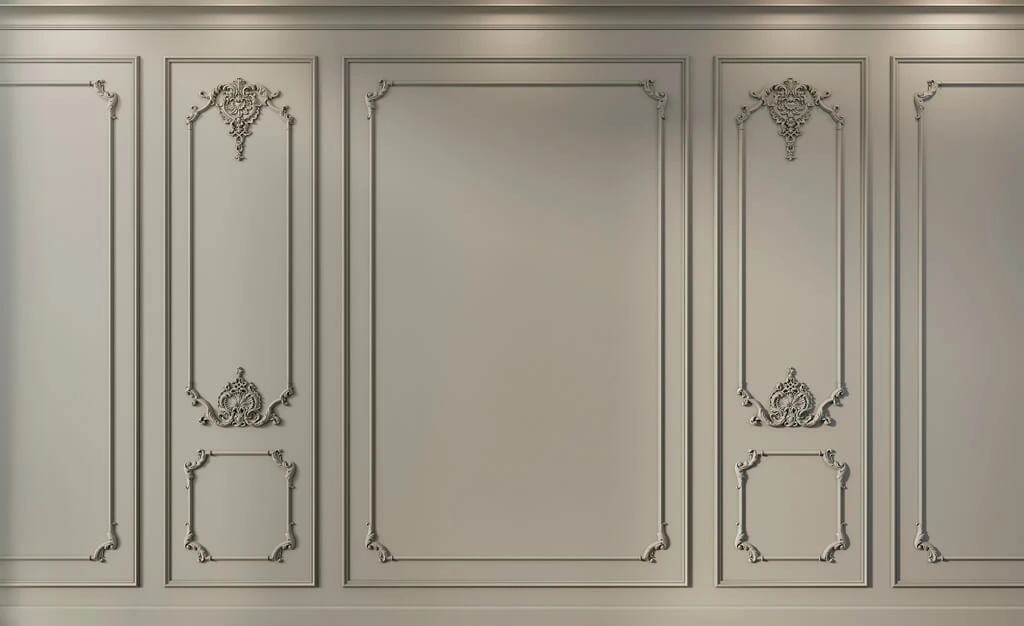
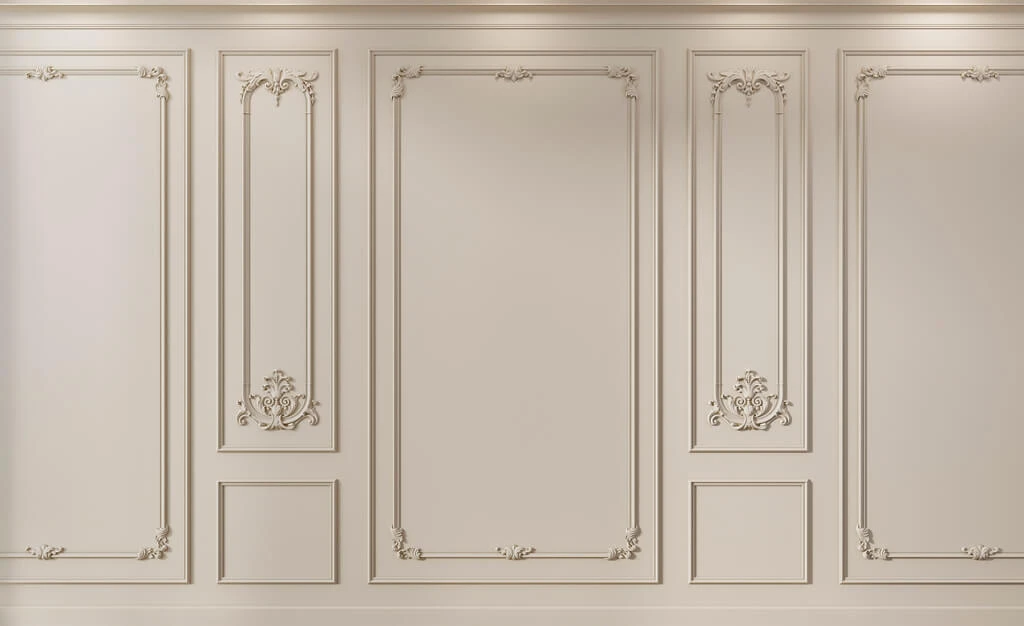
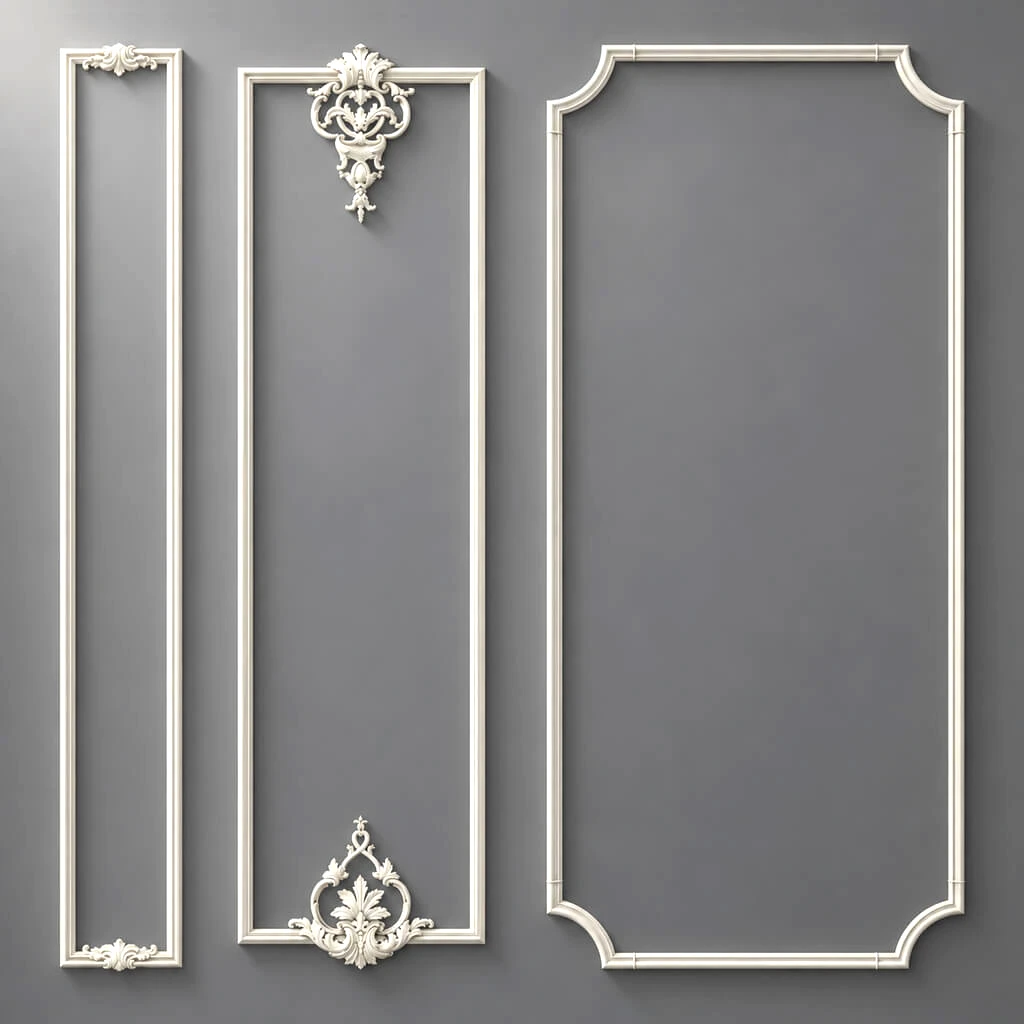
After installing a door, there is sometimes a section of wall left that is unexpectedly difficult to work with. Formally, there is space: between the trim and the corner, 300, 400, or 500 mm remain, the surface is flat, and furniture doesn't cover it. But when you try to transfer a familiar decorative frame made of moldings here, the narrow wall section instantly feels cramped. Two verticals of the frame, top and bottom crosspieces, and an inner empty field — for a small width, that's too many lines. Leaving the wall completely empty isn't always desirable either. In such a situation, it's appropriate to consider not a reduced copy of a large wall composition, but a single standalone decorative element.
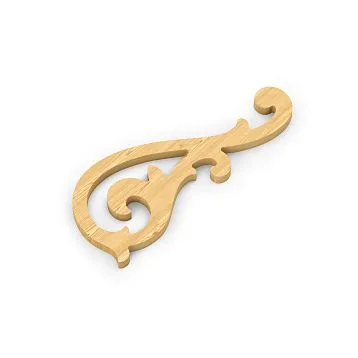
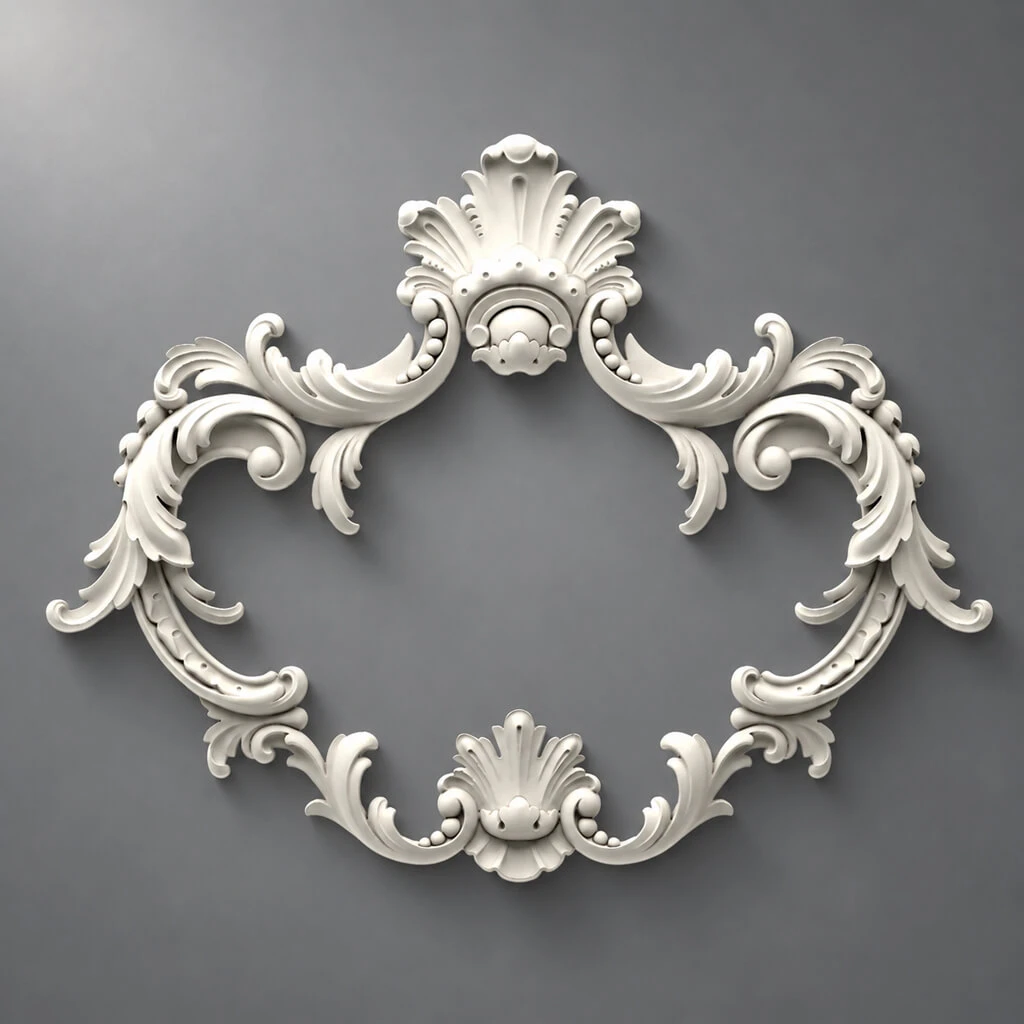
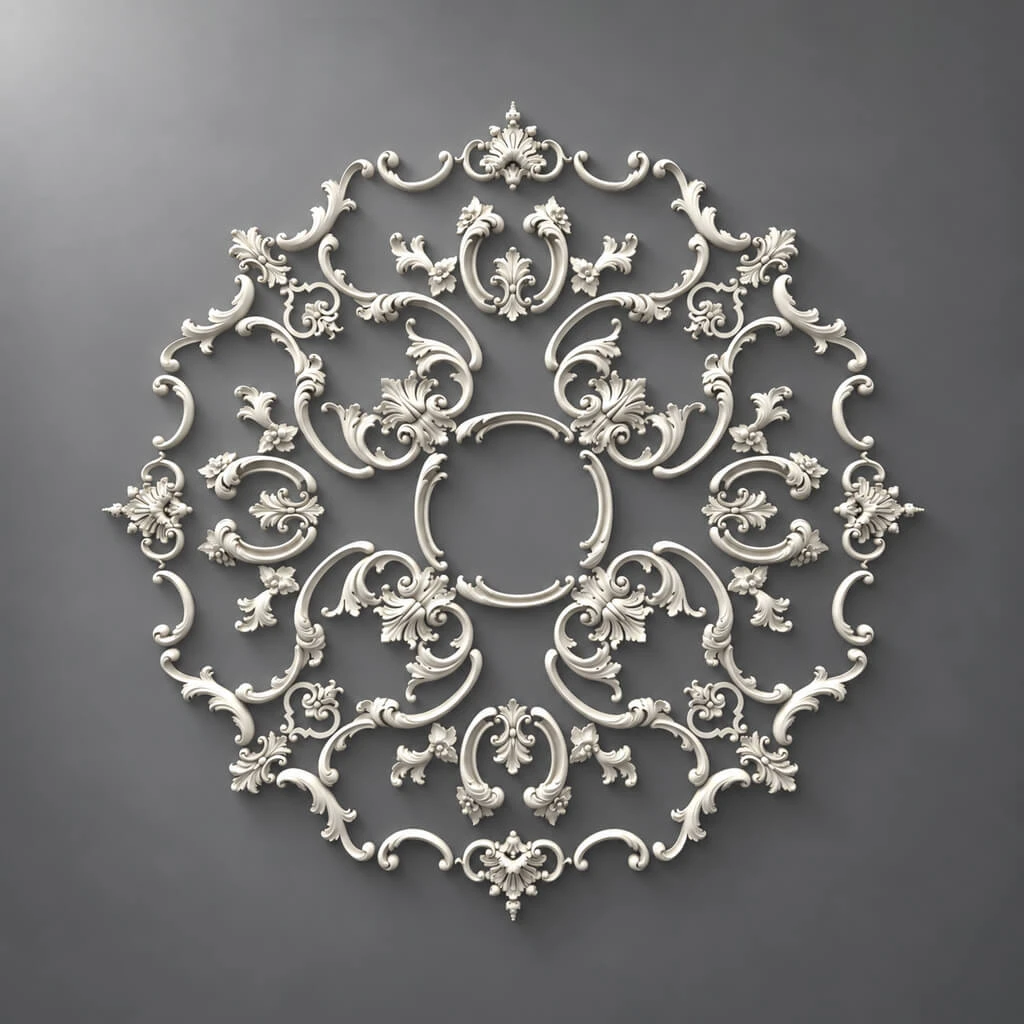
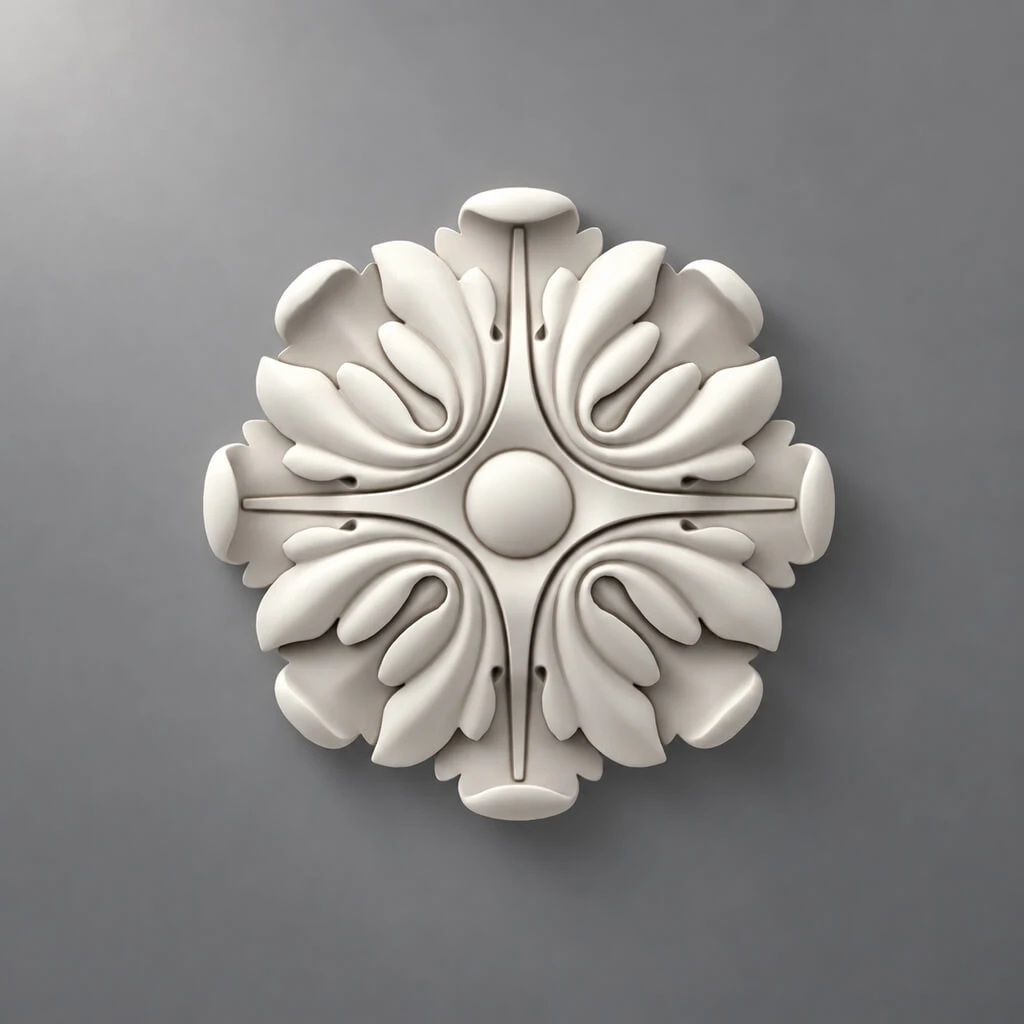
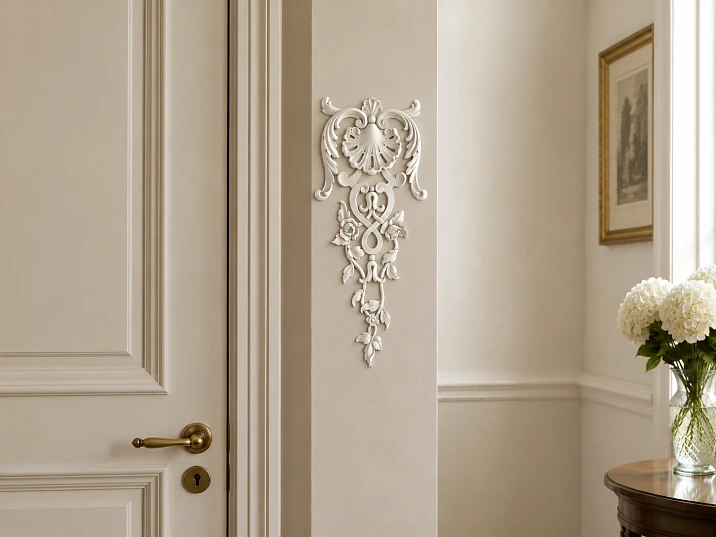
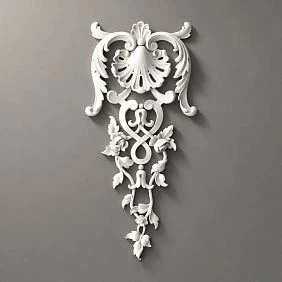
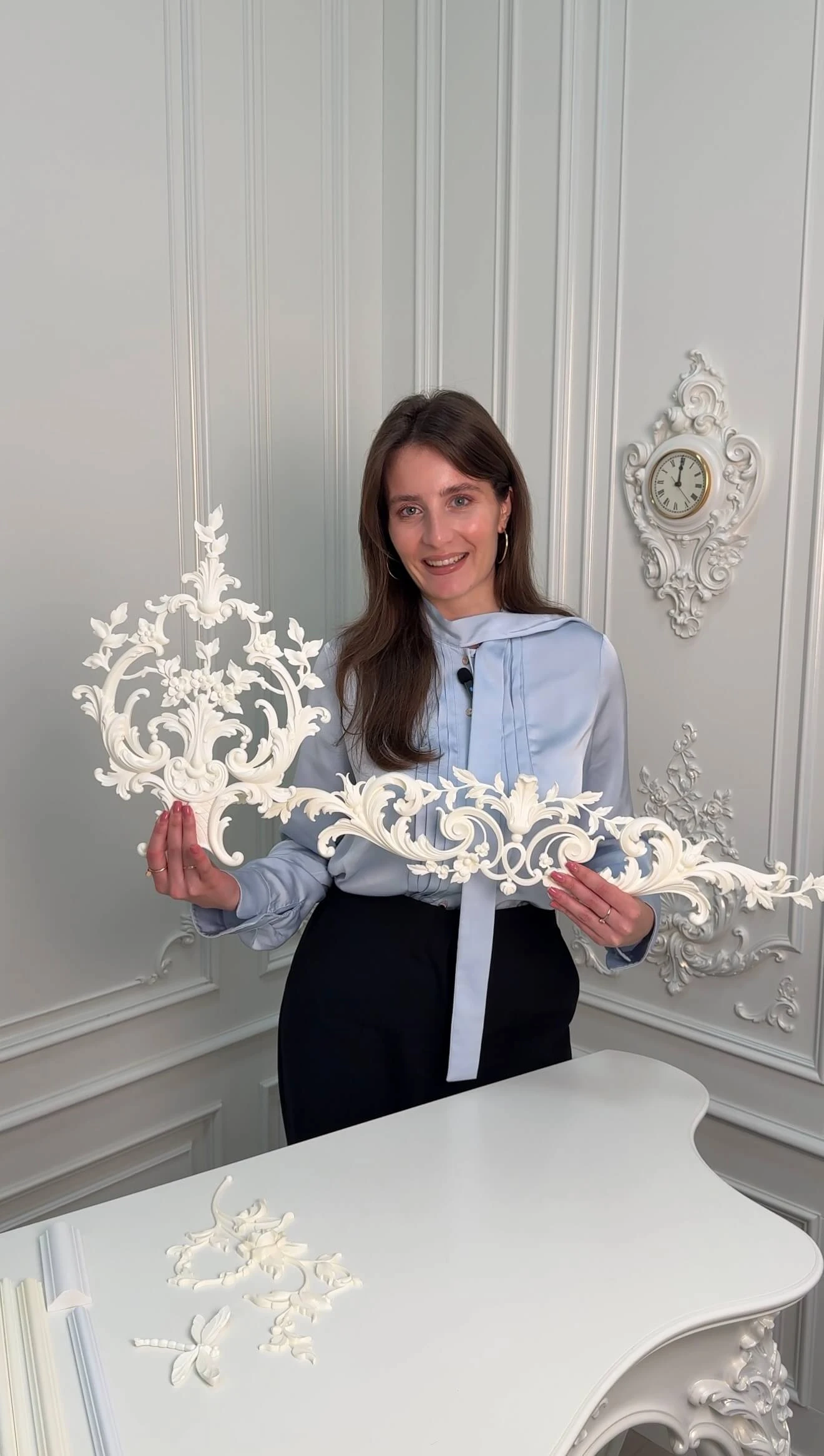
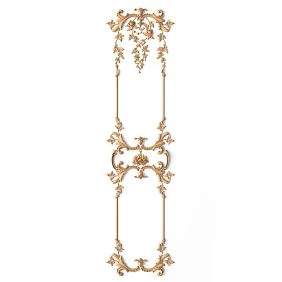
NPU.VRS-005 is a decorative polyurethane overlay measuring 150 × 321 × 16 mm. Its vertical shape allows it to be used where there isn't enough width for a full molding frame, but the free plane still needs an expressive detail. The overlay can be considered for a wall, niche, accent panel, and other interior surfaces. For a narrow wall section, it's especially interesting that the width of the detail itself is only 150 mm: before purchasing, it's easy to make a full-size paper mockup and literally see how much free wall will remain on the left and right.
Here, the principle of "the more stucco, the richer the wall looks" doesn't apply. A small surface requires the opposite approach: first determine how much decor it can accommodate, and only then choose the product. A narrow section between a door and a corner often looks better with a single expressive vertical overlay than with a frame that had to be reduced to the state of a cramped rectangle.
If the task goes beyond a single narrow wall section and several decorative zones of the apartment need to be coordinated, you can first You can buy ready-made stucco matching the Baroque style. Calculate the quantity: linear meters of cornices and moldings, number of rosettes, pilasters, consoles, corner elements. Add a ten to fifteen percent allowance for trimming. and build a common system. For the wall in question itself, a more precise route would be buy wall decor after measuring the free surface, and then compare a specific overlay with other wall decor formats.
When the idea is already defined — not a frame, but a single vertical carved piece — it makes sense to go to the category and Buy decorative polyurethane overlays. NPU.VRS-005 here becomes not a random item from the catalog, but a response to a very specific interior problem: a small wall width requires a compact but complete decorative gesture.
Why a narrow wall section is harder than a large empty wall
A large wall forgives a lot. You can move the frame right and left on it, change its width, make several identical fields, add vertical and horizontal divisions. If one idea doesn't work, the free area allows you to try another.
A narrow wall section lacks such a reserve.
On one side there is a doorway and a casing. On the other — the corner of the room. Below there may be a baseboard, nearby a switch, a door handle, furniture, or another detail. Every centimeter is already included in the overall geometry.
Therefore, the usual expression "just decorate the wall with moldings" helps little here.

A molding frame takes up width twice
Suppose the free plane between the trim and the corner has a width of 320 mm.
If you try to place a frame on it, you will need an indent from the trim, then the left profile, the inner field, the right profile, and another indent to the corner.
Even a thin profile visually breaks up the surface.
As a result, the wall itself, 320 mm wide, begins to be perceived as even narrower.
NPU.VRS-005 works differently. Its width is 150 mm. On the sides, an open surface remains, and it is this that allows the ornament not to look cramped.
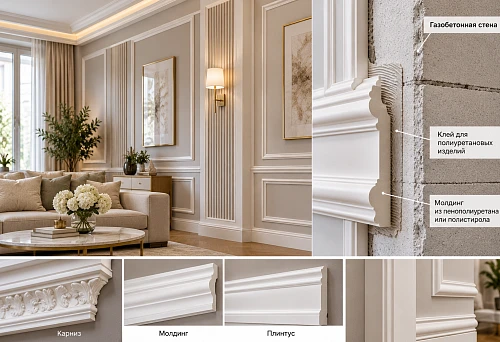
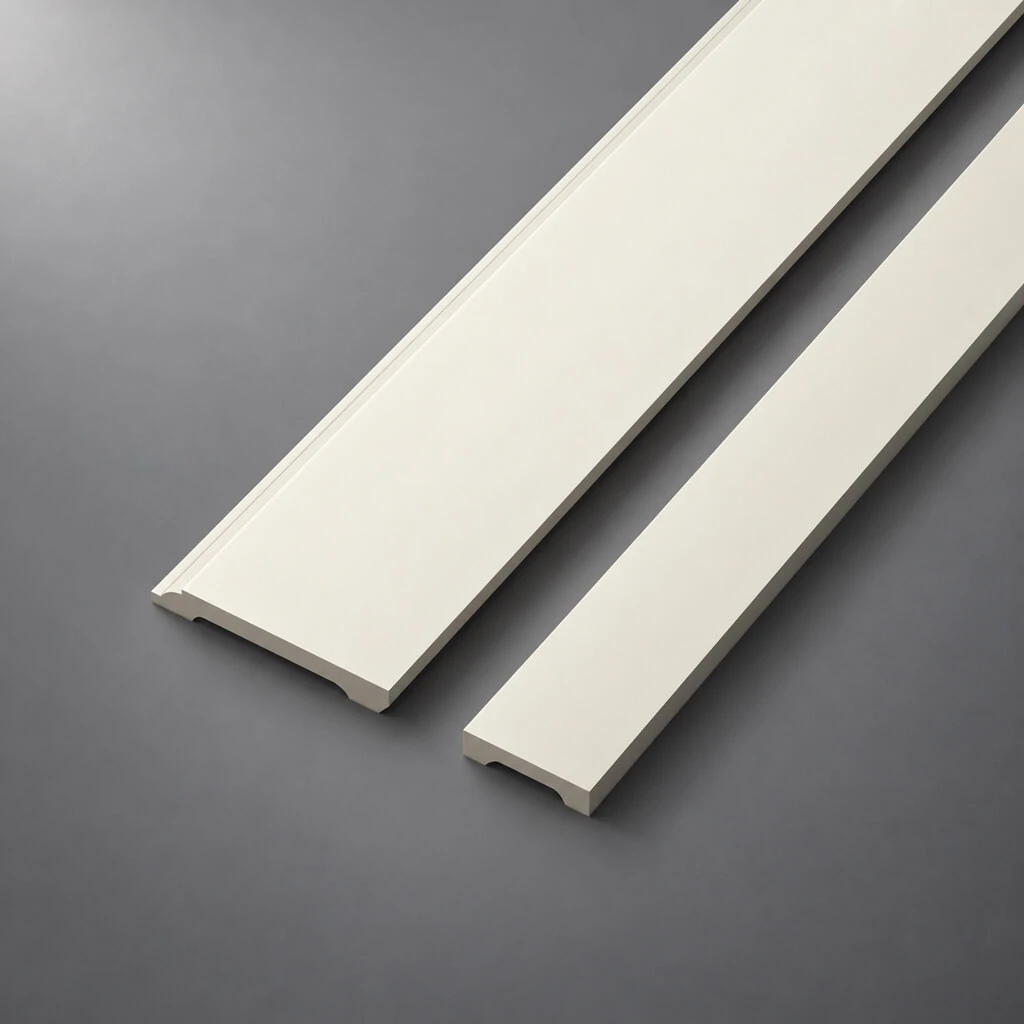
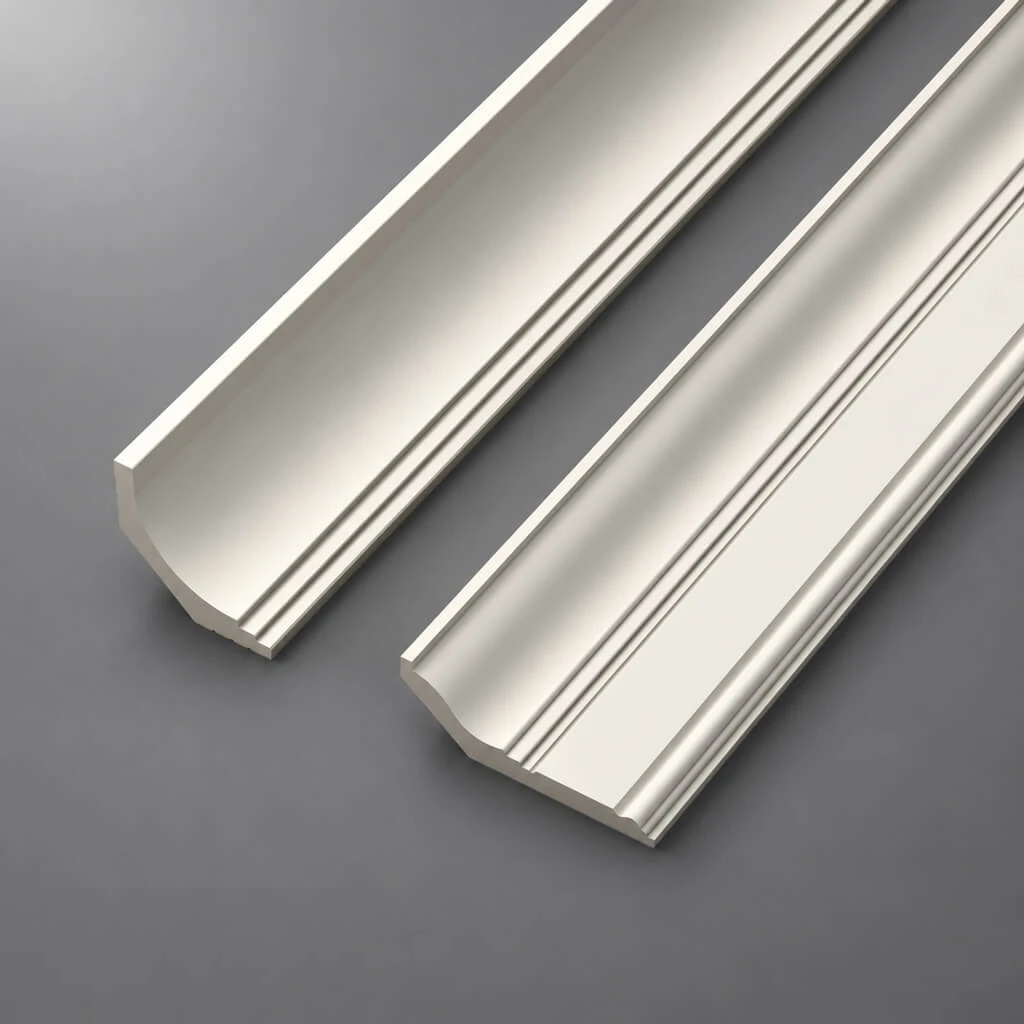
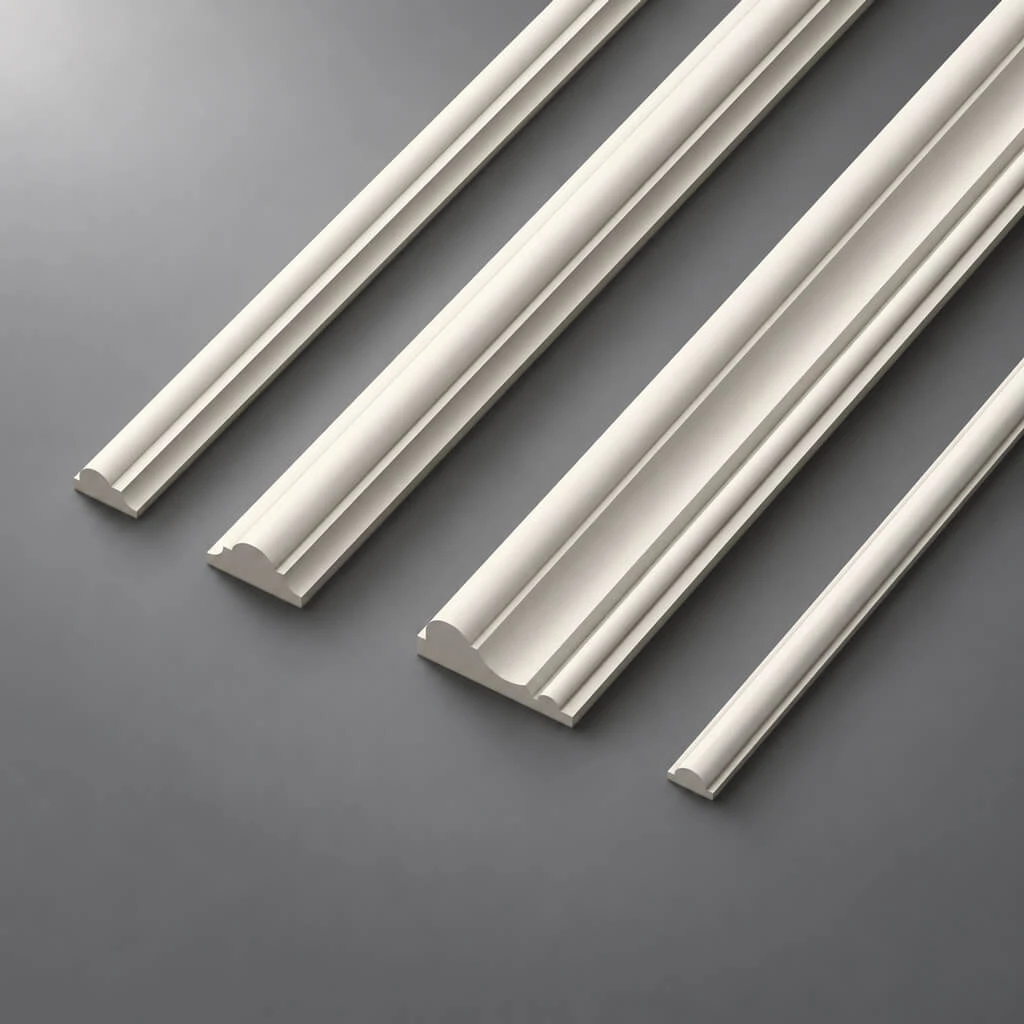
Our factory also produces:

A small field does not need a reduced version of a large decor.
This is an important principle.
If a frame 1200 mm wide looks good on a living room wall, transferring the same scheme to a 350 mm pier is pointless.
The proportions change.
A large frame works as an architectural division of the wall.
One decorative overlay is like a local wall accent.
Both ideas can belong to the same interior but serve different functions.
Get Consultation
NPU.VRS-005: specifications that really matter when choosing
The decorative trim has several confirmed parameters, and each one is important specifically for a narrow wall.
| Parameter | NPU.VRS-005 | Practical significance |
|---|---|---|
| Product type | Decorative overlay | Works as a standalone local element, no frame assembly required |
| Article number | NPU.VRS-005 | Allows you to find the exact model you need |
| Material | Polyurethane | The material must be considered when choosing the base and finish |
| Size | 150 × 321 × 16 mm | Allows you to check the width, height, and protrusion on the wall in advance |
| Width | 150 мм | Key dimension when matching to a narrow partition |
| Height | 321 мм | Determines the vertical scale of one trim |
| Depth | 16 мм | The relief protrudes relative to the wall plane |
| Current specified price | 4 060 ₽ | The actual cost needs to be verified before ordering |
| Possible application areas | Walls, niches, accent panels, and other interior surfaces | The overlay is not limited to just one type of wall |
| Specific product | Buy decorative overlay NPU.VRS-005 | Before ordering, you need to check the actual size of the free field |
For the task in question, the combination of 150 mm width and 321 mm height is especially useful. The overlay is clearly vertically elongated, so it can support the shape of a narrow wall section rather than conflict with it.
A depth of 16 mm also cannot be ignored. In a photo, the buyer primarily sees the ornament on the front, but on a real wall, the element has relief. If a door opens nearby, a furniture facade passes by, or a person constantly moves close to the wall, you need to account not only for the frontal width but also for the protrusion.
Start not with the purchase, but with the clean width of the wall
The phrase "a wall section 400 mm wide" sometimes turns out to be inaccurate.
A person measures the distance from the edge of the doorway to the corner but forgets that part of this space is occupied by the trim.
For NPU.VRS-005, the actually free decorative zone is important.
Measure the distance from the visible edge of the trim to the corner
If a trim is installed between the wall and the door, you should count from its outer edge.
For example:
the total width of the section from the opening to the corner is 450 mm;
the trim takes up 70 mm;
the actually free zone is about 380 mm.
It is precisely from 380 mm that the width of the 150 mm overlay should be compared.
Separately check protruding elements
The wall may contain:
-
switch;
-
socket;
-
thermostat;
-
intercom;
-
sensor;
-
wall lamp;
-
decorative trim;
-
Furniture.
If they fall into the expected NPU.VRS-005 zone, the geometric center of the empty rectangle will no longer necessarily be the best place for the overlay.
What does a width of 150 mm mean on piers of different sizes
The figure of 150 mm by itself says little. It is much more useful to see what part of the wall the overlay will occupy.
Pier 250 mm
NPU.VRS-005 occupies about 60% of the field in width.
With precise centering, about 50 mm of free wall remains on each side.
The composition turns out to be quite dense.
This option must be tried at full scale. If there is a wide trim nearby, the pier may feel even tighter.
Pier 300 mm
150 mm is exactly half the width.
With symmetrical placement, about 75 mm remains on the right and left.
This is already a calmer proportion, but the result depends on the trim pattern and the angle.
Pier 350 mm
The overlay occupies approximately 43% of the width.
When centered, about 100 mm remains on each side.
This margin begins to noticeably separate the carved element from adjacent boundaries.
Pier 400 mm
The product width is 37.5% of the field.
Approximately 125 mm of free background remains on each side.
The overlay reads as an independent vertical accent, not as an element filling the entire wall.
Pier 450 mm
The decor accounts for a third of the width.
When centering, approximately 150 mm remains on each side.
Interestingly, the free space on the right and left becomes approximately equal to the width of the NPU.VRS-005 itself.
Pier 500 mm
The overlay occupies 30% of the total width.
This is already a fairly free composition.
On such a wall, it is worth comparing two solutions: one NPU.VRS-005 and a small molding frame. Perhaps there is already enough space for both approaches.
Selection table by pier width
| Free wall width | NPU.VRS-005 share | What to Check |
|---|---|---|
| 250 мм | 60% | Doesn't the overlay look squeezed between the trim and the corner? |
| 300 мм | 50% | Is there enough free background on the sides |
| 350 мм | about 43% | Does the centering look convincing |
| 400 мм | 37,5% | Is an additional frame needed at all |
| 450 мм | about 33% | Does one overlay seem too small |
| 500 мм | 30% | Compare a single overlay with a small frame of moldings |
This table does not set the minimum allowable wall width. It is needed for a preliminary assessment of the proportion.
Two piers of the same width can be perceived completely differently if one has a thin smooth trim next to it, and the other has a large carved door frame.
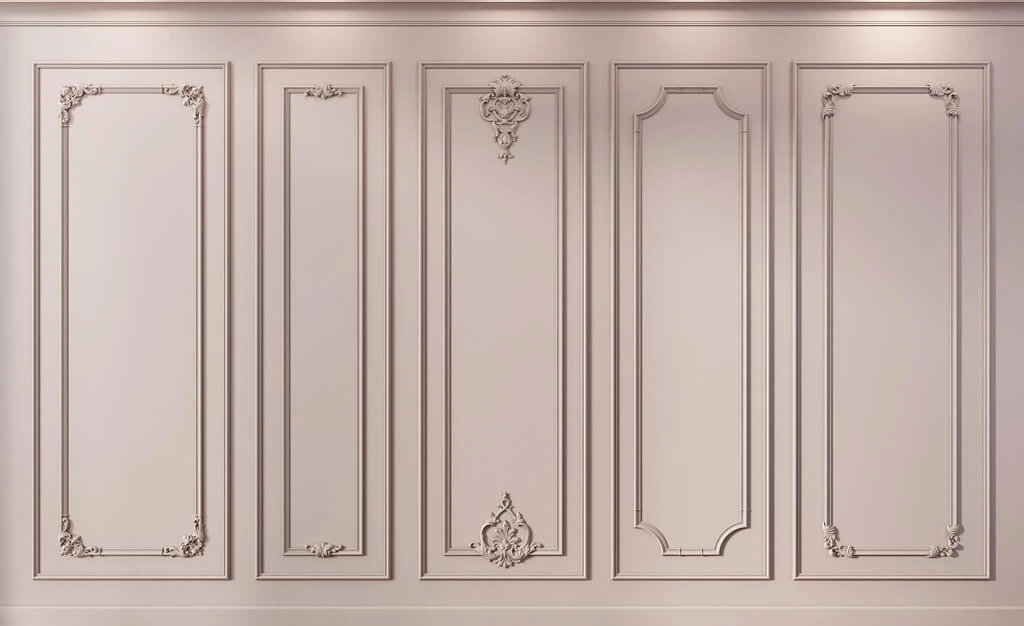
One NPU.VRS-005 versus a frame of moldings: where the difference becomes fundamental
Both ideas relate to wall decor, but they work differently.
| Criterion | One NPU.VRS-005 | Frame made of moldings |
|---|---|---|
| Number of lines | One local ornament | Four sides of the frame |
| Wall width requirement | Relatively small | Space is needed for both the profile and the inner field |
| Character of the Decoration | Carved vertical accent | Geometric division |
| Calculation | Checking the dimension 150 × 321 mm | Need to calculate the frame perimeter and joints |
| Angles | There are no separate joints | Usually four corners need to be designed |
| Perception on a narrow pier | May leave air around the decor | May make the field tighter |
| Approach to purchase | One or several ready-made overlays | Several linear elements |
| When it is especially appropriate | Narrow wall section, niche, small accent | Wider free surface |
If after fitting it turns out that the wall section is large enough and architectural geometry is required, you can buy polyurethane moldings.
But on a small surface, you shouldn't consider a frame a mandatory sign of "proper stucco molding."
The overlay has one important advantage: it doesn't require an inner field
A molding frame always creates another rectangle inside itself.
Therefore, you need to decide how wide, tall, and proportional it is.
NPU.VRS-005 has no inner field.
The ornament itself is a complete object.
For a narrow section of wall, this saves visual space.
You can draw an analogy with a painting and a separate decorative object.
A painting requires its own frame and space around it.
A relief wall piece itself forms the center.
Where to center NPU.VRS-005: not always in the middle between the door and the corner
The geometric center is a good starting point, but not the only possible answer.
The wall section is located next to two different boundaries.
On the left, there may be an active door casing.
On the right, there is a calm corner line.
These boundaries have different visual weight.
First, try the mathematical center
If the free width is W and the trim width is 150 mm, the side margins when centering are:
(W − 150) ÷ 2.
For a 400 mm wall section:
(400 − 150) ÷ 2 = 125 mm.
That gives 125 mm on each side.
Make this marking first.
Then look at the entire wall, not at the ruler
Sometimes a wide casing visually "extends" onto the wall section more than a simple corner.
Because of this, a perfectly mathematical placement appears shifted toward the door.
Then a slight visual shift can make the composition calmer.
But such a decision should be made based on the layout, not by eye before fitting.
Do not center the overlay relative to the door leaf.
This is a common confusion.
The wall between the door and the corner is a separate decorative field.
The axis of the door leaf is located elsewhere and is not the main reference point for it.
NPU.VRS-005 should be associated primarily with:
-
the free part of the wall;
-
the casing;
-
a corner;
-
adjacent verticals;
-
furniture, if it is nearby.
Placement height: why a universal millimeter mark would be a mistake here
The NPU.VRS-005 has a known height of 321 mm, but this does not mean there is a single mandatory height from the floor.
The wall sections differ.
In one room, there is a tall door nearby.
In another, a molding runs along the top.
In a third, there is a console below.
In a fourth, the wall remains completely free.
Therefore, it is more correct to choose the position relative to the visible vertical field.
Option: overlay as a central accent
If the wall is free of furniture and other elements, first check the position near the visual center of the wall section in height.
It doesn't have to be the physical center of the wall from floor to ceiling — you need to account for the baseboard, door casing, and the top part of the trim.
Option: connection with the door
If there's a decorative door nearby, you can orient the overlay so that it supports the middle part of the door frame.
But don't mechanically align it with the handle.
The handle is a functional detail, not an architectural axis for wall molding.
Option: connection with furniture
If a narrow console or cabinet stands under the wall section, the overlay can work as the top decorative center of that vertical zone.
Then its position is chosen relative to the furniture and the free space above it.
A paper template of 150 × 321 mm is the most useful try-on before ordering
For NPU.VRS-005, the mockup is especially simple.
You don't need to reproduce the drawing.
It's enough to cut out a rectangle:
150 × 321 mm.
It's better to use thick paper or thin cardboard.
The template shows four things at once
First, the real width.
Second, the vertical scale.
Third, the distance to the trim and corner.
Fourth, the position by height.
Start with one template
Attach it with painter's tape.
Look from the hallway, from the adjacent room, from the door opening point.
Don't limit yourself to looking from a distance of 30 cm.
Wall decor is perceived as part of the interior, not as a product card.
Take a photo
The camera helps to see the imbalance.
In the photo, it's easier to notice if the template hangs too high, if it visually sticks to the door trim, or if there's oddly too much empty space on the corner side.
Depth of 16 mm: a small number that cannot be ignored
The frontal size determines the composition.
Depth determines the volume.
NPU.VRS-005 protrudes 16 mm from the surface.
On a regular free wall, this primarily creates relief.
But near a door, additional questions arise.
Does the door open toward the wall section
If the door leaf, handle, or another part of the structure passes close to the wall, the trajectory of movement needs to be checked.
The decorative cover should not be installed in a potential contact zone just because everything looks clear when the door is closed.
Does a person pass close to the wall
In a very narrow corridor, the relief is perceived differently than in a spacious room.
Sixteen millimeters is not a huge protrusion, but it is no longer a painted ornament.
Is there a furniture door nearby
If there is a cabinet nearby, check the movement of its door.
The meaning is the same: a frontal photograph of the wall does not show all real intersections.
The wall section between the door and the corner: a basic scenario for NPU.VRS-005
This is where one overlay is most understandable.
There are two vertical boundaries:
-
door trim;
-
the corner of the wall.
A field remains between them.
If it is too narrow for the frame, NPU.VRS-005 works as an independent center.
Why the vertical form is convenient
The wall section itself is elongated vertically.
A horizontal detail could emphasize the small width more strongly.
A vertical overlay supports the natural direction of the surface.
When one NPU.VRS-005 is particularly convincing
When:
-
the width is sufficient for noticeable margins on the right and left;
-
there is not a large amount of other ornamentation nearby;
-
the door itself is already decorated expressively enough;
-
you want to add a detail to the wall, but not a second architectural frame.
The wall section between two doors: the rules change slightly
Between two doors, the overlay is surrounded not by a corner and a casing, but by two active casings.
The composition becomes more symmetrical.
Here, geometric centering works especially naturally.
Measure the distance between the outer edges of the casings
Not between the door frames.
It is the casings that form the visual boundaries of the decorative field.
Check that it is not too cramped
If the distance between casings is 300 mm, NPU.VRS-005 with a width of 150 mm will take up half of the field.
If the casings themselves are carved and wide, the free zone may appear smaller than the nominal size.
Do not duplicate the ornament unnecessarily
Two doors already create a rhythm.
One central overlay may be sufficient.
Narrow niche: NPU.VRS-005 as a separate center
The product card allows the use of an overlay in niches, so this scenario is logical to consider separately.
The niche has a natural frame — its own boundaries.
Adding another frame of moldings inside often means creating a rectangle within a rectangle.
One NPU.VRS-005 can solve the task more simply.
Measure the internal width of the niche
The width of 150 mm should be compared specifically with the clean internal field.
Consider the depth of the niche
The overlay has a relief of 16 mm.
In a deep niche, this is usually perceived as part of the inner surface.
In a very shallow one, the relief may seem stronger.
One overlay or a vertical pair
If the niche is tall, a single 321 mm piece may seem too small.
Then it is worth checking two identical overlays vertically.
But do not order a pair automatically — first make two paper templates.
Accent panel: the overlay can work without a separate frame
If the wall section is covered with a decorative panel, another boundary appears — the edge of the panel itself.
In this case, NPU.VRS-005 can be placed inside it as a central relief element.
This is a good example where a molding frame is not only unnecessary but can also duplicate existing geometry.
The panel sets the field.
The overlay provides an ornament.
Two levels are enough.
One NPU.VRS-005 or two vertically
The size of 150 × 321 mm makes a single overlay a compact accent.
On a tall wall segment, the question arises: doesn't it look too small?
Instead of automatically switching to another model, you can check a vertical pair.
One overlay
Works as a local center.
More free wall remains around it.
Suitable if the door itself and adjacent surfaces are already sufficiently saturated.
Two overlays
Create a longer decorative vertical line.
Suitable for a tall free field if one piece really gets lost.
How to determine the distance between them
There is no universal value.
First, make two templates 150 × 321 mm.
Try different gaps and photograph the entire wall.
Do not turn two overlays into a randomly torn ornament.
Three overlays on a narrow wall segment is almost always a different compositional task.
Technically, several repetitions can be imagined.
But three elements, each 321 mm high, already create a pronounced vertical system.
This ceases to be the idea of "one overlay instead of a frame."
If the wall section is so tall and wide that three elements are required, it is worth comparing:
-
a larger decorative element;
-
a molding frame;
-
full-fledged wall decor.
Here it is useful to go back to the category and Buy decorative polyurethane overlays after comparing other sizes.
When one overlay looks better than an expensive and complex composition
Price and quantity of parts do not determine the quality of the result.
A narrow wall shows this especially clearly.
Imagine a section 350 mm wide.
Option one:
-
two vertical moldings;
-
two horizontals;
-
four corner joints;
-
a small inner field;
-
possibly, one more insert inside.
Option two:
-
one NPU.VRS-005 with a width of 150 mm;
-
an open surface remains around it.
The first option is technically more complex.
But the second one can look calmer and more expensive precisely due to the absence of crampedness.
When a molding frame is still better
NPU.VRS-005 cannot be turned into a universal replacement for moldings.
The frame makes sense if the pier is wide enough.
For example, on a field of 500–700 mm, you can already get normal internal space rather than a narrow vertical channel.
The frame is chosen for the sake of architecture
It connects the wall with other rectangular fields of the room.
If the entire room is built on a molding grid, one wall section without a frame can stand out.
The overlay is chosen for its ornament.
It can support the decorative style without repeating the geometry of adjacent frames.
If after the mockup it is clear that the wall needs a rectangular contour, it is more reasonable buy polyurethane moldings and not to make the overlay solve someone else's task.
Can NPU.VRS-005 be combined with moldings?
It is possible, but then the original idea of the article disappears — an overlay without a frame.
On wider walls, the combination may be appropriate: moldings form the field, NPU.VRS-005 is placed inside.
On a narrow wall section, this should only be done after a mockup.
If the frame itself is already tight, adding an overlay will make it even denser.
For developed compositions, there is a separate category where you can buying polyurethane molding decor. But such elements should be used where the wall area truly supports multi-layered decoration.
Entryway: a place where one vertical element is especially clear
The entryway has many functional boundaries.
Doors, wardrobe, mirror, console, switches.
Large decorative frames do not always fit.
NPU.VRS-005 allows you to occupy a small free area without new large geometry.
Next to the front door
Check the movement of the door leaf and handle.
If the door opens in the other direction and nothing threatens the wall, you can work with the wall segment as a separate vertical field.
Between the entrance door and the interior door
Here it is especially important to measure the clear width between the casings.
One overlay can become a calm connecting element between two portals.
Corridor: repeating the same NPU.VRS-005 can link several narrow wall sections.
In a long corridor, the same type of surface often repeats:
door — wall section — door — wall section.
If the dimensions are close, identical overlays can create a sequence without a complex molding grid.
There is no need to fill every section.
Sometimes it is better to decorate only two or three key wall sections.
Repeating on every available surface can turn a beautiful ornament into a mechanical pattern.
First, decide where the rhythm begins.
For example, overlays are installed only on piers wider than a certain visual scale.
Narrow sections remain empty.
This way the composition does not look forced.
Bedroom: NPU.VRS-005 as a small decor near the door
In the bedroom, the main decorative center is usually near the bed.
Therefore, the pier near the door should not compete with it.
One overlay can softly continue the molding language already present on the main wall.
Especially if large fields are framed with moldings, and the small area near the door remains without a frame.
This results in a clear hierarchy:
-
large wall — architectural frame;
-
narrow pier — local ornament.
Living room: a small wall section doesn't have to repeat the scale of the main wall.
In the living room, there's often a desire to make everything uniform.
For example, on the main wall there are three large frames.
Next to the door, 350 mm remains.
Trying to squeeze a fourth frame in there just for symmetry can ruin the overall composition.
NPU.VRS-005 allows you to maintain decorativeness but change the format.
This is one of the strong scenarios: one style, but different tools depending on the wall area.
Study: vertical overlay between the door and the bookshelf
Here, the free area may be limited not by a corner, but by tall furniture.
The principle remains the same.
Measure the clear gap between the trim and the cabinet.
Check whether the furniture door will open toward the relief.
Then apply the 150 × 321 mm template.
If the overlay looks convincing, a separate molding frame is no longer needed.
Commercial interior: small wall sections can be repeated as a signature motif.
In a salon, showroom, small hotel, or other public space, identical door sections are often repeated.
NPU.VRS-005 can be used as a repeating decorative motif on limited walls.
But here the number of elements grows quickly.
Before a large order, it is especially important to test one real section.
A wrong scale repeated ten times is more noticeable than a single error in an apartment.
Wall color and relief: two different ways to showcase NPU.VRS-005
After choosing the size, the question of finishing arises.
Specific material compatibility cannot be determined without testing the product, the wall, and the chosen coating system.
But compositionally, there are two clear directions.
The overlay is close to the wall color
Then its form is revealed mainly through relief, light, and shadow.
On a narrow wall segment, this helps maintain calm.
The ornament is present but does not turn the small surface into a contrasting insert.
Contrast highlighting
Color separates NPU.VRS-005 from the wall more strongly.
A width of 150 mm begins to be perceived more actively.
On a wall segment of 250–300 mm, such a technique can visually occupy a large part of the surface.
Therefore, it is advisable to check the color contrast on a mockup rather than choose it after installation.
Do not try to fix an incorrect size with color
If NPU.VRS-005 looks too large on the wall, painting it in the surface color can soften the impression, but it will not change the physical width of 150 mm.
If a detail seems too small on a large field, contrast will make it more noticeable, but it will not turn it into an architectural frame.
First, the proportion.
Then, color.
Polyurethane is important in this article as a confirmed material, not as a reason to invent properties
NPU.VRS-005 is made of polyurethane.
This is enough for the buyer to understand which product group the item belongs to and with which categories to compare it.
There is no need to automatically attribute unconfirmed characteristics of coating, moisture resistance, painting method, or installation to a specific overlay.
Before ordering and finishing, it is better to verify the current information in the product card and select a work system based on the actual surface.
What to check on the wall before installation
A designer fitting answers the question "is it beautiful."
A technical check — "can it be installed properly here."
These are different things.
Before starting work, look at:
-
what material the surface is made of;
-
how level it is;
-
what coating has already been applied;
-
whether there are cracks or peeling areas;
-
is the moving part of the door not passing nearby;
-
does the switch not interfere;
-
is there free space for the 16 mm relief.
The specific fixing system should be chosen considering the polyurethane and the base, not based on random universal advice.
Already painted wall: do not start with gluing
If the renovation is finished, it is especially disappointing to discover after installation that the position was chosen incorrectly.
First, a paper mock-up.
Then marking.
Then checking the actual base.
And only after that — the chosen installation technology.
This order saves more time than trying to quickly attach the part and then adjust the position.
What to buy together with NPU.VRS-005 and what you don't need to buy automatically
A single overlay is good because its purchase can remain simple.
But for some projects, adjacent categories are needed.
| What to consider | What for | When needed | Link |
|---|---|---|---|
| NPU.VRS-005 | Main vertical decor for a narrow wall section | When the 150 × 321 mm template fits the scale | Buy decorative overlay NPU.VRS-005 |
| Other decorative overlays | Compare size and pattern | When NPU.VRS-005 is too large or too small | Buy decorative polyurethane overlays |
| Wall decor | Extend the design to adjacent walls or niches | If the project includes several different zones | buy wall decor |
| Moldings | Make a geometric frame instead of a single overlay | If the wall width is already sufficient for the frame | buy polyurethane moldings |
| Decor for moldings | Develop a more complex frame system | Only on a sufficiently large surface | buying polyurethane molding decor |
| Polyurethane molding | Connect the pier to the overall room system | When more than one wall is being decorated | You can buy ready-made stucco matching the Baroque style. Calculate the quantity: linear meters of cornices and moldings, number of rosettes, pilasters, consoles, corner elements. Add a ten to fifteen percent allowance for trimming. |
For the original theme, the most rational set may consist of just one NPU.VRS-005. This is normal.
A complex set is not a mandatory sign of a finished interior.
How not to confuse NPU.VRS-005 with a molding
A molding is a linear element.
It is used to create long lines and frames.
NPU.VRS-005 — a separate decorative overlay of fixed size 150 × 321 × 16 mm.
It does not need to be calculated in linear meters.
It already has a finished shape.
If the task is to "outline the field around the perimeter," a molding is needed.
If it's "to place one carved vertical accent," an overlay is considered.
How not to confuse an overlay with a carved panel
A panel usually occupies a significantly larger field and forms an independent surface.
NPU.VRS-005 is more compact.
It does not try to cover the entire wall section.
On the contrary, an important part of the composition is the free wall around it.
A rosette and a socket are also not the same thing.
A rosette often has a more centered geometry.
NPU.VRS-005 is elongated vertically.
It is this proportion that makes it convenient for a narrow wall section.
You should not choose a product only by the general word "stucco molding."
The type of shape affects how the element is perceived on the wall.
Practical scenario: a 250 mm wall section
This is a dense option.
The width of NPU.VRS-005 is 150 mm.
With ideal centering, 50 mm remains on each side.
What are we checking?
First, the width of the trim.
Second, how sharply the wall corner reads.
Third, the depth of 16 mm.
If the overlay looks visually squeezed, don't reduce the side margins even further. It's better to choose a different decorative element of a smaller scale or leave the wall free.
Wall section 300 mm
75 mm of free wall on each side when centered.
This is already a more comfortable margin.
But a large carved trim can visually take up part of the space.
Make a mockup and look at it together with the door.
If the door ornaments and NPU.VRS-005 start to compete, the problem is not necessarily the size — perhaps this wall segment is better off staying calmer.
Wall segment 350 mm
About 100 mm of free space on the right and left.
Here NPU.VRS-005 starts to work especially well as a standalone object.
There is space to see its outline.
At the same time, a full frame may still turn out to be too tight.
This is one of the most understandable scenarios of the original idea.
Wall segment 400 mm
125 mm on each side.
One overlay gets enough background.
But it's already worth asking an additional question: doesn't the entire height of the wall look too empty with just one 321 mm detail?
If so, compare:
-
one NPU.VRS-005;
-
a vertical pair;
-
a small frame.
The choice no longer depends
Assuming that if 150 mm fits, the size automatically works
Physical fit and visual proportion are different things.
Hanging the overlay too close to the door
The ornaments blend together, and the free space on the other side becomes unjustifiably large.
Ignore 16 mm depth
Especially near an opening door.
Making a molding frame around NPU.VRS-005 on a wall that is already cramped
Too many lines appear.
Choosing height by eye without a mockup
The part may end up too high or low relative to the door.
Buying two overlays without seeing one
A vertical pair changes the scale very noticeably.
Making a contrasting color before checking the proportion
Contrast amplifies any placement error.
Fill every wall segment of the apartment with the same decor
The repetition must have compositional logic.
Treat NPU.VRS-005 as a linear element
It has a fixed size, it is a separate overlay.
Do not check the actual free surface
A socket, switch, or furniture can make the project impossible.
Choose only based on a large photo of the ornament
The card shows a detail, but you need to see the entire wall.
Try to "fit" the overlay by changing its shape
If the size does not fit, it is better to look at other overlays.
When NPU.VRS-005 is especially appropriate
This model deserves a try if several conditions match.
You have a narrow vertical wall section.
The molding frame looks too cramped.
The 150 mm width leaves noticeable background on both sides.
The 321 mm height matches the required scale.
The 16 mm depth does not conflict with sliding doors and furniture.
The interior allows for carved ornament.
Then you can order NPU.VRS-005 150 × 321 × 16 mm after checking the natural template.
When it's better to choose a different decor
NPU.VRS-005 should not become mandatory just because the article topic is dedicated to it.
Another option is more reasonable if:
- The pier is too narrow;
- 150 mm takes up almost its entire width;
- one overlay is too small relative to the large surface;
- the vertical shape does not match the composition;
- there is already a very ornate carved door nearby;
- the 16 mm relief falls into the dangerous opening zone;
- the entire wall is built on strict smooth molding frames, and a separate ornament looks foreign.
In that case, you can Buy decorative polyurethane overlays of a different scale or move to another group of wall decor.
When it is better to return to moldings
The pier has enough width.
The adjacent walls are already decorated with rectangular frames.
What is needed is not a local ornament, but a continuation of the architectural grid.
Then buy polyurethane moldings it will be more consistent than artificially replacing a frame with a single overlay.
Especially if the width of the field exceeds that at which moldings begin to look loose.
How to connect NPU.VRS-005 with a large wall decorated with frames
This is an interesting interior technique.
Suppose in the living room a large wall is decorated with several rectangular fields.
A narrow wall section remains near the door.
There is no need to reduce one of the frames to a miniature size.
You can keep the geometry of the large wall as the main level, and use one NPU.VRS-005 on the narrow field.
The connection is created not by the identity of form, but by the overall decorativeness.
If colors and scale are coordinated, the solution looks natural.
How to combine several different overlays in one interior
It is not necessary to place NPU.VRS-005 everywhere.
For example:
- on narrow wall sections, NPU.VRS-005 is used;
- on a wide field — a larger overlay;
- in a niche — another element;
- the walls are united by a common finish.
Such a system can be richer than a mechanical repetition of one detail.
But additional models should be chosen from a confirmed category, rather than inventing random combinations.
One ornament near the door: when the door should remain the main element
The door itself may have:
- panels;
- decorative trim;
- carved details;
- an intricate handle.
In this case, NPU.VRS-005 plays a secondary role.
It should not visually draw attention away.
Particular care should be taken with contrasting finishes.
If the door is simple and smooth, the wall panel can become a more noticeable accent.
The corner of the wall is not an empty space, but a strong vertical boundary
When designing a wall segment, a door is often taken into account, but the corner is forgotten.
Meanwhile, the corner of the room is clearly perceived by the eye.
It completes the plane.
If NPU.VRS-005 is placed too close to it, the right part of the ornament will appear cramped.
That is why the layout should be viewed not only frontally, but also at an angle from the adjacent part of the room.
The door trim also works as a decorative line.
The more active the trim, the calmer the wall segment should be decorated.
If the trim is wide and carved, NPU.VRS-005 should be given more free space.
If the door has a simple smooth contour, the overlay can be placed more confidently.
There is no universal distance in millimeters.
There is a principle — ornaments should not visually stick together.
Is symmetry needed on the opposite side of the door?
Suppose there is a 350 mm wall section to the right of the door, and a wide wall area to the left.
Is it mandatory to install NPU.VRS-005 in both places?
No.
The architecture is already asymmetrical.
Attempting to create artificial pairing may require placing a second overlay where it is not needed at all.
Symmetry is good when there are equal fields for it.
Two narrow wall sections on both sides of the door
Here, pairing becomes natural.
If the fields on the left and right are of equal width, two NPU.VRS-005 units can frame the portal without an additional frame.
Before ordering, make two templates at the same time.
One overlay alone may look good, but two next to the door can be too busy.
Or vice versa: a paired composition finally ties the opening together.
Can the overlay be placed horizontally?
The topic is built around vertical use because the proportions of NPU.VRS-005 fit a narrow wall section well.
Changing the orientation of the product should only be done within an approved design and installation solution.
For the original task, there is no need to complicate the project: the vertical position directly supports the shape of the wall.
What does not need to be assembled from scratch if a ready-made overlay is used
In a small area, it is especially pointless to complicate the work.
Do not:
- assembling a miniature frame from four moldings;
- fit four corner joints;
- calculate the linear footage for one small field;
- cut the ornament by hand;
- combine several random small details;
- try to fill the entire wall with decor.
The finished NPU.VRS-005 already has a specific size and ornament.
The buyer focuses on what is more important:
whether the scale fits, where the center is, whether one piece or two are needed, and whether the relief conflicts with the door.
How to prepare a small specification before purchasing
For one simple wall segment, it is enough to note:
Location: between the door and the corner.
Clear width: for example, 360 mm.
Clear zone height: measured on site.
Architrave: taken into account.
Switches: absent or located outside the zone.
Template: 150 × 321 mm approximate.
Quantity: 1 pc.
Depth 16 mm: does not conflict with the door.
After this, you can proceed to the product.
Multiple wall sections: the table will help avoid mixing up the quantity.
| Zone | Net width | Layout NPU.VRS-005 | Solution | Quantity |
| Hallway, to the right of the door | 350 мм | Suitable | One overlay | 1 |
| Corridor, between doors | 310 мм | Fits after centering | One overlay | 1 |
| Bedroom, near the wardrobe | 240 мм | Too tight | Another decor | 0 |
| Living room, near the portal | 480 мм | One looks too small | Compare with frame | 0 or after decision |
Such a simple document protects against buying the same quantity for surfaces of different scales.
How to buy NPU.VRS-005 on STAVROS
The path depends on the project's readiness level.
If the entire type of wall decoration is still being chosen, you can start with the general section and buy wall decor after comparing different approaches.
If it's already clear that a separate overlay is needed, you can Buy decorative polyurethane overlays and compare models by sizes.
If the paper template confirmed a specific dimension, all that remains is Buy decorative overlay NPU.VRS-005.
Before placing an order, you need to double-check:
- article number NPU.VRS-005;
- size 150 × 321 × 16 mm;
- material — polyurethane;
- required quantity;
- current price;
- finishing and installation parameters, if they are important for a specific project.
FAQ: NPU.VRS-005 on a narrow wall section
Can NPU.VRS-005 be used without a molding frame?
Yes. It is precisely as a separate decorative element that NPU.VRS-005 is especially interesting for a narrow wall section, where a frame made of several profiles would look cramped.
What is the size of NPU.VRS-005?
The confirmed size is 150 × 321 × 16 mm.
What material is the overlay made of?
NPU.VRS-005 is made of polyurethane.
How much does NPU.VRS-005 cost now?
The source data indicates a price of 4,060 ₽. Before ordering, the current price should be checked on the product page.
Will NPU.VRS-005 fit on a wall segment 300 mm wide?
It should be tried on. With precise centering, a 150 mm wide overlay will take up half the field, leaving about 75 mm on each side. The final choice depends on the trim and the overall scale of the wall.
Will it fit a 250 mm wall segment?
Physically, it fits in width, but the composition becomes dense: about 50 mm remains on each side. A paper mock-up is mandatory.
And for a 400 mm wall?
On a 400 mm field, NPU.VRS-005 occupies 37.5% of the width. When centered, about 125 mm remains on each side, so the single element gets more free background.
Can NPU.VRS-005 be placed on a wall segment exactly 150 mm?
Technical width matching does not yet mean good proportion. Without free background, the overlay may look squeezed between two boundaries.
What to do if the wall section is already 150 mm?
It is better to choose another decorative element of a smaller size rather than trying to squeeze NPU.VRS-005 into insufficient width.
How to make a mockup before purchasing?
Cut out a 150 × 321 mm rectangle from cardboard, attach it with masking tape at the intended location, and evaluate the wall from several points in the room.
Do I need to reproduce the overlay pattern on the mock-up?
No. For an initial check, the external dimensions are sufficient. They show the scale, distances to the door casing, corner, and vertical position.
Where is the best place to position NPU.VRS-005 vertically?
There is no universal mark. First, assess the free vertical space, door, furniture, and other elements, then select the position using a full-size template.
Do I need to align the overlay with the door handle?
No. The handle is a functional detail, and the position of the wall decor should be determined by the overall geometry of the wall section.
Can two NPU.VRS-005 be used vertically?
This option can be considered for a tall wall section if a single overlay seems too small. Before ordering a pair, place two paper templates on the wall.
What distance should be left between two overlays?
There is no universal size. The gap needs to be selected based on the wall scale and checked with a mockup.
Is NPU.VRS-005 needed on both sides of the door?
Only if there are suitable spaces on both sides and a paired composition is truly needed. It is not necessary to artificially create symmetry on walls of different widths.
Can it be used between two doors?
Yes. For this scenario, you need to measure the clear width between the outer edges of the two casings.
Can the overlay be placed in a niche?
Yes, use in niches is one of the intended scenarios. Before purchasing, you need to check the internal width and depth of the niche.
Will it work for an accent panel?
Yes, if the size 150 × 321 mm corresponds to the free field of the panel. The edge of the panel itself can already serve as a geometric boundary, so a separate frame may not be needed.
Why is a depth of 16 mm important?
Because the overlay has volume and protrudes relative to the wall. Near the door, you need to check the trajectory of the leaf, handle, and other moving elements.
Can the door hit NPU.VRS-005?
This depends on the specific opening scheme and the position of the overlay. Before installation, you need to check the door across its entire range of motion.
What glue is needed?
The specific mounting compound should be selected considering polyurethane and the actual substrate. Recommending a universal brand without checking the wall would be incorrect.
Can NPU.VRS-005 be installed on an already painted wall?
The possibility depends on the condition of the coating and the chosen mounting system. Before installation, you need to assess the substrate.
Can the overlay be painted to match the wall color?
A color solution can be considered as part of the design, but the compatibility of specific finishing materials should be checked before work.
What is better: wall color or contrast?
In the wall color, the relief is usually perceived as softer, contrast makes the shape more noticeable. On a narrow pier, strong contrast can visually enlarge the decorative element, so it is better to first make a color mockup.
When is it better to use molding instead of NPU.VRS-005?
When the pier is wide enough and an architectural frame is required that continues the geometry of other walls. Then you can buy polyurethane moldings.
Can NPU.VRS-005 be combined with moldings?
It is possible on a larger surface if the frame and the overlay do not overload each other. For a very narrow pier, the original idea is to use one overlay without a frame.
Where can I see other decorative overlays?
If NPU.VRS-005 does not fit in scale, you can Buy decorative polyurethane overlays after comparing other products in the category.
Do I need to buy a spare NPU.VRS-005?
For a separate ready-made overlay, there is no such calculation of spare stock as for linear molding with cutting. The quantity is determined by the number of selected decorative zones.
If there are four identical piers in the hallway, how many should I order?
If after trying it on, the decision is made to use one NPU.VRS-005 on each, four overlays will be needed.
Should I order four right away without a real fitting?
It's better to first check a natural template on at least one characteristic pier. A repeated mistake on several walls costs more than a preliminary check.
Can NPU.VRS-005 be used on only one pier in an apartment?
Yes. The decor does not have to mechanically repeat in every room. One overlay can work as a local accent.
Won't a single overlay look too lonely?
This is determined by the size of the wall. On a narrow field, it is often the free space around the ornament that makes the composition expressive. If the detail gets lost, you need to compare a vertical pair or another decor format.
Where to buy NPU.VRS-005?
After measuring and trying it on, you can Buy decorative overlay NPU.VRS-005after first checking the size and current parameters of the product.
A narrow wall does not require complex decor — it requires the right scale
The pier between the door and the corner is easy to ruin with excessive effort. On a large wall, an extra line may barely change the impression. On a section 300–400 mm wide, every stripe is noticeable. That is why the idea of a reduced molding frame does not always work: the frame takes up part of the already small width, creates four corners, and forms another cramped inner field.
NPU.VRS-005 offers a different approach.
Do not outline the pier.
Do not try to turn it into a reduced copy of a large wall.
Do not fill the entire surface.
Instead, place one complete vertical decorative element and leave the background around it.
Before purchasing, you need to check very little, but check precisely.
First, measure the clear width from the outer edge of the door casing to the corner.
Then the NPU.VRS-005 dimension — 150 × 321 mm — is transferred to paper.
The template is placed in the center.
After that, the door is assessed as a whole.
Then the position is adjusted by height.
The 16 mm depth and the opening trajectory of the door leaf are checked separately.
If one overlay seems too small, the vertical pair is compared.
If the wall section itself is already wide enough for architectural division, a frame is tried on the wall, and if necessary, it can be buy polyurethane moldings.
If the original idea is confirmed — one carved vertical looks better than four cramped lines — it remains order NPU.VRS-005 150 × 321 × 16 mm in the required quantity.
With STAVROS, this path is convenient because a specific overlay can be considered not in isolation from other solutions, but within the overall system of polyurethane molding. For a large wall, moldings and more developed wall decor are available; for a narrow area, ready-made decorative overlays are available. The buyer does not have to force one type of product to solve all the apartment's tasks.
The main thing before ordering NPU.VRS-005 is to answer four questions: whether the wall section has enough width for 150 mm of decor, whether free background remains around the shape, whether the 321 mm height fits the scale, and whether the 16 mm deep relief conflicts with the door or furniture.
If all four checks are passed, the narrow wall ceases to be an awkward leftover space. It doesn't need a complex frame. Sometimes a single precisely chosen carved element is enough to make the pier look not like a random gap between the door and the corner, but like a deliberate part of the interior.