








































































Article Contents:
- Why a narrow door requires a different approach than a wide facade
- NPU-316 does not build a frame — it creates the center of the facade
- What you need to know about NPU-316 before trying it on
- Width 28 mm: why it is so important specifically on a narrow leaf
- Height 200 mm should not match the height of the door
- Relief 6 mm: a small figure that cannot be ignored
- Trying on 28 × 200 mm before purchasing solves half the issues
- Why you cannot try on only one door separately
- What facade dimensions to take before ordering
- The center of the door is a good starting point, but not a rule
- If the handle is positioned strictly on the central axis
- NPU-316 above the handle
- Overlay below the handle
- Rejecting NPU-316 on a specific door
- One NPU-316 on each
- Only the central door
- Two outer panels, center without decor
- What is NPU-316?
- What is the size of NPU-316?
- What do these dimensions mean for a cabinet door?
- Is NPU-316 a molding?
- Can NPU-316 be used instead of a molding frame?
- Why is the overlay especially interesting for narrow facades?
- Will NPU-316 fit a wide door?
- Where is the best place to position the NPU-316?
- Does the plate need to be placed strictly in the center?
- Can NPU-316 be placed above the handle?
- Can it be placed below the handle?
- Can two NPU-316 units be installed on one door?
- Can two plates be installed one above the other?
- Do all cabinet doors need to be decorated?
- How many NPU-316 units are needed for a two-door cabinet?
- How many are needed for four doors?
- Do I have to buy six for a six-door wardrobe?
- How can I check the NPU-316 before purchasing?
- Do I need to account for the 6 mm relief?
- Can I make a three-dimensional template?
- What matters more — the wardrobe width or the door width?
- Can NPU-316 be used as a handle?
- Will the NPU-316 work for a ceiling-height wardrobe?
- Wouldn't 200 mm be too little on a tall door?
- What to do if the overlay seems too small?
- What to do if it's too big?
- Will the NPU-316 fit for a built-in wardrobe?
- Can NPU-316 be installed on mezzanine facades?
- Will it be suitable for a bedroom?
- Will it suit a hallway?
- Can NPU-316 be used in a walk-in closet?
- Is it necessary to install NPU-316 on mirrored doors?
- Can NPU-316 be combined with molding on the same cabinet?
- Can a frame and NPU-316 be installed on the same door?
- Where can I buy moldings if the frame fits better?
- Where can I see additional elements for the frame?
- Where can I see other decorative overlays?
- Can the NPU-316 be used on an already finished cabinet?
- Is it necessary to mill the facade for NPU-316?
- Can the NPU-316 be glued onto painted MDF?
- And onto a laminated door?
- Can NPU-316 be painted to match the facade color?
- Can the overlay be made contrasting?
- Do the handles need to be changed along with the overlay?
- Which layout looks calmer — overlays on all doors or only on the central ones?
- Is NPU-316 only suitable for classic interiors?
- What to do if the interior is minimalist?
- How to calculate the quantity without extra details?
- Do I need to buy spare overlays?
- How much does NPU-316 cost?
- Can I order one overlay first and try it on?
- What should you check right before ordering?
- Where can I buy NPU-316?
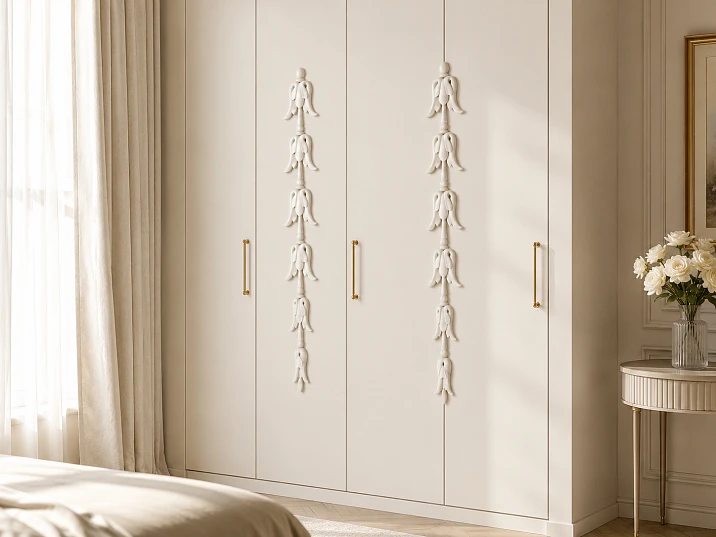
Narrow tall cabinet doors often look too simple precisely because there is almost nothing for the eye to "catch": a smooth surface, a handle, a vertical seam — and nothing more. It seems that the easiest way to add a classic character is with a molding frame. But on a narrow facade, this technique doesn't always work. Four sides of the frame take up space, leaving a cramped field inside, the handle starts to conflict with the decorative contour, and several adjacent doors turn into a frequent grid of lines. As a result, the cabinet doesn't become more expressive, but visually heavier.
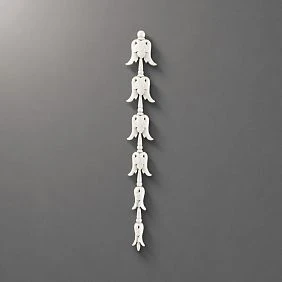
In such a situation, it's useful to change the design principle itself. Instead of outlining the door around the perimeter, place one narrow vertical ornament on it. The carved overlay NPU-316 made of polyurethane has dimensions of 28 × 200 × 6 mm. With a width of only 28 mm, it takes up a very small part of the facade, and the height of 200 mm supports the vertical proportion of the door. This is not a molding, not a baguette, and not a rosette, but a complete decorative overlay with a vertical garland composition that can be viewed precisely as decor for a furniture facade.
This scenario is especially interesting for owners of a ready-made cabinet. The facades are already there, you don't want to change them, ordering milling is expensive or pointless, and full frames seem too complex for narrow doors. Then a single NPU-316 can become that intermediate solution: the furniture remains smooth and light enough in perception, but gets a carved vertical accent.
However, the size of 28 × 200 × 6 mm by itself does not yet guarantee a good result. The overlay needs to be matched with the width of the door leaf, the height of the door, the position of the handle, the distance to the edge, the number of adjacent fronts, and the overall style of the cabinet. On one door, a single NPU-316 looks calm, but on six identical leaves, the same pattern turns into a strong repetition. That is why before buy the carved overlay NPU-316It is better to first try it on in full size and decide whether the overlay is really stronger than the molding frame in your specific case.
Why a narrow door requires a different approach than a wide front
A wide door easily accepts a classic frame. There is enough space between the edge of the facade, the molding, and the central field. Inside, you can place a handle, an additional overlay, or leave a clean surface. The eye calmly reads several levels: the outer contour of the door, the frame, the inner field.
On a narrow leaf, the same elements end up too close to each other.
Imagine a row of four tall doors. Each has its own side edges. There are gaps between them. If you add a rectangular frame to each, you get two more vertical lines per leaf. Instead of four calm doors, the eye begins to see a dense picket fence of eight additional verticals, plus the joints of the facades themselves.
At the top and bottom, the frame adds horizontal lines. A tall door is visually fragmented into a rectangle within a rectangle. If the facade is very narrow, its elongated proportion becomes less noticeable.
This does not mean that moldings are bad for cabinets. On the contrary, they work great where they have enough space. But decorating narrow facades requires greater economy of expression.
And here NPU-316 offers a fundamentally different way: one central vertical instead of four sides of a frame.




NPU-316 does not build a frame — it creates the center of the facade
The difference between molding and an overlay is not just about size.
Molding defines a border.
NPU-316 defines a single point or vertical zone.
This is very important for a narrow door. When the edges are already close to each other, an additional border is often unnecessary. It is much more useful to give the facade one recognizable center.
A vertical carved garland guides the eye from top to bottom. It supports the height of the panel rather than enclosing it in another rectangle. A lot of smooth surface remains around it, so the furniture does not look completely covered with stucco decor.
For someone who wants to make an ordinary cabinet closer to classic style without turning it into heavy stylization, this is a significant advantage.
Our factory also produces:
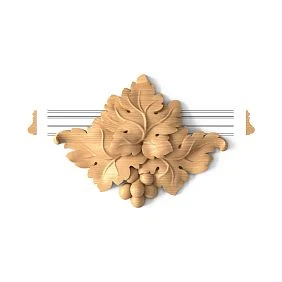
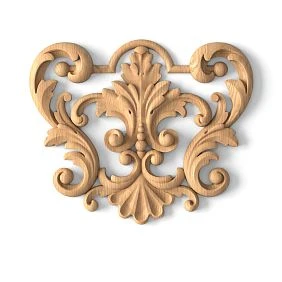
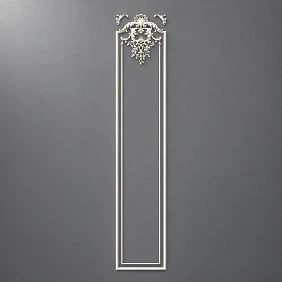
What you need to know about NPU-316 before trying it on
NPU-316 has several characteristics that directly affect the purchase decision.
| Characteristic | NPU-316 |
|---|---|
| Product type | Carved decorative overlay |
| Article number | NPU-316 |
| Material | Polyurethane |
| Size | 28 × 200 × 6 mm |
| Width | 28 мм |
| Height | 200 мм |
| Relief | 6 мм |
| Orientation | Vertical |
| Character of the Decoration | Vertical garland composition |
| Main article scenario | Narrow furniture fronts and cabinet doors |
| Price at time of check | 640 ₽ |
| What to check before ordering | Front width, height, handle position, side margins, number of doors, and final repeat |
The most interesting figure here is 28 mm.
Less than three centimeters in width — this is why the overlay can work where a full decorative contour starts taking up too much space.
The height of 200 mm defines a different task. NPU-316 does not turn into a long linear ornament from the top of the door to the bottom. It is a self-contained finished garland that needs to be properly placed within a large facade.
The 6 mm relief adds a third parameter: the overlay is not drawn on the surface but protrudes from the plane. Therefore, you need to check its proximity to the handle and the actual area where a person touches the door.
Get Consultation
Width of 28 mm: why it is so important specifically on a narrow door
When furnishing furniture, the buyer often starts with the question "what height is the overlay." For NPU-316, it is more useful to first think about the width.
28 mm allows placing the decorative element in the central part of the door while preserving a large volume of smooth surface around it.
Let's take a conditional narrow door 280 mm wide. An overlay 28 mm wide takes up only a tenth of this size. This is not a rule of ideal proportions, but a clear example of scale. Even after installing the ornament, most of the facade remains calm.
With a frame, it happens differently.
To make the frame look independent, it needs to be set back from the edge. Then the profile itself takes up a certain width. After it, there should be an inner field left. On a narrow door, the two side parts of the frame can visually take up a significant portion of the space.
Therefore, a vertical overlay is not just "smaller." It distributes the free space differently.
The height of 200 mm should not coincide with the height of the door
Often a buyer looks at a tall cabinet and doubts: "The door is almost two meters, and the overlay is only 200 mm — won't it get lost?"
Such a question arises if NPU-316 is perceived as a replacement for a long profile.
But this is a different type of product.
The overlay does not have to stretch from top to bottom.
It can be placed:
at the top of the facade;
in the central zone;
above the handle;
below the handle;
as part of a paired composition;
only on selected panels.
In each case, it works as a complete ornamental sign.
A tall door can easily have small but well-placed decor. Moreover, the free space at the top and bottom helps the relief look intentional, not like an attempt to fill every centimeter.
6 mm relief: a small detail that cannot be ignored
On the paper template, NPU-316 will be completely flat.
The actual overlay has a relief of 6 mm.
For a narrow cabinet, this is important for three reasons.
First, the volume creates chiaroscuro. Even if the overlay is painted close to the facade color, it is still readable due to the relief.
Secondly, there may be a handle nearby. Two protruding parts in a small area can visually come closer together than it seems in the drawing.
Third, a person touches the door daily. If the overlay falls exactly into the habitual hand-grip zone, the decorative scenario may turn out to be inconvenient.
Therefore, it is useful to make the template not only flat. You can place several layers of cardboard of approximate thickness under the paper to at least roughly feel the volume.
Trying on 28 × 200 mm before purchasing solves half of the questions
The most rational tool here is an ordinary paper template.
Cut out a rectangle of 28 × 200 mm.
There is no need to copy the ornament perfectly. You can only outline the approximate silhouette of the garland so as not to perceive the template as a solid white or dark strip.
Attach it to the facade with painter's tape.
Close the cabinet.
Step back to a normal distance.
Don't examine it only from half a meter away.
If the cabinet is in the bedroom, look at it from the bed.
If it's in the hallway, look from the front door.
If it's in the living room, look from the main point where the furniture is visible.
Take a photo of the entire cabinet.
In the overall plan photo, it immediately becomes clearer whether the 200-millimeter garland matches the scale of the furniture.
Why you can't just try on only one door separately
Suppose you attached the NPU-316 to one door.
Beautiful.
After that, you ordered six pieces for a six-door cabinet.
But six identical vertical ornaments are perceived completely differently than one.
Repetition reinforces any decision.
One accent looks delicate.
Two create symmetry.
Four form a regular rhythm.
Six already become the main motif of the entire furniture wall.
Therefore, there should be as many paper templates as the number of overlays you plan to install.
If you are thinking about six NPU-316, cut out six.
This simple check is much more valuable than a guess.
What facade dimensions to take before ordering
You don't need to start with the width of the entire cabinet.
A specific door leaf is measured.
Required:
-
visible door width;
-
visible height;
-
handle position relative to the central axis;
-
distance from the handle to the top edge;
-
distance from the handle to the bottom edge;
-
free space to the right and left of the intended overlay;
-
location of existing decor, if any;
-
distance to the adjacent door leaf and its handle.
If the doors are not identical, measurements are taken separately.
Sometimes a cabinet appears symmetrical on the outside, but the central fronts are wider than the outer ones. In this case, there is no need to use a single decorative scenario on all doors.
The center of the door is a good starting point, but not a rule.
The vertical shape of NPU-316 naturally calls for the central axis.
For a smooth door without a handle, this is indeed the most obvious position.
Equal margins remain on the left and right.
The ornament supports the height.
On multiple panels, an orderly repetition is achieved.
But real furniture almost always has hardware.
If the handle is strictly in the center, two elements compete for the same line.
Then the mathematical center ceases to be the automatic answer.
If the handle is positioned strictly on the central axis
There are several working options.
NPU-316 above the handle
For a tall door, this is one of the most natural scenarios.
The garland occupies the upper decorative zone, while the handle remains below as a functional detail.
The main task is to choose the distance between them.
If the overlay almost touches the handle, the elements become one dense cluster.
If the distance is too large, the connection between them disappears.
There is no universal number of millimeters here. A visual fitting on the facade is needed.
Overlay below the handle
This option is possible if the upper part of the door is already occupied by other decor or the cabinet's construction itself makes the lower placement more appropriate.
But the visual character changes: the ornament becomes more strongly connected to the lower part of the furniture, the plinth, and the floor.
Therefore, this option should be evaluated based on the overall appearance.
Declining NPU-316 on a specific door
That is also a normal solution.
Not every product you like has to fit every door panel.
If the handle fully occupies the optimal place, and moving the decor looks artificial, it is better to leave the facade without an overlay or consider another option.
Two handles on the sides free up the central vertical line
Some cabinets have two small handles or another type of hardware, where the middle of the facade remains free.
This is a convenient situation for NPU-316.
You can place one garland along the axis.
But you need to measure not the handle attachment points, but their actual outer boundaries.
Volumetric hardware can take up more space than is visible on the diagram.
If the side handles come too close to the center, the overlay will again be in a cramped environment.
A long vertical handle and NPU-316 can conflict with each other
Long vertical handles are found on modern cabinets.
They already create a strong line.
If you place a vertical carved garland nearby, the facade gets two competing axes.
Sometimes this technique is acceptable, but it requires a very precise composition.
More often it is wiser to choose just one thing:
either an expressive handle;
or a decorative vertical.
Especially on a narrow door.
A hidden handle gives more freedom, but does not eliminate the need to check convenience.
If the cabinet opens via a profile, edge, or hidden mechanism, the central plane of the facade can be completely free.
At first glance, this is an ideal place for NPU-316.
But you need to look at where the user actually touches the door.
If the hand constantly passes through the center, the overlay may end up in the zone of daily contact.
The decor should work together with the furniture, not force the owner to change their usual way of opening the door.
NPU-316 cannot be used instead of a handle.
A 6 mm relief may seem sufficient for gripping with fingers.
But the NPU-316 is a decorative overlay.
It is not furniture hardware.
Its purpose is to decorate the facade, not to bear force when opening.
If you want to get rid of a visible handle, the issue is solved by the door opening design, not by using molded decor as an improvised grip.
One overlay per door leaf is the basic scenario
For a narrow door, it is reasonable to start with a single NPU-316.
Why?
Because the whole idea of such a scheme is to reduce the number of decorative lines.
Instead of a frame, a single vertical ornament appears.
If you immediately install two overlays, the facade starts to fragment again.
The question of the distance between them arises.
The side margins decrease.
A new symmetry emerges.
For a wide facade, two details can work interestingly, but for a very narrow door, one is usually enough.
When two NPU-316 on one door are still appropriate
Suppose the facade is wider than the others.
The central axis is occupied by the handle.
On both sides of it, a lot of free surface remains.
Then two vertical overlays can be placed symmetrically.
But before ordering, it's worth asking a more important question: if the facade is already that wide, why not compare this scheme with a molding frame?
Sometimes two NPU-316s really do look better.
Sometimes it's the width of the door that shows it's time to move to a different type of decor.
NPU-316 and a molding frame solve different tasks.
They are not competitors in the literal sense.
They organize the facade differently.
| Criterion | NPU-316 | Molding frame |
|---|---|---|
| Type of decor | Finished carved overlay | Linear profile |
| Basic geometry | Vertical center | Closed contour |
| NPU-316 size | 28 × 200 × 6 mm | Frame size determined by facade |
| Number of elements | Usually one overlay | Multiple profile segments |
| Narrow sash | a particularly interesting scenario | May become too fragmented |
| Wide sash | May get lost | Gets enough space |
| Working with the handle | Need to separate decor and fittings | The handle usually stays inside the field |
| Perception of height | Enhances verticality | Divides the door into a framed field |
| Amount of smooth surface | Remains large | Significantly reduced |
| When to choose | Need a carved accent without complex structure | Need an architectural classic facade |
If after trying it on you want a frame effect, there is no point in forcing NPU-316. In that case, it is better buy polyurethane moldings to build a full-fledged field.
If the frame looks too tight, NPU-316 returns a free plane to the facade.
Why the frame often loses on six narrow doors
One frame can look great.
Six in a row is a different story.
Each door gets two additional vertical lines.
On six doors, that's twelve lines just on the side edges of the frames.
Plus the joints of the facades themselves.
Plus the handles.
Plus the horizontal top and bottom parts of the frames.
If the cabinet takes up the entire wall, the interior can become too graphic.
Six NPU-316 also create repetition, but much more economically: instead of twelve side lines of the frames, six central ornaments appear.
The difference in visual density is very noticeable.
A wide central door can get a frame, while narrow ones get NPU-316.
It is not necessary to style the entire cabinet in one way.
For example:
The two central doors are wider;
the two outer ones are noticeably narrower.
If you use identical frames, the outer ones will feel cramped.
If you use only NPU-316, the central doors may look too empty.
Then a mixed scheme emerges.
On wide facades — frames.
On narrow ones — vertical garlands.
The main thing is that the trim and the general character of the elements tie the system into a whole.
This approach is especially useful for furniture where the door widths already differ from the start.
Not every cabinet needs molding decor.
When a frame is built on a wide facade, it can be complicated with additional decorative elements.
For such a task, there is a possibility. buying polyurethane molding decor.
But a narrow door should not become a platform for the maximum amount of stucco just because such products exist.
the overlay.
frame.
Frame decor.
the handle.
Four layers on a small surface quickly create overload.
On a narrow facade, the value of NPU-316 is just the opposite — in its ability to reduce the decorative system to a single element.
What to do if 28 × 200 mm seem too small
Do not try to automatically place two or three overlays.
First, you need to understand which specific characteristic does not fit.
If there is not enough height, perhaps a different vertical model is needed.
If the width is insufficient, perhaps the facade is already large enough for more extensive decor.
If the ornament is too delicate, you can consider a different pattern.
For this, it is useful to open the general catalog and Buy decorative polyurethane overlays after comparing several options.
NPU-316 is good not because it should suit everyone, but because it has a specific strong proportion.
What to do if the NPU-316 seems too large
This is possible on a very narrow or low door.
Physically, 28 mm fits almost anywhere.
But a height of 200 mm can take up too large a share of a small facade.
If the ornament begins to look like the main object of the entire door, and only a light accent was desired, it is better to choose a different overlay.
One cannot consider "fits" as a synonym for "suits."
Decorative overlays for furniture facades should be chosen based on the free field
Often people look for where buy decorative overlays for furniture facades, and they start with a beautiful pattern.
For a finished cabinet, it is more useful to unfold the order.
First — the free area.
Then — the direction.
Next — the size.
And only then — the ornament.
A narrow door almost immediately cuts off large horizontal compositions.
A tall shape suggests a vertical.
The free central field determines the maximum allowable width.
After this, the catalog becomes much clearer.
How to position the NPU-316 relative to the top edge
Too high a position creates the feeling that the garland is hung on the cabinet cornice.
Especially if there is only a very small gap left to the top edge.
On a tall facade, it is better to give the overlay its own field.
Do not press it to the edge.
Do not try to "fill the void" at the top.
Empty space is part of the composition.
Too low a position also changes the character.
If NPU-316 is close to the bottom edge, it begins to visually interact with the plinth and the floor.
On a tall door, this can look unexpectedly heavy.
Especially if the handle is significantly higher.
Therefore, the lower placement requires a separate base: for example, a special door design or an already existing upper decorative zone.
The central zone is not necessarily the geometric middle.
For a tall door, the mathematical center may be too low relative to the usual eye level.
Therefore, sometimes the overlay looks better slightly higher.
Here it is useful to take three photos:
NPU-316 strictly in the center;
a few centimeters higher;
even higher, closer to the handle or the upper third.
Comparing photos helps more accurately than long examination of a single diagram.
One cabinet — several decorative levels
A large cabinet can be conditionally divided into:
the top;
central field;
handle zone;
bottom.
NPU-316 does not necessarily have to fall exactly in the middle of the entire height.
It can support one of the levels.
For example, garlands on all doors are positioned above the handles at the same mark.
Then a calm horizontal connection arises between the vertical overlays.
This works especially well on a series of facades.
Why a unified height is more important than the ideal position on each door leaf
If six doors are identical, but NPU-316 is installed slightly differently on each, the eye immediately notices the violation.
Therefore, when designing a series of facades, the entire cabinet is first marked out.
A single conditional horizontal line is drawn for the top or center point of the overlays.
After that, the vertical axes of each door are checked.
Only then can you proceed to final fixation.
A tilt is more noticeable than a slight shift.
NPU-316 is narrow and elongated.
This shape works almost like an arrow.
Even a slight tilt catches the eye.
If the overlay on the adjacent door is tilted in the other direction, the cabinet visually starts to "spread apart," even though the facades themselves may be perfectly aligned.
Therefore, the vertical must be checked with a tool.
The naked eye is not enough.
How to calculate the number of NPU-316 for a two-door cabinet
The simplest option is two overlays.
One for each door.
But this is not an automatic rule.
If one door is mirrored and the other is solid, perhaps only one is needed.
If both doors are smooth, make two templates at the same time.
A pair will be perceived differently than a single element.
Three panels allow for a central accent.
A cabinet with three doors is interesting because it is not necessary to use three identical panels.
Three schemes are possible.
One NPU-316 on each
This results in a uniform vertical repeat.
Good for calm symmetry.
Only the central door
The central facade becomes the main one.
The outer ones remain as background.
Two outer panels, center without decor
Not the most universal, but a possible technique if the central panel differs in material, handle, or other design.
Here it is especially important not to buy the quantity before visualization.
A wardrobe with four doors: two pairs or four identical fronts
Four doors can be perceived as a single sequence.
Then four NPU-316 units create a regular rhythm.
The wardrobe can be read as two pairs.
Then it is enough to design the two central or, conversely, the outer doors.
If the central doors are wider, they can be made framed, and the outer ones with NPU-316.
The quantity is determined not by arithmetic, but by the compositional scheme.
Six doors: repetition becomes stronger than the article itself
On a wardrobe with six narrow doors, NPU-316 begins to work not only as a separate garland.
Six identical elements form a new pattern.
The buyer needs to see exactly this one.
Therefore, paper templates are mandatory for such a cabinet.
Six rectangles of 28 × 200 mm, placed on the actual doors, will quickly show:
whether the repetition is too frequent;
whether it conflicts with the handles;
whether you want to leave some doors smooth;
whether a frame is needed only in the center.
The formula for the quantity is simple
Once the pattern is chosen, the calculation takes a few seconds.
The number of NPU-316 = the number of doors being decorated × the number of overlays on one door.
Example:
4 doors × 1 overlay = 4 NPU-316.
2 central doors × 1 overlay = 2 NPU-316.
2 wide fronts × 2 overlays = 4 NPU-316.
But the word "being fitted" is key here. You don't need to automatically multiply by the number of all cabinet doors.
Price of one NPU-316 and cost of the decorative scheme
At the time of verification, the price of NPU-316 is 640 ₽.
This allows you to calculate the cost of the overlays in advance for different scenarios.
| Scheme | Quantity | Calculation at a price of 640 ₽ |
|---|---|---|
| One accent door | 1 pc. | 640 ₽ |
| Two paired leaves | 2 pcs. | 1 280 ₽ |
| Three identical doors | 3 pcs. | 1 920 ₽ |
| Four leaves | 4 pcs. | 2 560 ₽ |
| Six leaves | 6 pcs. | 3 840 ₽ |
This is a calculation only for the NPU-316 units themselves at the specified price at the time of checking. The current cost before ordering should be verified in the product card.
Such a calculation is also useful for comparison with the frame option. A frame requires linear profile and several segments per door. NPU-316 is a ready-made part of a fixed size. These are structurally different purchases.
Why one overlay can be commercially more rational than a whole frame
Suppose a buyer wants to slightly change the appearance of two narrow doors.
For the frame, he needs:
select a profile;
calculate the perimeter;
plan corner joints;
make sure enough space remains inside;
repeat everything on the second door.
With NPU-316, one question is resolved first: whether the ready-made 28 × 200 mm shape fits.
If yes, the quantity is determined by the number of selected panels.
This does not mean that an overlay is always cheaper than any frame solution. The point is different: the project becomes simpler in composition when a full frame is not needed for the facade.
Narrow wardrobe doors up to the ceiling
Tall furniture especially enhances the vertical character of NPU-316.
On a cabinet up to the ceiling, the door itself sets a strong direction from bottom to top.
A frame can break it with horizontal lines.
One garland supports what already exists.
But you need to choose the installation height correctly.
If you raise the NPU-316 too high, it can get lost under the ceiling cornice or the top line of the cabinet.
If placed at eye level or slightly above the handle, the pattern is read much better.
Built-in wardrobe across the entire wall
Built-in furniture has a feature: it is often perceived almost as part of the wall.
Smooth facades continue the architecture of the room.
A heavy frame scheme makes the cabinet noticeably more "furniture-like" and separates it from the wall.
This can be necessary.
But if you want to preserve the calm of the built-in structure, NPU-316 can be a more delicate solution.
A single narrow ornament on selected doors does not disrupt the large smooth surfaces.
Walk-in closet with many doors
When there are many cabinets, it is especially important not to repeat the molding mechanically.
If NPU-316 is placed on every door of every section, the decorative motif will begin to dominate the entire room.
It is better to highlight:
the central cabinet;
sections with clothing;
a separate pair of doors;
facades opposite the entrance.
So overlays help organize a furniture wall, rather than just filling every free surface.
Bedroom: less decor often works better
The bedroom already has textiles, a headboard, lighting, nightstands, possibly a mirror and wall moldings.
The wardrobe does not have to become another very active composition.
Two NPU-316 on the central doors may be a sufficient classic gesture.
Especially if the overlays are finished in the color of the facade and are read mainly through the relief.
Hallway: close distance enhances the relief
In the hallway, a person is close to the wardrobe.
Even 6 mm of relief is clearly visible.
This means that the contrasting color of the overlay can look significantly more active than on a cabinet in a large bedroom.
The hallway also requires a convenience check: people pass through in outerwear, grab the facades, and open doors at a short distance.
The overlay should not fall into a constantly used area.
Office and library
Tall narrow facades of bookcases are a natural environment for vertical decor.
NPU-316 can support elongated lines of sections and tie them to the cornice, plinth, or other classic trim.
At the same time, there is no need to turn every door into a paneled one.
One narrow ornament preserves lightness.
Commercial interiors: first test, then series
A boutique, salon, hotel, or restaurant may have several identical cabinets.
Here, it is especially dangerous to order a large batch right away based on a photo.
One NPU-316 looks a certain way.
Twenty identical overlays on twenty facades create a strong repetition.
Therefore, one real section is tested first.
After that, a decision is made about the series.
The color of the overlay can change the perception of its size.
The same NPU-316 can look almost invisible or very prominent.
It all depends on the contrast.
If the overlay is close in color to the facade, its shape is revealed through light and shadow.
If the color differs sharply, the 28 mm width becomes a noticeable graphic stripe.
On one facade, this can be beautiful.
On six, it's too intrusive.
Therefore, the color should be chosen together with the number of overlays.
The monochrome version makes the relief part of the facade.
For calm neoclassicism, this is a particularly interesting path.
The facade and the overlay do not compete in color.
The eye first sees the overall plane of the furniture.
Then it notices the relief.
This scheme suits a person who fears 'applied decor' well.
NPU-316 looks not like a separate decoration, but like part of the facade's architecture.
Contrast turns the overlay into a graphic sign.
A dark garland on a light facade or a light one on a dark one instantly becomes more noticeable.
Now not only the shape matters, but also the silhouette.
If the cabinet has many doors, each NPU-316 becomes a separate vertical mark.
This could be intentional.
But before painting, it is useful to check at least paper color templates on all planned doors.
Handles and overlays cannot be selected independently
A large complex handle is already a decoration.
If you place an active NPU-316 nearby, competition arises.
A small calm handle leaves more space for the ornament.
It is not necessary to make the hardware and the overlay identical.
Roles need to be distributed.
What is the main thing here?
Handle?
Garland?
Frame?
If all three elements are equally active, the narrow door becomes overloaded.
Do I need to change the handles after installing NPU-316?
No, not necessarily.
If the existing hardware matches in scale and does not take up space on the overlay, it can be left.
This is especially important for the idea of updating without completely redoing the cabinet.
First, you need to check if the NPU-316 itself is sufficient.
Sometimes one new part already changes the character of the facade, and an additional replacement of handles adds nothing useful.
Can NPU-316 be added to an already painted facade
Such a scenario is possible, but the technology depends on the specific surface.
The cabinet can be:
painted;
laminated;
veneered;
wooden;
lacquered;
faced with another material.
One universal fixing method cannot be given without considering the base.
First, determine the facade material and the condition of the coating, then choose a compatible mounting system.
Why milling in this task can be skipped altogether
A milled facade requires working with the plane of the door itself.
For a finished cabinet, this is already a serious rework.
You need to remove the doors or perform precise machining.
The pattern becomes part of the facade and cannot be easily changed after manufacturing.
NPU-316 offers a different path.
The carved ornament already exists as a finished part.
There is no need to cut it into MDF.
There is no need to manually form the garland.
There is no need to order a new door just for the decor.
If the size 28 × 200 × 6 mm fits, the task comes down to choosing the right position and finish.
What you don't need to do from scratch if using a ready-made overlay
Do not:
cut a complex ornament by hand;
build a carved shape from several random parts;
draw a template for milling;
change the entire facade;
assemble a pattern from many small elements;
selecting approximately similar decorative fragments.
That is why for the buyer, the ready-made order NPU-316 28 × 200 × 6 mm already for the specific number of selected doors.
When it is better to choose moldings
If the facade is wide.
If a full-fledged classic paneled structure is required.
If the central field is too large for one small overlay.
If the interior is built on rectangular frame compositions.
If you need to connect furniture with wall frames of similar geometry.
Then buy polyurethane moldings would be a more logical next step.
When it is better to choose a different overlay
NPU-316 may not fit in scale.
This is normal.
If it is too short, too narrow, or the pattern itself does not match the furniture, it is more useful to go to the section where you can Buy decorative polyurethane overlaysand choose another option.
The article number must match the facade, not the facade match the article number.
Practical steps before purchasing
First, close all cabinet doors.
Remove temporary items from view.
Measure each door panel.
Mark the position of the handles.
Cut out NPU-316 templates measuring 28 × 200 mm.
Place them on the intended doors.
Take a photo of the overall view.
Try a different height position.
Then remove some templates and compare.
After that, draw a molding frame with painter's tape on at least one door.
Now you have two real options on the same piece of furniture.
Overlay or frame.
The choice becomes concrete.
How to buy NPU-316 on STAVROS without accidentally ordering
If the size fits after trying it on, first determine the quantity.
One door — one overlay.
Two central ones — two.
All four are four.
Do not add extra just because it might come in handy if the layout is already known.
Then check the product card again:
SKU NPU-316;
size 28 × 200 × 6 mm;
material — polyurethane;
current price;
the required quantity.
After that, you can buy the carved overlay NPU-316 specifically for the prepared furniture project.
If the fitting shows that the overlay does not match the proportions, do not buy it just because the article is about NPU-316. The correct route is to go back to the category and compare other decorative elements.
FAQ: NPU-316 on narrow cabinet fronts
What is NPU-316?
NPU-316 is a carved decorative overlay made of polyurethane with a vertical garland composition. In this task, it is used as decor for a furniture facade.
What is the size of NPU-316?
The size is 28 × 200 × 6 mm.
What do these dimensions mean for a cabinet door?
28 mm is the width of the overlay, 200 mm is its height, 6 mm is the relief. All three parameters need to be matched with a specific facade.
Is NPU-316 a molding?
No. A molding is a linear profile, while NPU-316 is a finished carved overlay of a fixed size.
Can NPU-316 be used instead of a molding frame?
Yes, if the task is not to create a framed field, but to add a single vertical ornament to a narrow door.
Why is the overlay particularly interesting for narrow facades?
The 28 mm width takes up little space and keeps most of the door leaf smooth.
Will NPU-316 fit a wide door leaf?
It may fit, but on a very wide facade a single overlay can look too small. A full-size mock-up is needed.
Where is the best place to position NPU-316?
Most often it is checked on the central vertical line of the leaf or above the handle. The final position depends on the specific door construction.
Does the overlay need to be placed strictly in the center?
Not necessarily. If the central axis is occupied by the handle, the position can be shifted vertically or a different layout can be chosen.
Can NPU-316 be placed above the handle?
Yes, this is one of the most straightforward scenarios for a tall door leaf, provided there is sufficient free space between the hardware and the overlay.
Can it be placed under the handle?
Yes, but this option must be evaluated against the overall look of the cabinet.
Can two NPU-316 be installed on one door?
Such a composition can be considered on a wider facade, but on a narrow door, two overlays can overload the surface.
Can two overlays be placed one above the other?
This is only possible as an independent design scheme. Two NPU-316 do not automatically turn into one long linear ornament.
Do all cabinet doors need to be decorated?
No. Sometimes only two central doors or one accent door look more expressive.
How many NPU-316 are needed for a two-door cabinet?
If one overlay is used on each door, then two.
How many are needed for four doors?
If all doors have the same design, four. But first, it's worth checking the option with only the two central ones.
For a cabinet with six doors, is it mandatory to buy six?
No. The quantity is determined by the chosen scheme, not automatically by the number of doors.
How to check NPU-316 before purchasing?
Cut out a paper template 28 × 200 mm and secure it to the facade with painter's tape.
Do I need to account for the 6 mm relief?
Yes. Especially near the handle and in the area where a person touches the door.
Can a three-dimensional template be made?
Yes. You can temporarily place cardboard of approximate thickness under the paper to better feel the protrusion.
What is more important — the width of the cabinet or the width of the door?
The width of the specific door. The overlay is located on it.
Can NPU-316 be used as a handle?
No. This is a decorative overlay, not furniture hardware.
Will NPU-316 fit a ceiling-height cabinet?
It may fit. On a tall door, it is especially important to choose the height mark correctly so the overlay does not get lost.
Will 200 mm be too little on a tall door?
Not necessarily. NPU-316 is used as a finished ornamental accent, not as a profile along the entire height.
What to do if the overlay seems too small?
Compare other decorative overlays or consider a molding frame.
What to do if it is too large?
Choose a more compact decorative element. There is no need to install NPU-316 just because it physically fits.
Will NPU-316 fit for a built-in wardrobe?
Yes, if you need to preserve large smooth surfaces and add a small carved accent without a complex frame system.
Can NPU-316 be installed on mezzanine facades?
Only after checking the actual size. On a low upper door, a height of 200 mm may be too significant.
Will it fit for a bedroom?
Yes, especially if the wardrobe needs a calm classic or neoclassical accent without a large number of frames.
Will it fit for a hallway?
It may fit, but you need to check the close distance, the position of the handle, and the zone of constant contact with hands or clothing.
Can NPU-316 be used in a walk-in closet?
Yes. On a large furniture wall, overlays can be used to highlight individual sections or the central group of facades.
Is it necessary to install NPU-316 on mirrored doors?
Not necessarily. Mirrored and solid facades can be styled differently.
Can NPU-316 be combined with molding on the same cabinet?
Yes. For example, wide doors can be framed, and narrow ones can have vertical overlays.
Can a frame and NPU-316 be placed on the same door?
On a sufficiently wide facade, it can be considered. On a narrow one, first make sure there is free space left between the elements.
Where can I buy moldings if a frame fits better?
You can buy polyurethane moldings and choose a profile to match the dimensions of the specific facade.
Where can I see additional elements for the frame?
For a more complex system, you can buying polyurethane molding decor.
Where can I see other decorative overlays?
In the category you can Buy decorative polyurethane overlays and compare other models.
Can NPU-316 be used on an already finished cabinet?
Yes, ready-made furniture is indeed one of the interesting scenarios, if the condition and surface material allow for the intended installation.
Is it necessary to mill the facade for NPU-316?
The point of an overlay decor is that the carved ornament already exists as a separate piece. Specific surface preparation is determined by the facade material and the chosen mounting system.
Can NPU-316 be glued onto painted MDF?
The possibility depends on the actual coating and the chosen mounting adhesive. Compatibility must be checked before fixing.
And on a laminated door?
It also requires checking the specific base and mounting material. There is no universal answer for all types of lamination.
Can NPU-316 be painted to match the facade color?
Such a designer approach is possible. It makes the relief calmer and connects the overlay with the door itself.
Can the overlay be made contrasting?
Yes, but contrast enhances its visual presence. On several panels, the effect multiplies.
Do the handles need to be changed along with the overlay?
No. If the existing handles match in scale and do not conflict with NPU-316, they can be kept.
Which layout looks calmer — overlays on all doors or only on the central ones?
Usually, fewer overlays create a more pronounced hierarchy, while repetition on all panels makes the ornament the main motif of the cabinet. Which option is better needs to be assessed on the specific furniture.
Is NPU-316 only suitable for classic interiors?
The carved character is naturally associated with classic styles, but the overlay can also be used in more modern eclectic furniture if such a contrast is deliberately intended.
What to do if the interior is minimalist?
First, make a template. If the carved garland looks out of place, it's better to abandon it rather than try to adapt the interior to the product.
How to calculate the quantity without unnecessary details?
Determine which specific panels are being decorated, and multiply their number by the count of NPU-316 per door.
Do I need to buy spare overlays?
Without a specific reason, this is not necessary. First, calculate the actual layout.
How much does NPU-316 cost?
At the time of verification, the price was 640 ₽. The current cost should be checked in the product card right before ordering.
Can I order one overlay first and try it on?
The possibility of a specific order format needs to be checked in the product card and sales terms. For a visual check before purchase, it's more useful to first make an accurate template of 28 × 200 mm.
What should be checked right before ordering?
The facade size, handle position, number of panels, selected installation height, 6 mm relief, the required quantity of NPU-316, and current product card data.
Where to buy NPU-316?
After fitting, you can buy the carved overlay NPU-316 in the required quantity for the prepared facade layout.
A narrow door doesn't always need a frame — sometimes it needs just one correct vertical line.
The most common mistake when updating a cabinet is assuming that a classic facade must necessarily be surrounded by molding.
On a wide door, a frame can indeed become the best solution.
On a narrow one, it often takes up too much of the free surface.
And then NPU-316 works more interestingly not because it's 'better than molding in general,' but because it responds to a different scale.
Its width is 28 mm.
Height is 200 mm.
Relief is 6 mm.
These dimensions make the NPU-316 a suitable candidate for a single vertical decorative insert on a smooth door leaf when you want to preserve the elongated proportion of the door and not build a full rectangular contour around it.
Before purchasing, it is enough to take a few correct steps.
Measure the facade.
Mark the handle.
Cut out a template of 28 × 200 mm.
Try it on one door.
Then on all door leaves that are intended to be decorated.
Compare with the molding frame option.
Look at the cabinet as a whole.
After such a check, it becomes clear whether you really need one NPU-316, two, four, or a different type of decor altogether.
If the vertical overlay fits, you can order NPU-316 28 × 200 × 6 mm to the actual number of selected doors. If the size or pattern didn't fit, it's better to open the category and Buy decorative polyurethane overlays of a different format.
If the facade turned out to be wide enough and requires not a point ornament, but full-fledged architecture, it's worth buy polyurethane moldings and move to a frame composition.
And when not only the cabinet is updated, but the entire interior, you can You can buy ready-made stucco matching the Baroque style. Calculate the quantity: linear meters of cornices and moldings, number of rosettes, pilasters, consoles, corner elements. Add a ten to fifteen percent allowance for trimming. and assemble a connected system for furniture, doors, walls, and other surfaces.
STAVROS in such a task gives the buyer the opportunity to choose not an abstract "decor for furniture," but a specific type of product for a specific facade geometry. For a narrow door, this is especially important: one correctly placed NPU-316 can give furniture a classic carved motif without milling, without replacing facades, and without an overloaded frame grid. The main thing is to first check the actual size of 28 × 200 × 6 mm on your cabinet, and only then turn a successful fitting into a ready order.