
















































































Article Contents:
- The filler has already done the technical work — now you can solve the decorative part
- NPU-021 is an overlay, not a reduced pilaster
- NPU-021 in numbers: what 40 × 171 × 11 mm mean on a real wardrobe
- A formula that immediately shows the free space on the sides
- If the filler is exactly 40 mm: technically it matches, but is such an effect needed?
- With a filler of 60–80 mm, NPU-021 starts to work as an independent motif
- Eleven millimeters of relief: the door must pass by it freely
- NPU-021 is installed on a fixed strip, not covering the door gap
- What to do if the extension piece is already the NPU-021 itself
- The vertical axis matters more than the distance from the wall
- In height, the NPU-021 does not have to be centered in the entire cabinet
- The formula for the mathematical center is still useful
- One NPU-021 for the full height or several repeats
- When one overlay looks more convincing than three
- Acanthus ornament: you should look not at the name, but at the neighboring facades
- White cabinet and white NPU-021: contrast is not necessary at all
- Contrast trim: only if such a language already exists on the cabinet
- If the cabinet was painted long ago, the problem is not just the color name
- What comes first: painting NPU-021 or gluing it on
- The base of the extension strip determines the installation
- Why you can't glue first and then check if the door opens
- Swing wardrobe: checking not only the door panel, but also the handle
- Sliding wardrobe: different mechanics, same need for checking
- Two extension strips on the sides of the wardrobe: symmetry changes the solution
- Only one extension strip: don't try to create false symmetry
- Extension strip up to the ceiling: NPU-021 doesn't have to fill it entirely
- NPU-021 or molding along the entire extension strip
- NPU-021 or a full pilaster: a simple comparison
- NPU-021 or wall decor next to the wardrobe
- How to understand that exactly the extension looks technical
- Classic built-in wardrobe: a natural environment for NPU-021
- Neoclassicism: more free surface, fewer repetitions
- Modern wardrobe: first ask why it needs acanthus
- Hallway: the extension is especially visible up close
- Bedroom: a soft connection with furniture matters more than a bright accent
- Dressing room: decorativeness must yield to the system
- What to buy together with NPU-021
- When it is more profitable to order one NPU-021, and when a pair
- Why five NPU-021 do not automatically turn into a pilaster
- The decorative repeat must match the door architecture
- A photo strictly from the front helps better than a tape measure
- Example 1: extension 45 mm
- Example 2: extension 50 mm
- Example 3: extension 60 mm
- Example 4: extension 80 mm
- Example 5: extension 120 mm
- Mistake No. 1: Measuring the old gap instead of the finished extension
- Mistake No. 2: Assuming that 40 mm of extension is automatically ideal
- Mistake #3. Not checking the door because the overlay is "only 11 mm"
- Mistake #4. Gluing part of NPU-021 onto the facade for centering
- Mistake #5. Choosing the height at the middle of the wall without looking at the cabinet
- Mistake #6. Buying four identical overlays at once
- Mistake #7. Making the trim more decorative than the facades
- Mistake #8. Painting NPU-021 in contrast just for visibility
- Mistake #9. Trying to fix an uneven plank with NPU-021
- Mistake #10. Gluing over a weak coating
- Mistake #11. Choosing NPU-021 instead of a pilaster just because it's cheaper
- Mistake #12. Decorating the trim when the problem is on the wall
- When NPU-021 is really appropriate
- When it's better not to buy NPU-021
- What to do if you like NPU-021, but the extension is too narrow
- What to do if the extension is too wide
- Do I need to repeat NPU-021 on the doors
- Can NPU-021 be installed upside down
- Can NPU-021 be turned horizontally
- How to buy NPU-021 without making a mistake in a single measurement
- FAQ: answers to questions about NPU-021 on the extension strip of a built-in wardrobe
- Can NPU-021 be glued onto an already installed extension?
- What is the exact size of NPU-021?
- How much does NPU-021 cost?
- What is the minimum width the extension piece should be?
- Will NPU-021 fit for a 50 mm extension?
- And for 60 mm?
- Can NPU-021 be installed on a 35 mm wide strip?
- Is it necessary to place NPU-021 exactly in the center?
- Can two NPU-021 be placed one above the other?
- How many overlays are needed for a cabinet up to the ceiling?
- Can NPU-021 be placed right next to the door?
- Can the handle touch the NPU-021?
- Will the overlay fit for a sliding wardrobe?
- Do I need to install the overlay on both sides of the wardrobe's extension panels?
- How is NPU-021 different from a pilaster?
- Can I make a molding frame instead of NPU-021?
- Can NPU-021 be painted to match the wardrobe color?
- Is a contrasting color acceptable?
- What should I use to glue NPU-021?
- Can the overlay be glued onto an already painted strip?
- Do I need to sand the painted extension panel?
- What is better for a 100–120 mm extension: NPU-021 or a pilaster?
- Can NPU-021 be used on a wall next to a cabinet?
- What to do if NPU-021 looks too large visually?
- What to do if it is too small?
- Can I order one NPU-021 for a trial?
- 1. Is the width really sufficient?
- 2. Do you like the amount of free space?
- 3. Does the door and handle pass by the relief?
- 4. Is NPU-021 located exactly on the fixed part?
- 5. Does the ornament make the cabinet more cohesive?
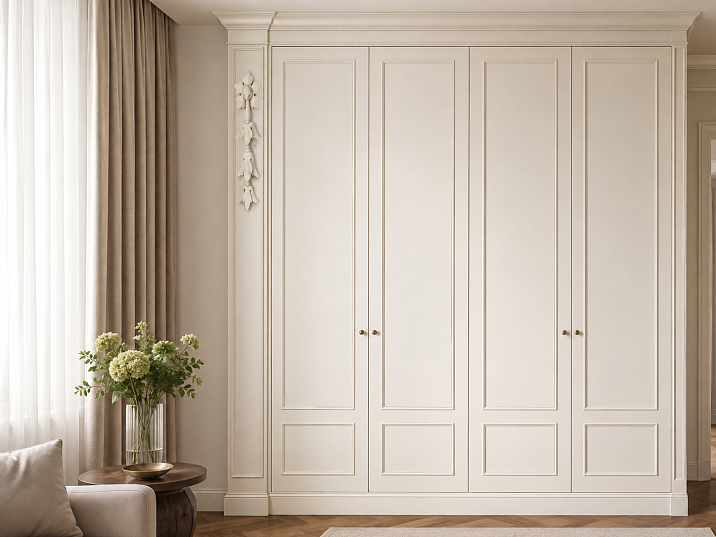
A built-in wardrobe can be executed flawlessly — even fronts, neat gaps, a single line up to the ceiling, properly selected handles — and still, one narrow strip near the wall will reveal the installation nature of the structure. This is an infill panel. It is technically necessary: it covers the space between the cabinet body and the wall, compensates for junction features, and allows furniture not to be adjusted to every wall irregularity. But after installation is complete, it is precisely this smooth vertical that often looks poorer than the adjacent fronts.
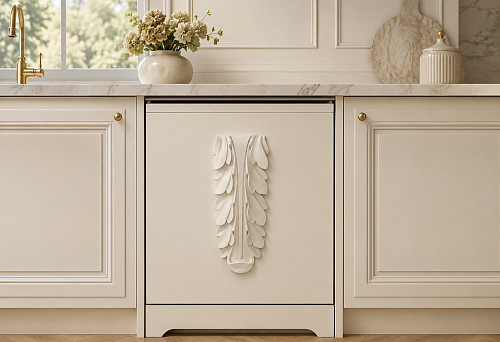
Redoing the cabinet for its sake is pointless. Turning a narrow infill into a full pilaster is also not always desirable. Between these extremes, there is a more precise solution — a carved vertical decorative overlay NPU-021 made of polyurethane, sized 40 × 171 × 11 mm. It is small, vertically oriented, and therefore aligns well with the very geometry of the narrow infill strip.
But matching in width alone is not enough.
If the infill is exactly 40 mm wide, NPU-021 will technically match it in dimension, but it will be placed edge to edge without a calm free margin. If the cabinet door opens flush against the infill, the 11 mm protruding relief may fall into the path of the front or handle. If the overlay is placed too high, it will lose connection with the door panels; too low — it will start to be perceived as a separate decorative patch.
Therefore, the solution begins not with glue or purchase. First, measure the actual width of the fixed infill panel, check gaps and door opening, determine the position of the vertical axis. And only then can you buy the carved overlay NPU-021 and use it not as decoration for decoration's sake, but as a way to turn the technical strip into part of the cabinet's architecture.

The infill has already done its technical job — now the decorative one can be addressed
Between a built-in cabinet and a wall, absolute geometric idyll is rare.
The wall may slightly deviate from vertical. The corner may not be strictly 90°. The baseboard, plaster, or decorative finish also affect the junction. If the furniture body were to be made precisely to fit each such irregularity, installation becomes more complicated, and the result still does not always look neat.
Therefore, a fixed filler strip appears next to the body.
Its first task is simple: to cover the technical gap and form a neat junction of the furniture to the wall.
If the issue is still at the stage of the gap itself, it's more useful to first figure out, how to close the gap between the cabinet and the wall. But the situation in our article is different: the gap is already closed. The required strip is installed. Technically, nothing needs to be fixed.
The problem has become visual.
It is especially noticeable on a classic built-in wardrobe. Imagine:
- the facades have panels;
- there is frame molding on the doors;
- the top of the cabinet is supported by a cornice line;
- the handles are matched to the overall style;
- to the left of all this, there remains a smooth flat strip 60–80 mm wide.
It looks not like a continuation of the furniture, but like what it was during installation — an extension piece.
On a minimalist cabinet, this is normal. On a classic or neoclassical one — sometimes it is too noticeable.
This is where NPU-021 is interesting because it does not require turning the entire side strip into a complex order composition. One vertical overlay can provide exactly as much relief as needed so that the extension piece no longer reads as empty.




NPU-021 is an overlay, not a reduced pilaster
Terminology here matters not for the sake of a dictionary, but for the sake of making the right purchase.
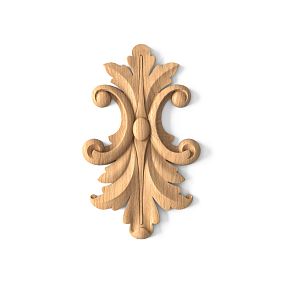
NPU-021 is a carved vertical decorative overlay made of polyurethane.
Its size:
40 × 171 × 11 mm.
Price:
990 ₽.
It is not a pilaster.
A pilaster is an architectural vertical element of a different scale. In a full system, it can have a shaft, base, capital, and additional profiles. Such a composition can extend almost the full height of a cabinet or wall.
NPU-021 works differently.
It occupies a small fragment of a vertical strip and creates a local relief motif. It does not aim to imitate a column from floor to ceiling.
Therefore, if a cabinet next to a wall has a remaining filler strip of, for example, 60–80 mm wide, a small overlay may be much more proportional than a full architectural pilaster.
If the free side area is wide, the cabinet is tall, and the design intent suggests a pronounced portal treatment from floor to cornice, then it makes sense to separately consider polyurethane pilasters for a built-in cabinet.
These are not competing products.
These are two different scales of solution.
NPU-021 — for a compact vertical part. Pilaster — for the architecture of an entire side zone.
Our factory also produces:


NPU-021 in numbers: what 40 × 171 × 11 mm mean on a real cabinet
The product photo shows the ornament. The dimensions answer the question of whether it can be used at all.
| Parameter | NPU-021 | What this means for the filler strip |
|---|---|---|
| Type | Carved vertical decorative overlay | Local vertical ornament |
| Article number | NPU-021 | Allows you to select a specific model |
| Material | Polyurethane | Interior decorative element |
| Width | 40 мм | Critical dimension when matching to a narrow filler strip |
| Height | 171 мм | Defines the vertical scale of the ornament |
| Relief | 11 мм | Must be considered when opening the adjacent door |
| Price | 990 ₽ | Cost of one overlay |
| Main Scenario | Fixed filler panel of the cabinet | Non-movable furniture facade |
Of all the numbers, 40 mm is the most important for this article.
Why?
Because the width of the filler panel is limited. On a large facade, you can shift the decor, choose different sizes, and assemble complex frames. On a narrow strip, there is almost no freedom.
If the filler itself is NPU-021, the model physically does not fit.
If it is exactly 40 mm, the overlay fits without side margins.
If it is 50 mm, there are 5 mm left on each side with strict centering.
At 60 mm — 10 mm each side.
At 70 mm — 15 mm each side.
At 80 mm — 20 mm each side.
That is why the question "will NPU-021 fit on a narrow extension?" cannot be resolved without one simple measurement.
Get Consultation
A formula that immediately shows the free space on the sides
Let us denote:
- W — actual width of the extension strip;
- 40 mm — width of NPU-021;
- P — free space on each side when precisely centered.
Then:
P = (W − 40) / 2.
This is not a design standard or a mandatory regulation. The formula simply shows how much real air will remain around the overlay.
For several typical sizes, we get:
| Extension width | NPU-021 width | Left field | Right field | What to check visually |
|---|---|---|---|---|
| 40 мм | 40 мм | 0 мм | 0 мм | The relief will take the full width |
| 45 мм | 40 мм | 2.5 mm | 2.5 mm | Very tight fit |
| 50 мм | 40 мм | 5 мм | 5 мм | Mandatory fitting required |
| 60 мм | 40 мм | 10 мм | 10 мм | The overlay is separated from the edges |
| 70 мм | 40 мм | 15 мм | 15 мм | A calmer vertical line |
| 80 мм | 40 мм | 20 мм | 20 мм | A lot of free plane |
| 100 мм | 40 мм | 30 мм | 30 мм | A different scale of decor may be required |
From this table, one cannot derive a universal rule like "at least 10 mm on the edges." We have no such confirmed requirement.
However, a useful conclusion can be drawn: the size of the extension should be assessed not only by the principle of "fits or doesn't fit," but also by how much smooth surface will remain around the carved motif.
NPU-021 on a 42 mm wide strip and on an 80 mm wide strip — the same product, but completely different visual situations.
If the extension is exactly 40 mm: technically it matches, but is such an effect needed?
This is the most interesting borderline case.
The width of the extension strip is 40 mm.
The width of the overlay is also 40 mm.
Mathematically, everything aligns perfectly.
But design-wise, the match isn't necessarily perfect.
The carved contour will fit almost to the very edges. The extension will no longer be perceived as a smooth strip and will turn into an almost continuous ornamental fragment.
Sometimes that's exactly what you want.
For example, a small classic cabinet is located nearby, and its side vertical should look rich and decorative.
But in neoclassicism, such density can seem excessive. There, the free space around the relief often helps the detail look lighter.
Therefore, at 40–50 mm, a paper mock-up is especially important.
Cut out a silhouette 40 mm wide and 171 mm high. Place it on the extension piece. Look not up close, but from the distance from which the cabinet is usually seen.
If the strip turns into a too active carved "column," it's better to look for a more compact model among the category where you can buy vertical polyurethane overlays.
You don't need to choose NPU-021 just because its width formally matches.
When the extension reaches 60–80 mm, NPU-021 begins to work as an independent motif.
When free surface appears around the 40-millimeter overlay, the perception itself changes.
It no longer fills the strip.
It lives inside it.
This is an important distinction.
On a 60 mm extension, 10 mm remains on each side. On 80 mm, it's already 20 mm.
The carved pattern separates from the edges, and a calm background appears around it. This placement is especially interesting if NPU-021 is painted together with the furniture in one tone: the free field remains smooth, and the relief is revealed through light and shadow.
In this range, it's easier to achieve the feeling that the extension was designed as decorative from the start.
But width is only the first check.
The second is much more important for the cabinet's operation.
Eleven millimeters of relief: the door must pass by it freely
NPU-021 protrudes 11 mm from the base.
On a stationary wall, this is just relief.
Next to a moving facade, it's already physical volume.
Special attention should be paid to cabinets with hinged doors when the facade edge is located next to the extension.
A closed door can be at a safe distance. But when opened, its edge moves along an arc.
The following are involved in this trajectory:
- the door plane itself;
- handle;
- the decorative frame of the facade;
- protruding elements;
- sometimes a mirror or an applied profile.
Therefore, the correct check is performed in motion.
Do not just measure the distance between the closed door and NPU-021.
Simulate an overlay about 11 mm thick on the bar and fully open the nearest facade several times.
This can be done with a cardboard template.
If the door, handle, and existing decor pass freely, the geometry is suitable.
If at least one element is close, it is better to change the position of the overlay, choose a different size, or abandon the idea on this particular extension.
NPU-021 is installed on a fixed strip and does not overlap the door gap.
There is a principle that cannot be violated for the sake of beautiful symmetry.
The overlay must be entirely on the fixed extension.
It must not:
- enter onto the door facade;
- overlap the technological gap;
- connect the fixed panel to the moving door;
- extend beyond the edge of the extension so that part of the relief falls within the facade area.
Why?
Because the gap between the door and the fixed element exists not by chance. It is needed for movement.
If the carved detail visually crosses this line like a 'bridge', the structure will come into conflict at the very first opening.
Moreover, decoratively this is also incorrect. NPU-021 should turn the extension into an independent vertical, not mask the boundary between two parts.
The cabinet should have clear levels:
wall → extension → gap → facade.
The decor adorns one of them without negating the furniture's structure.
What to do if the filler strip is already narrower than NPU-021
If the actual width is less than 40 mm, NPU-021 is not suitable for this position.
Do not:
- trim the carved overlay along its length;
- extend part of it beyond the edge;
- stick diagonally;
- transfer half of the ornament to the wall;
- go into the door gap.
The carved element has a complete composition.
Longitudinal trimming will disrupt its shape.
If the extension piece is, for example, 32–35 mm, it is better to look at a narrower decorative element in the section where decorative inlays for furniture.
Sometimes it is wiser to leave a narrow extension completely smooth.
Not every technical strip has to become decorative.
The vertical axis is more important than the distance from the wall
When NPU-021 fits in width, you need to precisely determine the horizontal position.
For symmetrical centering:
X = (W − 40) / 2.
We already used this formula for the field, but now it becomes working markup.
For example, an extension of 70 mm:
(70 − 40) / 2 = 15 mm.
This means the edge of NPU-021 is at a distance of 15 mm from each side boundary of the plank.
But there is a situation where the mathematical center and the visual center may differ.
Imagine: on the wall side, the extension does not end in a straight line but goes into an uneven junction. On the cabinet side, on the contrary, a perfectly flat facade runs alongside.
In this case, the eye is more strongly oriented toward the furniture line.
Nevertheless, shifting the pattern "by eye" is risky.
It is better to first place it geometrically in the center and only then assess the overall look. If adjustment is needed, it should be deliberate and repeatable, especially when the cabinet has two extensions.
In height, NPU-021 does not have to be in the center of the entire cabinet.
The overlay height is 171 mm.
A cabinet up to the ceiling can have a height of more than two meters.
If you place a small ornament exactly in the mathematical center of the entire vertical, this does not always give the best result.
Why?
Because the cabinet is perceived not only as a rectangle. It has its own reference points:
- the top of the door panel;
- middle of the panel;
- handle;
- horizontal divisions;
- drawers;
- cornice;
- base.
Therefore, the vertical position of NPU-021 is better linked to the facade architecture.
For example, if the adjacent door has a central ornament, it is reasonable to place NPU-021 at a similar height.
If the panel has a pronounced vertical center, the overlay can be aligned with it.
If the cabinet is completely smooth and the filler strip only needs slight embellishment, a freer composition is possible.
The main thing is not to place the detail randomly between two furniture levels.
The formula for the mathematical center is still useful.
If the extension has a visible height H, and the overlay is 171 mm, then with strict centering at the top and bottom, the following will remain:
Y = (H − 171) / 2.
For example, the visible decorative zone of the extension is 2200 mm.
(2200 − 171) / 2 = 1014.5 mm.
That is, the center of NPU-021 will be approximately at the middle of the vertical.
But this figure is only a starting point.
On a cabinet taller than two meters, a single 171 mm overlay can look very compact. Sometimes it is more logical to tie it not to the center of the entire height, but to a specific furniture belt.
This is why a paper model is more useful than bare arithmetic.
One NPU-021 for the full height or several repeats
A narrow extension can run from the floor almost to the ceiling.
At such a height, a single overlay measuring 40 × 171 mm occupies a small part of the overall vertical.
A natural idea arises: to place two or three.
This is possible as a design scheme, but requires a much stricter rhythm.
One NPU-021 is an accent.
Several identical NPU-021s form an ornamental sequence.
The effect is completely different.
If you place three pieces at random distances, the trim will start to look like a surface onto which leftover decor was gradually glued.
If repetition is needed, first mark the entire height and determine:
- the number of elements;
- equal intervals;
- the upper and lower boundaries;
- connection with door panels;
- symmetry on the opposite side of the cabinet.
There is no need to buy several overlays before this scheme appears at least on paper.
When one overlay looks more convincing than three
There are extensions that need not a decorative column, but just one sign.
This especially applies to neoclassicism.
A smooth strip retains most of the calm surface. A small floral ornament appears on it. The relief is not noticed immediately, but the vertical ceases to be technical.
This approach is good when there is already enough decor nearby:
- paneled doors;
- cornice;
- expressive handles;
- Molding frames.
Three more identical ornaments on the extension may become redundant.
The rule is simple: do not try to fill the entire area just because it is free.
NPU-021 can accomplish its task with a single detail.
Acanthus ornament: you should look not at the name, but at the neighboring facades
NPU-021 is present among models with acanthus ornament. If this motif suits the interior, you can see what other overlays with acanthus ornament to buy for furniture or adjacent decorative areas.
But the word "acanthus" itself does not mean that the element automatically suits any classic cabinet.
First, they look at the carved language of the existing furniture.
If the facades already have:
- plant scrolls;
- leaf motifs;
- soft classical carving,
NPU-021 can continue their character.
If the furniture is built on strict geometry, fluting, and straight-line profiles, the plant acanthus can look like a separate stylistic inclusion.
The situation is even more complicated when completely different ornaments are used nearby—for example, the pronounced geometry of Art Deco.
Therefore, it is not a "classic overlay in general" that is chosen, but an ornament compatible with the specific cabinet.
White cabinet and white NPU-021: contrast is not necessary at all
When a person buys carved decor, they want to emphasize it with color.
This is a natural impulse, but not always the best.
On a narrow extension strip, the contrast is especially active. Black, golden, or bronze ornament on a white extension instantly turns the 40-millimeter NPU-021 into a focal point that competes with the facades.
If the goal is to hide the technical nature of the extension rather than make it the main decoration of the cabinet, a tone-on-tone finish works more calmly.
The overlay and the strip have the same color.
What remains of the decor then?
Relief.
A thickness of 11 mm creates its own chiaroscuro. The ornament becomes noticeable when light comes from the side, but does not fragment the furniture with a new color.
Thus, the extension piece begins to look like part of a unified joinery or stucco composition.
Contrast finish: only if such a language already exists on the cabinet
There are interiors where contrast is justified.
For example:
- light facades;
- dark handles;
- individual dark molding lines;
- repeating accent elements.
Then NPU-021 can be linked to an existing color.
But there is a simple test.
Imagine a finished cabinet without this overlay.
What is the main thing?
Facades.
Now add the contrasting NPU-021.
If the eye first goes to the narrow side panel, the balance is off.
The technical strip that was meant to be "hidden" suddenly became the main focal point.
Therefore, contrast should only be used when it is repeated in other parts of the cabinet or room.
If the cabinet was painted a long time ago, the problem is not just the color name.
White is not equal to white.
Gray is not equal to gray.
Even with a known paint code, an old surface can visually differ from fresh paint due to lighting and wear over time.
So if NPU-021 needs to blend perfectly with the side panel, it's useful to do a test patch.
The best way is to use a small sample or an inconspicuous test surface.
Don't paint the entire panel permanently until the shade has been checked next to the cabinet itself.
The narrow vertical part is flush against the main furniture, so the color difference is especially visible.
What comes first: painting NPU-021 or gluing it on?
Each option has its own conveniences.
Pre-painting makes it easier to work with the relief. The overlay lies horizontally, so you can carefully paint the recesses without worrying about touching the cabinet door.
But after installation, finishing treatment of the joint may be needed.
Therefore, a reasonable logic looks like this:
- try on NPU-021 without glue;
- finally determine the position;
- prepare the base;
- perform the necessary preliminary finishing;
- glue;
- finish visible joint areas according to the selected technology.
Do not start with paint if it is not yet clear that NPU-021 fits in size and opening.
The base of the extension strip determines the installation
The extension piece can be made from different furniture materials and have various surfaces.
It can be:
- painted;
- laminated;
- veneered;
- made from another furniture blank.
It is impossible to assign one universal preparation for all cases.
The mounting adhesive must be compatible simultaneously:
with polyurethane NPU-021 and with the actual surface of the extension piece.
If the surface is painted, the adhesive actually works with the top paint layer. Consequently, this layer itself must hold firmly.
If the coating is peeling, a stronger adhesive will not solve the problem. It may tear off the paint along with the overlay.
If the surface is smooth and non-porous, the technology is also selected taking into account its type.
Before working, it is useful to separately study which molded decoration adhesive is suitable for the specific base.
Why you cannot first glue and then see if the door opens
NPU-021 is small. It seems that if a problem arises, it can always be removed.
But it's better not to turn glue mounting on finished furniture into an experiment.
After dismantling, the following may remain:
- traces of the compound;
- damage to the coating;
- color difference;
- need for local repair.
Therefore, the entire experiment needs to be conducted before permanent fixation.
A cardboard template solves almost all primary questions:
- width;
- height;
- position;
- repeat;
- interaction with the door.
An additional gasket about 11 mm thick helps roughly model the actual relief.
Wardrobe with hinged doors: check not only the panel, but also the handle
On a swing door, the main danger is obvious — the edge of the facade.
But sometimes, the handle reaches NPU-021 before the door does.
Especially if it is:
- long;
- protruding;
- located close to the edge;
- oriented vertically.
Open the facade fully.
Then slowly move it back along the entire trajectory.
Don't just look at the final position.
The maximum approach of two parts can occur at an intermediate opening angle.
That's why it's not enough to open the door 90° and say: "it doesn't touch."
Check the full travel.
Sliding wardrobe: different mechanics, same need for checking
With a sliding wardrobe, the door does not swing outward, so the risk seems smaller.
But nearby there may be:
- side profiles;
- protruding handles;
- guides;
- system elements.
The extension piece can also participate in the visual connection to the doors.
NPU-021 must remain on a stationary surface and not extend into the operating area of the sliding system.
If the decorative trim is on the outside and no part of the door passes nearby, the task is simpler.
But it cannot be universally stated that such installation is safe for any sliding-door wardrobe.
The design is verified in practice.
Two extension pieces on the sides of the wardrobe: symmetry changes the solution
One of the most successful scenarios is when the cabinet is in a niche, with small filler strips on the left and right.
Here, it becomes possible to use two NPU-021 mirrors in terms of position.
The product itself is the same, and symmetry is created by placement.
It is important to maintain:
- the same height;
- the same indentation from the inner edges;
- the same position relative to the facades;
- the same color.
If the left filler strip is 70 mm and the right one is 55 mm, mechanically centering the overlays within each strip may not be sufficient.
You need to look at the entire cabinet.
Sometimes it's better to orient both NPU-021 relative to the facade composition, maintaining visual symmetry.
In a complex situation, first a photo of the cabinet is taken strictly from the front, and two templates are overlaid on it.
Only one addition: don't try to create false symmetry
A common situation: the cabinet stands flush against a side wall on one side, and a significant addition exists only on the other.
The customer is worried:
"If I install NPU-021 only on the right, won't the cabinet become asymmetrical?"
It is already asymmetrical due to the room's architecture.
And that's not necessarily a problem.
There's no need to add a decorative overlay to the facade itself on the other side just for the sake of an artificial paired repeat.
If one addition truly exists as an independent strip, it can be styled separately.
It is much worse to invent a second decorative element where there is no natural basis for it.
Extension to the ceiling: NPU-021 does not have to fill it entirely.
A built-in wardrobe reaching the ceiling emphasizes the verticality of the room.
The adjacent extension can have a height of 2400–2700 mm or more.
Against this background, 171 mm seem small.
But size does not mean a weak effect.
The carved motif works locally. If it is placed at the right point, that is enough.
A small vertical overlay looks especially beautiful in combination with other divisions:
- a handle;
- a panel;
- with a cornice;
- with the horizontal line of the drawer.
There is no need to try to stretch the visual action of NPU-021 to the full height by repeating eight identical elements.
If a constant architectural vertical from almost floor to ceiling is needed, this is already an argument in favor of a molding or pilaster.
NPU-021 or molding along the entire extension panel
These are fundamentally different solutions.
NPU-021 provides a local carved motif.
Molding can form a continuous vertical line.
If the extension panel is 100–150 mm wide and looks like a separate pier, one small overlay may not be enough. Then it makes sense to use a frame or a longitudinal profile.
Category where you can buy polyurethane moldingsis useful precisely when the task shifts from "adding an ornament" to "rebuilding the strip's geometry."
There is also a combined option:
a thin molding frame + NPU-021 inside.
But for a narrow strip of 50–70 mm, such a composition may feel cramped.
Therefore, the narrower the strip, the more convincing a single compact detail usually works.
NPU-021 or a full pilaster: a simple comparison
| Criterion | NPU-021 | Pilaster |
|---|---|---|
| Type of decor | Separate carved overlay | Architectural vertical system |
| Project size | Local | Large |
| Suitable for a very narrow selection | Often yes, after measuring | Usually requires more space |
| Fills the entire height | No | Maybe |
| Needs a complex composition | No | Often yes |
| Main task | Remove the feeling of a technical strip | Create an architectural framing |
| Visual activity | Moderate | High |
| What to check | Width, relief, door, position | Full geometry of the side zone |
It is this comparison that helps not to confuse the desire to "slightly decorate the filler" with a completely different project.
If you want the side of the cabinet to become almost a portal, NPU-021 may be too compact.
If you want to remove the emptiness, a pilaster will be excessive.
NPU-021 or wall decor next to the wardrobe
There is a third situation.
The filler strip itself is quite narrow and neat, and it is not it that looks empty, but the wall section next to it.
Then gluing NPU-021 onto the furniture panel is an attempt to solve the wrong problem.
If there is a lot of free wall, you can explore Polyurethane wall decor and build the composition already on the wall plane.
It is also useful to see how it works Stucco decor for a wall with a built-in cabinet.
The difference here is fundamental:
- NPU-021 on the filler changes the furniture;
- moldings on the wall change the architecture around the furniture.
These approaches can be combined, but they must not be confused.
How to understand that the filler looks technical
There is a simple visual test.
Close all wardrobe doors.
Step back to the opposite wall.
Look not at the overlay, which is not there yet, but at the wardrobe itself.
Ask yourself three questions.
First: is the narrow strip near the wall what stands out?
If not, maybe decor isn't needed at all.
Second: does it differ in relief from the facades so much that it looks like a mounting strip?
If yes, NPU-021 can help.
Third: isn't the real problem the huge empty wall nearby?
If yes, then you need to work not with the filler strip.
Such simple diagnostics save you from an unnecessary purchase.
Classic built-in wardrobe: a natural environment for NPU-021
In classic furniture, a vertical carved motif reads naturally.
Especially if the facades already have:
- panels;
- floral ornament;
- cornice;
- decorative handles;
- overlays.
Here, NPU-021 can support the existing language.
But don't try to make the extension panel richer than the doors themselves.
If the facade has one small carved detail, one on the side strip is enough too.
If the doors are richly decorated, consider repeating, but first check the scale.
Classics is not a competition in the amount of decor.
Neoclassicism: more free surface, fewer repeats
For a neoclassical cabinet, the following scheme is especially good:
one NPU-021 → painted in the color of the trim → a large smooth surface around it.
The ornament is present but does not overwhelm.
Thanks to the 11 mm relief, it is visible in side light, and from a distance the trim remains part of the overall cabinet plane.
If you place three contrasting overlays one above the other, the effect will be completely different — more traditional and decorative.
Therefore, the choice of quantity depends not only on the length of the strip, but also on the character of the interior.
Modern wardrobe: first ask why it needs acanthus
On a smooth handleless wardrobe with flat fronts and hidden profiles, the filler looks simple because all the furniture is simple.
This is not a defect.
In such an interior, NPU-021 can become a deliberate eclectic accent, but it will no longer 'mask the technical strip'.
It will create a new style that did not exist before.
If that is exactly what is desired, the solution is acceptable as a design idea.
If the goal is only to make the filler less noticeable, it is better to keep it smooth or use more neutral geometry.
Hallway: the filler is especially visible up close
In the hallway, a person often passes very close to the built-in wardrobe.
This changes perception.
The 11 mm relief reads more strongly here than on the wardrobe in the far part of the bedroom.
Need to assess more carefully:
- the risk of accidentally catching the overlay with clothing;
- position relative to switches and the wall;
- ease of cleaning;
- handles of the nearest door.
If the space is narrow, a large contrasting accent on the trim can visually fragment the passage.
Tone-on-tone is usually calmer.
Bedroom: soft connection with furniture matters more than a bright accent
A large built-in wardrobe in the bedroom takes up a significant area of the wall.
The trim nearby can be perceived as part of the room's architecture.
Here, one NPU-021 can connect furniture with classic interior elements — especially if the walls already have moldings or other stucco decor.
But it's important not to duplicate all the ornaments at once.
If the adjacent wall is decorated with a complex frame, the panel can be made calmer.
If the wall is completely smooth, NPU-021 becomes a small connecting motif.
Walk-in closet: decorativeness should be subordinate to the system
In a separate walk-in closet, there are many wardrobes.
If you place one NPU-021 on each side extension, the number of identical accents quickly grows.
That's why they first calculate the entire system, not just one cabinet.
For example, you can decorate only:
- the outermost side extensions;
- the central furniture block;
- the entrance composition.
And leave the intermediate verticals smooth.
This preserves the hierarchy.
What to buy together with NPU-021
NPU-021 by itself can handle the task.
Additional items are only needed when the project goes beyond a single overlay.
| What to consider | What for | When it is really needed | Internal link |
|---|---|---|---|
| NPU-021 | Order a narrow fixed extension | If the width and opening direction fit | buy the carved overlay NPU-021 |
| Another vertical overlay | Find a different scale | If 40 × 171 mm doesn't fit | buy vertical polyurethane overlays |
| Other furniture overlays |
Compare shape and sizeWhen it's more cost-effective to order one NPU-021, and when a pairThe price of one NPU-021 is 990 ₽. If the cabinet has one filler panel and needs one accent, the task is obvious: one piece. If there are two symmetrical filler panels, it's often natural to consider a pair. Then the cost of two overlays at the specified price: 990 × 2 = 1 980 ₽. If three identical elements are planned on one vertical line: 990 × 3 = 2 970 ₽. Four: 3 960 ₽. This simple arithmetic is useful precisely before developing a complex repeating ornament. Sometimes a buyer starts with the idea of "I'll install five pieces up to the ceiling," and after the calculation realizes that for the same decorative activity it is wiser to choose a completely different architectural element. The price helps bring the project back to the real task. Why five NPU-021 do not automatically turn into a pilasterThis is an important distinction. You can place several vertical overlays one above the other. But they will remain recurring overlays. The pilaster has a different architectural logic:
If you want exactly this effect, you don't need to imitate a pilaster with a chain of small elements. It's better to go straight to the material about polyurethane pilasters for a built-in cabinet and assess whether there is enough space for a full solution. The decorative repeat should match the door's architectureSuppose the facade has two panels: a tall upper one and a small lower one. Where to place NPU-021? Not necessarily in the middle of the cabinet. You can align its center with the center of the upper panel. If the handle is approximately at its lower level, the ornament can be adjusted relative to the handle. The point is not absolute mathematics, but that neighboring verticals "speak" the same language. The extension and the door differ in width, so you cannot copy the markings verbatim. But it's better to take the main horizontal levels into account. A photo taken strictly from the front helps better than a tape measure.The tape measure shows millimeters. The photo shows the composition. Take the cabinet straight on, without strong perspective. In the image, it's easy to see:
You can even overlay a rectangle with a 40 × 171 proportion on the photo. Then make a second version — two overlays. Comparing two images often gives an answer faster than ten minutes of deliberation in front of the cabinet. Example 1: extension 45 mmFormally, NPU-021 fits. Free field: (45 − 40) / 2 = 2.5 mm. This is a very tight fit. The carved element will almost completely occupy the width. What to do? First, a paper template. If this effect seems too heavy, it is better to look at a narrower model. Do not try to squeeze out extra millimeters by shifting the overlay toward the wall: the asymmetry will become noticeable. Example 2: extension 50 mmField: 5 mm on each side. Already easier. On a small classic cabinet, such a combination can look quite organic. But the 11-millimeter relief still requires checking the door. If the distance to the nearest facade is small, it is the depth, not the width, that will be the main limitation. Example 3: extension 60 mmField: 10 mm on each side. NPU-021 reads as a separate overlay. This size is convenient to try in a neoclassical project: the ornament is well separated from the edges, but the extension still remains narrow. If one part seems too small in height, first try changing its position rather than immediately buying a second one. Example 4: extension 80 mmField: 20 mm on each side. Here, a significant amount of smooth surface appears. NPU-021 can look very delicate. But on a large cabinet, there is also the opposite risk — getting lost. If the extension is 2600 mm high and 80 mm wide, a small overlay in the center may seem too lonely. Then compare:
Example 5: extension 120 mmMathematically, NPU-021 fits perfectly: 40 mm of free space on each side. But the question changes. A 120 mm extension is already perceived almost as a separate panel. In such an area, you can consider a larger decor, a molding frame, or another vertical model. NPU-021 does not become wrong — it just acquires a more intimate character. If that is exactly what you want, one compact detail can look exquisite. If you need to fill the side vertical more strongly, it is worth comparing other options. Mistake No. 1. Measuring the old gap instead of the finished extensionThe person remembered that there was about 70 mm between the cabinet and the wall. After installation, he believes that the extension is also 70 mm. But part of the space could go under a technological junction, wall profile, or mounting structure. For NPU-021, the actual visible surface size after installation is needed. It is exactly this that is measured. Mistake No. 2. Assuming that a 40 mm extension is automatically idealMatching width does not guarantee a beautiful fit. There are no margins on the edges. You need to see this on the template. Sometimes a dense relief is appropriate. Sometimes it is not. Mistake No. 3. Not checking the door because the overlay is "only 11 mm"A one-centimeter protrusion is already a real volume. Especially near the handle. Checking the opening is mandatory. Mistake No. 4. Gluing part of NPU-021 onto the facade for centeringYou cannot do that. A fixed extension and a moving door are different elements. The overlay remains entirely on the stationary strip. Mistake #5. Choosing a height in the middle of the wall without looking at the cabinetThe furniture composition is more important than the geometric center of the room. Look at the panels, handles, and cornice. Mistake #6. Immediately buying four identical overlaysFirst, one is tried on. After that, it becomes clear whether a repeat is needed at all. Mistake #7. Making the extension more decorative than the facadesThe side panel is a supporting element. If it turns out richer than the main door, the architectural hierarchy is flipped. Mistake #8. Painting NPU-021 contrastingly just for visibilityThe ornament already has a relief of 11 mm. Contrast is not mandatory. Mistake #9. Trying to fix an uneven plank with NPU-021The overlay does not straighten the base. If the extension is crooked or poorly fitted, the furniture part itself is corrected first. Mistake #10. Gluing over a weak coatingStrong glue does not make weak paint strong. The base must hold on its own. Mistake #11. Choosing NPU-021 instead of a pilaster just because it is cheaperThe products solve different tasks. If the project requires a full architectural vertical, a chain of small overlays will not replace it. Mistake No. 12. Decorate the extension when the problem is on the wall.Sometimes it is not the cabinet that seems empty, but the wall section. Then you need to work with the wall. When NPU-021 is truly appropriateThe solution is especially logical if several conditions are met simultaneously. The extension panel is already installed and technically functional. It is stationary. Its width is at least 40 mm and visually allows placing NPU-021. The 11 mm relief does not intersect with the door or handle trajectory. The cabinet has a classic, neoclassical, or other interior character where the plant-carved motif does not look random. The extension panel is indeed noticeably simpler than the facades. One small detail is enough to connect it with the furniture. In such a situation vertical overlay NPU-021 buy — a much more precise step than redoing the entire side of the cabinet. When it is better not to buy NPU-021It is reasonable to abandon the idea if the extension is already 40 mm. Also, NPU-021 is not suitable when:
A good product choice sometimes ends with the decision not to buy that particular product. This is better than trying to adapt a ready-made element to unsuitable geometry. What to do if you like the NPU-021, but the extension is too narrowDo not cut it lengthwise. Do not extend beyond the edge. Do not reduce the ornament mechanically. Go to the category and compare others decorative inlays for furniture. This is exactly why a category is more useful than a single item card: it allows you to choose by actual size, rather than falling in love with one shape. What to do if the extension is too wideThere are more options here. You can leave one NPU-021 as a small center. You can choose a larger vertical overlay. You can assemble a frame from molding. You can consider a pilaster. The choice depends on the scale of the cabinet itself. The more the side panel begins to resemble a separate architectural pier, the less sense there is in treating it as a narrow filler strip. Is it necessary to repeat NPU-021 on the doorsNot automatically. If the facades already have their own decor, an additional ornament may overload them. If the doors are absolutely smooth and the entire project is based on updating the cabinet, repetition is possible. But then the task changes: it is no longer about decorating the filler strip, but about a comprehensive redesign of the facades. In such a project, it is worth drawing up a general scheme in advance and only then Buy Polyurethane Molded Decoration with the required set. Can NPU-021 be installed upside downFor ornamental items, direction matters for the perception of the pattern. If the card and visual materials show a specific orientation, it is safer to stick to it, especially when repeating multiple elements. If the designer deliberately considers a different rotation, it is better to first test it on a template. One cannot assume that any vertical ornament is symmetrical at the top and bottom just because its outline is rectangular. Can NPU-021 be rotated horizontallyPhysically, a decorative element can be placed in different ways, but this article discusses its confirmed and most logical scenario — a vertical overlay on a vertical extension. Horizontal use changes the compositional meaning. If horizontal decor is needed, it is better to choose a product that is originally designed for such a task. Not every shape should be forced to work in a different orientation just to use a specific item. How to buy NPU-021 without an error in a single measurementBefore ordering, write down five values or observations. 1. Width of the extension. Main number. 2. Height of the visible part. Needed for the position of the overlay. 3. Distance to the door edge. Helps to initially assess the proximity. 4. Opening trajectory. Checked not by number, but by movement. 5. Position of the nearest handle and existing decor. Defines the composition. After that, make a template 40 × 171 mm with a nominal thickness of 11 mm. If everything fits, you can order NPU-021 made of polyurethane. The price of one part is 990 ₽, so this preliminary check takes more time than the purchase itself, but protects the finished cabinet from unnecessary rework. FAQ: answers to questions about NPU-021 on the filler strip of a built-in cabinetCan NPU-021 be glued onto an already installed filler strip?Yes, such a scenario can be considered if the filler strip is stationary, has sufficient width, a solid base, and the overlay does not interfere with the door. First, a dry fit is performed, then a compatible installation technology is selected. What is the exact size of NPU-021?40 × 171 × 11 mm. For a narrow filler strip, the width of 40 mm and the relief of 11 mm are critical. How much does NPU-021 cost?Current price is 990 ₽ per single overlay. What is the minimum width required for the extension piece?Physically, NPU-021 has a width of 40 mm, so it does not fit entirely on a narrower strip. But even at exactly 40 mm, you need to assess the absence of free margins on the edges. There is no universal mandatory decorative allowance in millimeters — a template is needed. Will NPU-021 fit for a 50 mm extension piece?Physically, yes: when centered, 5 mm will remain on each side. But the final answer depends on the appearance and proximity to the door. And for 60 mm?When centered, 10 mm of margin will remain on each side. This fit provides more free surface around the ornament, but still requires checking the facade when opening. Can NPU-021 be installed on a strip 35 mm wide?No, if the overlay needs to be kept entirely on the extension. Longitudinal trimming of a finished carved ornament will disrupt its shape. Does the NPU-021 need to be placed exactly in the center?In terms of width, centering is usually a good starting point. In terms of height, the position should be linked not only to the mathematical center, but also to panels, handles, and other lines of the cabinet. Can two NPU-021 be placed one above the other?Yes, if the repetition is justified by the proportions of the tall filler panel. Before purchasing, you need to mark out the entire vertical and check the evenness of the intervals. How many overlays are needed for a cabinet up to the ceiling?The quantity cannot be determined only by the cabinet's height. One overlay can work as a local accent; several create a repeating pattern. First, the composition is chosen, then the quantity. Can the NPU-021 be placed flush against the door?The entire working area of the facade must be left free. Even if the closed door does not touch the overlay, its movement must be checked taking into account the 11 mm relief. Can the handle interfere with the NPU-021?Yes, if the handle is located at the edge of the facade and protrudes significantly. The full opening trajectory must be checked, not just the position of the closed door. Is the overlay suitable for a sliding wardrobe?The possibility depends on the design of the sliding system and the position of the filler panel. NPU-021 must remain on a fixed surface and not enter the door's working area. Is it necessary to install an overlay on the filler panels on both sides of the wardrobe?Only if both filler panels exist and the paired design truly enhances the composition. There is no need to artificially transfer the overlay to the facade for the sake of symmetry. How is NPU-021 different from a pilaster?NPU-021 is a compact separate carved overlay measuring 40 × 171 × 11 mm. A pilaster is a large architectural vertical solution that can include multiple parts and occupy significant height. Can I make a molding frame instead of NPU-021?Yes, if the width of the filler panel is sufficient. On a very narrow strip, the frame may feel cramped, so a single vertical overlay is often simpler. Can NPU-021 be painted in the color of the wardrobe?For blending with the furniture, painting in a tone-on-tone manner is one of the most subtle approaches. The specific preparation system and paint must be compatible with polyurethane and the existing finish of the wardrobe. Is a contrasting color acceptable?Yes, if such a color is already present in the furniture or interior. A single contrasting overlay on the side extension can make the technical vertical too noticeable. What to use to glue NPU-021?A composition compatible with polyurethane and the surface of the specific extension is selected. If the strip is painted or laminated, this must be considered separately. It is useful to study the material about in advance. molded decoration adhesive. Can the overlay be glued onto an already painted strip?Such installation can be considered if the coating is durable and the adhesive is compatible. If the paint is peeling, the base must be restored first. Is it necessary to sand a painted extension?Finished furniture should not be mechanically damaged without the requirements of a specific mounting system. Preparation depends on the type of coating and the chosen adhesive. What is better for a 100–120 mm extension: NPU-021 or a pilaster?It depends on the overall height and the design intent. NPU-021 will provide a small local ornament. A pilaster will create a pronounced architectural vertical. On a wide area, it is worth comparing both scenarios visually. Can NPU-021 be used on the wall next to a wardrobe?As a decorative overlay, the product can have broader interior scenarios, but the topic of this article is a fixed furniture extension. If a large free wall section is being designed, it is more logical to look separately Polyurethane wall decor. What to do if NPU-021 is visually too large?Do not trim the ornament. Better Buy decorative furniture overlays of a different size. What to do if it is too small?Compare larger vertical polyurethane overlays, a molding composition or a pilaster. Repeating several NPU-021 is also a possible option, but only after full layout. Can I order one NPU-021 for a trial?The card allows you to select a specific NPU-021 as a separate product. Before placing an order, current purchase conditions should be checked directly in the card. Five checks before turning a technical extension into a decorative verticalThe entire long article in practice boils down to five precise questions. 1. Is the width really sufficient?NPU-021 has 40 mm. Do not rely on the old mounting gap. Measure the finished visible trim. 2. Do you like the amount of free field?Use the formula: (width of the extension − 40) / 2. Get the actual field on each side. After that, still do a paper mock-up. 3. Do the door and handle pass by the relief?We simulate an 11 mm protrusion. We open the facade completely. We check the entire path. 4. Is NPU-021 exactly on the fixed part?No approach to the door gap. No connection of the extension to the facade. 5. Does the ornament make the cabinet more cohesive?This is the main visual criterion. If after the overlay appears, the eye stops catching on the technical strip and perceives the cabinet as a single composition — the task is solved. If attention, on the contrary, instantly goes to the extension, there is too much decor or it is incorrectly designed. How to order NPU-021 on STAVROS and not buy too muchAfter measuring, there are three possible results. First: NPU-021 fits perfectly in scale. Then you can buy the carved overlay NPU-021 measuring 40 × 171 × 11 mm at the current price of 990 ₽. Second: the width is sufficient, but the ornament scale does not fit. Then there is no need to change the extension or trim the overlay. It is simpler buy vertical polyurethane overlays after comparing other sizes and shapes. Third: it turned out that the side area is wide enough and you want not a separate accent, but an architectural framing. Then NPU-021 no longer solves the entire task. You should compare moldings or full pilasters. This route is much more rational than buying "by eye." NPU-021 does not have to fit every cabinet. Its strength lies precisely in its specificity: 40 mm width, 171 mm height, 11 mm relief, and a vertical composition. When these parameters match the actual extension strip, a small element can achieve what sometimes requires a much more complex furniture remodel. With STAVROS, in such a project, it makes sense not to choose "molding in general," but to go from the actual geometry of the cabinet to a specific product. First, measure the filler strip. Then check it with the NPU-021 template. Make sure the door opens freely. Decide whether one overlay or a paired composition is needed. Match the ornament with the facades. And only then place the order. Then the carved overlay ceases to be a glued decoration. It performs more interesting work: the technical filler strip, which previously revealed the cabinet's installation location, begins to be perceived as a deliberate decorative vertical—part of the overall furniture, not a leftover space between the body and the wall. STAVROS in this case provides the opportunity to solve the task precisely: select a ready-made NPU-021, compare it with other vertical overlays, and if necessary, move to larger polyurethane decor, without forcing one element to do work for which it is not suited. |