Article Contents:
- Short answer: the NPU-473 should be a secondary permanent sign, not another "flower" in an already flower-saturated space
- NPU-473 "Rose": confirmed specifications and the separate task of a flower shop
- NPU-473 100 × 70 × 20 mm: which specifications actually influence the decision
- The frontal size of 100 × 70 mm is a local sign, not a central panel
- We do not build geometry on the assumption of which number is the width
- Why the general advice "do not overload the retail interior" is insufficient here
- If there is no smooth field
- From the entrance
- The packaging zone changes throughout the day: NPU-473 must visually handle both an empty rack and rush hour
- In the color of the wall
- How to understand that NPU-473 has taken the right place
- NPU-473 near a door, cabinet, or pull-out equipment: first, shoo away anything that moves
- Decision table: one NPU-473 or zero
- Placement map: which store zones are better suited, and which require caution
- What to Check
- How to separate the decor problem from the problem of the slat wall itself
- Connection to slat panels: when the commercial branch leads not to NPU-473, but to wall finishing
- What is useful to take from the general showroom material, and what should be decided only for a flower shop
- 5. Gift and flower shop
- Can NPU-473 be used on a checkout wall if there is already a logo there?
- Will NPU-473 suit a small store with an area of several dozen square meters?
- Can NPU-473 be placed on the door of a utility room?
- Is it worth placing NPU-473 next to a "Bouquets" or "Flowers" sign?
- Can a rose be placed on a smooth panel inside a slat wall?
- Does NPU-473 need to be oriented strictly to the 100 mm size horizontally?
- Can NPU-473 be painted in the store's brand color?
- What to do if NPU-473 is barely visible from the entrance area?
- Can NPU-473 be placed next to a live rose in the display window?
- Will NPU-473 be suitable for a dried flower shop?
- Can NPU-473 be used as a marker for the wedding floristry zone?
- Is it necessary to place two NPU-473 symmetrically on both sides of the logo?
- Can NPU-473 be installed on a furniture stand instead of a wall?
- What to do if tall branches and greenery constantly stand near NPU-473?
- Can NPU-473 be made part of a photo zone for clients?
- Is special lighting needed specifically for NPU-473?
- Can NPU-473 be placed on the wall next to the flower cold storage unit?
- Is there any point in buying a spare NPU-473?
- What matters more when choosing — matching the floral theme or the quality of the composition?
Short answer: NPU-473 should be a secondary permanent sign, not another "flower" in an already flower-saturated space
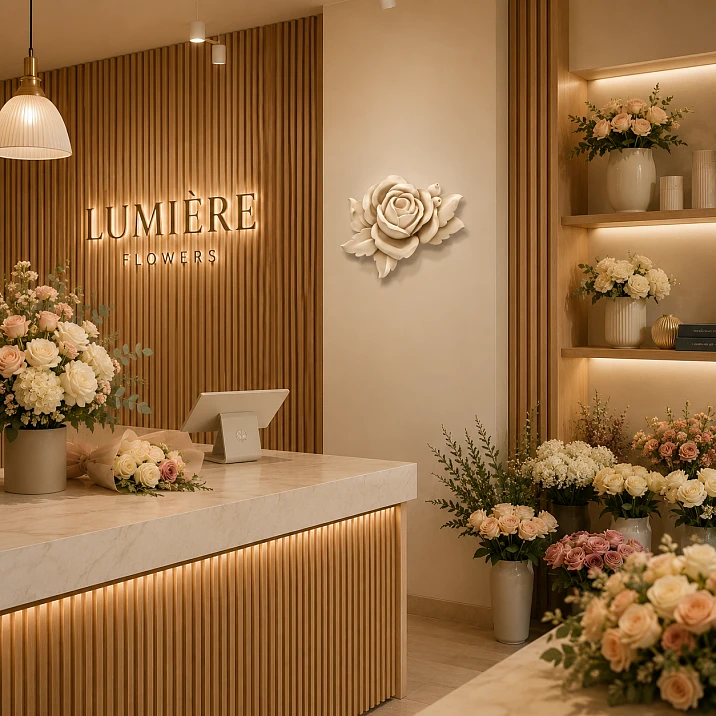
A flower shop has a problem rare for interior decor: the main product itself is the strongest decorative material. Bouquets constantly change color, silhouette, height, and density. Today light peonies stand behind the counter, tomorrow bright roses, in a month an autumn arrangement, and by December pine needles, ribbons, and seasonal decor may appear nearby.
Therefore, the idea "a flower shop means a rose on the wall" is insufficient on its own.
The carved decorative overlay NPU-473 made of polyurethane can be a good purchase if it performs one clear interior function:
-
creates a small permanent sign on a calm wall;
-
softens the strict vertical rhythm of the slats;
-
supports the floral theme without literally copying live bouquets;
-
remains noticeable when the work area is empty;
-
does not become the main "flower" in the frame when a large bouquet appears in front of it.
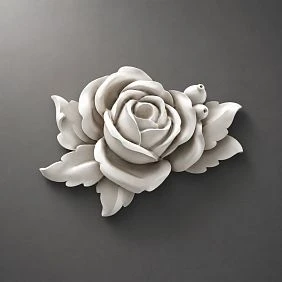
At the time of verification, the STAVROS card indicates for NPU-473 one option of 100 × 70 × 20 mm, polyurethane material, and a price of 1,160 ₽ per piece. The manufacturer describes the product as a polyurethane overlay with a floral motif in the shape of a rose, allows use on walls and the possibility of painting.
But these characteristics do not yet prove that the rose is needed specifically for your store.
Before purchasing, you need to answer five questions.
First: is there a smooth field next to the slat wall where a small relief will be read as a whole?
Second: does NPU-473 duplicate an existing symbol — for example, a rose in the logo, botanical graphics, or a floral sign on the packaging?
Third: will the permanent rose remain appropriate when the assortment in front of it changes from roses to tulips, dried flowers, peonies, or seasonal conifers?
Fourth: will the 20 mm depth intensify shadows so much that the small overlay becomes too noticeable next to the vertical relief of the slats?
Fifth: does the same wall without NPU-473 look calmer and more expensive?
If, after a full-size mockup, the version with one rose wins, you can buy stucco decor NPU-473 "Rose" like one precise accent.
If without it fresh flowers get more visual space, the correct result of this article is 0 × NPU-473 for this wall.




NPU-473 "Rose": confirmed characteristics and a separate task for a flower shop
Our factory also produces:
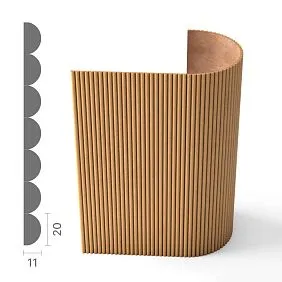
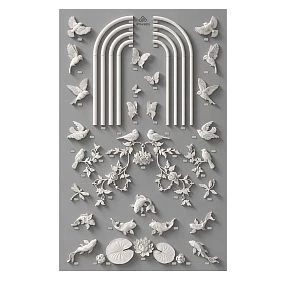
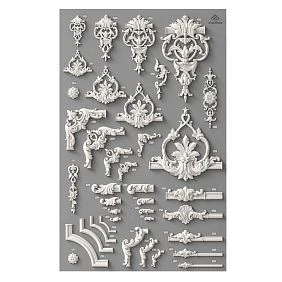
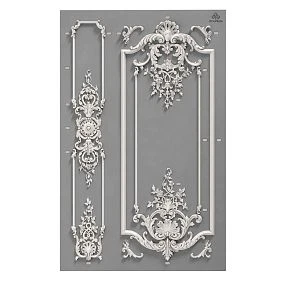
NPU-473 100 × 70 × 20 mm: which characteristics really influence the decision
For this task, the product card provides several facts that can be used confidently.
| Parameter | Confirmed value |
|---|---|
| Article number | NPU-473 |
| Type | polyurethane decorative overlay with a floral motif |
| Motif | rose |
| Size A × B × C | 100 × 70 × 20 mm |
| Material | Polyurethane |
| Price at time of check | 1,160 ₽/pc. |
| Drawing | available on the product card |
| 3D model | available on the product card |
| Application | walls, ceilings, furniture, facades |
| Painting | allowed by the manufacturer |
Get Consultation
Frontal size 100 × 70 mm is a local sign, not a central panel
It is important not to confuse the catalog close-up with the real scale of the wall.
NPU-473 is small. On a smooth panel next to a stand, it can be quite noticeable. On a large wall several meters high, the same element can turn into an almost random dot.
Therefore, the task is not to "find the center of the wall." You need to find the scale of the surface where a small rose looks like a deliberate accent.
20 mm of depth cannot be assessed only from a photograph.
Even a small frontal element has noticeable volume.
20 mm affect:
-
side shadow;
-
perception of petals;
-
close passage;
-
cleaning;
-
how much the rose stands out under directional light.
This is a separate variable. A flat paper mockup shows the size but does not show the real light and shadow.
We do not build geometry on the assumption of which number is the width.
The card gives the size as A × B × C = 100 × 70 × 20 mm, but the product table itself does not explain each axis to the reader with the words "width/height/depth."
Therefore, in the article it is safer to work with two confirmed values:
-
frontal dimensions 100 × 70 mm in the orientation shown on the card/drawing;
-
relief up to 20 mm from the base plane.
For actual marking, the orientation must be verified against the image and the NPU-473 drawing, not by the order of numbers.
Why the general advice "do not overload the retail interior" is insufficient here
STAVROS already has a large article about stucco decor for showrooms and boutiques. It correctly formulates the general principle: the retail wall should work for the product, and an active ornament should not compete with a large amount of merchandise, the logo, mirrors, and light.
This is not enough for a flower shop.
For clothing, furniture, or jewelry, the visual form of the product usually changes more slowly. In floristry, the background against the wall can change several times in one day.
On Monday, the packaging area is almost empty.
On Friday, dozens of bouquets stand against the wall.
Before the holiday, the following appear:
-
boxes;
-
ribbons;
-
baskets;
-
wrapping paper;
-
postcards;
-
seasonal plants.
Therefore, NPU-473 has to be evaluated not in a single beautiful interior shot, but as a permanent detail against a backdrop of changing merchandise.
It is precisely this dynamic that makes a flower shop a separate challenge.
Live goods versus a permanent floral symbol: how to build the hierarchy
Live flowers are already the main decor: when a permanent rose strengthens the brand, and when it becomes literal.
NPU-473 carries one strong and one dangerous meaning at the same time.
The strong one — the rose shape is easily recognizable and supports the floral theme.
The dangerous one — precisely because of its obviousness, the motif may turn out to be too literal.
When the rose works.
It is usually appropriate if the interior is built on calm materials:
-
wood or slat panels;
-
solid-color plaster;
-
stone;
-
neutral metal;
-
soft lighting;
-
a small number of permanent accessories.
Then NPU-473 does not try to "explain" that flowers are sold here. It simply introduces a soft organic form.
When a rose becomes a redundant illustration of the assortment.
The risk is higher if the store already has:
-
a large floral logo;
-
botanical wallpaper;
-
rose drawings;
-
phytowall;
-
dried flowers as permanent decor;
-
floral prints on packaging;
-
neon sign with a flower;
-
decorative bouquets that are not for sale.
Then NPU-473 becomes another repetition of the same idea.
The "remove the bouquets" test.
Look at the interior in the evening after closing or take a photo of the work area without the product.
Does the wall need a small rose at that moment?
If yes, NPU-473 works on the store's architecture.
If not, and it only makes sense next to bouquets, it might be a redundant product illustration.
The "return the bouquets" test.
Now return the usual working volume of flowers to the stand.
If NPU-473 stops interfering and remains secondary — good.
If the eye keeps jumping:
live rose → sculpted rose → logo → bouquet, the composition is overloaded with repetitions.
Smooth field, scale, and layout: where the small NPU-473 reads best
The best place for NPU-473 is a smooth field next to the slats, not the deep slatted relief itself.
The slatted wall already has its own geometry:
-
vertical protrusions;
-
the gaps;
-
deep shadows;
-
regular step;
-
sometimes a contrasting substrate.
Rose NPU-473 is a complex organic form.
If a complex floral relief is applied directly onto a frequent vertical rhythm, two problems may arise.
The first is that the form loses its integrity.
The second is that the mounting base ceases to be continuous.
Why a smooth insert works better.
On a flat surface, the entire contour of the rose is readable.
It gets:
-
own shadow;
-
the free margin;
-
clear center;
-
visual separation from vertical slats.
In this case, the composition can be built as follows:
slats → calm smooth insert → one rose → live bouquets in front.
Where to find a smooth zone in an already finished store.
Not only specially created panels are suitable.
This could be:
-
wall section next to the slatted wall;
-
side smooth panel of the stand;
-
wall area above a low console;
-
a small area near the logo, but not right next to it;
-
the end of an architectural niche;
-
the field between the slats and the door opening.
If there is no smooth field
Don't rush to redo the wall for a 1,160 ₽ overlay.
First, compare three alternatives:
-
give up the NPU-473 altogether;
-
find another smooth surface;
-
choose decor that is originally designed for a different type of base.
If a separate backing is needed only to justify an already chosen rosette, the product starts dictating a disproportionately large rework.
Full-size mockup 100 × 70 mm: how to check if the rose won't get lost on the wall.
NPU-473 is convenient to check before purchase because the front dimension is easy to reproduce.
The first mockup is flat.
Print the rose image at 1:1 scale or cut out a contour matching the front dimension of 100 × 70 mm.
It's better to use the actual product shape rather than an empty rectangle.
A rose visually occupies space differently than a geometric card.
The second mockup is three-dimensional.
After a successful flat fitting, add an offset of about 20 mm.
This can be done:
-
foam board;
-
cardboard in several layers;
-
with remote spacers.
The task is not to imitate petals perfectly, but to show real depth.
What should be in the frame.
You cannot photograph just a piece of the wall.
The frame should include:
-
rack section;
-
smooth field;
-
post;
-
real bouquets;
-
logo, if it is nearby;
-
nearest light fixture.
Only then is it visible who is the main one — the product or the permanent decor.
Work zones and viewing distances: entrance, consultation, packaging, and actual display
Three observation points in a flower shop: entrance, consultation, and packaging give different answers.
Small decor cannot be assessed from a single distance. A flower shop has at least three characteristic points, and each has its own task.
From the entrance
From the entrance, a person reads:
-
the overall character of the interior;
-
rack wall;
-
logo;
-
the main color spots of the bouquets.
NPU-473 may be barely readable — and that is not necessarily a drawback.
If the rose is intended as a subtle interior detail, it does not have to compete with the sign and merchandise.
The problem starts if the designer expects a 100 × 70 mm element to become a noticeable brand symbol across the entire hall.
From the consultation counter.
This is a more suitable distance for a small relief.
Customer:
-
examines compositions;
-
chooses flowers;
-
communicates with the florist.
Here, NPU-473 can work as a small "signature" of the wall.
At the wrapping table.
Close up, details of the petals and a depth of 20 mm are visible.
But this is exactly where there is the most visual noise:
-
paper;
-
ribbons;
-
scissors;
-
boxes;
-
ready-made bouquets.
If a rose is positioned too low and ends up directly behind the work surface, it may get lost or constantly be covered.
Do not expect one element to have the same strength at all distances.
This is an important criterion.
NPU-473 can:
-
almost disappear from the entrance;
-
be noticeable at the counter;
-
be clearly readable up close.
For a small decorative overlay, this is natural.
The main thing is to determine in advance at what distance it should work.
The packaging area changes throughout the day: NPU-473 must visually survive both an empty stand and rush hour.
A flower shop has dynamics that a regular decorative wall does not.
In the morning:
-
few ready-made bouquets;
-
the stand may be almost empty;
-
NPU-473 is clearly visible.
Before a holiday:
-
many flowers;
-
several orders at the same time;
-
there is a package on the table;
-
the wall is partially covered.
Permanent decor should look normal in both states.
If the rose is needed only on an empty stand.
This is a weak scenario.
During working hours, the buyer almost never sees the interior without merchandise.
If NPU-473 remains a calm background even in a busy area.
This is a good sign.
It does not have to constantly be the center of attention.
If the bouquets completely cover the rose.
There's no need to automatically raise it higher.
First, ask whether this zone needs it at all.
Perhaps it's better to move the overlay:
-
at the entrance;
-
to the side wall;
-
to the waiting area;
-
to a separate calm wall.
Seasonality of the assortment: a permanent rose should match not only today's bouquets.
This is one of the most important tests specifically for a flower shop.
Today the interior may be photographed with pink roses and look perfect.
But in a few months, there will be other products around NPU-473.
Spring.
-
tulips;
-
ranunculus;
-
daffodils;
-
delicate pastel bouquets.
A carved rose can remain neutral if painted in the color of the wall.
Summer.
Lots of greenery, wildflowers, bright compositions.
If NPU-473 is painted realistically — for example, in red or pink — it begins to compete more strongly with the living palette.
Autumn.
Warm tones, dried flowers, branches, berry compositions.
A metallic or bright white rose may be too contrasting.
Winter and holidays.
Needles, wreaths, New Year decor, packaging.
A permanent floral symbol should not conflict with the seasonal theme.
Practical conclusion.
The more the assortment changes throughout the year, the safer it is to make NPU-473:
-
solid-colored;
-
close to the wall color;
-
secondary in contrast.
Then the bouquets change, while the architectural detail remains a calm relief.
Color and light: how not to make a permanent rose louder than live bouquets
Color NPU-473: why a "real red rose" is usually weaker than a calm relief.
In a flower shop, there is already a lot of color. Therefore, literal coloring of a stucco rose can quickly make the wall theatrical.
Matching the wall color
This is a basic strategy.
Advantages:
-
the rose is read through light and shadow;
-
does not compete with bouquets;
-
maintains a connection with the interior, not with a specific flower variety;
-
easier to survive seasonal changes in assortment.
This is especially useful for a slat wall nearby: the slats provide texture, NPU-473 provides soft relief, and the color does not create a third active layer.
In the color of the slats.
This way, two surfaces can be connected.
But a polyurethane rose doesn't become wooden just because of a similar shade.
Need to evaluate:
-
lightness;
-
saturation;
-
mattness;
-
surrounding background.
If a dark rose in the color of the slats appears on a light wall, it becomes a graphic sign.
White rose.
Looks very expressive on a dark background.
In a store with pastel branding, this can be beautiful.
In a space with bright bouquets, it's too noticeable.
Metallic.
Gold, bronze, or brass are only appropriate if the metal is already systematically present:
-
in lamps;
-
in profiles;
-
in handles;
-
in the logo.
If the metallic NPU-473 is the only shiny accent, it may look like souvenir decor.
Red, pink, or "naturally painted."
This is the most literal option.
It may suit a themed interior, but for modern floristry the risk is higher.
Live flowers already provide a truly complex palette. An artificially painted sculpted rose almost always loses to them in naturalness.
Therefore, for the first mockup, it is better to compare the monochrome NPU-473 with the version without the overlay.
Light and 20 mm relief: a small rose may turn out to be more noticeable than it seems by size.
100 × 70 mm sounds compact.
But the 20 mm depth creates its own chiaroscuro.
Frontal diffused lighting.
The rose looks calmer.
The contour is readable, but the shadows are shallow.
Side light.
The petals become more voluminous.
On a smooth wall, this can be a beautiful effect.
Next to the slats, there is a risk of double shadow:
-
vertical from slats;
-
multi-petal from NPU-473.
Spot light.
If a single spot hits the rose, it can unexpectedly become the main object of the wall.
For a small overlay, this is not always necessary.
Light from the display window.
In a flower shop, reflections and brightness of the entrance area are important.
During the day, natural light can make NPU-473 almost flat.
In the evening, artificial lighting makes it noticeable.
How to check.
Create a mockup and review it:
-
during the day;
-
in the evening;
-
under full working light;
-
with decorative lighting of the slats.
If a rose is only appropriate in one rare scenario, the venue should be reconsidered.
Logo, storefront, and camera: how NPU-473 behaves in branding and in frame
Store logo and NPU-473: two signs should not compete for the same role.
In the floral business, the logo often already contains:
-
a flower;
-
a bud;
-
leaf;
-
a monogram;
-
a botanical ornament.
In that case, NPU-473 needs to be checked especially strictly.
If the logo already contains a rose.
It is not necessary to repeat the same motif on the wall.
This may look like an overly literal duplication of the brand.
If the logo is text-based.
A small rose on the adjacent smooth field can soften the composition.
But it is better not to place it right next to the letters.
If the logo is large and light.
It is already the main sign of the wall.
NPU-473 should be secondary or absent.
If you want to make NPU-473 part of the logo.
This is already a separate task of corporate design.
An interior overlay does not have to automatically become part of the brand identity.
For such a solution, you need to check separately:
-
scale;
-
repeatability;
-
the graphic system;
-
how the motif will look on other media.
Slat wall, bouquets, and NPU-473: three different rhythms must have a hierarchy.
In the interior of a flower shop, three rhythms can work simultaneously.
The first is vertical: slats.
The second is organic: live flowers and leaves.
The third is a local ornamental: rose NPU-473.
The problem arises when all three claim equal attention.
Good hierarchy.
-
rails form the architecture;
-
bouquets remain the main product;
-
NPU-473 is a small permanent detail.
Bad hierarchy.
-
the slats are contrasting;
-
bouquets are bright;
-
the rose is white or gold;
-
there is also a logo nearby;
-
everything is highlighted separately.
Then the gaze constantly jumps.
How to understand that NPU-473 has taken the right place
It should be noticeable after the main product, not before it.
A useful test:
show the photo to a person who did not participate in the project for a few seconds.
What will he name first?
if:
-
bouquets;
-
interior;
-
a rose as a beautiful detail —
the hierarchy works.
If the first thing mentioned is a sculpted rose, but the store sells fresh flowers, the emphasis is too strong.
A rose at the consultation counter: when it helps the zone, and when it hinders the florist's work.
The consultation counter is a logical place for NPU-473, because the customer lingers here longer.
But the workflow needs to be taken into account.
What is constantly on the counter.
-
catalogs;
-
tablet;
-
card terminal;
-
cards;
-
packaging samples;
-
sometimes ready-made compositions.
If the rose is directly above this set, the wall becomes too saturated.
When NPU-473 helps.
If the rack itself is laconic, and above it there is a calm field next to the rails.
Then a small relief can support the zone without a large panel.
When it interferes.
If behind the florist there is already:
-
logo;
-
shelf;
-
several vases;
-
hanging light;
-
bouquets.
Adding one more character hardly improves anything.
Placement height.
It is impossible to assign a universal height from the floor.
It depends on:
-
stand heights;
-
employee heights;
-
shelves;
-
logo;
-
customer's viewpoint.
You need to check the actual layout on the finished wall.
Packaging area: the permanent rose should remain visible but not get caught up in the work chaos.
The packaging area is especially dynamic.
Here appear:
-
rolls of paper;
-
ribbons;
-
pruning shears;
-
boxes;
-
baskets;
-
vases;
-
orders.
Therefore, it's better to keep the decor slightly above the working visual layer, but not so high that the small size gets lost.
What to check.
-
Place a regular working set on the table.
-
Add a few typical bouquets.
-
Attach the NPU-473 template.
-
Look at it from the client's perspective.
-
Look at it from the florist's perspective.
If the rose is constantly blocked, the spot is weak.
If it interferes with the working shelves, the spot is weak.
If it remains visible but doesn't compete with the product, the scenario is successful.
Don't automatically turn the work area into a photo zone.
Floral packaging is photogenic on its own.
If you want to create a beautiful background for social media, that's a separate task.
NPU-473 should not simultaneously be:
-
working decor;
-
logo;
-
photo zone;
-
brand symbol.
One small overlay doesn't have to solve everything.
Showcase, mirror, and reflections: one physical rose can be visually duplicated.
A flower shop often has a lot of glass:
-
showcase;
-
mirror;
-
glass door;
-
glossy panels.
This changes the perception of NPU-473.
A rose opposite the mirror.
One physical element can become a visual pair.
If the reflection:
-
symmetrical;
-
calm;
-
does not fall between the slats,
it can add depth.
If the reflection is cut off by the mirror frame or blends with the bouquets, a random repetition appears.
A rose near the display window.
During the day, the glass can reflect the street, in the evening — the interior.
NPU-473 sometimes becomes more noticeable in the reflection than on the wall itself.
Before purchasing, it's useful to check both modes.
A rose next to a glossy stand.
A small relief can be duplicated in the shiny surface.
This is not a technical problem, but a compositional one.
If the reflection makes one floral motif too intrusive, it's better to:
-
change the location;
-
reduce contrast;
-
give up NPU-473.
Real bouquets cover the wall differently: check not one "ideal" bouquet, but three characteristic volumes.
For the mockup, three scenarios are enough if they actually change the output.
A small bouquet.
Shows the basic visibility of NPU-473.
Even if it completely covers the overlay, the spot is too low or too close to the product.
An average working composition.
This is the most honest scenario for a regular day.
The rose should remain secondary, but not disappear completely if its role is a constant accent.
A tall festive bouquet.
Shows a boundary case.
If a large composition temporarily overlaps NPU-473, it is not necessarily a problem.
Festive goods should be the main focus.
Why you don't need to test ten bouquets.
If different compositions lead to the same conclusion, it doesn't add knowledge.
Three states are important:
-
free;
-
normal;
-
maximum load.
When floral meanings are already sufficient: phytowall, packaging, and useful emptiness.
Phytowall, dried flowers, and botanical graphics: when NPU-473 almost certainly becomes redundant.
A constant plant theme may already be present in the store's architecture.
Phytowall.
It itself is a large botanical object.
A small stucco rose nearby often looks like a secondary illustration.
Dried flowers as permanent decor.
If they are not for sale but constantly decorate the room, that is already a separate plant layer.
NPU-473 adds another one.
Botanical posters.
Even framed graphics can compete with the rose if the motifs are on the same wall.
Wallpaper with a floral pattern.
Against such a background, NPU-473 almost always requires a separate smooth area.
Otherwise, the flower gets lost within the floral pattern.
When the rose can still work.
If the constant plant theme is in another area of the store, and NPU-473 is used as a small standalone detail on a calm wall.
That is, the question is not about the presence of a green wall itself, but about how many floral meanings meet in one field of view.
Slat finishing and materials: what NPU-473 decides, and what requires reconsidering the wall itself
The slat as a background should support the product, not turn into a fourth active decor.
A slat wall can be:
-
light;
-
dark;
-
natural;
-
painted;
-
with a contrasting backing;
-
with backlighting.
The more active it is itself, the quieter the NPU-473 should be.
Before purchasing, it is useful to do a separate test specifically of the background. Photograph the store without the NPU-473 and temporarily reduce the activity of the slat wall in the layout: turn off the decorative backlighting or cover a small fragment with a neutral smooth surface. If the interior immediately becomes calmer and the bouquets read better, the problem is not the absence of the rose. A small overlay will not fix excessive contrast of the slats, a conflict with the logo, or overly saturated backlighting. In such a situation, it is wiser to leave the NPU-473 out of the order and adjust the background itself during the next interior update. If the slats already work well, and the adjacent smooth surface really lacks one soft organic point, the rose solves a separate clear task.
Light slats.
Allow using a more noticeable rose if the other elements are calm.
Dark slats.
Create a strong graphic background.
A white NPU-473 on an adjacent light field may become more noticeable than expected.
Slats with backlighting.
Already providing a decorative effect.
Additional floral relief should be introduced carefully.
Slats and logo.
If the logo is already placed on the slat wall, NPU-473 is better moved to an adjacent smooth surface.
Thus, the two symbols get separate zones.
Installation and operation: base, cleaning, passages, and adjacent equipment
Installation on a finished wall: "suitable for walls" does not mean one adhesive for any base.
The NPU-473 card confirms wall application. But a flower shop may have different bases:
-
painted plaster;
-
decorative plaster;
-
MDF panel;
-
HPL;
-
tile;
-
stone;
-
glass;
-
furniture panel.
They cannot be considered the same.
First, determine the material.
Before ordering the mounting compound, you need to know exactly what surface the pad will be glued to.
Then check the condition of the finish.
Even the right adhesive won't save a weak coating.
If the paint itself adheres poorly, the pad may come off along with it.
Don't buy adhesive "out of habit."
After checking the base, you can look materials for installing stucco decor, but the specific compound must be compatible with both polyurethane and the actual surface.
Removable panels.
If the smooth area is a service panel, you need to check:
-
Can it be removed?
-
Doesn't NPU-473 cover the fasteners?
-
Do you have to grab the relief with your hand?
If maintenance becomes complicated, it's better to choose another location.
Working operation of a flower shop: water, packaging, pollen, and cleaning change the requirements for the location.
NPU-473 is intended for decorative use, but a flower shop is a working environment.
Nearby there may be:
-
water;
-
wet stems;
-
soil;
-
pollen.
-
green trimmings;
-
adhesive tape;
-
paper dust;
-
packaging mesh.
Do not place in the dirtiest work zone.
A relief with petals is harder to wipe than a smooth wall.
If the panel is directly behind a table where trimmings and water constantly fly, decorative value quickly yields to convenience.
Do not make conclusions about any household chemicals.
What can be used to clean painted NPU-473 depends on the finish coating.
Therefore, the care regime is determined not only by polyurethane, but also by the paint.
Pollen and fine dust.
A depth of 20 mm creates indentations.
On a white or dark solid surface, dirt may be more noticeable.
The best location in terms of maintenance.
This is usually the area:
-
slightly away from wet processing;
-
not behind the work sink;
-
not where stems are cut;
-
accessible for regular cleaning.
Passages, bags, and the 20-millimeter relief: a small front size does not eliminate the physical protrusion.
On a large wall, the NPU-473 seems tiny.
In a narrow passage, 20 mm can make a difference.
Especially if nearby:
-
a queue;
-
waiting area;
-
a doorway;
-
customers' bags;
-
baskets;
-
Delivery.
How to check.
Create a full-scale mockup and walk past it several times in normal mode.
Need to simulate:
-
a customer with a bag;
-
an employee with a bouquet;
-
a courier;
-
a person in outerwear.
If the mockup is constantly bumped, the real overlay will receive the same contacts.
Where the risk is minimal.
On the wall behind the counter, where the client does not physically come close.
Where the risk is higher.
On the side wall of a narrow passage at arm or shoulder level.
There is no universal "safe height." The actual trajectory is checked.
NPU-473 near a door, cabinet, or sliding equipment: first run everything that moves
Even a wall-mounted overlay can be in the trajectory:
-
cabinet doors;
-
of the entrance door;
-
of the folding panel;
-
of the pull-out stand;
-
of the cart.
Before permanent installation:
-
secure the full-scale mock-up;
-
open adjacent doors fully;
-
pull out the equipment;
-
move the cart;
-
check the extreme positions.
This is a small check, but it eliminates the situation where a decorative element has to be removed after the first working day.
When to refuse NPU-473: reasons, mistakes, and checking before irreversible installation
When it's better not to buy NPU-473: nine situations where live floristry is stronger than a permanent rose.
This section is not there for formality. A commercially useful article should help you refuse an unsuitable product as confidently as choose a suitable one.
1. The logo is already built on a rose.
Repeating the same symbol rarely adds value.
2. There is already botanical graphics on the wall.
NPU-473 becomes another floral object.
3. The slat wall itself is very active.
Contrasting step, backlighting, and saturated color already create a strong background.
4. There is no smooth field.
You have to mount the rosette directly on deep rails or create a separate backing just for it.
5. The front layout of 100 × 70 mm gets lost.
If a bright color or a separate spotlight is needed for visibility, the wrong scale was likely chosen.
6. The rosette falls directly behind the constant mass of bouquets.
The product covers it most of the time.
7. The store is built on strict minimalism.
One carved flower can become an accidental stylistic quote.
8. Maintenance becomes inconvenient.
The relief ends up in the dirtiest work area.
9.
Decision table: one NPU-473 or zero
| Condition | What this means | Solution |
| There is a smooth zone next to the rails | The rose gets a solid background | continue checking |
| The only place is right on the deep rails | The pattern and installation become more complex | More often 0 or another place |
| The 100 × 70 mm layout is readable from the required point | The scale fits | continue |
| The layout gets lost on the wall | The product is too small for this task | Different scale |
| 20 mm give a soft shadow | the relief works | continue |
| 20 mm give too sharp a shadow | decorative activity is high | change light/color or 0 |
| A rose in the color of the wall remains secondary | the product does not compete with bouquets | 1 × NPU-473 |
| Need a bright red/gold color so the rose is noticed | scale or placement is weak | reconsider the decision |
| The logo already contains a flower | the symbol is duplicated | more often 0 |
| Live floristry already saturates the background | an extra rose is unnecessary | 0 |
| Without the overlay, the wall looks empty, but with it — complete | a useful center has appeared | 1 |
| Without the overlay, the product reads better | live flowers win | 0 |
Practical algorithm: how to check NPU-473 in the store before ordering.
Step 1. Record the original product.
We check specifically NPU-473:
-
100 × 70 × 20 mm;
-
polyurethane;
-
rose motif;
-
1,160 ₽ per piece at the time of check.
Do not mix this task with other floral overlays.
Step 2. Determine the role.
Choose one:
-
small sign near the consultation area;
-
accent in the packaging area;
-
detail at the entrance;
-
calm element in the waiting area.
If there are five roles at once, the task is blurred.
Step 3. Choose a maximum of three candidate locations.
Do not scatter roses throughout the store.
First, find the best place for one.
Step 4. Exclude inconvenient bases.
Remove zones:
-
with a deep slatted relief without a smooth insert;
-
with service access;
-
with constant impacts;
-
with an unknown mounting base.
Step 5. Make a front template 1:1.
Check the orientation against the card/drawing.
Step 6. Take a control photo without the overlay.
This is important: otherwise, after a long fitting, the eye gets used to the new object, and the smooth version seems "empty" simply due to contrast.
Step 7. Add the NPU-473 template.
Check:
-
the center;
-
proximity to rails;
-
logo;
-
shelves;
-
bouquets.
Step 8. Add a regular working product.
Do not shoot the layout only on an empty stand.
Step 9. Add maximum load.
Festive tall bouquet or several ready orders.
Step 10. Check the volume of 20 mm.
Evaluate:
-
light;
-
passage;
-
cleaning.
Step 11. Check the color.
Minimum two options:
-
in the color of the wall;
-
selected contrast.
Step 12. Look from three points.
-
entrance;
-
consultation;
-
packaging.
Step 13. Check seasonal neutrality.
Imagine instead of today's bouquets:
-
tulips;
-
wildflowers;
-
dried flowers;
-
New Year compositions.
Step 14. Confirm installation.
Only after the composition is approved.
Step 15. Decide "1 or 0".
If NPU-473 makes the wall better and remains secondary to live flowers — one piece.
If it only repeats the floral theme — zero.
Placement map: which store zones are better suited and which require caution
| Zone | Potential | Main risk | What to check |
| Smooth wall section next to the slats | High | the element may get lost | Scale 1:1 |
| Behind the consultation counter | High | competition with the logo and product | working load |
| Above the wrapping table | Medium | overlap with bouquets | three volumes of goods |
| Near the entrance | Medium | too small from a distant point | visibility and role |
| Waiting area | High | may not be associated with the brand | overall composition |
| Next to the mirror | Medium | the reflection doubles the motif | Reflection |
| On a deep slat panel | Low | fragmentation of form and base | better another surface |
| near the sink/flower processing | Low | water and contamination | operation and coating |
| Narrow passage | low/medium | contact with 20-mm relief | volumetric layout |
| Photo zone | depends on the idea | the rose becomes too literal | brand and frame |
The table shows that the best position does not have to be the most visible. For a small NPU-473, the right background and stability of the environment are more important than maximum visibility.
One point or a series: the number of NPU-473 and scaling to a network
Why one rose is usually stronger than a series of identical roses in one store.
The main scenario of this article is a single NPU-473.
If the first element seems successful, the thought easily arises:
-
add a second one near the checkout;
-
a third one by the mirror;
-
a fourth one in the photo zone.
Thus, the constant motif begins to repeat more strongly than the live assortment.
When repetition is justified.
If the rose is consciously part of the branded interior system.
For example, a retail chain uses the same small relief in every consultation area.
When it is not justified.
If the quantity grows simply because the first overlay is inexpensive.
The low cost of an item is not a reason to repeat it.
The cost also changes.
At the current price:
| Quantity | The cost of the NPU-473 itself |
| 1 | 1 160 ₽ |
| 2 | 2 320 ₽ |
| 3 | 3 480 ₽ |
| 5 | 5 800 ₽ |
| 10 | 11 600 ₽ |
For one store, this is not a large budget, but the series changes not only the amount, but the meaning of the interior.
One rose is a detail.
Ten is a theme.
Alternatives and the cart: a different motif, a different overlay, or no stucco at all
When it's better to replace the rose with a different motif, and when to abandon stucco altogether.
NPU-473 may not fit for three different reasons. It's important not to mix them up.
It's specifically the size that doesn't fit.
If 100 × 70 mm is too small for the chosen wall, but the idea of a single carved accent is right, you can look at Polyurethane decorative appliques and choose a different scale.
This is better than buying several NPU-473s to fill the area.
It's specifically the rose that doesn't fit.
If the store sells modern designer floristry without romantic styling, the rose shape may be too literal.
Then you should choose:
-
an abstract ornament;
-
geometry;
-
a more neutral plant form;
-
a completely smooth wall.
The type of decorative solution itself is not suitable.
Sometimes the problem is not the product, but that the interior doesn't need another relief detail.
Then the following work better:
-
light;
-
wall color;
-
logo;
-
a clean field;
-
slat texture;
-
live plants.
When to look at the general catalog.
If not only the model changes, but also the very idea of decor, it makes sense You can buy ready-made stucco matching the Baroque style. Calculate the quantity: linear meters of cornices and moldings, number of rosettes, pilasters, consoles, corner elements. Add a ten to fifteen percent allowance for trimming. already after the new layout, rather than blindly picking a replacement for NPU-473.
A flower shop with a slat wall and without NPU-473: why an "empty" area can be commercially more useful.
A free surface in a store is not always unfinished.
It can serve an important function — visually separating the interior from the merchandise.
In a flower shop, this is especially valuable.
Bouquets need a neutral background.
Complex color compositions are better read next to an area that does not try to compete.
The slats need a pause.
If the vertical rhythm runs along the entire wall, the adjacent smooth zone reduces visual density.
The logo needs air.
If a brand sign already exists, an additional flower may reduce its weight.
Photos need a clean background.
Clients photograph bouquets.
A too saturated wall can interfere with the composition of the frame.
Seasonal decor needs a reserve.
A free zone allows you to temporarily add:
-
a festive sign;
-
a seasonal arrangement;
-
a poster;
-
a promotion.
A permanent rose occupies part of this space and introduces a fixed meaning.
Therefore, the option without NPU-473 may be commercially stronger — not because the decor is bad, but because the store must remain flexible.
How NPU-473 affects photos of bouquets and store content.
For a flower business, the interior often becomes a backdrop for:
-
catalog;
-
social media;
-
stories;
-
product cards;
-
customer photos.
A small permanent rose can work in the frame in different ways.
In a good scenario.
NPU-473:
-
barely noticeable;
-
adds depth;
-
recognizable as part of the interior;
-
does not distract from the bouquet.
In a bad scenario.
Rose:
-
ends up right behind the center of the bouquet;
-
visually "grows" from the live flowers;
-
creates a strange duplication;
-
In a contrasting color, it becomes a spot.
Camera test.
Take three shots:
-
vertical for the phone;
-
horizontal overall;
-
close-up of the bouquet.
Check that the NPU-473 does not fall into awkward parts of the frame.
Why this is a separate variable.
In real life, a small rose can be almost invisible.
The camera compresses depth and changes the composition.
Therefore, photogenicity cannot be assessed only with the eyes.
Branded packaging, postcards, and ribbons can tie the interior to the brand more strongly than a molded rose.
Sometimes NPU-473 is chosen because one wants to make the floral theme "clearer."
But the buyer already sees the brand through:
-
paper;
-
ribbons;
-
stickers;
-
postcards;
-
boxes;
-
tags.
If all the packaging has a floral pattern, another rose on the wall may be redundant.
When NPU-473 adds something new.
If the packaging is strict and typographic, a small organic relief on the wall creates another layer.
When it repeats an existing one.
If the packaging is literally covered in roses.
Practical test.
Place next to the NPU-473 mockup:
-
a package;
-
frame;
-
a postcard;
-
a ribbon.
If all elements say the same word "flowers" equally literally, the wall needs more neutral decor.
Shelves, vases, and tall merchandise: NPU-473 should occupy a stable, not randomly free, spot.
Shelves often appear behind the consultation or packaging area.
They stand on:
-
vases;
-
boxes;
-
decor;
-
tools;
-
ready-made compositions.
A free piece of wall between shelves seems convenient for NPU-473, but it should be evaluated as part of a constantly changing system.
If the shelf is fixed.
You can build a stable composition:
-
shelf;
-
the free margin;
-
rose.
If the display is rearranged.
Today there is a small vase nearby, tomorrow a tall composition.
NPU-473 may unexpectedly end up behind the product or too close to it.
If the store uses tall bouquets.
You cannot rely only on the average height of the product.
Check the maximum typical scenario.
Do not assign a universal height.
There is no correct rule like "hang a rose at 160 cm."
The height depends on:
-
uprights;
-
shelves;
-
product;
-
logo;
-
actual field of view.
A mockup on a finished wall is more useful than any universal number.
Natural wood, greenery, and a polyurethane rose: the material can be tied by color, but you don't need to imitate a living flower.
A slat wall is often used in a flower shop precisely because of the natural character of wood or wood texture.
Live plants add a second natural layer.
NPU-473 — polyurethane.
This is not a problem if the material is used honestly as a painted interior relief.
Good pairing.
-
warm slats;
-
neutral smooth wall;
-
NPU-473 in the color of the wall;
-
live flowers in front.
Materials do not try to imitate each other.
Weak pairing.
-
a polyurethane rose is painted to look like a real flower;
-
add artificial greenery;
-
try to make the petals as realistic as possible.
Next to live floristry, artificial imitation is compared with the real product and usually loses.
If you want to tie a rose to a tree.
Better to repeat:
-
tone;
-
color temperature;
-
degree of contrast,
rather than drawing wood texture on each petal.
Can NPU-473 be made part of a wall with a price list, service menu, or information sign.
A flower shop may offer:
-
delivery;
-
event decoration;
-
wedding floristry;
-
flower subscription;
-
corporate orders.
An information panel is sometimes placed next to the consultation.
NPU-473 may be nearby, but should not impair readability.
What to check
-
does the rose look like a marker for one specific item;
-
does it not overlap with the text;
-
does it not compete with the heading;
-
does it not hinder future information replacement.
If the information changes.
It is more logical to leave NPU-473 on the stationary wall, and make the information panel separate and replaceable.
If the price list is already decorative.
For example, with botanical graphics.
Then an additional stucco rose may be unnecessary.
If there is a refrigerated display case next to the slat wall, NPU-473 should be evaluated together with it.
Refrigeration equipment is often a large visual object:
-
glass;
-
metal;
-
lighting;
-
shelves;
-
bright flowers inside.
A small rose nearby may almost disappear.
When this is good.
If the NPU-473 is designed as a part for close viewing.
When it's bad.
If it's bought for the 'composition center'.
Do not transfer the overlay to equipment without separate verification.
The card allows different surfaces, but a refrigerated display case is technical equipment.
Do not:
-
glue onto a removable panel;
-
block ventilation;
-
interfere with service;
-
modify equipment without approval.
For this article, it's safer to consider the wall nearby, not the equipment casing.
Flower shop chain: first approve one location, then repeat the motif.
For one store, NPU-473 costs 1,160 ₽.
For a chain, even an inexpensive item becomes a system.
Why you can't just multiply by the number of branches.
The same layout can work differently in different spaces:
-
different areas;
-
different lighting;
-
different slat spacing;
-
different counter placement.
The correct prototype.
First, approve one real node:
-
smooth surface type;
-
position;
-
color;
-
light;
-
installation;
-
photos with the product.
Then create an installation card.
For repetition, it is useful to note:
-
position relative to a specific wall element;
-
orientation according to the drawing;
-
color;
-
mounting method;
-
acceptable exceptions.
Seriality changes the meaning.
One rose in one store is a decorative detail.
The same rose in all branches is already part of the interior identity.
This should be a conscious brand decision.
What to buy together with NPU-473 and what should not be added to the cart automatically.
If the mockup confirmed the decision, the basic purchase in this article is simple:
1 × NPU-473 100 × 70 × 20 mm — 1,160 RUB.
Additional items depend on the base and finish.
Installation materials.
They are chosen after checking the wall.
You should not consider one specific adhesive as universal for:
-
paints;
-
plaster;
-
tiles;
-
glass;
-
stone;
-
of the furniture panel.
Paint.
If NPU-473 must match the wall, it is more useful to make a test swatch in advance than to hope to hit the shade after gluing.
This is especially important when:
-
complex gray;
-
warm white;
-
beige;
-
brand color.
Second rose.
Not a mandatory addition.
If one seems small, first check the other scale.
Molding frame.
NPU-473 can be used as a standalone overlay. The frame is only needed if the interior is already built on a frame system.
Next to a slat wall, it can add extra lines.
If a different overlay is needed.
You can Buy decorative polyurethane overlays and choose a different motif.
If the project requires a whole system.
Then it makes sense to go to the general section and Buy Polyurethane Molded Decoration already as a set of coordinated elements.
How to separate the decor problem from the problem of the slat wall itself
Before purchasing, it is useful to do one more diagnostic test. Remove not only NPU-473 from the frame, but also temporarily reduce the visual activity of the slat background — for example, turn off the decorative lighting in the layout or cover part of the surface with a neutral sheet.
Compare three states:
-
active slat wall without rosette;
-
the same wall with NPU-473;
-
a calmer background without NPU-473.
If the third option wins more strongly than the second, the problem is not the absence of a floral symbol. The wall lacks a pause, not molding.
This is especially important in a store where live merchandise constantly stands in front of the background. Adding a small relief cannot fix:
-
too frequent contrasting rhythm;
-
conflict of slats with the logo;
-
excessive lighting;
-
poor background for bouquet photos.
In such a situation, it is wiser to adjust the background in the next renovation or leave a smooth adjacent area than to buy NPU-473 as an attempt to "assemble" an already overloaded composition.
If the slat wall itself works well on its own, but the adjacent smooth field really lacks one small organic point, then the NPU-473 fulfills exactly its purpose, and the purchase becomes much clearer.
Connection with slat panels: when the commercial branch leads not to the NPU-473, but to wall finishing
Sometimes trying on a rose shows that the problem is not in the decor.
For example:
-
the slat wall is too active;
-
there is no smooth zone at all;
-
the color of the slats conflicts with the brand;
-
the background works poorly with bouquets.
Then purchasing the NPU-473 will not solve the problem.
If the finishing is still being designed, it is more useful to first buy wall slat panels and plan the wall architecture:
-
where the slats will be;
-
where the smooth field will remain;
-
where the logo will be;
-
where the product will stand.
But if the slat wall is already ready, there is no need to rebuild it just for a small overlay.
Thus, the commercial route remains honest:
a rose fits → NPU-473 card;
the motif does not fit → overlay category;
the wall itself does not fit → reconsider the slat finish.
Parental principles of retail interior and what is unique to floristry
What is useful to take from the general material about the showroom, and what should be decided only for a flower shop
The general STAVROS guide to showrooms and boutiques is useful as a parent page.
From it, the following principles apply:
-
the product should remain the main focus;
-
not every wall should be an accent wall;
-
decor should not conflict with the logo;
-
lighting, mirrors, and walkways should be considered together.
But a flower shop adds variables that are insufficient in the general scheme:
-
live goods themselves serve as decor;
-
the color palette changes daily;
-
the height of bouquets varies;
-
the packaging area can be empty or overloaded;
-
seasonal assortment sharply changes the context;
-
a floral symbol can too literally repeat the product.
Therefore, if necessary, general principles can be referred to in the article "Stucco decor for showroom and boutique", and the decision on NPU-473 should be made according to the narrower logic of this page.
Five store formats: where a rose is natural, and where it is especially risky
Five flower shop formats: the same NPU-473 gives different results.
The decision depends not only on the wall. The business format changes the acceptable expressiveness of a permanent rose.
1. A small authorial floristry studio.
Character:
-
few products at a time;
-
bouquets are made to order;
-
the interior is calm;
-
a lot of empty space.
Here, NPU-473 is easier to become a beautiful small detail.
If there is a smooth wall section next to the slats, a single monochrome rose can work as a "signature" of the space.
Likely result: one piece after the mockup.
2. A store with a large daily display.
Character:
-
many ready-made bouquets;
-
bright color spots;
-
high product density;
-
constant movement.
Here NPU-473 is more often lost or becomes an unnecessary floral repetition.
Likely result: zero on the working wall or relocation to a calmer area.
3. Wedding floristry salon.
Character:
-
romantic theme;
-
consultations;
-
albums;
-
samples;
-
delicate palette.
The rose shape here is stylistically more natural.
But if the logo and brand graphics are already floral, duplication is still possible.
Likely result: one calm NPU-473 near the consultation area, if the brand does not repeat the rose.
4. Modern urban flower bar.
Character:
-
minimalism;
-
metal;
-
strict slats;
-
graphic typography;
-
unusual bouquets.
A carved classic rose can be a deliberate contrast or a stylistic mistake.
Here the check is especially strict.
If NPU-473 is introduced only for "coziness," it's better to keep it smooth.
Likely result: often zero; one piece only with deliberate eclecticism.
5. Gift and flower shop
There are already many different product categories here:
-
candles;
-
postcards;
-
toys;
-
boxes;
-
souvenirs.
NPU-473 can help highlight the floral part, but it can also add another object to an overloaded interior.
Likely result: depends on zoning. The rose works only if it is in a calm field and truly marks the floral zone, without becoming part of the visual chaos.
Trial week instead of instant installation: when a reversible mockup is especially useful.
For a finished commercial interior, there is a practical method that is rarely used: leave a full-size mockup for several working days.
This is more useful than making a decision in five minutes after the first fitting.
Why the first impression is deceptive.
A new object almost always seems noticeable.
The eye does not yet know whether it will become part of the interior or will constantly "stick out" separately.
What happens over several days.
You will see:
-
the morning display;
-
the evening store;
-
different bouquets;
-
workload;
-
customer photos;
-
employee behavior.
What to ask florists.
Not "do you like the rose?"
Better:
-
does it interfere with the shelves;
-
is it constantly blocked;
-
do customers notice it;
-
do you have to work more carefully nearby;
-
is it convenient to wipe the wall.
What to ask yourself after a week.
If the layout is removed, did it become worse?
If the answer is "no" — the purchase is not mandatory.
If the wall really lost the necessary point — NPU-473 passed a more honest test than one beautiful photo.
Final recommendation: NPU-473 should win against a smooth wall, not just fill it.
The selected rose has clear confirmed parameters:
-
NPU-473;
-
polyurethane;
-
front dimension 100 × 70 mm in the shown orientation;
-
relief 20 mm;
-
1,160 ₽ per piece.
Buying 1 × NPU-473 makes sense if:
-
there is a calm smooth area next to the rails;
-
small scale is read from the selected operating point;
-
the relief does not fall into an inconvenient zone;
-
the rose does not duplicate the logo;
-
live bouquets remain the main object;
-
monochrome or selected coloring works all year round;
-
a wall with a mockup looks more accurate than without it;
-
the mounting base is confirmed.
Buying 0 × NPU-473 is more reasonable if:
-
the floral theme is already repeated in branding and decor;
-
there is no calm field on the wall;
-
the rose gets lost and requires bright coloring to be noticeable;
-
bouquets constantly cover it;
-
the slat wall is already active enough;
-
a smooth surface works better as a background for the product;
-
the store should maintain maximum flexibility for seasonal displays.
The most useful test costs less than any repair: make a front mockup 100 × 70 mm, add 20 mm of depth, place regular bouquets in front of it, look from the entrance, the consultation point, and the wrapping table, then remove the mockup.
If the wall becomes worse after removal, NPU-473 is truly needed.
If it becomes calmer and fresh flowers read better, a permanent rose is not required for this zone.
FAQ
Can NPU-473 be used on the checkout wall if there is already a logo there?
Yes, but the checkout wall already has a main sign — the brand. NPU-473 should be secondary and placed on a separate calm field. If the logo contains a flower or a botanical motif, an additional rose often duplicates it. First, compare the wall with and without the mockup from the customer's position at the checkout.
Will NPU-473 suit a small store with an area of a few dozen square meters?
The size of the space itself does not decide the issue. In a small store, an element of 100 × 70 mm may be more noticeable, but the risk of visual overload is also higher: products, slats, shelves, and signage are closer to each other. A real fitting on a specific free surface is needed.
Can the NPU-473 be installed on the door of a utility room?
This option can be considered if the door is smooth and the decor does not interfere with the handle, the lock box, or the opening. But then the rose will work more as a decorative sign of the door rather than of the store wall. It is necessary to check the full swing of the panel and whether the secondary door will become too noticeable.
Is it worth installing the NPU-473 next to the "Bouquets" or "Flowers" sign?
Usually this is too literal a pairing: the word already explains the function, and the rose repeats it graphically. It is better to use the NPU-473 where it adds form rather than duplicates text. If the sign looks too dry without it, compare one monochrome mockup.
Can the rose be placed on a smooth panel within a slatted wall?
Yes, if the smooth panel itself is part of the architecture and exists not only for the overlay. Then the NPU-473 gets a solid background and reads better. If cutting or reworking an already finished slatted system is required just for a small rose, the commercial sense of the solution becomes questionable.
Should the NPU-473 be strictly oriented to the 100 mm size horizontally?
Such a conclusion should not be drawn only from the order A × B × C. The card confirms the dimension 100 × 70 × 20 mm, but for installation the orientation must be verified against the product image and drawing. Therefore, the article uses the frontal size 100 × 70 mm without arbitrarily assigning axes.
Can the NPU-473 be painted in the store's brand color?
Yes, as a design idea, if the chosen painting system is compatible with the product. But the brand color can make the small rose too noticeable. This especially applies to bright pink, red, and purple shades. First, compare a colored mockup with a version in the wall color.
What to do if NPU-473 is barely visible from the entrance area?
That's normal if its purpose is to be a detail for the consultation area. If the rose is meant to work as a distant brand sign, the size is likely insufficient. Don't compensate automatically with backlighting or repeating several overlays: better to reconsider the scale of the task.
Can NPU-473 be placed next to a live rose in a display window?
Yes, but literal matching of motifs can be stronger than it seems. Today it looks logical, but tomorrow the assortment may change. For permanent decor, it's safer to focus not on one type of flower, but on the overall interior and seasonal product rotation.
Will NPU-473 suit a dried flower shop?
It might suit, but the constant botanical theme there is already very strong. Dried flowers themselves create relief and a complex silhouette. A small molded rose makes sense only on a calm, separate surface and in a neutral color. On a saturated background, it's often unnecessary.
Can NPU-473 be used as a marker for a wedding floristry zone?
Yes, if the store actually has a separate wedding zone and the rose helps to designate it. But the marker must be clear in the overall navigation. One small relief without text or other structure may be too inconspicuous for functional zoning.
Is it necessary to place two NPU-473 symmetrically on either side of the logo?
Not necessarily. Symmetry creates a more formal and decorative effect, but two roses compete more strongly with the brand and double the floral motif. For a modern flower shop, one asymmetrical detail on a separate field is often calmer. First, test with one.
Can the NPU-473 be installed on a furniture rack instead of a wall?
The card allows the use of a decorative overlay on furniture. But then the task changes: you need to check the rack's covering, contact points, cleaning, sliding elements, and working load. On a vertical wall behind the rack, a small relief usually has less contact with people and inventory.
What to do if tall branches and greenery constantly stand near the NPU-473?
Check the actual display. If plants cover the rose most of the time, don't automatically raise it to the ceiling. Perhaps this area simply isn't suitable for a small permanent accent. Better to move it to where the background is more stable.
Can the NPU-473 be made part of a photo zone for clients?
Yes, if the photo zone is built on a very restrained background and the rose remains a small branded detail. If the photo zone already contains text, a logo, flowers, and lighting, the NPU-473 may be an unnecessary fifth object. Check the vertical mobile frame, not just the overall wall view.
Is special lighting needed specifically for the NPU-473?
Not by default. The 20 mm relief already creates a shadow with side lighting. A separate spotlight can turn a secondary element into the main one. First, assess the existing lighting of the slat wall and the retail area. Additional light is justified only if the rose is deliberately meant to become the visual center.
Can the NPU-473 be placed on a wall next to a flower cold storage unit?
On an adjacent stationary wall — after the usual check of the base and composition. On the body of the cold storage unit itself, without separate approval, it's not advisable: it's technical equipment with service, ventilation, and operational requirements. Interior decor should not interfere with its operation.
Is there any point in buying a spare NPU-473?
For a single store, there is no mandatory spare stock. It can be useful for a chain, complex custom coloring, or a standardized interior system where future replacements must match other branches. For a single accent, it is enough to initially purchase the actually confirmed quantity.
What matters more when choosing — matching the floral theme or the quality of the composition?
The composition matters more. Matching the motif to the product does not automatically make NPU-473 suitable. If the rose worsens the background for live bouquets, conflicts with the logo, or gets lost on the wall, a literal thematic connection does not save the decision.