Article Contents:
- A squeak-free staircase starts with the tread: buy a wooden stair tread with the right thickness, overhang, and installation
- A tread is not just a board with a rounded edge
- Why a wooden staircase squeaks: causes to eliminate before purchase
- Insufficient tread thickness
- Raw material
- Unprepared base
- Missing riser
- Incorrect fastening
- Inaccurate geometry and poor overhang
- Thickness of wooden steps: where savings turn into deflection
- Thickness guidelines
- Why the step deflects
- Width, depth, and overhang: three dimensions that determine step comfort
- Tread depth
- Riser height
- Wooden step overhang
- How to calculate steps before purchase
- Riser: an inconspicuous detail that makes the staircase quieter and more cohesive
- Step material: oak, beech, ash, pine — what to choose for a specific task
- Oak: status and wear resistance
- Beech: density and clean color
- Ash: expressive grain and elasticity
- Pine: affordable but requires attention
- Steps under varnish, oil, stain, or paint: how the finish affects the choice
- Step and railing: why you can't buy a staircase in parts without a unified system
- First step and starting post: the area seen first
- Open or closed staircase: when risers are needed
- Stair steps to the second floor in a private house
- Mistakes when buying wooden steps
- What to buy with steps: a kit for a quiet staircase
- Steps for open and spiral staircases: individual scenarios
- Staircase as part of the interior: a unified line from step to baseboard
- How to choose steps to match your interior style
- FAQ: answers to popular questions about wooden steps
- Where to buy wooden steps for stairs: STAVROS
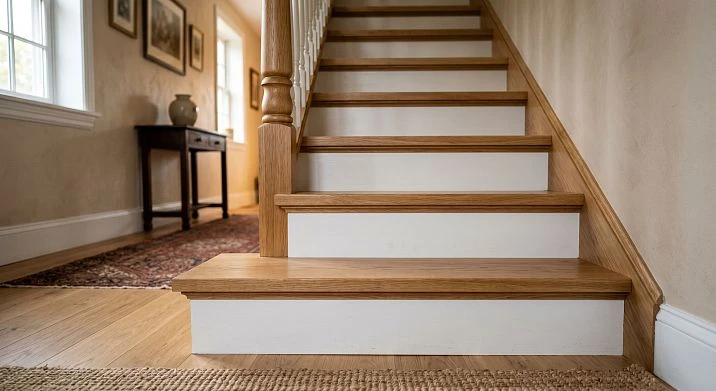
A squeak-free staircase starts with the step: buy a wooden step for stairs with the right thickness, overhang, and fit
If you want to buy a wooden step for stairs so you don't have to redo it later, start not by choosing a color, but by understanding how the step works under load, why it starts to squeak a year after installation, and what happens when its geometry doesn't match the rest components and elements for stairsThis article is not a catalog of wood species. It's a discussion about how to choose a wooden step correctly: once, without mistakes, and without unnecessary expenses.




A step is not just a board with a rounded edge.
Many buyers see a step as a flat blank of a certain length. Paid, delivered, installed — that's it. In practice, a wooden step for a staircase is an engineering element that simultaneously bears several loads: stepping load, point load, lateral load from the railing, and deformation load from humidity changes in the house.
A tread is what we step on. A riser is the vertical board that closes the space between steps. A stair board is a wider blank for custom cutting. A decorative overlay is a finishing element on top of an already prepared base. Each of these options solves its own task, and confusing them means getting problems even at the ordering stage.
A step under constant load works differently than, say, a floorboard. It is supported on a stringer or string at two points, while the center remains free. With a flight width of 900–1000 mm, this creates a bending moment that over time loosens the fastening connections — and the staircase starts to creak. That is why the material, thickness, and geometry of the step are not an aesthetic choice, but a technical calculation.
Our factory also produces:
Why a wooden staircase creaks: causes that need to be eliminated before purchase
The question 'why does a wooden staircase creak' is one of the most common. And most answers boil down to one thing: the problem is not created during use, but during selection and installation. Let's analyze each cause separately.
Get Consultation
Insufficient step thickness
The most common mistake is buying a step with a thickness of 30 mm where 40 or 50 mm is needed. With a wide flight, a thin board bends under a person's weight. Bending is not only an unpleasant feeling underfoot; it is a micro-displacement of the step on the support. Each step slightly shifts the board, the fasteners loosen, and after a few months, a characteristic creak appears. A creak-free staircase step starts precisely with the correct thickness — and no other way.
Raw material
A board that has not undergone chamber drying to an operational moisture content of 8–12% will shrink after installation. Shrinkage is a reduction in linear dimensions. A step that fits tightly during installation will develop gaps in the mounting grooves after six months and start moving under load. Damp material means squeaks, cracks, and deformation all in one. To prevent a wooden step from squeaking, it must be made from properly dried solid wood.
Unprepared base
If the stringer or bowstring has unevenness, height differences, or play, no step will fit tightly. Even a perfect board of dry oak will squeak if there is no flat, rigid support underneath. Before installation, the base must be checked with a level, and all gaps must be eliminated before laying.
Absence of riser
An open flight without risers looks beautiful, light, and airy. But the riser is precisely the stiffening rib that connects adjacent steps and prevents them from moving laterally. A staircase with risers behaves like a rigid structure. Without them, each step works as a separate cantilever, and over time it starts to squeak.
Incorrect fastening
Self-tapping screws into the end do not hold as well as a screw with pre-drilling and a countersunk head. An adhesive joint without mechanical fastening creates play during shrinkage. Only a combination of glue and fasteners ensures long-term rigidity of the fit without a single extra sound.
Inaccurate geometry and poor overhang
If the steps have different thicknesses in the batch or uneven overhang, the staircase will lose a straight line of the flight. This is not just about aesthetics: with uneven overhang, the load on the step is distributed differently, and the support points shift.
Thickness of a wooden step: where savings turn into deflection
What thickness of step is needed is one of the key questions when purchasing. The answer depends on the width of the flight, the type of wood, and the expected load.
Thickness guidelines
For a flight width up to 800 mm and normal household load, a step made of hardwood (oak, beech, ash) with a thickness of 40 mm provides sufficient rigidity. A 40 mm step for stairs is the working minimum for most private homes.
For a flight width of 900–1100 mm or in homes with high usage intensity — children, frequent guests, moving furniture — it is recommended to switch to a 50 mm step for stairs. A solid wood step without deflection under such parameters is exactly 50 mm from hardwood or 40 mm from oak with support on three points.
Pine as a soft wood deflects noticeably more than oak at the same thickness. If the budget is limited and pine is chosen, increase the thickness by at least 10 mm relative to the calculated minimum. A durable wooden step made of 50 mm pine at a normal flight width works quite confidently but requires careful fastening.
Why the step deflects
Deflection is the result of an incorrect combination of thickness, span width, and wood type. Stairs with high load require not just greater thickness but also denser wood. The thickness of a wooden step for stairs is a calculated parameter, not just a preference. Choosing a step "by eye" without knowing the flight width means risking both deflection and squeaking within a season.
Width, depth, and overhang: three dimensions that determine step comfort
A beautiful staircase can turn out to be uncomfortable if its proportions are violated. And most often, it is not the architect or builder who is to blame, but the incorrectly selected sizes of wooden steps.
Tread depth
The tread depth of a wooden staircase is the distance the foot actually occupies on the step. The optimal range is 270–300 mm. With a smaller depth, descending becomes strained: the heel overhangs the edge, and a person instinctively slows down. With a larger depth, the step becomes unnaturally wide, and fatigue accumulates faster.
Riser height
The riser height in a comfortable staircase is 150–180 mm. This ratio sets the rhythm of the ascent — not too steep, not too shallow. The step of a wooden staircase consists of the tread depth and riser height: the classic formula for a comfortable staircase is: 2h + b = 630 mm, where h is the step height, b is the depth. This is an ergonomic standard, proven by centuries of construction.
Wooden step nosing
Nosing is the projection of the tread beyond the line of the riser or stringer. What should the nosing of a wooden step be? The standard is 20–30 mm. Nosing makes the step visually lighter and provides additional comfort when ascending: the toe of the foot does not hit the vertical plane.
Important: the nosing must be the same throughout the entire flight. If the nosing in the middle of the staircase is 25 mm, and at the top step it is 15 mm, this is noticeable to both the eye and the foot. When calculating before purchasing, always clarify whether the nosing will be maintained in each position of the flight.
How to calculate steps before purchasing
How to calculate wooden steps? The algorithm is simple: the rise height is divided by the height of one step. If the floor height is 2800 mm and the step height is 175 mm, you get 16 steps. The depth of each tread with the standard formula is about 280 mm. How many steps are needed for a staircase depends on the floor height and the chosen step. It is better to calculate in advance and order with a small margin — one or two extra steps will cost less than a construction delay.
Riser: an inconspicuous detail that makes the staircase quieter and more cohesive
Many buyers perceive the riser as an additional expense. In fact, it is one of the most effective elements of a quiet staircase — and it is worth including in the list from the very beginning.
A wooden riser can be purchased separately, but it is more correct to select it in the same batch as the steps, from the same species and cut. This guarantees matching texture, color after finishing, and geometric dimensions.
It makes sense to buy a wooden riser in several cases: when a closed staircase with a monolithic appearance is needed, when the house is used intensively and acoustic rigidity of the structure is required, when there are children or elderly people in the family — a closed flight is psychologically safer.
Buying a wooden riser to match the same finish as the steps is also a matter of aesthetics. A riser for painting made of pine accepts enamel perfectly. Riser made of solid oak or beech under varnish create a unified visual field with the treads. Ideally, a riser for wooden steps is ordered in the same batch — then the staircase looks like a single product, not a set of parts.
The riser for a wooden staircase also affects the rigidity of the entire structure: it prevents the steps from moving back and forth, fixes the space between them, and significantly reduces the likelihood of squeaking.
Step material: oak, beech, ash, pine — what to choose for a specific task
The question "what is better — oak or beech for steps" is often asked. The answer depends on the load, final finish, and interior style.
Oak: status and wear resistance
Buying oak steps means choosing a material with a density of about 700 kg/m³, high hardness, and expressive grain. Oak is not afraid of moisture or abrasive load. Its structure accepts any finish: oil, varnish, tinting. After 10 years of intensive use, oak steps look decent — with a noble dark polish in areas of frequent contact, but without deformation or delamination. For a private house with high load, for staircases in classic, neoclassical, loft styles — oak remains the optimal choice.
Beech: density and clean coloring
Buying beech steps is worth it if uniform texture without pronounced grain is important — especially under colored enamel or monochrome varnish. Beech is denser than most species, polishes well, and holds geometry. Its only drawback is sensitivity to humidity fluctuations. Beech steps are best placed in rooms with a stable microclimate.
Ash: expressive grain and resilience
Buying ash steps means getting wood with contrasting grain, which looks especially advantageous under light oils and clear varnishes. Ash is slightly lighter than oak and has a different, more "lively" texture. In terms of hardness, it is comparable to oak. For stairs in Scandinavian, modern, or mixed styles, ash creates the right visual mood.
Pine: affordable but requires attention
Buying pine steps is the most budget-friendly option among solid woods. Pine is softer than hardwoods, but with proper thickness and good coating, it lasts for many years. Its downside is relatively quick wear at points of intense contact. For stairs in country houses, guest areas, or on a limited budget, pine is justified. In a home with children and daily high traffic, it is better to choose a harder species.
Steps for varnish, oil, stain, or paint: how the finish affects the choice
The final finishing of steps is not the last step but a parameter that must be considered when choosing the wood species and profile. Wooden steps for varnish require a smooth surface without chips or pronounced pores — oak and beech handle this better than pine. Wooden steps for oil are the most "lively" option: oil penetrates the fiber structure, emphasizes the grain, and creates a tactilely pleasant matte surface. Wooden steps for oil can be restored locally without re-treating the entire surface.
Wooden steps for painting are most often made from pine or beech: these species accept primer and enamel well, providing an even opaque color. Solid wood steps for tinting are a compromise: stain or tinted oil changes the shade while preserving the wood grain. This is a popular choice when you need to age the stairs to look like wenge, walnut, or gray smoked oak.
How to choose steps for painting? The main criterion is the cleanliness of the profile: no resin pockets (especially in pine), no large knots, and a minimum of open pores. Before painting, the steps must be thoroughly primed — this prevents uneven absorption of the enamel and ensures the durability of the finish.
Step and railing: why you cannot buy a staircase in parts without a unified system
This is one of the key insights that most buyers get too late — after the steps have already been purchased and the balusters do not match them in style or fit.
Wooden steps and balusters must form a single structural and aesthetic system. The step must withstand not only the foot load but also the attachment points of the railing — that's where they are placed balusters for staircases. The baluster transmits horizontal load to the step's mounting socket when leaning on the hand. If the step is thin or made of soft wood, the mounting point loosens over time, and the railing starts to wobble.
Steps for wooden railings require height coordination: if the steps are too thick or have a non-standard overhang, the baluster height "shortens," and the handrail ends up below the norm. Selecting steps for the handrail, for handrails for stairs means calculating the entire system in advance: baluster height, step thickness, flight height.
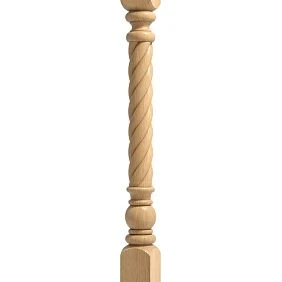
Steps for balusters and posts are not about abstract compatibility, but literally: the diameter of the baluster's mounting tenon must match the diameter of the hole in the step. If the steps and balusters are bought from different manufacturers, the tenons and sockets may simply not align.
That's why it's better to buy wooden staircase elements in one place — where all parts are manufactured within a unified tolerance system and coordinated in style. Buying components for a wooden staircase as a single set is not an overpayment, but a saving of time, nerves, and installation errors.
First step and starting post: the area seen first
There is one point on the staircase that shapes the entire first impression — the beginning of the flight. The first step, the starting post, the first pair of balusters, and the handrail line — this is what everyone sees when entering the hall or living room.
The first step is usually wider than the others: it can be rounded, have a shaped edge, or an increased overhang. This is an accent element, and its appearance sets the tone for the entire staircase. If the first step is made of one wood species and the rest of another, the staircase visually "falls apart."
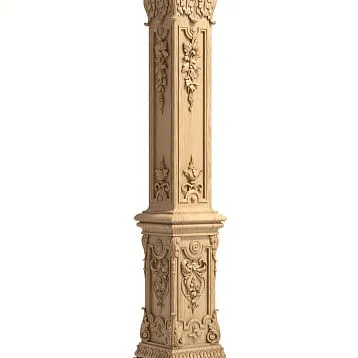
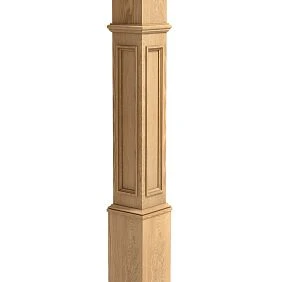
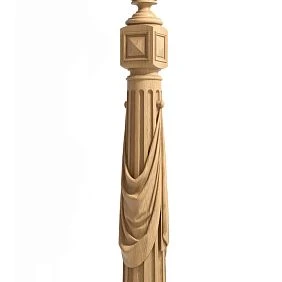
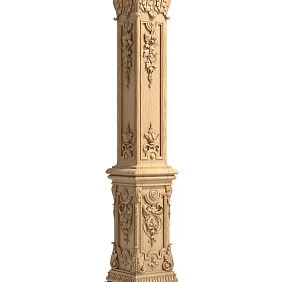
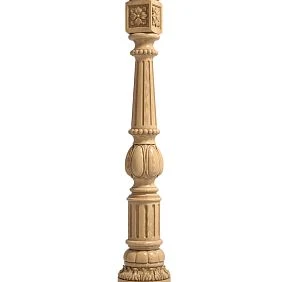
The starting post is the anchor piece of the entire structure. It supports the handrail, secures the first baluster, and visually "opens" the staircase. Wooden staircase post L-001 и Wooden staircase post L-053 — examples of products that create exactly this type of staircase entrance: visually strong, structurally reliable.
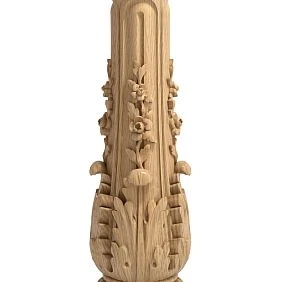
The beginning of the staircase is a portal: a person passes through it several times a day, each time touching the handrail, stepping onto the first step. The quality of this point determines the feel of the entire home. It's no coincidence that in classic interiors, the starting post received the most attention — carving, turned profile, decorative top finial.
The top accents of the posts and the completion of the staircase composition should be considered in advance: Wooden Caps give the posts a finished look and prevent the staircase from appearing incomplete — especially in classic and neoclassical interiors.
Open or closed staircase: when risers are needed
An open flight is light, airy, modern. A staircase without risers visually takes up less space, lets light through, and gives a sense of spaciousness. This is a popular choice for interiors in loft, minimalist, and Scandinavian styles.
A closed flight is monumental, quiet, classic. Risers give the staircase integrity and textural richness. Buying a wooden riser for a closed staircase means simultaneously solving the issue of acoustics and the visual "weight" of the structure.
When exactly are risers needed? If there are small children in the house, a closed flight is mandatory: open gaps between steps create a risk. If the staircase is used intensively and quietness is important, risers significantly reduce footstep noise. If the interior is designed in a classic or traditional style, a closed flight is more organic.
Risers made of solid wood matching the same species as the steps create the feel of a monolithic product. A white-painted riser against dark oak steps is a classic contrast that never goes out of style. Buying wooden risers in the same batch as the steps means avoiding geometry discrepancies and simplifying installation.
Stairs for the second floor in a private house
Stairs for the second floor in a private house are perhaps the most heavily used scenario. This is not a museum staircase that is used once a month. People go up and down it several times a day, carry washing machines and sofas during moves, children run, and guests walk in shoes.
Stairs for a country house, a cottage, are an element of daily use. This is where it makes no sense to skimp on thickness and wood species. Stairs for a straight flight in a private house must withstand point loads from heels—about 200 kg per area of a few square centimeters. Stairs for a turning staircase require special attention to geometry: winder steps have a trapezoidal shape and non-standard width that needs to be calculated individually.
The size of a wooden step for a staircase in a cottage should be chosen with the future in mind: today there are two adults in the house, in a year a small child, and a few years later elderly parents. A staircase comfortable for all user categories should have a deep tread, a low riser, and reliable railing.
Mistakes when buying wooden steps
Mistakes when buying wooden steps is a topic rarely discussed directly, but one that costs money. Let's break down the most common ones.
Buying based on price rather than parameters. A cheap step made of raw pine with a thickness of 30 mm will require complete replacement in a year. This is not savings, but deferred expenses.
Not calculating the quantity with a buffer. Always order 5–10% above the calculated amount. One chipped step during transport, one defective in texture—and you'll have to place a separate order from a different batch where the color will be slightly different.
Do not account for length allowance. Steps are often sold in standard lengths of 900, 1000, 1100, 1200 mm. If your flight is 870 mm, take a 900 mm step and trim it. Do not try to find the "exact size" — this will delay the order and increase the price.
Buy steps without coordinating with risers. Even if the flight is planned to be open, make sure that if you later want to add risers, it will be structurally possible.
Forget about the overhang. If you have not agreed on the size and shape of the overhang with the seller, there is a high chance of receiving steps without rounding or with a non-standard profile.
Do not check the moisture content. From a reliable supplier, solid wood steps have a moisture content of 8–12%. Request this information or check with a moisture meter upon receipt.
Buy steps separately from balusters and handrails. This is the most costly mistake: later it turns out that the mounting diameters do not match and the style of the elements does not coordinate.
Do not account for the final finish. If the steps are planned for painting, that is one type of wood and profile. For oil or varnish, a different surface preparation is required.
What to buy together with the steps: a kit for a quiet staircase
A step is the beginning, not the end of the shopping list. To make the staircase truly quiet, beautiful, and complete, it makes sense to immediately select together with the steps:
-
Risers — for rigidity, quietness, and a closed flight
-
balusters for staircases — the railing, which must match the steps in wood species and style
-
Posts for staircase — handrail support and visual accent marking the start and end of a flight
-
stair railings — comfortable handle, aligned in height with balusters and steps
-
Wooden Caps — finishing of posts, decorative accent that gives the staircase a finished look
-
Fasteners — specialized for wooden staircases: countersunk screws, dowels, wood glue
-
Wooden trim — baseboards, trims, strips that connect the staircase with wall and floor finishes into a unified interior; Carved wooden decoration allows adding accents at points where the staircase meets the wall, portal, or partition
Step and riser in the same style, the set of step — risers — balusters — handrails is not a marketing story, but real engineering logic: elements manufactured in the same tolerance system and from the same batch of wood are installed faster, fit tighter, and look like a single product.
Matching steps to balusters means ensuring that the tenon diameter matches the socket diameter in the step, that the baluster height corresponds to the calculated handrail height, and that the style of the turned or carved baluster profile does not conflict with the step shape. How to match steps to the handrail is a matter of ensuring that the final handrail height from the finished floor meets the standard of 900–1000 mm on the staircase flight.
Steps for open and turning staircases: separate scenarios
Steps for an open staircase are a special type: without risers, with a finished lower edge of the tread, sometimes with double rounding (on both sides). An open staircase looks light but requires stiffer steps: without a riser, they lack a stiffening rib, so a thickness of 40 mm here is the minimum, and 50 mm is the standard.
Steps for a spiral staircase — winder steps — are made individually according to the calculation of a specific flight. These are not standard rectangular blanks: they have variable width along their length. Before ordering winder steps, an accurate drawing or template for each position is required.
Staircase as part of the interior: a unified line from step to baseboard
A staircase in a private home is not an isolated structure. It interacts with walls, ceiling, and the floors of the first and second levels. A properly chosen Wooden trim — baseboards, trims, thresholds — visually connects the staircase with the room's finishing into a single whole.
If the steps are made of oak and the baseboards are painted MDF, the staircase will look like an 'insert' from another interior. But if the wooden moldings are of the same tone and species as the steps, the transition between zones becomes organic, and the space gains integrity.
Solid wood steps for a staircase in a home are a warm and expressive material that sets the tone for all wooden decor. A wooden step as the foundation of a safe staircase is true. But a wooden step as the foundation of a beautiful interior is no less important.
How to choose steps to match the interior style
A staircase in a classic interior — oak or ash under varnish with carved balusters, a profiled handrail, and figured newel posts. Steps are wide, with a pronounced overhang, risers are white or matching the wall color.
A staircase in a modern interior — ash or oak under oil, balusters of a minimalist profile, handrail made of stainless steel or wood with metal posts. Steps are visually thinner, open flight.
A staircase in a Scandinavian style — light birch or ash under clear oil, white risers, laconic balusters. A feeling of lightness and air.
Loft-style staircase — dark oak stained or fumed color, metal stringers or bowstrings, steps as "floating" slabs. Open flight, rough texture, minimal decor.
FAQ: answers to popular questions about wooden steps
Which wooden step should you buy for a staircase in a private house?
For constant load in a residential house, steps made of solid hardwood — oak, beech, or ash — with a thickness of 40–50 mm are optimal. The species is chosen considering the final finish and interior style. Pine is acceptable on a limited budget but requires greater thickness and regular coating renewal.
Why do wooden steps creak?
Most often — due to improper seating on the stringer, weak or unsuitable fasteners, use of raw material with moisture content above 12%, and also due to the absence of risers, which ensure the rigidity of the flight. Sometimes the reason is a step that is too thin, which bends and damages the seating points.
Are risers needed for a wooden staircase?
If you need a quiet, rigid, and visually monolithic staircase — yes, they are needed. If the interior requires an open flight — risers can be omitted, but then the thickness of the steps must be increased, and installation must be more thorough.
What is more important — step thickness or wood species?
Both parameters are important and interrelated. Thickness is responsible for the rigidity of the span and the absence of deflection, while the species is responsible for wear resistance, surface hardness, and behavior under humidity changes. The optimal choice considers both parameters simultaneously.
Can I buy treads separately from balusters and handrails?
Technically — yes. Practically — it's difficult: the diameters of mounting tenons, heights, styles, and even wood shades may not match. It's better to choose all elements from one manufacturer, within one system.
What should be the overhang of a wooden tread?
The standard overhang is 20–30 mm. The main condition is a consistent overhang along the entire flight. A non-standard overhang is possible, but it needs to be coordinated with the staircase structure and balusters.
What should I buy together with wooden treads?
Risers, balusters, newel posts, handrails, finials, fasteners, wooden moldings for finishing joints, and finishing materials. This entire set, selected within a unified system, guarantees a quiet, beautiful, and durable staircase.
Where is the best place to buy solid wood treads for a staircase?
From a manufacturer or a store with its own production: there you can coordinate dimensions, wood species, finish preparation, and order all components in one batch.
Where to buy wooden treads for a staircase: STAVROS
STAVROS has been operating since 2002 and specializes in the production of wooden elements for staircases and interiors from solid valuable wood species. If you want to buy a wooden tread for a staircase — here you can do it as a system: not just one wooden tread, but a complete set of staircase elements, coordinated by wood species, style, dimensions, and finish.
in the STAVROS catalog Staircase Components and Elements from oak, beech, ash and pine — balusters, posts, handrails, finials, carved decor, moldings. All products are manufactured on modern CNC equipment, have passed moisture and geometry control, and are ready for final finishing.
Buying a staircase in parts means assembling a construction set without instructions. Choosing everything in one place means getting a staircase that does not creak, does not sag, does not differ in color, and looks like a finished work of interior craftsmanship. A creak-free staircase starts with the step — the right step, chosen with an understanding of how it works, what it pairs with, and what it requires during installation. STAVROS helps you make this choice correctly the first time.