Article Contents:
- Why the table gets lost against the slat wall
- "The table got lost" is a silhouette problem, not necessarily a color one
- Quick diagnosis without buying
- When the distance from the wall matters more than a new leg
- A height of 750 mm does not equal the finished table height
- The sphere is decorative geometry, not a promise of technical advantage
- What does "Prestige" sanding mean
- Straight leg and MN-238: difference in perception
- Why the sphere should not be covered with a decorative apron
- The tabletop sets the frame, but does not have to repeat the sphere
- The sphere should be read in real scale
- The rhythm of the slats can be supported by material, without repeating their shape
- Step 1. Fix the main viewing points
- Step 2. Apply the MN-238 silhouette to the photo
- Step 3. Evaluate not one leg, but the entire silhouette
- Step 4. Check the light in the morning and in the evening
- Step 5. Check the background in the sphere area
- Step 6. Reduce the solution to a short matrix
- Painting to match the countertop tone
- Contrast enamel
- Matte, satin, or glossy surface
- Paint before or after assembly
- Why beech does not have to match the species of the slats
- Three strategies for combining oak with a slat wall
- Do not try to match wood by looking at the screen
- One material does not mean one texture
- Oak is not an automatic "premium" answer
- The central sphere will be hidden
- The interior already has too many spherical details
- The tabletop itself is very active
- The supports are in a narrow passage area
- The table design is not coordinated with MN-238
- A nearly invisible interior is needed
- The merging is not caused by the legs
- 1. SKU and product card
- 2. Drawing and values A, B, D, E
- 3. Final table height
- 6. Mounting and recommended hardware
- 7. Current availability and real calendar
- 8. Sample next to real materials
- 9. Packaging, delivery, and acceptance
- 10. Final visual hypothesis
- Checklist for sending to the manager and furniture maker
- Buying based on a beautiful close-up
- Assuming 750 mm is the finished furniture height
- Calling "under enamel" a finished coating
- Matching oak to slats by photo
- Buying all recommended hardware without a specification
- Repeating the sphere in all items in the room
- Assuming oak slats require oak legs
- Ignoring the background at sphere height
- Will MN-238 fit a rectangular tabletop?
- Is it mandatory to choose an oak leg for oak slat panels?
- Can beech MN-238 be painted to match the wall color?
- Will the sphere be visible behind the chairs?
- Is MN‑238 suitable for a round table?
- Do I need to repeat the sphere shape in the lamp or furniture handles?
- Can I use MN‑238 if there is a rug under the table?
- What is more important for separating from the slats — color or shape?
- Why can't the 109 mm size be considered a mounting plate?
- Is the mounting hardware included in the price of MN‑238?
- Can I install MN‑238 on an existing tabletop?
- What to do if MN‑238 looks too decorative?
- How to check the oak shade without a finished leg?
- Can I order MN-238 in a different size?
- How do I account for the lead time if the model is in stock?
- Will the sphere suit a dark slat wall?
- Do I need to see all the legs at the same time?
- What should I do if the table is placed sideways to the slat wall?
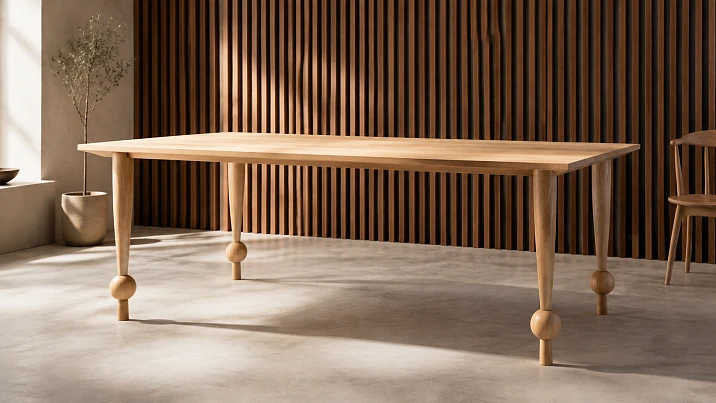
The table can indeed visually "disappear" next to a slat wall, even if its tabletop, dimensions, and color are well chosen. The reason is often below the tabletop: straight thin legs repeat the direction of the slats, and the eye reads the furniture together with the background as one system of vertical lines. In such an interior, changing the panels or the entire table is not necessary. The silhouette can be separated from the wall with a leg where the vertical is interrupted by a noticeable rounded volume.
MN-238 is suitable for this task precisely because of its shape: at a height of 750 mm, the leg has a spherical middle with a diameter of 109 mm and tapering sections. The sphere creates a transverse visual impulse where a regular straight leg would continue the wall pattern. However, one expressive shape is not enough for a correct order. Before payment, four things need to be checked: whether the central part is visible from the main viewing points, whether the chosen finish matches the tabletop and slats, whether the 750 mm height is compatible with the specific table construction, and how the leg will be attached to its base.
The main exception is simple: if the apron, deep tabletop, chairs, or textiles completely cover the middle of the leg, the effect disappears. In such a situation, MN-238 can remain a quality wooden leg, but paying for the expressive spherical geometry as a way to fix the "striped" background is no longer rational.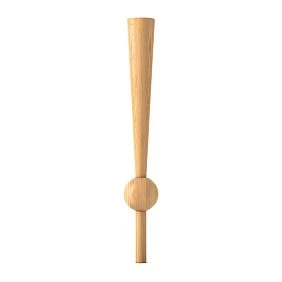
Why the table gets lost against a slat wall
Slat paneling is built on repetition. Equal intervals, elongated elements, and the contrast between the front surface of the slats and the recesses create a strong vertical rhythm. It is noticeable before the small details of the furniture. If a table with straight solid-color legs, especially close to the slats in width and color, is placed nearby, the legs begin to work as four more stripes in the same composition.
This does not mean that there is too much wood in the interior or that the slatted wall itself is chosen incorrectly. The problem arises from the coincidence of several features:
-
The slats and legs are oriented in the same direction;
-
There is little free background between the table and the wall;
-
The color of the supports is close to the color of the slats or the dark gaps between them;
-
The tabletop is thin and does not create a sufficiently strong horizontal line;
-
The chairs are pushed back, so the supports are in view;
-
The lighting emphasizes the relief of the wall but barely models the volume of the furniture.
The more coincidences, the weaker the boundary between the table and the wall is read. The eye sees not a separate object but a dense lattice. The effect is especially noticeable in a frontal view: when a person looks at the long side of the table almost perpendicular to the wall, the legs project directly onto the slats. From a side angle, the situation may be better because diagonals, distance, and overlaps appear.




"The table got lost" is a silhouette problem, not necessarily a color problem
The first reaction is often the desire to repaint the table in a contrasting shade. Sometimes this helps, but color does not solve everything. If the legs remain straight and match the slats in rhythm, they may look like contrasting stripes on a striped background. The object will become more noticeable, but the visual noise will remain.
Another common move is to replace the tabletop with a thicker one. The horizontal line will indeed be strengthened, but the bottom of the table will continue to blend with the wall. Moreover, a heavy tabletop on vanishing supports sometimes creates the feeling that the plane is hanging in front of the panels without clear support.
MN-238 works differently: not only the tone changes, but also the contour. The central sphere breaks the long straight line of the leg, and the conical transitions provide sections of different widths. Against the background of identical slats, a shape appears that cannot be mistaken for another wall plank.
Our factory also produces:

Quick diagnosis without purchase
Before choosing a new support, it is useful to understand whether the table really lacks shape, rather than light or distance. Take four photos from the eye level of a sitting and standing person:
-
frontally, when the legs coincide with the slatted background;
-
at an angle of approximately 30-45 degrees;
-
in daylight;
-
in the evening with interior lighting on.
Then convert the photos to black and white mode. Color will stop distracting, and it will become visible whether the outer contour of the table is readable. If in monochrome the legs break apart into vertical stripes, working with geometry is justified. If the table separates well from the wall, and the problem appears only under one lighting scenario, it is wiser to first adjust the light or the furniture position.
A second test is also useful: temporarily cover the middle part of the existing legs with circles of thick cardboard about 109 mm in diameter, cut to the scale of the central element of MN-238. The mock-up will not convey the exact plasticity of the wood, but it will show whether the table gains its own rhythm. You should check not up close, but from the doorway, the sofa area, and other places where the table is most often seen.
Get Consultation
When the distance from the wall matters more than a new leg
If the table stands almost flush against the panels, no calm field is formed between the support and the rails. Any complex shape will be perceived together with the wall relief. Sometimes it is enough to move the table forward within the permissible layout: the shadow and side gap will separate the furniture from the background. This is especially noticeable with directed light from above or from the side.
But rearranging does not always help. In a narrow dining room, kitchen-living room, or home office, the passages are already defined, and the table cannot be moved. Then the shape of the support becomes a more reliable tool: it works not through additional space, but through the contrast of straight and rounded.
Modern furniture leg MN‑238 750 mm: what the card confirms
MN‑238 is a tall wooden furniture leg of a modern shape. The product page lists two materials — beech and oak. For the selected beech version, the card shows the sanding quality "Prestige" and preparation "for enamel." The product page also states that the warehouse item is shipped within three working days and the average production time for custom orders is 5–10 days. Since the price and warehouse stock change, they should be checked directly on the card before placing an order.
| Parameter | What is specified for MN‑238 | What this means before purchasing |
|---|---|---|
| Article number | MN‑238 | In the request and correspondence, it is better to specify the article number, not just the description "leg with a ball" |
| Size A × B × D × E | 750 × 109 × 88 × 34 mm | The letters should be read according to the product drawing; you cannot arbitrarily assign zones of the leg to them. |
| Height A | 750 мм | The final height of the furniture also depends on the tabletop and the connection unit |
| Central shape | Spherical volume 109 mm | This is the main visual distinguishing element of the model |
| Material | Beech or oak | The material is chosen together with the finishing scheme, not automatically based on the type of slats |
| Quality of the selected beech option | «Prestige» | On the website, this indicates the quality of sanding |
| Preparation of the selected beech option | For enamel | This is a blank for opaque finishing, not a ready-painted leg |
| Lead time | Warehouse — up to 3 business days; made to order — on average 5–10 days | The project timeline is better calculated after confirming the selected execution. |
The dimension string requires careful reading. On the specifications page, it is given as A × B × D × E = 750 × 109 × 88 × 34 mm. In site headings and descriptions, an extended notation may appear, but for a technical solution, you need to open the drawing and match each letter to a specific section. Based on a text sequence alone, you cannot confidently determine where the 88 mm dimension is, which section the 34 mm refers to, and what area is available for connection to the table.
The height of 750 mm is not equal to the finished table height.
The number 750 mm refers to the leg itself. After it is attached, a tabletop appears, and sometimes a mounting plate, underframe, apron, or another structural component. Therefore, you cannot see "750 mm" in the product card and automatically assume the finished table is standard in height. The final dimension must be confirmed by a designer or furniture maker based on the actual cross-section of the product.
In this article, height is important not as a reason to choose among dozens of sizes, but as a control parameter for a specific purchase. If an existing table is being modified, you should compare not the previous leg length with the new one, but the actual furniture height before and after modification, taking into account all connecting parts. If a new table is being created, the leg, tabletop, and underframe structure are coordinated as a single unit before ordering.
The sphere is decorative geometry, not a promise of technical advantage.
The central spherical volume makes MN‑238 recognizable, but you cannot independently derive from its shape increased strength, special load distribution, or mounting versatility. The product card confirms the geometry and product options; structural suitability for a specific tabletop is determined separately.
This distinction protects against two mistakes. The first is buying a leg only as a beautiful object without checking the connection joint. The second is attributing an engineering function to the decorative sphere that the manufacturer does not state in the specifications. In a commercial solution, aesthetics provide the desired silhouette, while the furniture project ensures the table works correctly.
What does "Prestige" sanding mean
On the STAVROS website, "Prestige" refers to the quality of sanding. It is not the name of a finished color or a designation of wood species. Therefore, the phrase "beech, Prestige, under enamel" describes three different properties: material, surface preparation quality, and the intended type of opaque finish.
It is useful for the buyer to separate them in the order as well. Otherwise, the phrase "need a Prestige leg in oak color" may be understood ambiguously: "Prestige" does not set a color, and "oak" can mean either the species or a common name for a shade. A correct request looks more specific: item MN‑238, selected wood, sanding quality, type of future coating, and required quantity according to the furniture project.
After checking the form and wood type, you can buy the modern furniture leg MN‑238 in the product card. Before payment, open the drawing, request confirmation of the configuration, and agree on the fasteners with the table maker.
How the spherical middle changes the strict rhythm of the slats
The visual task of MN‑238 is not to make the leg "noticeable." A too noticeable support can compete with the tabletop and turn the furniture into a set of scattered accents. A more precise effect is needed: the leg should stop the repetition of verticals but remain part of the table.
The spherical middle works on three levels. The contour expands across the direction of the slats. Light falls on the rounded surface as a gradient, not an even strip. Finally, the connection of the sphere with the conical sections creates a change in tempo: the eye moves along the vertical, encounters the rounded volume, and returns to the narrowing. Against the wall, the rhythm remains uniform; at the table, it is variable.
Straight leg vs. MN‑238: difference in perception
| Situation | Regular straight support | MN‑238 with spherical middle |
| Front view against the slats | May coincide with one or more verticals | Rounded center extends beyond the linear contour |
| Side light | Produces a relatively even longitudinal shadow | Forms a chiaroscuro transition on the sphere |
| Close tone of wall and furniture | Geometry may dissolve | Shape remains discernible even with close color |
| Contrast color | Adds another vertical stripe | Contrast is distributed across the volumetric form |
| View from the adjacent zone | Perceived as part of the overall picket fence | Can become a recognizable detail of the table silhouette |
This analytical comparison describes the perception of form, not a guaranteed result. On a real object, distance, light, viewing height, chair placement, and apron depth change everything. Therefore, the table helps formulate a hypothesis, and the final decision is made after a mockup or visualization.
Why the sphere should not be covered by a decorative apron
If the purpose of the purchase is to separate the table from the slatted wall with a rounded element, the sphere must remain visible at least in the main angles. A deep decorative apron, a hanging drawer, dense chair upholstery, or a draped tablecloth can cover the main part of the leg. Then the viewer will only see the lower taper, and the model will again approach an ordinary vertical support.
At the same time, the structural apron should not be removed just for the sake of leg aesthetics. Its presence, dimensions, and function depend on the furniture design. The correct action is not to dismantle a necessary element, but to overlay the MN‑238 contour on the table section in advance and check the visible area. If the structure covers the sphere, it is better to change the decorative idea or choose a different support silhouette compatible with the underframe.
The tabletop sets the frame but does not have to repeat the sphere
The rounded leg detail does not require a round tabletop. For a rectangular table, the sphere can become a soft counterpoint to the corners; for an oval one, it can continue the plastic logic; for a round one, it can support the geometry but simultaneously increase the risk of excessive repetition of circles.
Before ordering, it is useful to answer not the question "do the shapes match," but another one: which geometry already dominates in the room? If slats, rectangular facades, linear lighting, and a strict tabletop create many straight lines, one rounded detail will add the missing type of line. If the interior already has a round table, spherical lampshades, arched openings, and chairs with rounded backs, MN‑238 may become another repetition instead of a precise accent.
The sphere should be read at real scale
A diameter of 109 mm cannot be assessed from a catalog photo without context. On screen, a close-up makes the detail monumental, but in a room it is perceived relative to the tabletop, ceiling height, and slat width. Next to a very massive tabletop, the volume may look restrained; near a thin plane, it becomes noticeable.
The most reliable home test is to print the front contour of the leg at 1:1 scale on several sheets, glue them together, and place the mock-up in the intended spot. If an exact drawing for printing is insufficient, make a simplified silhouette 750 mm high with a 109 mm circle, but do not use it for mounting layout. Such a template only evaluates composition.
The rhythm of the slats can be supported by material without repeating their shape
The interior does not have to be assembled from literal duplicates. The connection between the table and the wall can arise through wood, shade, degree of gloss, or overall contrast level. At the same time, the leg's shape is free to argue with the vertical. It is precisely the combination of common and different that makes the composition cohesive: wood connects objects, the sphere separates their silhouettes.
Therefore, the wall material does not automatically determine the leg material. Oak panels do not require oak MN‑238, and painted slats do not oblige you to choose beech under enamel. The decision depends on what needs to be kept common and what should be separated. Sometimes matching color temperature is enough; sometimes contrasting enamel is more useful; sometimes oak texture is left on the legs, and the wall is made a calm solid background.
How to check the visual effect in advance
A catalog photo shows the product separately. The buyer, however, needs to understand what will happen in a specific room where there are slats, a tabletop, chairs, baseboards, light, and several viewing directions. Full 3D visualization is useful, but for a decision on form, an accurate check can be done without it.
Step 1. Fix the main viewing points
Do not evaluate the table only while standing in front of it. Mark the places from which the furniture will actually be visible:
-
the entrance to the room;
-
passage between kitchen and living room;
-
sofa or armchair;
-
adjacent work area;
-
position of a person sitting at the table;
-
reflection in the mirror, if it is constantly part of the composition.
For each point, take a photo with a regular smartphone lens without strong wide-angle distortion. A low angle can artificially enlarge the legs, and a wide angle can stretch distances. The goal is not a beautiful shot, but an honest assessment of the visibility of the spherical middle.
Step 2. Overlay the MN‑238 silhouette onto the photo
Use the 750 mm size as the vertical scale and 109 mm as the control for the central volume. Scale the mockup relative to a known size in the image—for example, the height of an existing table or door opening. Do not try to determine the mounting hardware from such a collage. The task is to see whether the chairs and the apron block the sphere, whether it coincides with the active panel pattern, and whether it differs enough from straight lines.
Check two color versions: one close to the tabletop and one contrasting. If the shape is only readable in a very bright color, it may lack visible area against the real background. If the sphere remains distinguishable in monochrome, the geometric contrast works on its own.
Step 3. Evaluate not just one leg, but the entire silhouette
A catalog close-up provokes examining each support separately. In the room, the viewer sees the table as a whole. The repetition of spherical elements should create a clear lower rhythm and not turn into a fragmented ornament. Check the overall frontal view with chairs placed, and then the same view when some chairs are pulled out. In everyday life, the composition changes, and good furniture should not look convincing only in a staged shot.
The article intentionally does not specify the number of supports or calculate the load: these parameters are determined by the table's construction. The visual layout only shows how noticeable the form is and whether there is an excess of rounded accents.
Step 4. Check the light in the morning and evening
The sphere is revealed by light and shadow. With even frontal lighting, its volume may look like a flat circle. Side light gives a smooth transition from light to shadow and separates the leg from the slats. But too harsh directional light creates dense shadows on the textured wall, in which even an expressive contour gets lost.
If the interior is still being designed, it is appropriate to show the designer not only the finish color but also the desired lighting scenario. If the room is ready, conduct a test with a portable lamp. Sometimes it is enough to change the direction of light for MN‑238 to work more calmly and precisely, without contrasting coloring.
Step 5. Check the background in the sphere area
The sphere can be projected not only onto the slats but also onto the baseboard, outlet, carpet edge, radiator, or dark gap between panels. The more active the intersections, the worse the form reads. On a frontal photo, draw a horizontal line at the assumed level of the central volumes and see what is behind them.
If many small details pass along this line, there are several options: slightly change the table's position, simplify the background, choose a more contrasting finish for the legs, or admit that in this particular room MN‑238 will not solve the task. The latter conclusion is more useful than a purchase after which the expressive form turns out to be invisible.
Step 6. Reduce the decision to a short matrix
| Check | Yes | No | What to do |
| Is the sphere visible from two main viewpoints? | The form will be able to work as an accent | The effect will be episodic | Reconsider the position of the table or the support model |
| In monochrome, does the leg separate from the slats? | The geometry works independently of color | A stronger color contrast will be needed | Check the finish on the sample |
| Do the apron and chairs not fully overlap the central volume? | The meaning of the model is preserved | The main detail is hidden | Coordinate the underframe or choose a different silhouette |
| Is there no visual chaos in the sphere zone? | The contour will be clean | The background breaks up the form | Simplify the background or move the furniture |
| Are there few rounded motifs in the room? | MN-238 adds the needed contrast | A repetition of spheres occurs | Choose a calmer support |
The matrix does not replace the furniture project. It only answers the question for which MN-238 is considered: will the spherical geometry separate the table from the vertical pattern of the wall.
Beech furniture support for enamel coating
In the product card, the selected beech option is described as "Prestige, for enamel coating." For the buyer, this means the leg is not a finished white or colored product. It is purchased as a prepared wooden blank for opaque coating. The color, primer, finish material, gloss level, and compatibility of the coating system are part of a separate finishing decision.
Beech is convenient in a scenario where the MN‑238 shape needs to be preserved, and the natural wood grain should not compete with the slat wall. Opaque enamel unifies different sections of the leg with a single color field. Chiaroscuro on the sphere remains, but the texture pattern becomes secondary.
Painting to match the tabletop
If the leg and tabletop are painted closely, the table is perceived as a single object. The sphere does not become a separate decoration but reads as the plasticity of the overall form. This approach is useful near active slats: the furniture gets its own cohesive silhouette without adding another wood species and another pattern.
Matching "in tone" cannot be determined by the color name in a messenger. On a horizontal tabletop and a vertical leg, the same material looks different due to lighting. The spherical surface adds gradients. Therefore, a physical paint sample on the same or comparable wood base is coordinated, examined next to the tabletop and panels under daylight and evening lighting.
Contrast enamel
Contrast is needed when the shape itself does not separate enough from the wall. A dark leg on light slats or a light one on dark slats creates a clear outline. But extreme contrast intensifies each support. If the table is large and the spheres are visible simultaneously, the lower part can become too active.
It is more practical to choose not the farthest color, but one that is already present in the interior: the tone of the tabletop, facades, lamp frames, or doors. This is not a mandatory rule of "repeat the color three times," but a way to integrate new geometry into the existing palette. If there is no suitable connecting shade, a neutral complex enamel is usually calmer than a pure signal color.
Matte, satin, or glossy surface
The gloss level changes the perception of the sphere no less than the shade. A matte surface softens highlights and makes the volume calm. Satin shows curvature through light transitions but rarely turns the support into a mirror accent. Gloss sharply reflects light sources and surrounding slats; on the spherical part, highlights will be especially noticeable.
The choice depends on the existing surfaces. Next to matte panels, high gloss may look like an intentional contrast, but will require precise color matching. If the tabletop is matte and the leg is glossy without other connecting elements, the piece is sometimes perceived as assembled from different sets. You should check not a small color chip, but a sample of sufficient area that can be tilted toward the light.
Paint before assembly or after
This question is for the finishing technologist and the furniture maker. Before assembly, it is easier to uniformly treat the sphere and conical transitions, but the connection areas may have special requirements: the coating must not interfere with fitting, gluing, or fastening. After assembly, it is easier to achieve a uniform color across multiple parts, but access to internal areas becomes worse.
In the order, you need to separate the supply of the leg and the finishing service. The "under enamel" card does not mean that the final coating is already applied or automatically included in the price. If painting is done by another workshop, provide them with the drawing, wood information, and the furniture maker's requirements for mounting areas.
Why beech does not have to match the species of the slats
Under opaque enamel, the visual connection is created primarily by color and shape. If the slats are oak, that does not make oak the only acceptable material for the support. Beech can be a rational choice for a given opaque painting scheme if the specific execution and technology are agreed upon.
For your own color scheme, you can look unpainted solid wood furniture legs. The link leads to a category, not a replacement for checking the selected MN‑238: different models and variants may have different sizes, preparation, and availability.
Oak MN‑238 next to wooden slat panels
The oak version is often considered when you want to preserve a visible wood theme on the table. But the word "oak" itself does not guarantee a match with the slat panels. The species has natural variability, and the final appearance depends on the selection of the blank, preparation, staining, varnish, oil, or another finishing system. Even two oak parts can differ in grain and tone.
Therefore, the task is formulated not as "matching oak to oak," but as "coordinating the samples of two finished surfaces." The leg and the panel are evaluated after the intended finishing, side by side, under the lighting of the specific room.
Three strategies for combining oak with a slatted wall
| Strategy | What connects the table with the wall | Why the table does not blend in | Main risk |
| Close tone, different geometry | Common wood palette | Spherical center and tapers | In insufficient light, textures may merge |
| Related temperature, different saturation | Warm or neutral base | Lighter or darker support | Random mismatch may look like a fitting error |
| Pronounced tonal contrast | Wood material | Clear silhouette edge | The sphere may become too dominant |
The first strategy is the calmest: an oak leg supports the wall with material, and the form makes the furniture independent. It works if the slats and the table are separated by light and a small distance. The second requires a good sample, because "almost identical" brown shades sometimes conflict more strongly than clearly different ones. The third is effective in photography and at a distant viewpoint, but it needs to be checked together with the tabletop and chairs.
Don't try to match wood by screen
A photo of the card is useful for understanding the shape, but not for confirming the exact oak shade. The screen, camera white balance, shooting lighting, and finish coating change the color. Moreover, a specific delivered piece may have natural differences from the image.
The working sequence looks like this:
-
determine the desired type of finish;
-
request from the seller the available options for the selected finish;
-
obtain or produce a coating sample;
-
compare it with the slat panel and countertop at the site;
-
approve the result in daylight and main evening light;
-
only after that hand over the entire set for finishing.
If the panels have not been purchased yet, the background for the table can be selected in the section buy slat panels for walls for interior finishing. First, determine whether the wall should be a calm background or an independent accent; the allowable expressiveness of the oak leg depends on this.
One material does not mean one texture
Slats show wood in elongated narrow planes. On the sphere, the pattern runs along a curved surface and constantly changes its angle to the light. Even with similar finishing, the wood is perceived differently. This is a useful distinction: the common species ties the elements together, but the form prevents them from becoming literal copies.
Too active tinting or a contrasting porous pattern can argue with the wall. If the slat panels already have a pronounced texture and deep shadows, the leg finishing should be evaluated on a full-scale fragment. A small sample does not show how the pattern will behave on a sphere with a diameter of 109 mm.
Oak is not an automatic "premium" answer
The choice between beech and oak should follow the finishing project, not a simple hierarchy of "more expensive means better." Beech under opaque enamel can more precisely solve the task of separating the tabletop from the slats. Oak may be stronger where visible wood needs to be preserved. If an oak leg is still planned to be covered with an opaque coating, you should understand in advance why this particular option was chosen and confirm available finishes with the seller.
MN-238 versions made from different wood species cannot be considered fully interchangeable. The visual result, coating technology, budget, and availability differ. You need to compare specific card options and approved samples, not abstract properties of the wood species.
When it's better not to buy MN-238
An expressive product is useful to evaluate not only by its advantages, but also by the conditions under which its meaning disappears. MN-238 solves a narrow compositional task: it introduces a rounded volume into an environment of straight verticals. If the interior needs a different answer, a simpler leg may be more precise.
The central sphere will be hidden
Don't choose MN-238 for its shape if it's constantly covered:
-
a deep apron or box under the tabletop;
-
built-in drawers;
-
dense chairs with a closed base;
-
a long tablecloth;
-
attached banquette;
-
furniture placed so that only the lower part of the supports is visible.
You should check the everyday scenario, not the exhibition one. An empty table without chairs may look expressive, but after arranging the furniture, the central elements will disappear. If the sphere is visible only during cleaning, its value as a permanent visual accent is low.
There are already too many spherical details in the interior
Spherical lampshades, round handles, a tabletop with a soft contour, spherical vases, and rounded chair backs can form a cohesive theme. But with excessive repetition, the theme turns into a literal motif. MN-238 will add several large rounded elements to the lower part of the composition at once, and the interior will start to look contrived.
Take a photo of the room and mark all the circles that are visible at the same time. If the eye already moves from one sphere to another, a straight or faceted leg silhouette will likely provide the needed contrast.
The tabletop itself is very active
A slab with a complex live edge, contrasting stone, bright mosaic, artistic painting, or a massive profiled edge requires a calm base. A spherical middle can compete with the main tabletop material. In this case, the problem of "the table gets lost" is solved not by adding another accent, but by separating the furniture and the wall with light, color, or position.
The supports are in a tight passage area
The dimensions and contour should be compared with the actual movement zone. The article does not claim that the protruding parts of MN-238 are suitable for any narrow passage. If chairs are regularly pulled out nearby, a robot vacuum passes, a door opens, or a serving cart moves, the furniture maker should check the dimensions on the plan and in the section.
It is important not to guess the spatial allowance based on the maximum number in the specification line. Open the drawing and clarify which dimension corresponds to each section and where exactly the widest part is located relative to the floor and the tabletop.
The table design is not coordinated with MN‑238
A beautiful collage does not confirm compatibility. If the tabletop has no prepared base, the under-table scheme is unknown, or the contractor has not yet chosen the fasteners, it is too early to place the order. The card shows recommended hardware, but a list of recommendations does not mean that each item is included in the set or fits any table.
First, the furniture maker must confirm the connection joint, thicknesses, placement of mounting zones, and finishing requirements. This is not a load calculation or an installation guide, but a minimum compatibility check for the specific product.
Need a nearly invisible interior
In a minimalist space, it is sometimes important for the table to serve as a backdrop for art, a window view, or a lamp. If the furniture should not attract attention, a spherical support may solve the opposite problem. MN‑238 is appropriate when the table truly needs its own silhouette, not when any noticeable base is considered a visual mistake.
The merging is not caused by the legs
If the table and wall match in tone across huge surfaces, and the lighting is flat, replacing one detail is not always sufficient. Run the diagnostic tests from the first section. If a temporary round mockup does not change the perception, do not order MN‑238 just hoping that an expensive detail will automatically fix the composition.
What to Check Before Ordering
Ordering MN‑238 must connect the interior solution and furniture documentation. The designer answers whether the sphere needs to play an accent role. The furniture maker confirms that the specific support can be correctly integrated into the table. The seller clarifies the available finish, lead time, and completeness. When one of the three blocks is missing, the risk of error increases.
1. Article number and product card
Record the full designation MN‑238 and the product link. Do not submit a request based on a screenshot without the page address: images of similar legs are easy to confuse, and an old saved price or stock quickly becomes outdated.
In the commercial proposal, the following must match:
-
article number;
-
material;
-
size line;
-
grinding quality of the selected version;
-
preparation for the selected type of finish;
-
quantity per project;
-
deadline;
-
delivery scope and separately ordered hardware.
2. Drawing and values A, B, D, E
Open the drawing from the product card and pass it to the furniture maker. The text entry 750 × 109 × 88 × 34 mm does not show the relative arrangement of all dimensions. It cannot be assumed that 109 mm automatically describes any top platform, and 34 mm any bottom diameter. The value of each letter is confirmed by the graphics.
For the visual solution, separately note the position of the sphere relative to the apron and chairs. For the technical one, note the mounting area and the permissible connection method. These two layers cannot replace each other.
3. Final table height
Create a simple cross-section: floor, support, connecting part, underframe or apron, tabletop. The total size must match the project. When reworking an existing table, compare the new top surface mark with the old one and check how it relates to chairs and surrounding furniture.
This is a geometry check, not a recommendation to independently change the leg length. Any trimming, size change, or individual pro
6. Fastening and recommended hardware
The card lists recommended hardware, including studs, kits, glides, and mounting plates. This is a useful starting point, but not a ready-made universal specification. Clarify:
-
what is included in item MN‑238;
-
what is purchased separately;
-
which option is agreed upon with the specific underframe;
-
what is the thickness and material of the base;
-
whether a mounting plate is required;
-
is the finish compatible with the selected connection;
-
who is responsible for preparing the holes and assembly.
Do not buy the entire list of recommendations "just in case." The specification is formed by the furniture contractor.
7. Current availability and real calendar
The card states: warehouse items are shipped within three business days, the average production time for custom orders is 5–10 days. Shipping is not equal to delivery to the site, and the production time does not automatically include finish approval, assembly, transportation, and the furniture maker's work.
The project calendar needs separate dates: order confirmation, production or preparation of the warehouse item, finishing, delivery, incoming inspection, and assembly. Before payment, ask to confirm the timeline specifically for the selected wood species and finish.
8. Sample next to real materials
Do not approve the shade based on the name. Place a sample of the countertop, slat, floor, and future leg finish side by side. Look vertically and horizontally, because the surface direction changes light reflection. Check in the morning and evening.
If a physical sample of MN‑238 is not available, a swatch on a comparable wood base is suitable for color, and a full-size paper or cardboard mockup is suitable for shape. One tool does not replace the other: the swatch covers color, the mockup covers contour.
9. Packaging, delivery, and acceptance
A wooden part 750 mm high requires careful transportation and storage. Clarify the packaging, address, and delivery method, as well as who receives the product. Upon receipt, the article number, material, quantity, and absence of visible transport damage are checked. Parts should not be immediately handed over for finishing without verification against the order and drawing.
Storage and wood acclimatization conditions should be obtained from the manufacturer and finisher. Do not leave unpainted parts near a heating appliance, in a damp area, or in direct sunlight, relying on household intuition.
10. Final visual hypothesis
Before payment, formulate the decision in one sentence: "We choose MN‑238 because the visible sphere breaks the vertical rhythm of the slats; we create the connection with the countertop through such-and-such finish." If instead you only get "a beautiful leg," the project is not yet complete.
A short formulation helps all participants understand the goal equally. The cabinetmaker will not cover the central volume with a random apron, the painter will not choose the gloss level without context, and the client will be able to evaluate the result against a predetermined criterion.
Checklist for sending to the manager and cabinetmaker
-
The article number MN‑238 is specified without error.
-
A link to the current product card is attached.
-
Material selected: beech or oak.
-
Drawing A × B × D × E is opened and checked.
-
Height 750 mm is accounted for in the full table view.
-
The spherical center is visible from main viewing points.
-
The apron and chairs do not ruin the intended effect.
-
The coating type and gloss level are confirmed by the sample.
-
The mounting method is agreed upon with the contractor.
-
It is clear which hardware is included in the delivery and which is ordered separately.
-
Current price, availability, and lead time are confirmed before payment.
-
Delivery, acceptance, and finishing are included in the project schedule.
Mistakes when buying MN‑238 for a table against a slat wall
Buying based on a beautiful close-up
A large photo isolates the leg from the furniture and makes the sphere the main object. In the room, part of the shape will be covered by the tabletop, apron, and chairs. Prevention: check the full-size silhouette in a real interior and at least two everyday angles.
Consider 750 mm as the finished height of the furniture
This is the length of the support, not automatically the final mark of the tabletop. Consequence: the table may end up higher than designed after adding the tabletop and connecting elements. Prevention: assemble a full dimensional section before ordering.
Calling "under enamel" a finished coating
Such a description refers to preparing the blank for opaque finishing. If you expect a ready painted part, the budget and timeline will be incomplete. Prevention: agree on the finish, color, and contractor as a separate line item.
Matching oak to slats by photo
The screen does not show the exact tone, texture, and gloss of specific finished surfaces. Consequence: two "oaks" may look randomly different. Prevention: compare physical samples after the intended finish.
Buying all recommended hardware without a specification
The recommendations section shows possible related items but does not turn them into a universal set. Consequence: extra parts or an incompatible assembly. Prevention: get a specification from the furniture maker and confirm completeness with the seller.
Repeating the sphere in all items in the room
A successful motif is tempting to continue in handles, lamps, vases, and adjacent furniture. With excessive repetition, the interior becomes thematic. Prevention: leave MN-238 as the main rounded accent of the lower level, or repeat the shape only where it is compositionally needed.
Assuming that oak slats require oak legs
The wall material does not dictate the furniture material. Beech under enamel may separate the table more precisely, while oak may more strongly tie in the wood theme. Prevention: first determine the desired ratio of 'connection or contrast,' then choose the material.
Ignoring the background at sphere height
Sockets, the edge of the baseboard, dark objects, and dense shadows can cut through the rounded contour. The consequence is that the sphere stops being readable, even though it looked expressive in the catalog photo. Prevention: conduct a horizontal background check on the wall elevation.
Where to buy table legs and slat panels
If MN-238 has passed visual and technical checks, it is logical to start the order from the specific model's page: there you will find current options, price, stock, and the drawing. Do not transfer data from a saved article or an old commercial offer—verify the current page before payment.
If the spherical geometry turned out to be too active or is hidden by the construction, open the section Buy wooden table legs and compare supports of the same purpose with a different silhouette. The alternative should be chosen based on the drawing and visible shape, not just the card in the catalog grid.
For supports for other furniture items, a general catalog is provided buy furniture legs and supports. In the category, you can compare the purpose and silhouettes of products, but the characteristics of MN‑238 should only be checked against its own card.
Ordering the leg and wall cladding at the same time is convenient when the interior is not yet assembled: you can compare samples, gloss level, density of the vertical pattern, and the future background of the sphere. If the panels are already installed, take a leftover slat or a sample of the finish coating for approval. The decision should be made next to the real material, not based on two browser tabs.
The final purchase sequence looks like this:
-
confirm that it is the rounded volume that solves the problem of the table merging with the wall;
-
check the visibility of the sphere from real angles;
-
choose beech for enamel or an agreed oak option;
-
approve the finish based on a physical sample;
-
send the drawing to the furniture maker and get confirmation of the connection joint;
-
check the current price, availability, lead time, and completeness;
-
Place the order and include finishing with delivery in the overall calendar.
The phrase "custom wooden furniture legs" should not create a false expectation of arbitrary shapes. MN‑238 is a ready-made catalog model. If resizing or other geometry is required, the possibility and minimum batch for custom production are clarified separately; such modification cannot be considered a standard option of the product card.
FAQ
Will MN‑238 fit a rectangular tabletop?
Yes, the rounded middle can work as a contrast to the rectangular plane. Matching shapes is not necessary. Before ordering, check the overall silhouette, visibility of the sphere, and the technical connection joint. If the tabletop has a very active edge or complex decor, make a collage: the support may compete with it.
Is it mandatory to choose an oak leg for oak slat panels?
No. The wall material does not automatically assign the wood species of the support. The oak MN‑238 can support a visible wood theme, while beech under opaque enamel can separate the table with color and keep the focus on the shape. The choice is made based on samples of finished surfaces.
Can the beech MN‑238 be painted to match the wall color?
The selected beech version in the card is indicated as prepared for enamel, but the specific coating system must be confirmed by a finisher. With a close color, the sphere can separate the table through geometry and light-and-shadow. Check a full-size paint sample: on a rounded surface, the same color looks different than on a flat panel.
Will the sphere be visible behind the chairs?
This depends on the backrests, seats, armrests, chair positions, and viewing angle. Check the scene with chairs pushed in and pulled out. If the central volume is hidden in every everyday viewpoint, MN‑238 will not solve the stated visual task.
Is MN-238 suitable for a round table?
The shape does not exclude a round tabletop, but there may be too many circles. Evaluate the tabletop, lighting, chairs, and other round objects together. If the circle already dominates, a calmer base will give the composition the necessary pause.
Is it necessary to repeat the sphere shape in the lighting or furniture handles?
No. The connection can be established through color or material. Literal repetition of the sphere in many elements often makes the interior contrived. If the motif is repeated, it is better to check the overall frame rather than examine each item separately.
Can MN-238 be used if there is a rug under the table?
This option can be considered, but the contour of the sphere and the lower part should be checked against the rug pattern. An active ornament can fragment the leg more than slats. The technical suitability of the base, foot, and coating for a specific foundation is confirmed by a furniture maker; the article does not replace this check.
What is more important for separation from the slats—color or shape?
In the MN-238 scenario, shape is primary: the sphere interrupts the vertical. Color regulates the strength of the contrast. If the geometry is not visible due to the apron and chairs, bright enamel will not restore the full effect; it will only make the remaining areas noticeable.
Why can't the size of 109 mm be considered a mounting area?
Because the text line of dimensions does not explain the location of each section. The value of 109 mm is related to the product geometry, but the mounting zone is determined by the drawing. Transferring the size to production without graphical verification is risky.
Is fastening included in the price of MN-238?
The card shows a section for recommended fittings, but it cannot be concluded from this that specific fasteners are automatically included. The completeness must be confirmed with the seller, and the required parts with the furniture maker based on the table's design.
Can MN-238 be installed on an existing tabletop?
Sometimes modification is possible, but there is no universal answer. The material and thickness of the base, previous holes, the presence of an underframe or apron, the future height, and the connection must be assessed and agreed upon. Purchasing before such a check creates a risk that the expressive leg may be incompatible with existing furniture.
What to do if MN-238 looks too decorative?
First, reduce the color contrast: a monochrome or finish close to the tabletop makes the sphere calmer. If the shape still dominates, it is better to compare other table legs. There is no need to keep MN-238 just because it is unusual: the product must solve a specific room's task.
How to check the oak shade without a finished leg?
Request an available sample or do a test finish on a comparable oak blank according to an agreed system. Compare it with the panel and tabletop on site. A screen image does not replace a physical sample.
Can MN-238 be ordered in a different size?
The card confirms the catalog size of 750 × 109 × 88 × 34 mm. The possibility of changing the geometry, conditions for custom production, and the minimum batch must be requested separately. A non-standard size should not be considered a regular product variant.
How to account for the lead time if the model is in stock?
The page states that in-stock items are shipped within three business days. Add time for delivery, incoming inspection, finishing, and the cabinetmaker's work. Before payment, confirm the availability of the exact material you selected: stock levels change.
Will a sphere suit a dark slat wall?
Yes, if it maintains a readable outline. For a dark background, you can test a light, related, or contrasting finish. The decision is made not by the color name, but by a full-size sample under actual lighting. On a matte dark background, light and shadow may work differently than on a glossy one.
Is it necessary to see all legs at once?
No. In natural perspective, some supports are obscured by the tabletop and chairs. It is sufficient that the characteristic spherical geometry is consistently readable from key angles and forms a clear table silhouette. The number and placement of supports are determined by the furniture's construction, not by a visual rule in this article.
What to do if the table is positioned sideways to the slat wall?
Check the angle that is visible from the entrance and the main area of the room. A side position often naturally creates a diagonal and reduces blending with the slats. If the table is already well separated, MN-238 can be chosen based on the overall composition, but buying it specifically as a way to combat "stripiness" is not necessary.