Article Contents:
- Short answer: for which table is the MN-105 intended
- What is confirmed about the geometric leg MN-105
- The tabletop has already been purchased, but the table will not turn out to be a dining table
- Why a photo of the leg does not determine the purpose of the furniture
- The main formula of the finished table
- Stage 1. Geometric minimum
- Stage 2. Real assembly
- Oak
- Oak
- "Standard"
- "Prestige"
- Which table is MN-105 designed for?
- What size is MN-105?
- Can MN-105 be placed on a kitchen table?
- Can MN-105 be used for a dining table?
- What table will you get with a 20 mm tabletop?
- What table will you get with a 30 mm tabletop?
- What table will you get with a 40 mm tabletop?
- Do I need to account for the mounting plate?
- Can the height be increased with a leveling foot?
- How many MN-105 legs do I need to buy?
- What wood is MN-105 made from?
- What to choose — beech or oak?
- Can I order MN-105 for enamel coating?
- What does "Standard" mean?
- How does "Prestige" differ from "Standard"?
- What hardware is shown in the MN-105 card?
- Do I need to buy all the recommended hardware?
- What is the difference between FUR-001 and FUR-012?
- What is FUR-023 for?
- Can the legs be glued without mechanical fastening?
- Is MN-105 suitable for a glass tabletop?
- Is MN-105 suitable for a stone countertop?
- Can I make a table with three legs?
- Can MN-105 be shortened?
- Can I order a leg of a different height?
- How do I check the height next to the sofa?
- Where can I see the current price of MN-105?
- Where can I see other low supports?
- Where can I find taller legs?
- Can MN-105 be used as a bench leg?
- Do I need to check the floor?
- When to install support pads?
- Do I need to do a test paint?
- What to do if MN-105 has already been purchased for a dining tabletop?
- Can a very thick tabletop be placed on top?
- Does the apron affect the final height?
- How to check the symmetry of four legs?
- Can the table be assembled immediately after delivery?
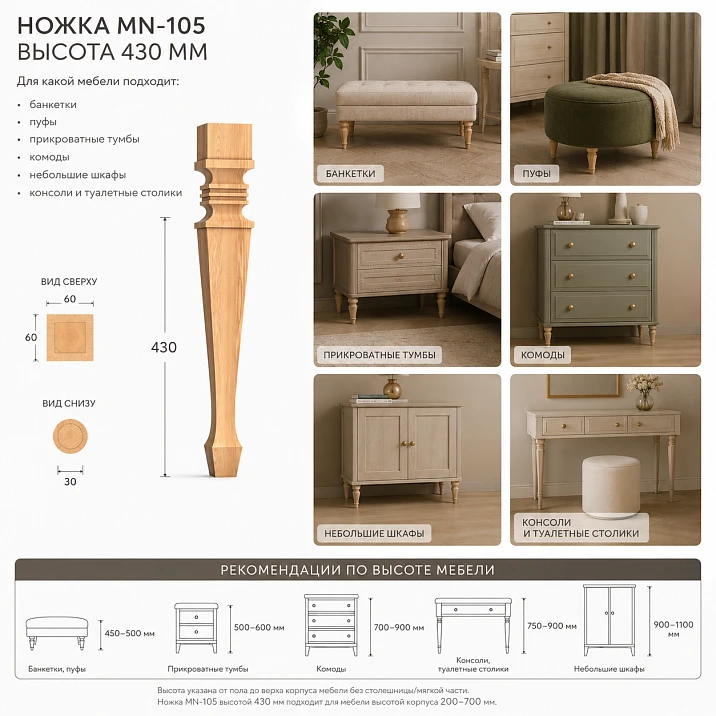
The tabletop has already been chosen. It looks solid enough for a kitchen or dining room: wide, heavy, designed for family dinners and working on a laptop. Minimalist wooden supports are selected for it, and MN-105 is found — a straight geometric leg without intricate carving, decorative curls, or a massive base. In the photo, it seems universal. The buyer adds four pieces to the cart, mentally pictures the finished table, and then notices a number that completely changes the project: the leg height is 430 mm.
Even a tabletop 40 mm thick will give a base height of about 470 mm without considering the mounting assembly. This is no longer a dining or kitchen table. It will be a coffee table, a cocktail table, or low furniture for a sofa area. The mistake occurs not because MN-105 is bad or not strong enough. The support is simply designed for a different scenario. The geometric shape looks universal, but the height remains a rigid structural parameter.
Therefore, before buy MN-105 legs for a coffee tableTo do this, you need to add three values: 430 mm, the thickness of the tabletop, and the actual allowance of the mounting assembly. After the calculation, the solution becomes simple. If the finished height suits a low table, MN-105 stays in the project. If the table should be a dining, writing, or kitchen table, you need to return to the catalog and choose a taller support.
Legs for a coffee table cannot be chosen only by a beautiful angle. In this article, MN-105 is considered as a specific model with a specific purpose. We will break down the confirmed dimensions, the formula for the finished height, the influence of the tabletop and fasteners, the differences between beech and oak, the "Standard" and "Prestige" sanding, the number of supports, placement under the tabletop, and the set of hardware. As a result, the buyer will be able not just to order wooden legs, but to assemble furniture with a pre-understood height and proportions.
Short answer: what table is MN-105 intended for
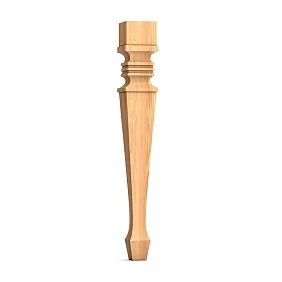
The product card positions MN-105 as a leg for a coffee table. Its height is 430 mm. Therefore, the model is primarily suitable for low furniture:
-
coffee table;
-
coffee table;
-
table in the sofa area;
-
low side table;
-
decorative table for the living room;
-
special low console, if its dimensions are calculated by the designer.
For a regular dining, kitchen, writing, or work table, a height of 430 mm is not sufficient. A thick tabletop and mounting plate will not turn a low support into a tall one. If you need a table of standard dining height, you should choose taller table legs.




As confirmed for the geometric leg MN-105
| Parameter | Confirmed value | How to use in a project |
|---|---|---|
| Article number | MN-105 | Specify in the drawing, order, and specification |
| Type | Geometric straight furniture leg | Suitable for modern and minimalist furniture |
| Size A × B × D × F | 430 × 61 × 56 × 44 mm | Height A is included in the calculation of the finished table |
| Material | Beech or oak | Selected by finish and wood grain |
| Sanding | "Standard" or "Prestige" | Determines the volume of manual preparation before finishing |
| Basic beech configuration | For enamel | Suitable for opaque painting |
| Stated application | Coffee table | Should not be automatically transferred to the dining table |
| Recommended hardware | FUR-001-1, FUR-001, FUR-012, FUR-023 | Required items are selected according to the mounting assembly |
| Sale | Per piece | Quantity is determined by the design |
| Price, availability, delivery time | Checked in the product card | These data may change |
The key figure is 430 mm. The other dimensions are needed for the drawing, placement of mounting points, assessing visual mass, and checking clearances from the edge of the countertop. The buyer must look at the dimensions of MN-105 not after delivery, but before choosing the countertop and hardware.
Our factory also produces:
The countertop has already been purchased, but the table will not turn out to be a dining table
Let's imagine a typical situation. There is a countertop 40 mm thick. It was planned to be installed in the kitchen. The buyer chooses MN-105 because the leg looks straight, calm, and sufficiently massive. The calculation is performed after ordering:
430 mm + 40 mm = 470 mm.
Even without taking the mounting system into account, the result is low furniture. It is uncomfortable to sit at such a table on a regular dining chair: the knees and seating position will not be at the height for which the furniture group is designed.
Here, the project cannot be corrected with a pad of a few millimeters. The difference between a coffee table and a dining table is measured not by a cosmetic addition, but by hundreds of millimeters. There are only two solutions:
-
Keep MN-105 and use the countertop for a low table.
-
Preserve the dining purpose of the countertop and choose taller supports.
Attempting to combine incompatible parameters usually creates strange furniture: a coffee table that is too tall or a dining table that is too low.
Get Consultation
Why a photo of a leg does not determine the purpose of furniture
MN-105 looks universal precisely because its form lacks an obvious stylistic constraint. Straight edges, a smooth taper, and calm geometry suit modern interiors, neoclassicism without excessive decor, japandi, minimalism, and restrained eclecticism.
But visual universality does not equal constructive universality. The purpose is determined by:
-
height;
-
tabletop thickness;
-
mounting method;
-
the presence of a crossbar;
-
distance between supports;
-
tabletop dimensions;
-
usage scenario;
-
height of adjacent upholstered furniture.
A photo answers the question "do you like the shape." A drawing answers the question "will the desired item work out." Buying MN-105 based only on an image is like choosing a door only by color without checking the size of the opening.
The main formula of the finished table
The calculation begins as follows:
Finished height = 430 mm + tabletop thickness + constructive allowance for the mounting assembly.
The constructive allowance can be zero, positive, or depend on how the leg fits into the underframe. You cannot automatically add the thickness of any plate: part of the fastening may be located inside the wood or under the tabletop without changing the external height.
Therefore, the formula is applied in two stages.
Stage 1. Geometric minimum
Add the height of MN-105 and the tabletop thickness.
Stage 2. Real assembly
From the drawing, determine whether the fastening adds height. If a crossbar, underframe, mounting panel, or intermediate frame is used, take their actual position into account.
Until the mounting assembly is drawn, the result is called preliminary.
Three examples with different tabletop thicknesses
| Tabletop thickness | Basic calculation | Preliminary finished height |
| 20 мм | 430 + 20 | 450 мм |
| 30 мм | 430 + 30 | 460 мм |
| 40 мм | 430 + 40 | 470 мм |
| 50 мм | 430 + 50 | 480 мм |
All four examples remain within the low furniture range. Even a massive tabletop 50 mm thick does not bring the project closer to a dining table.
The table helps immediately rule out an incorrect scenario. If the customer is looking for legs for a coffee table, a height of 450–480 mm may be appropriate after checking the sofa and seating. If they plan to dine at a table on a regular chair, MN-105 is not suitable for this task.
Tabletop 20 mm: light coffee table
With the MN-105 leg and a 20 mm thick tabletop, the base height will be 450 mm. This proportion suits a compact coffee table next to a sofa or armchair.
A thin tabletop requires careful checking of the mounting. You need to ensure that:
-
the screws will not come out on the front side;
-
the plate will fit on the bottom surface;
-
the material holds local load;
-
supports do not loosen the edge;
-
there are sufficient indents;
-
the construction does not require an additional frame.
A light appearance should not be achieved at the expense of a weak mounting unit. A thickness of 20 mm is not only a visual parameter, but also a limitation for hardware.
Tabletop 30 mm: a calm medium proportion
With a thickness of 30 mm, the finished height without an additional allowance will be about 460 mm. Such a table is noticeable enough next to a sofa, but does not turn into a tall cabinet.
This configuration is suitable for:
-
books and magazines;
-
coffee zone;
-
tabletop decor;
-
drink service;
-
sofa group in the living room;
-
closed veranda.
Before purchasing, check not only the overall height, but also the bottom clearance. If the tabletop has an apron, decorative overlay, or thick frame, the useful legroom and visual lightness change.
40 mm tabletop: massive coffee table
A forty-millimeter tabletop gives a base of 470 mm. The furniture looks more substantial. Here, the geometric MN-105 is not lost under the heavy plane, but its position needs to be calculated especially carefully.
The more massive the tabletop, the more noticeable the errors:
-
too large overhang;
-
supports assembled close to the center;
-
accidental mismatch with the edge;
-
different indentation on left and right;
-
lack of a single axis;
-
fasteners visible from the side.
The project should be checked from the bottom and top. A beautiful frontal view does not show whether it is convenient to approach the table and whether the legs protrude beyond the outline.
Why a mounting plate does not save an incorrect height
The buyer sometimes reasons like this: "The leg is 430 mm, but the plate will add a few more centimeters." This is a dangerous hope.
Mounting hardware is designed for joining parts, not for compensating for an incorrect height. Even a noticeably thick plate will not add the missing hundreds of millimeters. In addition, part of the assembly may be recessed or located inside the structure.
A floor cap also does not turn a coffee table leg into a dining table leg. Its task is contact with the floor, surface protection, or a small technical function. It is not a tall adjustable support.
The conclusion is simple: first choose the purpose and height, then the fastening. You cannot first buy a low leg and then look for hardware that will change the type of furniture.
Do not confuse height and load-bearing capacity
MN-105 should not be called weak just because it is low. Height and load are different properties.
A low furniture leg can be strong and stable in a properly calculated table. The error when installing under a dining tabletop is related to ergonomics and geometry, not to proven insufficient strength.
When designing, you need to separately check:
-
the permissible load on the set;
-
the strength of the tabletop;
-
fasteners;
-
indents from the edge;
-
resistance to loosening;
-
stability against a side push;
-
the number of supports.
You cannot transfer the general load value to an arbitrary structure without calculation. A finished table works as a system, not as four independent wooden blocks.
For the coffee table MN-105, it is suitable for its intended purpose
A buyer who needs a low table in the living room is in the right product group. On the website, MN-105 is included in a thematic selection where you can to buy legs for a coffee table and compare height, shape, and material.
MN-105 is especially appropriate when you need:
-
calm geometry;
-
natural wood;
-
finish matching the furniture color;
-
four separate legs;
-
a visually light low table;
-
a modern silhouette without carving;
-
option to choose beech or oak.
But even direct assignment does not cancel the drawing. Coffee tables differ in length, width, mass, and tabletop design.
Coffee table next to the sofa
The coffee table should be comfortable from a seated position. Therefore, MN-105 is evaluated not by an average interior advice, but by the actual sofa.
Measure:
-
Seat height without a person.
-
Seat height during normal sitting.
-
Cushion thickness.
-
Distance from the edge of the sofa to the future table.
-
Desired tabletop height relative to the seat.
If the base height with MN-105 is 450–480 mm, compare it with the sofa group. The table can be slightly lower, at the same level, or higher than the seat — the decision depends on the scenario. For a cup, one level is important; for a laptop or serving, another.
Low side table
MN-105 can be considered for side furniture, but the word "side" does not automatically imply compatibility.
Check:
-
should the table go under the sofa;
-
what is the armrest height;
-
where are the sofa legs;
-
does the support prevent the tabletop from being brought closer;
-
is a console overhang needed;
-
are four legs suitable or is a different underframe required.
A regular four-legged table on MN-105 does not replace a C-shaped structure that slides its base under furniture. The scenario name should not hide the difference in the frame.
Decorative table in the living room
A low table can be used not only for drinks. Books, a vase, a composition, a tray, or a collection of items can be placed on it.
MN-105 supports this style well if:
-
the tabletop does not overload the straight form;
-
the legs are visible and work as part of the design;
-
the finish is coordinated with the floor and furniture;
-
there are floor glides;
-
the item does not become an obstacle in the passage;
-
the corners of the tabletop are safe for the traffic route.
Decorativeness does not cancel stability. A light visual image must rely on precise installation.
Low console: only per special drawing
A height of 430 mm is too small for a typical freestanding console against a wall. However, MN-105 can be part of a special low structure: a decor stand, a bench without a seat, a low pedestal, or a furniture composition.
Here, the word "console" cannot be used without dimensions. It needs to be defined:
-
the purpose;
-
depth;
-
height;
-
wall mounting;
-
stability;
-
placement of supports;
-
the load;
-
possible tipping over.
If a tall console table is needed, a different model should be chosen.
Why MN-105 is not suitable for a regular kitchen table
A kitchen table is designed for sitting on a chair. A person's legs should fit freely under the tabletop, elbows should be at a comfortable level, and the work surface should match the usual sitting posture.
With MN-105, the tabletop will be at approximately 450–480 mm in height. This is below or close to the seat level. The user will have to lean forward, knees will be too high, and the chair will not fit under the table.
Even if such a table looks visually interesting, daily use will become uncomfortable. Design should not contradict the body.
Why MN-105 is not suitable for a writing desk
A person sits at a desk for a long time. The height affects the position of the back, shoulders, arms, and monitor.
A low support will cause:
-
leaning toward the tabletop;
-
raising the knees;
-
searching for a non-standard seat;
-
reducing the space under the table;
-
disrupting the keyboard position;
-
using furniture not for its intended purpose.
If a workspace is being designed, find legs for a dining table or a writing desk, it should be in the general catalog by suitable size A, not in the selection of low supports.
Why MN-105 does not fit a standard dining group
The dining table is connected to the chairs. It cannot be considered separately.
Check:
-
seat height;
-
tabletop height;
-
apron thickness;
-
knee space;
-
distance between legs;
-
elbow position;
-
tabletop overhang.
MN-105 does not provide the required total height. Even if you remove the apron and install a thin tabletop, the furniture will become even lower.
A "children's" table also requires a separate calculation
The low height may seem suitable for children's furniture. But you cannot declare MN-105 a children's leg just based on the figure of 430 mm.
The children's table is calculated based on:
-
age;
-
height;
-
chair height;
-
activity scenario;
-
corner safety;
-
stability;
-
finishing materials;
-
possibility of tipping over.
If MN-105 is used in a children's room, the designer must check the entire furniture pair. An automatic recommendation would be irresponsible.
How to match MN-105 with a sofa
General Rules for choosing legs for a coffee table Useful for understanding proportions, but the final decision is made based on actual measurements.
Place a temporary mock-up next to the sofa at the height calculated for MN-105. This could be a box or a stable template. Check:
-
Is it convenient to place a cup;
-
Does the table block the view;
-
Is there enough room for legs;
-
Is it comfortable to lean over;
-
Does the tabletop look too high;
-
Does it interfere with the armrest.
The mockup provides more information than a visualization without scale.
Tabletop size and geometric leg
Height is the first filter, but not the only one. A too-large tabletop can visually and structurally overload the MN-105, while a too-small one can hide its shape or make indents impossible.
Check:
-
length;
-
width;
-
thickness;
-
mass;
-
position of the center of gravity;
-
material;
-
edge;
-
lower relief;
-
mounting zones.
The leg card does not assign a universal tabletop size. It is determined by the project.
How to arrange legs under the tabletop
Draw the bottom plane to scale. Then apply the contours of the MN-105 and mounting hardware.
The check includes:
-
Equal indentation from the long sides.
-
Same indentation from the ends.
-
Symmetry.
-
Sufficient material thickness in the mounting area.
-
No intersection with the apron.
-
tool access.
-
No protrusion of the support beyond the outline.
-
Convenient access to the table.
-
Space for the footrest.
-
Ability to replace the leg.
After marking, cut out the paper templates. They will show whether the supports are assembled too close to the center.
Tabletop overhang: not just appearance
Overhang — the distance from the edge of the tabletop to the outer face of the leg. It affects:
-
proportion;
-
stability;
-
ability to sit nearby;
-
risk of tipping over;
-
protection of supports;
-
visibility of fasteners.
Too large an overhang visually separates the heavy plane from the supports and increases the lever arm when load is applied to the edge. Too small brings the leg closer to the corner, where the tabletop wood may be vulnerable.
A universal figure cannot be assigned. The overhang is verified by calculation and mockup.
Distance between legs
The user must be able to approach the table, and the furniture must remain stable. The distance depends on the tabletop size and the number of supports.
With four legs, measure:
-
distance between inner edges;
-
distance between axes;
-
diagonals;
-
indents;
-
free storage space;
-
position relative to the sofa.
If a shelf is planned under the table, it must fit between the supports and not change the load scheme without calculation.
How many MN-105 do you need to buy
The card sells the leg per piece. Four pieces is a common but not mandatory set.
Possible configurations:
-
four legs at the corners;
-
two legs combined with a frame;
-
more than four supports for long furniture;
-
a special table with a different underframe.
The quantity is determined by the design. You cannot reduce the number of supports to save money, nor add them without understanding the load distribution.
Before ordering, prepare a specification:
| Position | Quantity | Reason |
| MN-105 | ___ | According to the drawing |
| Fastening | ___ | By the number of mounting points |
| Thrust bearing | ___ | By the number of supports |
| Spare leg | ___ | Only when reasonably necessary |
| Finishing materials | By consumption | By material and coating system |
Is a spare leg needed
A spare MN-105 may be justified for a large batch of identical furniture, a commercial project, or a project where a later replacement must exactly match in material and finish.
For a single home coffee table, a spare is usually not needed. Better to allocate the budget to:
-
high-quality sanding;
-
control sample of finish;
-
correct hardware;
-
a drawing;
-
accurate marking.
Spare parts are purchased not out of anxiety, but according to the service scenario. If the table is the only one and all four legs are inspected before painting, the fifth part may lie unused for years. If the project consists of twenty identical tables for a hotel or restaurant, a spare support from the same batch simplifies future repairs.
Beech or oak: the choice starts with the finish
MN-105 is available in beech and oak. Both species are suitable for furniture parts, but they behave differently in the finish.
Beech
Dense wood with a calmer grain. Often used under enamel. The base card shows beech in the "under enamel" configuration.
Oak
Porous wood with pronounced texture. It is chosen when the natural grain should remain visible under a transparent or semi-transparent finish.
It cannot be said that one species is better than another. Beech is convenient for an even colored coating, oak is valued for its grain. The decision depends on whether the leg should blend into the color of the tabletop or remain an independent wooden part.
Beech under enamel
Beech is rational if the legs must match:
-
with a painted tabletop;
-
with furniture fronts;
-
with doors;
-
with a baseboard;
-
with the wall color;
-
with metal details for contrast.
Opaque enamel unifies the slats and hides texture differences. Before painting, check the re-gluing category, surface preparation, primer, and material compatibility.
Beech should not be considered a "cheap version of oak." In painted furniture, it is often more appropriate precisely because the calm structure does not conflict with dense color. For a table in dark blue, graphite, milky, or complex beige, the MN-105 form will be read through the edge and light, not through the wood grain.
Oak for transparent finish
Oak is chosen for its fibers, pores, and natural expressiveness. A clear finish makes each leg unique.
Before ordering a set, check:
-
gluing quality;
-
shade matching;
-
direction of fibers;
-
test coating;
-
tabletop color;
-
the difference between end grain and longitudinal surface;
-
the placement of legs in the set.
The oak tabletop and oak legs do not have to match automatically. The species is the same, but the batch, cut, and finish may differ. If the tabletop is already coated with oil, varnish, or tint, the color sample should be compared not on a screen, but on real wood.
Can you take oak and paint it with enamel?
Technically, opaque painting is possible, but the buyer must understand the economic and visual implications. If the texture is completely covered, the main decorative advantage of oak is not utilized.
Such a choice may be justified:
-
project requirements;
-
availability of a specific batch;
-
desire to obtain a certain wood density;
-
agreed finishing technology.
However, you should not overpay for a wood species out of habit without discussing the result with the finisher. Sometimes beech under enamel gives a more logical set, and the budget difference is better directed to the "Prestige" category, quality hardware, or design.
Sanding "Standard" or "Prestige"
STAVROS offers two categories of processing.
"Standard"
Machine sanding after milling. The surface is prepared, but may require manual touch-up before demanding finishing.
"Prestige"
Machine and detailed manual sanding. This option reduces the amount of subsequent processing, especially on edges, transitions, and in places where it is difficult to work with tools after assembly.
To choose MN-105 sanding, you need to consider not only the price, but also the future finish, the finisher's qualifications, and project timelines.
When the "Standard" is enough
The "Standard" is suitable if:
-
there is your own carpentry workshop;
-
the finisher included finishing in the estimate;
-
the legs will be covered with dense enamel;
-
the project allows for control sanding;
-
the batch is large and processing is organized in series.
The buyer gets a more affordable preparation, but should not expect a fully finished hand surface. Before priming, each leg is inspected under side light, checking edges, fibers, and transition points of the cross-section.
When "Prestige" is more reasonable
The "Prestige" is useful when:
-
Legs are visible from a close distance;
-
A transparent finish is used;
-
There is no separate carpenter;
-
Uniform smoothness of the set is important;
-
Installation deadlines are limited;
-
The surface is difficult to sand after assembly.
Choosing a category does not cancel inspection before finishing. Even well-prepared wood is inspected after delivery, because storage, transportation, and installation can leave marks.
Comparison of MN-105 options
| Solution | Visual result | Preparation | When to choose |
| Beech, "Standard", under enamel | Even opaque color | Need final finishing | Have our own finisher |
| Beech, "Prestige", under enamel | Smooth painted geometry | Less manual work | Deadlines and surface cleanliness matter |
| Oak, "Standard" | Visible wood after preparation | Requires careful sanding | Processing is done in the workshop |
| Oak, "Prestige" | Expressive texture and smooth edges | Readiness above | The leg remains natural in view |
The table does not list prices: they are dynamic and checked in the product card. The comparison task is to link material and finish to the actual result.
The finish needs to be designed before fastening
If legs are painted before assembly, the installer must protect the finish from tools and clamps. If painting is done after assembly, the tabletop and hardware need to be covered.
The process sheet answers the questions:
-
when to drill;
-
when to install the stud;
-
when to prime;
-
whether the thread needs protection;
-
how to paint the bottom end;
-
when to install the support plate;
-
how to store parts between layers.
Random order creates chips around holes and unpainted areas. Such defects are especially noticeable on dark enamel and transparent oak coating.
Why the bottom end cannot be forgotten
The lower part of the leg contacts the support plate and is close to the floor. It must be included in the finishing system.
Check:
-
flatness;
-
perpendicularity;
-
location of the support plate;
-
wood protection;
-
absence of an open end;
-
compatibility of the covering with the heel plate mounting.
You cannot cover only the visible side surfaces and leave the end face without a solution. During wet cleaning, it is the lower area that first comes into contact with water and dirt.
Hardware is not selected as a single line from the card.
Card MN-105 shows FUR-001-1, FUR-001, FUR-012, and FUR-023. This is a list of recommended items, not a mandatory set of four products for each leg.
You need to determine:
-
tabletop material;
-
thickness;
-
the presence of a crossbar;
-
possibility of access from below;
-
whether a detachable connection is required;
-
thread position;
-
type of mounting plate;
-
method of floor protection.
After that, you can select a mounting for MN-105. Purchasing all recommended items at once without a drawing only increases the bill and does not create a finished assembly.
FUR-001: stud and insert nut
Check the FUR-001 kit for MN-105 useful for threaded connections. The kit includes an M8 × 60 stud and a metal insert nut M8 × 13.
Such a joint requires:
-
sufficient thickness of parts;
-
accurate marking;
-
perpendicular drilling;
-
alignment of axes;
-
suitable countertop material;
-
depth control.
The insert creates a metal thread in the furniture part, and the stud connects it to the leg. If drilling is done incorrectly, the support will deviate from vertical, so installation is first tested on a sample of similar material.
FUR-012: stud and round plate
View FUR-012 kit worth it if the design includes a mounting plate. It includes an M8 × 60 stud and a round plate with M8 thread.
The plate distributes the joint over its area and attaches to the furniture structure. But you need to check:
-
whether it will fit;
-
whether the screws will protrude;
-
whether installation is accessible;
-
whether the edge interferes;
-
whether the leg axis aligns;
-
Is the plate visible from the side?
FUR-012 does not add significant height to the table. Its function is connection, not correcting an incorrectly chosen support.
FUR-001-1: separate stud
The M8 × 60 stud may be part of another mounting assembly. Separate sale is useful when the insert, plate, or threaded socket is already provided by the design.
The buyer should not replace the kit with a single stud without checking the mating part. Metric threads require a compatible socket, and the threaded portion requires the correct pilot hole.
FUR-023: square foot
The MN-105 card recommends buying the FUR-023 foot. Its size is 25 × 25 mm.
The foot helps:
-
separate the wood from the floor;
-
protect the surface;
-
reduce direct contact;
-
complete the bottom joint.
But it must be matched with the bottom size of the leg, the installation method, and the type of floor. It is not a universal protection for any surface without verification.
The floor protector does not fix an uneven floor
If the table is wobbly, the cause may be in:
-
different leg lengths;
-
a warped tabletop;
-
a mounting error;
-
an uneven floor;
-
non-parallel planes;
-
different seating of the hardware.
A regular floor protector does not replace an adjustable support. First, find the cause, check the diagonals, and place the table on a control flat surface.
What to buy together with MN-105
| Position | Why it's needed | Add automatically |
| MN-105 | Main wooden support | By quantity from the drawing |
| FUR-001 | Threaded connection with bushing | Only according to the installation diagram |
| FUR-012 | Connection via round plate | Only according to the installation diagram |
| FUR-001-1 | Separate stud M8 × 60 | If there is a mating unit |
| FUR-023 | Protection of the lower part and floor | After checking the base |
| Primer and finish | Finish of beech or oak | According to the technological system |
| Tabletop | Working surface | By dimensions and weight |
| Tsarga or frame | Reinforcement, if provided | By calculation |
| Project | Connects height, supports, and fasteners | Especially important for non-standard furniture |
The table does not replace the picking list. It shows which issues must be resolved before payment.
Comparison of two options: keep MN-105 or return to catalog
| Question | Keep MN-105 | Choose a different support | |||||||||||||||||||||||||||||||||||||||||||||||||||||
| Purpose | Coffee or side table | Dining, kitchen, or writing | |||||||||||||||||||||||||||||||||||||||||||||||||||||
| Base height with top 40 mm | About 470 mm | Calculated according to the new model | |||||||||||||||||||||||||||||||||||||||||||||||||||||
| Chairs | Not the primary seating | Mandatory for verification | |||||||||||||||||||||||||||||||||||||||||||||||||||||
| Sofa |
The specific length and width of the tabletop are determined by the project. Dimensions of one table cannot be transferred to another without checking stability. Practical scenario No. 2: round coffee tableA round tabletop changes the placement of supports. Four legs must be positioned symmetrically relative to the center and must not extend beyond the circle. Check:
A paper template is especially useful: square contours of the legs on a circle immediately show the proportion. If the supports are rotated differently, the geometric shape looks untidy even with precise height. Practical scenario No. 3: heavy oak tabletopAn oak top with oak MN-105 creates a solid material but increases structural requirements. You need to:
The leg card is not a calculation for a wooden table. A heavy top may require an underframe that is not present in a simple scheme with four separate supports. Practical scenario No. 4: painted table matching the wall colorBeech under enamel suits calm monochrome furniture. The table visually blends into the interior, while the geometry remains readable through light and shadow. Procedure:
Painting each leg at different times is risky: the shade and gloss level may differ. Practical scenario #5: the tabletop was a dining tableThere is a large top that was planned for a family table. MN-105 visually appealed, but the calculation gives about 470 mm. Options:
The most dangerous path is to increase MN-105 with a homemade extension. It changes the appearance, axis, strength, and responsibility. Practical scenario #6: two tables instead of oneSometimes a large tabletop can be replaced with a pair of compact tables. But the solution should not appear just to preserve already purchased legs. First, check:
If two tables are really useful, MN-105 can become part of a flexible composition. If not, it is better to choose the correct height for the original item. Can MN-105 be extended?Without an official project and production, extension is not recommended. A glued block, a tall plate, or a decorative cube create a new furniture unit that is not confirmed by the card. Problems:
If a different height is needed, it is better to choose a different leg or discuss custom manufacturing for a production run. Can MN-105 be shortened?Shortening is only possible after checking the shape and base. The lower part tapers to parameter F, and the foot pad is designed for a specific area. Cutting may change the proportion, support area, and hardware placement. The product card does not promise custom cutting to size. The decision is made by a furniture designer, and the work is performed by a specialist. After trimming, all legs must have strictly the same length and a perpendicular bottom end. Final height and comfort: full-scale mockupBefore purchasing, make a simple mockup. You will need:
Place a cup, a book, a laptop, a tray. Sit on the sofa. Check the movement of your hands and the distance to your knees. If the height is comfortable, the MN-105 is confirmed not only by arithmetic, but also by a real scenario. Layout of the lower planeThe second mock-up is made of paper or cardboard. It shows the tabletop, supports, and mounting plates. It helps to see:
Checking the bottom plane is especially important for a small round tabletop, where four supports quickly fill the available space. What to send to the STAVROS managerIn the application, specify:
This way the manager can check the product card, hardware, and completeness. The question "will the leg fit my tabletop?" without dimensions is too general. When a design project is neededThe project is especially useful if:
You can check the final table height as part of the project development. This is more reasonable than reworking finished furniture after painting. Glass tabletop: a separate intermediary is neededFUR-001 and FUR-012 are intended for furniture structures, but glass cannot be drilled and fastened like wood without special technology. For a glass top, an underframe, platforms, inserts, or another professionally calculated node is required. MN-105 cannot be glued directly to glass with a random adhesive. You need to check:
Stone tabletop: four legs may be an insufficient schemeStone has a large mass and requires load distribution. Separate wooden legs without a frame may not ensure the proper operation of the structure. Check:
MN-105 can be part of the decorative element, but the finished joint is designed by a specialist. Countertop made of MDF or furniture boardFor wood-based panels and boards, it is important to check thickness, density, and the fastening zone. The insert nut or screw must hold in the material without damaging the edge. Special attention is paid to:
Equal thickness does not mean equal ability to hold fasteners. How to order MN-105 without mistakes
Commercial route through STAVROS pages.For a low table:
For a dining table:
Order conditions, current lead time, and shipping of the set can be clarified on the page payment and delivery MN-105. Who MN-105 is suitable forThe model is suitable for a customer who:
Who MN-105 is not suitable forYou need to choose a different support if:
Checklist before payment
Full table estimate: leg price — only one lineThe buyer often compares the cost of four MN-105 with the price of a finished table and forgets the other items. To make the decision fair, the budget is calculated in full. Total project cost = legs + tabletop + mounting + floor glides + wood treatment + finish + labor + delivery. The estimate may include:
This calculation helps compare not a single leg with ready-made furniture, but two complete solutions. Self-assembly is beneficial when the buyer needs specific dimensions, material, and color. If the project is built solely for savings but requires complex carpentry work and several reworks, the result may exceed the initial expectation.
Acceptance of kit MN-105 after deliveryBefore painting and drilling, inspect each leg individually. Match the article number, size, material, sanding category, and re-gluing quality against the invoice. The inspection proceeds sequentially:
You cannot first sand down a defect, drill a hole, or apply primer, and then try to separate a manufacturing feature from installation damage. Acceptance must occur before irreversible actions. For a clear oak set, it is useful to lay out the four legs in the order they will stand on the table. Calmer grain sides can be turned inward, expressive ones outward. This does not change characteristics but makes the furniture visually assembled. Test assembly without final tighteningAfter marking, perform a dry assembly. Install the legs without final tightening, turn the table over on a flat surface, and check the geometry. Inspection includes:
If the table wobbles, don't immediately glue a random shim. First loosen the fastening, check the flatness of the tabletop, the length of the legs, the depth of the fit, and the diagonals. Only after eliminating the cause are the joints finally tightened. Test assembly is especially important before enamel. If a hole needs to be moved, repairing a painted surface is significantly more difficult. For oak under a clear finish, a mark from a mistaken drilling may remain visible even after filling. What to check a week after assemblyWooden furniture and threaded connections go through the first period of use. After a few days, the table is inspected again. Check:
Re-checking does not mean that the connection will necessarily loosen. It helps to notice a mistake before a small play breaks the seat. Tightening is done with a suitable tool without excessive force that could damage the threads or wood. FAQ: MN-105, height 430 mm and finished tableWhich table is MN-105 intended for?The card positions the model as a leg for a coffee table. The height of 430 mm corresponds to low furniture for the sofa area, a coffee table, or a decorative table. What size is MN-105?Confirmed size A × B × D × F — 430 × 61 × 56 × 44 mm. In the calculation of finished furniture, height A becomes the main parameter, but the other dimensions are needed for the drawing and placement of fasteners. Can MN-105 be placed on a kitchen table?For a regular kitchen table where people sit on standard chairs, the height is insufficient. Even with a thick tabletop, the result will be low furniture. Can MN-105 be used for a dining table?No, if we are talking about a typical dining set. A leg height of 430 mm together with the tabletop gives approximately 450–480 mm, whereas a dining table requires a significantly greater height. What kind of table will result with a 20 mm tabletop?The base height will be about 450 mm without considering the constructive allowance of the mounting. This is a compact coffee or side table. What kind of table will result with a 30 mm tabletop?About 460 mm without an additional node. This height suits many sofa groups, but it should still be checked against the actual seat. What kind of table will result with a 40 mm tabletop?About 470 mm without the additional node. The table will look more massive and will require careful checking of overhangs. Do we need to account for the mounting plate?Yes, but only its actual effect according to the drawing. You cannot automatically add the entire thickness of the part, because part of the node may be located inside the structure. Can the height be increased with a foot?The foot is not intended for significant height increase. It will not turn a coffee table into a dining table. How many MN-105 legs do I need to buy?The quantity is determined by the design. Four pieces are common for a rectangular or round table, but this is not a universal configuration. What wood is MN-105 made from?From beech and oak. The choice is linked to the future finish, not just the price of the species. What to choose — beech or oak?Beech is often chosen for enamel when an even color is needed. Oak is suitable for transparent or semi-transparent finishes that preserve the texture. Can I order MN-105 for enamel coating?The basic configuration of the beech in the card is specified as "for enamel". The specific material option, re-lamination, and sanding are checked before payment. What does "Standard" mean?Machine sanding after milling. Before complex finishing, the surface may require manual touch-up. How does "Prestige" differ from "Standard"?"Prestige" includes detailed manual sanding and reduces the amount of preparation before applying the coating. What hardware is shown in the MN-105 card?FUR-001-1, FUR-001, FUR-012, and FUR-023. These are recommended items, not a mandatory single set. Do I need to buy all the recommended hardware?No. You choose one suitable mounting assembly and the needed protection option for the bottom edge. What's the difference between FUR-001 and FUR-012?FUR-001 uses a stud and a threaded insert. FUR-012 includes a stud and a round mounting plate. The choice depends on the tabletop and the construction. What is FUR-023 used for?A square foot pad 25 × 25 mm helps to finish the contact of the leg with the floor and protect the coating. Its compatibility is checked against the lower support area. Can legs be glued on without mechanical fastening?The connection method depends on the design. For a table, a verified joint rated for vertical and lateral loads is required. Random glue does not replace a design. Is MN-105 suitable for a glass tabletop?Direct attachment to glass requires a special system that is not included in the leg's specification. A separate frame, mounting plates, or a professional joint is needed. Is MN-105 suitable for a stone tabletop?A heavy slab requires calculation of the underframe and load distribution. Automatic compatibility of four individual legs is not confirmed. Can a table be made with three legs?Special three-support designs are possible, but the geometry, center of gravity, and stability must be calculated by a designer. Can MN-105 be shortened?Only after checking the shape, bottom cross-section, foot, and the method for achieving equal length of all supports. Can I order a leg of a different height?Individual changes are only possible under the terms of a batch order, which are clarified with the manager. For a one-off project, it is easier to choose an existing model of a different height. How to check the height next to the sofa?Make a mock-up of the finished tabletop at a level of 430 mm plus its thickness and test it from a regular seating position. Where can I see the current price for MN-105?In the product card. Price, availability, and delivery times are dynamic data and are checked immediately before ordering. Where can I see other low supports?In the thematic selection of legs for a coffee table. Where can I find taller legs?In the general catalog of unpainted furniture legs, where models can be compared by size and purpose. Can MN-105 be used as a bench leg?The bench's purpose, lateral loads, seat length, and number of supports require a separate calculation. The card states it's a coffee table. Do I need to check the floor?Yes. Unevenness, sensitive flooring, and height differences affect the glides, rocking, and stability. When should the glides be installed?After finishing the bottom edge and checking the position of all legs. Early installation may interfere with sanding and painting. Do I need to do a test coat?For beech and oak, a test helps confirm color, gloss, grain reveal, and compatibility of the primer with the finish. What to do if MN-105 has already been purchased for a dining tabletop?Do not extend the leg with random parts. Either use MN-105 in a separate low table, or select taller supports for the dining tabletop. Can a very thick tabletop be placed on top?A thickness of 80–100 mm will visually and structurally change the table, but still won't compensate for the height deficiency for a dining scenario. Additionally, the weight and mounting requirements will increase. Does the apron affect the final height?The apron is usually located under the tabletop and doesn't necessarily increase the top height, but it reduces the free space below. Its position is taken into account in the cross-section. How to check the symmetry of four legs?Measure the offsets from the edges, the distances between the axes, and both diagonals. Before drilling, a full-size template of the bottom plane is useful. Can the table be assembled immediately after delivery?First, the legs are inspected, conditioned in suitable conditions, checked for completeness, a dry fit is performed, and only then proceed to finishing and assembly. Decision before ordering: height first, then beautyMN-105 is not a wrong leg. The scenario in which it is attempted to be used is wrong. The height of 430 mm immediately defines low furniture. With a tabletop thickness of 20–50 mm, you'll get an item about 450–480 mm high, excluding the mounting allowance. This is a coffee table, side table, or decorative table, not a regular table for the kitchen or dining area. Before purchasing, write down three numbers: the height of MN-105, the tabletop thickness, and the actual fastener addition. Then check the sofa, the bottom plane, the number of supports, beech or oak, sanding, and hardware. If the result matches a low table, you can confidently order MN-105. If people should sit at the table on regular chairs, return to the catalog and choose a different height. STAVROS company offers the MN-105 card, a separate selection of legs for a coffee table, a general catalog of furniture supports, FUR fittings, glides, quality information, and a project development service. These pages allow you to go through the process without random purchases: first calculate the furniture, then assemble the set, and only after that place an order. |