Article Contents:
- Short answer: which legs to choose for a coffee table
- How legs for a coffee table differ from supports for a regular table
- How to choose the height of the legs
- How to choose the shape of wooden legs
- Straight Legs
- Round furniture supports
- Turned legs
- Shaped legs
- Low massive supports
- How to choose legs to match the living room style
- Load and fastening: what to check before buying
- Wooden legs for restoring a coffee table
- How to combine a coffee table with a sofa and other furniture
- Mistakes when choosing legs for a coffee table
- What to buy together with legs for a coffee table
- FAQ: answers to the most common questions
- About the Company STAVROS

A coffee table is an interior detail that is not noticed immediately. It stands in front of the sofa, holding books, cups, the remote control, and decorative items. It is small, it is "auxiliary" — but it is what completes the look of the living room and ties the soft seating area into a single whole. And if Legs for coffee table chosen correctly — the table becomes part of the system. If not — it stands like a foreign object that accidentally ended up in the living room.
Wooden legs for a coffee table are not just supports. They are a visual anchor that connects the table to the sofa, to the floor, to the baseboard, to the rest of the furniture. The right choice takes time, but the result is worth it: the table gains character, style, and its place in the interior.
Short answer: which legs to choose for a coffee table
If you need specifics without long introductions — here you go.
For a low table by the sofa — low, stable Wooden legs 10–15 cm high. Wide base, reliable fastening, moderate cross-section. Stability here is more important than decorativeness.
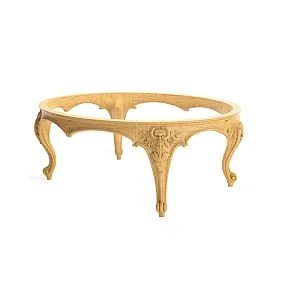
For a classic living room — turned or shaped solid wood supports. They create a feeling of expensive, deliberately designed furniture. They perfectly echo the legs of the sofa, armchairs, and cabinets.
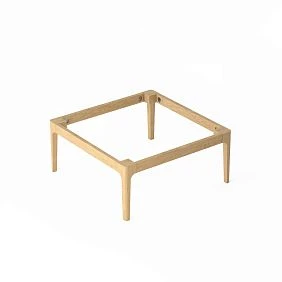
For a modern minimalist interior — straight legs without complex relief. Natural beech or oak with clear lacquer — calm, clean, modern.
For restoration — choose legs that match the height of the original table, the type of attachment to the base, and the style of the rest of the furniture in the room.
For painting — take unpainted models with good factory sanding. They perfectly accept enamel, varnish, stain, and oil-wax — you can accurately match the desired shade of the interior.




How do coffee table legs differ from supports for a regular table
This is an important question that many ignore — and then wonder why the table looks "not right."
A coffee table is not a dining or writing table. It is fundamentally different in height, proportions, and function. A dining table stands at a height of 72–76 cm. A coffee table stands at a height of 35–50 cm. These are different tasks for the legs.
The first difference is height. Coffee table legs are significantly shorter than those for a standard table. A height of 10–20 cm is a typical range. This requires stability from the support at a low height: with short legs, lateral loads are perceived differently than with long ones.
The second difference is the decorative role. A coffee table stands right in front of the sofa, in plain sight. Its legs are constantly visible — at an angle, in perspective, in conjunction with the sofa legs. This makes the decorativeness of the supports much more important than for dining legs hidden under a tablecloth.
The third difference is load. A coffee table bears less weight than a dining table. Books, magazines, coffee cups, a vase of flowers — the load is moderate. But stability is still critically important: a person may lean on the table with their hand or accidentally bump it with their foot.
The fourth is the interior system. wooden furniture legs for a coffee table should match the legs of the sofa, armchairs, cabinets, and other furniture in the lounge area. This is a requirement that does not exist for a dining table standing in another part of the apartment.
And fifth — proportions relative to the sofa. A coffee table that is too high is inconvenient: it's awkward to place coffee on it, and it visually disrupts the horizontal line of the soft seating area. One that is too low is also inconvenient — it's hard to reach without leaning forward significantly. The correct legs for a coffee table — is a balance between convenience and visual proportions.
Our factory also produces:
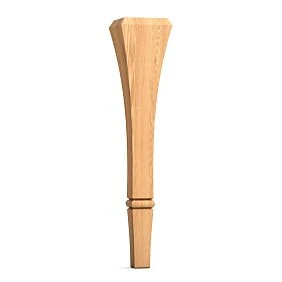
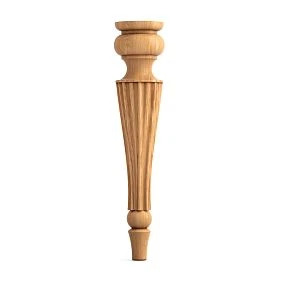
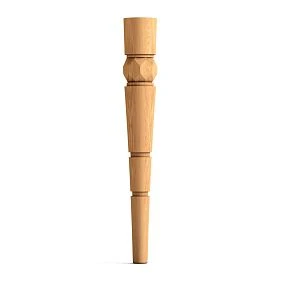
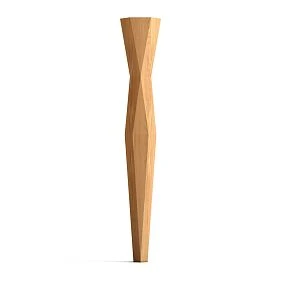
How to choose the height of legs
Height is the first and most practical parameter. This is where you should start your selection, not with shape or color.
The main reference point is the height of the sofa seat. Ideally, the coffee table should be at the level of the sofa seat or slightly below it. This is a rule of convenience: you don't reach up for a cup or bend down to the floor. Typical seat height is 42–48 cm. Tabletop thickness is 2–4 cm. So, the optimal leg height is 38–46 cm minus the tabletop thickness. Usually this is 10–20 cm.
A low table with legs 8–12 cm looks cozy and calm. It doesn't dominate the space or obstruct the view. It's good for small living rooms where visual lightness is important.
A medium-height table with legs 12–20 cm is a universal option. It's convenient to use and looks good with most standard-height sofas.
A high coffee table with legs 20 cm and above is a non-standard solution. It can look modern and elegant, but requires compatibility: the sofa must be high enough, and the living room itself spacious. In a small room, a high coffee table starts to look like a small dining table.
Practical tip: before buying new legs, measure the seat height of your sofa with a tape measure. Write down: 45 cm (seat height) minus 3 cm (tabletop thickness) = 42 cm desired table height. So, you need legs approximately 38–40 cm high. This is more accurate than an intuitive "by eye" selection.
When restoring, measure the old legs and decide: do you want to keep the height or change it. If you want to raise the table — choose higher legs. If you want to lower it — choose lower ones. Just don't forget to recalculate the final height considering the tabletop.
Get Consultation
How to choose the shape of wooden legs
The shape defines the character of the support. It determines whether the table will be classic or modern, elegant or solid, light or visually heavy.
Straight legs
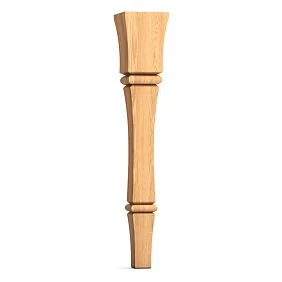
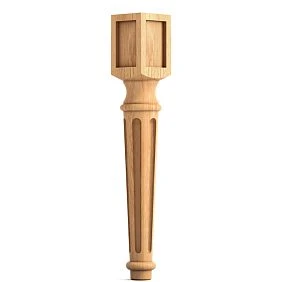
A straight shape is architectural honesty. No decorations, no relief. A clear vertical line from the tabletop to the floor. These are exactly the ones that wooden furniture legs fit organically into modern interiors, minimalism, Scandinavian style, and loft.
Straight legs with a square or round cross-section are among the most structurally robust. At a low height (10–15 cm), they hold the load well without the risk of loosening. Beech is a good choice: dense structure, smooth surface, accepts any coating well.
For a coffee table in Scandinavian style — straight legs made of light ash or beech with a clear matte lacquer. Nothing extra — only material and shape.
Round furniture supports
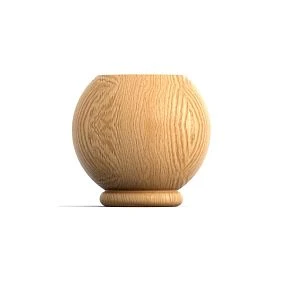
Round furniture leg — this is softness in silhouette. Unlike square straight legs, round supports create a calm, rounded image without sharp edges or corners. They look especially good on tables with a round or oval tabletop — the shape echoes, creating a unified look.
Round supports are versatile in style: they suit both classic and modern living rooms. In a classic interior — a turned round leg with relief. In a modern one — a smooth cylindrical shape.
Turned legs
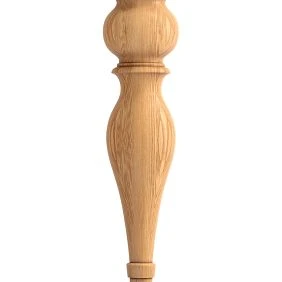
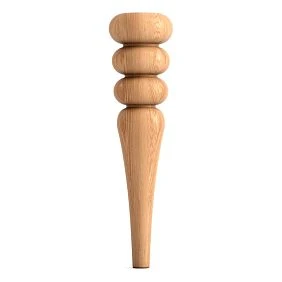
Turned furniture legs — a classic of furniture art. Turning creates an elegant relief: thickenings, narrowings, vase-shaped or spindle-shaped profiles — all these are integral attributes of classic and neoclassical furniture.
For a coffee table, turned legs make it noticeable, "expensive" in feel. These are the supports placed on antique tables, on restored furniture, on items that should look like part of a well-thought-out classic ensemble.
An important point: a turned leg has a more complex relief, and the minimum diameter at the narrowest point must withstand the load. For a coffee table, where the load is moderate, this is not critical — but for a heavy stone or glass tabletop, you should choose turned legs with a sufficient cross-section.
Shaped legs
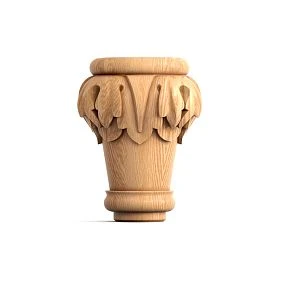
Curved supports are for those who want expressiveness and an author's touch. Bends, widening towards the bottom, decorative transitions — such legs attract the eye. They are appropriate in living rooms with rich decor: coffered ceilings, stucco molding, classic furniture, decorative overlays.
Curved legs are good for restoration — when you need not just to replace the supports, but to give the table character and style it didn't have before.
Low massive supports
For heavy tabletops — marble, stone, thick wooden slabs — appropriate supports are needed. Massive wooden furniture supports with a wide base and increased cross-section ensure stability and reliability. Here, decorativeness gives way to functionality — although massive legs can also be beautiful.
How to choose legs for your living room style
The coffee table stands in the center of the living room — in full view of everyone. Its legs work in tandem with the sofa, with the rest of the furniture, with wooden skirting board and with the floor. Style consistency is not a perfectionist's whim; it is a condition for a cohesive interior.
A classic living room requires turned or curved legs made of solid wood. Walnut, oak, cherry under varnish — the table becomes part of a classic ensemble, on par with the sofa, chest of drawers, and mirror in wooden baguette. The legs of the coffee table should echo the legs of the armchairs and sofa — this is a rule, the violation of which immediately catches the eye.
Neoclassicism is a more restrained option. Neat turned legs under enamel: white, gray, milky. Without complex relief, but with the correct profile. Such legs go well with milky kitchen fronts, with decorative inlays on cabinets and with soft stucco on the ceiling.
Modern interior (contemporary) implies simple forms. Straight or slightly tapered legs without decoration — in natural wood color or in a neutral finish. No turning, no figured profiles.
Scandinavian style — natural light wood, light silhouette, straight or slightly splayed legs. It is this kind of coffee table that creates the characteristic "airiness" of Scandinavian design. Beech or ash legs with a clear matte varnish are an ideal fit.
Study and library — dark wooden supports: wenge, dark walnut, black oak. The table becomes part of a serious, solid setting. Works well paired with a leather sofa and bookshelves.
Living room with classic furniture — consistency is most important here. The legs of the coffee table, the legs of the sofa, wooden furniture handles on chests of drawers and cabinets — all these elements should speak the same decorative language. The matching of wood species, shade, and style creates a sense of a well-thought-out, cohesive space.
Load and fastening: what to check before buying
This section is for those who buy legs not for a new table, but for an existing one — during replacement or restoration. But even when creating a table from scratch, these parameters are fundamentally important.
The weight of the tabletop is the starting point. A lightweight wooden tabletop made of MDF or plywood weighs 3–8 kg. A thick solid wood board weighs 10–20 kg. A stone slab of marble or granite weighs 25–50 kg or more. The load on the legs is calculated from this data plus the weight of items on the table.
Base material. If the base is solid wood, tenon or bolt fastening is possible. If it is made of laminated chipboard or MDF, mounting plates with multiple fixation points are better. Unscrewing a bolt from laminated chipboard for a long time is a difficult task for standard fastening.
Number of legs. For a rectangular coffee table, four corner legs. For a round one, three or four. For a long rectangular table (from 120 cm), additional central supports are desirable.
Area of the mounting plate. The wider the mounting platform of the leg, the more reliable the fastening and the more even the load distribution. For a coffee table with moderate load, a standard plate is sufficient, but for a heavy tabletop, an increased contact area is needed.
Stability under lateral movement. This is critically important for a coffee table. A person may accidentally bump it with their foot or place a heavy object on the side, causing lateral load on the legs. Legs with a conical widening towards the bottom or a wide base handle lateral load better than narrow straight supports.
Do the legs protrude beyond the tabletop perimeter. This is important for convenience: if the legs protrude far beyond the edges, people will trip over them. This is especially relevant for a coffee table placed in the walking area of the living room.
Do the legs interfere with seating near the sofa. Some legs with a strong downward spread can create an obstruction if the table is placed close to the sofa. Check this point even at the selection stage.
Wooden legs for coffee table restoration
Restoring a coffee table is one of the most effective ways to refresh a living room without major expenses. Replacing the legs completely changes the appearance of the piece, sometimes beyond recognition.
When is this needed? Old legs are broken or loose — the most obvious reason. The table is too low or too high — replacing the legs solves the problem without replacing the entire piece. Simple technical supports want to be replaced with decorative ones — and then an inexpensive IKEA table takes on a completely different character.
The first step in restoration is to remove one leg and carefully examine the attachment. The type of mounting: a tenon socket, an M8 bolt threaded hole, a mounting plate. Record the attachment type and take the old leg as a sample when selecting new ones.
The second step is to determine the desired height. Measure the old leg, decide whether to keep the height or change it. Recalculate the final height of the table.
The third step is to choose the style of the new legs. Here it is important to look not only at the table itself but also at the entire living room. If the room already has Wooden legs for sofas in a classic style — the legs of the coffee table should support that style, not contradict it.
The fourth step is to decide on the finish. If you plan to repaint the legs to match the tabletop or the sofa color — choose unpainted models. Good factory sanding guarantees an even paint application.
The result of proper restoration: a table that previously stood as "temporary furniture" becomes a full-fledged part of the living room — with character, decorative contribution, and history.
How to combine a coffee table with a sofa and other furniture
This is a question that goes beyond choosing legs — but it is what makes the difference between a "normal" interior and a truly beautiful one.
Table legs and sofa legs. The best option is when they are made of the same material and similar shapes. Classic turned sofa legs and classic turned table legs form a system, not a coincidence. If the legs are identical in style but slightly different in shade — that is acceptable. If one piece has straight legs and the other has turned legs — that is a conflict without apparent reason.
Wood color and connection to the floor. Warm oak parquet requires warm wooden legs. Dark wenge on the floor — dark furniture legs. This is not a strict rule, but breaking it requires a deliberate contrast, not a random mismatch. with a classic profile creates a sense of solidity, reliability. from the array — another reference point for choosing the tone of the legs. The baseboard and legs in the same wood create a horizontal "rhythm" in the interior.
Handles of the chest of drawers and nightstands. wooden furniture handles in the same wood and tone as the legs of the coffee table — a sign of a systematic approach to decor. These are details that are not noticed immediately, but without which the interior looks "unfinished".
Decorative elements. decor for furniture — overlays, brackets, moldings — in a unified style system with legs and handles create a complete look. Decorative brackets from solid wood on shelves and consoles, Wooden decoration on facades — all these are parts of a single decorative language.
Bagette and moldings. Mirrors and paintings in wooden baguette of the same shade as the table legs create a vertical accent that supports the horizontal decor of the furniture. This is the type of attention to detail that distinguishes an interior from mere furnishings.
Mistakes when choosing legs for a coffee table
Knowing mistakes in advance means not paying for them twice.
Choosing legs only by appearance. A beautiful photo in the catalog does not guarantee that the leg will fit the mount, withstand the load, and match the actual dimensions of your table. Start with parameters — size, mount type, load.
Not considering the sofa height. This is the most common mistake when choosing legs for a coffee table. The result is a table that is either too high or too low relative to the seat. Always measure the sofa seat height before purchasing.
Installing legs that are too tall. A coffee table is not a dining table. Tall legs disrupt the proportions of the lounge area. It looks strange and is inconvenient to use.
Choosing legs that are too thin for a heavy tabletop. A decorative turned leg with a diameter of 25 mm under a marble tabletop weighing 30 kg is a risk. The leg cross-section must match the load.
Not checking the mounting method. A mismatch in mount type is money down the drain. Be sure to find out what type of mounting seat your table has before buying legs.
Not considering the floor and furniture color. Warm walnut legs on a cold gray floor create a conflict. Light beech legs on dark parquet can be a deliberate contrast, but it must be intentional.
Mixing different styles. Turned legs on the table, straight legs on the sofa, ornate legs on the armchair — these are three different signals the interior sends simultaneously. The result is visual noise.
Not planning the finish before installation. Painting or varnishing legs before installation is much more convenient and neater than after. This especially applies to ends and mounting points.
What to buy together with legs for a coffee table
Updating legs is a good reason to do everything right at once. Here's what is often bought together.
Wooden legs for sofas — so that the sofa and coffee table form a single system. This is especially important if the sofa already stands on plastic or metal legs that don't fit the interior.
wooden furniture handles — for cabinets, dressers, and other items in the living room. Handles made of the same wood as the table legs are details that unify the space.
Decorative Inserts — for cabinet and dresser fronts. Wooden decor in a unified style with the coffee table legs completes the living room look.
Decorative Bracket — for shelves in the living room. A solid wood bracket in the same material as the legs creates a unified wooden accent in the interior.
with a classic profile creates a sense of solidity, reliability. made of solid wood — to complete the lower visual tier. A baseboard matching the furniture legs is a classic and flawless combination.
Wooden Picture Frame for mirrors and paintings in the living room. Solid wood frames in the same wood as the furniture legs create vertical accents that support the horizontal decor.
Classic Furniture — if you are creating or updating a soft seating area comprehensively, it's worth considering ready-made solutions in a unified style.
Decorative furniture leg support — if you need a particularly expressive decorative element for a non-standard table with an emphasis on the leg silhouette.
FAQ: answers to the most common questions
Which legs to choose for a coffee table?
This depends on three factors: the height of the sofa, the style of the living room, and the weight of the tabletop. For a classic living room — turned wooden furniture legsFor a modern interior — straight, minimalist supports. For restoration — legs that match the height, attachment, and style of existing furniture.
What height of legs is needed for a coffee table?
Use the height of the sofa seat as a guide. The final height of the table (legs + tabletop) should be equal to or slightly lower than the seat height. For most standard sofas, this means a table height of 40–45 cm, i.e., legs 35–40 cm high with a tabletop thickness of 3–4 cm.
Can the legs of an old coffee table be replaced?
Yes, this is one of the simplest ways to update furniture. You need to remove one leg, determine the type of attachment, and purchase compatible legs for a coffee table of the appropriate height and style.
Are turned legs suitable for a coffee table?
They are an excellent choice — for a classic, neoclassical, or decorative living room. Turned furniture legs they give the coffee table nobility and decorative value. It is important to ensure that the minimum cross-section of the leg is sufficient for the load from your tabletop.
Can wooden legs for a coffee table be painted?
Yes. Unpainted Wooden legs Solid wood accepts any coating: enamel, varnish, stain, oil-wax. It is better to paint before assembly, applying the coating in 2–3 layers with intermediate sanding. Before the first layer — priming for better adhesion.
How many legs should a coffee table have?
The standard is four legs at the corners. For a round table with a diameter of up to 60 cm, three legs evenly spaced are sufficient. For a long rectangular table (from 120 cm), additional central supports are desirable — they prevent the tabletop from sagging.
How to choose legs for a small coffee table?
For a small table, it is important not to overload it with massive legs — they will look disproportionate. Thin straight or neat turned legs with a moderate cross-section are the right choice. Furniture support should be proportional to the tabletop.
About the company STAVROS
Choosing the right legs for a coffee table is a task that requires both an understanding of proportions and the availability of the right assortment. STAVROS is a Russian manufacturer of solid wood products that produces a wide range wooden furniture legs for any furniture items: from coffee tables to sofas, armchairs, poufs, and cabinets.
The STAVROS assortment includes straight and turned legs, round supports, shaped elements, low massive supports, and high conical legs in a Scandinavian style. All products are made from selected beech and oak, undergo multi-stage sanding and geometry control. A wide selection of sizes and mounting types allows you to choose a support for any coffee table — both ready-made and created from scratch. Buy legs for furniture At STAVROS, it means getting a product where dimensional accuracy, processing quality, and decorative value work together.