Article Contents:
- The word "set" refers to one leg, not the entire table
- The card describes a vertical composition
- A set of parts and a set of supports are different concepts
- The name does not replace the composition line
- Table of confirmed specifications
- The size of 730 mm is not equal to the finished table height
- Dimensions B and D cannot be arbitrarily renamed
- The composition must be transferred to the specification without paraphrasing
- Why piece-by-piece configuration is useful
- A set composition requires sequence control
- Basic calculation table
- For a table with four supports, the basic answer is four items
- When a backup set is needed
- A leg does not replace stretchers and underframe
- The central support is counted separately
- Three supports require precise geometry
- Formula for preliminary height
- The apron can affect not the height, but the legroom
- The foot also changes the mark
- Make a full-size cross-section
- The 120 mm dimension affects the corner offset
- The 34 mm dimension is related to the axis and internal fits
- The drawing is more important than the photo
- Beech for a smooth painted surface
- Oak for a pronounced natural texture
- Comparison for ordering
- Manual finishing of complex areas
- All four sets must have the same quality
- Re-gluing and sanding are different parameters
- Three possible delivery states
- Separate finishing or painting after assembly
- Control assembly before final coating
- First the assembly design, then the metal purchase
- Glue does not replace mechanical calculation
- Support feet protect the bottom but do not fix geometry
- One batch simplifies selection
- Batch parameters must be repeated in each line
- Finish sample is made on the same wood
- Dining table on four legs
- Desk
- Console on two legs
- Round table on three legs
- Long table on six legs
- Two paired consoles
- Commercial interior
- Assembled leg
- Ready-made solid or glued model
- Random set of individual KN
- Suitable
- Better to choose another option
- Finishing is ordered before trial assembly
- Sets are documented on different days
- The word "under enamel" is taken as a finished coating
- Set composition changed without recalculating height
- Example for one table
- Questions before issuing an invoice
- A summary list is needed for a furniture series
- Right and left positions usually do not occur, but orientation is still checked
- Check the number of kits
- Match the materials
- Check the dimensions and appearance
- Assemble the control leg
- Compare all four supports on one plane
- Record the result
- The tabletop became thicker
- The table became longer
- The shape of the tabletop changed
- Beech was replaced with oak
- Added a support plate
- Commercial route without extra items
- First, compile a list of items
- Material cannot be changed within one visual group
- The total is checked in two ways
- Reserve is calculated separately from the working quantity
- Recalculation after changing one item
- Assembly template saves time
- Measure not only with a tape measure
- Coating should not mask assembly problems
- Lower elements are checked on one plane
- Top node must be repeated
- Control after final assembly
- Do not mix parts of four kits without necessity
- Finishing materials are checked on a sample
- Seating surfaces are protected from coating
- Order documents are kept until installation.
- Is one KON-010 item one leg?
- Why is the product called a set?
- How many KON-010 should I order for a table with four legs?
- Do I need a fifth set as a spare?
- What is included in KON-010?
- Is the fastener for the tabletop included?
- Does KON-010 arrive assembled?
- Can the order of the figures be changed?
- What height will the table be with KON-010?
- Will KON-010 fit a tabletop that is 40 mm thick?
- What to choose: beech or oak?
- Can I order four legs from different wood species?
- What does the "Prestige" sanding finish mean?
- Do I need to sand 'Prestige' before painting?
- Can KON-010 be used for a console on two legs?
- Is this model suitable for a long dining table?
- Can the legs be attached directly to the tabletop?
- How can I ensure that four sets are identical?
- Do I need to buy floor glides?
- Where can I check the price of KON-010?
- Can I buy one KON-010 as a sample?
- How are kit parts shipped?
- What should I do if the countertop thickness is changed after ordering?
- Can KON-010 be shortened to the required height?
- Is an assembly instruction needed?
- Where should I look for an alternative if KON-010 is too large?
This is why a buyer who is about to
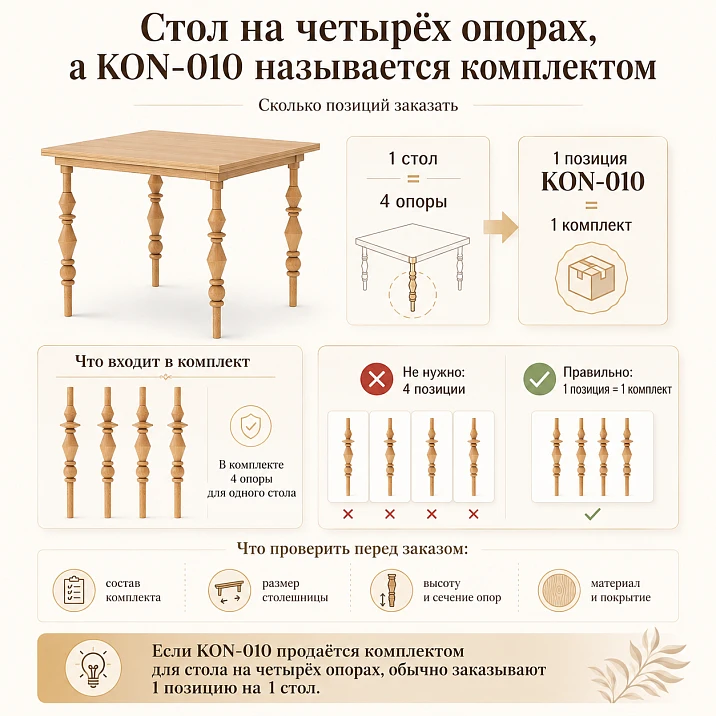
That is why a buyer who is going to buy a KON-010 furniture leg setIt is useful to divide the order into three levels. The first is a decorative leg as an assembled vertical composition. The second is a set of wooden parts from which this composition is assembled. The third is fastening to the aprons, underframe, or tabletop, floor glides, finishing materials, and other items that should not be automatically considered part of the set without checking the product card and written specification.
For a regular table with four supports, the basic calculation is simple: if one KON-010 item is intended for one leg, the order needs four identical items. But simple arithmetic does not eliminate the need for design verification. You need to ensure that the four supports fit the tabletop in terms of placement, height, top contact area, attachment method, and load capacity. The height of 730 mm only indicates the size of the decorative support. It does not confirm the stability of any tabletop and does not determine the underframe design.
Below is the entire process broken down: how to read the word "set," what is confirmed by the KON-010 card, how to calculate two, three, four, or six supports, how to get the final table height, how beech and oak differ, what to check in the delivery contents, which hardware to order separately, and how to prepare a specification so that four legs arrive identical.
The word "set" refers to one leg, not the entire table
The main mistake starts before the calculation. The buyer sees the name "furniture leg set" and mentally fills in the usual retail meaning: a set of furniture legs is four pieces. However, in the furniture designer system, the word does not mean the number of supports under one piece of furniture, but rather a selected composition of elements from which one tall decorative leg is assembled.




The card describes a vertical composition
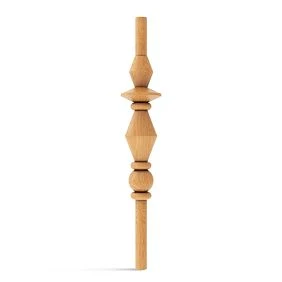
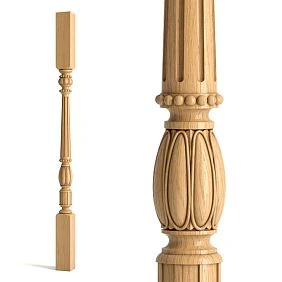
KON-010 consists of a wooden axis MLD-060 and geometric shapes from the KN series. The parts are selected so that after assembly they form one vertical support of a specified design and height. Therefore, one line of KON-010 in the cart should not automatically be read as four ready-made legs.
The practical conclusion is direct: for a table with four identical supports, initially consider four KON-010 items. Before payment, you need to open the product contents and ensure that each item indeed corresponds to one complete set of parts for one leg.
Our factory also produces:

A set of parts and a set of supports are different concepts
In a furniture order, the word "set" can mean several things:
| Formulation | What it can mean | How to check |
|---|---|---|
| Furniture leg kit KON-010 | Set of parts for one vertical leg | Read the description and composition of the item |
| Table leg kit | Multiple physical supports for one piece of furniture | Clarify the number of pieces in the set |
| Fastener kit | Plates, studs, screws, or other connecting parts | Check individual specification |
| Set of finishing materials | Primer, paint, oil, or other compounds | Verify volume and compatibility |
| Furniture assembly kit | Supports, stretchers, fasteners, and additional elements | Require a full list of items |
Such division seems formal only until the first mistake. If you order one item instead of four, production or assembly will stop. If, on the contrary, you treat each internal part as an independent leg, the estimate will show an excessive number of elements. In a good specification, the word "set" is always expanded through physical content and quantity.
Get Consultation
The name does not replace the composition line
Even when the product is familiar, the order should be read not by the title. Dimensions, material, sanding quality, list of geometric elements, axis, number of sets, and fastener status matter. The product card serves as a starting point, but the final delivery for a specific project is recorded in the invoice or agreed specification.
What is confirmed for KON-010 and what should not be assumed
The KON-010 card provides enough information to determine the scale and purpose of the model, but it does not cover the design of the entire table. The leg has an overall dimension line of 730 × 120 × 34 mm, is made of beech or oak, and is offered with a "Prestige" sanding quality. The composition belongs to a furniture construction kit and is assembled from the MLD-060 axis and KN geometric elements.
Table of confirmed characteristics
| Parameter | Confirmed value | What this means when ordering |
| Article number | KON-010 | In the specification, it cannot be shortened to "leg 730" |
| Product type | Furniture leg set | This refers to a modular decorative support |
| Overall dimension line | 730 × 120 × 34 mm | Orientations B and D need to be checked against the drawing |
| Height A | 730 мм | The final height of the furniture will be greater after adding the countertop and structural layers |
| Material | Beech or oak | The entire series of supports must be ordered in one wood species |
| Sanding quality | «Prestige» | The surface undergoes detailed hand sanding |
| Re-gluing of the selected modification | "Under enamel" | The parameter needs to be checked for the selected material and finish |
| System | Furniture constructor | The leg consists of an axle and stacked geometric parts |
| Purpose of the kit | Assembly of one vertical decorative leg | For four supports, four kits are initially needed |
| Furniture fasteners | Should not be considered included without confirmation | Selected after checking the under-table structure |
| Assembly before delivery | Need to clarify | The set may require assembly operations |
| Price and availability | Checked in the product card before payment | Not recorded in the article since they change |
After the table, the difference between the product fact and the design solution is especially noticeable. The size of 730 mm is confirmed. The number of supports under a specific tabletop is the result of furniture calculation. The presence of wooden elements in the composition is confirmed. The type of metal fastening to the tabletop is a separate issue. Beech and oak are available, but the shade of the final coating depends on the chosen finishing system.
The size of 730 mm is not equal to the finished table height
The leg height is only one component. If there is a table base, mounting plate, apron, or tabletop on top, the finished furniture will be taller. Sometimes the leg partially fits into the structural assembly, and then simple addition can also give an erroneous result. Therefore, a formula is used for a preliminary estimate, and the final height is checked against the cross-section.
Preliminary furniture height = height of KON-010 + thickness of all layers above the leg − depth of possible leg insertion into the assembly.
For example, if a leg with a height of 730 mm directly adjoins a tabletop with a thickness of 40 mm and is not recessed into the table base, the preliminary result is 770 mm. This is an arithmetic example, not a confirmation of the finished structure. If there is a mounting plate, aprons, or a hidden connection, the formula changes.
Dimensions B and D cannot be arbitrarily renamed
The card specifies B = 120 mm and D = 34 mm. Without a drawing, one cannot confidently declare one parameter as the width of the top platform and the other as the axis diameter or depth. The lettered dimension line must be read together with the image and DWG. This is crucial for ordering: the designer must understand which part of the leg occupies 120 mm, where the 34 mm axis runs, and how the part is oriented relative to the edge of the tabletop.
What elements make up one KON-010
The modular system differs from a ready-made solid leg. Its decorative pattern is formed by geometric shapes threaded or assembled around a wooden axis. The KON-010 card lists elements KN-005, KN-006, KN-007, KN-008, KN-009, and wooden molding MLD-060.
The composition must be transferred to the specification without paraphrasing
It is not enough to write: "four sets of KON-010." For a private order, such a formulation may pass, but in a production project, it is better to disclose the composition. This helps to verify the uniformity of all supports, the number of repeating shapes, and the presence of axes.
A working specification may contain the following lines:
-
main kit article KON-010;
-
number of kits;
-
material of all wooden parts;
-
sanding quality;
-
gluing quality;
-
list of internal KN articles;
-
axis MLD-060;
-
quantity of each internal element per leg;
-
total quantity of internal elements for the entire batch;
-
assembly status;
-
fastener status;
-
required marking of kits.
The exact quantities of internal figures must be transferred from the current card or an agreed account. They should not be restored from a photo: repeating details may be partially covered by neighboring elements, and visually similar figures may have different article numbers.
Why per-item kit configuration is useful
Imagine that four legs are ordered. All parts are packed in one box without separation into kits. The assembler has to count elements manually, compare sizes, and look for repeating figures. An error in one part will only be discovered on the last leg.
It is more convenient to agree on labeling in advance: "KON-010, kit 1 of 4", "kit 2 of 4", and so on. Even if the delivery comes in a common package, a list by internal article numbers reduces receiving time. For serial furniture, labeling is especially useful because one missing element stops the assembly of the entire batch.
A stacked composition requires control of the sequence
Geometric parts have dimensions and orientation. Rearranging figures can change the overall pattern and the actual height. Therefore, the assembly order should be checked against the manufacturer's diagram. A photo of the finished composition helps understand the appearance but does not replace the installation cross-section and the labeled sequence of parts.
How many KON-010 items to order for two, three, four, or six supports
The main calculation rule is as follows:
Number of KON-010 items = number of physical legs in the project × number of kits per leg.
Since the card describes KON-010 as a composition for one vertical leg, the coefficient in the basic calculation is one. For four supports, this results in four product items. However, the number of physical supports is determined by the furniture designer, not by the decorative part card.
Base calculation table
| Furniture scheme | Physical supports | Base quantity KON-010 | What else to check |
| Console on two supports with frame or wall mounting | 2 | 2 positions | Load-bearing frame and wall fixation |
| Round table on three supports | 3 | 3 positions | Geometry of the triangle and stability |
| Table on four corner supports | 4 | 4 positions | Indents from edges, aprons and fasteners |
| Long table on six supports | 6 | 6 positions | Placement of middle supports and tabletop deflection |
| Two identical consoles with two supports each | 4 | 4 positions | Single material and same finish |
| Set of three tables with four supports each | 12 | 12 positions | Batch, marking, and reserve |
This table only answers the question of the number of set supports. It does not confirm that the chosen scheme is safe. Two legs without a rigid frame will not hold a standalone console just because the arithmetic works out. Three supports require proper placement. Six legs can create a skew on an uneven floor if the design does not provide for adjustment or precise fitting.
For a table with four supports, the basic answer is four positions
The buyer does not need to add up the internal parts of one leg and divide them by four. Each KON-010 position refers to one vertical composition. Therefore, four identical physical supports require four identical sets.
Before payment, the invoice must show:
-
KON-010 — 4 sets.
-
Material — beech or oak, the same for all four.
-
Sanding quality — "Prestige".
-
The gluing parameter is the same for the batch.
-
Composition of one set — according to the current product card.
-
Fasteners — included or listed as separate items.
-
Assembly — performed by the customer or supplied in a different state.
-
Finishing — without coating or with a separately agreed service.
When a spare set is needed
Spare parts cannot be added automatically. KON-010 is not a consumable strip that is cut with waste. For a single table, four legs usually mean four sets. A fifth is needed only for an objective reason: complex serial assembly, remote site, risk of damage during production, need for future repairs, or a customer requirement to have a reserve.
It is better to order the reserve simultaneously with the main batch. This makes it easier to preserve the wood species, processing quality, and general character of the blanks. However, the economic justification for a fifth set depends on the project. For a single home table, a spare may be unnecessary, while for a restaurant chain it can be a reasonable insurance position.
Four legs are not yet a finished support system
KON-010 defines a decorative vertical, but a table consists of more than just legs. Between the supports and the tabletop, there must be a node that distributes the load, maintains geometry, and prevents loosening.
The leg does not replace the apron and underframe
A tall support can be strong vertically, but without horizontal ties, the structure remains vulnerable to lateral forces. A person leans on the edge of the table, furniture is moved, and the tabletop receives asymmetric load. These impacts are absorbed not only by the legs, but also by the aprons, frame, under-table, mounting plates, and connections.
Therefore, the phrase "four KON-010 will hold the tabletop" without a project is incorrect. You need to know the dimensions and weight of the tabletop, the distance between supports, the material of the under-table, the connection method, expected load, and operating conditions.
The central support is considered separately
For a long tabletop, four corner legs may be insufficient due to deflection. Sometimes one or two intermediate supports are added. The solution depends not on the appearance of KON-010, but on the calculation of the span and stiffness of the entire system.
If the designer has specified six supports, the cart must contain six KON-010. You cannot buy four sets and hope to assemble two additional legs from "leftover" internal parts: the set is selected for one composition and does not automatically imply surplus parts.
Three supports require precise geometry
A three-support scheme can be stable, but only with correct placement of support points and matching tabletop shape. For a rectangular desk, randomly removing one leg will create a tipping moment. Therefore, the number of supports first appears in the drawing, and only then is translated into the number of product items.
Height 730 mm: how to calculate the finished table without error
Buyers often choose tall legs based on a single number. They see 730 mm and assume the table will be of standard height. But the tabletop, under-table, and fasteners add or change millimeters.
Formula for preliminary height
For a simple node:
H of the finished table = 730 mm + T of the tabletop + T of the intermediate node − G of the seating.
Where:
-
T of the tabletop — the actual thickness of the top plate;
-
T of the intermediate node — the thickness of the plate, frame, or other layer, if it increases the height;
-
G of the seating — the depth to which the leg goes into the structure and does not participate in the total height.
If the tabletop is 30 mm thick and lies directly on the top of the leg without an additional layer and without recessing, the preliminary height is 760 mm. With a thickness of 40 mm — 770 mm. These numbers show the arithmetic, not the finished project.
The apron may affect not the height, but the space for the legs
Even if the apron does not add millimeters on top, it reduces the free space under the table. For a writing or dining table, you need to check the distance from the floor to the lower edge of the apron. A tall decorative leg can provide a suitable overall height, but a too-deep under-table structure will make seating uncomfortable.
The foot pad also changes the mark
A soft pad, adjustable support, or other lower element adds its own thickness. If the foot pads are purchased separately, their size must be included in the section. Even a difference of a few millimeters can be noticeable when combined with ready-made chairs, a windowsill, a neighboring console, or built-in furniture.
Make a full-size cut
The most reliable household method is to draw a vertical cut at a 1:1 scale or at least assemble a control dimensional chain on the wall with painter's tape. Mark 730 mm, the thickness of the tabletop, the lower edge of the apron, and the seat height. This makes it visible where the knees will be and how massive the leg looks.
Dimensions 120 and 34 mm: why a designer needs them
Height usually attracts all the attention, but transverse dimensions are no less important. They determine the scale, fit into the joint, distance from the tabletop edge, and compatibility of internal elements.
The 120 mm dimension affects the corner offset
If the maximum decorative part occupies 120 mm, the leg cannot be placed so that the relief extends beyond the tabletop edge or intersects with the apron. You need to check not only the axial point but also the full contour of the widest shape.
Conditional scheme for calculating the offset:
The minimum geometric offset of the axis from the edge ≥ half of the maximum transverse dimension + the project's technological allowance.
But the formula can only be applied after determining what exactly the dimension B = 120 mm on the drawing denotes. If this is the width of one shape, half is 60 mm. The technological allowance is assigned by the designer considering the tabletop chamfer, fasteners, and visual composition.
The 34 mm dimension is related to the axis and internal fits
The assembly uses MLD-060 with a size of 34 mm, and the geometric parts of the KN series have corresponding mounting parameters specified. This confirms the systemic connection of the elements. However, the exact nature of the connection, tolerances, and the need for glue should be taken from the documentation, not from the coincidence of numbers.
The drawing is more important than the photo
The front view may not show the depth, faceted transitions, and the actual position of the axis. To order a table, at least a side view and a cross-section of the top assembly are required. If the project is complex, it is useful buy wooden construction set elements only after the entire dimensional chain is coordinated in a single coordinate system.
Beech or oak: the choice is not only about color
KON-010 can be ordered in beech or oak. Both species are hardwoods, but they look and behave differently in finishing. The choice should cover the entire batch: four legs of one table cannot be accidentally split between two species.
Beech for a smooth painted surface
Beech has a calmer, denser, and relatively uniform structure. It is often considered for opaque enamel, when color and the shape of the assembled composition become the main focus. Under a layer of paint, the geometric transitions of KON-010 are read through light and shadow, and the natural wood grain is not the main decorative argument.
This does not mean that any beech is automatically ready for any enamel. You need to check the quality of the glue joints, prepare the surface, use a compatible primer, and follow the technology of the chosen paint system.
Oak for pronounced natural texture
Oak has noticeable pores and an active grain. It is appropriate when the finish should showcase the wood: with staining, oil, or clear varnish. On a complex assembled leg, the oak grain can emphasize each shape, but at the same time it will make differences between lamellas and parts more noticeable.
For transparent finishing, the quality of re-lamination must be checked separately. If the card of the selected modification shows "under enamel", you should not expect a uniform translucent result without clarification.
Comparison for order
| Criterion | Beech | Oak |
| Visual texture | Calmer | Pronounced, porous |
| Typical design task | Opaque painting | Tinting and transparent finishing |
| Geometry behavior | Form is read through light and color | The form is complemented by the wood grain pattern |
| What to check | Primer, enamel, re-lamination quality | Selection of parts, pores, tone, transparent coating |
| Order series | All legs from the same batch | Matching by the overall texture character is especially important |
Before deciding, it is useful to open the section choose beech or oak for furniture legs and compare not only the price, but also the planned finish. The material is chosen before purchasing coatings and before approving the color.
"Prestige" for KON-010 is a practical surface characteristic
The model card indicates the "Prestige" sanding quality. For an assembled geometric leg, this is especially significant: it has many edges, transitions, planes, and areas where parts meet.
Manual refinement of complex areas
"Prestige" quality includes machine and detailed manual sanding. Such preparation reduces the amount of independent work in corners and transitions. Under side lighting, roughness, fuzz, and cutter marks on geometric elements are more noticeable than on a simple cylindrical leg.
At the same time, "Prestige" does not eliminate preparation before coating. The surface needs to be inspected, dusted, and treated according to the manufacturer's instructions for primer, oil, or varnish.
All four sets must have the same quality
You cannot order three legs in one quality and the fourth in another, even if the difference seems insignificant after painting. Uneven preparation changes primer absorption, tactility, and light reflection. In the specification, the sanding quality is recorded for the entire batch in one line.
Re-gluing and sanding are different parameters
"Prestige" refers to surface treatment. "Under enamel" or "under tinting" describes the selection of lamellas in the workpiece. These characteristics cannot be substituted for each other. Smooth hand sanding does not turn a "under enamel" workpiece into material selected for transparent finishing.
Is KON-010 supplied assembled
The name "set" and the description of the construction kit indicate a collection of parts for assembly. However, the delivery condition of a specific order must be checked before payment. What matters to the buyer is not the general meaning of the category, but the actual contents of the box.
Three possible delivery conditions
-
Parts are separate, without assembly.
-
Partially assembled units.
-
Fully assembled decorative leg.
You cannot choose one option based on a photo. In the invoice or manager's response, you need a direct formulation. Packaging, painting technology, access to joints, furniture maker's time, and adhesive joint requirements depend on this.
Separate finishing or painting after assembly
Separate finishing facilitates access to edges but creates a risk that the coating will get on seating surfaces and alter the joint. Painting after assembly provides a uniform outer layer, but hard-to-reach areas may remain at contact points. The correct sequence is determined by the joint design and the chosen coating system.
Test assembly before final coating
Even if legs are planned to be painted later, it is useful to assemble one test composition without irreversible operations. Check overall height, order of shapes, alignment of joints, verticality, and visual pattern. After that, transfer the result to the remaining sets.
Is fastening to the tabletop included
Card KON-010 describes a wooden decorative composition. Fastening to specific furniture should not be considered included until directly confirmed. Tabletops can be made of solid wood, MDF, plywood, stone, and composite materials; identical fastening for all options is impossible.
First the joint design, then metal purchase
Fastening is chosen after answering the questions:
-
what the leg attaches to — tabletop, aprons, or underframe;
-
What is the thickness and material of the receiving part;
-
Is a metal plate provided;
-
Is there a threaded stud;
-
Is disassembly required;
-
How are seasonal movements of the massif compensated;
-
Is a thrust bearing needed;
-
Is there height adjustment;
-
What lateral forces does the assembly withstand.
After that, you can Buy hardware for furniture legs And do not assemble the connection from random screws.
Glue does not replace mechanical calculation
In a prefabricated decorative composition, adhesive joints between wooden elements may be used, but the glue for internal assembly of the leg and the attachment of the entire leg to the table are different tasks. It cannot be assumed that the mounting compound will automatically ensure the stability of the underframe. The type of glue, surface preparation, and mechanical fixation must match the design.
Glides protect the bottom but do not fix geometry
Bottom pads reduce the contact of wood with the floor and can protect the coating. Adjustable elements help compensate for minor unevenness. But a glide will not fix a leg assembled with a deviation from vertical, nor will it replace a rigid connection between supports.
What to buy together with KON-010
Related items form not a decorative basket, but a working set for assembly. First, the structure is determined, then hardware and finishing materials are selected.
| What to add | Why is this needed | When to buy | What to check |
| Fasteners to the underframe or aprons | Connect the support to the load-bearing system | After developing the joint | Material, length, diameter, access for installation |
| Mounting plates | Create a detachable or reinforced connection | If provided for in the drawing | Dimensions and hole locations |
| Floor protectors | Protect the bottom of the leg and the floor | After selecting the coating and height | Thickness and method of fixation |
| Compound for assembling wooden elements | Join the parts of the assembled composition | After confirming the technology | Compatibility with wood and coating |
| Primer and enamel | Opaque finish | For a paint-ready project | A complete system from one manufacturer |
| Oil, varnish, or tinting compound | Highlight the wood | For a suitable workpiece for transparent finishing | Test coating and quality of re-gluing |
| Abrasives and dust removal materials | Prepare the surface between operations | Before finishing | Grit and system recommendations |
| Template or jig | Repeat the same position of four supports | Before drilling | Snapping to axes and tabletop edges |
| Packaging pads | Protect parts after painting | For transport to the site | No sticking to the coating |
Suitable compounds can be selected in the section buy materials for finishing wooden legs. The exact consumption is calculated based on the surface area, number of coats, and the material's instructions. The number of cans cannot be determined solely by the number of legs.
Four identical legs are best ordered in one batch
Wood is never absolutely identical. Even within the same species, the tone, texture, and lamella arrangement differ. For a modular model, another factor is added: each support consists of several parts.
One batch simplifies selection
When four KON-010 are ordered as one order, it is easier to coordinate the common material, re-gluing, sanding, and composition. This does not guarantee photographic identity of the natural grain, but it reduces the risk that one leg will noticeably differ in preparation or origin of parts.
Batch parameters must be repeated in each line
The specification should not contain the wording "one leg is oak, the rest are the same." Each essential characteristic is explicitly recorded: four sets, oak, "Prestige," agreed re-gluing option, identical composition, identical delivery condition.
A finish sample is made on the same wood
Screen color does not show how the composition will behave on beech or oak. Before painting the entire batch, a test application is needed. For transparent coating, the sample is especially important because the texture contributes to the result. If the furniture maker changes the primer, stain, or number of layers, the approved color may change.
Practical scenarios: how many KON-010 different furniture needs
The same leg height does not make it universal. In each scenario, the number of supports, attachment method, and visual scale change.
Dining table on four legs
The base order is four KON-010. Additionally, the distance between supports, space for chairs, apron height, tabletop deflection, and resistance to lateral load are checked. If the table is extendable, the mechanism may conflict with the upper parts of the supports.
Desk
Four decorative legs may fit in height, but space must be left for feet, pedestals, and cable channels. If there are drawers under the tabletop, their body reduces the free height. First, a section is built, then the supports are ordered.
Console on two legs
Two KON-010 units are allowed only if there is another load-bearing scheme: wall mounting, a rear frame, or a support body. The two vertical legs themselves do not form a stable self-supporting structure. There will be two items in the cart, but additional elements must be present in the project.
Round table on three legs
Three KON-010 units are ordered only after checking the support triangle. The tabletop diameter, center of gravity position, and distance between supports determine stability. Decorative parts up to 120 mm wide must not collide under the center.
Long table on six legs
Six positions help reduce the span, but the middle supports may interfere with seating. Distances are chosen based on chair positions and the under-table structure. All six sets must be from the same batch and have the same height after assembly.
Two paired consoles
For two consoles with two legs each, four KON-010 units are ordered. In the specification, it is useful to split them into pairs, especially if the furniture is installed in different rooms. The color and finish pattern of each pair are coordinated together.
Commercial interior
In a restaurant, hotel, or showroom, maintainability and repeatability are important. A spare set may be justified, but its quantity is determined by the project owner. It is useful to keep the invoice, composition, and coating sample so that a repair part can be reproduced later.
How is KON-010 different from a ready-made one-piece leg
A buyer who wants Buy wooden furniture legs, will see both ready-made models and modular compositions. They solve a similar task but require a different approach to ordering.
Modular leg
Advantages of the modular system:
-
complex architectural pattern made of several geometric shapes;
-
clear belonging to the constructor series;
-
ability to work with individual system elements during design;
-
expressive vertical composition.
What to consider:
-
kit contents;
-
assembly order;
-
internal plantings;
-
delivery condition;
-
uniformity of several sets;
-
finishing of joints.
Finished solid or glued model
The finished leg is perceived as one product part. It has fewer questions about the sequence of internal elements, but you still need to check the size, material, top mounting, and finish. For a project that does not require a stacked geometry, a finished model can reduce the number of assembly operations.
Random set of individual KN
Purchasing individual figures without a calculated scheme is not equal to KON-010. The coincidence of the hole diameter does not yet confirm the required height, composition, and quantity. A ready-made set is valuable because the elements are already selected into one vertical model. An independent composition should be designed separately, not by changing the composition of a ready-made KON-010 on site.
When KON-010 is really suitable
The model is appropriate when the project needs a tall decorative support with a geometric stacked pattern, and the height of 730 mm is coordinated with the furniture section.
Suitable
-
to a table or console with a calculated underframe;
-
furniture where the supports remain clearly visible;
-
for a project with opaque enamel made of beech;
-
compositions with expressive oak texture when properly re-glued;
-
custom furniture where a repeated set of shapes sets the rhythm;
-
a series of items for which identical sets can be ordered in one batch.
Better to choose another option
-
if a short leg is needed for a dresser or cabinet;
-
if the table should have a minimalist straight support;
-
if the construction requires a metal frame with a thin cross-section;
-
if the final height with the chosen tabletop turns out to be excessive;
-
if the top node does not fit the decorative dimension;
-
if the assembler is not ready to work with a composite composition;
-
if a fully pre-confirmed
Finishing ordered before trial assembly
The coating gets on the mounting surfaces, and chips appear during fitting. First, check the assembly and joints, then approve the finishing technology.
Sets are issued on different days
With separate orders, the risk of differences in batch, material, and preparation increases. All legs of one piece of furniture are better ordered at the same time.
The word "under enamel" is taken as a finished coating
The quality of gluing "under enamel" does not mean that the leg is already painted. It describes a blank designed for opaque finishing. Primer, paint, interlayer treatment, and the final coat must be included in the technology separately.
The composition of the set has been changed without recalculating the height
The buyer removes one figure or swaps it with another, assuming the appearance will barely change. But the vertical dimension chain and the pattern become different. If a custom composition is needed, it should be designed from the kit elements as a new assembly.
A specification that can be sent to a manager or a furniture maker
A good specification is short but unambiguous. It should not replace the engineering drawing, but it helps to get the required quantity of identical product items.
Example for one table
Field Entry Product Furniture leg kit KON-010 Purpose Four vertical supports for one table Quantity 4 sets Set dimensions 730 × 120 × 34 mm Material Beech or oak — specify one option Sanding «Prestige» Re-gluing Specify the selected option from the card Internal composition According to the current KON-010 specification Delivery condition Confirm: parts or assembled leg Fasteners for the underframe Confirm availability or list separately Floor protectors Select separately if necessary Finishing Without coating or by separate agreement Labeling Sets 1–4 Assembly drawing Provided by the furniture maker Final height of the furniture Checked by section Questions before invoicing
It is useful for the manager to send not a general question like "does everything fit", but a specific list:
-
Does one KON-010 item correspond to one vertical leg?
-
What is the current list and quantity of parts in one set?
-
In what form are the elements supplied?
-
Is the MLD-060 axle included?
-
Is the fastening to the tabletop or underframe included?
-
Is there an assembly sequence diagram?
-
Which veneering option is available for beech and oak?
-
Will all four sets be manufactured in one batch?
-
Can the sets be labeled separately?
-
What documents and drawings are available for the designer?
Direct questions create a paper trail and allow comparing the answer with the invoice.
For a furniture series, a summary list is needed
If KON-010 is used not in one table but in a collection, one line saying "24 sets" is not enough. The distribution must be specified: table A — 4, table B — 6, console V — 2, and so on. Such a list helps to kit products by site and avoid discovering shortages at the final stage.
Right and left positions usually do not arise, but orientation is still checked
The vertical composition itself may be axisymmetric, but the fastening unit, aprons, and position relative to the tabletop can create different mounting situations. The specification records not a "right" or "left" leg without basis, but the axis and top node reference per the drawing.
Checking delivery before finishing begins
Acceptance does not start with unpacking one beautiful part. The entire batch must be checked while the products are not yet painted and not handed over for assembly.
Check the number of kits
For a table with four legs, there should be four complete sets. If parts are packed loose, use the internal item list and recount the total quantity.
Match the materials
Make sure all parts are made of the selected wood species. Oak and beech have different grain patterns. If in doubt, do not start painting until clarified.
Check dimensions and appearance
Verify the overall dimension line, geometry of shapes, holes, condition of edges and surfaces. Irreversible operations — gluing, trimming, drilling, painting — are performed only after acceptance.
Assemble a test leg
One trial assembly shows whether the height matches, whether the order of shapes is correct, and whether there are any joint issues. After checking, you can assemble the other three using the same pattern.
Compare all four legs on one flat surface
After the test assembly, place the legs side by side on a flat base and check the top marks. Differences can arise not only from parts, but also from incomplete seating of elements, dirty joints, or different assembly order. Before fixing the connections, the problem is easier to detect and correct.
Record the result
Photos of four disassembled kits, packaging markings, and trial assembly are useful for the furniture maker and the customer. For a commercial project, this is part of normal quality control.
What to do if the project changes after placing an order
Changing the thickness of the tabletop, the length of the table, or the number of seats affects the supports even when the article KON-010 remains the same.
The tabletop has become thicker
Recalculate the final height, the lower edge of the apron, and the legroom. You may need to change the junction point, but you cannot trim a modular leg without a project: this will disrupt the composition and fit of the parts.
The table has become longer
Check the deflection and the number of supports. Four kits may remain sufficient with a stiffer underframe, or two additional legs may be required. The decision is made by the designer, not based on visual impression.
The shape of the tabletop has changed
Round, oval, and rectangular tabletops have different support points. Shifting the axes can lead to decorative figures colliding with aprons or the transformation mechanism.
Beech was replaced with oak
Changing the material in one line is not enough. You need to review the finish, color sample, texture selection, and cost of all sets. If part of the batch is already manufactured, mixing materials without a designer's decision should not be done.
Added a foot pad
Include its thickness in the vertical chain and ensure that the lower part of the leg accepts the chosen mounting method. The adjustment part may require a hole or a metal insert, which cannot be assigned without a drawing.
How to order KON-010 on STAVROS
First open the card and check the current composition of KON-010. Check the size, material, sanding, re-gluing, price, and order status. Then match one item to one physical leg according to the set description.
If the model does not fit in scale or height, you can choose legs for the table and console among ready-made supports. When the project is built around your own sequence of shapes, it is more reasonable to look at the KON series sets and individual constructor elements, rather than randomly reworking KON-010.
After approving the node, select furniture fasteners for the table and finishing materials. The cart should contain not just four identical names, but a complete project set: supports, confirmed composition, hardware, coating, and a clear assembly diagram.
Payment terms, shipping calculations, and order receipt are collected on the page delivery of furniture leg sets across Russia. Delivery cost depends on order parameters and address, so it is checked at checkout, not carried over from another project.
Commercial route without extra items
The purchase sequence should follow the project logic:
-
Approve the number of physical supports.
-
Check KON-010 for size and composition.
-
Record the material and quality.
-
Multiply one set by the number of legs.
-
Clarify the internal composition and delivery condition.
-
Design the top and bottom joints.
-
Select fasteners and foot pads.
-
Choose the finishing system.
-
Check delivery and packaging.
-
Only after this pay for the full order.
Such a route does not complicate the purchase, but separates confirmed product characteristics from the furniture maker's decisions.
How to recalculate KON-010 for a furniture series, not a single table
When a project has one table, the error is immediately noticeable: instead of four legs, only one arrived. In a series of several items, the situation is more complex. Some models may have four supports, others — two decorative legs and a wall mount, and still others — six supports due to an increased span. Simply multiplying the total number of items by four no longer works.
First, compile an item list
Item Number of items Supports per item Total KON-010 Dining table 2 4 8 Console with calculated rear frame 3 2 6 Long table 1 6 6 Desk 4 4 16 TOTAL 10 — 36 The example requires 36 sets of KON-010. This is a calculation of product line items, not a confirmation of structures. For each line, there must be its own drawings, tabletop dimensions, and fastening units.
Material cannot be changed within one visual group
If two dining tables are in the same room, their supports are better counted as one visual group. For all eight sets, the same wood species, sanding, and gluing are fixed. Consoles in another room may have a different finish, but then a separate group is created in the list, rather than adding a note "paint differently" to the common line.
The total result is checked in two ways
The first calculation starts from furniture items: the number of items is multiplied by the number of supports. The second is based on the physical layout in the rooms. On the plan, each leg is marked with a conventional sign, and the signs are recounted. If the two totals do not match, the specification cannot be sent to the order.
Such double control is also useful for a private interior. For example, a buyer orders one table and two identical consoles. The formula gives 4 + 2 × 2 = 8 sets. The plan should also show eight support points.
The reserve is calculated separately from the working quantity
Working sets and reserve cannot be mixed. In the invoice, it is useful to write: "KON-010 — 36 sets for products; KON-010 — 2 sets reserve." Then, during acceptance, no one will take the spare leg for the first table they come across, and the furniture maker will understand why the quantity exceeds the number of supports in the drawings.
Recalculation after changing one item
If a long table, instead of six supports, receives a reinforced underframe and four legs, the total order decreases by two sets. But the change should be agreed upon before production starts. If the order has already been manufactured, the extra KON-010 cannot be considered a universal stock for any other item: the height, material, and finish must match the new purpose.
How to achieve the same height for four stacked legs
Even with the same composition, the result depends on the correct seating of each part. One piece that does not reach its calculated position will raise the top mark. For a table, this turns into rocking, misalignment of mounting plates, or forced adjustment of already painted wood.
An assembly template saves time
For four legs, a simple control template is useful. It can set a total height of 730 mm, the position of the outer elements, and the perpendicularity of the axis to the support plane. The template does not replace the factory drawing, but helps to replicate one approved result.
The procedure is as follows:
-
Lay out one complete set according to the diagram.
-
Check each part and the mounting surface.
-
Perform a trial assembly without the final finish.
-
Verify the height and the external pattern.
-
Secure the position with control marks.
-
Repeat the procedure for the three remaining sets.
-
Place the four legs side by side and compare the top surfaces.
Measure not only with a tape measure
The tape measure shows the overall height but does not reveal the axis tilt. A flat surface, a square, or another suitable control tool is needed. If a leg is tilted from vertical, the top point may match in height, but the underframe will still be installed with a skew.
The coating should not mask an assembly problem
A thick layer of primer or enamel can visually smooth out a small joint, but it does not fix incomplete seating of parts. First geometry, then finishing. Attempting to level four legs of different heights with additional coating layers will produce an uneven surface and does not guarantee an accurate result.
Lower elements are checked on a single plane
Modular legs are placed side by side before mounting to the tabletop. If one wobbles, the cause must be found: a speck in the joint, incorrect sequence, difference in fit, damaged end, or unevenness of the test surface. Gluing a random shim before determining the cause is not advisable.
The top assembly must be repeatable
Even four identical legs can be installed differently if holes are marked individually. A jig or a single drilling template helps maintain distance from edges and orientation of fasteners. For a solid wood tabletop, the direction of grain and allowable wood movement are additionally considered.
Inspection after final assembly
The finished table is placed on a flat surface and all support points are checked. Then diagonals, tabletop position, stability under moderate lateral force, and access to fasteners are evaluated. If the structure wobbles, one leg cannot be automatically blamed: the cause may be underframe geometry, uneven floor, or different tightening of joints.
Storage and preparation before assembly
It is better not to unpack wooden parts at a damp site or leave them near a heating appliance. Before assembly, the kits need a stable environment, and the packaging should be opened so as not to lose the labeling of individual sets.
Do not mix parts from the four kits unless necessary
If the delivery is marked by kits, maintain the separation until the trial assembly. Mixing increases the risk that one leg will get pieces from different sets, and the last one will be incomplete. After checking, a common inventory can be created, but physical separation remains convenient.
Finishing materials are tested on a sample
Before working on all four legs, apply the coating system to a sample of the same wood species and glue quality. For oak, evaluate pore filling and tone uniformity; for beech, the behavior of primer and enamel. The color on a small sample is then compared with the room lighting.
Seating surfaces are protected from coating
If the joint requires a precise fit, thick primer or varnish on the contact can hinder assembly. Which areas to mask is determined by the diagram. Removing the coating with a knife after painting on your own is risky: you can damage the edge and get a noticeable chip.
Order documents are kept until installation
The card, invoice, composition diagram, and correspondence about fasteners should remain near the kits. This is not bureaucracy, but working information for the assembler. If the furniture maker sees only a box of parts, they have to guess again at solutions that were already agreed upon.
FAQ: questions about the quantity and composition of KON-010
Is one KON-010 position one leg?
Yes. The card describes KON-010 as a composition of parts for assembling one vertical decorative leg. For a table on four such supports, four positions are basically required.
Why is the product called a kit?
Because one leg is made up of several matched wooden elements: the MLD-060 axis and KN geometric shapes. The word refers to the composition of one assembled support, not to the number of legs under the table.
How many KON-010 should I order for a table with four legs?
Four kits, if the project indeed provides for four physical supports and one position corresponds to one leg. The quantity is first confirmed in the drawing, then transferred to the cart.
Is a fifth kit needed as a spare?
Not always. For a single home table, a spare is usually not mandatory. For serial furniture, a remote site, or a commercial interior, a reserve may be justified, but it is added deliberately.
What is included in KON-010?
The card lists the MLD-060 axis and geometric elements KN-005, KN-006, KN-007, KN-008, and KN-009. The exact quantity of each internal element should be verified against the current specification before payment.
Is the fastener included with the tabletop?
It should not be considered included without direct confirmation. The mounting depends on the tabletop material, the underframe, and the joint scheme, so it is checked as a separate line item.
Does KON-010 arrive assembled?
The delivery condition must be confirmed in the product card or with a manager. The name "kit" allows for a set of parts, so a fully assembled leg cannot be promised without a written response.
Can the order of the figures be changed?
Only after a design review. Rearranging changes the pattern, height, and fit. The finished KON-010 composition is best assembled according to the diagram, while a custom composition should be designed from individual constructor elements.
What height will the table be with KON-010?
Add the thickness of the tabletop and intermediate layers to 730 mm, then subtract the depth of the leg's possible insertion into the joint. The final result is taken from the vertical cross-section.
Will KON-010 fit a tabletop with a thickness of 40 mm?
It cannot be answered based on thickness alone. The preliminary height with direct contact would be 770 mm, but the underframe, aprons, fasteners, tabletop dimensions, and ergonomics need to be checked.
What to choose: beech or oak?
Beech is often considered under an opaque enamel, oak — for projects where they want to show the natural texture. The final choice depends on the quality of the glue joint and the finishing system.
Can I order four legs from different wood species?
Technically, individual items can have different materials, but for one table such a choice will give a noticeable difference in texture and finish. If contrast is not part of the design, all four sets are ordered from the same species.
What does "Prestige" sanding mean?
This is machine processing followed by detailed manual sanding of the surface. For assembled geometry, it reduces the amount of finishing work on edges, planes, and transitions before finishing.
Do I need to sand the "Prestige" before painting?
The surface is still inspected and prepared according to the paint system instructions. Usually, dust removal, priming, and intercoat treatment are required; rough independent re-sanding should not be done unless necessary.
Can KON-010 be used for a console on two legs?
Two decorative supports can be considered only together with a calculated frame, body, or wall mounting. Two legs by themselves do not guarantee the stability of the console.
Will the model suit a long dining table?
Possibly, but the number of supports and the under-table structure are determined by calculation. A long tabletop may require middle supports or a reinforced frame.
Can the legs be attached directly to the tabletop?
This depends on the material and thickness of the tabletop, the shape of the top part of the leg, and the chosen fasteners. The joint must be shown in the drawing; there is no universal method for all tables.
How can I ensure that the four sets are identical?
Order them in one batch, specify one material, sanding, re-gluing, and composition. Upon receipt, lay out all sets, compare internal parts, and perform a test assembly.
Do I need to buy floor glides?
Only if they are specified in the project. Floor glides protect the bottom of the leg and the floor, and adjustable options can compensate for minor unevenness, but they change the final height.
Where can I check the price of KON-010?
The current price is checked in the card of the selected modification. The price depends on the material and current conditions, so it should not be fixed in the project article.
Can I buy one KON-010 as a sample?
The availability and order status are checked in the card. One set is useful for a mockup or test assembly, but it does not replace ordering four legs for a finished table.
How are set parts transported?
Packaging and delivery conditions depend on the order. Before shipping, it is useful to clarify the marking of sets and the protection of sanded surfaces, especially if the products are sent directly to a third-party production facility.
What to do if the tabletop thickness was changed after placing the order?
Recalculate the final height, the position of the aprons, and the fastening assembly. If the new design changes the number of supports or the fit, pause assembly and coordinate the changes before drilling and painting.
Can KON-010 be shortened to the required height?
This should not be done without a separate project. The leg is assembled from a calculated sequence of shapes, so trimming or removing a part changes the composition, fit, and overall size.
Is an assembly instruction needed?
Yes, if the set is supplied as separate elements. The diagram should show the sequence, orientation of parts, and connection requirements. A photo of the finished leg does not replace such documentation.
Where to look for an alternative if KON-010 is too large?
Compare other models in the furniture leg category and KON series sets. You should choose based on the full dimensional line, not just the height.
From four supports on the drawing — to four complete STAVROS sets
For a table with four legs, the initial order is four items of KON-010, because one set is designed for assembling one vertical decorative support. But the correct basket does not start with the number four. First, the dimensions of 730 × 120 × 34 mm, the finished height with the tabletop, the under-table structure, material, re-gluing, delivery condition, and full internal composition are checked. Then, fasteners, floor glides, and finishing materials are added as separate line items.
STAVROS company offers the ability to order a ready-made, pre-selected composition of furniture constructor elements, without assembling a leg design from random parts. Before payment, open the product card, record four complete sets from one batch in the invoice, and confirm in writing everything that is not evident from the name: assembly condition, exact number of internal elements, and presence of fasteners. This procedure turns the word "set" from a source of confusion into a clear specification for the furniture maker and production.
-