Article Contents:
- Wooden underframe STL-012: first a top view, then the order
- What will be visible through the glass: a map of the carved support surfaces
- "Standard" or "Prestige": which STL-012 preparation you pay extra for
- Glass and wood shade: evaluate the finish sample together with the tabletop
- Hardware for assembling the underframe — not the entire order for a glass tabletop
- Cleaning under a transparent tabletop: checking access before assembly
- Underframe, finish, glass: calculating the total cost of the table
- STL-012 ordering process: what to agree on before starting glass production
- What to write in the application
- When to stop an order
- Can I order STL-012 for a transparent tabletop that has not been chosen yet?
- Is glass and its mounting included in the cost of the base?
- Which surfaces need to be agreed upon as visible from above if the table will be placed against a wall?
- What does the extra charge for "Prestige" provide if the finishing is done by a third-party workshop?
- Can I choose the finish only based on a photo of existing furniture?
- Will one STL-012 item be enough for the selected table?
- When should the tabletop be put into production under a tight deadline?
- Who calculates the assembled delivery and the full set?

A carved base is chosen for its pattern and volume, so you don't always want to cover it with an opaque tabletop. Glass allows the wood to remain visible but changes the requirements for the order: areas, joints, and contact elements that the tabletop would otherwise hide may be visible from above. Their appearance needs to be discussed before manufacturing the tabletop, not after final assembly.
Before buy wooden underframe STL-012, coordinate the look of the future table from several points, a map of visible surfaces, a finish sample, and the glass fitting. If the required mounting is not visually acceptable, the project is changed. Removing intended parts for the sake of transparency is not allowed.
Let's break down an order where the carving is wanted to be seen without a tablecloth, runner, or other ways of masking. This is a design scenario, not a description of the ready STAVROS configuration. The result should be a specification understandable to the base seller, finisher, tabletop manufacturer, and assembler.
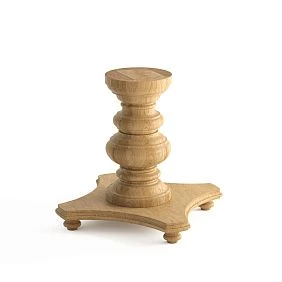
Wooden underframe STL-012: first the top view, then the order
For choosing the version, the following parameters are specified in the STL-012 card. Letter size designations are kept in the manufacturer's format: you cannot independently assign the height of the finished table or the glass dimensions based on a single line of dimensions.
| Parameter | What is specified for STL-012 |
|---|---|
| Product type | Carved wooden underframe |
| Size A × B × D | 900 × 760 × 332 mm |
| Wood | Beech or oak |
| Sanding | "Standard" or "Prestige" |
| Standard delivery | Disassembled, with assembly fittings |
| Packaging | Rigid box |
| Delivery assembled | Separate approval and calculation via manager |
This information defines the product item but does not yet specify a finished table. In particular, the delivery format says nothing about how inconspicuous the joints will be under the chosen transparent top.
Start with a sheet of three angles. Standing next to the table, assess the upper parts of the base and the view through the central section of the tabletop. Sitting in the intended spot, look at the joints at an angle and at the edge of the glass. From the walkway side, check the overall composition: which elements are truly readable and which overlap each other.
For preliminary approval, photographs of the specific product and design images are suitable. On the top view, mark the outer contour of the tabletop, the position of the base, and the areas that should remain open to view. If the project includes an additional element covering part of the wood, show it immediately rather than leaving it outside the beautiful sketch.
Do not turn the intended table setting into a way to hide a technical area. A vase sometimes stands in the center, sometimes it is removed. If the appearance is acceptable only when the spot is constantly covered, that is a different operating condition that the customer must consciously accept.
When the task is Buy wooden furniture Specifically for an open composition, a frontal photograph is insufficient. After viewing three angles, specific comments should remain: which area is liked, which requires a sample, which joint needs to be shown larger. Such a sheet becomes the basis for further decisions, not a replacement for a technical drawing.
Ask to show the composition without objects on the table, and then with the intended table setting. The first option reveals all open areas; the second helps understand whether the meaning of the transparent top is preserved in everyday life. If most of the surface is constantly occupied by placemats, equipment, or dishes, assess how much of the carving will actually remain visible. This is not a reason to automatically abandon the idea, but a useful check before spending on complex finishing of the upper areas.




What will be visible through the glass: a map of the carved support surfaces
The phrase "process everything beautifully" does not allow checking the result. Instead, create a surface map: assign a number to each noticeable area, specify the required appearance, and the person who will confirm the execution. Transfer the numbering to photographs or a drawing so that different craftsmen do not discuss different areas under the same name.
The table below is a working form for a specific project. It does not assert that every STL-012 necessarily has all the listed visible details or that their placement is the same with any tabletop.
| Zone | How to determine visibility | What to coordinate | Who confirms |
|---|---|---|---|
| Relief carving | By selected angles | Coverage of protrusions and recesses | Customer and finisher |
| Top platforms | According to the drawing of the base and tabletop | Boundaries of the visible area and its treatment | Manufacturer and finisher |
| Edges and joints | Based on actual part mating | View after assembly and finishing | Cabinetmaker |
| Contact elements | According to the glass support scheme | Position and acceptable appearance | Cabinet maker and glazier |
| Visible hardware | According to the connection drawing | Visible parts without changing their function | Node responsible |
For each row, one of the clear statuses is needed: "visible and agreed", "covered by the intended element", or "requires clarification". The last status cannot be silently considered approval. For example, the absence of a photo of the top platform means a lack of information, not confirmation of its readiness for a transparent top.
Distinguish between the visible surface and the contact surface. One area can simultaneously participate in a joint and be visible through glass. Then the finisher should not independently decide which layer to apply: the appearance is agreed upon together with the requirements for the joint. Otherwise, the decorative decision will be made separately from the part it is meant to work with.
Suppose a light area is noticeable on the project image between tinted elements. First, determine what it is: exposed wood, a joint part, or inaccurate rendering. Only then assign an action. The requirement to "paint over the spot" without defining its function can lead to unnecessary work or interference with the joint.
A technical surface in itself is not a defect. The question is whether its execution matches the agreed application. If the buyer intends to leave it exposed under glass, this requirement must be recorded in advance. Separately note who finishes the treatment of the area if the standard execution does not match the desired appearance.
Instead of writing "top — in the color of the base," a more specific project specification can be used: "Zone B-01, marked in the photo: visible part — per sample O-01; coating boundary near the joint to be confirmed per diagram U-01." These designations are an example of document organization, not STAVROS part markings. Such a specification allows distinguishing the decorative part from the area with separate technical requirements. If the boundary is later changed, both the photo and the description are updated so the craftsman does not work from an outdated version.
It is useful to supplement the map with acceptance conditions: agreed viewing angles, normal lighting, reference photos. There is no need to invent your own STAVROS tolerances. If a result stricter than the standard execution is required, its feasibility and cost are confirmed with a separate response.
Our factory also produces:
"Standard" or "Prestige": what the extra charge for STL-012 preparation covers
The sanding level is chosen after determining the visible zones. Otherwise, the buyer pays for abstract "better quality" without understanding which operations are actually needed for their table.
According to the official STAVROS classification, "Standard" includes milling and machine sanding; in this category, limited machining marks, roughness, and fuzz are allowed. "Prestige" adds detailed hand sanding, including hard-to-reach areas. However, small acceptable machining marks are also described for it. Therefore compare sanding "Standard" and "Prestige" it is useful to rely on the manufacturer's definitions rather than assuming that the second name means absolute flawlessness of any surface.
The extra charge within one wood species according to the card prices as of September 5, 2026, is:
Beech: 129,030 − 122,760 = 6,270 ₽.
Oak: 238,800 − 227,330 = 11,470 ₽.
You need to compare two estimates with the same final result. The first one includes the "Standard" base and all necessary workshop work. The second one includes "Prestige" and the work that remains after obtaining it. In both, the surface map, color, gloss, and assembly requirements must match.
For the beech finish, the monetary threshold is simple: if the difference in the cost of remaining work between the two options exceeds 6,270 ₽ in favor of "Prestige," its higher purchase price can pay off in this estimate. For the oak finish, the corresponding threshold is 11,470 ₽. This is a comparison condition, not a finisher's rate or a promise of savings.
Ask the craftsman to name the operations, not just the total amount. Preparing complex relief, making a sample, and applying the chosen coating system are different tasks. If the sample and painting are the same in both proposals, they do not explain the difference specifically in sanding.
"Prestige" does not set the color, does not replace the veneer grade, and does not make hardware invisible. It also does not confirm the acceptability of painting the contact area. The zone map applies here: each contractor sees not only the smoothness requirement but also the surface's purpose.
An error occurs when, after payment, it turns out that the workshop still included the same preparation for both finishes. To avoid double expense, agree on the scope of remaining work before choosing the category. The decision may differ for two projects with the same article.
Get Consultation
Glass and wood shade: evaluate the finish sample together with the countertop
First, determine what should be visible through the transparent top: the natural wood grain or the shape of the base in an opaque color. Then agree on the wood species, veneer grade, coating system, and gloss. The rule "beech only under enamel, oak only under tinting" is too rough for such a choice: the final decision is made based on the sample.
In the manufacturer's terminology, "under enamel" and "under tinting" refer to the selection of wood lamellas. In the first case, their color and texture are not matched; in the second, they are matched, but natural differences are not completely eliminated. These designations, like sanding quality, do not imply an applied finish. Confirm the availability of the desired combination of parameters for STL-012 when placing the order.
The sample is reviewed together with a sample of the selected glass. Ask the countertop manufacturer to specify its material, intended thickness, and treatment, so that a random transparent offcut is not used during approval. A small sample helps evaluate the combination of materials but does not replace checking the entire composition and structure.
Show the finisher an area with relief, not just a flat board. For a carved base, the type of recesses, protrusions, ends, and transitions must be approved. When the sample is made only on a flat surface, some decisions are effectively left to the craftsman's discretion during the work itself.
Compare the combination under expected daylight and evening lighting. Look straight on and at an angle, temporarily remove the glass sample and put it back. The goal is to accept a specific look of the wood through the chosen material, not assuming that any two glasses will give the same impression.
For the order, keep marked samples and their description: wood, finish, color, gloss, approval date. Photos are needed for correspondence but should not become the only reference. If participants work in different workshops, determine in advance where the control sample is stored and how compliance with it is checked.
Do not sign off on a vague "color approved" when only the face plane has been checked. You can separately accept the main tone and leave the treatment of recesses or the degree of gloss for approval. This helps continue the discussion without the false impression that the entire finish has been approved. This separation is especially useful for decorative finishes: a photo of the overall silhouette may please the client, even though they have not yet seen a close-up of the transitions.
After the technology is approved, you can buy materials for finishing a wooden underframe. Do not assemble a system from products that only coincidentally match by name. The list of materials, the sequence of operations, and the condition of the finish under which assembly is allowed must be confirmed by the contractor.
Hardware for assembling the underframe is not the entire order for a glass tabletop
The future table has two different levels of connections. The first unites the parts of the STL-012 itself. The second links the assembled base with the selected tabletop: it defines support, retention, and prevention of unwanted displacement. The presence of complete hardware for the base does not automatically confirm the entire second level.
Before purchasing an underframe for a glass tabletop, request a list of components and their purpose. Then the furniture maker and glass manufacturer must coordinate a separate joint that accounts for the specific shape of the top, its dimensions, characteristics, edge treatment, and intended use. A promotional mention of glass in the model description does not replace such work.
The connection diagram needs contact zones, visible parts, and the service method. If an intermediate element is provided, show its actual outline in the top view. The transparency of the top sheet does not make the rest of the structure invisible.
Suppose a required support element overlaps a threaded area that the customer wanted to leave exposed. This creates a re-coordination task: change the composition, the permissible position of elements, or the concept itself. The solution of "leaving this fastener out of the image" only postpones the conflict until installation.
Do not assign random silicone points, suction cups, or universal adhesive based on similarity to someone else's table. The material of the contact part, its dimensions, and location belong to the chosen structure. The same applies to decorative covering of fasteners: it must not interfere with the joint's operation or the intended access.
This article contains no installation calculation for a specific tabletop, so universal glass thickness, load, and quantities of STL-012 items are not assigned. The weight of the top itself is only part of the specification; the contractor also needs to know the intended use of the table. A mere match of external dimensions is insufficient to confirm a finished solution.
A finally coordinated joint has a responsible contractor and is linked to a specific version of the drawing. Verbal agreement that "glass is placed here" is insufficient if another craftsman later changes the contact elements. With any replacement, both technical suitability and the appearance approved by the customer must be checked.
Also separate the glass geometry from its depiction in the sketch. The outer outline is needed for composition; the manufacturer additionally requires a description of processed edges and all structural features provided by the project. If holes, cutouts, or special elements are needed for the adopted joint, the tabletop manufacturer coordinates them before production. Adding them independently after receiving the finished top or transferring dimensions from a photo is not allowed. The glazier's proposal must reference the same drawing that the furniture maker uses to prepare the connection.
Cleaning under a transparent tabletop: checking access before assembly
An area exposed to view should preferably be made accessible for the intended maintenance. Otherwise, after installation, a strange situation arises: the surface is clearly visible, but it can only be cleaned through disassembly that no one planned.
In the project, separately check access to the underside of the glass, the upper surfaces of the wood, and visible thread recesses. Clarify what can be used to work in these places and whether the connection blocks the approach. The entire path of the hand or permitted tool matters, not just the free space immediately near the dirt.
For preliminary checks, use a safely arranged mockup or a demonstration at the contractor's site. A paper outline helps understand the placement of parts but does not reproduce actual accessibility between them. A useful question during coordination sounds specific: "How to clean the marked area after the final installation of the glass?"
Do not consider the tabletop removable unless such a method is provided by the project. The ability to remove it during installation by specialists does not mean the owner is allowed to regularly lift the glass alone. If maintenance requires disassembly, the work procedure and the responsible party must be clear.
Divide recommendations by surfaces. Glass cleaner cannot automatically be considered suitable for the selected wooden finish, and a general memo on carved decor cannot be treated as instructions for a glass unit. Agree on how to perform cleaning without getting an unsuitable product onto adjacent materials.
Official tips for finishing wooden decor help discuss preparation and coating. But the care routine for a specific finish is clarified by its contractor, while handling of the tabletop and connection is clarified by the manufacturer of the finished structure.
In the table documents, leave a short maintenance diagram with marked zones. It is more useful than a verbal promise that "you can reach everywhere": the owner sees which operations they perform themselves and which require a specialist. If regular cleaning requires constantly disassembling a complex assembly, it is worth reconsidering it at the project stage.
Table base, finish, glass: calculating the full cost of the table
Prices of carved table base STL-012 as checked on September 5, 2026, are provided below. This is the cost of one product of the selected configuration, not a finished table with a transparent tabletop.
| Wood | "Standard" | "Prestige" |
|---|---|---|
| Beech | 122 760 ₽ | 129 030 ₽ |
| Oak | 227 330 ₽ | 238 800 ₽ |
The number of products is taken from the approved project. One support cannot be assigned just because the article discusses one item. Also, the base calculation should not be replaced with the price of the minimum configuration if another material or preparation level has already been selected for the order.
The full formula looks like this:
Quantity of STL-012 × execution price + preparation and coating + countertop and its processing + missing connection elements + assembly + packaging and delivery + installation.
To prevent the formula from turning into a set of repeatedly charged expenses, each item must have a supplier, an amount, and a clear scope of work.
| Part of the order | What should be included in the proposal | How to avoid double billing |
|---|---|---|
| Base | Execution, quantity, completeness, delivery format | Do not repurchase assembly hardware that is already included |
| Finishing | Samples, preparation, coating of agreed areas | Clarify whether materials are included in the price of the work |
| Glass | Manufacturing and processing according to the drawing | Check whether edge processing is enabled |
| Connection | Missing parts and work on the agreed assembly | Separate the furniture maker's and glazier's items |
| Receiving and installation | Packaging, transportation, carrying in, assembly, installation | Check each stage of the route and its performer |
For example, the word "assembly" in a seller's quote may refer only to the wooden base. In an installer's quote, it may refer to joining already finished components on site. This is not necessarily a duplicate, but the difference must be stated in the estimate. The reverse situation is also possible: one operation is included in two quotes under different names.
The rigid box is specified in the description of STL-012, but the packaging of the finished painted base after work in another workshop needs to be discussed separately. The initial packaging of the product and arranging subsequent transportation are not the same event. Also consider the route of the glass if it is produced by another contractor.
Before payment, check current prices and payment and delivery terms for the table baseIf some amounts have not yet been received, call the total preliminary. An unfilled work line does not mean zero cost, and self-assembly does not guarantee savings without evaluating the entire project.
Order procedure STL-012: what to agree on before starting glass production
First, the composition and the technical feasibility of its implementation are approved. The customer provides angles and a map of visible zones; the contractors confirm geometry, connections, and the possibility of required processing. After that, the product version is selected and coating samples are agreed upon.
Before irreversible work, check the received parts and completeness. The order of trial assembly is set by the manufacturer. If it provides for a preliminary check of joints, it is performed before final finishing. If individual connections require a different order, do not replace it with the universal advice "paint everything first."
Disassembled delivery does not promise repeated disassembly of the finished product. In particular, do not plan to re-disconnect assemblies after final assembly or intended gluing. All operations that will require access to areas being closed off are agreed upon in advance.
Glass is put into production after confirming dimensions and connections. Parallel work is possible when both contractors have accepted a single control drawing and determined which dimensions are checked on finished parts. A picture without installation data is not suitable for this.
It is practical to introduce a separate status "countertop production approved." It is set after inspection, not automatically after payment for the base. If the contact element, support position, or edge treatment has changed, the relevant documents are revised and all participants are informed which version is now in effect.
Before transferring the base to the next contractor, a separate acceptance of visible zones is useful. Compare the product with the map, take agreed angles, and record remaining comments. If an unpainted base is being checked, do not require it to look like the approved finish: at this stage, compliance with the ordered version and readiness for subsequent work are assessed. After finishing, the coating is checked, then the appearance of the entire composition after glass installation.
Such a sequence helps determine at which stage a discrepancy arose. For example, an agreed coating pattern and a noticeable contact element that appeared during assembly belong to different parts of the order. A general "accepted" mark at the stage of receiving wooden parts does not replace the acceptance of the finished table. Agree on who shows the final result to the customer and who collects comments from all contractors.
What to write in the request
STL-012; size A × B × D — 900 × 760 × 332 mm; wood — ___; sanding — ___; glue grade — confirm; quantity per project — ___; delivery — disassembled or assembled per separate calculation.
Purpose: base for a transparent tabletop. Three agreed views, a map of visible surfaces, coating samples, and a joint drawing are attached. Please confirm completeness, execution of marked zones, cost, and readiness time. Finishing, glass fabrication, assembly, transportation, and installation works should be listed as separate items with responsible executors.
Unknown fields are left open for response, not filled with plausible numbers. The request is considered agreed when critical issues are closed and the scope of paid works matches the project.
When to stop an order
Do not pay for unsuitable configuration if the technically necessary joint is visually unacceptable, the required treatment of open zones is not confirmed, or the full estimate exceeds the budget. Changes to composition, alternative execution, or refusal of the transparent top are possible.
If the accepted decision requires a different model, you can buy a carved underframe after re-checking. Replacing the article itself does not cancel questions about glass and joints. The goal is to get a table that suits without constant masking and unauthorized alterations.
Choose STL-012 execution and agree on the order set.
Questions before purchasing the wooden underframe STL-012
Can I order STL-012 for a transparent tabletop that has not yet been selected?
Discussion can start with the base, but the final order for a specific table requires data about the top. Until its shape and construction are known, contact zones and the finished look cannot be approved. First obtain a preliminary proposal, then refine it after the tabletop is selected.
Does the cost of the base include the glass and its mounting?
The price in the product table refers to STL-012. For a finished table, a separate confirmed configuration is needed. If the seller or workshop offers a total invoice, ask them to break down the glass, connection, and work: the name "kit" without a list does not allow you to verify what exactly is paid for.
Which surfaces need to be approved as visible from above if the table will be placed against a wall?
Check the actual viewing points, including the positions of seated people. The wall may block one angle, but not the top surface. If the table is expected to be occasionally moved or repositioned, add this condition to the map: otherwise, the finish will be approved only for a permanent position.
What does the "Prestige" surcharge provide if the finishing is done by a third-party workshop?
It pays for the selected level of product preparation at the manufacturer. The external workshop needs to assess in advance the remaining operations for the specific coating. Ask to recalculate exactly the preparation, not to automatically exclude samples, priming, or painting from the estimate, which relate to other works.
Can the finish be selected based only on a photo of existing furniture?
A photo helps indicate the direction of the search. For acceptance, it is better to agree on a physical sample next to the furniture and the chosen glass. When an exact match cannot be confirmed, a conscious difference in shade can be accepted—but record it as a decision, rather than relying on a random coincidence.
Is one STL-012 item enough for the selected table?
This is determined by the project, not by the number of product items in the article. Pass the characteristics of the tabletop and the intended mode of use to the contractor. If the number of bases changes, the top composition needs to be re-checked: additional elements may change the reason why a transparent top was chosen.
When should the tabletop be put into production under a tight deadline?
After the approval of the control drawing and the conditions for checking dimensions. Ask the contractors to highlight operations that can be carried out in parallel without assumptions. Urgency does not make an approximate sketch working documentation; it is better to clarify the sequence than to receive glass earlier than confirmation of its compatibility.
Who calculates the assembled delivery and the complete set?
The calculation of the STL-012 assembly at the production site is requested through the manager. The complete table set requires consolidating proposals from all participating contractors. Assign one order coordinator so that agreed angles, samples, and the drawing reach everyone who influences the final result.