





















































































Article Contents:
- Why the inscription "100 mm" can lead to an error
- How to read the designations A, B, C, and L
- Exact dimensions of the two versions N-322L and N-322R
- Overall rectangle — an honest first fitting
- Why the large version takes up approximately 2.23 times more space
- Template at 1:1 scale
- Why the template should be viewed from a distance
- The free field of the facade is not the entire door
- Thickness C, which must not be forgotten
- Two sides with separate cards
- How not to confuse left and right sides
- Ornament towards the center or from the center
- N-322L/R on a double-door cabinet
- One overlay, a pair, or four parts
- Compact version A 100 mm
- Large version A 150 mm
- Can sizes be mixed in one project
- How not to hit the handle
- How to avoid hitting the frame and molding
- Hinge side and opening direction
- Beech or oak
- Standard or Prestige
- How to order both sides without color mismatch
- What to write in the specifications
- Why the word "set" requires caution
- N-322 on buffet and display cabinet doors
- N-322 on the dresser
- N-322 on the wall panel
- N-322 on the sides of the mirror
- N-322 on the door leaf
- N-322 for furniture restoration
- N-322 for custom new furniture
- How to use wooden overlays on the facade
- What types of decor suit furniture facades
- How to choose the scale of paired overlays
- What to buy together with N-322L and N-322R
- Order decor layout for a complex facade
- How the surface of carved decor is prepared
- Installation without central axis misalignment
- Paint before or after installation
- How to avoid flooding the relief with enamel
- Acceptance of N-322L and N-322R
- Storage and marking before installation
- Errors when purchasing N-322L/R
- Accept A 100 mm as full length
- Accept A 150 mm as full length
- Buy two N-322L
- Select different sizes L and R
- Mix beech and oak
- Order Standard and Prestige in one pair
- Ignore thickness C
- Place the large version on a narrow panel
- Place decor flush against the handle
- Paint sides with different systems
- What is the full size of N-322 with parameter A 100 mm?
- What is the full size of version A 150 mm?
- How is A different from L?
- Why can't you rely only on 100 mm?
- Are N-322L and N-322R sold as a set?
- Can I buy only the N-322L?
- Can I buy only the N-322R?
- How do I install a pair on two doors?
- Which option should I choose for a narrow front?
- How much larger is the bigger version?
- Can I mix A 100 and A 150 in one pair?
- Can I use different sizes on different items?
- What to choose for enamel — beech or oak?
- When to choose oak?
- What do Standard and Prestige mean?
- How do I check the size before ordering?
- How to check the thickness?
- Do I need to paint the overlays before installation?
- How not to confuse article numbers upon receipt?
- How many parts are needed for four corners?
- Can the overlay be trimmed?
- What mounting adhesive should I use?
- Where can I see other overlays?
- What should I send to the manager for an accurate order?
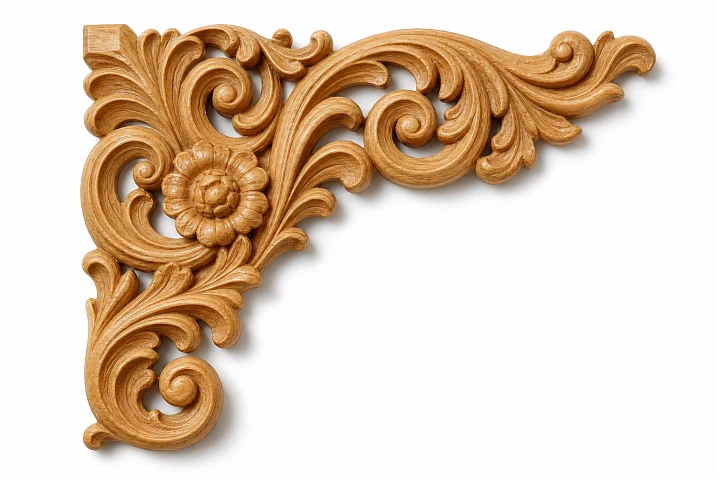
In the carved overlay card, it's easy to see the number 100 mm and decide that's exactly how much space is needed on the facade. For N-322L and N-322R, this is a dangerous simplification. Parameter A for the compact version is indeed 100 mm, but the overall length L is 153 mm. For the large version, A is 150 mm, and length L reaches 229 mm. If you order the decor based on one number, the overlay may extend beyond the panel, come too close to the handle, bump into the molding, or disrupt the symmetry of two doors.
N-322L and N-322R are mirrored carved overlays with separate product cards. Each side is available in two sizes, made of beech or oak, with Standard and Prestige sanding options. The buyer needs to coordinate not only the left and right direction but also four drawing parameters: A, B, C, and L. It is the full length L together with the transverse dimension B that forms the rectangle that should be fitted to the free field of the facade.
The compact version occupies a dimensional field of 128 × 153 mm, the large one 191 × 229 mm. The area of these rectangles is 19,584 and 43,739 mm² respectively. The large version occupies approximately 2.23 times more surface area, although parameter A increases only from 100 to 150 mm. This is not the area of the carving itself, but a practical way to compare the scale of parts before purchase.
The article helps read the drawing, make templates at 1:1 scale, determine the ornament direction, compile a specification, and order separately left carved overlay N-322L и right carved overlay N-322R. This order protects against three typical mistakes: mistaking A for the full length, buying two identical sides, and choosing different sizes for a mirror pair.
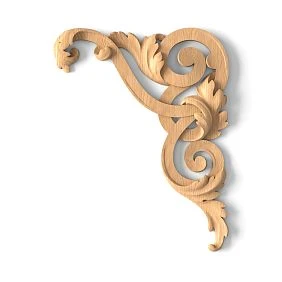
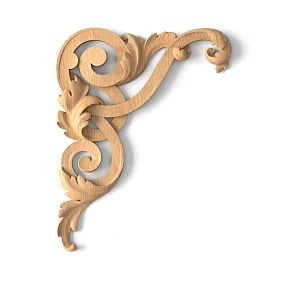
Why the inscription "100 mm" can lead to an error
The number in the name or brief modification selection is often perceived as the main dimension. The buyer mentally marks 100 mm on the facade, sees free space, and adds the item to the cart. After receiving, it turns out the ornament is longer: its actual edge is at the 153 mm mark. The difference of 53 mm is significant for a small panel. It can completely consume the side margin, fall into the handle area, or extend beyond the inner frame.
The same logic applies to the large version. Parameter A equals 150 mm, but the full length L is 229 mm. You cannot assume the large part is only 50 mm longer than the compact one. The length difference is 76 mm, width B is 63 mm, thickness C is 4 mm, and the overall footprint increases more than twofold.
The correct entry for a project should include all four dimensions. Instead of "N-322, 100 mm," write "N-322L or N-322R, A 100, B 128, C 11, L 153 mm." For the large version: "A 150, B 191, C 15, L 229 mm." This notation is clear to the designer, customer, manager, finisher, and installer.




How to read the designations A, B, C, and L
A is one of the dimensional parameters of the version. It helps distinguish between compact and large modifications but is not the full length. B is the transverse dimension, forming the second side of the rectangle. C is the maximum thickness or depth of the relief. L is the full overall length from extreme point to extreme point.
For the facade layout, B and L become key because they show which rectangle needs to be freed for decor. C is checked separately: the relief should not interfere with the handle, adjacent door leaf, slope, mirror, or other protruding element. A is kept in the specification to accurately select the modification in the card.
The four letters should be perceived as one system. If only A is written out, the project loses the actual length. If C is forgotten, a conflict with opening may occur. If B is not checked, the overlay may not fit into the panel width.
| Designation | What does it mean | How to use |
|---|---|---|
| A | Dimension parameter of execution | Select modification 100 or 150 mm, but do not consider it as the full length |
| B | Transverse dimension | Build the template width and check the facade field |
| C | Maximum thickness or depth of relief | Check the protrusion, handles, opening, and adjacent elements |
| L | Full overall length | Build the actual template length and check the fit |
Our factory also produces:




Exact dimensions of two versions N-322L and N-322R
Left and right overlays have the same dimensional system. The ornament direction differs, not the set of dimensions. For a mirror pair, you need to select the same modification for A, B, C, and L.
The compact version is suitable for checking on small panels, narrow doors, on the sides of handles or mirrors. The large one is designed for a more open field, but it cannot be assigned just because the cabinet or panel looks large. The final decision is made using a full-size template.
The size table must be included in the working drawing and in the order. It is also used during acceptance: the total length and transverse dimension are checked with a ruler, not just the modification designation.
| Execution | A | B | C | Total length L | Overall rectangle |
|---|---|---|---|---|---|
| Compact | 100 мм | 128 мм | 11 мм | 153 мм | 128 × 153 mm |
| Large | 150 мм | 191 мм | 15 мм | 229 мм | 191 × 229 mm |
Get Consultation
Overall rectangle — honest first fitting
For the first template, it is not necessary to reproduce the entire thread contour. It is enough to cut a rectangle of 128 × 153 mm for the compact version and 191 × 229 mm for the large one. These shapes will show whether there is enough space inside the frame, between the handle and the edge, near the molding, and on the hinge side.
The rectangle is deliberately stricter than the actual silhouette. There are voids inside the thread, but the extreme points still occupy the stated dimensions. If the rectangle does not fit, the real overlay will not fit either. If it fits, the next step is to make a more precise contour template.
On the template, mark the article number, side, A/B/C/L, top and bottom. Without markings, two mirrored paper silhouettes can easily be confused, especially after several rearrangements on the facade.
Why the large version takes up approximately 2.23 times more area
The compact rectangle 128 × 153 mm has an area of 19,584 mm². The large one 191 × 229 mm has 43,739 mm². Dividing the second value by the first gives approximately 2.23. This is not the area of the thread itself nor a calculation of wood consumption, but a comparison of the external bounding rectangles.
The practical meaning of the calculation is that parameter A increased by 50 percent, but the visual presence of the detail on the facade increases much more. The large version is taller, longer, and thicker. It requires more free background and a greater viewing distance.
Therefore, the formulation "let's take 150 mm instead of 100 mm, the difference is small" is erroneous. On a narrow door, the large decor can approach the frame, cover the calm plane, and become heavier than the handle.
Template at 1:1 scale
A full-size template translates the drawing into real furniture. It can be made from paper, cardboard, or thick film. The main thing is to disable automatic scaling when printing and check the dimensions with a ruler after printing.
For the compact version, build a rectangle of 128 × 153 mm, for the large one — 191 × 229 mm. If the product contour is available, place it inside the exact dimensions. Print the left and right sides separately, without accidentally mirroring the file in the printer settings.
The template is fixed with masking tape, the facade is closed and opened, the handle, adjacent sash and hinge side are checked. After that, step back to a normal distance and photograph the composition.
Why the template should be viewed from a distance
Up close, the eye reads leaves, curls, and edges. From a distance, the overlay turns into a silhouette and a relief spot. A compact option may fit perfectly in size but get lost on a wide cabinet. A large one may look expressive next to the facade and too heavy from the doorway.
It should be evaluated from the points where the furniture is seen every day: from the entrance to the room, from the sofa, from the bed, from the hallway. For a wall panel, a side angle is added because thickness C forms a shadow.
Photos of two options side by side help make a decision more calmly. They are taken under the same lighting and from the same point so that the scale is compared, not a random camera angle.
The free field of the facade is not the entire door
The overall size of the door is not equal to the available field. Inside there may be a panel, frame, molding, handle, lock, hinge, glass, mirror, and other overlays. You need to measure the space within which the ornament can be placed without conflicts.
First, mark the inner boundaries of the frame. Then apply the full contour of the handle, including the working area of the hand. Separately check the hinge side and the movement of the adjacent sash. After that, place the overall rectangle B × L in the remaining field.
A universal minimum offset in millimeters cannot be assigned. It depends on the frame, relief, furniture scale, and overall composition. The correct offset is determined by the layout: there should be background left around the carving.
Thickness C, which should not be forgotten
The compact version has a maximum thickness or relief depth of 11 mm, the large one — 15 mm. On a flat drawing, the difference seems small, but on furniture it affects the shadow, tactility, and interaction with handles.
If the overlay is located near the grip zone, the protrusion should not interfere with the hand. On two doors, it is necessary to check whether the reliefs come closer when opening. On a wall panel, the thickness affects the side view and lighting.
After choosing a flat template, it is useful to make a three-dimensional mockup: add an 11 or 15 mm spacer to the cardboard. It will show the real interaction with the hardware.
Two sides with separate cards
The letters L and R denote mirror directions. Left and right parts should not be automatically perceived as one product set. Each has a separate card, a separate size selection, and its own position in the order.
For a paired facade, usually one N-322L and one N-322R of the same finish, material, and sanding level are needed. But the quantity depends on the layout. On four corners, a different combination may be required if the patterns are directed asymmetrically.
Before placing an order in the cart, open both cards and check the parameters. The price, availability, and selected modifications are checked separately for each side.
How not to confuse the left and right side
You cannot determine the side only by which door the part is on. A left overlay can be placed on the right part of the composition if the ornament should diverge from the center. First, choose the direction of the pattern, then assign the article to a specific location.
On paper templates, they write not just L and R, but the full purpose: "left door, pattern towards center", "right door, pattern towards center" or "top left corner, pattern outward". Such a record eliminates ambiguity.
Before ordering, templates are photographed on the facade. The photograph is included in the specification along with the article numbers. Upon receipt, the parts are laid out according to the approved scheme.
Ornament towards the center or from the center
On a two-door facade, ornaments can be directed towards each other or from the central axis to the outer edges. Both solutions are possible but create a different impression.
A pattern towards the center draws the eye around handles, locks, or the joint. A pattern outward expands the composition and can connect the doors with side pilasters or a frame.
Choosing the direction from small images in the card is inconvenient. Two mirror templates at a 1:1 scale show the result directly on the furniture.
N-322L/R on a two-door wardrobe
On two doors, first mark the overall central axis of the wardrobe, then the axis of each door. Overlays can relate to the common center or to individual panels. These approaches cannot be mixed.
If parts work around a common joint, distances from the center must be equal. If each overlay relates to its own panel, its position is calculated within that frame. Handles are checked in both open and closed states.
Compact and large templates are placed simultaneously on both doors. One small and one large overlay do not form a mirror pair.
One overlay, a pair, or four parts
A single N-322 can work as a corner accent on an asymmetrical facade, panel, door, or dresser. In this case, the absence of a second side should be part of the composition, not a result of forgetfulness.
A mirror pair is suitable for two doors, sides of a central panel, spaces on either side of a handle, mirror, or vertical molding. Four pieces are used to decorate the corners of a rectangular field, but the exact number of L/R is determined by the direction of each ornament.
You cannot automatically order four items of the same article. A paper diagram must show where L and R are needed. For several identical facades, the quantity is multiplied after approving one reference layout.
Compact version A 100 mm
The 128 × 153 × 11 mm version becomes the first candidate for a narrow panel, small door, dresser drawer, side area near a handle, or a small wall field. This is a practical starting point, not a rigid limitation.
It leaves more background around the carving and protrudes less above the surface. On a wide cabinet, this size may get lost, especially if the frame is massive or large hardware is nearby.
The template should show whether the ornament is readable from a normal distance. If the compact piece looks like a random dot, check the large one, but only if there is enough free space.
Large version A 150 mm
The large version has dimensions of 191 × 229 × 15 mm. It is designed for a more noticeable presence, deep shadow, and greater viewing distance. Such decor can work on a wide cabinet, large wall panel, door leaf, or large panel.
Size requires discipline. If the edge comes too close to the frame, handle, or adjacent element, the carving ceases to read as a complete form. The greater thickness enhances the shadow and may conflict with hardware.
A large option is not chosen based on the principle of "looking richer." It is chosen when the entire 191 × 229 mm rectangle fits and there is a calm background around it.
Can sizes be mixed in one project
In different items of the same collection, mixing is possible as a deliberate scaling. For example, large overlays work on a cabinet, compact ones on nightstands. The shape remains related, but the sizes are adjusted to the fields.
In one mirror pair, mixing finishes is not allowed. N-322L A 100 mm and N-322R A 150 mm differ in all dimensions and do not form symmetry. The same rule applies to the four corners of one field.
In the specification, each group of sizes is recorded separately. For a project with several items, a map is created: cabinet — 150 mm, nightstands — 100 mm, dresser — after template.
How not to hit the handle
The handle cannot be imagined only as a metal outline. There is a working hand zone around it. If the thread comes too close, the furniture becomes uncomfortable, and protruding edges receive constant touches.
On the template, the base of the handle and the grip trajectory are marked. Then the palm is applied and opening is simulated. For two doors, both sides are checked because the user's habit may differ.
If the large version interferes, switch to a compact one or change the placement. Do not expect that trimming the finished ornament will solve the problem.
How not to hit the frame and molding
The inner frame creates a border for the composition. The overlay must be inside it, unless the project intentionally requires crossing. The edge of the carving, almost touching the molding, looks cramped.
A rectangular template checks extreme points, a contour template checks the nature of free gaps. In corner placement, it's important to evaluate two directions simultaneously: horizontally and vertically.
If N-322 is used with other overlays, maintain hierarchy. The main motif, frame, and handle should not compete for the same field.
Hinge side and opening
On a closed facade, the overlay may look safe, but when opening, it can approach the side panel, wall, or adjacent door. A thickness of 11 or 15 mm makes this check mandatory.
After selecting a flat layout, use a 3D sample and open the door to the full working angle. For new furniture, perform the check in the drawing and on a test sample.
If movement causes a conflict, change the size, position, or model. Installation should not create a hidden operational problem.
Beech or oak
N-322L and N-322R are available in beech or oak. The wood species is chosen for both sides at once. Under transparent or semi-transparent finishes, mixing is especially noticeable: the texture and grain of the wood will not become identical after staining.
Beech is often considered for opaque enamel, where the shape of the carving plays the main role. Oak is chosen when you need to preserve visible texture and tie the overlays to oak facades, frames, or other details.
This is not a universal rule. You need to make a test sample on the selected wood species and check compatibility with the facade base.
Standard or Prestige
The Standard and Prestige options refer to the quality of the grinding. For a paired carving, the choice must be the same for N-322L and N-322R. Different levels of preparation may become apparent after finishing, especially under side lighting.
The more transparent the coating and the closer the overlays are to eye level, the more noticeable the surface condition. Preparation is also needed under dense enamel because paint does not correct geometry and can emphasize unevenness.
Before ordering, check the available option in both product cards and record it in the specification. You cannot rely on two separate items being automatically combined into one processing level.
How to order both sides without color mismatch
Color mismatch occurs not only due to paint. The result is influenced by wood species, natural grain, batch, grinding, primer, application method, and drying conditions. For a mirror pair, all controllable parameters must match.
It is better to order N-322L and N-322R simultaneously, choose one size, one wood species, and one grinding level, and indicate in the comment that the parts work as a pair on the same facade. This does not guarantee absolute identity of natural wood but helps to correctly assemble the project.
It is advisable to paint the pair in the same technological cycle. The test color sample is approved before the main work; after finishing, the parts are again arranged mirror-wise.
What to record in the specification
The entry "N-322, two pieces" is insufficient. It does not define the sides, size, material, grinding, and installation location. Each product card receives a separate line.
For a compact pair, record: N-322L — 100 × 128 × 11 × 153 mm, one piece, beech, Prestige, left door; N-322R — the same parameters, one piece, beech, Prestige, right door.
If large parts are used, all four values change. The quantity for repeating facades is multiplied after the reference pair is approved.
Why the word "set" requires caution
In the project, N-322L and N-322R can form a set by meaning because they work together on the same facade. But commercially, these are two separate listings. It cannot be promised that one item automatically includes both sides.
In the order, it is better to write "mirror pair of two separate items", then list N-322L and N-322R. This approach eliminates the situation where the buyer adds only one listing and expects to receive two parts.
Price, availability, and selected modifications are checked separately for each side.
N-322 on buffet and display cabinet doors
A buffet often combines glass, frames, handles, and solid panels. N-322 can work in the corners of the panel, on the sides of the handle, or next to a glass insert. The first candidate is usually a compact template because the free fields are divided by many parts.
The large version is checked on a wide lower door or common panel. The thickness of the relief should not conflict with opening and glass maintenance. If the overlay is located close to the transparent insert, the reflection and shadow under internal lighting are evaluated.
For a symmetrical display cabinet, it is important to distribute L and R across the entire composition, rather than considering each door separately. The same height, one size, and consistent finish make the row calm.
N-322 on a dresser
On a chest of drawers, overlays can decorate the upper corners of a wide drawer, side fields, or the central panel. Handles are usually close by, so the hand's working area becomes the main limitation. The paper template should include not only the outline of the hardware but also the movement of the palm.
If there are several drawers, it is not necessary to repeat the carving on each one. One mirrored pair on the upper wide facade can create an accent without overloading. When repeating on all drawers, a single template is used and the vertical rhythm is checked.
Compact and large versions can be used on different items in a collection, but not in the same mirrored pair. A chest of drawers, nightstands, and a cabinet are linked by the same wood species, identical sanding, and coordinated finish.
N-322 on the wall panel
On the wall, there is more free space, but this does not eliminate the need for marking. Overlays can be placed on the sides of a mirror, decorative panel, sconce, or central molding. The full length L is checked relative to all adjacent objects.
The large version is more noticeable when viewed from a distance. A thickness of 15 mm creates a more pronounced shadow, so side lighting can make the ornament more active than on a furniture facade. The L/R direction is chosen based on the overall axis of the room.
The method of attachment depends on the base and finish. A universal adhesive cannot be assigned without checking compatibility with the wood, wall, primer, and coating. Before installation, a test joint is created on a technological sample.
N-322 on the sides of the mirror
The mirror enhances symmetry: any difference in height, size, or direction is immediately doubled by the reflection. Therefore, first mark the central axis of the mirror, then the identical offsets, and only after that assign N-322L and N-322R.
The compact template is suitable for a narrow frame or a small mirror field. The large one requires more background. The edge of the overlay should not extend onto the reflective surface unless specified by the design, and should not interfere with the mirror's attachment.
The finish is checked near the frame. Oak texture can support a wooden frame, while beech under enamel can blend with a painted panel. The decision is confirmed with a sample.
N-322 on the door leaf
On the door, you need to consider not only the pattern but also the operation. The overlay should not interfere with the handle, lock, casing, or the movement of the leaf. On the hinge side, check the gap to the frame and wall.
Paired parts can be located in the upper corners of the panel or on the sides of the central axis. The template is applied to the closed door, then the door is fully opened. A thickness of 11 or 15 mm is simulated with a volumetric spacer.
If the door has a complex frame, measure the inner field, not the overall dimension of the leaf. For double doors, check the common axis and the same direction of the ornament.
N-322 for furniture restoration
During restoration, the free field is already set by the existing furniture. You cannot change the frame, handles, and proportions as freely as in a new project. Therefore, the template becomes the main tool for selection.
Before purchasing, check the condition of the base. The overlay should not hide a structural crack or replace repairs. First, restore the facade, then plan the decorative composition.
The wood species and finish are coordinated with the existing surface. Sometimes opaque paint simplifies the combination, but the decision is confirmed with a test on a separate sample and compared with the furniture under real lighting.
N-322 for custom-made new furniture
In the new project, the facade dimensions can be coordinated with the decor in advance. This does not mean that the overlay is chosen after the drawing is completed. On the contrary, the dimensions B × L are entered into the furniture documentation before the frames are produced and the handles are installed.
The designer creates two schemes: compact and large. The constructor checks the opening, the seating surface, and the thickness C. The client approves the scale based on the visualization and template.
Thus, N-322 becomes part of the facade architecture, rather than an addition that has to find a random free space after furniture assembly.
How to use wooden overlays on the facade
For a broader overview of compositions, you can study the material how to use wooden overlays on the facade. It helps to understand how the carving interacts with frames, moldings, handles, and the overall style of the furniture.
The task of N-322 is already more specific: the buyer must read A/B/C/L, select mirror sides, and check the templates. The general guide does not replace the product drawing, but helps to decide whether an angular paired composition is needed at all.
First, the type of decor is chosen, then the specific model, and only after that the size. If the direction of N-322 does not match the facade, it is better to change the form rather than randomly rotate the ornament.
What types of decor are suitable for furniture facades
If N-322 does not fit or the direction does not match the composition, it is worth opening the material what types of decor are suitable for furniture facades. A narrow vertical field, a round center, a long horizontal belt, and a corner area require different solutions.
N-322 should not be forced to serve as a central rosette or a long frieze. Its strength is a mirrored directional ornament that works in pairs, singly, or in corners.
A proper replacement preserves the scale and material but changes the shape to fit the actual field. This is better than trimming ready-made carving and disrupting the pattern.
How to choose the scale of paired overlays
A separate material has been published on the website about how to choose the scale of paired overlays using other models as an example. It reveals the general difference between compact and large paired decor.
For N-322, the key question is different: parameter A is not equal to the full length L. Even a buyer who already understands the purpose of L and R must rebuild the rectangles 128 × 153 and 191 × 229 mm.
Related material is useful for the composition, and this one is for reading the drawing and precise ordering. The two intents should not be mixed.
What to buy together with N-322L and N-322R
The mirror pair does not exist separately from the facade, finishing, and installation. Materials for the template, preparation, finish, and fastening may be needed for purchase. The specific composition depends on the base and technology.
A wide selection of adjacent products is available in the category where you can Buy decorative furniture overlays. Other directions are collected in the section view wooden decor for furniture and interior.
There is no need to add random related products just for the sake of a set. Each item should solve a specific task: fitting, finishing, installation, or coordination of adjacent decor.
| What to add | Why | What to Check | Link |
|---|---|---|---|
| N-322L | Left side of the composition | Size, material, sanding, and quantity | N-322L size 100 × 128 × 11 × 153 mm |
| N-322R | Right mirror side | Same parameters as L | N-322R size 150 × 191 × 15 × 229 mm |
| Template material | Fitting B × L at 1:1 scale | Exact size after printing | Prepared according to the project |
| Finishing materials | Uniform color and wood protection | Compatibility with beech or oak | Select materials for installation and finishing of overlays |
| Mounting compound | Fixation on a specific base | Wood, facade, primer, and coating | Selected by a specialist |
| Other carved decor | Design of adjacent fields | Scale, style, and no overload | Catalog of carved wood decor |
Order decor layout for a complex facade
If the furniture has multiple doors, pilasters, frames, a mirror, and different groups of overlays, a self-made paper layout may not be enough. In this case, you can order a decor layout on the furniture facade.
A design project helps distribute sides, dimensions, and axes. It is especially useful for four corners, several identical cabinets, or a collection where compact and large N-322 are used on different items.
The project does not cancel checking the cards. The specification must still include N-322L and N-322R, full size A/B/C/L, material, sanding, and quantity.
How the surface of carved decor is prepared
General quality principles can be viewed on the page how the surface of carved decor is prepared. But the final finish depends on the wood species, color, coating system, and requirements of the specific facade.
Paired elements are inspected side by side. Differences that are almost imperceptible individually become obvious when placed mirror-wise. Before painting, check edges, recesses, protruding parts, and the consistency of the two sides.
If additional preparation is required, it is performed symmetrically, without changing the contour or erasing the fine relief. The finisher must preserve the distinction between protrusions and the background.
Installation without shifting the central axis
Before final fastening, find the axis of the facade or the selected panel. Then mark control points on the templates and transfer them to the surface. For two leaves, measure the height from one common baseline.
Temporarily secure the overlays in a safe way, close the doors, and check symmetry from a distance. Only after approval proceed to installation using a technology compatible with the base and finish.
The fastening method is not specified in the original scheme. A universal composition cannot be named. The master checks the material manufacturer's recommendations and performs a test connection.
Paint before or after installation
Both sequences are possible. Pre-finishing provides convenient access to the carving and allows comparing the mirror pair before gluing. Joint painting after installation helps unify the overlays with the facade in a single color.
The choice depends on the base, the finish system, and the quality of the joint. In any variant, N-322L and N-322R undergo the same technology. It is not allowed to paint the left and right parts with mismatched compositions without a control sample.
The thick layer should not fill the relief. A test coating shows how to preserve detail and achieve an even tone on the pair.
How to avoid flooding the relief with enamel
The carving is readable due to the difference in levels. If too much coating accumulates in the recesses, small details become soft, and the mirror finish loses its expressiveness. Correcting this after complete drying is difficult.
The finisher first works on a sample of the same wood species. They check the primer, viscosity, number of layers, and application method according to the technical recommendations of the chosen system. A universal recipe without material data cannot be given.
The left and right parts are painted in one cycle and compared under side lighting. If one side appears denser, the cause is eliminated before installation.
Acceptance of N-322L and N-322R
Upon receipt, one cannot limit oneself to the total quantity. First, the parts are separated by article numbers, then by size, material, and sanding. Compact and large versions are checked with a ruler and a list.
The mirror pair is laid out on the table in the approved orientation. The edges, relief, wood species, and absence of side mixing are checked. Before finishing, the condition is recorded with photographs.
If the order is intended for multiple facades, each pair receives an object code: cabinet 1, doors 1–2; chest of drawers 1; panel 2. This marking is maintained until final installation.
| Check | What to check | What error is prevented |
|---|---|---|
| Article number | N-322L and N-322R separately | Two identical sides instead of a pair |
| Size A/B/C/L | All four values | Mixing 100 and 150 mm |
| Material | Beech or oak | Different shade and different texture |
| Sanding | Standard or Prestige | Different preparation of mirror parts |
| Quantity | For each side and scheme | Missing part |
| Direction | With the approved template | Ornament rotation |
| Condition | Edges and relief | Late detection of damage |
Storage and marking before installation
Left and right sides are stored in pairs, but not stacked so that the reliefs press against each other. Each package receives the facade code, side, size, and material.
Marking is preserved after finishing on the hidden side of the package. Do not rely solely on the master's memory: mirrored elements may look similar, especially after monochrome painting.
Storage conditions are coordinated with the requirements for wooden products and the selected coating. Damage to the protruding relief before installation may disrupt the symmetry of the pair.
Errors when purchasing N-322L/R
The main mistake is to take A for the full length. But in practice, problems often accumulate: an incorrectly read size is combined with a mixed-up side, different wood species, and the absence of a template.
Every mistake is easier to fix before the basket than after finishing and installation. Therefore, the check follows a single sequence: full size, side, quantity, material, sanding, layout, fastening.
Below are not abstract risks, but situations that directly change the result on the facade.
Accept A 100 mm as the full length
The actual length L is 153 mm. On the facade, you need to build a rectangle 128 × 153 mm, otherwise the decor may extend beyond the field boundaries.
Accept A 150 mm as the full length
The large version has L 229 mm and a field of 191 × 229 mm. The difference from the compact version is much larger than it seems from parameter A.
Buy two N-322L
Two identical sides do not form a mirror pair. You need to open a separate card N-322R and check the same modification.
Select different sizes L and R
A 100 and A 150 differ in length, width, and thickness. For a pair, choose the same version.
Mix beech and oak
Under a transparent finish, the difference in texture will be noticeable. Even under enamel, the technique needs to be coordinated.
Order Standard and Prestige in one pair
Different preparation may show after finishing, especially with side lighting.
Ignore thickness C
A relief of 11 or 15 mm may interfere with the handle, door leaf, or adjacent surface.
Place the large version on a narrow panel
A rectangle 191 × 229 mm must fit completely with free background.
Place the decor close to the handle
Need to leave a hand working area and check opening in real motion.
Paint sides with different systems
The pair may differ in tone, gloss, and fill
When it's better to choose a different decor
N-322 is not suitable if the field is too narrow even for 128 × 153 mm, if a round central motif, long horizontal belt, or vertical overlay is needed. Another shape is chosen when the handle occupies the entire work area.
Do not trim the finished ornament to fit it into the frame. Trimming disrupts the completeness of the pattern and mirroring. In the category, you can select a model of a different scale or direction.
If the large version does not fit and the compact one gets lost, the problem may be in the type of decor itself. It is better to change the composition than to choose between two unsuitable sizes.
How to place an order for STAVROS
The customer journey starts with the facade drawing. First, the free field, handles, frames, and hinge side are noted. Then templates of 128 × 153 and 191 × 229 mm are built, the L/R direction is assigned, and the size is selected.
After that, two separate cards are opened. In the N-322L card, the size, beech or oak, Standard or Prestige, price, and availability are checked. The same parameters are selected in the N-322R card. The quantity is specified according to the actual scheme.
For a complex object, the manager is given a table and a photo of the approved layout. Current order conditions are checked on the STAVROS website, without automatically transferring data from one side to the other.
Final cart check
Before payment, it is useful to read each line aloud. "N-322L, compact, beech, Prestige, one piece" and "N-322R, compact, beech, Prestige, one piece" sound like a complete pair. A record without a side or modification immediately reveals a gap.
Then the parameters are checked against the template photo. If the pattern on the layout is directed towards the center, the article numbers in the table must correspond to this position. For four corners, each position is checked separately.
The final check concerns dimensions: A 100 does not replace L 153, and A 150 does not replace L 229. All four values are kept in the order and working drawing.
How to calculate the quantity for a series of identical facades
First, one reference door or one mirror pair is approved. Until this point, the quantity cannot be multiplied: an error in direction or size will be repeated across the entire series. The reference layout must contain article numbers, dimensions A/B/C/L, axes, offsets, and pattern direction.
After approval, the number of identical facades is counted. If each requires one pair, the quantity of N-322L and N-322R matches the number of facades. If part of the furniture has an asymmetrical scheme or four corners, it is placed in a separate line.
It is useful to break down the list by rooms and items. This way, the kit for a cabinet is not mixed with overlays for a dresser, even if the size and material match. The reserve is discussed separately: a universal percentage without considering the project scale and conditions for repeat purchase cannot be assigned.
Matrix for four corners
Four corners seem like a simple task, but this is where the wrong ratio of L and R is most often ordered. One cannot assume that two left and two right parts are always needed. First, the ornament is laid out in each corner and the direction of the motif is checked.
On the diagram, the corners are labeled TL, TR, BL, and BR. Next to them, the article number, size, and direction are recorded. If the bottom pair should mirror the top pair, this is visible from the templates. If the pattern forms a circular motion, the distribution of sides may be different.
Only after filling the matrix is the cart formed. Such a table is more useful than a verbal comment "four identical corner overlays" because it preserves the actual orientation.
| Angle | Article | Size | Pattern direction | Note |
|---|---|---|---|---|
| Top left | Assign by template | 100 or 150 mm | To center or outward | Do not determine without layout |
| Top right | Assign mirror side | Same size | Match top left | Check axis |
| Bottom left | Assign by composition | Same size | Repeat or flip | Check handles and frame |
| Bottom right | Assign by composition | Same size | Closes the scheme | Compare with all corners |
Photo fixation of templates
A photo does not replace dimensions, but it records the approved composition. In the first shot, the facade should be fully visible; in the second, the overlays and handle should be shown close-up; in the third, a side angle simulating thickness C. For two doors, photos are taken in closed and open states.
It is useful to add a ruler or a sheet with size markings to the photo. This prevents the situation where a week later it is impossible to determine which template was approved: 128 × 153 or 191 × 229 mm.
Files are named by article and location: "cabinet-1_N-322L_A100" and "cabinet-1_N-322R_A100". Photos are sent to the manager, finisher, and installer along with the table.
Mirror pair passport
For a complex or serial project, a short pair passport is created. It combines information that is usually scattered between the cart, drawing, and correspondence. The passport is not a manufacturer's document but serves as an internal tool for the client and workshop.
It includes N-322L and N-322R, full size, material, sanding, color, facade code, direction, installation height, finishing method, and a photo of the templates. After receipt, package numbers and an acceptance mark are added.
Such a passport is especially useful if time passes between ordering, painting, and installation, or if different contractors perform the work. It reduces the risk that the right part ends up at another site or is painted using a different system.
Lighting and relief readability
Carving is perceived through light and shadow. A compact 11 mm relief under soft frontal lighting may appear calmer than on the card. A large 15 mm relief under side light becomes more noticeable and visually heavier.
The template does not fully convey the texture, so after choosing the size, it is useful to evaluate a wood sample or a photo of a similar relief under room lighting. Special attention is paid to illuminated display cases, wall panels near sconces, and facades opposite windows.
If light accentuates every unevenness, the quality of preparation and uniform sanding of the pair become even more important. The finish is approved not only under bright work light but also in the normal room mode.
Facade color and ornament scale
On a light solid facade, the shadow from N-322 can be the main way to read the pattern. On a dark or textured base, contrast decreases, and the compact version may get lost. This does not mean you should automatically choose the large one: first compare two templates and finish samples.
A contrasting overlay color makes the dimension visually larger. If oak carving remains natural on a painted facade, the 191 × 229 mm rectangle will be perceived more actively than the same part in a single enamel.
Size, wood species, and color cannot be chosen sequentially as independent decisions. They form a single composition that is checked before ordering.
Packaging after finishing
After painting, mirror sides cannot be stacked face to face without a protective layer. The protruding relief may imprint on the coating or damage the opposite part. Each overlay is packed separately and the pair code is preserved.
The external marking includes the article number, A/B/C/L, facade, and side. A printed photo of the template can be placed inside. This way the installer understands the purpose without opening all packages at once.
If multiple sizes are transported to the site, compact and large groups are physically separated. A single N-322 label without a full dimension line is insufficient.
Handover to installer
The installer receives not only two parts and a general request to place them symmetrically. They must get a baseline, center axis, offsets, code for each side, a photo of the layout, and coating information.
Before applying the mounting compound, the craftsman performs a dry fit. If the actual facade differs from the drawing, work stops until approval. It is not allowed to compensate for an error by shifting one side relative to the other.
After fixing, the view from a distance is checked, not just the tape measure readings. Accurate geometry and visual symmetry must match.
Control of several identical cabinets
In a series of cabinets, it is not enough to correctly design the first item. The template must be turned into a repeatable jig or marking map. All bodies are checked for actual dimensions: even a small difference in frames can change the offset.
The first cabinet is assembled as a reference and photographed. On the second, the height, direction, and working area of the handles are checked. After confirmation, proceed to the rest. This order is faster than correcting the entire series.
Overlays for each cabinet are paired before painting. If all items lie in a common group, natural wood differences and markings may be accidentally mixed.
What to check the day before placing the order
Final control is best done not immediately after long work on the layout. The next day, the composition is viewed with fresh eyes and the numbers are checked again. Often it is then that it is discovered that A 100 is recorded in the table, but L 153 is forgotten, or one card is left in a large modification.
Ten items are checked: article L, article R, same A, same B, same C, same L, one wood species, one sanding, correct quantity, and approved direction.
If at least one item is not confirmed, the cart is not placed. First, the specification and template are corrected.
What to check immediately after delivery
Packages are opened in a controlled area and compared against the manifest. Do not transfer parts to finishing until both sides and all dimensions are confirmed. A painted incorrect item is more difficult to return to the process.
Use a ruler to check B and L, visually check mirroring, material, and relief condition. Compact and large versions are laid out separately. Standard and Prestige are verified against the order.
After each part is accepted, a facade code is assigned and the pair is photographed again. This photo links the product shipment to future installation.
Commercial route without unnecessary operations
The buyer does not need to independently cut carved ornaments or assemble mirroring from random blanks. Ready-made N-322L and N-322R already have an agreed shape in two directions and two sizes. The main work shifts to precise selection, finishing, and installation.
The route looks like this: facade drawing, rectangles B × L, two templates, L/R assignment, wood species and sanding selection, two product cards, a common specification, and acceptance. Each step prevents a specific error.
This approach makes the purchase meaningful: the customer receives suitable ready-made carving, not an experiment with size after delivery.
FAQ: sizes, sides, and ordering N-322
Below are questions that arise between viewing the product card and placing an order for two mirrored items. The answers are based on confirmed dimensions and do not replace checking the current product configuration.
What is the overall size of N-322 with parameter A 100 mm?
The compact version has A 100 mm, B 128 mm, C 11 mm, and overall length L 153 mm.
What is the overall size of version A 150 mm?
The large version has A 150 mm, B 191 mm, C 15 mm, and overall length L 229 mm.
How does A differ from L?
A is one of the dimensional parameters of the modification. L is the overall length of the pad from extreme point to extreme point.
Why can't you rely only on 100 mm?
Because the actual length of the compact part is 153 mm, and it occupies a rectangle of 128 × 153 mm.
Are N-322L and N-322R sold as a set?
Left and right sides have separate listings. For a mirrored pair, both items need to be selected and checked individually.
Can I buy only N-322L?
Yes, if the project requires one left part. But asymmetric application must be planned in advance.
Can I buy only N-322R?
Yes, the right overlay is also a separate item.
How to unfold a pair on two doors?
Make two mirrored templates and compare the pattern to the center and from the center. After approval, sign each door.
Which option to choose for a narrow facade?
Start with a template of 128 × 153 mm. If it does not fit with free background, you need to choose another model.
How much larger is the large version?
Its bounding rectangle of 191 × 229 mm is approximately 2.23 times larger than the rectangle of 128 × 153 mm.
Can I mix A 100 and A 150 in one pair?
No. They differ in length, width, and thickness and do not form mirror symmetry.
Can I use different sizes on different items?
Yes, if each item has its own complete pattern. For example, large overlays on a cabinet and compact ones on nightstands.
What to choose under enamel — beech or oak?
Beech is often considered for opaque enamel, but the solution depends on the technology and base. A test sample is needed.
When to choose oak?
When it's important to preserve the wood texture and tie the decor with oak details.
What do Standard and Prestige mean?
These are sanding quality options. For a mirror pair, you should choose the same option.
How to check the size before ordering?
Cut out rectangles 128 × 153 and 191 × 229 mm, then make contour templates at a 1:1 scale.
How to check the thickness?
Add 11 or 15 mm of volume to the paper template and check the handle, opening, and adjacent surfaces.
Do I need to paint the overlays before installation?
The order depends on the technology. The main thing is to process both sides equally and approve a test sample.
How not to confuse article numbers upon receipt?
Arrange N-322L and N-322R according to the approved scheme, check the markings, dimensions, and layout photos.
How many parts are needed for four corners?
The quantity and sides are determined by the pattern of each corner. You cannot automatically order four identical parts.
Can the overlay be trimmed?
Not recommended: trimming disrupts the completed ornament and symmetry.
Which mounting adhesive to use?
The specific composition in the original scheme is not confirmed. It is selected based on the wood, base, primer, and topcoat.
Where can I see other overlays?
Other models are presented in the category of decorative overlays and the general section of carved decor STAVROS.
What should I send to the manager for an accurate order?
A table with N-322L and N-322R, full A/B/C/L, quantity, wood species, sanding, and a photo of templates on the facade.
Conclusion
For N-322L and N-322R, the number 100 or 150 mm does not indicate the full length. The compact overlay has A 100, B 128, C 11, and L 153 mm. The large one has A 150, B 191, C 15, and L 229 mm. A mistake in reading one letter can lead to purchasing decor that does not fit on the facade.
A reliable choice is built on four actions: write down all dimensions, make rectangles B × L, prepare mirror templates 1:1, and create separate items for N-322L and N-322R. The pair must match in size, wood species, and sanding, and the direction of the ornament is confirmed on the actual furniture.
STAVROS offers both sides in separate cards, so the buyer can assemble an accurate mirror composition. Before ordering, check the current parameters, price, and availability, and for a complex facade, attach a layout. One hundred millimeters is indeed not the full length; the full length is indicated by the letter L, and it should be the first to go on the template.





