










































































Article Contents:
- Why the price of one detail says nothing about the budget
- What makes up the price of stucco: the complete anatomy of a set
- Category one: linear elements
- Category two: piece decorative elements
- Category three: installation materials
- Category four: paint and painting
- Category five: allowance for trimming
- Polyurethane moldings: how to calculate the cost of a wall
- Step one: determine the number of frames and their sizes
- Step two: calculate the perimeter of each frame
- Step three: add allowance
- Step four: corner elements or miter cuts at 45°
- Step five: additional decor inside frames
- Example calculation for three frames on a wall
- What affects the price of moldings: from profile to relief
- Profile width
- Complexity of relief
- Length of a standard rod
- Polyurethane moldings price: how not to overpay and not save on the wrong things
- Decorative stucco: when one detail costs more than complex finishing
- Where it is especially profitable to buy decorative stucco
- How to buy decorative stucco without size mistakes
- Stucco decor: small elements that change the check and look
- Single stucco decor
- Paired decor (Left/Right or two identical)
- Central element for an accent wall
- Furniture decor
- Stucco decor price: what determines the cost of a single element
- Ceiling stucco: why the ceiling needs to be calculated separately
- Ceiling cornice: calculation by perimeter
- Ceiling rosette: single but important
- Ceiling contour: square or rectangle in the center of the ceiling
- How to calculate a ceiling budget completely
- Three budget levels: basic, accent, grand
- Level one: basic set
- Level two: accent set
- Level three: grand set
- Budget calculation mistakes: what people forget to buy
- Table: what affects the final price of molding
- How to calculate molding for specific areas: practical scenarios
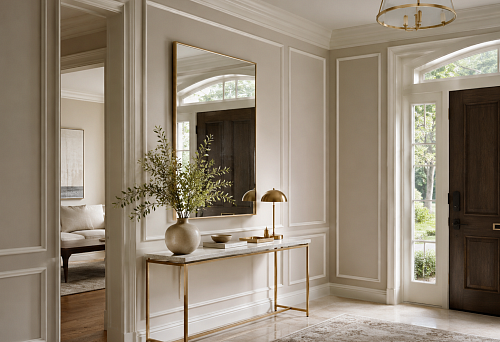
- Mirror in the hallway
- Wall Behind Bed in Bedroom
- Living room: wall behind the sofa with three frames and ceiling decor
- Hall: entrance area
- About the company
- Frequently Asked Questions
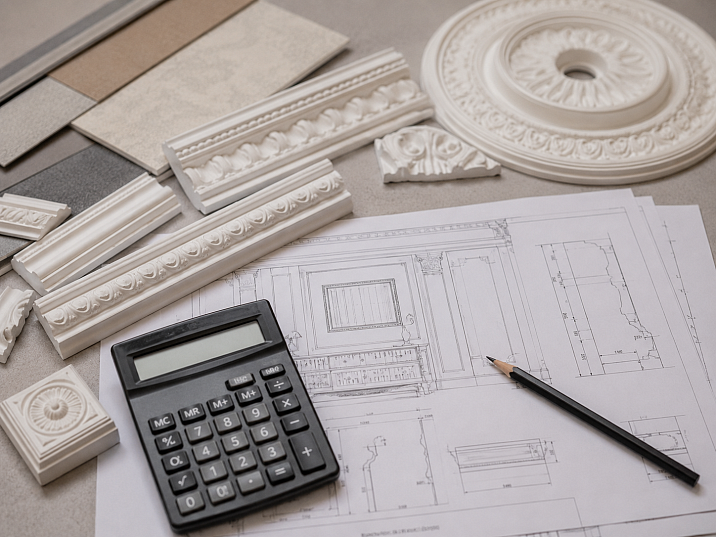
You look at the molding. The price is quite reasonable. It seems clear how much it will cost. You pick up a calculator, multiply by the length of the wall — and get an amount that suits you. Great. Only then it turns out that you also need glue. And extra for trimming. And corner pieces. And one decorative accent inside the frame — otherwise it's empty. And paint, because the molding needs to be painted. And a ceiling cornice, because without it the wall "hangs in the air." And a rosette for the chandelier.
The final amount turns out to be completely different — not because someone deceived you, but because Molding price — this is not the price of one part. This is the cost of a finished composition.
That's what this article is about. How to calculate correctly. How to form a budget not by an individual element, but by the task. How to understand what is actually included in the set for a wall, for a ceiling, for a mirror, for the entire room. And how not to end up in a situation where work has started, but the necessary parts are missing.
Buy molding correctly means buying everything you need at once, in one order, with an understanding of the final result. Let's break down how this is done.


Why the price of one part says nothing about the budget
Here's an honest example from practice. A person wants to decorate the wall behind the sofa with three molding frames. He sees molding at a reasonable price per meter and thinks he understands the cost of the task. But let's calculate it for real.
Three frames measuring 1.2 × 0.9 meters. The perimeter of each is 4.2 meters. Total molding — 12.6 meters. Plus a 15% allowance for trimming — about another 2 meters. Total molding — about 15 meters. This is no longer the small volume that was imagined at the beginning.
Next: corner pieces. Three frames with four corners each — 12 corner blocks. Installation glue — at least one tube per 3–4 linear meters, so 4–5 tubes. Acrylic putty for sealing joints. Primer. Paint.
If you decided to add decorative molding inside the central frame — that's another position. If you wanted Relief Decoration in the center — another one. If the wall is high enough and you decided to add a ceiling cornice — that's already Ceiling molding a separate line item.
See how the budget changes shape? That's not a reason to be scared. It's a reason to calculate wisely — in advance, before purchase, not during installation when something is already missing.
The cost of molding should be calculated not by one beautiful detail, but by the finished task: Moldings made of polyurethane create the base, Decorative stucco adds an accent, Ceiling molding completes the top, and glue, paint, and spare parts turn a set of items into a real interior result.




What makes up the price of molding: the complete anatomy of the set
Before counting money, you need to understand the structure. Any decorative scenario with molding consists of several expense categories. Missing any of them means getting an unfinished result or unexpected costs during the process.
Our factory also produces:


Category one: linear elements
These are all items sold by the linear meter or by pieces of a given length:
-
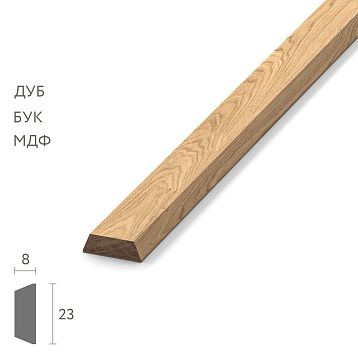
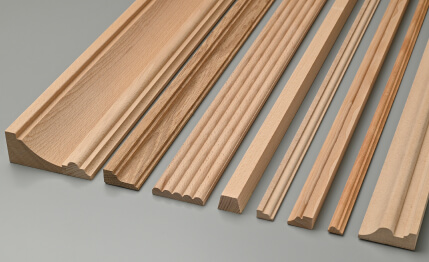
moldings for frames and borders;
-
ceiling cornices;
-
baseboards with relief;
-
friezes and rods.
For linear elements, the price is determined by three parameters: length, profile width, and relief complexity. The wider the profile and the richer the relief, the higher the price per linear meter. For calculation, you need to know the exact total length of all linear elements + a 15% margin.
Get Consultation
Category two: piece decorative elements
These are stucco overlays, medallions, cartouches, corner blocks, rosettes, paired decorative details.
Their price is influenced by:
-
physical size of the element (larger ones are more expensive);
-
depth and complexity of the relief;
-
availability of paired execution (L/R or two identical);
-
purpose (ceiling rosette, corner block for molding, central wall accent).
Important point: paired elements almost always cost more than single ones — these are two items in the order, not one. But it is they that provide the level of symmetry and completeness that distinguishes a professional interior from an amateur one.
Category three: installation materials
They are often not included in the initial estimate — and this is the main reason why the actual cost turns out to be higher than expected.
What is included:
-
mounting adhesive for polyurethane (consumption: 1 tube per 3–5 linear meters depending on the profile);
-
acrylic putty for filling joints and seams;
-
primer;
-
Painter's tape;
-
sandpaper for sanding.
Category four: paint and painting
All polyurethane products need painting after installation. This is both the final touch and protection from mechanical damage.
Paint consumption for moldings is approximately 100–150 ml per 2 linear meters when applied in one layer with a brush. For decorative elements — from 50 ml per piece. For an entire wall with moldings — count one small can of paint.
Category five: reserve for trimming
This is an item that is often ignored, and then people run to the store for extra meters. The rule is simple: always buy molding with a 15–20% reserve of the calculated length. Cutting at 45° always leaves leftovers. Mistakes during the first cut are a reality. An extra shelf or an unplanned corner is common.
You won't regret buying a reserve. But you will definitely regret it if you don't have it when needed.
Polyurethane moldings: how to calculate the cost of a wall
This is a key block for most tasks. A wall with molding frames is the most popular application. Let's break down the calculation in detail.
Step one: determine the number of frames and their sizes
This is the starting point. Decide: how many frames you want on the wall, what size they will be, how they are arranged — in a row, in two rows, at different heights.
Standard molding frame formats:
-
Small frame (up to 600 × 900 mm) — for the hallway, lower part of the wall, detail above a console.
-
Medium frame (600–1000 × 900–1400 mm) — universal format, living room, bedroom.
-
Large frame (from 1000 mm wide) — accent wall, study, hall.
Step two: calculate the perimeter of each frame
Perimeter = 2 × (width + height). For a frame 800 × 1200 mm, perimeter = 2 × (0.8 + 1.2) = 4 meters. For three such frames — 12 meters of molding.
Important: if frames are placed side by side and separated by a gap — count each frame separately. If frames form a double system (shared side), the perimeter is calculated differently.
Step three: add a reserve
+15% to the total length of molding. If the total is 12 meters — order 14 meters. This protects against trimming, errors, and unforeseen changes.
Step four: corner elements or 45° miter cuts
If you plan to make 45° miter cuts, no additional items are needed, but the molding allowance increases slightly. If you plan Decor for Molding to use corner blocks, count 4 corner elements per frame. Three frames = 12 corner blocks.
Corner blocks have a specific seating width that must exactly match the molding width. This needs to be checked when ordering.
Step five: additional decor inside the frames
If planning Decorative stucco inside the frames are separate items. For each frame, one central element or a pair of symmetrical ones. Here it is important to make a design decision before ordering: will there be decor in all frames or only in the central one, will it be single or paired.
Paired Relief Decoration looks more expensive but requires two items in the order. A single medallion in the center is one item, a more economical option.
Example calculation for three frames on a wall
| Position | Quantity | Note |
|---|---|---|
| Molding (linear meter) | 14–15 m | 12 m + 15–20% reserve |
| Corner blocks | 12 pcs | 4 corners × 3 frames |
| Central decor | 1–3 pcs | depends on design |
| Construction adhesive | 4–5 tubes | ~3 m/tube |
| Putty | 1 can | for joints |
| Paint | 0.5–1 L | Wall color |
Buy polyurethane moldings ordering together with corner elements in one order is the right strategy. You won't need to place a repeat order, wait for delivery, or interrupt installation.
What affects the price of moldings: from profile to relief
Not all moldings cost the same. The price difference between the simplest and the most elaborate profile can be quite significant. Let's break down what exactly creates this difference.
Profile width
This is the first and most obvious factor. A molding 20 mm wide and a molding 80 mm wide are fundamentally different products in terms of material volume. The wider it is, the more expensive it is — a direct relationship.
Which width to choose?
-
For delicate framing — 20–35 mm.
-
For a standard molding frame — 35–60 mm.
-
For a grand interior with high ceilings — 60–100 mm and more.
Complexity of relief
A smooth rectangular profile — minimum cost. A profile with a simple shelf and fillet — medium. A profile with acanthus leaves, egg-and-dart, rosettes along the length — higher. Complex relief requires a more precise shape and higher quality material processing.
It's important to understand: more complex relief works for certain styles in an interior. In a minimalist space, rich relief will be out of place, and there's no need to overpay for it. In a classic interior, a smooth profile looks poor.
Standard rod length
Most polyurethane moldings are produced in lengths of 2 or 2.5 meters. This is important for calculation: if the wall is 3.6 meters and the molding is 2 meters, you will have to make a joint, which means additional putty and precision in installation.
For large volumes of work, some suppliers provide products of non-standard lengths — check this point when ordering, as it can simplify installation.
Polyurethane moldings price: how not to overpay and not save on the wrong things
Saving on the width and relief of the molding is reasonable if the interior allows it. But saving on the quantity of molding by buying it tight without a reserve is not reasonable. Ordering an additional one or two meters separately always costs more than buying it with a reserve right away.
Decorative stucco: when one detail is more expensive than complex finishing
Here is a paradox that experienced decorators understand but rarely explain to clients. Sometimes one correctly chosen element decorative molding makes the interior more expensive than expensive continuous finishing.
Why does this happen? Because an expensive interior is not one where everything is covered with expensive materials. It is one where there is precision. An accent. Intention. The eye finds something specific, stops — and reads the level.
Expensive seamless plaster without a decorative accent looks like expensive plaster. Average plaster with a correctly chosen stucco accent above the console looks like a well-thought-out interior.
Where it is especially profitable to buy decorative stucco
Above the mirror. One small decorative element above the mirror is the difference between "a mirror on the wall" and "a mirror in a decor system." The element is small, but the effect is obvious.
In a molding frame. A central medallion or horizontal frieze inside the frame. Without it, the frame is just a rectangle. With it, it becomes a complete decorative panel.
Above the console. A console in the hallway or living room is already an accent. Decorative stucco above it turns a utilitarian object into an interior group.
Near the sconce. A sconce as a light fixture gives light. A sconce with a decorative element nearby creates an atmosphere.
On furniture facades. Decorative overlays on cabinet fronts, nightstands, door panels are one of the most economical ways to elevate the level of furniture.
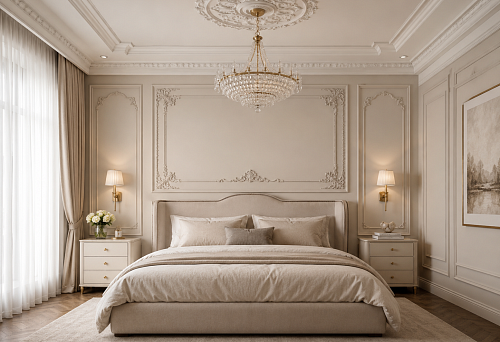
In the bedroom above the headboard. A headboard with a molding frame + a stucco accent above the center = an accent wall at the level of custom design.
In the hallway. A small decor above the mirror or next to the coat rack is a detailed solution that is noticeable at first glance in the hallway.
How buy decorative moldings without errors in size
The main mistake when buying decorative overlays is the wrong scale. An element that is too small gets lost. One that is too large conflicts with the frame or furniture.
Size selection rule:
-
For a frame 600 × 900 mm — decorative element no more than 200 mm on the longer side.
-
For a frame 900 × 1300 mm — up to 300 mm.
-
For a frame from 1000 × 1500 mm — up to 400 mm.
-
For decor above the mirror — element width no more than 40% of the mirror width.
These proportions are approximate. The best method is to make a paper template of the actual size and hold it against the wall. Five minutes of work with scissors and tape will save you from a possible ordering mistake.
Molded decor: small elements that change the check and the look
Relief Decoration — is a broad concept that includes different types of products with different usage logic and different prices. Let's break it down by category.
Single molded decor
One element — symmetrical, without a pair. Suitable for central placement: in the center of the frame, in the center of the wall, in the center of the upper part of the mirror.
Single decor is the minimum cost in the category. One item per order. Mounted with a single point application of glue.
Paired decor (Left/Right or two identical)
Two elements — symmetrical or mirrored. This is a fundamentally different visual result: symmetry reads as a deliberate solution, not a coincidence.
Paired Buy Molded Decoration — these are two items in the order. The total cost is higher than a single one, but the visual effect is incomparable. Paired elements create a "frame within a frame," set an axis, and give the space a sense of rhythm.
Paired decor is used:
-
on the sides of the mirror;
-
on the sides of the sconce;
-
in the lower corners of the molding frame;
-
on the sides of the console;
-
as an accent on a symmetrical wall.
Central element for an accent wall
A large stucco medallion, cartouche, or horizontal frieze for placement in the center of an accent wall, above a sofa, above a bed. These are larger elements — and accordingly a higher price per piece. But this is one detail that solves the entire wall.
Furniture decor
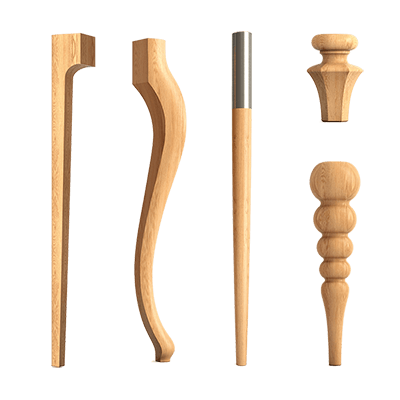
Overlay elements for furniture facades, door panels, cabinets. Typically small in size — from 50 to 150 mm. The price of one piece is minimal, but several may be needed: for example, one for each kitchen cabinet facade.
Stucco decor price: what determines the cost of a single piece
-
Size — direct dependency: larger element — higher price.
-
Relief depth — flat ornament is cheaper, three-dimensional stucco with undercutting is more expensive.
-
Pairing — a single piece is always cheaper than a paired one.
-
Material — solid extruded high-density polyurethane costs more than soft PU, but lasts incomparably longer.
Ceiling stucco: why the ceiling should be calculated separately
Here's another budget line that is often overlooked. The ceiling is a separate area that requires separate planning. And a separate estimate.
If the interior is rich enough with moldings and wall decor, the room will look unfinished without ceiling decoration. Richly decorated walls and a bare ceiling are like a suit without a jacket.
Ceiling molding comes in several types, each with its own pricing logic.
Ceiling cornice: calculation by perimeter
The ceiling cornice is mounted along the perimeter of the room at the junction of the wall and ceiling. This is a linear element — calculated in linear meters.
How to calculate:
-
Calculate the perimeter of the room: (length + width) × 2.
-
For a room 4 × 5 meters: (4 + 5) × 2 = 18 meters.
-
Add a 15% margin — total about 21 meters.
-
Consider the corners: internal and external corners of the cornice are cut or solved with corner inserts.
The width of the ceiling cornice ranges from 30 to 150 mm. A wider cornice looks richer, but with low ceilings (up to 2.6 meters) it can feel oppressive. For low ceilings — up to 60 mm.
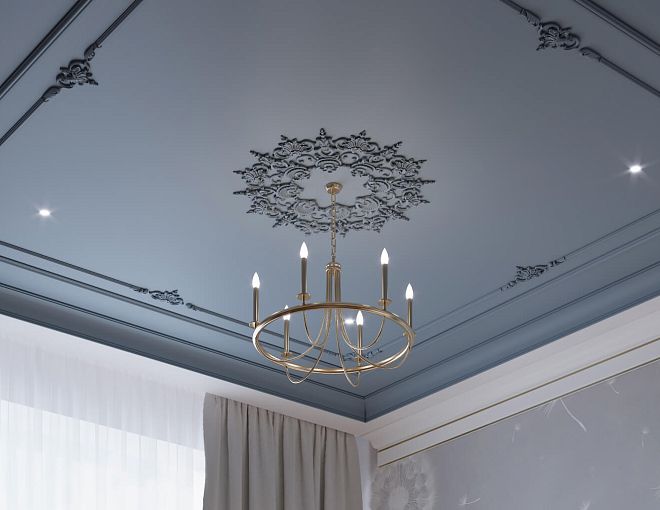
Ceiling rosette: single but important
A ceiling rosette is a decorative frame for the chandelier mounting point. It is not measured by meters — it is a single piece. But its choice is critically important for the result.
The size of the rosette should match the diameter of the chandelier: approximately equal to it or slightly larger. Typical sizes range from 200 to 700 mm in diameter.
Ceiling stucco price of the rosette depends on its diameter and the complexity of the relief. A small rosette 200–300 mm — minimal budget. A rosette 500–700 mm with rich ornamentation — significantly more expensive.
Ceiling contour: square or rectangle in the center of the ceiling
For high ceilings or formal rooms, a ceiling contour is often made — a decorative frame made of ceiling molding, set back 40–60 centimeters from the edges of the ceiling. Inside the contour is a rosette. Along the perimeter is a cornice.
This is a "three-level" ceiling without construction work: cornice along the perimeter + contour + rosette. Each item is counted separately.
How to calculate the full ceiling budget
| Element | How to count | Note |
|---|---|---|
| Cornice | Room perimeter + 15% | Linear calculation |
| Rosette | 1 piece | By chandelier diameter |
| Ceiling contour | Contour perimeter + 15% | If planned |
| Cornice corner inserts | 4 pieces per room | Internal corners |
| Glue | 1 tube per 4–5 m | PU assembly adhesive |
| Paint | 0.5–1 L | In the color of the ceiling |
Buy ceiling molding ordering the cornice, rosette, and corner inserts together in one order is the right strategy. The cornice and rosette should be from the same stylistic collection, otherwise the ceiling will look disjointed.
Three budget levels: basic, accent, grand
Now let's look at practical scenarios. Three budget levels for three different tasks.
Level one: basic set
Task: quickly improve the interior without major work. Suitable for rented housing, a temporary solution, or for areas that are not the main focus.
What is included:
-
Moldings made of polyurethane — simple profile 25–35 mm.
-
Mounting adhesive.
-
Paint in the color of the wall.
What you get: neat frames on the wall that create structure and make the space more organized. Works well in a children's room, hallway, or kitchen.
Calculation for one wall 3.5 × 2.8 meters with three frames:
-
Molding ~15 m.
-
Glue 4–5 tubes.
-
Paint ~0.5 L.
Level two: accent set
Task: create an expressive accent wall in the bedroom, living room, hallway. Suitable for primary housing where the result matters.
What is included:
-
Moldings made of polyurethane — profile 40–60 mm, possibly with relief.
-
Decor for Molding — corner blocks.
-
Decorative stucco — central accent in the main frame.
-
Glue, putty.
-
Paint.
What you get: a finished accent wall with architectural character. Noticeably enhances the interior's perceived level.
Level three: formal set
Task: create a fully decorated interior of a hall, study, living room, formal area. Commercial space or residential home with a claim to a representative level.
What is included:
-
Moldings made of polyurethane — wide profile from 60 mm, classic relief.
-
Decor for Molding — corner blocks with rich relief.
-
Decorative stucco — central and paired accents in frames.
-
Relief Decoration — accents above mirrors, consoles, near sconces.
-
Ceiling molding — cornice around the perimeter + rosette.
-
Glue, putty, spare, paint.
What results: an interior where each element supports the others. A decor system from baseboard to ceiling cornice.
Budget calculation mistakes: what they forget to buy
Let's break down typical mistakes that lead to having to stop installation and place an urgent additional order.
First mistake: they only count the molding, forgetting the glue. Glue is a consumable that needs to be sufficient. For 15 linear meters of molding — at least 5 tubes.
Second mistake: they don't count corner elements. Either they plan to cut at 45° and don't accurately calculate the waste volume, or they decide to take corner blocks but don't include them in the order.
Third mistake: they buy molding without a reserve. 10–15 extra meters of molding cost significantly less than an urgent reorder and waiting for delivery.
Fourth mistake: they forget about ceiling decor. The walls are decorated, but the ceiling is bare. It's noticeable. Buy ceiling stucco molding needs to be done simultaneously with wall moldings.
Fifth mistake: not enough paint. Paint applies easily to a polyurethane surface, but after puttying the joints, a second coat is needed. Paint reserve — 20–30% of the calculated volume.
Sixth mistake: they don't account for delivery of long items. Moldings 2–2.5 meters long are long cargo. Standard delivery services may not ship them. Check delivery conditions when ordering.
Table: what affects the final price of stucco
| What we buy | What affects the price | Category |
|---|---|---|
| Moldings | Length, width, relief, number of frames | Moldings made of polyurethane |
| Corner blocks | Landing width, relief complexity | Decor for Molding |
| Decorative stucco | Size, relief, single/pair | Decorative stucco |
| Stucco decor | Type, size, quantity | Relief Decoration |
| Ceiling cornice | Width, relief, perimeter length | Ceiling molding |
| Ceiling rosette | Diameter, relief complexity | Ceiling molding |
| Installation materials | Scope of work, length of moldings | Fixed percentage |
| full set | Zone, style, allowance, painting | Buy moldings |
How to calculate moldings for specific zones: practical scenarios
Mirror in the hallway
Mirror size: 600 × 900 mm.
What you need:
-
Molding — mirror perimeter + 5 cm indent on each side = (0.7 + 1.0) × 2 = 3.4 m + 15% = ~4 m.
-
Corner blocks — 4 pieces.
-
Decorative stucco above the mirror — 1 element.
-
Glue — 2 tubes.
-
Paint — 0.3 L.
Wall behind the bed in the bedroom
Wall size: 2.2 × 2.5 meters. One large frame with wallpaper inside and molding trim is planned.
What you need:
-
Molding — frame perimeter (2.2 + 2.5) × 2 = 9.4 m + 15% = ~11 m.
-
Corner blocks — 4 pieces.
-
Relief Decoration Above the frame — 1 element.
-
Glue — 3–4 tubes.
-
Paint — in the color of the wall.
Living room: wall behind the sofa with three frames and ceiling decor
Wall size: 3.6 × 2.8 meters. Three frames 0.9 × 1.4 meters.
What you need:
-
Molding — (0.9 + 1.4) × 2 × 3 = 13.8 m + 15% = ~16 m.
-
Corner blocks — 12 pieces.
-
Decorative stucco — 3 pieces (one in each frame).
-
Ceiling cornice — perimeter of the entire wall (3.6 m) + side walls, if the cornice runs along the perimeter of the room.
-
Glue — 6–7 tubes.
-
Paint — 1–1.5 L.
Hall: entrance area
Size: 4 × 4 meters, ceiling height 3.2 meters. Panel frames on walls + ceiling decor.
What you need:
-
Moldings made of polyurethane — calculation of frames + ceiling cornice along the perimeter (16 m + spare).
-
Corner blocks for frames.
-
Decorative stucco — central and paired.
-
Relief Decoration — accents at the mirror, sconces, console.
-
Ceiling molding — cornice + rosette.
-
Glue, putty, primer, paint.
About the Company
STAVROS — professional supplier of polyurethane decorative molding for residential and commercial properties. The STAVROS catalog features a full range of elements for any decorative tasks: Moldings made of polyurethane various profiles, Decorative stucco и Relief Decoration for accent zones, Ceiling molding for cornices and sockets, Decor for Molding — corner elements and inserts.
STAVROS helps calculate the amount of material for a specific task, select compatible elements from the same stylistic family, and form a complete order set. All STAVROS products are made of solid extruded polyurethane: moisture-resistant, durable, paintable, and easy to install. You can buy ready-made stucco matching the Baroque style. Calculate the quantity: linear meters of cornices and moldings, number of rosettes, pilasters, consoles, corner elements. Add a ten to fifteen percent allowance for trimming. At STAVROS, it means getting not just individual elements, but a comprehensive solution for your interior.
Frequently asked questions
How much does polyurethane molding cost?
Polyurethane molding price depends on the type of element. Moldings are priced per linear meter — the price depends on the width and profile relief. Decorative overlays are priced per piece, the price depends on the size and complexity of the relief. A ceiling rosette is a single item, the price depends on the diameter.
How to calculate the number of moldings for a wall?
Calculate the total perimeter of all frames you plan to make. Add 15–20% extra for trimming. This will be the required number of linear meters of molding. Don't forget corner elements: 4 pieces per frame.
Which is cheaper: moldings or decorative stucco?
Moldings made of polyurethane form the base — they are needed in larger quantities. Decorative stucco is purchased selectively, by the piece, but it provides the visual accent. Comparing them directly is incorrect — they serve different purposes.
Is a reserve of moldings needed?
Always. A 15–20% reserve is not wastefulness, but insurance against cutting errors, unforeseen changes, and possible reorders. Spare molding is cheap. Urgent delivery of one or two meters is expensive.
How to calculate the cost of ceiling decor?
Measure the perimeter of the room — this is the length of the cornice. Add 15% extra. One rosette — based on the diameter of your chandelier. If a ceiling contour is planned, add its perimeter. Four corner inserts for the cornice. Glue and paint are consumables.
What to buy to make the interior look more expensive without a big budget?
The most effective basic set: Moldings made of polyurethane an accent zone + one decorative element in the center of the main frame + painting everything in the wall color. These are three positions that give maximum effect for a minimal budget.
How to save on stucco without losing results?
Choose a simpler molding relief — it's cheaper, but when painted in the wall color, the difference is almost unnoticeable. Use one central decorative accent instead of several. Skip ceiling decor in less significant areas. Buy stucco cheaply and still get a good result — it's possible if you set priorities correctly.