










































































Article Contents:
- Bedroom and stucco: why special logic is needed here
- Three rules for stucco in the bedroom
- Bedroom zones: where to start choosing
- Wall behind the bed: the main accent of the bedroom
- Ceiling above the bed: vertical accent
- Sconces near the bed: bedside accents
- Mirror and vanity table: vertical zone
- Ceiling chandelier: center of the ceiling
- Moldings for the bedroom: the wall by the bed that speaks
- Which molding scheme to choose behind the bed
- How to calculate the frame size under the bed
- Molding width for the bedroom
- Color of moldings in the bedroom: the main choice
- What to buy together with moldings for the bedroom
- Ceiling rosette for the bedroom: a small detail with a big effect
- How to choose a rosette for the bedroom
- Rosette and chandelier in the bedroom: how to coordinate them
- When a ceiling cornice is needed in the bedroom
- Decorative stucco for the bedroom: one expressive element
- Above the headboard: central accent
- Decor in a molding frame
- Decor near the mirror
- Decor near the sconce: bedside side accents
- Corner overlays and molding decor: details that make a difference
- Corner rosettes in frames behind the bed
- Central inserts along moldings
- Stucco styles in the bedroom: how not to make a mistake
- Modern bedroom
- Neoclassical bedroom
- Provencal bedroom
- Minimalist bedroom
- Classic luxury bedroom
- Bedroom 10 sq m: how not to overload a small space
- What to do in a small bedroom
- What to do in a spacious bedroom
- Analysis of specific scenarios: what to buy for the task
- Scenario 1: Newlyweds, first apartment, standard bedroom 14 sq m
- Scenario 2: Bedroom with chandelier, bare ceiling
- Scenario 3: Bedroom with two sconces by the bed
- Scenario 4: Complete Classic Bedroom Finishing
- How to Properly Install Moldings in the Bedroom
- Wall preparation
- Cutting Moldings
- Installation
- Finishing
- Table: What to Buy for the Bedroom
- FAQ: Answers to Key Questions About Stucco in the Bedroom
- About the Company STAVROS
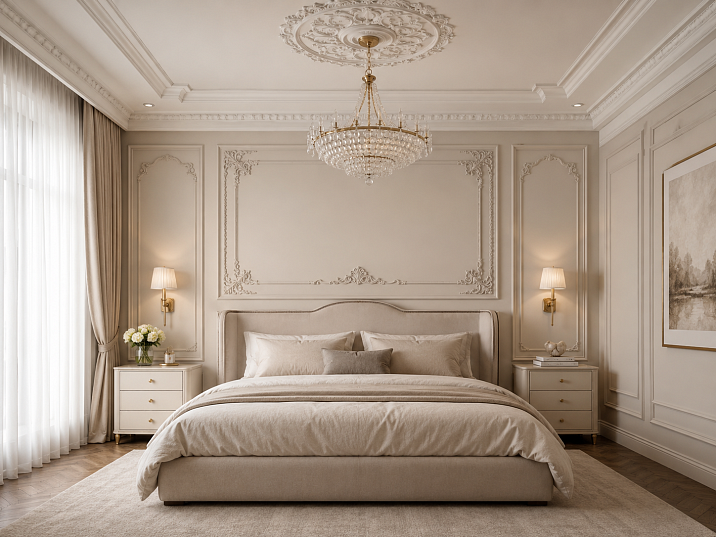
The bedroom is a special space. It doesn't need the formality of a living room or the businesslike feel of a study. What matters here is different: a sense of completeness, coziness, a consciously created space where you want to be. And it is here that stucco works with particular subtlety—it doesn't shout, but speaks in a half-whisper.
Many people think that stucco in the bedroom is something complicated and expensive. Plaster cornices, rich ornamentation, a designer project. In reality, it's simpler. A wall at the head of the bed, two moldings in a frame, calm painting in the color of the wall, a neat ceiling rosette under the chandelier—and the bedroom acquires that very finished look that is so hard to describe in words but is immediately felt.
Stucco for the Bedroom — it's not about the number of elements. It's about the precision of choice. One right accent in the right place—and the room becomes different. Better. More expensive. Calmer.
This article is a specific guide to selection. What to buy, where to place, how not to overload, and at the same time make it truly beautiful.



Bedroom and Stucco: Why Special Logic Is Needed Here
Before opening the catalog and choosing elements, it's important to understand how the bedroom differs from other rooms in terms of decor.
In the living room, stucco works for representativeness. In the hallway, for the first impression. In the study, for status. In the bedroom, the task is different: stucco should create a feeling of shelter, calm, and completeness. It shouldn't be noticeable—it should be appropriate.




Three Rules of Stucco for the Bedroom
Rule one: one accent, not five. In the bedroom, you don't need to decorate all four walls, the ceiling, and every corner. Choose one main area—the wall behind the bed, the ceiling above the chandelier, the mirror at the vanity table—and work with it. Let the rest remain neutral.
Rule two: moderate scale. Wide moldings, large medallions, heavy cornices are not for the bedroom. Moderate profiles work here: molding 30–50 mm, rosette 35–55 cm, decorative elements 20–35 cm. A scale proportionate to a person in a horizontal position—that's how the bedroom is perceived.
Rule three: color in tone. In the bedroom, moldings and decor are most often painted in the tone of the wall. This creates a delicate architectural effect—volume exists but doesn't shout. Contrasting white stucco on a colored wall is acceptable but requires caution. White in the bedroom can be too active.
Buy stucco for the bedroom means choosing with these three rules in mind. Then the result will be exactly as it should be: quiet, precise, and very beautiful.
Our factory also produces:


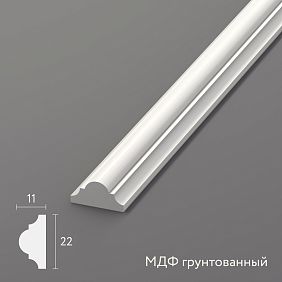


Bedroom Zones: Where to Start Choosing
The bedroom is a room with several decorative zones. Each requires its own approach. First, determine which zone is a priority for you — and only then proceed to selecting elements.
Get Consultation
Wall behind the bed: the main accent of the bedroom
This is the most obvious and the strongest zone. The wall behind the headboard is the first thing you see in the morning when you open your eyes. The first thing guests see when entering the bedroom.
If you only decorate one zone — this is it. Moldings behind the bed — this is a classic. Molding frames on the wall at the headboard create an architectural accent that visually completes the bed. This works especially well if the bed has a low or soft headboard — the moldings on the wall create the vertical axis that is missing.
Ceiling above the bed: vertical accent
When you lie in bed — you look up. The ceiling above the bed is what a person sees every night. If there is a beautiful rosette for a chandelier, a properly selected cornice, or at least a clean decorative axis — the bedroom feels complete even with your eyes closed.
Sconces by the bed: bedside accents
Two sconces on either side of the headboard — a bedroom classic. And these are not just light fixtures — they are an opportunity to create a decorative horizontal axis for the entire bedside area.
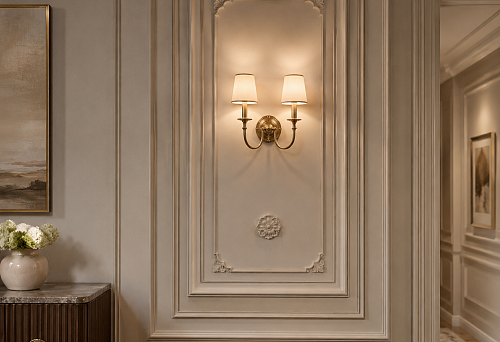
Moldings in a frame around each sconce, a decorative element above the headboard — and the bedside wall turns into a well-thought-out decorative panel.
Mirror and vanity table: vertical zone
The mirror at the vanity table is the third most important zone in the bedroom. A molding frame around the mirror or a decorative element above it is a small change with a big visual impact.
Ceiling chandelier: center of the ceiling
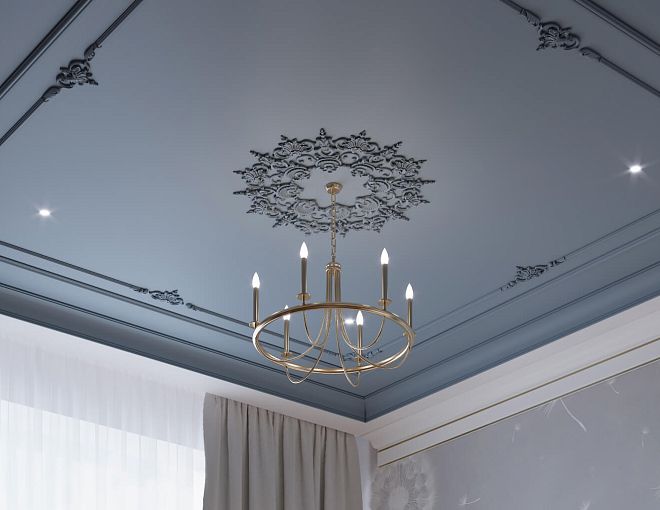
If there is a chandelier in the bedroom, a ceiling rosette turns it from a 'lighting fixture' into part of the interior. A properly selected ceiling rosette for the bedroom is one of the fastest and most effective purchases.
Moldings for the bedroom: the wall at the bed that speaks
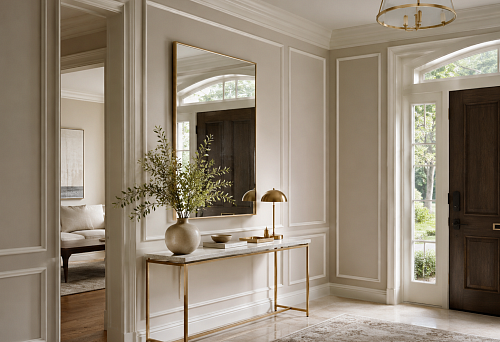
moldings for the bedroom is the main tool for designing the bedside area. Frames made of moldings on the wall at the headboard create what designers call the 'architectural background of the bed'.
What does this mean in practice? The bed is furniture. It stands against the wall. But the wall is just a plane. Moldings turn this plane into part of the interior: they create frames that visually frame the bed from above and on the sides, giving it an architectural context.
Which molding scheme to choose behind the bed
There are several schemes — the choice depends on the wall width, ceiling height, and bed size.
One wide frame in the center. A rectangular frame made of moldings, equal in width to the bed or slightly wider. The frame height is from the top edge of the headboard to a height of 70–90 cm above it. This is the simplest and cleanest scheme. The bed is visually "built into" the frame.
Three frames: one large central and two narrow side ones. The central frame is behind the headboard, matching the bed width. Two narrow vertical frames on the sides — from the floor to the frame height. A three-part scheme, classic and very balanced.
Two frames on the sides of the headboard. If the headboard itself is expressive — leather, framed, tall — the frames are placed not behind it, but on the sides. The headboard becomes the central element, the moldings become the side architectural context.
Vertical moldings from floor to ceiling. Two or three vertical molding elements behind the bed, running from floor to ceiling. These are not frames, but vertical accent columns. Modern, concise, works in minimalist bedrooms.
How to calculate the frame size for a bed
Basic proportions:
-
Frame width = bed (mattress) width + 10–15 cm on each side
-
Frame height = 60–90 cm (from the top of the headboard)
-
Bottom edge of the frame = level of the top edge of the headboard or slightly lower
-
For a 160 cm double bed → frame width 180–190 cm
If the ceiling is high (from 2.8 m) — the frame can be made higher: 100–120 cm. With a standard ceiling of 2.5–2.6 m — 60–80 cm.
Molding width for bedroom
In the bedroom — moderate profile width. Simple rule: in the bedroom, the molding should be 10–15% thinner than a similar molding in a living room of the same height.
Practical guidelines:
-
Ceiling 2.4–2.5 m → molding 25–35 mm
-
Ceiling 2.5–2.7 m → molding 30–45 mm
-
Ceiling 2.7–3.0 m → molding 40–55 mm
Molding wider than 60 mm in the bedroom is rare. It is only suitable for very high spaces or deliberately monumental classic interiors.
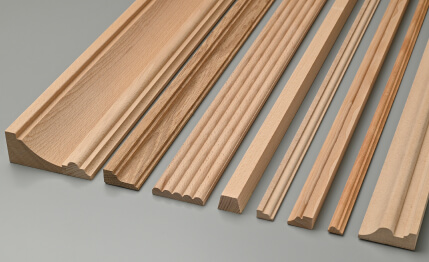
buy polyurethane moldings for the bedroom — means choosing a profile with a soft, calm relief. Smooth or with a moderate stepped profile. Not ornamental — ornament in the bedroom can be overly active, unless it is intentional classic style.
Color of moldings in the bedroom: the main choice
This solution defines the entire character of the decorative zone.
Matching the wall. Moldings are painted the same color as the wall. The frame is perceived through light and shadow — volume is present but unobtrusive. This is the most delicate, most "bedroom" option. Ideal for neutral walls (milky, gray-beige, light gray).
White on a neutral wall. If the walls are light but not white — white moldings provide a soft contrast. Classic and airy.
Slightly darker than the wall. Moldings 1–2 shades darker than the wall. Delicate contrast adding depth. Works well with light gray or sand-colored walls.
Metallic accent. Moldings in copper, gold, or bronze tones — for intentionally luxurious bedrooms. Requires coordination with hardware, lighting, and other metallic accents in the room.
Buy polyurethane moldings Made of polyurethane — primed and ready for painting. Polyurethane accepts any paint: acrylic, alkyd, water-based. This allows you to precisely match the desired shade and coordinate moldings with any wall.
What to buy in a set with moldings for the bedroom
-
Moldings made of polyurethane — footage for the perimeter of frames plus 15%
-
Acrylic mounting adhesive — 1 tube per 4–6 linear meters
-
Acrylic sealant — for joints at frame corners
-
Finish paint — the right shade
-
Painter's tape
-
Miter saw — for precise 45-degree cuts
Ceiling rosette for the bedroom: a small detail with a big impact
A ceiling rosette in the bedroom — a purchase often thought of last. But it shouldn't be. It's one of the fastest ways to transform the look of the ceiling.
A chandelier without a rosette is just a fixture hanging from the ceiling. A chandelier with the right rosette is part of the interior, connected to the ceiling by a decorative element. The difference in perception is huge.
How to choose a rosette for the bedroom
In the bedroom, the rosette should be more restrained than in the living room. Selection rules:
By size:
-
Bedroom 10–14 sq m → rosette 30–45 cm
-
Bedroom 14–18 sq m → rosette 40–55 cm
-
Bedroom 18–25 sq m → socket 50–65 cm
-
Bedroom from 25 sq m → socket 60–75 cm
By relief: for a bedroom, sockets with moderate relief work best — geometric, with soft floral patterns, with classic acanthus leaves. Complex baroque sockets with deep multi-tiered relief are only for deliberately formal bedrooms.
By color: the socket is painted the color of the ceiling — then it creates a delicate effect. Or white with a neutral ceiling. A contrasting colored socket is exotic, requiring a deliberate design decision.
Socket and chandelier in the bedroom: how to coordinate them
The diameter of the socket should be larger than the upper part of the chandelier. The socket 'frames' the connection point — it should be visible around the entire perimeter, not covered by the lampshade or chandelier base.
Socket shape — round for most cases. Square and rectangular sockets are appropriate for a square room or a deliberately geometric interior concept.
Ceiling Molding Purchase for a bedroom — means choosing a moderate, calm cornice profile and a socket of proportionate area. Nothing excessive.
When a ceiling cornice is needed in the bedroom
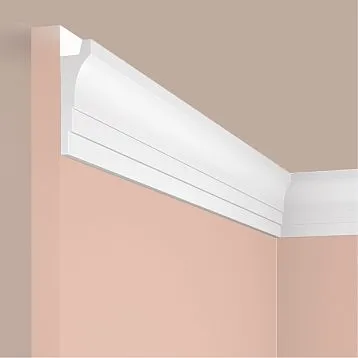
If there is no stretch ceiling in the bedroom and the joint between the wall and ceiling is exposed — a ceiling cornice completes the top of the room and creates a sense of completeness.
In the bedroom, the curtain rod is chosen smaller than in the living room:
-
Ceiling 2.5 m → rod 45–60 mm
-
Ceiling 2.7 m → rod 55–75 mm
-
Ceiling 3.0 m → rod 70–90 mm
The curtain rod in the bedroom is painted to match the wall or ceiling — creating a smooth, almost invisible transition between the two planes. It's not an accent, but a finish.
Decorative stucco for the bedroom: one expressive element
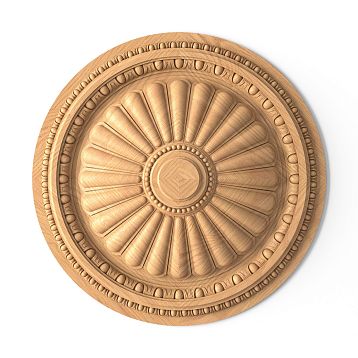
Decorative stucco for the bedroom — these are medallions, cartouches, ornamental overlays. Unlike moldings, which create structure, decorative stucco creates character — it puts the finishing touch on the decorative statement.
In the bedroom, the rule is one: one decorative element for the main area. Not three, not five. One — but properly chosen and precisely placed.
Above the headboard: central accent
A decorative element above the headboard is the most classic technique for a bedroom. A medallion or cartouche in the center of the wall, above the headboard — and the entire bedside area gains an axis around which everything is arranged.
How to choose the size:
-
Bed width 120–140 cm → element 25–35 cm
-
Bed width 140–160 cm → element 30–45 cm
-
Bed width 180–200 cm → element 40–55 cm
The element should be proportionate to the bed width. Too small — it will get lost. Too large — it will feel overwhelming.
Placement height: the center of the element — 20–30 cm above the top edge of the headboard. This is the point where the gaze naturally falls when looking at the bed from the doorway.
Decor in a molding frame
If there is a molding frame behind the bed, the decorative element is placed inside the frame, in the center. Frame + central accent = a complete decorative panel.
Element size — 30–40% of the frame width. With a frame width of 190 cm → element 55–75 cm.
buy decorative moldings For the center of the frame — choose an element that matches the style of the molding profile. Smooth moldings — a geometric or moderately decorative medallion. Moldings with a classic ornament — a medallion with a floral motif.
Decor near the mirror
If there is a mirror in the bedroom at the dressing table or on a separate wall — the decorative element above the mirror completes the vertical axis: table — mirror — decor.
A small cartouche above the mirror, a molding frame around the mirror — and the dressing table area gains completeness and coziness.
Decor near sconces: bedside side accents
Two sconces by the bed — an opportunity for a symmetrical decorative solution. Small overlays on each side of each sconce, or an element above each lamp — create decorative axes on the sides of the bedside area.
Buy Moldings For the sconce area in the bedroom — choose elements of the same size and style. Pairing is a key requirement.
Corner overlays and molding decor: details that make a difference
In the bedroom, small details work especially strongly — because the scale of the room allows you to see them. In the living room, corner rosettes of frames might go unnoticed from the other end of the room. In the bedroom — they are noticeable and matter.
Corner rosettes in frames behind the bed
In the corners of molding frames, there are decorative corner rosettes. Small square elements that cover the joints of corner cuts and add decorative expressiveness.
The size of the corner rosette = molding width × 2. For a 40 mm molding → rosette 70–80 mm. Four corner rosettes per frame — eight if there are two frames.
In classical or neoclassical style, corner rosettes are mandatory. In modern style, optional.
Suitable for corner overlays Decor for Molding — a category of elements specifically designed to work within the molding frame system.
Central inserts along moldings
On long horizontal frame moldings (wider than 80–90 cm), small central inserts are appropriate — a decorative element in the center of the top horizontal. This is a subtle touch, noticeable only up close — but it is precisely these details that distinguish professional work from amateur.
Molding styles in the bedroom: how not to make a mistake
The style of molding should match the overall style of the bedroom. Let's break down the main options.
Modern bedroom
Moldings are smooth or with minimal geometric relief. Painting strictly matches the wall color. No ornamentation. One small geometric medallion under the chandelier, if a ceiling rosette is needed.
Principle: stucco in a modern bedroom should be almost invisible — its presence is felt but does not catch the eye.
Neoclassical bedroom
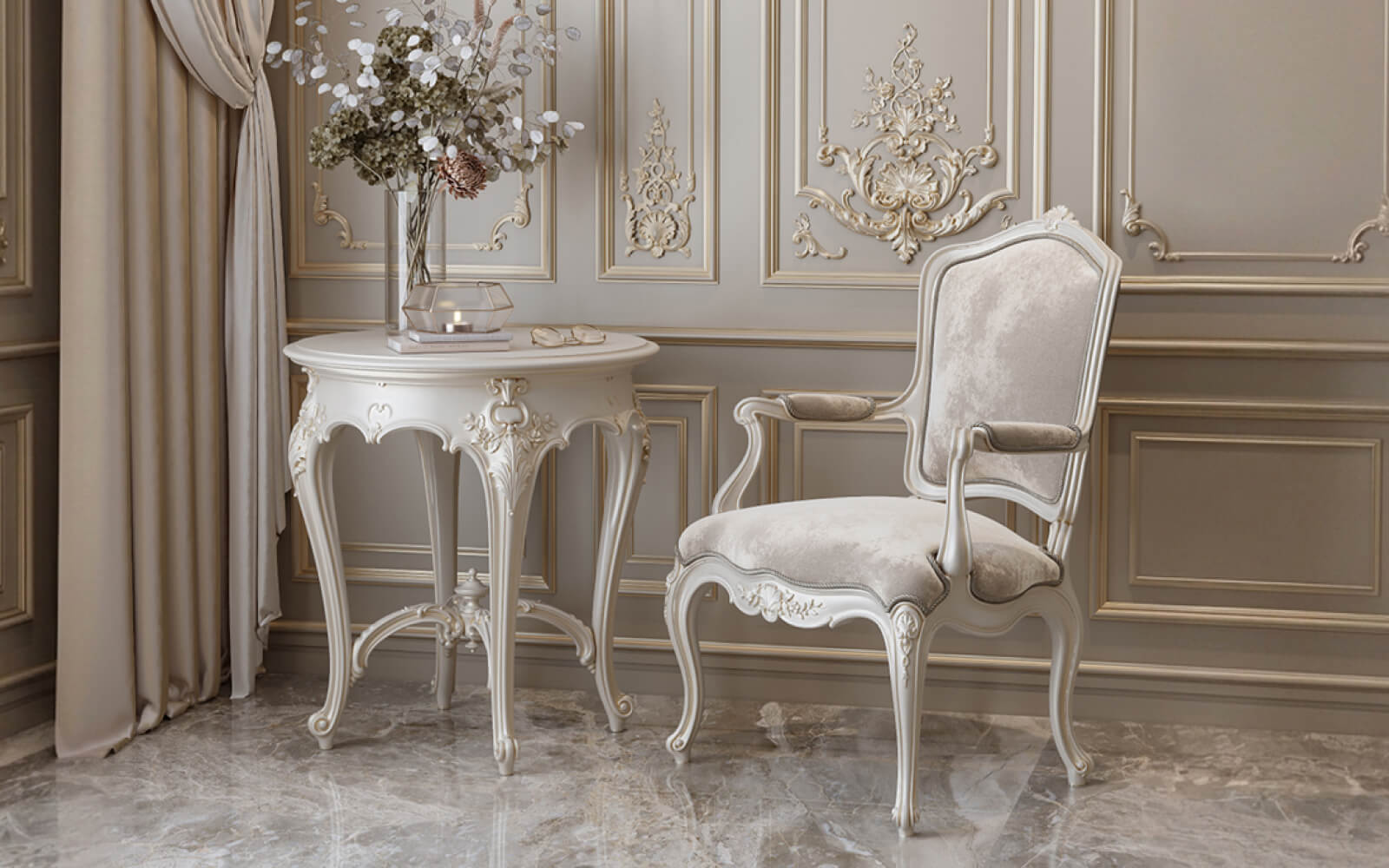
Moldings with stepped or moderately ornamental profiles. Frames behind the bed — a three-part scheme with a central wide frame. Ceiling rosette with classic relief — Ionic, acanthus, laurel wreath. Decorative medallion in the central frame.
Painting: moldings white or matching the wall color — depends on how pronounced the classical theme is.
Provence-style bedroom
Moldings with a soft floral profile. Frames — rounded or with rounded corners (if available). Decorative element above the headboard — floral medallion. Rosette with petals and leaves.
Painting: white or cream — almost always.
Minimalist bedroom
Moldings — only vertical. No frames. One vertical molding in the center of the wall behind the bed — as a laconic architectural accent. Or a horizontal band at headboard height.
Ceiling rosette — geometric, without ornament. Decorative stucco — absent or one minimal element.
Classic luxurious bedroom
Moldings with rich ornamentation, large profiles. Frames on all walls, not just behind the bed. Cornice around the perimeter. Large rosette with baroque ornament. Decorative medallion above the headboard with complex relief.
This is a rare option for a large bedroom with high ceilings. Here the stucco works to its fullest extent.
Bedroom 10 sq m: how not to overload a small space
A small bedroom is a special case. Here the fear of 'overloading' with decor is quite justified. But this does not mean that stucco does not work in a small bedroom. The rules are just stricter.
What to do in a small bedroom
Only one zone. Moldings — only behind the bed. No additional frames on the side walls.
Thin profile. Molding maximum 30–35 mm. With a ceiling of 2.4 m — even 25 mm is enough.
Only in the color of the wall. In a small bedroom, contrasting white moldings on a colored wall create a feeling of fragmentation and overload. Only in the color.
Small rosette. For a room of 10 sq m — rosette no more than 30–35 cm. It is better to do without a rosette and use spot lighting.
Decorative element — one and small. A medallion 20–25 cm or a very small cartouche. No larger.
What to do in a spacious bedroom
With an area of 20 sq. m or more — there is enough space for a full decorative system:
-
Frames behind the bed — a three-part scheme
-
Ceiling rosette 55–65 cm
-
Cornice around the perimeter
-
Decorative element in the central frame
-
Corner rosettes in frames
A spacious bedroom allows you to create a full-fledged interior with decor — while maintaining the principle of tranquility.
Analysis of specific scenarios: what to buy for the task
Scenario 1: Newlyweds, first apartment, standard bedroom 14 sq. m
Task: beautifully decorate the wall behind the bed, make the bedroom more complete.
What to buy:
-
Moldings made of polyurethane — profile 35–40 mm, about 6–7 linear meters
-
Buy decorative stucco — one medallion 35–40 cm for the center of the frame
-
Glue, sealant, paint matching the wall
-
Molding allowance 15%
Result: a frame of moldings behind the bed with a decorative accent in the center.
Scenario 2: Bedroom with chandelier, bare ceiling
Task: design the center of the ceiling under the chandelier.
What to buy:
-
ceiling rosettes — diameter 45–55 cm for a bedroom area of 16–20 sq. m
-
Acrylic glue
-
Paint matching the ceiling color
Result: the chandelier is integrated into the decorative context, the ceiling is finished.
Scenario 3: Bedroom with two sconces by the bed
Task: design the bedside area with sconces.
What to buy:
-
Moldings — for two small frames around each sconce (3–4 meters each, total 6–8 m)
-
Buy Moldings — two identical decorative elements, one above each sconce
-
Corner pieces — 4 per frame, total 8 pieces
-
Glue, sealant, paint
Result: a symmetrical decorative axis with sconces in frames and accents above each light fixture.
Scenario 4: Full classic bedroom finishing
Task: create a complete classic bedroom interior with stucco molding.
What to buy:
-
Moldings — profile 45–55 mm, for frames behind the bed and on side walls
-
Ceiling cornice along the perimeter — 55–70 mm
-
Ceiling rosette — 55–70 cm, with classic relief
-
Decorative stucco — medallion in the central frame behind the bed
-
Corner rosettes — for all frames
-
Glue, sealant, primer, paint
-
15% reserve
Result: a full-fledged classic bedroom with complete decor on walls and ceiling.
How to properly install moldings in the bedroom
Wall preparation
The wall must be clean, dry, free of dust and grease stains. If the walls are covered with glossy paint, apply an acrylic primer. This improves glue adhesion.
Marking: draw the outline of the future frame with a pencil. Check the right angles with a square. The diagonals of the rectangle must be equal.
Molding trimming
Frame corners are 45 degrees. A miter saw with an angle stop is used. The first cut is a test cut, without glue. It is applied to the wall to check the joint accuracy. If adjustment is needed, it is cut again.
Don't skimp on test cuts. A precise joint is 50% of success.
Installation
Glue is applied to the back of the molding in a zigzag pattern every 10–15 cm. It is applied to the wall and pressed for 20–30 seconds. It is fixed with painter's tape until fully set (15–30 minutes).
Frame installation order: horizontal planks first, then vertical ones. Corner joints are on the cut ends.
Final finishing
After installing all planks, fill the corner joints with acrylic sealant. Level it flush with the molding surface, remove excess with a damp brush. After drying, paint.
When painting to match the wall color, paint the entire wall surface together with the moldings with one final coat. This gives the most uniform result.
Table: what to buy for a bedroom
| Task | What to buy |
|---|---|
| Wall behind the bed | Moldings 35–45 mm + glue + paint |
| Chandelier in the center | Ceiling rosette 40–55 cm |
| Perimeter cornice | Ceiling molding 50–70 mm |
| Accent in the frame | Decorative stucco 30–45 cm |
| Bedside sconce | Moldings in a frame + Relief Decoration above the sconce |
| Frame details | Corner pads (Decor for Molding) |
FAQ: answers to main questions about stucco in the bedroom
Which stucco to choose for the bedroom?
For the bedroom, one decorative zone works best: Moldings behind the bed in a frame, a neat ceiling rosette and one decorative element. Moderate scale, painted to match the wall.
What to buy for the wall behind the bed?
Polyurethane moldings with a profile of 35–45 mm, mounting adhesive, acrylic sealant, paint. For a classic style — additionally corner pads for frames and one decorative medallion in the center.
Can stucco molding be used in a small bedroom?
Yes. A thin molding of 25–35 mm, one frame behind the bed, painted to match the wall. A small diameter rosette — 30–35 cm for an area up to 12 sq. m. One small decorative element.
Is a ceiling rosette needed in a bedroom?
If there is a chandelier in the bedroom, a rosette is needed. It turns the light fixture into part of the interior. The size is selected based on the area: for a bedroom of 14–18 sq. m — a rosette of 40–55 cm.
How not to overload a bedroom with stucco molding?
Choose one main zone. Paint the moldings to match the wall. Choose a moderate profile. One decorative element — not three. And check the proportions: the width of the molding, the size of the rosette and decor should match the ceiling height and room area.
Is a cornice needed in a bedroom?
With an open ceiling (without stretch ceiling) — yes, the cornice completes the top of the room. With a stretch ceiling — a molding below the canvas line as an alternative. In a small bedroom with a low ceiling — the cornice can be lowered.
In what order should the work be done?
First the moldings — before the final painting. Then the final painting of the walls together with the moldings. Mount the ceiling rosette — before or after painting the ceiling.
About the company STAVROS
The bedroom deserves exactly this kind of attention — quiet, precise, meaningful. Not screaming luxury, but thoughtful beauty. One molding frame behind the bed, the right rosette under the chandelier, a neat decorative accent — and the room transforms. Without a designer, without expensive renovations, without complex solutions.
STAVROS is a Russian manufacturer of decorative polyurethane products. The STAVROS catalog includes Moldings made of polyurethane all formats for walls and frames, ceiling rosettes for chandeliers, Ceiling molding for cornices, Decorative stucco и Relief Decoration for accent zones. The entire assortment for the bedroom — Buy molding on the website with delivery across Russia.
All STAVROS products are made of dense polyurethane, lightweight, ready to be painted with any paint. They are mounted with acrylic glue. STAVROS specialists will help you choose a set for a bedroom of any size and style — and calculate the exact length of moldings for your dimensions.