










































































Article Contents:
- Ceiling without a chandelier: what happens to the top of the room
- Why the wall-ceiling joint is the main challenge
- Three scenarios for a ceiling without a chandelier
- What to choose instead of a ceiling rosette
- Ceiling cornice: the main element of a ceiling without a chandelier
- Ceiling molding: a thin line around the perimeter
- Ceiling baseboard: an option for minimalism
- Cornice for recessed lighting: how to choose correctly
- What a cornice should not do with spot lighting
- Rule: the more points, the calmer the cornice
- What to buy for a ceiling with spotlights
- Molding and track lighting: allies, not competitors
- Principle of stylistic unity
- Color of molding under track lighting
- Rule of distance between track and cornice
- Perimeter lighting and molding: dual function of the cornice
- Cornice as a box for LED strip
- Cornice above lighting: floating ceiling effect
- How to connect ceiling and walls without a chandelier
- Wall moldings as an extension of the cornice
- Decorative stucco in a chandelier-free system
- Room-by-room breakdown: what to choose in each space
- Living room without a chandelier
- Bedroom without a chandelier
- Entryway without a chandelier
- Kitchen without a chandelier
- Hallway without a chandelier
- Study without a chandelier
- Material matters: why polyurethane
- Calculation of material for a ceiling without a chandelier
- How to calculate the length of a cornice
- How to calculate moldings for walls
- Adhesive Quantity
- Installation of cornice and moldings on the ceiling: key points
- Marking
- Corner Trimming
- Adhesive and Fixation
- Painting
- Table: what to buy for different ceiling situations without a chandelier
- FAQ: answers to questions about stucco for a ceiling without a chandelier
- About the Company STAVROS
Ten years ago, a conversation about ceiling stucco was almost always a conversation about a rosette for a chandelier. A chandelier in the center of the ceiling was a given, almost an axiom. But modern renovation lives by different rules.
Today, in the center of the ceiling, there is increasingly nothing. Or a recessed light. Or a track with adjustable heads. Or even perimeter lighting and several sconces on the walls. The centralized chandelier is leaving the current interior — and with it, the main reason for a classic ceiling rosette is disappearing.
And here, a person doing renovations has a question that sounds something like this: 'If there is no chandelier — is ceiling stucco even needed? What to do with the top of the room? A cornice? A molding? Or just a clean ceiling and that's it?'
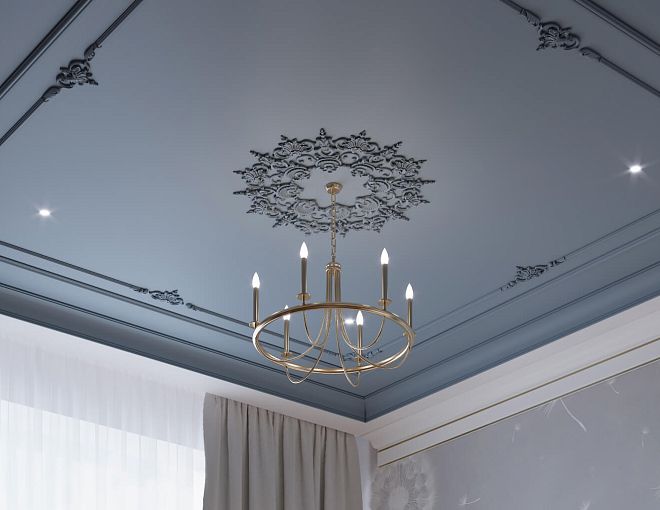
The answer is unexpected: Ceiling Molding Purchase for a ceiling without a chandelier — this is not only possible, but often necessary. The task simply changes: not a socket in the center, but the perimeter, cornice, wall-ceiling joint, connection to the lighting system. Stucco without a chandelier works differently — but it works.




Ceiling without a chandelier: what happens to the top of the room
Let's be honest: a ceiling without a chandelier is a ceiling without a visual center. There is no object that draws the eye upward. And this creates a certain challenge: if there is no center, there must be a periphery. The cornice, perimeter profile, wall-ceiling connection — all of this takes on the role that the socket used to play.
Without a central light fixture, the ceiling remains just a plane. Beautifully painted, smooth, but flat. A well-designed cornice or ceiling molding around the perimeter turns this plane into a finished architectural surface — with a frame, a border, with character.




Why the wall-ceiling joint is the main task
The wall-ceiling joint is a place that the eye constantly falls on, especially in low rooms. A sharp right angle without a profile looks technical and boring. A molding or cornice in this joint does several things at once:
-
Visually raises the ceiling — an angle with a curve or step is perceived as higher
-
Creates a sense of completeness — the room is "closed" from above
-
Provides architectural rhythm — the perimeter of the cornice forms the frame of the entire space
And all of this — without a single chandelier in the center.
Our factory also produces:


Three ceiling scenarios without a chandelier
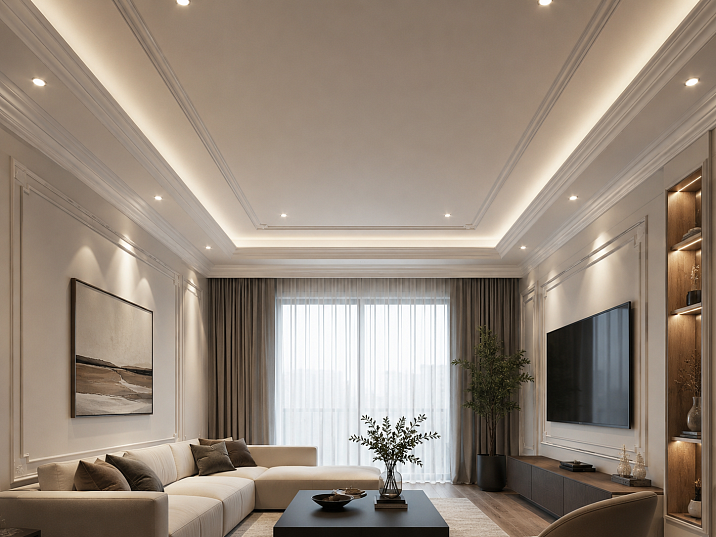
Scenario one: recessed lights. Several recessed spots built into the ceiling. They provide even, diffused light, but lack a single visual center. In this case, it's best to frame the ceiling with a perimeter cornice — it creates a decorative frame into which the recessed lights fit organically.
Scenario two: track lighting. A track is a modern, geometric, almost industrial element. It requires appropriate framing: calm, smooth moldings without ornamentation, a minimalist cornice. Stucco next to track lighting should be its ally, not its competitor.
Scenario three: perimeter lighting. Hidden lighting behind a cornice is a separate architectural technique. Here Ceiling molding it serves a dual function: decorative and structural, hiding the LED strip behind it. More details on this solution in a separate section.
Get Consultation
What to choose instead of a ceiling rosette
So, there is no chandelier. A rosette is not needed. But that doesn't mean the ceiling remains bare. There are several tools that replace the rosette as a decorative finish for the top of the room.
Ceiling cornice: the main element of a ceiling without a chandelier
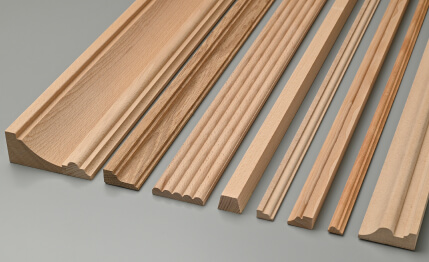
A ceiling cornice is a molding installed at the junction of the wall and ceiling. It creates a smooth or stepped transition between the two planes and is perhaps the most important element for a ceiling without a chandelier.
Buy ceiling molding in the form of a cornice means getting a full-fledged decorative perimeter system that works regardless of what happens in the center of the ceiling.
Cornice width and ceiling height:
-
Ceiling 2.4–2.5 m → cornice 45–65 mm
-
Ceiling 2.5–2.7 m → cornice 55–80 mm
-
Ceiling 2.7–3.0 m → cornice 70–100 mm
-
Ceiling from 3.0 m → cornice 100–140 mm
A cornice wider than 100 mm is rare in a standard apartment. It is only appropriate with high ceilings and a deliberately monumental interior.
Cornice profile for recessed lighting:
For a ceiling with recessed lights, a stepped or shelf profile is best. It does not compete with the light, creates a clear horizontal line around the perimeter, and looks modern.
Cornice profile for track lighting:
With track lighting, only a smooth, geometric profile. No ornamentation. Stepped or angular cross-section. The cornice should be as laconic as possible to avoid a stylistic conflict with the modern technical aesthetic of the track.
Ceiling molding: a thin line around the perimeter
Ceiling molding is a cornice of smaller cross-section. If the cornice actively works with the transition of the wall and ceiling, then the molding simply marks the boundary — with a thin, neat line.
Buy polyurethane moldings for a ceiling without a chandelier — this is a good choice for modern and minimalist interiors. A molding 30–45 mm around the perimeter of the ceiling, painted in the color of the ceiling or wall — and the room acquires completeness without a single extra element.
When is molding better than a cornice:
-
With a ceiling of 2.4 m or lower — a cornice will weigh down the space
-
In small rooms (up to 12–14 sq. m)
-
In the bathroom, toilet, hallway — here the scale requires a thin profile
-
In a modern minimalist interior
Ceiling plinth: an option for minimalism
Ceiling plinth is the thinnest and most delicate option. Its width is 20–35 mm. It is almost invisible, but gives a feeling of a finished joint.
Ceiling plinth — choice for:
-
Apartments with low ceilings
-
Bathrooms and kitchens
-
Hallways and entryways
-
Interiors where minimal decor is desired, but an empty joint looks sloppy
Cornice for spot lighting: how to choose correctly
Spotlights are the most common alternative to a central chandelier. And they set specific requirements for the molding near them.
What a cornice should not do with spot lighting
Should not draw attention. Spotlights provide diffused, even light — they don't have a single dominant object. The cornice should not become such an object. Its role is a frame, not self-expression.
Should not interrupt light cones. If spotlights are placed close to walls, the cornice should not protrude so far as to block their light cones. The optimal distance from the row of spotlights to the wall is at least the width of the cornice.
Should not be too dark in contrast. With spot lighting, shadows from the cornice become more noticeable. A cornice with deep relief under side spot lighting creates expressive shadow play — this can be beautiful but requires a conscious choice.
Rule: the more points, the calmer the cornice
If there are 8–12 spotlights in the room, they themselves are already an active decorative element. The cornice should be calm, supportive, not competing.
If there are few spotlights (4–6), the cornice can be slightly more expressive, as it takes on part of the decorative load.
What to buy for a ceiling with spotlights
-
Ceiling molding — cornice 55–80 mm, stepped or shelf profile
-
Moldings made of polyurethane — for walls, to create a system with a cornice
-
Acrylic glue
-
Paint in ceiling color (for cornice) or wall color (for moldings)
-
15% allowance for trimming
Stucco and track lighting: allies, not competitors
Track lighting is a modern, technological, deliberately architectural element. Tracks can be recessed into the ceiling, surface-mounted, single-phase, or multi-phase. But in any case, it is a pronounced, noticeable line or configuration on the ceiling.
How does stucco coexist with track lighting?
Principle of Stylistic Unity
The track is modern. That means the stucco must be modern. No Baroque, no acanthus leaves, no ornamental cornices with egg-and-dart. Only the following works next to a track:
-
Smooth stepped molding
-
Rectangular profile without ornament
-
Ceiling baseboard with minimal relief
buy polyurethane moldings For a ceiling with a track, choose a profile similar in spirit to the metal track: clear, straight, without lyricism.
Color of stucco with track lighting
Two options, both work:
Matching the ceiling color. A cornice or molding in the same color as the ceiling. The track stands out, the stucco blends into the background. This is correct when the track is a deliberate visual object.
Matching the wall color. A molding that transitions from the wall to the ceiling is painted in the wall's tone. The ceiling is white, the wall is colored — the molding marks this transition. Modern and clear.
Contrasting. In very bold interiors — a dark molding on a light ceiling. It works as a graphic accent, coordinated with the track color.
Rule for distance between track and cornice
The track should not be placed flush against the cornice. The minimum distance is 20–30 cm. This provides both visual freedom and practical convenience when adjusting the track heads.
If the track runs along one wall, the cornice on the opposite wall can be slightly more expressive: there is no direct visual conflict here.
Perimeter lighting and stucco: the dual function of the cornice
This is a separate and very interesting topic. Hidden perimeter ceiling lighting is one of the most popular modern solutions. And here Ceiling Molding Purchase it is no longer just for decoration.
Cornice as a box for the LED strip
Special ceiling cornices with a shelf or niche allow you to hide an LED strip behind them. The light comes out from the bottom or top of the cornice, creating the effect of a floating ceiling or soft perimeter glow.
This technique changes the entire character of the space. With such lighting, the room looks more spacious, softer, and more expensive.
Technical requirements for the cornice for the light strip:
-
Profile with a shelf or niche at least 3–4 cm deep
-
Bottom shelf behind which the strip is hidden
-
Sufficient height: the strip should not be visible from below
How to choose a cornice for backlighting:
Look for a profile with a horizontal bottom shelf — a "shelf" cornice. The strip is glued to the inner surface of the shelf. The light comes out downwards, diffuses along the wall, and creates a soft halo near the ceiling.
The width of such a cornice is 70–100 mm. This is due not to decorative but to functional requirements: enough space is needed for the strip and to hide it from direct view.
Cornice above the backlight: floating ceiling effect
If the tape is glued on top of the cornice, the light is directed upward, onto the ceiling. The ceiling receives a soft, diffused glow and visually "rises." This is especially effective in rooms with low height: 2.4–2.5 m.
How to connect the ceiling and walls without a chandelier
The absence of a chandelier is not just a ceiling issue. It is a matter of architectural unity of the entire space. When there is no central light fixture, the decorative accent naturally shifts to the walls. And here, stucco molding on the walls becomes an important tool.
Wall moldings as an extension of the cornice
If there is a cornice around the perimeter of the ceiling and the walls are completely bare, a dissonance arises. The top of the room is decorated, but the walls do not support this solution.
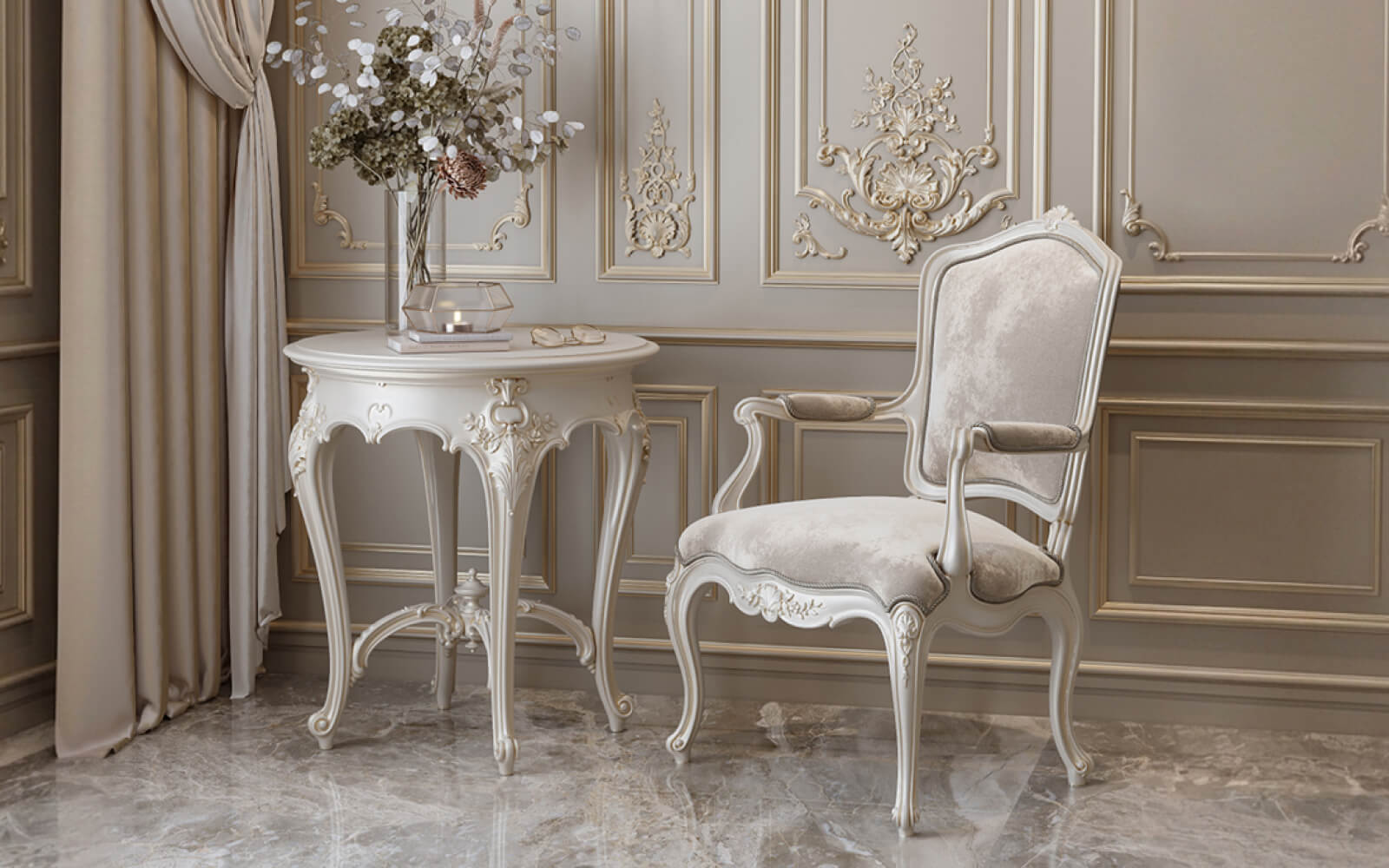
Buy polyurethane moldings for the walls means creating a vertical or horizontal continuation of the ceiling theme. Wall moldings work in conjunction with the cornice, creating a unified decorative system.
Vertical moldings from the cornice downward. Several vertical profiles running from the cornice line down the wall. They create a rhythm of verticals, emphasize the height of the room, and connect the ceiling with the lower part of the wall.
Horizontal molding belt. A molding at a height of 90–110 cm — a horizontal line dividing the wall into two parts. The upper part of the wall seems to "belong" to the ceiling, the lower part to the floor. This is a classic architectural technique that works in any style.
Molding frames. Rectangular fields on the walls formed by moldings. Inside the frames — either a different wall color, a textured coating, or simply the same surface but framed. Frames create the feeling of panels and make the walls part of the room's architectural system.
Decorative stucco molding in a system without a chandelier
If the ceiling is finished with a cornice and moldings, and the accent zone is shifted to the walls — Buy decorative stucco it is worth focusing on one specific zone on the wall.
This could be:
-
A decorative element above the sofa in the living room
-
A medallion in a central frame
-
An ornamental overlay above the mirror
-
An accent near the sconce
-
Decor behind the bed in the bedroom
In an interior without a chandelier, decorative stucco focuses attention on the walls — exactly where the visual center of the room is now formed.
Room-by-room breakdown: what to choose in each space
Living room without a chandelier
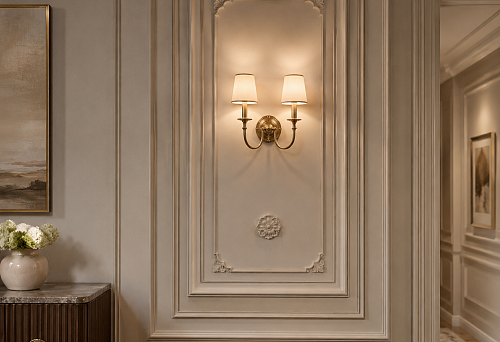
The living room is the most important space. Here, the absence of a chandelier must be compensated by a well-thought-out lighting system and a strong ceiling cornice.
Cornice for the living room: 70–90 mm, moderately ornamental or stepped profile. Installed around the entire perimeter. Painting:
-
In the color of the ceiling — delicate
-
White with neutral walls — classic
-
In the color of the wall — modern and bold
Moldings on the living room walls: a system of frames on the accent wall (behind the sofa or opposite the entrance). Cornice + wall frames = full decorative architecture without a single rosette.
Decorative stucco in the living room: one accent element in the central frame on the main wall. A medallion or cartouche — proportionate to the frame, but not drawing all the attention.
to buy molding For a living room without a chandelier — a cornice around the perimeter, frames made of moldings on the main wall, one decorative accent, and glue with a reserve.
Bedroom without a chandelier
In a bedroom without a chandelier, there are usually recessed lights or sconces. The bedroom ceiling is a horizontal plane that a person sees every night while lying in bed.
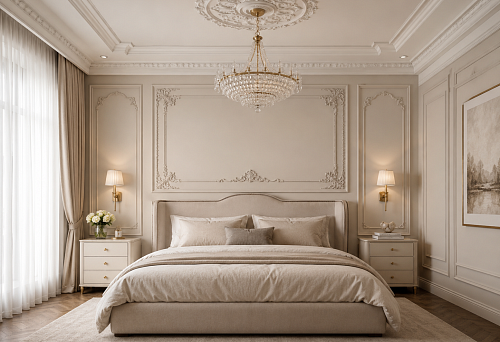
Cornice for the bedroom: 55–75 mm, calm profile. Painting to match the ceiling is the most delicate option for the bedroom. No contrast, no activity. The cornice should discreetly complete the top of the room.
Without a rosette does not mean without molding. In a bedroom without a chandelier, the decorative accent shifts to the wall behind the bed. Molding frames, a decorative element above the headboard — and the bedroom gains completeness that a chandelier with a rosette no longer creates.
Important note: with recessed lights in the bedroom, the cornice must be strictly in the color of the ceiling. The shadow from the cornice with recessed side lighting can create an undesirable effect if the cornice is contrasting.
Hallway without a chandelier
The hallway is a small space with limited height and recessed lighting. Here, a ceiling molding of a small profile (30–45 mm) around the perimeter provides a powerful effect with minimal investment.
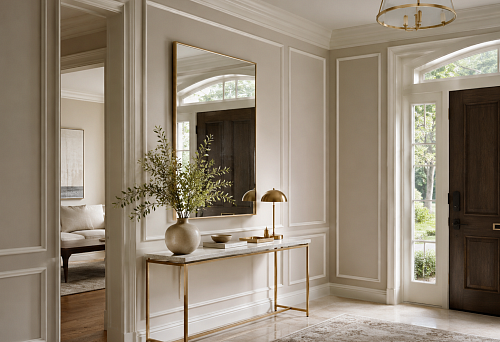
In a hallway without a chandelier, a cornice + a mirror in a molding frame is a complete decorative ensemble that makes a small space feel finished.
Kitchen without a chandelier
The kitchen is an area with track or recessed lighting in most modern renovations. The kitchen ceiling requires delicate handling: here there is humidity, grease, and temperature fluctuations.
For the kitchen, choose Moldings made of polyurethane — polyurethane is resistant to moisture and does not swell with temperature changes, unlike plaster.
Cornice for the kitchen: 40–60 mm, smooth or stepped. Painted with washable paint. No ornament with deep relief — grease accumulates in the relief.
Hallway without a chandelier
In a long hallway with spotlights — the cornice creates horizontal lines that visually 'push' the space into depth. This is an optical effect: horizontal lines at the top make the hallway longer and taller.
Molding along the perimeter of the hallway ceiling + a horizontal molding belt on the walls at a height of 90–100 cm — and the narrow passage space acquires the architectural character of a gallery.
Study without a chandelier
Study with track lighting — a modern, professional space. Here, stucco is only geometric. Cornice 55–70 mm, smooth profile. Molding on the walls — vertical accents or a frame system.
Buy Moldings for a study with track lighting — one geometric element on an accent wall. Everything else — moldings and cornice.
Material matters: why polyurethane
A discussion about stucco for a ceiling without a chandelier would be incomplete without addressing the material. Polyurethane products are the modern standard for household use.
Weight. Polyurethane cornices and moldings weigh 5–8 times less than their plaster counterparts. This is critical for ceiling installation: a lightweight element is securely held with acrylic glue without additional fasteners.
Moisture resistance. Polyurethane does not degrade in high humidity. For kitchens, bathrooms, and washrooms, this is an absolute advantage over plaster.
Flexibility. The slight flexibility of polyurethane allows moldings to be installed on uneven surfaces without gaps.
Ready for painting. All Polyurethane Items are primed during production and ready for painting with any paint without additional treatment.
Precision of relief. Polyurethane products are manufactured using injection molding into metal molds. The relief is transferred with an accuracy of tenths of a millimeter.
Material calculation for a ceiling without a chandelier
How to calculate the length of a cornice
The formula is simple: room perimeter + 10% reserve.
Examples:
-
Room 4×5 m → perimeter 18 m → with reserve 20 m
-
Room 3.5×4.5 m → perimeter 16 m → with margin 18 m
-
Corridor 1.5×8 m → perimeter 19 m → with margin 21 m
Margin is needed for trimming at corners. For a rectangular room with four right angles — 10% is enough. For non-standard layouts with niches and protrusions — 15–20%.
How to calculate moldings for walls
For frames: perimeter of each frame × number of frames + 15% margin.
Example: three frames measuring 80×100 cm.
-
Perimeter of one frame: (0.8+1.0)×2 = 3.6 m
-
Three frames: 3.6×3 = 10.8 m
-
With 15% margin: 12.4 m ≈ 13 linear meters
Adhesive quantity
One tube of acrylic mounting adhesive (400–450 ml) — for 4–6 linear meters of molding. For a room with a perimeter of 20 m — 4 tubes of adhesive with margin.
Installation of cornice and moldings on the ceiling: key points
Marking
Before installation — horizontal marking along the entire perimeter. Use a laser level or water level. The horizontal line is marked on the wall at a distance from the floor = ceiling height minus the height of the cornice on the ceiling.
Check the corners: in standard apartments, corners are rarely exactly 90°. Cutting should be done considering the actual angle.
Trimming Corners
Internal corners (standard) — cut at 45°. External corners (protruding columns, niches) — cut at 45° in the opposite direction.
For precise cutting — a miter saw. A manual miter box also works, but is less accurate for wide profiles.
The first cut is always a test cut, without glue. It is applied to the joint, and accuracy is checked. Adjusted if necessary.
Adhesive and fixation
Glue is applied in a zigzag pattern to the back side of the cornice. Pressure when applying is moderate and even. Masking tape secures the cornice until fully set (15–20 minutes for acrylic glue).
Joints in corners after installation — fill with acrylic sealant, remove excess with a damp brush.
Painting
The cornice is painted after installation. If the cornice matches the ceiling color — paint it together with the ceiling with the final coat. If it matches the wall color — paint it together with the wall.
Masking tape protects the ceiling from paint applied to the wall, and vice versa.
Table: what to buy for different ceiling situations without a chandelier
| Situation | What to buy |
|---|---|
| Ceiling without a chandelier, recessed lighting | Ceiling molding — cornice 55–80 mm |
| Track lighting | Moldings made of polyurethane — smooth profile 40–60 mm |
| Perimeter lighting | Cornice with shelf for LED strip 70–100 mm |
| Ceiling + empty walls | Cornice + wall moldings within the frame |
| Modern minimalism | Ceiling molding 30–45 mm in ceiling color |
| Need an accent on the wall | Buy decorative stucco — one element |
| Small space | Ceiling plinth 20–35 mm |
FAQ: answers to questions about ceiling molding without a chandelier
Do you need a ceiling rosette if there is no chandelier?
No. If there is no central chandelier, a classic ceiling rosette is not advisable. Replace it with a cornice around the ceiling perimeter and, if necessary, moldings on the walls.
What to choose for a ceiling with recessed lights?
Buy ceiling molding — cornice 55–80 mm with a calm stepped or shelf profile. Painted to match the ceiling. Recessed lights should be positioned no closer than the width of the cornice from the wall.
Can you combine stucco molding and track lighting?
Yes, but with track lighting, the stucco should only be minimalist. A smooth stepped molding 40–60 mm without ornament. Painted to match the ceiling or the wall color. Ornamental cornices with track lighting create a stylistic conflict.
What to buy for a modern ceiling without a chandelier?
Buy polyurethane moldings — smooth profile 35–50 mm, painted to match the ceiling or wall, glue, sealant, and a 15% reserve. If necessary, decorative stucco for an accent area on the wall.
How to create a floating ceiling effect using stucco molding?
A cornice with a lower horizontal shelf is mounted around the perimeter of the ceiling. An LED strip is hidden behind the shelf. The light is directed upward onto the ceiling. The ceiling receives a soft, diffused glow and visually 'rises'.
Is polyurethane stucco suitable for the kitchen?
Yes. Polyurethane is moisture-resistant, does not absorb grease, and is not damaged by temperature fluctuations. Choose a smooth profile without deep relief — it is easier to keep clean.
Is a cornice needed in a room with a stretch ceiling?
With a stretch ceiling, the cornice is mounted below the stretch fabric line, on the wall. It hides the stretch ceiling mounting profile and creates a decorative transition. This is standard practice in modern renovations.
About the company STAVROS
A ceiling without a chandelier is not a ceiling without decor. It is a ceiling with a different logic of decor. A cornice around the perimeter, a molding marking the boundary between wall and ceiling, a connection with wall moldings — and the space gains architectural completeness that no chandelier can provide.
STAVROS is a Russian manufacturer of decorative polyurethane products. The STAVROS catalog includes Ceiling molding all formats: cornices, moldings, ceiling baseboards. Moldings made of polyurethane for walls and frames. Decorative stucco и Relief Decoration for accent zones.
All STAVROS products are dense polyurethane, ready for painting, easy installation with acrylic glue, delivery across Russia. Buy molding for a ceiling without a chandelier — in the STAVROS catalog with specialist consultation on profile selection and footage calculation.