














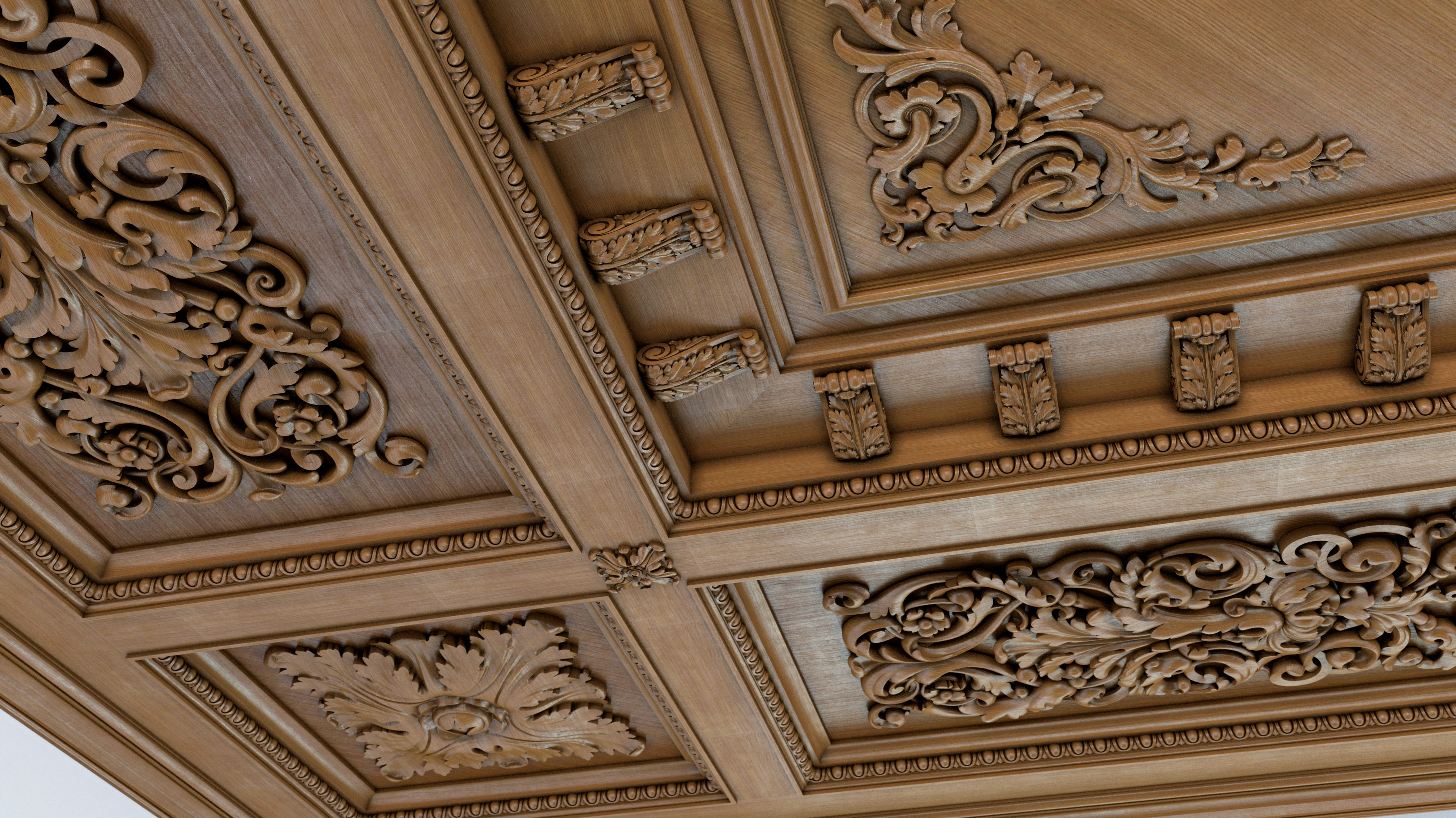
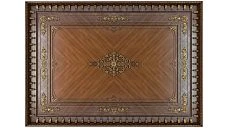




Ceiling medallion ideas that work in American homes
A ceiling medallion can make an ordinary light fixture look intentional. Instead of allowing a chandelier canopy to sit alone on a broad stretch of painted drywall, a decorative circle, star, or shaped arrangement gives the ceiling a visual center. In American interiors, the familiar shopping term is ceiling medallion. You may also see polyurethane ceiling medallion, chandelier medallion, ceiling rosette, or architectural ceiling decor. The British expression ceiling rose appears in design literature, but in the United States it can be confused with electrical hardware. This guide uses the language a U.S. homeowner, interior designer, or trim installer is most likely to recognize.
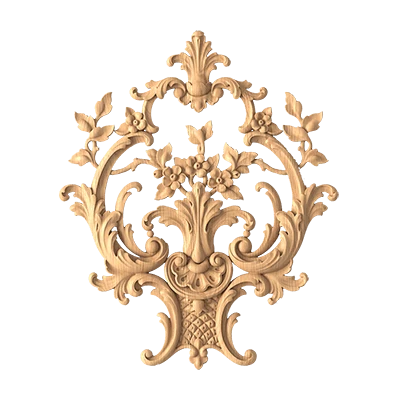
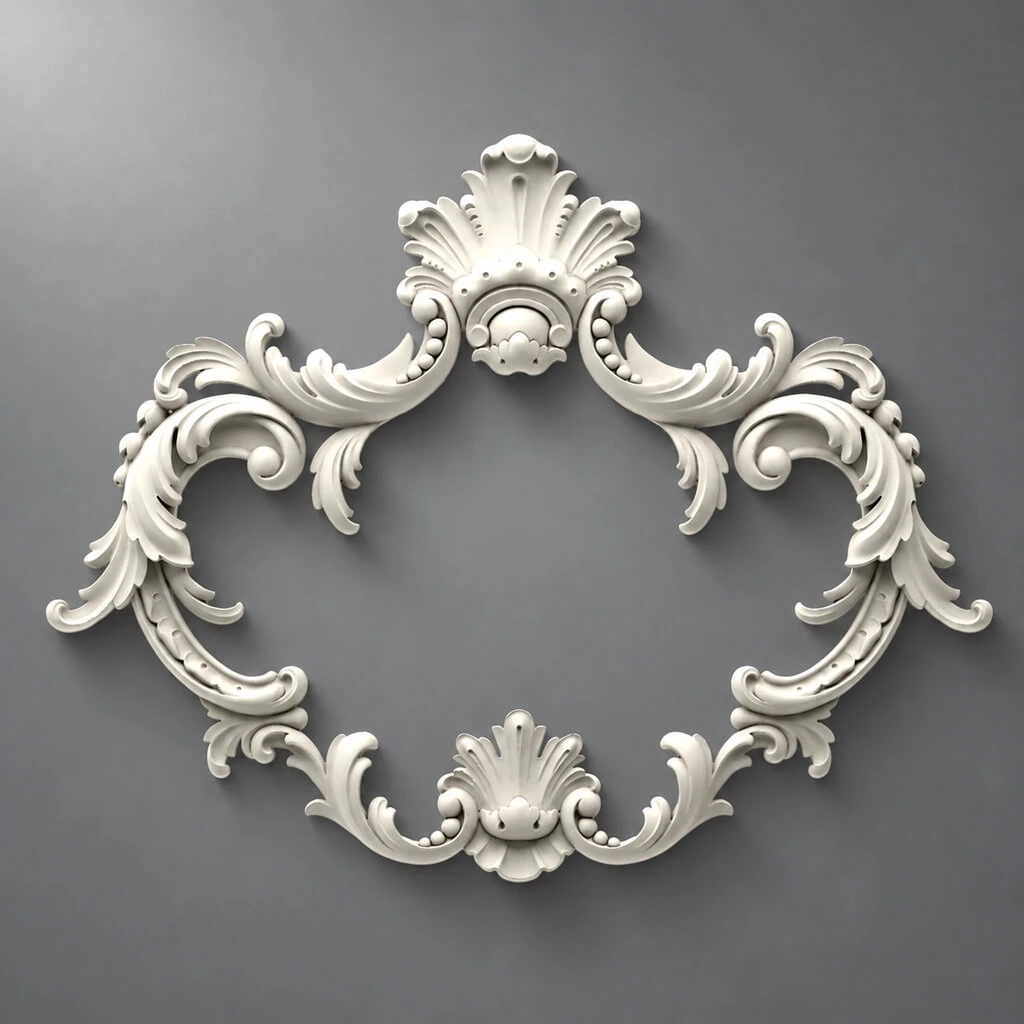
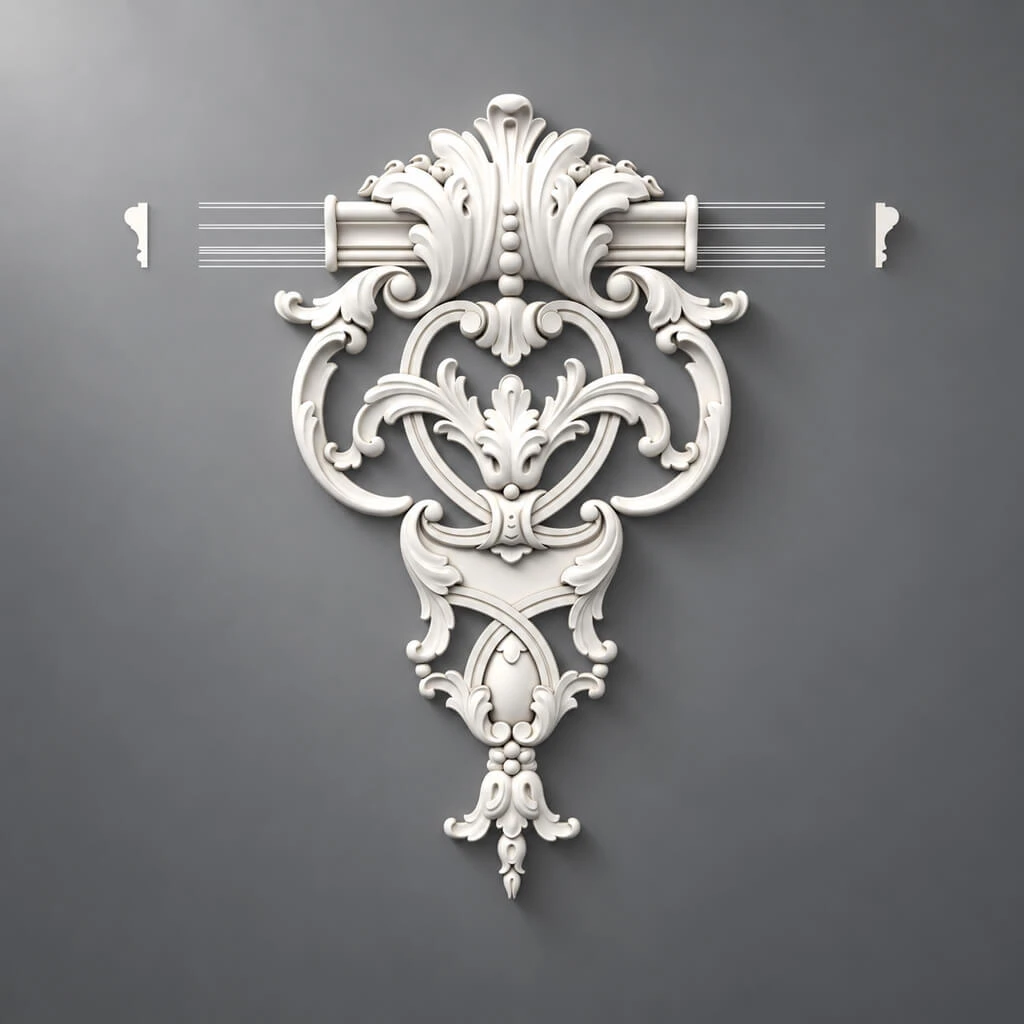
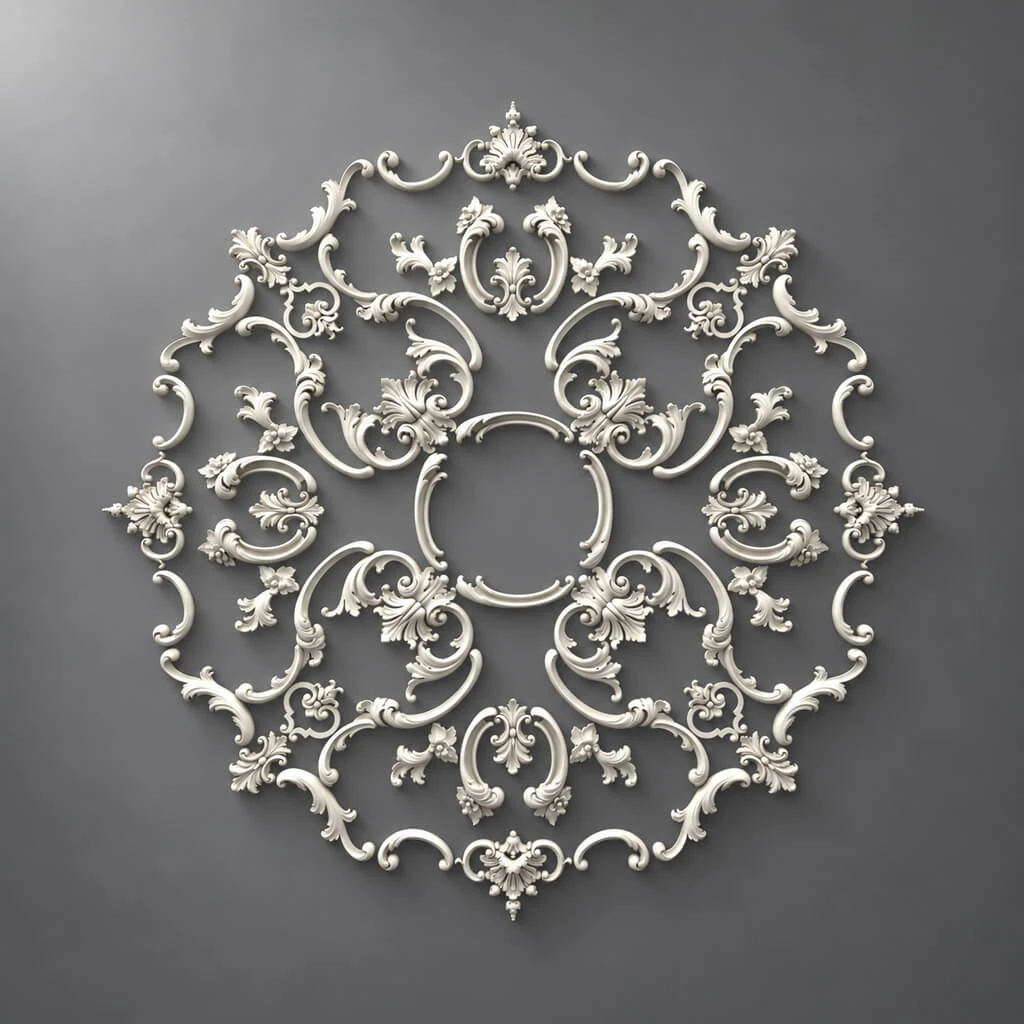
STAVROS has both individual polyurethane ornaments and larger modular compositions that can function as ceiling focal points. The distinction matters. A small floral rosette suitable for a cabinet door is not automatically a chandelier medallion, and a large decorative arrangement is not automatically a pre-drilled, one-piece disc. Start with the polyurethane ceiling medallion collection to see the actual scale and construction of the products before planning the room. Use drawings and product details, rather than a flattering installation photograph, to determine what will fit your ceiling and fixture.
The best result is rarely the most ornate possible ceiling. It is the composition that clarifies the relationship among the room, lighting, furniture, moldings, and architectural lines. This article develops the ideas in the original STAVROS ceiling-rosette guide for U.S. room dimensions, American English terminology, practical product selection, and careful installation planning. It also explains where a decorative medallion stops and the electrical fixture's independently supported mounting system begins.
What a medallion changes visually
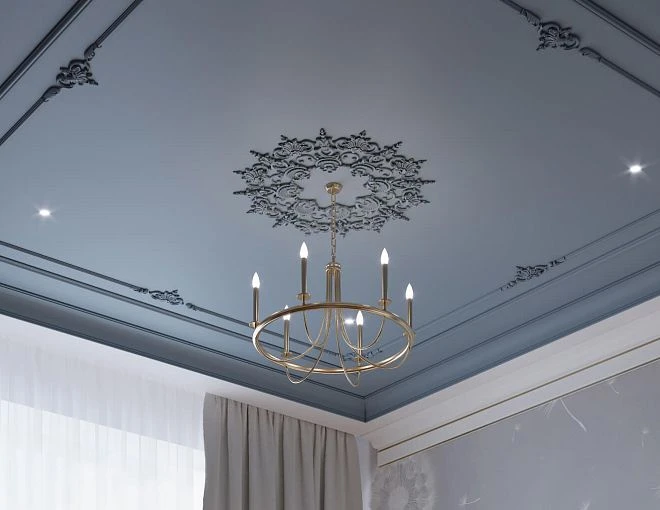
A medallion is an architectural punctuation mark. It draws attention to the ceiling center, organizes the area around a pendant or chandelier, and adds shadow lines that a flat ceiling lacks. In a narrow dining room, it can signal the center of the table setting. In a broad living room, it can prevent a relatively small chandelier from looking isolated. In a foyer with a high ceiling, it rewards an upward glance without requiring a decorative treatment on every wall.
Those effects are visual rather than structural. A polyurethane medallion should never carry the weight of a chandelier or ceiling fan. Nor should a medallion be assumed to hide electrical problems, provide fire protection, or correct an improperly supported fixture. A professionally installed fixture remains attached to a suitable listed electrical box or another code-compliant support, independent of the ornament. Think of the medallion as a finish detail coordinated with the lighting installation, not as part of the fixture's load path.
The three decisions to make first
Before shopping, answer three questions: What is the ceiling height? What is the size and shape of the fixture? What other architectural trim is already visible? A dramatic 36-inch decorative arrangement may read beautifully across a 20-by-18-foot formal living room, but it can visually crowd a small bedroom with an 8-foot ceiling. A clean star-shaped composition may pair with a geometric pendant, while a lush botanical ring works with a traditional chandelier. A medallion should also speak the same design language as nearby doors, baseboards, crown molding, or wall panels.
Do not choose by diameter alone. Check the exact footprint, relief depth, number of modules, inside opening, and whether the product includes a center suitable for the planned fixture. Many STAVROS architectural medallions are modular arrangements with measured overall widths and heights rather than conventional round discs with a factory-cut center opening. That difference changes layout, installation time, and clearance planning.



Seven ceiling medallion ideas by room
1. Dining room: frame the chandelier without competing with the table
The dining room is a natural place for a chandelier ceiling medallion because the fixture already marks a social center. Center the composition over the dining table, not automatically the center of the room. In an open-plan house, the table may sit to one side of the structural ceiling center. If the fixture is properly located over the table, the medallion usually belongs with the fixture, provided the arrangement does not collide with a beam, soffit, smoke alarm, or recessed light.
For a 12-by-14-foot dining room with a 9-foot ceiling, begin by sketching a restrained 18-to-26-inch visual footprint; treat that as a design trial, not a mandatory sizing rule or a promise of STAVROS stock sizes. A 30-inch-wide fixture and a medallion close to the same width may visually flatten each other. Make one clearly dominant, either the lighting silhouette or the architectural ornament. An intricate brass chandelier generally needs more breathing room than a thin, modern pendant.
If the dining table is rectangular, keep the medallion centered at the fixture and let the table establish the room's main axis. Repeating the table's rectangle with a thin molding border on the ceiling can be more effective than installing several separate medallions. When planning the border, leave enough uninterrupted ceiling between the ornament and molding that the two do not look accidentally connected.
2. Living room: create a focal point in a large ceiling field
Open living rooms often have enough blank ceiling area for an elaborate medallion, yet they may also contain multiple ceiling lights. Decide whether one chandelier should be the visual anchor or whether recessed lights and pendants divide the room into smaller zones. For a central chandelier in a traditional room, a larger, sculptural arrangement can make the center legible from a sofa or doorway. For a low-profile fixture in a contemporary room, simplify the surrounding ornament instead of matching decorative complexity with decorative complexity.
An especially useful test is to view a full-scale paper template from the primary seating position. From the floor, intricate details merge into a general shape. Look for a stable outline and a clear center rather than choosing a model solely because individual leaves or scrolls are impressive close-up. If the fixture is already an oversized statement, a subtle ceiling medallion painted to match the ceiling may provide just enough architectural definition.
3. Entryway and two-story foyer: design for viewing distance
A tall foyer permits a bolder silhouette, but distance changes what people can see. A fine border that reads clearly at eye level may vanish fifteen feet overhead. Larger leaf masses, a star shape, or a pronounced ring remain visible longer. Evaluate the medallion both from directly below and from the second-floor landing, where the edges may be seen at a shallow angle.
In a two-story entry, the fixture's hanging height and the medallion's overall footprint should be planned together. A highly detailed ceiling composition can work with an airy lantern, while an elaborate chandelier may be better served by restrained geometric decoration. Consider where visitors stand as they enter, not just a centered camera view of the hall. The goal is a recognizable focal point that fits the architecture, not a decorative object that appears suspended in empty space.
4. Bedroom: use a soft architectural accent
Bedrooms benefit from a quieter approach. Consider a painted medallion that nearly matches the ceiling, a low-relief floral motif, or a restrained geometric composition. The fixture may be a pendant, a shallow chandelier, or a decorative ceiling light. On an 8-foot ceiling, review the total fixture drop and the medallion projection separately. A flat visual treatment will generally feel less imposing than a dense, high-relief border close to the bed.
Do not automatically center the feature over the bed. Many bedrooms have a ceiling light at the room center, while the bed sits off-center because of doors, windows, or closet access. Keep the medallion coherent with whichever location is selected for the properly mounted light fixture. If the design calls for ornament above the bed but no electrical fixture, use a purely decorative arrangement without cutting an unnecessary wiring opening.
5. Kitchen or breakfast nook: let the ceiling remain easy to read
A kitchen ceiling typically has several visual demands: recessed lights, exhaust-related elements, cabinets, and sometimes a peninsula or island pendant. A ceiling medallion makes the most sense over a dining nook or a single feature pendant where it has room to breathe. Do not surround every recessed downlight with ornament; that usually produces visual clutter and may conflict with fixture clearances.
Moisture, heat, grease, and frequent cleaning affect finish selection. Polyurethane decorative elements vary by formulation, coating, and installation system; the material name alone does not establish suitability directly above a cooktop or in a high-humidity area. Check the manufacturer's application requirements, finish compatibility, and fixture clearances. A smooth profile is often easier to maintain in a working kitchen than a deep pattern with recesses that collect dust.
6. Hallway and gallery: create rhythm with restraint
A long corridor can be organized with repeated small decorative accents, but repetition must follow architectural rhythm. Start at the doorway sight line and mark the centers of the actual ceiling bays, not simply equal distances between the first and last wall. If there are three hanging fixtures, three coordinated motifs may make sense; if the corridor is illuminated by recessed lights, a single feature at an intersection may be better.
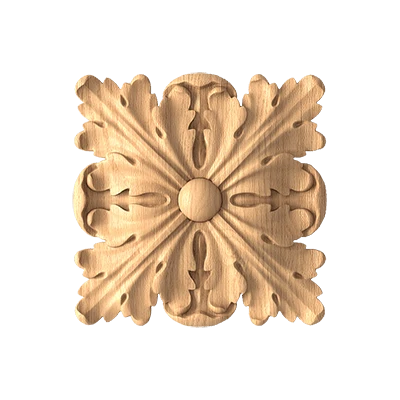
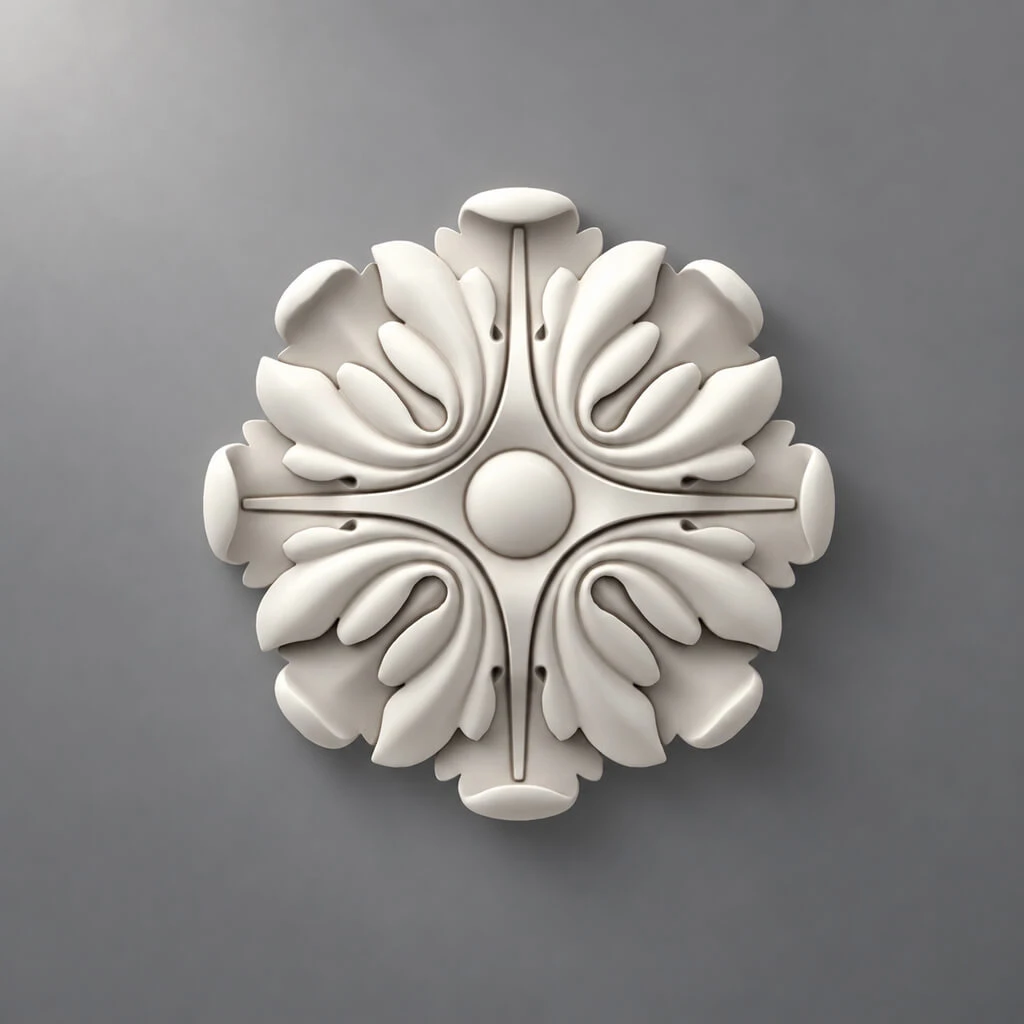
Small ornaments in the polyurethane rosette and accent collection can be explored for decorative patterns away from fixtures. They are not necessarily approved as ceiling fixture medallions. Consider using them at the centers of decorative ceiling panels, above a gallery landing, or in other clearly non-load-bearing applications where their proportions are appropriate.
7. Home office and library: connect ceiling detail to cabinetry
Traditional home offices often include built-in shelving, paneled doors, and dark-toned furnishings. A restrained medallion can echo the repetitive structure of the cabinetry. Try a simple central ornament paired with a rectangular ceiling molding frame that follows the dimensions of the room. For a modern workspace, a single star or ring shape in the ceiling color can bring definition without making the room look formal.
Consider the eye-level view from the desk. If the ceiling treatment attracts more attention than the artwork, bookcases, or task lighting, simplify it. The medallion can be a transitional design element: classical enough to relate to door casing and shelves, but quiet enough to coexist with contemporary furniture.
Choose shape, ornament, and visual weight
Round, square, star-shaped, or modular?
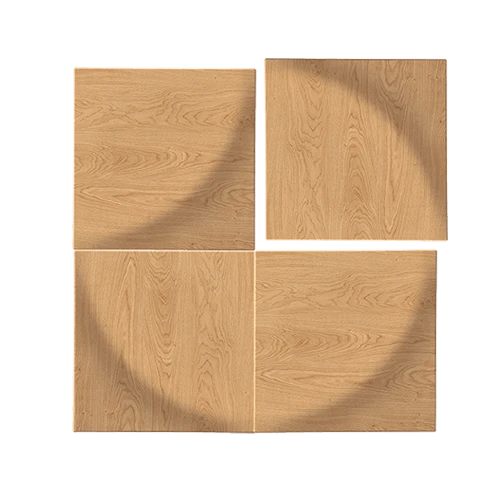
A round medallion creates an obvious center and can be easy to relate to a round chandelier canopy. A square or star-shaped composition is more assertive and connects naturally to rectangular rooms or geometric ceiling borders. A modular ornament can make a large statement while leaving open ceiling between separate components. That open area reduces the apparent visual weight even when the overall measured footprint is substantial.
When comparing products, ask whether the dimensions represent a solid object, a multi-piece composition, or an overall bounding box. A modular design measuring 36 inches across does not necessarily fill all 36 inches with material. Nor does the overall measurement tell you the size of its center opening. Use a scaled drawing to see how much bare ceiling remains inside the pattern and around the fixture canopy.
Botanical relief versus crisp geometry
Leaf and scroll patterns harmonize with traditional millwork, ornate furniture, and chandeliers that have curved arms. Geometric stars and repeated radial elements often pair more naturally with simple drum shades, lanterns, and modern fixtures. Neither approach belongs exclusively to a historical period. A botanical medallion painted in the exact ceiling color can feel surprisingly contemporary; a geometric composition finished in contrasting color can feel formal.
Visual weight also comes from relief depth. A shallow, finely modeled product reads as a delicate drawing in soft daylight. More pronounced relief creates moving shadows as light changes. Compare the projected depth with ceiling height and pendant drop before making a choice. A fixture canopy that sits against a thick relief may require different clearances than one surrounded by an open center.
Paint color changes the apparent size
White-on-white is not the only option, but it is an excellent starting point for a room with multiple architectural details. Matching the ceiling and medallion color reduces contrast, so the pattern is revealed primarily by shadow. A slightly warmer or cooler finish can make the relief legible without turning it into a graphic symbol. A fully contrasting color magnifies the apparent footprint, which can be effective in a foyer but demanding in a small bedroom.
If you want metallic highlights, test them on an inconspicuous sample first. Strong gold over every raised detail can flatten a complex design because the entire ornament competes for attention. Selectively dry-brushing a compatible finish on raised edges may preserve the original shadow pattern. The method must suit the coating and material; do not assume any solvent-based decorative finish is safe for every molded product.
How to size a ceiling medallion for a chandelier
Measure the room, fixture, and canopy separately
U.S. homeowners usually work in feet for room dimensions and inches for decorative products. Record the room width and length, finished ceiling height, chandelier width, fixture canopy diameter, and any nearby obstacles. A 14-by-16-foot room is 224 square feet, but square footage alone is not enough: two rooms can have the same area and very different proportions. The chandelier's location relative to the table or seating arrangement may matter more than the exact center of the ceiling.
Measure the canopy itself rather than the widest part of the chandelier. The canopy is the small ceiling cover around the fixture's connection point. Its dimensions determine whether an existing opening can be concealed and whether a decorative edge would obstruct its seating. The chandelier's overall width, meanwhile, determines the relative visual mass below. For a modular composition, inspect the negative space around the center. A supplier's outside dimension cannot tell you whether the canopy will fit.
A homeowner might start by considering medallions around 12–20 inches for smaller rooms, 18–30 inches for many dining rooms and bedrooms, and 30 inches or more for larger formal rooms. These are visual mockup ranges, not building standards or the STAVROS inventory. Some architectural STAVROS compositions are substantially larger than a conventional stock round medallion. Review the companion guide to selecting a medallion for a chandelier if you want to concentrate specifically on the fixture-and-ornament relationship.
A room-by-room sizing worksheet
| Room example | What to measure | A useful design question | What to verify before ordering |
|---|---|---|---|
| 10 × 12 ft bedroom, 8 ft ceiling | Fixture drop, canopy, closet and door clearances | Would a flatter design keep the ceiling calm? | Relief depth and clearances |
| 12 × 14 ft dining room, 9 ft ceiling | Table center, pendant width, canopy | Should the chandelier or medallion dominate? | Center opening and alignment |
| 16 × 20 ft living room, 10 ft ceiling | Seating sight lines, fixture width, other lights | Does a modular pattern read from the sofa? | Overall footprint and component count |
| Two-story foyer | View from entry and landing, chandelier height | Is the silhouette legible from far below? | Structural fixture support and access |
| Open kitchen and dining space | Island/table axes, downlight spacing | Can one focal element clarify the dining zone? | Distances from adjacent equipment |
The table deliberately avoids a universal formula. Some retailers recommend medallions smaller than the chandelier, others suggest substantial ornaments around compact fixtures, and historical styles use different proportions. A taped paper template is a much better decision aid than a one-size-fits-all ratio. If one candidate seems too small and the next too large, compare them at the actual viewing distance under the real lighting conditions.
Build a full-scale ceiling mockup without buying anything
Make a paper or lightweight cardboard outline matching the product's overall footprint. For modular products, add a few key shapes instead of using only a solid disc; the negative space is part of the design. Use painter's tape to mark its position on the ceiling, taking care not to damage fresh paint. View it from the doorway, dining chair, sofa, and adjacent hallway. Photograph the room from a consistent spot with each mockup to compare the options fairly.
Check whether the ornament seems centered relative to the fixture, whether it leaves space for ceiling trim, and whether its edges approach a recessed light, air register, sprinkler, smoke alarm, beam, or access panel. Those elements cannot be treated as decoration that can simply be covered. A ceiling layout should preserve the function, access, and required clearances of every building system. On a multi-piece medallion, mark a second ring or reference line for the individual ornaments so you can see where actual adhesive contact will occur.
Convert product measurements accurately
STAVROS may publish metric dimensions with inch conversions on the English site. The conversion is straightforward: 1 inch = 25.4 millimeters and 1 foot = 12 inches. A 765 mm dimension is approximately 30.12 inches, while 910 mm is approximately 35.83 inches. Preserve the distinction between a nominal product footprint and the usable area around its central motif. When planning close clearances, use the manufacturer's original millimeter drawing rather than rounded conversions. A fraction of an inch can matter where a canopy, molding edge, or adjacent fixture must fit.
Compare actual STAVROS polyurethane ceiling medallions
The STAVROS catalog includes modular polyurethane arrangements with identifiable model numbers. This is useful for designers because a real product page supplies more information than a generic inspiration photograph. The following examples come from currently published product specifications. They are not interchangeable sizes of one medallion, and their outline measurements should not be mistaken for the diameter of a pre-cut center hole.
CPU-069: a broad, low-relief composition
The CPU-069 polyurethane ceiling arrangement has a published overall size of 910 × 910 × 15 mm, approximately 35.83 × 35.83 × 0.59 inches. Its nearly three-foot footprint makes it a candidate for a room where a substantial visual center is desirable, but the shallow listed depth limits how far the decorative surface projects downward. Think of it as a composed architectural pattern; do not assume that it is a solid disk or that the lighting canopy will fit any opening simply because the outside dimensions are generous.
To evaluate it, print the product drawing or trace a 35.83-inch square on paper. Compare that outline with the chandelier width and the available space from the composition's outer corners to nearby crown molding. A roughly square composition can extend toward room corners differently from a circular medallion of the same nominal width. The diagonal dimension is therefore visually important, even when the product card gives only width and height.
CPU-070: geometry with a star-like rhythm
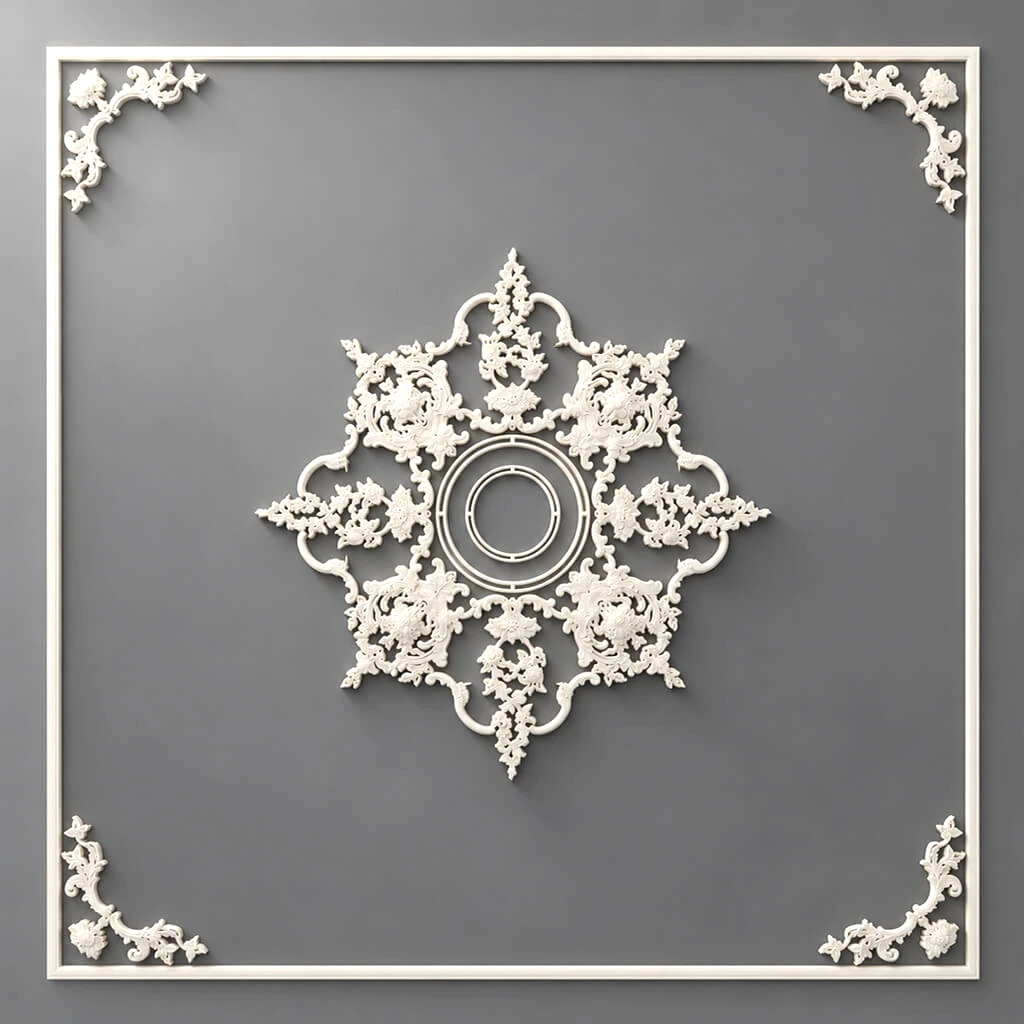
The CPU-070 star-shaped polyurethane composition is listed at 765 × 765 × 18 mm, approximately 30.12 × 30.12 × 0.71 inches. STAVROS describes a modular assembly that uses different decorative component types, including NPU-244, NPU-130, and NPU-309. Its geometry can suit a transitional foyer, a dining space with a geometric pendant, or a room whose wall paneling has crisp axes.
Because the arrangement is modular, lay it out on the floor first. Confirm the order and orientation of every element against the manufacturer's current drawing. The shape will not read correctly if pieces are rotated independently or if the intended gaps are compressed. You can rotate the complete composition to align with the room, but that is a design decision to test with the actual fixture and ceiling lines, not a substitute for the supplied assembly plan.
RPU.VRS-001: a larger composite decorative center
The RPU.VRS-001 ceiling rosette measures 911 × 911 × 18 mm, approximately 35.87 × 35.87 × 0.71 inches. Its product information identifies a composite made from four NPU-507 pieces and four NPU-508 pieces. The eight-part construction is useful when you want a shaped architectural center rather than the look of a simple circular ring.
The key question is how the eight pieces relate to the chandelier canopy. A product's overall footprint cannot answer that question. Review the central layout and the fastener or adhesive recommendations with the drawing in hand. A composite may be easier to transport and position one piece at a time, but it also introduces more alignment decisions, more joints, and additional opportunities for variations in the ceiling surface to become visible.
CPU-071: a grand-scale room statement
The catalog's CPU-071 polyurethane ceiling rosette is listed at 1,365 × 1,365 × 19 mm, approximately 53.74 × 53.74 × 0.75 inches. The product page also uses the label CRPU-071 in its heading, so confirm the exact order designation with STAVROS instead of silently substituting one product code for another. At more than four and a half feet across, this is not a default recommendation for an average American bedroom.
A large modular medallion belongs in a space that can accommodate its visual envelope. Try its outline in a spacious living room, entry hall, or ceiling with a broad open field. Check for ceiling obstructions early. If a fire sprinkler, recessed light, or HVAC component lies inside the proposed composition, the correct response is to redesign the layout rather than cover or move the device without professional review.
Smaller and related ornament options
The STAVROS selection also includes CPU-068 ceiling ornament arrangements and CPU-066 ceiling ornament arrangements. Compare their current product drawings, component descriptions, and material listings before treating them as direct substitutes for the examples above. The shapes and footprints are not universally interchangeable, and a nominal width cannot establish whether the arrangement will work around an existing ceiling fixture.
A different product family is the RPU-020 small polyurethane ornamental rosette, with a listed option of 60 × 38 × 8 mm, approximately 2.36 × 1.50 × 0.31 inches. That is a little architectural ornament, not a substitute for a 30-inch ceiling medallion. It may suit smaller decorative fields, furniture, or coordinated panel accents. Labeling every rosette a chandelier medallion would give shoppers the wrong expectations.
Verified size comparison
| STAVROS model | Published overall footprint | Approximate U.S. dimensions | Design interpretation |
|---|---|---|---|
| CPU-070 | 765 × 765 × 18 mm | 30.12 × 30.12 × 0.71 in | Defined modular star-like geometry |
| CPU-069 | 910 × 910 × 15 mm | 35.83 × 35.83 × 0.59 in | Large, relatively shallow arrangement |
| RPU.VRS-001 | 911 × 911 × 18 mm | 35.87 × 35.87 × 0.71 in | Eight-part composite decorative center |
| CPU-071 / CRPU-071 listing | 1,365 × 1,365 × 19 mm | 53.74 × 53.74 × 0.75 in | Grand-scale focal composition |
| RPU-020 example option | 60 × 38 × 8 mm | 2.36 × 1.50 × 0.31 in | Small ornamental rosette, not a chandelier disc |
These measurements refer to the cited product pages at the time of preparation. Product dimensions may be shown as an overall decorative layout, and components within a kit may have different individual measurements. They do not certify an electrical opening, fastener design, code suitability, or compatibility with a particular light fixture. Use the latest product drawing and ask for clarification before purchasing if the installation depends on a tight dimension.
Build a complete ceiling composition, not just a center ornament
Pair a medallion with a restrained molding frame
A medallion is often most effective when it relates to a second architectural line. In a rectangular dining room, for example, a ceiling molding border can echo the table proportions without duplicating every wall detail. Start with the central ornament, then determine the frame's location by the room's actual visual boundaries. Keep a deliberate gap between the medallion and the inner molding edge. Too little open space makes separate decorations look as though they collide; too much can make them feel unrelated.
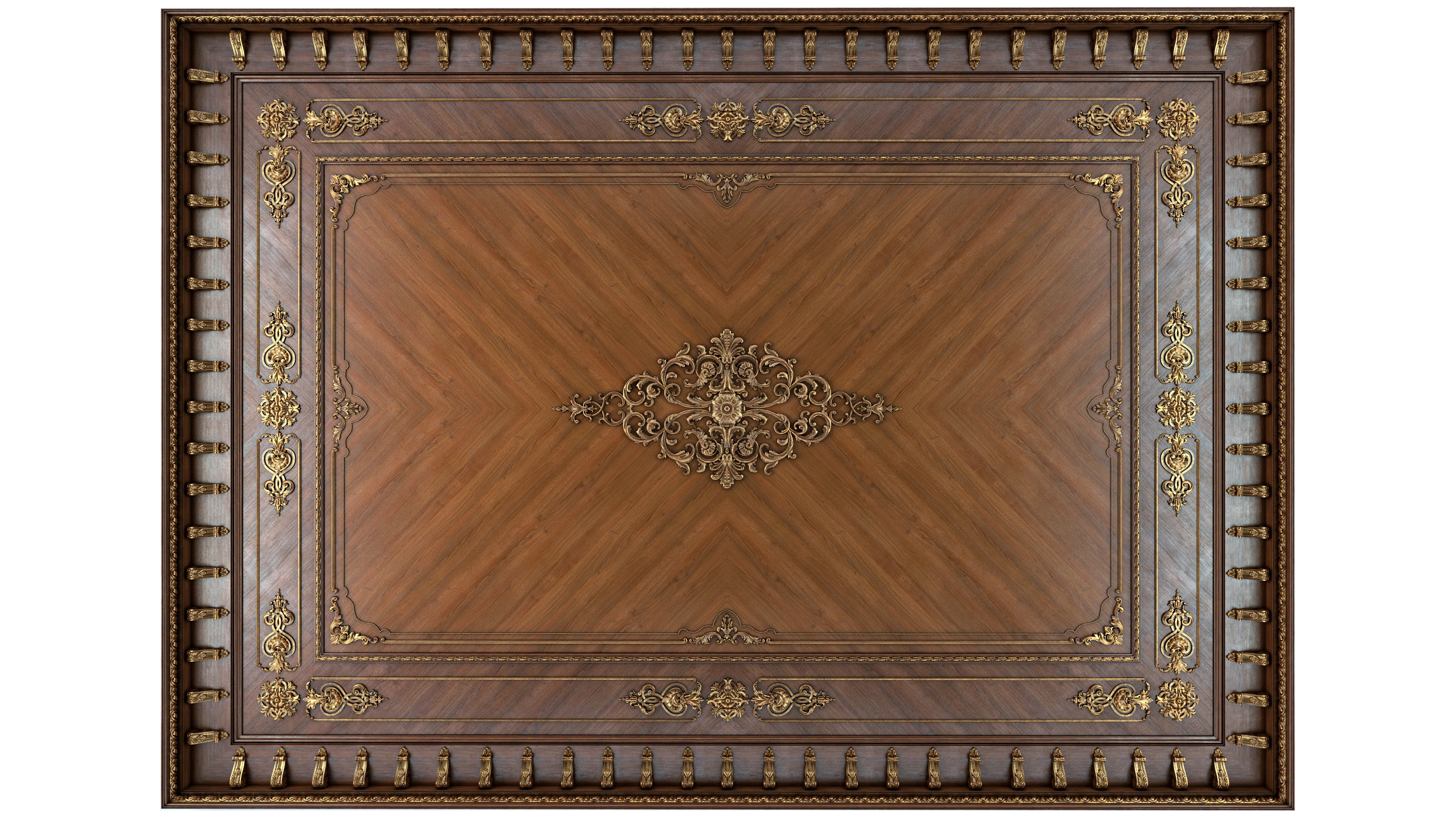
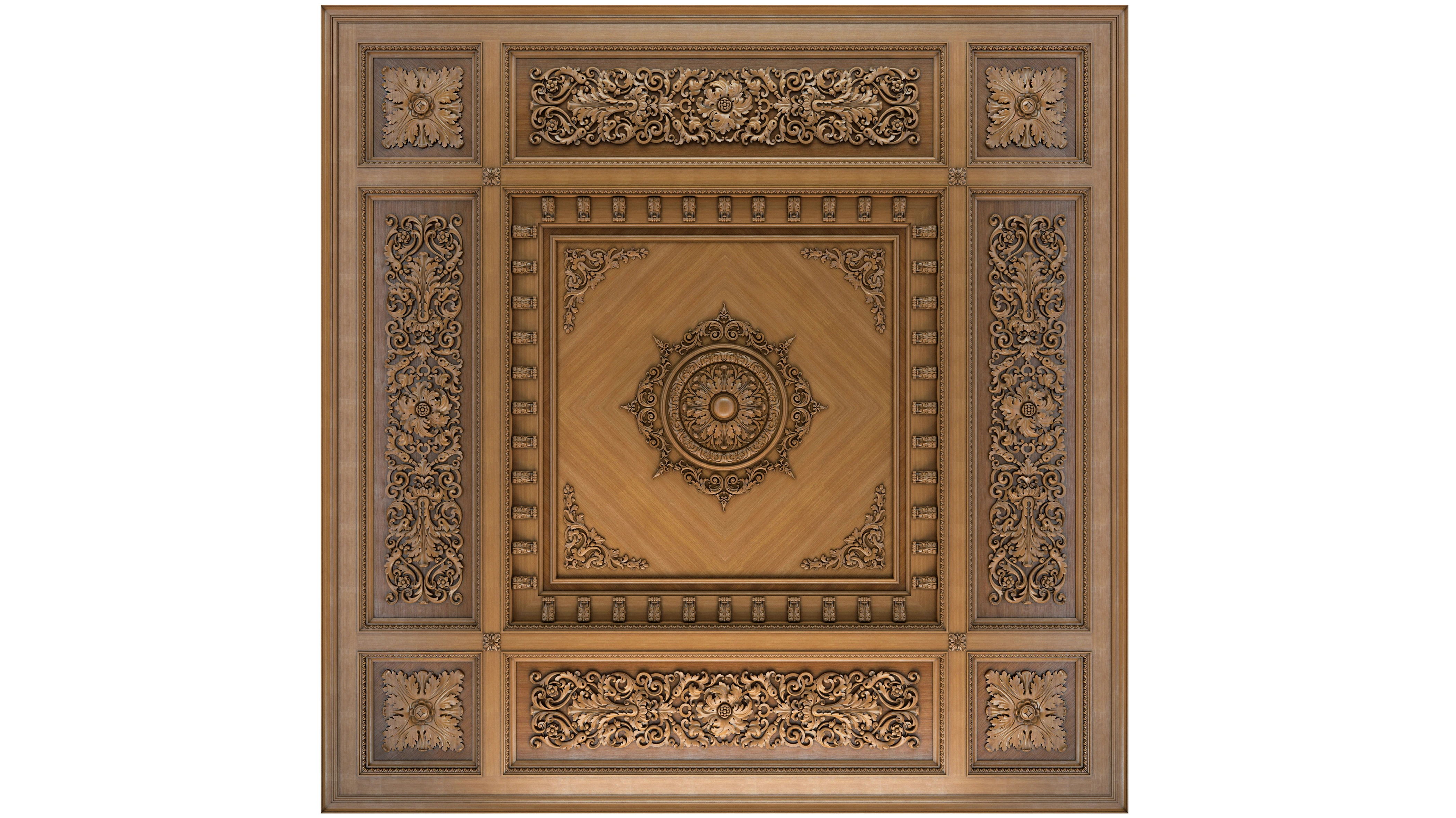
For a framed composition, see the STAVROS ceiling decor kit collection. The group includes the CPU-P series with a nominal ceiling arrangement around 2,500 × 2,500 mm, or approximately 98.43 × 98.43 inches, on currently listed models. This is an overall ceiling design footprint, not the size of a single medallion or a cut sheet that will fit every ceiling without adjustment. Consider the entire ceiling treatment when measuring for furniture and lighting.
Choose between a central wreath and a multi-frame layout
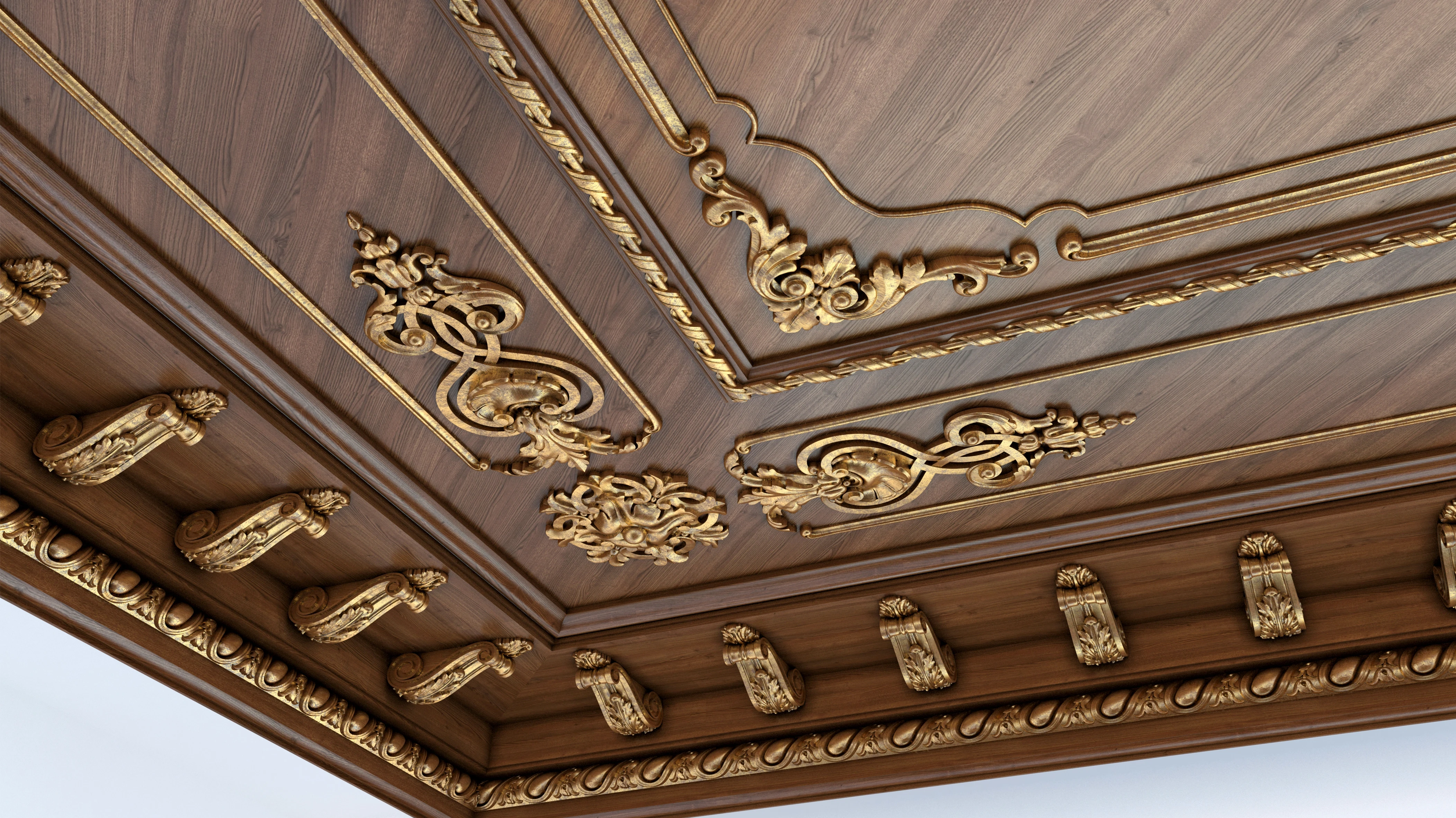
A center-focused room may need only the medallion. Larger or more formal rooms can support a frame, corner accents, and intermediate ornaments. The CPU-P1 ceiling decor kit is worth examining when you want an open central motif inside a structured rectangular composition. Its documented components include polyurethane decorative elements and primed MDF molding profiles; the kit should not be described as entirely polyurethane.
The CPU-P4 ceiling molding kit offers another reference for a central ornament connected visually to a surrounding frame. Compare the diagram and component list rather than assuming the two kits only differ in the number of decorative pieces. If your project must use exclusively polyurethane components, review the material of every item in the proposed kit, not just the name of the category where it appears.
Continue the visual language onto the walls
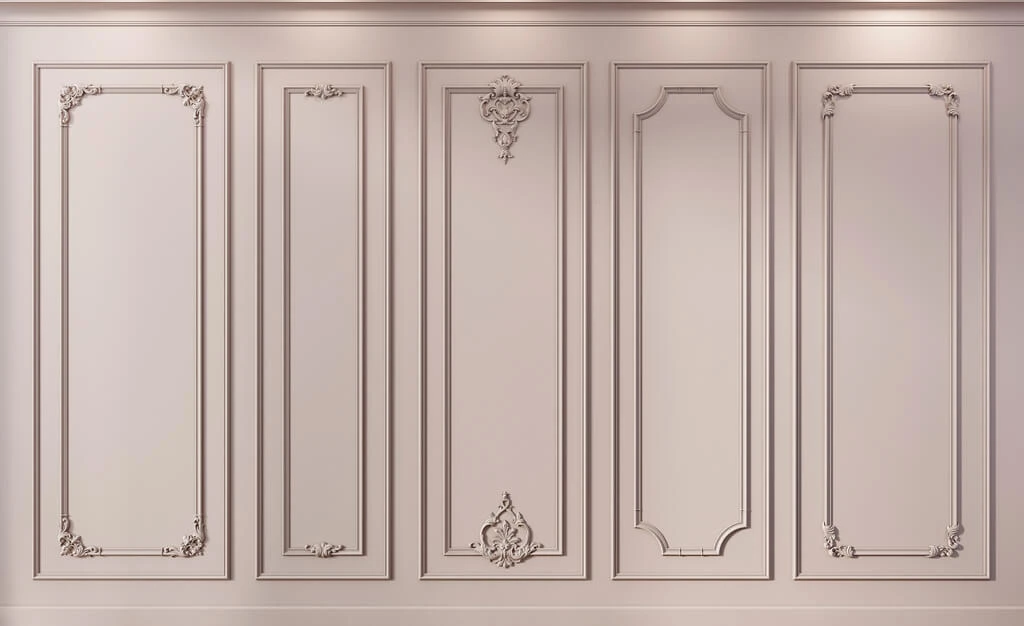
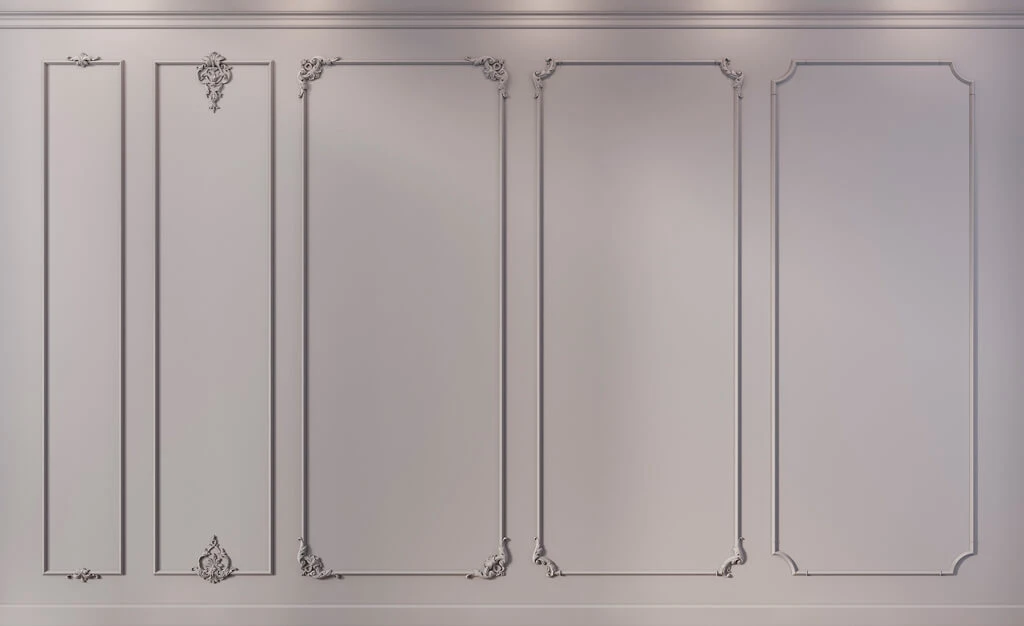
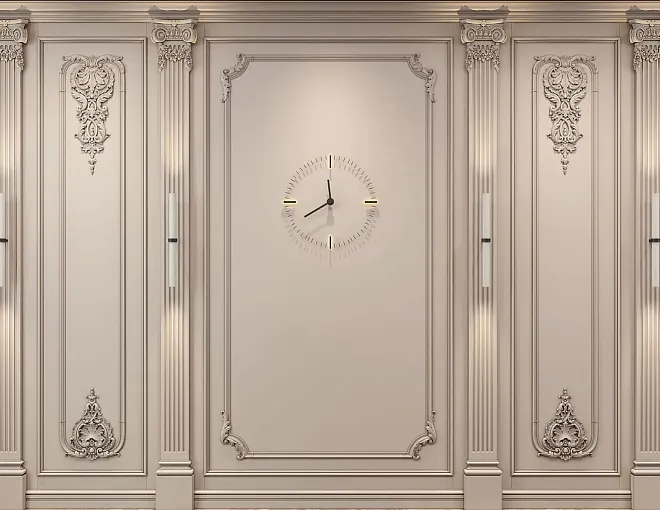
When a room uses ceiling ornament and wall trim, the two surfaces should have a recognizable relationship. That does not require the same flower to appear on the ceiling and every wall. Repeat a more subtle property: line weight, spacing, degree of relief, or the choice between curves and geometry. A modest ceiling medallion may be enough when the walls already feature tall panel frames. A simple wall arrangement can provide balance below an elaborate ceiling.
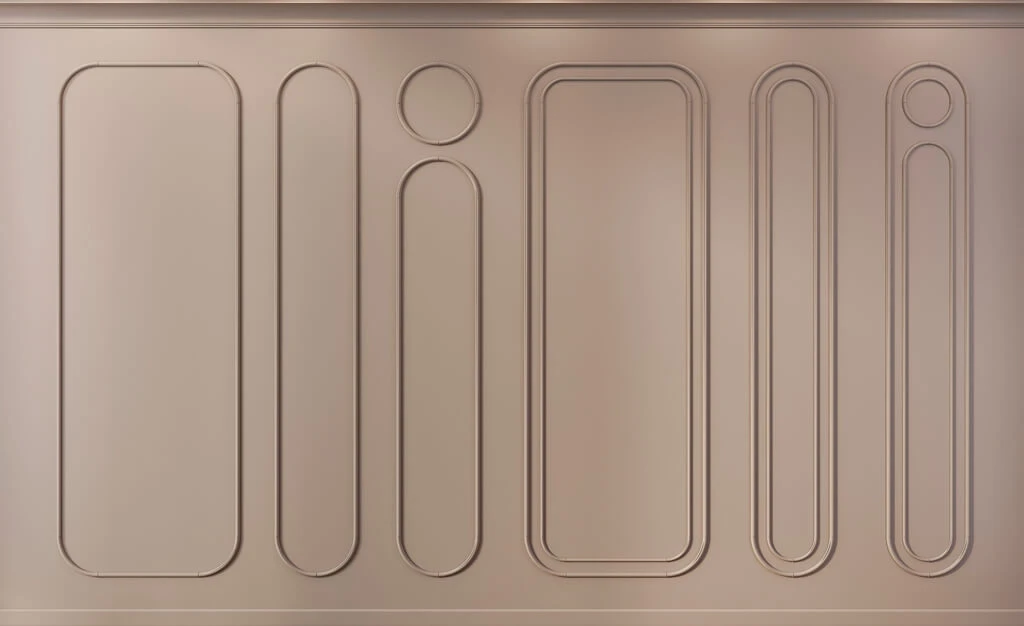
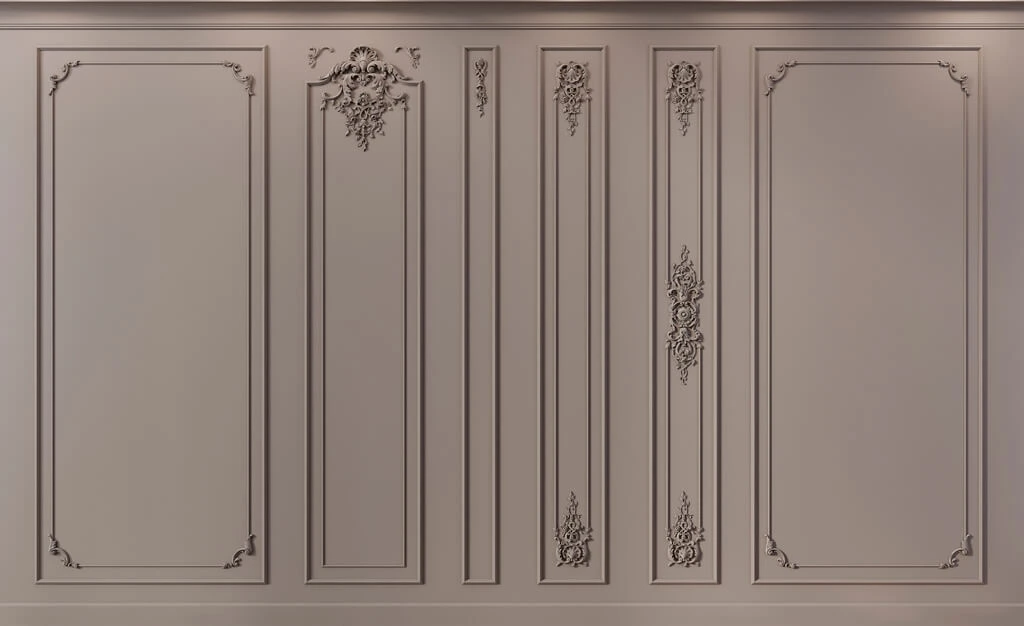
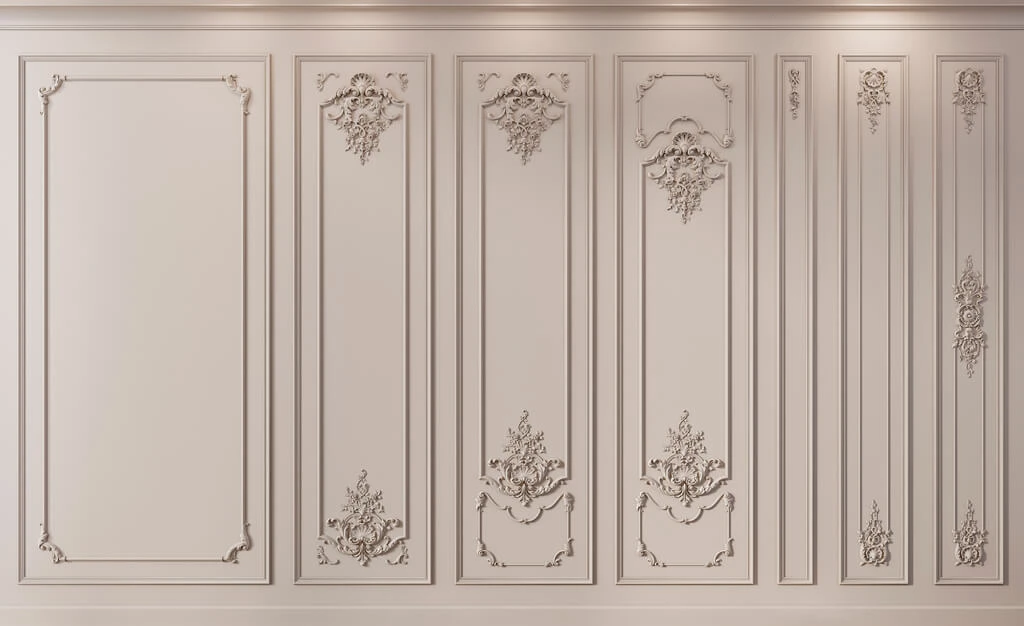
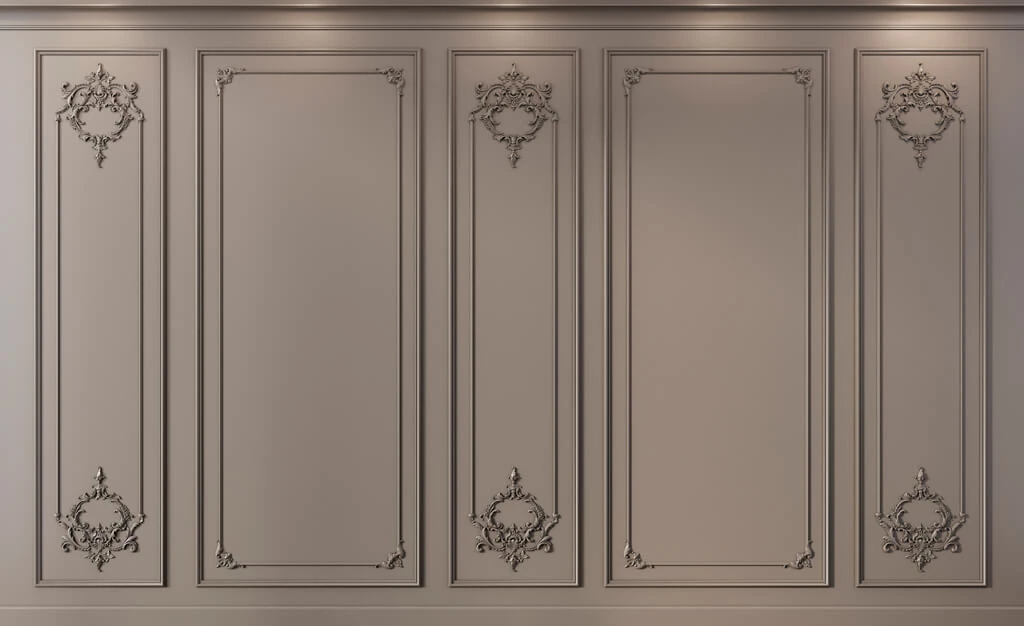
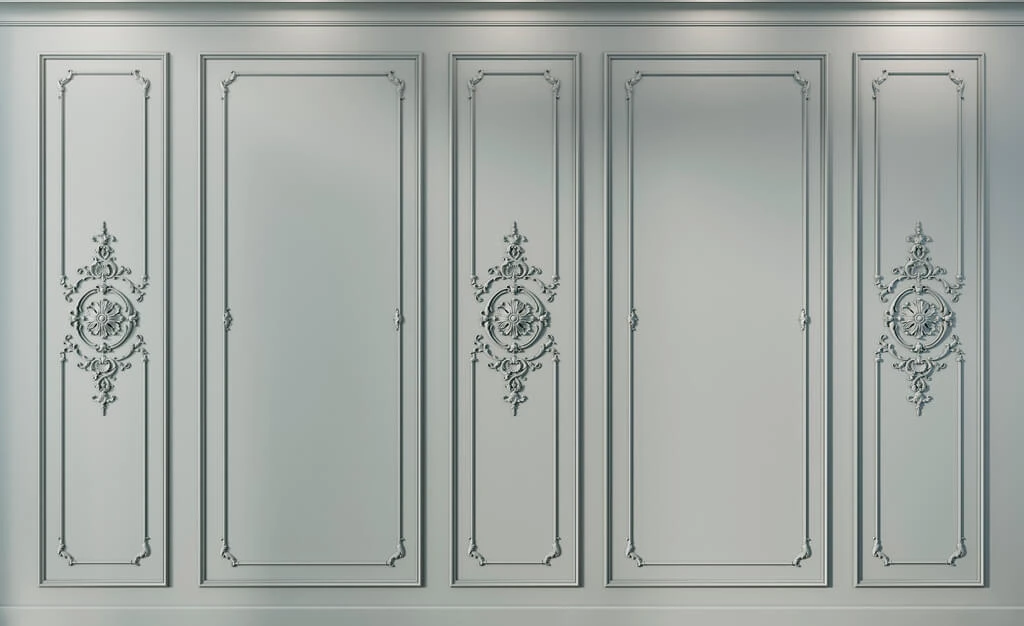
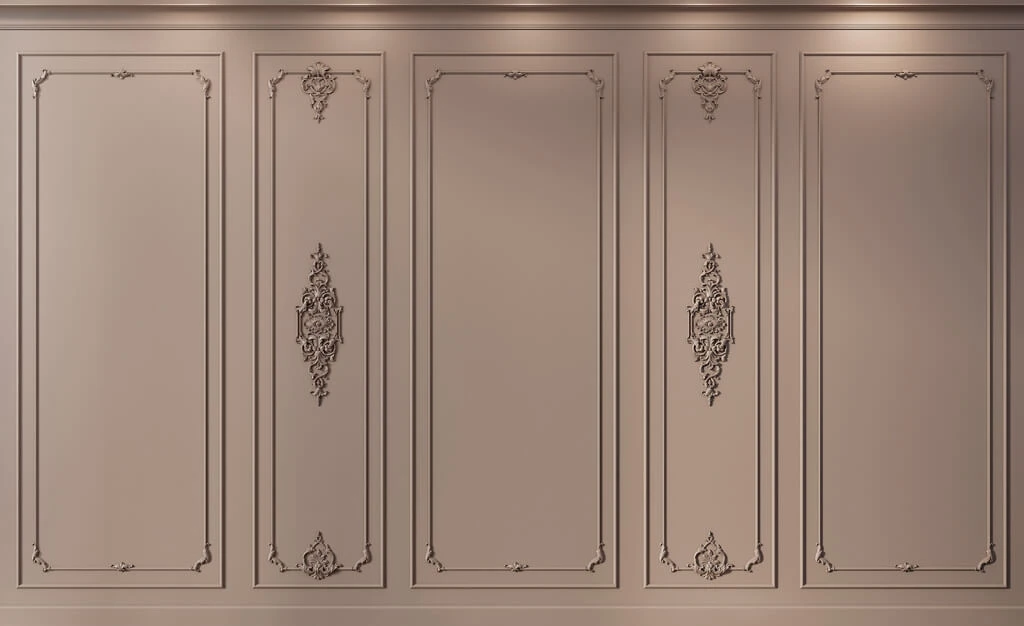
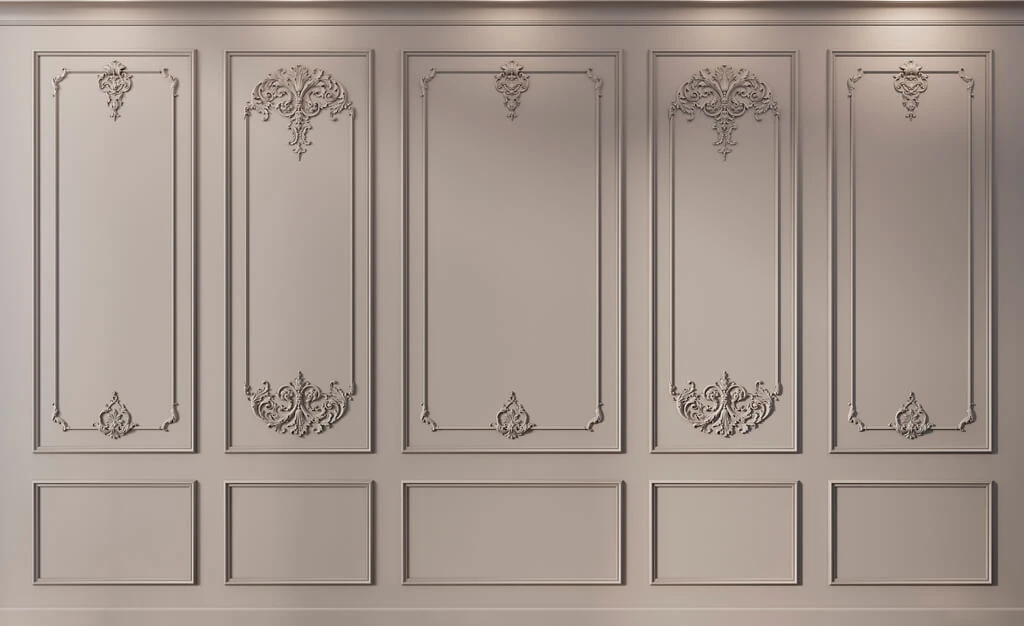
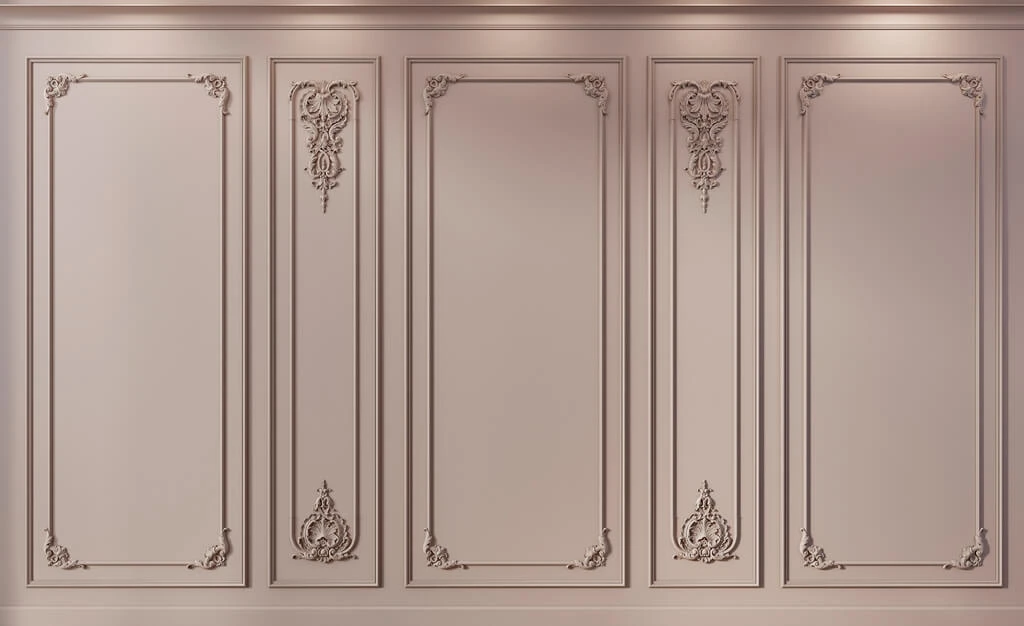
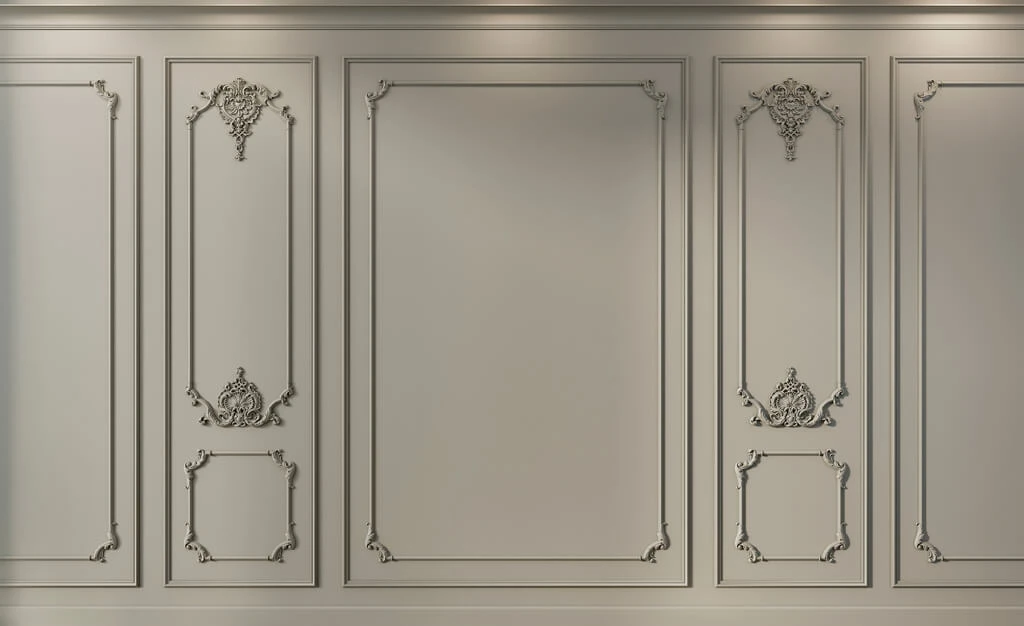
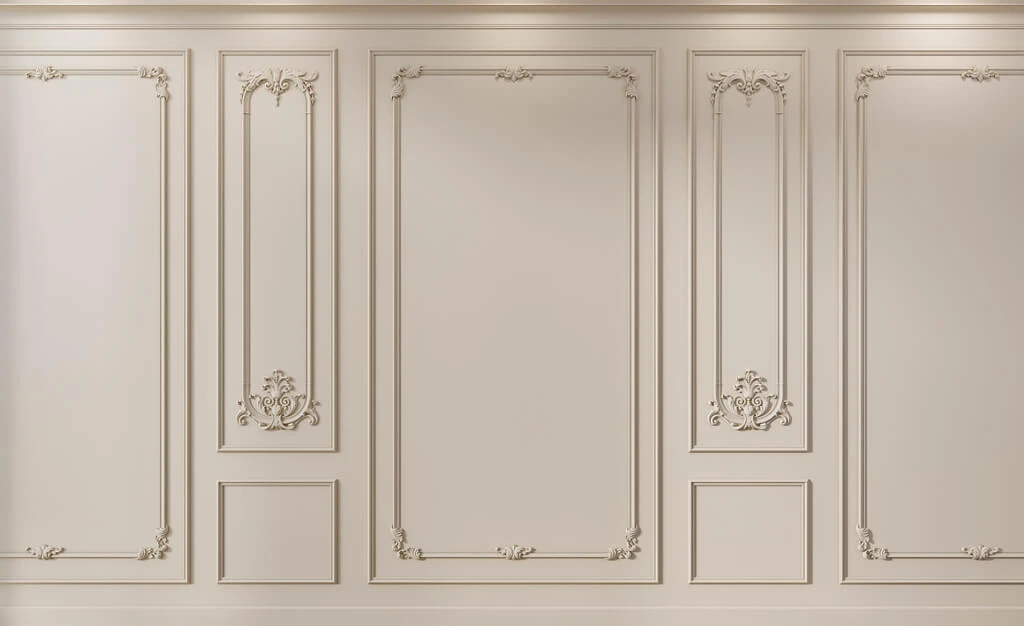
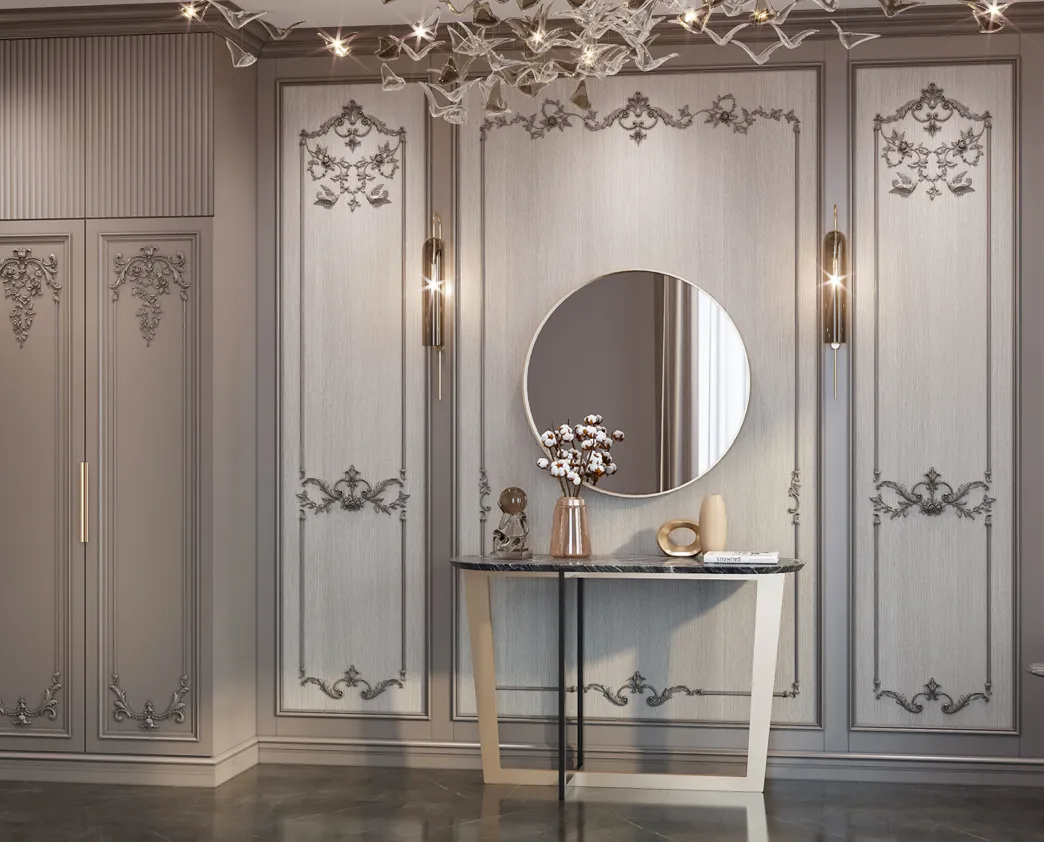
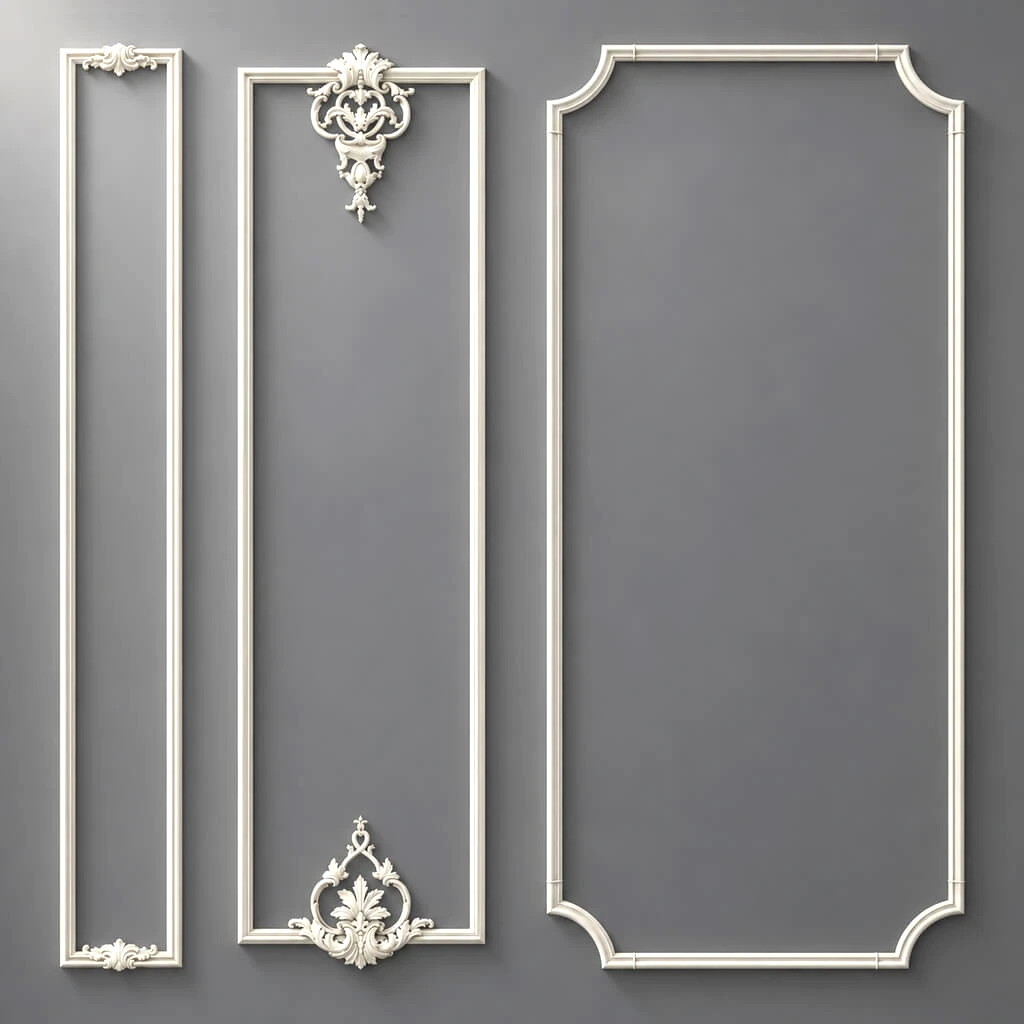
Explore decorative wall molding and panel kits if the project needs a coordinated approach. For a traditional room, let door casing and crown molding establish a steady perimeter while the medallion takes the starring role. For a modern room, keep the panel outlines linear and use one ceiling ornament with very limited contrasting color. The aim is continuity, not a collection of unrelated decorative purchases.
Use crown molding with accurate material labels
Crown molding provides the line where the wall meets the ceiling. It can make a medallion appear integrated with the architecture by defining the room's upper edge. But the material matters. The English site's crown molding category includes polystyrene HIWOOD products; those must not be described as polyurethane simply because they are displayed in the architectural decor area. Verify profile shape, length, material, and installation requirements before pairing them with a polyurethane medallion.
A contemporary room may need only a clean ceiling medallion and ordinary painted walls, without crown molding at all. In a more classical room, choose crown molding with an ornamental intensity lower than the center design so the two features can coexist. Where the ceiling slopes or the wall line is interrupted by tall cabinets, it may be better to omit a crown run than to force a visually inconsistent return.
Architectural style: six combinations worth testing
Transitional dining room: a quiet center with modern furniture
Take a white or warm-neutral ceiling, a simple chandelier, a wood dining table, and softly painted walls. Add one medallion in the same ceiling color and keep the molding frame minimal or absent. The medallion becomes visible as daylight grazes its relief. This is a useful strategy when the furniture has strong silhouettes and a heavy gold or dark ceiling contrast would make the room feel too formal.
Modern classic living room: symmetry without excess
Use one substantial ceiling composition on the main chandelier axis. Repeat a compatible line weight in two or three wall panel frames, but avoid a different scroll pattern in every zone. Keep the room's perimeter trim consistent. If there are two pendant lights in separate seating zones, assess whether both need medallions; a single principal ceiling center often looks more intentional than an equal amount of decoration over every light source.
Art Deco-inspired entry: geometry and measured contrast
A star-like arrangement can emphasize the symmetry of a geometric entry lantern. Use an edited palette: ceiling white and one subdued metallic accent, or a monochromatic finish with strong contrast in the light fixture itself. Avoid assuming that any eight-point design is historically Art Deco; the relationship to the room's doors, flooring, and lighting matters. A geometric medallion in a space full of organic carved furniture may require a transitional element to feel natural.
Cottage or traditional bedroom: a soft floral rhythm
Use a floral or botanical motif with a shallow profile, painted in the ceiling color. Pair it with simple baseboards and doors rather than building a heavy frame across a small ceiling. The visual interest comes from the detail and shadow, not from scale alone. If the fixture is a ceiling fan, confirm that blade clearance, ceiling height, and the support box meet the fan manufacturer's requirements before assuming the decorative design will fit.
Formal foyer: a large composition with an airy chandelier
In a tall entry, a large modular medallion can be visible from the lower level without competing with an intricate chandelier. Select the composition from the primary viewing angles and confirm how its pieces align around the fixture canopy. A broad decorative arrangement works particularly well when surrounding ceiling lights are kept out of its perimeter. Leave service access for electrical and fire-safety equipment undisturbed.
Eclectic interior: repeat one motif, not every motif
Eclectic spaces have freedom, but the ceiling still needs hierarchy. If a chandelier already has crystal drops, ornate arms, and a colored finish, choose a medallion that repeats one characteristic—perhaps a circular rhythm or a floral outline—without imitating all three. A restrained medallion can connect antique furniture with a new paint scheme. A contrast finish should be applied selectively so the relief remains readable rather than becoming a bright ceiling decal.
Material differences that affect the purchase
Polyurethane is not plaster, MDF, PVC, or polystyrene
Polyurethane architectural decor is molded from a polymer material, which can reproduce dimensional ornament at a weight and construction different from traditional plaster. Its specific performance depends on the formulation and product, not on the word polyurethane alone. Plaster offers a mineral finish with its own repair and installation considerations; wood presents grain, seasonal movement, and joinery questions. MDF is an engineered fiberboard that may be used for long primed linear profiles in mixed kits. Polystyrene and PVC are distinct polymer materials with their own finishing, adhesive, and temperature limitations.
When buying a medallion or polyurethane architectural molding, check the product-level material description. A category may display visually related items made from different substances. Do not assume the same primer, adhesive, nail pattern, or cutting method is appropriate for all of them. A product marketed as a decorative wall rosette is also not automatically intended to sit beneath a light fixture.
Moisture and temperature are application questions
A molded polyurethane ornament may be suitable for many interior settings, but no general material statement guarantees performance in a steamy bathroom, directly above a range, or near a high-output lamp. Ask whether the particular item and finish are rated for the intended environment. Confirm the fixture's heat and clearance requirements and avoid enclosing anything that requires ventilation. If an installation sits near a shower, resolve electrical protection and location requirements with a qualified professional before considering decorative options.
A modular kit is a system of parts
Large ceiling compositions often arrive as multiple elements with specific orientations. Count the parts, confirm the layout dimensions, and identify any profiles made from other materials. The installer must know which details are intended to meet, which gaps form part of the drawing, and where there is a deliberately open center. Even a well-designed modular kit can look uneven if the ceiling is not flat or if the alignment marks are made from the wrong reference axis.
For comparison of available physical samples and drawings, use STAVROS molding samples and decor catalogs as a starting point. A sample or current technical drawing is particularly valuable when texture, relief depth, color matching, or surface preparation is important. If there is any ambiguity about the contents of a set, request the exact current bill of materials before ordering.
Plan installation and electrical safety before decorating
Separate decorative attachment from fixture support
A chandelier, ceiling fan, or pendant needs its own listed, properly installed support. The ceiling medallion is not load-bearing. Turning off the relevant circuit at the breaker and verifying that power is off are essential precautions whenever work could expose electrical components. Electrical wiring, fixture mounting, and any modification to the electrical box should be handled by a qualified electrician in accordance with the fixture instructions and locally applicable codes. A medallion must not trap an electrical box where access is required or prevent the fixture canopy from seating as designed.
If the medallion is for a ceiling fan, check the fan-rated support, the blade sweep, and the clearance around raised decoration. For a chandelier, confirm that the canopy, stem, and mounting hardware can accommodate the decorative thickness. A heavy modular ceiling composition also needs an attachment plan appropriate to its weight and individual components; do not assume that one bead of adhesive will support every product on every substrate. Follow the current STAVROS instructions and the adhesive manufacturer's tested assembly requirements.
Prepare the surface and mark the axes
Before opening adhesive, document the existing finish. Loose paint, dust, flaking texture, or a damp ceiling can compromise adhesion. Do not remove old textured coatings without checking whether testing and appropriate remediation are required; older ceiling finishes can contain hazardous materials. Clean and prepare sound surfaces using compatible methods, let repairs cure, and verify that the ceiling is sufficiently flat for the actual component backs. On a modular kit, mark a center point plus two perpendicular axes, then lay out every component dry before making the final fixing decisions.
Small changes in spacing become obvious around a circular or star-shaped pattern. Measure from the same fixed axes throughout rather than placing each piece by eye relative to the preceding piece. An assistant can hold larger sections during a dry fit. Photograph the complete layout and label the backs of repeated parts if the manufacturer's instructions allow, so mirrored or rotated ornament is not confused during installation.
Adhesive, fasteners, and finishing sequence
Use a product-specific compatible installation adhesive and any specified mechanical fastening. Some assemblies call for temporary bracing or support while the adhesive develops strength. The amount of adhesive, open time, cure time, fastener type, and substrate preparation depend on the selected product and installation system; no universal minute count is reliable. Do not put adhesive or patching compound into electrical equipment, and do not conceal devices that require access.
Finish joints only after components are correctly positioned. A paintable, material-compatible filler or caulk may work for perimeter seams, but a deliberate ornamental gap should remain open. Sand only as permitted by the product and coating instructions, and avoid erasing fine relief detail. Where the installation meets an existing light canopy, confirm that finishing work has not changed the required clearance. The STAVROS finishing and installation advice provides an additional starting point; product-specific directions take priority over generalized decorating advice.
Paint and light the medallion with intention
Select a finish system, then test it
Do not assume that every polyurethane piece arrives with the same primer or that all coatings are compatible. Inspect the current product description, test a small hidden area, and choose a finish approved for the molded surface. A ceiling-color finish usually emphasizes light and shadow while keeping visual contrast low. A gently contrasting eggshell or satin color can make a geometric arrangement clearer, but high sheen may exaggerate surface imperfections. Metallic glazes or antique effects are best tested before they are applied to the full ornament.
Paint small recesses with the appropriate brush and avoid letting finish pool in details. Larger flat areas can often be finished with a suitable small roller or controlled spray system, subject to site conditions and coating directions. If prepainting individual pieces, account for seams that need touch-up after assembly. For more focused guidance, consult the STAVROS article on painting polyurethane decorative molding.
Let architectural shadows do part of the work
A medallion's texture depends on light direction. Natural daylight from side windows produces changing shadows; a chandelier may wash the center from below, making the outside relief more visible than the inner details. Test the room after dark and during the day. Do not add concealed LED strips behind a product unless the planned system allows appropriate access, heat management, electrical installation, and separation from combustible or temperature-sensitive materials. A simple well-positioned fixture can be more effective than complex backlighting.
A practical ordering checklist
Before requesting a quote or placing an order, gather the room plan, ceiling height, chandelier width, canopy dimensions, desired finish, and photos showing the actual ceiling obstacles. Select a model by verified SKU and compare its overall layout, depth, component list, material, and center geometry. Ask for a current dimensioned drawing if the fixture must pass through a specific opening. For a modular set, confirm whether the supplied parts are all polyurethane or include MDF or another material. A clear part list makes both installation planning and replacement orders more accurate.
For an American buyer, clarify the purchasing and delivery terms for the actual destination before budgeting. The English-language website and prices displayed in a chosen currency do not, by themselves, establish U.S. inventory, a local warehouse, guaranteed delivery dates, import charges, or a fixed installation service. Use the STAVROS product and order contact page to confirm current availability, product documentation, and shipping arrangements relevant to your project. A thoughtful inquiry with measurements will usually produce a more useful answer than an unspecified request for the “best ceiling rose.”
Frequently asked questions about polyurethane ceiling medallions
Is a ceiling medallion the same thing as a ceiling rose?
They often refer to the same architectural concept, but ceiling medallion is the clearer U.S. shopping term. In the United States, rosette can also mean a much smaller ornament on furniture or millwork. On a product page, check the dimensions and intended application rather than relying only on the translated name.
How large should a ceiling medallion be over a dining table?
Begin with the chandelier width and the usable ceiling field above the table. Mock up the candidate size from the chair and doorway views. An 18-to-26-inch example may be a useful starting point in some average dining rooms, but larger modular designs are possible where ceiling height and composition justify them. There is no single ratio that works for every fixture and room.
Can the chandelier hang from the medallion?
No. A decorative medallion is not a structural or electrical support. The chandelier or fan must be mounted to the independently appropriate support system, with electrical work performed according to applicable requirements. The canopy also needs the fit and clearance specified by its manufacturer.
Can I use a large modular arrangement without a chandelier?
Yes, where the product is suitable for the ceiling substrate and the manufacturer's installation method is followed. A ceiling ornament can define a seating area, foyer, or gallery space on its own. In that case, keep electrical openings closed or otherwise properly finished rather than creating holes for wiring that does not exist.
Are decorative ceiling kits made entirely of polyurethane?
Not necessarily. Some STAVROS CPU-P compositions combine polyurethane ornaments with primed MDF linear profiles. Check each bill of materials. An all-polyurethane requirement should be communicated before purchasing, especially when the design combines centerpieces, corner details, and long molding runs.
Can I install a medallion over an existing textured ceiling?
Only after the substrate is assessed and prepared in accordance with the product and adhesive instructions. Loose or uneven texture can prevent full contact. Do not scrape an older ceiling surface without considering the possibility of hazardous material. Professional preparation may be more appropriate than an improvised adhesive solution.
What is the best ceiling medallion color?
Matching the ceiling is a versatile option because relief appears through shadow rather than strong contrast. Contrasting paint can define the ornament in formal or eclectic spaces, but it also makes the medallion feel larger. Test your chosen finish against the actual room lighting and verify paint compatibility with the product surface.


A ceiling design worth keeping
Choose a ceiling medallion the way you would choose architectural trim: by scale, material, connection to the room, and how it looks under real light. A beautiful chandelier deserves a carefully sized visual setting, not a decorative afterthought. The strongest scheme may use a single polyurethane centerpiece, or it may combine a modular rosette with a restrained molding frame and coordinated wall details. Whatever the style, verify the actual STAVROS components, keep electrical support independent, and preserve the ceiling's functional clearances. When those decisions are made well, the ornament feels like part of the architecture rather than something attached to it later.