










































































Article Contents:
- Why interior style is the first thing to consider when choosing stucco molding
- What exactly to look at before choosing
- Stucco molding for modern interiors: invisible architecture
- The main rule: stucco molding in the color of the wall
- Molding profile for modern interiors
- Molding width for modern style
- How to use moldings in a modern room
- Ceiling rosette in modern interiors
- Decorative stucco in modern interiors: as dosed as possible
- Stucco for neoclassicism: a balance between richness and restraint
- The character of neoclassicism
- Moldings for neoclassicism
- Molding system in a neoclassical interior
- Ceiling rosette in neoclassicism
- Decorative stucco in neoclassicism
- Color of stucco in neoclassicism
- Stucco for classical interiors: boldness of ornament
- What is a classical interior from a decorative perspective
- Moldings for classics: rich profile
- Cornice in a classic interior
- Ceiling rosette in classic style: size and relief
- Decorative stucco for classic style: what and where
- Color of stucco in classic style
- Stucco for Art Deco: geometry as philosophy
- Character of Art Deco
- Moldings for Art Deco
- Frames in Art Deco
- Contrast painting in Art Deco
- Ceiling rosette for Art Deco
- Decorative stucco for Art Deco
- Summary table: stucco for interior style
- How to choose stucco if the interior style is not defined
- Identify the dominant element
- Use moldings in the color of the wall as a universal option
- Start with one zone
- Practical kits for different styles
- Modern kit
- Neoclassical kit
- Classic kit
- Art Deco Set
- Mistakes When Choosing Moldings for a Style
- FAQ: Answers to Popular Questions About Choosing Moldings for a Style
- About the Company STAVROS
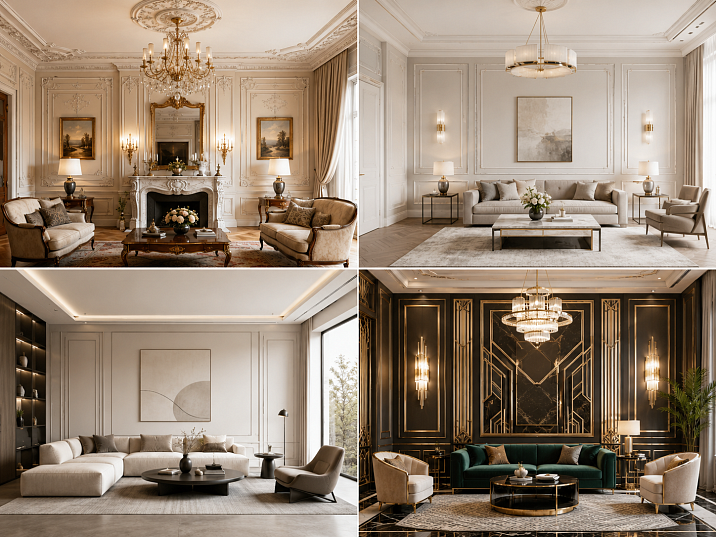
Imagine this scene. A person stands in front of a screen with an open catalog of moldings. Moldings of different profiles, rosettes, overlays, cartouches, cornices. Everything is beautiful. You want it all. But there is one question in your head: "Will this even suit my interior?"
This is where most people make their first mistake: they choose moldings separately from the room's style. They buy what they liked on its own — and then discover that an ornamental cartouche looks alien in a minimalist apartment, and a simple smooth molding gets lost against the background of heavy classic doors.
Moldings are not a separate element of the interior. They are part of its language. And you need to choose them the same way you choose a font for text: it should speak with the same voice as the rest of the interior.
Buy moldings for a specific style — means understanding the character of that style and selecting elements that enhance it, rather than conflict with it. This article is a detailed breakdown of four main styles: modern, neoclassical, classic, and art deco. With specific recommendations on profile, relief, scale, color, and configuration.




Why Interior Style Is the First Thing to Start With When Choosing Moldings
There is a temptation to think that moldings "in general" enhance any interior. This is not true. The same 45 mm wide molding can look:
-
flawless — in a neoclassical living room with wooden doors and neutral walls;
-
pretentious — in a modern apartment with glass and metal;
-
too plain — in a rich classic interior with stucco cornices and heavy drapes.
Context defines everything. Ceiling, doors, furniture, wall color, chandelier, materials — each of these elements speaks a certain language. Stucco must speak the same language. Otherwise, it stands out from the ensemble.




What exactly to look at before choosing
Before opening the catalog — look at your room and answer a few questions:
Doors. What is the profile of the door trims? Smooth, stepped, ornamental? Moldings should be in the same profile family.
Furniture. Is it geometric or with rounded shapes, with or without ornament? Heavy classic furniture requires corresponding stucco. Modern furniture — calm lines.
Ceiling. Is there already a cornice or baseboard? What is its character? Stucco on walls and ceiling should form a system, not a set of different elements.
Chandelier. Shape, style, material. The ceiling rosette should be in dialogue with the chandelier.
General character. Is there a sense of strictness and geometry (modern, art deco) or softness and ornament (classic, neoclassic)?
Buy molding — this is the second step. The first is to honestly look at your interior and determine its style.
Our factory also produces:


Stucco for a modern interior: invisible architecture
A modern interior is the most demanding style for stucco. Not because it doesn't belong here. But because here it must work on the edge of visible and invisible.
In a modern interior, stucco is present — but does not catch the eye. It creates an architectural rhythm, structures surfaces, adds depth — and at the same time does not disturb the feeling of cleanliness and conciseness.
Get Consultation
The main rule: stucco in the color of the wall
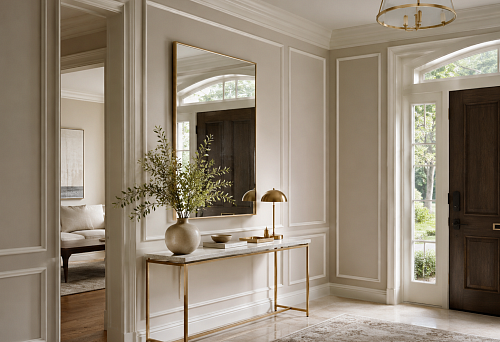
The first and most important rule for a modern interior: Moldings made of polyurethane are painted the same color as the wall. No contrast. No white on a colored wall — unless it is a deliberate architectural technique.
When the molding is the same color as the wall, it creates a chiaroscuro effect: the form is present, the volume is felt, but the color does not divide the surface into parts. This is subtle, expensive, and modern.
Molding profile for a modern interior
In a modern style, the following work:
-
Smooth stepped profile — rectangular or square sections, without ornament. Clear geometry, architectural rigor.
-
Simple corner profile — L-shaped or T-shaped. Minimalism in its pure form.
-
Cove molding with minimal relief — smooth concave line without decorations.
What does NOT work in a modern interior: moldings with egg-and-dart, acanthus, ornamental beads, scrolls, leaves, and baroque profiles. All of this is the language of classicism and baroque. In a modern interior, such molding will look like a random quote from another era.
Molding width for modern style
The more modern the interior, the thinner the molding. General rule:
-
Minimalist apartment → molding 20–35 mm
-
Modern interior with decorative elements → molding 35–50 mm
-
Modern classic (transitional style) → molding 45–60 mm
buy polyurethane moldings for a modern interior — look for a profile with minimal cross-section and without ornament.
How to use moldings in a modern room
Several scenarios:
Frames on an accent wall. One wall (usually the one that catches the eye upon entry) is divided into rectangular fields with moldings. Moldings in the same color as the wall. One accent — not the whole room.
Horizontal band. One horizontal molding at a height of 90–100 cm from the floor — like a conditional "handrail" or divider. Works in hallways, entryways, bathrooms.
Vertical accents. Two or three vertical moldings on the wall, running from floor to ceiling. The rhythm of verticals is a modern and very architectural technique.
Ceiling rosette in a modern interior
Ceiling rosette in a modern interior — only geometric. Simple concentric circles, clear geometric shapes, no ornamentation. Paint in the color of the ceiling.
Size of the rosette in a modern interior — slightly smaller than the "classic norm." For a room of 18 sq. m — a rosette of 40–50 cm instead of the usual 55–65 cm.
Decorative stucco in a modern interior: as dosed as possible
Decorative stucco in a modern interior — one element, in one place, with the right scale. This doesn't mean it shouldn't be there. It means it should be a precise, intentional gesture — not a set of decorations.
A good option for a modern interior: a medallion with a clear geometric pattern as a central accent on a wall or ceiling. No ornamentation, no curls — only line and form.
Stucco for neoclassicism: a balance between richness and restraint
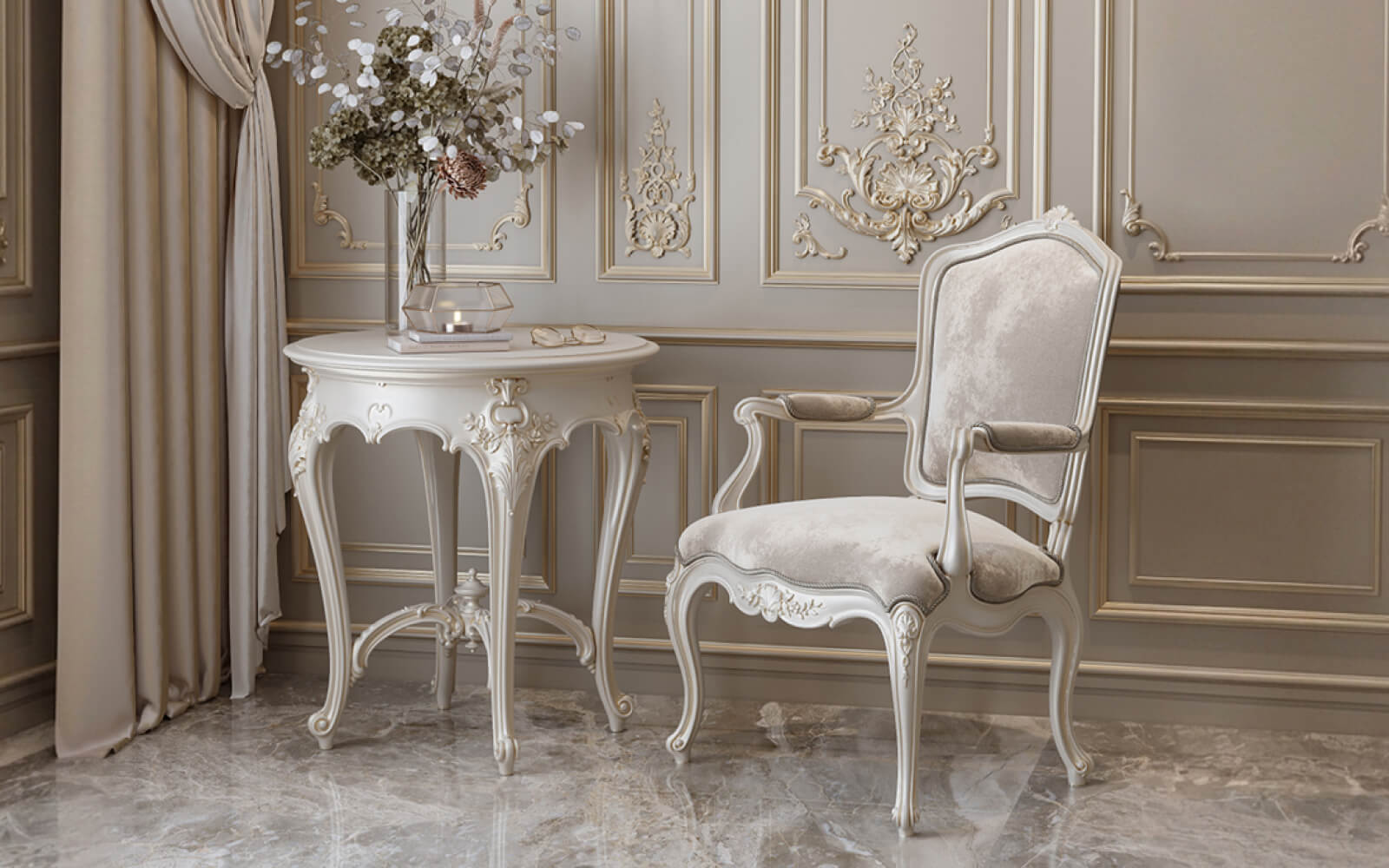
Neoclassicism is a space where most stucco buyers live. Not strict minimalism, not heavy classicism — but something in between: comfortable, beautiful, with character, but without overload.
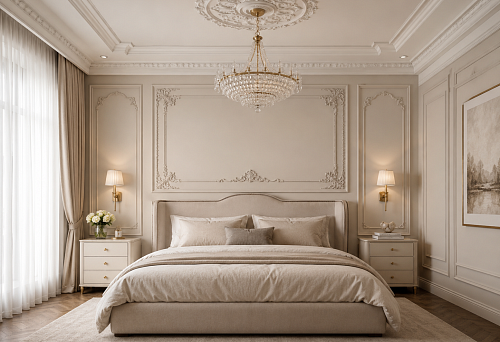
Molding for neoclassicism — this is the most commercially active segment. Here, moldings on walls, a ceiling rose under a chandelier, a decorative element in one zone, calm symmetry — all of this works together and creates exactly the interior that is shown in magazines as "modern classic."
The character of neoclassicism
Neoclassicism takes the architectural principles of classicism — symmetry, proportions, ornament — but softens them. There is no Baroque overload here, but there are references to classical form: pilasters, frames, cornices, rosettes with moderate relief.
Keywords of neoclassicism: symmetry, proportion, moderation, white color, neutral tones, calm ornament.
Moldings for neoclassicism
The profile of a molding in a neoclassical interior is stepped or with moderate ornament. Allowed:
-
Shelf molding (shelf profile) — a horizontal protruding line
-
Ionic or bead — a small ornamental element on the profile
-
Ovoid (egg and dart) is a classic ornament, but in a calm execution
What is unacceptable in neoclassicism: overloaded baroque profiles, heterogeneous moldings in one room, mixing ornaments from different eras.
Buy polyurethane moldings for neoclassicism — look for a profile with a moderate, clear relief. Width — 40–65 mm for standard ceilings 2.6–2.8 m.
Molding system in a neoclassical interior
In neoclassicism, moldings form a system — not just frames on one wall, but a coordinated decorative structure of the entire room:
Cornice along the perimeter of the ceiling. Transition from wall to ceiling. Molding 55–80 mm depending on ceiling height.
Frames on walls. Rectangular or vertical fields dividing the wall into decorative panels. Molding 35–50 mm, matching the wall color or white.
Baseboard. Completion of the wall at the bottom. Molding 60–80 mm, coordinated in profile with the cornice.
Ceiling rosette. In the center of the ceiling, under the chandelier. Diameter — according to the scale of the room.
All elements of this system must be from the same family of profiles and the same material. Only then does the feeling of a well-thought-out interior arise, rather than a set of random purchases.
Ceiling rosette in neoclassical style
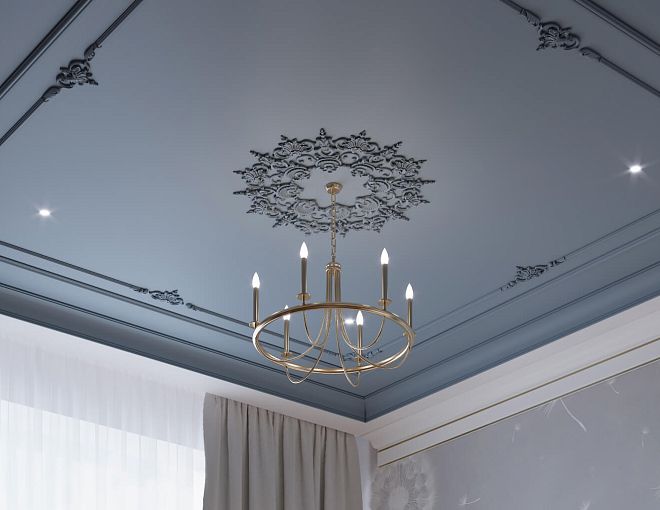
Ceiling molding And the rosette in neoclassical style — a moderate, calm relief. Laurel wreath, acanthus ornament, concentric bands with ionic beads — all of this works.
Size of the rosette for neoclassical style:
-
Room 15–20 sq m → rosette 50–65 cm
-
Room 20–30 sq m → rosette 65–80 cm
-
Room from 30 sq m → rosette 80–100 cm
Color of the rosette in neoclassical style: white on a white ceiling — a classic and flawless option.
Decorative stucco in neoclassical style
Buy decorative stucco For neoclassical style — choose one element for the main accent zone. This could be:
-
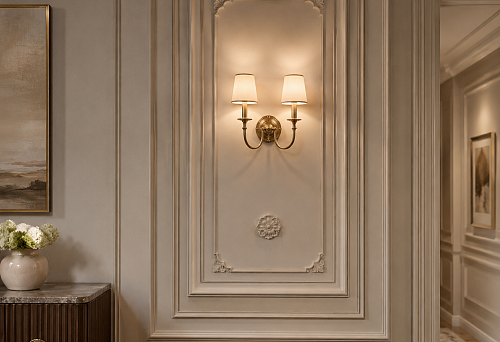
Medallion in the central frame on the accent wall
-
Cartouche above the fireplace or mirror
-
Decorative element above the headboard in the bedroom
-
Ornamental overlays at the center of the cornice or frame
Keyword — one zone. In neoclassicism, decorative stucco should not be everywhere. One precise accent — and that's it. Let the rest speak through moldings and proportions.
Color of stucco in neoclassicism
Two correct options:
-
White stucco on neutral walls — a classic of neoclassicism. White moldings, white cornices, white rosette. Walls in neutral tones: gray-beige, cream, ash-gray.
-
Stucco in the tone of the wall — a delicate, 'expensive' option. Works especially well with rich wall colors: dark green, dark blue, burgundy.
Gold and metallic tones in neoclassicism — possible, but in doses. Only as an accent on one element (medallion, rosette), not on all moldings.
Stucco for a classic interior: boldness of ornament
Classicism is a space where stucco can speak at full volume. There's no need to hold back here. Ornament, relief, large profiles, and rich decor are not excess but the norm.
But "full volume" does not mean chaos. Classicism demands rigor in another sense: all elements must belong to the same era, the same order, the same decorative vocabulary.
What is a classic interior from a decorative perspective
A classic interior is based on historical European styles: Renaissance, Baroque, Empire, Georgian, Louis XIV–XVI. Each has its own decorative system with its own rules.
Common features of a classic interior:
-
High ceilings — from 2.8 m and above
-
Heavy doors with rich architraves
-
Furniture with carved elements
-
Floor-length drapes
-
Chandelier with crystal or bronze
-
Parquet or carpet
In such a space, stucco molding doesn't hold back — it's a full participant in the decorative ensemble.
Moldings for classic style: rich profile
Moldings made of polyurethane for classic style — wide, with an expressive ornamental profile:
-
Ionic (egg-and-dart) — classic ornament of eggs and anchors
-
Acanthus leaf — large floral ornament
-
Meander — geometric ornament of straight lines
-
Laurel wreath combined with other motifs
-
Multi-tiered profile with several decorative bands
The width of a molding in classic style is 60–120 mm. This is not a mistake. In a tall classic space, a 45 mm molding looks thin and insufficient.
Cornice in a classic interior
A cornice around the perimeter of the ceiling in classic style is one of the main architectural elements. It can include several tiers: dentils (teeth), astragal, cyma, shelf.
Buy ceiling molding For classic style — means choosing a composite cornice with several profiles or a wide multi-tiered molding 100–150 mm high. In a large room with a ceiling of 3 m or higher — the cornice can be 200 mm.
Ceiling rosette in classic style: size and relief
In a classic interior, the rosette is not a modest accessory. It is an architectural element with a full-fledged ornament:
-
Acanthus leaves around the perimeter
-
Baroque scrolls
-
Multi-tiered relief with ornamental bands
-
Large diameter — 80–130 cm
For a classic hall or living room with an area of 30+ sq. m — a rosette with a diameter of 90–120 cm is appropriate and organic.
ceiling rosettes for classic style — look for the richest relief and a diameter proportional to the room.
Decorative stucco for classic style: what and where
In a Classic Interior Buy Moldings needed for several zones at once:
Above the fireplace. The fireplace in a classic interior is the central element of the room. Above it — a decorative cartouche or horizontal ornamental panel. Rich relief, large scale.
Above mirrors. Mirrors in classic style are framed with moldings and decorated above with a cartouche or ornamental fragment.
In the corners of frames. Corner overlays in each frame on the wall. Large, ornamental.
On the cornice. Decorative rosettes or inserts along the perimeter of the cornice — at equal intervals.
On the baseboard. Corner elements at baseboard joints.
In a classic interior, decor is present everywhere — but it forms a system. This is not a random scattering of ornament, but a well-thought-out decorative architecture.
Color of stucco in classic style
Three options:
White. Classic of classics. White moldings, white cornice, white rosette — on walls of any tone. Works flawlessly.
Gold. Gold accents — not all decor is gold, only individual elements: corner inserts, rosette, part of the cornice ornament. Rich, ceremonial.
In wall tone. For rich dark walls — white stucco is mandatory. For neutral light walls — moldings in wall tone give a refined, non-textbook effect.
Stucco for Art Deco: geometry as philosophy
Art Deco is one of the most captivating styles of the 20th century. And one of the most ambiguous in terms of stucco: here ornament exists, but it is of a completely different nature than in classicism.
Art Deco is geometry. Clear lines, symmetry without curves, rhythmic repetitions, contrast of materials. No acanthus leaves or baroque curls. Only line, form, and rhythm.
Character of Art Deco
If neoclassicism is "classicism softened by modernity," then Art Deco is "geometry elevated to a cult." In Art Deco, everything has a clear pattern:
-
Right angles or stepped forms
-
Radial or fan-shaped ornaments
-
Repeating geometric motifs
-
Contrasting materials: black and white, gold and black lacquer
-
Vertical accents — 'upward aspiration'
Moldings for Art Deco
Buy polyurethane moldings for Art Deco — look for smooth stepped profiles without ornament. Key parameters:
-
Rectangular or stepped cross-section
-
No curved lines — no semi-circular ogees
-
Multi-tiered stepped cross-section possible
-
Width — 40–70 mm
Contrasting use of moldings is a hallmark of Art Deco. Dark moldings on a light wall, gold moldings on a dark background — this works.
Frames in Art Deco
Frames made of moldings in Art Deco are geometrically precise and strict. Square or horizontal rectangles. Vertical rectangles with an aspect ratio of 1:2 or 1:3.
Inside the frame, there is either an empty field (creating the effect of a "window in the wall") or a decorative element with a clear geometric pattern.
Contrast painting in Art Deco
In Art Deco, contrast is not a mistake, it is a principle. Moldings can be:
-
Black on a white wall
-
Gold on a dark green or dark blue wall
-
Bronze on a cream wall
-
White on a graphite wall
Painting moldings in the same tone as the wall is less typical for Art Deco, although it is acceptable in a modern interpretation.
Ceiling rosette for Art Deco
Art Deco rosette — geometric, with a clear pattern. Concentric rectangles or squares, radial ribs, stepped forms. Not acanthus leaves, not Baroque ornament.
Ceiling Molding Purchase for Art Deco — choose ceiling decor with a geometric character. Square or rectangular rosettes — if available — fit perfectly into Art Deco.
Decorative stucco for Art Deco
decorative molding for Art Deco, choose with a clear pattern — fan-shaped, radial, stepped. No naturalistic flowers and leaves. Geometric flowers, radial compositions — yes.
A good scheme for Art Deco: an accent wall with a large geometric frame made of moldings and a central decorative medallion with a radial pattern. Contrast painting of moldings. One strong accent — not four walls of ornament.
Summary table: stucco for interior style
| Style | Molding profile | Rosette | Decorative element | Color |
|---|---|---|---|---|
| Modern | Smooth, 20–40 mm | Geometric, small | Minimally, geometrically | Matching the wall |
| Neoclassical | Moderate ornament, 40–65 mm | Classic, 50–80 cm | One zone, calm | White or matching |
| Classic | Rich ornament, 60–120 mm | Ornamental, 80–130 cm | Across all zones | White or gold |
| Art Deco | Stepped, 40–70 mm | Geometric | Geometric accent | Contrast |
How to choose molding if the interior style is not defined
This is a real situation. The apartment is furnished gradually — one piece of furniture from one store, another from another, the renovation was done by themselves. As a result, there is a "personal" interior without a clear style.
What to do in this case?
Identify the dominant element
In most apartments, there is one element that sets the tone: doors, kitchen, wall unit, or sofa. Look at it. Is it geometric and modern? Then — moldings closer to a modern style. Does it have wooden inserts and classic lines? Then — closer to neoclassicism.
Use moldings in the same color as the wall as a universal option
If the style is unclear — moldings in the same color as the wall work almost everywhere. They add architecture and rhythm without creating a stylistic conflict. This is a "neutral position" in any interior.
Start with one zone
You don't need to do the entire room at once. Start with one wall — an accent wall. See how the moldings look in the interior. If you like the result — continue. If not — you only have one wall to redo.
Practical sets for different styles
Modern set
-
Moldings made of polyurethane — smooth profile 25–35 mm, 6–8 m for one accent wall
-
Acrylic glue
-
Paint matching the wall color
-
Geometric rosette 40–50 cm — if chandelier is present
Neoclassical set
-
Buy polyurethane moldings — profile 40–55 mm with moderate ornament, 12–18 m (frames on two or three walls)
-
Ceiling rosette — classic, 55–70 cm
-
Decorative stucco — one medallion for accent area
-
Glue, sealant, white or neutral paint
Classic set
-
Moldings — rich profile 65–90 mm, 20–30 m (full system: cornice + frames + baseboard)
-
Buy ceiling molding — multi-tiered cornice 90–150 mm
-
Ceiling rosette — ornamental, 80–120 cm
-
buy decorative moldings — cartouches, medallions, corner elements
-
Glue, primer, white paint, gold paste (if necessary)
Art Deco set
-
buy polyurethane moldings — stepped profile 40–60 mm, 8–12 m for accent frames
-
Geometric ceiling rosette 50–65 cm
-
Buy Moldings — geometric medallion for accent wall
-
Contrast paint for moldings
Mistakes when choosing stucco for style
Mixing styles in one room. An ornamental cornice in the Empire style and smooth geometric moldings in the Art Deco spirit are a conflict that is immediately visible. Choose a style and stick to it.
Wrong scale. A thin 25 mm molding in a high classical room with a 3-meter ceiling looks like a thread. A large 90 mm profile in a low modern apartment is like a bull in a china shop.
Ornament not coordinated with doors. If you have wooden doors with smooth architraves, ornamental Baroque moldings on the walls will clash with them. Coordinate the profile.
Ceiling rosette chosen at random. A rosette is not an independent object. It is chosen in dialogue with the chandelier (shape, scale, style) and with the room's moldings (character of ornament).
Different shades of white. If the room has white doors, white moldings, and a white rosette, all these whites must be the same tone. Warm white and cool white next to each other are immediately visible and unpleasant.
FAQ: answers to popular questions about choosing stucco for a style
What type of molding is suitable for a modern interior?
Smooth Moldings made of polyurethane with minimal relief, profile 25–40 mm, painted to match the wall. A geometric rosette of small diameter. One decorative element without ornament.
What to buy for an interior in neoclassicism?
Buy polyurethane moldings with moderate ornament 40–55 mm, ceiling outlet 55–70 cm, one decorative medallion for an accent area. White or neutral color.
Can relief stucco molding be used in a modern apartment?
Yes — one element, in one place, proportionate to the space. The key is not an ornamental profile of moldings, but a geometric one. And painting in the color of the wall.
Which stucco molding to choose for classic style?
Relief moldings 65–100 mm, Ceiling molding with a rich cornice, a large ornamental rosette 80–120 cm, Decorative stucco in several zones.
How does Art Deco differ from Neoclassicism in terms of stucco molding?
Neoclassicism uses traditional ornaments (acanthus, ionic, laurel wreath) in a moderate form. Art Deco works only with geometry: no plant ornament, only lines, steps, radii, and contrasting color.
Does the rosette need to be coordinated with the moldings?
Absolutely. The rosette and moldings must belong to the same stylistic family: the same ornamental vocabulary and the same breadth of scale.
About the company STAVROS
Choosing stucco molding to match your interior style is not about finding the "most beautiful element." It is a conversation with the space in its own language. When the molding, rosette, and decorative element speak in the same voice as the doors, furniture, and chandelier, the interior becomes whole.
STAVROS is a Russian manufacturer of decorative polyurethane products with a wide catalog for all styles: from modern minimalism to rich classic. In the STAVROS catalog — Moldings made of polyurethane with profiles of different character and width, ceiling rosettes from laconic to ornamental, Ceiling molding — cornices and ceiling decor, Decorative stucco и Relief Decoration for accent zones.
All STAVROS products are made of dense polyurethane, ready to be painted with any paint, and mounted with acrylic glue. Buy molding for any style — on the STAVROS website with delivery across Russia.