







































Article Contents:
- What a Ceiling Medallion Actually Does in a Room
- Ceiling Medallion, Ceiling Rose, or Ceiling Rosette?
- Why Polyurethane Works So Well for Ceiling Decoration
- Start With the Chandelier, Not the Medallion
- How to Choose the Right Diameter
- 1. Read the room from wall to wall
- 2. Consider ceiling height
- 3. Compare the medallion with the chandelier’s width
- 4. Mark the diameter before ordering
- Compact rooms
- Average-size living and dining rooms
- Large rooms, halls, and double-height spaces
- Classical interiors
- French and palace-inspired interiors
- Neoclassical interiors
- Art Deco and transitional interiors
- Contemporary interiors
- Monochromatic ceiling
- Slight tonal contrast
- Metallic highlights
- Dark ceilings
- What is the best material for a ceiling medallion?
- What is the difference between a ceiling medallion and a ceiling rose?
- Can a medallion be larger than the chandelier?
- Can a ceiling medallion be smaller than the chandelier?
- How large should a medallion be for a dining room?
- Can polyurethane ceiling medallions be painted?
- Should the medallion match the ceiling color?
- Can I install a medallion over an existing chandelier?
- Does the chandelier hang from the medallion?
- Can I use a polyurethane medallion with a ceiling fan?
- Can I use a large medallion on an eight-foot ceiling?
- Are polyurethane ceiling medallions only for classical interiors?
- What if my junction box is not in the exact room center?
- Can a ceiling medallion hide ceiling damage?
- How do I clean a polyurethane ceiling medallion?
- Where can I compare STAVROS ceiling medallions?
A ceiling medallion can do something that paint, furniture, and even an expensive light fixture often cannot: it can make the ceiling feel intentional. Instead of treating the ceiling as an empty plane above the room, a well-chosen medallion gives the eye a center, frames the chandelier or pendant, and creates a deliberate transition between lighting and architecture. In a traditional room it can reinforce symmetry and classical proportion. In a contemporary room it can introduce one controlled decorative gesture without turning the entire interior into a period reconstruction.
For U.S. buyers, designers, remodelers, and homeowners, the most useful term is polyurethane ceiling medallion. “Ceiling rose” is still used, particularly in British and European design language, but “ceiling medallion” is the phrase most American shoppers are likely to recognize when they are comparing architectural trim, decorative ceiling elements, chandeliers, and renovation details. STAVROS offers polyurethane ceiling elements that can work as stand-alone focal points or as part of a larger decorative ceiling scheme.
The difficult part is not deciding whether a decorative ceiling element looks attractive in a photograph. The difficult part is choosing one that is correctly scaled to the room, compatible with the light fixture, visually appropriate for the architecture, practical to install, and detailed enough to remain convincing when viewed from the floor. A medallion that is too small can disappear. One that is too large or too ornate can dominate the room. A beautiful design can still be a poor choice if the chandelier canopy, junction box, mounting hardware, ceiling slope, or surrounding crown molding has not been considered.
This guide approaches the decision the way an interior designer or finish carpenter would: start with the room, identify the visual center, understand the fixture, establish scale, then choose ornament, depth, color, and installation strategy. The goal is not simply to add decoration. The goal is to make the ceiling, the light fixture, and the architecture read as one composition.
What a Ceiling Medallion Actually Does in a Room
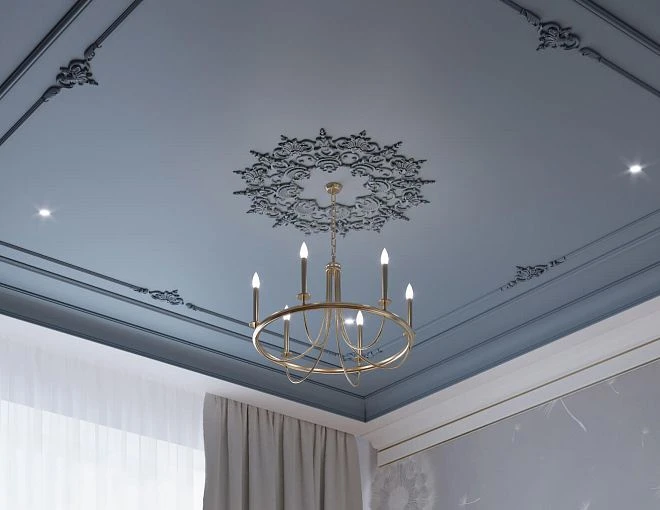
A ceiling medallion is often described as decoration around a chandelier, but that definition is incomplete. Its first job is architectural: it creates a visual zone around the ceiling fixture. The light fixture is no longer a piece of hardware attached to an empty surface; it becomes the center of a designed ceiling composition.
This is especially valuable in rooms where the chandelier carries strong visual weight. A crystal chandelier, branched brass fixture, sculptural pendant, or large lantern naturally attracts attention. Without an architectural transition around it, the fixture can appear visually detached from the ceiling. The medallion gives that transition a beginning and an edge.
The second job is proportional. A medallion can make a modest fixture feel more substantial, or it can prevent a very large chandelier from seeming to float in an undefined field. It can also help the ceiling relate to other architectural details in the room: crown molding, wall panels, door casings, pilasters, fireplaces, or decorative trim. When those elements share a similar level of refinement, the interior feels composed rather than assembled.
The third job is stylistic. A smooth concentric medallion can reinforce a restrained modern-classic interior. A floral or acanthus composition can support French, Baroque, Rococo, traditional, or historic-inspired rooms. A radial geometric design can work in Art Deco or transitional settings. The medallion does not need to match every ornament in the room, but it should belong to the same visual language.
Finally, a medallion can be used as a tool of emphasis. In a dining room, it marks the center of the table. In an entry hall, it can establish an arrival axis. In a bedroom, it can center the ceiling over the bed or seating area. In a large living room, it can define one lighting zone even when the room contains several functional areas.


Ceiling Medallion, Ceiling Rose, or Ceiling Rosette?
Terminology matters because American and European architectural vocabulary overlap without being identical. In the United States, “ceiling medallion” is the clearest general term for a decorative element installed around a chandelier, pendant, or other ceiling fixture. The phrase polyurethane ceiling medallions therefore works well when browsing products or describing a family of decorative ceiling pieces.
“Ceiling rose” is older architectural vocabulary and remains common internationally. You may also encounter the exact search phrasing polyurethane ceiling rose or even ceiling rose polyurethane. In an American-facing project specification, however, “ceiling medallion” will usually require less explanation.
“Rosette” can describe a smaller ornamental motif as well as a ceiling element, so context matters. A decorative rosette used on a wall, cabinet, door, or molding is not necessarily intended to surround a light fixture. That distinction becomes important when selecting dimensions, center openings, relief depth, and installation method.
For this reason, think first in terms of function. If the piece visually frames a chandelier or pendant at the ceiling center, “ceiling medallion” is the most useful working term. If it is a smaller decorative accent used as an applique, it belongs to a different design problem even if the ornament itself is circular.
Наша фабрика также производит:
Смотреть весь Каталог продукции
Why Polyurethane Works So Well for Ceiling Decoration
The original appeal of plaster ceiling ornament is easy to understand: it can carry deep relief, crisp shadow lines, and historical detail. Its disadvantages are equally familiar to anyone who has handled large plaster elements. Weight, brittleness, installation complexity, and repair work can become significant, particularly in remodeling projects.
Polyurethane offers a different balance. It allows detailed molded ornament while keeping the decorative element comparatively light. That matters above eye level, where handling, positioning, alignment, and temporary support are part of the installation process. Lower weight does not remove the need for correct preparation or secure attachment, but it can make the work more manageable.
Polyurethane is also suitable for paintable architectural decoration. A medallion can remain close to the ceiling color for a quiet built-in appearance, or it can be finished with subtle contrast, gilded highlights, metallic accents, glazes, or layered decorative painting. This makes the same basic form adaptable to very different interiors.
Moisture resistance is another useful quality in interior applications. A decorative element is less vulnerable to normal humidity than untreated wood or some mineral-based decorative materials. That does not mean every ceiling condition is automatically suitable, and it does not replace correct surface preparation, adhesive selection, or climate control. It simply broadens the range of rooms in which polyurethane decoration can be considered.
For a designer, the most important advantage may be consistency. A molded architectural element can repeat a complex motif with predictable geometry. When several pieces form one larger composition, dimensional consistency matters because small errors become visible once the pattern is centered around a chandelier or aligned with crown molding.
Получить консультацию
Start With the Chandelier, Not the Medallion
One of the most common selection mistakes is shopping for a medallion as an isolated object. The medallion should be evaluated in relation to the light fixture below it. That relationship is more important than whether the medallion looks impressive on a product page.
Begin with the chandelier canopy—the plate or cover at the ceiling that hides the electrical box and mounting hardware. Measure its diameter or width. Then look at the overall fixture: its widest dimension, its visual density, the amount of empty space between arms, and the distance it hangs below the ceiling.
A delicate chandelier with thin arms may look best with a medallion whose relief has breathing room and a clear center. A dense fixture with many crystals may need a simpler medallion so the two elements do not compete. A wide lantern can often support a larger, more geometric form. A small pendant can work with a restrained medallion used almost like a ceiling “frame.”
Do not assume the medallion must be larger than the fixture in every case. The correct proportion depends on how the chandelier is seen from the room. In a two-story foyer, for example, a medallion may need greater diameter simply to remain legible from below. In a small dining room with a low ceiling, an oversized medallion can make the fixture feel compressed even if the medallion is technically proportional to the chandelier.
How to Choose the Right Diameter
There is no single formula that produces the correct medallion size for every room. Good selection is a proportional judgment based on room width, ceiling height, fixture size, and ornament density. Treat formulas as starting points, not laws.
1. Read the room from wall to wall
Stand in the doorway and look at the ceiling as one field. In a compact room, a medallion occupies a larger percentage of that field, so even a modest diameter can feel substantial. In a large room, the same piece can look unexpectedly small. This is why product dimensions should always be visualized in the actual room rather than judged from close-up photography.
2. Consider ceiling height
Height changes apparent scale. A decorative element mounted eight feet above the floor is visually close; a similar element on a twelve- or fourteen-foot ceiling is much farther from the viewer. Fine relief that looks intricate at hand level can flatten visually when seen from below. Larger scale and stronger relief can therefore make sense in tall rooms.
3. Compare the medallion with the chandelier’s width
The medallion and fixture should have a deliberate relationship. They can be similar in overall visual diameter, the medallion can be somewhat smaller, or it can extend beyond the fixture. What matters is that the pairing looks intentional. A chandelier with a very wide spread but visually light arms may tolerate a smaller medallion. A compact but heavy fixture may benefit from a more generous architectural frame.
4. Mark the diameter before ordering
This is one of the simplest and most effective design checks. Use painter’s tape, removable paper strips, or a cardboard template to mark the proposed diameter on the ceiling. Then step back to normal viewing positions. Check from the doorway, from the center of the room, and from adjacent spaces. A diameter that seemed large on paper can look surprisingly restrained once it is actually mapped on the ceiling.
The current STAVROS ceiling-medallion category includes round polyurethane compositions ranging approximately from 30.12 inches to 69.69 inches across, which makes scale planning especially important. Large formats are not simply “bigger versions” of small medallions; they change the visual hierarchy of the entire room.
Small, Medium, and Large Rooms Need Different Thinking
Rather than using rigid square-footage rules, divide the decision into three design situations.
Compact rooms
In a small bedroom, study, breakfast area, or narrow entry, the ceiling should not become visually heavier than the room. A simpler medallion with restrained relief often works better than a highly layered composition. If the chandelier is compact, keep enough plain ceiling visible around the medallion so the eye can distinguish the ornament from the surrounding architecture.
A medallion can still be dramatic in a small room, but then it becomes the main architectural event. That is a valid design choice—especially in a powder room, jewel-box entry, or richly decorated bedroom—but it should be intentional.
Average-size living and dining rooms
These rooms offer the broadest range of options. The medallion can reinforce the chandelier without dominating the ceiling, and there is usually enough distance from the walls to coordinate it with crown molding. If the room already has panel molding, substantial baseboards, or traditional door casings, the ceiling can often support more ornament than a minimally detailed room of the same size.
Large rooms, halls, and double-height spaces
Scale becomes the primary issue. Large ceilings can make medium-size details look weak. A broad medallion or modular composition creates a visual anchor that can be read from below. In these spaces, deeper relief and stronger pattern repetition may be more effective than fine, delicate ornament.
Large spaces also reward more complete ceiling composition. The medallion can be related to perimeter molding, ceiling frames, corner elements, or other architectural trim instead of functioning as a single isolated disk.
The Center Opening: A Small Detail That Can Decide the Entire Installation
A ceiling medallion and a light fixture meet at the center, so the center condition must be planned before installation. The fixture canopy, electrical box, wiring, threaded stems, hooks, and mounting bracket may all occupy that area.
Never assume a decorative medallion is itself structural support for the chandelier. The light fixture should be supported by an electrical box or mounting system rated for the fixture, installed according to the fixture manufacturer’s instructions and applicable electrical requirements. The medallion is decorative architecture around that system.
Before ordering, determine whether the chosen model has a center opening, whether it is supplied solid, or whether it can be modified for the project. Measure the chandelier canopy as well as the position of the electrical box. If a center hole must be cut, the opening should be large enough for the necessary hardware but small enough to remain concealed by the canopy.
For renovation work, this check is especially important. Existing junction boxes are not always perfectly centered in decorative ceiling fields, and previous fixtures may leave patched areas, old screw holes, or paint transitions. A medallion can conceal some of those visual irregularities, but only when its actual center aligns with the electrical installation.
What About a Ceiling Fan?
There is confirmed U.S. search interest in the phrase polyurethane ceiling fan medallion. The design idea is understandable: a ceiling fan can also benefit from an architectural transition at the ceiling. But this application needs more verification than a typical chandelier installation.
Fans create movement and require fan-rated electrical boxes and mounting systems. They also have larger canopies, motors, downrods, and moving blades. A decorative element that works beautifully around a chandelier may not have the necessary center opening, clearance, geometry, or compatibility for a fan installation.
Therefore, do not choose a medallion for a ceiling fan solely from diameter. Verify the fan canopy dimensions, mounting plate, downrod, required clearances, medallion center condition, and the specific decorative model. If the product page does not state that it is suitable for a fan configuration, treat the application as a custom compatibility check rather than an assumed use.
Relief Depth Matters More Than Most Buyers Expect
Diameter receives most of the attention, but relief depth changes how a medallion looks from the floor. A shallow profile reads as graphic and restrained. A deeper relief produces stronger highlights and shadows and can remain visible from greater distances.
In rooms with abundant daylight, relief can create changing shadow patterns throughout the day. Under evening lighting, especially when light is reflected upward from a chandelier or wall sconce, the same relief can become more dramatic.
Depth also affects how the medallion transitions into the chandelier canopy. A thick medallion around a very shallow canopy may require careful detailing so the components do not appear mechanically stacked. Conversely, a medallion that is too flat can disappear behind a substantial ceiling plate.
Think of the medallion in section, not only in plan. The ideal profile should look coherent from the side angles at which occupants actually see the ceiling.
Choosing Ornament: Let the Architecture Lead
The right ornament is not simply the pattern you like most. It is the pattern that belongs to the room.
Classical interiors
Classical rooms respond well to symmetry, radial order, acanthus, leaves, floral motifs, bead patterns, and disciplined repetition. A detailed medallion can connect visually with panel molding, traditional crown, pilasters, carved furniture, and formal door trim.
The key is hierarchy. If the chandelier is already elaborate, the medallion should support it rather than compete with it. If the chandelier is comparatively simple, the medallion can carry more of the decorative burden.
French and palace-inspired interiors
Rococo, Louis-style, and French classic interiors allow more movement: shells, scrolls, botanical motifs, asymmetrical flourishes inside a larger symmetrical composition, and layered relief. These rooms can support a medallion that feels sculptural rather than merely graphic.
Neoclassical interiors
Neoclassicism usually benefits from greater restraint. Clear radial geometry, balanced botanical details, and controlled relief often work better than extremely dense ornament. The medallion should feel architectural first and decorative second.
Art Deco and transitional interiors
A medallion does not need to be floral. Geometric rings, sunbursts, stepped relief, radiating lines, or stylized motifs can create a stronger relationship with Art Deco lighting and modern furnishings.
Contemporary interiors
In a modern room, decorative ceiling work is often most effective when used as contrast. One medallion can become the room’s single traditional gesture against smooth walls, simple furniture, and contemporary lighting. Painting it the same color as the ceiling keeps the form subtle; using a tonal contrast turns it into an intentional focal point.
Why “More Detail” Does Not Automatically Mean “More Luxurious”
Luxury depends on proportion, clarity, and execution. A heavily ornamented medallion installed in a room with low ceilings, small windows, minimal trim, and an undersized fixture can look accidental. A simpler medallion, correctly scaled and professionally finished, may look significantly more sophisticated.
Think in terms of visual density. Every room already contains lines: window muntins, door casings, cabinet rails, furniture legs, wall panel frames, flooring patterns, lighting arms, and textile motifs. A ceiling medallion adds another layer. The question is not whether the element is beautiful by itself, but whether the room has space for that additional layer.
This is why designers often test both a decorative and a restrained option before making a final selection. When in doubt, evaluate the room from normal eye level rather than judging ornament from a close-up product image.
How to Coordinate a Medallion With Crown Molding
A medallion near the center of the ceiling and crown molding at the perimeter are naturally related. Together they define the ceiling as an architectural surface rather than an empty lid.
If the crown is ornate, the medallion can echo one or two motifs without copying the profile literally. A repeated leaf, bead, or geometric rhythm is often enough to establish continuity. If the crown is plain, the medallion may carry more decorative complexity.
For a broader architectural system, browse related polyurethane moldings and compare the relief language before finalizing the ceiling center. The objective is not to make every element identical. It is to avoid mixing decorative vocabularies that appear unrelated.
Another useful approach is to paint crown and medallion in the same finish. Even when the profiles differ, a shared color makes them read as one architectural family. This is particularly effective in white-on-white or monochromatic rooms.
Pairing the Medallion With Decorative Trim
In more developed ceiling designs, the center medallion can be linked visually to frames, borders, or linear profiles. A restrained band around the ceiling can make a large room feel organized and keep the center element from appearing isolated.
When a project calls for linear decorative profiles, polyurethane trim molding can be considered as part of the broader composition. The trim does not need to touch the medallion. Often the most elegant design leaves a field of plain ceiling between the central ornament and the perimeter frame.
The amount of negative space is as important as the ornament itself. Without enough empty surface, decorative elements lose definition and the ceiling can become visually crowded.
Color: White Is Only the Beginning
White remains the most flexible finish because it allows relief to be read through natural shadow instead of strong color contrast. But “white” is not one decision. A warm white, cool white, soft ivory, or ceiling-matched matte finish can change the way ornament relates to walls and furnishings.
Monochromatic ceiling
Painting the medallion the same color as the ceiling is the safest option for a refined architectural look. The ornament is visible because of relief and shadow, not because of color difference. This approach works especially well in contemporary classic and transitional interiors.
Slight tonal contrast
A medallion one or two steps warmer, cooler, lighter, or darker than the ceiling becomes more noticeable without feeling theatrical. This is useful when the relief is relatively shallow.
Metallic highlights
Gold, silver, bronze, or champagne accents can emphasize selected raised details. The most convincing results are usually selective rather than total. A few highlighted edges may create more depth than covering the entire medallion in metallic paint.
Dark ceilings
Deep blue, charcoal, olive, brown, or black ceilings can make polyurethane ornament especially striking. The medallion can match the ceiling for a sculptural effect or contrast with it for a more graphic result.
Whatever finish is selected, verify coating compatibility with the specific product and follow the manufacturer’s preparation guidance. A beautiful color cannot compensate for poor adhesion or insufficient surface preparation.
Should the Medallion Match the Chandelier Finish?
Usually, no. Exact matching is not necessary. A brass chandelier does not require a gold medallion, and a black fixture does not require black ceiling ornament. Matching every finish can make the design feel literal.
A better method is to decide which element is architecture and which is object. The medallion generally belongs to the architecture, so it can match the ceiling, crown molding, or wall trim. The chandelier belongs to the furnishing and lighting layer, so its metal finish may contrast.
That contrast often improves clarity. A white medallion behind an aged-brass chandelier, for example, allows both the ornament and the fixture to remain distinct. A dark fixture against a same-color ceiling medallion can create a stronger silhouette if the room is designed around deep tones.
How to Center a Medallion Correctly
“Center of the room” and “center of the composition” are not always the same point. In a dining room, the chandelier is often centered over the table rather than perfectly centered between all four walls. In a living room, the light fixture may align with a seating group. In a long room, one fixture may mark one of several zones.
The medallion should generally follow the fixture, because the two are perceived as one assembly. Moving the medallion away from the chandelier to satisfy abstract room geometry usually creates a more obvious problem.
Before installation, confirm the actual fixture center using measurements from fixed architectural references. Then mark perpendicular axes through that point. For circular medallions, these lines help confirm alignment. For modular or directional designs, they are essential.
If the medallion has a floral or geometric orientation, decide which direction is “up” relative to the room. A symmetrical circular motif may not care; a composition with directional leaves, scrolls, or star points may look noticeably wrong if rotated arbitrarily.
Large and Modular Medallions
Large ceiling ornament is sometimes assembled from multiple polyurethane components rather than produced as one heavy piece. This allows broad compositions while preserving manageable individual elements.
Modular systems demand careful layout. The installer must establish the center, axes, spacing, and orientation before adhesive is applied. A small error in the first component can propagate around the entire composition.
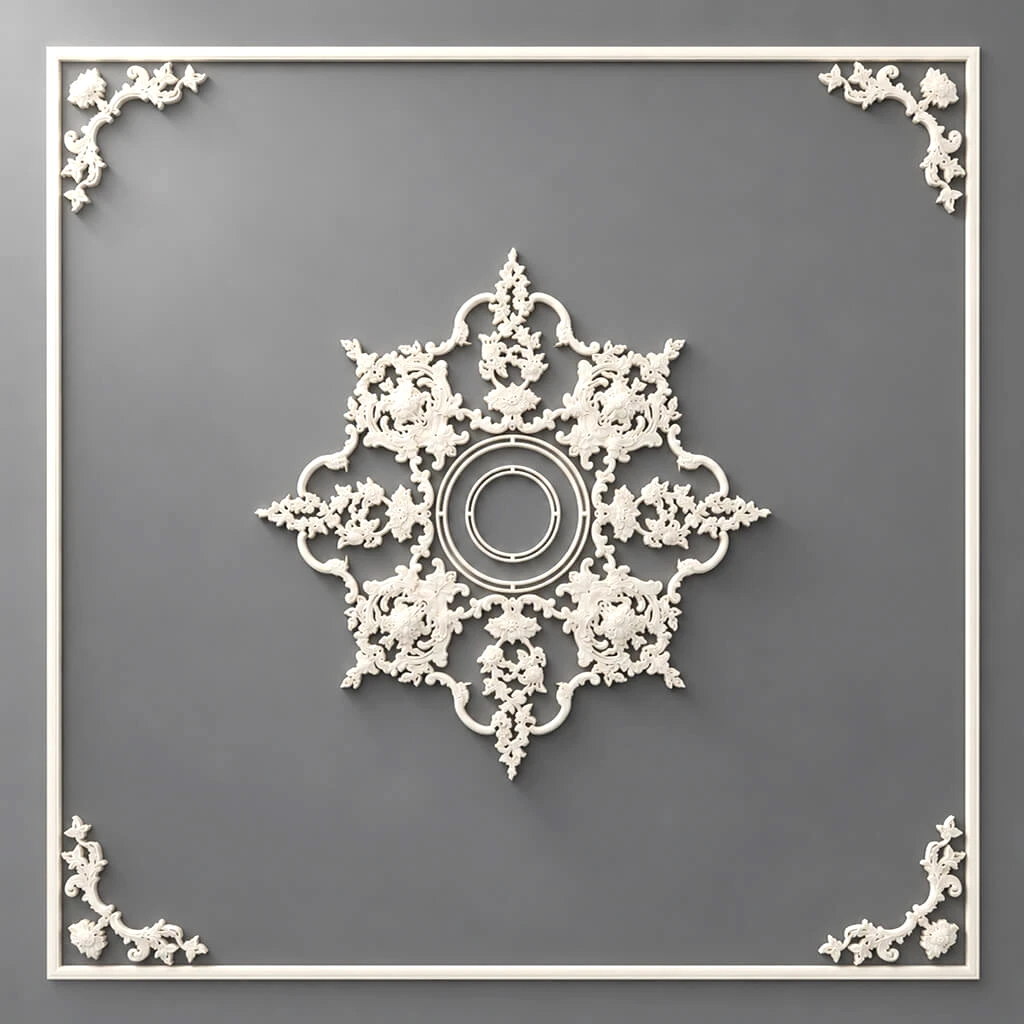
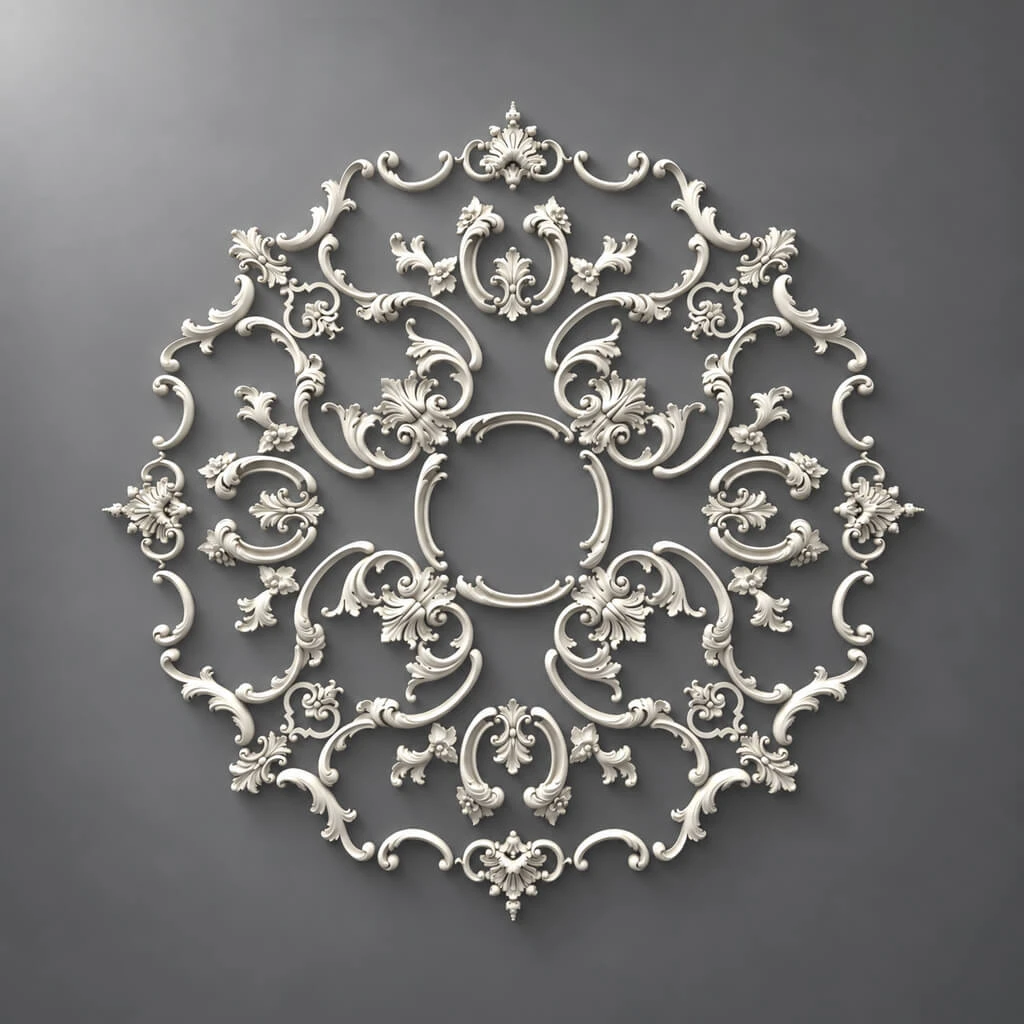
One example in the current STAVROS range is the CRPU-070 composition, listed at approximately 30.12 × 30.12 × 0.71 inches and assembled from multiple decorative elements. Larger models in the category extend to roughly 69.69 inches across. This range shows why the word “medallion” can describe both a relatively compact ceiling accent and a room-defining architectural composition.
For large systems, a paper or full-scale template can be extremely useful. It allows installers to establish the geometry before working overhead and reduces the temptation to “correct by eye” after adhesive has been applied.
Surface Preparation: The Step That Determines Whether the Result Looks Professional
The original Russian article correctly emphasizes that installation begins before adhesive is opened. The ceiling must be clean, dry, stable, and sufficiently even for the medallion to sit correctly. A decorative piece will not hide every substrate defect; in some cases, its straight or circular edges make unevenness more visible.
Remove dust, loose paint, flaking compound, grease, and unstable coatings. Repair cracks and significant depressions. If the surface has a high-gloss finish, check whether the adhesive manufacturer recommends scuffing, priming, or another preparation step.
Dry-fit the medallion before installation. Lift it into position, confirm the center, check the relationship to the chandelier canopy, and inspect the perimeter for gaps. This is the moment to discover that the ceiling is uneven—not after adhesive has been applied.
Installation Planning for a Chandelier
Ceiling-medallion installation and light-fixture installation are related tasks but they are not the same task. The medallion is decorative. The chandelier requires a properly supported electrical installation.
If the fixture is already installed, many installers remove or lower the canopy while keeping the electrical mounting point protected and accessible. If a new fixture is being installed at the same time, the sequence should be planned so the medallion does not interfere with the electrician’s work.
Power should be shut off at the appropriate breaker before electrical components are handled. If wiring, box capacity, fixture weight, or fan support is uncertain, use a qualified electrician. The decorative work should never create pressure to improvise the electrical mounting.
Once the center condition is established, the medallion can be installed according to the adhesive and product instructions. Large or multi-piece compositions may require temporary support or staged installation. Excess adhesive should be removed before it cures in visible areas.
How to Cut or Modify a Center Opening
Some medallions are supplied with a center condition that works as-is; others may need an opening sized to the project. If modification is required, begin from the chandelier canopy—not from the electrical box alone.
The canopy should conceal the finished opening. Mark the required cut accurately and maintain symmetry around the medallion center. Use a cutting method appropriate to polyurethane and the product’s thickness. Avoid forcing the tool, because an irregular cut can produce visible damage beyond the area covered by the canopy.
After cutting, dry-fit again. Check not only that the hardware passes through but that the canopy sits flat and does not rock against raised ornament.
Adhesive, Mechanical Support, and Manufacturer Instructions
Use an adhesive suitable for the polyurethane element and the ceiling substrate. Compatibility matters. A product formulated for one surface does not automatically perform the same way on painted gypsum board, plaster, concrete, wood, or another coating.
The STAVROS product guidance for its decorative elements describes adhesive installation and short open-time/pressing steps for certain products. Treat the current product instructions as the governing source for the specific item rather than relying on a generic installation recipe.
Large elements may need temporary support while adhesive sets. Depending on the model, substrate, and project requirements, installers may also use mechanical assistance or a more specialized attachment strategy. Do not assume that every medallion can be handled identically simply because the material is polyurethane.
Finishing the Perimeter
A professionally installed medallion should look integrated with the ceiling rather than glued onto it. The perimeter joint is where that illusion is created.
After the element is securely installed, inspect the edge under raking light. Small gaps may need a compatible filler or caulk selected for the substrate and finish system. The goal is not to bury the decorative edge but to create a clean transition.
Once the joint is finished and cured, the medallion can be painted as part of the ceiling or treated as a separate decorative surface. When the ceiling and medallion receive the same paint, the edge often becomes visually seamless.
Painting Polyurethane Ceiling Medallions
A paintable medallion offers more design freedom than a prefinished element because the installer can coordinate it precisely with the room. But painting decorative relief requires more care than rolling a flat ceiling.
First, confirm whether the product is supplied primed and what coating systems are recommended. Current STAVROS ceiling products are presented as ready for finishing, but product-specific instructions should still be checked before painting.
Use thin, controlled coats so paint does not fill crisp relief. A brush is useful for carved recesses, while spraying can produce a very even finish when performed correctly. If the medallion is already mounted, protect the surrounding ceiling and fixture carefully.
For antique or highlighted effects, build color gradually. A darker glaze in recesses can deepen the relief. A lighter or metallic dry-brush treatment on high points can make ornament more readable from below. The most convincing decorative finishes preserve the geometry of the molding rather than coating it so heavily that detail becomes soft.
Using a Medallion in a Modern Interior
There is a persistent misconception that a ceiling medallion belongs only in a historical room. In reality, one classical element can be extremely effective in a modern interior because contrast gives it significance.
Imagine a room with large plain walls, wide-plank flooring, a sculptural sofa, a contemporary chandelier, and one restrained medallion painted exactly the same warm white as the ceiling. The ornament does not make the room “traditional.” It gives the modern room architectural memory.
The key is editing. If the room is modern, avoid adding a medallion, heavy crown, ornate wall panels, carved pilasters, multiple rosettes, and gilded trim all at once unless the design concept deliberately calls for maximalism. One carefully chosen element can be more powerful.
Using a Medallion in Traditional and Classical Interiors
Traditional rooms can support a more complete architectural hierarchy. The ceiling medallion may relate to crown molding, wall panels, decorative door surrounds, fireplace trim, and symmetrical furniture placement.
In this context, the medallion is not a decorative afterthought. It is one component in a system of visual transitions: floor to wall, wall to opening, wall to ceiling, and ceiling to chandelier.
This is where urethane ceiling medallion and urethane ceiling medallions searches often overlap with broader architectural-molding research. American buyers may use either “polyurethane” or “urethane” even when they are looking for the same decorative category.
Dining Rooms: The Natural Home of the Ceiling Medallion
A dining room provides an ideal condition because the chandelier, table, and medallion can share one centerline. That creates immediate visual order.
Begin with the table location. If the table is permanently centered, the fixture and medallion can align with it. If the table is frequently expanded or moved, think about the room’s architectural center instead of one furniture configuration.
Dining rooms also allow a medallion to be appreciated at a slower pace than in a hallway. Guests are seated, the chandelier is often dimmed, and relief shadows become part of the atmosphere. Detailed ornament can therefore make sense even when the room is not especially large.
Living Rooms and Great Rooms
In a living room, the biggest challenge is often that the room has multiple centers. The seating arrangement, fireplace, windows, television, and ceiling fixture may not all align.
Do not use a medallion to “correct” a poorly located light fixture without first deciding whether the fixture itself should move. A medallion makes the ceiling center more obvious. If that center is wrong, the decoration can intensify the problem.
Great rooms with high ceilings often benefit from large-scale ceiling ornament because the viewing distance is greater. Strong relief and generous diameter help the medallion remain visible. In a double-height room, evaluate the design from both the first floor and any upper gallery or landing.
Bedrooms
A bedroom medallion can be quieter. The chandelier or pendant may be smaller, and the ceiling often benefits from subtle rather than monumental decoration.
Paint the medallion to match the ceiling for a calm effect, or use a soft tonal shift to reinforce a romantic or traditional palette. In children’s rooms and casual bedrooms, simple geometry can be more flexible than strongly historical ornament.
If a ceiling fan is used in the bedroom, revisit the compatibility issues discussed earlier. Do not assume that a standard chandelier medallion will work with a fan canopy or fan-rated box.
Entries, Foyers, and Stair Halls
These spaces can support stronger decorative gestures because the ceiling is often visible from several viewpoints. A medallion in a foyer announces the architectural character of the home before the visitor sees every room.
In a two-story entry, consider the viewing distance and the chandelier drop together. A very detailed small medallion may be visually lost. A broader composition with readable relief can create a stronger relationship to the fixture and stair architecture.
Kitchens and Breakfast Areas
Ceiling ornament can work in a kitchen, but it should respond to the cabinetry and overall design language. In a traditional kitchen with paneled cabinets and substantial crown, a medallion over an island pendant group or breakfast table can feel coherent.
In a minimalist kitchen, a heavily classical medallion may compete with the clean geometry. A simpler profile is usually easier to integrate. Consider maintenance as well: kitchen surfaces can accumulate airborne residue more quickly than those in a formal living room, so intricate relief may require more frequent cleaning.
Bathrooms and Humid Rooms
Polyurethane’s resistance to ordinary interior moisture makes it a candidate for decorative use in bathrooms and other humid spaces, but the entire assembly still needs to be appropriate for the environment. Paint, adhesive, substrate, ventilation, and the light fixture’s wet/damp-location rating all matter.
A small decorative medallion can be especially effective in a powder room, where a relatively compact space can support a strong ornamental idea. In full bathrooms, make selections with the room’s ventilation and finish system in mind.
Historic Restoration and Period-Inspired Work
In restoration work, decorative selection should begin with documentation rather than taste alone. Look for old photographs, fragments, paint shadows, ceiling scars, or surviving ornament in adjacent rooms. The objective may be to reconstruct a missing composition or to create a compatible replacement when the original is no longer available.
Polyurethane can be useful when a project needs repeated ornament with consistent detail and lower weight than traditional plaster. The new element should still be judged against the proportions and vocabulary of the building.
If exact historical reproduction is important, the process may require custom design rather than selecting a stock medallion. Measure carefully, document surviving motifs, and identify which features are essential to authenticity.
How to Read a Product Page Like a Designer
Do not stop at the product photo. A professional selection process should examine at least the following:
- Overall dimensions. Translate them into the actual room, preferably with a full-size ceiling mark or template.
- Thickness or relief depth. This affects shadow, canopy transition, and how the ornament is perceived from below.
- Material. Confirm that the specific product is polyurethane rather than another material in a mixed architectural-decor catalog.
- Shape. Round, oval, star-shaped, modular, or directional compositions create different relationships with the room.
- Ornament. Floral, plant, geometric, classical, or restrained patterns should correspond to the surrounding architecture.
- Center condition. Verify whether the product has an opening and whether modification is possible.
- Set composition. Some large medallions are assembled from multiple pieces rather than installed as one unit.
- Installation guidance. Use product-specific adhesive and preparation instructions.
- Finish condition. Confirm primer and paint recommendations before specifying a coating system.
The STAVROS category page allows filtering by size and identifies current polyurethane ceiling rosettes as round products with classical, floral, and plant-oriented options. That information is more valuable for specification than a generic statement that “many styles are available.”
Why a Full-Size Mockup Is Worth the Effort
Designers routinely use samples because scale is difficult to judge on a screen. A ceiling medallion deserves the same discipline.
If you cannot obtain a physical sample, create a paper or tape mockup of the overall diameter. For a strongly ornamented piece, print enlarged fragments of the pattern and tape them near the center. The mockup will not reproduce relief, but it will reveal whether the footprint is right.
View it during daylight and at night with the fixture turned on. Ceiling decoration can feel completely different under artificial light because shadows become directional.
Common Mistake #1: Choosing by Diameter Alone
Two medallions with the same diameter can have very different visual weight. One may consist mostly of open negative space and fine lines; another may be densely filled with deep ornament.
Always compare diameter, relief depth, pattern density, and the size of the plain center field. A dense 36-inch medallion can feel larger than a simpler 42-inch design.
Common Mistake #2: Ignoring the Chandelier Canopy
The center joint between medallion and canopy is visible at close range and often photographed. If the canopy is too large for the medallion’s central field, it can cover important ornament. If it is too small for an oversized opening, the cut becomes visible.
Measure first. This is a technical detail with major aesthetic consequences.
Common Mistake #3: Treating “Lightweight” as “No Installation Planning Required”
Polyurethane is easier to handle than many heavy decorative materials, but a large ceiling element is still overhead work. Surface preparation, adhesive compatibility, temporary support, center alignment, and electrical coordination remain essential.
Light weight improves practicality; it does not eliminate craftsmanship.
Common Mistake #4: Using a Ceiling Fan Keyword Without Checking the Product
The phrase “fan medallion” can create a false sense of compatibility. A fan requires a fan-rated support system and may need more central clearance than a chandelier.
If you are specifically shopping for a polyurethane ceiling fan medallion, treat that as a project requirement that must be verified against the selected SKU and fan hardware—not as a universal property of the category.
Common Mistake #5: Over-Optimizing the Room
Decoration can become less effective when every available surface receives the same level of ornament. A medallion is strongest when the room has hierarchy.
Decide where you want the eye to stop first. If the chandelier and ceiling center are the focal point, allow other decorative elements to support that decision rather than compete with it.
Common Mistake #6: Installing Before the Lighting Plan Is Final
The medallion should not determine the electrical plan after the fact. Confirm the fixture, canopy, hanging height, electrical box, and room center before final attachment.
In renovation projects, coordinate decorator, electrician, painter, and finish carpenter early. A few minutes of planning can prevent patching, repainting, and re-centering later.
Choosing Between a Ceiling Medallion and a Full Ceiling Decor Set
A single medallion is ideal when the chandelier needs emphasis but the ceiling should remain relatively calm. A full ceiling decor scheme makes sense when the room already has strong architectural character or when the ceiling itself is intended to become a major design surface.
STAVROS also has a dedicated ceiling decor category with larger decorative compositions. Use that route when the design requires more than one center element.
The decision is similar to choosing between a single framed artwork and a paneled wall. Both can be correct; they simply create different levels of architectural intensity.
Using a Medallion With Wall Molding and Paneling
A ceiling medallion becomes more convincing when the room has a clear vertical and horizontal hierarchy. Wall molding can help establish that structure.
For example, a neoclassical dining room might combine restrained wall panels, a simple crown, and one detailed ceiling medallion. The wall treatment sets rhythm around the room while the medallion marks the center. Neither element needs to repeat the other literally.
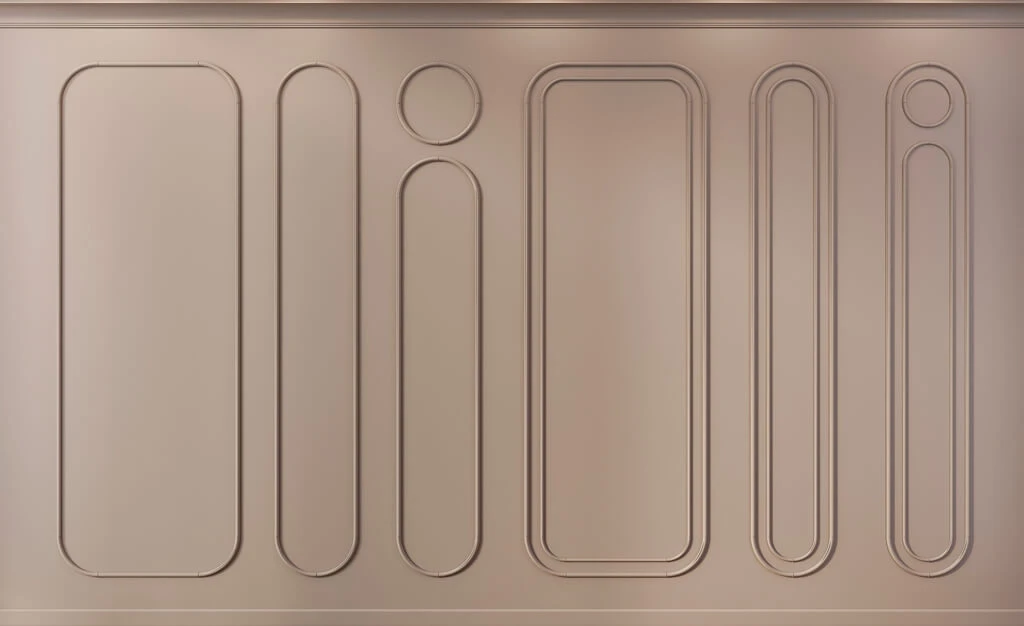
If the room includes polyurethane wall decor, compare the scale of the wall ornament with the ceiling ornament. Fine wall details and an extremely massive ceiling element may feel disconnected; similarly, highly sculptural walls can make an undersized medallion look weak.
Polyurethane Versus Plaster for Ceiling Medallions
Plaster remains an authentic and beautiful material, especially in historic construction and artisan work. It can achieve deep relief and can be integrated into traditional plaster ceilings by skilled craftspeople.
Polyurethane is attractive when lower weight, repeatable molded detail, easier handling, and paintability are priorities. It can be particularly practical in remodeling, where the substrate and access conditions may not favor heavy ornament.
The decision should not be reduced to “old material versus new material.” Instead, choose according to project goals: historic authenticity, weight, installation logistics, available craftsmanship, desired detail, budget, and long-term maintenance.
Polyurethane Versus Wood
Wooden ceiling ornament has warmth and material authenticity, especially when stained rather than painted. It may be the correct choice in a timber interior, carved-wood room, or project where visible grain is essential.
Polyurethane is usually more appropriate when the desired result is painted architectural relief rather than exposed wood. It can also reproduce complex ornamental shapes without asking the installer to manage wood movement or grain direction in the same way.
Again, neither material is universally better. They belong to different design languages.
Specifying a Medallion for a Professional Project
Architects and interior designers should treat the medallion as a scheduled finish element rather than an informal accessory. A useful specification includes:
- manufacturer and product number;
- overall width and height;
- thickness or projection;
- material;
- number of pieces if modular;
- orientation reference;
- center opening requirements;
- fixture canopy dimensions;
- ceiling substrate;
- adhesive or attachment requirements;
- primer and paint system;
- final color and sheen;
- coordination notes for electrical installation;
- template or layout drawing where required.
This information prevents the medallion from becoming a last-minute decorative purchase that arrives after the electrical center, paint, and chandelier installation have already been completed.
For Contractors: Sequence the Trades Correctly
The cleanest installation is usually the result of sequencing, not repair. Establish the electrical box and chandelier location first. Complete major ceiling leveling and substrate repairs. Dry-fit and mark the medallion. Coordinate any center opening. Install the decorative piece. Finish perimeter joints. Prime or paint as required. Then complete the final fixture installation and touch-ups.
Project conditions vary, and some teams will change that sequence, but the principle is consistent: do not make one trade undo the work of another.
For Homeowners: What to Measure Before You Order
Before adding a medallion to the cart, write down the following dimensions:
- room length and width;
- ceiling height;
- chandelier overall width;
- chandelier canopy diameter or width;
- distance from ceiling to bottom of fixture;
- junction-box center relative to walls or architectural axes;
- distance from fixture center to nearby ceiling features;
- crown molding projection, if present.
Then photograph the room from at least three positions. These measurements and photos make it much easier to judge scale and to ask a useful product-selection question.
A Practical Selection Workflow
- Confirm the light fixture. Know its canopy, width, style, and mounting system.
- Confirm the ceiling center. Decide whether the composition follows room geometry, furniture, or an architectural axis.
- Establish a size range. Use room scale and viewing distance, then mock up the diameter.
- Choose visual density. Decide whether the medallion should be restrained, moderate, or highly ornamental.
- Coordinate with existing trim. Compare crown, wall panels, doors, and fireplace details.
- Check product dimensions and depth. Do not rely on photos alone.
- Verify the center condition. Make sure the chandelier canopy and electrical installation are compatible.
- Plan finish. Decide whether the medallion matches the ceiling or receives decorative treatment.
- Plan installation. Confirm substrate, adhesive, access, temporary support, and trade sequence.
- Order only after the above is resolved. This turns a decorative impulse into a controlled architectural decision.
Understanding U.S. Search Language When Shopping
American shoppers use several overlapping terms for the same product family. The strongest confirmed search phrase in the current keyword research is polyurethane ceiling medallion, with the plural polyurethane ceiling medallions in the same high-demand cluster. The related phrase urethane ceiling medallion also has meaningful U.S. demand.
These variants should not be interpreted as different materials simply because one person writes “urethane” and another writes “polyurethane.” In decorative-product search behavior, they often describe the same broad category.
There is also smaller but confirmed demand for polyurethane ceiling roses and polyurethane medallion. These phrases are useful when researching, but for clear American-facing copy, “ceiling medallion” should remain the primary term.
Why the Biggest Keyword Should Not Be Repeated in Every Paragraph
A page written for search engines still has to sound like an expert wrote it. Repeating “polyurethane ceiling medallion” mechanically makes the text less readable and does not improve the design advice.
Good SEO writing uses the exact commercial phrase where it naturally identifies the product, then relies on related language—ceiling ornament, chandelier medallion, architectural ceiling detail, decorative center, relief, molding, rosette, fixture canopy, and ceiling composition—to explain the subject fully.
The same principle applies to internal linking. One strong exact-match link placed in a relevant sentence is more useful than turning every mention of the product into an anchor.
Questions to Ask Before Buying
Before committing to a design, ask:
- Is the product definitely polyurethane?
- What are the exact overall dimensions in inches?
- What is the maximum projection from the ceiling?
- Is the product one piece or modular?
- Does it have a center opening?
- If not, can it be cut for the fixture canopy and mounting system?
- Is a layout template available?
- What adhesive is recommended?
- What surface preparation is required?
- Is the item primed?
- What paint system is recommended?
- What is the current production lead time?
- How is the item packaged for a long-distance shipment?
- If the project is in the United States, what shipping and import arrangements are currently available?
The last question is especially important for an international order. Product design and shipping logistics should be confirmed separately; do not assume that an English-language catalog automatically means a particular U.S. delivery method or lead time.
Frequently Asked Questions
What is the best material for a ceiling medallion?
There is no universal best material. Plaster is appropriate for many historic and artisan projects; wood is excellent where visible grain matters; polyurethane is highly practical when you want detailed, paintable architectural relief with relatively low weight and manageable installation.
What is the difference between a ceiling medallion and a ceiling rose?
They can describe the same general type of decorative ceiling element. “Ceiling medallion” is the more common U.S. shopping term, while “ceiling rose” is more common in British and European usage.
Can a medallion be larger than the chandelier?
Yes. The correct relationship depends on room scale, chandelier design, ceiling height, and visual density. A medallion does not need to fit inside the fixture’s width. Mock up the proposed diameter before ordering.
Can a ceiling medallion be smaller than the chandelier?
Yes. A wide chandelier with visually light arms can look elegant over a more compact medallion. Evaluate the pairing as a composition rather than relying on a fixed formula.
How large should a medallion be for a dining room?
Start with the room dimensions, ceiling height, table and chandelier scale. Then mark the proposed diameter on the ceiling. The visual mockup is more reliable than a universal square-footage chart because ornament density and fixture design vary widely.
Can polyurethane ceiling medallions be painted?
Yes, paintability is one of their major design advantages. Confirm the specific product’s primer and coating recommendations, then use a compatible finish system.
Should the medallion match the ceiling color?
It often looks excellent when it does. Matching color emphasizes relief and shadow while keeping the architecture calm. Contrast, metallic highlighting, and decorative painting are also valid when they support the room concept.
Can I install a medallion over an existing chandelier?
Possibly, but the fixture canopy and electrical work usually need to be coordinated during installation. Do not work around live electrical components. Depending on the fixture and medallion, the canopy may need to be lowered or the fixture temporarily removed.
Does the chandelier hang from the medallion?
No. The decorative medallion should not be treated as the structural support for the light fixture. The chandelier must be mounted to an appropriate electrical box or structural system according to the fixture requirements.
Can I use a polyurethane medallion with a ceiling fan?
Only after checking the specific fan and medallion. A fan needs a fan-rated mounting system and may require more center clearance. Confirm canopy dimensions, opening, hardware, and movement clearances before installation.
Can I use a large medallion on an eight-foot ceiling?
Possibly, but evaluate projection and visual density carefully. A wide but shallow medallion can sometimes work better than a smaller piece with very deep, heavy ornament. Full-size mockups are especially useful on lower ceilings.
Are polyurethane ceiling medallions only for classical interiors?
No. Restrained or geometric medallions can work in contemporary, transitional, Art Deco, and eclectic interiors. Even an ornate medallion can be effective in a modern room when used as one deliberate contrasting element.
What if my junction box is not in the exact room center?
Decide whether the fixture should remain where it is. If the chandelier is correctly centered over a dining table or seating zone, the medallion should usually follow the fixture. If the existing box is simply misplaced, correct the electrical location before installing decorative work.
Can a ceiling medallion hide ceiling damage?
It can cover some old holes, patched areas, or paint transitions near the fixture, but it should not be used to conceal an unstable substrate, active crack, moisture problem, or electrical issue. Repair the cause before decorating.
How do I clean a polyurethane ceiling medallion?
Dust it gently with a soft brush, microfiber tool, or appropriate vacuum-brush attachment. For more substantial cleaning, follow the finish manufacturer’s recommendations. The paint or decorative coating may be more sensitive than the polyurethane beneath it.
Where can I compare STAVROS ceiling medallions?
You can browse the current collection of polyurethane ceiling medallions, compare dimensions, and review individual product pages. For broader architectural coordination, the STAVROS relief decoration section includes related ceiling, wall, molding, and trim categories.
Final Design Principle: The Medallion Should Look as Though the Room Was Designed Around It
The best ceiling medallion does not look added. It looks inevitable.
Its diameter makes sense in the room. Its relief can be read from normal viewing distance. Its ornament belongs to the architecture. Its center works with the chandelier canopy. Its finish belongs to the ceiling. Its placement reinforces the furniture or architectural axis. The installation is clean enough that the eye notices form rather than joints and adhesives.
This is why choosing a ceiling medallion should be treated as an architectural decision rather than a decorative impulse. Start with the room and the light fixture, not the product photograph. Measure, mock up, compare, and coordinate. If a large composition is being considered, study it at full scale. If a ceiling fan is involved, verify compatibility. If the medallion is part of a larger molding system, make sure the ceiling center and perimeter speak the same visual language.
For American projects, the clearest product vocabulary remains polyurethane ceiling medallion. The category covers a wide range of architectural expression—from relatively restrained round forms to large modular compositions. Used carefully, a medallion can turn the junction between ceiling and chandelier into one of the most resolved details in the entire interior.
A successful ceiling is rarely successful because it contains the most decoration. It succeeds because every element has a reason to be there. The medallion establishes the center, the chandelier brings light and movement, the crown or trim defines the perimeter, and the open ceiling between them gives the composition room to breathe. When those relationships are right, the ceiling no longer feels empty. It feels designed.