Article Contents:
- Short answer: on four identical doors, four NPU-237s give a strict repetition, two central ones give one accent block, and sometimes it is stronger to leave the cabinet without overlays
- NPU-237 70 × 315 × 15 mm: confirmed specifications and scope of the task
- NPU-237 70 × 315 × 15 mm: what is confirmed for this article
- Why the size 110 × 495 × 23 mm is not needed in this article
- Why two central NPU-237s are not "half of a full set"
- Why two central overlays are especially useful if the slats are on the side of the cabinet
- Why four overlays are stronger if the cabinet should become an independent architectural object
- Zero overlays — a full composition, if the slat wall is already the main accent.
- How to measure a door for NPU-237: you need not only the facade size, but also the clear decorative field.
- Conditional example: door 500 × 2200 mm.
- Why the geometric center in height is not always the visual center.
- Why the handle and NPU-237 need to be mocked up together.
- The 15 mm relief matters differently for a hinged and sliding wardrobe.
- The 70 mm share of the door width helps understand the scale better than the overall wardrobe size.
- The 315 mm height on a very tall door requires a conscious tie-in to the interior.
- If the floor or ceiling has a noticeable slope, do not transfer it to the overlay line.
- Four identical doors are the simplest case; facades of different widths require different logic
- Four NPU-237 units create not only a vertical but also a horizontal rhythm of centers
- In the color of the facade: the calmest scenario for four overlays
- In the color of the slats: strong connection, but high risk of visual fragmentation
- Contrasting metal or patina require especially strict symmetry
- Push-to-open makes the facade cleaner but does not eliminate ergonomics
- Proximity to a slatted wall should be assessed not in centimeters but by visual density
- A smooth edge panel can serve as a useful 'buffer zone'
- If the rails are behind the opening panel
- If the two central panels form a pair door, NPU-237 can emphasize it as the main unit
- If the central doors are not identical in function, symmetry may be only visual
- Frequency of door use can influence the choice of 2 or 4
- Mirror doors require a separate solution
- A paneled door already has its own architecture
- Installation of NPU-237 must be independent of furniture mechanics
- Do not cover the joint of two moving parts with NPU-237
- If the cabinet is already painted, first check the base, rather than immediately gluing
- Solid color painting of the entire door and NPU-237 is simpler for future repairs
- Cleaning four overlays is also part of the solution
- A slatted wall up to the ceiling and a smooth mezzanine create a useful contrast
- If the cabinet stands between two slatted fields
- What to measure before ordering NPU-237
- Practical algorithm: how to choose 4, 2, or 0 NPU-237 on a finished cabinet
- Decision tree
- If the facade is damaged, this article is no longer the main scenario
- When molding is better than repeating NPU-237
- When slat panels are still being selected
- Several identical cabinets in one project require a separate prototype, not multiplying the quantity
- Cost of the series
- If the cabinet is planned to be repainted later
- If the cabinet is used as a hidden door
- Can you first buy two NPU-237s and then add two more if needed?
- Do I need to place NPU-237 strictly in the center of each door?
- Can I install two NPU-237 only on the outer doors?
- Is NPU-237 suitable for a cabinet with doors up to the ceiling?
- Can NPU-237 be stuck onto a mirror?
- If the cabinet is sliding, can I install four NPU-237?
- Is NPU-237 needed on mezzanine doors?
- What to do if one door leaf is wider than the other?
- Can NPU-237 be placed horizontally?
- Should I make four NPU-237 in a contrasting color?
- If the handles are in the center of the doors, can I move NPU-237 higher?
- Can NPU-237 be installed on an already assembled cabinet without removing the doors?
- Do you need four overlays if the slat wall is far from the cabinet?
- Can NPU-237 be used to hide holes from old handles?
- What to do if the two central NPU-237s look too small on a very wide cabinet?
- Can only one NPU-237 be used on a four-door cabinet?
- Do I need to buy a spare NPU-237?
- If NPU-237 is already painted to match the facade color, can it be removed later without a trace?
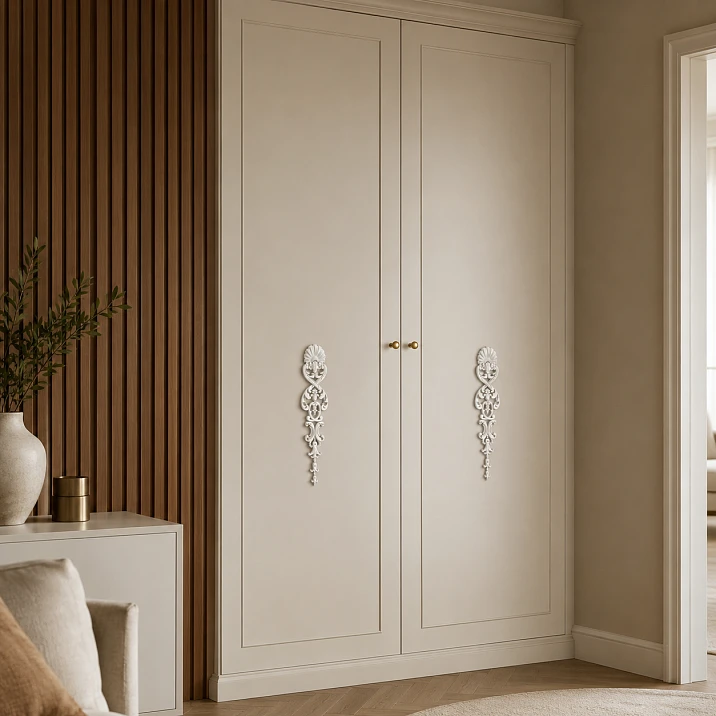
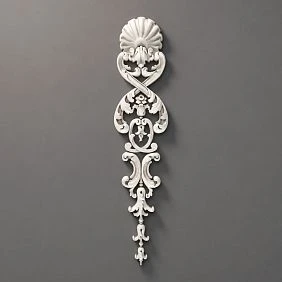
Short answer: on four identical doors, four NPU-237s create a strict repetition, two central ones create one accent block, and sometimes it is better to leave the cabinet without overlays
For a built-in cabinet next to an active slat wall, the rule "one door - one overlay" is not mandatory. NPU-237 70 × 315 × 15 mm has an elongated vertical shape, so four identical elements on four doors create a second frequent vertical rhythm next to the existing rhythm of the slats.
This can look convincing if the cabinet should become an independent decorative furniture plane. But in another interior, the result becomes too fragmented: slat, door seam, NPU-237, next door, next NPU-237 - and so on across the entire width.
According to the current STAVROS card, the small variant NPU-237 has dimensions of 70 × 315 × 15 mm, is made of polyurethane, and costs 1,940 ₽ per piece. The same card lists a larger variant of 110 × 495 × 23 mm for 5,530 ₽, but this article does not select or compare it as an alternative size. Here, the task is specifically fixed on one SKU — 70 × 315 × 15 mm.
For a four-door wardrobe, the commercial fork is as follows:
| Scheme | Quantity of NPU-237 | Cost at 1,940 ₽/pc. | Compositional meaning |
|---|---|---|---|
| Without overlays | 0 | 0 ₽ | the wardrobe remains calm next to the active slatted wall |
| Only the two central doors | 2 | 3 880 ₽ | a unified decorative center is created, the outer facades provide a pause |
| One on each door | 4 | 7 760 ₽ | the entire wardrobe receives a regular vertical ornamental rhythm |
The choice between these schemes should be made not on the principle of "four doors means four parts," but after a full-size mockup on the actual cabinet.
The new topic has an important difference from the already published STAVROS article about NPU-237. There, the overlay is considered as a way to decoratively cover a local scratch on a furniture facade, two sizes are compared, and it is separately decided whether to repeat the decor on the adjacent door after repair. Here, the facades are intact, the small size is already chosen, and the main question is which rhythm works better next to the slatted wall: 4, 2, or 0 identical NPU-237.
Before ordering, you need to check:
-
whether the doors are identical in width and height;
-
where the central axis of each door passes;
-
whether there are handles, opening profiles, or other functional zones;
-
whether the 15 mm relief interferes with the movement of adjacent doors;
-
how close the cabinet is located to the slatted field;
-
whether the four ornaments become a visual continuation of the slats instead of an independent furniture pattern;
-
how the two central NPU-237 look with the doors open and closed;
-
which option reads better from the main entry point.
After this check, you can buy carved decorative overlay NPU-237 made of polyurethane in the quantity that is actually needed for a specific cabinet.




NPU-237 70 × 315 × 15 mm: confirmed characteristics and scope of the task
Our factory also produces:
NPU-237 70 × 315 × 15 mm: what is confirmed for this article
NPU-237 belongs to carved decorative overlays made of polyurethane. The STAVROS card directly allows use on furniture facades, doors, walls, and ceilings.
For the small variant, the following are confirmed:
| Parameter | Value |
| Article number | NPU-237 |
| Material | Polyurethane |
| Width | 70 мм |
| Height / length of the elongated shape | 315 мм |
| Thickness / relief | 15 мм |
| Price | 1,940 ₽ per 1 pc. |
| The script of this article | decorative distribution across functional doors of a built-in wardrobe |
In the fresh official STAVROS article about facade repair, these same dimensions are additionally explained along the axes: the small variant has a width of 70 mm, a height/length of the elongated shape of 315 mm, and a thickness of 15 mm. Therefore, for vertical installation on a door, side and top/bottom margins can be correctly calculated.
This is important: the article does not conclude that "A is the width" based only on the order of the numbers A × B × C. The orientation is confirmed by the manufacturer's own material and the category of vertical overlays.
Get Consultation
Why this article does not need the size 110 × 495 × 23 mm
A larger variant exists, but including it in the main selection would change the intent to "what size of NPU-237 to choose."
The new task is different.
We are already noting:
NPU-237 70 × 315 × 15 mm.
After that, we examine:
-
the rhythm of the sashes;
-
quantity;
-
axes;
-
interaction with the rails;
-
handles;
-
opening type;
-
operation;
-
cost.
If the small variant is not suitable for a specific facade in terms of scale, the article should not be turned into a justification for buying the large one. In such a case, it is more reasonable to go to the catalog of overlays and choose a different decorative scenario.
The main fork: 4, 2, or 0 NPU-237 on a four-door wardrobe
Why four identical overlays can look either cohesive or overly fragmented
Four NPU-237 on four doors create a repetition:
door → vertical overlay → seam → door → vertical overlay.
Such a rhythm is logical in itself. It makes the modularity of the furniture more noticeable.
But nearby there is already a slatted wall, which has its own much more frequent repetition:
slat → gap → slat → gap.
When both rhythms fall into the same field of view, two outcomes are possible.
Scenario A: the rhythms support each other
This happens if:
-
the slats are calm enough in color;
-
the cabinet has wide identical doors;
-
NPU-237 are painted in the color of the facade;
-
the seams between the doors are neat;
-
the overlays are positioned exactly along one axis;
-
there is a visual pause between the cabinet and the slat zone.
Then the four vertical ornaments are perceived as a larger furniture rhythm, and the slats as a smaller wall rhythm.
Scenario B: rhythms compete
This happens if:
-
the slats are contrasting;
-
the door seams are also dark;
-
NPU-237 are painted contrastingly;
-
The doors are narrow;
-
The cabinet almost adjoins the slatted wall;
-
There are vertical handles nearby.
Then, on a small section, too many parallel verticals appear.
In such a case, the 2 × NPU-237 layout on the central doors often works more calmly.
Why two central NPU-237s are not "half of a full set"
The layout with two overlays should be a deliberate composition.
If you simply remove the two outer pieces from four, you can get a feeling of incompleteness.
For the two central NPU-237s to look intentional, the central pair of doors must be perceived as a single unit.
This works especially well if:
-
the central doors are identical;
-
the axis of the entire cabinet passes between them;
-
the outer doors are already visually connected to the side panels or adjacent walls;
-
a slatted wall begins next to the outer door;
-
the central pair is used as a decorative "portal" of the cabinet.
In this case, the composition reads:
calm outer door → two decorative central doors → calm outer door.
This technique creates a hierarchy within the furniture.
Why two central overlays are especially useful if the slats are on the side of the cabinet
Let's imagine a wardrobe built into a niche, and to the right of it begins a slatted accent wall.
If you place NPU-237 on all four doors, the far right panel will be closest to the slats.
It is there that the two vertical rhythms will be most dense.
If you leave the outer doors without panels, a visual buffer appears:
slats → smooth outer door → decorative central pair.
This can be stronger than four identical elements.
It is important that this conclusion depends on the specific position of the wardrobe relative to the slatted area. If the slats are not on the side, but behind the wardrobe or on the opposite wall, the scheme may be perceived differently.
Why four panels are stronger if the wardrobe should become an independent architectural object
There is an opposite scenario.
The wardrobe can occupy most of the wall and be the main furniture object of the room.
Then each door should have the same decorative status.
Four NPU-237s help:
-
emphasize the regularity of the doors;
-
make a smooth cabinet more classic;
-
visually "pull together" a wide facade;
-
repeat the vertical direction of the slats, but on a different scale.
This works especially well if the NPU-237s are painted in the color of the facade and read not as four separate appliqués, but as relief.
Zero overlays — a full composition if the slatted wall is already the main accent
Sometimes the cabinet next to the slats should be almost invisible.
For example:
-
facades without handles;
-
the color of the cabinet matches the wall;
-
the slatted zone contains a TV or backlighting;
-
the room is modern;
-
the doors should look like a single plane.
In this case, four vertical carved elements can ruin the effect of a hidden built-in wardrobe.
The two central ones too.
Then the correct order is:
0 × NPU-237.
This is not a rejection of decor to save money. This is preserving the original architecture.
Dimensions, axes, and door mechanics: what to check before the layout
How to measure a door for NPU-237: you need not only the facade size, but also the clean decorative field
For one leaf, it is important to know:
-
full width;
-
full height;
-
handle position;
-
the width of the opening profile;
-
milling;
-
the panel;
-
technological gaps;
-
the position of hinges or hidden mechanisms;
-
any overlay elements.
If the door is conditionally Wdoor wide and Hdoor high, then with vertical installation of NPU-237 70 × 315 mm, the minimum geometric check looks like this:
Wdoor ≥ 70 mm
и
Hdoor ≥ 315 mm.
But this is almost a useless minimum. The real door is significantly larger, and the question is about free margins.
If the overlay is centered on the leaf:
Eleft = Eright = (Wdoor − 70) / 2
Etop = Ebottom = (Hdoor − 315) / 2
These formulas do not define a "correct indent," but rather allow you to see the proportion.
Conditional example: a door 500 × 2200 mm
This is only a demonstration size.
By width:
500 − 70 = 430 mm
or 215 mm on each side.
By height:
2200 − 315 = 1885 mm
or 942.5 mm from top and bottom with precise geometric centering.
This calculation shows something important: the small NPU-237 occupies only a small part of the tall door.
Therefore, the vertical position should not be chosen automatically by the middle of the height. On a long facade, the geometric center may be too low or too high relative to the handle, eye level, and adjacent furniture.
Why the geometric center in height is not always the visual center
For a built-in wardrobe, the height can be 2300–2700 mm or more. A small overlay of 315 mm easily "floats" in such a field.
The visual center depends on:
-
the top line of the wardrobe;
-
the plinth;
-
handles;
-
the level of adjacent furniture;
-
the decorative line of the slatted wall;
-
the height of the lamp;
-
the proportions of the door.
Therefore, for four doors, it is better to first choose one common horizontal line of centers for NPU-237.
That is, do not place each one "in the middle of what remains," but set:
Y = a single height mark for the center of all overlays.
If the facades are identical, this creates a calm horizontal rhythm over the vertical one.
If the two central doors receive NPU-237, their centers must still lie on the same line.
A handle can make the "centered on each door" layout non-functional.
On a smooth facade, the handle is a functional element, not a decorative detail.
Three typical situations are possible.
Handle on the outer edge of the door leaf
The center of the door remains free.
For NPU-237, this is the simplest scenario.
Long vertical handle closer to the center
It already creates its own vertical line.
NPU-237 nearby can form two competing lines on one narrow door.
Then the options are:
-
shift the overlay;
-
choose only the two central doors;
-
give up NPU-237;
-
use a calmer handle — if the furniture is still being designed.
Integrated profile or push-to-open
The facade looks visually cleaner.
But the profile can occupy the top or side edge, and the mechanism requires a certain press zone.
The overlay should not fall where the user regularly presses with the palm.
Why the handle and NPU-237 need to be mocked up together
If you try the overlay on an empty facade without a handle, it almost always seems more successful.
After installing the hardware, the real density appears.
For the paper test, you need to apply:
-
NPU-237 contour;
-
real handle;
-
its protrusion;
-
working grip area;
-
adjacent sash.
After that, the person should open the door several times.
If the hand constantly touches the 15 mm relief, the composition is unsuccessful regardless of the beauty of the frontal view.
The 15 mm relief is important for hinged and sliding wardrobes in different ways.
For a hinged door, the NPU-237 moves outward together with the leaf.
Check:
-
whether it catches the adjacent facade;
-
whether it comes close to the wall;
-
whether it gets under the handle;
-
whether it interferes with the opening of the adjacent door.
For a sliding wardrobe, the situation is more complex.
One leaf can overlap another. Then the protruding 15 mm can potentially fall into the mutual overlap zone.
You cannot assume that the decorative overlay is automatically compatible with any sliding door system.
Before ordering, you need to measure:
-
inter-door gap;
-
direction of movement;
-
profile depth;
-
position of the overlay relative to the overlap zone;
-
actual clear opening between the doors.
If a 15-millimeter relief falls into the trajectory of the adjacent door, NPU-237 is not suitable for that position without design changes.
A share of 70 mm of the door width helps understand the scale better than the overall cabinet size.
The same NPU-237 looks different on a 350 mm and 600 mm door.
It is useful to calculate not only the free field, but also the share of the overlay width relative to the facade width:
Share = 70 / Wdoor × 100%.
This is not a standard or a “can / cannot” criterion. It is a visual comparison tool.
| Door width | 70 mm as a share of the door width |
| 350 мм | 20,0% |
| 400 мм | 17,5% |
| 450 мм | 15,6% |
| 500 мм | 14,0% |
| 550 мм | 12,7% |
| 600 мм | 11,7% |
On a narrow door leaf, NPU-237 occupies a noticeable part of the central strip. On a wide one, it becomes a thinner marker.
That is why four identical elements on doors of different widths may be perceived differently, even though the article number is the same.
For a cabinet with four door leaves of 350–400 mm each, four NPU-237s form a fairly dense repetition.
On facades of 500–600 mm, each element gets more breathing room.
But the table does not replace the layout: the shape of the ornament, handles, and color change perception more than a dry percentage.
A height of 315 mm on a very tall door requires a conscious tie-in to the interior
Vertically, the situation is the opposite.
On a door over two meters high, NPU-237 occupies only a short section.
Therefore, what matters more is not the percentage of height by itself, but where exactly this section is located.
The overlay can be aligned:
-
with the handle line;
-
with the center of the room;
-
with the height of the adjacent console;
-
with the center of the decorative panel;
-
with other moldings in the interior.
If four NPU-237 units are at the same horizontal level, the cabinet gains a sense of cohesion.
If each is installed "roughly in the center of the free space," small differences become noticeable precisely due to repetition.
For the installation template, it is better to set one absolute height line for identical doors.
If the floor or ceiling has a noticeable slope, do not transfer it to the overlay line
In built-in furniture, minor fitting differences may occur on site.
The cabinet is visually aligned by facades and technological gaps.
NPU-237 must follow the approved furniture grid, not repeat random floor or ceiling deviations.
Checked:
-
line of the top edges of the doors;
-
line of handles;
-
horizontal of NPU-237 centers.
If the furniture maker has already compensated for the room's curvature, decorative elements should not emphasize it again.
Facade modularity, handles, and color: when repetition looks cohesive
Four identical doors are the simplest case; facades of different widths require different logic
A furniture composition often looks symmetrical only from a distance.
In reality, the cabinet may consist of:
-
two wide central doors;
-
two narrow side;
-
mezzanine shelves;
-
a built-in side section;
-
a technical door.
If you place the same NPU-237 in the center of each, the scale relative to the facade will be different.
On a narrow door, 70 mm takes up a noticeable share of the width.
On a wide one, the overlay looks thinner and lighter.
Therefore, the scheme "one per door" works best on identical doors.
If the two central doors are wider than the outer ones
This is a natural scenario for two NPU-237.
The central pair gets a decorative status, the side ones remain calm.
If the outer panels are wider
Two central overlays may seem like too tight a group.
Then four or zero is sometimes more logical.
If the widths differ randomly
There is no need to mask asymmetry with identical overlays.
Identical decor does not automatically make different doors the same.
Four NPU-237 create not only a vertical but also a horizontal rhythm of centers
When four identical elements stand at the same height, the eye connects them into a horizontal line.
So there are two systems:
-
the vertical of each NPU-237;
-
the horizontal of four centers.
This is a useful effect.
It helps a wide cabinet look cohesive.
But if the slat wall nearby has strong vertical lighting, and the cabinet also receives a horizontal line of four dark ornaments, the composition becomes more complex.
Therefore, color is especially important.
In the color of the facade: the calmest scenario for four overlays
If NPU-237 is painted in the same shade as the doors, the four elements are read through light and shadow.
Advantages:
-
the vertical rhythm is not too active;
-
the cabinet remains a single volume;
-
The decorative effect appears when approaching;
-
The slat wall can maintain the status of the main accent.
This is especially useful if the panels are already separated by dark seams.
The downside is that a small overlay can almost disappear under weak frontal light.
But for built-in furniture, this is sometimes a plus.
In the color of the slats: a strong connection, but a high risk of visual fragmentation
If the slats are dark and the NPU-237 overlays are painted in a similar shade on light facades, each overlay turns into a separate vertical sign.
Four signs next to the slat wall literally continue its rhythm.
This can be striking if that is the intention.
But it is easy to get:
many dark verticals across the entire wall.
In such a color scheme, the option with two central NPU-237 often looks cleaner.
Contrasting metal or patina require especially strict symmetry.
Golden, bronze, or other contrasting finishes emphasize the small size.
70 × 315 mm becomes visually more noticeable.
If four plates are not perfectly at the same height, the error is immediately noticeable.
If one door is slightly narrower, the difference is also more noticeable.
Therefore, contrasting finishes require:
-
a precise template;
-
identical centers;
-
identical orientation;
-
of the same shade;
-
of the same degree of gloss.
For the 2 × NPU-237 scheme, these requirements are easier to control.
Why four overlays should not automatically repeat four handles
If each sash has a long vertical handle, the “handle + NPU-237” scheme on each door can turn the facade into eight vertical elements.
This is especially difficult near the rails.
In such a situation, it is useful to compare:
-
four NPU-237;
-
two central ones;
-
only handles without moldings.
If the cabinet already has enough rhythm without overlays, a decorative purchase is not needed.
Push-to-open makes the facade cleaner, but does not cancel ergonomics.
A cabinet without visible handles NPU-237 gets more visual space.
But the user still presses on a specific area.
If the decor is located where you are used to pressing with your hand, the following arise:
-
contamination of the relief;
-
inconvenience;
-
accidental touches;
-
risk of damage to the finish.
Therefore, on the prototype, you need to actually open the cabinet the way it will be used.
Adjacency to a slatted wall: buffer, light, and edge doors.
Proximity to the slat wall should be assessed not in centimeters, but by visual density.
There is no universal rule:
from NPU-237 to the slat wall there should be at least 100, 150, or 200 mm.
The manufacturer does not provide such a figure, and the composition depends on:
-
the width of the outermost panel;
-
the color of the slats;
-
the depth of their relief;
-
the color of the cabinet;
-
lighting;
-
the presence of an end profile;
-
the viewing angle.
Therefore, a mockup is needed.
A paper contour NPU-237 70 × 315 mm is temporarily installed on the outermost door, and they look:
-
from the front;
-
from the passage;
-
from the point where the slat wall reads most actively.
If the outermost NPU-237 visually merges with the first slat, the 4 × NPU-237 scheme loses its meaning.
A smooth outermost leaf can be a useful "buffer zone"
This is one of the main arguments in favor of two central overlays.
A smooth outermost door between the slat wall and the central ornament:
-
reduces visual density;
-
separates furniture decor from wall decor;
-
makes the central pair more noticeable;
-
preserves the modern character of the built-in wardrobe.
This works especially well if the slatted wall is only on one side.
If the slats surround the wardrobe symmetrically on both sides, the two smooth outer doors provide equal buffers on the left and right.
If the wardrobe adjoins the slats on only one side, the two central panels can still be symmetrical
Sometimes it seems that having slats on the right automatically requires shifting the decor to the left.
But this is not necessary.
The central pair NPU-237 can remain symmetrical relative to the wardrobe.
And the smooth right outer door simply creates a pause before the slats.
This way, the composition preserves the internal symmetry of the furniture while respecting the adjacent active surface.
If the slats are behind the opening door leaf
In a built-in wardrobe next to the slat panel, the outermost door may open towards the slats.
Need to check:
-
opening angle;
-
NPU-237 protrusion 15 mm;
-
edge of the slat panel;
-
door handle;
-
possible limiter.
If the overlay comes close to the slats or wall when opening, the decorative element cannot be placed without checking for collision.
This is especially important for the outermost door.
Central leaves may be safe, but the outermost one may not be. Such a technical factor alone can make the 2 × NPU-237 layout more rational than four.
If the door opens towards the wall, check not only the NPU-237 but also the handle
Sometimes the 15 mm relief protrudes less than the handle, so it is the hardware that touches the wall first.
But this does not mean that NPU-237 is automatically safe.
At a different angle, different position, and door deflection, the decorative element may hit the adjacent surface.
A physical test with a volumetric template is needed.
Light along the slats can visually increase the relief of NPU-237.
The 15 mm relief looks moderate under frontal diffused light.
But if light comes from the side of the slatted wall, shadows appear on the overlays.
Four NPU-237s produce four repeating shadow spots.
Two — one central block.
Therefore, the evening scenario may change the decision made during the day.
A trim matching the facade color may be more noticeable under side lighting than a contrasting one during the day.
This is a useful nuance.
There is no need to make NPU-237 dark or golden in advance so that it doesn't get lost.
The 15 mm relief creates its own shadow.
Sometimes a monochrome finish looks richer and calmer, especially next to wooden slats.
If the slatted wall has backlighting, check the cabinet with the scenario turned on.
Linear light in the slats can:
-
enhance shadows on the outermost doors;
-
make one side of the cabinet visually brighter;
-
change the contrast between two and four trims.
To choose the quantity, a real evening test is needed, not just a daytime photo.
Door movement and facade material: how not to lose practicality
A closed and an open wardrobe are two different compositions
Four NPU-237 panels are evaluated on a closed facade as a regular series. But a built-in wardrobe is used every day, so part of the time one or more doors are open.
This changes the pattern.
With four overlays
If one outer door is open, three vertical ornaments remain. The rhythm temporarily becomes asymmetrical.
If one central door is open, the central group also falls apart.
This is normal for working furniture, but it is important to see it in advance.
With two central overlays
When both central doors are closed, they form an accent pair.
If one is open, the pair almost completely disappears.
Therefore, a scheme with two elements depends more on how the cabinet looks specifically when closed.
If the doors often remain open, the decorative system may be less noticeable than it seems in the render.
If the two central panels form a paired door, NPU-237 can emphasize it as the main block.
In a four-door cabinet, the central panels are sometimes perceived as one paired section.
For example:
-
behind them is the main clothing area;
-
the outer doors lead to narrow sections;
-
the central panels are identical;
-
the handles are positioned mirror-symmetrically near the central seam.
Then two NPU-237 on the central doors support the furniture architecture.
Each panel remains on its own door and moves with it. At the same time, the closed cabinet gets a visual center.
This is stronger than trying to place one large element on top of two movable doors, which is completely unacceptable without a special structural solution.
If the central doors are not identical in function, the symmetry can only be visual.
One central door can hide shelves, the other — hanging rods.
Externally, they can still be identical.
For NPU-237, the external facade and the opening method are what matter.
The internal content does not require distinguishing decor if it does not affect:
-
handles;
-
hinges;
-
the load;
-
service;
-
daily frequency of use.
But if one central door is used constantly and the other rarely, the first NPU-237 will be touched by hands more often and receive more operational load.
The frequency of door use can influence the choice of 2 or 4
Let's imagine:
-
two central doors are opened several times a day;
-
the outer ones — several times a month.
In this case, the decorative pair ends up on the most heavily used facades.
It may turn out that visually the two central overlays are stronger, but operationally four or zero are more convenient.
There is no universal answer here.
You need to check where the grip zone is and whether a person touches NPU-237.
If the handles are located far from the ornament, the frequency of opening may not create a problem at all.
Mirrored doors require a separate solution
The NPU-237 card allows use on furniture and doors, but does not provide a universal mounting technology for mirror glass.
If the facade is mirrored:
-
you cannot automatically use the same adhesive as on painted MDF;
-
you need to account for the reflection of the ornament;
-
four NPU-237s may visually double due to reflections of neighboring objects;
-
removal may damage the surface.
For a mirrored facade, first confirm the mounting technology with the adhesive manufacturer or furniture contractor.
If such confirmation is not available, it is better to place NPU-237 on a separate opaque insert or choose a different design.
Glass, acrylic, and high gloss also cannot be considered the same substrate
A smooth facade can be:
-
painted MDF;
-
acrylic;
-
with enamel;
-
glass;
-
plastic;
-
with veneer.
There is one polyurethane pad, but the gluing conditions are different.
Therefore, the article does not prescribe a single universal composition.
Need to check:
-
adhesion to a specific coating;
-
the possibility of degreasing without damage;
-
visibility of the adhesive seam;
-
the possibility of future removal;
-
the reaction of the coating to local load.
A paneled door already has its own architecture
If the facade is not smooth but has a panel, milling, or frame, NPU-237 must conform to the existing field.
Then centering it relative to the common door is not enough.
You need to determine:
-
width of the inner panel;
-
height;
-
axis;
-
distance to the milling;
-
depth of the relief.
If the NPU-237 almost touches the frame, it looks squeezed in.
If a large calm field remains inside the panel, the vertical overlay can be a natural center.
Installation, maintenance, and daily operation
Installation of the NPU-237 must be independent of furniture mechanics
Even a decorative overlay must not interfere with the operation of the facade.
Before installation, the following must be excluded from the NPU-237 zone:
-
cup hinges and hidden fasteners;
-
push-to-open mechanism;
-
opening profile;
-
door closer;
-
magnet;
-
service screw;
-
adjustable hardware.
On the front side, these elements may not be visible.
Therefore, for a finished built-in wardrobe, it is useful to open the door and inspect its construction from the back side.
If the location of the future overlay coincides with the area where the cabinet maker needs to drill, adjust, or replace the mechanism, the decorative element may complicate maintenance.
Do not overlap NPU-237 at the joint of two moving parts
One overlay must be fully positioned on a single door panel.
It cannot be used as a decorative "bridge" across:
-
the central gap;
-
the mezzanine joint;
-
the connection between the door and side panel;
-
the boundary between the opening and fixed parts.
The polyurethane element must move together with one base.
This rule is especially important if the designer wants to "unite" two central doors with a single ornament.
For such an effect, it is better to use two separate NPU-237 units, each on its own door panel.
If the cabinet is already painted, first check the base, rather than gluing immediately
The card confirms the use of NPU-237 on furniture facades, but the actual mounting durability depends on the top layer of the specific door.
On one test area, you need to evaluate:
-
whether the coating peels off;
-
whether there is silicone or wax;
-
whether the surface can be safely cleaned;
-
whether the preparation damages the gloss;
-
whether the chosen mounting compound is suitable.
This is especially important for factory enamel and high-gloss facades.
If the cabinet is only being manufactured, NPU-237 should be included in the furniture project in advance
This allows you to immediately agree on:
-
handle placement;
-
axes;
-
color;
-
the mounting surface;
-
the absence of conflicts with the opening profile;
-
the required number of elements.
Then the furniture maker receives a ready-made scheme, rather than trying to "find a place" for the decor after assembly.
A solid color finish for the entire door and NPU-237 is simpler for future repairs
If the overlay is painted in the color of the facade, local repairs can be planned as part of a single color system.
Contrast patina or metallic finishes are harder to replicate.
For a cabinet with four identical NPU-237s, this is especially important: one restored overlay should not differ from the others.
If the project is commercial or heavily used, it is worth preserving:
-
color code;
-
finishing technology;
-
a photo of the reference;
-
one position template.
Cleaning four overlays is also part of the solution
One NPU-237 has a carved relief.
Four give four times more relief areas.
For a home cabinet this is usually not critical, but in a hallway near the entrance, facades may get dirty more often.
Need to check:
-
whether the decor is on
A slatted wall up to the ceiling and a smooth mezzanine create a useful contrast
If the slats run the full height of the room and the cabinet is also built up to the ceiling, repeating NPU-237 on the upper doors is tempting because of the "emptiness."
But this emptiness can be useful.
Smooth top zone:
-
provides a pause;
-
does not compete with long slats;
-
visually lightens the top of the cabinet;
-
allows the main row of NPU-237 to remain the focal point.
In this case, two or four overlays on the lower doors work more effectively than eight elements on two levels.
If the cabinet stands between two slatted fields
This is another strong scenario.
The cabinet can be built into a smooth niche, with slats placed on the left and right.
Then the outer doors end up between the ornament and two active walls.
The scheme with two central NPU-237 is especially logical:
slats → smooth edge door → central pair → smooth edge door → slats.
The composition gets symmetrical buffers.
Four panels are also possible, but they make the whole wardrobe more classic and less "built-in".
If the slatted wall is opposite the wardrobe
There is no direct adjacency along the edge.
A person sees the slats and the wardrobe facade in different planes.
In this case, the risk of visual merging is less.
Four NPU-237 can work better because there is room space between the two rhythms.
But another question arises: whether the style matches.
If the slats are very modern and the panels are classic, the distance does not eliminate the stylistic contrast.
The bedroom, hallway, and living room impose different requirements on the same wardrobe.
Bedroom
The wardrobe can be a calm backdrop.
Four contrasting NPU-237 panels can make it too active.
Two or four monochrome panels look softer.
Entryway
More random touches, bags, and outerwear.
Practicality and the handle area matter more than symmetry.
Living room
The wardrobe is often seen from afar along with the slatted TV zone.
Here, the compositional rhythm is especially important.
If NPU-237 supports the overall molding system, four can be justified. If the slatted wall is already saturated with equipment and light, two or none look cleaner.
1:1 mockup, price, and commercial comparison of three schemes
Comparison of 4, 2, and 0 NPU-237 should be done on the same frontal photo
The eye compares options poorly if you look at them at different times.
Better to make three mockups on the same photo of the cabinet.
Option 4
One NPU-237 in the center of each door.
Checked:
-
regularity;
-
overload;
-
relation to the handles;
-
proximity to the rails.
Option 2
Only the central pair.
Checked:
-
clarity of the central accent;
-
sufficiency of smooth end doors;
-
symmetry of the cabinet;
-
visual buffer at the slat wall.
Option 0
Smooth doors without overlays.
Checked:
-
is the rhythm of the panels itself enough;
-
does the cabinet not look more modern;
-
is additional molding needed at all.
After this, the comparison becomes fair.
The paper template 70 × 315 mm should replicate not only the rectangle but also the density of the ornament
A simple rectangle is useful for geometry.
But NPU-237 is a carved overlay, so it is better to print or roughly apply the silhouette of the pattern.
Otherwise, 70 × 315 mm is perceived as a calm white strip, but the actual carved element will be visually more active.
For the first test, it is enough:
-
an accurate outer contour;
-
a central axis;
-
dark zones of the ornament;
-
an approximate relief of 15 mm.
A 15 mm volumetric mock-up is especially important for handles and sliding doors
Flat paper does not show:
-
a protrusion;
-
shadow;
-
hand touch;
-
possible collision;
-
cleaning.
You can add a layer of foam board or other material about 15 mm to the template.
After that, you need to:
-
open each door;
-
close;
-
run your hand along the handle;
-
check the adjacent leaf;
-
look from the side.
If the volumetric mock-up interferes, it's too early to buy NPU-237.
The cost of 2 and 4 overlays is not the only difference
At the current price:
2 × 1 940 = 3 880 ₽
4 × 1 940 = 7 760 ₽
The difference is 3,880 RUB.
But four elements also require:
-
twice as many mounting points;
-
twice as many parts to paint;
-
more time for alignment;
-
more identical templates;
-
more surface to maintain.
Therefore, choosing the quantity affects not only the shopping cart.
When four NPU-237 justify the additional 3,880 RUB
The surcharge makes sense if:
-
all four doors really should have the same status;
-
the four elements do not compete with the rails;
-
the handles do not create an extra rhythm;
-
the cabinet is an important decorative object;
-
a monochrome or coordinated finish makes the repetition cohesive;
-
each door is clearly visible.
If the outer NPU-237 add almost no value, the surcharge is not justified.
When the two central ones provide almost all the needed effect
Two NPU-237 are often enough if:
-
The central pair is the visual core of the cabinet;
-
The outer doors create a buffer;
-
there is an active slatted wall nearby;
-
The cabinet is wide;
-
I want to add a classic motif but keep it modern.
This is not an "economy version of four."
This is a different design.
When the zero scheme is stronger than both
0 NPU-237 is rational if:
-
The facades should look hidden;
-
the interior is minimalist;
-
The slatted wall is already saturated;
-
expressive handles;
-
the relief interferes with opening;
-
base is inconvenient for mounting;
-
sliding doors and no confirmed gap;
-
color system does not support carved ornament.
If the two central overlays look lonely
No need to automatically return to four.
Check:
-
position by height;
-
color;
-
distance between central doors;
-
handle size;
-
overall cabinet scale.
Sometimes the problem is not the quantity, but that NPU-237 is too small for a specific large facade.
Then a different overlay is better, rather than doubling the number of identical small elements.
If four look too fragmented
Options:
-
leave the two central ones;
-
make NPU-237 in the color of the facade;
-
choose one larger central decor;
-
use a molding frame;
-
abandon the stucco molding.
Thus, the user has a real alternative, not just "buy less."
Mistakes that make the scheme of 2 or 4 NPU-237 look random
Error 1. Counting the quantity by the number of doors
Why it happens: the cabinet has four doors, so you want to buy four identical parts.
Consequence: the facade gets an extra repeat that starts competing with the slats.
Check: compare 4, 2, and 0 in one photo.
How to avoid: first choose the composition, then the quantity.
Error 2. Centering each NPU-237 on the handle rather than on the door
Why it happens: the handle seems to be the main reference point.
Consequence: if the hardware is positioned asymmetrically, the overlays "float."
Check: mark the geometric centers of the doors.
How to avoid: first the door axis, then check for conflict with the handle.
Error 3. Place four contrasting overlays next to contrasting rails
Why it occurs: you want to more strongly connect two elements by color.
Consequence: the entire wall turns into a frequent sequence of vertical spots.
Check: evening frontal shot.
How to avoid: reduce contrast, switch to two central ones, or keep the facade smooth.
Error 4. Not checking the 15 mm protrusion when opening
Why it occurs: depth is barely noticeable in a frontal photo.
Consequence: a hand, adjacent door, or wall catches the relief.
Check: volumetric template and full opening cycle.
How to avoid: check movement before ordering.
Error 5. Using the same pattern on doors of different widths
Why it happens: identical overlays create a sense of order in the specification.
Consequence: on narrow facades NPU-237 looks larger, on wide ones — smaller.
Check: measure the free side margins of each door.
How to avoid: highlight typical groups of facades.
Error 6. Placing NPU-237 over a furniture seam
Why it happens: there is a desire to combine the central pair.
Consequence: one decorative element ends up on two movable bases.
Check: open each door and mark the boundaries.
How to avoid: one overlay — one door.
Error 7. Evaluating only a closed cabinet
Why it occurs: this is exactly how furniture is shown in the project.
Consequence: during daily opening, decor interferes with the hand or the composition unexpectedly falls apart.
Check: use the cabinet with mockups for several minutes.
How to avoid: test real usage.
Error 8. Buying four because two are "cheaper and therefore worse"
Why it occurs: quantity is perceived as an indicator of completeness.
Consequence: the user overpays for decorative details that do not improve the interior.
Check: remove the outer elements and compare photos.
How to avoid: evaluate the result, not the completeness of the set.
Error 9. Trying to hide inappropriate scale with color
Why it occurs: it seems that if you paint NPU-237 in a matching tone, the four elements will no longer be noticeable.
Consequence: geometric fragmentation remains.
Check: first use a neutral layout.
How to avoid: assert quantity and scale before coloring.
From measurements to decision: algorithm for choosing quantity
What to measure before ordering NPU-237
Parameter What to record What it affects Number of doors … possible scheme Width of each leaf … mm Side margins Height of each leaf … mm vertical position NPU-237 width 70 мм scale on the door NPU-237 height 315 мм scale and axis Relief 15 мм movement and touches Handle position Diagram ergonomics opening type hinged / sliding / other trajectory check To the rack wall by object Visual density Light Direction shadows facade material actual installation technology Service zones Diagram Maintenance This table is enough to move to the layout and not make a decision based on a single catalog image.
Practical algorithm: how to choose 4, 2, or 0 NPU-237 on a finished cabinet
-
Count the actual doors visible in one frontal composition.
-
Measure the width and height of each.
-
Confirm that NPU-237 is used vertically: 70 mm in width, 315 mm in height, 15 mm in relief.
-
Mark the handles, opening profiles, and press zones.
-
Check the movement type of each door.
-
Apply central axes to the facade.
-
Make four templates 70 × 315 mm.
-
Install one on each door.
-
Photograph the cabinet together with the slat wall.
-
Remove the two outer templates and leave the central pair.
-
Take a second shot from the same point.
-
Remove all overlays and take a third one.
-
Add 15 mm depth to at least one outer and one central position.
-
Open and close all flaps.
-
Check the handle or push-to-open zone.
-
Turn on the evening light.
-
Compare the three layouts not by the amount of decor, but by the integrity of the wall.
-
If 4 looks better, order four.
-
If the central pair is stronger, order two.
-
If a smooth cabinet is better, do not buy NPU-237 for this task.
Decision tree
Are the facades intact and NPU-237 needed only as decor?
No → if there is damage, a different evaluation scenario is needed, including the existing STAVROS article on decorative scratch covering.
Yes → continue.
Are the four doors equal in width and visual role?
No → do not use the rule '4 doors = 4 NPU-237'; design groups.
Yes → continue.
Is the 15 mm relief safe for opening and for the hand?
No → 0 on conflicting panels or other decor.
Yes → continue.
Do four layouts create a calm rhythm next to the rails?
Yes → compare with two in terms of price and aesthetics.
No → proceed to two central ones.
Do the two central ones look like a deliberate accent rather than missing outer ones?
Yes → 2 × NPU-237.
No → compare 4 and 0 or another type of decor.
Does the cabinet already look complete without overlays?
Yes → 0.
No → choose the best of the confirmed options.
When a different scenario is needed: repair, molding, another overlay, or new slats
If the facade is damaged, this article is no longer the main scenario
On STAVROS, there is a separate detailed material about NPU-237 as a way to decoratively cover a scratch on a furniture facade.
There, the choice of quantity follows a different logic:
-
size of the damage;
-
its position;
-
need for coverage;
-
symmetry after repair;
-
comparison of 315 and 495 mm.
How to use NPU-237 for a damaged furniture facade
If the doors are intact, there is no need to automatically carry over the symmetry rule from the repair article. There is no defect here that dictates the first position. The composition starts from scratch and is evaluated as a single cabinet next to the rails.
When molding is better than repeating NPU-237
If the cabinet needs a classic character, but four vertical overlays are too fragmented, a calmer frame system can be built.
The molding can:
-
combine each door into a large field;
-
create one rhythm without four separate carved centers;
-
support other frames in the interior.
But this is not an "addition to NPU-237 by default."
When switching to molding, recalculate:
-
perimeters;
-
angles;
-
number of slats;
-
the position of the handles;
-
distance to the edge;
-
overall style.
If such a system is closer to the interior, you can order polyurethane molding already as a full-fledged furniture composition.
When it is better to choose a different decorative overlay
NPU-237 may turn out to be:
-
too narrow;
-
too long;
-
too classic;
-
too embossed;
-
unsuccessful next to the handle.
Then there is no need to increase the quantity.
Open catalog of decorative polyurethane overlays and choose a model for the actual facade.
A new overlay requires a new layout.
It cannot be assumed that if it is smaller, it automatically fits into the old position.
When slat panels are still being selected
If the cabinet is already designed, but the slat wall is not yet, both objects can be coordinated in advance.
For example:
-
choose the color of the slat to match the facade;
-
leave a smooth buffer;
-
decide where the slat field ends;
-
Check the evening light.
If the project requires the panels themselves, you can buy slat panels for walls for interior finishing after the composition of the cabinet is understood.
A commercial request about slats here is the next step for wall finishing, not a replacement for the main product intent NPU-237.
If the slat wall is already installed
This is even more convenient for the final choice of quantity.
You need to:
-
place four paper NPU-237;
-
see the real color;
-
turn on real light;
-
remove the outer ones;
-
compare the central pair;
-
remove everything.
Thus, the decision is made against a finished background, not based on a visualization.
Serial cabinets and lifecycle: how not to replicate a mistake
Several identical wardrobes in one project require a separate prototype, not multiplication of quantity.
An apartment may have one built-in wardrobe. In apartments, hotels, dressing areas, or serial interiors, there are several identical wardrobes.
Then the error 'four look a bit overloaded' multiplies across the entire object.
For a series, it's better to do this:
-
approve one wardrobe;
-
check 4 / 2 / 0;
-
fix the position;
-
check the color;
-
use the wardrobe for several days;
-
only then scale the order.
Series cost
If each four-door cabinet receives four NPU-237:
Cabinets Overlays Cost 1 4 7 760 ₽ 2 8 15 520 ₽ 3 12 23 280 ₽ 5 20 38 800 ₽ If each receives only the central pair:
Cabinets Overlays Cost 1 2 3 880 ₽ 2 4 7 760 ₽ 3 6 11 640 ₽ 5 10 19 400 ₽ These tables are not meant to prove that two are always more advantageous. They show why the composition should be checked before a series purchase.
If the cabinet is planned to be repainted later
NPU-237 can become part of a long-term design.
If the overlays are painted together with the facades in one color, future repainting is potentially simpler in terms of composition.
But it should be taken into account:
-
access to edges;
-
accumulated coating layers;
-
relief preparation;
-
the ability to remove or leave NPU-237.
If after a few years the cabinet is to be returned to minimalism, dismantling decorative elements will require local surface restoration.
Therefore, installation must be of high quality, but the project must account for the furniture's life cycle.
If the cabinet is planned to be replaced, but the slatted wall is to remain
This is another argument not to make NPU-237 a "binding element" too literally.
The interior connection should be maintained even without specific furniture.
If the slats and cabinet harmonize only because the overlays are painted in the color of the lamellas, replacing the facades could ruin the entire effect.
Stronger when NPU-237 supports the common style, but is not the only bridge between the two surfaces.
If the slats and the cabinet have the same color
It seems that since the materials already match in shade, additional decor is not needed.
Sometimes that is the case.
But the same color can, on the contrary, make a large wall too monotonous.
Two central NPU-237 units can create a small relief center without changing the palette.
Four — to enhance modularity.
The choice again depends on the scale.
If the slats strongly contrast with the facade
For example:
-
dark wood + light cabinet;
-
black slats + beige facade;
-
warm oak + cool gray cabinet.
NPU-237 can be used as an intermediate accent.
But it doesn't have to be painted exactly the color of the slats.
Sometimes it's better to choose an intermediate tone or leave it the color of the facade, so the relief connects rather than copies.
If there is already molding on the wall nearby
Then NPU-237 gets a clearer stylistic context.
For example, the room already has:
-
molding frames;
-
decorative rosettes;
-
cornices;
-
other polyurethane overlays.
In such an interior, four NPU-237 look more natural because the cabinet supports the existing language.
If NPU-237 is the only classical ornament in a fully modern space, two or zero often look more convincing.
If the cabinet is used as a hidden door
Sometimes built-in furniture masks a passage.
Then the decorative scheme should account for the hidden door function.
The overlay must not:
-
hinder opening;
-
reveal the structural seam where it is not intended;
-
fall on two independent parts;
-
conflict with the hidden mechanism.
If the goal is to make the door inconspicuous, NPU-237 may be completely contraindicated as a visual marker.
Final recommendation
For a four-door built-in wardrobe next to a slat wall, there is no rule of "one NPU-237 per door."
The small version of NPU-237 is a confirmed vertical carved decorative polyurethane overlay measuring 70 × 315 × 15 mm, with a current price of 1,940 ₽ per piece.
Practical choice:
4 × NPU-237 = 7,760 ₽ — if four identical doors should receive equal decorative status, the rhythm does not conflict with the slats, the handles do not create extra verticals, and the 15 mm relief is safe for opening.
2 × NPU-237 = 3,880 ₽ — if the central pair of doors is the natural compositional center, and the smooth outer doors are needed as a visual buffer between the stucco ornament and the active slat wall.
0 × NPU-237 — if the wardrobe is intended as a hidden smooth surface, the slats already provide enough rhythm, the overlays interfere with the mechanics, or four/two pieces look added just to fill the void.
Before ordering, you need to make four full-size templates of 70 × 315 mm, compare 4 / 2 / 0 on the same wall, add the 15 mm depth, and actually open all the doors.
If after this four elements give the most cohesive facade, buying four is correct.
If the outer overlays only duplicate the vertical noise, the central pair is stronger.
Even if two don't add anything new to the interior, the best order is not to buy NPU-237 for this cabinet.
After checking, you can order NPU-237 overlay in the calculated quantity.
FAQ
Can I first buy two NPU-237s and then add two more if needed?
Yes, that approach is reasonable if you're sure the product and finish will remain available, and the first pair won't be permanently mounted in a composition that's hard to change later. For an accurate assessment, it's still better to mock up all four positions at once. Otherwise, after mounting the central pair, you might get used to it and evaluate the full option less objectively.
Do I need to place NPU-237 strictly in the center of each door?
Not necessarily. The geometric center is a good starting point, but the handle, panel, opening profile, and overall height line may require a different position. The key is that the offset should be systematic and consistently explained across all doors being styled. Random different offsets look like an installation error.
Can I place two NPU-237s only on the outer doors?
Yes, if the outer doors have a distinct architectural role, for example framing a central smooth block. But for a typical symmetrical four-door cabinet, this layout often creates "brackets" at the edges. It needs to be checked separately and shouldn't be considered equivalent to the central pair.
Is NPU-237 suitable for a cabinet with doors up to the ceiling?
Yes, by application type, if the size 70 × 315 × 15 mm fits the facade compositionally and installation is safe. On a very tall door, the overlay occupies a small portion of the area, so the vertical position is especially important. Simply centering between floor and ceiling may look random.
Can NPU-237 be applied to a mirror?
The card confirms application on furniture and doors, but does not provide universal instructions for mirror glass. The adhesive, surface preparation, and removability need to be separately confirmed for the specific mirror. Without such confirmation, it is better not to transfer the technology from painted MDF to glass.
If the wardrobe is sliding, can four NPU-237 panels be installed?
Only after checking the mutual clearance of the doors. The thickness of the small version is 15 mm, and sliding doors can overlap each other. If the decorative relief falls into the trajectory of the adjacent facade, the layout is technically unsuitable. A physical test or furniture system data is required.
Is NPU-237 needed on mezzanine doors?
Not automatically. The top row may be better left smooth to avoid creating a second tier of repeating patterns. If the mezzanines are large and specifically included in a classical composition, a separate layout is developed for them.
What to do if one door is narrower in width than the others?
Do not try to keep four identical NPU-237 panels at all costs. First, compare the side margins. A narrow door can make the overlay appear visually larger. Often it is better to keep only the two central identical doors or divide the facades into different types.
Can NPU-237 be placed horizontally?
This article is based on the confirmed vertical elongated shape: 70 mm in width and 315 mm in height/length. Rotating 90° changes the character of the ornament and should not be considered neutral. If the designer wants a horizontal version, it must be separately checked against the pattern and the card.
Should we make four NPU-237 in a contrasting color?
Only if a very active rhythm is needed. Next to a slat wall, four contrasting verticals can easily create overload. For starters, it's better to compare four solid ones, two contrasting central ones, and a completely smooth facade. Color should not replace checking the scale.
If the handles are in the center of the doors, can the NPU-237 be shifted higher?
Yes, if after shifting all trims maintain a common line and do not fall into other functional zones. On a full-size template, you need to check not only the distance to the handle, but also the overall visual center of the cabinet.
Can NPU-237 be installed on an already assembled cabinet without removing the doors?
This depends on the surface, hardware, and installation technology. The fact that the cabinet is ready does not exclude installation. But you need to ensure precise marking, base preparation, and no load on the mechanisms. Sometimes a removed door is more convenient for precise installation, but the article should not universally require its removal.
Do we need four trims if the slat wall is far from the cabinet?
The less direct visual proximity, the weaker the rhythm conflict, but the quantity is still determined by the facade. Four may be more appropriate if the cabinet is a standalone decorative object. However, stylistic compatibility with the slats and the entire room remains important.
Can NPU-237 be used to hide holes from old handles?
This is already a repair scenario. You need to check the size of the damaged area, the condition of the base, and whether the decor completely covers the traces. For such a task, STAVROS has a separate article about NPU-237 and furniture facade damage; solution 2 or 4 is not automatically transferred here.
What to do if two central NPU-237s look too small on a very wide wardrobe?
It is not necessary to add the outer ones. Perhaps the small size of 70 × 315 mm is simply insufficient for the scale of the furniture. In that case, it is wiser to open the catalog of overlays and compare a different composition. Increasing the number of small elements and increasing the scale of one element give different visual results.
Can only one NPU-237 be used on a four-door wardrobe?
Yes, if the composition is deliberately asymmetrical: for example, one door is a separate accent or hides a special section. On a regular symmetrical wardrobe, a single overlay often looks random. For it, it is more natural to compare 0, a central pair, and four.
Do I need to buy a spare NPU-237?
There is no mandatory percentage of spare for a single home wardrobe. Spare makes sense if complex coloring, intensive use, or a series of identical wardrobes make future replacement sensitive. The decision should be made separately, not by automatically increasing the order from four to five.
If NPU-237 is already painted in the color of the facade, can it be removed later without a trace?
A trace-free removal cannot be promised. The result depends on the glue, the facade coating, surface preparation, and time of use. If a future design change is likely, this should be considered when choosing the installation technology and the data on the finish should be preserved.
-