Article Contents:
- Wooden carved overlay N-101: three sizes of the same ornament
- What does the 95 mm field mean and why it should be measured after cabinet assembly
- What actually fits into 95 mm: counting three N-101s
- N-101 450×66×14 mm
- N-101 550×81×17 mm
- N-101 750×111×22 mm
- Beech Standard
- Beech Prestige
- Oak Standard
- Oak Prestige
- What sizes does N-101 have?
- Which N-101 fits on a frieze 95 mm high?
- How much is left for N-101 450×66?
- How much is left for N-101 550×81?
- Why doesn't N-101 750×111 fit?
- Can 750×111 be trimmed in height?
- Does a wide cabinet necessarily need the longest N-101?
- Do I need to account for the thickness of C?
- What to choose: 450 or 550 mm?
- How does Standard differ from Prestige?
- How much does N-101 450 mm cost?
- How much does N-101 550 mm cost?
- Do I need to buy both sizes for fitting?
- Can N-101 be installed on a hinged door?
- What to do if 550 mm seems too short?
- Where can I see other wooden overlays?
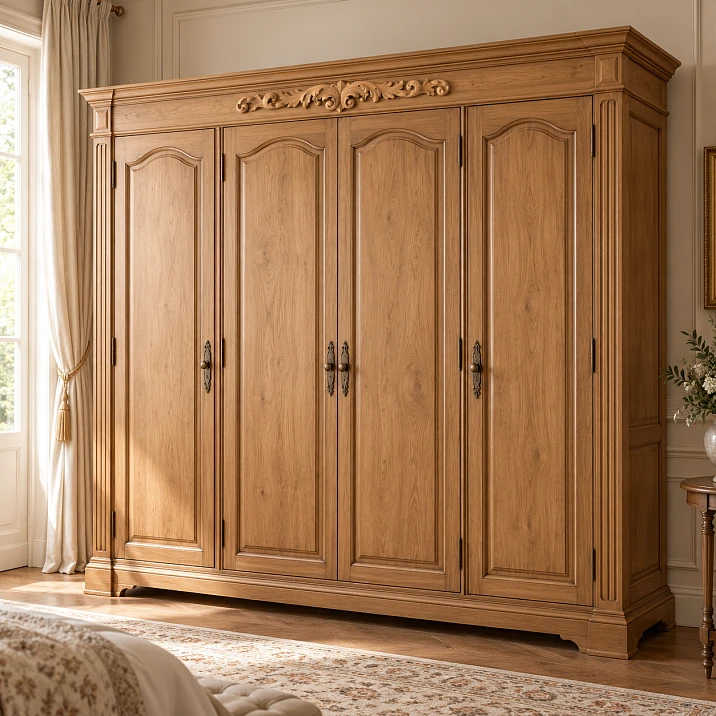
A wide cabinet almost automatically suggests that the longer the decorative overlay, the better it will look centered on the facade. For N-101, this logic is dangerous. The model increases not only in length A, but also in height B and thickness C simultaneously. Therefore, the 750×111×22 mm version may seem suitable for the cabinet width, but it physically does not fit on a fixed frieze with a height of 95 mm.
In such a situation, you cannot start with the question "what length do I want visually." First, check the available frieze height, then compare all three dimensions A×B×C, make a full-size template, and only then choose between the standard options 450×66×14 and 550×81×17 mm. Trimming a ready-made carved ornament in height just to fit an oversized N-101 is a bad way to fix a selection error.
For a specific model, you can buy a wooden overlay N-101 after checking the actual furniture frieze. If no size fits, it is better to change the solution before payment than to try to rework the finished carving.
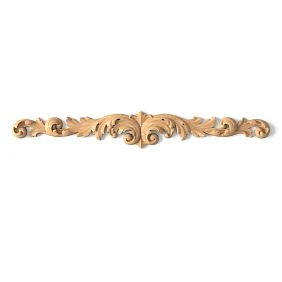
Wooden carved overlay N-101: three sizes of one ornament
N-101 is available in three size versions. As the length increases, so does the height of the decorative element and its thickness.
| Size A×B×C, mm | Beech Standard | Beech Prestige | Oak Standard | Oak Prestige |
|---|---|---|---|---|
| 450×66×14 | 3 970 ₽ | 5 700 ₽ | 4 740 ₽ | 6 400 ₽ |
| 550×81×17 | 5 550 ₽ | 8 090 ₽ | 6 640 ₽ | 9 120 ₽ |
| 750×111×22 | 8 530 ₽ | 11 480 ₽ | 10 420 ₽ | 13 360 ₽ |
At the time of preparing the material, the card offers beech and oak, Standard and Prestige sanding, and production to order in approximately 5–10 days.
The main feature of the size range is clearly visible from B:
- at A=450 mm, height B is 66 mm;
- at A=550 mm — 81 mm;
- At A=750 mm — it is already 111 mm.
That is, the transition from 550 to 750 mm adds not only 200 mm of length, but also 30 mm of height. For a low furniture frieze, it is this second figure that becomes the limiting factor.
The three versions of N-101 should not be perceived as the same overlay that was simply stretched horizontally. The entire scale of the relief changes.




What does the 95 mm field mean and why should it be measured after assembling the cabinet
95 mm in this task is not a characteristic of N-101 and not a manufacturer's recommendation. It is the conditional finished height of the fixed upper frieze of a specific cabinet.
It is important to measure not the nominal part from the furniture drawing, but the actually available decorative area after assembly.
For example, a panel may be declared as 100 mm, but on top part of it is visually overlapped by a cornice, and at the bottom there is a bevel or a technological gap, and the actual flat field turns out to be smaller.
Before ordering, the following are recorded:
| What we measure | Why |
|---|---|
| Finished height of the frieze | Determine the available field by B |
| Width of the flat zone | Check length A and centering |
| Upper boundary | Avoid hitting the cornice or ledge |
| Lower boundary | Do not cross the door gap |
| Chamfer and profile | Understand whether the base remains level |
| Thickness/relief of adjacent parts | Check protrusion C from the side |
| Position of hinges and mechanisms on the reverse side | Do not assign a mounting in a conflict zone |
If the cabinet is not yet assembled, it is better to use the furniture manufacturer's working drawing and then repeat the measurement on the finished body before installing the decor.
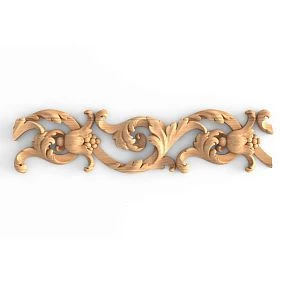
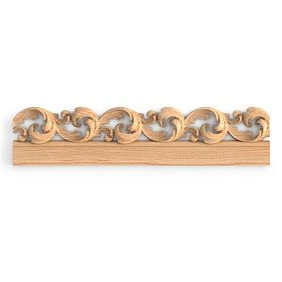
Our factory also produces:
What actually fits in 95 mm: counting three N-101
For this task, simple frontal arithmetic is sufficient.
Get Consultation
N-101 450×66×14 mm
Available field — 95 mm.
Overlay height — 66 mm.
Remainder:
95 − 66 = 29 mm.
If you center the overlay strictly by height:
29 / 2 = 14.5 mm from top and bottom.
This is not a mounting gap or manufacturer's standard. This is a geometric remainder in a conditional field of 95 mm.
N-101 550×81×17 mm
95 − 81 = 14 mm.
When centering:
14 / 2 = 7 mm from top and bottom.
This version also fits entirely, but visually fills the frieze noticeably more densely.
N-101 750×111×22 mm
95 − 111 = −16 mm.
A negative value means the overlay is 16 mm above the available area. With simple centering, it would extend beyond the frieze boundaries by about 8 mm at the top and bottom.
| Execution | Remaining height | Preliminary conclusion |
|---|---|---|
| 450×66×14 | 29 мм | Fits |
| 550×81×17 | 14 мм | Fits more tightly |
| 750×111×22 | −16 mm | Does not fit entirely |
Therefore, for a 95 mm field, the third version is not a candidate for purchase without modifying the furniture project itself.
Why can't you simply remove 8 mm from the top and bottom of the 750 mm version
Mathematically, the idea looks tempting. If the height is 111 mm and you need 95 mm, the difference is 16 mm. It seems you could remove 8 mm from the top and bottom to get the required dimension.
But N-101 is a carved overlay, not a smooth rail.
Height trimming changes the finished ornament. Without a drawing, it is impossible to state in advance which parts of the pattern will be damaged, where the highest elements of the relief are located, and whether a normal edge will remain after processing.
The main rule here is simple: if the standard size does not fit into the approved decorative zone, the first solution should not be trimming the carving, but choosing another standard size.
The sequence looks like this:
550×81 check → 450×66 check → if necessary, change the furniture frieze → if this is not possible, choose another article.
Individual refinement is permissible only as a separate design solution, when the furniture maker and the decorator understand in advance what is being changed and why. It should not arise after delivery as an emergency attempt to 'fit it in somehow'.
A cabinet two meters wide does not automatically make the N-101 450 mm too small.
Another mistake is evaluating the size of the overlay only through the width of the cabinet.
Let the body conditionally have a width of 1900 mm. An overlay of 450 mm occupies about a quarter of this width, 550 mm — slightly less than a third, 750 mm — noticeably more. But these ratios by themselves do not determine which composition is better.
On a wide facade, there may be a large central portal, doors, pilasters, cornice, handles, and other vertical elements. In this case, a small central overlay may work more precisely than a long frieze accent.
Therefore, you should not look at the number 450 in isolation, but at the entire furniture layout.
It is useful to make three paper rectangular templates at a 1:1 scale:
- 450×66 mm;
- 550×81 mm;
- 750×111 mm.
For an initial check, a rectangle is sufficient. It shows the occupied footprint. But it does not reproduce the exact silhouette of the carving, so after selecting a candidate, it is advisable to use an image or drawing of the actual N-101.
On the full facade, the following is usually visible:
450×66 leaves more air around the ornament and more strongly emphasizes the central point.
550×81 makes the accent more noticeable, but still fits within 95 mm.
750×111 may look proportional to the cabinet width, but geometrically conflicts with the frieze height.
This is precisely why the choice cannot be made based on A alone.
A vertical clearance of 7 mm does not automatically mean a good installation allowance.
For N-101 550×81 with a field of 95 mm, 7 mm remains at the top and bottom when centered.
This figure may look sufficient, but it confirms only one thing: the external rectangular footprint fits.
In practice, a few more things need to be checked.
If there is a chamfer on the edge, part of these 7 mm may no longer apply to the flat surface.
If the lower boundary runs near the door gap, the relief of the overlay must not cross the moving front.
If a cornice overhangs from above, the side profile needs to be examined: 17 mm along C may give a different visual contact with the upper part than expected from the frontal pattern.
If the overlay is to be attached with glue, the installer must confirm that the actual contact surface is sufficient. The rectangle size does not show the rear geometry.
Therefore, 7 mm is not permission for installation. It is a reason to keep 550 mm among the candidates.
Thickness C also changes: 14, 17, and 22 mm
In the project, it's easy to forget the third parameter C, because the main problem seems two-dimensional: length and height.
But N-101 becomes thicker as the size grows.
Between 450 and 550 mm:
17 − 14 = 3 mm.
Between 550 and 750 mm:
22 − 17 = 5 mm.
This affects the side perception of the overlay. The more the relief protrudes relative to the plane of the frieze, the more noticeable the decor boundary becomes when viewed from the side.
It cannot be stated in advance that 22 mm will interfere with doors or a cornice. You just need to include C in the check.
This is especially important for a cabinet that stands next to a passage. A person sees furniture not only strictly from the front, and the difference between 14 and 22 mm can be noticeable.
450 or 550 mm: comparing not only length, but also frieze density
After excluding 750×111, two normal candidates remain.
Their main difference in this task is not the price itself, but the degree of frieze filling.
For 450×66, 29 mm remains vertically, that is, 14.5 mm at the top and bottom with geometric centering.
For 550×81, 14 mm remains, that is, 7 mm each.
This is almost a twofold difference in the free field around the ornament.
If the top of the cabinet is already saturated with a cornice, pilasters, and large hardware, the 450 mm option may yield a calmer result.
If the facade is laconic and the central overlay should become the main decorative accent, 550 mm may look more convincing.
The final decision should be made on the full facade, not from a catalog photo of a single part.
How much does it cost to switch from 450 to 550 mm
The price difference depends on the wood species and the quality of the sanding.
Beech Standard
450 mm — 3,970 ₽. 550 mm — 5,550 ₽.
The difference:
5 550 − 3 970 = 1 580 ₽.
Beech Prestige
450 mm — 5,700 ₽. 550 mm — 8,090 ₽.
The difference:
8 090 − 5 700 = 2 390 ₽.
Oak Standard
450 mm — 4,740 RUB. 550 mm — 6,640 RUB.
The difference:
6 640 − 4 740 = 1 900 ₽.
Oak Prestige
450 mm — 6,400 RUB. 550 mm — 9,120 RUB.
The difference:
9 120 − 6 400 = 2 720 ₽.
| Execution | 450 мм | 550 мм | Difference |
|---|---|---|---|
| Beech Standard | 3 970 ₽ | 5 550 ₽ | 1 580 ₽ |
| Beech Prestige | 5 700 ₽ | 8 090 ₽ | 2 390 ₽ |
| Oak Standard | 4 740 ₽ | 6 640 ₽ | 1 900 ₽ |
| Oak Prestige | 6 400 ₽ | 9 120 ₽ | 2 720 ₽ |
The commercial choice should not look like "pay an extra 1,580–2,720 ₽ for a longer overlay," but rather like a comparison of finished options: visual density, wood species, sanding quality, future finishing, and installation.
Standard and Prestige are not color names
N-101 is offered in Standard and Prestige. These words refer to the surface treatment, not the final color.
For ordering, four things need to be distinguished:
- type of wood;
- the quality of sanding;
- preparation of the workpiece for the future finish;
- the finish coating itself.
If the cabinet is painted in an opaque color, the corresponding preparation and coating system need to be coordinated. If the natural oak grain is important, the selection logic will be different.
You cannot simply order Prestige and expect the overlay to arrive ready in the cabinet's color.
For a more precise understanding of the treatment, it is useful to refer to the STAVROS page on product quality, and transfer the already agreed option into the commercial specification.
A full-size template 550×81 is more useful than buying three sizes 'for trying on'.
To choose between 450 and 550 mm, you don't need to buy both overlays in advance.
First, cut a rectangle of 550×81 mm from paper or thick cardboard. Place it on the frieze along the intended axis.
Check:
- whether the center of the overlay matches the center of the cabinet;
- how close the ornament comes to the cornice;
- Does a clear lower boundary remain?
- does the decor conflict with the tops of the doors;
- How does the size look from a normal distance?
- what happens when viewed from the side;
- is there enough free space for a calm composition.
If 550 mm seems too tight, try 450×66.
If 550 mm seems too short for the width of the cabinet, that is not a reason to go back to 750×111 and trim it. First, decide whether the frieze itself can be changed or another article selected.
The template checks the dimensions and composition. It does not replace checking the exact contour, back surface, and mounting technology.
If 550 mm looks too short, we change the project, not the thread.
Let's imagine furniture about two meters wide, and even N-101 550×81 after fitting looks too compact.
There are three proper ways.
First, increase the height of the fixed frieze if the furniture is still being designed. After the change, re-check 750×111 as a whole. It cannot be assumed that adding 16 mm is automatically sufficient: a proper visual and installation margin is needed.
Second, choose another long item with a smaller height. In the decorative overlay category, there are different proportions, so the task does not have to be solved only by N-101.
Third, change the composition. For example, abandon one long central overlay in favor of another decorative system if it better matches the facade.
A bad way is to buy 750×111 and then decide on site which parts of the thread to remove down to a height of 95 mm.
If N-101 does not solve the task, you can move to the category of decorative overlays and choose a different model rather than fitting an unsuitable one.
Do not place the overlay through the gap of two opening doors.
Even if the upper frieze visually looks like a single strip, you need to make sure it is truly stationary.
If a decorative element crosses two independently opening doors, the overlay must not bind them into a single stationary unit.
In the article under consideration, 95 mm refers specifically to the stationary top frieze. This is an important condition of the scenario.
If on a specific cabinet the "frieze" is actually the upper part of the door fronts, the task changes. You need to separately decide which part the overlay belongs to and how it will move when opened.
Therefore, before ordering, it is worth doing a simple check: outline the boundaries of the stationary part with a pencil or painter's tape and make sure that the entire dimension N-101 is only on it.
Beech or oak is chosen after the size
It is reasonable to choose the wood species after the dimension has been determined.
If 550 mm is already approved geometrically, then beech and oak are compared.
For opaque finishes, beech is often considered a practical base, but the specific choice depends on project requirements.
For visible texture, oak may be preferred if it is consistent with the rest of the furniture.
An absolute match of the natural grain of a new overlay with existing cabinet parts cannot be guaranteed.
If a decorative element is meant to be perceived as part of a furniture series, it is better to coordinate the finish sample next to a real facade.
Installation on a ready-made frieze: first the base, then the adhesive
Even a correctly chosen N-101 may install poorly on an unprepared base.
You need to determine:
- what the frieze is made of;
- what it is already coated with;
- is the old coating firmly adhered;
- whether there is a bevel;
- how flat is the surface;
- whether the selected mounting system can be used on this pair of materials.
You cannot assign one universal adhesive for any furniture.
If the surface is laminated, lacquered, or already painted, the preparation method differs from bare wood or MDF. The installer must use a compound suitable for the specific materials and follow its instructions.
If the finish coating is unstable, gluing an overlay on top of it as a way to "cover up the problem" is not advisable. First, the base is brought to a proper condition.
When N-101 450 mm is better, although 550 mm also fits
The 550 mm version is not automatically better just because it is larger and fills the frieze more strongly.
450 mm may turn out to be more suitable if:
- The cabinet has a rich cornice;
- there are pilasters or other carved elements nearby;
- the upper frieze is visually divided into several zones;
- the furniture is mostly viewed from a close distance;
- 7 mm of clearance in the 550 version looks too tight;
- The overlay should be an accent, not a frieze spanning the full width.
So the choice between 450 and 550 mm is no longer a question of "fits or not." Both fit. Composition comes into play from there.
When N-101 should not be purchased for this cabinet at all
There are several situations where it is better to refuse the model.
If the actual height of the fixed zone after final measurement is less than 81 mm, version 550 no longer fits, and only 450 remains — provided that 66 mm also fits with the required clearance.
If even 450 mm looks disproportionately short, and the furniture frieze cannot be changed, it is better to choose a different article.
If the base does not allow safe attachment of the overlay without questionable rework, the installation is resolved first.
If the decorative zone belongs to an opening door rather than a fixed frieze, the installation scenario itself needs to be reconsidered.
If the owner wants a long ornament spanning almost the entire width of the cabinet, N-101 may simply be the wrong proportion: its large version is too tall.
In such cases, it is better to buy carved wooden decor of a different format than forcing N-101 to perform an unsuitable task.
Mistakes when ordering N-101 for a low frieze
Mistake: choosing only by A. The cabinet is wide, so the buyer immediately looks at 750 mm. Consequence — version B=111 mm does not fit into 95 mm. Solution — check A, B, and C simultaneously.
Error: considering a negative remainder acceptable as "with a slight trim." −16 mm means a real size conflict. Solution — another standard size or another project.
Mistake: considering 7 mm at the top and bottom as an installation norm. This is only a mathematical remainder. Solution — check bevels, the flat zone, and installation.
Mistake: ignoring C. The thickness difference changes the side silhouette. Solution — view the overlay from the side.
Error: choosing the wood species before the size. You can spend a long time comparing beech and oak for a version that physically does not fit. Solution — geometry first.
Error: buying several sizes for physical fitting. Initial screening can be done with templates. Solution — mockup first, then product.
Error: gluing the overlay onto weak old coating. The decor holds together with the base. Solution — check the surface condition before installation.
Final order specification
Suppose, after a full-size fitting, N-101 550×81×17 mm is approved.
For the seller, the request might look like this:
N-101 / 550×81×17 mm / beech / Standard or Prestige / confirm blank quality / 1 pc. / application — fixed upper furniture frieze with a height of 95 mm / finish per project.
If oak is chosen, the material is changed in the line.
If after fitting 450×66×14 looks better, the full size of that exact version is substituted into the request.
You should not write "overlay approximately 550 mm" or "the longest one that fits." The order must include a specific article and full A×B×C.
After choosing the size and finish, you can complete the purchase of N-101, and if necessary, separately agree on installation materials and delivery.
Questions before purchasing N-101
What sizes are available for N-101?
450×66×14, 550×81×17, and 750×111×22 mm.
Which N-101 fits on a frieze with a height of 95 mm?
By external height B, 450×66 and 550×81 fit. The 750×111 version is taller than the specified field.
How much space remains for N-101 450×66?
29 mm in height, that is, 14.5 mm on top and bottom with purely geometric centering.
How much space remains with N-101 550×81?
14 mm, that is, 7 mm at the top and bottom when centered.
Why doesn't N-101 750×111 fit?
Because its height is 16 mm more than the nominal field of 95 mm.
Can the 750×111 be trimmed in height?
You should not use trimming a ready-made ornament as a way to fix an incorrectly chosen size. If individual reworking is needed, it is designed separately.
Does a wide wardrobe necessarily need the longest N-101?
No. The cabinet length is only one parameter of the composition. The frieze height can be the limiting factor.
Do I need to take thickness C into account?
Yes. It varies from 14 to 22 mm and affects the side relief.
What should I choose: 450 or 550 mm?
Both versions fit within 95 mm. The choice depends on visual density, free space, and the overall cabinet front.
How does Standard differ from Prestige?
These are surface finish quality options, not two product colors.
How much does the N-101 450 mm cost?
At the time of writing: from 3,970 ₽ for beech Standard.
How much does the N-101 550 mm cost?
At the time of writing the article: from 5,550 ₽ for Standard beech.
Do I need to buy both sizes for fitting?
No. First, you can make full-size templates.
Can the N-101 be mounted on an opening door?
Only if the project involves attaching entirely to one moving part. This article discusses the fixed upper frieze.
What to do if 550 mm seems too short?
Change the frieze, choose a different item, or reconsider the composition. Do not trim 750×111 without a separate project.
Where to see other wooden overlays?
In the STAVROS decorative overlays category or in the general carved decor section.