Article Contents:
- What is Rhythm in Interior Design: From Theory to Practice
- Five Elements of Interior Rhythm
- Polyurethane Moldings: Architectural Space Markup
- Four Systems of Wall Molding Layout
- Molding Profile: What to Choose for Different Interiors
- Stucco Decor: The Accent That Sets the Final Touch
- Where to Place a Decorative Stucco Accent
- Decorative Stucco: How Not to Overdo It with Accents
- Five rules for working with decorative moldings in a unified system
- Ceiling moldings: the upper voice in the overall score
- Ceiling rosette: the central note of the upper plane
- Ceiling cornice: the spatial connection between wall and ceiling
- Molding contour on the ceiling: zoning without walls
- Three rhythm formulas: from quiet to grand
- Formula «quiet rhythm»
- Formula «accent rhythm»
- Formula «grand rhythm»
- Rhythm by zones: a map for applying moldings in the interior
- Stucco and Light: A Rhythm That Changes with Lighting
- Systematic Approach: How to Buy Stucco Correctly
- Additional Zones and Non-Standard Applications
- Rhythm in the Bathroom
- Rhythm in the Children's Room
- Rhythm in a Country House
- Rhythm in Commercial Spaces
- Five Mistakes When Creating Rhythm with Stucco
- Mistake One: Different Elements Without a Common Logic
- Mistake Two: Too Frequent Rhythm
- Third mistake: no main center
- Fourth mistake: ceiling not connected to walls
- Fifth mistake: buying parts without a plan
- FAQ: answers to common questions
- About the company
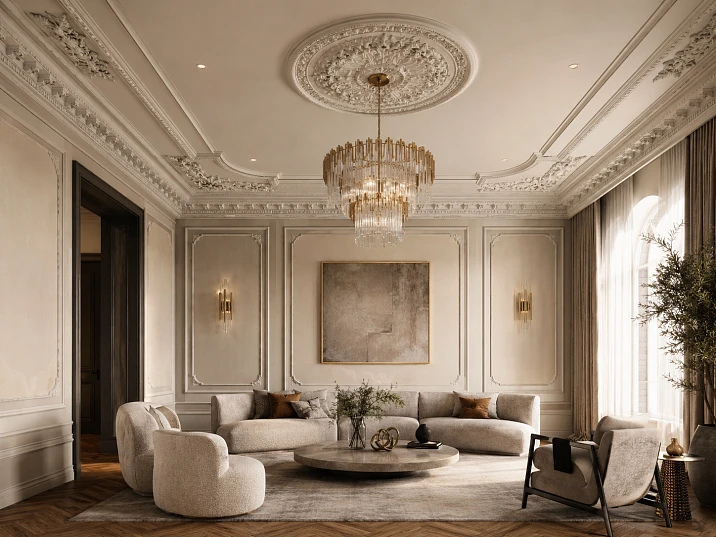
Imagine an orchestra where every musician plays on their own — without a conductor, without a common score, without rhythm. The instruments are the same. The musicians are the same. But there is no music — only noise. This is exactly what happens to an interior when there is no rhythm: expensive furniture, good finishes, a beautiful lamp — but the room does not "sound." It is not assembled. It is not whole.
The rhythm of an interior is what creates Moldings: repeating lines of moldings that guide the eye; a ceiling rosette that fixes the central axis; a decorative accent that says "stop here." This is not decoration. This is an architectural score by which the entire interior is read.
That is why to buy molding correctly means buying it as a system, not as a set of random parts. Moldings, decorative stucco, ceiling stucco, and stucco decor work together — or they don't work at all.
What is rhythm in interior design: from theory to practice
In music, rhythm is the ordered alternation of sounds and pauses. In interior design, the principle is the same: ordered alternation of architectural elements and empty planes. A molding frame is an element. The clean wall around it is a pause. A decorative overlay is an accent. Emptiness again — a pause again.
When this alternation is structured, the eye moves through the room predictably and pleasantly: from wall to ceiling, from molding to furniture, from mirror to chandelier. The space "reads" like a well-written text. When there is no rhythm, the gaze wanders without support.
That's why professional designers say: "an expensive interior relies not on details, but on a system." You can add one correct molding — and the room will transform. You can buy ten trims without logic — and they will only create visual noise.




Five elements of interior rhythm
Repetition. Identical molding frames spaced at equal intervals create a rhythm of repetition — the calmest and classically flawless. It soothes the space, makes it predictable and "expensive" in an architectural sense.
Symmetry. A mirror with paired trims on the sides. A bed with identical frames on both sides of the headboard. A fireplace with symmetrical elements on the mantel. Symmetry is rhythm duplicated relative to an axis, and it creates a sense of intentionality and completeness.
Accent. After a uniform rhythm, a "forte" is needed — a loud note that stands out. A large Relief Decoration in the center of the main wall, a monumental rosette under the main chandelier, an ornamental trim above the fireplace — this is the accent for which all the preceding rhythm was built.
Pause. This is perhaps the most underestimated element. An empty wall next to a decorated one is not "incompleteness." It is an architectural pause that makes the preceding element "sound" longer. Without a pause, rhythm turns into noise.
Connection of planes. The rhythm of the interior should not end on the walls. Ceiling molding continues the rhythm upward: the cornice picks up the line of the wall molding, the rosette under the chandelier responds to the symmetry of the furniture group below it.
Our factory also produces:
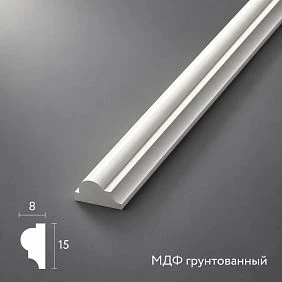


Polyurethane moldings: architectural marking of space
If one had to explain the role of moldings in a single phrase, it would sound like this: a molding turns a wall from a surface into architecture. It does not decorate — it transforms. A fundamental difference.
A bare wall is a plane. A plane has no scale, no division, no rhythm. A molding introduces a line into this plane — and following the line comes proportion, division, shadow. A vertical pair of moldings makes the wall "tall." A horizontal band makes it "stable." A rectangular frame makes it "meaningful."
Moldings made of polyurethane — this is exactly the tool needed. Polyurethane reproduces any classic profile with lithographic precision, weighs several times less than plaster, is glued with construction adhesive without anchors or drilling. It is cut with a knife at any angle. It is painted with any matte paint. This is a practical material with results comparable to professional plaster stucco.
Get Consultation
Four systems of molding wall marking
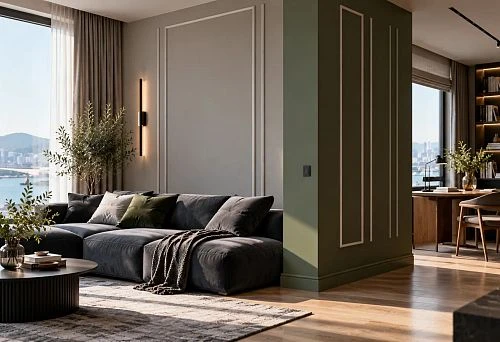
System of vertical lines. Moldings are mounted vertically from the ceiling plinth to the floor plinth, at equal intervals. The wall is divided into "panels" — this is a classic technique known in architecture as "rustication" in a flat version. Vertical lines stretch the wall upward, making the ceiling visually higher. Works in hallways, bedrooms, classic living rooms.
System of horizontal belt. One horizontal molding at a height of 1.0–1.3 m divides the wall into two parts: the lower ("base") and the upper. The lower part can be painted in a richer tone or finished with panel material. The horizontal calms the space, making it "warm" and "grounded."
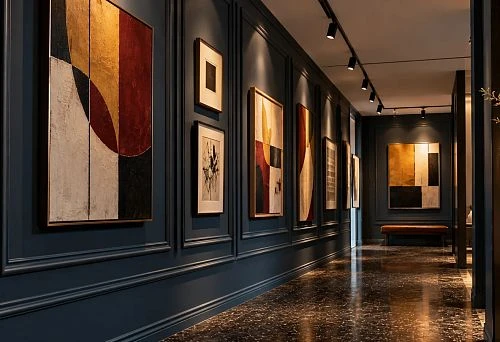
System of frames. Rectangular or square frames made of moldings, applied to the wall in a regular order. This is a "panel" system — one of the most recognizable architectural techniques, used in European palaces and still working flawlessly in modern apartments with the right scale and profile.
Accent frame on the main wall. One large frame behind the sofa, bed, or console. This is not a "system," but a "statement." Here, all architectural energy is concentrated in one point. Especially effective when there is a decorative accent inside the frame — an overlay, painting, sconce, or mirror.
Molding profile: what to choose for different interiors
A profile is the cross-section of a molding that determines the shape of the shadow. Shadow is the visual "voice" of the molding. Without shadow, the molding is almost invisible. With side lighting, it is expressive and voluminous.
-
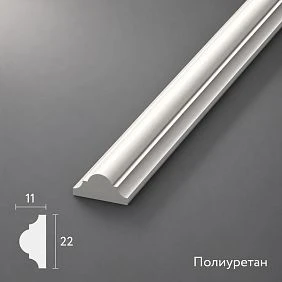
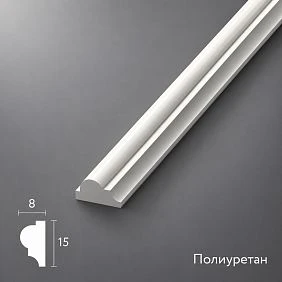
Thin flat profile (15–30 mm) — for modern minimalist or Scandinavian interiors. Creates a light shadow line, almost invisible in daylight, but provides the necessary detailing.
-
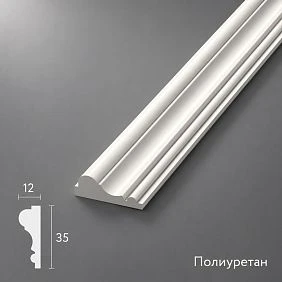
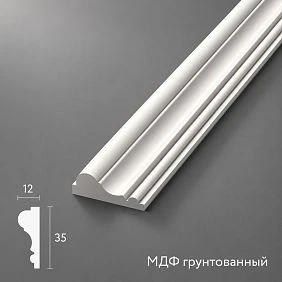
Medium classic profile (40–65 mm) — a universal choice. Works in neoclassical, modern classic, and transitional styles. Expressive shadow, clear line.
-
Wide ornamental profile (70–120 mm) — for classic interiors, high rooms, and formal areas. Creates a monumental architectural molding, requires ceiling height of at least 2.8 m.
buy polyurethane moldings the right profile is the first step to interior rhythm. The STAVROS catalog offers a wide range of profiles for any task: from the finest modern lines to monumental classic moldings.
Stucco decor: the accent that puts the finishing touch
If moldings are rhythm, then Relief Decoration is the final chord. It is needed not everywhere, but precisely in those places where the eye should slow down and stop. Where the 'pause' ends and the 'statement' begins.
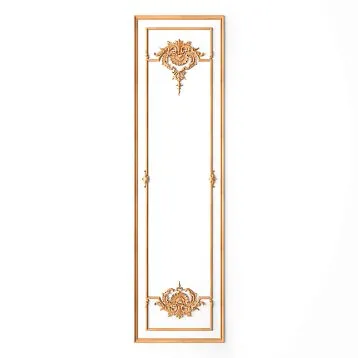
A decorative polyurethane overlay is a three-dimensional ornamental element: a bird, floral motif, mascaron, abstract ornament, leaf decor, geometric accent. It is not a 'sticker' — it is an architectural detail with a depth of 5–15 mm that casts a shadow, interacts with light, and creates the feeling of a 'living' surface.
The rule for applying a decorative accent in the context of rhythm: one strong center — and a minimum of 'secondary' elements. Or a regular series — without a highlighted center. Mixing the two principles in one space creates chaos.
Where to place a stucco decorative accent
Center of the molding frame. This is a classic position — a frame without a central element looks incomplete. A small overlay in a geometric or natural motif "closes" the frame, turning it from a "contour" into a "work of art."
On the sides of the mirror — a pair L/R. Symmetrical overlays to the left and right of the mirror create an "architectural framing" without an additional frame. This is one of the most elegant and simple techniques: the mirror immediately acquires a "built-in" look — part of the wall architecture, not an "object hung on the wall."
Above the door opening. A decorative element above the door is a "supraporta": a technique with a thousand-year architectural history. It works at any scale: from a small modest overlay to a monumental ornamental cartouche above the main gate.
At the head of the bed. A central overlay between the molding frame and the bed — or a symmetrical pair on either side of the headboard. This creates an "architectural headboard": not soft, not fabric, but equally expressive.
On the fireplace portal. Above the mantelpiece, a decorative element works like a "coat of arms" — a sign of the space's identity. This point in the room attracts the eye first, and here the accent works with maximum force.
Buy Moldings — this is a choice from the wide range of PU overlays in the STAVROS catalog: natural motifs, geometric ornaments, animals, mascaron, paired L/R elements. For each task — its own solution.
Decorative stucco: how not to overdo it with accents
This is perhaps the most subtle section — because this is where mistakes are most often made. Decorative stucco attracts the eye. You want to put it here, and here, and here too. But every next accent without a pause is noise, not music.
How to know when there are enough accents? A simple test: enter the room and close your eyes for a second. Open them — and note where your gaze immediately goes. If it rushes to one point — the accent works. If it "jumps" between several elements, not knowing where to stop — there are too many accents.
Five rules for working with decorative molding in a unified system
Rule one: one main center. Each room should have one "most important" point: a main wall, a fireplace, a mirror in the hallway, the center of the ceiling under the chandelier. That's where the most expressive element is. Everything else is subordinate.
Rule two: large decor requires a pause. If there is a large decorative mascaron or ornamental rosette in the center of the wall, the wall around it should be calm. No additional overlays, no small details. Only a molding frame and an empty field inside.
Rule three: small overlays work in a series or pair. A single small overlay gets lost. A pair or series is already a rhythm. Three identical overlays at equal intervals on a horizontal surface or on a wall is a very strong technique.
Rule four: monochrome painting in the color of the wall. buy decorative moldings and immediately paint it in the color of the wall — and it instantly "fits" into the architecture. It becomes a relief, not an object. It is this technique that creates the feeling of "built-in" decor — the most expensive and noble.
Rule five: contrast — only with intent. Contrast painting (for example, a dark overlay on a light wall) is a design statement with a clear "voice." It either works at the level of intent — or looks like a mistake. Without a clear understanding of "why contrast?" it is better to choose monochrome.
buy decorative moldings from polyurethane in the STAVROS catalog — means getting products ready for painting with any matte compound without additional treatment: the polyurethane surface is non-porous, the paint lays evenly and holds securely.
Ceiling molding: the upper voice in the overall score
An interior where the walls are worked out but the ceiling remains empty is like an orchestra without cellos. Something important, warm, and substantial is missing. Ceiling molding complements the rhythm of the interior from above — and that is exactly what makes the room cohesive.
What happens when the ceiling is 'included' in the system? First: the cornice around the perimeter creates a visual transition from the wall to the ceiling — smooth and architecturally sound. The walls and ceiling stop 'cutting' at the corners and start 'breathing' together. Second: the ceiling rosette under the chandelier fixes the central axis of the room. Third: the molding contour on the ceiling repeats the shape of the furniture group below, creating a 'vertical' connection between the floor and the ceiling.
Ceiling rosette: the central note of the upper plane
ceiling rosettes made of polyurethane — this is a separate story about how a small detail creates a big effect. A rosette with a diameter of 40 cm, painted in the color of the ceiling, is almost invisible in daylight. But when the chandelier is turned on, the rosette begins to 'speak': concentric ornamental rings cast soft shadows, creating an architectural halo around the light fixture.
This is rhythm: not constant noise, but appearance at the right moment. The rosette is 'silent' during the day and 'sings' in the evening — exactly when the space is most in use.
How to choose the diameter of the rosette? A simple proportion: the diameter of the rosette is 60–80% of the diameter of the chandelier's light spot. For a chandelier with a diameter of 50 cm — a rosette of 30–40 cm. For a monumental chandelier with a diameter of 100 cm in a high hall — a rosette of 65–80 cm.
Ceiling cornice: spatial connection between wall and ceiling
A cornice is a molding installed in the corner between the wall and the ceiling. It works as a transition element and simultaneously as a 'frame' for the entire ceiling. The simplest cornices — with a straight profile — provide a light dividing line. More complex ones — with a stepped profile — create a monumental transition that enhances the sense of height.
An important detail: a cornice with a groove for an LED strip allows for hidden contour lighting — a very relevant technique for modern interiors. Such a cornice is simultaneously an architectural and lighting element.
Buy ceiling stucco molding in full assortment — cornices, rosettes, moldings, and ready-made CPU-P ceiling systems — can be found in the corresponding category of the STAVROS catalog.
Molding contour on the ceiling: zoning without walls
In open-plan apartments, the ceiling molding contour serves as architectural zoning. A rectangular frame on the ceiling above the sofa group "says": this is the living room. A similar frame above the dining table — this is the dining room. Zone boundaries are clearly readable, but without partitions, without heavy structures.
For this purpose Buy ceiling molding in the form of molding contours — this is the most cost-effective solution in the category of architectural zoning.
Three rhythm formulas: from quiet to grand
Formula "quiet rhythm"
For a modern apartment with clean finishes, neutral colors, minimalist or Scandinavian furniture.
Principle: detailing exists, but it is almost "inaudible." Molding is thin, the profile is laconic, the coloring is monochrome. The relief is only readable with side lighting — and that is exactly what is needed.
What to buy:
-
Thin Moldings made of polyurethane with a profile of 20–35 mm
-
A ceiling rosette of delicate shape — ceiling rosettes
-
Minimal Decorative stucco — one pair of overlays at the mirror or one central element
-
Paint strictly matching the wall and ceiling color
Where it works: modern living room, neutral-toned bedroom, study, rental apartment.
The “accent rhythm” formula
For a neoclassical interior, a “hotel-style” bedroom, a living room with expressive furniture.
Principle: there is a clear center — and a rhythm leading to it. Molding frames set the structure. One decorative accent, but expressive — sets the point.
What to buy:
-
Moldings made of polyurethane with a 40–60 mm profile for frames
-
Decorative overlay for the center of the main frame — Buy Moldings
-
Paired elements at the mirror
-
Ceiling rosette of proportionate diameter
-
Paint in wall color
Where it works: main living room wall, bedroom headboard, console area with mirror, dining area with chandelier.
Formula "ceremonial rhythm"
For a country house, high hall, ambitious study, restaurant, formal lobby.
Principle: here the stucco speaks at full volume. Wide moldings, deep ornamental relief, monumental ceiling system, large decorative accent with symmetry.
What to buy:
-
Wide Moldings made of polyurethane profile 70–120 mm
-
Large Decorative stucco — mascaron, ornamental overlay, paired elements
-
Monumental Ceiling molding — ready-made CPU-P system or custom assembly
-
Ceiling rosette with a diameter from 50 cm
-
Painting in a single tone with possible delicate patina on accent elements
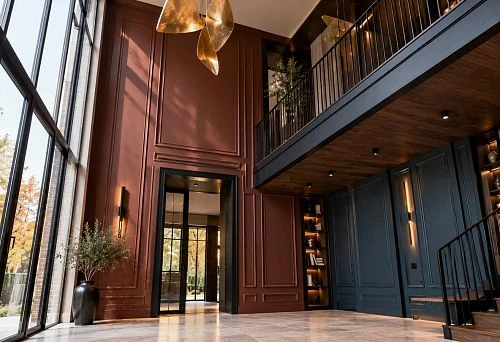
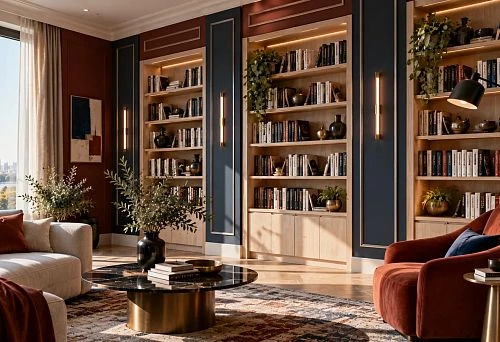
Where it works: double-height hall of a country house, formal dining room, study with library, restaurant hall, executive office.
Rhythm by zones: map of stucco application in the interior
| Zone | What rhythm is needed | What to buy |
|---|---|---|
| Living room (main wall) | Accent rhythm with a large frame | Moldings + stucco decor |
| Bedroom (headboard) | Soft symmetry | Moldings + decorative stucco |
| Hallway | Vertical rhythm | Narrow moldings |
| Ceiling | Center and perimeter | Ceiling molding + rosette |
| Mirror | Paired accent | Molding decor L/R |
| Office | Strict architecture | Moldings + large molding |
| Furniture front | Small repeat | Decorative Inserts |
| Dining area | Top contour | Molding contour on ceiling |
Stucco and light: a rhythm that changes with illumination
Here we need to mention an important aspect that is often forgotten when purchasing decor. Moldings decoration — is not a static element. It lives in different modes depending on the source and direction of light.
In diffused daylight, monochrome-colored stucco almost 'melts' into the wall. It is there, it creates detailing, but does not shout about itself. This is ideal for a daytime space — quiet architecture as a backdrop for life.
In evening directional light — side sconces, floor lamps, spotlights — the relief 'opens up.' Shadows become deep. The ornament gains volume. Molding lines are drawn clearly. The decorative overlay turns into a sculptural element. The space becomes richer — not due to additional objects, but due to what is already there.
This is the 'rhythm with lighting': the interior changes character from morning to evening, but does not lose architectural logic. That is why stucco works especially effectively in areas with active evening use (living room, bedroom).
Systematic approach: how to buy stucco correctly
Chaotic purchasing is the main enemy of interior rhythm. 'I'll buy one overlay, see how it looks.' 'I'll take a molding, if I like it, I'll add more.' This approach leads to the result we talked about at the beginning: there are details, but no system.
The right approach is to design the system on paper before purchasing. It's not difficult. You need to answer five questions:
1. Where is the main center of the room? Sofa? Bed? Fireplace? Mirror? That is where the main accent should be.
2. What type of rhythm is needed? Quiet, accented, or ceremonial? This determines the molding profile and the scale of the decor.
3. Where do the walls require molding layout? One main wall? All four? Only the perimeter?
4. Is ceiling stucco needed? If the ceiling is part of the "frame" — it is needed. If it's a small utility room — you can get by with just one cornice.
5. How will all this be painted? Monochrome in the color of the walls and ceiling is the safest and most versatile solution.
After answering these questions, the shopping list is compiled in 10 minutes. Buy molding systematically means buying moldings, decorative accents, ceiling decor, and glue in one order, rather than collecting them piece by piece over six months.
Additional zones and non-standard applications
Rhythm in the bathroom
A bathroom with molding frames on the walls is a separate story about how polyurethane works where plaster cannot. Moisture resistance, light weight, lack of porosity (paint does not "peel off" in humidity) — all this makes You can buy ready-made stucco matching the Baroque style. Calculate the quantity: linear meters of cornices and moldings, number of rosettes, pilasters, consoles, corner elements. Add a ten to fifteen percent allowance for trimming. it a completely rational solution for the bathroom.
Molding frames on bathroom walls, framing tile fields or a mirror, create the feel of a "spa hotel." A small decorative overlay near the mirror with a marine motif — and the bathroom acquires a theme, not just a "function."
Rhythm in a children's room
In a children's room, stucco works on two levels: architectural and narrative. Molding frames on the walls can serve as a "gallery" for children's drawings — an architectural frame for interchangeable content. Decorative overlays with natural motifs create the "world" of the room, without requiring bright wallpaper or complex painting.
Rhythm in a country house
In a country house, ceiling stucco has a special meaning: here ceilings are often high, spaces are large, and it is here that deep ornamental relief unfolds in full force. Buy ceiling molding and install it in the living room of a country house with a 3.2 m ceiling — this is a different scale, a different sound, a different level of architectural statement.
Rhythm in commercial spaces
A restaurant, hotel, salon, showroom — in commercial spaces, stucco works as a positioning tool. It says: "This is a place with history. With taste. With a claim to something more than just a function." One molding contour on the restaurant ceiling above the central tables — and the space acquires an architectural "story" without a multi-million renovation.
Five mistakes when creating rhythm with stucco
Mistake one: different elements without a common logic
Three different molding profiles in one room, overlays in different ornamental motifs, a ceiling rosette with a completely different 'language' — this is not rhythm, this is cacophony. One stylistic language for the entire interior is a rule without exceptions.
Mistake two: too frequent rhythm
Many small frames with short intervals make the wall 'restless'. The gaze darts between elements, finding no pause for rest. The intervals between frames should be no less than the width of the frames themselves.
Mistake three: no main center
All decorative elements are 'equally important' — and therefore none is important. A main accent is needed. Everything else is built around it.
Mistake four: the ceiling is not connected to the walls
Walls with moldings, a ceiling without a cornice — an incomplete system. A cornice around the perimeter is the minimal element that 'closes' the wall system from bottom to top. Ceiling Molding Purchase at least in the form of a cornice — this is a mandatory step when working with moldings on walls.
Mistake five: buying parts without a plan
'I'll buy one overlay and see how it looks' — the most expensive approach in the long run. It's better to design a system once and buy Buy stucco decor as a set, rather than returning to an unfinished result several times.
FAQ: answers to frequently asked questions
What kind of stucco molding should you buy to make the interior look cohesive?
Buy stucco molding as a system: Moldings made of polyurethane for walls, Decorative stucco for an accent point and Ceiling molding for finishing the room from above. All three levels together create a cohesive architectural system.
What to buy first: moldings or stucco decor?
First — moldings. They create the architectural foundation: frames, lines, rhythm. Buy Molded Decoration makes sense after the molding system is ready — then the accent will have a 'place' and context.
Why do you need ceiling stucco if you already have moldings on the walls?
Ceiling stucco completes the rhythm 'from above'. The cornice creates a smooth transition from wall to ceiling. The rosette fixes the center. The molding contour zones the ceiling plane. Without this, the wall system remains 'unfinished' — the interior is not assembled into a whole.
How to use decorative stucco without overloading?
One main center. One zone — one accent. Monochrome painting in the color of the wall. A pause around a large element. And no "let's add one more here" without understanding what it adds to the rhythm.
Can stucco be used in modern interiors?
It is possible and necessary — with the right profile selection. A thin molding, a laconic shape, monochrome painting — and You can buy ready-made stucco matching the Baroque style. Calculate the quantity: linear meters of cornices and moldings, number of rosettes, pilasters, consoles, corner elements. Add a ten to fifteen percent allowance for trimming. for a modern interior is absolutely justified. The decor will not be "palatial" — it will be "architectural."
How to choose a molding profile for your interior?
The rule is simple: the more modern the interior — the thinner and more laconic the profile. The more classic — the wider and more ornate. For a universal solution — a medium profile of 40–55 mm with clear geometry.
About the Company
All moldings, decorative overlays, ceiling rosettes, cornices, ready-made ceiling systems and Relief Decoration for creating a rhythmic, cohesive, and architecturally expressive interior are presented in the STAVROS catalog. STAVROS produces items from high-quality extruded polyurethane — a material that allows reproducing any classic profile with precision, ease of installation, and durability surpassing traditional plaster.
STAVROS is the choice of those who understand: an interior relies not on the amount of decor, but on the quality of the system. Moldings, overlays, ceiling decor from the STAVROS catalog are designed as a single collection with coordinated profiles, scales, and ornamental languages. You can buy one element — and it already works. You can assemble a complete system — and it works even stronger.
Stucco makes an interior look expensive not by the number of details, but by rhythm: the molding line guides the eye, Ceiling molding holds the center, and Relief Decoration places a beautiful accent in the right place. That's exactly what STAVROS does.