Article Contents:
- What counts as a small batch of carved decor
- First, calculate the consumption per item
- The article number must be linked to the installation location
- Count left and right overlays separately
- Dimensions A, B, and C are checked before manufacturing the fronts
- Approve a sample before ordering the entire batch
- Carved overlays: check not only the pattern, but also the fit
- Rosettes: the same diameter does not eliminate orientation
- Brackets are calculated based on the actual installation scheme
- Capitals and pilasters are ordered as an approved assembly
- Beech, oak, and surface preparation are separate parameters
- The test paint sample must replicate the future technology
- Production quantity, samples, and reserve are not mixed
- Before payment, verify the composition and lead times of the order
- How to accept a batch of carved elements
- Only verified sets are sent to painting
- How to save data for a repeat series and reorder
- When a ready-made carved element is more cost-effective than making your own
- Where to buy carved elements in small wholesale
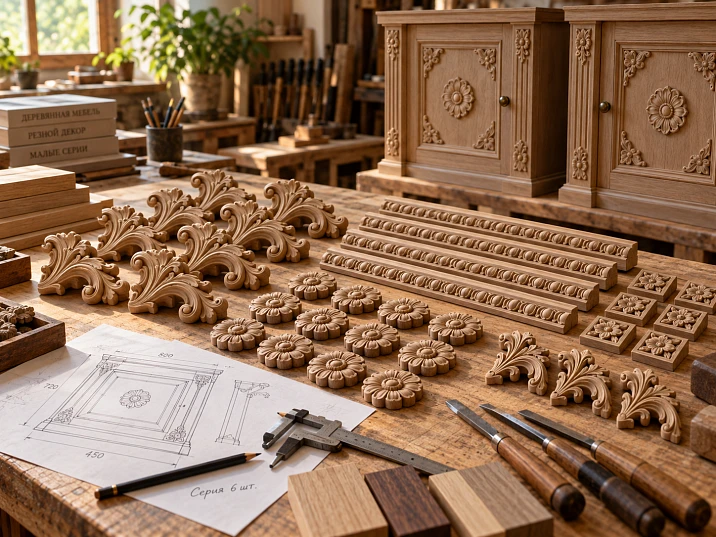
Twelve two-door cabinets require twelve left and twelve right overlays. If the order simply says "24 carved elements," the quantity may add up, but it will be impossible to assemble the facades according to the project. The same problem arises with size: the same ornament in two versions looks almost identical on screen, but takes up different amounts of space on the door.
Carved elements in small wholesale are ordered for a specific furniture series. Therefore, purchasing begins with a set for one item, it is checked on a sample, and only then is the quantity multiplied. The documents retain the full designation of the part, dimensions, pattern direction, wood species, surface preparation, and future finish. This record links the work of the designer, purchaser, finisher, and assembler — even if one craftsman performs all four tasks.


What counts as a small batch of carved decor
Small wholesale has no universal threshold of ten or twenty pieces. For a workshop, a small batch might be eight central overlays for chests of drawers, twelve mirrored pairs for cabinets, or forty rosettes for repeating facades. The practical point of such a purchase is to obtain repeating parts for several items.
The quantity itself does not determine the discount, availability, or production time. These terms relate to the specific order and the chosen version. A small series of complex oak overlays and an equal quantity of compact rosettes may require different preparation times.
When buying a single part, a mistake can sometimes be corrected by rearranging the decor. In a series, such a solution changes several facades at once, the marking template, and the finisher's work. It is especially unpleasant to discover a mix-up after finishing: the costs have already been incurred, and there are still not enough sets for the finished furniture.
Therefore, repeatability here means quite verifiable things: the required geometry, identical execution of each item, a consistent appearance after finishing, and the correct number of sets.




First, calculate the consumption per item
Take a drawing of one chest of drawers and mark each installation location. Two overlays on the drawers and one rosette in the center are three parts, but two purchasing items if the overlays are indeed identical.
Conditional calculation for a series of eight chests of drawers:
| Position | Per chest of drawers | Chests of drawers in the series | For furniture production |
|---|---|---|---|
| Horizontal overlay of one version | 2 pcs. | 8 | 16 pcs. |
| Central rosette of one version | 1 pc. | 8 | 8 pcs. |
| Total parts | 3 pcs. | 8 | 24 pcs. |
This is a production requirement. Samples for fitting, parts for test painting, and the reserve are not included in it yet.
If a series consists of different models, consumption is calculated separately for each model. For example, a tall chest of drawers may use three overlays, while a low one uses two. The general phrase “eight chests of drawers” does not convey this difference. First, the quantity of parts for all models is obtained, then only fully matching items are added together.
It is also useful to calculate the assembly result. Twenty-four parts in a box should turn into eight complete sets, not just add up to the required total. Such a check immediately reveals a situation where there are enough overlays but one rosette is missing.
Our factory also produces:
The item code must be linked to the installation location
The entry “carved overlay — 16 pieces” leaves too many questions. What size, what wood, what sanding quality? Several options may be available on one product page. The link helps find the model, but does not replace the selected characteristics.
In the work list, each item is assigned a clear designation: "top drawer overlay", "left door overlay", "central rosette". The supplier's details are indicated next to it. The internal name is responsible for the place in the furniture, while the factory article number is responsible for the product itself.
| What to record | Why this is needed |
|---|---|
| Furniture model and installation location | So that the part goes on the correct front |
| Full article number with letters and additional designations | To preserve the specific variety of the ornament |
| Link to the product page | To find the original model again |
| Dimensions according to the drawing, in millimeters | To select the required size version |
| Left, right, or symmetrical part | To assemble the composition correctly |
| Wood species, quality of gluing and sanding | To order an approved blank |
| Workshop finish designation | To replicate the color, sheen, and texture treatment |
| Quantity per item and for the entire series | To verify completeness |
A single SKU may be used in multiple locations. In that case, the assembly document retains all installation locations, while procurement combines their quantities. If at least one approved parameter differs — for example, size or material — separate lines are required.
After the sample is approved, all participants in the work receive the list. Changes to it are marked with a date or revision number: otherwise, procurement may proceed with the new size while the facades follow the old template.
Get Consultation
Count left and right overlays separately
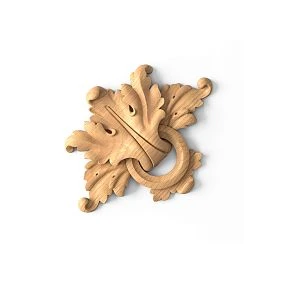
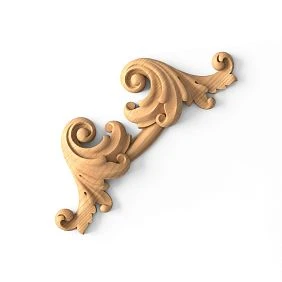
A symmetrical overlay and a mirrored pair serve different purposes. In a symmetrical central element, the pattern is balanced relative to its own axis. In a pair, the direction of the ornament changes: scrolls, leaves, or branches open in different directions.
In the catalog, such variants may have separate designations. For example, STAVROS has overlay N-322L и overlay N-322R. For both, versions are available with dimensions A × B × C 100 × 128 × 11 mm and 150 × 191 × 15 mm. The model number without the last letter and without the size does not fully describe the order.
If one cabinet in the project requires one left and one right piece, then ten cabinets require ten left and ten right pieces. For twelve cabinets — twelve of each version. It is convenient to count them in pairs within the workshop, but the order must retain a separate quantity for each side. If the product is sold as a set, first check the contents of the set and the unit of sale.
Do not determine the side only by which door the overlay is installed on. In a specific composition, the scrolls may face the center or diverge outward. Place images of both pieces side by side, mark the top, and label their position on the facade as viewed from the front. This way the assembler will see the intent rather than reconstruct it from the article letter.
Rotating a piece 180 degrees is not the same as mirroring it. Along with the direction, the top of the pattern, the position of the leaves, and the supporting areas change. Replacing a right overlay with a rotated left one is treated as a separate change to the composition, not accepted by default.
Dimensions A, B, and C are checked before manufacturing the facades
In the STAVROS overlay section, dimension A denotes width, B denotes height, and C denotes thickness. For a specific product, still verify against its drawing: additional dimensions and designations may differ.
Thickness C characterizes the overall dimensions of the part, but by itself it does not describe the difference between the crests and roots of the thread, the size of the pad on the back, or the shape of how it fits against the facade. Two elements of the same thickness can have different relief and require different installation space.
Measure the working area inside the frame. A conventional example: the width of the flat section of the facade is 360 mm, and the width of the overlay is 300 mm. When centered, 30 mm remains on each side: (360 − 300) ÷ 2. This calculation shows only the side clearances. The height, protruding ends of the ornament, handle, and the swing path of the adjacent door are checked separately.
On the drawing, mark the mounting plane, the extreme points of the thread, and the axis of the composition. Positioning relative to the axis is especially convenient for repeating facades: the craftsman does not try each time to measure the distance from the uneven edge of the sheet or scroll.
Use available drawings and models for preliminary layout. A full-size paper outline helps estimate dimensions, but the final check of the protrusion and opening is done with the actual part.
Approve the sample before ordering the entire batch
For a new carved element, order one part, and for a directional ornament, order both sides. If there are several different elements on the facade, it is more useful to assemble one complete set: a separate rosette may be pleasing on its own and turn out to be too large next to the overlays.
Sample verification is carried out sequentially:
- Check the product designation and the ordered specifications.
- Measure the overall dimensions and inspect the back side.
- Lay out the decor on the facade or its full-size mockup along the project axes.
- Check the joints, access to the handles, and the movement of adjacent furniture parts.
- Test the specified preparation, fastening, and finishing on a suitable trial assembly.
- Record the result and note which version is approved for ordering for the series.
A sample on a flat cut and a sample on a finished framed facade answer different questions. The first shows the surface and color. The second also shows the fit, visual clearances, and how the door works. If the risks are related to the geometry of the assembly, a single painted piece of wood is not enough.
In the section product samples you can view the available sets and options for getting acquainted with the materials. Their composition is checked separately. A sample set should not automatically be considered a replacement for a full-size overlay of the selected article.
Approval of a sample does not mean a promise of an absolute match of all wood fibers. It sets agreed reference points: size, shape, surface quality, and the acceptable appearance after finishing.
Carved overlays: check not only the pattern, but also the fit
For a series of chests of drawers, wardrobes, cabinets, or kitchen facades Carved wooden overlays for furniture are selected taking into account the surface beneath them. A wide element may overlap the frame, but only touch it at the ends. An externally successful composition does not yet provide a prepared installation solution.
On the sample, check where the actual contact areas are. The decor should not wobble during a loose test fit. If the front has a complex profile, fitting or an intermediate base should be provided before starting the series. Do not assume that a layer of adhesive will automatically eliminate any mismatch between surfaces.
For repeating parts, make a template based on clear reference points: the edge of the front, its center, the line of the frame. Mark the top and the required overlay variant on the template. First check one assembled composition, then use the markings on the remaining items.
During installation, the base material and the condition of both surfaces are important. Unpainted wood and an already lacquered front require a separate adhesive compatibility check. The installation method is agreed upon with the future finishing sequence. Raised relief elements must also be protected from damage during pressing: pressure should not accidentally fall on a thin tip of the sheet.
Rosettes: the same diameter does not eliminate orientation
Wooden sockets it is convenient to repeat them in the center of panels, at frame intersections, or in identical corner nodes. Each model and each size remains a separate order item.
A round rosette may have a directional pattern. A leaf, flower, or scroll can define the top even with a round outer contour. Therefore, the assembly drawing marks not only the center but also the rotation of the ornament. In a series of several cabinets, differences of this kind are more noticeable than on individual parts.
If the rosette joins with the frame, check the thickness and shape of the adjacent elements. Matching face dimensions do not guarantee a neat transition between them. One assembled corner or profile intersection allows you to see in advance a step, gap, or overly high relief.
Brackets are counted according to the actual installation scheme
Wooden Brackets they are not always purchased in pairs. A furniture composition may have one central element, two side elements, or several repeating support nodes. The quantity is determined by the product drawing.
Check the height, projection, contact areas, and visibility of the side faces. If the model has left and right versions, they are separated in the same way as directional overlays. For identical brackets, keep a single line with the quantity per product.
The function is determined separately. A bracket that frames the area under a shelf cannot be considered a load-bearing support just because of its name and appearance. If a load is transferred to it, confirmed suitability of the part and a developed fastening assembly are required. A decorative purpose does not replace structural verification.
When approving a sample, the entire assembly is examined from the side: the bracket's protrusion may interfere with the door's movement or turn out to be noticeably deeper than adjacent decorative parts.
Capitals and pilasters are ordered as a coordinated assembly
For a furniture portal or a tall cabinet wooden capitals are selected together with pilasters and columns. The assembly must match in mounting width, protrusion, and thread type. A similar collection name by itself does not confirm dimensional compatibility.
First, one vertical fragment is assembled: the lower part, the pilaster shaft, the capital, and the junction to the upper trim. After that, the number of fragments is multiplied by the number of cabinets. Multiplying the number of capitals separately while forgetting the corresponding pilasters is inconvenient: you end up with full boxes of parts and incomplete furniture sets.
If the composition continues carved molding, the scale of the repeating ornament is additionally checked. For the junction to wooden moldings the cross-section profile is important. Linear trim is calculated based on the lengths of the blanks and the cutting plan; its requirement cannot be expressed only by the number of decorative units.
Beech, oak and surface preparation — separate parameters
The wood species is chosen together with the finish. For opaque enamel, beech can be a suitable option when the grain pattern is not part of the design intent. Oak is often considered for furniture with an open texture. However, neither of these schemes is a prohibition: beech is also finished semi-transparently, and oak is painted with enamel. The decision is verified on a sample of the selected blank.
STAVROS distinguishes between the quality of lamination "for enamel" and "for tinting", as well as the surface treatment quality "Standard" and "Prestige". These are different characteristics. Selecting lamellas by color and texture does not replace sanding, and additional sanding does not change the color combination of the lamellas.
In the description quality of wooden products it is stated that blanks for enamel are assembled without selecting lamellas by color and texture, while those for tinting are assembled with selection. At the same time, natural tonal differences are possible even within a single batch. For the "Prestige" category, additional detailed manual sanding is provided.
Therefore, a line stating "beech, unfinished" is not enough in the order. The selected lamination quality and the selected surface quality are required. They determine which blank the finisher will receive.
For the workshop, its own labor intensity also matters. If deep carving recesses need to be reworked by hand for a long time, a lower purchase price may not yield savings on the finished facade. Compare the preparation time and the result after coating on a trial piece.
Do not change the material within an approved item just to speed up shipment. Even under an opaque finish, such a substitution is first run through a trial cycle. With an open texture, the difference in species also becomes part of the furniture's appearance.
The trial finish must replicate the future technology
A flat board shows the color on a flat surface. A carved element has end grains, slopes, narrow recesses and protruding peaks. Therefore, to approve stain, patina or a transparent coating, use an actual carved part of the same design that will go into production.
The test is carried out through the entire prescribed sequence: surface preparation, compatible compositions, intermediate operations, finishing coat. The number of layers, consumption and holding time are taken from the technological instructions of the manufacturers of the selected materials. There is no universal drying time for any enamel or any varnish.
The result is evaluated after the required drying next to the facade. Not only the shade is checked, but also the gloss, the visibility of the fibers, the cleanliness of the recesses, the contrast of the patina. With side lighting, it is easier to notice differences in relief and preparation. A photograph helps to record the result, but the screen does not replace a physical sample.
To repeat the finish, the names of materials, the color designation, the mixing proportions where they are provided, the order of application and the modes used are preserved. A single name like "dark walnut" is too vague: it explains neither the base of the coating, nor the degree of gloss, nor the treatment of the protrusions.
If the finisher changes the primer or the tinting composition, the new system is tested before processing the entire batch. A similar rule is useful when transferring an order to another painting workshop. The sample is handed over together with the record of the technology, and not with a request to "match approximately this color."
Production quantity, samples and reserve are not mixed
The reserve does not have to be ten percent. Its size depends on the complexity of the carving, the number of tests, the risk of damage during processing, the period of possible reorder and the consequences of stopping assembly. For a compact rosette and a thin extended overlay, these circumstances may differ.
Suppose a workshop makes twelve cabinets with one left and one right overlay on each. It decided to keep one additional part of each version for repair or replacement. This is a decision for a conditional project, not a mandatory procurement norm.
| Position | For furniture | To reserve | Order for a series |
|---|---|---|---|
| Left overlay | 12 pcs. | 1 pc. | 13 pcs. |
| Right overlay | 12 pcs. | 1 pc. | 13 pcs. |
| Total | 24 pcs. | 2 pcs. | 26 pcs. |
If two sample parts were previously purchased separately and remain as reference samples, they are not deducted from these 26 pieces. In total, the project will have 28 purchased parts: 24 for furniture, 2 in reserve, and 2 samples.
A sample can be included in furniture production if it is suitable, matches the approved finish, and the workshop has deliberately decided to use it. In that case, it is counted as available stock and the purchase on the corresponding side is reduced. A part kept for comparison is not considered available stock.
The reserve of a mirrored pair is distributed between the sides. Two spare left overlays will not replace one missing right one. At the same time, it is not always necessary to store a complete pair: if only one side's reserve is justified for the project, this is stated explicitly in the schedule.
Before payment, verify the order contents and lead times
At this stage, the working schedule is compared line by line with the supplier's offer. The item code, size, material, workmanship, quantity, and sales unit must match. Separately, check whether any part is included in a set: otherwise it is easy to order one component twice or undercount another.
The readiness of the complete set is important for the assembly deadline. If the overlays are available earlier while the central rosettes are still being manufactured, the arrival of the first box does not mean the decor is ready to start. In case of partial shipment, decide in advance whether the workshop will wait for all items or work with separate complete sets.
Own operations are added to the receipt deadline: acceptance, preparation, finishing, and assembly. The supplier's manufacturing time and the time until the finished decor is installed on the furniture are different values.
If a replacement for a missing model is needed, a new composition is agreed upon and the schedule is updated. Choosing a similar ornament based only on an image is risky: thickness, fit, and the position of the extreme points may change. Passing such a decision to the finisher after the boxes have arrived is too late.
How to receive a batch of carved elements
Start with the packaging and labeling, then move on to the items themselves. When counting, keep the link between the part, its designation, and the order. If similar variants are immediately put into a common box, they will have to be sorted by size and pattern.
| What to Check | What to compare with | What to do in case of discrepancy |
|---|---|---|
| Quantity for each item | Agreed order | Mark shortages or extra parts separately |
| Product code, size variant, side | Facade schedule and diagram | Set aside unsuitable options |
| Dimensions and fit | Drawing, sample, test template | Record measurements and fitting conditions |
| Material and ordered quality categories | Marking, documents, approved finish | Clarify the disputed characteristic with the supplier |
| Thread integrity and surface condition | Sample and agreed requirements | Photograph the damage or difference |
| Appearance of parts within one set | The specified finish and permissible variations | Select matching sets or agree on a further solution |
For a batch of several dozen items, it is reasonable to recount and inspect each part. Critical dimensions are checked especially carefully where the decor fits into a limited area, joins with adjacent elements, or affects opening. The measurement method must be consistent: comparing the overall dimension at the extreme points with the size of only the mounting area will produce a false discrepancy.
If a specific level of precision is required, it should be discussed before purchase. A single approved sample by itself does not establish numerical tolerances for the entire batch. Requirements must take into account both the supplier's capabilities and the permissible deviations of the specific furniture component.
If in doubt, keep the packaging and labeling, photograph the part as a whole and the problem area with a scale. For discussion, it is more useful to specify the order position and the measured difference than to write "the decor is slightly different." Disputed elements should not be sanded, trimmed, or painted until the matter is resolved.
Only verified sets are sent for painting
Before finishing, the batch is divided into accepted parts and items with outstanding issues. The workshop needs to know how many complete sets can already be started. For example, eleven right overlays with twelve left ones yield eleven sets, even if the overall order is almost complete.
Paired parts are conveniently kept nearby during preparation and color comparison. Labeling is placed so that it does not damage the face surface or interfere with installation. If some parts are finished later, the same process record is kept for them, and the result is compared with the sample again.
Before serial gluing, the chosen sequence is tested on a trial assembly: first installation and then painting, or finishing the parts before assembly. It determines access to recesses, the condition of the glued surfaces, and the ability to remove excess adhesive. Different substrates and coatings require their own solutions.
When transferring between work areas, carvings are protected from contact and impacts. Particularly vulnerable protrusions are best provided for in the packaging plan in advance: repairing a chipped scroll on an already painted part is harder than keeping it intact during movement.
How to keep data for a repeat series and reorder
After the furniture is completed, the workshop should retain more than just the invoice and a photo of the result. Keep the final specification, links to the products, dimensions, wood species, preparation quality, finish designation, and the date the sample was approved. Keep the layout drawing nearby with axes, offsets, and the direction of each part.
Label the physical sample and protect it from accidental use. If it represents only color, this must be stated: it must not be quietly taken as the standard for all dimensions and installation features. For a complex composition, a sample of the assembly or detailed photos of the assembled front from the front and side are useful.
When repeating a series six months later, first check the current product card and available versions. Then check the saved specification: whether the front dimensions, handles, framing, or painting technology have changed. The previous overlay may remain in the catalog and yet no longer fit the updated furniture.
A repeat order for a new series and a part for repairing an already produced cabinet are checked differently. In a new series, the overall appearance can be re-approved. For repairs, the new part must be matched to the existing furniture, including its current shade and sheen. The remaining coating composition does not guarantee an invisible match with a surface that has already been in use.
If the model, wood species, or finish has changed, do not mix the new delivery with the old leftover stock until it has been checked. Label it separately in your records. This will also help with the next order: it will be clear which products have which version of the carved decor installed.
When a ready-made carved element is more cost-effective than making your own
For a small series, ready-made carved parts can reduce production preparation. The workshop does not have to separately create an ornament model, set up processing, make initial samples, and work out the repeatability of each new shape. But a ready-made element does not automatically become more cost-effective.
Compare the full path to installation on the furniture. In-house work includes design, material, setup, machine and manual time, sanding, inspection, and possible rework. In purchasing, it includes the cost of parts, samples, delivery, incoming inspection, additional preparation, and necessary changes to the furniture assembly.
Labor intensity calculation for preparation is especially useful. Suppose a workshop spends 15 minutes reworking one part. For 24 identical parts, that is 360 minutes, or 6 hours. The values are conditional: they are obtained from your own sample. Knowing your cost per labor hour, you can compare two levels of execution quality without guessing about savings.
If a catalog model already fits in shape, dimensions, and technology, purchasing allows you to move faster to repeatable assembly. If every purchased overlay has to be significantly reworked, it is worth reconsidering the model choice or the manufacturing method. The main indicator is a predictable result across the entire series at clear costs.
Where to buy carved elements in small wholesale
In the STAVROS catalog you can select carved elements in small wholesale for repeating furniture compositions: overlays, rosettes, and other parts. It is worth starting with the working field of the facade and the decor scheme. After that, compare the available sizes, material, and preparation options for each model.
В conditions for manufacturers shipping is specified from one piece. This allows considering a separate purchase to check a sample before a series. The cost and terms of a specific batch, availability of the required version, and readiness time are clarified according to the compiled list; the number of parts alone does not give grounds to promise a fixed discount.
To buy carved wooden decor for a small series, provide the supplier with a list of items including full article numbers, dimensions, wood type, gluing and sanding quality, and quantity for each side. Note which items are needed for a sample, which are for furniture, and which remain in reserve. Attach a composition diagram if it is needed to verify the selection.
Before final order approval, verify payment and delivery and the readiness date of the complete set. Once the sample is checked, the specifications are recorded, and the left and right parts are counted separately, the purchase can be repeated using the documents — without a new search for the ornament by photo and guesses about the previous version.