Article Contents:
- Oak or beech is chosen not on the principle of "which wood is better"
- Why wood species is especially noticeable on carved decor
- Oak: when wood grain should be part of the design
- Beech: when the relief itself should remain the main feature
- What happens to fine ornamentation after finishing
- Oak under clear lacquer
- Oak under stain and tinting
- Beech for enamel
- Patina on carved beech
- Openwork carved overlays: the material is especially noticeable
- N-505 with acanthus: one shape, two wood options
- N-489: the material must be specified together with the product number
- The choice of wood species matters not only for overlays
- Carved legs
- Carved brackets
- Rosettes, capitals, and pilasters
- One material for all visible parts
- Different materials for a dense opaque finish
- Different materials are used intentionally
- 1. The relief itself
- 2. The surface
- 3. The wood species
- 4. A test finish
- 5. Light and shadow
- 6. Coordination with the facade
- If all the furniture will be white or colored
- If the furniture remains natural
- If the furniture is tinted a dark color
- If part of the wood remains natural and part is painted
- Mistake 1. Buying the part first, then thinking about the finish
- Mistake 2. Assuming oak is always better
- Mistake 3. Assuming beech is only suitable for painting
- Mistake 4. Checking color only on a flat board
- Mistake 5. Randomly mixing wood species under a clear finish
- Mistake 6. Not recording the material together with the product number
- Mistake 7. Applying too thick a finish to fine carving
- Mistake 8. Selecting overlays separately from the rest of the furniture
- What to choose for carved decor — oak or beech?
- Which carved elements are best made from oak?
- When is it better to choose beech?
- Which is better under enamel — oak or beech?
- Which wood is best under clear lacquer?
- Can beech carved elements be tinted?
- Can oak and beech be combined in a single furniture project?
- How does the material affect the appearance of deep carved relief?
- Should I do a test finish?
- Where to buy carved elements made of oak and beech?
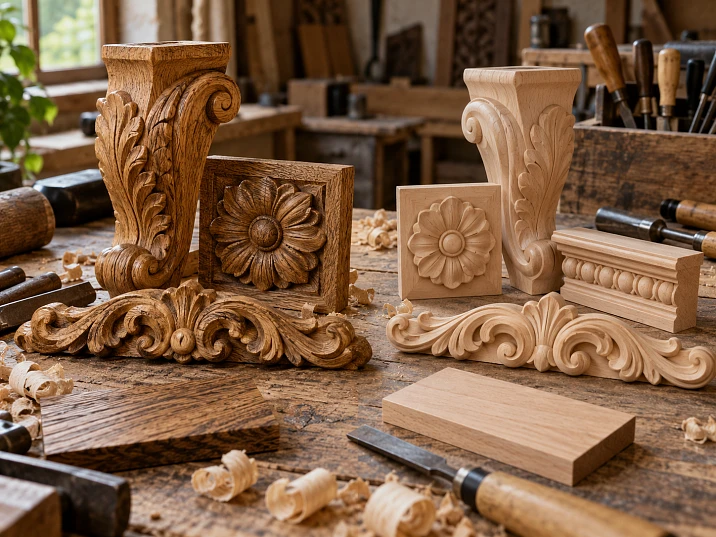
Two identical carved overlays can look completely different simply because one is made of oak and the other of beech. The shape is the same, the pattern is the same, the dimensions match, but after finishing the result changes noticeably. On oak, the natural wood texture is more visible. On beech, attention more often remains on the relief itself, especially if the part is painted with opaque enamel.
Therefore, the question "which is better — oak or beech" is not quite right in itself. It is better to first decide what the finished piece of furniture should be like. Should the wood remain visible? Is white or colored enamel needed? Will there be tinting? Is it necessary to emphasize the natural wood pattern or, on the contrary, to obtain a calm, even base for painting?
The choice of species depends on the answer.
If you need carved decor with open wood texture, it often makes sense to look toward oak. If the carved part should become part of a painted facade, where color matters more than the wood pattern, beech is often more convenient. But this is not a strict rule. Oak can be painted, and beech can be tinted. What matters is not a prohibition, but the expected result.
That is why carved elements made of oak and carved elements made of beech should be chosen together with the future finish, and not separately from it.

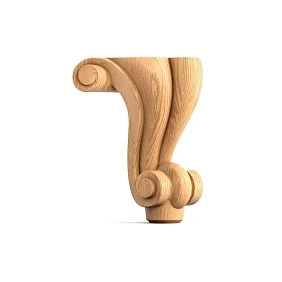
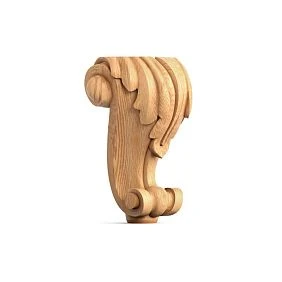
Oak or beech is chosen not on the principle of "which wood is better"
Oak and beech have different roles in the same furniture project.
Let's imagine a classic wardrobe. A carved overlay is planned for the front. If the wardrobe is to remain natural, with a visible wood grain, the carved element must also be part of the overall wood pattern. In this case, oak often looks logical: the relief is readable not only through light and shadow, but also through the wood structure itself.
Now a different task. The same wardrobe is to be painted in a solid milky color. After finishing, the natural wood pattern is almost invisible. Form comes to the fore: the scroll, leaf, flower, acanthus, depth of carving. Here beech often turns out to be a convenient choice, because there is no point in paying extra just for an expressive oak texture that will be covered by paint anyway.
The correct order of selection looks like this:
first the appearance of the finished furniture → then the finish → then the wood species → then the specific carved element.
Not the other way around.
If you first buy a carved oak overlay you like and then decide to cover it with a solid enamel along with the entire front, nothing terrible will happen. But some of oak's advantages will simply go unused.
The same applies to beech. If a beech part is planned to remain under a transparent finish, you need to look at a real sample in advance. It is quite possible that the result will be completely satisfactory. But you cannot automatically expect beech to have the same surface pattern that oak provides.




Why wood species are especially noticeable on carved decor
On a smooth board, the eye reads a large, calm surface. Color, grain direction, and the overall pattern are visible.
On a carved element, the surface is broken up into many small areas:
- protrusions;
- recesses;
- ends;
- internal corners;
- smooth bevels;
- thin edges;
- deep undercuts.
The same piece of wood looks more complex on such a shape.
On a raised area, light falls directly, so that section appears lighter. In a recess, a shadow appears. In some places the grain runs along the surface, in others it comes out almost across it. After staining or tinting, these differences can become even more noticeable.
That is why the material affects not only the color of the part. It affects how the carving pattern itself reads.
On oak, the natural structure of the wood adds its own pattern to the carved ornament. On beech, the surface is more often perceived as calmer, so it is the form itself that works more strongly.
This is especially noticeable on overlays with deep leaves, volutes, floral motifs, and openwork cutouts.
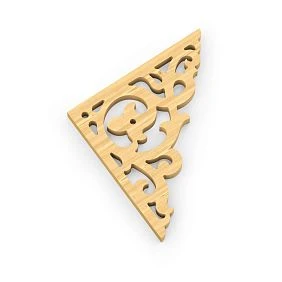
Our factory also produces:
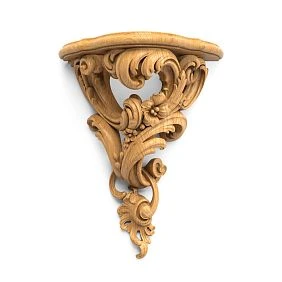
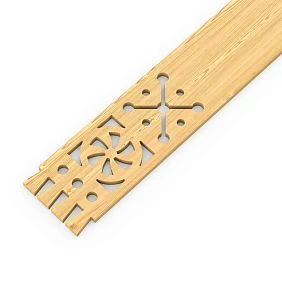
Oak: when the wood texture should be part of the design
Oak should be considered first of all when the wood is not hidden under thick paint.
For example, if the furniture is planned to be:
- coated with clear lacquer;
- tint;
- coated with oil;
- left with a clearly readable natural texture;
- combined with oak fronts, countertops, or frames.
In this case, the carved oak detail works on two levels at once.
The first is form. Leaves, scrolls, recesses, and height transitions are visible.
The second is the wood. Through the finish, the grain and pores remain visible.
The result is a richer surface. Even a calm overlay on oak can look more active than the same detail on a more uniform wood.
This does not mean that oak is always more beautiful. Sometimes the carving needs to be the main element, and the texture should not compete with it. In that case, beech may be more appropriate.
Oak is especially good where the naturalness of the material should be visible immediately. For example, on a dark study, sideboard, massive classic door, console, or furniture with transparent tinting.
Get Consultation
Beech: when the texture itself should remain the main feature
Beech is often chosen for projects where a decorative detail will be painted.
For example:
- white classic kitchen;
- painted cabinet;
- chest of drawers for enamel;
- facade with patina;
- decorative panel in the furniture color;
- carved legs that must fully match the color of the apron and body.
Here the natural wood grain is not the main part of the design.
A person first of all sees the form: how deeply the ornament is carved, how the shadow falls, where the scroll ends, how thin the edges of the leaf remain.
For this task, beech is convenient because its surface is perceived more calmly. After a dense paint coating, attention does not drift into the wood grain.
But it is wrong to write that "beech is only needed under enamel." Beech can also be used under other types of finishes. It is simply better, before choosing, to look at how a specific color or transparent coating looks on this particular wood.
What happens to fine ornament after finishing
The finer the carving, the more carefully you need to work with the coating.
On a large overlay with wide leaves, a small extra layer of paint may barely change the pattern. With a thin openwork detail, everything is different.
If paint or primer collects in the recesses, thin lines become softer. A sharp transition turns into a rounded one. A small gap may partially close. Over several layers, this effect intensifies.
They pay special attention to:
- internal corners;
- small grooves;
- thin edges;
- deep hollows;
- places where two elements of the ornament come close to each other.
Therefore, for carved decor, not only the wood species matters, but also the entire finishing system.
If the craftsman chose beech for enamel, that does not mean paint can be applied in a thick layer. If oak is chosen for clear lacquer, it also cannot be assumed that the surface will look good on its own without preparation.
Carving requires careful finishing regardless of the wood species.
Oak under clear lacquer
Clear lacquer is suitable for cases where you want to preserve the natural appearance of the wood.
On oak, it emphasizes two layers of the pattern at the same time:
- the structure of the wood;
- the carved relief itself.
This is especially visible in side lighting. The raised areas become lighter, the recesses darker, and the texture continues to read across the entire form.
But there is an important point. A small sample on a flat board does not show how the same lacquer will look on deep carving.
On a flat surface, everything looks even. On the overlay, recesses, end-grain areas, and small edges appear. There, color and sheen may be perceived differently.
Therefore, for a serious project, it is better to make a test specifically on a real carved part or on a fragment of similar depth.
Oak for stain and tinting
Tinting makes carved oak even more expressive, but at the same time complicates the result.
On the raised areas, the color may appear lighter. In the recesses, darker. The shade can also change in different directions of the grain.
Because of this, the same stain on a smooth oak sample and on a carved overlay can look noticeably different.
Let's imagine a floral ornament. On the protruding leaves, light reflects more strongly. In the depth between the leaves, a shadow appears. If dark tinting is also added there, the relief becomes visually deeper.
Sometimes that is exactly what is intended.
But if the entire furniture facade should look calm, too strong a contrast may be unnecessary.
Therefore, it is better to choose the shade not by the color name, but by a test finish.
Beech under enamel
Painted furniture is one of the most straightforward cases for beech.
For example, the cabinet facade, carved overlays, and furniture legs should become the same color. After painting, a person should not see three separate types of material. They should see one solid piece.
In such a project, the main thing is that:
- the parts were well prepared;
- the relief did not lose its clarity;
- the paint went on evenly;
- the color matched on all elements.
If the carved decor is made of beech, and the main furniture is made of another material, this is not yet a problem. With a dense opaque finish, the difference in species may hardly be visible in the appearance.
But before a series, a test painting is still needed. Not because beech is capricious, but because different materials may react differently to primer, sanding, and the topcoat.
Patina on carved beech
Patina works especially well where there is relief.
It can emphasize:
- recesses;
- leaf edges;
- scrolls;
- acanthus;
- small grooves;
- transitions between carving levels.
On a smooth surface, patina simply has nothing to catch onto visually. On a carved piece, every curve creates a separate shadow and an additional line.
That is why beech under enamel with subsequent patina can produce a very expressive result.
But it is easy to overdo it here. If the patina is too dark or there is too much of it, the complex pattern turns into a set of dark spots.
It is better to first make one test element and look at it from the same distance from which the furniture will be perceived.
A carved overlay on the table in front of the craftsman and an overlay on a cabinet door two meters away from the person are two different visual impressions.
Openwork carved overlays: the material is especially noticeable
Openwork decor differs from a regular overlay in that part of the pattern is created not only by relief, but also by actual cutouts.
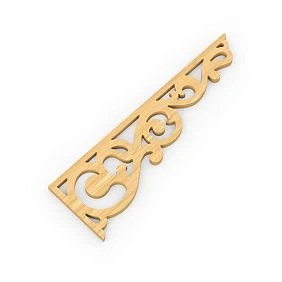
A good example is Wooden Decor N-502.
For this model, the STAVROS website lists options in beech and oak. The element size is 35 × 300 × 9 mm.
For such a thin detail, the following are especially important:
- edges;
- small transitions;
- the depth of the cutouts;
- the quality of sanding;
- how neatly the finish settles in narrow places.
If N-502 is chosen for a solid paint finish, beech can be a very clear option. If you want to keep the natural wood visible, it makes sense to look at the oak option and do a test with the chosen stain or lacquer.
The main advantage of such a comparison is that the shape does not change. You can look specifically at the difference in material.
N-505 with acanthus: one shape, two wood options
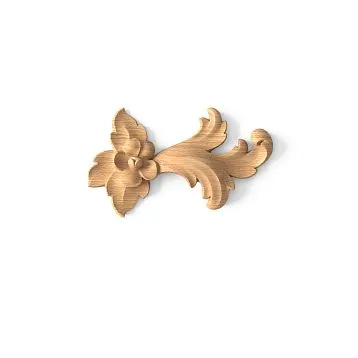
Another illustrative example — carved overlay N-505.
It measures 50 × 228 × 10 mm, and the material can be selected: beech or oak.
This is a convenient example for understanding the entire article.
The ornament remains the same. The acanthus, volutes, and overall pattern are identical.
The material changes.
If you take beech and coat the part with a dense white enamel, a person will perceive primarily the relief.
If you take oak and leave it under a transparent finish, a pronounced wood grain will be added to this same relief.
In other words, the choice of species does not change the carving pattern itself. It changes how this pattern will look after finishing.
N-489: the material must be specified together with the product number
Carved Applique N-489 it is also available in beech and oak. Size — 80 × 53 × 16 mm.
On a small project, it is easy to simply write:
N-489 — 2 pieces
But for a workshop, this is not enough.
It is better to record right away:
- product number;
- wood species;
- quantity;
- selected finish.
For example:
N-489, beech, 2 pieces, for enamel
or
N-489, oak, 2 pieces, for clear tinting
This kind of record seems excessive only until the first repeat order.
Six months later, the craftsman may remember the shape of the overlay, but no longer remember what wood the first batch was made from. And with a clear finish, this difference will be immediately visible.
The choice of wood species is important not only for the overlays
The same principle applies to other carved wooden elements.
Carved legs
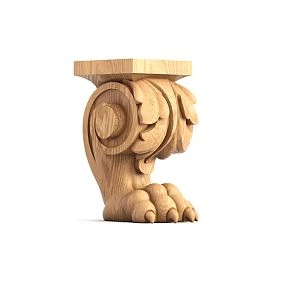
For example, Carved Furniture Leg MN-036 is offered in beech and oak. The model comes in sizes 430 × 69 × 85 mm and 500 × 81 × 99 mm.
If the leg remains natural, the oak grain becomes part of the furniture.
If the entire leg is painted together with the body, beech may prove to be a more straightforward solution.
Carved brackets
Bracket KR-009.1 is also available in oak and beech and comes in several sizes.
Here the question is the same: will the wood be visible after finishing, or will only the relief remain the main feature.
Rosettes, capitals and pilasters
for carved rosettes, capitals, brackets и pilaster with columns the choice of wood species is best made using the same logic.
First, we decide what the finished piece should be.
Then we choose the wood.
One piece of furniture — one clear material logic
The most unpleasant mistake appears not in a single detail, but in the set.
Let's imagine a sideboard:
- legs — oak;
- overlays — beech;
- molding — oak;
- everything is coated with clear oil.
Before finishing, the elements may seem quite similar in color. After oiling, the difference becomes more pronounced: the pores, grain, and the surface itself read differently.
As a result, one item starts to look as if it was assembled from parts of different kits.
This is not always bad. Sometimes different species are deliberately combined. But then the difference should be part of the design intent, not an accident.
For most calm furniture projects, there are three clear paths.
One material for all visible parts
For example, all carved elements, moldings, and legs are made of oak with a clear finish.
This is the simplest path to a unified look.
Different materials under a dense opaque paint
For example, some parts are made of beech, some of another wood, but after primer and enamel they become a single colored surface.
Here you need to check how each species behaves in the chosen coating system.
Different materials are used intentionally
For example, oak parts are left natural, while some beech elements are stained.
Then the difference becomes part of the design.
Only one thing is bad: mixing oak and beech by accident and discovering the difference only after finishing.
Why you should not automatically mix oak and beech under a clear finish
In a photo without finishing, oak and beech can sometimes appear close in tone.
After clear lacquer, oil, or tinting, the difference becomes more noticeable.
The reason is not only color. The following also differ:
- grain pattern;
- pores;
- how light behaves on the surface;
- the character of the transitions between longitudinal and end-grain sections.
On carved decor, this difference is amplified because the surface turns toward the light at different angles.
Therefore, if a single furniture composition is assembled from oak and beech parts and everything must remain in a wood finish, be sure to do a test.
Not on a screen.
Not from two catalog photos.
On real pieces of wood with a real finish.
When oak and beech can be safely used together
The clearest case is opaque enamel.
if:
- the wood texture must not be visible;
- all parts are coated in a single color;
- the primer and enamel have been tested on both species;
- a test finish gives the same appearance,
then the combination of oak and beech within a single item may not be visually distinguishable at all.
But the material should still be recorded in the production documents.
Why?
Because a year later the product may be repeated. If beech was used in the first batch and in the second the craftsman accidentally orders oak, the price, preparation, and surface behavior may change.
Even when the wood species is not visible to the buyer, it remains important for production.
What to check on a real sample
Before ordering a large batch of carved decor, it is useful to check at least one real element.
You should look not only at the shape.
1. The relief itself
Is the depth satisfactory? Does the pattern seem too small or too massive on the actual facade?
2. Surface
How well are the protrusions and recesses prepared? Are there any areas that will require additional hand sanding?
3. Wood species
Do you like this particular oak or beech after the selected finish?
4. Test coloring
You need to test the actual system: primer, paint, stain, oil, or lacquer.
5. Light and shadow
Look at the part not only under a desk lamp, but also vertically, as it will stand on the furniture.
6. Combination with the facade
A carved element can be beautiful on its own and too dominant next to a specific facade.
After such a check, you can already order the required quantity.
Beech for enamel and oak for tinting — a handy hint, but not a rule
The phrase “beech for enamel, oak for clear finish” is useful only as a starting point.
It helps you quickly understand the difference.
But you shouldn’t turn it into a hard-and-fast rule.
Oak can be painted with enamel.
Beech can be tinted.
The question is why this is done and what appearance is needed.
If the designer specifically wants an oak part under opaque paint, this can be part of the project.
If the craftsman wants to leave beech under clear lacquer and is satisfied with the result on the sample, that is also a perfectly valid solution.
The right choice is determined not by the name of the species, but by the finished look of the furniture and a proven finish.
Carved overlays made of oak and beech
If you specifically need overlays, the main section of the catalog is — Wooden carved appliqués.
Here it makes sense to select elements in four steps:
- shape;
- size;
- wood species;
- Future finishing.
Not the other way around.
First, the overlay must match the furniture in size and pattern. If it is physically too large for the facade, choosing between oak and beech will no longer fix anything.
Only after geometry does it make sense to decide on the material.
This is how the query “buy carved wooden elements” turns into a proper selection rather than just a transition to the catalog.
Solid wood rosettes
carved rosettes are often used alongside overlays, moldings, and other wooden elements.
If a rosette is part of the same composition as oak details and remains under a clear finish, the material is best coordinated in advance.
This is especially noticeable with four identical sockets placed in the corners. A person sees them simultaneously, so differences in the surface are perceived more quickly.
If everything is painted with a dense enamel, the task is simpler, but a test painting is still useful.
Capitals, brackets, and pilasters
The same rule applies to large carved decor.
Capitals may be located next to a pilaster.
Brackets may be repeated throughout the furniture.
pilasters and columns by themselves occupy a large area and strongly influence the overall appearance.
The larger the decorative system, the more dangerous it is to choose material for each part separately.
It is better to make a single list in advance:
- which elements are needed;
- which remain with visible wood;
- which are painted;
- where oak is needed;
- where beech is acceptable;
- where species can be mixed without visual conflict.
This is much easier than fixing finished furniture after painting.
How to choose material for the entire decor set
It is convenient to start from the finished result.
If all furniture will be white or colored
First of all, look at the quality of the carving, the dimensions, and the ease of preparation for enamel.
Beech will often be a clear choice.
If the furniture remains natural
It is better to aim for a single species on all visible parts.
If the base is oak, oak carved elements are usually easier to fit into the overall look.
If the furniture is tinted a dark color
A test should be done on the actual parts.
Dark tinting can greatly change the perception of deep relief.
If part of the wood remains natural and part is painted
Different species can be used deliberately.
But the decision must be made before purchasing.
Common mistakes when choosing oak and beech
Mistake 1. Buying the part first, then thinking about the finish
A person chooses a beautiful overlay, and a week later decides that the entire facade will be under white enamel.
What's better: first determine the appearance of the furniture, then the material.
Mistake 2. Assuming that oak is always better
Oak is more expensive not because it is automatically better for any task.
If the texture is completely covered by a dense paint, its advantages may not be used at all.
Mistake 3. Assuming that beech is only suitable for painting
Beech can also be used for other types of finishes.
You need to look at the specific result.
Mistake 4. Checking the color only on a flat board
A carved surface looks different.
What's better: making a test on the actual relief.
Mistake 5. Randomly mixing wood species under a transparent finish
After lacquer or oil, the difference can become much more noticeable.
Mistake 6. Not recording the material together with the product number
After a few months, repeating the project becomes more difficult.
Mistake 7. Applying too thick a coating on fine carving
Relief loses clarity.
Mistake 8. Selecting overlays separately from the rest of the furniture
A beautiful element may not match the rest of the piece in scale, color, or material.
Where to buy carved wooden elements
The main STAVROS section with this decor — Carved wooden decoration.
There you can select not only overlays, but also other types of carved elements.
For a specific task, it is more convenient to go straight to the required group:
- carved appliqués;
- carved rosettes;
- wooden capitals;
- Carved brackets;
- pilasters and columns;
- Carved Trim.
After choosing the shape and size, it makes sense to check whether the required element is available in oak, beech, or both options.
For a furniture maker, the safest order is simple:
choose the shape → check the size → choose the wood species → do a test finish → order the required quantity.
Short selection table
| Task | What most often makes sense to consider |
|---|---|
| Dense white or colored enamel | Beech |
| Natural wood under clear lacquer | Oak |
| Tinting with visible texture | Oak |
| Patina over a painted surface | Beech |
| The oak texture of the entire furniture needs to be preserved | Oak |
| All the wood is completely covered with opaque paint | Beech is often more practical |
| There are doubts about the color | Make a test on an actual part |
| A single item has several carved elements | Agree on the wood species for the entire set |
This is not a strict instruction, but a convenient starting point.
How to place an order without confusion
For a single part, it is enough to remember the name.
For several pieces of furniture, it is already better to make a simple table.
For example:
| Detail | Material | Quantity | Finish |
|---|---|---|---|
| N-502 | Beech | 2 | Enamel |
| N-505 | Oak | 2 | Transparent tinting |
| N-489 | Beech | 4 | Enamel |
| MN-036 | Oak | 4 | Oil |
| KR-009.1 | Oak | 2 | Varnish |
This way you can immediately see what exactly is being purchased and why.
If the project is repeated later, there is no need to remember which wood species was used in the first set.
What to ultimately choose — oak or beech
To put it very simply:
oak is more often chosen when you want to see the wood itself.
beech is more often chosen when you want to see primarily the shape of the carving and the color of the finish.
But the final decision should be made based on the specific piece of furniture.
If the oak texture is part of the design, choose oak and check the transparent finish on a sample.
If the carved element should blend with the painted facade, beech will often be a very reasonable choice.
If the project is non-standard, make two small samples and compare them next to the actual facade.
This is more reliable than any general advice.
Frequently Asked Questions
What to choose for carved decor — oak or beech?
If the wood should remain visible, oak often makes more sense. If the part will be painted with opaque enamel, beech is often chosen. But there is no hard rule: the final decision depends on the specific finish.
Which carved elements are best made from oak?
Oak is well suited for overlays, legs, brackets, rosettes, and other parts where they want to preserve the natural texture under lacquer, oil, or tinting.
When is it better to choose beech?
When furniture is painted white, cream, gray, or another opaque color, and the natural wood grain should not be part of the appearance.
What is better under enamel — oak or beech?
In many projects, beech is more convenient under enamel. But if oak is required by the construction or design, it can also be painted. It is better to do a test paint.
Which wood is better under clear lacquer?
If you want a pronounced wood texture, oak is often chosen. On a carved surface, its pattern combines well with the light and shadow of the relief.
Can beech carved elements be tinted?
Yes. But the result should be tested on an actual sample, because beech and oak look different under the same tint.
Can oak and beech be combined in one furniture project?
Yes. It is especially easy to do this under a dense opaque finish. Under a transparent finish, mixing species is best tested in advance, because the differences in texture will be noticeable.
How does the material affect the appearance of a deep carved relief?
On oak, a noticeable wood pattern is added to light and shadow. On beech, the surface is usually calmer, so the eye focuses more on the shape of the carving itself.
Should a test finish be done?
For a serious project, it is advisable. Especially if stain, tint, patina, or a transparent coating is used. A test on a carved element shows the result more accurately than a flat wooden board.
Where can I buy carved elements made of oak and beech?
You can choose them in the section of carved decor STAVROS. After choosing the shape, check the size, available material, and finish option for the future piece.