





































Article Contents:
- Wooden leg MN-032 for a coffee table: dimensions and required hardware
- Why the bottom end of MN-032 needs to be measured separately
- Why it's better to equip four legs with one batch of hardware
- Why you can't leave the leg just on wood
- A floor protector doesn't replace a level floor
- A floor protector doesn't make parquet invulnerable
- Why "slides easier" does not equal "better for any parquet"
- When FUR‑022 is more practical than FUR‑028
- When it is better not to choose FUR‑022 first
- Why felt is logical for lacquered parquet
- Why felt does not provide an absolute guarantee against scratches
- How long does a felt foot last
- Why cleanliness is especially important after lacquering
- Which sizes to check on the actual leg
- Why the difference between 28 and 30 mm even matters
- Do I need to double-check FUR-028 with the manager if the card has already been corrected?
- Why is it better to buy four identical ones rather than two FUR-022 and two FUR-028?
- Do I need a fifth glide as a spare?
- When to replace as a set?
- Step 1. Find the center of the end
- Step 2. Check the direction of the grain
- Step 3. Make a pilot hole
- Step 4. Limit the depth
- Step 5. Drill perpendicularly
- Step 6. Do not overtighten the screw
- Can the screw from the kit be used automatically
- Lacquered parquet
- Laminate
- Ceramic tile and ceramic granite
- Natural wood board under oil or varnish
- Stone
- Carpet
- Summary comparison
- How to check FUR‑028 before moving the table
- Where does sand appear in the living room
- How to clean felt
- Why you shouldn't tear off debris with a sharp tool directly over parquet
- What happens to FUR-022 when exposed to sand
- Fresh varnish and sand — double risk
- Oak
- Oak
- Should the leg be made of the same wood as the parquet
- What does 'under enamel' mean
- "Standard" or "Prestige"
- When to install the floor protector — before or after painting
- Basic specification for a table on four legs
- When to choose FUR-028 in the cart right away
- When to choose FUR-022 in the cart right away
- When not to select any option until the legs arrive
- Where to compare other glides
- What to check before payment
- Scenario 4. A house with a dog, children, and constant fine sand
- What will change in the overall height of the table
- How to conduct a test on an inconspicuous area of the floor
- Why side lighting is important for checking the parquet
- Why it's better not to "impregnate" new felt with floor care products
- How to move the table if the parquet is especially expensive
- When FUR-028 turns from protection into a consumable
- When FUR-022 also requires replacement
- Why the screw needs to be checked after the first rearrangements
- 30-second selection scenario
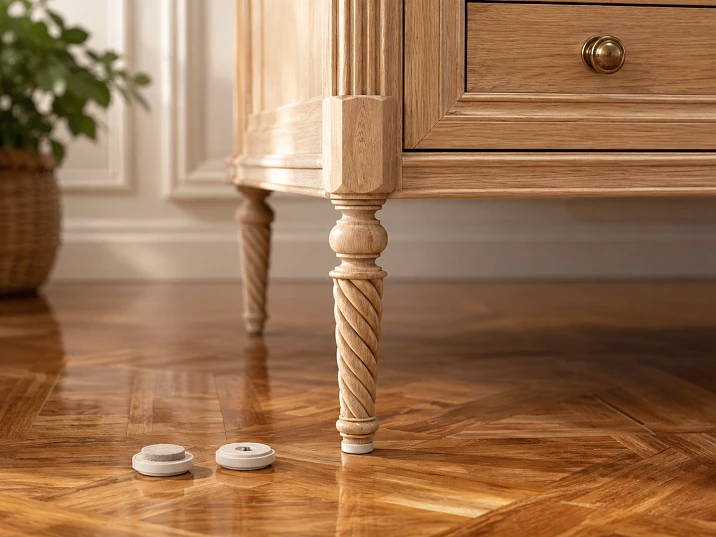
The parquet is already laid, the lacquer is applied, and the coffee table is only being assembled. In such a situation, the floor protector ceases to be a minor fitting "for later": it will be the one sitting between the new wooden leg and the finished floor covering. For the carved MN-032, STAVROS recommends two specific options — the round FUR-022 with the SUPER GLIDE sliding system and the felt FUR-028. Both are attached with a screw, both are intended for furniture legs, but they work differently.
If the main goal is the most delicate contact with lacquered parquet, and the coffee table will only be moved occasionally, the first candidate becomes buy the felt floor protector FUR-028. Its contact part is made of felt: the soft layer reduces hard friction, lowers noise, and suits sensitive wooden floors. But felt requires care: if sand grains or hard debris get embedded in it, the soft pad itself can turn into an abrasive.
If a coffee table has to be moved around the room frequently without being fully lifted, it makes more sense to consider buy a FUR-022 furniture glide for furniture. FUR-022 belongs to the SUPER GLIDE system: its special sliding surface is designed for easier movement of furniture. But for freshly lacquered parquet, this choice cannot be made automatically. First, you need to wait for the full period of bringing the coating into service according to the varnish manufacturer's instructions, and then make sure that the hard sliding surface is acceptable specifically for your finish.
The practical selection scheme is as follows:
-
new lacquered parquet, priority on protection and quietness → first FUR-028;
-
the table is moved regularly, priority on easy sliding → consider FUR-022;
-
the varnish has not yet reached operational strength → do not place or move furniture regardless of the type of glide;
-
the lower end of MN-032 does not allow safe installation of the screw of the selected glide → first solve the mounting assembly, rather than drilling the leg at random.
For a table with four legs, you need to count not one glide, but four identical elements. Mixing FUR-022 and FUR-028 on the same piece of furniture is unreasonable: they have different designs, heights, and sliding characteristics, so the four support points must work identically.
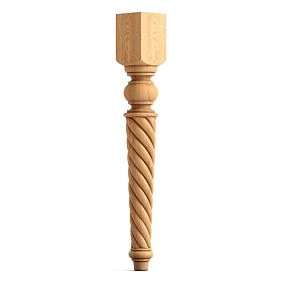
Wooden leg MN-032 for a coffee table: dimensions and necessary hardware
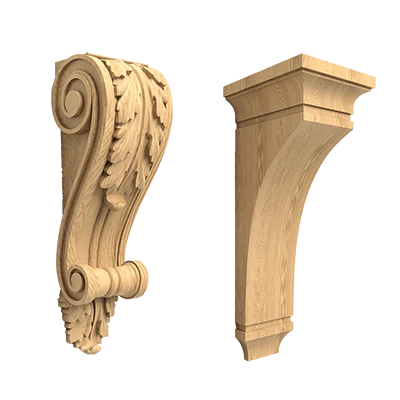
MN‑032 — carved wooden furniture leg, which the STAVROS card directly attributes to a coffee table. Its dimensions are 430 × 60 × 88 mm. Beech and oak are available, with sanding options "Standard" and "Prestige", and the selected base configuration on the card is prepared for enamel.
| Parameter | MN‑032 |
|---|---|
| Article number | MN‑032 |
| Purpose | furniture leg for a coffee table |
| Size | 430 × 60 × 88 mm |
| Material | Beech or oak |
| Sanding | "Standard" / "Prestige" |
| Preparation | options for enamel finish are available |
| Recommended hardware | FUR‑022 and FUR‑028 |
| Vertical load | for STAVROS furniture legs is stated as at least 100 kg per support |
The last figure cannot be turned into a permitted weight for the finished coffee table as "4 × 100 = 400 kg". The vertical load on an individual leg and the calculation of the entire piece of furniture are different tasks. The finished structure is affected by the tabletop, the method of attaching the legs, the distance between supports, dynamic loads, lateral rocking, and the properties of the body. Therefore, the floor cap is chosen not as a means to increase load capacity, but as a contact element between an already correctly calculated leg and the floor.
The MN‑032 card shows FUR‑022 and FUR‑028 in the recommended hardware block. This means that both items are logically considered together with the leg, but the floor cap is not automatically included in the cost of the MN‑032 itself. It needs to be added to the order as a separate line.
If the table is built on four identical legs, the basic specification looks like this:
MN-032 — 4 pcs.
FUR-022 — 4 pcs.
or
FUR-028 — 4 pcs.
Useful before purchase buy carved furniture leg MN-032 only after the tabletop, top mounting, and bottom support have been determined. Then the leg is designed as a single unit, not as a beautiful carved element to which hardware is later attempted to be adapted.
Why the bottom end of MN-032 needs to be measured separately
The size 430 × 60 × 88 mm is the overall dimension of the leg. It does not directly indicate that the bottom contact area is 60 × 88 mm. The carved shape tapers and changes cross-section along the height, so the support should be applied to the actual bottom end, not selected by the maximum width of the part.
FUR-022 has a contact dimension of 30 mm in diameter, FUR-028 — 28 mm. Both must fit on the bottom platform without protruding beyond the edge and without the screw getting dangerously close to a thin section of wood.
Before drilling:
-
place the leg vertically;
-
take the actual size of the bottom end;
-
find the geometric center;
-
apply a template with a diameter of 30 mm and 28 mm;
-
check the wood allowance around the future screw;
-
only after this choose the floor protector.
Our factory also produces:

Why it is better to equip four legs with one batch of hardware
A coffee table has four points of contact with the floor. If three legs have the same floor protectors installed, and the fourth has a different type, the furniture may get different support heights or uneven resistance to movement.
For neat assembly, the following must be the same:
-
floor protector model;
-
height;
-
mounting method;
-
contact surface condition;
-
screw insertion depth.
Therefore, when ordering Buy wooden furniture legs it is better to immediately add four identical glides to the set.
Get Consultation
Why does a wooden furniture leg need a separate glide
The glide has two different functions that are easy to confuse.
The first is floor protection. A separate contact surface appears between the wood of the leg and the varnish of the parquet. It absorbs friction and minor movements.
The second is protection of the end of the leg itself. The lower end of the solid wood is constantly near dust, accidental wet cleaning, and mechanical impact. The glide separates the wood from direct contact with the floor.
For new parquet, the first function is more important. For expensive carved MN‑032, both are.
Why can't you just leave the leg on bare wood
Even a well-polished end of a wooden leg remains hard. If the table is moved and a grain of sand gets under the leg, the load concentrates at a tiny point. The lacquer may get a line or a dent.
In addition, an open end gets dirty faster. On light enamel or a tinted leg, the lower area may differ from the rest of the part over time.
A floor protector does not replace a level floor
Neither FUR-022 nor FUR-028 are adjustable supports. They are not designed to compensate for significant level differences.
If the table wobbles, first check:
-
whether the legs are the same;
-
whether the mounting is skewed;
-
whether the tabletop is level;
-
whether the floor protectors are installed the same way;
-
whether there is a floor level difference.
Setting one glider deeper or placing random materials under another leg is a poor way to level furniture.
A glider does not make parquet invulnerable.
Even soft felt does not eliminate cleaning. Sand, fine stone chips, and construction dust are dangerous precisely because they get between furniture and the floor.
Protection works only as a system:
clean floor + functional floor protector + proper furniture movement + fully cured varnish.
If one element is missing, promising the absence of scratches is impossible.
Floor protector FUR-022 30 mm: when it is important to move a small table freely
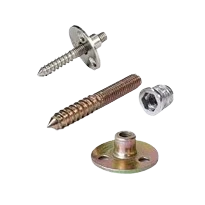
FUR-022 is a round floor protector with a diameter of 30 mm and a height of 5 mm. It is installed on a self-tapping screw. The card confirms a complete universal galvanized self-tapping screw 3.5 × 20 mm with a countersunk head and a Phillips slot.
The main feature is the SUPER GLIDE system. The manufacturer describes a special sliding coating that makes furniture easier to move across the floor.
For a coffee table, this is useful in several scenarios:
-
the table is regularly moved away from the sofa;
-
it is moved during cleaning;
-
the furniture is periodically turned around;
-
the floor under the table is cleaned with a robot vacuum, and the item has to be shifted;
-
the table is used in several areas of the room.
Why "slides easier" does not equal "better for any parquet"
FUR‑022 is designed to protect the floor surface and provide sliding, but a specific parquet varnish may have its own requirements for furniture supports.
Particular caution is needed with fresh coating. The varnish may stop being sticky and look dry long before the manufacturer allows prolonged point load and moving furniture.
Therefore, before installing the table:
-
find the varnish technical data sheet;
-
check the full curing time;
-
clarify when heavy furniture can be placed;
-
separately check when it is allowed to be moved;
-
only after that evaluate FUR‑022.
If the varnish document recommends soft felt pads under furniture, for new parquet this is an argument in favor of FUR‑028.
When FUR‑022 is more practical than FUR‑028
FUR‑022 becomes a stronger choice when controlled sliding is the priority.
For example, a small coffee table is moved back 30–50 cm every evening. Felt supports also allow moving furniture, but their fibers depend more on floor cleanliness and the condition of the felt itself. The FUR‑022 sliding system was originally designed around easy movement.
However, movement should still be gentle. The glider does not turn a coffee table into furniture on wheels.
When it is better not to choose FUR‑022 first
if:
-
the varnish has just been applied;
-
the coating manufacturer recommends soft felt pads specifically;
-
there is often sand on the floor;
-
the table is barely moved;
-
priority is the softest possible contact and silence,
felt FUR-028 seems more logical.
Felt pad FUR-028: when protecting parquet becomes the priority
FUR-028 is a round felt pad. At the time of the current check, the card shows dimensions of 28 × 28 × 11 mm. It comes with a universal screw 3.5 × 20 mm; the metal part is chrome-colored.
In the source materials on this topic, an old discrepancy in the card was recorded: the name said d=28 mm while the table showed 25 × 25 × 5 mm. On the current page, this discrepancy has been resolved — both the name and the table are consistent with a diameter of 28 mm, and the height is listed as 11 mm. For a publication article, it is more correct to use the current specifications rather than preserve an already corrected error.
Why felt is logical for lacquered parquet
Soft fibrous contact reduces hard friction between furniture and flooring. Manufacturers of floor protection and wood flooring products widely use felt pads specifically for parquet, wooden, and other sensitive hard floors.
FUR-028 also has an acoustic effect: with a slight shift, furniture moves more quietly.
For a coffee table that stays in one place most of the time, this is a particularly rational scenario.
Why felt does not provide an absolute guarantee against scratches
The main risk is contamination.
Imagine clean felt: the fibers gently touch the varnish.
Now imagine that a quartz grain has gotten into the felt. During the next move, the hard particle is pressed against the varnish by the weight of the furniture. The felt itself remains soft, but the sand acts as an abrasive.
Therefore, FUR‑028 needs to be:
-
inspected;
-
cleaned;
-
do not move on dirty floors;
-
replace when worn;
-
replace as a set, not one leg at a time, if the height has noticeably changed.
How long does a felt glider last
There is no universal lifespan for a specific table. Wear depends on:
-
furniture weight;
-
frequency of movement;
-
type of floor;
-
amount of dust;
-
wet cleaning;
-
installation quality;
-
contact area.
It is better to focus not on the calendar, but on the condition. If the felt has thinned, become stiff, accumulated debris, peeled off from the base, or the metal part has started to approach the floor, the glider needs to be replaced.
Why cleanliness is especially important after lacquering
After renovation, fine construction dust often remains in the room. It is at this moment that new felt can quickly pick up abrasive.
Before installing the coffee table, it is useful to do a final cleaning, wait for the floor to dry completely, and only then place the furniture.
Why the size of FUR‑028 must be confirmed before ordering
In the original plan of the topic, a problem was recorded: the name FUR‑028 contained a diameter of 28 mm, while the table on the page previously showed other dimensions. On the current product card, this discrepancy has already been resolved: now it indicates 28 × 28 × 11 mm. This is a good example of why, before buying hardware, you should look not at an old article or a saved screenshot, but at the current product card.
But even after correcting the table, there remains a second, more practical question: does FUR‑028 fit on the bottom end of exactly MN‑032.
The MN‑032 card shows the overall leg dimension of 430 × 60 × 88 mm, but does not publish a separate size for the bottom round or oval platform. Therefore, you cannot conclude that "28 mm fits exactly" by simply comparing 28 with 60 or 88.
What dimensions to check on the actual leg
After receiving MN-032, measure:
-
minimum width of the bottom platform;
-
minimum length of the bottom platform;
-
distance from the center to the nearest edge;
-
thickness of the solid wood in the area where the screw will go;
-
absence of a hidden crack or knot at the attachment point.
For a round foot cap, it is convenient to make a simple template:
FUR-028 → circle 28 mm.
FUR-022 → circle 30 mm.
Attach the template to the end face and make sure it does not extend beyond the contour anywhere.
Why does the difference of 28 and 30 mm even matter
In diameter, FUR‑022 is only 2 mm larger than FUR‑028. On a wide flat end face, this is almost imperceptible. On a narrow carved support, even 1 mm of clearance on each side can matter for aesthetics and screw placement.
At the same time, the height of the products differs more significantly:
-
FUR‑022 — 5 mm;
-
FUR‑028 — 11 mm according to the current product card.
This is another reason not to mix the two types on the same table.
Do I need to double-check FUR‑028 with a manager if the product card has already been corrected
For a standard purchase, the current product card is sufficient as the primary source: 28 × 28 × 11 mm.
But if you are assembling furniture according to an exact drawing and every millimeter of height is critical, it is useful to additionally confirm:
-
overall height of the product;
-
height of the protruding part after installation;
-
diameter of the felt contact pad;
-
actual position of the screw head.
This is not because the card is “unreliable,” but because for custom furniture, the installation dimension matters, not just the product size.
How many glides to buy for four carved furniture legs
If the coffee table has four MN‑032, the minimum number of glides is four.
The formula is simple:
Nglides = Nlegs.
For four supports:
4 = 4.
The error occurs not in the arithmetic, but in the configuration: the customer adds four beautiful carved legs to the cart and forgets that the glides are sold separately.
Why it's better to buy four identical ones rather than two FUR-022 and two FUR-028
The difference between the models is not only in the contact material.
| Parameter | FUR‑022 | FUR‑028 |
| Diameter | 30 мм | 28 мм |
| Height per card | 5 мм | 11 мм |
| Contact | SUPER GLIDE sliding surface | felt |
| Self-tapping screw | 3.5 × 20 mm | 3.5 × 20 mm |
| Main focus | easy movement | soft protection and noise reduction |
If you install two glides with a height of 5 mm and two with a height of 11 mm, the table will most likely lose its overall support plane. Even if the actual mounting height differs from the full product dimension, mixing without a drawing is still unjustified.
Moreover, one side will slide differently than the other.
Therefore, for one table, choose:
4 × FUR‑022
or
4 × FUR‑028.
Is a fifth glider needed as a spare?
Mathematically — no.
Four legs are enough for four gliders.
A fifth can be added as an operational reserve if:
-
the table will be moved frequently;
-
the object is far from the store;
-
the felt layer wears out intensively;
-
you want to have an identical spare part from the same purchase.
But this is not a mandatory configuration. If a spare thrust pad is stored for years, you still need to check the current condition of the other three before replacement: replacing one heavily worn element with a new one sometimes creates a difference in height.
When to replace as a set
A complete replacement makes sense if:
-
all four felt elements have noticeably thinned;
-
contact surfaces are contaminated;
-
one thrust pad is destroyed, and the others are already close to wear;
-
the furniture has started to wobble due to different heights;
-
after floor repair, the entire assembly needs to be rechecked.
For FUR-022, the condition of the sliding surface is assessed similarly. If one support is damaged and the others are significantly worn, replacing only one may result in uneven sliding.
How to check the bottom end of a wooden leg before installing the self-tapping screw
Both models under consideration are attached mechanically. This is important: FUR-022 and FUR-028 are not self-adhesive felt circles. They are held by a 3.5 × 20 mm self-tapping screw.
Mechanical attachment is more reliable than a random adhesive pad, but requires proper work with the wood.
Step 1. Find the center of the end face
The screw must enter the wood at a point where there is enough wood around it.
If you shift the attachment toward the edge, a crack may appear when screwing it in.
Use:
-
a ruler;
-
a square;
-
compass;
-
foot template.
Draw a 28 or 30 mm outline and mark its center.
Step 2. Check the direction of the grain
The bottom end face is a sensitive area. Beech and oak are dense, so a screw without a pilot hole can create strong wedging stress.
For responsible end-grain installation, pre-drilling is more sensible than attempting to drive a 3.5mm screw directly.
Step 3. Drill a pilot hole
The exact drill bit diameter depends on the actual core diameter of the screw and the density of the wood. Universal logic: the hole should be smaller than the outer thread diameter so the threads continue to grip in the solid wood.
Do not blindly use a random "3.5mm bit for a 3.5mm screw" without checking: then the threads may have nothing to bite into.
For oak and beech, especially in end grain, pre-drilling reduces the risk of splitting.
Step 4. Limit the depth
The screw is 20mm long. But the hole depth cannot be chosen blindly based only on this figure.
First, make sure there is sufficient solid wood thickness in the center of the bottom end of MN-032 and that the drill will not hit another fastener assembly.
It is convenient to put a depth stop or a mark with painter's tape on the drill bit.
Step 5. Drill perpendicularly
If the guide hole is tilted, the thrust pad may sit at an angle. Then:
-
the contact area decreases;
-
the table may wobble;
-
the felt wears unevenly;
-
FUR-022 will slide with a skew.
Step 6. Do not overtighten the screw
The goal is to press the thrust pad firmly against the end face, not to sink the metal base into the wood.
Excessive force can:
-
dent the surface;
-
strip the threads in the wood;
-
split the end;
-
deform the fittings.
It is better to control the final tightening manually.
Can the screw from the kit be used automatically
Cards FUR‑022 and FUR‑028 confirm the 3.5 × 20 mm screw as part of the kit. Card MN‑032 recommends these floor protectors as fittings.
This is a strong compatibility argument, but before drilling, the specific end is still checked. The manufacturer does not publish a separate drawing of the drilling depth for the lower part of MN‑032.
Therefore, the correct wording is not “the screw can definitely be screwed in 20 mm without checking,” but:
the included screw is intended for mounting the floor protector; the depth and diameter of the pilot hole are determined based on the actual leg.
What is better for parquet, laminate, tile, and natural wood boards
The same coffee table may move from a room with parquet to a room with tile after a few years. Therefore, it is useful to understand the logic of choosing based on the flooring.
Lacquered parquet
Priority is gentle contact.
For this scenario, it makes more sense to start with FUR-028, because felt creates a soft intermediate layer.
Especially if:
-
new floor;
-
glossy varnish or sensitive to micro-scratches;
-
the table is moved rarely;
-
silence is important.
FUR-022 is also positioned as protective sliding hardware, but for a specific parquet varnish, it should be chosen after checking the coating manufacturer's recommendations.
Laminate
Laminate is harder on the top layer, but can also get scratches from sand.
FUR‑028 provides soft contact.
FUR-022 may be more convenient if the table is frequently moved.
Here again, cleanliness matters: sand is dangerous under any base plate.
Ceramic tiles and porcelain stoneware
On tiles, the risk of damaging the covering itself is usually less related to contact softness and more to:
-
noise;
-
slipping;
-
getting into the joint;
-
surface unevenness.
FUR-022 is convenient for moving.
FUR-028 makes movement quieter, but the felt in the wet cleaning area needs to be checked more often.
If the tile has a pronounced relief, no model should be used as a leveling support to compensate for unevenness.
Natural wooden board under oil or varnish
The logic is close to parquet: soft felt is often the first option for surface protection.
But the board's coating can be very different. Oil systems, matte varnish, and industrial UV coating have different requirements.
Therefore, the final check is the floor manufacturer's instructions.
Stone
For smooth natural or artificial stone, FUR-022 can provide convenient sliding.
Felt is useful for reducing noise and preventing direct contact of metal or wood with the surface.
But if there is a lot of sand in the room, felt requires especially frequent cleaning.
Carpet
FUR-022 and FUR-028 are not necessarily the optimal choice for thick carpet. Soft pile changes the nature of the support, and felt can catch on fibers.
If the table will be placed on a carpet, the choice of the floor protector should be considered separately from the scenario of this article.
Summary comparison
| Finish | First candidate | What to check |
| lacquered parquet | FUR‑028 | lacquer curing time, felt cleanliness |
| Laminate | FUR-028 or FUR-022 | frequency of movement and sand |
| smooth tile | FUR-022 or FUR-028 | noise, sliding, seams |
| natural board | more often FUR-028 | finish manufacturer's recommendations |
| stone | Depends on the task | sand, noise, frequency of movement |
| Carpet | individual selection | stability and interaction with pile |
This table does not replace the requirements of a specific floor covering. It shows the principle of choosing between two products.
How sand under a felt pad can scratch the varnish
Felt has a paradox: it is the soft surface that protects clean parquet well, but it can also retain hard particles.
Sand is dangerous because its mineral particles are harder than the lacquer layer. While a grain of sand lies freely on the floor, it can be removed with a vacuum cleaner. When it gets stuck in the felt and is pressed down by the weight of the table, any movement turns it into a cutting abrasive.
Therefore, the phrase "felt glides do not scratch parquet" is only true when the felt is in good condition and clean.
How to check FUR‑028 before moving the table
If the table is moved rarely, develop a simple habit:
-
slightly lift one side;
-
visually inspect the felt;
-
remove hair, sand, and hard particles;
-
wipe or vacuum the floor area;
-
only then move the furniture.
For daily small movements, such a procedure is excessive, so regular cleaning of the entire area around the table is more important.
Where does sand come from in the living room
Even if the coffee table is far from the front door, abrasive gets into the room:
-
on shoes;
-
on pets' paws;
-
from stroller wheels;
-
after renovation;
-
from flower pots;
-
from an open balcony;
-
along with road dust.
New parquet after finishing work is especially vulnerable: construction dust can remain in gaps and under furniture even after the first cleaning.
How to clean felt
Do not soak FUR-028 with household chemicals.
The main task is to mechanically remove dry solid particles.
Suitable options:
-
vacuum cleaner;
-
soft brush;
-
clean cloth;
-
tweezers for individual grains.
If the felt is soaked with dirt, deformed, or no longer soft, it is more practical to replace the heel pad.
Why you should not pick off debris with a sharp tool directly over the parquet
If you clean the heel pad with a screwdriver, knife, or awl, it is easy to slip and damage the varnish.
Safer:
-
turn over or lift the furniture;
-
protect the floor with a soft cloth;
-
clean the glider without contact with the coating.
What happens to FUR-022 with sand
SUPER GLIDE does not eliminate the abrasive problem.
If a grain of sand gets between FUR-022 and the varnish, light sliding can even increase the length of the scratch because the table moves more freely.
Therefore, floor cleanliness is mandatory for both options.
The difference is not that FUR-028 is 'afraid of sand' and FUR-022 is not. The difference is that felt can hold particles inside its fibers, so its condition is especially important to check regularly.
Fresh varnish and sand — double risk
While the coating has not yet reached full operational hardness, it is more sensitive to point loads and friction.
Therefore, immediately after varnishing, you should not:
-
place the table before the allowed time;
-
test sliding by experiment;
-
drag furniture to "seat the glides";
-
cover marks with a carpet if the varnish manufacturer has not yet allowed its installation.
First, the varnish must go through the full curing cycle according to its system's instructions.
Beech or oak for furniture leg MN‑032
MN‑032 is made from beech and oak. The glide is selected based on the floor and mounting geometry, not the wood species: both FUR‑022 and FUR‑028 can be considered for both materials.
The difference between beech and oak is more important for the appearance and finish of the leg.
Beech
STAVROS describes beech as a dense, non-porous wood, often used for items with opaque enamel finishes.
If the coffee table will be:
-
white;
-
cream;
-
black;
-
colored;
-
fully opaque in finish,
beech is a natural candidate.
The density of the material also means something else: when installing the glider screw, pre-drilling is especially useful. There is no need to test "for strength" by driving fasteners into dry beech without a pilot hole.
Oak
Oak has pronounced porosity and an active natural texture. It is often chosen for transparent and semi-transparent finishes.
If the legs should visually match:
-
an oak tabletop;
-
parquet;
-
wooden wall panels;
-
with other oak furniture,
the material can become part of the entire composition.
But trying to match a leg "exactly to the parquet color" based only on a photo from the website is unreliable. The tone of natural wood, floor varnish, lighting, and tinting change perception.
Do you need to make the leg from the same wood as the parquet
There is no such mandatory rule.
An oak leg on oak parquet can look harmonious, or it can blend in and provide too much of the same texture.
A beech leg under enamel can, on the contrary, create a neat contrast.
The foot pad remains a technical detail and is almost not involved in selecting the wood species.
What does "under enamel" mean
The selected configuration MN‑032 on the card shows the quality of gluing "under enamel". This means preparation for an opaque finish.
If you want a transparent tint, you need to choose or agree on an option designed for the corresponding finish.
You should not buy a blank "for enamel" and then expect perfect matching of lamellas by natural pattern under a clear varnish.
"Standard" or "Prestige"
Both sanding levels are available for MN-032.
"Standard" is machine sanding, after which more noticeable manual finishing may be required before the final coat.
"Prestige" includes more thorough manual sanding of complex relief.
This is especially important for a carved leg: excessive intensive sanding can soften the pattern.
You can check the difference in preparation in more detail on the page quality of wooden furniture legs.
When to install the floor protector — before or after painting
It is more practical to first perform the main finishing of the leg, and install the floor protector on a fully prepared and dried element before final assembly.
Why:
-
FUR-028 does not need to be stained or varnished;
-
the felt must not pick up sanding dust;
-
FUR-022 must not have coating drips on the working surface;
-
it is easier to finish the bottom edge of the wood properly.
But the hole for the self-tapping screw can be marked in advance.
It is useful to check the general sequence of wood preparation against tips for finishing wooden legs and the instructions of the specific paint and varnish material.
How to buy wooden furniture legs and fittings in one order
The main commercial mistake in this scenario is treating the leg and the floor protector as two independent purchases.
For a coffee table, a system is needed:
tabletop / body → upper mounting MN‑032 → wooden leg → floor glide → floor.
If at least one component is not designed, assembly stops.
Basic specification for a table with four legs
| Position | Quantity | What to check |
| MN‑032 | 4 pcs. | beech/oak, sanding, finishing |
| FUR-022 or FUR-028 | 4 pcs. | one type for all legs |
| upper mounting hardware | By design | select in the MN‑032 card |
| guide drilling for the floor glide | 4 points | center and depth |
| Floor protection | before installation | varnish is fully cured |
If you need a different type of support, you can buy wooden legs for the coffee table in the general section and compare the bottom end of different models before choosing the floor protector.
When to choose FUR‑028 in the cart right away
FUR‑028 logically adds to four MN‑032 if:
-
the table will stand on parquet;
-
the floor covering is sensitive;
-
furniture is not moved constantly;
-
silence is important;
-
the owner is ready to control the cleanliness of the felt.
In this case, the order:
4 × MN‑032 + 4 × FUR‑028.
When to choose FUR‑022 in the cart right away
FUR‑022 is more logical if:
-
the floor allows sliding glides;
-
the table is moved regularly;
-
ease of movement is important;
-
the user does not want to lift the furniture every time;
-
a diameter of 30 mm fits confidently on the end.
Order:
4 × MN‑032 + 4 × FUR‑022.
When not to choose any option until receiving the legs
Postpone the final choice of the foot pad if:
-
the lower end of MN‑032 must be additionally trimmed;
-
the legs are manufactured in a non-standard size;
-
the craftsman changes the shape of the lower platform;
-
a decorative metal shoe is planned at the bottom;
-
the floor has a non-standard covering and the manufacturer requires a specific type of support.
In this case, it is better to first obtain a drawing or the actual size of the end.
Where to compare other foot pads
If FUR-022 and FUR-028 do not fit the task, you can buy furniture glides in the general fittings section.
There are adjustable, felt, round, square, and self-adhesive options.
But you don't need to switch to another model just because it's cheaper or visually appealing. For MN-032, the manufacturer has already listed FUR-022 and FUR-028 as recommended fittings, so it makes sense to start the comparison with them.
What to check before payment
Make a short specification:
Leg: MN-032, 430 × 60 × 88 mm.
Quantity: 4 pcs.
Material: beech / oak.
Sanding: "Standard" / "Prestige".
Finish: under enamel / other agreed
Scenario 4. House with a dog, children, and constant fine sand
Felt can still be good protection, but the operating mode becomes stricter.
If FUR‑028 is selected:
-
vacuum the area more often;
-
regularly lift the table and check the felt;
-
replace the soiled set rather than waiting for complete wear.
If FUR‑022 is selected:
-
also keep the floor clean;
-
before a long move, check the trajectory;
-
do not drag furniture over a visible grain of sand.
In such a room, it is not only the material of the glides that matters, but the regularity of maintenance.
What will change in the overall height of the table
MN‑032 has a height of A = 430 mm. The glides add their own part to the bottom assembly.
According to the cards:
-
FUR‑022 — overall height dimension 5 mm;
-
FUR‑028 — overall height dimension 11 mm.
Difference between products:
11 − 5 = 6 mm.
These 6 mm seem insignificant, but for a furniture project they matter.
If the tabletop must hit an exact mark relative to a sofa, armrest, or other furniture, you cannot first calculate the table using one MN‑032 and then forget about the floor glide.
At the same time, the formula “430 + 11 = 441 mm” should not be used as a guaranteed finished leg height without understanding the top mounting and the actual installation seating of the floor glide. The product dimension and the part protruding after installation may differ.
For the project, you need to request or measure:
the finished height of MN‑032 after top mounting + the actual protrusion of the floor glide + the tabletop thickness.
How to conduct a test on an inconspicuous area of the floor
Even when the floor glide manufacturer claims floor protection and the parquet manufacturer allows furniture, the specific combination of “varnish + floor glide + table mass” remains a real object.
If the coating is expensive or non-standard, you can conduct a careful test.
Do not drag the assembled table across the center of the room.
Better:
-
wait for the full curing time of the varnish;
-
choose an inconspicuous area near the wall;
-
use a clean sample of the floor protector;
-
press it against the coating without strong pressure;
-
then check a small controlled slide only if the varnish manufacturer allows it;
-
inspect the surface under side lighting.
This test does not replace the coating instructions, but it helps spot an unexpected mark before the furniture goes through the entire room.
Why side lighting is important for checking parquet
A micro-scratch on the varnish can be almost invisible from above and become sharply visible under sliding light from a window.
After the first days of use, it is useful to check the area around the four legs:
-
in the morning or evening when the sun is low;
-
with a side light;
-
after careful cleaning.
If recurring arcs or lines appear, do not continue moving "until it gets worse." First:
-
stop moving;
-
clean the floor;
-
check the glides;
-
find out if there is contamination;
-
replace the set if necessary.
Why it's better not to "impregnate" new felt with floor care products
Sometimes the idea arises to apply wax, polish, silicone, or parquet care product to FUR‑028 to make it slide even more smoothly.
Without a direct recommendation from the manufacturer, this should not be done.
Impregnation can:
-
change friction;
-
collect more dust;
-
leave marks on the lacquer;
-
alter the structure of the felt;
-
get onto the metal part and fasteners.
FUR‑028 is already designed as a ready-made furniture pad. Its working surface is best kept clean and dry.
How to move a table if the parquet is especially expensive
Even the best floor protector does not preclude the safest method — lifting the furniture.
If the table is light enough for two people:
-
clear the tabletop;
-
grip the load-bearing frame, not a decorative element;
-
lift all four supports;
-
move it;
-
lower it vertically without a sideways jerk.
This is especially advisable:
-
immediately after the end of the permitted curing period;
-
when rearranging over a long distance;
-
if sand is noticed on the floor;
-
if the felt has not been checked for a long time;
-
when carrying across the threshold.
The glider is needed for protection in normal use, not to make it mandatory to drag any furniture across the floor.
When FUR‑028 turns from protection into a consumable material
Felt has a working lifespan. That is normal.
Signs that the glider should be considered a consumable and replaced:
-
the thickness has noticeably decreased;
-
the edge of the felt is crushed;
-
the surface became shiny and hard;
-
there are particles in the fibers that cannot be removed;
-
the foot pad got wet and deformed;
-
one leg sits lower than the others;
-
the movement became noisier.
For a table with four identical supports, it is usually more sensible to replace all four if the wear is similar in degree.
When FUR‑022 also needs replacement
The sliding surface is also not eternal.
Check FUR‑022 if:
-
deep scratches appeared on the foot pad itself;
-
the edge is split;
-
the base is skewed;
-
the screw is loose;
-
the foot rotates on the leg;
-
one point slides noticeably worse than the others.
Do not wait until the foot housing starts contacting the parquet with an incorrect edge.
Why the screw needs to be checked after the first rearrangements
After assembly and the first movement cycles, make sure all four FURs are standing firmly.
If one screw is loose:
-
the foot may tilt;
-
the load will become uneven;
-
the edge will start touching the floor;
-
the hole in the wood will gradually wear out.
Tighten carefully, without over-tightening. If the screw no longer holds, simply using a longer fastener without a professional's assessment is a bad decision. First, you need to restore the correct mounting assembly.
30-second selection scenario
Before placing an order, ask yourself four questions.
1. Is the varnish fully cured?
If not, the floor protector won't solve the problem yet.
2. Is the table moved frequently?
If yes, FUR‑022 has an advantage in sliding function.
3. The main goal is the softest possible contact with the parquet?
If yes — FUR‑028 becomes the first candidate.
4. Does the selected diameter fit on the bottom end, and is there a safe spot for the screw?
If not — the mounting solution is changed first.
This short scheme covers most real cases without trying to declare one model universally best.
FAQ: FUR‑022 or FUR‑028 for MN‑032 on parquet
Is the floor protector included in the MN‑032 set?
No. The MN‑032 card shows FUR‑022 and FUR‑028 as recommended hardware, but the floor protectors themselves are separate items.
When ordering four legs, you need to add four identical floor protectors separately.
How many floor protectors should be ordered for a coffee table?
If the table stands on four MN-032 legs, at least four glides are required — one for each leg.
The fifth element is not mandatory. It can only be purchased as a spare consumable part if the table is frequently moved or if repeat delivery is inconvenient.
How does FUR-022 differ from FUR-028?
FUR‑022:
-
diameter 30 mm;
-
height 5 mm;
-
SUPER GLIDE system;
-
sliding contact surface;
-
self-tapping screw 3.5 × 20 mm included.
FUR‑028:
-
diameter 28 mm;
-
height 11 mm per the current card;
-
felt contact part;
-
soft and quieter contact with the floor;
-
self-tapping screw 3.5 × 20 mm included.
The main difference is not the 2 mm diameter, but the nature of the contact with the floor.
Which glider is better for lacquered parquet?
If the priority is protecting sensitive lacquer and the table is moved infrequently, the first candidate is FUR-028 with felt.
But before installation, you need to wait for the full curing time of the specific parquet lacquer.
If the table is moved constantly and the floor manufacturer allows sliding hardware, you can consider FUR-022.
Can you frequently move a table on felt gliders?
Yes, if the felt is clean, in good condition, and the parquet itself allows use after full curing.
But with frequent movement, FUR-028 needs to be regularly checked for:
-
sand;
-
solid particles;
-
abrasion;
-
deformation;
-
contamination.
If the table is moved several times a day, FUR‑022 may be more convenient specifically in terms of sliding.
What is the actual size of FUR‑028?
As of the current check, the STAVROS card shows 28 × 28 × 11 mm.
The old discrepancy, where the name mentioned d=28 mm but the table showed a different size, has been resolved in the current card.
Before precise furniture assembly, it is still useful to check the actual height and contact area of the received product.
Is the screw included with the furniture foot?
Yes.
FUR‑022 is supplied with a universal galvanized self-tapping screw 3.5 × 20 mm.
FUR‑028 is also supplied with a universal self-tapping screw 3.5 × 20 mm.
Is the 3.5 × 20 self-tapping screw suitable for MN‑032?
The MN‑032 card recommends both support feet, and their cards supply the products with such a self-tapping screw. However, the open drawing does not show a separate safe drilling depth for the bottom end of MN‑032.
Therefore, before installation, check:
-
the thickness of the solid wood;
-
the center of the end;
-
absence of cracks;
-
the depth of the pilot hole.
Do not automatically drill all 20 mm without measuring the leg.
Is it necessary to pre-drill a hole in the wooden leg?
For beech and oak, especially when working on the end grain, a pilot hole is a rational measure against splitting.
The drill diameter is chosen smaller than the outer diameter of the screw thread.
Hold the drill perpendicular to the end grain and limit the depth.
If you lack experience installing into dense wood, it is better to entrust this operation to a furniture craftsman.
How often should felt glides be replaced?
There is no universal time frame.
Replace FUR‑028 based on condition, if:
-
the felt has thinned;
-
it has become stiff;
-
it is soiled to the point that it cannot be cleaned;
-
started to move away;
-
the furniture began to stand unevenly;
-
traces of contact between the metal part and the floor appeared.
For a frequently moved table, the condition should be checked more often than for a stationary cabinet.
Can different glides be placed on one table?
Not recommended.
FUR‑022 and FUR‑028 have different designs, different overall height dimensions, and different slip coefficients.
It is better to place one piece of furniture on four identical glides.
What should be ordered together with furniture legs MN‑032?
Minimum set:
-
4 × MN‑032;
-
4 × selected glide;
-
upper mounting hardware according to the table design.
Also, determine in advance:
-
leg material;
-
level of sanding;
-
finish;
-
method of attachment to the tabletop or underframe;
-
floor protection.
Can self-adhesive felt be used instead of FUR-028?
Physically, self-adhesive felt pads exist on the market, but they are a different type of hardware.
FUR-028 is attached with a self-tapping screw and is an independent floor protector.
If changing to a self-adhesive system, you need to re-evaluate:
-
end size;
-
adhesion;
-
thickness;
-
the load;
-
Service life.
Do not describe the self-adhesive pad as a direct equivalent of FUR-028.
What to do if the 28 mm diameter protrudes beyond the edge of MN-032?
Do not drill.
The foot pad must fit completely under the bottom platform of the leg.
If FUR-028 protrudes, you need to:
-
recheck the orientation of the leg;
-
measure the actual size of the end face;
-
look at a foot pad of a smaller diameter;
-
coordinate the option with the manager or the craftsman.
In the STAVROS catalog, there is, for example, a felt model with a smaller diameter, but the switch to it should be deliberate, not accidental.
What to do if FUR-022 fits, but FUR-028 does not?
This is possible not because of the difference in nominal diameter — FUR-028 is smaller — but because of the specific shape of the metal base, height, or actual end face.
Compare the actual products and the drawing, not just the name.
If both physically fit, the choice returns to the floor scenario: sliding versus soft contact.
Can the table be installed immediately after varnishing the parquet if there is felt?
No.
Felt does not shorten the curing time of the varnish.
Before installing furniture, you must wait for the period specified by the manufacturer of the specific coating for furniture load.
If the varnish is not ready yet, even a soft glider can leave a dent or a mark.
How to move the table on fresh parquet after full curing?
Even after the allowed period, it's better to make the first movements carefully.
Correct sequence:
-
make sure the floor is clean;
-
check the four support pads;
-
if necessary, slightly lift the table;
-
move without jerking;
-
after moving, check that no debris has appeared under the supports.
If the furniture is heavy, it's safer to lift it together than to test the limit of the floor's protective coating.
Which is better: FUR-022 or FUR-028, if the table is almost never moved?
For lacquered parquet, FUR-028 is more common.
The main function then is not sliding, but soft separation of the wooden support and the finished floor.
FUR‑022 makes sense if regular movement is expected.
What is better if the table has to be moved every day?
First, check the parquet requirements.
If the flooring allows this type of furniture sliding glides, FUR‑022 is more convenient in its main SUPER GLIDE function.
But daily movement still requires a clean floor: the glide does not protect against sand trapped under the furniture.
Should the glides be installed before the final assembly of the table?
It is better to install them while there is convenient access to the bottom ends of the legs, but after the main wood finishing.
Then:
-
easier to center precisely;
-
the felt does not get dirty;
-
the sliding surface is not damaged;
-
You can control the pilot drilling.
Will FUR-028 affect the height of the coffee table?
Yes, any floor glide adds its own mounting height to the support.
The FUR-028 card shows a total height of 11 mm, FUR-022 — 5 mm.
When designing the exact total height of the table, this difference must be taken into account. The furniture height should not be calculated based only on MN-032 at 430 mm.
Can FUR-028 be replaced with FUR-022 later?
Only as a set and after re-checking the floor.
If four FUR-028 are replaced with four FUR-022:
-
the total height of the support will change;
-
the sliding characteristics will change;
-
need to check the condition of the holes for the self-tapping screw;
-
you cannot endlessly unscrew and screw fasteners into one damaged hole.
If the wood in the old hole is damaged, the method of re-fastening should be determined by a specialist.
Which option should be chosen specifically for freshly lacquered parquet?
If the lacquer has already fully cured according to the manufacturer's instructions, and the main goal is to preserve the coating, I would start with four FUR‑028.
Causes:
-
felt creates a soft contact surface;
-
a table on felt moves more quietly;
-
soft felt supports are traditionally used to protect parquet and wooden floors;
-
MN‑032 itself recommends FUR‑028 among the hardware.
Choose FUR‑022 if after this a second important condition appears: the table needs to be moved regularly, and for the owner, easy sliding is more important than the softness of the felt contact.
Result: for fresh lacquered parquet, first FUR-028; for frequent traffic, FUR-022
MN-032 has no single "correct glider for all cases." The card intentionally shows two options: they solve different tasks.
FUR-022 30 × 30 × 5 mm — a choice centered around movement. The SUPER GLIDE system helps move furniture more easily over hard floors.
FUR-028 28 × 28 × 11 mm — a choice centered around soft contact. Felt reduces hard friction and noise, so for lacquered parquet it is usually the first candidate.
For a coffee table on four MN-032 legs, you need four identical gliders. Before installation, measure the bottom end of the leg and check that the 28- or 30-millimeter pad fits completely under the wood. The included 3.5 × 20 mm screw does not eliminate the need for pre-drilling dense beech or oak and checking safe depth.
The most important condition is not even in the hardware card: the parquet lacquer must fully reach operational strength. Do not place furniture early just because there is felt under the leg.
After starting use, periodically check all four supports. Clean FUR-028 from sand and replace when worn. Check FUR-022 for damage to the working surface. The floor must be clean before moving the table in both cases.
Thus, choosing a glider becomes not a random small purchase, but part of a properly designed lower furniture assembly: four carved legs MN-032, four identical gliders, and preserved lacquered parquet.