Article Contents:
- NPU-459R — it is precisely an asymmetrical carved decorative overlay, not a "half of a mandatory pair"
- Why a one-sided slat field does not have to receive mirror decor on the left
- How to determine whether there is a real axis on the wall that requires a pair L/R
- Is there a central object that really needs to be framed?
- Are there two identical edges?
- Is the decorative element repeated elsewhere?
- What will happen if the second overlay is removed?
- Scale relative to the batten field
- Distance to the edge of the battens
- Proximity to a switch, sconce, painting, or furniture
- Need for a second piece
- How to distinguish a technical edge issue from a decorative task
- Why this also affects the quantity
- What to check on the finished transition
- When the best option is not to place an overlay at the very edge
- Do not place the ornament where its contour visually 'sticks' to the slats
- Too much distance also weakens the meaning
- Check the position relative to furniture, not just the wall
- Consider the eye level
- Check the frontal and diagonal views
- 1. The wall has two equally significant edges
- 2. The central object requires framing
- 3. A strict mirror system has already been built in the room
- 4. There is a second repeating node on another wall
- 5. The template shows a real visual skew without the second detail
- How to check whether empty space is useful
- Free space is especially important near furniture
- Emptiness can be stronger than a second ornament
- A slatted wall is already expressive enough
- There is already a large painting or mirror on the smooth part
- The interior style is extremely minimalist
- Scenario 2. Central panel between two slatted fields — a pair
- Scenario 3. One-sided slats, but the overlay conflicts with the sconce — none
- When spatial repetition is appropriate
- When repetition turns into decorative dispersion
- Identical repetition and a mirror pair are different techniques
- How to check repetition without buying
- Mistake: treating L/R as a ready-made set
- Mistake: trying to fix an asymmetrical wall with symmetrical decor
- Mistake: choosing R only because the panels are on the right
- Mistake: adding a second small overlay when the problem is scale
- Mistake: not accounting for evening light
- Can the NPU-459R be used separately if there is no NPU-459L in the room at all?
- Do I need to buy two NPU-459R instead of an R/L pair if I want to repeat the same pattern?
- Can the overlay be turned the other way on the wall?
- Will one NPU-459R fit a wall wider than 4 meters?
- What is better: an overlay matching the wall color or a contrasting one?
- Is the NPU-459L needed if there is the same cabinet to the left of the wall as on the right?
- Can I first buy one NPU-459R and then add the L later if needed?
- What to do if R doesn't fit the edge of the slats in shape, but L does?
- Can NPU-459R be placed directly on a slat panel?
- If one NPU-459R is not enough, is it mandatory to add exactly NPU-459L?
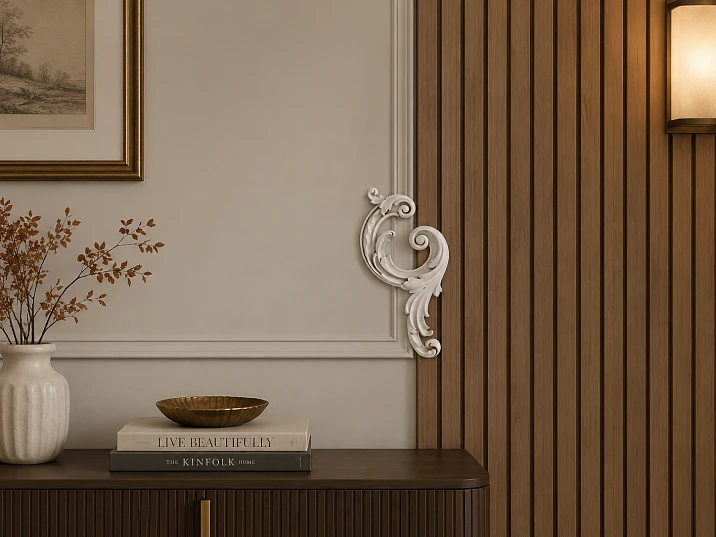
If the slat panels occupy only the right part of the wall, and the rest of the surface remains smooth and painted, the wall architecture itself is already asymmetrical. In such a situation, the presence of two similar SKUs in the catalog — NPU-459R and NPU-459L — does not necessarily mean they must be purchased as a pair. Sometimes a single asymmetrical carved decorative overlay NPU-459R better continues the logic of a one-sided composition: it works as a local accent at the transition between the rhythmic slatted surface and the calm smooth field, while the second overlay only artificially creates symmetry that was not originally present in the project.
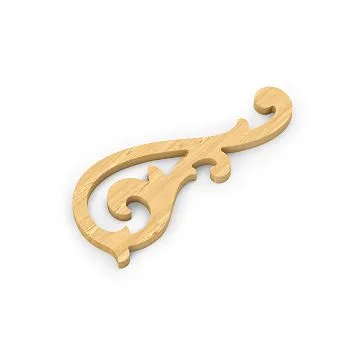
For this task, we consider a specific product: NPU-459R measuring 159 × 84 × 13 mm, material — polyurethane, current price — 880 ₽ per piece. There is also a separate mirrored item NPU-459L with the same dimensions and the same current price. Therefore, the commercial choice is very clear: buy one piece for 880 ₽ or assemble a pair L/R for 1,760 ₽. But the right decision is determined not by the 880 ₽ difference, but by how many meaningful accent points there actually are on the wall.
If there is only one transition on the wall from a smooth surface to slat panels, one decorative gesture is often sufficient. If the interior has two equally significant edges, two mirrored niches, a symmetrical furniture axis, or another real reason for a pair, then it makes sense to separately consider NPU-459L. The main mistake is buying two overlays just because the SKU has the letters L and R next to it.
Before ordering, you need to do four things: determine the compositional axis of the wall, mark the actual boundaries of the slatted field, cut out a full-size template 159 × 84 mm, and check the direction of the ornament from a photo or drawing of the product. You should not automatically assume that the letter R itself prescribes a specific position on the right of the slats or on the right side of the wall. In the catalog, this designation distinguishes related product variants, but their actual orientation in your composition needs to be assessed visually.
If after such a trial one NPU-459R looks like a natural completion of a one-sided slatted field, you can form a cart with one item. If without the second element the composition seems cut off not because of a habit of symmetry, but because there is truly a second equally significant node on the wall, then it makes sense to add the mirrored variant.
Below we will examine this fork in detail: where useful asymmetry ends and randomness begins, what distance to leave from the slats and furniture, how to use the template, when L/R should really work together, how not to confuse a mirrored pair with a repetition of one element, and when it is better to completely refuse additional molding.
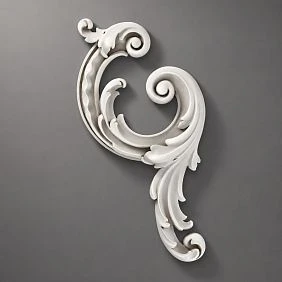
NPU-459R is precisely an asymmetrical carved decorative overlay, not a half of a mandatory pair.
First, it is important to correctly determine the type of product. NPU-459R is an asymmetrical carved decorative overlay made of polyurethane. It is not a molding, not a corner frame element, not a rosette, and not a structural part of a slat panel. It can be used as a separate ornamental accent, so the absence of NPU-459L nearby does not by itself make the composition "incomplete."
The product has one current size for the version in question:
| Parameter | NPU-459R |
|---|---|
| Product type | asymmetric carved decorative overlay |
| Size A × B × C | 159 × 84 × 13 mm |
| Material | Polyurethane |
| Current price | 880 ₽/pcs. |
| Related mirrored option | NPU-459L |
| Price of a pair at current prices | 1 760 ₽ |
If the decision is confirmed after trying it on, buying the carved decorative overlay NPU-459R makes sense precisely as one independent element, rather than as a deliberately incomplete set.
Why is this fundamental? Because in an interior composition, the number of elements should follow the architecture, not the catalog's assortment logic. The catalog must show both mirrored options so that the designer can assemble a symmetrical composition if needed. But the presence of two SKUs does not create an obligation to use both.
The same logic applies to door casings, carved furniture elements, asymmetric capitals, and decorative corners: the manufacturer provides a set of tools, and the project determines how many of them to use. If a wall has one expressive transition, one local accent can be more precise than two.
Another important point: the asymmetry of the NPU-459R itself is its artistic property. It does not have to be "corrected" by a mirrored piece. In a modern interior composition, a single asymmetric element can work intentionally: to support the movement of the eye toward the slat zone, to soften a rigid vertical boundary, to connect classical ornament with the modern rhythm of slats, or simply to create one point of decorative tension on a large smooth surface.
Therefore, the first question before purchasing should be: "what task on this wall does exactly one ornament solve?" If the answer is clear—for example, "completes the transition to the slat panel" or "creates one accent in the free field next to the slats"—then a single purchase makes sense. If there is no answer and the piece is chosen only because it feels "empty," it is better to first work out the composition without buying.




Why a one-sided slat field does not have to receive mirrored decor on the left
Slat panels create a very strong vertical structure. Even if they cover only a third of the wall, the eye perceives them as a separate architectural block. The smooth painted part next to them works differently: it is quieter, freer, and better accommodates paintings, sconces, a TV, a console, a mirror, or a local decorative overlay.
When the panels are only on the right, the wall is already divided into two unequal zones. Suppose the total wall width is 3.6 m. On the right, the slat field occupies 1.2 m, leaving 2.4 m of smooth surface on the left. This is not a symmetrical scheme of 1.8 + 1.8 m. It is deliberately offset.
Attempting to add a mirrored pair of overlays can create a new center that did not exist before. Two pieces begin to "close" the composition onto each other and force the eye to look for an axis between them. As a result, the slat zone on the right ceases to be an independent accent and starts to look like one side of an imaginary frame. Sometimes this is useful, but in the original scenario it is often the opposite: the person wanted to keep the one-sided panels and the free smooth field.
A single NPU-459R can support exactly this unevenness. It can work at the edge of the smooth zone, closer to the transition to the slats, or in another calculated place where its shape directs the gaze toward the rhythmic surface. Such a composition is perceived not as "the left piece is missing," but as one deliberate decorative gesture.
Here it is useful to separate two concepts: wall symmetry and visual balance. They are not the same thing. A wall can be asymmetric in geometry and yet perfectly balanced in mass. The slat field on the right already provides significant visual weight. On the left, there may be furniture, a painting, or a free plane. One small overlay can only fine-tune the balance, while a second one would add extra weight.
Therefore, buying a pair just for the sake of equal numbers of pieces is weak logic. It is much more useful to assess the entire set of visual masses:
-
slat field;
-
furniture against the wall;
-
lighting fixtures;
-
paintings or a mirror;
-
a doorway;
-
color accents;
-
the NPU-459R itself.
If the right side of the wall is already saturated with slats, and on the left there is large furniture or a painting, a second decorative overlay may become a third competing dominant. If, however, there are two identical empty fields on the left and right of the central furniture, then the situation changes and a mirrored pair can become logical.
For a broader understanding of material combinations, refer to the article “Slat panels for interior wall finishing and polyurethane molding decor”, but in our case the task is narrower: not how to combine categories in general, but how many specific asymmetric overlays are needed on one asymmetrical wall.
Our factory also produces:
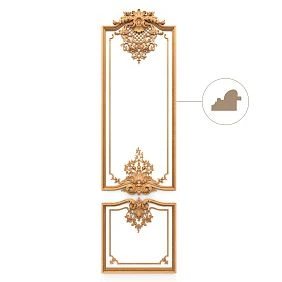
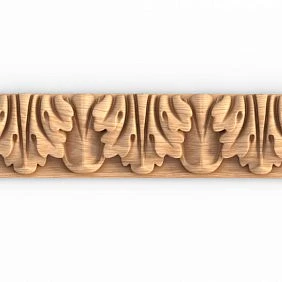
How to determine whether the wall has a real axis that requires an L/R pair
Before comparing one NPU-459R and a pair of NPU-459R + NPU-459L, you need to find the axis of the composition. This is not necessarily the geometric center of the wall. The axis can be a TV, mirror, console, sofa, bed, doorway, fireplace portal, or dining group.
If a central object exists and there are roughly equivalent fields on both sides of it, mirrored panels can be justified. In this case, L and R work as two edges of one composition. But if the slat panels are only on the right and are themselves the main vertical block, the axis often shifts toward them or disappears entirely as a symmetrical structure.
The check consists of several questions.
Get Consultation
Is there a central object that really needs to be framed?
If a mirror hangs on the smooth part of the wall centered on the console, and there are equal fields on both sides of the mirror, the pair can work. But if the mirror is shifted, with slats starting immediately on the right and a wide empty area on the left, an artificial pair will conflict with the real geometry.
Are there two identical edges?
A mirrored pair is especially convincing when there are two identical transitions: for example, a smooth panel surrounded by slats on both sides. In our scenario, the slats are only on the right, so there is no second equal transition. This is a strong argument for a single panel.
Is the decorative element repeated elsewhere?
Sometimes a pair is made not on one wall, but according to the logic of the room: one R near the right slat zone, and L on another, truly mirrored wall. Then the elements don't have to be adjacent. But that's a separate spatial composition, not an automatic purchase of two pieces for one area.
What happens if the second panel is removed?
A very useful test. Make two paper templates and first attach both. Then remove one. If the wall immediately becomes lighter and clearer, and the slat zone starts to read more confidently, then the pair was redundant. If without the second piece the composition really "falls" to one side, that's an argument for the mirrored element.
The main thing is to evaluate not the "completeness of the set," but the stability of the entire wall. In a professional composition, the absence of a symmetrical detail is not a mistake if the asymmetry is supported by other elements.
Full-size template 159 × 84 mm: mandatory check before ordering
For small decorative elements, people often consider a template unnecessary: 159 × 84 mm seems like a size that is easy to imagine. In practice, it is precisely small overlays that are most often mistakenly assessed from a photo. In the product card, the ornament is shown large, but on a wall 3–4 meters away, it can behave completely differently.
The template should reproduce the flat dimension of 159 × 84 mm. It can be made from cardboard, thick paper, or painter's tape. At the first stage, there is no need to imitate the pattern itself—it is enough to see the real scale. But to check the direction of asymmetry, it is better to print a photo of the product at an approximate scale or at least draw the direction of the main curl with an arrow.
The template helps to check four independent things.
Scale relative to the slat field
If the slat zone is 1.2 m wide, a 159 mm overlay occupies only a small fraction of its scale. This is good if a subtle transitional accent is required. But if you expected it to become a large centerpiece of the wall, a real fitting may show that the product is too delicate for that role.
Distance to the edge of the slats
You cannot automatically place the overlay "flush against" it. The slat surface has its own rhythm and shadow. If the ornament is placed too close, it may visually blend with the vertical lines. If moved too far, the connection with the slat zone disappears. The exact distance depends on the slat pitch, color, wall height, and other objects, so a universal number cannot be invented here.
Proximity to a switch, sconce, painting, or furniture
The overlay is 159 × 84 mm, which is small, but it needs visual breathing room around it. If there is already an outlet, switch, thermostat, or sconce mount nearby, the ornament can start to look like a random element squeezed between fixtures.
The need for a second piece
Make two templates of the same size. Label one as R and the other as L. First, evaluate only one. Then add the second where you think it should go. Comparison is much more useful than a theoretical debate about symmetry.
After such a trial fitting, if the single scenario is confirmed, you can order NPU-459R in polyurethane already with an understanding of its real scale on the specific wall.
The letter R does not replace checking the orientation of the ornament
Separately, a common misconception needs to be addressed: the R index cannot be mechanically translated into the instruction "place on the right." The manufacturer has related variants NPU-459R and NPU-459L, but the interior orientation depends on how you rotate the piece, where the slat field is, and which part of the ornament should face it.
Before final marking, you need to open the product page, look at the photo, and, if a drawing is available, verify the geometry. This is especially important for an asymmetric scroll: its direction is much more noticeable than that of a symmetric rosette or central overlay.
The correct sequence is as follows:
-
determine which edge of the wall needs to be emphasized;
-
look at which direction the ornament on the product image is "moving";
-
place the template in the intended position;
-
look at the composition from several points;
-
only after that decide whether R or L is suitable.
This check protects against two mistakes. The first is buying R just because the slats are on the right, although visually a mirrored curl L fits the specific edge better. The second is buying both parts "just in case," although after trying it turns out that one specific option is needed.
If you see that a mirrored ornament is required for the selected point, you can separately open NPU-459L for the mirrored composition and compare the image, rather than forming a pair automatically.
Practical example: wall 3.6 m, 1.2 m of slats on the right, 2.4 m of smooth surface on the left
Let's take a scenario that well demonstrates the meaning of a single purchase.
A wall 3.6 m wide. On the right, slat panels are located over a 1.2 m section. On the left, 2.4 m of painted wall remains. On the smooth part, there is no second slat field, meaning architecturally there is only one transition between two surface types.
In this scheme, the first mistake is mentally dividing the wall in half. The actual project already divides it in a 2:1 ratio. Therefore, a symmetrical pair relative to the geometric center of the entire wall will conflict with the finish. Even if two overlays are placed at equal distances from the center, they will not receive the same surroundings: on the right there will be an active slat texture, on the left a smooth field.
The second mistake is assuming that NPU-459R must stand exactly on the boundary of materials. Not necessarily. Sometimes it is better to shift it into the smooth part so that the ornament has its own background and visually directs the eye toward the slats. Sometimes, on the contrary, a small accent near the transition is needed. This is determined by the template.
The third mistake is adding NPU-459L on the left side only for the sake of a formal pair. Then a second ornament appears on the smooth field, which is no longer connected to the slat transition. It requires a new explanation: what does it complete, where does it lead the eye, what does it interact with? If there is no answer, the second detail is unnecessary.
For such an example, the basic basket looks like this:
1 × NPU-459R = 880 ₽.
Pair:
1 × NPU-459R + 1 × NPU-459L = 1 760 ₽.
But saving 880 ₽ is a secondary result. The main reason to choose one detail is matching the number of elements to the number of actual compositional nodes. On a wall with one transition, one accent is often enough.
If after fitting the smooth zone turns out to be too empty, that does not automatically mean NPU-459L is needed. Perhaps the emptiness should be filled with a painting, a sconce, a mirror, furniture, or remain emptiness altogether. Molded decor does not have to cure every free surface.
NPU-459R does not replace the finishing of the slat panel end: first complete the material transition itself
There is a technically important boundary between a decorative accent and the edging of a finishing material. NPU-459R is a carved overlay. It is not an end profile for a slat panel and should not be used as a way to hide a sloppy cut, base level difference, or an unfinished technical joint.
This is especially important in the "slats only on the right" scenario, because the eye naturally falls on the vertical boundary of the two surfaces. If the panel edge is uneven, has a visible substrate end, or requires a separate structural finish, a small baroque curl will not fix the problem. On the contrary, it will draw attention to the transition zone and make the defect more noticeable.
Therefore, the design order should be as follows: first ensure that the boundary between the slatted and smooth surfaces looks finished without NPU-459R, and only then decide whether an additional ornament is needed nearby.
How to distinguish a technical edge problem from a decorative task
Look at the wall without the trim template. If what bothers you is the joint line itself — its curvature, gap, uncovered end, or thickness difference — address that issue first. If the joint is neat but the transition seems too plain or you want to add a small classical detail, then NPU-459R works as intended: as decoration.
A useful test is to photograph the edge in close-up and in wide shot. The close-up assesses the quality of the finish. The wide shot assesses the composition. The trim should address the wide-shot problem, not mask a close-up defect.
Why this also affects the quantity
If the buyer mistakenly perceives NPU-459R as an "edge finish," they may decide that the opposite side also needs the same element, even though there is no second edge of the slats there at all. This creates an artificial pair. When the technical joint is resolved separately, it becomes clear: the trim is needed only where there is a decorative reason.
This principle is especially useful for partial wall cladding. The slatted field may end near a door, furniture, an internal corner, or simply on a smooth plane. In each case, the way to structurally finish the material is determined by the panel system itself and the project. NPU-459R should not substitute for this task.
What to check on the finished transition
Before fitting the trim, evaluate:
-
the evenness of the vertical boundary;
-
absence of visible unfinished ends;
-
stability of the painted surface nearby;
-
absence of a random gap that is being covered with decor;
-
visual compatibility of the thicknesses of two surfaces;
-
quality of the line from floor to ceiling.
If these points raise no questions, you can move on to decorative fitting. Then the 159 × 84 mm template is evaluated honestly — not as a "patch," but as a separate ornamental accent.
When the best option is not to place an overlay at the very edge at all
Sometimes after high-quality finishing of the slat field, it turns out that the material transition itself is expressive enough. The vertical line already creates an architectural accent, and NPU-459R next to it becomes redundant. Then the ornament can either be moved further into the smooth field, if there is a separate task there, or be abandoned.
This is an important commercial conclusion: not every finished edge needs additional decor. A well-executed boundary can be a standalone design technique. One NPU-459R is justified only when it adds a new compositional function, rather than trying to mask a technical flaw.
Where exactly to place one overlay relative to the edge of the slats
There is no universal distance in millimeters here, and there shouldn't be. The decision is influenced by the spacing of the slats, the width of the lamellas, the color difference between materials, the wall height, furniture, and lighting. But there is a clear verification system.
Do not place the ornament in a spot where its contour visually "sticks" to the slats
If the edge of the overlay almost touches the vertical relief, small leaves and curls can get lost in the shadows of the slats. Between two different types of relief, there needs to be a section where the eye can separate them.
Too much distance also weakens the meaning
If a single NPU-459R is far away in the center of a smooth wall, it ceases to be perceived as part of the transition and becomes an independent ornament. This can be intentional, but then the article is solving a different task.
Check the position relative to furniture, not just the wall
For example, under a smooth field there is a console 1.4 m wide. Then the overlay should be aligned both with the edge of the slats and with the composition of the console. If it ends up directly above one leg or almost touches the edge of the mirror, the position may look random.
Consider the eye level
The 159 × 84 mm overlay is relatively compact. If you raise it too high on a large wall, it can get lost. If you lower it too much above furniture, you get the feeling of a furniture appliqué accidentally glued to the wall. A trial fitting from the actual viewing point is needed, not just marking with a tape measure.
Check the frontal and diagonal angles
From the front, the composition may look correct, but when entering the room at an angle, the overlay and slats can overlap each other. This is especially noticeable with side lighting.
A useful procedure: attach the template with painter's tape, take photos from three points — from the entrance, from the center of the room, and from the main seating area — and compare. Photos help notice imbalance that the eye quickly gets used to in the room.
When NPU-459L is truly needed: five signs of a real mirror composition
A single NPU-459R is not always suitable. There are situations where the L/R pair is truly stronger. It's important only that the decision comes from the project, not from catalog habit.
1. The wall has two equally significant edges
For example, a smooth central panel is located between two slatted fields. Then the left and right boundaries have the same function. Mirror overlays can complete them as a pair.
2. A central object requires framing
A large mirror, panel, or console is positioned strictly on the axis, with equal fields remaining on the sides. In this case, asymmetric L/R scrolls can work as two ornaments directed toward or away from the center — after checking the orientation.
3. A strict mirror system is already built in the room
For example, symmetrical sconces, identical cabinets, paired doorways. One overlay in such an environment may look like a missing half. Then the pair supports the existing system rather than imposing a new one.
4. There is a second repeating node on the other wall
In some projects, L and R are not adjacent, but they repeat two mirrored sections of space. Then buying a pair is justified at the room level.
5. The template shows a real visual imbalance without the second piece
This is the most honest criterion. If one template looks randomly lonely, and with a mirrored second element the wall becomes cohesive, then a pair is needed. But first make sure the reason is the composition, not the unfamiliarity of asymmetry.
In all other cases, the presence of NPU-459L nearby in the assortment is not an argument in itself.
One R, one L, or a pair: decision table before purchase
| Situation on the wall | What to check | Reasonable purchase in advance |
| Slat panels only on the right, one transition to a smooth wall | which pattern best guides the eye toward the transition | one R or one L after checking orientation |
| Slat panels with a smooth central field on both sides | Are both edges equivalent | Mirror pair L/R |
| One slat zone and large furniture on the smooth part | Balance with furniture, not wall symmetry | Usually one overlay |
| Central mirror and two equal free fields | Is decorative framing required | Possible L/R |
| Overlay is needed only because the wall seems empty | Is there even a task for the decor | Perhaps, not buying any |
| The second element lands next to the switch or sconce | Does it create a visual conflict | One overlay |
| Two mirrored nodes repeat in the room | Does their role match | The pair can be used separately |
This table is more important than the simple recommendation "R on the right, L on the left," because such a mechanical principle ignores the real interior architecture.
A free smooth field is not a "void" that must necessarily be filled symmetrically
One of the most useful principles for this topic is to stop considering the smooth part of the wall as an unfilled remainder after slatted panels. If there is already an active rhythmic surface on the right, the left may need visual calm. A free field does its job just like a pause in music: it allows the adjacent relief, furniture, and light to be read without mixing everything into one decorative mass.
This is especially important for a wall where slat panels occupy only one third. The panels already form a dense vertical texture. If you automatically place two mirror overlays, a painting, a sconce, a console, and several other small elements on the remaining two thirds, the smooth surface will cease to be a background. It will turn into a second active zone competing with the slats.
One NPU-459R can be appropriate precisely because it does not take up the entire free field. It creates a single point, after which a sufficient amount of calm plane remains. This technique is especially useful if the wall is visible from an adjacent room or from a long corridor: at a distance, the overall distribution of masses matters more than the number of decorative details.
How to check whether empty space is useful
Take a photo of the wall without the overlay template and mentally divide it into active and calm areas. Active areas include slats, furniture, lighting fixtures, paintings, doors, and other contrasting objects. The smooth painted surface between them is not a mistake. It creates background and distances.
Now add one NPU-459R template. If it helps direct the gaze toward the slat zone but does not destroy the free background, the composition gains a new function. Add a second template. If after that the eye starts darting between two small ornaments and the slats, and the free field disappears, then the second detail does not enhance the wall.
It is useful to evaluate not the number of empty centimeters, but the share of visually calm surface. A wall can have two meters of free space and still be perfectly balanced. Another interior may have only 60–80 cm of free area, which is already overloaded by its proximity to a door and a sconce. Therefore, the formula "a lot of empty wall = two elements needed" does not work.
Free space is especially important near furniture
If a sofa, console, or low cabinet stands on the smooth part, a horizontal and vertical dialogue already exists between the furniture and the slat zone. A small overlay can complete it, while a mirrored pair may start to argue with the furniture axis.
For example, a long console is shifted to the left, and the slats are on the right. If you place two equally significant decorative points above the console, they can visually center it relative to the wall, even though the furniture itself is deliberately shifted. One overlay at the transition to the slats preserves the original logic.
Emptiness can be stronger than a second ornament
The most useful test is to compare three options in a photo: without an overlay, with one, and with two. If one element gives a clear result, while the second only makes the wall "richer" but not clearer, it is better to settle on one. Decorative richness in itself does not equal compositional quality.
Therefore, in a scenario with one-sided slats, the question "why is there nothing on the left?" does not always require an answer in the form of NPU-459L. Sometimes the correct answer is because there should be a calm field on the left.
How to combine a small baroque curl with a modern slatted surface
At first glance, slatted panels and carved baroque ornament belong to different stylistic languages. A slatted surface is associated with modern geometry and rhythm, while a curl is associated with classical decorative pattern. But it is precisely the contrast that can be interesting if it is dosed.
One NPU-459R in such a combination often works better than a pair precisely because it does not turn a modern wall into a classical framed composition. It adds a small historical note but leaves the slatted architecture as the main element.
This works especially well in transitional styles: modern classic, eclecticism, soft art deco, interiors with classical furniture against a modern background. Here, one decorative element can connect furniture ornament, brass hardware, or a stucco cornice with a slatted wall.
If you add two, four, or six asymmetrical overlays without an overall system, the contrast quickly turns into stylistic noise. Therefore, the quantity should be minimally necessary.
Color also affects perception. If NPU-459R is painted in the color of the smooth wall, it reads through light and shadow and remains delicate. If you make it contrasting, a small detail turns into an independent graphic sign. For a wall that already has active slats, a contrasting option requires especially careful fitting.
If after working with the template you want to compare other shapes and scales, it is better not to automatically buy a second piece, but Choose decorative polyurethane overlays and check whether a different geometry suits the single accent.
Light and Shadow: Why a 13 mm Relief Should Be Evaluated in the Evening
The thickness of NPU-459R per the card is 13 mm. For a small overlay, this means a noticeable relief that will look different under frontal and side lighting.
During the day, in diffused light, the ornament may appear soft. In the evening, wall sconces or track lighting can cast a sharper shadow, making the detail more visible. Therefore, the decision on quantity should not be made only during the day.
If the slats on the right already create a strong vertical light-and-shadow pattern, additional relief near them should be dosed. One overlay creates a local focal point. A pair creates two points and may compete with the rhythm of the slats.
Check three modes:
-
daylight;
-
main ceiling light;
-
local evening lighting that is actually used in the room.
If in one of the modes the second pattern looks particularly heavy, that is an argument against the pair. If, on the contrary, the two pieces beautifully tie together the central composition, the pair gains additional justification.
Installation on an Already Painted Wall: What to Check Before Purchase, Not After
If the smooth part of the wall is already painted, a decorative overlay is often chosen precisely as a final addition after renovation. This is convenient, but it means that the base and finish already exist and need to be taken into account.
The surface must be strong, clean, and suitable for the chosen mounting compound. You cannot assume that the decorative element holds 'to the paint': if the paint itself is poorly adhered to the base, the overlay will hold together with the weak layer of coating.
Before installation, it is useful to check:
-
Does the surface chalk;
-
whether there are any detachments;
-
does the element fall on the joint of different bases;
-
can excess glue be carefully removed;
-
how will local touch-up painting be done after installation.
For an already finished wall, the accuracy of marking is especially important. While only a paper template exists, it can be moved dozens of times. After gluing, correcting the position is already associated with the risk of damaging the paint.
Therefore, "try on once and glue" is a bad strategy. It is better to leave the template on the wall for at least a few hours, look at it under different lighting, and ask another person to evaluate the composition from the doorway.
If the project develops further and several types of polyurethane decor are required, you can You can buy ready-made stucco matching the Baroque style. Calculate the quantity: linear meters of cornices and moldings, number of rosettes, pilasters, consoles, corner elements. Add a ten to fifteen percent allowance for trimming. through the common section, but for this wall it is more useful to first complete the decision on one NPU-459R, and only then add other elements.
How to understand whether NPU-459R is too small for a large smooth surface
The size of 159 × 84 mm is compact. On a 3.6 m wall, such an overlay will not become an architectural center by itself. This needs to be understood before purchasing.
If the task is to subtly mark the transition to the slats, the size can be very successful. If the task is to fill a huge empty wall, one NPU-459R, most likely, will not solve the problem. In this case, trying to add a mirror L may also not help: two small details remain two small details.
One must distinguish between a lack of quantity and a lack of scale. These are different problems.
Signs that the issue is specifically about scale:
-
even two patterns look lost;
-
the viewing distance is large, and the ornament is barely readable;
-
there is large furniture nearby that visually overwhelms the overlay;
-
the slat zone occupies a large area and has a very active texture;
-
the decor is expected to play the role of a central accent.
In such a case, the correct alternative is not to automatically buy L, but to look at larger decorative elements or a completely different system: molding, panel, light, painting.
Signs that one element is sufficient:
-
its task is local;
-
it is in the zone of natural attention;
-
there are no competing small details nearby;
-
the rack transition reads more clearly after adding the template;
-
without the second element, the composition does not seem unfinished.
This test helps avoid turning a question of quantity into an attempt to compensate for an incorrect scale.
When it is better to refuse both R and L
A commercially useful article should allow for the option of "not buying." NPU-459R is not needed if it does not solve a specific problem.
The rack wall is already expressive enough
If the panels have a beautiful texture, backlighting, or a contrasting color, additional ornamentation may only complicate the composition.
There is already a large painting or mirror on the smooth part
In this case, the decorative overlay can compete with the main object. Especially if it ends up next to the frame and creates an unclear second decoration system.
The interior style is extremely minimalist
A baroque curl can look alien if
Scenario 2. Central panel between two slat fields — a pair
The slats are on both the left and right, with a smooth zone with a mirror in the middle. The two edges are identical in function. Here, L/R can form a deliberate mirrored pair. The reason for buying two pieces is not to denote SKU, but the presence of two equivalent boundaries.
Scenario 3. One-sided slats, but the overlay conflicts with the sconce — none
The slats are on the right, and there are already a sconce and a painting on the smooth wall. The only free spot for NPU-459R turns out to be too close to the switch and the light fixture. A second overlay does not solve the problem. Here, the correct outcome is to buy neither R nor L, because the composition is already saturated.
These three scenarios show the main formula: the quantity is determined not by the wall length or price, but by the number of independent places where the decor actually performs a function.
Should a single NPU-459R be repeated on another wall of the room
There is another reason why a buyer sometimes mistakenly adds NPU-459L: it seems to them that a single decorative element must receive a "response." But this response does not necessarily have to be on the same wall, and it does not necessarily have to be mirrored.
The interior is perceived not as a single frame, but as a sequence of angles. A person enters the room, walks past one wall, sees the opposite one, sits on the sofa, and gets a different viewing angle. Therefore, a single accent can be repeated on another plane of the room if there is an independent compositional node there.
When spatial repetition is appropriate
Suppose on the right side of the main wall there is a slat zone and one NPU-459R at its edge. On the opposite wall there is a doorway with the same direction of ornament movement or a small smooth niche. If the second overlay helps connect these two points as one moves through the room, the repetition can be meaningful.
In this case, the second element is chosen not because the first one is "lonely," but because a second real node has emerged in the room. Sometimes an NPU-459R is needed there, sometimes an NPU-459L, sometimes other decor. The mirroring of SKUs is secondary compared to spatial logic.
When repetition turns into decorative scattering
If you start repeating a small curl on every free wall, it quickly loses value. The eye stops perceiving it as an accent and begins to see a decorative pattern without an obvious reason. This is especially noticeable near slat panels: strong vertical texture requires rarer, not more frequent, small details.
The check is simple: for each additional place, formulate a separate function. For example:
-
completes the transition to the slats;
-
supports the door axis;
-
connects two mirrored niches;
-
completes the furniture composition.
If for the second overlay the function sounds only as "to repeat the first one," that is a weak reason for purchase.
Identical repetition and a mirror pair are different techniques.
Two NPU-459R units placed in different parts of the room create repetition in one direction. NPU-459R and NPU-459L create a mirror connection. These compositional mechanics cannot be mixed.
If you need to emphasize movement in one direction—for example, from the entrance to the slat wall—identical repetition may theoretically be more logical than mirroring. If you need to frame two opposite edges of one center, a mirror pair is stronger. Therefore, before ordering the second piece, first determine not the article number, but the type of connection between the two points.
How to check repetition without buying
Take a photo of the first wall with the template and a separate photo of the second intended location. Then evaluate them in sequence, like two frames of one interior. If the ornament helps connect the space, the second element may be justified. If the images look like two independent decorative inserts, it is better to keep just one.
This approach is especially useful for an open kitchen-living room, a long hallway, or a room with multiple entrances, where one wall is never perceived in isolation.
Mistakes that lead to buying an extra NPU-459L
Mistake: treating L/R as a ready-made set.
Why it occurs: two mirror-image SKUs exist side by side, and the buyer perceives them as two halves of one product.
Consequence: the second overlay appears without a compositional purpose.
Check: cover the L image and evaluate the wall with only the R template. If nothing is 'lost', the pair is not necessary.
How to avoid: form the order based on the number of actual accent points.
Mistake: trying to fix an asymmetrical wall with symmetrical decor
Why it occurs: symmetry seems safer.
Consequence: the decor starts to conflict with one-sided slats and creates a fictitious center.
Check: compare two photos of the wall — with one and with two templates.
How to avoid: accept the original asymmetry as part of the architecture.
Mistake: choosing R only because the panels are on the right
Why it occurs: the letter designation is mistaken for an installation instruction.
Consequence: the direction of the curl may turn out to be not the one visually needed for the transition.
Check: look at the image/drawing of R and L.
How to avoid: choose the option based on the actual direction of the ornament.
Mistake: adding a second small overlay when the problem is in scale
Why it occurs: it seems that "one is not enough — so two are needed."
Consequence: instead of one weak accent, two weak accents appear.
Check: look at templates from the far point of the room.
How to avoid: if the scale is insufficient, move to a larger element or another decor system.
Mistake: not taking evening light into account
Why it happens: the layout is done during the day.
Consequence: two overlays in the evening create extra active light and shadow near the slats.
Check: leave the templates until the evening.
How to avoid: make the final decision in several lighting modes.
Practical algorithm: how to decide in 12 steps whether to buy one NPU-459R or a pair
-
Take a photo of the entire wall. Do not evaluate only the area near the slats.
-
Mark the actual boundaries of the slat field. Note that the panels are indeed only on one side.
-
Find the main axis of the room or wall. It could be furniture, a mirror, a TV, or an asymmetrical composition without a central axis.
-
Count the actual decorative nodes. One transition to the slats is not two edges.
-
Make a template of 159 × 84 mm. Do not reduce it for convenience.
-
Check the direction of the ornament. Do not make conclusions based only on the letter R.
-
Try on one template. Find a position where it is actually connected to the slat zone.
-
Check the furniture and electrical fixtures. Make sure there is no switch, sconce, picture, or furniture edge nearby creating a conflict.
-
Add a second mirrored template only for comparison. Do not assume it must stay.
-
Look from several viewpoints and in the evening. Compare balance, shadows, and direction of gaze.
-
Determine the final basket. One R, one L, a pair, or none of them.
-
After confirming the composition, place the order. If one asymmetrical accent is needed, do not increase the set for the sake of formal symmetry.
If a pair is not needed, the final product cost is 880 ₽. If the project requires a mirrored solution, it is 1,760 ₽ for R + L at current prices. The arithmetic is simple; the harder and more important part is correctly determining the composition of the order itself.
What to do if slat panels are still being selected along with the overlay
Sometimes the situation is the opposite: the idea of an asymmetrical wall already exists, but the panels themselves have not been ordered yet. Then the overlay cannot be chosen in isolation from the scale of the future slat field.
First, you need to determine:
-
the width of the panel or modular field;
-
the material and color;
-
the direction of the slats;
-
the height of the finish;
-
the position of the edge relative to furniture and doors.
Only after this is the real role of the NPU-459R clear. If the slat field turns out to be narrower or wider than the initial sketch, the position of the ornament may also change.
For such a scenario, the logical next step is buy slat panels for walls for interior finishing after calculating their actual area, and to try on the overlay relative to the precise boundary of the future finish.
This is an important order: first the architecture of the large surface, then the small decorative accent. Otherwise, there is a risk of adjusting the entire wall to an already purchased part costing 880 ₽.
Commercial choice: one piece, a pair, or another overlay
Before adding a product to the cart, it is useful to formulate the decision in one sentence.
One NPU-459R — if there is one local node on the wall, the asymmetry is intentional, and the template shows that an additional mirror piece only weighs down the composition.
One NPU-459L — if its ornament direction better matches the actual edge of the slat field. Correctness is determined by the image and fitting, not by the name of the wall side.
A pair of NPU-459R + NPU-459L — if there are two equivalent edges or a central symmetrical composition that really needs to be framed.
Another overlay — if 159 × 84 mm is too small, the pattern does not support the style, or the available space requires a different geometry. Then it is more reasonable Buy decorative polyurethane overlays after a new fitting, rather than duplicating an unsuitable element.
If the idea of a directional curl itself is suitable, but a different size or plasticity is needed, you can separately compare asymmetric polyurethane overlays and go through a full-size fitting again. This is more useful than turning NPU-459R and NPU-459L into a mandatory set just to fill the wall.
Not a single one — if the slatted surface, furniture, and lighting already provide sufficient composition.
This approach makes the purchase deliberate. The main commercial result of the article is not to sell a person two items instead of one, but to help order exactly as much decor as the project actually needs.
Bottom line: an asymmetrical wall does not automatically require a symmetrical purchase
If slatted panels are located only on the right, and a smooth painted surface remains on the left, the original wall architecture is already built on asymmetry. In such a composition, one NPU-459R 159 × 84 × 13 mm can be a completely finished purchase. It is not a "half that must necessarily be complemented with NPU-459L."
One piece is especially logical when there is only one transition to the slatted zone on the wall, there is no central object requiring mirror framing, and a second template creates artificial symmetry. At the current price, such an order amounts to 880 ₽.
The L/R pair is justified in another project: two equivalent edges, a symmetrical central panel, mirrored niches, or another real repetition of the compositional node. Then the cost of the pair is 1,760 ₽, and both elements perform a clear function.
Before ordering, make a template 159 × 84 mm, check the direction of the ornament from the card or drawing, evaluate one and two elements from several points, look at the evening light, and take into account furniture, switches, sconces, and paintings. If a single NPU-459R gathers the transition to the slats and does not require a mirror continuation, there is no need to buy a second piece just for the letter L.
The main rule here is simple: asymmetry must be either deliberate or corrected by architecture — but not by the catalog. First, decide how many accent points there are on the wall. Only then form the cart.
FAQ
Can NPU-459R be used separately if there is no NPU-459L in the room at all?
Yes. Independent use of an asymmetrical ornament is acceptable if it solves a local compositional task. The presence of a mirror SKU does not turn the products into an indivisible set.
Do you need to buy two NPU-459R instead of a pair of L/R if you want to repeat the same pattern?
Only if you specifically need a repeat, not a mirrored composition. Two identically oriented elements create a different rhythm than L/R. Before such an order, it is useful to make two identical paper templates and separately compare them with the mirrored version.
Can the overlay be rotated on the wall in the other direction?
The physical possibility of rotation and artistic appropriateness are different questions. Before installation, you need to check the image and geometry of the product, and then assess how the ornament reads in the chosen position. You should not determine the permissible orientation only from the designation A × B × C or the letter R.
Will one NPU-459R be suitable for a wall wider than 4 meters?
The width of the wall itself does not determine the answer. If the overlay solves a local task near the edge of the slat field, it can work on a large wall. If it is expected to serve as the central decor of the entire plane, the size of 159 × 84 mm may be insufficient — this needs to be checked with a template from a distant viewing point.
What is better: an overlay in the color of the wall or a contrasting one?
For a wall with active slat panels, it is safer to first check the option in the color of the smooth surface: the ornament reads due to the relief but does not turn into a separate color spot. Contrast is appropriate if it is supported by other interior details.
Is NPU-459L needed if there is the same cabinet to the left of the wall as on the right?
Not necessarily. Paired furniture can create a prerequisite for symmetry, but other elements need to be checked as well: the slat field, lighting, paintings, openings. If the finish itself remains one-sided, one symmetrical furniture pair does not automatically require two overlays.
Can I first buy one NPU-459R and then add L later if needed?
Compositionally, this is a reasonable approach if timelines and product availability allow. But it's better to make two templates before purchasing: this way you'll see both scenarios in advance and avoid a repeat delivery just to test the idea.
What to do if R doesn't fit the edge of the slats in shape, but L does?
Choose L. In this task, the real orientation of the ornament in the composition matters, not the coincidence of the letter R with the word "right." Compare both cards and use the option that works better visually.
Can NPU-459R be placed directly on a slat panel?
This article discusses the overlay on a smooth part of the wall next to the slat area. Mounting directly on a textured slat surface is a different technical task: you need to check the support area, the specific panel geometry, and the fastening method. Recommendations for a flat wall cannot be automatically transferred to a textured surface.
If one NPU-459R is not enough, is it mandatory to add exactly NPU-459L?
No. A lack of visual scale is not always solved by increasing quantity. Perhaps a larger decorative element, molding, painting, lamp, or another compositional system is needed.