Article Contents:
- What is confirmed about NPU-113
- Why this article does not repeat materials about slatted TV stand facades
- First, determine the role of the stand: support the wall or calm it down
- The stand as a continuation of the wall
- The stand as a calm base
- The stand as neutral furniture
- Slightly above center
- Slightly below center
- Handle centered on the facade
- Handle near the top edge
- Vertical handle at the edge
- No handles
- In the color of the facade
- In the color of the slats
- In the color of the hardware
- Contrast metal or gold
- Painted MDF
- Laminated board
- Veneer and wood
- Acrylic and plastic
- Mistake 1. Buying four overlays just because there are four facades
- Mistake 2. Evaluating NPU-113 only by the product card
- Error 3. Place decor in the center of push-to-open
- Error 4. Ignore handles
- Error 5. Make four independent markings
- Error 6. Rotate the ornament horizontally just for a wide facade
- Error 7. Choose glue based on advice "suitable for polyurethane" without checking the facade
- Error 8. Make NPU too contrasting
- Through the cabinet material
- Can NPU-113 be installed only on the outer facades?
- Is NPU-113 suitable for drawers?
- Can NPU-113 be glued onto film MDF?
- If the facades open downward, does the 8 mm thickness interfere?
- Can two NPUs be made in a different color, leaving the outer facades empty?
- Is a molding around NPU-113 required?
- Can four NPU-113s be used on a cabinet 2400 mm long?
- What to do if NPU-113 is liked, but the facades already have routing?
- Can NPU-113 be installed on the cabinet while leaving the slatted wall without other stucco decor?
- Where can I see other furniture overlays?
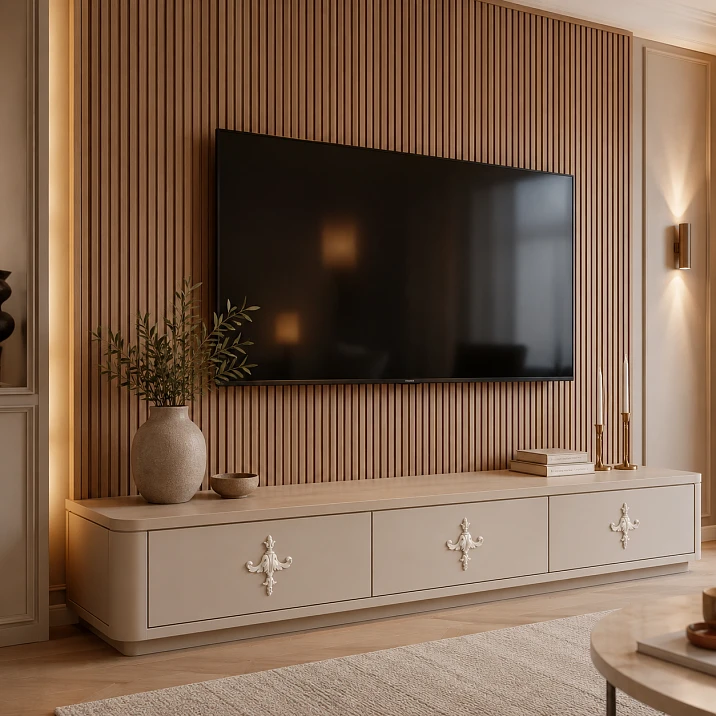
A slatted TV wall already gives the room a strong vertical rhythm. Against this backdrop, a long smooth cabinet under the TV may look too simple: four identical fronts form a calm horizontal strip, while all the texture and depth remain only on the wall.
The most obvious reaction is to continue the slats onto the furniture. But this is not the only option. If you don't want to repeat the lamellas on the cabinet, you can keep the fronts smooth and add local furniture decor — carved decorative overlays NPU-113 made of polyurethane.
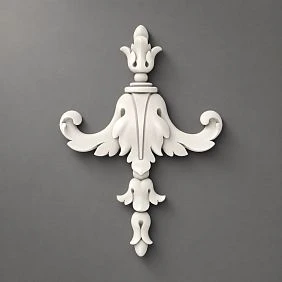
The NPU-113 has a compact size of 65 × 93 × 8 mm, suitable for such a task. On the official STAVROS product page, this option is listed as polyurethane, and the description directly includes furniture fronts, cabinets, and dressers among the application scenarios. Official STAVROS materials also confirm the orientation: 65 mm is the width, 93 mm is the height, meaning it is a small vertically oriented accent.
For a TV cabinet with four fronts, there are three reasonable outcomes:
-
4 NPU-113 — one for each front, if you need a rhythmic, symmetrical bottom line;
-
2 NPU-113 — only on the central pair, if the slatted wall is already active and the furniture should remain calmer;
-
0 NPU-113 — if the overlays get lost on large fronts, conflict with handles, make the cabinet too fragmented, or do not fit the style.
That is, the article should not pre-sell four pieces.
The correct answer depends on the actual size of one front, the opening mechanism, the distance between doors, the position of the TV, the pattern of the slats, and the role the lower zone of the TV wall should play.
Best course of action:
measure one facade → make a template 65 × 93 mm → check one element → compare schemes 2 and 4 → check opening and light → only then place the order.
What is confirmed for NPU-113
NPU-113 is a carved decorative polyurethane overlay. Only one specific size is used for the article.
| Parameter | NPU-113 |
|---|---|
| Product type | Carved decorative overlay |
| Material | Polyurethane |
| Width | 65 мм |
| Height | 93 мм |
| Thickness / relief | 8 мм |
| Quantity for checking | 1 template |
| Commercial variants of the article | 0, 2, or 4 pcs. |
| Application per card | furniture facades, cabinets, dressers, doors, walls |
At the time of verification, the official STAVROS listing shows a price of 750 ₽ for the 65 × 93 × 8 mm option. Since the online store price may change, it is worth checking again in the listing before ordering.
After fitting, you can buy carved decorative overlay NPU-113 made of polyurethane.
Dimensions matter here not just as a reference. The compact 65 × 93 mm means that NPU-113 does not try to cover a large area of the facade. It is a point vertical accent, not a panel or a full frame system.
The 8 mm thickness also affects the decision: the overlay protrudes above the smooth surface. Therefore, it needs to be checked not only frontally, but also when opening the door, near the handle, against the edge of the adjacent facade, and in the area of constant contact.




Why this article does not repeat the materials about slatted facades of the TV cabinet
STAVROS already has articles where the TV cabinet is suggested to be styled with slatted panels or individual slats. The logic there is:
slatted wall → repeat the same rhythm on the furniture → get a cohesive system.
This is a good approach, but the new task is the opposite:
slatted wall is already active enough → you don't want to make the cabinet slatted again → the facades remain smooth → the local NPU-113 is checked.
The difference is not cosmetic.
Slat cladding changes the entire facade surface, its thickness, rhythm, cleaning, and visual mass.
One NPU-113 changes only one point on the facade.
Therefore, the article addresses a different commercial question: not "which slats to choose for a cabinet," but "how many small polyurethane overlays are needed — 2, 4, or none."
For comparing approaches, the existing STAVROS article is useful about slat panels for cabinets and furniture. It separately examines a TV cabinet with slat facades; here — smooth facades with local stucco decor.
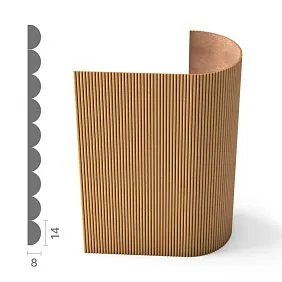
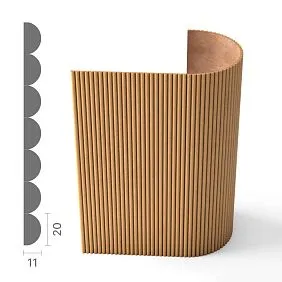
Our factory also produces:
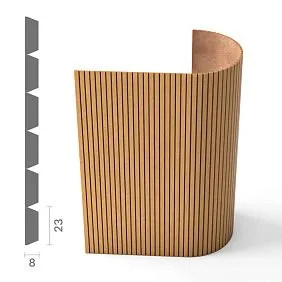
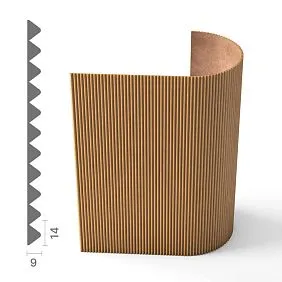
First, determine the cabinet's role: to support the wall or to calm it
In the TV area, there are two large objects:
-
TV;
-
slat wall.
The cabinet is the third layer.
If you make it active too, the composition may become overloaded.
Therefore, before overlays, you need to answer one question:
Should the cabinet repeat the decorative language of the wall or become a calm base under it?
Get Consultation
Cabinet as a continuation of the wall
Suitable if:
-
facades are large;
-
the interior leans toward neoclassicism or eclecticism;
-
there is little decor on the wall besides slats;
-
the TV is visually heavy;
-
you want to make the bottom line rhythmic.
Then the 4 × NPU-113 scheme looks logical: each facade gets the same vertical accent.
Cabinet as a calm base
Suitable if:
-
the slatted wall takes up a large area;
-
there is backlighting;
-
the facades are narrow;
-
the TV is large;
-
nearby there is decor, speakers, or display cases;
-
the interior is modern.
Then two elements on the central facades can provide enough connection without full repetition.
Cabinet as neutral furniture
If the cabinet itself is high-quality, proportionate, and matches the wall well in color, a decorative overlay may not be needed at all.
This is the third option that must be seen on the layout.
NPU-113 scale on the facade: width, height, and real free margins
For a four-door cabinet, you cannot start with a total width of 1800–2200 mm.
You need to first calculate the net area of one facade.
Assume the cabinet has four identical doors.
If the total width is 2000 mm, that does not mean each facade is exactly 500 mm. There are side panels, technical gaps, and internal sections.
Therefore, measure the actual door:
-
width
F; -
height
H; -
distance to the handle;
-
indent from the top and bottom edges;
-
width of the inter-facade gap;
-
presence of milling;
-
actual flat mounting area.
NPU-113 occupies 65 × 93 mm.
If it is centered on a clean facade:
side margin = (F − 65) / 2;
top and bottom margin = (H − 93) / 2.
This is not an instruction to “place only in the center,” but a first control layout.
For example, a facade of 450 × 320 mm:
-
in width remains
450 − 65 = 385 mm; -
when centered — 192.5 mm on the left and right;
-
in height remains
320 − 93 = 227 mm; -
when centered — 113.5 mm on the top and bottom.
That is, the overlay itself is physically very compact relative to the facade.
Next, the question is compositional: whether it is too compact.
The facade size changes the character of NPU-113
The same overlay reads differently on facades of 250, 400, and 600 mm.
| Front width | Share of NPU-113 by width | How to perceive |
| 220 мм | about 30% | noticeable central decor |
| 300 мм | about 22% | confident compact accent |
| 400 мм | about 16% | small element |
| 500 мм | 13% | local detail |
| 600 мм | about 11% | may get lost without anchoring |
The table does not set a norm.
It shows the scale.
On the narrow door, NPU-113 becomes a noticeable figure.
On the wide one — rather a "sign" in the center.
If the cabinet facades are wide and low, one vertical element 65 × 93 mm may seem too small. Then you shouldn't automatically buy four pieces just for symmetry.
First, you need to decide whether a different scale of decor is needed.
Why four NPU-113s are not always better than two
Four identical facades naturally provoke the scheme:
1 facade = 1 overlay.
Compositionally, this is clear.
But nearby there is already a slatted wall with a frequent vertical pattern.
If you also place four vertical ornamental points on the cabinet, the bottom line starts to fragment:
slats → TV → four facades → four overlays.
Instead of a calm base, another rhythm appears.
The scheme with two NPU-113 works differently.
If you decorate only the central pair of facades:
-
the edges of the cabinet remain calm;
-
the decor is gathered under the TV;
-
the central axis of the TV zone becomes stronger;
-
the amount of ornament is reduced by half.
But the scheme has a risk: two central elements may look like "unfinished four" if the facades are completely identical and not otherwise separated by role.
Therefore, you cannot decide only by quantity.
You need to compare the full facade composition.
Scheme for four facades: when repetition really works
Four identical NPU-113 can look convincing if the entire cabinet is built as a rhythmic system.
For example:
-
four facades of equal width;
-
identical gaps;
-
same height;
-
identical opening system;
-
the TV is centered on the cabinet;
-
the slatted wall is symmetrical relative to the screen.
Then one overlay on each facade creates a clear second rhythm.
The slats on the wall provide a frequent vertical rhythm.
NPU-113 provide a rarer rhythm — just four decorative points.
Two levels can work together if the overlays are not too contrasting.
This looks especially good when the NPU is painted in the color of the cabinet. Then the repetition is read through shadow and relief, rather than four bright spots.
The four-element scheme works worse if:
-
facades of different widths;
-
one section is open;
-
the outer doors are smaller than the central ones;
-
the TV is shifted;
-
there are large handles on the facades;
-
the slatted wall already has lighting and moldings;
-
the cabinet is very low.
In such cases, "one per door" becomes a mechanical rule without a compositional reason.
Scheme for two central facades: when it looks intentional
Two elements make sense if the central pair of facades is indeed perceived as a separate block.
For example:
-
under the TV there are two central doors;
-
on the edges — drawers or open sections;
-
the outer facades differ in material;
-
the center of the cabinet coincides with the TV axis;
-
the center is highlighted with color or handles.
Then NPU-113 reinforces the existing structure.
If all four facades are absolutely identical, the 2+0 scheme may require additional verification. A paper mockup helps here: the overlays are temporarily placed only on the central doors and the cabinet is viewed from the TV viewing distance.
If the central pair begins to be perceived as a separate decorative block — the scheme works.
If it feels like the outer doors simply "forgot the decor," it's better to either switch to four or abandon the repetition altogether.
The paper template should not be a square, but a real vertical silhouette.
For NPU-113, it's especially important not to just cut out a 65 × 93 mm rectangle and end the fitting there.
The rectangle only shows the overall dimensions.
The ornament inside it visually takes up less area.
It's better to use the product card and the drawing to make an approximate silhouette of the overlay.
The procedure is as follows:
-
print NPU-113 at 1:1 scale;
-
cut along the outer contour;
-
attach to the facade with painter's tape;
-
look at it from the front;
-
open the door;
-
check the side view;
-
repeat on two and four facades.
If it is not possible to print the exact silhouette, you can make two layers:
-
bottom rectangle 65 × 93 mm;
-
draw a conditional outline of the ornament on top of it.
This will show that most of the overall rectangle remains as "air," and the decorative mass is smaller.
The geometric center of the facade is only a starting point
If the overlay is placed in the mathematical center of each facade, the composition will be very regular.
But the TV cabinet often has other horizontal reference points:
-
handles;
-
top edge;
-
decorative countertop;
-
base;
-
legs;
-
bottom edge of the TV;
-
soundbar;
-
open shelves.
Therefore, after the first central layout, it is worth checking two more positions.
Slightly above center
May be useful if the facade is tall and the cabinet is low.
This way, the overlay visually moves closer to the TV and better connects the lower furniture strip with the screen.
Slightly below center
Works less often, but may be justified if the handles are on top and the upper area is already occupied.
The main thing is not to move the NPU by 10 mm without an idea.
First, determine the semantic reference.
Handles, push-to-open, and opening: where the decorative trim should not interfere
On a smooth TV cabinet, handles are often the only decoration.
If adding NPU-113, you need to decide who is in charge.
Handle centered on the facade
The most difficult situation.
The central handle and central NPU compete for the same spot.
Options:
-
NPU above the handle;
-
NPU below;
-
abandon the NPU;
-
replace the handle with a more discreet one;
-
switch to push-to-open.
You can't just "shift the panel slightly to the side" if the entire piece of furniture is symmetrical. It easily looks like a mistake.
Handle at the top edge
The NPU gets a free center.
This is one of the most convenient scenarios.
Vertical handle at the edge
The panel can remain in the center of the facade, while the handle is on the functional side axis.
Here you need to check whether too many vertical lines appear next to the slat wall.
No handles
Push-to-open gives maximum compositional freedom, but requires a separate operational check.
Push-to-open: do not place the NPU where a person presses with their hand
A smooth facade without a handle opens by pressing.
If the NPU-113 is exactly at the usual pressing point, the user will regularly press on the embossed decor.
This is a bad idea.
The overlay is decorative, not a button.
Before marking, you need to find out:
-
where the pusher is installed;
-
where the user usually presses;
-
how rigid the facade is;
-
whether the pressing point can be moved.
A practical test is simple: temporarily attach a paper mockup and open the drawer several times with a normal motion.
If your hand automatically lands on the NPU, the position is unfortunate.
Sometimes it's enough to raise the decor above the push zone.
Sometimes it's better to skip the central handle on a specific front.
The 8 mm thickness affects the opening of adjacent doors.
Frontally, 8 mm seem insignificant.
But if the NPU is close to the edge of the front, its relief may end up next to the adjacent door when opening.
Especially need to check:
-
swing doors;
-
corner sections;
-
flip-up doors;
-
fronts with a lift mechanism;
-
closely spaced columns or decorative panels.
For the central overlay on a wide facade, a conflict is unlikely.
For a narrow door where the decor has to be shifted toward the edge, the risk is higher.
Therefore, after a paper mockup, it is useful to make a three-dimensional template about 8 mm thick.
This could be a piece of foam board or several layers of cardboard.
Open all adjacent facades to the maximum working angle.
If nothing catches, the geometric test is passed.
Four facades 450 mm wide: an example of a complete scheme
Let's take a conditional cabinet with four identical facades of 450 × 320 mm.
NPU-113 — 65 × 93 mm.
When centering on one facade:
-
side margins — 192.5 mm each;
-
top and bottom — 113.5 mm each.
On four doors, you'll get four identical vertical accents.
If the price of one NPU-113 at the time of check is 750 ₽:
4 × 750 = 3 000 ₽.
Layout for the two central facades:
2 × 750 = 1 500 ₽.
That is, the commercial difference between the options is 1,500 ₽.
But the amount itself should not determine the choice.
If four elements overload the cabinet, the savings with two simply coincide with the better design.
If four create the right rhythm, don't give up the two necessary elements just for a small saving.
If the facades are of different widths, identical NPUs don't have to be on all of them
Let's imagine a cabinet:
-
the outer facades are 350 mm;
-
the central ones are 500 mm.
If you place one NPU-113 in the center of each, the relative scale will be different.
On 350 mm, the overlay takes up about 19% of the width.
On 500 mm — 13%.
Geometrically, everything is symmetrical by centers, but visually the outer facades will look more decorated.
In that case, a pattern only on the central pair might be more logical.
Or you could look for different decor for the outer doors.
It's important not to try to "fix" the proportions by shifting identical overlays.
The problem is in scale, not in coordinate.
Facade height: 93 mm can be either an accent or almost half of the door.
On a low TV cabinet, facades can have a height of only 220–280 mm.
For a facade 220 mm high, NPU-113 takes up about 42% of the height.
For a 320 mm facade — about 29%.
For 450 mm — about 21%.
This is again not a norm, but a scale hint.
| Facade height | Share of NPU-113 by height | Risk |
| 220 мм | 42% | may look large |
| 260 мм | 36% | prominent central motif |
| 320 мм | 29% | balanced small accent |
| 400 мм | 23% | calm decor |
| 450 мм | 21% | may require support |
That is, on a very low cabinet, the NPU-113 is no longer "small."
And on a high one, on the contrary, it may get lost.
The bottom line of the TV and the axis of the overlays
The TV zone is perceived as a whole.
If the TV is hung too high, decorative overlays on the cabinet will not fix the vertical gap.
But if the height of the TV and the cabinet is already coordinated, the NPU can support the central axis.
For a two-element layout, it is especially important that the central pair of facades is truly under the screen.
If the TV is shifted to the side, and the NPU are placed strictly in the center of the cabinet, two competing axes appear.
In such an interior, it is better to first decide on the position of the TV and furniture.
Overlays are the last decorative layer.
A soundbar and open equipment can make NPU unnecessary.
On the cabinet under the TV, there is often:
-
soundbar;
-
set-top box;
-
player;
-
router;
-
game console;
-
decorative books;
-
vases.
On the other hand, if the top of the cabinet is already visually saturated, four ornamental points on the facades can overload the lower part.
On the other hand, if the appliances are hidden inside and the countertop is almost empty, NPUs help add character without new items.
Therefore, the layout should be viewed together with the actual set of appliances.
Not on an empty cabinet from the catalog.
Color and light: how NPU-113 connects the cabinet with the slatted wall
Color determines whether the overlay will be perceived as furniture relief or as a separate decorative insert.
In the color of the facade
The calmest option.
NPU-113 is read due to the shadow from the 8-millimeter relief.
On a light matte cabinet, the ornament looks soft.
On a dark one, it is deeper, especially with side lighting.
This option works best if the slat wall is already contrasting in itself.
In the color of the slats
For example, natural oak on the wall and a light-colored cabinet.
The overlays can be painted in a similar wood tone to tie the lower furniture to the background.
But a solid-color polyurethane finish does not reproduce the natural texture of wood.
Therefore, this technique works as a color echo rather than an attempt to imitate solid wood.
In the color of the hardware
Black handles, legs, or a TV frame can support the dark NPU-113.
On four fronts, four dark ornaments will be very noticeable.
On the two central ones, they form a more compact accent.
Contrasting metal or gold
This is already a strong stylistic solution.
If there are no other metal decorative details in the room, small gold overlays may look random.
It's better to first check a paint sample of one piece or a paper color mockup.
Light from the slat wall can enhance the small NPU more than expected.
TV zones often have LED backlighting or track lighting.
The slats create vertical shadows.
NPU-113 creates a local complex shadow.
If the facades are close to the wall, side light can make the 8-millimeter relief more noticeable than on a uniformly lit sample.
Check at least three modes:
-
daylight;
-
main evening light;
-
backlighting of the slatted wall.
If with LED backlighting four overlays become too "noisy", a scheme with two central elements may be better.
If, on the contrary, the relief almost disappears, you can enhance it with color or opt for a larger article instead of a small one.
Facade material, removable door, and NPU-113 installation
NPU-113 is made of polyurethane, but TV cabinets can be very different.
The facade can be:
-
painted MDF;
-
laminated board;
-
with veneer;
-
solid wood;
-
plastic;
-
acrylic;
-
glass.
You cannot choose glue only based on the overlay material.
It must also be compatible with the base.
Painted MDF
A common scenario for a TV cabinet.
If the NPU and the facade are painted in the same color, the composition becomes cohesive.
But you need to consider the durability of the paint coating. The adhesive may hold well to the enamel, but the enamel itself may hold poorly to MDF.
Laminated board
A smooth surface requires adhesion testing.
Do not roughly sand the visible facade without understanding the technology: if the overlay is ever removed, a mark will remain.
Veneer and wood
NPU can be used as a separate decorative material, but you need to honestly assess stylistic compatibility.
A white polyurethane overlay on natural oak veneer and polyurethane decor painted to match furniture enamel are perceived completely differently.
Acrylic and plastic
Here it is especially important to know the exact coating material and the recommendations for the mounting compound.
If the surface is unknown, first ask the furniture maker.
For other options, you can look at decorative polyurethane overlays, but mounting compatibility is always checked for the specific facade.
A removable facade is more convenient to decorate before final installation
If the cabinet is new and the facades are not yet hung, mounting NPU-113 is easier to control on a horizontal table.
Advantages:
-
easier to mark the center;
-
easier to compare the four facades with each other;
-
more convenient to control the same height;
-
the glue does not slide;
-
it is easier to perform painting;
-
less risk of staining the body.
But we must not forget about the real composition.
Before permanent fixation, it is still useful to attach the facades to the cabinet or at least assemble them nearby in the correct order.
Otherwise, four perfectly marked doors may look bad in the overall TV area.
For existing furniture, facades can sometimes be removed, but this depends on the hinges and adjustments. If there is no confidence, it is better not to disassemble furniture just for decoration.
Four NPUs should have one height, not four independent centers
If the facades are identical, the geometric center of each automatically creates a common line.
If the heights or gaps differ slightly, it is better to first draw a common horizontal axis across the entire cabinet.
The check is performed as follows:
-
the plinth is installed level;
-
a single height for the center of the decor is determined;
-
this mark is transferred to each facade;
-
the NPU is centered individually by width.
This way, the eye reads the four elements as one system.
If each facade is marked separately from its own edge, accumulated millimeter differences can create a "step."
This is especially noticeable on a small ornament.
The two central facades require checking the common axis of the TV
For the 2 × NPU-113 scheme, it is not enough to simply select "two middle doors."
Need to check:
-
center of the TV;
-
center of the pedestal;
-
seam between the central facades;
-
distance between two overlays.
If the screen and the pedestal align on the same axis, the two elements can form a symmetrical pair under the TV.
If the TV is shifted by 150–200 mm, the pair begins to emphasize a different axis.
Then either the furniture composition is shifted, or it is better to use four identical elements, where the central axis is less literal.
Why two NPUs should not be placed flush against the central seam
If the overlays on two adjacent facades are too close to each other, they visually merge into one complex central ornament.
This can be beautiful, but then when one door is opened, the composition falls apart.
For a regular TV cabinet, it is better for each NPU-113 to belong to its own facade.
That is, it should be read as a separate element with sufficient space around it.
The article does not specify an exact minimum margin.
It is checked against the layout.
Should the NPU-113 be rotated horizontally
Official STAVROS material describes the NPU-113 as a vertically oriented small accent: 65 mm wide and 93 mm high.
Technically, the product can be rotated 90° as a physical object.
But this does not mean that the ornament is designed for a horizontal composition.
Before making such a decision, you need to check the drawing and the 3D model:
-
where the top is;
-
where the bottom is;
-
whether there is a directional plant pattern;
-
whether the element looks natural after rotation.
For the main article, it is better to use the standard vertical orientation.
Horizontal position is a separate experiment, not a way to “better fill a wide facade”.
Do not try to compensate for the small size with a molding frame without a layout
If the NPU-113 seems too small, the idea arises to add molding around it.
This turns the task into a different type of decor.
Now the facade gets:
-
a frame;
-
a central overlay;
-
corner joints;
-
new indents.
Against the background of a slatted wall, such a facade may become too classic.
Therefore, the sequence is as follows:
-
check one NPU;
-
compare 2 and 4;
-
if the scale is insufficient — try a larger overlay;
-
only after that consider a frame composition.
Do not add molding just to “give NPU a place”.
When it's better not to buy the NPU-113
The refusal to purchase should be a full-fledged result of the article.
The NPU-113 is not needed if:
-
the cabinet is already well connected to the slat wall in color and proportions;
-
the facades are very minimalist;
-
The TV and backlighting create enough accents;
-
The handles occupy the central zone;
-
Push-to-open requires pressing at the location of the overlay;
-
The facades are too wide, and 65 × 93 mm get lost;
-
The facades are too low, and the NPU appears large;
-
Four elements create visual fragmentation;
-
Two elements look like an unfinished series;
-
The facade material is poorly suited for the chosen adhesive mounting;
-
The furniture is planned to be replaced or repainted in the near future;
-
The NPU ornament is stylistically unrelated to the interior.
In that case, the best order is 0 pieces.
When four NPU-113 is a logical choice
Four pieces are worth considering if:
-
the cabinet has four identical fronts;
-
each front is wide and tall enough;
-
the handles do not conflict with the center;
-
the slat wall is not overloaded with other ornaments;
-
the decor is painted in the color of the furniture;
-
the TV and the cabinet are placed symmetrically;
-
four patterns look like a calm rhythm, not a scatter;
-
opening the facades does not affect the relief;
-
each overlay remains a separate element;
-
repetition really makes the furniture more cohesive.
At a price of 750 ₽ per piece, such a set at the time of checking amounts to 3,000 ₽ excluding glue and finishing.
When two NPU-113 — a stronger solution
Two central overlays are appropriate if:
-
the central pair of facades actually forms a separate block;
-
the edges of the cabinet should remain calm;
-
the slatted wall is already very active;
-
under the TV, one central decorative zone is needed;
-
The extreme facades differ in function or width;
-
Four elements look too fragmented.
At the same price, two pieces — 1,500 ₽.
But “cheaper” here is not the main argument.
Two elements should be compositionally better, not just more economical.
Errors, scale, and alternatives: when NPU-113 stops working
Error 1. Buy four overlays just because there are four facades
Why it occurs: the number of doors seems like a ready-made order formula.
Consequence: the lower part of the TV zone becomes too fragmented against the already active slats.
Check: create a mockup in two versions at once — 2 and 4 elements.
How to avoid: choose the quantity based on the overall composition, not on the arithmetic of the facades.
Mistake 2. Evaluating NPU-113 only by the product card
Why it occurs: in a large photo, the ornament looks noticeable.
Consequence: on a cabinet 2 m wide, the overlays turn out to be almost invisible.
Check: print 65 × 93 mm at 1:1 scale.
How to avoid: look at the cabinet as a whole from the sofa or the main viewing point.
Mistake 3. Placing decor in the center of push-to-open
Why it occurs: the center of the facade seems like the most beautiful place.
Consequence: the user constantly presses on the relief.
Check: open the door several times with a paper template.
How to avoid: move the NPU above the pressing zone or abandon the central scheme.
Mistake 4. Ignoring handles
Why it occurs: NPU is chosen separately from furniture fittings.
Consequence: the handle and the overlay compete for the same axis.
Check: mock them up simultaneously.
How to avoid: first approve the functional fittings, then the stucco decor.
Mistake 5. Making four independent markings
Why it occurs: each facade is removed and finished separately.
Consequence: the NPU centers end up at slightly different heights.
Check: a common horizontal line across the entire cabinet.
How to avoid: mark the series as a single furniture composition.
Error 6. Rotate the ornament horizontally just for a wide facade
Why it occurs: 93 mm is desired to be used as horizontal width.
Consequence: the pattern may look like it is lying on its side.
Check: official drawing and 3D model.
How to avoid: do not confuse the physical possibility of rotation with the confirmed orientation of the ornament.
Error 7. Choose glue based on advice "suitable for polyurethane" without checking the facade
Why it occurs: the decor material is known, the cabinet coating material is not.
Consequence: weak adhesion, damage to the varnish, or marks after removal.
Check: exact coating name and installation compound instructions.
How to avoid: consider both surfaces.
Mistake 8. Making NPU too contrasting
Why it occurs: small decor wants to be enhanced with color.
Consequence: four dark or gold accents compete with the TV and rails.
Check: colored paper mockup.
How to avoid: start with monochrome and intensify only when necessary.
What to do if 65 × 93 mm is too small
If one NPU-113 gets lost, there are four paths.
Choose a larger overlay. This is the most direct way to preserve the idea of one central accent on the facade.
Add another type of furniture decor. For example, a small molding or corner elements, if the style of the cabinet allows a frame scheme.
Decorate only the two central facades with larger elements. Then the decor gathers in the center.
Leave the cabinet smooth. Sometimes that's the best result.
You cannot consider multiple NPU-113 as an automatic replacement for a larger part.
If you multiply one small overlay into a grid, the decorative language of the furniture itself changes.
To select other sizes, you can open catalog of decorative polyurethane overlays.
What to do if NPU-113 seems too large on a low facade
On a facade about 200–220 mm high, a 93 mm overlay takes up a significant portion of the height.
In this situation, there are three checks.
-
Raise the NPU slightly above the geometric center and see if the composition becomes lighter.
-
Use only two elements on the central facades.
-
Choose a more compact item number.
There is no need to trim NPU-113 to "reduce" it.
The card does not describe it as a blank for trimming.
Carved ornament
Through the cabinet material
If the facades are painted in the color of the slat wall backing, NPU becomes an additional binding layer.
This makes the composition more complex than simply "let's make everything from the same slats."
Is it necessary to align the centers of NPU-113 with specific slats
No.
The rhythm of the slat wall and the rhythm of the facades are different systems.
Attempting to place each NPU center exactly opposite a specific lamella may lead to strange offsets relative to the facade itself.
It's better to set priorities like this:
-
geometry of the cabinet;
-
TV axis;
-
center of each facade;
-
only then interaction with the slats.
If after this the NPU center doesn't match any slat, it's not a mistake.
The main thing is that the furniture composition is internally precise.
Cleaning and maintenance: the small relief should remain practical
The TV cabinet is wiped regularly.
If NPU-113 is located on the facades, dust will collect in the relief.
The more contrasting the color and the brighter the side light, the more noticeable the dirt.
Therefore, before choosing a complex patina or very dark paint, it is worth evaluating regular maintenance.
If there are small children or pets at home, or the cabinet is placed in a walkway, the lower fronts receive more touches.
It is better not to place the overlay too low if it will be constantly bumped into.
Unlike a slatted wall behind the TV, furniture is in an area of active contact.
What to check before permanent adhesive mounting
Before fixing, go through seven points.
-
The facade is even and clean.
-
The coating is known.
-
The mounting compound is compatible with polyurethane and this coating.
-
The layout is confirmed by the mockup.
-
All NPUs have the same height.
-
The doors open fully.
-
Handles and push-to-open work without contact with the decor.
If the facades are planned to be repainted, the order of work is agreed upon in advance.
Sometimes it is more logical to install the decor before the final painting.
Sometimes — paint the overlays separately and glue them onto the finished coating.
This depends on the furniture technology and the chosen paint, so the article does not set a universal sequence for all facades.
Is a spare NPU-113 needed?
For four facades, mathematically, four overlays are needed.
For two — two.
The article does not introduce a universal reserve percentage.
An additional piece can be considered if:
-
the object is located far away;
-
repeat delivery is expensive;
-
the overlays will be painted with a complex system;
-
installation is performed by a contractor and a reserve is needed in case of damage;
-
the same decor is present in other furniture in the room.
But buying a fifth one “mandatorily with 25% reserve” without a reason is not necessary.
For small mass-produced decor, the reserve is a matter of logistics and risk, not a standard.
Commercial choice for a four-facade TV cabinet
At the time of checking, one NPU-113 costs 750 rubles.
| Diagram | Quantity | Cost of overlays | When to choose |
| Without decor | 0 | 0 ₽ | the cabinet already looks finished |
| Central pair | 2 | 1 500 ₽ | need a local accent under the TV |
| Each facade | 4 | 3 000 ₽ | need a uniform furniture rhythm |
| Test sample | 1 | 750 ₽ | for color samples and real fitting |
The last line is important to understand correctly.
Buying one piece for testing is useful if the color and installation are not yet clear.
But if after testing a scheme of four is approved, the final order should account for the full set.
If the shade of the finish is critical, all four elements are better prepared using one technology.
A closed and an open cabinet are two different compositions
Most mockups are made only with closed fronts. For a TV cabinet, this is not enough.
When all four doors are closed, four NPU-113 can form a perfect rhythm. But in real life, one door is regularly opened—for example, to access a set-top box, router, or cables.
At that moment, the composition changes.
If the decor is on each front, an open door takes one overlay aside, and the rhythm temporarily becomes 3+1.
If NPUs are placed only on the central pair, opening one central door disrupts the symmetry under the TV more strongly.
Therefore, before installation, it is useful to check two states:
state A — all facades are closed;
state B — one most frequently used door is open at a normal angle.
Look not only at the facade, but also at the side plane of the NPU, 8 mm thick.
If the ornament works beautifully only in the “photographic” closed state, but looks strange during normal use or catches on adjacent parts, the scheme is not practical enough.
For a cabinet where access to equipment is needed often, it is sometimes better to decorate less used facades rather than strictly central ones.
This is another argument against the automatic rule of “2 central” or “one on each”.
From the sofa, NPU-113 reads differently than from a meter away from the cabinet.
The size of 65 × 93 mm should be evaluated from the actual viewing distance.
In a store or on a table, NPU looks like a full-fledged carved element. In the living room, a person more often sees it from 2.5–4 m.
At such a distance, small details of the ornament read weaker, while the overall silhouette and rhythm read stronger.
For a four-facade layout, this is even a plus: individual overlays stop competing with the TV and work as four soft vertical accents.
For a two-facade layout, the opposite effect is possible: the pair may visually "collapse" into one central decorative block.
The check is very simple:
-
attach the templates;
-
sit at the main viewing point;
-
take a photo of the cabinet without digital zoom;
-
turn on the TV;
-
then turn it off and leave a black screen;
-
compare what the eye notices first.
When the TV is on, the content on the screen almost always dominates.
When the TV is turned off, the black rectangle becomes a graphic object, and the furniture decor reads more strongly.
If four NPUs look good only when the screen is off, but create unnecessary fragmentation while viewing, you can choose two elements or a monochrome finish.
If two almost disappear from the sofa, but four provide a clear, calm rhythm, that is an argument in favor of the full set.
Such a test is more useful than examining NPUs 30 cm from the facade.
Repeatability of decor is important when ordering multiple elements.
For a scheme of four NPU-113 elements, they should be perceived as a series.
Polyurethane decor is serial, but before installation it is still useful to lay out all purchased overlays side by side and check:
-
whether the pattern is oriented the same way;
-
whether there are any noticeable damages;
-
whether the surface preparation matches;
-
is the primer applied evenly;
-
is the paint shade the same;
-
is one part not mixed up when rotated.
This is especially important with contrasting colors.
Four identical white elements on a white facade forgive a slight difference in tone.
Four gold or dark ones — almost not.
If you first buy one test NPU and then three more, it is worth keeping the paint code and finishing technology so that the set looks uniform.
Commercial choice and practical algorithm before ordering
-
Take a photo of the entire TV zone.
-
Check the option without decor.
-
Measure each facade separately.
-
Record the width, height, and opening type.
-
Mark handles, push-to-open, and constant touch zones.
-
Print NPU-113 at a scale of 65 × 93 mm.
-
Check the standard vertical orientation.
-
Place one template on the central facade.
-
Assemble the scheme from two central ones.
-
Assemble the scheme from four.
-
Photograph all three options from the sofa.
-
Check the daylight and evening light.
-
Add real equipment to the cabinet.
-
Make a 3D mockup with a thickness of 8 mm.
-
Open all facades.
-
Determine the color of the overlays.
-
Clarify the facade material and compatible mounting compound.
-
Decide: 0, 2, or 4 pieces.
-
Only after that place the order.
If a scheme with decor is selected, you can order NPU-113 65 × 93 × 8 mm in the confirmed quantity.
Decision matrix: 0, 2, or 4 NPU-113
| Condition | Recommended first mockup |
| Four identical facades and a calm wall | 4 NPU |
| Four facades, but the slat wall is very active | 2 NPU |
| Central facades are highlighted structurally | 2 NPU |
| All doors are absolutely equivalent | compare 4 and 0 |
| Handles in the center of each facade | first resolve the conflict with the handles |
| Push-to-open in the center | do not place NPU at the push point |
| Facades wider than 500–600 mm | check if the NPU is too small |
| The facades are very low | check the scale by height |
| The cabinet already has decorative slats | NPU may be redundant |
| The interior is strict and minimalist | start from 0 |
| The furniture is neoclassical | 4 may look natural |
| The TV is offset relative to the cabinet | first decide the axes |
Result: NPU-113 helps if the cabinet needs a rare vertical accent.
NPU-113 is a compact carved decorative overlay made of polyurethane, measuring 65 × 93 × 8 mm.
For a TV cabinet next to a ready-made slat wall, its main value is that it allows you not to move the slats to the facades, but still add relief and ornament to the furniture.
On a four-facade cabinet, there is no universal rule of "need four."
Four NPU-113 create a uniform repeat.
Two central ones — a local accent under the TV.
Zero — keeps the furniture calm.
Therefore, the decision is made after a full-size mockup.
If four elements look convincing, at the time of checking the set costs 3,000 RUB.
If the central pair is better — 1,500 RUB.
If the overlays don't improve the composition, you don't need to buy them at all.
For a wider selection, you can Buy decorative polyurethane overlays, see the general section moldings from polyurethane or, if the concept changes, return to slat panels for walls and furniture.
FAQ
Can NPU-113 be installed only on the outer facades?
Yes, if the outer sections have a separate role — for example, they frame the central block of the cabinet. If all four facades are identical, the decor only on the edges must be checked with a mockup: it may look like an unfinished frame.
Is NPU-113 suitable for drawers?
Yes, if there is a free area on the front panel and the overlay doesn't interfere with the grip or mechanism. But the proportions of a drawer differ from a hinged facade, so the previous installation height cannot be transferred automatically.
Can NPU-113 be glued onto foil MDF?
Only after checking the compatibility of the adhesive with the specific foil and its adhesion to the substrate. Not all MDF can be considered the same mounting surface.
If the facades open downwards, does the 8 mm thickness interfere?
Need to check the specific trajectory of the flip-down facade and adjacent parts. The central NPU is usually far from the hinges, but when opening it may approach the cabinet body or the user's hand.
Can two NPUs be made in a different color, leaving the outer facades blank?
Yes. This will emphasize the central pair more strongly than monochrome. It is only suitable if the center of the cabinet truly aligns with the TV axis and such a color is already repeated in the interior.
Is a molding around NPU-113 needed?
No. The original theme allows using the overlay independently. A molding frame is a different level of decor and should be checked as a separate composition.
Can four NPU-113s be used on a cabinet 2400 mm long?
The total cabinet length is insufficient for an answer. The width of each facade is needed. If there are four doors of 600 mm each, NPU-113 may turn out to be very compact, so a full-size template is especially important.
What to do if NPU-113 is liked, but the facades already have milling?
Check whether the two reliefs compete. If the milling forms a frame or a central panel, NPU can be tied to it. If the facade pattern is self-sufficient, additional decor may be unnecessary.
Can NPU-113 be placed on a cabinet, while leaving the slatted wall without other molded decor?
Yes. The overlays can work on furniture alone. It is not required to necessarily repeat the molding on the wall.
Where can I see other furniture overlays?
In the category STAVROS polyurethane overlay line and in the article about polyurethane overlays for furniture facades of kitchens and cabinets.