












































Article Contents:
- What a Ceiling Medallion Does—and What It Does Not Do
- Why There Is No Universal Medallion-to-Chandelier Diameter Rule
- Measure three different things
- CRPU-070: a roughly 30-inch modular focal point
- CRPU-069 and RPU.VRS-001: similar footprint, different decorative logic
- CRPU-068, CRPU-066, and CRPU-071: 52–54-inch statement pieces
- CRPU-067: a nearly 70-inch ceiling centerpiece
- Example: a 12 × 14-foot room with an 8-foot ceiling
- Example: a 16 × 20-foot dining room with a 10-foot ceiling
- Example: a 22 × 26-foot foyer with a 12-foot ceiling
- Worked three-medallion layout
- Paint-to-match versus a contrasting finish
- Crown molding plus a central medallion
- A molding frame around the medallion
- A coffered ceiling
- Can you install a medallion on a stretch ceiling?
- Can a medallion hide an off-center electrical box?
- Is a hole already present in the middle?
- What size ceiling medallion do I need for a chandelier?
- Should a ceiling medallion be bigger than the chandelier?
- Is a 30-inch ceiling medallion too large for an 8-foot ceiling?
- What about rooms with 9- or 10-foot ceilings?
- Are large ceiling medallions suitable for 12-foot ceilings?
- What is the difference between ceiling medallions and ceiling rosettes?
- Can I put two or three medallions over a long dining table?
- Does the medallion come with a hole for the electrical box?
- Can the medallion support a heavy chandelier or ceiling fan?
- Can I trim a large modular medallion to make it smaller?
- Can ceiling rosettes be painted?
- Can I order STAVROS ceiling medallions in the USA?

A chandelier may be the most visible object in a dining room, living room, or entryway, yet its connection to the ceiling can feel unresolved. A well-chosen ceiling medallion introduces an architectural center: it gives the fixture a visual setting, connects it to nearby crown molding and wall paneling, and makes the ceiling part of the room's design instead of a blank surface above the furniture.
But selecting a ceiling medallion for a chandelier is not a matter of multiplying the chandelier diameter by one supposedly perfect number. The chandelier's width, its ceiling canopy, the room's footprint, ceiling height, ornament density, and the actual construction of the medallion all affect the result. In particular, a wide decorative composition may look excellent on a 12-foot ceiling and overwhelming in a small bedroom with an 8-foot ceiling.
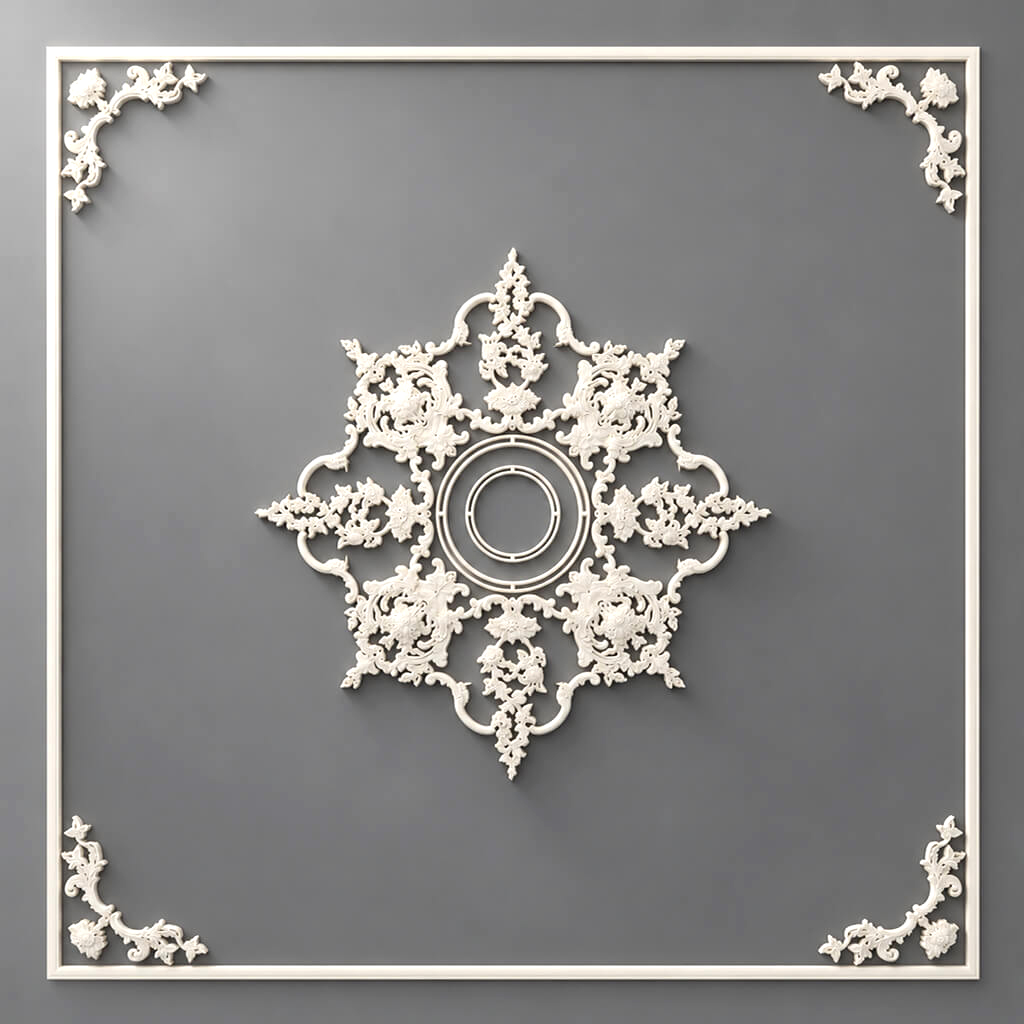
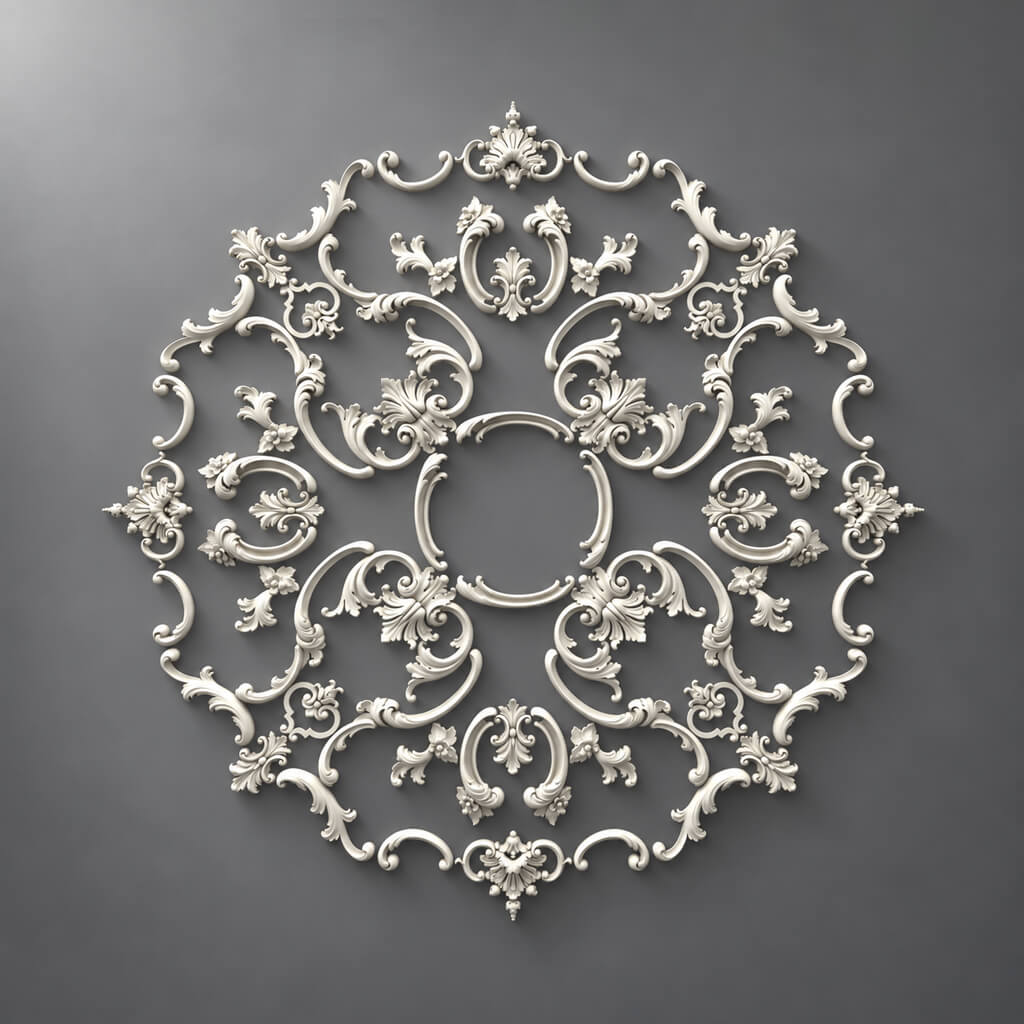
There is another distinction that matters when shopping at STAVROS: many of its polyurethane ceiling medallions are modular openwork compositions assembled from individual polyurethane ornaments, not one-piece circular plates with a standard hole in the middle. Their published overall dimensions describe the outside envelope of the completed ornament. They do not establish the size of the clear center, the opening needed for an electrical box, or how the fixture is supported.
Buyers searching for lighting ceiling medallions should distinguish decorative rosettes from electrical mounting hardware: the right product must suit both the architectural composition and the separately supported light fixture.
This guide brings together the original design questions—proportion, spacing, ornament, ceiling height, installation, and finish—with measurements in U.S. inches and feet, a verified comparison of seven STAVROS ceiling-rosette compositions, and a practical specification workflow for homeowners, designers, and contractors.



What a Ceiling Medallion Does—and What It Does Not Do
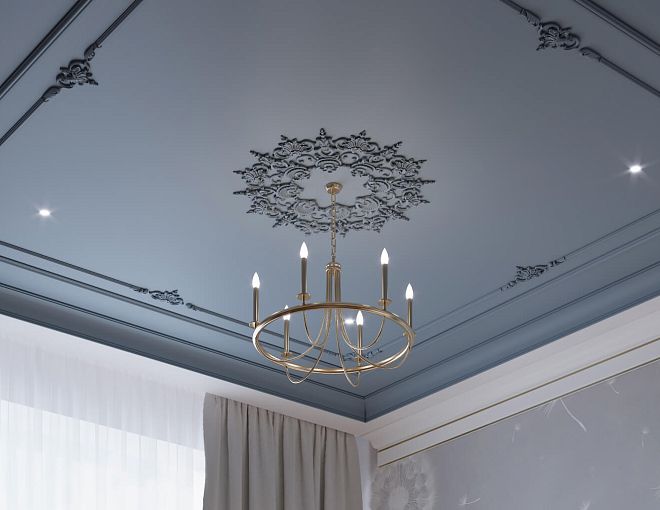
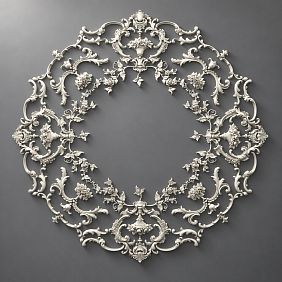
A decorative ceiling medallion organizes the space around a chandelier, pendant, or architectural focal point. It can echo classical ornament on the walls, define a dining-table axis, or become a piece of ceiling art even when no light fixture occupies its center. An openwork composition allows the ceiling color to remain visible between the raised motifs, giving an elaborate design a lighter visual appearance than an equally large solid disk.
The medallion is not the electrical support for the chandelier. The fixture must be supported by a suitable, properly installed and appropriately rated outlet box, brace, structural support, or other listed assembly as required by the fixture instructions and applicable local electrical rules. Decorative polyurethane must not carry the chandelier's weight or conceal electrical splices that must remain accessible.
Nor is a medallion required for every chandelier. A simple contemporary pendant on a smooth ceiling may be the most coherent solution in a small or minimal interior. Where the design calls for architectural relief, however, the right medallion can create a strong center without additional ceiling construction.




Why There Is No Universal Medallion-to-Chandelier Diameter Rule
You may encounter a recommendation that the medallion should be 1.2, 1.5, or even twice the chandelier's diameter. Another guide may claim that the medallion must never exceed one-fifth of the room's width. Neither statement is an installation standard, and the two can lead to contradictory answers.
Imagine a wide, shallow crystal chandelier and a tall, narrow lantern of the same maximum width. The lantern's ceiling canopy, vertical silhouette, and visual mass are quite different. A detailed 36-inch openwork medallion may suit one better than the other. Likewise, a 53-inch composition with delicate openings appears less solid than a continuous opaque medallion of the same size.
Use ratios only as design comparisons, not pass/fail rules. A useful first sketch can compare the medallion's overall width with the fixture's maximum width and with the shortest room dimension. Then check the actual ceiling canopy, center opening, decorative motifs, sightlines, and the relationship to furniture. The final choice comes from a full-size layout—not from one ratio.
Наша фабрика также производит:


Смотреть весь Каталог продукции
Measure three different things
-
Chandelier overall width: the widest visible span of the fixture, including the arms, shades, or glass, not merely the central stem.
-
Canopy diameter or footprint: the portion that contacts or sits immediately below the ceiling. For a rectangular canopy, record both dimensions. This controls whether the fixture physically fits within the medallion's central decorative field.
-
Medallion outside envelope: the maximum width and height of the entire assembled ornament. For a modular rosette, this is not necessarily a true circular diameter.
Also record the fixture's drop, suspension type, mounting hardware, and the desired distance above a dining table or walking surface according to the fixture manufacturer's instructions. The ceiling medallion cannot compensate for a chandelier installed at the wrong height.
Получить консультацию
STAVROS Ceiling Medallions: Seven Verified Polyurethane Designs
The STAVROS ceiling rosette collection contains several unusually large decorative compositions. The following dimensions are the listed finished overall width × height × maximum projection; all figures are approximate inch conversions from product specifications. Because these are ornamental layouts, the width and height should not automatically be called a circular diameter.
| STAVROS item | Overall size, inches | Approximate visual character | Planning priority |
|---|---|---|---|
| CRPU-070 | 30.12 × 30.12 × 0.71 | Compact relative to the rest of this range; star-like modular ornament | Evaluate in a modest central ceiling bay, with a full-size template |
| CRPU-069 | 35.83 × 35.83 × 0.59 | Circular openwork effect with acanthus and scrolls | Coordinate canopy clearance and detailed radial layout |
| RPU.VRS-001 | 35.87 × 35.87 × 0.71 | Openwork floral composition assembled from eight pieces | Confirm the free center between the separate onlays |
| CRPU-068 | 52.17 × 52.17 × 0.71 | Large composition with an oval character inside a square envelope | Check actual axes rather than specifying a single oval diameter |
| CRPU-066 | 52.95 × 52.95 × 0.75 | Wide botanical ring with open center | Keep the perimeter clear of cornices and ceiling framing |
| CRPU-071 | 53.74 × 53.74 × 0.75 | Expressive eight-ray classical ornament | Check scale and motif orientation on a large ceiling |
| CRPU-067 | 69.69 × 69.69 × 0.79 | Monumental centerpiece with a circular center and corner accents | Reserve for a ceiling area that can accommodate a nearly 70-inch ornament |
These are real catalog compositions, not an invented range of 12-, 18-, and 24-inch stock medallions. In the verified STAVROS selection, CRPU-070 at just over 30 inches is the smallest of these seven examples. Do not promise an 18-inch model, a split version, or a fan-rated medallion without verifying a separate SKU.
CRPU-070: a roughly 30-inch modular focal point
The CRPU-070 polyurethane ceiling rosette is presented as a star-like arrangement made from smaller decorative onlays. Its 30.12-inch outside dimension can be useful when you want an architectural accent but do not have space for a 50-inch ceiling composition. It is still a substantial decorative feature on a compact 8-foot ceiling.
Because the ornament is modular, inspect the supplied installation drawing and determine the free central area before selecting the chandelier canopy. The overall 30.12-inch width does not mean a 30.12-inch unobstructed opening, and the individual onlays are not a fixture-mounting assembly.
CRPU-069 and RPU.VRS-001: similar footprint, different decorative logic
CRPU-069 measures 35.83 inches across its listed envelope and uses a detailed, repeating classical arrangement. The catalog describes a modular composition of 64 elements in 15 types, with an open center and acanthus motifs.
RPU.VRS-001 measures 35.87 inches across and uses eight larger ornaments: four NPU-507 and four NPU-508. The result is an openwork floral composition with a different rhythm and installation process. Similar external dimensions do not make these two rosettes interchangeable; compare the center geometry, motif, assembly drawing, and style.
CRPU-068, CRPU-066, and CRPU-071: 52–54-inch statement pieces
The CRPU-068 ceiling composition is listed at 52.17 × 52.17 inches, with an oval-looking design arranged within a square overall footprint. It is a modular composition, not necessarily a one-piece oval disk. CRPU-066, at 52.95 × 52.95 inches, has a large botanical-ring effect with an open center. CRPU-071 measures 53.74 × 53.74 inches and uses a more pronounced eight-ray ornamental rhythm.
These three products occupy similar amounts of ceiling space but communicate different visual character. A restrained open ring may coexist more comfortably with detailed wall molding than an elaborate eight-ray medallion; conversely, a formal foyer may benefit from stronger sculptural relief. Choose from the actual drawing rather than treating all 53-inch products as identical.
CRPU-067: a nearly 70-inch ceiling centerpiece
The CRPU-067 polyurethane ceiling rosette is listed at 69.69 × 69.69 inches. Its circular center is complemented by decorative details that extend into the four corners. It should be treated as a large architectural composition occupying more than 5.8 feet across its full envelope.
Before choosing it for a foyer, confirm that it does not crowd a ceiling beam, sprinkler, recessed light, molding grid, or upper stairwell edge. Its approximate 0.79-inch relief depth may be modest relative to its overall width, but its footprint is monumental.
Choosing by Ceiling Height: 8, 9, 10, and 12 Feet
Ceiling height changes how a medallion is perceived from normal eye level. As the ceiling rises, the same amount of relief appears more distant and less prominent. But room width, furniture scale, lighting, and ornament density remain equally important. These are practical design scenarios, not mandatory size standards.
| Ceiling height | Design approach | STAVROS models to mock up first |
|---|---|---|
| 8 ft / 96 in. | Favor restraint; check fixture drop and whether any raised ornament is needed | CRPU-070 only where the room can support its 30-inch footprint; a smaller design outside this verified selection may be preferable |
| 9 ft / 108 in. | A central ornament can be more visible without feeling as close; keep details coordinated | CRPU-070, CRPU-069, or RPU.VRS-001, subject to room size |
| 10 ft / 120 in. | Evaluate a larger decorative field in a spacious dining or living room | 35–36-inch compositions first; then CRPU-068 or CRPU-066 if the plan supports 53 inches |
| 12 ft / 144 in. | Large ceiling centerpieces can be appropriate in a substantial room or foyer | CRPU-068, CRPU-071, or CRPU-067 after full-scale coordination |
An 8-foot room with a 30-inch medallion is not automatically wrong, and a 12-foot room does not automatically require 70 inches of ornament. The list simply helps prioritize what to test. A large, open-plan room with moderately low ceilings may tolerate a broader light-colored rosette than a narrow hallway with higher ceilings.
Room Dimensions Matter More Than a One-Fifth Formula
For initial design, compare the medallion's outside envelope to the ceiling area actually visible around the light fixture. In a room measuring 12 × 14 feet, the shorter ceiling dimension is 144 inches. A 30.12-inch composition occupies about 20.9% of that shorter dimension. The same design on a ceiling 18 feet wide occupies about 13.9% of the width. That is one reason identical objects look different in different rooms.
But the percentage is a descriptive measurement, not proof of architectural correctness. A 53.74-inch medallion across a 16-foot room covers about 28% of its shorter width, which might be effective as a pronounced formal centerpiece or excessive alongside heavy crown molding. A slender openwork composition reads differently from a solid disk.
When working with a long room, use the actual ceiling bay as the reference. An 18 × 30-foot open-plan living/dining area may have two separate lighting centers. If each center occupies a smaller architectural bay, the size should be judged against that bay rather than the length of the entire room.
Example: a 12 × 14-foot room with an 8-foot ceiling
Suppose the room is 144 × 168 inches and uses a 24-inch-wide chandelier. A 30.12-inch CRPU-070 would be about 1.26 times the chandelier's overall width. That comparison is neither too small nor automatically correct. The full-size template must show whether the star-like decorative elements have appropriate clearance around the canopy and whether the ornament is too dense for the low ceiling.
If the room already has detailed crown molding and a prominent chandelier, a plain ceiling may be more convincing. The best decision can be to omit the medallion rather than forcing the smallest available STAVROS example into a confined area.
Example: a 16 × 20-foot dining room with a 10-foot ceiling
In a 192 × 240-inch room with a 32-inch chandelier, CRPU-068 at 52.17 inches is about 1.63 times the fixture width. Its external ornament would occupy approximately 27.2% of the 192-inch room dimension. That can be an effective statement on an otherwise restrained ceiling, but only after checking its oval interior, square overall envelope, electrical canopy, and any ceiling cornice.
If the chandelier already has a wide ceiling canopy or the room includes a strong coffered pattern, a 35–36-inch composition could be more appropriate. The actual centerline of the dining table matters more than a fixed ratio.
Example: a 22 × 26-foot foyer with a 12-foot ceiling
A foyer 264 × 312 inches offers more space for CRPU-067 at 69.69 inches. The outside envelope occupies about 26.4% of the shorter room dimension. Such a composition can be visible from below and connect to the house's classical trim, but its four extended corners must not clash with beams, second-floor openings, or other fixtures. The full-size layout is still decisive.
Chandelier Width, Canopy, and Central Opening: Three Separate Checks
The maximum chandelier width determines its visual scale within the room. The ceiling canopy determines the physical interface between the light fixture and the ceiling. The medallion's inner open field determines whether its ornament surrounds the canopy as intended. None can be substituted for another.
A 36-inch-wide chandelier might hang from a canopy only 5–7 inches across, while another fixture of the same width could have a rectangular mounting plate or multiple suspension points. That is why a large medallion need not always have an oversized center, and why an otherwise attractive medallion can still be incompatible with a particular light fixture.
For each STAVROS composite rosette, inspect the current product drawings and downloadable catalogs and lay out the selected modules around a true-scale paper template of the canopy. Some designs retain a free center between ornaments; that does not establish the exact dimensions or shape of the clear area. Never assume a factory-drilled hole exists simply because a listing says “ceiling rosette.”
If the canopy overlaps a relief motif, do not cut away the motif or reposition electrical components without an approved plan. The better solution may be a different rosette, a more suitable fixture canopy, or an adjusted architectural composition designed around a properly located outlet.
Center the Medallion on the Right Architectural Axis
In a simple rectangular room, the geometric ceiling center is straightforward to locate. But the correct lighting center is not always the geometric center. A dining chandelier usually aligns with the dining table, not necessarily with the room's exact dimensions. A living-room chandelier may align with a seating group. In an open-plan interior, the architectural center of each zone may be more important than the overall building footprint.
Start with a dimensioned reflected ceiling plan showing the walls, doors, windows, furniture groups, ceiling beams, recessed lights, sprinkler heads, and the proposed fixture. Then locate the medallion around the approved chandelier position. The installation must keep the electrical support system compliant and accessible as required.
A decorative medallion cannot safely “move” the chandelier merely by covering the existing ceiling box. If the light fixture should move, an appropriately qualified electrician must determine how to relocate or reconfigure the mounting and electrical connection. Do not use the ornamental piece as a bridge between the old box and an unsupported fixture.
Multiple Medallions Over a Dining Table or Down a Long Hall
Two, three, or more chandeliers can have coordinated medallions. The correct number follows the lighting plan and room function, not a universal rule that odd numbers always look better. Two pendants over a dining table can be balanced and intentional; four repeated fixtures can create a clear rhythm in a large hall.
For equal medallions arranged in one straight row, define:
-
D = the outside width of one medallion along the row;
-
G = the desired clear gap between the neighboring outside envelopes;
-
P = the center-to-center spacing, so P = D + G;
-
n = the number of medallions;
-
L = the available length of the ceiling bay.
The total ornament span is D + (n − 1) × P. If centered symmetrically, the clear margin at each end is [L − total span] ÷ 2. These formulas describe physical spacing; the lighting designer must separately check light distribution, fixture spacing, and electrical requirements.
Worked three-medallion layout
Imagine a 20-foot (240-inch) ceiling bay with three CRPU-070 compositions, each 30.12 inches wide along the row. You propose a 24-inch clear ornament gap between neighboring medallions.
Center spacing: 30.12 + 24 = 54.12 inches.
Total ornament span: 30.12 + 2 × 54.12 = 138.36 inches.
Equal end margins: (240 − 138.36) ÷ 2 = 50.82 inches.
That layout fits geometrically and preserves generous end clearances, but it does not establish that three chandeliers are appropriate for the room. Evaluate the furniture axis, light spread, fixture drop, and view from adjacent spaces. If the medallions have corner protrusions or are rotated, account for their actual bounding dimensions in that orientation.
How Ornament Changes the Perceived Size
Not all 36-inch ceiling medallions appear equally large. A simple concentric ring produces a clear boundary and can draw attention to the central fixture. An openwork floral composition distributes detail through many smaller elements. A dark finish or pronounced gilding creates more contrast than a tone-on-tone ceiling color.
Neoclassical and transitional rooms can benefit from a restrained repeated motif. In a more formal setting, detailed scrolls and acanthus leaves may establish a connection with the door casing, wall moldings, and decorative furniture. A modern room can use one historical medallion as a deliberate contrast, but that contrast should appear intentional rather than accidental.
The STAVROS selection provides different levels of complexity: CRPU-070 is relatively compact and star-like; RPU.VRS-001 has a floral openwork rhythm; CRPU-069 creates a dense classical circular field; CRPU-067 extends the composition toward the corners of a nearly 70-inch square. Select the visual language before selecting the largest dimension available.
Paint-to-match versus a contrasting finish
Painting the rosette in the same color as the ceiling emphasizes form through light and shadow. It can make a large composition feel more integrated. A contrasting finish emphasizes its outer contour and may make the ornament look visually stronger. Neither effect can be reduced to a reliable claim that dark paint increases perceived size by a precise percentage.
A compatible satin or matte coating, selected according to the actual product and ceiling conditions, can preserve relief without overwhelming the fixture. For a classical installation, restrained metallic accents may highlight certain leaves or scrolls. Thick paint can obscure small ornament; trial the finish on a suitable sample before applying it across dozens of separate modules.
Medallion, Crown Molding, and Coffered Ceiling: Create a Hierarchy
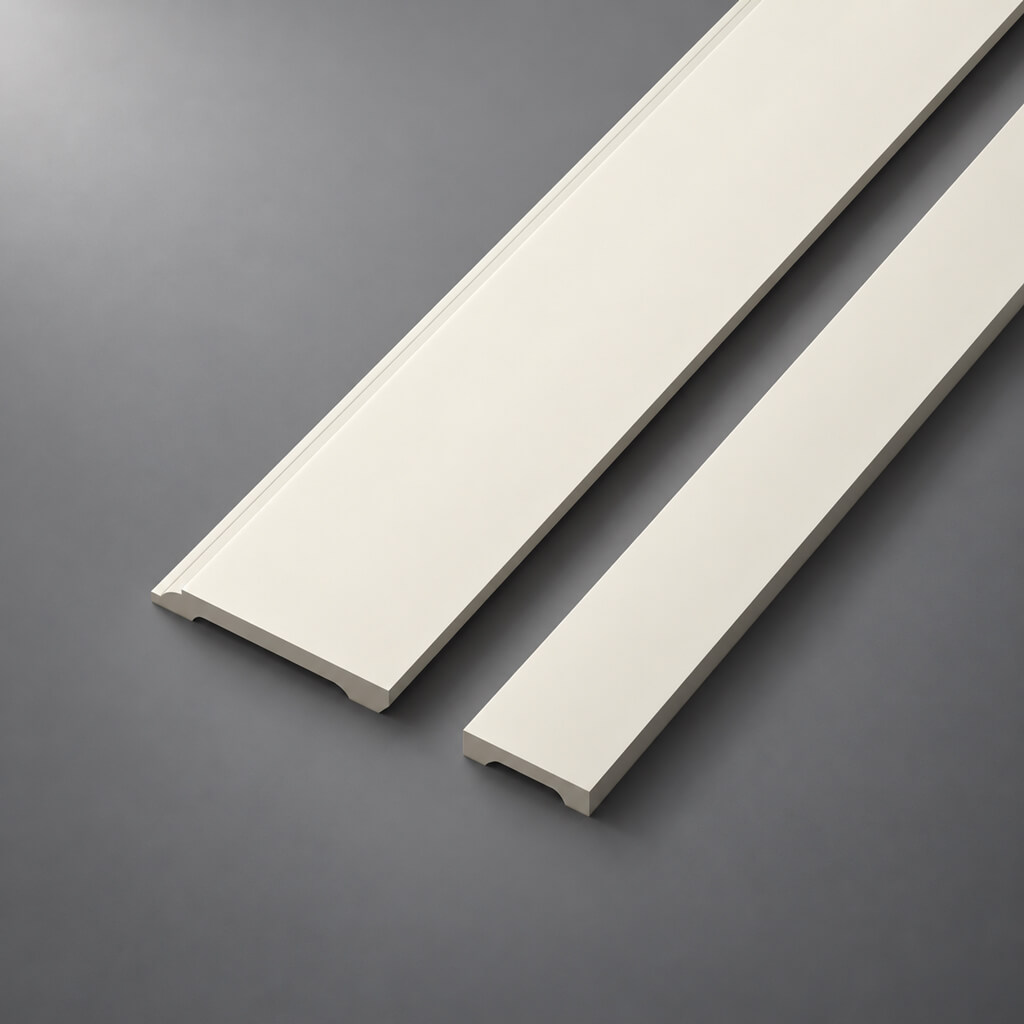
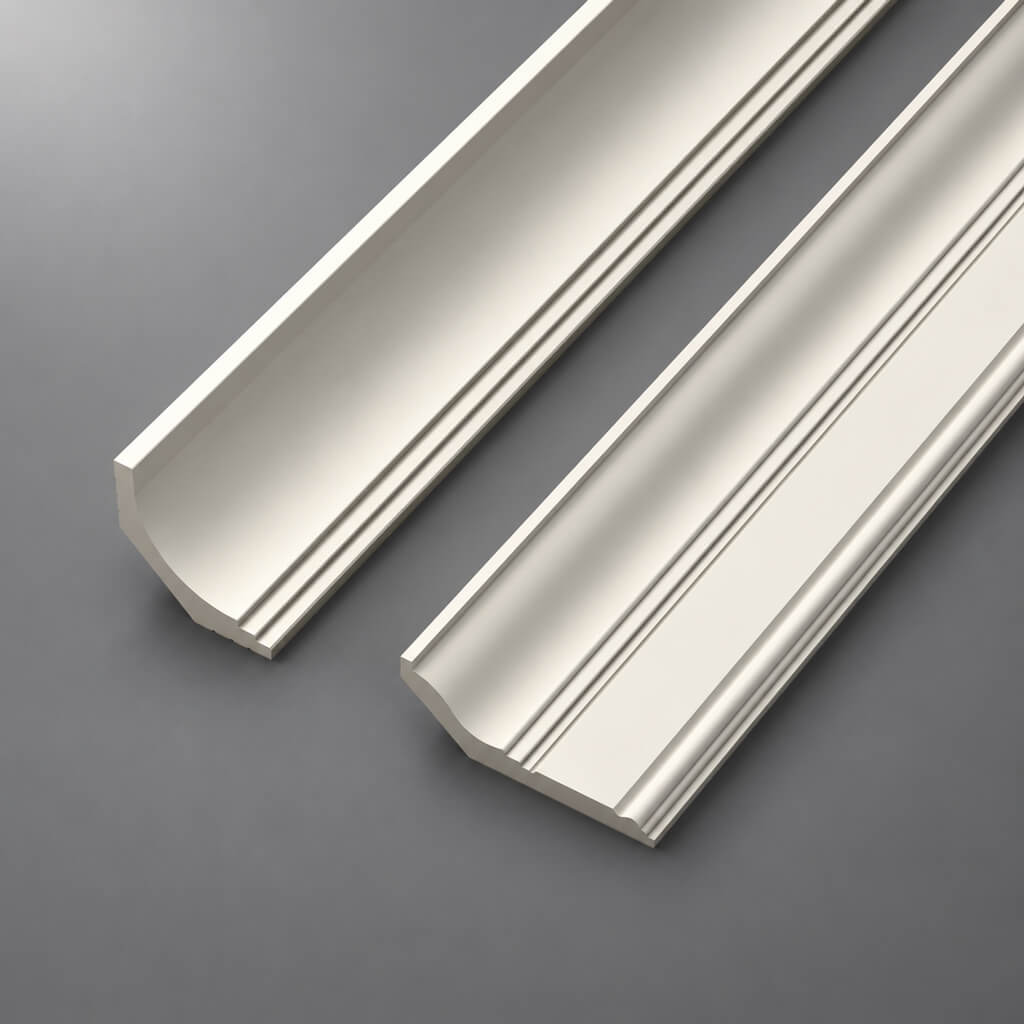
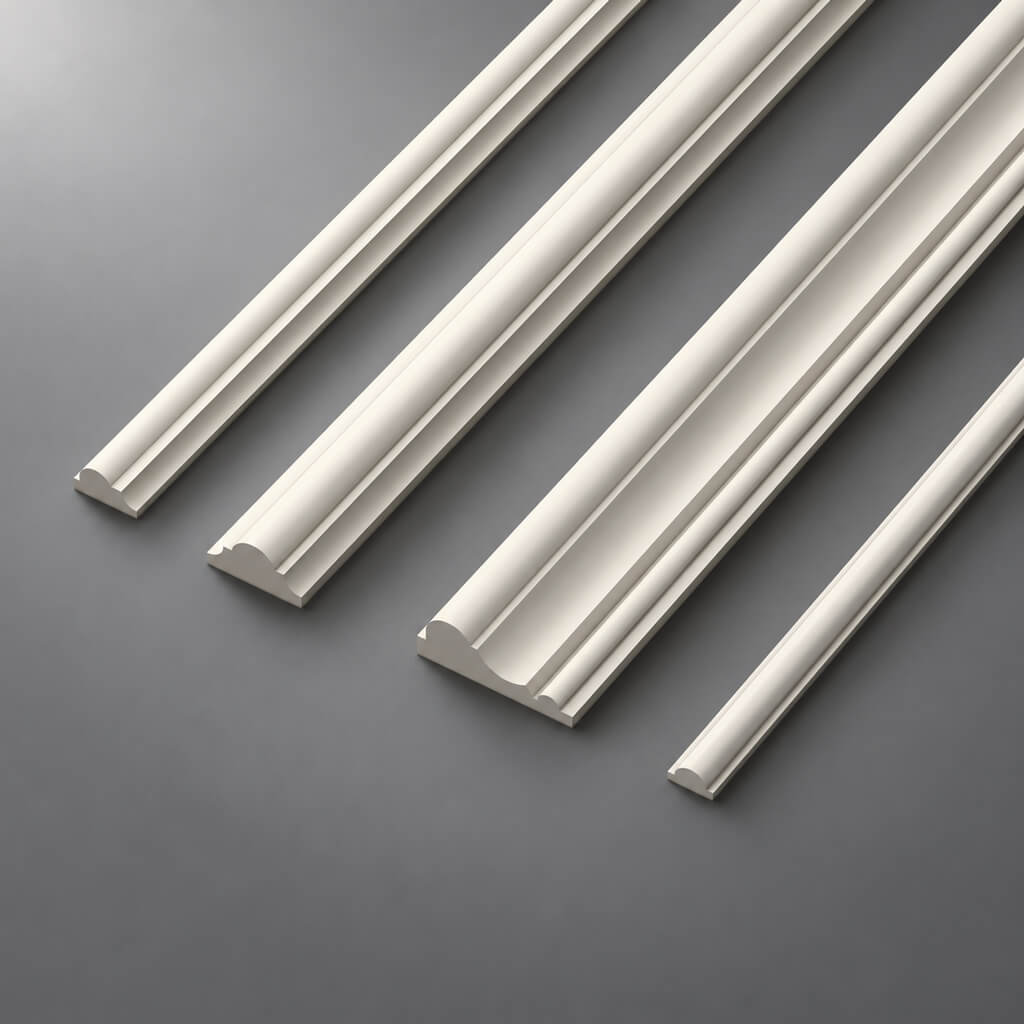
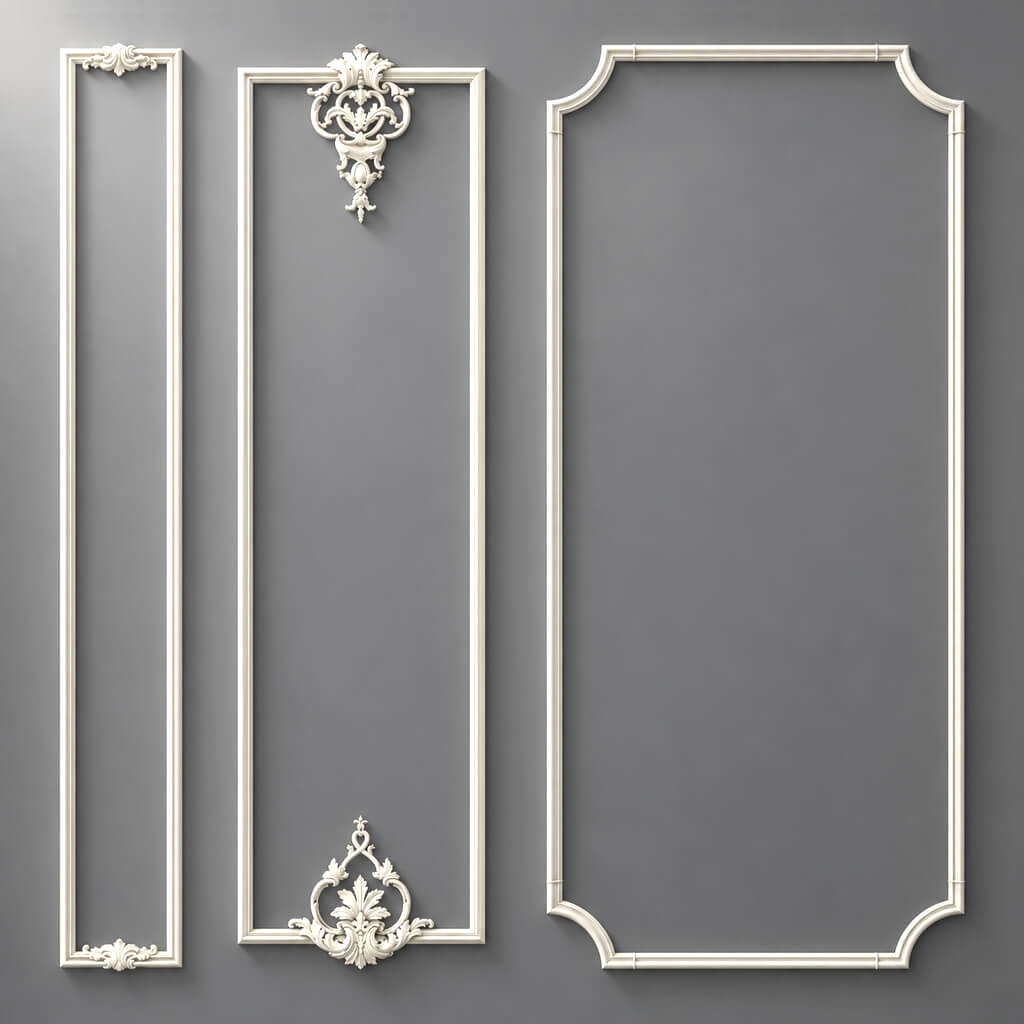
A ceiling medallion is often most successful when it belongs to a wider architectural vocabulary. The outer ceiling crown molding and cornice selection establishes the room's upper perimeter. A central medallion emphasizes the chandelier. Additional decorative ceiling molding profiles can form a rectangular frame or define coffers. These elements should complement one another rather than compete for attention.
Be particularly careful with material descriptions. The STAVROS cornice category includes polystyrene products; the broader molding selection may contain polyurethane, MDF, and polystyrene. If the specification requires PU only, verify each SKU's material rather than describing every ceiling trim product as polyurethane.
Crown molding plus a central medallion
A simple perimeter crown can work with a more detailed central medallion. Conversely, deeply ornamented perimeter trim may call for a calmer centerpiece. Check that a large modular rosette leaves a visible band of uncluttered ceiling between its outermost leaves and the crown projection. There is no universal required border width; it should be drawn in the actual ceiling plan.
A molding frame around the medallion
A rectangular frame around an openwork medallion can establish a formal ceiling bay. For a 35.87-inch RPU.VRS-001 composition, a nominal inside frame size of 60 × 60 inches would leave about 12.07 inches between the rosette's outer envelope and each inside frame edge if both are centered. That is a valid geometry example, not an automatic recommendation: decorative corner elements and the actual shape of the rosette must be checked.
A coffered ceiling
Where the ceiling is divided into coffers, the central decorative unit should be sized relative to the actual clear field of its coffer, not only to the entire room. The trim, lighting, and any ventilation or safety equipment must be coordinated before selecting the medallion. See the STAVROS ceiling decor collection for design context, and confirm the makeup of each set.
Modular Ceiling Rosettes: Why the Installation Drawing Matters
Many STAVROS ceiling-rosette products are assembled from individual onlays. CRPU-069 is described as a 64-piece system containing 15 element types. CRPU-068 uses a larger multi-part arrangement. RPU.VRS-001 consists of eight separate parts. The installer must align these components on the intended center and radial axes.
Unlike a single-piece medallion that is positioned as one unit, a modular composition needs a controlled sequence and an accurate template. The overall dimensions apply to the completed ornament only when its parts are located according to the drawing. Shifting a few elements to avoid a ceiling outlet can distort the radial symmetry and change the finished outer envelope.
When a product page offers a separate paper installation template, confirm whether it is included or must be ordered separately. Record the component quantities and any left/right orientation. Use the finished chandelier location, the actual ceiling canopy template, and the verified open center to approve the arrangement before work begins.
The STAVROS RPU.VRS-001 composition is an especially clear example: four NPU-507 and four NPU-508 ornaments form the radial layout. It should not be cut down arbitrarily to make a smaller medallion, because removing pieces can destroy the intended symmetry. For a smaller footprint, select a different product.
Safe Installation Around an Electrical Fixture
A ceiling medallion is an overhead decorative product. Safe installation demands a stable ceiling substrate, approved mounting materials, appropriate temporary support where needed, and clear separation between decorative components and the fixture's structural and electrical requirements.
Before any work involving the chandelier or its wiring, the electrical circuit must be made safe and the absence of voltage verified by an appropriately qualified person. Existing electrical junction boxes and wiring are not decoration. They must remain installed, covered, accessible, and used according to the applicable code and listed fixture requirements. Do not trap wiring between the ceiling and the medallion, cut into cables, or glue ornaments across required access openings.
The chandelier must not hang from the polyurethane medallion. It must attach to a support system suitable for its weight and mounting type. Ceiling fans require equipment and outlet support appropriate to fan use; a product described as a ceiling rosette does not establish fan-rated support.
For the medallion itself, use the specified installation system on a sound base. Check any existing paint, old plaster, wallpaper, stretch-ceiling membrane, or suspended ceiling assembly before applying adhesive. A large modular ceiling composition may require professional access equipment and a qualified installer; do not assume a small amount of tape or a few seconds of pressure will support it during cure.
Can you install a medallion on a stretch ceiling?
Not simply by gluing a decorative assembly to the flexible membrane. A stretch ceiling has its own structure, permitted accessories, and manufacturer-specific rules. The chandelier support and any decorative medallion need a design that transfers loads to approved structural backing and maintains the ceiling system's integrity. Have the stretch-ceiling and electrical specialists coordinate the solution before ordering the ornament.
Can a medallion hide an off-center electrical box?
It may conceal a minor cosmetic irregularity in the surrounding finish, but it cannot serve as an unapproved offset fixture mount or permanently cover access to an electrical connection. If the chandelier location must change, resolve the support and wiring first; then locate the decorative rosette around the correct fixture center.
Is a hole already present in the middle?
Do not assume so. These STAVROS products include openwork modular compositions; a central area may remain free between independent onlays rather than having a factory-drilled aperture in a single solid disk. Measure the actual free area on the approved layout, and confirm that the canopy and outlet access do not overlap the ornamental components.
Finish and Maintain Polyurethane Ceiling Ornaments
Paint and joint treatment should follow the selected polyurethane products' instructions and the ceiling substrate's coating system. Where many modules meet, a consistent finish helps them read as one composition. Avoid heavy filler at fine ornamental transitions, excessive sanding that rounds off petals and scrolls, or thick paint that fills narrow recesses.
A monochromatic finish often creates a coherent architectural appearance. On an ornate medallion, a light accent glaze may help individual motifs read from below, but the effect should be evaluated from the floor rather than only close to the ceiling. Directional lighting reveals projection and any uneven mounting gaps; check the installation under the planned artificial light before completing the final coat.
Over time, dust may collect on relief details. Clean the finished surface with appropriate soft tools and methods approved for the applied coating. Large or high installations should be accessed using suitable equipment. If a piece loosens, have the mounting inspected and repaired; do not simply conceal the problem with more paint.
Price, Quantity, Shipping, and Ordering for a U.S. Project
The cost of a ceiling-medallion project is more than the number shown beside the product. For a modular rosette, confirm whether the quoted product price covers the complete assembly and verify the set composition. Consider the mounting template, substrate preparation, compatible adhesive, finishing materials, skilled installation, safe overhead access, and electrical work when needed.
| Budget item | What to confirm before committing |
|---|---|
| Medallion product | Exact CRPU or RPU article, complete set contents, current price, and material |
| Drawing or template | Whether an accurately scaled paper or digital installation layout is available and included |
| Fixture coordination | Actual canopy size, approved outlet support, wiring and suspension details |
| Installation supplies | Manufacturer-approved mounting and finishing products |
| Labor | Height, component count, ceiling condition, electrical coordination, finishing |
| Freight and import | Packaging, shipping to the U.S. destination, taxes/duties and damage procedures |
The English catalog displays prices in U.S. dollars and dimensions in inches, but this is not proof of delivery to the United States. Published STAVROS delivery information primarily describes shipments within Russia and to CIS destinations. Before making a purchase decision, request confirmation of availability, shipping to the specific ZIP code, freight charges, customs responsibilities, and realistic lead time.
For a design or construction specification, collect the STAVROS product drawings and catalogs, verify the exact SKU and the layout of its modular pieces, and confirm everything before the electrician and decorative installer are scheduled.
Common Ceiling Medallion Sizing Mistakes
Treating an outside square measurement as a circular diameter. Several STAVROS compositions have square bounding dimensions despite circular or oval motifs. Use the actual envelope and detailed drawing.
Assuming all medallions are one-piece disks. A modular rosette requires many individually placed elements. Verify component count and assembly instructions.
Choosing by chandelier width alone. Two fixtures of equal width can have very different canopies and visual character. Record both measurements.
Following a rigid one-fifth rule. A room-width ratio is a rough visual comparison, not an architectural limit. Test the proposed footprint in the actual ceiling bay.
Ignoring ceiling height and fixture drop. An ornate center may crowd a low room visually, even when the outside dimension fits geometrically.
Cutting into an ornamental module to accommodate a canopy. Repositioning or trimming parts without an approved layout can damage the design and interfere with the electrical assembly.
Placing medallions according to wall centers rather than lighting centers. Over a dining table, the table and fixture axis may be the proper architectural reference.
Buying multiple pieces without spacing calculations. Use real outer dimensions and center-to-center spacing, then confirm that the fixture arrangement is functionally appropriate.
Expecting the medallion to support a chandelier. Decorative trim does not replace listed electrical boxes, braces, or structural fixture support.
Assuming U.S.-dollar prices equal delivered U.S. prices. Confirm freight and import terms before ordering.
Frequently Asked Questions About Ceiling Medallion Size
What size ceiling medallion do I need for a chandelier?
Start by measuring the fixture's maximum width and ceiling canopy, then evaluate the room's ceiling height and the usable ceiling bay. Compare those measurements with the medallion's real outside envelope and central free area. A fixed multiplier is a design shortcut, not a universal requirement.
Should a ceiling medallion be bigger than the chandelier?
It may be, but it does not have to be. An openwork medallion larger than the chandelier can establish a strong classical centerpiece; a subtler design smaller than the chandelier's overall arm span can also look intentional. The important physical check is the canopy and clear central field, not a mandated visual ratio.
Is a 30-inch ceiling medallion too large for an 8-foot ceiling?
Not automatically, but it is substantial. CRPU-070 is about 30.12 inches across, so its full-size template should be reviewed alongside the chandelier's drop, ceiling trim, and room width. In a small room, an understated fixture without a medallion may be more appropriate.
What about rooms with 9- or 10-foot ceilings?
These heights can accommodate a wider range of layouts, depending on room size. A roughly 35.8-inch CRPU-069 or RPU.VRS-001 may be worth testing first; a larger 52–54-inch composition requires more generous surrounding ceiling space.
Are large ceiling medallions suitable for 12-foot ceilings?
They can be, particularly in spacious living rooms or foyers. STAVROS offers CRPU-067 at 69.69 inches, but the room's clear ceiling field, fixture, and other ceiling elements still determine whether it is an appropriate choice.
What is the difference between ceiling medallions and ceiling rosettes?
In American architectural-decor listings, the terms often overlap. Ceiling medallion is the more recognizable shopping term; ceiling rosette or ceiling rose can refer to related decorative relief. In electrical contexts, however, some terminology may describe a fixture outlet component. Always verify whether you are purchasing decoration or listed electrical hardware.
Can I put two or three medallions over a long dining table?
Yes, if the lighting layout calls for multiple fixtures and the decorative envelopes fit. Calculate center spacing from the medallion width and desired clear gap, then coordinate the fixture positions separately. There is no rule that only odd-numbered groups look balanced.
Does the medallion come with a hole for the electrical box?
Not necessarily. STAVROS CRPU and RPU products in this comparison are modular ornamental compositions. Obtain the layout drawing and verify the free center or required clearance around the canopy and accessible electrical connection.
Can the medallion support a heavy chandelier or ceiling fan?
No. A decorative polyurethane rosette is not a rated support for luminaires or fans. Use the appropriate installed electrical and structural support system according to the fixture instructions and local requirements.
Can I trim a large modular medallion to make it smaller?
Do not assume so. Removing or cutting decorative units can destroy the symmetry, alter the dimensions, or leave visible incomplete motifs. Select another size or obtain a design-specific approved modification.
Can ceiling rosettes be painted?
A compatible polyurethane finish may be used according to the product documentation. Tone-on-tone painting creates subtle shadows, while contrast and metallic accents make the ornament more prominent. Test coatings and avoid burying fine relief in thick paint.
Can I order STAVROS ceiling medallions in the USA?
The English catalog provides product information in U.S. units, but published delivery terms primarily address Russia and CIS destinations. Confirm U.S. fulfillment, freight, import responsibilities, pricing, and delivery time directly before placing an order.
Choose the Medallion From the Architecture Outward
A successful chandelier medallion does more than surround a fixture. It reconciles the chandelier's visual width with the ceiling bay, the room's height, the furniture axis, the relief pattern, and the building's actual electrical installation. That is why a verified 35-inch openwork composition may be better than a guessed 48-inch solid disk, and why even a spectacular 70-inch rosette should not be chosen before the plan has been checked.
Browse the STAVROS polyurethane ceiling medallion collection to compare real CRPU and RPU designs. For coordinated ceilings, review the ceiling decor systems and the relevant molding profiles. Use the downloadable catalogs and drawings to verify the finished outside envelope, component layout, and actual center clearance of the selected item.
Measure the room, confirm the chandelier canopy and support, test the medallion at full size, and only then choose the decorative composition. That workflow produces a more convincing ceiling—and a more reliable specification—than any fixed diameter formula.