Article Contents:
- Short answer: one NPU-500 is possible, but an empty corner here can also be the right solution
- What exactly is the NPU-500
- First, assess the transition between the slat and smooth walls
- Why the slat wall already forms its own finish
- When one NPU-500 can really work as a standalone accent
- When a single NPU-500 looks like a torn-off corner of a frame
- CPU-1-5 shows the systematic nature of the NPU-500 but does not prohibit single use
- How large 208 mm looks on a smooth wall of different widths
- An interior corner of a room and a corner element on the same plane are not the same thing
- What exactly counts as the "upper interior corner"
- Size 208 × 208 mm: why a square template is mandatory
- Relief of 18 mm: why a frontal fitting does not show everything
- When a clean corner without molding is stronger than any decor
- How to understand whether the slat wall itself is technically complete
- The last slat and the NPU-500 should have visual air between them
- How to assess the distance to the ceiling
- If the ceiling is low, 208 mm feels larger
- Viewing distance changes the decision more than price
- Frontal and diagonal angles give different results
- Side lighting can make one element the main accent of the entire wall
- In the color of the wall: the safest way to test a single NPU-500
- In the color of the slats: the connection can become too literal
- Contrasting gold, bronze, or black require especially strict fitting
- Modern interior and classic ornament: conflict is not always bad, but must be intentional
- Neoclassicism: the most natural environment for a single NPU-500
- When it is better to continue the composition with molding
- When a frame system is stronger than a single accent
- When one NPU-500 is stronger than a full frame
- If the slat panels have not yet been brought to the corner, first finish the finishing, then decide on the NPU-500
- If the last slat already protrudes almost 18 mm, two reliefs may compete
- The technical joint of two walls cannot be masked with a decorative element without checking
- The surface under the NPU-500 must be self-sufficient and stable
- If the NPU-500 is placed very close to the corner, the template must account for the unevenness of the wall itself
- Mounting on a single plane is simpler and more predictable
- NPU-500 orientation: "angle up" or "angle inward" must be chosen before purchase
- One element in the top corner and one in the bottom — that's already a different composition
- One NPU-500 next to one slat wall and four NPU-500s in CPU-1-5 solve different tasks
- When it's better to choose a more compact corner decor
- When it's better not to use corner decor at all
- How to tie NPU-500 to existing moldings in the room
- If the smooth wall is very narrow
- If the smooth wall is very wide
- Practical fitting: three mockups that give an answer before purchase
- Mockup A — clean corner
- Mockup B — one NPU-500
- Mockup C — NPU-500 as part of a system
- How to compare three options without the habituation effect
- What to measure before purchasing NPU-500
- How to check if NPU-500 is too close to the ceiling
- How to check if it is too close to the slats
- Do you need to center NPU-500 relative to the width of the smooth wall
- Do you need to align it with the top line of the slat panels
- If the slat panels are only on one part of the wall
- If the corner falls near a socket, switch, or sconce
- If the corner is above furniture
- If the corner is empty only because there is no furniture nearby yet
- The cost of one element versus the cost of a system composition
- When 4,970 ₽ is better not to spend at all
- When 4,970 ₽ really gives a noticeable result
- Mistake 1. Deciding that an empty corner must be filled
- Error 2. Evaluating NPU-500 only against a white card background
- Error 3. Ignoring the 18 mm relief
- Error 4. Placing the element too close to the rails
- Error 5. Making a single classic detail in a modern interior without support
- Error 6. Treating NPU-500 as a technical finishing profile
- Error 7. Starting to design the frame only after purchasing a single NPU-500
- When the system variant needs to be designed from scratch, not "built around" an already purchased NPU-500
- If you want a system solution, but not such a rich one
- How to determine whether the corner is a focal point of the room
- If the corner is visible only at an acute angle
- If the corner is near the passage
- If a door opens nearby
- How to prepare the surface if the decision is made in favor of NPU-500
- Paint beforehand or after installation
- Before installation
- After installation
- Combined method
- What to do if you want to remove NPU-500 after installation
- Care for a single relief element next to the slats
- What will happen when repainting the wall in the future
- Three ways to tie NPU-500 to a corner — and why they give different results
- Tying to the vertical of the slatted wall
- Attachment to ceiling line
- Attachment to independent wall composition
- How to check visual balance if the slatted and smooth walls are different colors
- Why one large corner is better checked together with the adjacent wall as a whole
- Practical algorithm before purchasing
- Selection table: one NPU-500, clean corner, or frame composition
- Decision tree
- Who NPU-500 suits in this topic
- Who should decline
- When to buy decor for moldings instead of a specific NPU-500
- When to buy polyurethane wall moldings
- When to move to the general stucco catalog
- Can the NPU-500 be installed only on a smooth wall, without extending onto the slatted panel?
- Can the NPU-500 be used if the corner is not perfectly 90°?
- Is a second NPU-500 needed on the opposite corner of the room for symmetry?
- Can the NPU-500 be placed lower, rather than in the upper part of the wall?
- Can the NPU-500 be installed after the slatted panels have already been fully mounted?
- If the slats are wooden, is it better to paint the NPU-500 to match the wood?
- What to do if the NPU-500 looks good up close but is barely visible from the center of the room?
- Can the NPU-500 be installed near a stretch ceiling?
- Can the NPU-500 be combined with a ceiling cornice?
- If the slatted panels already have LED lighting, is additional corner decor needed?
- Can I buy one NPU-500 now and then extend the frame later if needed?
- Can the NPU-500 cover a structural crack in an internal corner?
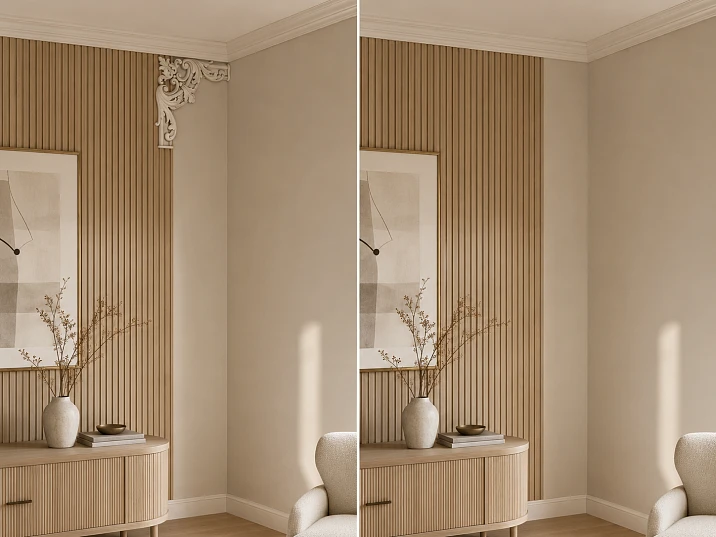
Short answer: one NPU-500 is possible, but an empty corner here can also be the right solution
If the slat wall already creates a strong vertical rhythm on its own and ends at an internal corner, buying an NPU-500 just because the corner seems "empty" is not worth it. In such a composition, the emptiness can work as a visual pause between the active texture of the slats and the smooth adjacent wall.
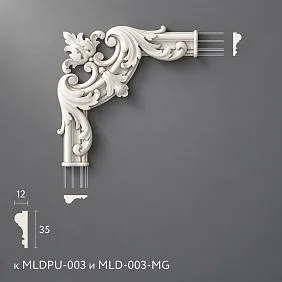
One NPU-500 corner decorative element made of polyurethane measures 208 × 208 × 18 mm and currently costs 4,970 ₽ per piece. It is a large ornamental accent, not a small technical corner piece. Its floral relief is noticeable from a distance and reads especially actively under side lighting.
Therefore, the buyer has three reasonable options.
Option 1 — install one NPU-500. It creates a point decorative finish and turns the corner into a standalone accent.
Option 2 — leave the transition without molding. This is the best path if the slats themselves already form a sufficiently strong boundary and additional ornamentation would only overload the joint.
Option 3 — do not use a single element, but instead move to a systematic molding composition. In this case, the NPU-500 becomes part of a frame or a repeating architectural scheme, rather than a separate "detached" decorative fragment.
The main check before purchasing is not the question "will 208 mm fit." You need to understand whether a single NPU-500 reads as an intentional finish for that specific corner. If, during a full-size trial, it looks like a randomly taken corner from a large frame, it is better to buy nothing or build a full system.
Buy NPU-500 corner decorative element made of polyurethane




What exactly is NPU-500
NPU-500 should correctly be called a corner decorative element made of polyurethane. In STAVROS system kits, it also appears as a corner trim, but in this article it is important not to turn it into a "molding" or a universal technical profile.
Current parameters:
| Parameter | NPU-500 |
|---|---|
| Type | Corner decorative element |
| Material | Polyurethane |
| Size | 208 × 208 × 18 mm |
| Price | 4,970 RUB / pcs. |
| Minimum order | From 1 pcs. |
| The script of this article | one element or its omission |
The size of 208 × 208 mm means that on a flat surface the element occupies a noticeable square area. The 18 mm relief enhances its presence even more: with side lighting, shadows make the ornament visually deeper.
This fundamentally distinguishes NPU-500 from compact corner pieces. It cannot be chosen as an inconspicuous masking of the joint between a slatted and smooth wall. If it appears in the interior, the viewer notices it.
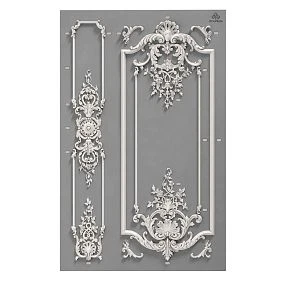
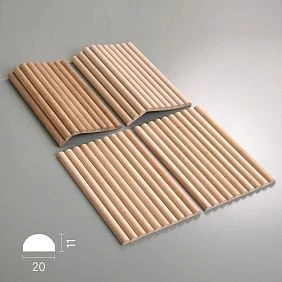
Our factory also produces:
First, assess the transition itself between the slatted and smooth wall
Get Consultation
Why a slatted wall already forms its own completion
Slat panels do not work like ordinary flat finishes. The repeating vertical slats create rhythm, depth, and chiaroscuro. When such a surface approaches an internal corner and ends, the very boundary between the textured and smooth wall already becomes an expressive architectural event.
The corner performs several functions at once:
-
stops the rhythm of the slats;
-
shows the transition to another finish;
-
creates a dark or light vertical line;
-
visually separates one plane from another;
-
forms a natural pause.
That is why an empty corner cannot automatically be considered unfinished.
If the slat wall is rich in color, the slats are deep, and the adjacent wall is calm, an additional NPU-500 may turn out to be a third competing element: the slats, the shadow line of the corner, and a large plant ornament.
Sometimes the best design is built on the fact that one material ends cleanly and does not receive a decorative "dot".
A single NPU-500 should look complete without requiring a continuation
When one NPU-500 can truly work as a standalone accent
A single application becomes convincing when the corner has its own compositional role.
For example, a slat wall ends at a prominent spot opposite the entrance, and the smooth adjacent surface is almost empty. In this case, the NPU-500 can become a kind of decorative signature at the boundary between the two materials.
Another scenario is a neoclassical interior where adjacent walls already feature stucco decoration of a similar scale. Then a single large corner element does not look like an accident: it continues the existing language.
A third case is when the corner is positioned high and perceived from a distance. With a large viewing distance, the 208-millimeter ornament becomes more proportionate than in a narrow corridor.
One NPU-500 is worth considering if several conditions are met simultaneously:
-
the corner itself is clearly visible;
-
there is no other large decor nearby;
-
the slat wall is not overloaded;
-
the element does not press against the ceiling, cornice, or rails;
-
the floral ornament matches the interior style;
-
the solitude looks intentional;
-
the 208 × 208 mm template is perceived as a complete accent.
If half of these conditions are not met, a clean corner is usually safer and stronger.
When a single NPU-500 looks like a torn corner from a frame
This is the main risk of the theme.
NPU-500 is actively used by STAVROS in the system frame composition CPU-1-5, where four identical elements stand in four corners and are connected by molding. In such a system, the viewer immediately understands the logic: there is a frame, there are four corners, there is repetition.
A single NPU-500 lacks this support.
It may look random if:
-
there is no other stucco element nearby;
-
the ornament's shape clearly directs the eye toward the missing molding;
-
the element is in the upper corner, but there is no continuation below;
-
the adjacent smooth wall is completely minimalist;
-
the slatted surface is modern and geometric, while NPU-500 is very classical in pattern;
-
the corner is barely noticeable, and the decor is only perceived at close approach.
The check is simple: temporarily attach a paper template, step back to the usual distance, and ask yourself — does it seem like the molding should continue here?
If the answer is "yes," the single scheme is weak. Then it is better to either switch to a frame composition or remove NPU-500 altogether.
CPU-1-5 shows the systemic nature of NPU-500 but does not prohibit single application
The ready-made CPU-1-5 kit includes four NPU-500 and molding MLD-003-MG. This is an important scale reference.
In the system, one frame measuring about 1000 × 2300 mm receives four corner elements of 208 × 208 × 18 mm. That is, the NPU-500 is conceived as a noticeable part of a large architectural composition.
Two opposite erroneous conclusions cannot be drawn from this.
The first erroneous conclusion: "since CPU-1-5 has four pieces, one NPU-500 can never be used separately." The product card allows other usage scenarios.
The second erroneous conclusion: "if one element is sold from 1 piece, it will automatically be a finished single decor in any corner." This is also incorrect.
The correct conclusion is different: single use requires stricter visual verification, because the systematic repetition that makes the NPU-500 obviously logical in CPU-1-5 disappears.
Geometry, scale, and angles
How large 208 mm looks on a smooth wall of varying widths
To assess the scale not only "by eye," it is useful to see what proportion of the available smooth plane one side of the NPU-500 occupies. This is not a standard or installation rule. The calculation shows only the relative scale of the square dimension of 208 mm.
| Width of the available smooth zone | Proportion occupied by 208 mm |
| 300 мм | 69,3% |
| 400 мм | 52,0% |
| 500 мм | 41,6% |
| 600 мм | 34,7% |
| 800 мм | 26,0% |
| 1000 мм | 20,8% |
On a strip of only 300 mm, the element takes up almost seven-tenths of the width. Even if the carved contour does not fill the entire outer square, visually it is already a dominant decor. Next to a slat wall, such a variant easily feels cramped.
At 500–600 mm, the NPU-500 is still large, but more calm surface appears around it. Here, the solution depends more on style, color, and distance to the last slat.
On a smooth wall of 800–1000 mm, a 208 mm square takes up a noticeably smaller share. But another risk appears: a single element can become too small a point on a large empty plane and start demanding a molding continuation.
That is why "more space" does not automatically mean "one NPU-500 fits better." On a narrow wall, the problem is crampedness; on a wide one, it is compositional isolation.
When calculating, use exactly the available decorative width, not the full wall size from corner to corner. If part of the plane is occupied by a door casing, cabinet, or mirror, the working field decreases.
This calculation only solves the scale problem along one axis. It does not replace checking height, the 18 mm relief, light, and the actual shape of the ornament.
An interior corner of a room and a corner element on one plane are not the same thing
Technical caution is needed here.
On the website, the NPU-500 is called a corner decorative element and is mentioned for decorating interior corners of rooms. At the same time, in CPU-1-5, it is used as a flat corner accent on a wall frame.
Therefore, without checking the actual product, you cannot automatically assume that the NPU-500 "bends" through 90° and lays evenly on two perpendicular walls at once.
For the scenario in this article, it is safer to first determine the mounting plane.
Possible options:
-
The NPU-500 is placed on a smooth adjacent wall flush with or close to the inner corner;
-
The element is placed on a smooth field next to the slat wall;
-
The product is used as part of a molding composition on a single plane;
-
A real installation directly into a spatial inner corner is considered — then you need to check the rear geometry of the specific product and the technical drawing before installation.
Do not design the mounting method based on the single word "corner." First, determine which surface the rear side adjoins.
What exactly to consider the "upper inner corner"
The phrase can mean several different joints.
The first is the vertical junction of two walls near the ceiling. The slat wall ends at the corner, the adjacent smooth wall continues, and the decorative element is intended to be placed high.
The second is a corner inside an already outlined wall composition, for example, the upper corner of a smooth panel next to the slats.
The third is the zone where a slat wall, a smooth wall, and a ceiling meet simultaneously.
These situations differ.
If the NPU-500 is simply placed at the top of a smooth wall near a vertical corner, it works as a wall accent.
If it needs to connect two walls and a ceiling, the composition becomes spatial, and a single flat template is not enough.
If it is a corner of a decorative frame, the logic is closer to CPU-1-5 and molding systems.
Before purchasing, it is useful to literally draw an arrow on a photo pointing to the installation spot. Such a simple step often reveals that one corner is discussed in words, but a completely different node is physically intended.
Size 208 × 208 mm: why a square template is mandatory
The NPU-500 easily seems moderate on a product card screen. On a real wall, 208 mm is more than twenty centimeters on each side.
To check, cut out a 208 × 208 mm square. It is better to use thick paper or cardboard.
The square itself will not convey the openwork pattern, so it is then useful to print a photo of the product at approximately actual scale or at least sketch the main curls.
The template should be placed at the intended point and evaluated:
-
distance to the last slat;
-
distance to ceiling;
-
distance to the trim, cornice, or baseboard;
-
the proportion of the smooth wall it occupies;
-
view from the adjacent room;
-
view along the slat wall;
-
view at a diagonal angle.
If the square already seems too large, the actual relief will look even more active visually.
18 mm relief: why frontal fitting doesn't show everything
The third size of NPU-500 is 18 mm. This is a noticeable protrusion relative to the smooth wall.
The frontal paper template shows the area but not the shadow. With side lighting, the relief forms a deep pattern and looks larger.
This is especially important next to slat panels. The slats themselves create a system of shadows. NPU-500 adds a different, more complex plant-like pattern of light and shade.
If light runs along the wall, the two reliefs begin to interact. In one interior, this looks rich. In another, it is too restless.
For a volumetric mock-up, you can place pieces of material with a total thickness of about 18 mm under the cardboard. Such a model does not imitate the ornament, but shows how far the element protrudes forward.
When a clean corner without molding is stronger than any decor
Not using NPU-500 does not mean the corner is "unfinished." In a modern interior, a clean transition of materials often looks more professional than trying to fill every free spot.
A clean corner is especially logical if the slat panels serve as an accent wall. Their task is to create rhythm, and this rhythm must end somewhere. The inner corner provides a natural boundary.
It is worth leaving the transition without molding if:
-
the last slat is neatly finished;
-
the end of the slat system does not require decorative masking;
-
the adjacent smooth wall already looks finished;
-
interior style modern or minimalist;
-
there is a ceiling cornice, sconce, furniture or other accent nearby;
-
NPU-500 has to be placed too close to the rails;
-
single plant ornament is not supported anywhere else.
In this case, the void works as a separator. The slatted wall retains its independence, the smooth one retains its own.
Commercially, this is an important conclusion: not buying NPU-500 is also the right decision if it does not improve the composition.
How to understand whether the slatted wall itself is technically complete
Before discussing molding, you need to check the base node.
NPU-500 should not mask a sloppy end of the slats, a large installation gap, or a damaged inner corner. These are different tasks.
First, you need to look at:
-
how does the last batten end;
-
is there a straight vertical line;
-
is the backing closed;
-
is there an open end of MDF or another base;
-
is there a noticeable gap;
-
does the color of the finishing element match the panels.
If the batten system is finished poorly, first fix its own edge. Depending on the system, this may be a standard end profile, a neat extension, a painted end, or another provided method.
The decorative NPU-500 should not become a "patch" for a technical defect. Its function is compositional.
If the joint is neat, then the question is indeed a design one: leave it clean or make an accent.
The last batten and the NPU-500 should have visual air between them.
If the NPU-500 is placed on a smooth wall near an inner corner, the distance from the ornament to the last batten becomes one of the key parameters.
A gap that is too small creates the feeling that the plant element is accidentally squeezed between two surfaces. A gap that is too large detaches the NPU-500 from the node it is meant to complete.
There is no universal number because the width and depth of the battens vary. But the template should allow you to see three states:
-
almost flush;
-
a moderate, calm offset;
-
a clearly separated accent.
It is useful to start not with millimeters, but with relationships. The visual gap should be large enough so that the NPU-500 does not blend with the last batten, but connected enough so that the viewer understands its relation to the corner.
If you have to leave only a narrow strip of wall, a large NPU-500 is most often unnecessary.
How to assess the distance to the ceiling
The upper corner accent can easily be pressed too tightly against the ceiling.
If the NPU-500 is positioned high, its top part should not accidentally collide with:
-
a ceiling cornice;
-
a shadow gap;
-
a stretch ceiling;
-
built-in lighting;
-
a ventilation grille;
-
the top finish of a slat wall.
At a size of 208 mm, even a slight shift noticeably changes the character.
If the element almost touches the cornice, it begins to be perceived as part of the ceiling molding. If there is enough air between them, the NPU-500 remains a wall accent.
Therefore, when creating the template, you need to evaluate not only the square itself, but also the remaining wall space above it.
A good composition doesn't look like a decorative element "didn't fit" and therefore ended up squeezed between the ceiling and the slats.
If the ceiling is low, 208 mm feels larger.
The size of the NPU-500 doesn't change, but the relative scale changes with the room's height.
In a room with a low ceiling, a large corner ornament is closer to the eyes and takes up a larger share of the upper wall zone. On a high ceiling, it gets more breathing room.
This doesn't mean it's forbidden for a standard apartment. But in a low room, a single NPU-500 should undergo stricter scrutiny.
Be especially cautious if:
-
the slat wall goes all the way to the ceiling;
-
the slats themselves are massive;
-
the ceiling cornice is wide;
-
a large light fixture hangs nearby;
-
The smooth adjacent wall is narrow.
In such conditions, an empty corner often looks lighter.
Viewing distance changes the decision more than price.
One NPU-500 costs 4,970 ₽, but the purchase decision cannot be made based on budget alone.
If the corner is in a spacious living room and is viewed from four to five meters away, a large element can look proportionate.
In a narrow corridor, a person passes 60–100 cm from it. The 18 mm relief and the 208 × 208 mm pattern are perceived much more actively.
Therefore, the pattern should be viewed from at least three points:
-
from the entrance;
-
from the main area of the room;
-
while moving along the wall.
If the NPU-500 is only beautiful when viewed from the front from one favorable spot, but looks heavy in all real routes, it is a weak choice.
Frontal and diagonal angles give different results
Slat panels are especially sensitive to the viewing angle. From the front, they look like rhythmic lines, but diagonally, the depth of the slats is enhanced.
NPU-500 also changes when viewed from the side: the 18 mm protrusion becomes more noticeable, and the complex botanical pattern creates deeper shadows.
Therefore, you need to photograph the template:
-
straight on;
-
from the side of the slat wall;
-
from the side of the smooth wall;
-
from the passage.
If, at a diagonal angle, an element starts to visually "overlap" the slats, although from the front there is a gap between them, it may be positioned too close.
Light, color, and stylistic compatibility
Side lighting can make one element the main accent of the entire wall
If there is a window, sconce, or linear lighting near the corner, the NPU-500 may look much more active than expected.
The 18 mm relief creates shadows. The slats also create shadows. With side lighting, a complex combination of two types of relief appears:
-
regular geometry of the slats;
-
irregular plant pattern of the NPU-500.
This can be a beautiful contrast of "geometry + ornament." But only if one element is visually subordinate to the other.
If both the slats and the NPU-500 are equally contrasting and equally lit, the corner becomes overloaded.
Therefore, before ordering, it is useful to look at the mockup in the evening under standard lighting, not just during the day.
In the color of the wall: the safest way to test a single NPU-500
If there is doubt about the saturation, the first painting option is in the color of the smooth wall.
This way, the NPU-500 does not create an additional color spot. It is revealed only by the relief.
This is especially useful when:
-
the slats are already contrasting;
-
the adjacent wall is light;
-
the interior is neoclassical but calm;
-
you want to test the form itself without extra ornamentation.
A single element in the color of the wall is perceived more as an architectural relief.
If even in this version it looks too large, the problem is in scale, not color.
In the color of the slats: the connection may become too literal
You can try painting the NPU-500 in the color of the slat panels, especially if the slats are wooden or dark.
Then the decorative element visually connects with the accent wall and looks like its "final point".
But the risk is high: the floral ornament and strict slat geometry get one color, which means the viewer begins to perceive them as one system. If they are stylistically different, this difference becomes even more noticeable.
A dark NPU-500 on a light smooth wall will appear larger than a white one. Therefore, before such a decision, the paper template should be painted approximately in the desired shade.
Contrasting gold, bronze, or black require especially strict fitting.
Contrast makes one element an independent decorative object.
An NPU-500 in gold next to natural slats can work in formal neoclassicism, but in an ordinary modern living room it may look alien.
Black on a light wall makes the 208 × 208 mm square graphically heavier.
Bronze adds a classic character.
With any contrast, you need to check whether there is at least one more element in the room that supports such material or color:
-
handles;
-
lighting fixtures;
-
furniture hardware;
-
mirror frame;
-
cornice;
-
furniture legs.
If the NPU-500 remains the only gold or black ornament, the sense of isolation is intensified.
Modern interior and classic ornament: conflict is not always bad, but it must be intentional.
Slat panels are often used in modern interiors. NPU-500 has a pronounced classical floral pattern.
At first glance, this is a contradiction. But the combination can work if the entire interior is built on the contrast of modern geometry and a classical detail.
For example:
-
smooth walls;
-
minimalist slats;
-
modern furniture;
-
one pronounced classical accent.
Then NPU-500 becomes an artistic detail.
But if there are no such connections, a single baroque element in the corner may look random.
The check is simple: if you remove the NPU-500 from the layout, does the interior lose its concept or just become calmer? If it only becomes calmer, it may not be needed.
Neoclassicism: the most natural environment for a single NPU-500
In neoclassicism, a single corner decorative element is perceived more organically because the ornament language is already supported by the style.
But even here, solitude requires explanation.
It is better if the following are present nearby:
-
moldings on another wall;
-
classic cornice;
-
paneled door;
-
profiled baseboard;
-
decorative portal;
-
another plant accent.
Then the NPU-500 doesn't seem like the first and last molding element in the room.
If the entire neoclassical style is expressed only by a single corner overlay, the effect may be weak.
A single accent or a systematic molding composition
When it's better to continue the composition with molding
If the NPU-500 pattern looks beautiful but "asks for continuation," don't ignore that feeling.
This result shows that the corner works not as an independent point, but as part of a frame logic.
Then you can consider:
-
vertical molding downward;
-
horizontal molding to the side;
-
a full frame on a smooth wall;
-
a system of several corner elements;
-
a ready-made composition where the NPU-500 is already integrated into the architecture.
In this case, the buyer stops solving the problem of "one element or nothing" and moves on to another project.
Buy polyurethane wall moldings
When a frame system is stronger than a single accent
The frame system wins if the smooth adjacent wall is itself large and empty enough.
A single NPU-500 can get lost or seem random. Moldings create geometry, and the corner element gets a clear function.
This is especially logical:
-
on a wide wall section;
-
behind the console;
-
next to a mirror;
-
on a wall in a classic living room;
-
with several repeating sections.
In such a composition, the NPU-500 ceases to be a "decor for the corner's sake" and becomes a nodal part of the architecture.
When one NPU-500 is stronger than a full frame
The reverse case also exists.
If the smooth adjacent wall is narrow, a molding frame may be excessive. One accent sometimes works better.
For example, there is already a slat wall, a door, and furniture nearby. Adding a full frame would create a fourth structure. One NPU-500 can provide a subtle classical touch without a new large outline.
That is, a single element is justified not only aesthetically, but also as a minimal dose of molding.
It is important that it truly looks finished on its own.
Technical readiness of the corner and surface
If the slat panels have not yet been brought to the corner, finish the finishing first, then decide on the NPU-500
Sometimes the decision about molding is made too early. The slat wall is not yet fully assembled, the last slat is not installed, the end profile is not chosen, and NPU-500 is already applied as a way to "close the edge."
This is the wrong sequence.
First, you need to finish the slat system itself:
-
determine the position of the last slat;
-
decide how the end is finished;
-
Check verticality;
-
close the technical gaps;
-
perform painting or finishing;
-
only then evaluate the empty corner.
The reason is simple: after completing the panel, the corner may no longer seem empty. The final slat, shadow, and color provide a stronger finish than the temporary installation view.
If, after completion, the composition still seems unfinished, then NPU-500 becomes a deliberate next step.
Buy slatted panels for wall finishing
If the last slat already protrudes almost 18 mm, two reliefs can compete.
The NPU-500 relief is 18 mm. The depth of specific slat panels may differ, and it needs to be measured on the actual product.
If the slats protrude by roughly the same order of magnitude, two surfaces of comparable depth appear in the corner.
This may be unnoticeable from the front. From the side, one system starts to "pick up" the other.
A bad scenario is when the last slat and the edge of the NPU-500 end up almost in line, creating an accidental complex profile.
A good one is when there is enough smooth area between them for the reliefs to read as separate.
Therefore, you need to measure:
-
the depth of the slat;
-
the distance from its front plane to the smooth wall;
-
the protrusion of the NPU-500;
-
actual gap between systems.
If the side angle looks overloaded, a clean corner is better.
The technical joint of two walls cannot be masked with a decorative element without checking.
The inner corner may have its own defect: a crack, unevenness, a gap, or sloppy painting.
NPU-500 should not be automatically used as masking.
If the crack is movable, the decorative element does not eliminate its cause.
If the corner is uneven, the back surface may not sit tightly.
If the paint is peeling, good glue will stick to the weak layer, not to the strong base.
First, check the technical condition:
-
the corner is stable;
-
plaster does not crumble;
-
paint holds;
-
no moisture;
-
no ongoing crack;
-
the surface is sufficiently level.
Only after this do they solve the decorative task.
The surface under NPU-500 must be self-supporting and stable
If the element is installed on a painted smooth wall, the quality of that wall matters more than it seems.
You need to understand:
-
what it is painted with;
-
is there a primer;
-
how strong is the top layer;
-
is the paint applied over weak putty;
-
does the texture interfere with a tight fit.
It cannot be assumed that “polyurethane is light, so it will stick anywhere.”
The mounting system holds only as well as the weakest layer of the substrate holds.
On an old wall, it is useful to do an adhesion test in an inconspicuous spot.
If the NPU-500 is placed very close to a corner, the template must account for the unevenness of the wall itself
Internal corners are rarely perfect 90°. The wall may slope slightly, the plaster may have waves, and battens may add thickness.
If the NPU-500 is positioned on the same plane a few millimeters from the corner, even a slight unevenness can create a dark wedge between its edge and the wall line.
Such a wedge is especially noticeable with contrasting paint.
Therefore, the template should be applied not only frontally, but also checked for how evenly it fits across the entire area.
If a real element is to be placed on a flat surface, do not try to "bend" it to fit an angle without confirmed technology.
Mounting on a single plane is simpler and more predictable.
If the task is to place the NPU-500 on a smooth wall near an internal corner, the mounting logic is clearer.
The element gets a single support plane.
You can check:
-
horizontality;
-
verticality;
-
distance to the corner;
-
distance to ceiling;
-
connection with rails.
This is the best scenario for single use, because no complex spatial fitting arises.
If real work on two planes at once is intended, a separate check of the product's shape is needed.
NPU-500 orientation: "corner up" or "corner inward" must be chosen before purchase.
The corner ornament can be perceived differently depending on the rotation.
Even a symmetrical square format does not mean the pattern looks the same in all rotations.
Before purchasing, print the image and try four orientations.
Evaluate:
-
where the main swirl "looks";
-
whether the pattern draws the eye toward the rails or away from them;
-
whether it creates a sense of continuation upward;
-
whether it looks upside down;
-
whether it supports the ceiling line.
If one rotation looks clearly better, this needs to be recorded in the layout.
One element in the top corner and one in the bottom corner is already a different composition.
After a successful fitting of one NPU-500, the idea may arise to add a second one below.
This is not just "another decor." A vertical repetition appears.
Two identical elements on the same line can:
-
connect the top and bottom;
-
create the beginning of a frame system;
-
visually stretch the wall.
But they can also create a feeling of an unfinished frame without molding between them.
If you want to add a second NPU-500, you need to reassess the composition as a separate project, rather than mechanically multiplying a successful accent.
One NPU-500 next to one slat wall and four NPU-500s in CPU-1-5 solve different tasks.
In CPU-1-5, repetition creates a system.
In the corner under consideration, solitude should be a virtue.
This is the difference between:
-
an architectural grid;
-
a point artistic accent.
In the first case, repetition ensures completeness.
In the second, the form and context themselves must provide completeness. Therefore, one cannot judge a single NPU-500 by a beautiful photo of CPU-1-5. There, it works together with three other identical elements and a molding.
Therefore, one cannot evaluate a single NPU-500 based only on a beautiful photo of CPU-1-5. There, it works together with three other similar elements and a molding.
When it is better to choose a more compact corner decor
If you like the idea of the stucco molding, but the 208 × 208 mm square is too large, you don't have to give up the decor entirely.
You can move to the category of decorative elements and look at a smaller scale.
This is reasonable if:
-
smooth wall narrow;
-
low ceiling;
-
slats close together;
-
corner visible up close;
-
NPU-500 too heavy;
-
want only a light touch.
But another element cannot be chosen only by smaller size. Need to check its role, pattern, and compatibility with the intended system.
buying polyurethane molding decor
When it's better not to use corner decor at all
There are situations where the very idea of corner molding doesn't fit.
For example:
-
interior built on clean geometric lines;
-
Slat panels are the only decorative material;
-
a hidden baseboard and shadow ceiling are used nearby;
-
the entire composition is minimalist;
-
the NPU-500 ornament is not supported by the furniture;
-
the corner is a walkway and is constantly perceived from the side;
-
the wall is planned to be changed or repainted in the near future.
In such cases, adding a classic ornament solves a problem that doesn't exist.
How to tie NPU-500 to existing moldings in the room
If moldings already exist on another wall, a single NPU-500 has more reason to appear.
Need to compare:
-
the width of the profiles;
-
the nature of the ornament;
-
color;
-
installation height;
-
relief;
-
scale of frames.
If the existing molding is very thin, NPU-500 may be too massive.
If the room already has large frames with corner accents
If the smooth wall is very narrow
On a narrow strip, NPU-500 almost always looks larger.
The wall width should leave a noticeable margin around the 208-millimeter decor.
If the element takes up a large share of the entire free surface, it ceases to be an accent and becomes almost the main content of the wall.
In that case, it's better to:
-
leave the corner clean;
-
take a smaller decor;
-
move the accent to a wider plane.
If the smooth wall is very wide
On a wide wall, the opposite problem arises: one NPU-500 can get lost.
Then it's worth checking whether a full frame is already needed.
If one element looks like a small dot in a huge plane, increasing its role with contrasting color is not always right.
Sometimes it's better to build the architecture with molding.
Fitting, measurements, and anchoring the NPU-500
Practical fitting: three mockups that give the answer before purchase
For this topic, one paper detail is not enough. It's better to make three mockups at once and compare them in a row.
Mockup A — clean corner
Don't add anything. Photograph the slat wall and the smooth adjacent surface as they are now.
Layout B — one NPU-500
Attach the 208 × 208 mm template at the intended point.
Layout C — NPU-500 as part of a system
Add two paper strips to the template, simulating molding: vertical and horizontal. This will show whether a single element truly asks for continuation.
Compare the three photos.
If variant B looks complete — the standalone NPU-500 has a right to exist.
If A is calmer and more precise — do not buy it.
If C is noticeably stronger than B — the standalone element truly needs a systemic frame.
How to compare three variants without the habituation effect
Do not stand at the wall for ten minutes rearranging paper. The eye quickly gets used to any composition.
Better:
-
photograph a clean corner;
-
attach one template and photograph;
-
add conditional moldings and photograph;
-
remove everything;
-
compare the photos after a few minutes.
View them at the same scale.
It is also useful to convert the images to black and white. Color will stop distracting, and the distribution of masses will become more visible.
What to measure before buying NPU-500
Minimum set of measurements:
-
distance from the last rail to the expected edge of the decor;
-
distance from the element to the ceiling;
-
width of the smooth wall;
-
height of the accessible zone;
-
depth of the slats;
-
distance to the trim, cabinet, or mirror;
-
height of the main viewing point;
-
actual location of the light.
The size of the NPU-500 itself is already known. The task of measurements is to understand its relationship to the surroundings.
How to check if the NPU-500 is too close to the ceiling
You can use a simple principle: the element should have a deliberate field, not a random gap.
If so little space remains at the top that it feels like it "didn't fit," it's better to:
-
lower the NPU-500;
-
choose a smaller decor;
-
abandon it.
The exact number depends on the cornice, wall height, and overall composition.
There is no universal mandatory gap.
How to check if it comes too close to the rails
The same approach applies here.
Make two positions of the template:
-
closer;
-
farther.
Take a photo diagonally.
If the closer option visually merges the reliefs into one lump, the offset is too small.
If the farther one turns the NPU-500 into a random separate decor, the offset is too large.
Look for a position where the connection with the corner is clear, but the reliefs do not merge.
Should the NPU-500 be centered relative to the width of the smooth wall?
Not necessarily.
If the element should complete the corner, it is more logical to associate it with the corner zone.
If it should become part of the wall panel, then the panel axis is more important.
These are two different scenarios.
The error occurs when the NPU-500 is simultaneously centered on the wide wall and pressed against the corner. This results in a compromise position without clear logic.
First, determine the function.
Should it be aligned with the top line of the slat panels?
If the slats reach the ceiling, there is no separate top line.
If the slat zone ends below the ceiling, a horizontal edge appears. Then the NPU-500 can be linked to it.
For example, the top part of the ornament aligns with the end of the slat.
But this solution needs to be checked visually. A large plant element does not have to literally continue the panel geometry.
If the slat panels are only on one part of the wall
A partial slat zone already creates a framed composition on its own.
For example, the slats occupy half the wall, and a smooth surface remains next to them.
The NPU-500 in the top corner can:
-
complete the transition;
-
make the composition more classic;
-
disrupt the pure geometry.
The more complex the original slat pattern, the more carefully you need to add molding.
If the corner falls near a socket, switch, or sconce
A large element 208 × 208 mm requires a free zone.
If there is electrical hardware nearby, consider:
-
visual conflict;
-
access to the mechanism;
-
the possibility of removing the switch frame;
-
the light trajectory from the sconce.
Do not overlap the serviced part with a decorative element.
If the sconce is placed above the NPU-500, the light can beautifully emphasize the relief. But too close proximity will create overload.
If the corner is above furniture
A console, dresser, or armchair changes the compositional center.
The NPU-500 can be linked with furniture:
-
place it above its edge;
-
align it along the vertical axis;
-
use it as an accent in the upper part.
But if the furniture itself is large and decorated, an additional corner may be unnecessary.
If the corner is empty only because there is no furniture nearby yet
This is an important pre-order question.
Don't buy the NPU-500 until the final furnishing is done, if the corner seems empty only during the renovation stage.
After it appears:
-
wardrobe;
-
plants;
-
floor lamp;
-
paintings;
-
mirrors;
the need for molding may disappear.
It's better to evaluate the finished composition, not a temporarily empty room.
Budget and commercial choice
Cost of one element versus cost of a systemic composition
A single NPU-500 costs 4,970 ₽.
This is a clear amount.
A system composition will require:
-
several corner elements;
-
moldings;
-
mounting materials;
-
additional painting;
-
more work.
Therefore, the option of "one NPU-500" can indeed be an economical way to add a classic accent.
But savings should not be a reason to use a single element if visually it requires a frame.
Bad logic: "the full system is more expensive, so let's leave one corner."
Good logic: "one corner looks complete on its own, so there is no point in buying more."
When 4,970 ₽ is better not to spend at all
Do not buy NPU-500 if at least one of the following conclusions is present after the template:
-
the corner looks complete even without it;
-
the ornament is too large;
-
the pattern is not supported by the interior;
-
there is too little air before the slats;
-
there is too little air before the ceiling;
-
the relief conflicts with the lighting;
-
one element looks like part of a missing frame.
This is not a "missed purchase." This is a precise decision.
When 4,970 ₽ really delivers a noticeable result
The purchase is justified if one element:
-
makes the corner more expressive;
-
connects the slatted and smooth wall;
-
requires no additional parts;
-
reads well from key angles;
-
supports the overall style;
-
fits the scale;
-
does not interfere with use.
In that case, one NPU-500 solves a specific task without needing to build an entire molding system.
Order NPU-500 208 × 208 × 18 mm
Mistakes before buying: what to check and why
Mistake 1. Deciding that an empty corner must be filled
Reason — fear of incompleteness.
Consequence — an extra decorative object.
Check — compare the clean corner and the template.
Mistake 2. Evaluating NPU-500 only on the white background of the card
Reason — the product looks isolated.
Consequence — the real scale next to the slats turns out to be unexpected.
Check — full-size mockup.
Error 3. Ignoring the 18 mm relief
Reason — in the photo, the depth is almost invisible.
Consequence — side light makes the ornament much more active.
Check — a volumetric cardboard mock-up.
Error 4. Placing an element too close to the rails
Reason — the desire to "tie" it to the corner.
Consequence — the two reliefs merge.
Check — a diagonal angle.
Error 5. Making a single classic detail in a modern interior without support
Reason — liked the product.
Consequence — the element seems random.
Check — find real connections with furniture, light, or other molding.
Mistake 6. Treating NPU-500 as a technical finishing profile
Reason — the word "corner."
Consequence — they try to cover a bad end of a slat panel with it.
Solution — first finish the technical edge of the panel.
Mistake 7. Starting to design the frame only after buying one NPU-500
Reason — a single element on the wall asks for continuation.
Consequence — the first purchase dictates all subsequent design.
Solution — check the layout with conditional moldings in advance.
When a system variant needs to be designed from scratch, rather than "built around" an already purchased NPU-500
If a single pattern looks unfinished, but you like the variant with moldings, don't buy the NPU-500 first and then improvise.
First, you need to:
-
determine the size of the future frame;
-
choose the molding;
-
check the four corner points;
-
calculate the quantity;
-
check the distances to the battens;
-
only then assemble the system.
CPU-1-5 shows exactly this sequence: corner elements work within a predefined frame geometry.
If you want a system solution, but not such a saturated one
You don't have to immediately repeat CPU-1-5.
You can choose:
-
a thinner molding;
-
a different corner element;
-
a frame without corner caps;
-
one large frame;
-
several simple sections.
The main thing is to maintain compatibility and a unified style.
How to determine if a corner is the focal point of a room
Stand in the main spots:
-
at the entrance;
-
on the couch;
-
at the dining table;
-
in the hallway.
Look at where the eye naturally falls.
If the inner corner is almost never in the field of attention, an expensive accent may work weakly.
If it is visible immediately upon entry, the NPU-500 makes more sense.
If the corner is visible only at an acute angle
The relief becomes more important than the face pattern.
In such a perspective:
-
the shadow intensifies;
-
The ornament is partially readable;
-
The square footprint visually compresses.
A single NPU-500 may appear not as a decorative pattern, but simply as a protruding mass.
Therefore, for side viewing, it is better to make a three-dimensional template.
If the corner is near a passage
Consider not only the appearance, but also accidental touches.
18 mm is not a large protrusion, but if the element is located low and in the path of movement, it can be bumped into.
The upper corner is usually safer.
However, near a narrow passage, it is still worth checking whether a curtain, door, furniture, or tall object passes there.
If a door opens nearby
An open sash may end up closer to the wall than it seems in the closed position.
Before installation, fully open the door and check:
-
handle;
-
the edge of the panel;
-
the casing;
-
limiter;
-
the trajectory.
The NPU-500 must not become a new opening limiter.
Installation, painting, and further operation
How to prepare the surface if you decide to go with the NPU-500
After the visual decision, the technical part begins.
First, make sure the painted wall is suitable for adhesive mounting. Check that the paint is not peeling and that the surface does not have a weak chalky film.
If the wall was painted a long time ago, remove dust and dirt in the installation area. Specific preparation and mounting compound are selected based on the substrate and the adhesive manufacturer's recommendations.
There is no need to roughly sand a large area in advance. First, finally fix the position of the element.
If the NPU-500 will be painted in the wall color, it is useful to decide the sequence:
-
preliminary painting;
-
installation and local touch-up;
-
installation followed by overall painting.
Each option has its own advantages.
Paint beforehand or after installation
Before installation
It is convenient to thoroughly paint the relief on the table.
This is especially useful with a contrasting color.
But after gluing, the joint with the wall may require refinement.
After installation
You can visually blend the NPU-500 with the wall.
This option works well for a monochrome solution.
But you need to protect the slats and adjacent surfaces.
Combined method
The base color is applied in advance, and after installation, local touch-ups are done.
For a single element, this is often a convenient compromise.
What to do if you want to remove the NPU-500 after installation
This question is rarely asked before purchase, although a single accent is especially sensitive to taste.
Adhesive mounting implies permanent installation. Removing the element without leaving marks on the painted wall may not always be possible.
You may need:
-
remove adhesive residue;
-
restore the putty;
-
prime;
-
repaint the area.
Therefore, paper mock-up has real economic value. It reduces the risk of redoing an already finished wall.
Care for a single relief element next to slats
NPU-500 and slat panels both collect dust more than a smooth wall.
One element does not create complex maintenance, but its plant relief requires more careful cleaning.
If there is light nearby, dust on protrusions becomes more noticeable due to shadows.
For regular care, a soft tool suitable for the finish coating is enough.
Do not choose a single relief accent where the wall is hard to reach.
What will happen when the wall is repainted in the future
If the NPU-500 is painted in the wall color, future repainting can be simple: the element is painted again together with the surface.
If it is contrasting, you will have to carefully preserve the border.
If the slats are made of a different material, they need to be protected.
The closer the NPU-500 is to the inner corner and the last slat, the harder it is to work neatly with a brush.
This is another argument not to press the element too tightly against the slat system.
Three ways to anchor the NPU-500 to the corner — and why they give different results
The same 208 × 208 mm piece can look convincing or random just because of the chosen anchor. For an inner corner next to a slat wall, it is useful to check three schemes.
Anchoring to the vertical of the slat wall
In this option, the NPU-500 is perceived as the completion of the slat zone specifically. Its position is calculated from the last slat and the inner corner line. This scheme works best when the main theme is the transition "slats → smooth wall".
Advantage — clear connection with the accent wall. Risk — a decorative element placed too close may visually blend with the slat relief.
Tying to the ceiling line
Here, the upper horizontal is more important. The NPU-500 is positioned so that its top edge or compositional center is connected to the cornice, ceiling, shadow gap, or the upper line of other decor.
This option makes the element part of the room's upper architecture. It suits neoclassical interiors with ceiling molding but creates a weaker connection between the NPU-500 and the slat wall directly.
Tying to an independent wall composition
In this case, the NPU-500 does not 'serve' the corner. It is the top point of a separate composition on a smooth wall — for example, a future frame, vertical molding, mirror zone, or decorative panel.
This scenario is the most systematic, but it immediately shows that a single element may not be enough.
It is useful to make three paper mockups in one photograph. If the best option is tying to the slats, the single application gets clear logic. If the best is tying to the frame, it is worth designing moldings. If neither scheme looks convincing, a clean corner is stronger.
How to check visual balance if the slat and smooth walls are different colors
The color of the two planes changes the role of the inner corner.
If the slat wall is dark and the smooth wall is light, the transition itself already has high contrast. NPU-500 on the light wall adds a third level — an ornament. In this case, a calm decor color matching the wall tone is more often needed.
If both surfaces are close in color, the corner may seem soft and unobtrusive. Then a single NPU-500 can provide the needed finishing point without extra color contrast.
If the smooth wall is darker than the slats, the light NPU-500 becomes especially noticeable. Before ordering, be sure to check a sample in the final color, otherwise white paper will give a wrong impression.
The color test solves a separate task: it shows how strong the contrast of the decorative spot will be, not its size.
Why one large corner is better checked together with the entire adjacent wall
The mistake of many mock-ups is looking only at a 50–70 cm area around the intended decor.
But NPU-500, being 208 mm in size, affects the entire adjacent wall. If there is a painting, door, mirror, or furniture on it, a single accent can shift the compositional center.
Therefore, take a photo of the entire wall, not just the corner. Overlay an approximate silhouette of NPU-500 on the image and see what happens to the balance.
If attention sharply goes to the upper corner, while the main object of the room should be elsewhere, the decor is too active.
If NPU-500 softly connects the slat and smooth zones without disrupting the hierarchy, its role is justified.
How to make a decision before ordering
Practical algorithm before purchase
-
Finish the technical edge of the slat wall.
-
Check that the inner corner is even and the paint is stable.
-
Determine the exact mounting plane of the NPU-500.
-
Cut out a template 208 × 208 mm.
-
Add a conditional volume of about 18 mm to it.
-
Check the position next to the last slat.
-
Check the distance to the ceiling.
-
Check the frontal view.
-
Check the diagonal view.
-
View in daylight.
-
View in the evening.
-
Compare a clean corner and one NPU-500.
-
Add paper molding strips and check the system option.
-
Determine the future color.
-
Check the surrounding furniture and doors.
-
Decide whether a stucco accent is needed at all.
-
Only after that place the order.
This order helps answer the question before the glue and before 4,970 ₽ in the cart.
Selection table: one NPU-500, clean corner, or frame composition.
| Condition | One NPU-500 | Leave the corner clean | Go to moldings |
| Slat wall is very active | Caution | often the best option | only with a general classical project |
| Smooth wall narrow | possible after the template | Yes | the frame may be tight |
| Smooth wall wide | May get lost | Possible | Often more logical |
| The interior is minimalist | Rare | More often yes | Rare |
| The interior is neoclassical | Good | Possible | Good |
| There is other stucco molding | logical | Possible | logical |
| There is no stucco molding anywhere else | needs strict verification | Safer | only as a new system project |
| The template looks like a "torn corner" | No | Yes | Yes |
| There is side lighting | expressive | calmly | expressive |
| Too little air to the rails | No | Yes | depends on the geometry |
The table does not replace fitting, but helps quickly determine the direction.
Decision tree
Is the rail edge neatly finished?
No → first fix the rail system itself.
Yes → continue.
Does the clean corner already look finished?
Yes → NPU-500 is not required.
No → continue.
Does the 208 × 208 mm template fit with normal air to the rails and ceiling?
No → choose smaller decor or decline.
Yes → continue.
Does one NPU-500 look complete without molding?
Yes → you can buy one piece.
No → continue.
With conditional moldings, is the composition noticeably better?
Yes → design a system frame.
No → leave the corner clean.
This is the complete customer journey.
Who NPU-500 suits in this context
It suits if:
-
the slat wall is calm enough;
-
The inner corner is clearly visible;
-
The smooth adjacent wall provides space;
-
The interior allows for classic floral ornament;
-
The element does not require visual continuation;
-
Color and light support the relief;
-
The technical surface is stable.
Who should avoid it
Better not to buy if:
-
The corner is already finished with slats;
-
the interior is minimalist;
-
smooth wall narrow;
-
Large furniture nearby;
-
the relief conflicts with the rails;
-
NPU-500 looks like part of a missing frame;
-
there is no stable surface for mounting;
-
you want to install it just because it's 'empty'.
When to buy decor for moldings instead of a specific NPU-500
If the idea of a decorative corner is correct, but the model is too large or too classic, it makes sense to move to the category.
This way, the buyer keeps the task but changes the tool.
buying polyurethane molding decor
When to buy polyurethane wall moldings
If a single element requires continuation, a linear framework is already needed.
Buy polyurethane wall moldings
Before ordering a molding, you need to determine the frame size and compatibility of the specific system.
When to move to the general stucco catalog
If no corner option solves the problem, it is more useful to go back a level and choose a different type of decor.
This way you can compare corner elements, overlays, moldings, and other solutions without being tied to a single article.
Final recommendation
For a situation where a slat wall ends at an inner corner and the adjacent wall is smooth and painted, one NPU-500 208 × 208 × 18 mm can be used as a standalone decorative accent, but only if it truly improves the transition.
It does not need to be purchased automatically.
First, finish the slat wall itself and look at the clean corner. Slat panels already create a strong vertical boundary and in many interiors do not require additional stucco.
If after that the corner seems empty, make a full-size template 208 × 208 mm. Check it from the front, diagonally, in daylight and evening lighting. Evaluate the 18-millimeter relief and the future color.
If one element looks cohesive and does not require continuation — 1 NPU-500 for 4,970 ₽ is a clear purchase.
If it is perceived as a "torn frame corner," do not try to convince yourself that everything will change after painting. Either leave the transition clean, or move on to a full molding composition.
The main question before the cart is this:
Does the NPU-500 complete an existing corner or force you to build a new composition around it?
If it completes it — buy one.
If it requires continuation — design the system.
If it improves nothing — leave the corner without molding.
FAQ
Can the NPU-500 be installed only on a smooth wall, without extending onto the slatted one?
Yes, if the chosen plane and visual composition allow it. This scenario is technically clearer than trying to make one element work on two perpendicular planes at once without verification.
Can the NPU-500 be used if the corner is not perfectly 90°?
If the element is placed on one plane next to the corner, the evenness of the mounting zone itself matters more. If a spatial fit directly into the corner is intended, the actual rear geometry of the product and its correspondence to the specific corner must be checked before installation.
Is a second NPU-500 needed on the opposite corner of the room for symmetry?
Not necessarily. Symmetry only makes sense if the opposite corner is part of the same visible composition. Buying a second element just for the sake of formal quantity is not needed.
Can the NPU-500 be placed lower, rather than at the top of the wall?
This option can be considered, but then you need to separately check the furniture, passage, likelihood of contact, and overall compositional connection. A large lower relief is usually perceived as more active and more often falls into the operational zone.
Can the NPU-500 be installed after the slat panels have already been fully mounted?
Yes, if a suitable stable smooth area remains and installation does not require interfering with the panels. Removing finished slats just for a single decorative piece is usually not worth it.
If the slats are wooden, is it better to paint the NPU-500 to match the wood?
Not necessarily. Imitating wood on polyurethane should be a deliberate finishing decision. Often it is neater to leave the element in the color of the smooth wall and connect it to the slats through composition, rather than trying to replicate the material.
What to do if the NPU-500 looks good up close but is barely visible from the center of the room?
This is a sign that the corner itself may not be a focal point. Do not automatically increase contrast. First decide whether this place really needs an accent.
Can the NPU-500 be placed next to a stretch ceiling?
It is possible only with sufficient mounting space and without interfering with the ceiling system. Do not glue the element to the stretch ceiling fabric or block technical access.
Can NPU-500 be combined with a ceiling cornice?
Yes, but the two decorative elements should have a clear visual interval and stylistic connection. If NPU-500 almost touches the cornice, it may be perceived as part of the ceiling system.
If the slat panels already have LED backlighting, is additional corner decor needed?
The backlight itself makes the edge more expressive. In such a situation, NPU-500 needs to be checked especially strictly: the light can either beautifully reveal the relief or overload the corner.
Can I buy one NPU-500 now and later extend the frame if needed?
Technically, the product is sold from one piece, but compositionally it is better to check the frame option in advance. If a single element already requires continuation on the mockup, designing the system after a random first purchase is less rational.
Can NPU-500 cover a construction crack in an internal corner?
It can physically cover part of the surface, but it does not eliminate the cause of the crack. A movable or damaged base is first repaired, and only then is the decorative element installed.