Article Contents:
- What is NPU-416.4 and why its size is crucial here
- The main answer: a smooth surface is not always required, but a slat wall cannot automatically be considered a normal adhesive base
- Scenario 1. Smooth surface
- Scenario 2. Slats bypass the decorative field
- Scenario 3. The overlay is placed directly on top of the finished relief
- 1. Is the face width sufficient
- 2. Is it located where the NPU-416.4 has a real rear support part
- 3. How firmly is the batten itself secured
- Platform in the plane of the base wall
- Platform in the plane of the front side of the rails
- The platform has its own frame
- The slats are too narrow relative to the large support areas of the overlay
- The gaps are too large
- The slat relief has different levels
- The base of the slats itself raises doubts
- NPU-416.4 should become the main accent of the wall
- It is possible to locally change the finish without destroying the entire wall
- On a light field
- On a field of the color of the slats
- On a contrasting independent background
- If a new smooth insert is being created
- If the slats already have a finished coating
- If NPU-416.4 will be contrasting
- One carved overlay
- Two overlays
- Installation materials
- Alternative decor
- If the panels themselves are also being designed
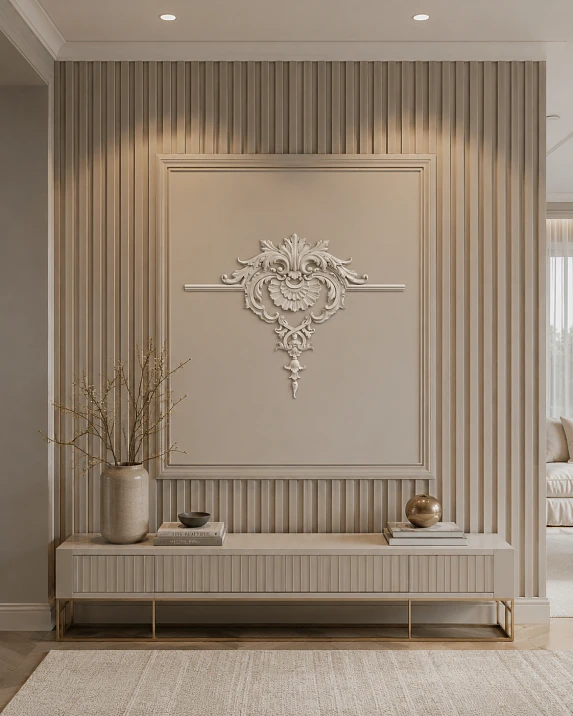
The slat wall is already assembled, painted, or fully finished, but after installation, you want to add one large decorative accent. In the catalog, you like the carved overlay NPU-416.4 made of polyurethane — expressive, quite large, capable of occupying an independent place in the composition.
And here a question arises that would not exist on a regular smooth wall:
can NPU-416.4 be glued directly on top of vertical slats, or does a large overlay need a separate flat mounting platform?
There should be no universal answer like "yes, glue it directly onto the slats."
The current STAVROS product card indicates for NPU-416.4 a size of 526 × 395 × 18 mm, polyurethane material, and a price of 9,180 ₽ per piece. The manufacturer provides for adhesive mounting of decorative products, and in installation recommendations requires a clean, dry, and durable base. For decorative elements, adhesion to the surface is also separately checked.
Therefore, for an already installed slat wall, the correct procedure is different:
not buying the overlay → trying to find a place for the glue, but first:
transfer the actual size to the wall → determine the location of slats and gaps under the future overlay → check the back surface of NPU-416.4 → understand where support will actually occur → choose the base preparation method → only then place the order.
If the slatted surface provides only a few narrow contact lines, and a significant part of the back side will be over empty gaps, a smooth platform becomes a much more logical solution than trying to compensate for the geometry with the amount of glue.
What is NPU-416.4 and why its size is crucial here
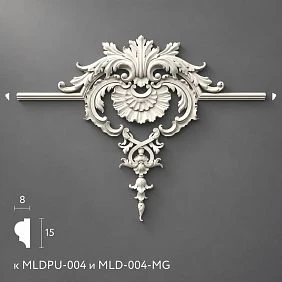
NPU-416.4 is precisely a carved polyurethane overlay. It is in the molding decor section and is an independent ornamental element, not a linear profile. The current product card specifies one size — 526 × 395 × 18 mm, price — 9,180 ₽ per piece.
| Characteristic | NPU-416.4 |
|---|---|
| Product type | Carved overlay |
| Size A | 526 мм |
| Size B | 395 мм |
| Size C | 18 мм |
| Material | Polyurethane |
| Price at time of check | 9,180 ₽/pc. |
| Minimum order | 1 pc. |
For a regular smooth panel, the dimensions are checked relatively simply: the item is applied to the chosen field, the scale is assessed, and the base is prepared.
With slats, the situation is different.
A 526 × 395 mm overlay no longer covers a single flat surface, but a repeating system:
slat → gap → slat → gap → slat.
That is why the product's dimensions begin to affect not only the design, but also the contact pattern.
If the decorative element were 50–70 mm wide, in a specific project it could entirely fit onto one wide base piece.
NPU-416.4 occupies a field of more than half a meter on one side. Within this field, several slats and several gaps could potentially fall at once.
The 526 × 395 mm rectangle has an area of about 0.208 m², but this is only the external dimension. The actual shape of the overlay is carved, and the rear contact surface is not equal to the area of the entire rectangle.
Therefore, calculating the 'bonding percentage' only based on two product dimensions is incorrect.
You need to see the specific rear side of the product and the specific slat layout.




The main answer: a smooth platform is not always needed, but a slatted wall cannot automatically be considered a normal adhesive base.
The phrase 'slatted panel' by itself says nothing about the possibility of installing NPU-416.4.
There are completely different designs.
In one project, these are wide flat slats with a small gap.
In another, narrow slats with deep gaps.
In the third, decorative planks are fixed on a soft or acoustic base.
In the fourth, the relief is formed by a solid milled panel.
Therefore, the decisive factor is not the name of the finish, but the actual contact of the back side of the overlay with a solid base.
Official STAVROS mounting materials recommend a clean, dry, and durable base. Some instructions for polyurethane decor also emphasize the need for a flat surface and checking dry adhesion before fixing.
This leads to three fundamentally different scenarios.
Our factory also produces:
Scenario 1. Smooth platform
Under NPU-416.4 there is a continuous flat surface.
This is the most predictable option for adhesive mounting.
Get Consultation
Scenario 2. Slats bypass the decorative field
A smooth insert is created in the wall in advance or after local modification, and the vertical slats end around it.
Thus, the panel and slat finish work as two separate systems.
Scenario 3. The panel is placed directly on top of the finished relief
Such a solution cannot be prohibited just because the wall is slatted, but it must be confirmed by a real trial fit.
If contact occurs only at a few random points or strips, such mounting cannot be considered equivalent to installation on a smooth base.
Do not confuse the front dimension 526 × 395 mm with the bonding area.
This is one of the most important checks in the entire article.
The buyer sees the size:
and intuitively represents a rectangular part whose entire back surface touches the wall.
and intuitively imagines a rectangular part whose entire back surface touches the wall.
cutouts;
The ornament may have:
-
narrowings;
-
narrowings;
-
protrusions;
-
individual support zones.
-
internal voids;
-
individual support zones.
526 × 395 = 207,770 mm²
526 × 395 = 207,770 mm²
and call the resulting number the adhesive contact area.
This is only the area of the bounding rectangle.
For a real mounting scheme, a different question is needed:
Which specific areas of the back side of NPU-416.4 are actually intended to fit against the base?
Before ordering, this can be roughly estimated from the drawing and image.
After receiving the product, check it directly.
And on top of this map, you need to overlay the pattern of the slats.
How to make a full-size template of NPU-416.4
For a product costing 9,180 ₽, a paper mock-up costs practically nothing, but it can completely change the purchase decision.
Make a template of the external dimensions 526 × 395 mm.
Do not automatically assume that the 526 mm side must be horizontal. The exact position of the product is chosen based on the composition and the current image/drawing. If rotation is considered, its artistic acceptability also needs to be checked.
On the template, mark:
-
external dimensions;
-
central vertical;
-
central horizontal;
-
top and bottom of the selected position;
-
approximate outer contour of the ornament.
Then secure the template to the slat wall with painter's tape.
But the work is only just beginning.
A regular fitting answers the question:
does the size suit here?
We need one more answer:
what is behind the overlay?
How to build a map of battens directly on a paper template
This is the most useful check for this topic.
Let the vertical battens already be in place.
Transfer their positions onto the paper.
For example:
-
attach the 526 × 395 mm rectangle in the intended location;
-
draw vertical lines on it where the actual front surfaces of the battens are;
-
mark the gaps with a different notation;
-
remove the template from the wall;
-
get the map of the future foundation.
Now before you is not an abstract rectangle, but a diagram:
solid surface / empty area / solid surface / empty area.
After that, compare it with the rear geometry of NPU-416.4.
It is here that it becomes clear how reasonable direct mounting over the battens is.
If the large support areas of the overlay coincide with the battens, the situation is one thing.
If most of these areas fall into the gaps, the situation is quite different.
Why you cannot come up with a universal percentage of required contact
A natural question arises:
"What percentage of the overlay should lie on the battens — 30, 50, or 70?"
For NPU-416.4, I would not introduce such a figure without confirmed technical data.
The reason is simple.
The reliability of the adhesive bond depends not only on the area.
Matters:
-
geometry of the back side of the product;
-
location of support areas;
-
base;
-
the condition of the coating;
-
type of mounting compound;
-
actual thickness of the adhesive layer;
-
load distribution;
-
ability of the slats to withstand additional load;
-
quality of fastening the slats themselves to the wall.
Two variants with the same "50% contact" can behave completely differently.
In one, the support is evenly distributed across the entire perimeter and central zones.
In the other, all 50% are concentrated in one part of the pad.
Mathematically, the percentage is the same.
Structurally — no.
Therefore, instead of a universal number, use a support map.
Three questions to ask for each batten under the pad
If installation directly over existing finishes is considered, each batten crossing NPU-416.4 must pass three checks.
1. Is the face width sufficient
A narrow batten creates a narrow contact strip.
This is especially important on a complex carved contour.
2. Is it located where the NPU-416.4 has a real rear support part?
A batten behind a decorative opening provides nothing.
3. How firmly is the rail itself attached?
The adhesive connects the overlay to the batten.
But if the rail is held on a weak base, the entire system remains weak.
That is, the chain looks like this:
NPU-416.4 → mounting layer → rail → rail attachment → wall base.
Reliability cannot be assessed only by the first connection.
Special case: rails are placed on a soft or acoustic base
In some slat systems, decorative slats are not located directly on a mineral wall or rigid furniture board, but are part of a multilayer panel.
In such a construction, the entire system needs to be considered.
Let's imagine:
overlay → batten → soft intermediate material → panel base → wall.
Even if the mounting adhesive adheres perfectly to the front surface of the batten, this still does not answer the question of whether the remaining layers are designed for an additional decorative element.
In such a situation, a smooth separate mounting insert connected to a rigid base becomes a particularly reasonable option.
The soft intermediate layer cannot be considered a full-fledged wall just because the battens look rigid on the outside.
The smooth panel option: why it is usually the most straightforward
If the project can still be locally modified, the most predictable scheme looks like this:
batten finish → separate smooth field → NPU-416.4 → batten finish again.
Here, the overlay gets a proper mounting surface, and the vertical battens do not run directly under the ornament.
This solves two problems at once.
The first is technical.
The adhesive bond works with a continuous base.
The second is compositional.
The carved decor does not compete with the vertical slots directly behind it.
For a large ornamental element, this can be visually cleaner.
You just need to correctly determine the size of the insert itself.
It does not have to mechanically match the 526 × 395 mm rectangle.
The size is determined by the entire composition:
-
the contour of NPU-416.4;
-
the desired free margin;
-
the pitch of the slats;
-
the position of the decorative center;
-
neighboring elements.
Therefore, first place the overlay template, and then design the boundaries of the smooth area around it.
If the slats are already installed, do not rush to dismantle them inside the 526 × 395 mm rectangle.
The most obvious way to make a platform:
mark the rectangle and remove all slats inside it.
But this may give a poor result.
NPU-416.4 has a carved contour, not the shape of a solid slab.
If you cut a strict rectangle exactly to its dimensions, a strange change in texture may become visible in the corners and near the openwork areas:
smooth surface → ornament contour → slats again nearby.
Therefore, the boundaries of the smooth insert should be designed separately.
Sometimes it is better to make the field noticeably independent — for example, within a molding composition.
In another project, it is more logical to leave a wider smooth vertical strip of the wall.
And sometimes it is better to move NPU-416.4 next to the slatted zone, without interfering with the finished finish.
When it is more reasonable to place the NPU-416.4 next to the slats rather than on top of them
This is one of the most useful alternatives.
Let's imagine:
-
the entire central part of the wall is already finished with slats;
-
a smooth strip remains on the right;
-
NPU-416.4 fits well on it;
-
modifying the slat panel would require dismantling several elements.
In such a situation, moving the overlay to the smooth part may be more rational.
You preserve:
-
already completed installation;
-
uniform step of the slats;
-
technical integrity of the panel;
-
clear adhesive base.
At the same time, an interesting composition arises:
the linear texture of the slats next to an independent carved accent, rather than one pattern on top of another.
The STAVROS website already has extensive materials on the combined use of slat panels and polyurethane decor; there, the two types of finishing are considered precisely as different tools of composition.
For this article, this is only important as an alternative:
if the overlay does not work well directly on the relief, you do not have to abandon it completely — you can change the location.
How to tell if NPU-416.4 will get lost against the vertical slats
Technically installing an element is only half the task.
The other half is seeing it after installation.
A slat wall itself creates an active pattern:
-
repeating verticals;
-
dark or light gaps;
-
side shadows;
-
regular rhythm.
NPU-416.4 adds:
-
plant or other carved contour;
-
own relief variations;
-
another line frequency;
-
new shadow drawing.
If you place one pattern directly on top of another, they can either interact interestingly or visually interfere with each other.
Therefore, on a paper template, it is useful not to leave a white rectangle.
Draw at least the main contours of the overlay inside, or print the image to scale.
Then it will become visible whether the slats pass through important areas of the ornament.
A good test: a photo of the wall with a full-size template
After installing the paper mockup, photograph the wall from the usual viewing point.
Just don't do a close-up.
Required:
-
the entire wall;
-
adjacent furniture;
-
door;
-
the ceiling;
-
floor;
-
lighting fixtures.
A large decorative element is assessed relative to the room.
Sometimes 526 × 395 mm on paper seems large, but on a three-meter wall it is perceived calmly.
In another interior, the same size next to narrow slats becomes the main accent.
This check also influences the decision about a smooth surface.
If the overlay is to be the main center of the wall, a separate calm field around it helps readability.
If a complex multi-layered relief is needed, the interaction with the slats can be intentional.
What changes the thickness of 18 mm
The third size of NPU-416.4 is 18 mm.
On the frontal template, this value is not visible at all.
But in a real interior, it participates in the composition.
The slatted wall already protrudes from the base plane.
Another relief object is added on top.
Therefore, you need to look at the node from the side:
base wall → slat surface → NPU-416.4.
If the decorative overlay is installed directly on the front surfaces of the slats, the final protrusion of the composition increases.
With side lighting, this creates a deeper shadow.
On a smooth insert located between the slats, the spatial scheme can be completely different.
That is why the "over the slats" option and the "in a smooth field" option cannot be considered the same just because the frontal position of NPU-416.4 matches.
Side lighting can completely change the result
In a flat visualization, the slat wall and the carved overlay are read as lines.
In a real room, they are also read through shadows.
If the window is on the side or the wall is lit by a directional spotlight, each slat casts its own vertical shadow.
NPU-416.4 creates a second set of shadows.
With direct mounting, several levels of relief appear over the slats.
This can look striking on a large, calm wall.
But in a small room, the same effect can make the surface too fragmented.
Therefore, it is useful to view the pattern:
-
during the day;
-
under primary artificial light;
-
with side lighting, if provided.
One NPU-416.4 or two: the quantity changes not only the price
The original task may assume one central decorative element.
This is the simplest option.
The current price of one NPU-416.4 is 9,180 ₽.
But on a long symmetrical wall, two overlays are sometimes considered.
Pair price:
9 180 × 2 = 18 360 ₽.
However, two elements create another problem — repetition relative to the slat pitch.
If the left NPU-416.4 falls on one sequence of slats, and the right one on another, the contact cards may differ.
That is, it is not enough to check only the first position and mirror the coordinates.
Each location needs to be measured on the actual wall.
If both pads are installed on pre-created identical smooth fields, controlling symmetry is significantly easier.
What to do if NPU-416.4 crosses the edge of the slat zone
Imagine that the template lies half on the racks and half extends onto a smooth wall.
This option technically and visually differs from both clean scenarios.
Under one part of the overlay:
relief surface.
Under the other:
flat base.
As a result:
-
the support plane differs;
-
a height difference is possible;
-
the back part may not fit evenly;
-
The decorative element may end up tilted relative to the wall.
You should not expect the mounting layer to automatically compensate for a significant difference between two bases.
In official STAVROS materials on the installation of polyurethane decor, the evenness of the base is considered an essential condition for proper adhesion.
In such a unit, you first need to bring the mounting field to a single geometry.
Can a smooth platform be recessed between the slats?
This is one of the most interesting options for remodeling an already installed wall.
Instead of applying a continuous plane over the slats, part of the slatted decor is locally removed and a separate insert is created within it.
But here you need to resolve the level issue.
Platform in the plane of the base wall
Then the surrounding slats protrude forward.
NPU-416.4 visually appears "in a niche."
This can look deliberate and architectural.
Platform in the plane of the front side of the slats
Then the smooth field and the battens are roughly at the same level, and the overlay protrudes relative to the overall plane.
This is a different effect.
The platform has its own frame
The smooth area is designed as a separate panel or molding field.
In this case, NPU-416.4 becomes the center of an independent composition.
You need to choose not based on which option is easier to cover with glue, but on the overall look of the wall.
Why you don't need to order NPU-416.4 before deciding on the platform
There is an understandable psychological desire:
"First I'll buy a beautiful overlay, and then the craftsman will figure out how to attach it."
For a finished slatted wall, this is a bad sequence.
The cost of one part is 9,180 ₽.
After purchase, things that existed before the order may come to light:
-
the overlay covers too many empty gaps;
-
the needed spot falls on the panel joint;
-
the slat system has a soft base;
-
the depth of the composition becomes excessive;
-
a smooth field will require too much rework;
-
the ornament is poorly readable on a vertical background.
None of these issues appear after the product is delivered.
They can be detected in advance using a template.
Therefore, the purchase should be the last step of verification, not the first.
Three installation schemes: which is more logical specifically after finished finishing
Let's compare the options in one table.
| Scheme | What's happening | Main advantage | Main risk |
|---|---|---|---|
| Directly on top of the slats | NPU-416.4 rests on individual face strips | minimal wall rework | insufficient or uneven support |
| Smooth insert instead of part of the slats | a separate flat field is created under the overlay | predictable base and clean composition | a local rework of the panel will be required |
| Next to the slat zone | the overlay is moved to an existing smooth wall | the slats don't need to be touched at all | the original composition changes |
This table is more important than a universal answer of "can/cannot".
Each wall has its own initial geometry.
When direct mounting over slats is worth considering at all
Don't automatically dismiss this option.
It can be subject to verification if several conditions are met simultaneously:
-
the rails have a wide, stable face surface;
-
they are rigidly fixed;
-
the rails actually pass under the key support zones of the pad;
-
the back geometry allows proper contact;
-
There is no noticeable misalignment between individual support points;
-
the mounting method permits the specific substrate;
-
a dry fit shows a stable position.
But even if these conditions are met, the final decision on installation should be made based on the actual product, substrate, and the instructions of the adhesive used.
The official STAVROS recommendation for adhesive starts precisely with preparing a dry, clean, and strong surface.
When a smooth area is preferable
I would immediately go with the option of a prepared flat surface if at least one serious problem is visible after the template:
The strips are too narrow relative to the large support areas of the overlay
The contact is fragmentary.
The gaps are too large
Significant parts of the back surface remain without a substrate.
The slatted relief has different levels
The pad does not lie in a single plane.
The basis of the slats itself raises doubts
For example, it is a multi-layer decorative system.
NPU-416.4 should become the main accent of the wall
A calm field helps separate the ornament from the vertical texture.
There is an option to locally change the finish without destroying the entire wall
Then the problem is solved even before the purchase.
How to determine the size of the smooth area
The most common mistake is to automatically make a rectangle of 526 × 395 mm.
These numbers describe the external dimension of NPU-416.4, but do not dictate the size of the architectural field.
First, place the template of the overlay itself.
Then add the assumed free space along the edges.
See where it is more logical to end the slats.
It is especially convenient to align the boundary of the area with the existing finishing step.
For example, if to achieve an exact size you have to cut one slat lengthwise and leave a strange half, it might be better to enlarge the field to the nearest natural boundary of the composition.
Conversely, do not expand the smooth area just for a symmetrical number if it breaks the pattern of the entire wall.
Should a molding frame be made around a smooth insert?
Not necessarily.
But the frame solves a separate task.
Without it, the transition can be:
slats → smooth surface → NPU-416.4.
With the frame:
rails → architectural border → smooth field → NPU-416.4.
The second option separates the two textures more strongly.
If the wall is large and the overlay should look like part of a classic panel, this can be useful.
If the interior is more subdued, an additional molding can become superfluous.
The category that NPU-416.4 belongs to includes decor related to molding compositions.
But this does not mean that a frame is mandatory for every application.
What to do with already painted rails
Ready-made paint is another reason not to start work with dismantling.
First, find out:
-
what the slats are painted with;
-
whether the selected elements can be removed without damaging adjacent ones;
-
how the finish around the new insert will be restored;
-
whether repainting will match in shade and gloss.
If a local rework leads to noticeable marks across the entire wall, the option of moving NPU-416.4 to an adjacent smooth surface may be more rational.
If the panels are modular and the required section can be easily modified, creating a separate field is not a serious problem.
The base for adhesive must be prepared as a system, not just cleaned of dust.
Often, preparation is understood as:
"wiped the surface — you can glue."
For a large patch, this is not enough.
Need to check:
-
strength of the base itself;
-
absence of peeling coating;
-
dryness;
-
cleanliness;
-
flatness;
-
compatibility of the mounting compound.
Official STAVROS recommendations indicate the need for a clean and dry surface; for loose substrates, preliminary reinforcement is provided, and in decorative materials, the evenness of the mounting plane is specifically mentioned.
On a finished painted surface, aggressive solvents should not be used without testing, and the visible part of the slats should not be accidentally sanded.
Preparation depends on the specific finishing system.
How to use KUDO from the product card
In the related products block for NPU-416.4, KUDO HIGH TACK 280 ml is currently present at a price of 990 ₽.
It can be considered as a related mounting product, but the presence of adhesive next to the card does not negate the need to check the substrate.
If you need buy glue for installing moldings, before work, you should still verify the instructions of the specific compound and its compatibility with the actual wall surface.
No need to promise in advance:
"one cartridge will definitely be enough for one NPU-416.4."
Actual consumption depends on the application pattern and the actual rear surface.
Why filling deep gaps between slats with adhesive is poor selection logic
If after a dry fit it turns out that deep voids remain between the back side of NPU-416.4 and the wall, an idea may arise:
"let's just apply more mounting compound."
This approach substitutes base design with glue consumption.
The mounting compound should join suitable surfaces, not turn into a random volumetric structure between several levels of the wall.
If the gap arises specifically from the slatted surface architecture, it's better to resolve the geometry first.
A smooth insert or a different position of the overlay gives a controlled result.
How to conduct a dry fit of the actual NPU-416.4
After receiving the product, do not immediately proceed to the adhesive.
Apply the overlay to the wall without the mounting compound.
It is better to work in pairs, especially if you need to simultaneously check the back fit and the overall look of the composition.
Check:
-
actual position;
-
contact with the rails;
-
presence of rocking;
-
points where the back side remains in the air;
-
position relative to the vertical rhythm;
-
side offset;
-
shadows;
-
possibility of temporary fixation during installation.
Official STAVROS instructions for decorative parts also use dry fitting and checking the fit before applying glue.
If the overlay rocks on the rails, this is a signal to change the base
Rocking means that the product does not receive one stable plane.
The cause may be in:
-
different heights of the slats;
-
curvature of the base;
-
geometry of the back surface;
-
the protrusion of the overlay getting between the lamellas;
-
local defect.
Do not immediately press the element harder.
First, find the cause.
If the problem is systemic — a relief wall and a flat back part fundamentally do not match — a smooth platform solves the task better.
What to do if after trying on, the overlay looks "foreign" over the slats
This is not an installation problem.
And it cannot be solved with glue.
The carved ornament may conflict with the slats in scale.
Signs:
-
verticals are visible through the openwork pattern and fragment it;
-
the contour of NPU-416.4 is lost;
-
the background looks more active than the overlay itself;
-
too many shadows appear on the wall;
-
the decorative center is poorly readable from a distance.
Try temporarily placing a solid-color sheet behind the paper template.
If the composition immediately becomes significantly calmer and clearer, this is a strong argument in favor of a smooth insert.
The color of the smooth area also changes the result.
Suppose the slats are dark, the wall is light.
NPU-416.4 can be placed:
On a light field
The ornament reads more clearly.
The slat part works as a frame or surrounding texture.
On a field of the slats' color
The difference is built mainly on relief.
The composition becomes more monolithic.
On a contrasting independent background
Another color layer appears.
For complex carved decor, this may be too much.
Therefore, the platform cannot be considered only a technical backing.
After appearing on the wall, it becomes part of the design.
If NPU-416.4 is painted in the color of the slats
Monotony reduces the conflict between different ornaments.
Vertical rhythm and carved decor are connected by color.
But the problem does not completely disappear: chiaroscuro still shows two reliefs.
Therefore, even in a monochrome solution, shadows need to be checked.
If an overlay on a smooth background in the same color reads better, the reason is precisely geometry, not shade.
When one overlay is better than a complex molding composition
Although NPU-416.4 falls into the category of molding decor, it can be considered a large standalone accent in a specific project if the composition allows it.
The advantage of such a solution is fewer competing lines.
A slat wall already has enough linear structure.
Addition:
-
frames;
-
angles;
-
several moldings;
-
additional overlays
may overload the surface.
Sometimes one NPU-416.4 on a properly prepared smooth field gives a clearer result.
When it's better to choose smaller decor
If installing NPU-416.4 requires dismantling too large a part of the finished wall, that's a signal to compare another product.
In the current section polyurethane molding decor other overlays of different sizes are presented; NPU-416.4 is there among other models.
A smaller element can:
-
fit onto a larger number of solid base sections;
-
require a smaller smooth area;
-
better match the frequent spacing of slats;
-
reduce the amount of rework needed on the finished wall.
There's no need to consider replacing NPU-416.4 a compromise.
If a smaller overlay better fits the structure, it's a more precise choice.
When a carved overlay is not needed at all
Sometimes after the template it becomes clear that the slat wall itself is already compositionally complete.
The vertical rhythm works.
The furniture is in its place.
The lighting emphasizes the texture.
A large additional ornament only creates another focal point.
In such a situation, the best test result is to add nothing.
There is no need to buy NPU-416.4 just because there is physically 526 × 395 mm of free space on the wall.
Practical example: wide slats, small gaps
Let's imagine a conditional slat wall where the front surfaces are wide enough and repeat frequently.
The NPU-416.4 template covers many individual slats.
After transferring the map, it is visible that the main zones of the rear contact are distributed across the entire area and coincide with solid sections.
Such a project allows for further verification of direct mounting.
But even here, the next stage:
not buying glue, but a dry fit of the actual overlay.
It is necessary to confirm that the geometry of the rear side indeed matches the paper map made.
Another example: narrow slats with deep gaps
Now the vertical lamellas are narrow, with large gaps between them.
On the template, it's visible that a significant part of the carved element is above the voids.
Additionally, individual large parts of the ornament fall completely between the slats.
Here, an attempt at direct installation becomes significantly less logical.
Instead of complicating the adhesive joint, it is simpler to consider:
-
a smooth insert;
-
Third example: the overlay falls on the joint of two slat modules
The problem is not in the gaps.
The NPU-416.4 position itself crosses the boundary of two panels.
Behind the decorative overlay are:
- different modules;
- a possible technological seam;
- a potentially slight difference in level.
Even if each individual slat is wide, the base is already uneven.
In this case, it is especially useful to check the flatness with a straightedge or another suitable tool and ensure that the overlay does not wobble.
If the joint noticeably changes the geometry, it needs to be brought to a single mounting plane.
Paint NPU-416.4 before or after installation
The product card and general STAVROS recommendations allow subsequent painting of polyurethane decor.
The sequence depends on the project.
If a new smooth insert is being created
It is often convenient to first assemble the entire assembly, then apply the intended finish as a single composition.
If the slats already have a finished coating
You need to work especially carefully near them.
Pre-painting the overlay can reduce the number of operations directly on the wall, but installation and finishing areas still require care.
If NPU-416.4 will be contrasting
Separate painting before installation makes it easier to work out complex relief.
But the specific technology depends on the chosen coating system.
How to form the final order
If after all checks NPU-416.4 is suitable, the shopping list becomes much clearer.
One carved overlay
For one central accent, you can buy a carved overlay NPU-416.4.
The current price is 9,180 RUB.
Two overlays
For a symmetrical composition:
18,360 ₽ for two pieces at the current price.
Installation materials
They are selected after determining the actual base.
For the related product, available glue for mounting moldings. KUDO HIGH TACK is now also present among the related products of the NPU-416.4 card.
Alternative decor
If NPU-416.4 is too large or requires excessive rework, go to the section polyurethane molding decor.
If the panels themselves are also being designed
For another wall or a new room, you can prepare in advance Buy slatted panels for wall finishing already taking into account the future decorative field, rather than cutting out the space after the renovation is completed.
For a general selection of the decorative system, there is a section where you can You can buy ready-made stucco matching the Baroque style. Calculate the quantity: linear meters of cornices and moldings, number of rosettes, pilasters, consoles, corner elements. Add a ten to fifteen percent allowance for trimming..
Ready-made solution scheme: from wall to purchase
If slat cladding already exists, use this order.
- Select the intended location for the NPU-416.4.
- Check the actual product size — 526 × 395 × 18 mm.
- Make a 1:1 template.
- Check the orientation of the ornament.
- Attach the template to the wall.
- Transfer all slats and gaps onto it.
- Mark the panel joints.
- Evaluate the composition's appearance from a distance.
- Compare the option over the slats and on a solid background.
- Check the construction of the slat panels themselves.
- Determine whether their front surface is a suitable hard base.
- Compare the slat map with the rear geometry of NPU-416.4.
- If the support is partial, design a smooth platform.
- Determine the level of the platform relative to the face plane of the rails.
- Check the side overhang considering the 18-millimeter relief.
- Decide whether a frame around the smooth field is needed.
- If the rework is too extensive, try the adjacent smooth part of the wall.
- If that doesn't work either, choose a smaller decor.
- After receiving the product, perform a real dry fit.
- Select a mounting compound suitable for the specific substrate.
- Only after this proceed to the final fixation.
Conclusion: can NPU-416.4 be glued directly onto the rails
Sometimes this option can be considered, but it cannot be considered a normal universal method in advance.
NPU-416.4 is a large carved overlay measuring 526 × 395 × 18 mm, costing 9,180 ₽.
For its installation, not only the wall area matters, but also the quality of the actual support behind the back side.
If the slatted surface gives:
- several random narrow contacts;
- large voids;
- a difference in plane levels;
- soft or questionable intermediate base,
it is more reasonable to create a smooth, sturdy mounting surface or move the overlay to an adjacent flat part of the wall.
If the slats are wide, rigidly fixed, coincide with the main zones of rear contact, the product lies stably during dry fitting, and the chosen mounting compound allows for the specific base, the direct option can be tested further.
The main thing is not to try to get an answer based on the single word "slats."
The correct question is:
what real support does NPU-416.4 get specifically on my wall?
If this support cannot be confidently shown on the template and confirmed by a dry fit, buying the overlay with the expectation that "the master will glue it somehow later" is not worth it.
First, the platform.
Then, the mounting diagram.
And only after that — order NPU-416.4 made of polyurethane.
FAQ
Can NPU-416.4 be secured on just two or three wide battens?
This cannot be determined by the number of rails alone.
You need to see where these battens run relative to the actual rear support areas of NPU-416.4 and how stable the product lies during a dry fit.
Two wide evenly spaced supports and two rails that end up only under one edge of the overlay are different situations.
What to do if the battens have a rounded face surface?
Then the actual contact area may be narrower than the visual width of the rail.
Such a surface needs to be checked on the actual product with particular care. If the overlay rests only on the tops of the fillets and rocks, a different base is required.
Is it possible to place a thin separate plate on top of the rails under the NPU-416.4?
Such a solution already creates a new structure: the overlay is attached to the plate, and the plate is attached to the rail system.
Its strength cannot be assessed only by the NPU-416.4 material. The fastening of the plate itself and its connection to the solid base need to be designed separately.
If the goal is precisely to obtain a flat surface, it is usually more useful to first design a full-fledged insert rather than a hidden random shim.
Is it necessary to remove the rails under all the openwork holes of the overlay?
Not necessarily. The decision is made based on the entire composition and the mounting area.
If a full smooth field is created, it can continue even behind the ornament holes, becoming a visible background.
This is already a design effect, not just a technical issue.
What will be visible through the open areas of the NPU-416.4?
If the shape of the overlay has gaps, the background participates in the composition.
On a direct slat mounting, a vertical rhythm may be visible through them.
On a smooth platform, there is a calm, solid-color surface.
That is why it is advisable to create the layout not only along the outer rectangle, but also along the approximate real contour.
Can a smooth platform be made in a different color?
Yes. But then it becomes an independent part of the composition.
First, check the color on the mockup: three levels — slats, a separate field, and a carved overlay — can look either layered or too fragmented.
What to do if NPU-416.4 covers a switch or an outlet?
Do not move the electrical point automatically for the sake of a decorative cover.
First change the position of the template or choose a different decor size. Any electrical changes must be handled separately by a specialist.
Will the NPU-416.4 fit a slat wall in a hallway with high traffic?
The size may physically fit, but additionally check the final protrusion of the entire composition.
The slat already protrudes relative to the wall, and the NPU-416.4 has its own relief of up to 18 mm according to the specified dimension.
In a narrow passage, this has more practical significance than on a wall behind a sofa.
Can the cover be glued onto painted wooden slats?
The answer depends on the specific paint, coating condition, substrate, and mounting compound.
The adhesive will actually adhere to the paint layer. If the layer has weak adhesion to the slat itself, the strength of the bond is limited by that layer.
Check the entire system.
What is better: to cut out a rectangle of 526 × 395 mm or to make a larger smooth area?
It is not worth automatically selecting the exact rectangle.
526 × 395 mm is the overlay dimension, not the finished size of the architectural insert.
The boundary of the smooth field should take into account the contour of the ornament and the pitch of the slat wall.
Can the NPU-416.4 be rotated 90 degrees?
The physical dimension allows trying a different position, but the artistic orientation should be checked against the pattern and the actual image/drawing of the product.
Do not rotate the carved ornament just because the rectangle fits better that way.
What to do if after removing the slats the platform turned out to be lower than the surrounding surface?
You get a niche.
It can become a deliberate design technique or require bringing the mounting surface to another level.
The decision is made before gluing the NPU-416.4, because the base level determines the final depth of the entire composition.
Can two NPU-416.4 be installed symmetrically on one slat wall?
Such a project can be considered, but the slat map needs to be built for each position separately.
At the current price, two overlays cost 18,360 ₽, so a full double fitting is especially justified.
Where to choose a smaller decor if NPU-416.4 is too large?
In the section polyurethane molding decor Other overlays and components of different sizes are presented. NPU-416.4 is also in this category.
Where to buy NPU-416.4?
Current product card carved overlay NPU-416.4 is in the STAVROS catalog.
At the time of inspection, the dimensions were 526 × 395 × 18 mm, the material was polyurethane, and the price was 9,180 ₽ per piece.
Before ordering for a finished slat wall, first make a full-size template and determine whether the overlay will have a normal mounting surface.