Article Contents:
- What exactly do we check before purchasing NPU-276
- 352 × 220 mm above the monitor: how to check the scale of NPU-276 before ordering
- Where does the axis of NPU-276 run relative to the desk and screen
- How much air to leave above the monitor and below the overlay
- Slatted panels already create a strong rhythm: won't NPU-276 become redundant
- The smooth field between the slats matters more than the mere fact of available space
- Should the overlay be positioned strictly above the monitor
- One common central axis
- The center of the wall is more important than the temporary position of the monitor
- Too many axes
- Purchasing without a full-size template
- Centering across the entire room instead of the work area
- Evaluating only in daylight
- Trying to fill any free space
- Adding a frame "for solidity" after choosing NPU-276
- Ignoring mobile equipment
- Can NPU-276 be placed above the monitor if the desk is not strictly centered in the room?
- What to do if the monitor is later replaced with a larger one?
- Will NPU-276 work for a workstation with a laptop instead of a stationary monitor?
- Can a webcam or video light be placed under the overlay?
- Is it necessary to repeat the color of the wooden slat panels on the NPU-276?
- Can the NPU-276 be installed if the slat panels are located only on one side?
- What to do if a ventilation grille or sensor passes directly above the monitor?
- Can the NPU-276 be installed first, and then the slat panels be selected?
- Is one NPU-276 suitable for two adjacent workstations?
- If the NPU-276 does not fit, is it mandatory to look for another overlay?
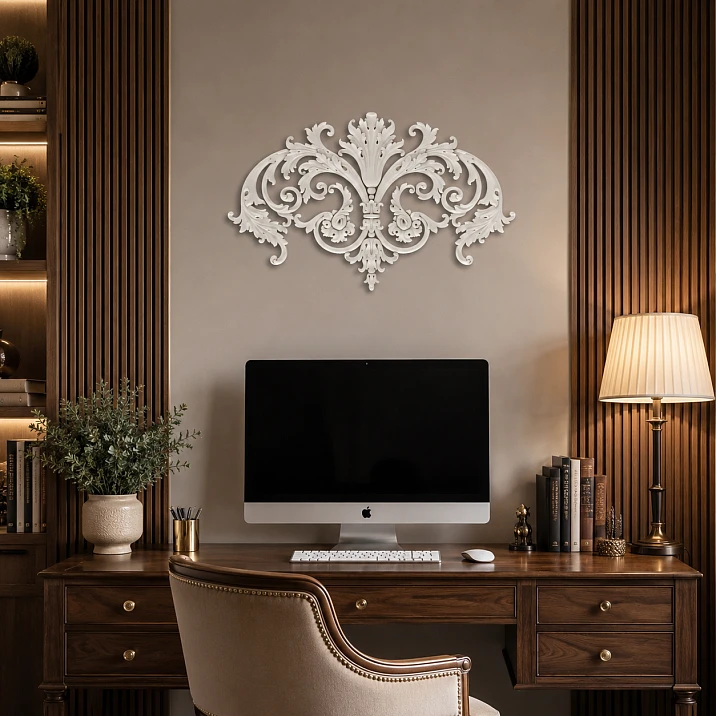
The workspace may already look complete without additional decor. The desk sets the horizontal line, the monitor creates a dark rectangular center, and the slat panels on the right and left form an active vertical rhythm. Therefore, the question of a central carved overlay above the screen cannot be resolved on the principle of "free space must be filled with something." What matters more here is whether one ornamental element will become a unifying center of the composition or turn into an extra detail that conflicts with both the monitor and the slats.
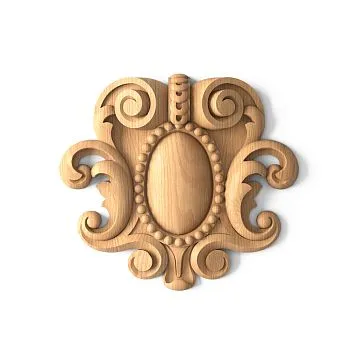
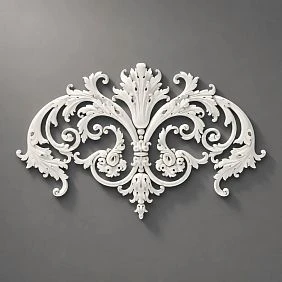
For this scenario, a specific central carved decorative overlay NPU-276 made of polyurethane in the size 352 × 220 × 12 mm is considered. At the time of preparing the material, this option is listed on the STAVROS website at a price of 4,600 ₽ per piece. The basic purchase is one overlay. It is not needed for mounting the monitor, is not part of the cable channel, and should not cover technical openings: its function is purely decorative.
The direct answer is this: the NPU-276 makes sense to buy only after a full-scale trial of the 352 × 220 mm template on the finished work wall. If the template brings the desk, monitor, and side slat fields into one composition, does not press on the screen, does not fall into a light glare, and does not look like a random "rosette" above the equipment, one overlay can become a neat central accent. If the area is already saturated with texture, the monitor is large, there is little air above it, or the smooth field is too narrow, an empty painted wall often looks more convincing.
If the fitting is successful, you can buy the central carved decorative overlay NPU-276 made of polyurethane. If the shape or scale does not fit, it is more logical to go to the catalog and choose a central overlay made of polyurethane with a different pattern, rather than trying to "force" NPU-276 just because it appealed to you on the product card.
What exactly we check before buying NPU-276
The work area has several independent geometries. The error occurs when only one is evaluated—for example, the width of the table. On the wall, the countertop, monitor, side panels, smooth section, free space up to the ceiling, lights, and sometimes wall shelves work simultaneously. The overlay should fit not just "above the table," but into the free field between all these objects.
For NPU-276, the manufacturer specifies dimensions A × B × C 352 × 220 × 12 mm. The article does not compare another version: the task is already fixed on the compact variant. During geometric fitting, it is safer not to base calculations on an unconfirmed assumption about which letter of the card corresponds to the horizontal. A practical method is simpler: open the image of the selected version, save the intended orientation, and make a full-size paper or cardboard template according to the dimensions 352 × 220 mm. If in the selected orientation the element occupies 352 mm horizontally and 220 mm vertically, that is exactly the rectangle that should appear on the wall before ordering.
The thickness of 12 mm also affects perception. In the frontal photo it is almost unreadable, but with side lighting the relief begins to cast its own shadow. Therefore, the final decision is better made not by a flat mockup on the screen, but by a template on the wall under the lighting in which the office is actually used in the evening.
Before fitting, it is useful to record five dimensions:
| What to measure | Why this is needed |
|---|---|
| width of the smooth field between slat panels | understand whether there is enough calm background around the overlay |
| distance from the top edge of the monitor to the ceiling or nearest shelf | check vertical placement |
| monitor width | align the decorative center with the main technical object |
| table width | understand the scale of the entire work area, not just the screen |
| position of the monitor center relative to the smooth field | decide which axis to consider the main one |
These measurements provide the basis for a decision. There is no universal standard in millimeters that will automatically make a composition beautiful. A workspace with a 27-inch screen, a 1400 mm desk, and a narrow central wall section is perceived differently than a workstation with a wide 34-inch monitor and a two-meter smooth surface. Therefore, the article uses not "magic distances" but verifiable relationships between objects.




352 × 220 mm above the monitor: how to check the scale of NPU-276 before ordering
The most useful check is to compare the overlay not with the entire wall, but with the rectangle that a person sees as the workspace. Usually, its lower boundary is set by the tabletop, the middle by the monitor, and the side boundaries by either the edges of the smooth surface or the edges of the slatted inserts. If NPU-276 inside this rectangle looks like a separate random detail, the purchase does not solve the task even if there is technically enough space.
Suppose the desk is 1500 mm wide. If, in the chosen orientation, NPU-276 occupies 352 mm horizontally, its dimension is approximately 23.5% of the desk width:
352 / 1500 × 100 ≈ 23,5%.
This is not a standard or an "ideal proportion." The calculation is needed to see the scale. The overlay does not try to match the width of the tabletop and remains a local central accent. But then it is important to compare it with the monitor. If the screen is, for example, about 700–800 mm wide, the decorative element will be noticeably narrower than the screen. Such a composition can be logical: the monitor remains the main large rectangle, and the molding works as a top point. If the screen itself is small, NPU-276 may approach its width and visually begin to compete with the equipment.
To avoid duplicating the same calculations, a single observation table is enough:
| Situation during fitting | How NPU-276 is perceived | What to do |
| the overlay is noticeably narrower than the monitor and there is a lot of smooth wall around it | local top accent | you can continue the check |
| the overlay is almost equal to the monitor in visual width | Two competing centers | check the height and light, possibly abandon it |
| the smooth field is barely wider than the template | the decor looks squeezed | more often it's better to choose a smaller/calmer element or leave the wall empty |
| the table is wide, and the overlay seems like a 'dot' far at the top | the connection with the workspace is lost | change the height, composition, or abandon the NPU-276 |
| the slat fields are very active and come close to the overlay | the ornament conflicts with the vertical rhythm | increase the calm field or do not add molding |
The main principle: scale is checked by eye on the real wall after marking, and numbers help explain why one option looks cohesive and another looks random. Buying an overlay just because 352 mm is "less than the table width" is not enough.
There is another practical observation. The central overlay works better where it has its own neutral field. Slat panels already form a textured frame around the smooth area. If NPU-276 almost touches them visually, the central zone stops being a pause and turns into another dense decorative layer. The more complex the ornament, the more important it is to leave a calm background around it.
Our factory also produces:
Where the NPU-276 axis runs relative to the table and screen
A common mistake is to automatically find the geometric center of the entire wall and place the overlay there. For a workspace, this is not always correct. If the table, monitor, and smooth field are truly positioned strictly in the center of the wall, all axes will align. But in a real office, the table may be shifted due to a door, window, radiator, cabinet, or outlets. Then the "center of the room" and the "center of the work composition" are different points.
In this scenario, you first need to determine what is perceived as the main object. If the monitor is centered on the table and the table is symmetrically placed in the smooth field, the most logical approach is one common axis: monitor center → NPU-276 center. This way, the eye connects the equipment and the decorative top into a single vertical composition.
If the monitor is shifted to the side on a mount, while the table remains centered on the smooth wall, the situation is more complex. Centering NPU-276 only on the screen can be a mistake: when the mount moves, the screen will change position, but the overlay will remain. In such a case, the architectural axis of the smooth field or the stationary table becomes a more stable reference. The same applies to workstations with a laptop and an external monitor: the equipment may change, but the wall composition should retain its meaning.
A practical check takes a few minutes:
-
Mark the vertical axis of the smooth field with painter's tape.
-
Separately mark the center of the tabletop.
-
Check the center of the monitor in its normal working position.
-
Attach the NPU-276 template first along the wall axis, then along the screen axis.
-
Step back to the room entrance and to the point from which the work area is most often visible.
If the difference between the axes is small, the eye may not read it as a problem. If it is noticeable, you need to choose what in the room is permanent architecture and what is temporary equipment. For an expensive decorative element, it is more reasonable to anchor to the permanent structure.
A separate case is two monitors. Hanging NPU-276 in the center of one of them is usually illogical. The axis of the pair of screens or the table becomes the main one. If the monitors are of different sizes and are placed asymmetrically, the central carved overlay can emphasize the conflict instead of hiding it. Here the template is especially important: sometimes the best result is given by an empty upper zone without an additional attempt to "fix" the asymmetry with molding.
Get Consultation
How much air to leave above the monitor and below the overlay
The overlay should not visually rest on the monitor. Between the dark top edge of the screen and the carved relief, a pause is needed, otherwise two different objects merge into one heavy block. But too large a gap can break the connection: NPU-276 will start living separately somewhere under the ceiling.
Here it is useless to assign one universal distance like 150 or 200 mm. The perception is influenced by the monitor height, the position of its top edge, eye level, ceiling height, and the presence of shelves. A practical method is more reliable:
-
first, place the monitor in its real working position, including the height of the stand or bracket;
-
run painter's tape along its top line on the wall;
-
place the NPU-276 template higher;
-
gradually raise it until the element is no longer perceived as part of the monitor body;
-
then check whether it has moved too close to the ceiling or wall light.
For evaluation, you can use the ratio of the empty gap to the height of the overlay itself. If in the intended orientation its vertical dimension is 220 mm, a gap of several tens of millimeters will almost certainly look like a random technical seam rather than a full pause. But the specific comfortable value depends on the entire wall, so it cannot be replaced with a universal number.
You also need to consider a possible monitor replacement. If today a low 24–27-inch screen is installed, and in a year a taller monitor appears on a different bracket, an overlay mounted too low may end up almost above the frame of the new display. Height margin is not just aesthetics, but also adaptability of the workspace.
If an adjustable wall lamp, camera, light panel, or acoustic shelf is planned above the desk, check not only the current position but also the working range of these objects. The decorative overlay should remain in an area that the equipment does not enter during movement.
Slat panels already provide a strong rhythm: will NPU-276 become redundant
In a study with slat panels, the background is initially more active than a regular painted wall. Vertical repeating lines create their own pattern and, with side lighting, add a series of shadows. STAVROS describes slat panels as a surface with a uniform linear rhythm that interacts with light. That is why they cannot be treated as a neutral frame around any decor.
NPU-276, in contrast, is built on a carved ornament. It has a different language: not repeating straight lines, but a complex central pattern. The combination can be successful if the smooth part of the wall serves as a pause between two types of texture. Then the slat panels limit the work area on the sides, and NPU-276 becomes a single point on a calm plane.
The problem starts when there is no calm field. Imagine a narrow smooth strip, with deep slats almost immediately to the right and left. In the center — a dark monitor, above — a carved overlay. Instead of a clear hierarchy, you get four competing layers: the lines of the slats, the black screen, the ornament, and the shadows from the ornament. In this case, adding molding does not "enrich" the interior, but reduces visual readability.
It is useful to perform a photo test. Take a strictly frontal shot of the working wall without the overlay. Then attach the template and take a second shot from the same point and at the same focal length. Compare not the beauty of NPU-276 separately, but where the eye stops in the first two seconds. If the shape of the workspace is seen first, and then the detail — the hierarchy is preserved. If the eye darts between the slats and the carved center, there is already too much decor.
For those who are just designing the side fields, it is useful to first buy wall slat panels or choose a specific texture from the catalog, and only after a real sample select the relief of the molding. On a monitor screen, the depth of the slat and its shadow almost always look calmer than in a room.
If you planned buy slatted panels for a specific office, keep in mind that this user URL currently leads to the current catalog of STAVROS slat wall panels. From the point of view of the composition itself, what matters is not the section address, but the actual profile of the selected panel: slat frequency, depth, color, and light direction.
The smooth field between the slats is more important than the mere fact of having free space
The phrase "there is free space above the monitor" does not yet mean that there is a good zone for NPU-276. For a central decorative accent, you need a plane where the product visually separates from the adjacent texture and can be physically securely attached.
First, measure the width of the smooth section. Then, if in the selected orientation the overlay width is 352 mm, calculate the remainder:
free side field = width of smooth section − 352 mm.
If the composition is symmetrical, half of the remainder falls on each side. This calculation is needed not to obtain a regulatory "minimum," but to see in advance how close the ornament will come to the rails.
For example, with a smooth field of 1000 mm, after placing a 352-mm template, 648 mm will remain in total, that is, 324 mm on each side with precise centering. The overlay gets its own background. With a field of 500 mm, the remainder will be only 148 mm, or 74 mm on each side. Geometrically, the template fits, but visually the ornament is almost squeezed between two relief zones. This is a different result.
Here, one calculation gives two fundamentally different scenarios, so there is no point in repeating the arithmetic for a dozen widths. After obtaining your value, you need to stand at the actual viewing point and assess whether the remaining field is perceived as a background or as a narrow gap.
There is also a mounting side. If the "smooth field" is formed by a thin decorative insert, wallpaper with pronounced texture, weak old coating, or an area with hidden utilities, visual width alone is not enough. The base must be suitable for the chosen mounting system. In the NPU-276 card, the manufacturer specifies installation with adhesive for moldings, so surface preparation and compatibility of the adhesive with the actual wall finish are important before installation.
If measurements reveal that the central zone is too tight, it is wiser to open the section and select a decorative polyurethane overlay of a different scale or a calmer pattern. This is better than mounting NPU-276 in a place where it physically fits but does not work compositionally.
Should the overlay be strictly above the monitor
The scenario name says "above the monitor," but this does not mean the product must be tied to the display body as a decorative superstructure. The overlay belongs to the wall. The monitor belongs to the work equipment. A good composition connects them with an axis but preserves the independence of each object.
This is especially noticeable with an adjustable bracket. The screen can be raised, lowered, or rotated, while NPU-276 remains in place. Therefore, the position of the molding should be chosen based on the architecture of the entire work area, not on the random height of the monitor on the day of installation.
If the table stands on a smooth section between panels, three stable layouts are possible:
One common central axis
The table, monitor, smooth field, and NPU-276 align at the center. This is the most straightforward scenario. The overlay completes the vertical line, and the slatted fields symmetrically hold the composition on the sides.
The center of the wall matters more than the temporary position of the monitor
The monitor is movable or slightly offset, but the table and wall field are stationary. It is more logical to keep the overlay on the axis of the architectural field. Then, when the equipment changes, the composition does not fall apart.
Too many axes
The table is offset, the monitor is asymmetrical, the panels have different widths, and a shelf hangs nearby. Attempting to add another "center" often makes the discrepancies more noticeable. In this option, forgoing the NPU-276 may be a more professional solution than striving to create symmetry at any cost.
Such a refusal is especially important in a commercial article. It is useful for the buyer to understand not only why the product might fit, but also what sign indicates that their specific work wall is not a suitable basis for a central accent.
Is a molding frame needed around the NPU-276
For the given topic, a frame is not a mandatory part of the purchase. Moreover, in a work area between slatted panels, it often worsens the result. The side slatted fields already serve as large vertical boundaries. If you add another rectangle of molding around the NPU-276, a second contour appears that can conflict with both the monitor and the outer boundaries of the smooth wall.
A single central overlay works differently: it leaves more air and does not turn a home office into a classic panel just because of one carved element. This is especially useful when the desk, equipment, and lighting are modern, and the molding is needed as a small historical or classical note.
A frame makes sense to consider only for a different initial task—when the entire smooth central part is designed as an independent decorative panel and the monitor is part of that system. Then you need to separately calculate the dimensions of the moldings, indents, screen position, and overlay. This is already a different intent and a different configuration, not a mandatory continuation of the current solution.
STAVROS has a comprehensive informational article "From frames to panels: three levels of wall molding complexity", which examines different levels of wall compositions. For our scenario, this link is useful precisely as a next step: it helps to understand when a single accent is no longer enough and the project truly transitions into a frame system.
If the task remains narrow—one NPU-276 above the workspace—there is no need to add molding for the sake of "completeness." What makes a composition complete is not the number of details, but a clear hierarchy.
How a 12-millimeter relief works with workspace lighting
The third dimension of NPU-276—12 mm—is easy to underestimate. Under even frontal lighting, the overlay is perceived mainly by its pattern. With side light, even a relatively shallow relief begins to cast shadows, and the ornament becomes more contrasting. This is especially relevant in an office: there is often a desk lamp, linear shelf lighting, sconces, a monitor lamp, or side light from a window.
Therefore, the mockup should be checked in at least two modes: daytime and evening. If directional light is turned on nearby in the evening, hold not only a paper outline against the wall, but also any safe test element of similar thickness to understand the direction of the shadow. A paper template shows the dimensions but does not convey the volume.
Too harsh side lighting can make the carved pattern visually heavier than in the catalog photo. Especially if the slatted panels nearby already provide an alternation of light and shadow. Then the same interior gets two different relief rhythms: frequent vertical shadows from the slats and complex local shadows from NPU-276.
A successful scenario is when the light on the smooth field is softer than on the side panels. The slatted sections retain their texture, and the central overlay reads as an ornament without turning into a sharp bas-relief above the screen.
Also watch out for glare on the monitor. The overlay itself does not interfere with work, but you should not direct light so that it reflects in the display just to illuminate it. The functionality of the workspace matters more than a decorative photo.
Color NPU-276: matching the wall tone or as a separate contrast
For a work area between slatted panels, the safest starting option is to test NPU-276 in the color of the smooth wall. Then the relief reads through light and shadow rather than turning into another color spot. This approach is especially useful if the side panels have a wood tone, the monitor is black or dark gray, and there is already noticeable equipment on the desk.
Contrast painting increases the visual weight of the element. This is not prohibited, but it changes the task. A white overlay on a dark wall or a dark one on a light wall will be perceived not as a subtle architectural relief, but as an independent graphic object. In a small office, such an accent may end up stronger than the monitor.
Before painting, it is useful to do a digital mock-up using a photo of the room, but the final decision should still be checked in person. The camera and screen do not convey the exact brightness of the surface, the gloss of the paint, or the behavior of the relief under side lighting.
If painting in the wall color is planned, the compatibility of the finishing system with polyurethane and the manufacturer's instructions for surface preparation and coating application must be considered. You should not transfer just any paint to the decorative element simply because the wall has already been painted with it. The base material is different, and adhesion requirements may differ.
If the office is still at the stage of selecting finishes, the general catalog allows you to view polyurethane molded decor and compare different decor groups before the final color choice. For an already finished wall, this article follows the reverse logic: first the existing interior, then the decision about a single overlay.
A monitor on a stand and a monitor on a bracket are two different scenarios
From the perspective of wall decor, these options cannot be mixed. A monitor on its standard stand usually has a limited range of positions. Its upper boundary relative to the wall changes little. If the desk is not height-adjustable, the composition is fairly stable.
A monitor on a wall or desk mount is mobile. The user can raise the screen, pull it forward, or rotate it to portrait mode. Therefore, you need to check the extreme working position, not just the "nice" position at the time of marking.
If the screen can rotate vertically, its top point will rise significantly. Before purchasing the NPU-276, perform the actual movement and see whether the screen enters the intended overlay area. Even if you rarely use portrait mode, it's better to know the limitation in advance.
The same applies to a height-adjustable desk. When the tabletop is raised, the monitor rises with it. Wall decor stays in place. If the workspace involves alternating between sitting and standing, the check must be performed at the highest table position. Otherwise, a nice sitting composition will become inconvenient when raised.
This is a good example of why an article about the NPU-276 should not be a retelling of the product card. The size and material are known from the catalog, but the purchase decision depends on the actual kinematics of the workspace.
What to do with the camera, light bar, speakers, and shelves
A modern workspace rarely consists only of a desk and a monitor. Above the screen, there may be a webcam, a lamp mounted on top, speakers on the sides, and a shelf hanging higher up. Each item changes the free space.
The webcam is especially important if it is mounted on the top bezel of the monitor. When turned off, it's a small detail, but during video calls, the camera sets the functional axis of the gaze. A decorative overlay placed too low directly above it can create a strange "camera-ornament" combination and appear in the background of the frame.
The monitor light bar adds a horizontal line on the top edge of the screen. If the NPU-276 is placed too close, the two horizontals will visually compress the space. A small pause is needed not between the screen and the molding, but between the light structure and the molding.
Wall shelves introduce another architectural boundary. If the shelf runs above the NPU-276, the overlay ends up inside the rectangular field and can look logical. If the shelf almost touches the template from above, it creates a cramped feeling. If the shelf itself is decorated with objects, plants, and books, an additional carved center can become excessive.
Speakers on the sides of the monitor affect the width of the technical block. In this case, the scale of the overlay should be compared not only with the screen, but with the entire «speaker — monitor — speaker» assembly. This is a new parameter that really changes the decision.
From which point to look at the wall: the work chair and the entrance give different answers
The composition above the desk is usually evaluated frontally, standing in front of the wall. In a real room, a person sees it differently most of the time. From the work chair, the monitor takes up a much larger part of the field of view and can almost completely «block out» the significance of the decor. From the door, on the contrary, the desk, slatted panels, and NPU-276 are perceived as a single wall scene. Therefore, the same overlay can look calm from a distance of three to four meters and too active from the workplace.
Before ordering, at least two checkpoints are needed. The first is the position of the head in the chair during normal work. The second is the main entrance or passage, from which the office is seen in its entirety. If the room is small and the work wall is constantly in front of the eyes, priority should be given to the view from the chair. The decor should not require constant visual attention. If the office is representative and the workplace is often perceived from the entrance, the importance of the distant point increases.
A simple photo test is useful. Place the phone approximately at the eye level of a seated person and take a photo of the wall with the template. Then repeat the shot from the door. Do not use the ultra-wide-angle mode: it stretches the edges and changes the proportions of the smooth field relative to the slats. Compare where the NPU-276 looks like a natural part of the architecture, and where it turns into a separate sign above the monitor.
There is also a third point — the side passage. It is important if the relief is lit from the side: it is from here that the 12 mm depth and the product's own shadow become more noticeable. If, at an oblique view, the overlay seems visually thick or its shadow is too contrasting next to the relief of the slats, changing the light can be more effective than moving the element.
Such a three-point test adds what a regular calculation in millimeters does not provide: it checks not the possibility of installation, but the real perception while moving around the room.
Care for the relief above the workplace and access after installation
Above the monitor, ordinary room dust collects, and the carved pattern has more edges and recesses than a smooth painted wall. This is not an argument against the NPU-276, but maintenance should be considered before installation, especially if the upper part of the work wall is hard to reach due to a deep desk.
Check whether you can safely reach the overlay for dry or manufacturer-approved cleaning without having to stand on the countertop and move the monitor. If the desk is heavy, built-in, or filled with equipment, placing the decor too high will complicate maintenance. In such a case, the height should be chosen not only based on composition but also accessibility.
Separately evaluate the finish. Matte paint is usually visually calmer next to the screen and emphasizes minor light irregularities less, while a glossier surface may produce noticeable reflections from the desk lamp. This observation does not replace instructions on permissible coatings for polyurethane, but it helps understand why the same ornament behaves differently after painting.
If the overlay is ever removed, an adhesive contact area will likely remain on the wall, and local finish restoration may be required. For an office where furniture is often rearranged, this is worth considering. The more strongly the NPU-276 composition is tied to a specific monitor location, the less flexibility there will be for future rearrangement. If the workspace is temporary, the template may show a beautiful result, but forgoing permanent wall decor will still be more rational.
Checking the background for video calls: NPU-276 may unexpectedly appear in the frame
For a home office, the wall is evaluated not only with the eyes but also through the webcam. The lens captures a different fragment of the space, changes perspective, and can turn a small overlay into a noticeable object directly above the user's head. This is especially typical for wide-angle laptop cameras and external webcams.
Before purchasing, start a regular video call or camera app with the same framing you use at work. Leave the template in the intended location. Sit in a normal posture, not specifically "for the photo." Check three things: whether the ornament visually appears at the top of the head, whether it creates a symmetrical shape resembling a random background sign, and whether the contrasting paint distracts from the face.
If the camera frames only part of the wall, the ideal frontal symmetry of the interior may appear asymmetrical in video communication. This does not require moving the decor solely for the camera, but for an office with daily conferences, this scenario has real operational value. Sometimes it is enough to keep NPU-276 in the wall color: the relief remains visible in the room, but in the camera it does not turn into a contrasting spot.
It is too late to check this aspect after gluing. The paper template allows you to see the compositional problem in advance without costs and without interfering with the finish.
Do not use NPU-276 to hide cables and technical openings
In the work area, there is a strong temptation to combine decorative and technical tasks. For example, route the monitor cable into the wall, cover the opening with an overlay, or hide a distribution box underneath. For NPU-276, such an approach should not be considered a basic purpose unless it is confirmed by the project and requirements for access to communications.
The decorative trim should be installed as decoration. If there is a serviceable connection behind it, access to it after gluing will become more difficult. If power cables run nearby, drilling or other mechanical wall preparation requires a separate check of the routing. Adhesive mounting does not eliminate the need to know what is in the base.
It is better to organize cables before decorative marking. First determine the permanent position of outlets, the bracket, the power output, and low-current lines, and then choose a place for NPU-276 in an already clear free field. This way, the decorative element will not become a mask for electrical installation errors.
Base for the trim: why a flat painted area is better than a relief one
The theme specifically assumes a smooth wall section between slat panels. This is more successful than trying to glue a central carved trim directly over deep slats. The product must have a support plane, and the adhesive joint must have a suitable base.
Before installation, the condition of the finish should be checked. Weak peeling paint, a dusty surface, fragile old coating, or wallpaper that does not hold well on the wall can become a weak link. In this case, the issue is not the mass of the polyurethane part itself, but the strength of the layer to which it is glued.
The NPU-276 card indicates the use of molding adhesive. The specific composition, preparation method, and fixation time should be selected according to the instructions of the appropriate mounting material and the actual base. If you need to select accompanying compounds, it is more logical to refer to the STAVROS catalog and recommendations for polyurethane decor, rather than a random universal adhesive.
Marking is convenient to do with painter's tape and a laser level. Before applying the adhesive, it is worth checking the axis and height from several points again. After fixation, correcting the position is much more difficult than moving a paper template.
Step-by-step fitting of NPU-276 without buying "by eye"
To make a decision in one evening, you do not need a design project for the entire room. A consistent on-site check is sufficient.
-
Bring the workspace to its real state. Place the monitor at the usual height, return the lamps, speakers, camera, chargers, and those items that are usually on the table.
-
Measure the smooth field. You need the width, height, and the actual boundaries between it and the slat panels.
-
Make a template 352 × 220 mm. Use cardboard, thick paper, or several glued sheets. The full dimension matters, not an approximate drawing.
-
Mark the axes. Compare the center of the smooth field, the table, and the monitor.
-
Find the working height. Move the template up and down, maintaining a sufficient visual pause above the monitor.
-
Check the extreme positions of the equipment. Raise the adjustable table, tilt the monitor, extend the bracket if it is part of normal use.
-
Turn on daytime and evening lighting. Make sure the future relief does not end up in an area of excessively harsh side lighting.
-
Take two photos from the same point. One with an empty wall, the second with the template.
-
Leave the template for at least a few hours. The first novelty effect often makes you overestimate the decor. Over time, it is easier to understand whether it really improves the work area.
-
Only then decide on the purchase. If the composition has become clearer, you can order NPU-276 352 × 220 × 12 mmIf not, the absence of a purchase is a normal test result.
This algorithm protects against the main mistake: evaluating the overlay separately from the interior. In the product card, a person sees a large detailed ornament on a neutral background. In the room, the same item exists next to a screen, furniture, slats, wires, and light. The decision is made only in the second context.
When one NPU-276 truly assembles the work area
A successful scenario can be described specifically. The smooth field is noticeably wider than the overlay itself. The side slat panels are symmetrical or at least perceived as a single frame. The desk and monitor have a clear axis. There is free height above the screen. NPU-276 does not visually touch the monitor, shelf, or lamp. The relief is readable but does not become the most contrasting object in the room.
In such a situation, one central overlay performs a useful compositional function: it completes the vertical of the workspace. The lower large
When it is better not to buy NPU-276 above the monitor
This section is more important than advertising a list of advantages because it saves money and protects the interior from an accidental detail.
The first case is when the smooth field is too narrow. The template fits mathematically but almost touches the slat panels. The ornament loses its own background, and the wall lacks a pause.
The second is when there is too little height above the monitor. NPU-276 has to be pressed either against the screen or against the ceiling/shelf. In both cases, it looks forced.
The third is when the monitor and equipment are movable. An adjustable desk or bracket enters the decorative field within the working range. The aesthetic scheme interferes with operation.
Fourth — the slat panels themselves are the main decorative accent. The deep profile, rich wood grain, backlighting, and contrasting shadows already provide enough visual information. An overlay does not add hierarchy but competes with the existing one.
Fifth — there is already a shelf, sconce, clock, poster, or acoustic panels on the wall. NPU-276 becomes another object without a distinct function.
Sixth — the template seems too small relative to the entire composition. This is not a reason to automatically buy a larger version. Perhaps the work wall does not need a central carved element at all. Choosing a different size is a separate task that this article deliberately does not substitute.
Seventh — the ornament is stylistically foreign to the rest of the interior. A beautiful decorative element by itself does not have to suit every work area.
Eighth — there is no reliable mounting base. Weak finishing or a complex technical zone requires first solving the surface issue rather than ordering decor.
If the refusal is related not to the very idea of a stucco accent but specifically to the form of NPU-276, you can order polyurethane wall decor of a different type. If the problem is wall overload, the best alternative is to add nothing.
Cost of the solution: what actually goes into the cart
In the basic scenario, one NPU-276 is used. At the time of verification, the selected version 352 × 220 × 12 mm is listed on STAVROS at a price of 4,600 ₽ per piece. This allows evaluating the solution not abstractly but as a specific purchase.
But the budget for wall decor is not always equal to the price of one piece. Depending on the wall condition, suitable mounting adhesive, materials for surface preparation, primer, or paint for finishing may be needed. Their cost cannot be honestly fixed with a single figure without a chosen system and work area.
Therefore, it is better to divide the commercial solution into two levels:
| Level | What is included | Solution |
| Decorative | 1 × NPU-276 352 × 220 × 12 mm | 4,600 RUB according to the current product card at the time of verification |
| installation/finishing | adhesive, preparation, painting if necessary | determined after checking the base and the chosen finish |
Do not buy two NPU-276 units "just in case" only for symmetry. The topic is dedicated to one central accent. A paired composition on the sides of the monitor is a different scenario with different geometry and a different visual result.
How to understand the result in a week, not in five minutes
A decorative detail may be liked immediately simply because it is new. For a home office, long-term perception is more important: a person will look at the wall every day, often for several hours. A too active pattern that looks impressive in the first photo may start to distract.
Therefore, it is useful to leave the paper template on the wall not for a minute, but at least for a working evening. Of course, a flat rectangle does not convey the relief, but it tests the main question — whether another object is needed in this zone at all.
If after a few hours the empty part of the wall with the template begins to seem overloaded, the real relief is unlikely to make it calmer. If the template is perceived as a natural top point, you can move on to the next check — the ornament and light.
For objectivity, it is useful to ask yourself not "do I like NPU-276", but three more precise questions:
-
has the composition of the workspace become clearer;
-
has the monitor remained the main functional center;
-
has the connection between the smooth field and the side slat panels improved.
If all three answers are positive, the purchase has a compositional basis. If not, the decorative element so far only solves the desire to "add something".
What to choose instead of NPU-276 if the idea is right but the form is not
Rejecting a specific overlay does not mean rejecting stucco molding altogether. There can be different reasons: 352 × 220 mm did not fit the scale, the ornament is too active, the shape does not match the furniture, or the central zone requires a calmer element.
In this case, the logical next page is a catalog where you can buy central polyurethane overlays. The search stays within the same product type and does not lead the user to random moldings, rosettes, or brackets.
If the type of decor itself is unclear, the section where you can browse more broadly works better. Buy decorative polyurethane overlays. This is a suitable level when you want to keep a wall-carved accent, but not necessarily in a central shape.
If the home office is still being designed and the stucco molding needs to match cornices, moldings, and other elements, it makes sense to view the entire catalog and You can buy ready-made stucco matching the Baroque style. Calculate the quantity: linear meters of cornices and moldings, number of rosettes, pilasters, consoles, corner elements. Add a ten to fifteen percent allowance for trimming. treat it as a system. But for a finished workspace, there is no need to specifically expand the set: the purpose of the article is to test one NPU-276, not to impose additional decor on the buyer.
If the slat panels have not been purchased yet: it is better to change the selection order.
When the wall is already finished, NPU-276 adapts to the existing geometry. If the renovation is just starting, the order can be made more rational.
First, determine the width of the desk and the position of the monitor. Then assign the size of the smooth central field. After that, choose the side slat sections. And only on the finished layout, check whether central stucco molding is needed.
This order protects against a situation where panels are mounted too close to each other, and then an attempt is made to squeeze a liked overlay between them. The central field should be designed as a full part of the wall, not as a random leftover between two panels.
For commercial interlinking, an exact query is appropriate here: buy slat panels for walls for interior finishingThe user falls into the category after understanding the function of panels in their scheme, not because the key needs to be mechanically inserted into the text.
If panels are already ordered, changing them for NPU-276 is irrational. The decorative overlay should conform to the ready-made architecture of the work area, not the other way around.
Mistakes that make one overlay redundant
Purchasing without a full-size template
The reason is simple: 352 × 220 mm on a browser screen is not perceived as a real object. The consequence is that the overlay after delivery seems unexpectedly large or, conversely, gets lost on the wall. The check is a 1:1 template. The way to avoid the mistake is not to pay for the product until a full-scale fitting, if the scale raises doubts.
Centering on the entire room instead of the work area
The mistake arises from the habit of considering the center of the wall as the main one. The consequence is that the overlay ends up shifted relative to the desk and monitor. The check is three separate axes: field, desk, screen. The solution is to choose an architecturally stable axis before installation.
Evaluation only in daylight
The reason is that the decor is chosen during the day, but the office is used in the evening. The consequence is that the relief under a side lamp turns out to be much more contrasting. The check is an evening lighting scenario. The solution is to assess the direction of shadows in advance.
Attempting to fill any free space
Reason — an empty wall is mistakenly perceived as unfinished. Consequence — the composition loses the pause between the monitor and the slatted panels. Check — a photo of the wall without decor and with a template. Solution — allow yourself to leave the field empty.
Adding a frame "for solidity" after choosing NPU-276
Reason — the desire to enhance an already selected element. Consequence — one local accent turns into a heavy panel that was not intended in the original composition. Check — first evaluate the single overlay. Solution — move to a frame system only as a separate project.
Ignoring movable equipment
Reason — the layout is done based on a static, aesthetically pleasing monitor position. Consequence — when the desk is raised or the screen is rotated, the equipment enters the decorative field. Check — extreme working positions. Solution — check the kinematics before installation.
Result: one NPU-276 or an empty smooth wall
For a workspace between slatted panels, NPU-276 is not a mandatory element. Its purchase is justified when one central overlay solves a specific compositional task: completes the vertical axis of the desk and monitor, remains on a calm smooth background, does not conflict with the rhythm of the slats, and does not interfere with working equipment.
The chosen option is NPU-276 352 × 220 × 12 mm made of polyurethane, cost at the time of check — 4,600 ₽ per piece. For the basic scheme, one piece is needed. Before ordering, a full-size template of 352 × 220 mm is required, along with checking the axes, height, lighting, mounting surface, and equipment mobility.
If the template looks natural and makes the workspace more cohesive, the next step is obvious: buy NPU-276 352 × 220 × 12 mmIf the template is squeezed between slats, competes with the monitor, falls into the working path of equipment, or simply adds nothing useful to the composition, it's better not to buy the NPU-276. An empty smooth wall in such a case is not an unfinished job, but a deliberate visual pause.
FAQ
Can the NPU-276 be placed above the monitor if the desk is not strictly centered in the room?
Yes. For this scenario, the axis of the work area itself matters more than the geometric center of the room. First, compare the centers of the smooth field, the tabletop, and the monitor. If the desk is offset due to a window or cabinet, the overlay can be correctly positioned relative to the work composition and still not align with the center of the entire wall.
What to do if the monitor is later replaced with a larger one?
Don't attach the overlay too close to the current top edge of the screen. Before installation, assess the likely clearance in height and width for the next monitor. If significantly larger equipment is planned, it's better to decide on the decor after it's installed.
Will the NPU-276 suit a workspace with a laptop instead of a stationary monitor?
The geometry will be different: a laptop is lower and visually smaller than a separate monitor. Therefore, the NPU-276 might be too dominant an accent. The template should be tried on specifically above the actual workspace configuration, not by transferring conclusions from a scenario with a large screen.
Can a webcam or video light be placed under the overlay?
Only if there is sufficient free space and no overlap with the working positions of the equipment. If the light is height-adjustable or the camera is on a bracket, first check the entire range of motion. The decor should not restrict functional equipment.
Is it necessary to repeat the color of the wooden slat panels on the NPU-276?
No. This is not a mandatory rule. Repeating the wood tone can make the overlay look like a separate furniture applique. For a calm architectural composition, it is often more logical to check the color against the smooth wall so that the ornament is expressed mainly through relief.
Can NPU-276 be installed if the slat panels are only on one side?
Yes, but the scenario ceases to be symmetrical. The central overlay can emphasize the imbalance if it is automatically centered on the wall. In such a zone, it is more important to assess the overall mass of the panel, table, screen, and free space. Sometimes an asymmetrical wall works better without a central stucco accent.
What to do if there is a ventilation grille or sensor directly above the monitor?
Do not cover or obstruct access to the technical element with a decorative overlay. Its service area and functional requirements take priority. If there is not enough free space, NPU-276 should be moved only if the compositional meaning is preserved, or it should be abandoned.
Can NPU-276 be installed first, and then the slat panels be selected?
Technically possible, but for new finishing it is more rational to design the entire wall from large objects to small ones: table, monitor, smooth field, panels, and only then the stucco accent. Otherwise, the panel sizes will have to be adjusted to fit the already fixed small decorative detail.
Is one NPU-276 suitable for two adjacent workstations?
Not automatically. Two tables and two monitors create a different compositional structure. One central overlay between them can become a common accent, but this is already a task of uniting two work zones, not completing one monitor. Separate marking along the common axis of the pair of workstations is needed.
If NPU-276 did not fit, is it mandatory to look for another overlay?
No. The reason for refusal determines the next step. If it's specifically the ornament or scale that doesn't fit, look at other central or decorative overlays. If the problem is an overloaded wall, the best alternative is to leave a smooth field without stucco molding.