Article Contents:
- RPU-020 is a decorative carved rosette, not a large ceiling rosette for a chandelier
- Five sizes of RPU-020 are five levels of the same decorative scale
- Before choosing a size, measure the inner field of the coffered cell, not the outer frame size
- Formula for free space around the rosette
- Edge case: small cell
- Medium case: 500–600 mm
- Large coffer
- One template in one coffer is not enough
- Look from below, not just from the ladder
- Leave the templates for the evening
- Why mixing sizes also changes the light rhythm
- When equality is more useful than variety
- When the same size looks boring
- Do not mix sizes to save money
- RPU-020 in each cell
- Decor every other coffer
- Only the central row
- Only the perimeter
- Example with 12 coffers
- Another scenario: 8 identical coffers
- Why the reserve is not included in this formula
- Why you can't choose 110 × 70 just as the "second-to-last size"
- Light only in some cells
- Lights at grid intersections
- Wide molding visually reduces the coffer
- The relief of the molding and the rosette add up
- Low viewing distance
- High ceiling
- View from adjacent room
- In ceiling color
- Contrast color
- Relief highlighting
- Do not mark all sockets from one wall without checking coffers
- Full-size layout before final fixation
- Technical elements have priority
- Can RPU-020 be rotated 90 degrees inside a rectangular coffer?
- What to do if the edge coffers are slightly smaller than the central ones?
- Why does RPU-020 110 × 70 mm cost more than 141 × 90 mm?
- Can RPU-020 be used only in the four corner coffers?
- Is an additional RPU-020 needed as a spare when ordering 12 pieces?
- What to do if one coffer is occupied by a ventilation grille?
- Can RPU-020 with different orientations be used on the same ceiling?
- What to do if it is impossible to choose between two sizes?
- Can the central coffer be left without RPU-020, while the rest are decorated?
- What to do if the coffers are square, but RPU-020 is rectangular?
- Is there any point in using the smallest size 60 × 38 mm in large coffers?
- Can two RPU-020 units be installed in one long coffer?
- How to decorate a coffer that contains a built-in speaker?
- Can a large RPU-020 be used only in one central coffer?
- Do all RPU-020s need to be painted the same?
- What to do if, after installing moldings, the internal size of the coffer differs from the project?
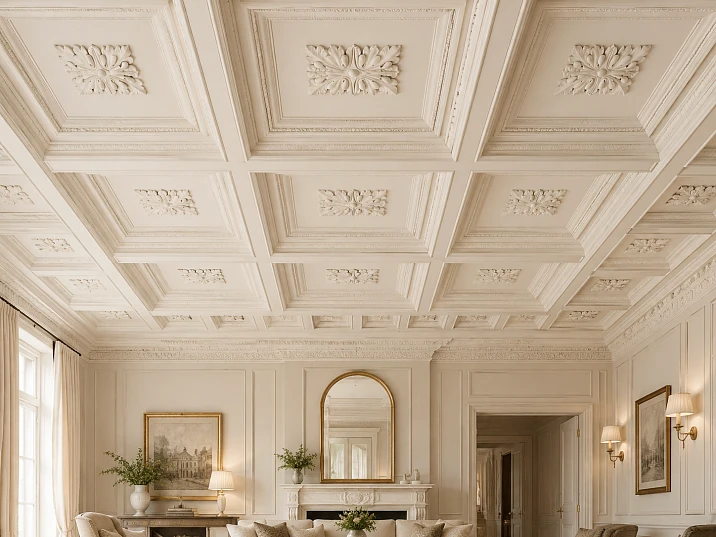
A coffered ceiling can be fully assembled and still look like it is missing the final layer of decor. The moldings already form a neat grid, cell sizes repeat, the geometry works, but inside each field there remains a large smooth surface. Adding another frame inside each cell is not desirable, and a large ceiling rosette under a chandelier solves a completely different task—it creates one central accent instead of a repeating rhythm.
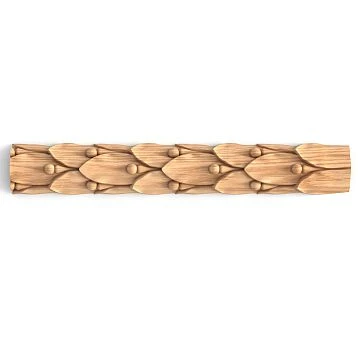
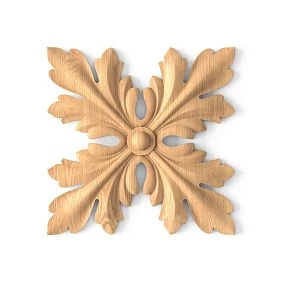
For such coffers, you can consider the carved decorative rosette RPU-020 made of polyurethane. One article has five sizes at once, so the buyer chooses not between five different ornaments, but between five scales of one solution.
At the time of checking, the STAVROS product card shows the following options: 60 × 38 × 8 mm — 510 ₽, 77 × 49 × 10 mm — 640 ₽, 93 × 59 × 12 mm — 940 ₽, 110 × 70 × 14 mm — 1,810 ₽, and 141 × 90 × 17 mm — 1,410 ₽. All options are made of polyurethane. The card also indicates an average production time for custom orders of 3–7 days.
Note the unusual pricing detail: the 110 × 70 × 14 mm option is currently more expensive than the larger 141 × 90 × 17 mm. This is not a typo that needs to be "corrected by logic": these are exactly the prices shown on the product card at the time of checking. The reason for this difference is not explained on the card, so you cannot choose RPU-020 solely on the principle "the larger, the necessarily more expensive."
The main question before purchasing is different: what size will be correctly read within a specific coffer, and how many identical or different RPU-020s will actually be needed?
If the ceiling consists of eight identical cells, you can order eight identical rosettes. But this is only one option. Two central cells can be made more expressive, some coffers can be left empty, fields with light fixtures can be excluded, or decor can be used only in the central row. That is why the number of RPU-020s cannot be calculated using a single formula "number of coffers = number of rosettes" until a complete ceiling layout is built.
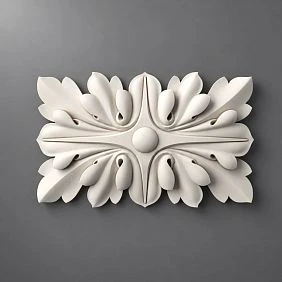
RPU-020 — decorative carved rosette, not a large ceiling rosette for a chandelier
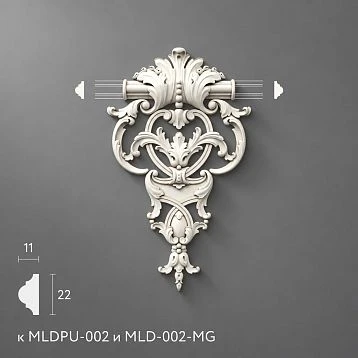
The word "rosette" can easily be misleading. In ceiling decor, it refers to products of different scales and functions. A large ceiling rosette usually forms the compositional center of a room and is associated with a chandelier or another central lighting fixture. RPU-020 belongs to a different product category: it is a compact carved decorative rosette of rectangular format that can be used as a repeating ornament.
On the STAVROS category page, RPU-020 is listed among polyurethane decorative rosettes; large ceiling rosettes of the CRPU series exist separately. The catalog also highlights RPU-020 among rectangular rosettes.
For a coffered ceiling, this is a fundamental difference.
A large central ceiling rosette answers the question:
"How to decorate the center of the ceiling and the chandelier area?"
RPU-020 in the discussed scheme answers another one:
"How to repeat a small identical ornament within several ceiling cells?"
That is why the size of 60 × 38 or even 141 × 90 mm should not be directly compared with the diameter of a large chandelier rosette. They exist in different compositional scales.
STAVROS general materials on ceiling molding confirm the principle itself: a coffered ceiling is built as a regular grid of moldings, and additional decor, including a decorative rosette, can be used inside individual cells.
For the buyer, a practical conclusion follows from this. If the ceiling is already divided into 8–12 cells and the main task is to make each or some of them more expressive, looking for a large central rosette is not necessary. First, it is worth trying the compact RPU-020 directly inside one coffer.
If the ceiling problem is the lack of a center around the chandelier, a different product scenario is needed. Then it is wiser to look at large ceiling rosettes rather than increasing the number of small RPU-020 units.




Five sizes of RPU-020 are five levels of the same decorative scale
The advantage of RPU-020 lies not only in the availability of five options. The sizes form a fairly consistent line.
If you compare the ratio of the long side to the short side, it barely changes:
-
60 ÷ 38 ≈ 1,58;
-
77 ÷ 49 ≈ 1,57;
-
93 ÷ 59 ≈ 1,58;
-
110 ÷ 70 ≈ 1,57;
-
141 ÷ 90 ≈ 1,57.
That is, the shape scales quite consistently. The buyer can test the same decorative motif on different coffer sizes without switching to a completely different pattern.
| RPU-020 option | Dimension A × B × C | Relief | Scale of the long side relative to 60 mm | Price at the time of check |
|---|---|---|---|---|
| The most compact | 60 × 38 × 8 mm | 8 мм | 1,00 | 510 ₽ |
| Compact | 77 × 49 × 10 mm | 10 мм | 1,28 | 640 ₽ |
| Medium | 93 × 59 × 12 mm | 12 мм | 1,55 | 940 ₽ |
| Enlarged | 110 × 70 × 14 mm | 14 мм | 1,83 | 1 810 ₽ |
| Maximum | 141 × 90 × 17 mm | 17 мм | 2,35 | 1 410 ₽ |
The difference between the extreme options is significant. The long side increases from 60 to 141 mm — more than 2.3 times. The short side — from 38 to 90 mm, that is, approximately on the same scale. The relief grows from 8 to 17 mm.
Therefore, the phrase "they are all small" is not accurate enough.
RPU-020 60 × 38 mm really works as a small accent. If you look at it from several meters on a large coffered ceiling, the ornament can be perceived very delicately.
141 × 90 mm is already a different visual weight. It occupies a more noticeable part of the field and works stronger with light and shadow due to the 17 mm relief.
The medium options 77 × 49, 93 × 59, and 110 × 70 mm allow avoiding a sharp transition from the minimum to the maximum scale.
There is also a commercial nuance. The sizes go sequentially, but the prices do not. Therefore, you cannot first choose a budget and automatically assume that the most expensive option will be the largest. First, the size needed for the coffered ceiling is determined, then the current price of that specific item is checked.
Our factory also produces:
Before choosing a size, measure the inner field of the coffered ceiling, not the outer size of the frame
One of the most common mistakes when buying ceiling decor is measuring the coffered ceiling by the outer boundaries of the moldings.
For RPU-020, another value is useful: the clean inner field that a person sees inside the frame.
Let's imagine that the distance between the axes of adjacent moldings is 700 mm. If the profiles themselves take up significant width, the free field inside the coffered ceiling will be less than 700 mm. The rosette should correspond to this free field.
Take two measurements:
K₁ — the clear size of the internal field along one axis;
K₂ — the size along the second axis.
For a square coffered ceiling, they will be the same or similar. For a rectangular one, they may differ noticeably.
Then check that there are no objects inside that change the composition:
-
a recessed light;
-
a sensor;
-
a ventilation grille;
-
a speaker;
-
hatch;
-
a decorative insert;
-
of a different ornament.
If the center of a cell is already occupied by light or a technical element, it ceases to be a regular candidate for RPU-020.
This immediately changes the quantity calculation. A ceiling of 12 coffers may require not 12 sockets, but, for example, 8, if four fields are occupied by light or intentionally left clean.
Get Consultation
Formula for the free field around the socket
For a simple rectangular coffer, you can use:
M₁ = (K₁ − A) ÷ 2
M₂ = (K₂ − B) ÷ 2
where A and B are the two sides of the selected RPU-020 in the orientation that will actually be used.
This is not a standard for the correct distance. The formula only answers the question: how much clean surface will remain between the socket's footprint and the inner boundary of the frame when centered.
If the coffer is square, rotating the RPU-020 by 90° will simply swap these two values.
If the coffer is rectangular, the orientation becomes a separate design decision.
We do not call A "horizontal width" without verification: how to work with the orientation of RPU-020 correctly
The product card lists dimensions as A × B × C. In the available textual information, there is no sufficiently reliable confirmation that A in all intended ceiling scenarios must necessarily be the horizontal side relative to the room.
Therefore, the correct approach is not to build the entire scheme on an unconfirmed assumption.
What can be said with confidence is different: in all five variants, A is greater than B, meaning there is a long and a short side of the dimension.
If the coffer is square, this poses almost no problem. The template can be rotated and both positions can be checked.
If the cell is rectangular, two options arise:
the long side of RPU-020 along the long side of the coffer;
or
the long side of RPU-020 across the coffer.
The first option more often supports the elongated geometry of the field. The second creates a transverse accent. But the choice is determined by the actual pattern, other ceiling elements, and how the template looks.
Suppose the inner field has a size of 800 × 600 mm, and the RPU-020 141 × 90 mm is being considered.
If the long side of 141 mm is oriented along the 800-mm axis:
along this axis remains:
800 − 141 = 659 mm;
conditionally 329.5 mm on each side.
Along the other:
600 − 90 = 510 mm;
255 mm on each side.
If the socket is rotated:
800 − 90 = 710 mm;
355 mm on each side;
600 − 141 = 459 mm;
at 229.5 mm.
Physically, both positions fit. But the perception is completely different.
That is why a template is needed even when the dimensions obviously fit.
Don't turn this into a technical complexity. Make a rectangle at full scale, mark the pattern direction on it, and rotate it directly inside the actual cell.
How to match the size of RPU-020 with the size of the coffered ceiling without a made-up "ideal percentage"
There is no universal law for a decorative rosette like "it should occupy exactly 20% of the width of the coffered ceiling." Interiors differ in height, molding relief, viewing distance, number of cells, and overall richness.
But percentages are useful as a comparison tool, not as a standard.
For a square cell, you can compare the long side of RPU-020 with the side of the free field.
| Side of the square coffered ceiling | 60 мм | 77 мм | 93 мм | 110 мм | 141 мм |
|---|---|---|---|---|---|
| 300 мм | 20,0% | 25,7% | 31,0% | 36,7% | 47,0% |
| 400 мм | 15,0% | 19,3% | 23,3% | 27,5% | 35,3% |
| 500 мм | 12,0% | 15,4% | 18,6% | 22,0% | 28,2% |
| 600 мм | 10,0% | 12,8% | 15,5% | 18,3% | 23,5% |
| 800 мм | 7,5% | 9,6% | 11,6% | 13,8% | 17,6% |
What does this table give?
It shows why you cannot choose one size of RPU-020 for any ceiling.
In a 300 mm cell, the maximum option takes up almost half of the side along the long axis. This is already a very noticeable center.
In an 800 mm coffered ceiling, the same RPU-020 takes up less than 18%. The ornament becomes much more local.
The smallest 60 × 38 mm in an 800 mm field has a long side of only 7.5% of the cell size. On a high ceiling and when viewed from a large distance, it can look very delicate.
This does not mean that “60 mm cannot be placed in 800 mm.” Sometimes a small repeat is exactly what is needed for a subtle rhythm. But the decision must be conscious.
Edge case: small cell
If the clear field of the coffered ceiling is about 300 × 300 mm, the sizes 110 × 70 and 141 × 90 mm already occupy a significant portion of the center. Here it is especially important to see how much space remains between the ornament and the moldings and how active the frame profile itself is.
Medium case: 500–600 mm
Here, all five options physically have a large free surrounding area. The choice becomes a matter of visible scale.
60 × 38 mm will give a very small center.
93 × 59 mm is medium.
141 × 90 mm is a more confident accent.
Large coffered ceiling
At 800 mm and more, choosing the smallest sizes should be checked from the distance from which a person actually sees the ceiling. A small dimension on the drawing may look elegant, but in the room it can almost disappear.
Paper templates at 1:1 scale are the cheapest way to avoid buying 8 rosettes of the wrong size.
If the ceiling is repetitive, the scale error multiplies by the number of coffers.
Missing the size on one rosette is unpleasant.
Missing the size on twelve identical ones is already a full-fledged configuration error.
Therefore, before ordering, no complex render is needed. It is enough to make a few templates.
For the first comparison, it makes sense to take three noticeably different scales:
60 × 38 mm;
93 × 59 mm;
141 × 90 mm.
If none looks perfect, add an intermediate 77 × 49 or 110 × 70 mm.
It is not necessary to cut out the exact carved silhouette. A rectangle shows the overall dimensions, although visually it will be slightly heavier than the actual ornament. If you can print the outline of the product itself to scale, the check will be more accurate.
One template in one coffered cell is not enough
RPU-020 is planned as a repeat.
So, the repeat needs to be checked.
If eight identical rosettes are intended, temporarily attach paper templates in at least several adjacent cells. Then you will see not only the ratio of one rosette to one frame, but also the density of the entire ceiling pattern.
One RPU-020 141 × 90 mm may seem small.
Eight such elements in a regular grid will create a much stronger ornamental effect.
Look from below, not just from the ladder
During installation, the ceiling is viewed from close range, from a stepladder. This is a poor vantage point for assessing scale.
You need to go down to where a person will be:
at the entrance;
to the sofa;
at the dining table;
in the center of the room;
in the adjacent room, if the ceiling is visible through a wide opening.
The higher the ceiling and the larger the room, the more the small RPU-020 can visually shrink.
Leave the templates for the evening
The relief of the real RPU-020 ranges from 8 to 17 mm. Artificial light can greatly change the readability of the decorative rosette.
Daytime flat light can make the ornament calm.
In the evening, directed rays will create shadows.
Therefore, it is advisable to evaluate the final size under the lighting that will be used after renovation.
Size changes not only the dimensions, but also the depth of the relief.
If all five RPU-020 differed only in length and width, the choice would be simpler. But the third dimension also changes.
60 × 38 mm has C = 8 mm.
77 × 49 mm — 10 mm.
93 × 59 mm — 12 mm.
110 × 70 mm — 14 mm.
141 × 90 mm — 17 mm.
That is, the maximum variant is not only more than twice as large as the minimum along the long side, but also has a relief more than twice as deep.
For a coffered ceiling, this is important for two reasons.
The first is chiaroscuro. A deeper pattern reacts more actively to side light.
The second is the proximity to the molding. If the coffered frame itself has an expressive profile, the small RPU-020 with an 8 mm relief and the large one with 17 mm will compete with it differently.
You don't need to automatically choose the deepest rosette for the largest molding. Sometimes it's better to make the frame the main relief element and the rosette a quieter central accent.
In another interior, the opposite is required: the molding grid is calm, and the center of each coffered cell should be well readable. Then the more noticeable RPU-020 is more logical.
Why mixing sizes also changes the light rhythm
Suppose six coffered cells receive RPU-020 60 × 38 × 8 mm, and two central cells receive 141 × 90 × 17 mm.
The difference is not only in the area of the ornament.
The central pair will protrude more from the plane and cast a different shadow.
This is how a real hierarchy emerges: the outer or background cells are quiet, the central ones are accented.
If this is intentional, the technique works.
If different sizes are chosen only because some sockets were missing, the ceiling may look random.
Identical RPU-020 in all coffers is the calmest and most predictable option.
A repeating grid naturally suggests repeating decor.
If all coffers are identical and serve the same function, eight identical RPU-020 is the clearest scheme.
The advantage is that the visual rhythm requires no explanation.
Identical frame.
Identical center.
Identical orientation.
Same relief.
Such a ceiling is easier to mark out and order.
The formula for the quantity in the simplest case:
N RPU-020 = N coffers being finished.
If there are eight cells and a socket is needed in each:
N = 8.
If 12:
N = 12.
But the word "being finished" is key here.
It is not the number of frames that determines the order, but the number of cells that actually need to receive a socket.
When uniformity is more useful than variety
If the ceiling is already complex — with a developed cornice, relief moldings, decorative corners, a chandelier — identical small RPU-020s create a background and do not compete with each other.
On a large ceiling, repetition also helps connect distant zones.
A person may not look at each small rosette individually, but sees the rhythm of the entire grid.
When the same size looks boring
In the central part of the ceiling, hierarchy is sometimes needed.
For example, two cells along the chandelier axis are more important than the rest.
Then you can enlarge only their rosettes.
However, this scheme cannot be built after purchase using the principle of "let's add two big ones." First, you need to see the entire grid in templates.
Mixed scheme: how to make central coffers stronger without turning the ceiling into a catalog of sizes
RPU-020 offers five sizes, but using all five on one ceiling is usually unnecessary.
The more different scales participate simultaneously in one regular grid, the harder it is to explain their hierarchy.
A system of two levels is much clearer:
background caissons — one size;
accent ones — another.
Let's imagine a ceiling of eight identical cells, two of which are highlighted compositionally.
Option 1:
6 × RPU-020 60 × 38 mm;
2 × RPU-020 141 × 90 mm.
Cost at current prices:
6 × 510 = 3 060 ₽;
2 × 1 410 = 2 820 ₽;
total 5,880 ₽.
This results in a very pronounced scale difference — the largest model is 2.35 times longer than the smallest and more than twice as deep in relief.
For some ceilings, such a jump is too strong.
Then you can build a soft hierarchy.
Option 2:
6 × RPU-020 93 × 59 mm;
2 × RPU-020 141 × 90 mm.
6 × 940 = 5 640 ₽;
2 × 1 410 = 2 820 ₽;
Total 8,460 ₽.
Here, the background sockets are already quite noticeable, while the central ones are larger but do not look like elements of a different category.
For comparison:
8 identical RPU-020 93 × 59 mm cost 7,520 ₽;
8 identical 141 × 90 mm — 11,280 ₽.
That is, the mixed scheme simultaneously changes both the composition and the budget.
Do not mix sizes to save money
If all eight cells need the size 141 × 90 mm, placing six small ones just because they are cheaper is a bad reason for hierarchy.
Different sizes should correspond to different roles.
If all coffers are equal, it is cheaper to choose one suitable identical size than to artificially create "central" and "secondary" cells.
Socket in each caisson, every other one, or only along the central axis
The number of decorative rosettes can be reduced not only by changing the size.
Sometimes the best ceiling is achieved when some caissons remain smooth.
Let's consider three different compositional logics.
RPU-020 in each cell
The most regular pattern.
It emphasizes the repeatability of the caisson grid.
The larger the RPU-020, the stronger the overall ornament becomes.
For 12 cells, even a small element is repeated 12 times, so the overall impression will be significantly richer than from a single rosette of the same size.
Decor in every other caisson
This technique creates a rhythm of "accent — pause — accent."
But it needs to be aligned with the grid geometry.
In a 3 × 4 grid, a simple checkerboard principle can work.
In another pattern, it can create unwanted asymmetry.
The entire ceiling needs to be checked, not just a single line.
Only the central row
If the coffered grid is wide, you can highlight the central longitudinal or transverse axis.
This is especially logical when it is tied to the room's architecture: a door portal, the main table, the furniture axis, or a zone without light fixtures.
This way, the number of RPU-020 units is reduced, but each one gets a clearer role.
Only the perimeter
Reverse scheme: central coffers remain calm, while decorative rosettes form the outer row.
This option can work if the center is already occupied by a large chandelier and a separate ceiling rosette.
But the two types of rosettes must be coordinated in scale. Small RPU-020 should not compete with the main central element.
You need to count not coffers in general, but decoratively available cells.
For ordering, it is useful to divide the number of coffers into categories.
Let us denote:
K — total coffers;
L — cells occupied by light fixtures or large central light decor;
T — technical cells where the rosette is not used due to sensors, ventilation, hatches, or other restrictions;
B — coffers that are intentionally left empty for composition.
Then:
N = K − L − T − B.
This is not a building standard, but a convenient ordering formula.
Example with 12 caissons
Total — 12.
Two central fields are occupied by light fixtures.
Two more are deliberately left empty for a calmer pattern.
There are no technical restrictions.
We get:
12 − 2 − 0 − 2 = 8 RPU-020.
If purchasing automatically by the number of caissons, we would order 12 and get four extra items.
Another scenario: 8 identical caissons
Lighting is placed between the frames, no technical elements in the cells, full repetition is required.
8 − 0 − 0 − 0 = 8 sockets.
Why the reserve is not included in this formula
RPU-020 is a separate ready-made decorative element, not a linear material that is cut to length.
Therefore, the universal "add 10% for trimming" is not needed here.
If the customer wants an additional piece as an operational or organizational reserve, that is a separate decision. It should not be disguised as geometric consumption.
Budget for 6, 8, and 12 coffers: five sizes give very different costs
On a repeating ceiling, the price of one rosette is multiplied across the entire pattern. A difference of a few hundred rubles on one item becomes a noticeable difference with 8–12 repetitions.
| RPU-020 size | Price per unit | 6 identical | 8 identical | 12 identical |
|---|---|---|---|---|
| 60 × 38 × 8 mm | 510 ₽ | 3 060 ₽ | 4 080 ₽ | 6 120 ₽ |
| 77 × 49 × 10 mm | 640 ₽ | 3 840 ₽ | 5 120 ₽ | 7 680 ₽ |
| 93 × 59 × 12 mm | 940 ₽ | 5 640 ₽ | 7 520 ₽ | 11 280 ₽ |
| 110 × 70 × 14 mm | 1 810 ₽ | 10 860 ₽ | 14 480 ₽ | 21 720 ₽ |
| 141 × 90 × 17 mm | 1 410 ₽ | 8 460 ₽ | 11 280 ₽ | 16 920 ₽ |
The table shows several things.
First: switching from 60 × 38 to 93 × 59 mm with eight cells increases the cost from 4,080 to 7,520 ₽.
Second: the current price of 110 × 70 mm makes this option the most expensive in the lineup, despite the fact that 141 × 90 mm is larger.
Third: with twelve caissons, the difference between the smallest and largest by size option is:
16 920 − 6 120 = 10 800 ₽.
Therefore, template checking has direct financial sense.
If 93 × 59 mm is already well readable, buying 141 × 90 mm "with a margin of expressiveness" is not necessary.
Conversely, if 60 × 38 mm gets lost on a high ceiling, saving on eight small items does not make them the right choice.
Why you cannot choose 110 × 70 just as the "second-to-last size"
Geometrically, it is indeed between 93 × 59 and 141 × 90 mm.
By price — no.
Therefore, this is a separate option that makes sense to buy only when its scale best fits a specific coffer.
The price anomaly particularly well shows why a commercial solution should start with a mockup, not with a ladder of "small — medium — large — most expensive."
Lights inside coffers change both the number and the size of the rosette.
A coffered ceiling is often designed together with lighting. One light can be in the central field, several can repeat in a grid, and others can be placed at the intersections of moldings.
You cannot automatically place RPU-020 in every coffer regardless of lighting.
If the center of a cell is occupied by a light, first decide whether an additional carved element is needed there at all.
In this article, RPU-020 is considered as a decorative rosette, not as a specialized large frame for a chandelier suspension point.
If the task is to frame a chandelier specifically, it is better buy polyurethane ceiling decor or to select an appropriate ceiling rosette from the profile category.
Light only in some cells
Suppose the grid has 12 coffers, and four of them contain built-in light groups.
There are several solutions.
These four cells can be completely excluded from the RPU-020 pattern.
You can change the entire rhythm and decorate only the fields that are along one axis.
You can choose a separate composition for the illuminated coffers.
What you should not do is first order 12 identical rosettes, and then try to find a place for them around already installed lighting.
Lights at grid intersections
This is more convenient for repeating decor inside cells: their centers remain free.
But you need to take into account light and shadow. A deeper RPU-020 141 × 90 × 17 mm under directed light can read much more actively than a small 60 × 38 × 8 mm one.
Therefore, it is advisable to check the layout with the lighting on.
The molding sets the scale of the frame, and the RPU-020 should work within it, not argue with it.
A coffered ceiling is not a set of rosettes. Its main architecture is already created by moldings.
RPU-020 should complement this structure.
If a wide, deeply profiled molding with rich ornamentation is used, a large rosette in each coffer can result in an excessive amount of relief.
If the grid is made of a calm, thin profile, a larger center can add the missing decorative touch.
For a new project, first buy polyurethane moldings after calculating the grid, and only then choose RPU-020 based on the actual internal cell size.
If the coffers are already assembled, the task is simpler: their actual geometry exists, and there is no need to guess it from the project.
A wide molding visually reduces the coffer
Even if the building module is large, a massive frame makes the inner field more compact.
Therefore, two ceilings with the same grid spacing may require different RPU-020.
The relief of the molding and the rosette are combined
If the frame protrudes significantly, the depth of RPU-020 of 8 or 17 mm is perceived relative to it.
A small rosette can work almost as a graphic accent.
A large one — as an independent relief center.
This relationship cannot be determined only by catalog dimensions. A real profile sample or at least an accurate mockup is needed.
Ceiling height and viewing distance: why the same coffered ceiling requires a different scale
You can take two rooms with identical coffers of 600 × 600 mm and get different results.
In the first, the ceiling is relatively close to the person.
In the second, it is significantly higher.
The geometric proportion of RPU-020 within the field is the same, but the angular size for the observer differs.
Therefore, the template is checked from floor level.
Low viewing distance
If the socket is relatively close, a person can clearly see fine relief.
Under such conditions, 60 × 38 or 77 × 49 mm can be quite expressive, especially if repeated many times.
The large version can fill a small cell too actively.
High ceiling
Small details gradually merge into an overall silhouette.
In such a situation, sizes 93 × 59, 110 × 70, or 141 × 90 mm should be compared especially carefully.
This is not a rule of 'high ceiling = largest RPU-020'.
If there are 20 coffers, even relatively small repeating elements can create a strong overall rhythm.
View from the adjacent room
The large hall is often viewed through a portal.
Then the ceiling is assessed not only directly from below, but also from a distance of several meters.
It is this point that sometimes shows that the smallest size practically disappears.
Painting changes the visual size of RPU-020 without changing millimeters.
Sockets of the same physical size may look different depending on the finish.
In the color of the ceiling
If RPU-020, the caisson background, and the molding are in a close color scheme, the ornament is read mainly due to the relief.
This approach allows the use of repeating decor neatly.
Eight or twelve sockets do not necessarily turn into eight bright spots.
Contrast color
Contrast separates each element from the background.
Even a small RPU-020 begins to seem larger and more active.
If a golden, dark, or other noticeable color is planned, checking the size on a white paper template is not enough. It is useful to roughly color the template.
Highlighting the relief
If recesses and protrusions are additionally emphasized by the finish, the visual complexity increases.
On 12 identical coffers, the effect multiplies.
Therefore, the more complex the future painting, the more carefully the size and quantity should be increased.
Installation sequence: first the grid and centers, then the rosettes
If a coffered ceiling is designed from scratch, RPU-020 should not determine the grid position randomly.
First, the dimensions of the coffers are set.
The symmetry of the grid relative to the room is checked.
Luminaires are taken into account.
Moldings are installed or marked out.
Only after this is the exact center of each decorated internal field determined.
If the coffers are already ready, even better: measurements are taken from the actual geometry.
Do not mark all outlets from one wall without checking the coffers.
Even with good installation, the actual dimensions of adjacent fields may vary slightly.
If each RPU-020 is placed according to the general coordinate grid of the room, rather than the center of its own coffer, small discrepancies will become noticeable relative to the frame.
Therefore, for repeating decor, two levels of control are useful:
the overall axis of the ceiling;
the local center of a specific coffer.
Full-size layout before final fixation
First, templates are temporarily placed.
Distances are checked.
Then, the actual products.
The mounting method itself is chosen based on the ceiling base and recommendations for the specific mounting system. You cannot automatically transfer one technology to a plaster, suspended, stretch, or other ceiling without checking the structure.
Technical elements have priority
If after marking it turns out that there is a revision, sensor, or ventilation element in the intended center, the decorative scheme must be changed.
RPU-020 should not interfere with the maintenance of engineering units.
Errors when choosing RPU-020 for a coffered ceiling
| Mistake | Why it occurs | What happens | How to avoid |
|---|---|---|---|
| Choose by product photo | No scale of the real caisson | The socket turns out to be too small or active | Use 1:1 template |
| Count the external size of the caisson | The width of moldings is ignored | The real inner field is smaller than expected | Measure the clean cell |
| Count A automatically as horizontal width | The card gives A × B × C, but the orientation needs to be checked | Layout error in a rectangular caisson | Try both orientations |
| Order by the number of all caissons | Light and technical fields are not excluded | Extra products appear | Count only the cells being designed |
| Choose the size by price | The price of the line does not increase proportionally to the size | The wrong scale is purchased | First size, then cost |
| Use all five sizes at once | Want to show the assortment | The grid loses clear hierarchy | Use one or at most two meaningful scales |
| Evaluate one socket instead of a series | The repetition effect is not visible | The entire grid becomes overloaded | Check multiple templates at once |
| Ignore depth of 8–17 mm | They only look at A and B | The chiaroscuro turns out to be stronger than expected | Take into account the relief and lighting |
| Place decor in a cell with a light fixture without a scheme | Light and stucco molding are designed separately | Conflict of centers | First, the light map |
| Add a large rosette to each small coffer | Want it 'richer' | Moldings and centers start to argue | Compare smaller size or leave some cells empty |
| Make allowance as for linear material | Habit of moldings | Extra pieces are ordered | Count items individually |
| Mix sizes due to leftover stock | Decision is made after purchase | Random hierarchy appears | Approve the scheme before ordering |
The first mistake is especially dangerous. When a socket is listed separately in the catalog, the eye evaluates the ornament, not its actual 60 or 141 mm.
The second most important is the evaluation of only one cell.
A coffered ceiling exists
What to buy together with RPU-020 and which links really help the customer
| Next step | When it is needed | Link |
| Buy a specific RPU-020 | The size is already selected according to the template | buy a carved rosette RPU-020 |
| Compare other sizes and shapes of rosettes | RPU-020 did not fit the scale | buy carved polyurethane rosettes |
| Assemble the caisson grid itself | The ceiling is still only being designed | buy polyurethane moldings |
| Move to a more complex ceiling composition | Sockets alone are not enough | buy polyurethane ceiling decor |
| Select polyurethane decor for the entire interior | The ceiling is connected to the walls and other zones | You can buy ready-made stucco matching the Baroque style. Calculate the quantity: linear meters of cornices and moldings, number of rosettes, pilasters, consoles, corner elements. Add a ten to fifteen percent allowance for trimming. |
| Compare different types of molded products | The project has gone beyond one type of product | Buy Molded Decoration |
If the principle of caissons itself is not yet defined, it is useful to look first general STAVROS guide to ceiling molding elements. There, caissons are considered as part of the entire ceiling architecture, whereas the current article addresses a narrower task — selecting a specific RPU-020 for an already defined grid.
Thus, interlinking works along the real customer journey.
First, understand the system.
Then, choose the category.
Next, the specific RPU-020 size.
Practical algorithm for ordering RPU-020 for a finished caisson ceiling
Before purchasing, you can go through the entire task in order.
Step 1. Count the caissons.
Not the number of frame lines, but the number of individual inner cells.
Step 2. Mark the fields that cannot or should not be decorated.
Luminaires, ventilation, sensors, technical access, intentionally empty caissons.
Step 3. Get the number of cells to be issued.
It is the first variant of the RPU-020 quantity.
Step 4. Measure the clean internal size of one typical caisson.
If the cells differ, divide them into groups.
Step 5. Prepare templates.
At least three scales: small, medium, maximum.
Step 6. Check the orientation.
For rectangular caissons, rotate the template on both sides.
Step 7. Place not one, but several templates.
Need to see the repetition.
Step 8. Check the ceiling from the main points of the room.
Not from a stepladder.
Step 9. Turn on the working lighting.
Assess the future light and shadow.
Step 10. Decide whether all cells are equal.
If yes — one size.
If not — two scale levels are acceptable.
Step 11. Calculate the budget.
Multiply the quantity of each item by its actual current price.
Step 12. Check the product card immediately before placing the order.
After that, you can order an RPU-020 of the required size.
How to place an order if the caissons have two different sizes
Not all ceiling grids consist of completely identical cells.
For example, elongated caissons may be located around the perimeter, and large square ones in the center.
In such a project, the rule "one socket size for the entire ceiling" requires verification.
First, group the fields:
type A — same size;
type B — different size.
Then do a separate fitting for each group.
There is no need to automatically select the "next size from the catalog" for group B.
If 77 × 49 mm looks good in a small cell, that does not necessarily mean that a larger one requires 93 × 59.
Perhaps the right jump is straight to 141 × 90.
And perhaps the same RPU-020 93 × 59 will tie both groups together well thanks to the identical ornament.
Here an interesting design choice emerges:
the same size unifies different coffers;
different sizes emphasize their hierarchy.
Both solutions can be correct, but they lead to different orders.
What to do if the central coffer is occupied by a chandelier
This is a separate scenario that often breaks the simple scheme of "a rosette in each cell."
Let the ceiling have nine coffers in a 3 × 3 grid.
The central cell contains a chandelier and a large ceiling rosette.
Eight peripheral fields remain.
If all of them receive the same RPU-020:
order = 8 decorative RPU-020 + a separate central ceiling composition.
This is much clearer than trying to place a small RPU-020 in the central coffer next to the main rosette.
Another option is possible:
the four corner coffers receive RPU-020;
the middle side ones remain smooth;
the center — a chandelier.
Then only four items will be needed.
Which option is better is determined by the ceiling layout, not the desire to use maximum decor.
Why a large RPU-020 is not necessarily "richer" than a small one
In regular architecture, value is created not by the size of an individual detail, but by the relationship of all elements.
A small RPU-020 of 60 × 38 mm, repeated twelve times, can create a subtle and very precise rhythm.
A large 141 × 90 mm one in the same twelve fields will create a much more saturated surface.
It cannot be said that the second option automatically looks more expensive or better suits a classic interior.
If the coffered ceiling already has:
a wide relief molding;
decorative corners;
contrasting coloring;
developed cornice;
complex light,
a large central detail can turn out to be the fourth or fifth strong motif in one small area.
Conversely, on a very calm grid of smooth moldings, a small size may prove insufficient.
Therefore, a good criterion is not “which RPU-020 is prettier,” but:
what level of decorative density is this particular ceiling currently lacking?
RPU-020 and molding relief height: how to avoid visual competition
The exact profile of each molding is selected individually, so giving a universal formula here would be incorrect.
But it is necessary to compare the two relief layers.
If the grid molding is very expressive, and the RPU-020 is small and shallow, the frame will dominate. This can be a desirable result: the coffers remain the main architectural pattern, and the rosette only marks the center.
If the central RPU-020 141 × 90 × 17 mm is visually equal to or more active than the frame, attention shifts to the inside of each field.
With eight or twelve coffers, this effect repeats many times.
Therefore, before purchasing one of the large sizes, it is useful to apply the template not to an empty ceiling, but specifically inside an already assembled frame.
If the moldings are not yet installed, you can make a fragment of the layout on the floor or on a stand.
This evaluates not an individual product, but a system.
When it is better to choose not RPU-020, but another type of ceiling decor
RPU-020 is good specifically for a repeating compact center.
But it has limits to its task.
If you need to decorate the entire perimeter of the coffer, you need a molding.
If a large composition around the chandelier is required — a ceiling rosette.
If inside the field you want not a small central ornament, but a developed large insert — you should look at other elements polyurethane ceiling decoration.
If the goal is to choose another compact pattern, a category opens where you can buy carved polyurethane rosettes.
And if the coffered grid has not yet been formed, it is too early to start the order with RPU-020. First, the ceiling structure is determined and Moldings made of polyurethane, and then the sizes of internal accents.
This does not reduce the commercial role of RPU-020. On the contrary, it helps to buy it exactly where the product solves a specific task.
FAQ: additional questions about RPU-020 in a coffered ceiling
Can RPU-020 be rotated 90 degrees inside a rectangular coffered cell?
The overall dimensional template can be checked in both orientations. For a rectangular cell, this is useful because the long side of the rosette can either support the elongation of the coffered cell or work across it. Before the final layout, you should also evaluate the direction of the ornament itself.
What to do if the edge coffered cells are slightly smaller than the central ones?
Do not cut RPU-020 to fit the cell size. It is better to divide the caissons into size groups and check whether a smaller version of the socket is needed in the edge fields, or whether it is more reasonable to leave them without central decor.
Why does RPU-020 110 × 70 mm cost more than 141 × 90 mm?
At the time of checking, the product card shows exactly these prices: 1,810 ₽ and 1,410 ₽, respectively. The reason for the difference is not stated on the page, so it should not be invented. Before ordering, the price should be checked again.
Can RPU-020 be used only in the four corner caissons?
Yes, if such a pattern has compositional meaning. This is a separate scheme in which the sockets form peripheral accents, and the center of the ceiling remains freer.
Is an additional RPU-020 needed "in reserve" when ordering 12 pieces?
Geometrically — no. This is a piece product that is not cut during cutting like a molding. An additional reserve can be purchased according to your own organizational logic, but it is not included in the consumption calculation.
What to do if one caisson is occupied by a ventilation grille?
Do not try to preserve the absolute number of sockets at any cost. This cell can be excluded from the decorative grid, or the entire pattern can be rearranged so that the absence of the center looks intentional.
Can RPU-020 with different orientations be used on the same ceiling?
You can check such a pattern with templates, but the alternation must match the ceiling geometry. A random rotation of some identical rosettes is easily perceived as an installation error.
What to do if it is impossible to choose between two sizes?
Do not look for an answer from a catalog photo. Attach both templates in adjacent identical coffers, then swap them and look from the main points of the room. This helps separate the real difference in scale from the influence of lighting or cell placement.
Can the central coffer be left without RPU-020, while the rest are decorated?
Yes. An empty center can be a deliberate pause, especially if there is already a light fixture, painting, another rosette, or a more complex ceiling element there.
What to do if the coffers are square and RPU-020 is rectangular?
This is not a conflict in itself. A rectangular rosette creates a directional accent inside a square field. You just need to choose and consistently maintain the orientation throughout the entire series.
Is there any point in using the smallest size 60 × 38 mm in large coffers?
Yes, if a very delicate rhythm is needed and the template confirms that the ornament is readable from the actual distance. On a high ceiling of a large room, this size needs to be checked especially carefully.
Can two RPU-020 be installed in one long coffer?
Physically, a composition of two elements can be designed, but this is a different principle than a central rosette in a repeating cell. The axes, the distance between the two parts, and the repetition of the entire pattern need to be recalculated.
How to design a coffered ceiling that contains a built-in speaker?
First, the functional zone of the speaker and its maintenance requirements are considered. If the central space is occupied, it is more reasonable to exclude the RPU-020 or move the decorative logic to other cells rather than try to cover the equipment.
Can a large RPU-020 be used only in one central coffered cell?
Yes, if it truly serves as the central accent, and the other cells receive a smaller version or remain empty. But if the center is associated with a chandelier, the RPU-020 needs to be separately compared with a full ceiling rosette.
Do all RPU-020s need to be painted the same color?
Not necessarily, but a different color creates another level of hierarchy. If two sizes are already used, adding multiple colors may make the pattern too complex. First, it is worth checking a simpler scheme.
What to do if, after installing moldings, the internal size of the coffered cell differs from the project?
Rely on the actual geometry. That is why it is advisable to purchase the RPU-020 after a control measurement of the finished or at least precisely marked cells.
The five sizes of RPU-020 provide freedom only when the scale of the coffered cell is chosen first.
The RPU-020 has a strong product feature: the buyer doesn't have to change the pattern if a different size is needed. Five dimensions are available in a single listing — from 60 × 38 × 8 to 141 × 90 × 17 mm.
But having five options doesn't mean the choice should be made on the principle of "I'll take the middle one."
First, the clean internal field of the coffer is measured.
Then, cells with lighting and technical elements are excluded.
After that, at least three significantly different sizes are checked using templates.
Only then is the quantity determined.
For eight identical empty coffers, this could indeed be 8 identical RPU-020 units.
For a ceiling with two accent central cells — 6 of one size + 2 of another.
For twelve coffers, where four fields are occupied by lighting or deliberately left smooth, the order may consist of only 8 sockets.
At the same time, the price should be calculated based on the specific selected size, because the current pricing grid does not linearly reflect the increase in dimensions. In particular, the RPU-020 110 × 70 × 14 mm currently costs more than the 141 × 90 × 17 mm.
If the mockup confirms the desired option, you can buy a carved rosette RPU-020 in the calculated quantity.
If even the maximum RPU-020 looks too small or the shape does not match the coffer, the correct next step is not to increase the number of elements in each cell, but to buy carved polyurethane rosettes another article.
If the issue goes beyond a small central accent and a full ceiling system is required, it is worth moving on to polyurethane ceiling decor and consider coffers, moldings, and central elements as a single composition.
In STAVROS, RPU-020 is useful precisely for its scalability: five sizes of one ornament allow maintaining the repeatability of the coffer pattern while selecting a decorative center to match the actual cell size, room height, light, and number of repetitions. Therefore, the correct order starts not with the largest or the cheapest item. It starts with one coffer, a full-size template, and checking how that template looks not just once, but across the entire ceiling grid.