Article Contents:
- SNL-21 characteristics that cannot be rounded in the estimate
- Five millimeters that become twenty
- Accumulated difference for multiple parts
- Construction opening
- Clear size between supports
- Visible length of the openwork row
- The gap changes the repetition of the ornament
- The base is visible through the gap
- Different gaps are noticeable
- A gap is not always technically acceptable
- You need to choose a place for trimming
- You need to understand whether the motif can be cut
- The remainder must have a purpose
- Extreme parts must work with the frame
- Scheme 1. Four whole SNL-21 and design fields
- Scheme 2. Five elements with symmetrical trimming
- Scheme 3. Four elements and separate separators
- Central element
- Central joint
- Central separator
- Offset composition
- First, find the center of the ornament
- Then build the left and right fragments
- Check the edge at the post
- Make a full-scale mockup
- Input data
- Marking of parts
- Marking of seams
- Frame marking
- Sum control
- Measure at the top, center, and bottom
- Check the diagonals
- Secure the finished surfaces
- Measure each repeating section
- Horizontal placement
- Vertical placement
- Frame
- Repeating multiple rows
- Frame first
- Then the drawing
- After — finishing
- Modules between posts
- View from two sides
- Maintenance
- Exterior finishing
- Print or transfer the drawing
- Compare several options
- Check the strength of thin sections
- Account for the processing of the new end face
- Assemble a test fragment
- Preparation for enamel is not the same as painting
- Openwork geometry complicates painting
- End faces after cutting are new surfaces
- One batch — one color cycle
- SNL-21 and a smooth wooden batten
- SNL-21 and a structural lintel
- SNL-21 and a casing
- SNL-21 and a flat baluster
- SNL-21 and another element of the SNL series
- Sizes
- Quantity
- Pattern
- Pine and preparation
- Dry layout
- Mistake 1. 995 mm rounded up to a meter
- Mistake 2. Ordered "four linear meters"
- Mistake 3. Measured the construction opening
- Mistake 4. Added the fifth element without a diagram
- Mistake 5. Installers distributed the shortage
- Error 6. Started layout from the left edge
- Error 7. Trimmed one edge
- Error 8. Cut went through a thin motif
- Error 9. Did not account for supports
- Error 10. Subtracted the fit twice
- Error 11. Gaps were automatically considered acceptable
- Error 12. Used SNL-21 as a load-bearing lintel
- Error 13. Forgot the 195 mm width
- Error 14. Did not match the 18 mm thickness with the groove
- Error 15. Started painting before trimming
- Error 16. The remainder was recorded in two sections at once
- Error 17. Identical spans were not measured separately
- Error 18. The batch was ordered in parts
- Error 19. No color sample was made
- Error 20. Only the price was checked in the invoice
- What is the exact length of SNL-21?
- How many do four SNL-21 give?
- Does this mean that for four meters you always need five pieces?
- How many do five planks give?
- Can I leave 10 mm on both sides?
- Can I distribute 20 mm among all joints?
- How do I find the correct center of the row?
- Where is the best place to put the joint?
- Can SNL-21 be trimmed to length?
- Can the fifth plank be cut into two equal fragments?
- What should I do with the remainder of the fifth SNL-21?
- How do I calculate two identical sections?
- Do I need to account for the thickness of the posts?
- Should the fit into the frame be taken into account?
- Why measure the span in three places?
- What does the width of 195 mm mean?
- What does the thickness of 18 mm mean?
- Can the SNL-21 be turned vertically?
- What is the SNL-21 made of?
- What sanding quality has been confirmed?
- What does preparation for enamel mean?
- How to choose enamel?
- Do the ends need to be painted after trimming?
- Can the SNL-21 be used outdoors?
- Is SNL-21 suitable for a partition?
- Can SNL-21 be used in fencing?
- Is SNL-21 a load-bearing element?
- Where can I see other connecting elements?
- Where can I see all carved decor?
- Can I order only four pieces?
- How do I write four whole elements in the specification?
- How do I write the diagram with the fifth plank?
- Where can I check the current price?
- Do I need to order a sample?
- Can I mix elements from different orders?
- How to mark the parts?
- What to check upon receipt?
- Can I saw immediately after delivery?
- How to order delivery of a batch?
- What to do if the span is not 4000, but 3980 mm?
- What to do if the span is 4010 mm?
- How to calculate a 10-meter row?
- Where to get a professional calculation?
- One remainder cannot be promised to multiple sections
- Repeating sections are not always the same after finishing
- Breaking down an eight-meter row into modules
- Layout for 2000 and 3000 mm also requires a decision
- It is advantageous to count sections of different lengths as one batch
- Who should sign the decision
- Control wording before payment
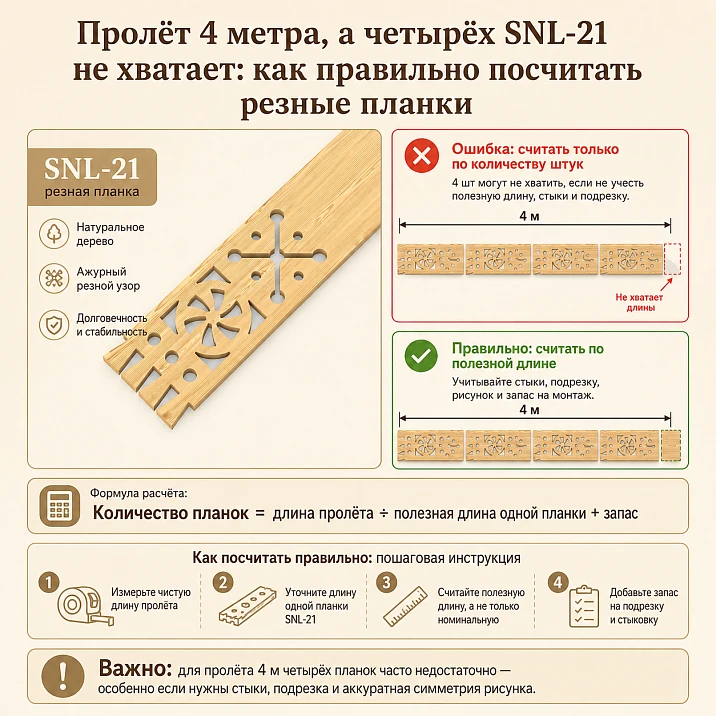
Four strips almost a meter each — so four meters should be enough. This is exactly how an error most often begins when ordering the carved connecting element SNL-21. The length of one part is 995 mm. At a glance, the difference from a meter seems insignificant: only five millimeters. But in a long section, these five millimeters add up. Four elements give 3980 mm, so 20 mm is already missing to reach a span of 4000 mm. If the project also includes seating zones in posts, gaps, separate connectors, or trimming of the ornament, a simple calculation based on rounded meters stops working altogether.
A buyer who is going to Buy carved element SNL-21, must order not abstract "four meters of carving," but a specific number of parts according to the approved layout. You need to know the clear size between supports, the position of the center, the number of visible joints, the possibility of trimming edge elements, and the method of completing the row. Only after this does it become clear whether four SNL-21s are enough, whether a fifth strip is needed, and where the remainder will go.
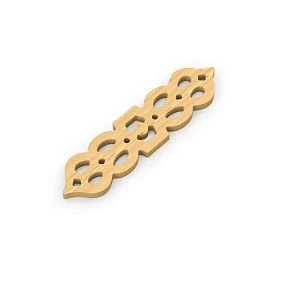
SNL-21 is an openwork wooden insert made of pine, sized 995 × 195 × 18 mm. It is prepared for further finishing, has a "Standard" sanding quality, and is made to order. The element can be considered for decorative partitions, verandas, gazebos, fences, stair areas, and panels, but the specific structure must be designed separately. The carved strip sets the pattern and fills the section; it does not automatically acquire a load-bearing function just because it is installed between posts.
The main goal of the article is not to teach mechanically rounding quantities up. The fifth part does provide a reserve, but by itself it does not solve how to preserve the ornament, where to place seams, and why edge fragments must be identical. A different approach is needed here: first, a span map is built, then a layout scheme is selected, after which a precise specification of SNL-21 and associated elements is prepared.
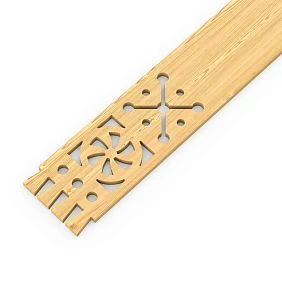
Characteristics of SNL-21 that cannot be rounded in the estimate
| Parameter | Confirmed value | How to use in calculation |
|---|---|---|
| Article number | SNL-21 | Specify in full in the request, invoice, and layout map |
| Product type | Carved connecting element, openwork wooden plank | Do not confuse with a smooth batten, load-bearing lintel, or mounting profile |
| Length A | 995 мм | Multiply by the actual quantity without rounding to 1000 mm |
| Width B | 195 мм | Match with the height or width of the designed decorative section |
| Thickness C | 18 мм | Consider in the frame, seating, and abutment to the posts |
| Material | Spruce | Coordinate with the frame, posts, and finishing system |
| Sanding | "Standard" | Check preparation before painting |
| Preparation | For enamel | Do not consider as a finished topcoat |
| Status | Custom Order | Approve the layout and quantity before starting production |
| Areas of application | Partitions, fences, verandas, gazebos, stair areas, panels | Check the specific structure against the drawing |
| Load Capacity | Not confirmed as a universal characteristic | Do not use instead of a calculated structural component |
| Mounting | Determined by the project | Do not assign universal fasteners without base data |
The most dangerous row in this table is 995 mm. The buyer usually copies the other parameters exactly, but mentally rounds the length to a meter. In the product card, it is indeed close to a round value, but ordering and cutting live in millimeters. Five lost millimeters on each part create a cumulative difference that grows with the quantity.




Five millimeters that become twenty
The arithmetic is simple:
995 × 4 = 3980 mm.
Span length:
4000 mm.
The difference:
4000 − 3980 = 20 mm.
If four slats are placed tightly together, the row will be 20 mm shorter than the span. If the difference is distributed between the parts, gaps will appear. If it is hidden at the edges, the outer fields will become wider. If the slats must fit into posts or a frame, the useful visible length will change even more.
You cannot reason like this: “Nobody will notice twenty millimeters.” The point is not just the size of the gap. In an openwork composition, the position of each slat is tied to the repetition of the pattern. Shifting elements can break the axis, make the outer fields different, or move the central motif out of the middle of the span.
Our factory also produces:
Accumulated difference for multiple parts
| Quantity of SNL-21 | Actual total length | Length with erroneous rounding | Accumulated difference |
| 1 | 995 мм | 1000 мм | 5 мм |
| 2 | 1990 мм | 2000 мм | 10 мм |
| 3 | 2985 мм | 3000 мм | 15 мм |
| 4 | 3980 мм | 4000 мм | 20 мм |
| 5 | 4975 мм | 5000 мм | 25 мм |
| 6 | 5970 мм | 6000 мм | 30 мм |
| 8 | 7960 мм | 8000 мм | 40 мм |
| 10 | 9950 мм | 10,000 mm | 50 мм |
For one part, five millimeters can disappear into the design fit. For ten elements, we're already talking about five centimeters. Therefore, the notation "SNL-21 — 10 linear meters" is incorrect by the very logic of the product. You need to specify the number of pieces and the actual length of one item.
Get Consultation
Three lengths of one span: structural, clear, and decorative
The phrase "four-meter span" can mean different sizes. Until the measurement points are defined, it is impossible to calculate SNL-21.
Structural opening
This is the distance between structures before installing the frame, cladding, posts, or decorative trims. It is useful for the overall project, but rarely equals the space that the carved row will occupy.
Clear dimension between supports
This is the distance between the finished inner faces of the posts or frames. It is this that most often determines the length of the decorative infill. If the posts are not yet manufactured, their width and position need to be fixed on the drawing.
Visible length of the openwork row
Part of SNL-21 may go into seating zones, be overlapped by covers, or be hidden by posts. Then the visible length differs from the physical length of the installed elements.
Before calculating, write down the dimension so that another specialist can understand it without explanations: "clear dimension between the inner faces of the posts — 4000 mm" or "visible decorative zone after installing the trims — 4000 mm". The word "span" without specification leaves too many options.
Calculation formula without rounding
For preliminary determination of the quantity, the ratio is used:
Number of whole elements = clear span length ÷ 995 mm.
The result shows how many pieces fit, but does not provide a ready layout. If the number is not an integer, you need to decide how to handle the remainder.
For a span of 4000 mm:
4000 ÷ 995 ≈ 4,02.
Four pieces are shorter than the span. Five are longer:
995 × 5 = 4975 mm.
The allowance relative to 4000 mm is:
4975 − 4000 = 975 mm.
But these 975 mm cannot automatically be called a useful remainder. Perhaps the fifth plank will have to be cut into two edge fragments. Perhaps the pattern does not allow the chosen trimming. Perhaps a whole piece is needed for another section, and it is better to add separate design inserts to this span. Each scheme is checked separately.
Popular spans: the table shows a deficit, not a ready-made solution
| Clear span length | Number of whole SNL-21 | Total length | Deficit to a round span | What else needs to be decided |
| 2000 мм | 2 pcs. | 1990 мм | 10 мм | Where to distribute the difference and whether there is a landing |
| 3000 мм | 3 pcs. | 2985 мм | 15 мм | Are equal edge fields needed |
| 4000 мм | 4 pcs. | 3980 мм | 20 мм | Can four whole elements be left |
| 5000 мм | 5 pcs. | 4975 мм | 25 мм | How to preserve the axis and pattern repeat |
| 6000 мм | 6 pcs. | 5970 мм | 30 мм | Are intermediate supports needed |
| 8000 мм | 8 pcs. | 7960 мм | 40 мм | How to split a long section into modules |
The table is useful for detecting errors. It does not determine allowable gaps, the number of supports, or the method of attachment. These parameters depend on the project, the visual task, and the structural scheme.
Why you can't automatically spread four slats by 20 mm
It seems the problem is solved simply: divide 20 mm into five gaps — two outer and three inner. That gives 4 mm each. Or leave only three inner gaps of about 6.7 mm each. Mathematically, the row will fill the span. But the decorative composition may worsen.
The gap changes the ornament repeat
SNL-21 is perceived as an openwork strip. When parts are placed closely, the pattern has one rhythm. When a gap appears between them, each element begins to read separately. This may be intentional, but the decision needs to be seen on a mockup.
The base is visible through the gap
In a partition or fence, behind the slats there may be another material, light, or empty space. A narrow gap that seems neutral on the drawing becomes a dark vertical line in reality.
Different gaps are noticeable
If the installer distributes the missing millimeters "in place," the seams will turn out uneven. On a repeating pattern, even a small difference is read faster than on a smooth batten.
A gap is not always technically acceptable
The article does not establish installation gaps. The possibility of leaving spaces depends on the base, operating conditions, fastening method, and design intent. An arithmetic deficit cannot be turned into an installation rule.
The fifth plank provides material, but not a design
Buying a fifth SNL-21 seems like the safest solution: there will definitely be enough material. For carved goods, this is only half the task.
You need to choose a place for trimming
If two edge fragments are cut from the fifth plank, it is important to preserve the same part of the pattern on the left and right. Simply dividing 975 mm in half does not guarantee visual symmetry, because the ornament may have its own center and repeat.
You need to understand whether the motif can be cut
The cut line may pass through a large petal, curl, or thin bridge. The result will look like damage, not like a completion of the composition.
The remainder must have a purpose
After cutting, a fragment may remain. It is considered useful only when it fits a specific section, pattern, or repair stock. The words "will come in handy somewhere" are not taken into account.
The outer parts must work with the frame
Trimmed fragments adjoin the posts. It is necessary to check which part of the pattern will be at the edge and whether it will create a too thin, vulnerable, or visually cut-off edge.
Therefore order SNL-21 measuring 995 × 195 × 18 mm in the quantity of five pieces makes sense only after the layout map appears.
Three schemes for a span of 4000 mm
The same span can be filled in several ways. Below are not ready-made installation solutions, but options that need to be checked against the drawing and pattern.
Scheme 1. Four whole SNL-21 and design fields
Four elements give 3980 mm. The remaining 20 mm are distributed along the edges, between the strips, or in pre-provided seating zones.
Advantages:
-
all carved parts remain intact;
-
no need to trim the ornament;
-
factory length is preserved;
-
easier to control completeness.
Limitations:
-
fields or gaps must be part of the composition;
-
their sizes cannot be assigned randomly;
-
need to check the appearance of the base behind the gaps;
-
the center of the row must coincide with the center of the span;
-
posts or frame must accept the chosen scheme.
If four whole elements visually form a beautiful row, 20 mm can be included in the design of side fields. But the article does not establish that 10 mm on each side are acceptable in any construction. This is only an arithmetically symmetrical distribution.
Scheme 2. Five elements with symmetrical trimming
The fifth plank creates a reserve of 975 mm. One possible approach is to use three whole elements in the center, and trim the other two pieces for the left and right edges. Another option is to leave four whole pieces and use a fragment of the fifth in one place, but such a scheme often breaks symmetry.
Advantages:
-
you can fill the span without a random gap;
-
the edge sections get equal length;
-
the central element or central joint can be tied to the axis.
Limitations:
-
pattern analysis is required;
-
the edge fragments must be mirrored or consistent;
-
the remainder must be included in the list;
-
the cut line must not destroy the fine pattern;
-
additional edge treatment may be required.
Scheme 3. Four elements and separate dividers
Between SNL-21, specially provided vertical rails, posts, overlays, or connecting parts are installed. Then the missing length ceases to be an "error" and becomes part of the modular system.
Advantages:
-
the pattern of each SNL-21 is preserved in its entirety;
-
a long span is divided into clear modules;
-
joints can be covered with posts;
-
the composition is easier to repeat in several sections.
Limitations:
-
dividers need to be designed;
-
their width is included in the overall calculation;
-
the material and finish must match the pine;
-
you cannot declare any rail a structural post without calculation;
-
a separate specification will be required.
To compare different products, you can to buy connecting elements for house carving after checking their drawings. Being in the same group does not automatically mean compatibility with a specific SNL-21 layout.
Span center: the point around which the pattern is built
In a decorative section, the center is more important than the first edge. If you start laying from the left and place whole elements sequentially, the remainder will end up on the right. The row will fill the space, but the composition will be shifted.
Central element
With an odd number of planks, one SNL-21 can be positioned along the axis. This creates calm symmetry if the pattern of the part itself has a clear center.
Central joint
With an even number of elements, the connection of two planks falls on the axis. Then you need to check whether the pattern comes together in the middle and whether a double motif or a gap occurs.
Central divider
A post or decorative overlay may coincide with the axis. It divides the span into two equal parts. For wide sections, this helps make the composition clearer, but the technical role of the post is confirmed by the project.
Offset composition
Sometimes the span axis is not the main one: nearby there is a door, a flight of stairs, or furniture. Then the pattern can be tied to another line. Such a solution must be deliberate and shown on the elevation.
Symmetric edge fragments: why dividing in half is not always enough
Suppose five pieces are used to fill 4000 mm, and the edge elements are trimmed. Mathematically, the required lengths can be calculated. But a carved pattern is not a uniform strip.
First, find the center of the ornament
On the drawing or a real sample, mark the repeating motifs. Perhaps SNL-21 has a large central part and lighter edges. The cut line must account for the structure of the pattern.
Then build the left and right fragments
They can be equal in length, but not mirror images in pattern. If the piece has a direction, one plank may need to be flipped. The admissibility of flipping is checked against the face side and the composition.
Check the edge at the post
A thin openwork section cannot be left without a clear finish. The junction line must look complete and have sufficient area for the intended connection.
Make a full-scale mock-up
A printout, cardboard, or markings on the floor will show where to cut the plank. On the screen, a slight offset seems unnoticeable, but in a four-meter row it becomes amplified.
How to build an SNL-21 layout map
A layout map is a development of a span with each part, joint, and remainder. It is needed before placing an order.
Initial data
Write down:
-
the clear length between supports;
-
the height or width of the section;
-
frame dimensions;
-
mounting zones;
-
the position of the posts;
-
the main axis;
-
viewing points;
-
the number of identical spans;
-
conditions inside or outside the room;
-
future finishing.
Marking of parts
Each strip is assigned a number: S1, S2, S3, and so on. The diagram indicates:
-
original length 995 mm;
-
actual length after trimming;
-
orientation;
-
left and right ends;
-
location in the span;
-
purpose of the remainder.
Marking of seams
The seam must have a coordinate. The notation "joints evenly" is insufficient for production. It is better to specify the distance from the left support or from the center.
Frame marking
Show how many millimeters of each element are hidden under the trim or fit into the seat. Without this, the actual and visible lengths are mixed.
Sum check
The sum of parts, gaps, separators, and seating parts must equal the clear span length. The calculation cannot use a rounded meter.
Full layout formula
For a decorative row, you can use the control equality:
Lspan = ΣLelem + ΣLgap + ΣLsep − ΣLseat, where:
-
Lspan — clear span length;
-
ΣLelem — sum of actual lengths of carved elements;
-
ΣLgap — sum of design gaps;
-
ΣLsep — sum of widths of separators or inserts;
-
ΣLп — parts hidden in seating areas, if they are already included in the lengths of the elements.
The formula does not assign the values themselves. It helps to check whether any component has been forgotten. If the fit is calculated differently, the notations are adjusted to the working drawing.
Clear size between posts: how to measure it
Measuring a long section with one tape measure motion can cause an error. The base may be uneven, the posts may be non-parallel, and the top and bottom may differ.
Measure at the top, center, and bottom
Three values show the geometry of the span. If they differ, you cannot simply take the average and trim the openwork row in place. You need to determine how the frame compensates for the deviation.
Check the diagonals
For a rectangular section, diagonals help to see skew. The carved plank should not be used as a tool for leveling the structure.
Record the finished surfaces
If painting, cladding, or installation of additional battens is ahead, specify whether they will change the size. An order based on the rough opening may become incorrect after finishing is completed.
Measure each repeating section
Two visually identical spans can differ by a few millimeters. For SNL-21 this is critical, because the rounding error itself is already five millimeters per part.
Width 195 mm: the second dimension that must not be forgotten
The article's topic focuses on the 995 mm length, but SNL-21 has a width of 195 mm. It determines the transverse size of the openwork strip.
Horizontal placement
If the slats form a horizontal frieze, 195 mm is the height of the decorative zone. You need to check the distance to the floor, railing, cornice, windowsill, or another horizontal line.
Vertical placement
When the part is rotated, 195 mm becomes the width of one module. Then the span calculation can be based on this side, but such use must be confirmed by a drawing and the visual task. You cannot automatically assume that any carved element can be rotated without changing the perception of the pattern.
Frame
The frame profile can overlap part of the width. The visible openwork zone will become smaller than 195 mm. This needs to be seen in a cross-section.
Repeating multiple rows
If SNL-21 is installed in two or three levels, horizontal connections appear between the rows. Their dimensions are included in the total height of the panel.
Thickness 18 mm: what it changes in the project
Thickness affects the fit into the groove, the abutment to the frame, the protrusion relative to the surface, and the processing of the ends. The article does not specify a particular groove or fastener, but requires checking the geometry.
If the frame is designed for a different material, SNL-21 may protrude forward or sit too deep. In an exterior composition, the ends and cut-out areas must be accessible for finishing. In a partition, you need to understand which side the relief is visible from and whether the product is perceived the same from both directions.
Before production, it is useful to download the SNL-21 drawing and compare the dimensions 995 × 195 × 18 mm with the frame, posts, and adjacent parts.
SNL-21 is a decorative insert, not an automatically load-bearing lintel
The name "connecting element" can be misleading. The buyer decides that the strip connects the posts structurally and can bear load. The original scheme confirms decorative use but does not provide a universal load-bearing characteristic.
Therefore, SNL-21 cannot be used without calculation as:
-
a load-bearing beam;
-
a standalone protective post;
-
an element that ensures the rigidity of the fence;
-
a replacement for a structural lintel;
-
a part onto which the load is transferred;
-
the only means of fixing a long span.
First, the frame is designed. Then the carved element is fitted into it. For fences and stair areas, it is especially important that safety is determined by the calculated structure, not just by decorative infill.
Interior partition: count each section, not the entire wall
An interior partition can consist of a frame, vertical posts, and openwork inserts. If the total wall width is four meters, this does not mean that the decorative span is also 4000 mm. Posts and framing take up part of the space.
First the frame
Determine the number of sections and their clear width. A long partition is often more reasonably divided into modules, but the width and structural role of the posts are set by the project.
Then the pattern
Decide whether SNL-21 will form a continuous strip or repeat in separate blocks. Continuity affects joints and the center.
After — finishing
Pine under enamel allows linking inserts with the color of the wall, furniture, or frame. But the finish is chosen after the sample.
For a complex interior, you can order a design project for a wooden partition and provide the exact room dimensions.
Veranda and gazebo: outdoor layout requires a margin not only in length
SNL-21 can be considered as an openwork insert for a veranda or gazebo. Outdoors, not only the 995 mm matter, but also all cut-out edges, ends, access to painting, and position relative to precipitation.
Modules between posts
Each span is measured separately. If sections differ, you cannot order identically trimmed edge fragments for all.
View from two sides
The openwork insert is visible from outside and inside. The joint hidden from the street may turn out to be the main one from the recreation area.
Maintenance
Dense layout should not exclude the possibility of updating the coating. Specific technological gaps are determined by the project.
Exterior finishing
Preparation for enamel does not replace the protective system for operating conditions. Priming, painting, ends, and cut-out areas need to be coordinated.
Staircase area: decorative rhythm follows the railing
In the staircase space, SNL-21 can be used as part of a panel or decorative filling. However, it does not replace calculated balusters, posts, and handrails.
When laying out, check:
-
angle or geometry of the area;
-
clear dimensions between structural parts;
-
visibility of the pattern from below and above;
-
position of the central joint;
-
connection with the handrail;
-
access for installation and finishing.
For inspiration, you can view stairs with carved inserts, but the specific joint is built according to the working design.
Decorative panel: when the remainder of the fifth plank becomes useful
In a large panel, the fifth SNL-21 can yield a remainder that goes to a smaller adjacent module. This is a good example of useful cutting.
For the remainder to actually work:
-
its length must be known;
-
the cut line must not destroy the motif;
-
the fragment must match in orientation;
-
there must be a specific section for it;
-
the finish and batch must match.
If these conditions are not met, the remainder cannot be deducted from the future order.
Facade composition: SNL-21 next to trim and house carving
SNL-21 belongs to the house carving group. It can be included in facade friezes, panels, or other decorative areas if the project accounts for dimensions and outdoor use.
For a complete design, you can order house carving made of pine and select trim, connecting elements, and flat balusters. The category query "buy wooden carved trim" refers to the general page, not to SNL-21 itself. In the article, it is appropriate only as a transition to the facade kit.
Examples will help view projects with house carving and see how openwork elements interact with openings, cornices, and posts. The dimensions of your house still need to be measured separately.
Whole elements, trimmed edges, or dividers: selection table
| Layout option | What is purchased | Main advantage | Main risk | When to consider |
| Four whole SNL-21 | 4 strips | The ornament is not cut | 20 mm remains, which need to be distributed | When margins or landings are provided by the project |
| Five SNL-21 with trimming | 5 slats | The material is sufficient for precise filling | The pattern can be damaged or shifted | When the edge parts can be made symmetrical |
| Four SNL-21 and separators | 4 slats plus additional parts | Whole motifs are preserved, the span is divided into modules | A separate drawing and calculation of posts are needed | When the composition is initially modular |
| Several short sections | Quantity per section | Convenient to control rhythm and joints | The overall width of the posts reduces the decorative field | For partitions, verandas, and long panels |
| Another SNL model | By new card | You can find another size or pattern | Cannot transfer SNL-21 characteristics | When 995 × 195 × 18 mm do not fit |
The table helps choose a direction but does not replace the layout. For a carved pattern, it is important to see not only the dimensions but also the character of the cut edge.
How to check ornament trimming before ordering
The trimming must be drawn, not described in words like "on site."
Print or transfer the pattern
Use a drawing or photo to scale. Mark the proposed cut lines.
Compare several options
Shift the line one motif left and right. Sometimes a small change in the length of the end fragment gives a much more natural finish. Then the remaining space can be redistributed through a frame or divider — only if the project allows it.
Check the strength of thin sections
The openwork edge after cutting may end with a narrow bridge. The article does not assess its permissible strength. Such a variant should be shown to the manufacturer or designer.
Consider the treatment of the new end face
The trimmed edge requires preparation for finishing. If the part is intended for outdoor installation, the end face cannot be left without coordinated protection.
Assemble a test fragment
For a large batch, it makes sense to order a sample of carved decor or approve a test element. The sample helps verify the pattern, sanding, and enamel before manufacturing the entire visible group.
Pine under enamel: the material is uniform, but the finishing system is selected separately
SNL-21 is made of pine and prepared for enamel. This data must be kept in the specification, but it cannot be read as "the product is already ready for any environment."
Preparation for enamel is not equal to painting
The finishing kit may include primer, enamel, and additional materials. The exact composition depends on the installation location and the chosen system.
Openwork geometry complicates painting
The SNL-21 has many internal edges. It is easy to get an uneven layer, runs, or insufficient coverage on them. A test coat should be done on a carved fragment, not just on a flat pine board.
Ends after cutting are new surfaces
If the fifth plank is trimmed, treating the new edges is part of the process. You cannot first fully paint the part and then cut it without restoring the coating.
One batch — one color cycle
For a continuous four-meter row, it is better to order all visible elements at the same time. This makes it easier to coordinate preparation and painting. Natural wood may have peculiarities, but a single batch reduces the risk of documentation confusion.
After the test coat, you can purchase materials for painting SNL-21 and include them in the overall order. The suitability of a specific composition for exterior or interior installation is checked separately.
Standard sanding: what to check before enamel
The option name does not describe the full process of further preparation. Before painting, inspect:
-
front surface;
-
internal slots;
-
pattern edges;
-
end faces;
-
future cut locations;
-
possible transitions between slats;
-
condition after transportation.
Do not mechanically sand a thin openwork motif the same way as a wide flat board. Work carefully to avoid altering the pattern.
What to buy together with SNL-21
| Position | Why it's needed | What to check before ordering |
| SNL-21 | Main openwork module | Quantity per map, size 995 × 195 × 18 mm |
| Additional SNL-21 | Material for edge fragments or spare | Cut lines and purpose of the remainder |
| Frame or binding | Forms a clear span | Internal size, thickness, fit |
| Posts or dividers | Divide a long row into sections | Structural role, width, and material |
| Connecting elements | Support modular composition | Compatibility per drawing |
| Sample | Check pattern and coloring | Real material and texture |
| Primer and enamel | Finishing of pine | Operating conditions |
| Materials for end grains | Protection after trimming | Compatibility with the main system |
| Installation materials | Mounting per project | Base and construction |
| Layout drawing | Coordinates all positions | Center, joints, fields, remnants |
| Packaging and delivery | Receiving a batch | Protection of openwork sections |
Everything that performs a structural function must be calculated. SNL-21 cannot be turned into a stand just because it fits by size.
How not to confuse SNL-21 with other products
The term "connecting strip" is often used for metal profiles, laminate parts, countertops, roofing, and furniture. SNL-21 does not apply to these.
SNL-21 and a smooth wooden batten
A smooth batten is easier to trim, but it does not produce an openwork pattern. With SNL-21, the cut line affects the motif.
SNL-21 and structural lintel
The lintel is calculated for load. SNL-21 is confirmed as a decorative element, not a universal load-bearing part.
SNL-21 and platband
The platband frames the opening. SNL-21 is used as a connecting or decorative insert. The category of house carving combines different types of products, but their purpose is not the same.
SNL-21 and flat baluster
The flat baluster creates a vertical railing module. SNL-21 has its own dimensions and pattern. Rotating or replacing one with the other requires a drawing.
SNL-21 and another element of the SNL series
The same letter part of the article number does not guarantee the same length, width, or ornament. You can compare the dimensions of SNL elements, but each product is calculated according to its own card.
Who is SNL-21 for
The element should be considered when the project needs:
-
openwork wooden strip made of pine;
-
confirmed length 995 mm;
-
width 195 mm and thickness 18 mm;
-
preparation for enamel;
-
repeating carved pattern;
-
filling a partition, veranda, gazebo, or panel;
-
decorative module between calculated supports;
-
possibility to manufacture a batch to order;
-
individual layout map.
SNL-21 is especially convenient where the designer thinks in modules rather than abstract linear meters.
Who SNL-21 is not suitable for
Choose a different product or design solution if:
-
an exactly meter-long part is required without accumulated deficit;
-
fields, joints, or trimming cannot be allowed;
-
a load-bearing element with confirmed calculation is needed;
-
the dimensions 995 × 195 × 18 mm do not match the frame;
-
the ornament is not
Order for production: why the quantity must be approved in advance
SNL-21 is made to order. You cannot rely on the fact that after installation, a missing plank can be instantly added without affecting the timeline and batch.
Before launch, the following must be approved:
-
clear size of each span;
-
layout diagram;
-
number of whole and cut elements;
-
material;
-
sanding;
-
finishing;
-
grain orientation;
-
purpose of remnants;
-
packaging;
-
delivery.
For a buyer who assembles several identical sections, it is more advantageous to order a batch of SNL-21 for enamel according to one version of the drawing.
How to check a commercial proposal
The invoice is compared with the map, not just with the total amount.
Check:
-
article SNL-21;
-
length 995 mm;
-
width 195 mm;
-
thickness 18 mm;
-
pine;
-
sanding "Standard";
-
preparation for enamel;
-
quantity;
-
status: made to order;
-
samples;
-
finishing materials;
-
delivery;
-
no rounding to linear meters.
If the sentence says "4 m SNL-21", ask to convert the item to pieces with exact specifications.
Delivery and marking of a long openwork batch
Length 995 mm is close to a meter, but the package cannot be considered a regular pack of slats. The openwork pattern has thin sections that need protection from impacts.
Before payment, please clarify:
-
number of packages;
-
method of fixing elements;
-
marking of different sections;
-
protection of ends;
-
position of trimmed parts;
-
possibility to combine finishing materials;
-
inspection order;
-
actions upon detecting damage.
After generating the list, you can buy SNL-21 with delivery and pre-distribute the parts across the spans.
Storage until installation
The batch may arrive before the frame is ready. Storage conditions should be checked against the manufacturer's recommendations. In the section, you can study storage rules for carved pine elements.
Practically important:
-
keep the markings;
-
do not place parts on a thin openwork edge;
-
do not stack heavy objects on top;
-
do not mix whole and trimmed elements;
-
store the layout map next to the kit;
-
do not start painting until acceptance;
-
protect parts from conditions not covered by the packaging.
The article does not specify storage temperature or humidity: exact conditions are checked in current recommendations.
Acceptance before cutting
First, check the documents, then open the packaging.
Dimensions
Check 995 × 195 × 18 mm. Several parts from the batch are measured using the same method.
Quantity
Compare the number of pieces with each section and reserve. The fifth plank should be marked as material for cutting if that is how it is used.
Pattern
Inspect the ornament under side light. Thin bridges and edges should be visible without shadows from the packaging.
Pine and preparation
Check the material and surface condition before finishing.
Dry layout
Lay the row on a flat surface at full length. At this stage, it will already be visible where the center is and what the seams look like.
Dry layout of four meters: work order
-
Mark the 4000 mm line.
-
Mark the center at the 2000 mm mark.
-
Lay out four whole SNL-21.
-
Record the actual deficit of 20 mm.
-
Check the option with equal margins.
-
Check the option with design gaps.
-
Lay out the fifth plank and simulate the edge fragments.
-
Compare the center of the ornament.
-
Photograph the variants from the main angle.
-
Approve one variant and transfer the dimensions to the drawing.
Before approval, you cannot cut the fifth part. First, you need to see both extreme parts simultaneously.
Errors due to which four SNL-21 are not enough
Error 1. 995 mm was rounded to a meter
20 mm were lost in four elements.
Fix: count only by actual length.
Error 2. Ordered "four linear meters"
The number of pieces remained unclear.
Fix: specify SNL-21 in pieces.
Error 3. Measured the construction opening
After installing the posts, the clear length changed.
Fix: record measurement points.
Error 4. The fifth element was added without a diagram
The remainder turned out to be useless, and the pattern became asymmetrical.
Fix: build a map before ordering.
Error 5. The shortage was distributed by the installers
The gaps turned out to be different.
Fix: mark coordinates on the drawing.
Error 6. Started laying out from the left edge
The central motif shifted.
Fix: start from the span axis.
Error 7. Trimmed one edge
The left and right parts became different.
Fix: check symmetrical trimming.
Error 8. The cut went through a thin motif
The edge looked damaged.
Fix: align the line with the pattern.
Error 9. Did not account for the posts
The common section was four meters, the decorative field was smaller.
Fix: count the clean zone.
Error 10. The landing was subtracted twice
The layout turned out shorter than the calculation.
Fix: uniformly account for hidden parts.
Error 11. Gaps were automatically considered acceptable
Through them, the dark base became visible.
Fix: make a full-size mockup.
Error 12. SNL-21 was used as a load-bearing lintel
An unconfirmed function was attributed to a decorative product.
Fix: design the frame separately.
Error 13. Forgot the 195 mm width
The carved strip did not fit into the frame by height.
Fix: check all three dimensions.
Error 14. The 18 mm thickness was not matched with the groove
The part protruded from the plane.
Fix: build a cross-section.
Error 15. Painting started before trimming
The new ends were left unprepared.
Fix: first cutting and fitting.
Error 16. The remainder was recorded in two sections at once
There wasn't enough material for the second panel.
Fix: each fragment has one purpose.
Error 17. Identical spans were not measured separately
Actual dimensions differed.
Fix: a separate line for each section.
Error 18. The batch was ordered in parts
Finishing, marking, and delivery became more complicated.
Fix: one list per visible group.
Error 19. Didn't make a color sample
The enamel changed the readability of the openwork pattern.
Fix: sample on carved fragment.
Error 20. In the invoice, only the price was checked
Incorrect quantity went unnoticed.
Fix: verify specifications and map.
Ready route from measurement to order
The first step is not the cart or quantity. First, determine the clean geometry of the section. After that, work proceeds sequentially:
-
measure the span at several points;
-
record the inner edges of posts or frame;
-
mark the center;
-
check the SNL-21 size — 995 × 195 × 18 mm;
-
multiply 995 mm by the expected quantity;
-
calculate the deficit or surplus;
-
choose a pattern of whole elements, trimmed edges, or dividers;
-
overlay the actual pattern;
-
determine the coordinates of the joints;
-
assign a purpose to each remainder;
-
match the pine, sanding, and enamel;
-
add the items to the specification;
-
check the calculation;
-
arrange one delivery;
-
perform acceptance and dry layout before cutting.
Once the map is approved, you can order the SNL-21 layout for the span or pass the finished drawing to the manager. The commercial order becomes clear: not "about four meters needed," but "four whole elements with design margins needed" or "five elements needed, with the two edge fragments trimmed symmetrically."
Frequently asked questions about SNL-21 calculation
What is the exact length of SNL-21?
The confirmed length is 995 mm. In the request, it cannot be rounded up to one meter. The five-millimeter difference multiplies by the number of parts.
How much do four SNL-21s give?
Four elements give 3980 mm: 995 × 4 = 3980. To reach 4000 mm, 20 mm is missing.
Does this mean that five pieces are always needed for four meters?
No. Four whole elements can be used with design margins, fits, or separators. Five pieces are needed for a scheme where additional material is trimmed or used otherwise. The layout map makes the decision.
How much do five slats give?
Five SNL-21 give 4975 mm. Relative to a span of 4000 mm, the allowance is 975 mm before accounting for design processing.
Can we leave 10 mm on each side?
Mathematically, four whole elements and two fields of 10 mm give 4000 mm. But the acceptability and appearance of such a solution need to be checked against the frame, pattern, and installation project.
Can we distribute 20 mm among all joints?
Only if the gaps are provided for by the composition and technology. They change the rhythm of the ornament and reveal the base behind the openwork strip.
How to find the correct center of the row?
Mark the middle of the clear span. Then decide what should align with the axis: the center of one slat, the joint of two elements, or a separate divider. Compare the options at full scale.
Where is the best place to put the joint?
There is no universal place. The center, the axes of the posts, the repetition of the ornament, the main viewing angle, and the possibility of covering the connection with a frame are checked. The joint must be indicated on the drawing.
Can SNL-21 be trimmed to length?
The possibility of trimming depends on the pattern and the required edge. The cut line must be checked against the drawing to avoid breaking the motif in an unfortunate place.
Can the fifth plank be cut into two equal fragments?
Equal length does not guarantee an identical pattern. First, analyze the ornament and orientation, then assign cut lines.
What to do with the remainder of the fifth SNL-21?
Assign it a specific task: adjacent section, sample, test cut, or repair stock. If there is no assignment, the remainder is not considered useful.
How to calculate two identical sections?
Measure both separately. Then create maps and combine the cutting. The remainder of the first section can be used in the second only if the length, pattern, and orientation match.
Do the thickness of the posts need to be taken into account?
Yes. If four meters is the total width of the structure, the posts reduce the clear span. The SNL-21 calculation is performed between the finished inner faces.
Should the fit into the frame be taken into account?
Yes. Specify which part of the part is hidden. Do not subtract the fit twice: the method must be consistent throughout the entire list.
Why measure the span in three places?
The top, middle, and bottom widths may differ. The carved row should not compensate for the base skew with random trimming.
What does the width of 195 mm mean?
This is the second confirmed dimension of SNL-21. When positioned horizontally, it can determine the height of the openwork strip. The exact direction is checked against the drawing and project.
What does the thickness of 18 mm mean?
It affects the fit, groove, and position relative to the frame plane. The cross-section of the structure should be compared with the part before ordering.
Can SNL-21 be rotated vertically?
This option requires checking the pattern, dimensions, and mounting. Rotation cannot be considered automatically acceptable just because the part fits.
What is SNL-21 made of?
Pine.
What sanding quality is confirmed?
"Standard." Before enameling, check the surface, cut edges, and ends.
What does preparation for enamel mean?
The product is intended for further finishing. It is not a finished painted item nor confirmation of universal outdoor protection.
How to choose enamel?
Based on operating conditions and compatibility with prepared pine. Before the batch, perform a test on an openwork fragment.
Do I need to paint the ends after trimming?
New surfaces must be included in the approved finishing system. The specific procedure is determined by the selected materials.
Can SNL-21 be used outdoors?
The scheme indicates use on verandas, gazebos, and facade compositions. For outdoor placement, wood protection and the mounting assembly must be separately approved.
Is SNL-21 suitable for a partition?
Yes, as a decorative insert in the designed frame. Clean sections are calculated after determining the posts and strapping.
Can SNL-21 be used in fencing?
Decorative use is possible, but the load-bearing and protective function of the fence must be provided by a calculated assembly. SNL-21 cannot be automatically considered a structural part.
Is SNL-21 a load-bearing element?
Universal load-bearing function is not confirmed. It is a carved decorative element. Loads and fastening are determined by the designer.
Where can I see other connecting elements?
You can order carved wooden inserts after comparing the sizes and patterns of each card.
Where can I see all the carved decor?
The catalog allows buy wooden decorative elements for various interior and facade tasks. It is necessary to distinguish between decorative and structural functions.
Can I order only four pieces?
Order conditions are specified in the product card or commercial offer. According to the calculation, four pieces give 3980 mm; further suitability depends on the layout.
How to record four whole elements in the specification?
Specify the full size, pine, sanding, preparation, and quantity of 4 pcs. Add: "fields and position of elements — according to the approved drawing of the 4000 mm span."
How to record the scheme with the fifth plank?
Specify 5 pcs. and purpose: two edge pieces are trimmed according to the drawing, the remainder is marked. The wording must correspond to the actual map.
Where can I check the current price?
In the product card. Request find out the price of SNL-21 made of pine must be linked to the exact quantity, not to rounded meters.
Is it necessary to order a sample?
For a large visible batch, a sample is useful: it shows the actual pattern, preparation quality, and staining result. Terms of receipt are clarified separately.
Can elements from different orders be mixed?
Only after checking dimensions, preparation, and finishing. For a continuous row, it is easier to order a visible group as one batch.
How to mark the parts?
Section number, position from left to right, original or trimmed length, orientation, and drawing number. Marking is kept until installation.
What to check upon receipt?
Item number, 995 × 195 × 18 mm, quantity, pine, sanding, ornament integrity, packaging, and compliance with the map.
Can I saw immediately after delivery?
First, a dry layout of the entire section is performed. Cutting begins only after confirming the center and the two edge parts.
How to order delivery of a batch?
After approving the quantity, you can calculate delivery of batch SNL-21 and provide information about sections and packaging.
What to do if the span is not 4000 but 3980 mm?
Four whole elements match arithmetically in length. Still need to check the fit, frame, joints, and actual geometry.
What to do if the span is 4010 mm?
Four elements are 30 mm shorter. Five give a large margin. The choice of layout is again based on fields, trimming, or separators.
How to calculate a 10-meter row?
Do not round. Ten SNL-21 give 9950 mm. For 10,000 mm, 50 mm is missing, and a long structure additionally needs to be divided into calculated sections.
Where to get a professional calculation?
You can calculate the number of carved planks, providing clean dimensions, frame drawing, photos, and installation conditions.
995 mm should be counted as 995, not as "almost a meter"
SNL-21 clearly shows how a small rounding turns into an order error. One plank is only five millimeters shorter than a meter. Four are already twenty shorter. Ten are fifty shorter. But the correct conclusion is not just "always take one more." An extra piece provides material, but only the layout creates symmetry, pattern, and joint positions.
Before purchasing, fix the clear span, mark the center, multiply 995 mm by the quantity without rounding, and compare three scenarios: whole elements with margins, a fifth plank with symmetrical trimming, or a modular scheme with dividers. Then check the width of 195 mm, thickness of 18 mm, frame, pine, finish, and purpose of each remainder.
STAVROS company allows you to assemble an order sequentially: select the SNL-21 card, compare connecting elements of the house thread, view facade and staircase projects, get a drawing, order a sample, select materials for painting, develop a layout, and arrange delivery. This route preserves the main advantage of the openwork plank — a continuous, meaningful pattern. In the finished span, you don't have to hide random twenty millimeters: each joint, edge, and fragment takes its place in advance.
Control sheet for long and repeating spans
When a project has one section 4000 mm long, an error can still be noticed on a dry layout. In a house, gazebo, or commercial interior, five, ten, or twenty identical spans are often found. Then five millimeters on each plank turn not only into accumulated length but also into a systematic purchasing error. To avoid recalculating each section on site, a general sheet is compiled.
Section Clear size Diagram Whole SNL-21 Planks for cutting Remainder Drawing number P-01 4000 мм Four whole with margins 4 0 No Sheet 1 P-02 4000 мм Five with symmetrical trimming 3 2 By map Sheet 2 P-03 By measurement Modular with post By calculation By calculation By map Sheet 3 The table is filled with actual project data. It shows an important difference: the number of SNL-21 that physically participates in a section and the number of product strips that need to be purchased may not match. For example, two trimmed edge fragments can be obtained from two separate items if the pattern requires the same orientation. In another project, both fragments can be cut from one strip. The decision depends on the ornament, not just the sum of lengths.
One remainder cannot be promised to multiple sections
In the summary list, each remainder is assigned a unique number. Suppose after cutting strip S5, a fragment R-01 remains with a length confirmed by the map. This fragment can be assigned to section P-04 or kept as a sample. You cannot simultaneously reduce the purchase for P-04 and record R-01 in the repair stock.
Such an error often occurs in spreadsheets: the remainder is visible in a common column and is used multiple times during manual planning. A simple rule protects the calculation: one physical fragment — one assignment row.
Repeated sections are not always identical after finishing
A project may contain ten openings of 4000 mm, but the actual net dimensions become different after installing posts and framing. Therefore, mass trimming of all edge elements using one template is allowed only after a control measurement. First, one reference section is assembled and checked, then the rest are confirmed.
If the difference is small, it still cannot be automatically distributed at the joints. Each span must have its own line with the actual size. The general typical drawing is supplemented with a deviation list.
Breaking down an eight-meter row into modules
Eight SNL-21 units give 7960 mm. To reach 8000 mm, 40 mm are missing. But for such a long decorative strip, the main question is no longer about forty millimeters. It is necessary to decide whether the row should remain one section or whether it is more reasonable to divide it with structural posts.
Suppose the project includes a central post. Its actual width is included in the total size. Then the left and right decorative zones are calculated separately. Perhaps each half can accommodate four SNL-21 units with their own fields. Perhaps the post will reduce the spans so much that trimming will be required. You cannot first order eight strips and then "insert a post in the middle": after adding its width, the total geometry will change.
Layout for 2000 and 3000 mm also requires a decision
Two SNL-21 units give 1990 mm. The deficit of 10 mm seems very small. That is why it is more often left to the installer. But on a narrow decorative panel, an asymmetric edge can be more noticeable than in a long row.
Three elements give 2985 mm. For a span of 3000 mm, 15 mm remain. If a central element is located on the axis, the edge fields can be made identical only after checking the frame. If there is a joint on the axis, a different scheme will be required. A small deficit does not exempt from design — it only reduces the numerical difference.
It is advantageous to calculate sections of different lengths as one batch
Suppose the project includes spans of 2000, 3000, and 4000 mm. A separate order for each section may yield several unused strips. A common map allows comparing whether the remainder after trimming the four-meter row can be used in the short panel.
However, combining cutting is permissible only after checking the pattern. A fragment of the required length may have an unsuitable motif at the edge or incorrect orientation. First, the ornament is aligned, then the material is optimized — not the other way around.
Layout approval act before manufacturing
For custom carved decor, it is useful to record the decision in a separate sheet. It specifies:
-
project name;
-
span number;
-
clear size;
-
quantity SNL-21;
-
center scheme;
-
joint locations;
-
lengths of edge fragments;
-
pattern direction;
-
purpose of remnants;
-
frame material;
-
selected finish;
-
drawing version number;
-
approval date.
Such a sheet does not replace the working project, but protects against verbal changes. If the customer decides after approval to add a post or change the frame width, the calculation is returned for verification. You cannot change one detail while automatically keeping the previous number of planks.
Who should sign the decision
In a small private project, this could be the client and the craftsman. In a complex partition, a designer, structural engineer, manufacturer, and installer are involved. The key is that responsibility for the pattern and responsibility for the structure should not be mixed. The designer approves the rhythm and symmetry, the structural engineer approves the frame and fastening, production approves the feasibility of cutting, and the installer approves the actual dimensions of the base.
Control statement before payment
Before placing an order, it is useful to state the entire result in one sentence:
"For a span of 4000 mm, ___ SNL-21 elements with a length of 995 mm are ordered; the row is assembled according to the ___ scheme; missing or extra millimeters are distributed through ___; the edge pieces have a length of ___; the remainder is used for ___."
If there are blank spaces left in this sentence, the calculation is not yet complete.
-