Article Contents:
- What is a wooden stair handrail
- When you need a wooden stair handrail
- For safety when moving on stairs
- To complete the balustrade
- For designing stairs in a classic interior
- For a wall-mounted solution without a full railing
- Straight handrail for stairs
- Finger-jointed handrail for long flights
- Handrail with subrail strip
- Handrail for private homes and public spaces
- Grip comfort
- Profile Width and Height
- Compatibility with Balusters
- Compatibility with posts
- Oak: massiveness, status, durability
- Beech: neat texture and workability
- Unpainted handrail for custom finishing
- How to choose a color for steps, posts, and balusters
- Need to make a wall-mounted handrail along the stairs
- Need to complete the balustrade on balusters
- Need to update an old staircase
- Need to assemble a staircase in a classic interior
- Need to choose a handrail for a wooden staircase in a private house
- Need to design a staircase in a commercial space
- Choosing Only by Photo
- Not considering grip comfort
- Buying a handrail without balusters and posts
- Forgetting about the under-rail strip
- Not Checking the Material
- Not accounting for the start, end, and turns
- Confusing a wall-mounted handrail with a balustrade handrail
- Not specifying parameters in the card
- Which wooden handrail to buy for a staircase in a private home?
- How is a handrail different from an under-rail strip?
- What to buy together with a wooden handrail?
- Can a wooden handrail be used without balusters?
- How to choose a handrail for posts and balusters?
- How to understand if the handrail profile is comfortable?
- Which material to choose: oak or beech?
- Is a wall-mounted handrail needed if there is already a railing?
- Can I replace only the old handrail?
- How to choose a handrail for a classic staircase?
- What is more important: appearance or grip comfort?
- How to calculate the length of the handrail?
- Where to buy wooden handrails for stairs?
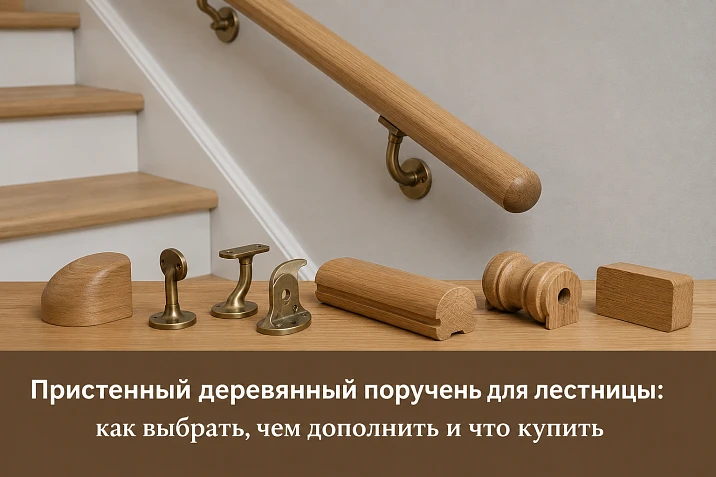
Wooden handrails for stairs are usually bought not just for a beautiful detail. The buyer solves several tasks at once: make ascent and descent safer, complete the stair railing, match the top line to the balusters and posts, design the staircase in a private house without random materials, and know in advance which components will be needed along with the handrail. This is especially important for a wooden staircase, where every detail is visible: steps, balusters, posts, a handrail bracket, finials, and the handrail itself should look like one well-thought-out set.
A wall-mounted wooden handrail is needed where a person holds onto the wall rather than a full balustrade. This solution is used on stair flights along the wall, in private houses, on transitions between floors, in halls, attics, basement rooms, and in interiors where a continuous railing with balusters is not required. But even a wall-mounted handrail cannot be chosen randomly. It should be comfortable to grip, suitable in length, profile, material, finish, and staircase style.
A wooden handrail is also purchased for a classic stair railing. In this case, it becomes the top part of the balustrade, covers the line of balusters, sets a finished silhouette, and helps connect the staircase with other wooden details. If the handrail is chosen incorrectly, even good balusters and posts can look disjointed. If chosen precisely, the staircase is perceived not as a set of components, but as a solid architectural part of the house.
At STAVROS you can buy wooden handrails for stairs in the actual product section and immediately select adjacent elements: balusters, posts, finials, and staircase components. This article will help you understand which handrail is needed for a private house, how a wall-mounted solution differs from a railing on balusters, why a handrail support strip is needed, how to choose the material, and what to buy together so that the staircase looks finished and is comfortable to use.
What is a wooden stair handrail
A wooden handrail is the top element of a stair railing or a separate wall-mounted part that you hold with your hand while moving up or down the stairs. It serves two purposes: it helps a person feel supported and forms the top line of the staircase. Therefore, a handrail should not be perceived merely as a decorative profile. It contributes to safety, comfort, proportions, and the overall appearance of the entire structure.
In a full balustrade, the handrail is installed on top of balusters and posts. Balusters fill the railing, posts reinforce the beginning, end, and turns, and the handrail unites these elements into one line. For a neat connection, a subrail strip is often used — a transitional piece between the top of the balusters and the bottom of the handrail. It helps achieve a cleaner fit and visually complete the railing.
A wall-mounted handrail works differently. It is attached along the wall and is not necessarily connected to balusters. This solution is convenient when the staircase runs along a wall, when a full railing is not required, or when an additional support point is needed. A wall-mounted wooden handrail is especially useful in a private home where the stairs are used by children, elderly people, guests, and residents with varying physical abilities.
The main feature of a handrail is its contact with the hand. Its profile should not only be beautiful but also comfortable. Too sharp edges are unpleasant, too wide a profile is difficult to grip, and too small a profile may seem unreliable. Therefore, when choosing, it is important to consider not only the pattern and wood species but also the grip shape, width, profile height, compatibility with fasteners, balusters, posts, and future finishing.




When a wooden stair handrail is needed
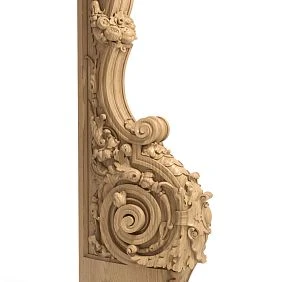
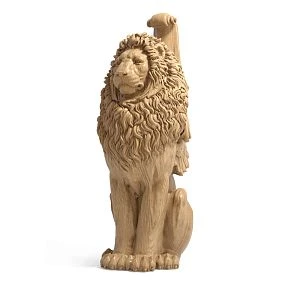
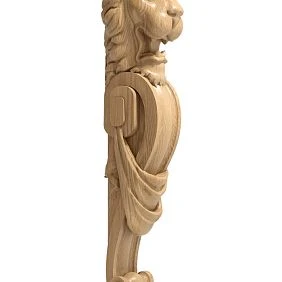
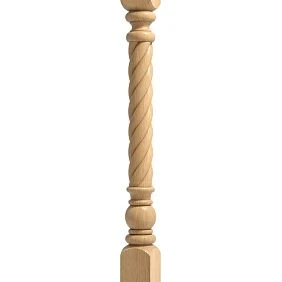
Our factory also produces:
For safety when moving on the stairs
The first task of a handrail is to provide a person with a clear support. A staircase can be beautiful, expensive, and made of good materials, but without a comfortable handrail, it will not feel completely safe. When ascending, the hand helps maintain balance; when descending, it helps control movement. This is especially important on long flights, turns, steep stairs, and in homes where the stairs are frequently used by children or elderly people.
A wall-mounted handrail is useful even where there is already a railing on the other side. For example, the staircase runs along a wall, and the balustrade is on the open edge. In this case, an additional handrail on the wall makes movement more comfortable. A person can hold on from a convenient side, especially when carrying things, walking at night, or descending the stairs in socks.
For safety, not only the profile itself is important, but also the quality of the fastening. The handrail must be installed at the appropriate height, securely fixed, and have no dangerous gaps where a person expects continuous support. The article helps select the product group, but specific installation should always be coordinated with the staircase structure, wall, base material, and project.
Get Consultation
To complete the balustrade
If a staircase is built with balusters and posts, the handrail becomes the top completion of the entire balustrade. Without it, the vertical elements look unfinished. Balusters can be beautiful, posts can be expressive, but the top line should bring them together into a single structure. It is the handrail that makes the railing comfortable for the hand and complete for the eye.
In such a scenario, it is important to select in advance not only the handrail, but also balusters for a wooden staircase, as well as posts for the beginning, end, and turns. If parts are chosen separately and without an overall logic, inconsistency may arise: the handrail is too massive for the balusters, the posts are too decorative for a simple profile, the finish does not match in color, and the top line of the staircase does not connect the elements.
A good handrail for a balustrade should not only sit beautifully on top. It must fit the handrail bracket, the top of the balusters, the support posts, and the overall scale of the staircase. Therefore, when purchasing, it is better to think in terms of a set: handrail, balusters, posts, finials, installation, finish.
For designing a staircase in a classic interior
In a classic interior, the staircase often becomes a prominent architectural part of the home. It connects floors, contributes to the first impression, and is visible from the hall, living room, or passage area. Here, a wooden handrail works not only as a functional support but also as a line that emphasizes the style of the staircase.
A classic interior values material, proportion, and consistency. If the steps, posts, balusters, and handrail are executed in the same logic, the staircase looks natural. If the handrail is random, too simple, or mismatched in scale, the entire image loses credibility. Therefore, for classic style, it is especially important to consider the profile shape, material, finish, and combination with carving and decorative elements.
A wooden handrail is well-suited for interiors where there are wooden steps, massive posts, carved balusters, warm floor shades, classic doors, solid wood furniture, or decorative panels. But this does not mean that a wooden handrail is only appropriate in classic style. In a calmer modern interior, it can become a soft, tactile line that makes the staircase less cold.
For a wall-mounted solution without a full railing
A wall-mounted wooden handrail is especially needed where the staircase runs along a wall and does not require balusters on that side. It helps a person hold on with their hand but does not overload the space. This solution is convenient for narrow staircases, attic passages, basement stairs, internal transitions, and areas where a full railing is visually or structurally unnecessary.
The wall-mounted option requires special attention to fastening. Unlike a handrail on balusters, it is supported not by vertical railing elements but by the wall through mounting brackets. It is necessary to consider the wall material, installation height, distance from the wall to the profile, grip comfort, line continuity, and the safety of the handrail end.
If a wall-mounted handrail is selected for an existing staircase, it is important to coordinate it with what is already there: steps, risers, baseboards, doors, posts, wood color, wall finish. The handrail should look not like a randomly added strip but like part of the interior.
Main characteristics of wooden handrails
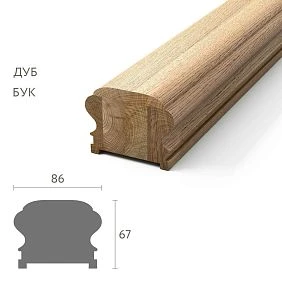
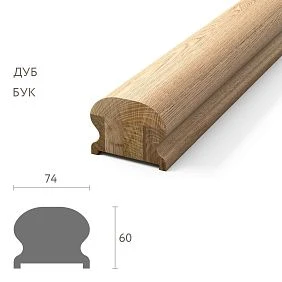
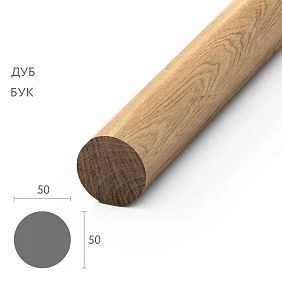
A wooden handrail is a staircase component, but it cannot be chosen solely by name. Different profiles may vary in grip shape, width, height, material, length, connection method, compatibility with the subrail strip, balusters, and posts. The STAVROS product group includes handrails for stairs, including PR-series items. Specific parameters of the selected model should be checked in the product card before ordering.
| Parameter | What is important for the buyer |
|---|---|
| Product type | Wooden handrail for stairs |
| Main scenarios | Wall-mounted handrail, top part of the balustrade, completion of the stair railing |
| Product group | Handrails for stairs |
| Series | PR series; specific model is specified in the product card |
| Material | Wood; in the selection by scheme, oak and beech are considered, exact options should be checked in the product card |
| Finishing | Options for custom finishing are available; actual data depends on the specific product |
| Compatible elements | Balusters, posts, handrail brackets, finials, mounting and finishing materials |
| What to check before ordering | Length, profile, material, compatibility with balusters and posts, attachment method, installation conditions |
| Main section | https://www.stavros.ru/products/reznoy-dekor/komplektuyushchie-i-elementy-dlya-lestnits/poruchni_dlya_lestnits/ |
This table helps you quickly understand where to start your selection. But a handrail is not an independent decorative strip. It is connected to the staircase structure. Therefore, before purchasing, you need to evaluate the length of the flight, type of installation, number of turns, presence of balusters, railing height, wall or base material, stair tread finish, and overall interior style.
If the handrail is chosen as part of a balustrade, it is especially important to check compatibility with balusters and posts. If it is needed as a wall-mounted element, wall attachment and grip comfort come to the fore. If the staircase is designed in a classic style, you need to look at the material, profile, and combination with decorative details.
Which wooden handrails can you buy
Straight handrail for stairs
A straight handrail is needed for straight stair flights, straight sections of balustrade, and wall-mounted solutions along a wall. This is the most straightforward format: it sets a calm line, helps the hand move without sharp transitions, and works well on stairs with simple geometry. Such a handrail can be part of a railing on balusters or be attached along a wall.
When choosing a straight handrail, it is important to consider the length of the section. If the stair flight is short, you can select a single element of the appropriate length. If the section is long, you need to plan the joints, connections, and overall appearance of the line. The handrail should not break off where a person expects the support to continue, and should not have uncomfortable transitions for the hand.
For a private home, a straight wooden handrail is often chosen as a universal solution: it is suitable for the main staircase, hallway, transition to the attic, double-height area, and along the wall. It is easier to integrate into the interior if you select the material and finish in advance to match the stairs, doors, floor, or other wooden elements.
Spliced handrail for long flights
On long stair flights or extended railings, a single piece may not be enough. In such cases, handrails are selected and joined with length in mind. It is important that the connection looks neat and does not interfere with the hand. The joint should not catch, stand out in color, or create a feeling of random assembly.
A spliced handrail is especially important in large houses, public spaces, long galleries, halls, and stairs with multiple flights. Here, any mistake is more noticeable: if the handrail line is interrupted, jumps in height, or changes profile, the staircase loses its integrity.
Before ordering, you need to calculate the length of each section, determine the joint locations, and coordinate the installation. Do not buy handrails based on the principle of "we'll take extra and cut it later." For a staircase, it is better to understand the geometry in advance: where the start is, where the end is, where the turn is, where the post is, where the wall-mounted bracket is, and where a subrail plank will be needed.
Handrail with subrail plank
A subrail plank is needed where the handrail is installed on balusters. It helps to neatly connect the top of the balusters with the bottom part of the handrail, covers the transition, and makes the structure visually cohesive. Without it, balusters may look like separate vertical pieces, and the top of the railing may appear as an element simply placed on top.
The handrail and subrail plank must match each other. If the handrail profile is not designed for a specific seating scheme, difficulties may arise with installation and appearance. Therefore, when purchasing, you need to understand in advance: whether the handrail will be wall-mounted or serve as the top of a balustrade. These are different scenarios.
If the staircase is being built from scratch, it is better to include the subrail plank in the kit immediately. Then the craftsman or staircase manufacturer can calculate the baluster placement, railing height, top line, and finish in advance. If the staircase is being renovated, you need to check whether the plank can be neatly added to the existing elements.
Handrail for private home and public space
In a private home, the handrail is often chosen based on a combination of safety, interior design, and tactile comfort. It should be pleasant to the touch, match the steps, and not conflict with furniture, doors, or finishes. Here, material and color are especially important: the staircase is often in a central area of the house and is seen every day.
In a public space, the handrail receives more load. Different people use it, traffic is more intense, and requirements for durability and installation are higher. For such tasks, it is especially important to carefully check the structure, fastening, and compliance with the project. The article helps to choose the direction and product group, but the final decision on installation should take into account the purpose of the room and the requirements for the staircase structure.
How to choose a handrail by shape and size
Grip comfort
Grip comfort is the main practical parameter of a handrail. A handrail can be beautiful, expensive, made of suitable wood, but if it is uncomfortable to hold with your hand, it will not fulfill its main task. A good profile does not cut into the palm, does not feel too thin, does not force you to twist your wrist, and allows you to hold on confidently when going up and down.
When choosing, it is important to imagine the actual movement. A person does not just touch the handrail, but slides their hand along it, holds on at turns, leans on it when descending, and sometimes transfers part of their weight to their hand. Therefore, sharp corners, overly complex protrusions, and an uncomfortable profile can become a problem. The beauty of the shape should work together with ergonomics.
For a wall-mounted handrail, grip comfort is especially important. It is often used as the main support along the wall. If the handrail is located too close to the wall, there is not enough space for the hand. If the profile is too wide, it is more difficult to grasp. If the surface is poorly prepared for finishing, the contact will be unpleasant. All these points need to be thought through before purchase.
Profile width and height
The width and height of the profile affect how the handrail feels in the hand and how it looks on the staircase. A narrow profile may seem light, but on a large staircase it will get lost. Too wide looks massive and may be uncomfortable to grip. A tall profile adds expressiveness but requires the right combination with balusters and posts.
For a private home, it is important to consider the scale of the staircase. On a small staircase to the attic, a too massive handrail will feel oppressive. On a wide grand staircase, a thin profile may look weak. The staircase should be read as a whole: steps, railing, newel posts, balusters, handrail, and the surrounding space.
The exact profile dimensions should be checked in the card of the selected model. You cannot choose a handrail based only on a photo. In the photo, the profile may look more compact or larger than in reality. Before ordering, it is worth comparing the parameters with the staircase project or existing elements.
Compatibility with balusters
If the handrail is installed on balusters, it is important that the top of the balusters matches the chosen profile and the under-rail strip. Balusters set the vertical pattern of the railing, and the handrail connects them from above. If the elements are not coordinated in style and size, the staircase looks assembled from different sets.
For example, thin, plain balusters can get lost under an overly massive handrail. Richly carved balusters can look strange under a too simple top profile. In a classic interior, it is especially important that the decor is evenly distributed: posts, balusters, and the handrail should support each other.
For a complete railing, it is worth looking not only at handrails but also at balusters for a wooden staircase. Then it is easier to understand what profile is needed on top: more subdued, more expressive, wide, narrow, restrained, or decorative.
Compatibility with newel posts
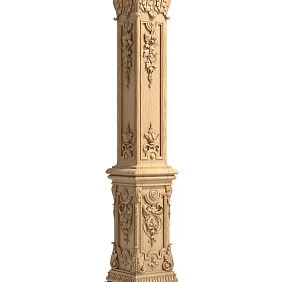
Posts reinforce the beginning, end, and turns of the staircase. They are perceived as the support points of the entire structure. If the handrail does not match the posts, the top line of the railing looks random. Therefore, when choosing, you need to evaluate not only the balusters but also Wooden posts for the staircase.
A post can be strict, turned, carved, massive, or lighter. The handrail should match it in scale. A handrail that is too thin on a massive post looks weak. A handrail that is too heavy next to a thin post disrupts the proportion. This is especially noticeable at turns and at the beginning of the staircase, where the gaze lingers longer.
If the post ends with a decorative element, it is worth considering the finial as well. It can support the style of the staircase and make the top of the support node more expressive. In this case, the handrail, post, and finial should be selected as one group.
How to choose material and finish
Oak: massiveness, status, durability
Oak is often chosen for staircases where expressiveness, density, and a sense of solidity are important. Visually, it is well-suited for solid private homes, classic interiors, and staircases with prominent posts and balusters. An oak handrail is perceived as a serious detail, not a temporary profile.
For the buyer, oak is important not only as a wood species but also as an interior signal. It looks good alongside massive steps, wooden doors, classic furniture, heated floors, and decorative elements. However, an oak handrail requires careful selection of finish. The color should match the steps, newel posts, balusters, and other wooden parts of the house.
When ordering, you need to check whether the selected handrail is available in the desired material and what parameters are specified in the product card. Do not automatically transfer the properties of one model to another. If oak is needed, this must be verified against the specific product or clarified with a STAVROS manager.
Beech: neat texture and workability
Beech is often chosen for calmer and neater wooden elements. It is well-suited for staircases where a clean shape, even appearance, and the ability to finish to match the interior are needed. Compared to more expressive species, beech can look more restrained, which is convenient for modern and not overly cluttered staircases.
A beech handrail can be a good choice for a private home where the staircase should be wooden but not overly massive in impression. It fits well with neat balusters, calm posts, light finishes, and interiors without heavy decor.
As with oak, the exact material options need to be checked in the specific handrail's product card. If the wood species is important for the project, it is better not to leave this issue for the final stage. The material affects the finish, shade, compatibility with steps, and the overall cost of the staircase set.
Unpainted handrail for custom finish
An unpainted wooden handrail is convenient when the staircase is being assembled for a specific interior and the final color has not yet been chosen. This option can be matched to steps, newel posts, balusters, doors, floors, furniture, or wall panels. This is especially important in a private home where wood often appears in several elements at once.
Custom finishing helps avoid mismatches. If the handrail is one shade, the steps another, the posts a third, and the balusters a fourth, the staircase loses its integrity. Even good details start to look random. Therefore, it's better to decide in advance whether the finish will be in tone, in soft contrast, or with emphasized texture.
Before ordering an unpainted handrail, you need to understand who will perform the finishing, what materials will be used, and how they combine with the chosen wood species. If the data in the product card is insufficient, it's better to clarify the parameters with a STAVROS manager.
How to choose a color to match steps, posts, and balusters
The color of the handrail should work not on its own, but together with the staircase. The calmest option is to choose a handrail in the same tone as the steps and main wooden elements. This approach makes the staircase integral and clear. A contrasting option is suitable when you need to emphasize the top line of the railing, but it requires more refined taste and coordination with the interior.
If the staircase already exists, start with what is most visible: steps, posts, balusters, floor, doors. The handrail can support one of these elements. For example, if the steps are dark and the balusters are light, the handrail can be dark and connect the railing to the steps. If the entire staircase is light, a dark handrail will become an accent line.
For a classic interior, it's important not to overdo contrast. Too sharp a color difference can make the staircase fragmented. For a modern interior, contrast sometimes works better, but you still need to consider the material and profile shape.
Commercial choice: which section to open for your task
| Buyer's task | What to offer | Where to look |
|---|---|---|
| Buy main handrail | Handrails for stairs | buy wooden stair handrails |
| Assemble a full railing | Balusters for stairs | balusters for a wooden staircase |
| Reinforce the start and turns of the stairs | Posts for stairs | Wooden posts for the staircase |
| Finish the post decoratively | Wooden finials | wooden finials for posts |
| Select a set of stair parts | Staircase components | solid wood staircase components |
This route helps avoid buying a handrail separately from the stairs. If a wall-mounted option is needed, you can start with handrails and immediately plan the wall attachment. If a balustrade is needed, you should look at the handrail together with balusters and posts. If the staircase is classic, it is worth thinking about finials in advance, because they complete the top of the posts and help make the structure more expressive.
What to buy together with a wooden handrail
A handrail is rarely bought as a completely separate part. It is either attached to the wall or becomes part of the stair railing. In the first case, reliable fasteners, correct height, and precise wall mounting are needed. In the second, the handrail works together with balusters, posts, a handrail bracket, and decorative details.
If the staircase is assembled as a full balustrade, a handrail bracket is usually bought together with the handrail. It helps neatly connect the top of the balusters to the handrail. Without it, the connection may look rough or require complex adjustment. The handrail bracket should be planned in advance because it affects the railing height and the overall appearance of the top assembly.
Balusters are needed to fill the railing. They set the vertical pattern of the staircase and determine the character of the balustrade. Posts are needed at the beginning, end, and turns. They reinforce the structure and act as visual anchor points. Finials help to beautifully complete the tops of the posts, especially in classic interiors.
Materials for finishing and installation also need to be planned in advance. If the handrail, balusters, and posts are to be painted or tinted, it is better to plan a unified finish. If a craftsman is performing the installation, he needs to know which elements have been purchased and how they should be connected.
| What to add to the purchase | Why this is needed | When it is especially important |
|---|---|---|
| Handrail support strip | Helps connect the handrail to the balusters and make the top of the railing neat | When the handrail is placed on the balusters |
| Balusters | Fill the staircase railing and form the vertical pattern | When assembling a full balustrade |
| Posts | Reinforce the beginning, end, and turns of the staircase | When a strong and expressive structure is needed |
| Finials | Decoratively complete the top of the post | For classic and decorative staircases |
| Finishing materials | Help to choose a uniform color and protect the wood | When the handrail is purchased for custom finishing |
| Mounting elements | Needed for reliable installation | For wall mounting and assembling the railing |
| Decorative elements | Support the staircase style | When the staircase is designed in a classic interior |
A comprehensive approach is important also because the staircase is usually in plain sight. If the handrail is purchased separately, and the balusters and posts are selected later, there is a high risk of mismatch in material, style, height, and finish. It is better to compile a list of elements in advance and understand exactly what is needed for your staircase.
How not to confuse a handrail with similar products
The handrail, sub-rail strip, baluster, post, and finial belong to the same staircase system but perform different tasks. A mistake in purpose leads to incorrect purchase. For example, a sub-rail strip does not replace a handrail, a baluster does not function as a support post, and a finial does not carry the railing.
| Product | What it is for | When to buy |
|---|---|---|
| Handrail | The top part of the railing or a wall-mounted support that you hold with your hand | When you need to finish the staircase and provide a comfortable grip |
| Handrail support strip | A transition element between balusters and the handrail | When the handrail is placed on the balusters |
| Baluster | Vertical railing element | When you need to fill the staircase railing |
| Pillar | Support element at the beginning, end, and turns of the staircase | When a durable structure and decorative accent are needed |
| Finial | Decorative top of the post | When you need to beautifully finish the top of the post |
The most common confusion occurs between the handrail and the subrail strip. The handrail is the part that the hand contacts. The subrail strip is an auxiliary element for connecting to the balusters. It can be important for installation but does not replace a comfortable top profile.
Another mistake is confusing a newel post and a baluster. A baluster fills the railing with a repeating row. A newel post is placed at key points: start, end, turn, landing. It is usually more noticeable and massive. The handrail must fit both the balusters and the newel posts because it connects them into one line.
A finial is sometimes perceived as an optional decoration. In strict interiors, it may indeed be unnecessary. But in a classic staircase, a finial helps complete the post and support the decorative logic. If the posts are expressive, the top without a finial may look unfinished.
Practical selection for different situations
Need to install a wall-mounted handrail along the staircase
Start with the wall length and ease of movement. A wall-mounted handrail should go where a person naturally reaches with their hand. It is important to consider the height, distance from the wall, start and end. The profile should be comfortable to grip, and the material should match the steps and interior.
If the staircase already has a railing on one side, a wall-mounted handrail can serve as additional support. In this case, it should not conflict with the existing balustrade. It is better to choose a similar material and finish so that the two sides of the staircase do not look mismatched.
Need to complete the balustrade on balusters
In this scenario, the handrail is chosen together with the balusters and the under-rail strip. You need to check how the top of the balusters will connect to the handrail, what height the railing will be, and how it will look at turns. If there are posts, the handrail must match them in scale.
For such a project, you cannot choose a handrail based only on shape. You need to look at the entire set: balusters, newel posts, bottom rail, finish, installation. If even one element stands out, the staircase loses its integrity.
Need to renovate an old staircase
If the staircase already exists, but the handrail is outdated, damaged, or uncomfortable, first evaluate the existing elements. What balusters are in place? Are there posts? What material are the steps made of? Can the old under-rail strip be preserved, or does the entire upper assembly need to be replaced? Sometimes replacing only the handrail improves the appearance, but sometimes it is better to replace the entire set.
When updating, compatibility is especially important. The new handrail must match the old elements in profile, color, and installation. If the staircase is to be repainted, you can choose a handrail for custom finishing and bring the entire set to a unified look.
Need to assemble a staircase in a classic interior
For classic style, it's better to assemble all decorative and structural elements in advance. The handrail should match the carving, balusters, posts, finials, steps, and the overall style of the home. The principle works well here: large elements set the scale, small ones support the image.
If the posts and balusters are decorative, the handrail should not be too random or utilitarian. It should complete the top line with dignity. If the staircase is more restrained, the handrail can be simpler, but still made of a suitable material and with a comfortable profile.
You need to choose a handrail for a wooden staircase in a private home
In a private house, the staircase should be comfortable every day. Therefore, choose a handrail not only with your eyes but also with your hand. Imagine how it will be used by children, adults, elderly relatives, and guests. Grip comfort, height, fastening reliability, and the absence of sharp, uncomfortable edges are more important than random decorativeness.
For a wooden staircase, it's better to immediately look at the related assortment: handrails, balusters, posts, finials, and components. This makes it easier to avoid situations where individual parts are beautiful on their own but don't come together into one image.
You need to design a staircase in a commercial space
In a salon, hotel, restaurant, showroom, or executive office, the staircase affects the impression of the space. The handrail should be not only comfortable but also resistant to heavy use. Here, the quality of installation, correct height, strength of joints, and consistency with the interior are especially important.
For a commercial space, it's better to choose a handrail as part of a project, not as a separate purchase. You need to consider foot traffic, wall material, safety requirements, cleaning, wear, and the visibility of the staircase in the overall space.
Installation, preparation, and finishing: what to consider before ordering
The installation of a handrail depends on the type of installation. A wall-mounted handrail is attached to the wall, while a balustrade handrail is installed on balusters, posts, and a handrail support plank. These are different tasks. For a wall-mounted solution, it is important to check the wall material, the load-bearing capacity of the base, the installation height, and the convenience of the offset from the wall. For a balustrade, it is important to check the fit on vertical elements, the connection with the handrail support plank, and the transitions on posts.
Before ordering, you need to calculate the length of the sections. A staircase rarely consists of only one straight flight. Often there are turns, landings, transitions, wall abutments, starts, and ends. Each section needs to be thought out separately, but the entire line should look unified. An error in handrail length leads to joints in inconvenient places or unnecessary cuts.
If the handrail will be finished after purchase, you need to think about the color in advance. Wood can be revealed in different ways, but the final result should match the steps, posts, balusters, doors, floor, and furniture. Do not leave finishing to the very end, when all elements have already been purchased haphazardly.
For maintenance, it's important to remember: the handrail is constantly in contact with hands. The surface should be pleasant, smooth, and resistant to daily use. If the finish is poorly chosen, marks, dirt, and unpleasant roughness will appear faster. Therefore, the finish should be not only beautiful but also practical.
Mistakes when buying a wooden handrail
Choosing only by photo
A photo helps to understand the shape but does not show everything. In the image, the handrail may seem comfortable, but in reality, the profile may be too wide, too high, or unsuitable for the balusters. Before ordering, you need to look at the dimensions, material, compatibility, and purpose.
Not considering grip comfort
A handrail is a part for the hand. If it is uncomfortable to hold, it does not fulfill its main function. This is especially important for wall-mounted solutions and stairs that are used every day. A beautiful but uncomfortable profile will quickly become annoying.
Buying a handrail without balusters and posts
If the staircase is built as a railing, the handrail cannot be chosen separately. It must match the balusters, posts, and handrail bracket. Otherwise, the top line will exist separately from the vertical elements.
Forgetting about the handrail bracket
The sub-rail strip may seem secondary, but without it, the connection between the handrail and balusters can look rough. If the handrail is mounted on balusters, this element needs to be considered in advance.
Not checking the material
If the steps are oak and the handrail is made of a different material without thoughtful finishing, visual inconsistency may appear. If the staircase is light and calm, a too dark handrail can become an unnecessary accent. The material and color should be chosen together.
Not accounting for the start, end, and turns
A staircase is not just a straight section. At turns, landings, and the beginning of a flight, posts, transitions, and neat finishing are needed. If you buy a handrail without calculating these areas, installation becomes more difficult, and the result may look unfinished.
Confusing a wall-mounted handrail with a balustrade handrail
A wall-mounted handrail is attached to the wall. A balustrade handrail works with balusters and posts. Sometimes one profile can be used in different scenarios, but the installation logic is different. Before purchasing, you need to understand exactly where it will be placed.
Not specifying the parameters in the product card
Even if the section and category are selected correctly, the specific model may differ in size, material, and purpose. Before ordering, you need to check the product card and, if necessary, clarify the parameters with a STAVROS manager.
Who is a wooden handrail suitable for
A wooden handrail is suitable for owners of private homes who want to make the staircase safe, beautiful, and coordinated with the interior. It is appropriate for both a new staircase and for updating an existing structure. The handrail is especially useful where the staircase is used daily and should be convenient for all family members.
It suits designers who are assembling a staircase composition for a specific interior. The handrail helps set the top line, connect steps, balusters, and posts, support classic style, or soften modern architecture. For a designer, it's important that the handrail can be considered not separately, but together with other staircase components.
It is suitable for carpentry workshops and staircase manufacturers. Ready-made elements help speed up selection, avoid wasting time on random blanks, and assemble a set of compatible parts. At the same time, the craftsman can focus on precise fitting, finishing, and installation.
It suits those who are renovating an old staircase. A new handrail can change the perception of the entire flight, especially if balusters, posts, or finishes are updated simultaneously. But before purchasing, you need to assess the existing structure and understand which elements can be preserved.
A wooden handrail is not suitable if a metal profile, PVC solution, temporary support without finishing is needed, or the staircase does not allow reliable fastening of wooden elements. It will also not suit those who want to buy one profile without checking dimensions, material, and installation scheme. Staircase parts require precision.
How to buy a wooden handrail at STAVROS
Start with the main question: will the handrail be wall-mounted or part of a balustrade. If it is attached to the wall, you need to consider the length, height, offset from the wall, base material, and grip comfort. If it is installed on balusters, you need to immediately look at the handrail bracket, balusters, posts, and decorative elements.
Then determine the material and style. For a solid classic staircase, more expressive wooden solutions are often chosen. For a calm modern home, a restrained profile and neat finish are preferred. If the staircase already exists, the handrail needs to be matched to the steps, floor, doors, posts, and balusters. If the staircase is being designed from scratch, it's easier to assemble a set right away.
On the website, you can open a section where handrails for staircases are collected, and buy wooden stair handrails taking into account the project. For a complete railing, it's worth looking at balusters, posts, finials, and solid wood staircase components.
Before ordering, be sure to check the length, profile, material, finish, purpose, compatibility with other elements, and installation conditions. If the staircase is non-standard, it is better to clarify the parameters with a STAVROS manager in advance. This way, the purchase will not be a random detail, but part of a well-thought-out staircase set.
FAQ: frequently asked questions about wooden handrails for stairs
Which wooden handrail should I buy for a staircase in a private house?
For a private house, it is better to choose a handrail based on grip comfort, flight length, staircase style, and compatibility with balusters, posts, or wall-mounted brackets. If the staircase is used daily, ergonomics are more important than random decorativeness.
How is a handrail different from a sub-rail strip?
The handrail is the top element that you hold with your hand. The sub-rail strip helps connect the handrail to the balusters and makes the top of the railing neater. It does not replace the handrail, but works together with it.
What should you buy together with a wooden handrail?
Most often, together with a handrail, you buy a sub-rail strip, balusters, posts, finials, mounting elements, and finishing materials. If the staircase is being assembled from scratch, it is better to plan the entire set at once.
Can a wooden handrail be used without balusters?
Yes, if it is a wall-mounted handrail. Then it is attached along the wall and does not require balusters on that side. It is important to correctly choose the installation height, profile, mounting, and distance from the wall.
How to choose a handrail to match posts and balusters?
You should focus on the carving style, material, color of the future finish, cross-section of the elements, and the overall scale of the staircase. The handrail should connect the balusters and posts, not look like a separate random detail.
How to understand if the handrail profile is comfortable?
A comfortable profile fits well in the hand, has no unpleasant sharp edges, is not too wide and not too thin. For a staircase in a private home, it is important to consider daily use: going up, going down, movement of children and elderly people.
Which material to choose: oak or beech?
Oak is suitable for more solid, expressive, and status staircases. Beech is often chosen for neat, restrained, and calmer wooden solutions. The exact choice depends on the project, finish, steps, and availability of the specific model.
Is a wall-mounted handrail needed if there is already a railing?
Yes, sometimes it is needed. If the staircase runs along a wall, a wall-mounted handrail can provide additional support and make movement more convenient. This is especially useful on long flights, steep staircases, and in homes where the staircase is used by children or elderly people.
Can I replace only the old handrail?
Yes, if the new handrail is compatible with the existing balusters, posts, and under-rail part. Before purchasing, you need to check the dimensions, fit, material, finish, and condition of the old railing. Sometimes it is better to update several elements at once.
How to choose a handrail for a classic staircase?
For a classic staircase, the combination of profile, material, balusters, posts, and finials is important. The handrail should be expressive enough but not conflict with other details. It is better to choose it as part of a set.
What is more important: appearance or grip comfort?
Both parameters are important, but grip comfort cannot be sacrificed for appearance. The handrail is a functional detail. It should be beautiful, but first and foremost comfortable and safe for daily use.
How to calculate the length of the handrail?
You need to measure each section of the staircase: straight flights, turns, landings, wall zones. It is important to consider the start and end of the handrail, joints, connections to posts, and installation features. For a complex staircase, it is better to coordinate the calculation with a craftsman.
Where to buy wooden handrails for stairs?
In the STAVROS catalog you can buy wooden handrails for stairs and select balusters, posts, finials, and other staircase components for them.
Result: how to choose a handrail without random mistakes
A wooden handrail is not just the top rail of a staircase. It is responsible for grip comfort, movement safety, completion of the balustrade, and the appearance of the entire staircase structure. In a wall-mounted version, it provides a person with support along the wall. In a balustrade with balusters, it gathers the vertical elements into a solid line and makes the staircase complete.
You should choose a handrail based on the task: for a wall, for a balustrade, for a private home, for a classic interior, for renovating an old staircase, or for a new project. It is important to check the profile, material, dimensions, finish, compatibility with balusters and posts, the need for a sub-rail plank and decorative finials. The earlier these elements are assembled into one set, the lower the risk of style and installation mismatch.
At STAVROS, you can select handrails, balusters, posts, finials, and staircase components in one direction. This approach helps move from the idea of "need a handrail" to a well-thought-out choice: which profile to take, what to complement it with, what to check before ordering, and how to assemble a staircase without random parts.