










































































Article Contents:
- What is a decorative portal made of moldings and garland
- What elements does the portal consist of
- Moldings
- Decorative garland
- Corners for moldings
- Decor for moldings
- Cornice, pilasters, capitals
- Where to use such a kit
- Door portal
- Fireplace portal
- Mirror portal
- Niche and console area
- Wall panel
- How to choose a set for a task
- How to calculate a set before purchase
- Mistakes when choosing a portal from moldings and garlands
- FAQ: Answers to Popular Questions
- About the company
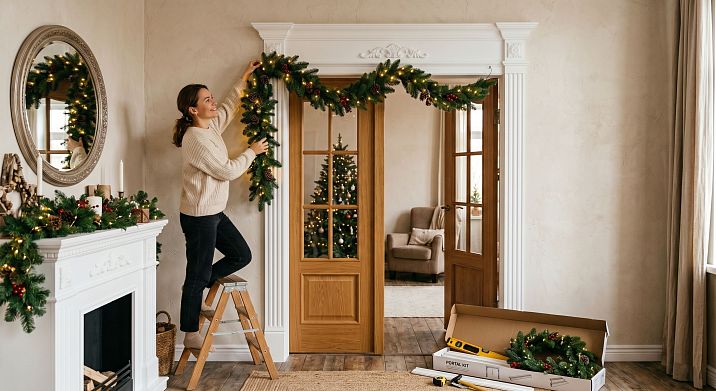
Portal from moldings and decorative garlands — this is not one beautiful element on the wall, but an architectural system where each detail plays its role. Moldings build a frame contour, the garland creates an ornamental semantic center, corner overlays complete the joints, side decor enhances the verticals, and the cornice crowns the top part and adds a representative scale to the entire structure. That is why proper work with such a set begins not with choosing a favorite detail, but with a scheme: what exactly needs to be framed, what is the scale, what style, what finish.
For walls to be painted and monolithic painted portals, polyurethane is optimal — Moldings made of polyurethane in combination with with PU overlays with garland ornament create a single surface with relief that easily accepts any paint. For wooden interiors, furniture portals, frames and trims with tinting — Wooden decorative inlays made of beech and oak give a lively, warm, natural character that polyurethane cannot reproduce. The choice between two paths is always a matter of context, not taste.




What is a decorative portal made of moldings and garlands
The word "portal" in everyday understanding is most often associated with a doorway. But in interior decor, this concept is much broader. A portal is any decorative framing that highlights, accentuates, or architecturally frames a specific element of the space. A fireplace, mirror, niche, console area, window opening, built-in shelving, accent wall behind the sofa — all of these can serve as the basis for a decorative portal.
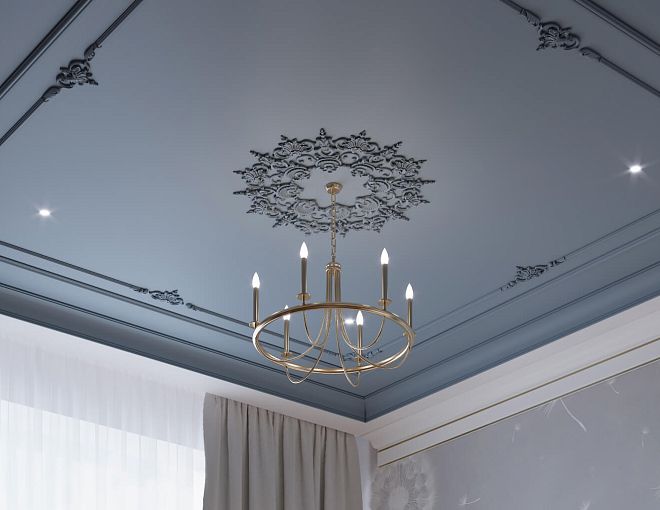
The essence of a portal made of moldings is to create an architectural frame. Molding strips form a contour, inside which a protected, accentuated field appears. Add a decorative garland to this field — and the empty frame turns into a full-fledged interior statement. A plant ornament, floral motif, vine, laurel branch — each gives the portal its own character, its own era, its own mood.
This approach is used in classic, neoclassical, Empire, French style, and Baroque. In modern soft classic and eclecticism with a classic vector, it also works — provided that the ornament and scale are chosen proportionally to the space. A giant Baroque garland in a small apartment with 2.7-meter ceilings is a mistake. A laconic leaf overlay in a frame of thin molding in the same apartment is a precise and expressive solution.




What elements does the portal consist of
A portal is a set. Understanding its components allows you to assemble a system, not a chaotic set of details. Let's break down each element separately.
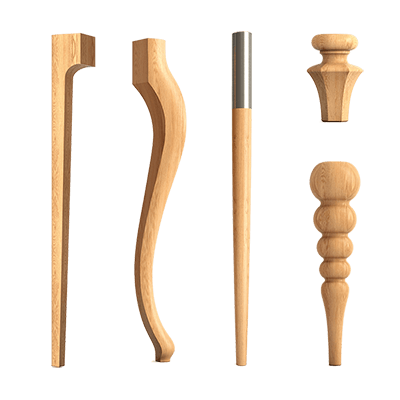
Our factory also produces:


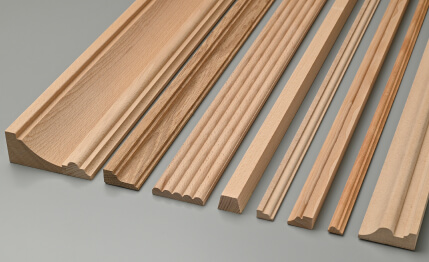
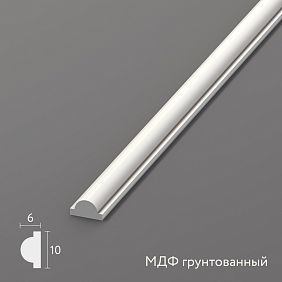
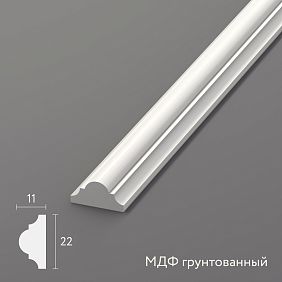
Moldings are linear profiles used to create framed compositions, zone walls, and frame openings. They come in various widths (from 20 to 150 mm) and relief complexity — from smooth to richly decorated.
Moldings are the load-bearing structural basis of the portal. They form vertical posts, the top lintel, and sometimes the bottom base. It is the moldings that determine the scale, width, and architectural weight of the entire system.
The molding profile is a key parameter. The STAVROS catalog features different formats. Molding MLDPU-004 — universal profile 15×8 mm, length 2600 mm — suitable for most framing tasks: wall frame, mirror framing, door design in neoclassical style. It is expressive enough to be noticeable and delicate enough not to overpower the attention. molding MLDPU-003 — a 35×12 mm profile, of the same length — is already a serious architectural element for a door or fireplace portal in a classic or Empire-style interior. Here, the 12 mm depth creates a developed chiaroscuro, and the 35 mm width makes the frame truly substantial.
It is important to understand: a molding for a portal is chosen not by the width of the wall, but by the scale of the object being framed. A narrow molding around a tall door looks disproportionate. A wide molding around a small wall mirror overwhelms it. Proportionality is the main principle.
Get Consultation
Decorative garland
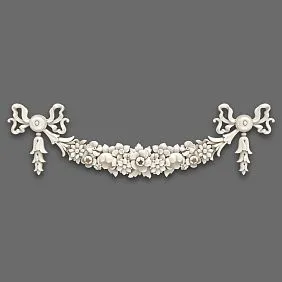
The garland is the semantic center of the portal. It can be positioned in different ways: above the opening in the upper horizontal part, inside the frame along the central axis, on the sides of the vertical posts (in pairs), or simultaneously at the top and on the sides in the most representative versions.
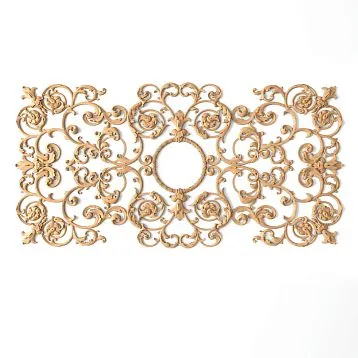
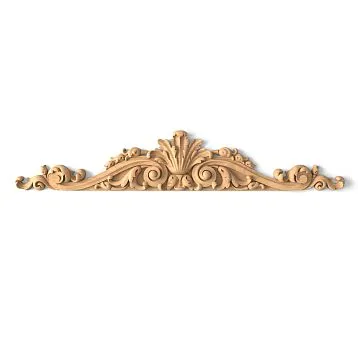
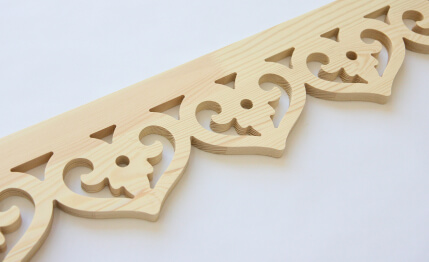
For door and fireplace portals, a horizontal garland above the opening is traditional — this is the place of maximum visual attention, what is seen first upon entry. Among STAVROS solutions — PU overlays with garland ornament: these products are made specifically for wall, ceiling, and facade tasks, for creating accent ornamental elements in interior and design projects. For portals with natural finishes — Carved wooden decoration provides a lively relief with a pronounced material structure.
Corners for moldings
Corner elements are a detail that is often underestimated, and then regretted. At the junction points of molding strips without corner decor, a dry technical 45-degree cut remains. It looks beautiful only if you look very closely and very indulgently. From a distance, a corner without decor looks like incompleteness.
Corner element MLDPU-004U — a square overlay 135×135×10 mm made of polyurethane — designed specifically to complete frame and portal structures. It covers the joint, adds a decorative accent to the corner, and turns a technical node into an aesthetically resolved detail. For four corners of one portal — four such elements. This is a small investment that radically changes the overall impression.
Decor for moldings
Decor for Molding — a separate and rich direction in the STAVROS catalog. These are central overlays, left and right side elements, decorative inserts — everything that mounts directly onto the molding strip and turns a simple profile line into an ornamental detail.
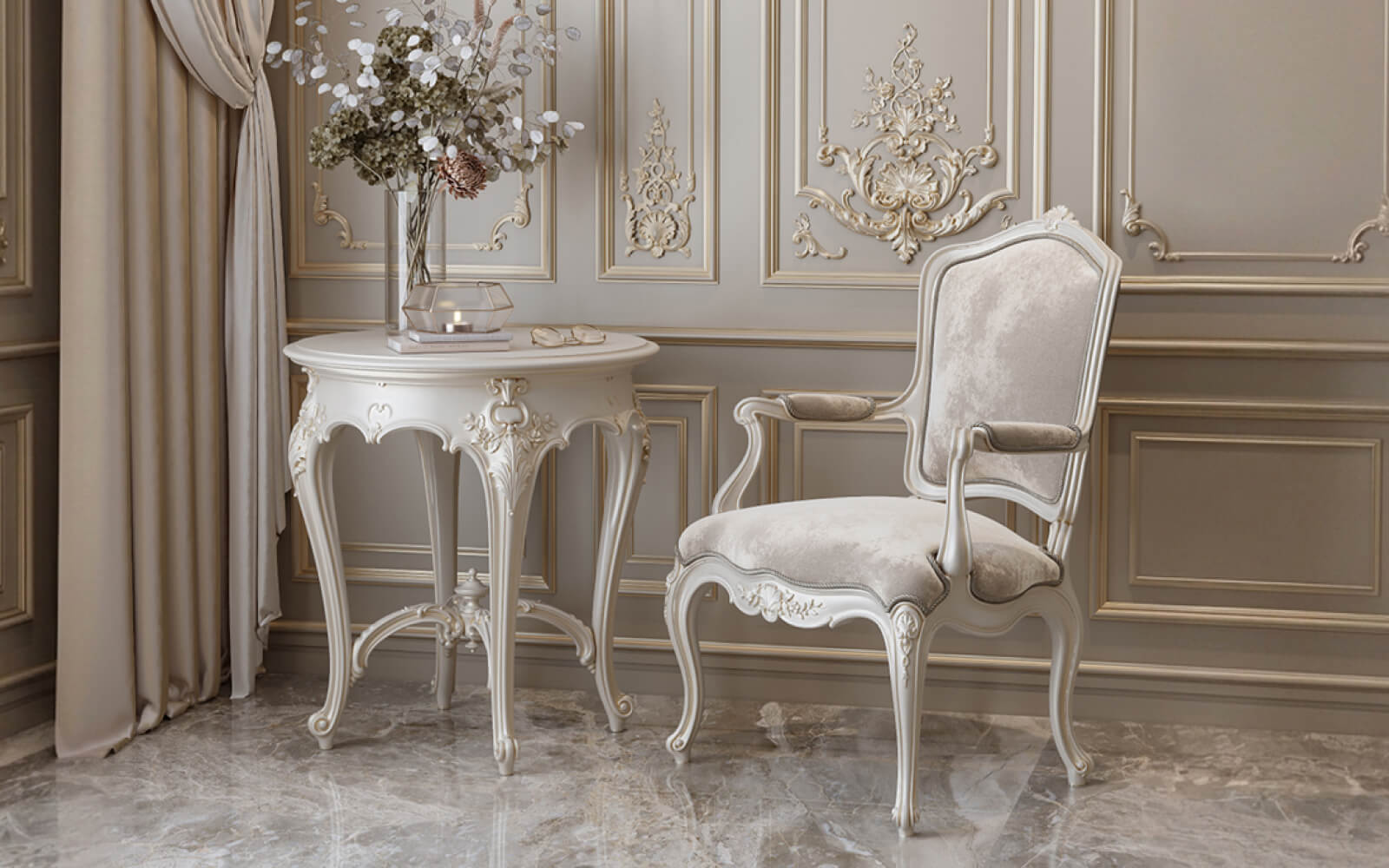
Molding overlay NPU-402.1L — this is a left decorative detail for walls, panels, doors, and interior compositions. Paired with the right mirror element, it forms a symmetrical side accent on the vertical post of the portal. Central decor NPU-434.1 — an overlay that attaches along the central axis of the horizontal crossbar and serves as the ornamental "lock" of the entire system. It is this combination — side overlays on the verticals and a central one on the horizontal — that creates a full-fledged representative portal.
Cornice, pilasters, capitals
For the most large-scale and ceremonial portals — doors to grand halls, fireplace zones in living rooms with high ceilings, architectural wall compositions — moldings and garlands alone may not be enough. This is where pilasters, cornices, and capitals come into play.
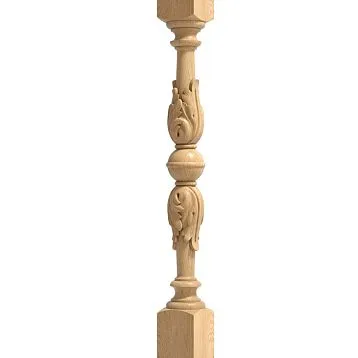
Pilasters — flat decorative columns — reinforce the vertical posts of the portal, adding architectural weight and a sense of load-bearing structure. The cornice above the crossbar creates a protruding canopy that casts a shadow and "closes" the portal from above, making it complete. The capital — the decorative top of the pilaster — connects the vertical with the horizontal and adds an order-based, historical character to the entire system. All these are elements of a single decorative language, and their combination must be consistent: you cannot mix a Doric capital with a Baroque garland without a clear conceptual logic.
Where to use such a set
Understanding the location is the first step in working on a portal. Different objects require different schemes, different scales, and different sets of elements.
Door portal
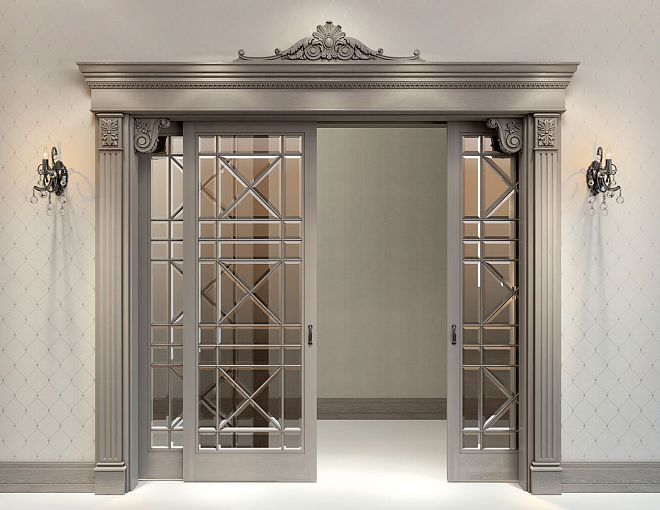
A door portal is a classic location for a molding system with a garland. An interior door to the living room, study, bedroom, formal dining room — everywhere, molding framing turns an ordinary opening into an architectural event. The scheme here is standard: two vertical posts on the sides of the opening, a horizontal lintel at the top, four corner elements at the joints, a central garland above the lintel, and, if necessary, side overlays on the verticals.
For a door portal, precision of proportions is important. The width of the molding should match the scale of the opening: for a standard door 80–90 cm wide — a profile of 20–35 mm. For a wider opening or double doors — you can use a wider molding or double framing (inner and outer contour). The garland above the lintel is chosen so that it occupies 50–70% of the opening width — leaving air at the edges, the ornament "breathes."
Fireplace portal
A fireplace is a space that initially requires architectural design. Without a portal, the fireplace looks unprotected, built into the wall without completion. The molding system with a garland here serves as a "setting": it highlights the fireplace area, sets its scale, and adds a ceremonial accent.
For a fireplace portal, a wide molding is recommended — a profile of at least 35 mm. The central garland is placed above the firebox in the horizontal zone of the mantel or above it. Symmetrical side overlays on the verticals complete the system. If the fireplace is large and the wall is high — you can add a cornice above the mantel: it visually "covers" the entire structure and adds architectural weight.
An important nuance for the fireplace area: the decor material must withstand thermal effects. Polyurethane in a moderate thermal regime (not direct heat, but thermal radiation from the fireplace) behaves stably. Direct contact with open flame or strong heating — of course, not: the decor is mounted on the wall around the fireplace, not on its firebox part.
Mirror portal
A mirror in a classic interior is not just a functional object. It is a vertical line, a source of reflected light, a visual expansion of space. An architectural frame made of moldings around the mirror turns it into an independent interior object.
For a mirror, the scheme is more delicate. Here, it is better to choose a thin or medium molding — 10–20 mm. A massive wide profile around the mirror creates a feeling of heaviness and narrows the reflection. The garland is located in the upper part of the frame — above the mirror or in the center of the upper lintel. Small side overlays on the verticals are acceptable, but they should be compact and delicate. Corner elements are mandatory — they make the mirror frame complete and professionally assembled.
Niche and console area
Niches in walls are a common element in modern classical and neoclassical interiors. A built-in niche without framing looks like a technical void in the wall. With a molding portal and a decorative garland, it becomes an accent point of the space.
The console area — a console table by the wall with a mirror above it — also perfectly accepts molding framing. The scheme often used here is 'a frame on the wall above the console + a garland inside the frame + a mirror in a molding frame.' This is a three-level decorative system that creates depth and richness on a relatively modest budget.
Wall panel
A wall panel made of moldings with a garland is essentially a decorative wall panel. This solution is used for an accent wall in a living room, bedroom, hallway, showroom, restaurant, or hotel. The scheme: one or several frames made of moldings, corner elements, central garlands in each frame. Everything is painted in a single color with the wall — only the relief comes to the forefront.
It is for such tasks that polyurethane is the material of first choice. A wall panel implies a uniform coating, monochrome, and solidity. Polyurethane can be painted in any color, does not deform, and requires no complex maintenance. Polyurethane wall decor STAVROS offers exactly such solutions: accent overlays and elements created for wall decorative systems.
How to choose a set for the task
Different tasks require different sets of elements. Let's systematize the logic of selection.
For light neoclassicism: thin or medium molding (10–20 mm), one neat garland with a neutral leaf ornament, minimal corner elements or simple rectangular corners, painting in the wall color. The result is restrained, architectural, without pretentiousness.
For a classic door portal: medium or wide molding (25–35 mm), central garland above the lintel, side overlays on vertical posts, corner elements with decor, possible cornice. The result is prestigious, with a pronounced historical character.
For a fireplace area: wide relief molding (35 mm and more), expressive horizontal garland, symmetrical side overlays, cornice above the shelf, decorative elements for moldings. The result is solemn, chamber-festive, with a sense of palace interior.
For a mirror: thin or medium molding (10–20 mm), central top accent, small side overlays or none, mandatory corner elements. The result is elegant, jewelry-like, without overload.
For a wooden portal: Wooden decorative inlays made of beech (for enamel) or oak (for tinting), wooden molding, ornament of the corresponding style. The result is warm, natural, with a lively wood texture.
| Task | Best solution |
|---|---|
| Painted portal matching the wall color | polyurethane moldings + PU overlays |
| Classic door portal | medium/wide molding + garland + corners |
| Fireplace area | wide molding + garland + cornice |
| Frame around the mirror | thin molding + top overlay + corners |
| Furniture or wooden portal | carved wooden overlays |
| Neoclassical | thin/medium molding + moderate decor |
| Natural finish for tinting | Oak |
| Facade for enamel | Beech or polyurethane |
| Wall panel for painting | Polyurethane |
| Classic with patina | polyurethane or wood with appropriate preparation |
How to calculate the kit before purchasing
Calculating the kit is not advanced mathematics. It is a sequence of steps that anyone who can use a tape measure can perform.
Step 1. Measure the width and height of the object: opening, mirror, fireplace, niche. Write down the exact numbers in millimeters.
Step 2. Determine the outer size of the portal. The portal usually extends 50–150 mm beyond the contour of the framed object on each side — this depends on the chosen scale and style.
Step 3. Choose the width of the molding. The larger the portal, the wider the molding. The more delicate the task, the thinner it is.
Step 4. Decide: single frame or double framing. Double framing (inner and outer contour with different profiles) creates a richer and deeper result.
Step 5. Select a garland according to scale: 50–70% of the inner field width for horizontal, 50–60% of the height for vertical.
Step 6. Decide whether paired side symmetry or only a central accent is needed.
Step 7. Add corner elements: 4 pieces for one frame. For double framing — 8 pieces.
Step 8. Calculate the perimeter of the frame. Divide by the length of one molding strip (usually 2600 mm), add 15% margin for 45° cuts and possible defects. Round up.
Step 9. Determine the finish: painting in the wall color, enamel, patina, tinting. The choice of overlay and molding material depends on this.
Step 10. Order as a set — moldings, garland, corner elements, decor for moldings — all together from one source. This guarantees stylistic and production compatibility.
Mistakes when choosing a portal from moldings and garlands
Let's list typical mistakes — directly and without leniency, because each one costs money and time.
They buy a garland without understanding the portal size. They see a beautiful overlay in the catalog — and buy it before marking. Result: the element does not fit the frame size.
They take too thin molding for a large fireplace or door composition. A thin profile around a large opening gets lost. The portal requires proportionate molding.
They use too wide molding around a small mirror. A wide profile covers the reflection and makes the mirror heavy. For a mirror — a delicate scale.
They don't account for the opening height. They choose a garland designed for a horizontal format for a vertical portal — and the ornament "lies" where it should "stand".
They don't leave space for the central garland. The moldings are mounted flush to the edge of the opening, and there isn't enough space for the garland above the lintel.
They do not buy paired side elements when symmetry is needed. One side element without a mirror pair is an incompleteness that is impossible not to notice.
They do not check the compatibility of the decor with a specific molding. Decor for moldings is designed for a specific profile. An overlay from one series may not align with a molding from another.
They mix different ornament styles. A laurel garland and floral corner rosettes in the Rococo style are incompatible. The ornament must be unified.
They do not calculate the quantity of moldings with a reserve. They buy exactly the perimeter length and discover a shortage when cutting. Always + 15%.
They install without a preliminary layout. They do not lay out all elements on the floor or wall before applying glue. As a result — wrong sequence, overlapping elements, corrections on the fly.
FAQ: Answers to popular questions
What is included in a decorative portal made of moldings?
Basic portal: molding strips (verticals and a horizontal crossbar), corner elements, central garland. Extended: side overlays on moldings, decor for moldings, cornice, pilasters are added. The specific composition depends on the task and scale.
Can I assemble a portal from polyurethane moldings myself?
Yes. Polyurethane moldings are mounted with acrylic construction adhesive. The technology is accessible for DIY work: marking, cutting at 45° in a miter box, applying glue, fixing until dry. The main thing is precise marking and patience.
Which garland is suitable for a door portal?
Horizontal overlay with floral or plant ornament for the top lintel. Width — 50–70% of the opening width. Relief — moderate for neoclassicism, more expressive for classicism. Ornament selection — according to the interior style.
What to add to moldings around the fireplace?
Central garland above the shelf, symmetrical side overlays on the verticals, corner elements at junction points, with high ceilings — a cornice above the horizontal lintel. All elements must be from the same stylistic family.
Are corner elements needed for the portal?
Always needed when the frame should look finished and decorative. Without corner elements, the joints of molding strips look technical and unfinished. Corner element MLDPU-004U — a specific solution for most frame and portal formats.
How to choose molding for a mirror?
Thin or medium profile: 10–20 mm width. The molding should frame, not overwhelm. For a small mirror — Molding MLDPU-004 15×8 mm — the optimal choice.
What is better for a portal — polyurethane or wood?
For wall portals to be painted — polyurethane. For wooden interiors to be tinted or enameled — wood. For furniture portals — wood (beech or oak). For monolithic painted surfaces — polyurethane definitely.
Can moldings and a garland be painted the same color?
Yes, and this is one of the best techniques. A single color — the wall color or an independent accent — unites all elements into a monolithic architectural system. Relief and chiaroscuro come to the forefront, not material and seams.
How to calculate the number of moldings for a portal?
Measure the outer perimeter of the portal frame. Divide by the length of one strip (2600 mm). Add 15% for cutting and waste. Round up. For double framing — calculate the inner and outer contours separately.
Where to buy a set of moldings, garlands, and decorative overlays?
In the STAVROS catalog: Moldings made of polyurethane, PU overlays with garland ornament, Decor for Molding, Wooden decorative inlays — everything in one place, with the ability to select elements of the same scale, style, and production standard.
About the Company
STAVROS is a Russian manufacturer and supplier of stucco and carved decor: polyurethane moldings, PU decorative overlays, corner decor for moldings, carved wooden overlays from beech and oak, cornices, baseboards, and related elements for classic and neoclassical interior projects. The extensive catalog covers all elements needed to assemble a decorative portal of any scale: from a neat mirror frame to a representative door or fireplace surround with a cornice and side overlays. If you want to assemble Portal from moldings and decorative garlands — start with the catalog STAVROS: here you will find both the molding of the desired profile and the garland of the required scale, and everything needed for a complete professional result.