Article Contents:
- Under-baluster and under-rail strip for a wooden staircase: how to choose the element under the handrail and balusters
- Under-baluster and under-rail strip — not a trifle, but an element of the staircase system
- How the under-baluster differs from the under-rail strip
- Balustrade
- Stringer board
- Briefly about the difference
- When the under-baluster is mandatory
- New wooden staircase in the house
- Replacing balusters without replacing the stringer
- Restoration of old railing
- Installation on the second floor platform
- Design projects with frequent baluster spacing
- How to choose the under-baluster rail by size
- Width of the under-baluster rail
- Height of the under-baluster rail
- Length of the under-baluster rail
- Profile of the groove for the baluster
- Material: why solid wood is important for a wooden staircase
- Oak
- Oak
- Why not MDF or particleboard?
- Principle of wood species compatibility
- How to attach the under-baluster rail and balusters: work procedure
- Foundation Preparation
- Marking the baluster spacing
- Attaching sub-baluster to base
- Installing balusters into the under-baluster rail
- How to attach balusters to the under-baluster rail: options
- Installation of the upper part: handrail bracket
- Handrail bracket under the handrail: where it is needed and how it works PR-003
- Tasks of the handrail bracket
- Handrail bracket PR-003 from STAVROS
- How to assemble a complete set: balusters, handrail, posts, and brackets
- Balusters
- Posts
- Handrails
- Under-baluster rail + handrail bracket
- Final railing system
- Typical mistakes when choosing a sub-baluster and handrail support strip
- Mistake 1: buying a strip without considering the baluster cross-section
- Mistake 2: not accounting for the final railing height
- Mistake 3: not checking compatibility of the handrail support strip with the handrail
- Mistake 4: mixing wood species without controlling the tint
- Mistake 5: not allowing for length margin
- Mistake 6: buying a strip without grooves if you don't have a routing tool
- Mistake 7: installing a sub-baluster without checking the level
- Mistake 8: not using a handrail support strip with a curved handrail
- Where to buy a baluster shoe and a handrail bracket
- About the Company STAVROS
- FAQ: Answers to the Most Popular Questions
- What is a baluster shoe?
- What is the difference between a baluster shoe and a handrail bracket?
- What is a baluster shoe used for?
- How to choose the size of a baluster shoe?
- How to attach a baluster shoe?
- Can balusters be attached without a baluster shoe?
- What type of wood should I choose for a baluster shoe?
- What is a handrail bracket PR-003?
- Where to buy a baluster shoe in Saint Petersburg and Moscow?
- Do I need to buy a sub-baluster and a sub-handrail strip together?
- Where to buy components for a wooden staircase in one place?
Sub-baluster and sub-handrail strip for a wooden staircase: how to choose the element under the handrail and balusters
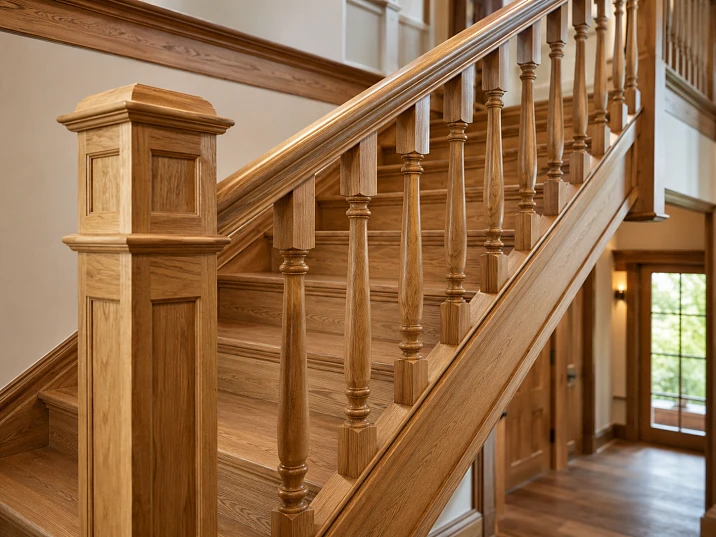
A wooden staircase is not just a structure. It is the character of the home. That moment when you step onto the first step and feel the warm wood of the handrail under your palm — that is the interior in the full sense of the word. But a beautiful result is made up not only of visible items. It is made up of details that are almost unnoticeable until you learn that they are the ones holding the entire system in precision and neatness.
Sub-baluster and sub-handrail strip are exactly such details. Small. Technical. Unnoticeable at first glance. And crucial — if you want the staircase railing to look like professional work, not like amateur work with crooked balusters and gaps at the base of the handrail.
If you are looking for where buy sub-baluster for a wooden staircase — this article will give you a complete understanding: what it is, why it is needed, how to choose, and how not to make a mistake.




Sub-baluster and sub-handrail strip — not a trifle, but an element of the staircase system
Let's start with the main thing: why are we talking about two different elements? And why are they needed if balusters can be installed directly?
A wooden staircase is a system. It has load-bearing elements: stringer, carriage, steps. There is a railing: balusters, posts, handrail. And there are connecting parts that turn a set of individual elements into a single structure with clean geometry and a reliable connection. Sub-baluster and sub-handrail strip are exactly such connecting parts.
Without them, of course, you can assemble the staircase. But each baluster will have to be installed individually, manually checking the vertical, layout, and spacing. And fastening at the points of connection with the stringer or floor will require hiding the mounting nodes using other methods. This is time-consuming, labor-intensive, and most often leaves visible traces.
With a sub-baluster rail, everything is different: it sets the line into which the balusters fit evenly, step by step, without individually adjusting each one. With a handrail support strip, the handrail lies evenly, without gaps or misalignments, resting on a properly prepared base.
STAVROS components for wooden staircases — this is precisely a systematic approach. Not "buy a baluster" and "buy a handrail" separately, but assemble the railing from compatible elements, where each performs its function accurately.
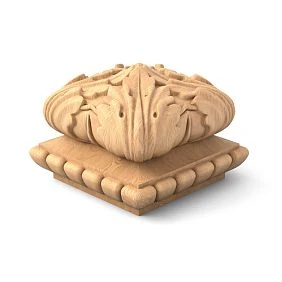
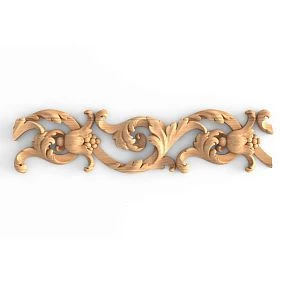
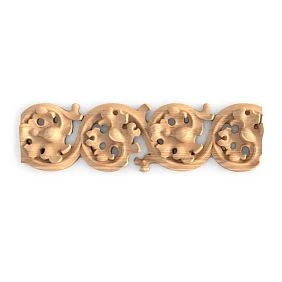
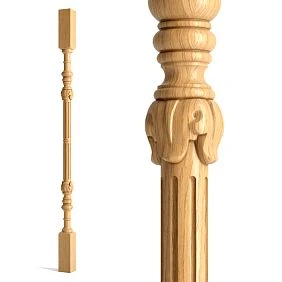
Our factory also produces:



How a sub-baluster rail differs from a handrail support strip
These two terms are often confused — and that's understandable, because both describe wooden strips in the context of staircase railings. But they work in different areas of the structure and perform different tasks.
Get Consultation
Baluster base
A sub-baluster rail is a wooden strip that is installed in the lower area of the railing: on the stringer, on the steps, or on the floor of the landing. It is into this strip that the lower ends of the balusters are cut or rest upon.
Functions of the sub-baluster rail:
-
Fixes the spacing of balusters: the strip with pre-marked or milled grooves prevents the balusters from shifting.
-
Hides the mounting node: the fastening of the baluster to the stringer or step goes inside, under the strip — nothing is visible from the outside.
-
Ensures a clean line of the row: all balusters stand in one plane, without deviations.
-
Simplifies marking during installation: no need to mark each baluster individually.
The sub-baluster is installed from below — on the horizontal string, on the edge of the step, or on the floor base of the stair landing.
Handrail Support Block
The handrail support strip is a wooden strip that works in the upper zone: under the handrail. It serves as a support for the handrail and a connecting element between the upper ends of the balusters and the handrail.
Functions of the handrail support strip:
-
Creates an even horizontal base for mounting the handrail.
-
Conceals the upper fastening nodes of the balusters.
-
Ensures precise mating of the handrail with the balusters without gaps or misalignments.
-
Holds the upper row of balusters in the specified plane.
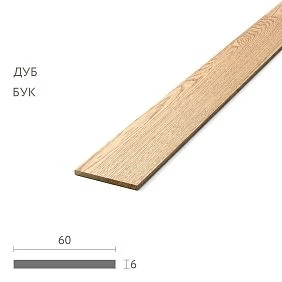
Handrail Support Bar PR-003 from STAVROS — this is a product made of solid beech or oak, executed as a ready-made element of the under-handrail system. It is part of a unified line of stair components and is compatible with STAVROS handrails and balusters.
Briefly about the difference
| Element | Zone | Task |
|---|---|---|
| Bottom rail | Lower part of the railing | Fastening and aligning balusters from below |
| Handrail support strip | Upper part of the railing | Support for the handrail, hiding the upper ends of the balusters |
Together they form the upper and lower "strapping" of the railing, in which the balusters stand evenly, the installation is hidden, and the entire row looks like a single architectural element.
When a bottom rail is mandatory
There are situations where you can do without a bottom rail — and the result will still be acceptable. And there are situations where it is not just desirable, but practically mandatory. Here is when you should take it without hesitation.
New wooden staircase in the house
When installing a staircase from scratch, the baluster rail is embedded into the structure at the design stage. This is easier than installing it post-factum: you can pre-select the strip for the stringer and the cross-section of the balusters, accounting for all gaps.
Replacing balusters without replacing the stringer
If the stringer is in good condition but the balusters need updating, the baluster rail allows installing new balusters without preparing new mounting grooves in the stringer. The strip takes on the attachment points and masks old traces from previous balusters.
Restoration of old railing
In historic homes, a common situation arises: old balusters have become loose, the row line is disrupted, and mounting joints look poor. The baluster rail is an effective restoration tool: it hides base damage and provides a level start for a new row of balusters.
Installation on the second floor landing
When balusters are installed not on a staircase flight but on a horizontal second floor landing, the baluster rail is especially important: it creates a level railing line on the floor without requiring complex base preparation.
Design projects with frequent baluster spacing
If by design the balusters are placed close together—every 10–12 cm—individual marking of each becomes a source of errors. A baluster rail with grooves at equal spacing solves this task accurately and quickly.
How to choose a baluster rail by size
This is the most technical section of the article — and the most important for making the right purchase. A baluster shoe that doesn't fit properly will create more problems than not having one at all.
Baluster shoe width
The width of the strip should match the width of the stringer or the base it is attached to. Standard values: 45, 50, 60, 70 mm. For most wooden stairs with a standard profile stringer, strips with a width of 45–60 mm are suitable.
The width also depends on the cross-section of the baluster. If the baluster has a square cross-section of 40 × 40 mm, the strip should be no narrower than 45–50 mm. If the cross-section is 45 × 45 or 50 × 50 mm, it should be no narrower than 55–60 mm.
Baluster shoe height
The height (thickness) of the strip affects the final height of the railing. The baluster shoe adds its thickness to the bottom of the baluster — and the handrail bracket subtracts the same amount from the top. Keep this in mind when calculating the total railing height.
The standard height (thickness) of a baluster shoe is 30–50 mm. The most common values are 40 mm and 50 mm.
How to calculate the railing height with strips:
Railing height = baluster height + baluster shoe thickness + handrail bracket thickness + handrail height
With a railing height of 900–950 mm from the floor (standard for residential buildings), all these values need to be accounted for in advance.
Under-baluster rail length
The plank is selected based on the length of the span or section where a row of balusters is installed. Standard sale — by linear meters or individually in standard lengths (usually 3 m or 6 m). When calculating, add a margin of 5–10% for trimming and joints.
Groove profile for baluster
If the under-baluster rail is sold with pre-made grooves — ensure the groove profile matches the bottom end of the baluster. A square baluster 40 × 40 mm requires a groove of 40 × 40 mm (or slightly larger, with a tolerance of 1–2 mm for fitting).
If the plank has no grooves — grooves are milled on site according to markings.
Material: why solid wood is important for a wooden staircase
A staircase in a country house or a spacious city apartment is an area of high load and constant visual attention. Balusters, handrails, posts, and planks are visible every day. They are touched by hands. The under-baluster rail is stepped on or leaned on when installing balusters.
That is why solid wood is chosen for staircase components, not MDF, not glued board, and not laminated parts.
Oak
Oak — a dense, hard species with an expressive pattern. Under-baluster rail made of oak:
-
Does not split when driving in fasteners.
-
Does not deform under load.
-
Looks expensive even without treatment.
-
Under stain, it reveals a characteristic golden-brown wood grain pattern.
Buy an oak sub-baluster — the right choice for a classic staircase with oak handrails and balusters.
Beech
Beech is a hardwood with a fine, uniform structure. It is easy to mill and sand. When painted or varnished in a neutral tone, it gives a smooth, neat result.
Handrail Support Bar PR-003 from STAVROS is made from solid beech or oak — depending on the project requirements and the customer's choice.
Why not MDF or particleboard?
MDF and particleboard cannot withstand point loads in fastening areas. At the points where screws or baluster tenons are inserted, they crumble and delaminate over time. They are also unstable with changes in humidity — and a staircase in a country house is constantly subject to seasonal fluctuations.
Solid wood performs much more reliably under these conditions.
Principle of wood species compatibility
If the balusters are oak, choose an oak sub-baluster rail. If the handrail is beech, the handrail bracket should be beech. Mixing species is not prohibited, but under tinting they produce different shades — and this is noticeable in a single row.
For a uniform result, it is better to select all railing elements from the same wood species and with the same finish. In the catalog of STAVROS balusters, handrails и posts products made of oak and beech are presented, forming a compatible system.
How to attach the sub-baluster rail and balusters: work procedure
The installation block is not meant to turn the article into a step-by-step guide. It is meant to provide understanding: what happens during installation, what decisions are made at this stage, and what errors occur most often.
Foundation Preparation
Before attaching the sub-baluster rail, the surface underneath must be level, dry, and prepared. On the stringer — without protrusions or defects. On the steps — the horizontal level must be checked. On the landing — the floor covering must already be installed (or the correct gap left for it).
Marking the baluster spacing
The baluster spacing is determined by structural and regulatory requirements. The standard spacing for residential premises is 100–150 mm clear between balusters (to eliminate risk for children). Marking is done on the sub-baluster rail before its installation: this is more convenient and accurate than marking on an already fixed rail.
Underbaluster attachment to base
The rail is attached to the stringer, step, or floor with self-tapping screws through hidden holes or using glue in combination with fasteners. The fastening must be sufficient to hold the total load from the entire row of balusters.
If the stringer is inclined (as on a flight of stairs), the sub-baluster rail is cut at the angle of the flight — otherwise, the lower ends of the balusters will be crooked.
Installing balusters into the sub-baluster rail
The lower end of the baluster fits into the groove of the rail or is attached to it via a tenon-and-groove joint, a stud, or a self-tapping screw. The key is to check the vertical alignment of each baluster after installation. The sub-baluster rail has leveled the horizontal row, but vertical deviation of an individual baluster is still possible — especially if the groove is made with a slight tolerance.
How to attach balusters to the sub-baluster rail: options
-
Tenon-and-groove with glue — the most durable method, the baluster enters the groove of the rail with a tenon and is glued. Non-removable.
-
Stud with nut — a metal stud is screwed into the end of the baluster, passes through the rail, and is secured with a nut from below. Removable option.
-
Self-tapping screw in a hidden hole — not visible from the outside if the hole is covered with a plug or located on the underside of the rail.
Installation of the upper part: sub-handrail rail
After installing all balusters on the sub-baluster rail, the sub-handrail rail is mounted — at the top of the row. It is attached to the upper ends of the balusters and to the posts, creating a level base for the handrail.
Wooden handrails for stairs STAVROS are mounted on the under-rail strip: this ensures an even fit of the handrail without gaps or misalignments.
Under-rail strip for handrail: where it is needed and how it works PR-003
The under-rail strip is an element that is most often overlooked when planning a staircase. You buy a handrail, balusters, posts — and then discover that the handrail rests on an uneven row of the top ends of the balusters and does not provide the desired fit.
This is exactly what the under-rail strip is for.
Tasks of the under-rail strip
-
To level the top row of baluster ends into a single horizontal (or inclined, depending on the flight) plane.
-
To provide an even support surface for the handrail.
-
To hide the upper mounting nodes of the balusters: the connection between the baluster and the strip goes inside under the handrail.
-
To increase the rigidity of the upper part of the railing: the strip ties the balusters along the entire length of the row.
Under-rail strip PR-003 from STAVROS
Handrail Support Bar PR-003 — a finished product made of solid beech or oak, designed as an element of the STAVROS stair railing system. Compatible with handrails and balusters from the same production line.
The plank is produced in standard profiles compatible with STAVROS series handrails. Clarify compatibility of a specific handrail model with PR-003 with the manager when ordering.
Who is PR-003 suitable for:
-
For a new wooden staircase with STAVROS handrails.
-
For staircase restoration where a new handrail and a level base for it are needed.
-
For design projects where precise railing geometry is important.
How to assemble a complete set: balusters, handrail, posts, and planks
A buyer looking for a sub-baluster is most often looking for more than just that. They are building or updating a stair railing — and they need the entire system. Let's consider what it consists of.
Balusters
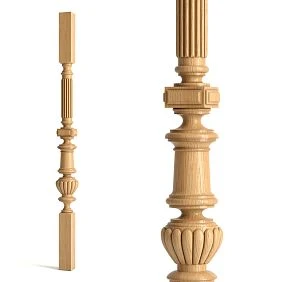
Balusters for STAVROS staircases — vertical railing elements. Made from solid oak and beech, in various profiles: round turned, square, with decorative carving.
When choosing balusters, consider:
-
Cross-section (40 × 40, 45 × 45, 50 × 50 mm for square);
-
Height (from 900 mm);
-
Profile of the lower and upper ends — the method of fastening in the sub-baluster and handrail bracket depends on it.
Columns
Posts for staircase — support posts that are installed at the beginning and end of the span, at turns and landings. The posts bear the main structural load of the railing, the balusters serve an enclosing function.
The cross-section of the posts is usually larger than that of the balusters: 80 × 80 or 100 × 100 mm. It is important that the posts are made of the same wood species as the balusters and handrail.
Handrails
Wooden handrails for stairs — the upper element of the railing that the hand grasps. Profiles can be round (diameter 40–50 mm) and shaped with side bevels for a horizontal palm.
The handrail is mounted on top of the handrail bracket: this creates an even seam without gaps and ensures a uniform support plane.
Sub-baluster + handrail bracket
They complete the system from below and above. Together, they "package" the row of balusters into a neat structure with closed mounting nodes.
Final railing system
text[Handrail] ↓ [Under-rail strip PR-003] ↓ [Balusters] × N pieces ↓ [Under-baluster strip] ↓ [Stringer / step / landing floor]
All STAVROS Staircase Components and Elements are produced as a compatible system. This means: no need to look for a strip from one supplier, balusters from another, and a handrail from a third. Everything is matched and tested for compatibility.
Typical mistakes when choosing an under-baluster strip and under-rail strip
Mistakes when choosing stair components are not a disaster. But they are additional costs and additional time. Here is what most often goes wrong.
Mistake 1: buying a strip without considering the baluster cross-section
The most common one. They buy an under-baluster strip with grooves of 40 × 40 mm, but the balusters turn out to be 45 × 45 mm — or vice versa. The groove is either too small and the baluster does not fit, or too large and it wobbles. Check the baluster cross-section before ordering the strip.
Mistake 2: not accounting for the final railing height
The under-baluster strip adds height from below, the under-rail strip 'eats' part of the baluster from above. If the baluster is 900 mm, the under-baluster strip is 40 mm, the strip is 30 mm — the net working height of the baluster in the railing will be 830 mm. Add the handrail height and you get the final railing height. The regulatory minimum for residential premises is 900 mm, preferably 950–1000 mm.
Mistake 3: not checking the compatibility of the under-rail strip with the handrail
The profile of the lower part of the handrail must match the profile of the upper part of the under-rail plank. If the handrail is a standard "tapered" type or has side protrusions, the plank must have a corresponding groove or flat surface for it. A mismatch in profiles means a gap or uneven fit.
Error 4: mixing wood species without controlling the tint
Oak and beech under the same tint give different final tones. If the under-baluster is made of beech and the balusters are made of oak, after applying the same composition, your expectations may not match the result. It is better to stick to one species within the same railing.
Error 5: not allowing for extra length
When cutting the plank to the angle of the flight or when fitting it to the posts, material is lost. The minimum allowance is 10% of the calculated length. 15% is better.
Error 6: buying a plank without grooves if you don't have a routing tool
If the grooves for the balusters need to be routed yourself, make sure you have a router and the required bit. Without this tool, working with a plank without pre-made grooves is extremely difficult.
Error 7: installing the under-baluster without checking the level
If the stringer or floor has a slight slope, an under-baluster installed "by eye" will create a row of balusters with a visible tilt. A level is a mandatory tool when installing the plank.
Error 8: not using an under-rail plank with a curved handrail
On curved sections of stairs, the handrail bends. Without a sub-rail strip, the upper ends of the balusters on the curves create an uneven row of support points. A strip bent along the curve's radius creates an even base — this is technically demanding but necessary for a neat result.
Where to buy a baluster base and sub-rail strip
The right question — and it has a specific answer.
buy sub-baluster for a wooden staircase and the handrail bracket PR-003 can be found at STAVROS — a manufacturer specializing in solid wood and MDF products since 2002.
In the staircase components and elements a complete system is presented: balusters, posts, handrails, sub-rail strip. All elements are made of beech or oak solid wood, compatible with each other.
Additionally: in the section of solid wood и carved decor elements STAVROS presents related categories — moldings, millwork, decorative elements that can complement the staircase area design.
Order — via the website or by phone. For non-standard parameters (length, profile, wood species) — consultation with a manager. Delivery across all of Russia, pickup from any transport company.
About the company STAVROS
STAVROS is a St. Petersburg manufactory of wood and MDF products, operating since 2002. Founded by artists Andrey Ragozin and Evgeny Tsapko. In 2003, the company was invited to restore the Konstantinovsky Palace in Strelna — and since then has participated in work on sites of the Hermitage, Alexander Palace, Trinity-Izmailovsky Cathedral, Sheremetev Mansion, and many private interior projects.
STAVROS wooden staircase components are products of a manufacturing process where precision and material quality are set as the standard, not the exception. The sub-baluster rail, handrail bracket, handrail, or baluster — each element is crafted with the same care as restoration pieces for historical sites.
Showrooms — in St. Petersburg and Moscow. Production — in St. Petersburg. Delivery — throughout Russia and CIS countries.
FAQ: answers to the most popular questions
What is a sub-baluster rail?
A sub-baluster rail is a wooden plank installed in the lower zone of the staircase railing: on the stringer, step, or landing floor. The lower ends of the balusters are set into it. It sets the spacing, aligns the row, and conceals the mounting joint.
How does a sub-baluster rail differ from a handrail bracket?
The sub-baluster rail is the lower plank, under the balusters. The handrail bracket is the upper one, under the handrail. Both work in the same railing system and conceal mounting joints from below and above.
What is a sub-baluster rail used for?
For precise alignment of the baluster row, concealing fastening joints, and simplifying installation. Without it, installing a row of balusters evenly is significantly more difficult.
How to choose the size of a sub-baluster rail?
Based on the baluster cross-section, stringer width, and required railing height. Standard values: width 45–70 mm, height (thickness) 30–50 mm. Confirm for specific system components.
How to attach the sub-baluster?
The plank is attached to the stringer, step, or floor using self-tapping screws or adhesive with fasteners. Before installation — leveling horizontally. After — installing balusters into grooves or on studs.
Can balusters be attached without a sub-baluster?
Yes. But an even row will require careful marking of each baluster. The sub-baluster simplifies marking and provides a hidden mounting point.
What type of wood should I choose for the sub-baluster?
From the same species as the balusters and handrail. Oak — for expressive texture under tinting. Beech — for a smooth surface under painting. Mixing species is possible, but under tinting it gives different results.
What is the under-rail plank PR-003?
This is a STAVROS product — a ready-made wooden plank made of beech or oak for installation under the handrail. It creates an even base for the handrail and hides the upper ends of the balusters.
Where to buy a sub-baluster in St. Petersburg and Moscow?
At STAVROS showrooms in both cities, as well as through the website stavros.ru with Contact us to confirm shipping to your destination.
Do I need to buy a bottom rail and a top rail together?
If you are installing a full railing system — yes, both elements are needed. The bottom rail covers the lower joint, the top rail covers the upper joint. Together they provide a neat system with concealed fasteners on both sides of the baluster row.
Where can I buy components for a wooden staircase in one place?
In the STAVROS catalog: balusters, posts, handrails, top rail, bottom rail — all made of solid oak and beech, all compatible with each other.