Article Contents:
- Why a round table wobbles
- Why a round table is more complex than a rectangular one
- How to tell if the underframe is too small
- How to choose a stable underframe for a round table
- How the support shape affects stability
- How to calculate the underframe size for a round tabletop
- Underframe for round dining table
- Base for a round coffee table
- Underframe color: white, black, or natural wood
- How not to confuse the underframe for a round table with similar solutions
- Mistakes when choosing a table base for a round table
- How to fix a wobbly round table
- What to buy together with the table base
- Practical choice for different situations
- Round table for kitchen
- Round table for dining room
- Round table for living room
- Round table for cafe
- Round table for meeting room
- Why does a round table wobble?
- How to tell if the underframe is too small?
- How to choose a stable underframe for a round table?
- What is more important for stability: the shape or the weight of the underframe?
- Can a central support be used for a round table?
- Which underframe is best for a round dining table?
- How does an underframe for a round coffee table differ from a dining table one?
- Why does a round tabletop overhang?
- Can wobbling be fixed without replacing the base?
- How to secure a round tabletop to the base?
- Will a white or black round base work for a stable table?
- Where to buy a wooden table base for a round table?
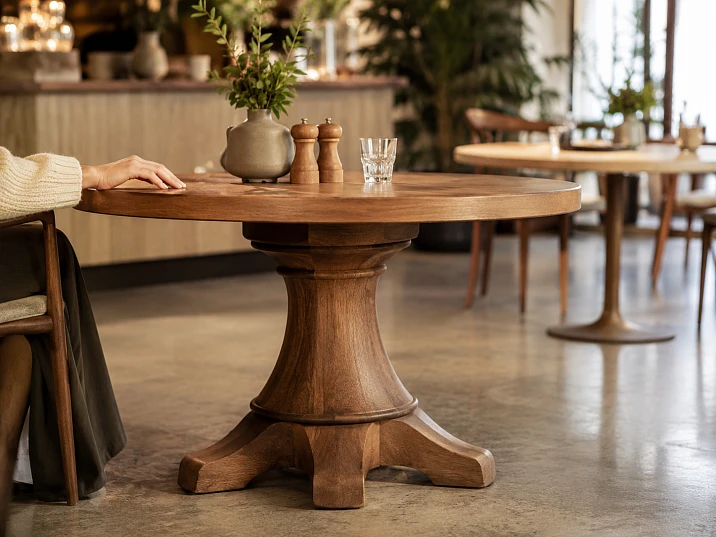
A round table wobbles — meaning the problem is not always the floor, not always the fasteners, and not always the tabletop itself. Very often the table starts to rock due to an incorrectly chosen base: the base turned out to be too narrow, too light, the wrong shape, or simply not designed to support the weight of a round tabletop. Externally, such a structure may look beautiful, but in daily use it is annoying: cups tremble, the edge of the table sinks when pressed by hand, the table has to be constantly turned, moved, or have something placed under its legs.
A round table is deceptively simple furniture. No corners, a soft shape, comfortable for conversation, looks good in a kitchen, dining room, living room, cafe, or meeting room. But it is the round shape that requires particularly careful selection of the base. For a rectangular table, supports are often distributed at the corners, while for a round one, the load can shift to the edge. If the base is small, offset, or too decorative, the tabletop starts to act like a lever: press on the edge — the whole structure rocks.
Therefore, you need to choose the base not only by style. It is important to know in advance the diameter of the tabletop, its weight, thickness, the height of the future table, mounting points, the attachment area, and the shape of the support. If you need not a temporary experiment but calm furniture for daily use, it is better to look in advance at buy a stable base for a round table and choose the base not by eye, but based on the actual task.
This article helps you understand why a round table wobbles, how to tell if the table base is too small, what mistakes lead to instability, and how to choose a wooden base so that the table not only looks beautiful but also stands confidently in the interior.
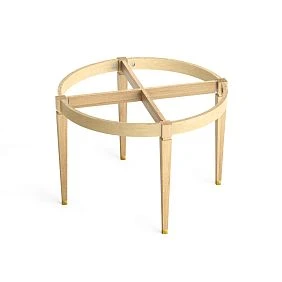
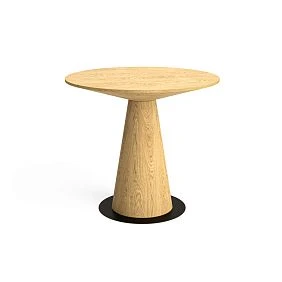
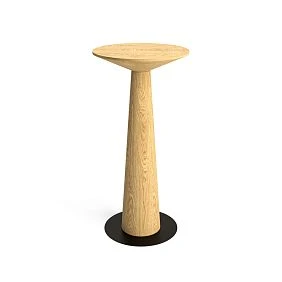

Why a round table wobbles
If the table starts to wobble, the first instinct is to check the floor. Sometimes the cause is indeed an uneven surface: one leg is slightly higher than another, tiles have a height difference, the wooden floor has sagged, and the furniture was placed where there is a slope. But if the table wobbles even after moving it, the problem is deeper. You need to examine the entire structure: the tabletop, the underframe, the mounting plate, the installation center, and the width of the base.
With a round table, the error in the size of the underframe is especially noticeable. The further the edge of the tabletop extends beyond the base, the stronger the leverage. A person leans on their elbow, places a heavy plate, moves a cup, a child pulls the edge towards themselves — and the table starts to wobble. With a small or light support, even a good tabletop cannot save the structure.
The second common cause is a shifted center. The round tabletop must be secured so that the center of the underframe coincides with the center of the circle. If the base is shifted even slightly, the load is distributed unevenly. One side begins to outweigh, and during use this is felt as a constant wobble.
The third reason is weak fastening. Even a stable underframe will not work correctly if the tabletop is poorly attached to the platform, the fasteners are chosen randomly, the holes are damaged, or the connection has loosened. For a round table, this manifests faster because the edge is often pressed from different sides.
The fourth cause is an unsuitable support shape. Some bases look expressive but do not provide the necessary support area. Others hold a compact coffee tabletop well but are not suitable for a large dining table. Therefore, it is important to distinguish decorative lightness from true stability.
| Cause of wobbling | How it manifests | What to Check | What to do |
|---|---|---|---|
| Underframe too small | Table wobbles when pressing on the edge of the tabletop | How far the tabletop extends beyond the base | Choose a more stable base for the tabletop diameter |
| The base is too light | The table moves easily, reacts to touch | Weight ratio of tabletop to base | Choose a design with sufficient mass and support width |
| Mounting center is offset | One side feels heavier, the table wobbles unevenly | Does the center of the tabletop align with the center of the underframe | Recenter the mount or replace the unsuitable base |
| Weak mounting | Tabletop moves relative to the base | Mounting plate, connections, play | Tighten the mounts, check compatibility of fasteners and base |
| Uneven floor | The table wobbles only in one spot in the room | Table behavior after rearrangement | Level the position, but don't blame the floor for all structural issues |
Good sign: if the table stopped wobbling after checking the floor and tightening the fasteners, the problem was local. Bad sign: if it still rocks when you press on the edge. Then almost always you need to check the size of the underframe relative to the tabletop and the overall geometry of the base.




Why a round table is more complex than a rectangular one
A rectangular table is easier to understand structurally. There is a long side, a short side, corners, clear support points. Even if the tabletop is heavy, four legs at the corners distribute the load in a familiar way. A round table has no corners, but has a continuous edge. Any point along the circumference can become a load point.
When a person sits at a round table, they often lean not strictly on the center, but on the edge. They place an elbow, move a plate, shift a vase, lean over. If the underframe does not support the load around the circumference, the table starts to wobble. The larger the diameter of the tabletop, the stronger this effect.
A central support for a round table looks beautiful and frees up legroom. But it requires a proper lower base and a good mounting platform. If the central base is too narrow, the round tabletop gets a large overhang area. Visually, the table may seem light and elegant, but physically it becomes unstable.
A cross-shaped support is often more stable because the legs distribute the support wider. But here another problem arises: the legs can get in the way of legs, especially if the table is a dining table and several people are sitting at it. If the support is beautiful but uncomfortable, the table starts to be shifted, turned, and pushed with feet. Over time, the fasteners receive extra load, and the structure becomes loose.
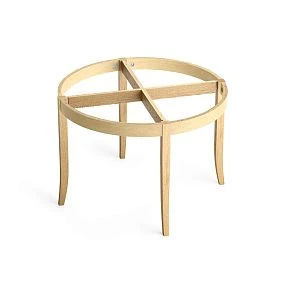
Four supports can also be a good option, especially for a classic round table. But it is important that the legs are not placed too close to the center. If they are hidden inward for visual lightness, the tabletop will still overhang when loaded at the edge.
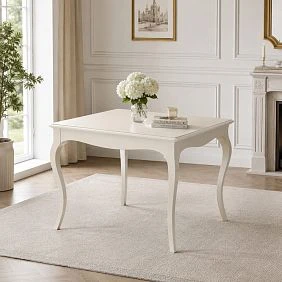
Our factory also produces:

How to tell if the underframe is too small
The main sign is that the table reacts to the edge. You don't need to press hard. It is enough to lightly lean with a palm, place a heavy plate, or move a vase closer to the circumference. If the table wobbles noticeably, the underframe may be too small for this tabletop.
The second sign is visual overhang. When the round tabletop looks much wider than the base, the table may seem impressive, but stability is questionable. Sometimes a designer deliberately makes the base thinner to make the furniture look lighter. For a decorative table, this is acceptable; for a dining table, it is a risk.
The third sign is that the mounting platform does not match the tabletop. For a round table, it is important not only what stands on the floor, but also how the tabletop is connected to the base. If the platform is small, the load is transferred to a narrow area. With a heavy tabletop, this can cause play.
The fourth sign is that the table is uncomfortable to sit at. This may seem strange, but stability is related not only to physics but also to people's behavior. If the support gets in the way of legs, the table is constantly moved. It is kicked, turned, pushed away, lifted. Even a strong structure will loosen faster with such handling.
The dimensions of the underframe relative to the tabletop cannot be assessed only from a photo. In a photo, the base may look proportional, but in a real room, it may turn out to be too narrow. It is better to measure the diameter of the tabletop in advance, understand its thickness, imagine the seating of people, and only then choose. Base for a round tabletop.
| Sign | What this may mean | Why it is dangerous | How to check before purchase |
|---|---|---|---|
| The table wobbles when touching the edge | The base does not support the load around the circumference | With daily use, the play will increase | Compare the tabletop diameter, base width, and attachment area |
| The tabletop overhangs significantly | The underframe was chosen for its visual lightness | The edge works like a lever and can outweigh | Evaluate the overhang of the tabletop relative to the base |
| The table looks good but is uncomfortable for legs | The support shape is not suitable for seating | The table will be constantly moved and loosened | Check the position of the support relative to seating areas |
| The tabletop moves separately from the base | The fastening is weak or the platform is small | The connection will break under load | Check the mounting area and compatibility with the selected tabletop |
If doubts remain, it's better not to try guessing the base from a picture. A more reliable way is to compare the dimensions of the underframe relative to the tabletop and understand in advance what stability margin your table needs.
Get Consultation
How to choose a stable underframe for a round table
A stable underframe starts not with shape, but with the task. The same beautiful option may work well for a compact coffee tabletop and poorly for a heavy dining round. So first you need to answer a few questions: where will the table be placed, what is its diameter, how heavy is the tabletop, how many people will sit at it, will the table be used daily or only as a decorative item.
For the kitchen and dining room, daily load is important. Dishes, serving bowls, pitchers, elbows, and children's items are placed on the dining table. People move, sit down, stand up, and sometimes lean on the edge. You cannot choose a base just because it looks visually thin and light. The underframe for a round dining table must support not a static interior photo, but real life.
For the living room and coffee table, requirements are milder, but the risk of tipping remains. A low round table often stands near the sofa. Cups, books, remotes are placed on it, sometimes people lean on it with their hand when standing up. If the underframe for a round coffee table is too small, the table may wobble even at a low height.
For a cafe, restaurant, or commercial interior, rigidity is especially important. There, tables are moved more often, the load is higher, and users do not treat furniture as carefully as at home. The base must be not only beautiful but also practical for seating, cleaning, moving, and daily use.
When choosing, it is useful to open the section wooden bases and look not only at the appearance but also at the structural logic: how wide the support works, how it connects to the tabletop, whether it interferes with legs, and whether it suits the height of the future table.
How the shape of the support affects stability
The shape of the underframe affects three things at once: physical stability, seating comfort, and appearance. A mistake occurs when a buyer looks at only one parameter. For example, they choose the lightest form for beauty and then wonder why the round table wobbles. Or they take a massive base that holds the tabletop but interferes with legs.
A central support looks good with a round tabletop. It supports the idea of a circle, frees up the perimeter, and allows sitting around the table without corner legs. But the central support requires a sufficient lower base. If the lower part is too small, the entire structure becomes like a tall object on a narrow leg.
A cross-shaped support often provides good balance. The rays spread from the center and help hold the tabletop in different directions. But here you need to check whether the rays will interfere with feet and chairs. If the underframe is beautiful but seating is uncomfortable, the table will constantly be bumped.
Four supports are familiar and understandable. They work well for classic solutions, but for a round table they need to be positioned wisely. If the legs are too close to the center, stability is worse. If too close to the edge, seating comfort and appearance may suffer.
A round base visually pairs well with a round tabletop. But a too-wide round base can interfere with legs, while a too-narrow one won't provide the needed stability. Here it's especially important to look not only at the base diameter but also at the table height, purpose, and seating.
| Table base shape | When it fits | Main risk | What to check before ordering |
|---|---|---|---|
| Central support | Compact round tables, neat dining areas, cafes | Sufficient mass and width of the lower base are needed | Tabletop diameter, weight, attachment area, lower support |
| Cross-shaped support | Dining round tables, kitchens, dining rooms | The legs may interfere with feet and chairs | Seating positions and chair placement |
| Four supports | Classic round tables, home interiors | If the legs are close to the center, the edge may overhang | Placement of supports relative to the tabletop edge |
| Round base | Tables where you want to support the tabletop shape | A wide base can interfere with legs, a narrow one can wobble | Balance between stability and seating comfort |
| Wooden base | Classic, natural, warm interiors | You cannot choose only by decor without checking geometry | Material, shape, attachment, compatibility with the tabletop |
If you need a separate consultation article specifically about the shape of a wooden base, you can additionally check the material about wooden underframe for a round tableAnd when buying a specific base, you still need to consider the dimensions, weight of the tabletop, and installation location.
How to calculate the size of the underframe for a round tabletop
There is no universal number that would suit all tables. Tabletops vary too much: thin and thick, light and heavy, compact and wide, wooden, stone, combined. Therefore, it is safer to think not in terms of a formula, but a ratio.
First, determine the diameter of the tabletop. This is the main size of a round table. The larger the diameter, the further the edge of the tabletop is from the center. This means the greater the load on the base when pressing on the edge. A small round tabletop can work normally on a compact underframe, while a large one requires a more serious base.
Then assess the thickness and weight. A heavy tabletop itself can add stability if the base is wide and sturdy. But if the underframe is narrow, the weight starts to work against the structure: the tabletop rocks the base more under offset load. The combination of a heavy circle and a decorative lightweight support is especially dangerous.
After that, look at the width of the base. The lower base should provide the table with confident support. The wider and heavier the tabletop, the more attention should be paid to the width of the lower part. But a too-wide base is also not always good: it can interfere with legs at a dining table.
Separately check the mounting platform. Stability depends not only on the lower support point. If the tabletop is poorly connected to the underframe, the table may wobble even with a normal base. The platform should distribute the load and prevent the tabletop from shifting relative to the base.
When comparing the dimensions of the underframe for a dining table, don't forget about the chairs. The table may be stable on its own, but if the support constantly interferes with legs, it will be bumped. This is a direct path to loosening the fasteners.
| Parameter | Why it affects stability | What error it helps avoid | Where to compare |
|---|---|---|---|
| Tabletop diameter | The wider the circle, the greater the load on the edge | Purchasing a base that is too narrow | the dimensions of the underframe relative to the tabletop |
| Weight and thickness of the tabletop | A heavy tabletop requires a more stable base | Installing a massive tabletop on a lightweight decorative support | Tabletop card or measurement of the finished product |
| Width of the lower support | The base resists tipping over | Wobbling when pressing on the edge | Base for a round tabletop |
| Mounting area | Transfers load from countertop to base | Play between countertop and underframe | Product card or consultation with STAVROS manager |
| Seating of people | The support should not interfere with legs and chairs | Constant bumping and loosening of the table | Furniture layout plan |
This calculation does not turn the purchase into an engineering project, but eliminates the main mistake: choosing by eye. A round table should be beautiful, but first it must stand firmly.
Underframe for a round dining table
A round dining table works harder than it seems. People don't just sit at it. They place dishes, serving bowls, pots, decanters, flowers, a laptop, children's books, and sometimes shopping bags on it. People lean on the edge, stand up, push chairs back, and move the table to clear a path. Therefore, the base for a round dining table must support not only the weight of the tabletop but also the live load.
For a dining table, structural rigidity is especially important. If the base wobbles slightly, it will be noticeable every day. A slight wobble is sometimes tolerated on a coffee table, but not on a dining table. Cups, plates, and utensils immediately reveal any instability.
The second important point is seating comfort. A round table is often chosen precisely for conversation: everyone can see each other, there is no head of the table, and it's easier to talk. If the support gets in the way of legs, the point of the round shape is lost. Therefore, the base must be not only stable but also correctly positioned relative to the seating places.
The third point is height. Even a good base won't save a table if the height is chosen uncomfortably. Height affects seating, leg position, and overall ergonomics. If the underframe is too high or too low for the chosen tabletop, the table will be uncomfortable to use, and uncomfortable furniture is more often moved and loosened.
If you are planning a wooden base for a kitchen or dining room, it's worth looking in advance table bases and choosing not by one parameter, but by a combination: tabletop diameter, height, seating, support shape, material, fastening.
Underframe for a round coffee table
A coffee table is lower, but that doesn't mean stability isn't important. Low furniture often seems safe: low height, less load, simpler shape. But a round coffee table has its own risk — people often lean on it with their hand when getting up from the sofa. If the base is small, the table may wobble or shift.
For the living room, visual lightness is important. No one wants a coffee table to look like a heavy object in the middle of the room. But lightness should not be confused with instability. A good underframe for a round coffee table should look calm and at the same time support the edge of the tabletop.
Here, it is especially important to consider the diameter. A small round table can have a compact support. The larger the tabletop, the more carefully you need to look at the base. If the table is low but wide, the edge can still act as a lever.
In the living room, the base should match the sofa, armchairs, rug, cabinet, TV area, and wooden interior elements. A wooden base supports a warm furniture environment well, especially if the room already has solid wood pieces, natural textures, wooden facades, or decorative details. Therefore, when choosing, you can look not only at the individual base but also at neighboring Solid Wood Itemselements to prevent the interior from falling apart into random pieces.
Underframe color: white, black, or natural wood
Color does not directly determine stability, but it affects the perception of size. A black base can look graphic and more cohesive. White is lighter and softer. Natural wood is warmer and closer to classic furniture. But in each case, remember: color does not compensate for a design flaw.
A round black underframe looks good in modern interiors with contrast: a light tabletop, dark chairs, metal details, graphic lamps. But if the black base is too thin, it may visually appear strong while physically remaining insufficiently stable.
A round white underframe is suitable for light kitchens, Scandinavian interiors, soft classics, and small spaces. White color lightens the object but can visually reduce the base. The buyer sees lightness and sometimes chooses a too compact base. For a round table, this is risky.
A natural wooden underframe is good because it does not hide or pretend to be a technical detail. It becomes part of the furniture. In a classic, country, warm modern interior, such a base looks natural. But here too, it is important not to get carried away only with the beauty of the texture. First geometry, then finish.
| Color or finish | Where it's appropriate | How it affects perception | What to pay attention to |
|---|---|---|---|
| Black round underframe | Modern kitchen, cafe, contrast interior | Adds graphics and visual coherence | Do not choose a thin form just because of the expressive color |
| White round table base | Light kitchen, soft classic, small dining room | Visually lightens the table | Check if the base looks too small under the tabletop |
| Natural wood | Classic, country interior, warm modern style | Connects the table with furniture and wooden parts | Match the material, shade, and finish with the tabletop |
If a color is chosen, it's not final yet. Before ordering, you still need to check the size, shape, mounting, and compatibility with the round tabletop.
How not to confuse a round table base with similar solutions
A round table base is often confused with any beautiful support that roughly matches the style. This is dangerous logic. A round tabletop requires a base designed for load distribution around the circumference. If the support was originally created for a different format, the table may look fine in photos but wobble in a real room.
A base for a rectangular tabletop is not always suitable for a round one. With a rectangle, the load is distributed differently, and the edges and corners work along different lines. If you take a base that holds a rectangular shape well and place a round top on it, the fit and balance may change.
A base for a coffee table should not be automatically transferred to a dining table. A coffee table is lower, the load is smaller, and the usage scenario is different. A dining table is higher, wider, and used more actively. Even if the shape is similar, the structural requirements are different.
A decorative base is not always equal to a functional table base. Some elements look like furniture supports but are not designed for a heavy tabletop. Before purchasing, you need to check the purpose, dimensions, material, and recommendations in the product card.
If in doubt, it is better to choose not an abstract leg, but specifically furniture frames and bases where the product logic is tied to the furniture structure.
Mistakes when choosing a base for a round table
The most common mistake is choosing a base solely based on appearance. A beautiful underframe is indeed important because it is visible and sets the style. But if it doesn't support the tabletop, the beauty quickly stops pleasing. Every meal will be accompanied by wobbling, and guests will carefully place their cups.
The second mistake is not considering the weight of the tabletop. The buyer looks at the diameter but forgets about the material and thickness. A lightweight tabletop and a heavy tabletop of the same diameter require different approaches to the base. The more massive the top, the more substantial the base and fastening should be.
The third mistake is forgetting about the center. The round shape does not forgive misalignment. If the tabletop is not fixed in the center, the load shifts to one side. Sometimes this is almost invisible to the eye but is clearly felt during use.
The fourth mistake is choosing a support that interferes with the legs. It seems like a matter of comfort, not stability. In reality, the connection is direct: an uncomfortable table is more often moved, bumped, and loosened. A good underframe should not force people to look for where to put their feet.
The fifth mistake is saving on fasteners or using random fasteners. Even a stable base won't work if the tabletop is weakly connected to it. The fasteners must match the material, thickness, and design. If in doubt, it's better to check compatibility before ordering.
| Mistake | What it leads to | How to avoid | Useful transition |
|---|---|---|---|
| Choosing only by photo | The underframe looks nice but doesn't hold the tabletop | Check dimensions, weight, shape, and attachment area | buy a stable base for a round table |
| Ignoring the weight of the tabletop | A heavy circle rocks a light base | Compare material, thickness, and table purpose | — |
| Shift of the attachment center | The table wobbles unevenly and appears skewed | Align the center of the under-table support with the center of the round tabletop | — |
| The support interferes with legs | The table is constantly bumped and moved | Check the seating positions and placement of chairs | the dimensions of the underframe relative to the tabletop |
| Weak fastening | The tabletop starts moving separately from the base | Clarify the fastening, material, and compatibility of parts | — |
Mistakes in choice are rarely visible at the moment of purchase. They appear later, when the table is already at home. Therefore, it is better to spend time checking parameters in advance than to look for a way to fix wobbling afterwards.
How to fix a round table that is already wobbling
If the table has already been purchased and is wobbling, don't immediately replace everything. Start simple. Move the table to another spot and check how it behaves on a different part of the floor. If the wobbling disappears, the issue may be a surface unevenness. But if the table wobbles everywhere, the cause is almost certainly in the construction.
Then check the fasteners. Sometimes connections loosen after transportation, assembly, or several months of use. The tabletop should be tightly attached to the underframe, without play or misalignment. If the fastener is damaged or doesn't suit the material, simple tightening will only help temporarily.
After that, check the center. For a round tabletop, the center must be precise. If the underframe is not centered, the table will feel unstable even with a normal base. This is especially noticeable on large tabletops.
If the floor is level, fasteners are tightened, the center matches, but the table still wobbles when pressing on the edge, the problem is in the size or shape of the underframe. In this case, placing felt, adjusting legs, and temporary solutions only mask the problem. It is more reliable to replace the base with a more suitable one.
For replacement, it's better not to look at a random support, but to buy a wooden underframe for a round table considering the current tabletop: its diameter, weight, thickness, and installation location. If the tabletop already exists, the task is even simpler: you can measure it and select a base based on actual parameters.
What to buy with a table base
An underframe rarely lives on its own. It is connected to the tabletop, fasteners, chairs, overall height, room style, and neighboring furniture. Therefore, buying a stable base is not a separate detail, but part of a furniture solution.
If you are assembling a round table from scratch, first determine the tabletop. The underframe should match its diameter and weight. If the tabletop is already purchased, you need to select a base for it, not the other way around. If you have doubts about height, it's useful to study material about the sizes and height of the underframe.
If the table will be placed in an interior with other wooden furniture, look more broadly: color, material, solid wood, visual weight, support shape. Sometimes a good underframe looks out of place simply because it is not connected to other items. In such a case, neighboring wooden elements, furniture parts, frames, and solid wood products help.
| What to add to the purchase | Why this is needed | Which scenario it suits | What to pay attention to | Link |
|---|---|---|---|---|
| Underframe for round tabletop | Creates a stable base for a round table | Kitchen, dining room, living room, cafe, workspace | Tabletop diameter, weight, height, seating | buy a stable base for a round table |
| Furniture frames | Help select the base as part of the furniture structure | Table assembly, replacing old base, furniture project | Construction type and compatibility with tabletop | furniture frames |
| Solid wood products | Help support the wooden underframe with other interior elements | Classic and natural interiors | Material, style, shade, combination with furniture | Solid Wood Items |
| Material about underframe dimensions | Helps check height and proportions before ordering | When there are doubts about height, seating, and tabletop | Match recommendations with a specific tabletop | the dimensions of the underframe relative to the tabletop |
This approach helps not just buy one beautiful piece, but assemble a table that is comfortable, stable, and connected to the interior.
Practical choice for different situations
Round table for the kitchen
In the kitchen, the table is used every day. People have breakfast at it, place hot dishes, move plates, put groceries, and sometimes work on a laptop. You can't risk a decorative, lightweight base here. The underframe must withstand frequent use and not obstruct passage.
Cleaning is also important for the kitchen. If the base is too complex, with awkward corners and protrusions, it's harder to clean around it. If it's too wide, there won't be enough legroom. So choose a balance: stability, comfortable seating, and a clear shape.
Round table for the dining room
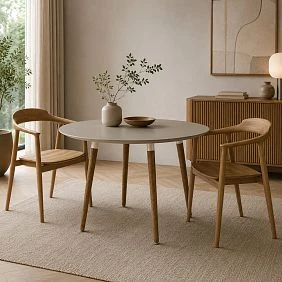
In the dining room, the table is often larger and more noticeable. It becomes the center of the room, so the underframe affects not only stability but also style. A wooden base looks good in classic, modern classic, country house, and interiors with natural materials.
For the dining room, it is especially important that the table does not wobble during serving. Large dishes, vases, candles, and tableware create additional load. If the table wobbles, it spoils the impression of the entire area.
Round table for the living room
In the living room, a round table can be a magazine table, coffee table, or decorative table. Lightness is often important here. But even a decorative table must be stable: cups, books, remotes are placed on it, and sometimes people lean on it with their hand.
For the living room, you should choose a table base so that it matches the sofa, carpet, cabinet, and other wooden details. The base should not look like a random technical part.
Round table for a cafe
In cafes, tables work under more demanding conditions. They are moved, different people sit at them, visitors lean on the edge, and staff rearranges furniture. The table base must be stable, comfortable for seating, and strong enough for daily use.
Here, overly light bases are especially dangerous. In a home interior, such a table can still be used carefully, but in a commercial space, it will quickly show its weaknesses.
Round table for a meeting room
In a meeting room, a round table creates equal communication. But it must be calm and confident. If the table wobbles, it is distracting, looks careless, and spoils the business atmosphere. The table base must support laptops, documents, water, elbows, and frequent movement of people.
For a meeting room, bases that look neat and do not interfere with seating work well. Decor is acceptable, but it should not hinder functionality.
Who is a wooden table base for a round table suitable for
A wooden table base is suitable for those who want not just a technical support, but a visible part of the furniture. In a round table, the base is clearly visible, especially if the chairs do not completely cover it. Therefore, the material and shape matter.
This solution looks great in kitchens with wooden facades, dining rooms with natural furniture, living rooms with warm textures, country houses, studies, and cafes with a cozy atmosphere. Wood helps the table appear softer than metal and warmer than fully painted technical structures.
A wooden base is especially appropriate if the interior already has other solid wood elements: handles, cornices, decorative details, frames, consoles, shelves, furniture components. Then the table does not look like a separate item but fits into the overall language of the interior.
But you shouldn't choose a wooden underframe solely for its appearance. It must fit in size, height, shape, and attachment. If maximum technical adjustment, a folding mechanism, special industrial load, or outdoor use without protection is needed, you should separately check whether the specific structure is suitable for such conditions.
| Who it suits | Why it suits | When to consider another option | What to check |
| For kitchen and dining room | Wood supports the furniture and makes the table visually warmer | If a highly technical or folding structure is needed | Height, seating, stability, mounting |
| For the living room | The base can be paired with other solid wood furniture | If the interior is built solely on metal, glass, and cold minimalism | Style, color, height of the coffee table |
| For cafes and restaurants | A wooden base creates a cozier interior | If the furniture will be frequently moved roughly without care | Strength, seating comfort, stability under load |
| For a classic interior | Wood pairs well with carved and furniture details | If you need an extremely neutral, unobtrusive support | Shape, massiveness, matching the tabletop |
An honest choice is always better than a random one. If a wooden base suits the task, it gives the table not only support but also character. If it doesn't fit, even beautiful solid wood won't save it from wobbling.
Where to buy a stable underframe for a round table
It's better to start a purchase with a clear task. Not "I want a beautiful leg," but "I need a stable base for a round tabletop of such and such diameter, for a kitchen, dining room, living room, or cafe." Then the choice becomes calmer: you filter out unsuitable options and look only at those that can withstand real use.
On the STAVROS website, you can go to the section buy a stable base for a round table and compare options for a specific task. Before ordering, you should check the shape, height, material, size, mounting part, and compatibility with the tabletop. If you already have a tabletop, prepare its diameter, thickness, and approximate weight. If you are still choosing a tabletop, first determine the scenario: dining table, coffee table, cafe, office, living room.
If you need not just a separate support but a broader furniture selection, look at furniture frames. This makes it easier to evaluate the underframe as part of the structure, not as a random decorative detail.
If the interior is built around wood, it's helpful to additionally look Solid Wood ItemsThe underframe, tabletop, furniture elements, and decor should support each other in scale, material, and style.
FAQ
Why does a round table wobble?
Most often, a round table wobbles due to an underframe that is too small, weak fastening, a shifted center, a heavy tabletop, or an uneven floor. If the table wobbles only in one spot in the room, first check the floor. If it wobbles everywhere, you need to look at the structure.
How to tell if the underframe is too small?
If the tabletop overhangs the base significantly, the table wobbles with a light press on the edge, or looks unbalanced, the underframe may be too small. This is especially noticeable with large-diameter round tables.
How to choose a stable underframe for a round table?
You need to consider the diameter of the tabletop, its weight, the height of the table, the shape of the base, the width of the lower support, and the attachment area. The underframe must support the load not only at the center but also when pressing on the edge of the round tabletop.
What is more important for stability: the shape or the weight of the underframe?
Both parameters are important. A heavy base helps hold the table steady, but an incorrect shape or too small a support area can still cause wobbling. A good underframe combines mass, geometry, and proper fastening.
Can a central support be used for a round table?
Yes, a central support works well with a round shape, but it must have a sufficiently stable lower base and a proper mounting platform. If the base is too narrow, the table may wobble under load on the edge.
Which underframe is best for a round dining table?
For a round dining table, it is better to choose a sturdy base with sufficient support width and comfortable seating. It must withstand the weight of the tabletop, dishes, and daily use, but not interfere with legs.
How does an underframe for a round coffee table differ from a dining table?
A coffee table is lower and usually lighter, but it also needs to be stable. A dining table experiences greater load: people sit at it, place dishes, and lean on the edge. Therefore, the base for a dining table must be sturdier and more reliable.
Why does a round tabletop overhang?
The edge of a round tabletop is far from the center. If the base is small or light, pressing on the edge acts like a lever. The larger the diameter and weight of the tabletop, the stronger this effect.
Can wobbling be fixed without replacing the base?
Sometimes you can. First, check the floor for levelness, tighten the fasteners, and make sure the tabletop is centered. If the table still wobbles after that, the problem is likely with an unsuitable base.
How to secure a round tabletop to a table base?
Attachment depends on the tabletop material, base design, and mounting plate. The main thing is to align the centers, use appropriate fasteners, and prevent play. Before assembly, it's best to check part compatibility in the product card or with a STAVROS manager.
Will a white or black round table base be suitable for a stable table?
Color alone does not determine stability. A white or black table base can be a good choice if it matches in size, shape, weight, and attachment. First, check the construction, then the color.
Where to buy a wooden table base for a round table?
To select one, you can go to the STAVROS section with wooden bases and furniture frames. Before ordering, you need to check the tabletop diameter, height, weight, base shape, and fit. If you already have a tabletop, it's better to prepare this data in advance.
Conclusion: the stability of a round table starts with the right base
A round table wobbles not because the round shape is bad. More often, the reason is that the table base does not match the tabletop: the base is too small, light, offset, inconvenient for seating, or poorly secured. A round tabletop requires careful calculation because the load can fall on any point along the edge.
Before purchasing, you need to check the diameter, weight, height, support shape, mounting plate, and seating points. For a dining table, rigidity is especially important. For a coffee table, it's the balance between visual lightness and stability. For cafes and commercial spaces, it's durability and ease of daily use.
STAVROS helps you approach the choice not randomly: you can view wooden table bases, furniture frames, and solid wood products, compare options, and select a base for your actual tabletop. If the goal is to get a round table that doesn't wobble with every touch, start not with color or a beautiful photo, but with a stable table base that matches in size, shape, and purpose.