Article Contents:
- Table base or individual legs — what's the fundamental difference
- When a table base is the only right choice
- Why a round table is more complex than a rectangular one — physics in one paragraph
- How to choose a table base by tabletop diameter — practical logic
- Tabletop diameter 60–70 cm
- Tabletop diameter 80–90 cm
- Tabletop diameter 100–110 cm
- Tabletop diameter 120 cm and more
- Table base selection table by diameter
- Table base for coffee table — a separate story
- Table base for kitchen table — stability as the main criterion
- Requirements for a kitchen table base
- Table base for a heavy tabletop — a special case
- What changes with a heavy tabletop
- Central support or four legs — what to choose
- Central support (monopod)
- Four legs with ties
- Production technologies: from idea to realization
- Table base shape and interior style — aesthetics that sell
- Classic interior: carved table base
- Scandinavian and modern interior
- Neoclassicism
- Country, Provence, country house
- Table base material — oak, beech, or something else
- Oak
- Oak
- Why Not Pine
- Table base height — how to calculate the final table size
- Height and seating at the table
- Wooden table base coating — choosing the finish
- Oil (Danish, linseed, tung)
- Polyurethane varnish 2K
- Enamel (acrylic or alkyd)
- Mistakes when choosing a table base for a round table
- What to check before buying a wooden table base
- Table base in a wooden interior system
- FAQ — popular questions about wooden table bases for round tables
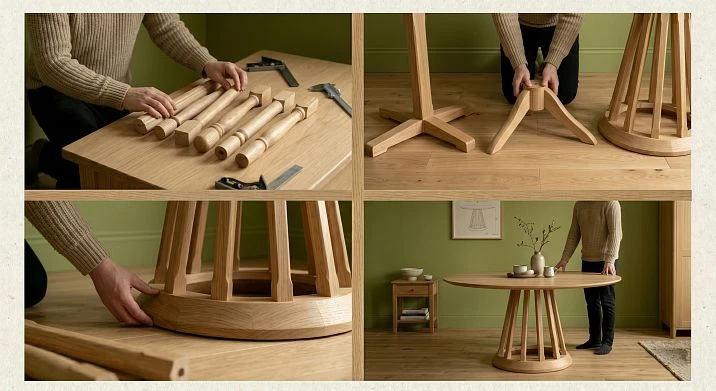
A round table is a special item in the interior. It is softer than a rectangular one, more democratic in seating, cozier in a small space, and visually "softer" than any sharp-angled furniture. But it is the round table that places special demands on the base: there are no corner supports, the load is distributed differently, the edge overhang is large, and any wobbling is immediately noticeable.
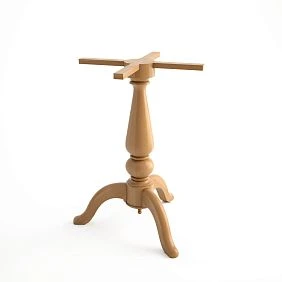
wooden table base is a ready-made load-bearing structure on which the tabletop rests. Not a set of individual legs, not a homemade frame made of bars, but a well-thought-out support with calculated geometry, correct center of gravity, and fastening zones. It is this kind of base for a round table that makes the table what it should be: stable, comfortable, and beautiful.
View wooden bases made of solid oak and beech — in the STAVROS catalog.
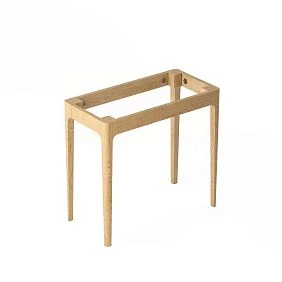
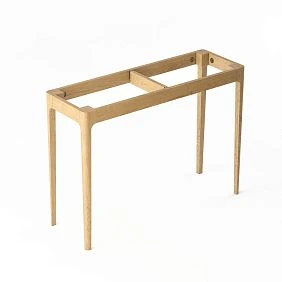
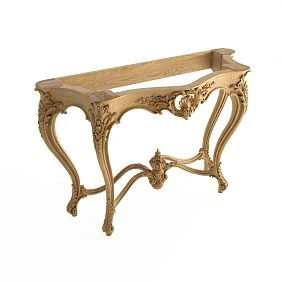
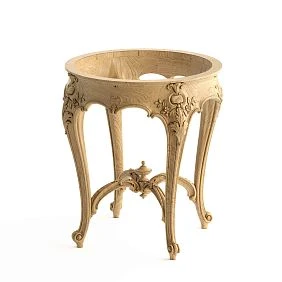

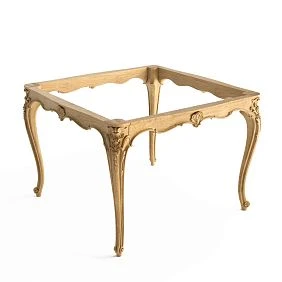
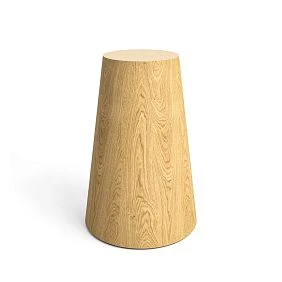
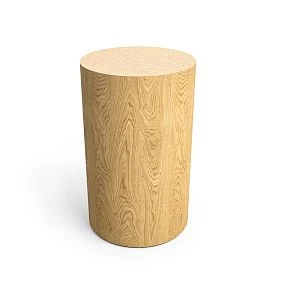
Table base or individual legs — what is the fundamental difference
Many start with a simple question: why buy a whole table base when you can take four Furniture legs and screw them to the tabletop? For a small rectangular table, this sometimes works. But for a round tabletop — almost never.
The problem lies in geometry. Four legs attached directly to the tabletop do not form a rigid base — there are no connections between them. Under load on the edge, the table starts to "wander," the legs spread apart, and the fastenings loosen. This is especially evident on round tabletops, where any tilt to the side immediately creates a dangerous leverage moment.
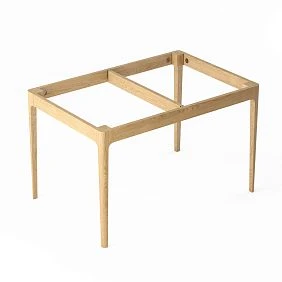
wooden base for the table This is a different class of construction. The legs are connected to each other by horizontal elements (stretchers, a central platform, a cross-shaped base) — forming a rigid frame. This is a fundamentally different geometric stability.




When an underframe is the only right choice
-
A round tabletop with a diameter of 80 cm or more — the edge overhang is too large for unconnected legs.
-
A heavy tabletop made of solid wood, stone, or artificial stone — the load requires a rigid base.
-
A dining table in the kitchen — daily intensive use will reveal weaknesses within the first few months.
-
A decorative table in the living room, where the base is visible — Carved apron becomes the main decorative element of the table, rather than a hidden technique.
-
A coffee table — here both stability and elegance of the base are important.
If you want the table to look like furniture, and not like a "board on legs" — you need wooden base.
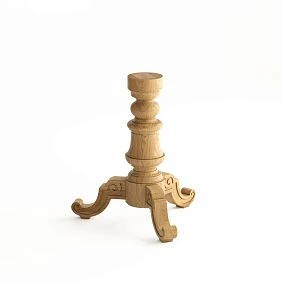
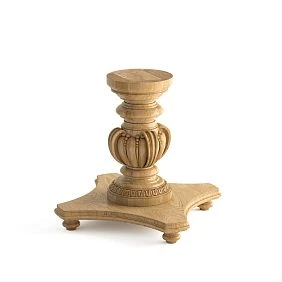
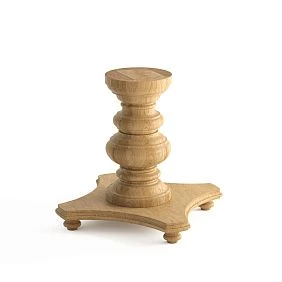
Our factory also produces:

Why a round table is more complex than a rectangular one — physics in one paragraph
A rectangular table with four corner legs — stable geometry: the legs are at maximum distance from the center, forming a wide support rectangle. Load on the edges is distributed through rigid corner joints.
A round table with a central base — a different system. All load is transmitted through the center. The larger the tabletop diameter, the longer the lever from the edge to the support center — and the higher the tipping moment when load is applied to the edge. That is why the base of a round table must be either sufficiently heavy or have a wide support area — or both.
If the base is too light or too narrow, the table will wobble and tip over from an accidental push or when a child sits on the side. This is not a tabletop defect — it is a mistake in choosing the underframe.
Get Consultation
How to choose an underframe based on tabletop diameter — practical logic
The tabletop diameter is the first and main parameter when choosing an underframe. It determines:
-
the required diameter (width) of the base;
-
the necessary weight of the underframe;
-
the shape of the support element (cross, star, platform, four legs with ties).
Tabletop diameter 60–70 cm
Compact table — for coffee, for two people in a small kitchen, for a corner area. Underframe: central support or compact cross with legs. Support zone diameter: 40–50 cm. Height: 720–750 mm for dining or 400–450 mm for coffee table.
A small table doesn't mean you can pair it with just any base. Even here, the overhang of the tabletop edge (15–20 cm from the support edge) creates a leverage moment. The base must be stable.
Tabletop diameter 80–90 cm
The most popular size for a kitchen or dining round table — for 4 people in a standard apartment. Underframe: four angled legs with stretchers, a wide cross, or a platform with a diameter of 55–65 cm. Mass of an oak solid wood underframe: from 8 kg — this guarantees stability.
Tabletop overhang from support: 15–25 cm. This is already serious: a load on the edge point during shrinkage or when leaning with hands creates a force of 50–80 N at the end of the lever.
Tabletop diameter 100–110 cm
Table for 4–6 people. Underframe: significantly more massive. Support zone area: 65–75 cm. Rigid connections between legs are mandatory. Carved apron with a wide decorative platform — both functional (large support area) and visual (the base is proportionate to the tabletop).
Tabletop diameter 120 cm and more
Large dining table. The underframe must be either a very massive central one (base diameter 80–90 cm, weight from 15 kg), or a four-support one with widely spaced legs and strong stretchers. Such a table is often chosen for the living room — and here Wooden table frame it should be not only functional but also decoratively expressive.
Table base selection by diameter
| Tabletop diameter | Table base type | Support zone width | Table base weight (approximate) |
|---|---|---|---|
| 60–70 cm | Central support, compact cross | 40–50 cm | 5–8 kg |
| 80–90 cm | Cross, 4 legs with ties | 55–65 cm | 8–12 kg |
| 100–110 cm | Wide cross, platform | 65–75 cm | 12–18 kg |
| 120+ cm | Massive platform, 4 legs | 75–90 cm | 18–25 kg |
Coffee table base — a separate story
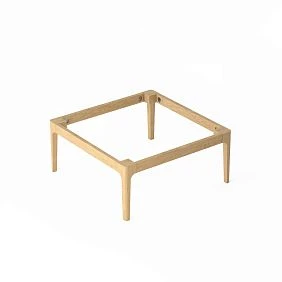
A coffee table is an item with its own logic. Its height: 400–500 mm (matching sofa or armchair height). Diameter: usually 60–80 cm. Load: light — books, cups, remote, flower. But its role is decorative: the coffee table is always in sight, often in the center of the living room, next to upholstered furniture.
coffee table base must solve three tasks simultaneously:
1. Stability at low height. A low base — short lever of vertical legs. Stability is ensured not by height, but by the width of the support base. Legs should be spread wide.
2. Visual lightness. A coffee table next to a sofa should not "weigh down" the space. Thin, elegant legs, an openwork cross, decorative carving — everything that makes the base look light is organic for a coffee table format.
3. Legroom. The height of the gap under the table: a guest sits on the sofa, their legs stretched under the coffee table. Crossbars (stretchers) between the legs should not block this space. The optimal placement of stretchers: either very close to the floor (at a height of 50–100 mm), or they are absent altogether.
If the base is too heavy and monumental, the coffee table will "overwhelm" the sofa area. The scale must match: light upholstered furniture requires an elegant base.
Table base for a kitchen table — stability as the main criterion
The kitchen is a zone of daily intensive use. A table in the kitchen is used 3–5 times a day. People lean on it, reach over it, bump into it while walking, and wash it. The table base for a kitchen table is primarily an engineering task, and only then an aesthetic one.
Requirements for a kitchen table base
Stability without compromise. In the kitchen, there is no such thing as "almost stable" — a wobbly table is dangerous, annoying, and wears out faster. Four legs with ties or a wide cross are the right designs. A thin single column under a round tabletop of 80 cm is a failure after just a year of use.
Legroom when seated. People sit at a round table in the kitchen more often than in the living room. The table base should not "take up" legroom. A cross-shaped base with feet — legs hit the feet when sitting sideways. The best design: four legs with one central stretcher at a height of 250–300 mm from the floor — free legroom on all sides.
Coating durability. In the kitchen — humidity, steam, accidental spills. A table base made of solid oak with oil or 2K polyurethane varnish is the right choice. Pine with nitro varnish is bad: the coating wears out quickly.
Ease of cleaning. The fewer horizontal surfaces on the table base, the easier it is to clean. Complex carved decor in the kitchen collects dust and grease. For the kitchen — strict lines, smooth surfaces, minimal details.
Matching the kitchen style. The table base in the kitchen should match the cabinet fronts, wooden skirting board chairs. If the kitchen is in a classic style — Wooden table frame with turned legs and neat ties. If the kitchen is modern — simple straight legs with minimal decor.
Table base for a heavy countertop — a special case
Heavy countertops are a separate topic. A massive oak or beech countertop 40–60 mm thick and 100 cm in diameter weighs 25–40 kg. A natural stone countertop (marble, granite) of the same diameter weighs 50–70 kg. Artificial stone — 35–50 kg.
What changes with a heavy countertop
Load on fasteners. With a heavy countertop, the bolts connecting it to the table base experience constant load. With poor-quality fasteners or weak material in the fastening area, the connection fails.
Requirements for table base rigidity. A light table base under a heavy countertop means concentrated load in the center with uneven mass distribution. The structure must be rigid in all directions.
Support area. The heavier the countertop, the more important it is to distribute the weight. A platform or cross-shaped support with a large diameter handles this better than four thin legs.
Tips for stone countertops:
-
Solid oak underframe is quite durable.
-
Fastening area (top plate of the underframe): at least 30×30 cm for secure attachment.
-
Use metal studs with nuts — not just self-tapping screws.
-
The underframe must not have any play in the joints — even slight movement with a heavy tabletop turns into a serious defect.
More about the technique — in the article attaching the tabletop to the underframe.
Central support or four legs — which to choose
This is one of the main questions when buying an underframe for a round table. Both options exist, both have strengths — and each has its own logic of application.
Central support (monopod)
One central element that widens downward into a platform or "feet." A table with a central support — without side legs, the space under the table is completely open. Maximum seating comfort: no need to "go around" corner legs, you can sit from any side.
For a small round table (60–80 cm) with a central support, stability requirements are strict: the base must be wide and heavy. For a table of 100 cm or more with a single central support, the base must be very massive (from 12–15 kg).
A central support is an elegant solution for a living room table or a coffee table. It visually "frees up" space under the table.
Four legs with crossbars
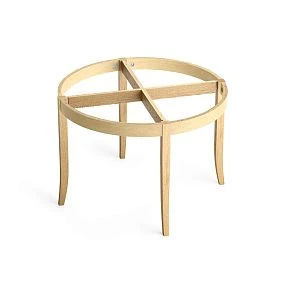
Four legs placed along a diameter slightly smaller than the tabletop diameter, connected by horizontal stretchers. This is a geometrically stable structure — the load is distributed across four points. For a kitchen or dining area with heavy use, this is the best choice.
Disadvantage: the legs occupy the corner seating areas. If four people sit at a round table, one of them always feels slightly uncomfortable "between the legs." Solution: place the legs as wide as possible, shifting them toward the edges — using a bevel or tilt.
Cross-shaped base
A cross of four legs radiating from the center. A compromise: a wide support base without corner legs. The legs are positioned diagonally to the seating sides — they don't interfere with the sitters' legs. For a round table for 4 people, this is a very convenient option.
Width of the legs (diameter of the circumscribed circle of the leg tips): should be 60–70% of the tabletop diameter. For a 90 cm tabletop, the legs spread to 55–65 cm. Less — wobbling.
The shape of the underframe and the interior style — aesthetics that sell
The underframe of a round table is always visible: from the side, from below, from any angle. It is a decorative object, not a hidden structure.
Classic interior: carved underframe
carved base for a table — this is a real furniture sculpture. Turned legs with relief, a base with acanthus ornament, connecting stretchers with chamfers. In a classic living room with wooden moldings, carved decorative elements и with wooden appliqués on the furniture — a carved oak underframe is organic and logical.
STAVROS carved underframes of the STL-020 series are hand and machine processing of hardwood. The relief maintains clarity of lines after coating with varnish or oil. Toning in walnut, dark oak, or wenge — this is the level of furniture production, not DIY crafts.
Scandinavian and modern interior
Minimalist straight legs, tapered or slightly flaring towards the bottom. Connections without excess molding. Material: natural beech under oil or white enamel. Such wooden base for the table — neat, functional, with an emphasis on the texture of the material.
Neoclassicism
Moderate decor: light chamfer on the legs, slight relief on the stretchers. Paint: ivory enamel, light gray, soft white with patina. Such an underframe looks organic in a neoclassical living room or dining room.
Country, Provence, country house
Massive legs of dark oak with live texture, wide cross with paws. Coating: oil with wax, matte. Deliberate "rustic" solidity. In a country house with wooden beams and oak floor — it is precisely such an underframe that looks organic.
Underframe material — oak, beech, or something else
The choice of wood species is not only aesthetics but also physical characteristics.
Oak
Density 650–750 kg/m³. Open expressive texture. High hardness — 3.7 Brinell. Resistant to loads, does not dent, holds fasteners well. Color: warm brown, takes stain beautifully.
Oak underframe — a choice for premium furniture. Its expressive texture is visible even under coating. Dark walnut on oak is one of the most beautiful finishes for furniture.
Feature: oak contains tannins — it darkens when in contact with wet iron. Use stainless steel or galvanized fasteners.
Beech
Density 620–680 kg/m³. Fine uniform texture, almost neutral color. Takes any paint or stain well. Surface is smooth after sanding — pleasant to look at and touch.
Beech underframe — for painting in white, gray, light beige. Or for light natural stains. Scandinavian style, light-toned neoclassicism, modern kitchens.
Why not pine
Pine is a soft wood (hardness 1.6–1.8 Brinell). Dents from chair legs and objects appear quickly. Coating holds up worse. made in the same manner. For protection and maintenance, use natural oils and waxes. should be made of a hardwood — especially if the tabletop is heavy.
Pine is acceptable for a country house or temporary table. For a home built to last for years — oak or beech.
Table base height — how to calculate the final table size
This is a question often overlooked when choosing. You buy a table base — and only during installation do you discover that the table turned out too high or too low.
Formula: table base height + tabletop thickness = table height.
Standard dining table height: 740–760 mm. With a tabletop thickness of 30 mm — the base should be 710–730 mm. With a thickness of 40 mm — base 700–720 mm. With a thickness of 20 mm — base 720–740 mm.
Standard coffee table height: 400–500 mm. With a tabletop of 25 mm — base 375–475 mm.
Height and seating at the table
Comfort zone: the chair seat is 280–320 mm below the table surface. Standard seat height: 440–460 mm. Total: table surface at a height of 720–780 mm. This is the accepted standard.
If the table is for tall people (height 185 cm+) — 760–780 mm. For a children's table — 560–620 mm.
How to attach the table base to the tabletop — step-by-step guide — in a separate article how to attach the table base to the tabletop.
Covering a wooden table base — choosing the finish
The finish determines how the table base will look after one, three, five years of use.
Oil (Danish, linseed, tung)
Penetrates the wood, does not form a film. The surface is matte, lively. The texture of oak or beech is maximally expressed. Tactile: warm, natural feel.
Plus: easy to refresh — sand and apply another coat. Minus: less moisture-resistant than varnish. For the kitchen — oil with wax or hard wax oil.
Two-component polyurethane varnish
Hard, wear-resistant film. Resistant to water and mechanical impacts. Matte or silk finish — for furniture, semi-gloss is less preferred. Best choice for a kitchen table.
Enamel (acrylic or alkyd)
For table bases to be painted — white, light gray, colored. Acrylic enamel — eco-friendly, dries quickly, matte. Alkyd — more durable, but has a smell during application.
Before painting — priming. Beech under white enamel — sanding, primer, 2–3 coats of enamel with intermediate sanding.
Mistakes when choosing a base for a round table
Each of these mistakes comes from practice. Some are costly.
Choosing only based on a beautiful photo. The photo does not convey scale and proportions. In the picture, the base looks massive — but upon delivery, it turns out the legs only spread 40 cm. For a tabletop of 90 cm, this is too little. Always check the actual dimensions in the description.
Not calculating the final table height. A base height of 740 mm + a tabletop of 40 mm = a table of 780 mm. This is already above the standard. With chairs having a seat height of 460 mm — the difference is 320 mm, which is a bit too large. Before purchasing — calculate.
Ignoring the weight of the tabletop. A lightweight decorative base under a stone tabletop is a disaster. Not figuratively, but literally: the connection will not hold, the table will start to 'wobble' and fall.
Buying a base without a mounting kit. Attaching a round tabletop to the base is not just 'screwing it on from below'. You need the correct bolts, possibly metal brackets or special ties. Clarify when ordering.
Not checking legroom. Buying a beautiful cross-shaped base — and finding that when seated, your legs hit the legs. The placement of the legs should match the number of seats and the seating arrangement.
Choosing a base in a different style than the tabletop. A modern Wooden Countertop with simple geometry + a baroque carved base = a clash of eras. A unified style concept is needed.
Not considering whether the table will be moved frequently. If the table needs to be moved, the mounting must be reliable. A disassemblable option (base + tabletop connected with bolts) is more convenient for transportation.
What to check before buying a wooden table base
A short checklist for a confident choice:
-
Tabletop diameter — determines the required width of the support base.
-
Tabletop thickness — calculate the final table height.
-
Tabletop weight — heavy materials require a massive base.
-
Purpose — kitchen, living room, coffee table area, office.
-
Future table height — dining 740–760 mm, coffee 400–500 mm.
-
Legroom — placement of legs and crossbars.
-
Material — oak or beech, for tinting or painting.
-
Finish — oil, 2K varnish, enamel.
-
Base shape — cross, four legs, central support, platform.
-
Fasteners — included in the set, how it attaches to the tabletop.
-
Style — compatibility with furniture, decor, moldings и wooden decor interior.
Underframe in a wooden interior system
The table is the center of the dining room or kitchen. But it doesn't exist in a vacuum. wooden table base made of oak works in tandem:
-
wooden countertop of the same species — a single material.
-
Wooden furniture legs for chairs and cabinets — the tint matches.
-
Wooden baseboard in the same material — the horizontal line at the floor "rhymes" with the table legs.
-
furniture frames for other furniture — sofas, beds, cabinets — made of the same oak or beech.
When all wooden elements in a room are made of the same material and have the same tint, the interior comes together as a cohesive whole. The table base is one of the key visible elements of this system.
FAQ — popular questions about wooden table bases for round tables
Which table base should I choose for a round table?
Stable, with a support base 60–70% of the tabletop diameter. For heavy tabletops — made of solid oak, with rigid connections. For light ones — an elegant central base is possible. More details — wooden table base in the catalog.
Can I place a round tabletop on a single central support?
Yes, if the support is massive enough (platform diameter at least 50 cm for a 90 cm tabletop) and heavy. A light thin column under a wide tabletop is unstable.
What is better for a round table — a table base or four legs?
A table base is more reliable: its structural connections provide rigidity that four unconnected legs cannot offer. For a decorative living room table, it is also more beautiful.
Will a wooden table base work for a stone tabletop?
Yes, provided: the base is made of solid oak, the top platform is wide enough, and the fasteners are metal stud bolts. A lightweight decorative base for stone is not suitable.
How to choose a table base for a coffee table?
Key points: height 400–500 mm, a wide support base for stability, no horizontal crossbars at leg height, visual lightness. We recommend looking coffee table frame.
What is the height of a standard dining table base?
Table base for a table height of 740–760 mm: with a 30 mm tabletop, the base should be 710–730 mm. Always calculate: base height + tabletop thickness = final table height.
How to attach a round tabletop to a table base?
Using mounting brackets, stud bolts, or special ties. Never use only glue. Instructions are in the article how to attach the table base to the tabletop.
A table is an object around which people gather. A good table is stable, well-made, and beautiful. And its quality starts not with the tabletop, but with the base. wooden table base made of solid wood is that invisible foundation that makes the visible beautiful and reliable.
STAVROS manufactures wooden underframes for round tables, Carved frames, coffee table frames, round tabletops and a full range solid wood furniture frames. Oak and beech from our own drying, own production, strict control. Warehouses in St. Petersburg and Moscow, Contact us to confirm shipping to your destination. STAVROS — when a table is made for decades.