

















































































Article Contents:
- Why baseboard should be chosen together with the floor, not after
- Which flooring types most often require conscious baseboard selection
- MDF baseboard for laminate: shade decides everything
- MDF baseboard for oak laminate
- Active floor pattern — calm baseboard
- For light laminate
- For dark laminate
- MDF baseboard for quartz vinyl and SPC: a modern approach
- For quartz vinyl with wood grain pattern
- For quartz vinyl 'stone-look' and 'concrete-look'
- Features of the quartz vinyl and baseboard joint
- MDF baseboard for SPC in the hallway and corridor
- Baseboard for parquet and engineered wood: naturalness requires dignity
- Wooden baseboard for parquet: why it works
- MDF baseboard for parquet: when it is justified
- MDF baseboard for engineered wood
- Baseboard for solid wood: classics require dignity
- MDF baseboard for porcelain stoneware: an unobvious but working choice
- Why MDF baseboard for porcelain stoneware is normal
- For gray porcelain stoneware
- For warm porcelain stoneware
- Three color schemes: matching the floor, walls, or doors
- Scheme one: skirting board matching floor color
- Scheme two: skirting board matching door and trim color
- Scheme three: skirting board matching wall color
- Fourth scheme (special): contrasting baseboard
- How to choose the height of an MDF baseboard for a specific covering
- Up to 60 mm: minimalist baseboard
- 70–90 mm: universal range
- 100–120 mm: expressive profile
- Coordination with Door Casings
- Corners, joints, and door transitions: technical precision as aesthetics
- Junction with door casing
- Internal corners
- External corners
- Joints by length
- Mistakes when choosing a baseboard for flooring
- Comparison table: which baseboard suits different coverings
- What to buy for a finished floor: a complete set
- FAQ: Answers to Popular Questions
- About the Company STAVROS
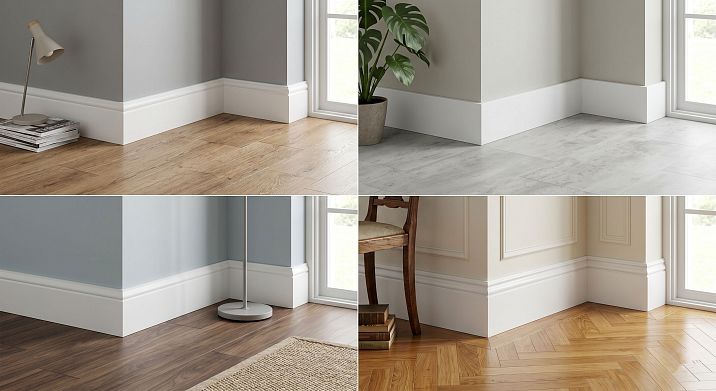
The floor is laid. The finishing touches are almost complete. And now comes the seemingly simple final step: choosing the baseboard. This is where many people make mistakes. Not because the task is difficult, but because it is treated as a formality: "let's pick something that matches the color." The result is a baseboard that looks out of place, disrupts the color logic of the interior, or simply doesn't work with the flooring.
Baseboard MDF — it's not just about covering the technical gap between the wall and the floor. It is the final horizontal line of the room, which ties the flooring, walls, and doors into a single visual ensemble. Choosing it correctly means finishing the renovation as intended: without random dissonances or "close enough" compromises.




Why the baseboard should be chosen together with the floor, not after
This question deserves a clear answer. Why can't you just go to the store after laying the floor and pick something you like?
Because the baseboard visually works in three planes at once. At the bottom, it contacts the flooring — here, the shade, color temperature, and texture matter. Vertically, it meets the wall — here, the profile height and shape are important. Horizontally, it aligns with door trims — and here, it's crucial that all three elements (floor, baseboard, doors) look like a deliberate decision, not a random assortment.
If you choose a baseboard without considering the already laid floor, there is a high chance of missing the shade. A mismatch of 1–2 tones between warm laminate and a cold gray baseboard is noticeable even in photos, let alone in a real space.
The second argument: different flooring types have different technical requirements for baseboard attachment. Laminate "breathes" — a gap at the wall is mandatory. Quartz vinyl requires a tight fit at the bottom during wet cleaning. Parquet looks different under a wooden baseboard than under MDF. All of this needs to be considered before purchase, not after.




Which flooring types most often require thoughtful baseboard selection
List of relevant flooring types in descending order of selection frequency in modern renovations:
-
Laminate is the most common flooring. A huge range of decors, different classes, different shades. The baseboard is chosen carefully: a color "miss" is immediately visible here.
-
Quartz vinyl (LVT) is rapidly gaining popularity. It imitates wood, stone, concrete. Requires a conscious choice: which texture to match the baseboard to?
-
SPC (Stone Polymer Composite) is a rigid quartz vinyl with a mineral base. Widely used in kitchens and hallways. Often imitates stone or coarse-grained wood.
-
Engineered wood flooring is a multi-layer construction with natural veneer on top. Requires a baseboard that "gets along" with the natural texture.
-
Engineered wood flooring is similar to parquet but with a different base. Also tends towards baseboards made of natural wood or MDF imitating wood.
-
Solid wood flooring is a classic. A wooden baseboard looks most organic with it.
-
Porcelain stoneware — in living areas (kitchen-living room, hallway) it is increasingly paired with a wooden or MDF baseboard rather than a tile one.
-
Self-leveling floor is a monochrome, usually gray or warm surface. Here the baseboard is almost an architectural element.
-
Combined flooring — different coverings in different zones of a single open space. The most difficult case for selecting a baseboard.
Our factory also produces:


MDF baseboard for laminate: shade is everything
Laminate is a coating with a huge variety of decors. Light natural oak, dark smoked oak, gray concrete, walnut, wenge, bleached board — each requires its own approach to choosing a skirting board.
Get Consultation
MDF skirting board for laminate oak
One of the most frequent requests is — MDF skirting board oak or MDF skirting board color oak. And here lies the first trap: not every "oak" is the same.
"Oak" on the skirting board and "oak" on the laminate are often different shades, different saturation, different temperature. One "oak" is warm, with honey notes. Another is cool, with grayness. A third has a calm natural pattern. A fourth has an active texture and contrasting veins.
Rule: before buying a skirting board, take a sample of the laminate and compare them in person, under different lighting — daylight and artificial. Photos and a monitor screen won't help here. Only direct comparison.
Active floor pattern — calm skirting board
If the laminate has a pronounced pattern, strong texture, contrasting veins — it's better to choose a skirting board that is plain and calm. A white MDF skirting board or a paintable skirting board in a neutral shade works better here than a "wooden" one with a competing pattern.
Visual rule: the more active the floor, the quieter the skirting board. The calmer and more uniform the floor, the more freedom the skirting board has.
For light laminate
Light flooring — warm white, linen, vanilla, light ash — pairs well with white MDF baseboard or paintable baseboard in a neutral shade. If you want to connect the floor with wooden doors, choose a baseboard in the tone of the doors, not the floor.
For dark laminate
Dark flooring (wenge, dark walnut, thermo oak, graphite tones) creates a striking contrast with white baseboard. This is a classic, always relevant combination. An alternative is a baseboard in the tone of the floor for a more restrained and 'Japanese' character of the space.
MDF baseboard for quartz vinyl and SPC: a modern approach
Quartz vinyl and SPC are next-generation coverings. Their decors cover everything from light Scandinavian oak to dark industrial concrete. That's why the choice of baseboard here is especially diverse.
For quartz vinyl with a wood pattern
If SPC or quartz vinyl imitates wood, a baseboard in a close shade is appropriate. an MDF skirting board with a wood finish is The same rule applies here as for laminate: compare in person, not by catalog.
For a modern minimalist interior with 'wooden' quartz vinyl, a straight, laconic profile MDF Skirting Boards Without complex milling, it works much cleaner and more modern than a shaped profile with a shelf.
For quartz vinyl in 'stone' and 'concrete' styles
Stone and concrete decors of quartz vinyl are gaining popularity in apartments with loft, minimalism, and neoclassical styles. The following work best with such flooring:
-
White MDF baseboard — provides a clear and contrasting border, visually 'raises' the wall
-
Gray MDF baseboard for painting, painted to match the wall — creates a monolithic effect
-
MDF baseboard for painting in the wall color — completely blends the baseboard into the wall, leaving only a line
Features of the quartz vinyl and baseboard joint
Quartz vinyl and SPC create small splashes at the base of the baseboard during wet cleaning. This requires a tight fit of the profile to the floor. Use acrylic sealant along the bottom edge of the baseboard — this seals the joint and prevents water from getting under the covering. For kitchens and hallways, this is a mandatory measure.
About the rules installation of MDF baseboard on different substrates — in a separate full guide.
MDF skirting board for SPC in the hallway and corridor
SPC in the hallway and corridor is a standard solution today due to its high wear resistance and moisture resistance. The skirting board in these areas should be practical: tight fit to the floor, resistance to mechanical impact, ease of cleaning.
White or gray MDF skirting board here is the optimal choice. If necessary — — is a horizontal element that frames the room at the bottom of the walls where the wall meets the floor. Skirting boards perform several functions: they hide the technological gap between the wall and floor covering (necessary for thermal expansion), protect the lower part of the wall from mechanical damage, create visual completion, and may conceal wiring., painted to match the color of the corridor walls.
Skirting board for parquet and engineered wood: naturalness requires dignity
Parquet and engineered wood are coatings with character. They are expressive in themselves, and the skirting board here should either support this character or delicately step into the background.
Wooden skirting board for parquet: why it works
A natural floor is logically complemented by a natural skirting board. Wooden baseboard made of solid wood creates a unity of material from the floor to the bottom line of the wall. Here, it is important to match not only the color but also the 'temperature' of the shade: warm birch to warm oak, dark walnut to dark parquet.
The profile of a wooden skirting board for parquet can be more decorative — with a rounding, chamfer, or expressive molding. Natural material withstands a more detailed profile better than plain MDF.
Assortment of wooden skirting boards, including Wide Wooden Skirting Board for high ceilings and expressive interiors — on the corresponding page of the catalog.
MDF skirting board for parquet: when it is justified
If the interior design leans towards minimalism — a white or light MDF skirting board for parquet works as a neutral divider. It "resets" the bottom line of the wall and allows the parquet to work independently, without a competitor below.
This technique is especially appropriate when the walls are light, the doors are white, and the parquet is the only "warm" element in the interior. The white skirting board here does not compete with the parquet, but creates a soft boundary between it and the wall.
MDF skirting board for engineered wood flooring
Engineered wood flooring is a compromise between parquet and laminate in terms of construction, but visually it is perceived as a natural floor. Both MDF skirting board in wood finish, wooden skirting board, and MDF for painting are equally suitable for it — depending on the interior style and wall color.
Skirting board for solid wood flooring: classics require dignity
Solid wood is a serious material. It does not forgive frivolity in choosing a skirting board. Two working scenarios:
A wooden skirting board made of the same or similar type of wood is the most cohesive solution. Ash skirting board for ash flooring, oak skirting board for oak parquet. Here, the main thing is matching in tone and degree of surface treatment (matte varnish to matte varnish, oil to oil).
MDF baseboard in wall color — for modern interiors with solid wood. The floor lives on its own, the baseboard dissolves into the wall. This is not a loss, but a choice: let the floor dominate.
MDF baseboard for porcelain stoneware: an unobvious but working choice
Porcelain stoneware in living areas — hallway, kitchen, corridor — is traditionally accompanied by tile or special aluminum baseboard. But in modern design, they increasingly choose differently.
Why MDF baseboard under porcelain stoneware is normal
In areas without direct contact with water (living part of a kitchen-living room, corridor with good ventilation), MDF baseboard is quite appropriate. It is visually warmer than a tile border. It is easier to install. And it allows maintaining a single baseboard line throughout the entire apartment — without "jumps" from tile to wood when transitioning from room to room.
The main condition: the baseboard must fit tightly to the floor, seams must be sealed with sealant.
For gray porcelain stoneware
Gray porcelain stoneware is one of the most popular solutions for hallways and kitchens. The following work well with it:
-
White MDF baseboard — a contrasting clear line
-
Gray baseboard for painting in wall color — dissolving into the space
-
Light gray MDF skirting board — a smooth transition from floor to wall
For warm porcelain stoneware
Warm porcelain stoneware — beige, cream, travertine — requires a warm neutral skirting board. Cold white creates an unpleasant contrast here. MDF skirting board for painting, painted in warm white or neutral cream, is optimal.
Three color schemes: matching the floor, walls, or doors
This is the most common question when choosing a skirting board: what to match it to? Let's break down three main strategies — without unnecessary words, specifically.
Scheme one: baseboard matching the floor color
The skirting board is matched to the flooring. Result: the floor visually extends upward, the walls start higher, the room appears lower — but at the same time more monolithic and calm. Works well in small spaces where integrity is important.
Risk: if the floor is dark, a dark skirting board can weigh down the lower part of the room. This is compensated by the profile height — the thinner the skirting board, the less noticeable it is.
Scheme two: baseboard matching the color of doors and architraves
A classic designer technique. Skirting boards, architraves, and doors of the same color — the interior feels cohesive and well-thought-out. Horizontal lines (skirting board) support vertical ones (doors, architraves).
This scheme works regardless of the floor color. Dark parquet + white doors + white skirting board — perfect. Light laminate + gray doors + gray skirting board — also great.
More details on the logic of color combinations — in the article MDF baseboard matching the color of the wall, floor, or doors.
Scheme three: baseboard matching the wall color
A modern minimalist approach. The baseboard completely matches the wall in shade — and visually «disappears». Only a shadow line remains at the base of the wall. The floor and walls are separated without an explicit divider.
This solution requires MDF skirting boards for painting and an exact match of the paint with the wall finish. The result — when executed correctly — is one of the most elegant in a modern interior.
Scheme four (special): contrasting baseboard
A black baseboard on white walls with a light floor. A white baseboard on dark walls. This is an expressive graphic technique — it is appropriate in conceptual interiors and requires a confident designer's hand. In standard apartments — be cautious.
How to choose the height of an MDF baseboard for a specific flooring
The height of the profile is not just an aesthetic issue. It affects the proportions of the room, the character of the interior, and how the baseboard relates to the height of door casings.
Up to 60 mm: minimalist baseboard
A low profile — for rooms where the baseboard should be «invisible». Modern quartz vinyl in a loft style, gray concrete floor, low furniture — here a baseboard height of up to 60 mm is justified. A narrow profile does not overload the bottom line of the wall.
Limitation: a low baseboard «suffers» more during wet cleaning — its bottom edge more often comes into contact with water and a brush.
70–90 mm: universal range
This is the optimal height for most interiors and all types of flooring. It is expressive enough but does not dominate. It aligns well with standard-height door trims. An overview of the size range is in the full guide on MDF baseboard dimensions.
100–120 mm: expressive profile
For rooms with high ceilings (2.7 m and above), classic interiors, and expressive doors. Suitable for parquet and solid wood — appropriate. For minimalist quartz vinyl — requires caution to prevent the baseboard from visually outweighing the floor.
Coordination with door casings
Rule: the height of the baseboard should not exceed the width of the door trim. Ideally, the baseboard is slightly lower than or equal to the trim in height. If the baseboard is higher, the doorway becomes disproportionate.
Corners, joints, and door connections: technical precision as aesthetics
The most beautiful baseboard loses half its value with carelessly finished corners and ends. Let's break down the key points.
Junction with door casing
The baseboard is brought to the trim with a neat 90° end cut. The end of the baseboard must fit tightly against the trim — without a gap. If the trim is taller than the baseboard, the baseboard is hidden under the trim, and the end is not visible. If the baseboard is taller than or equal to the trim, the end must be perfectly painted.
Wooden angle can be used as a vertical extension element to cover the end of the baseboard at a doorway in cases where it is technically difficult to achieve a tight fit.
Internal angles
In a rectangular room — four internal corners. Miter cut at 45° on both sides. A perfect 90° angle — everything is simple. An angle of 88–92° (real construction tolerance) — the cut is adjusted on-site, and precision of the cut is important here. For proper tools and techniques, see the separate guide on the website.
External corners
External corner on a projection or pilaster — two pieces of baseboard cut outward. Precision is especially important here: the external corner is always visible, and any gap or step is immediately noticeable. Allowance for adjustment is mandatory.
Length joints
Joint on a long wall — the connection point of two planks. The ends are cut at 90° and joined butt-to-butt. The seam is treated with sealant or putty (for baseboards intended for painting). When done correctly, the joint is nearly invisible.
Placement rule: the joint should not be in the center of the most visible wall. The best place is behind furniture, in a side area of the room, or in a far corner. For information on how to correctly calculate the number of planks and plan the layout considering joints, see the article how to calculate MDF baseboard.
Mistakes when choosing baseboard for flooring
Let's analyze real mistakes — without softening or reservations.
1. Choosing baseboard only by photo in the catalog. The screen does not convey the temperature of the shade. The same "natural oak" looks different on different monitors. Only a live comparison of the sample with the installed floor.
2. Taking "oak" without comparing it with the laminate. This is a specific case of the first mistake, but so widespread that it deserves a separate point. There are dozens of shades of "oak." They are not interchangeable.
3. Mixing warm floor and cold baseboard. Warm honey-colored laminate + cold gray baseboard — a temperature conflict that the eye reads as "something is wrong," even without understanding what exactly.
4. Making the baseboard match the floor color when doors require a different logic. If the doors are white — a white baseboard ties the interior together. A baseboard matching the dark floor with white doors breaks this logic.
5. Choosing too low a baseboard for tall doors. Tall doors (2.1 m and above) with wide architraves visually "demand" a higher baseboard. A narrow profile looks disproportionate with tall doors.
6. Forgetting about architraves. When buying a baseboard, look at the architraves. They should be in a unified color scheme.
7. Not considering wet cleaning. In the hallway, kitchen, corridor, the baseboard comes into contact with water during cleaning. MDF baseboard with a good coating withstands it. MDF baseboard without bottom finishing does not. Check with the manufacturer.
8. Buying exactly without a reserve. For corners, ends, trimming — you need a reserve of at least 10%. Without it, you risk running out of one plank at the most inconvenient moment.
Comparison table: which baseboard suits different flooring
| Floor covering | Recommended skirting board | Profile height | Note |
|---|---|---|---|
| Light laminate | White MDF or paintable | 70–100 mm | Compare shades in person |
| Dark laminate | White MDF (contrast) or matching tone | 70–100 mm | White — classic |
| Laminate under oak | MDF oak or for painting | 70–90 mm | Precise shade matching |
| Quartz vinyl under wood | MDF under wood or white | 60–90 mm | Straight profile |
| SPC under stone/concrete | Gray or white MDF | 60–80 mm | Laconic profile |
| Parquet board | Wooden or MDF wood-look | 80–100 mm | Wooden — more organic |
| Engineered board | Wooden or MDF wood-look | 70–100 mm | Depending on style |
| Solid wood | Wooden skirting board | 80–120 mm | Material unity |
| Gray porcelain stoneware | White or gray MDF | 70–90 mm | Tight fit to floor |
| Warm porcelain stoneware | MDF for painting (warm tone) | 70–90 mm | Avoid cold white |
| Self-leveling floor | MDF for painting in wall color | 60–80 mm | Monolith effect |
What to buy for a finished floor: complete set
MDF Skirting Board — basic element. Choose a profile by height and shade to match the specific flooring and interior style.
— is a horizontal element that frames the room at the bottom of the walls where the wall meets the floor. Skirting boards perform several functions: they hide the technological gap between the wall and floor covering (necessary for thermal expansion), protect the lower part of the wall from mechanical damage, create visual completion, and may conceal wiring. — for interiors where the baseboard must match the wall finish. Ideal for quartz vinyl, SPC, and self-leveling floors in a minimalist style.
Wooden baseboard — for parquet, engineered wood, and solid wood. Natural material creates unity with the flooring.
Wide Wooden Skirting Board — for rooms with high ceilings and expressive architecture. For parquet in classic or neoclassical interiors.
Wooden corner bracket — for external corner transitions and finishing ends at doorways.
wooden molding — for decorative belts and frame solutions that support the character of parquet or classic interiors.
Trimming Items — a full range of wooden linear profiles. Everything for finishing in a unified quality system.
FAQ: Answers to popular questions
Which skirting board to choose for laminate?
The choice depends on the shade of the laminate and the interior style. For light laminate — white MDF skirting board or one for painting. For dark laminate — white skirting board (contrast) or in the color of the floor. For oak laminate — MDF in oak color, with mandatory comparison of shades in person.
Is MDF skirting board suitable for quartz vinyl?
Yes. For quartz vinyl with a wood pattern — MDF in wood finish. For quartz vinyl imitating stone or concrete — white or gray MDF skirting board, or a skirting board for painting in the wall color. Important: tight fit to the floor and sealing of the bottom seam.
Which skirting board to choose for SPC?
For SPC in the hallway and entryway — white or gray MDF with a straight, minimalist profile. For a kitchen-living room with SPC imitating wood — MDF in wood finish or white. A straight profile looks more modern than a shaped one.
What is better for parquet: MDF or wooden skirting board?
A wooden skirting board creates material unity with the parquet — it is more organic and honest. MDF in wood finish is a working alternative for a limited budget or for a neutral contour along the wall. For solid wood and expensive parquet — wooden skirting board is definitely the choice.
Should the skirting board match the floor or the doors?
There is no single rule. Skirting board in the color of doors and architraves — the interior looks cohesive. Skirting board in the color of the wall — modern minimalism. Skirting board in the color of the floor — a calm continuation of the flooring. The choice depends on the style and overall color concept.
How to choose a skirting board for a gray floor?
For gray SPC or gray laminate — white baseboard (pure contrast), light gray baseboard (calm transition), or paintable baseboard in wall color (minimalism). Warm baseboard with cold gray floor — a conflict of shades, best avoided.
Can I choose an MDF baseboard for painting for any floor?
Yes. A paintable baseboard is a universal solution for any flooring. It is painted in the desired shade: to match the wall, doors, or neutral. This is the most flexible and precise color solution.
Which baseboard to choose for porcelain stoneware?
In dry living areas (kitchen-living room, hallway) — white or gray MDF with sealing of the bottom joint. For warm porcelain stoneware — MDF for painting in a warm neutral shade. In areas with direct water contact (bathroom, shower) — MDF baseboard is not recommended.
About the company STAVROS
The final choice of baseboard is the choice of a company you trust for the finishing touch of the renovation. The baseboard is visible every day. And it determines whether the floor looks finished or random.
STAVROS manufactures MDF skirting boards and wooden baseboards with constant geometry control, shade stability from batch to batch, and coating quality that withstands wet cleaning and household loads. The catalog includes white MDF baseboard, paintable baseboard, wood and stone decors, solid wood baseboard, wide profiles for high rooms, corners, moldings, and trim pieces.
The entire range, current MDF baseboard price and the ability to order with delivery — on the STAVROS website.