








































































Article Contents:
- Why it's important to calculate the baseboard before buying, not during
- What you need to know before starting the calculation
- Basic formula for calculating MDF baseboard
- Step one: perimeter
- Step two: subtract doorways
- Step three: allowance for trimming
- Step four: converting meters to planks
- Final formula
- MDF baseboard plank length: how it affects the calculation
- Layout with a 2400 mm plank
- How long walls affect the number of joints
- Door openings in the calculation: subtract or not?
- When a door opening is subtracted
- When an opening is not subtracted (or partially subtracted)
- Practical rule
- How to account for corners: internal, external, non-standard
- Internal corners
- External corners
- Non-Standard Angles
- Trapezoidal and polygonal rooms
- Joints along the length: where and how to plan in advance
- Where to place the joint
- How the length of the plank affects the layout
- Straight or angled joint
- How to calculate the cost of MDF baseboard
- Cost calculation formula
- Cost of planks
- Trim elements
- Installation Costs
- What affects material consumption: full list of factors
- Wall length and number of joints
- Number of doors
- Number of corners
- Niches and protrusions
- Furniture against walls
- Curved walls
- High skirting board
- Fitting around trims and thresholds
- Calculation for different room types
- Rectangular room
- Hallway
- Entire apartment
- Room with bay window
- Bathroom and toilet
- Example calculation: apartment 60 m²
- Data:
- Calculation:
- MDF baseboard calculation errors: point-by-point breakdown
- Margin table depending on room complexity
- What to buy with the baseboard: complete list
- FAQ: Answers to Popular Questions
- About the Company STAVROS
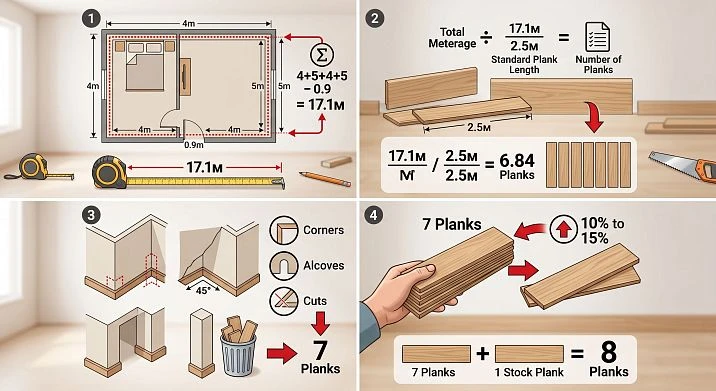
It would seem, what's there to calculate? Measured the perimeter, added a little — and done. But it's with this "simple" task that people most often make mistakes: they bring one plank less than needed, or take so much extra that the leftovers gather dust in the storage room for years. And between "just enough" and "enough with a margin" lies a specific method — once you understand it, you won't make mistakes again.
How to correctly calculate MDF baseboard is not just an arithmetic question. It's important to understand how the plank is structured, what the standard MDF baseboard length in reality, how corners and doorways are calculated, why a reserve is not 'just in case' but a mandatory line in the calculation. This article is a complete, honest, and practical breakdown. No fluff, but with specific examples, formulas, and tables.
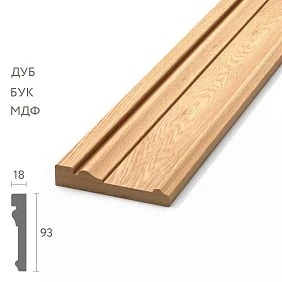
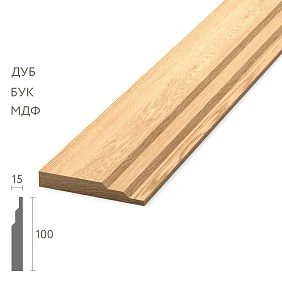
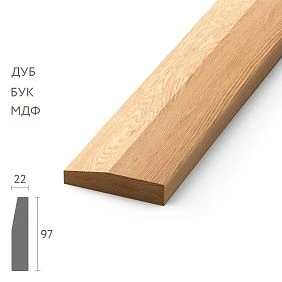
Why it's important to calculate the baseboard before purchase, not during
Picture this: the renovation is finishing, the installer is packing up tools, and it turns out there's not enough planks for the last wall. The nearest store is an hour away. The required item is out of stock. Delivery takes three days. The result: either a halt at the final stage, or a hasty purchase of a 'similar' baseboard with a slightly different shade that will be an eyesore for years.
Another scenario: bought with a 'by eye' reserve, four planks left over with nowhere to go. Money spent, planks can't be returned because the packaging is opened.
Both situations are a consequence of a lack of calculation. A proper calculation MDF Skirting Boards before purchase takes 15–20 minutes and completely eliminates both scenarios. It's not complex math—it's attentiveness and methodicalness.




What you need to know before starting the calculation
Before picking up a tape measure, you need to gather the initial data. Here's the full list:
-
The perimeter of the room is the sum of the lengths of all walls. It is measured with a tape measure along the bottom edge of the walls (exactly where the baseboard will be placed).
-
Number and width of door openings — subtracted from the perimeter (or not — this is discussed separately).
-
Number of internal corners — standard right angles in a rectangular room. In each corner, a 45° miter cut is made.
-
Number of external corners — protrusions, pilasters, columns, corner cabinets, built-in niches with external corners.
-
Presence of niches, bay windows, corridor protrusions — each of them adds corners and complicates the layout.
-
Length of one plank — standard 2400 mm (2.4 m), less often 2700 mm (2.7 m). Check with the manufacturer.
-
Height and profile of the baseboard — does not affect the linear footage consumption, but affects the number of additional elements.
Details about the size range, height, and profiles — in the full guide on MDF baseboard dimensions.
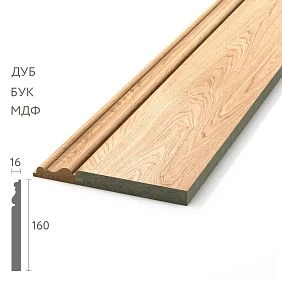
Our factory also produces:
Basic formula for calculating MDF baseboard
The calculation logic follows a simple scheme where each step has meaning.
Get Consultation
Step one: perimeter
Measure the length of each wall with a tape measure. Add them up. This is the perimeter of the room.
For a rectangular room: perimeter = (length + width) × 2.
Example: room 4 × 5 m → (4 + 5) × 2 = 18 m.
Step two: subtract door openings
Subtract the total width of all door openings from the perimeter. A standard door is 0.7–0.9 m. So, for one opening 0.8 m wide:
18 − 0.8 = 17.2 m — net working length.
Step three: allowance for trimming
Add an allowance to the net length. The standard allowance is 10%. For complex rooms with many corners, niches, and protrusions — 12–15%.
17.2 × 1.10 = 18.92 m → round up to 19 m.
Step four: converting meters to planks
If the length of one plank is 2.4 m (standard MDF skirting board 2400):
19 / 2.4 = 7.92 → round up to 8 planks.
If the room has non-standard corners or many short sections, take 9 planks.
Final formula
(Perimeter − width of doorways) × safety factor / plank length = number of planks (round up)
Safety factor:
-
Rectangular room, 4 corners, 1 door — 1.10
-
Corridor with many corners — 1.13–1.15
-
Room with bay windows, niches — 1.15–1.20
-
Entire apartment in one order — 1.10 (stock is divided among all rooms)
MDF skirting board plank length: how it affects the calculation
The most common format is a 2400 mm (2.4 m) plank. This size is the standard for most MDF skirting board manufacturers in Russia. Less common is 2700 mm (2.7 m) — a long-length format convenient for rooms with long walls.
Why is plank length important? Not just for converting meters to pieces. The plank length determines where the joints will be. And joints are a separate task in layout.
Layout with a 2400 mm plank
Let's take a wall 5.5 m long. One 2.4 m plank is not enough — you need two pieces: 2.4 + 2.4 = 4.8 m, and another piece of 0.7 m. In total, the wall takes 2 whole planks and a third of a third.
But this 'remainder' of 0.7 m — where to put it? If there is a short section in the same room (for example, a wall between doors 0.6 m wide) — great, the piece is used. If not — the piece goes to waste.
That is why before buying, you should not just calculate linear meters, but also think through the layout: which walls are long, where the joints will be, and where the leftovers will go.
How long walls affect the number of joints
On a 7 m wall with a 2.4 m plank, two joints are inevitable: 2.4 + 2.4 + 2.2 m. Three pieces, two connections. The longer the walls, the more joints — and the more important it is to plan them in advance. Joints should not fall in the most visible places (opposite the entrance, under the main light source).
More about proper installation of MDF baseboard layout in a separate guide.
Door openings in the calculation: subtract or not?
A question many get confused about: should the width of the door opening be subtracted from the perimeter when calculating MDF baseboards?
When the door opening is subtracted
If the baseboard does not go into the opening, the width of the opening is subtracted from the perimeter. This is a standard situation: the baseboard approaches the trim on both sides of the door, and there is none in the opening itself.
Subtract the clear width of the opening — the distance between the trims on both sides. This is usually 700–900 mm.
When the opening is not subtracted (or subtracted partially)
If the baseboard goes behind the casing and covers part of the slope, less is subtracted. If the wall with the door is short (e.g., 1.2 m) and the door is 0.8 m wide, taking up most of the wall, almost the entire wall is "consumed" by the opening, and its length is insignificant.
Another nuance: each door opening requires two end cuts of the baseboard. This means a small allowance for a clean cut near the casing is always needed.
A more detailed breakdown of how to handle the baseboard joint at an opening is in the article about MDF baseboard and door architraves.
Practical rule
For each door opening, add 100–150 mm "extra" to the allowance. This accounts for clean cuts on both sides. If the apartment has 5 doors, that's an additional 500–750 mm, essentially a third of a strip. This is not trivial.
How to account for corners: internal, external, non-standard
Corners are the main source of "unexpected" losses when laying out baseboards. Each corner requires a 45° cut, and the first cut in a non-standard corner is almost always a "test" cut—with a small error corrected by a second cut.
For information on how to properly make clean cuts at corners, see the guide on How to cut MDF skirting board.
Internal angles
An internal corner is typical for a straight room. In a rectangular room, there are 4 internal corners. At each, two pieces of baseboard are cut at 45° toward each other.
Losses at an internal corner are minimal if the angle is exactly 90°. An additional cut is about 30–50 mm on each side. For 4 corners of a standard room, that's up to 400 mm in losses. This is small.
External corners
External corner — a protruding element: pilaster, column, corner of a built-in wardrobe, decorative wall projection. Here, both pieces of skirting board are cut at 45° outward — with the sharp edge facing the corner apex.
Losses on an external corner are higher: cutting requires precision, and "trial" cuts consume material. For each external corner, an additional 150–200 mm of allowance should be included.
Non-standard angles
Real rooms often have angles of 88–92° — a slight deviation from a right angle. With proper work, this is corrected by adjusting the cut on site. But each such adjustment means an additional cut.
If there are 8 internal corners in a corridor, the allowance should be increased to 12–15%. If the apartment has a bay window with five acute corners, increase it to 15–18% for that room.
Trapezoidal and polygonal rooms
Kitchen-studios with diagonal walls, bay window areas, rooms in "Stalin-era" buildings with trapezoidal corners — a separate story. Here, the angles are not right, cuts are calculated individually, and the allowance for trimming should be 15–20% of the net footage.
Joints along the length: where and how to plan in advance
A joint of skirting board along the length is the connection point of two planks on the same wall. In the footage calculation, joints do not add linear meters, but they affect how to plan the layout and where remnants go.
Where to place the joint
Professional rule: the joint should not be in the most visible place. The wall opposite the entrance door, the wall under the main light source, the "main wall" of the living room — the joint should not fall there. Best places for a joint:
-
Behind furniture that will stand against the wall
-
On the walls that are visible "end-on" when entering
-
In the far, less lit corners of the room
-
On the short walls, where a joint is inevitable due to remnants
How the length of the plank affects the layout
Before purchasing, draw a simple room diagram with wall lengths. Mark where the planks start and end when laying out from a corner. See where the remnants fall — and whether they match short sections in the same room.
Example: a room 6 × 4 m. Long wall 6 m. With a 2.4 m plank: 2.4 + 2.4 + 1.2 m. The 1.2 m remnant — does it go to a short section of 1.2 m? No, 4 m is needed there. So, the remnant is "wasted" or goes to another wall. Consider this when estimating the total number of planks.
Straight or angled joint
Straight joint (end at 90°) — standard. Easier to execute, gives an invisible seam with proper preparation.
Mitered joint (at 45°) — used less often. Its advantage: with seasonal movement of MDF baseboard, the mitered joint "overlaps" and remains invisible longer.
For any type of joint, final finishing is important — touching up the joint line and, for paintable baseboard, puttying the seam before final painting.
How to calculate the cost of MDF baseboard
Cost calculation is the next step after calculating the footage. And here too, there are nuances that are often overlooked.
Cost calculation formula
Total cost = number of planks × price per plank + additional elements + consumables + installation (if needed)
Let's break down each component.
Cost of planks
MDF skirting board price depends on several parameters:
-
Profile height. Baseboard 60 mm, 80 mm, 100 mm, 120 mm — different prices. The higher, the more expensive.
-
Type of coating. White with factory enamel, for painting, wood-like (decorative film) — different price levels.
-
Profile. A simple straight profile is cheaper than a shaped one with detailing.
-
Manufacturer. Domestic and imported — different price categories.
For an accurate calculation MDF skirting board price per meter — check the website or showroom for the specific article.
Fitting elements
This is an expense item often forgotten during initial calculation:
-
Wooden corner bracket — for external corners and end finishing at doorways. Counted in pieces based on the number of external corners.
-
Acrylic sealant — for sealing the top joint. 1 tube per 25–30 linear meters.
-
Primer — if the skirting board is for painting.
-
Paint — if the skirting board is for painting.
-
Glue — if adhesive installation (liquid nails, construction adhesive).
-
Fasteners — dowel nails for fastening installation.
Installation cost
If a master installs the baseboard, the cost of work is calculated separately. The price per meter for MDF baseboard installation varies depending on the region, type of installation, and complexity of the room. The installation cost is influenced by:
-
Type of fastening (glue, hidden fasteners, clamps)
-
Number of corners and joints
-
Presence of uneven walls (more details in the article about MDF baseboard for uneven walls)
-
Baseboard height
-
Additional finishing (putty, painting)
What affects material consumption: full list of factors
It would seem that the footage is calculated — and everything is clear. But the actual consumption of baseboard depends on a dozen factors, each of which can "eat up" an additional 50–300 mm.
Wall length and number of joints
Walls longer than 2.4 m require joints. Each joint means small losses from trimming both pieces. On a 6 m wall — two joints, losses of about 40–60 mm total. A trifle? On a scale of 8–10 planks — that's almost half a plank.
Number of doors
Each door means two end cuts. The more doors, the higher the waste from end trimming. In an apartment with 5 doors — 10 end cuts, additional waste of about 300–400 mm. Almost a third of a plank.
Number of corners
More corners — more cuts — more waste. A standard rectangular room with 4 corners and a 10% reserve: precise calculation. A corridor with 8–10 corners, niches, and protrusions: need 15%. An apartment in an old building with non-standard layouts — sometimes 20%.
Niches and protrusions
A niche adds 2 external corners + 2 internal corners + additional length along the three walls of the niche. One protrusion — the same. Count the niche as a "mini-room" within the perimeter of the main space.
Furniture against walls
Built-in floor-to-ceiling wardrobes, case furniture flush with the baseboard — sometimes the baseboard is not installed behind them at all. This reduces waste. But keep in mind: furniture is sometimes rearranged. If there is no baseboard behind the wardrobe, it will be noticeable after rearrangement.
Practical solution: if the furniture is stationary (built-in wardrobe) — the baseboard behind it is not needed. If the furniture is "on wheels" or may be rearranged — the baseboard is installed around the entire perimeter.
Uneven walls
On curved walls, MDF baseboard fits unevenly. Sometimes additional cuts and adjustments are needed. Curvature slightly increases consumption (the planks themselves are not shortened), but raises the risk of chipping during adjustment. Reserve for curved walls — 12–15%.
High baseboard
Baseboard 100 mm and wider — being broader, when cut at 45° it removes more material in width. But this does not affect consumption in linear meters.
Adjustment to architraves and thresholds
At level transition points (threshold between rooms, transition from one flooring to another), the baseboard sometimes requires non-standard trimming. Each such point is an additional cut.
Calculation for different room types
Rectangular room
The simplest case. Four corners, one door, straight walls.
The formula works directly: perimeter − door width × 1.10 / plank length.
Corridor
Corridors are the most difficult rooms to calculate. Why? Narrow walls, many corners (often 8–12 in one corridor space), doors on both sides, possible niches for cabinets.
For a corridor with 8+ corners: reserve at least 15%. Be sure to draw a diagram before calculating — mark all corners, doors, and niches.
Entire apartment
It's more convenient to calculate not by individual rooms, but for the entire apartment as a whole:
-
Sum up the perimeters of all rooms
-
Subtract all door openings (there may be 5–8 in the apartment)
-
Add a reserve of 10–12% (the reserve is "averaged" across the entire apartment: some places will use less, some more)
-
Convert to the number of planks
-
Add 1–2 planks "for emergencies"
Advantage of a unified calculation: leftovers from one room are used in another. This reduces total waste.
Room with a bay window
A bay window is an additional "protrusion" with three (or more) walls and external corners. Add the footage along all walls of the bay window, add 200 mm for each external corner of the bay window, account for a total reserve of 15% for this part.
Bathroom and toilet
Baseboard in the bathroom is a separate topic. Moisture resistance is important here. Standard Baseboard MDF is suitable for the bathroom only if there is good ventilation and no direct contact with water. Calculation — using the same formula. But the margin — 15%: small rooms with many corners require greater precision.
Calculation example: apartment 60 m²
Let's analyze a real example for a typical two-bedroom apartment.
Data:
| Room | Dimensions | Perimeter | Doors |
|---|---|---|---|
| Living room | 5 × 4 m | 18 м | 1 × 0.8 m |
| Bedroom | 4 × 3.5 m | 15 м | 1 × 0.7 m |
| Corridor | 1.2 × 4 m | 10.4 m | 3 × 0.8 m |
| Kitchen | 3 × 4 m | 14 м | 1 × 0.8 m |
| Bathroom/WC | 1.5 × 2 m | 7 м | 1 × 0.6 m |
Calculation:
Living room: 18 − 0.8 = 17.2 × 1.10 = 18.92 m → 8 planks
Bedroom: 15 − 0.7 = 14.3 × 1.10 = 15.73 m → 7 planks
Corridor: 10.4 − (3 × 0.8) = 8 m × 1.15 = 9.2 m → 4 planks
Kitchen: 14 − 0.8 = 13.2 × 1.10 = 14.52 m → 7 slats (2.4 × 6 = 14.4 — slightly insufficient, take 7)
Bathroom: 7 − 0.6 = 6.4 × 1.15 = 7.36 m → 4 slats
Total: 8 + 7 + 4 + 7 + 4 = 30 slats.
With an "emergency" reserve — 31–32 slats.
This is a conditional calculation. Actual values depend on exact dimensions and number of corners.
MDF baseboard calculation errors: itemized breakdown
1. Calculating by area instead of perimeter. A classic mistake. Room area is square meters of floor. Baseboard goes along the perimeter — linear meters. These are fundamentally different quantities. Room 4 × 5 m: area — 20 m², perimeter — 18 m. Difference — 2 m (almost one slat).
2. Not accounting for any reserve. "Calculated by perimeter — and that's enough." No. Cuts at corners, ends, fitting near trims — all this consumes actual material. Without a reserve, there will be a shortage.
3. Forgetting to subtract door openings. Openings are often not subtracted — resulting in buying extra meters. In a large apartment with several doors — overpayment by 1–3 slats.
4. Not considering the length of one slat. Calculated 19 meters, bought 19 meters. But a slat is 2.4 m — and 19 / 2.4 = 7.92. Need 8 slats = 19.2 m. If you buy exactly 19 m (7.92 slats) — it's physically impossible: you take 7 or 8. With 7 — there won't be enough.
5. Do not account for losses at corners. In a hallway with 10 corners without accounting for losses, you will definitely run short.
6. Do not plan the layout in advance. Joints in the center of the main wall, short trimmings near doors, long tails with nowhere to go — all of this results from a lack of layout planning.
7. Buy baseboards from different batches "just enough." MDF baseboards are produced in batches. Even for the same article, there may be a slight difference in shade between different batches. Buy the entire required volume at once — from the same batch.
8. Forget about additional elements. Corner pieces, end caps, glue, sealant, primer — these are not "trifles." For an apartment of 60 m², the total cost of additional consumables can amount to 15–20% of the cost of the baseboard itself.
Table of margin depending on room complexity
| Room Type | Number of corners | Recommended margin |
|---|---|---|
| Rectangular room | 4 | 10% |
| Room with a niche | 6–8 | 12% |
| Straight hallway | 4 | 10% |
| Hallway with protrusions | 8–12 | 15% |
| Bay window | +4–6 to main | 15–18% |
| Bathroom/WC | 4–6 | 15% |
| Apartment total | all | 10–12% |
| Non-standard layout | 10+ | 15–20% |
What to buy together with the baseboard: full list
Correct calculation is not just linear meters of baseboard. It's the entire kit for installation and finishing.
MDF Skirting Board — main item. Choose by height, profile and color for the specific interior.
buy MDF skirting board for painting — for interiors with non-standard wall color, minimalist solutions and hidden doors.
Wooden baseboard — for rooms with natural parquet or wooden doors. Calculation — using the same formula.
Wooden corner bracket — for external corners. Counted in pieces: by the number of external corner points.
wooden molding — for decorative belts, transition zones, classic interiors with wooden frames.
Trimming Items — a complete system of wooden linear elements for any finishing tasks.
All information about choosing the right MDF skirting board sizes for a specific room type and style — in the corresponding guide.
FAQ: Answers to popular questions
How to calculate MDF skirting board for a room?
Measure the room perimeter with a tape measure, subtract the width of doorways, multiply by a safety factor (1.10 for a rectangular room), divide by the length of one plank (usually 2.4 m), and round up to a whole number.
How much extra MDF skirting board should you take?
Standard extra is 10% of the net footage. For corridors with many corners and niches — 12–15%. For non-standard rooms with bay windows, sloped walls, and many protrusions — up to 15–20%.
Do you need to subtract doorways?
Yes. The total width of all door openings is subtracted from the perimeter. A standard door is 0.7–0.9 m. The baseboard is not installed in the opening, so these meters are not needed. But add 100–150 mm to the allowance for each opening for neat trimming on both sides.
What is the length of an MDF baseboard plank?
Standard MDF baseboard length — 2400 mm (2.4 m). A format of 2700 mm (2.7 m) is less common. Check with the manufacturer: the calculation of the number of pieces depends on the length of the plank.
How to convert the length into the number of planks?
Divide the required length (with allowance) by the length of one plank. Round the result up to a whole number. For example: 19 m / 2.4 m = 7.92 → 8 planks.
How to calculate baseboard for a corridor with corners?
Measure the perimeter of the corridor along all walls (including niches and protrusions), subtract all door openings, multiply by a factor of 1.13–1.15 (allowance for a corridor with 8+ corners), divide by the length of the plank, round up.
How much does MDF baseboard cost per meter?
Significantly lower than solid wood. depends on the profile height, type of coating, and manufacturer. Current prices are on the website. For an accurate budget, multiply the price per plank by the number of planks and add the cost of additional elements and consumables.
How to calculate the cost of baseboard with installation?
Calculate: cost of planks + corners and additional elements + consumables (glue, sealant, primer) + installation cost per linear meter (MDF baseboard installation price per meter is clarified with the master). For complex rooms with non-standard angles and curved walls, the master may apply a multiplying factor to the base rate.
About the company STAVROS
Correct calculation loses its meaning if it is based on material of unstable quality. A plank with geometric deviation, mismatched shade between batches, porous edge that chips at the first cut — all of this makes even the most accurate calculation pointless.
STAVROS manufactures MDF Skirting Board with constant control of geometry and shade from batch to batch. Planks 2400 mm long, E1 base with density 820–850 kg/m³, full-wrap decorative coating. Shade is stable: if you buy additional planks a month later, they will match the already installed ones.
The STAVROS range includes white MDF baseboard with factory enamel, baseboard for painting, wood decors, solid wood baseboards, corners, moldings, and linear products. All in unified size standards — no fitting between items of the same system.
Calculate the required quantity, check the current cost of MDF baseboards and place an order with delivery — on the STAVROS website.