Article Contents:
- What exactly is being purchased: HI WOOD L1605
- Why you can't just write “13.7 mm confirmed”
- Why you can't assume 13 mm is automatically correct
- Scenario A — only the display is rounded
- Scenario B — the value is actually converted
- The number format and the number itself are not the same thing
- Rounding and truncation are different errors
- Rounding
- Truncation
- Where the decimal part is most often lost
- Why one article number is still not enough
- Strong matching algorithm
- Weak algorithm
- The danger of automatic duplicate removal
- What a unique internal code should look like
- Why the full size still needs to be stored
- What to pass to the designer
- What to pass to procurement
- How to create a request for L1605
- Why you can't write “approximately 14 mm” in a request
- What to do if the supplier replies “90×14×2000”
- The SKU in a quotation matters more than a rounded description
- How to compare multiple quotations
- Why price per meter doesn't save you from an SKU error
- The invoice must contain L1605
- Shipping documents retain the same item code
- Acceptance at the site: what to check
- Why a regular tape measure is not suitable for checking tenths
- When a caliper is needed
- Where to measure thickness
- How to submit a size confirmation request
- Why the answer “it's the same thing” is insufficient for ERP
- How to store the original and normalized value simultaneously
- Why you cannot overwrite the source value after confirmation
- How to maintain versioning for L1605
- R0
- R1
- R2
- R3
- Why manual correction without a version is dangerous
- Who should have the right to change master data
- Why the article remains about L1605
- How to verify CSV import
- Decimal comma
- Decimal point
- Locale
- How to create a control file for import
- Why export back also needs to be tested
- How to detect loss of precision automatically
- Why “13.7” cannot be stored only as text
- Why rounding is dangerous specifically on a large project
- Why it is especially dangerous to store the B90 series nearby
- L1605 reference
- Why stock remnants also get a product code
- Do not put leftovers into the shared "90 mm" box
- How to issue L1605 to the installer
- What to do if a different profile is found on the floor
- How to draw up a mis-shipment report
- Why you cannot accept goods by size only
- The reserve must be a reserve L1605
- Installation and operational reserve
- Mounting
- Operational
- Why the reserve cannot be calculated in linear meters only
- Why the new search by size is more dangerous than the old count
- What to do if the supplier card has changed
- How to keep a history of conflicting dimensions
- How to prohibit manual rounding for employees
- Why a system rule is more beneficial than training each employee
- Second table: control before ordering
- How to calculate 100 apartments without switching to regular cutting
- Why quantity and geometry should live in the same row
- 1. Round 13.7 up to 14
- 2. Truncate 13.7 to 13
- 3. Remove duplicates by size
- 4. Treat 90×14 as a unique identifier
- 5. Lose L1605 during import
- 6. Record “90 mm skirting board”
- How to test catalog search
- How to use broad commercial anchors naturally
- Why building materials at wholesale prices cannot be compared before normalization
- Why a no-substitution rule should be specified
- How to verify the first delivery as a reference
- Why a reference sample matters more than a photo
- How to verify the second delivery batch
- How to distinguish a description change from a product change
- Scenario 1 — SKU preserved, size rounded only in the printed form
- Scenario 2 — master data already contains 14
- Scenario 3 — the supplier card shows 13 mm
- How to perform a reverse check of the final order
- How to verify that the reserve is not mixed with the B90 series
- How to verify the physical completeness of the project
- Why the geometric conflict must be resolved before mass publication of the article
- What to do if the drawing confirms 13.7 mm
- What to do if the drawing confirms 13 mm
- What to do if the supplier explains 13.7 as maximum protrusion and 13 as a different field
- Why the exact name of the dimension field is as important as the number
- What the final request to the supplier should look like
- Step 1 — source
- Step 2 — geometric reference
- Step 3 — master-data
- Step 4 — ERP/Excel
- Step 5 — SKU matching
- Step 6 — warehouse
- Step 7 — reorder
- Why a round-trip test is better than a regular Excel review
- How to handle the decimal separator
- Why you can't normalize a comma by simply deleting it
- How to verify an import from a supplier price list
- Why there should be only one source of truth
- When you shouldn't buy the entire L1605 batch
- How to tell that the article solved the problem
- Final check before handing the order to the supplier
- How to close the project after the last batch
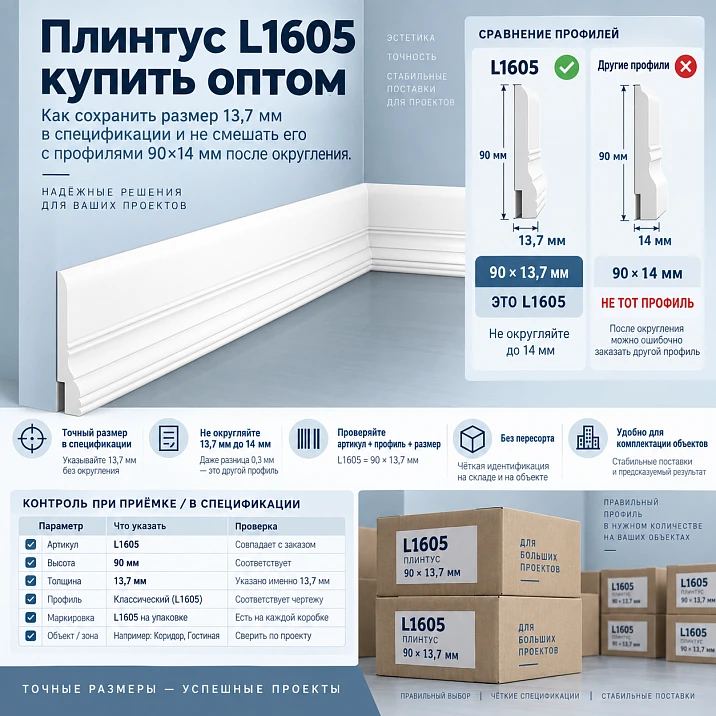
A wholesale mistake sometimes starts not with the warehouse and not with the installation crew, but with a single field in a table. In the product card, the HI WOOD L1605 skirting board is listed as 90×13.7×2000 mm. The estimating program accepts only whole millimeters, and the import turns 13,7 в 14, while the internal reference book then sees the line 90×14×2000. At this stage, L1605 begins to machine-resemble other HI WOOD items with a height of 90 mm and a thickness of 14 mm. If the system removes "duplicates" by dimensions, groups products only by geometry, or the procurement specialist relies on the shortened line "skirting board 90×14", the real SKU can easily be lost.
For a large project, this is no longer a cosmetic inaccuracy. The error spreads along the chain:
L1605 card → import → master reference book → estimate → request → commercial proposal → invoice → acceptance → warehouse → issue → reserve → reorder.
Therefore, the L1605 skirting board should be purchased wholesale only after the system can preserve the original precision of the dimensional fields and does not replace the article number with rounded geometry.
The main principle of the article:
article number L1605 is the primary product identifier; dimensions are the second level of control. The decimal part must not be destroyed simply because a particular ERP is used to working with whole millimeters.
There is another important circumstance. On the current STAVROS product page, the product name and catalog use the designation 90×13.7×2000 mm, but the structured specification block within the same page shows 90×13×2000 mm. This means that the technical article must not choose the “correct” value by eye. Before the final order, the exact geometry is confirmed against the current drawing or supplier document. At the same time, the original value of 13.7 mm must not be automatically rewritten as 14 mm: such a conversion already changes the master data and creates a false match with other SKUs.
Working chain for the project:
L1605 → current product page → current drawing → confirmed A/C/L → master SKU → exact numeric fields → import control → L1605 request → L1605 quotation → L1605 invoice → acceptance → separate bin → L1605 reservation → repeat order L1605.

What exactly is being purchased: HI WOOD L1605
L1605 is a HI WOOD floor skirting board made of polystyrene, 2000 mm long and with a nominal height of 90 mm.
Product card: HI WOOD L1605 skirting board.
For the procurement system, it is safe to separate confirmed fields from those requiring verification.
| Field | Working value |
|---|---|
| Manufacturer | HI WOOD |
| Article number | L1605 |
| Type | Floor skirting board |
| Material | Polystyrene |
| Height | 90 мм |
| Thickness/projection | original card designation 13.7 mm; confirm the exact value against the current drawing |
| Length | 2000 мм |
| Purchase unit | piece |
This approach does not hide the contradiction or turn it into a fabricated fact.




Why can't we simply write “13.7 mm confirmed”
Because the current card contradicts itself:
-
the title and description use 13.7 mm;
-
the specifications block shows 13 mm.
For editorial text, this is not a reason to choose the more attractive number. For procurement, it is a signal:
a verification of the primary geometric source is needed.
Up to it, 13.7 mm remains an important source value of the nomenclature, which cannot be rounded to 14.
Our factory also produces:


Why 13 mm cannot automatically be considered correct
A structured block may also contain:
-
rounding;
-
truncation;
-
simplified field;
-
old record.
Therefore:
13.7 versus 13
is resolved by a drawing or supplier confirmation, not by trusting a single page block.
Get Consultation
Why 0.3 mm becomes a major procurement problem
If an employee manually sees:
13.7 mm,
they understand that this is an exact decimal value.
For an information system, often only the number exists.
With a format without decimal places, two scenarios are possible.
Scenario A — only the display is rounded
In memory:
13,7.
On screen:
This is unpleasant, but the original value is not lost.
Scenario B — the value is actually transformed
In memory:
Now the original 13.7 can no longer be restored without an external source.
The second scenario is more dangerous.
It changes the data.
The number format and the number itself are not the same thing
This is one of the central technical theses of the article.
In Excel, a cell can store:
13,7
and display:
14
because of the format 0.
If an employee copies the value as a number into another system, the result depends on the import method.
But if the formula:
ROUND(C2,0)
or the export itself writes a whole number:
14,
the original precision is destroyed.
Therefore, the audit should check:
-
display;
-
actual value;
-
export;
-
import.
Not only what is visible on the screen.
Rounding and truncation are different errors
Rounding
13,7 → 14.
The system creates a false match with products where 14 mm is the actual nominal value.
Truncation
13,7 → 13.
The system also changes the original value, but in the opposite direction.
In the current L1605 card, there is a conflict between 13.7 in the name and 13 in the specifications. Therefore, the article should not teach the user how to "round correctly." It should teach not to change the original geometry without confirmation.
Where the decimal part is most often lost
The problem can occur at any transition:
-
CSV;
-
XLSX;
-
ERP;
-
1C;
-
BIM export;
-
supplier price list;
-
internal catalog;
-
PIM;
-
warehouse database;
-
printed specification;
-
manual entry.
The more systems between the product card and the warehouse, the higher the risk.
What the L1605 master reference should look like
It is better to store dimensions in separate fields.
Not only:
90×13,7×2000.
But:
| Field | Value |
|---|---|
| A | 90 |
| C | 13.7 — before drawing verification as the initial card value |
| L | 2000 |
At the same time, the full string is preserved:
HI WOOD L1605 / 90×13.7×2000 mm / source value / drawing verification required.
Why are both formats needed?
Individual fields are convenient for the machine.
The full string is convenient for a person and helps to notice that C=14 it already differs from the source.
Why one SKU is still not enough
One might object:
if there is L1605, why worry about 13.7 at all?
The SKU is indeed the main identifier.
But dimensions work as an integrity check.
For example, in a quote:
L1605 / 90×14×2000.
The SKU matches.
Size — none.
This does not automatically mean that the supplier offers a different product. They may have rounded the description. But the line needs to be clarified before payment.
It is precisely the combination:
manufacturer + article number + confirmed geometry
that provides stable identification.
What happens after rounding L1605 to 14 mm
In the STAVROS catalog, there are several separate HI WOOD skirting boards with a size of 90×14×2000 mm. In particular:
-
B90V1;
-
B90V1L;
-
B90V2.
These are real standalone SKUs. Their matching nominal dimensions do not make them the same product.
Now let's imagine that the original line L1605:
L1605 / 90 / 13,7 / 2000
after import turns into:
L1605 / 90 / 14 / 2000.
If the internal reference uses size as one of the deduplication keys, a false signal appears:
L1605 resembles B90V1/B90V1L/B90V2.
In a weak system, two scenarios are possible:
-
L1605 is mistakenly merged with one of the B90 positions;
-
the employee sees several
90×14×2000and chooses "any similar one."
Both scenarios are dangerous.
Why decorative trim cannot be merged by dimensions alone
For a product, geometry matters.
But identical three numbers do not guarantee an identical profile.
B90V1, B90V1L, and B90V2 have the same nominal dimensions of 90×14×2000 mm, but remain distinct models with different face geometry.
Therefore, the primary key must be built on at least:
manufacturer + SKU.
Dimensions — check.
Not a primary identifier.
Strong matching algorithm
-
brand;
-
article number;
-
confirmed geometry;
-
card/drawing;
-
status.
Weak algorithm
height + thickness + length.
It is precisely this kind of algorithm that turns the rounding of 13.7 → 14 into a product error.
The danger of automatic duplicate removal
Let's imagine an export:
| SKU | A | C | L |
|---|---|---|---|
| L1605 | 90 | 14 | 2000 |
| B90V1 | 90 | 14 | 2000 |
| B90V1L | 90 | 14 | 2000 |
| B90V2 | 90 | 14 | 2000 |
If Excel or an ERP system looks for uniqueness by A+C+L, four products look identical.
The program may:
-
keep one;
-
assign a common internal code;
-
sum up the stock quantities;
-
overwrite the prices;
-
mix up orders.
This is already a systemic master-data defect.
What a unique internal code should look like
You can use:
HIW-L1605.
Or:
SKIRT-HIW-L1605.
But the internal code is always linked to the factory code:
L1605.
No need to create a code:
PL-90-14-2000.
Such a code again ties identity to rounded geometry.
Why the full size still needs to be stored
If the SKU is the primary identifier, dimensions are needed for verification.
For example:
internal_code = HIW-L1605;
sku = L1605;
A = 90;
C_source = 13,7;
L = 2000.
If a new delivery arrives as:
L1605 / 90×14×2000,
the system shows:
the geometry differs from the original card entry → CHECK.
This is more useful than blind acceptance.
What to pass to the designer
Not:
skirting board 90 mm.
Not:
white HI WOOD.
But:
HI WOOD L1605 / polystyrene / 90 mm / original card designation 13.7 mm / 2000 mm / confirm the exact geometry against the current drawing.
If the drawing has already been confirmed, it is the confirmed value that is passed into the project.
What to pass to procurement
The same master SKU.
No manual retyping:
13,7 →14
"for convenience".
The less re-entry, the lower the risk.
It is ideal if the purchase request is generated automatically from the master reference.
How to create a request for L1605
Working line:
HI WOOD L1605 / polystyrene / size per current drawing / length 2000 mm / ___ pcs. / project ___ / revision ___
If the drawing has not yet been verified at the time of the request:
the card/catalog states 90×13.7×2000 mm; please confirm the current size in the quotation.
This way the buyer does not pretend that there is no contradiction.
Why you cannot write "approximately 14 mm" in a request
Phrase:
thickness about 14 mm
Suitable for general description.
Not for procurement.
It:
-
allows the supplier to interpret;
-
does not protect the SKU;
-
does not lock the original value;
-
destroys the control function of the geometry.
Therefore, either an exact confirmed value or an explicit note:
requires confirmation.
What to do if the supplier responds "90×14×2000"
Do not approve the quotation automatically.
Check:
-
whether L1605 is specifically indicated;
-
this is a rounded text description;
-
whether there is an attached drawing;
-
whether B90V1/B90V1L/B90V2 is not offered;
-
whether the URL/product code matches.
If SKU = L1605, the situation may simply be rounding in a commercial document.
But this needs to be recorded.
The item code in the quotation is more important than the rounded description
Scenario:
Skirting board L1605 / 90×14×2000.
This is not ideal.
But the identity can still be verified.
Scenario:
Skirting board HI WOOD / 90×14×2000.
Item number is missing.
Now the line can refer to multiple models.
Such a quotation is better returned for clarification before payment.
How to compare multiple quotations
Normalization:
manufacturer + SKU.
Not:
size group 90×14.
For example:
| Supplier | SKU | Size in the quotation | Status |
|---|---|---|---|
| А | L1605 | 90×13,7×2000 | matches the catalog designation |
| Б | L1605 | 90×14×2000 | clarify rounding |
| В | B90V1 | 90×14×2000 | another product |
Only after product identification is the price compared.
Why price per meter doesn't save you from SKU errors
L1605 and B90V1 may have a similar price.
If the system has already grouped them by size, the comparison table will show:
both skirting boards are 90×14, we choose the cheaper one.
But different models are being compared.
That is why commercial analytics always comes after item normalization.
The invoice must contain L1605
Final document:
HI WOOD L1605 / ___ pcs.
If the invoice contains only:
skirting board 90×14,
it is better to request an adjustment.
Specifically according to the invoice:
-
are paid;
-
are assembled;
-
are shipped;
-
are accepted.
Losing the SKU at this stage is especially dangerous.
Shipping documents retain the same item code
The invoice must not revert to the general description:
HI WOOD skirting board 90 mm.
The chain must retain L1605.
If the supplier uses an abbreviated line, the site must retain a document that unambiguously links it to L1605.
Acceptance at the site: what to check
Minimum:
-
L1605;
-
HI WOOD;
-
length 2000 mm;
-
quantity;
-
factory marking;
-
matching the invoice;
-
external profile;
-
reference/drawing.
Acceptance should not be based only on:
height about 90 mm.
Or:
thickness about 14 mm.
Why a regular tape measure is not suitable for checking tenths of a millimeter
A tape measure is useful for:
-
overall length;
-
rough height;
-
checking that it is not a completely different profile.
But the dispute:
13.7 or 14 mm
cannot be resolved with a tape measure.
For tenths of a millimeter, you need a tool with the appropriate accuracy and a clear measurement point.
When you need a caliper
Reasonable situations:
-
incoming inspection of the reference sample;
-
dispute about the actual size;
-
unknown strip without marking;
-
comparison of the old and new batch.
But a measuring tool does not replace a drawing.
A shaped profile may have different local protrusions.
Where to measure thickness
You cannot make things up:
always at the thickest point.
You need to look at the drawing.
If size C refers to a specific geometric datum, the measurement is taken from it.
Otherwise, two employees may measure the same profile at different locations and get different numbers.
The drawing is the primary geometric reference
The product page is convenient for navigation and sales.
The drawing is needed for technical identification.
It must define:
-
base dimensions;
-
measurement points;
-
cross-section profile;
-
relative position of elements;
-
nominal values.
If the product card shows 13.7 mm in the title and 13 mm in the specifications, it is the drawing that should help resolve the contradiction.
If the current drawing is unavailable, the request to the supplier should explicitly state the problem.
How to draft a request to confirm the size
A practical wording:
In the current HI WOOD L1605 product card, the title states 90×13.7×2000 mm, while the specifications block shows 90×13×2000 mm. Please confirm the current size C according to the valid product drawing and use the confirmed value in the quotation and invoice.
This way the supplier understands that the question is not about price or availability, but about master data.
Why the answer “it’s the same thing” is insufficient for ERP
For a person:
13,7 ≈ 14.
For a database, these are two different values.
If the system must:
-
distinguish SKU;
-
catch duplicates;
-
compare deliveries;
-
build a reference guide,
a specific policy is needed:
-
what is the source of truth;
-
how many digits are stored;
-
what can be rounded;
-
what cannot.
How to store the original and normalized value at the same time
If the business system is forced to have a separate rounded field, it is safer to keep two values.
For example:
| Field | Value |
|---|---|
| C_source | 13,7 |
| C_confirmed | According to the drawing |
| C_display | 14 |
| C_rounding_rule | display_only |
| source | product card/drawing |
| revision | R2 |
Then the rounded display does not destroy the source data.
Why source-value must not be overwritten after confirmation
If the drawing shows, for example, 13 mm, there is no need to erase the fact that the card previously contained 13.7.
Stronger:
source card = 13,7;
current confirmed drawing = 13;
reason = discrepancy resolved;
date = ___.
This way the history is explainable.
If the card is corrected tomorrow, it will be possible to understand what changed.
How to maintain versioning for L1605
Example:
R0
Card import:
90×13,7×2000.
R1
ERP displayed:
90×14×2000.
Error detected.
R2
Drawing verified/supplier response.
Confirmed value entered into the master reference.
R3
Supply batch accepted and linked to R2.
One current version is active in the working system.
The archive retains previous ones.
Why manual correction without a version is dangerous
The employee sees:
Changes:
13,7.
The next employee sees a conflict with the specification card:
Changes again.
A month later, no one understands:
-
who set the rules;
-
why;
-
what to believe.
Therefore, changing a geometry field must have a justification.
Who should have the right to change master data
It does not have to be one specific department.
But there must be a role:
owner of the product catalog.
They are responsible for:
-
SKU;
-
sizes;
-
material;
-
source;
-
revision;
-
aliases;
-
Statuses.
Other employees use the data rather than editing it "to fit their own file."
How to disable rounding in ERP
Minimum technical requirement:
dimensional fields of decorative trim must store at least one decimal place where the original source contains a decimal value.
This applies not only to L1605.
The current catalog also contains other items:
-
13.5 mm;
-
17.5 mm;
-
19.5 mm;
-
12.5 mm.
Therefore, support for decimal values is a systemic necessity for the catalog.
Why the article remains about L1605
Other products are needed only as evidence:
decimal dimensions in the assortment are real.
There is no need to turn the page into an audit of all of HI WOOD.
Main object:
L1605.
Main problem:
preserving its exact identity during import and procurement.
How to check CSV import
Typical risks:
Decimal comma
13,7
may be interpreted as:
-
number;
-
text;
-
two columns with an incorrect delimiter.
Decimal point
13.7
may import correctly in one system and incorrectly in another.
Locale
The Russian locale expects a comma.
The international one — a point.
Therefore, the test import should specifically verify L1605 and other decimal positions.
How to create a control file for import
It is useful to have in the test set:
-
integer value 14;
-
decimal 13.7;
-
decimal 13.5;
-
decimal 19.5;
-
length 2000.
After import, verify:
original value = saved value.
Not just display.
Why export back also needs to be tested
ERP may accept 13.7 correctly, but on export to CSV output:
Then the buyer receives already corrupted data.
Therefore the test:
source → import → database → export → compare.
For master data this is more important than a beautiful interface design.
How to detect loss of precision automatically
You can create a control rule.
For example:
if SKU = L1605 and C does not match the approved master-value → ERROR.
Or a general control:
if source has decimal and target integer → CHECK.
This is how the system catches the problem before purchase.
Why “13.7” cannot be stored only as text
Text protects the characters.
But it prevents:
-
numeric validation;
-
filtering;
-
comparison;
-
validation.
It is better to store:
-
numeric value;
-
unit;
-
original string.
For example:
numeric_C = 13.7
raw_C = "13.7 mm"
How to work with 100 apartments
Let's imagine:
-
object of 100 apartments;
-
L1605 is approved in all;
-
one master position;
-
several apartment types.
The article should not become a piece about ordinary cutting again.
But the quantity still needs to be brought up to the purchase order line.
For example:
-
type A ×40;
-
type AR ×40;
-
type B ×16;
-
non-typical ×4.
For each:
quantity L1605.
Final:
main volume + reserve.
The main point:
at each stage this is specifically L1605, not an unnamed
90×14.
Why rounding is dangerous specifically on a large project
An error in one line gets scaled up.
If one apartment receives the wrong SKU:
a local problem.
If the master reference replaced L1605 with a size group 90×14:
the error repeats across all 100 apartments.
That is why the value of master-data quality grows with the project's serial production.
How to store L1605 in the warehouse
The warehouse bin should be named:
HI WOOD L1605
Or:
HIW / L1605 / 2000
Not:
skirting board 90×14.
Not:
high white HI WOOD.
Not:
skirting board 90 mm.
The reason is simple: the size string may match other SKUs.
Why is it especially dangerous to store the B90 series nearby
A single warehouse may simultaneously contain:
-
L1605;
-
B90V1;
-
B90V1L;
-
B90V2.
All of them have:
-
height of about 90 mm;
-
length 2000 mm;
-
white polystyrene.
After opening the packaging, the visual risk increases.
Therefore:
-
individual cells;
-
large SKU;
-
reference sample;
-
photo of the end face.
Reference sample L1605
Useful kit:
-
one signed strip or control sample;
-
photo of the end cross-section;
-
factory label;
-
current drawing;
-
master card;
-
product URL.
The reference sample is not consumed during normal installation.
It is needed for:
-
incoming inspection;
-
comparison of a new batch;
-
unknown remnants;
-
warehouse training.
Why do remnants also get a SKU
After cutting, the following appears:
740 mm.
If you write:
remnant of skirting board 90 mm,
identity is almost lost.
Correct:
L1605 / 740 mm / valid / FREE.
For B90V1:
B90V1 / 740 mm.
The lengths are the same.
The SKUs are different.
Remnants must not be put together in a common "90 mm" box
After a few months, the box turns into a mixture.
During repair, the employee takes:
a piece suitable in height.
But the profile may differ.
Therefore, the remainder only makes sense together with the SKU.
How to issue L1605 to the installer
Document:
building 1 / floor 3 / apartments 31–38 / L1605 / ___ pcs.
Not:
90-millimeter skirting board — ___ pcs.
The installer does not need to figure out whether the thickness is rounded.
He needs the exact SKU.
What to do if a different profile is found on the floor
Procedure:
-
stop a specific package;
-
check the label;
-
verify the invoice;
-
compare with the standard;
-
identify the SKU;
-
separate the incorrect item;
-
file a discrepancy.
There is no need to try to prove:
it is almost the same.
Identity matters for the project.
How to draw up a mis-shipment report
For example:
Ordered: HI WOOD L1605 — 240 pcs.
Actually L1605 — 220 pcs.
Actually B90V1 — 20 pcs.
Shortage L1605 — 20 pcs.
Incorrectly delivered B90V1 — 20 pcs.
This is how accounting and the supplier see the problem unambiguously.
Why you can't accept goods by size alone
Even if the caliper shows:
14 mm,
this does not prove the model.
The size could:
-
be rounded;
-
measured at another point;
-
match another SKU.
Primary check:
L1605.
Geometry — confirming.
The reserve must be L1605 reserve
Not:
skirting board reserve 90 mm.
Not:
HI WOOD reserve.
Correct:
L1605 / RESERVE / ___ pcs.
If there are 20 B90V1 in stock, they do not increase the L1605 reserve.
Installation and operational reserve
Mounting
Used before handover:
-
cutting error;
-
damage;
-
local rework.
Operational
Remaining after installation:
-
repairs;
-
replacement;
-
damage during operation.
Both must retain the SKU.
Why reserve cannot be calculated in linear meters only
A whole 2000 mm plank is more versatile than a set of short offcuts.
If a long 1750 mm part is damaged:
-
a whole L1605 works;
-
two pieces of 900+900 do not work if the part must be solid.
Therefore:
functional reserve = not just the sum of meters.
How to place a reorder after six months
The most dangerous phrase:
need the same skirting board 90×14.
A new employee can find B90V1.
Stronger:
HI WOOD L1605 / size per confirmed drawing / 2000 mm / ___ pcs.
If necessary, attach:
-
old invoice;
-
a label;
-
master card.
Why the new size search is more dangerous than the old invoice
The old invoice contains the project history.
Search:
90×14 HI WOOD
shows several options.
Therefore, the reorder begins with:
master SKU L1605.
Not from the catalog filter.
What to do if the supplier card has changed
Compare:
-
old drawing;
-
new;
-
name;
-
structured characteristics;
-
physical reference;
-
supplier's response.
Do not silently rewrite history.
If the value has changed:
new master-data revision.
How to keep a history of conflicting dimensions
For example:
| Version | Source | C |
|---|---|---|
| R0 | card title | 13,7 |
| R0b | structured block | 13 |
| R1 | drawing | ___ |
| R2 | supplier confirmation | ___ |
This shows why the final value was chosen.
This is much stronger:
changed 13.7 to 13.
How to prevent manual rounding by employees
Working rule:
Dimensional values of decorative trim are copied only from master data. Manual rounding or truncation for orders, quotation matching, and warehouse cards is prohibited.
If the interface does not support decimals:
the display field may be simplified, but the master value is preserved.
Why a system rule is more effective than training each employee
You can explain:
do not round L1605.
But in a year, a new person will come.
Stronger:
-
the system prevents loss of precision;
-
there is a validator;
-
there is a catalog owner;
-
there is a revision.
Then quality does not depend on memory.
Central table: what the system does with L1605
| Original entry | After conversion | Risk |
|---|---|---|
| L1605 / 90×13,7×2000 | 90×13,7×2000 | original precision preserved |
| L1605 / 90×13,7×2000 | 90×14×2000 | false match with the B90 series |
| L1605 / 90×13,7×2000 | 90×13×2000 | loss of the original decimal part |
| L1605 | "90 mm skirting board" | loss of the item code and geometry |
| B90V1 / 90×14×2000 | 90×14×2000 | normal own row |
This table shows:
the problem is not with the number 14 as such.
The problem is that 14 was obtained from a different source product by automatic conversion.
Second table: check before ordering
| Field | Value |
|---|---|
| Manufacturer | HI WOOD |
| Article number | L1605 |
| Type | Floor skirting board |
| Material | Polystyrene |
| Height | 90 мм |
| Thickness | confirm against the current drawing; card designation 13.7 mm |
| Length | 2000 мм |
| Rounding | do not use for identification |
| Object | ___ |
| Quantity | ___ pcs. |
| Reserve | ___ pcs. |
| revision | ___ |
How to count 100 apartments without switching to standard cutting
Let:
-
type A — 40;
-
type AR — 40;
-
type B — 16;
-
non-standard — 4.
For each type, the number of whole L1605 is known.
For example:
| Type | Apartments | L1605 per apartment | Total |
|---|---|---|---|
| А | 40 | 12 | 480 |
| AR | 40 | 12 | 480 |
| Б | 16 | 14 | 224 |
| NT | 4 | Separately | As per actual |
The numbers are illustrative.
Key idea:
all 1184+ items remain SKU L1605 at every stage.
If master data rounds the thickness and mixes the model with B90, the error scales across hundreds of planks.
Why quantity and geometry should live on the same line
Bad table:
skirting board 90 mm — 1184 pcs.
Stronger:
L1605 / HI WOOD / 2000 mm / confirmed cross-section / 1184 pcs.
This way the quantity stays attached to the product.
Fifteen mistakes when buying L1605 wholesale
1. Round 13.7 up to 14
Why it happens: the ERP stores whole millimeters.
Consequence: L1605 falls into the size group 90×14×2000 and starts to look like B90V1/B90V1L/B90V2.
How to prevent it: store the original precision and the SKU separately.
2. Truncate 13.7 to 13
Why it happens: the system discards the decimal part.
Consequence: the original geometry is also lost.
How to prevent: do not use an integer field for dimensions with decimal values.
3. Delete duplicates by size
Why it happens: you want to quickly clean up the catalog.
Consequence: different SKUs are merged.
How to prevent: deduplicate by manufacturer + article number.
4. Treat 90×14 as a unique identifier
Why it happens: the size seems precise enough.
Consequence: B90V1, B90V1L, and B90V2 already have the same size string.
How to prevent: size only control.
5. Losing L1605 during import
Why it happens: the SKU is stored inside a long name and the parser does not extract it.
Consequence: an unnamed “90 mm skirting board” remains.
How to prevent: a separate SKU field.
6. Record “90 mm skirting board”
Why it happens: a short internal description.
Consequence: when reordering, the employee looks for the wrong product.
How to check catalog search
Employee enters:
90×14×2000.
The system may show multiple SKUs.
This is normal.
Abnormal:
automatically select one as the "same item".
Search by size — filter.
Not confirmation of identity.
How to use broad commercial anchors naturally
When choosing construction materials suppliers the buyer can compare terms for a large batch delivery.
But a commercial request must end with an exact master line:
HI WOOD L1605.
The same applies to wholesale building material suppliers, supply of construction materials и materials in bulk.
Broad queries lead to the supplier.
Product anchors — to the L1605 card.
Why building materials at wholesale prices cannot be compared before normalization
If one table counts L1605 and another counts B90V1, the same price per meter says nothing.
First:
-
the product;
-
SKU;
-
geometry;
-
Quantity.
Then:
-
price;
-
delivery;
-
term.
Otherwise, the commercial choice is based on different products.
How to submit a request for 100 apartments
Example:
Please calculate a wholesale supply of HI WOOD L1605 polystyrene floor skirting for a 100-apartment project. Product length — 2000 mm. The current card title uses the size 90×13.7×2000 mm; please confirm the actual size C according to the current drawing and reflect the confirmed value in the quotation. Main volume — ___ pcs., installation reserve — ___ pcs., operational reserve — ___ pcs. Replacing L1605 with B90V1, B90V1L, B90V2, or another model without written approval is not permitted.
Such a request immediately shows the supplier the essence of the risk.
Why the replacement prohibition should be specified
The supplier may offer:
the same 90×14.
For him, this is a commercial alternative.
For the project — a different SKU.
Therefore, replacement is possible only after a separate comparison and approval.
How to verify the first delivery as a reference
The first batch creates a reference set:
-
label L1605;
-
photo of the end;
-
a drawing;
-
measurement of the control sample;
-
invoice;
-
delivery note.
Subsequent batches are compared with this set.
Why a control sample is more important than a photo
The photo is useful.
But does not show:
-
exact depth;
-
relief at scale;
-
geometric base.
A physical segment allows you to find the neighboring profile faster.
How to check the second delivery queue
Check:
-
L1605;
-
packaging labeling;
-
profile;
-
length;
-
master-data revision.
If the supplier changed the dimension entry from 13.7 to 13:
do not panic and do not accept automatically.
You need to understand whether only the text changed or the profile itself.
How to distinguish a description change from a product change
Compare:
-
a drawing;
-
reference sample;
-
SKU;
-
physical geometry;
-
supplier confirmation.
If the profile is the same:
master SKU remains L1605;
description/revision is updated.
If the geometry has actually changed:
new technical assessment.
Three diagnostic scenarios before final payment
Scenario 1 — SKU preserved, size rounded only in the printed form
In the database:
L1605 / C=13,7.
In the PDF request:
L1605 / 90×14×2000.
Product identity is not yet lost, but the document is weak.
What to do:
-
do not rewrite master-data;
-
fix the output template;
-
if necessary, add a note about the exact original value.
Key idea:
display-error ≠ master-data error.
But display-error can still confuse the supplier.
Scenario 2 — master-data already contains 14
In the database:
L1605 / C=14.
The original value 13.7 is lost.
Now the system calculates:
L1605, B90V1, B90V1L, B90V2 — one size group.
What to do:
-
restore the original source-value;
-
check the current drawing;
-
create a new revision;
-
recheck all documents generated from corrupted data.
This is already a system error.
Scenario 3 — supplier card shows 13 mm
In the project:
13,7.
Current structured block:
You cannot automatically decide:
so the old 13.7 was an error.
You need to:
-
check the drawing;
-
request confirmation;
-
compare the reference;
-
save history.
Until clarification, master-value has the status:
CHECK.
How to perform a reverse check of the final order
Suppose the final line is:
L1605 — 1240 pcs.
You need to trace back:
1240 → apartment types → master SKU → drawing → card → original value.
Another employee should be able to understand without verbal hints:
-
why L1605 was selected;
-
which size is confirmed;
-
why the B90 series was excluded;
-
where the quantity comes from;
-
what reserve was added.
If the figure exists only in the file:
"that's how the previous procurement person calculated it,"
the system is not transparent enough.
How to verify that the reserve is not mixed with the B90 series
Final inventory:
| SKU | Whole | Remaining stock | Reserve |
|---|---|---|---|
| L1605 | ___ | statement | ___ |
| B90V1 | ___ | statement | ___ |
| B90V1L | ___ | statement | ___ |
| B90V2 | ___ | statement | ___ |
If the warehouse shows:
reserve of 90 mm skirting boards — 40 pcs.,
this is not enough.
Need to know:
how many exactly L1605.
How to verify the physical completeness of the project
A useful question:
how many fully closed apartments can be provided with the current remaining stock of L1605?
If one apartment requires 12 whole planks, and the warehouse shows:
-
L1605 — 108 pcs.;
-
B90V1 — 36 pcs.,
completeness:
9 apartments L1605.
Not:
12 apartments for all 90-millimeter profiles.
This does not allow a neighboring SKU to mask the shortage.
Why the geometric conflict must be resolved before mass publication of the article
This is especially dangerous for technical content:
confidently write 13.7 mm as the final dimension,
if the live product card shows a different value in one of the blocks.
A strong article makes the conflict useful:
-
explains the risk;
-
proposes a procedure;
-
does not substitute verification with an assumption.
Before the actual purchase, the user will still check the drawing.
What to do if the drawing confirms 13.7 mm
Then master-data:
C_confirmed = 13,7.
The article can include:
L1605 90×13.7×2000 mm.
And separately mention:
the current structured block of the product card should be corrected/not used as a source.
What to do if the drawing confirms 13 mm
Then master-data:
C_confirmed = 13.
But the historical:
13,7
is retained as a source discrepancy.
The article must be updated before publication:
H1 and dimension tails must not be misleading.
That is, editorial content follows the confirmed geometry.
Not the other way around.
What to do if the supplier explains 13.7 as the maximum projection and 13 as a different field
Such a variant cannot be ruled out without a drawing.
In a shaped profile:
-
overall thickness;
-
mounting area;
-
local protrusion
may be measured from different bases.
If this is exactly what is confirmed:
the fields need to be named correctly.
Don't reduce everything to the single word "thickness".
Why the exact name of a dimension field matters as much as the number
Bad master data:
thickness = 13,7.
If, according to the drawing, 13.7 refers not to thickness but to maximum projection, the field name is incorrect.
Stronger:
-
A;
-
C;
-
L;
or names that match the drawing.
This way, ERP does not interpret geometry on its own.
Final readiness matrix L1605
| Check | Status |
|---|---|
| Manufacturer HI WOOD | Yes/No |
| SKU L1605 | Yes/No |
| Material polystyrene | Yes/No |
| length 2000 mm | Yes/No |
| Original 13.7 preserved | Yes/No |
| Drawing verified | Yes/No |
| Confirmed C recorded | Yes/No |
| ERP stores decimal | Yes/No |
| Display does not change master value | Yes/No |
| Deduplication is not by dimensions | Yes/No |
| B90V1 separated | Yes/No |
| B90V1L separated | Yes/No |
| B90V2 separated | Yes/No |
| Quotation contains L1605 | Yes/No |
| Invoice contains L1605 | Yes/No |
| Separate warehouse cell | Yes/No |
| Stock items have SKU | Yes/No |
| Reservation specifically L1605 | Yes/No |
| Reorder format approved | Yes/No |
| Master-data revision saved | Yes/No |
If critical lines remain "no", a large order is not yet protected from a rounding error.
What the final request to the supplier should look like
We request a quote for the wholesale supply of HI WOOD L1605 polystyrene floor skirting board, 2000 mm long, for a project of 100 apartments. The current product card title uses the size 90×13.7×2000 mm, while the structured specifications block shows 90×13×2000 mm. Please confirm the current A/C/L dimensions according to the valid drawing and specify the confirmed geometry in the commercial offer and invoice. Main volume — ___ pcs., installation reserve — ___ pcs., operational reserve — ___ pcs. Replacement of L1605 with B90V1, B90V1L, B90V2, or any other profile without separate approval is not permitted.
This request resolves the issue before payment.
How to conduct a final master-data audit before bulk purchasing
Before paying for a large batch, it is useful to go through not just one document, but the full product journey.
Step 1 — source
The current L1605 card opens.
The following are recorded:
-
SKU;
-
manufacturer;
-
material;
-
length;
-
original dimension values;
-
detected discrepancy between 13.7 and 13.
Step 2 — geometric reference
The current drawing opens or supplier confirmation is requested.
This is where it is determined which value is considered valid for the current revision.
Step 3 — master data
Checked:
-
whether the decimal part has been lost;
-
whether 14 has been substituted;
-
whether 13 has been substituted without justification;
-
is L1605 preserved;
-
is there a link to the source.
Step 4 — ERP/Excel
A test request is created.
We check:
what actually made it into the document?
If the master value is exact but the PDF is rounded — it's a template error.
If the master value is already corrupted — it's a reference data error.
Step 5 — SKU matching
B90V1, B90V1L, and B90V2 are checked.
None should merge with L1605.
Step 6 — warehouse
The future cell must be created by SKU.
Not by 90×14.
Step 7 — reorder
A new employee should be able to create a repeat order without knowing the project history verbally.
If they open the master card and immediately see L1605, the check can be considered passed.
Why the round-trip test is better than a regular Excel review
Regular check:
opened the file — I see 13.7.
But the actual chain may be:
Excel → CSV → ERP → PDF → Excel.
At each step, precision may change.
Therefore, a round-trip is useful:
-
export L1605;
-
import;
-
export back;
-
compare with the original string.
We check not only C.
Checking:
-
SKU;
-
A;
-
C;
-
L;
-
unit;
-
Material.
This way, hidden conversion can be detected before the actual order.
How to work with the decimal separator
In the Russian table:
13,7.
In API/CSV often:
13.7.
These are not two geometries.
These are two formats for writing a number.
The system must be able to:
-
convert the separator;
-
preserve the numeric value;
-
not turn
13,7into two fields13и7; -
not round the value.
That is why it is useful to store raw-value separately.
Why you cannot normalize a comma by simply removing it
Incorrect handling:
13,7→137.
This can happen with careless cleaning of text data.
Correct:
locale-aware parse.
That is, the system understands:
13.7 mm = 13.7 mm numeric.
Not 137.
How to check import from a supplier price list
The price list may contain:
90x13.7x2000
in a single line.
The parser should receive:
-
A=90;
-
C=13,7;
-
L=2000.
If the result is:
-
C=14;
-
C=13;
-
With empty;
-
the entire string as one text without structure,
manual or programmatic correction is needed until it matches the master reference.
Why there should be a single source of truth
A project cannot simultaneously consider as primary:
-
the card;
-
Excel;
-
ERP;
-
old invoice;
-
the manager's memory.
One approved master record is needed.
It references the primary source.
All other documents get their data from it.
If a new fact appears:
the master record and revision are updated.
Not ten files independently.
How to audit the first delivery
After receiving the first batch:
-
check SKU L1605;
-
save the label;
-
verify the drawing;
-
measure the reference at the required point with a suitable tool;
-
verify whether the physical profile matches the master data;
-
only then proceed to mass issuance.
This does not require measuring every plank.
The first reference confirms the link:
digital card → commercial document → physical product.
When you should not buy the entire batch of L1605
If the 13.7/13 conflict has not yet been resolved, it is better not to finalize a large order.
Allowed:
-
request a price;
-
reserve budget;
-
request a sample;
-
Get a drawing.
But purchasing hundreds of items before master-data confirmation is a poor sequence.
Identity first.
Then the scale.
How to tell that the article solved the task
After reading, the buyer should be able to:
-
distinguish display-rounding from data loss;
-
protect L1605 from being merged with the B90 series;
-
create an accurate request;
-
request drawing confirmation;
-
check the ERP;
-
accept the first delivery;
-
organize the warehouse;
-
place an additional order.
The IT/ERP specialist must understand:
-
why an integer field is not enough;
-
why deduplication by size is dangerous;
-
why a SKU-first approach is needed;
-
why round-trip testing is necessary.
The warehouse must understand:
L1605 is a separate product item, even if 90×14 appears for it on the screen.
Final check before sending the order to the supplier
It is useful to review the final specification through the eyes of three different roles.
The procurement specialist must understand, without searching through similar sizes, that exactly L1605 is being ordered.
The supplier must see the SKU and unambiguously link it to their own product card, without selecting an "analog 90×14".
The warehouse must know in advance which separate bin the batch will go into and which reference to use during receiving.
If at least one role is forced to rely on the description:
skirting board 90 mm;
approximately 14 mm;
the same as last time,
the document is still weak.
It is also useful to test the negative scenario. B90V1 90×14×2000 mm is deliberately inserted into the test request. The system must recognize a different item code and not merge it with L1605 even if the rounded dimension string matches. Such a simple test proves that master data really work by SKU, not just by geometry.
The reserve is checked separately. If the statement says:
reserve L1605 — 24 pcs.,
the warehouse must contain exactly 24 whole L1605 units. They cannot be replaced:
-
B90V1;
-
B90V1L;
-
B90V2;
-
with unnamed "90 mm" remnants.
Only after this is the batch considered ready for serial ordering and subsequent reordering without loss of identity.
Final chain of wholesale procurement L1605
L1605
→ original card 90×13.7×2000
→ conflict 13.7/13 identified
→ CURRENT DRAWING
→ confirmed A/C/L
→ master SKU L1605
→ dimension fields without loss of the decimal part
→ CSV/Excel/ERP control
→ deduplication by SKU, not by size
→ B90V1/B90V1L/B90V2 remain separate
→ request L1605
→ quote L1605
→ invoice L1605
→ acceptance by SKU and reference sample
→ SEPARATE WAREHOUSE BIN
→ stock with L1605 marking
→ reserve L1605
→ reorder by master SKU
→ history of conflicting sizes preserved
The main question of this article is not:
will a person notice the difference between 13.7 and 14 mm on a wall?
But:
Will the procurement system preserve the exact identity of L1605 if one decimal parameter is rounded, truncated, or displayed differently across sources, and will it then merge several different HI WOOD items into a single "skirting 90×14"?
Once this issue is resolved, the data becomes stable. The designer, estimator, procurement specialist, supplier, warehouse, and operations team all refer to the same SKU — L1605 — and the geometry serves as a check rather than a risky substitute for the item code.
How to close out a project after the final batch
After the project is completed, the L1605 master card is not deleted. It is moved to operational status and retains:
-
the approved SKU;
-
the final size revision;
-
a drawing;
-
old conflicting values;
-
last invoice;
-
reserve stock data;
-
the storage location for leftovers.
This is necessary because the next procurement may occur several years later, when the original project team is no longer available. If the operations team sees only the line "skirting 90×14," all the work done on identification will be undone.
The final material balance is also maintained specifically for L1605:
purchased → installed → returned intact → remaining stock → damaged → operational reserve.
This way, the dimensional conflict remains a documented history but does not affect the future identity of the product.
A project can be considered closed only when a new employee can, without verbal hints, open the master card, see L1605, confirm the current geometry, find the reserve, and place a repeat order for exactly this SKU. If identification still requires searching for a "similar 90×14 skirting board," then the original rounding problem remains in the system.
It is precisely this verifiable chain that protects a large batch of L1605 from false duplicates and accidental substitution with neighboring profiles.