Article Contents:
- Why the size 90×14×2000 mm is not enough
- What exactly B90V1 is
- Which models have the exact same dimensions
- Why measuring with a tape measure won't reveal the error
- Size is a characteristic, not a unique identifier
- Creating a B90V1 reference sample before a large delivery
- Why a photo of the entire two-meter plank is of little use
- What the purchasing line item should look like
- Why the term B90 alone is also insufficient
- The danger of auto-abbreviating the SKU in the accounting system
- Why B90V1L cannot be written as B90V1
- B90V2 is also not a default replacement
- How to work with a specification for 100 apartments
- Why you cannot copy the name manually across 100 rows
- Apartment types and B90V1 quantity
- First determine the quantity, then verify the SKU
- How to request a quote
- If the supplier writes only “skirting HI WOOD 90×14”
- If the supplier offers B90V1L at the same price
- If the supplier offers B90V2
- Why a commercial proposal must be checked line by line
- The invoice must retain the full item code
- Receiving a wholesale batch of B90V1
- Why measuring the size is only the first level of receiving
- Creating a sampling inspection procedure
- Why checking only one pack may be insufficient
- How to label received B90V1
- Storage bins for B90V1, B90V1L, and B90V2 must be separate
- Opened packages are especially dangerous
- How to label one remaining plank
- How to label a usable offcut
- Why the remainder B90V1L cannot be recorded as remainder B90V1
- The reserve must be exactly B90V1
- How to separate working demand and reserve
- Why a shared reserve across all skirting boards on the project is harmful
- Issuing to installers
- What to do if an installer finds a different texture in the pack
- How to localize a mix-up
- Why a mix-up is better detected before painting
- Reorder B90V1
- Repeat order after a few months
- If B90V1 is temporarily unavailable
- When a replacement is truly acceptable
- What to do if part of the item is already installed B90V1
- The first batch becomes the reference
- B90V1 cannot be identified by price alone
- Cannot be identified by size alone
- Cannot be identified by color alone
- Reliable identification of B90V1
- How to send a work request to the supplier
- How to make changes in a project
- How to work with the master item and versions
- Why the correct quantity does not compensate for the wrong SKU
- How to count B90V1 by apartment types
- Why total square footage does not replace the quantity of two-meter planks
- How to account for usable leftovers between apartments
- Why one box of offcuts is not a reserve
- How to maintain the B90V1 project balance
- How to prevent mixing in a shared wholesale purchase
- Why a polystyrene cluster is appropriate here
- How to use wholesale requests naturally
- When B90V1 should not be purchased as a full batch at once
- When a single large batch is rational
- How to split 600 planks into queues without losing the SKU
- Why a repeat delivery needs full inspection
- How to handle returns of whole planks
- What to do with questionable remaining stock
- How to check the warehouse before reordering
- Why proper labeling saves money
- What the final project specification should look like
- Main mistakes when purchasing B90V1 wholesale
- Central control table B90V1
- Final check before payment
- Buy B90V1 skirting board wholesale after three-level inspection
- Case study: 100 apartments, 600 planks and one unnoticed mismatch
- How to organize batch acceptance by lots instead of one total mass
- How to reconcile the project, request, quotation and invoice
- Why a commercial proposal cannot be considered correct just because the price matches
- How to handle the phrase “or equivalent” in tender documentation
- What to do if the project itself changes B90V1 to B90V1L
- How to split an object if part is already assembled B90V1 and part is being transferred to another profile
- How to calculate the remaining stock after a model change
- How not to lose B90V1 after painting
- What to do if the factory packaging is damaged
- Why a warehouse code should be shorter but not less meaningful
- How to handle a return from an apartment if the tag is lost
- How to use B90V1 in a bin location storage system
- How to prepare the installation crew before the first issue
- How to record a detected mix-up without blame or guesswork
- How to determine the scope of an error after discovering one incorrect plank
- Why 100 apartments require master specification version control
- When a change requires a new version and when it requires a new SKU
- How to prepare the final reorder based on the remaining stock of 100 apartments
- Why the final reorder is especially risky for overordering
- When buying B90V1 is not advisable
- Why the identical size makes this article separate from a regular skirting board comparison
- Extended control route from the first request to the last apartment
- How to conduct a short site audit after the first ten apartments
- How to work with photos in the work chat without losing accuracy
- How to submit an internal warehouse request to procurement
- Final working memo for the buyer and warehouse
- Why B90V1 control is especially important on a typical project
- Control formula before the final order
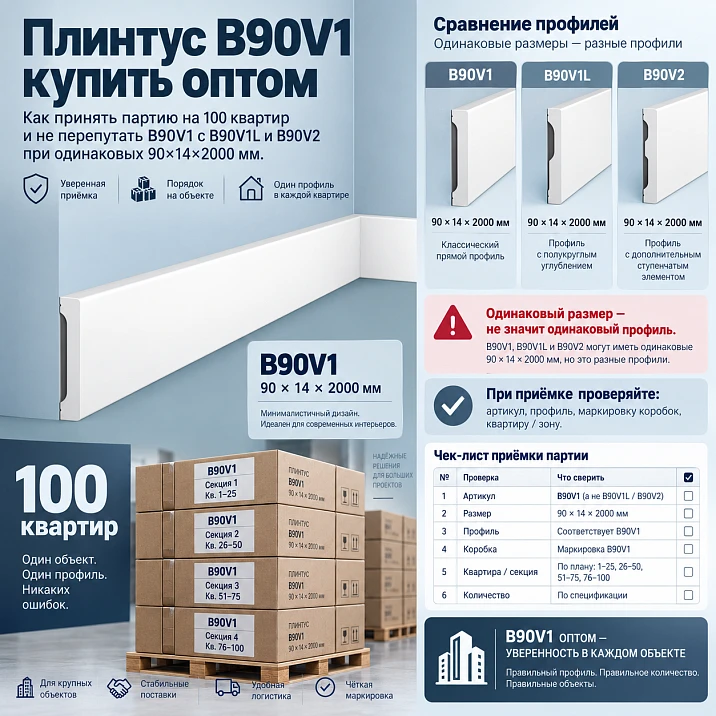
When purchasing HI WOOD B90V1 skirting in bulk, the size alone does not allow reliable identification of the product. In the current range, B90V1, B90V1L, and B90V2 exist side by side, and all three models share the same nominal size — 90×14×2000 mm. If procurement, the supplier, or the warehouse only check height, thickness, and length, a mix-up can pass through the entire chain unnoticed.
That is why a request such as “polystyrene skirting 90×14×2000 mm — 600 pcs.” is insufficient for a 100-apartment project. All three neighboring models formally pass such a check. The exact article number B90V1 is required, and at acceptance, the actual profile must also be compared against the reference relief or drawing. The size confirms the product class, but not the unique model.
For a large batch, the correct control system is built as follows: B90V1 card → master position → request → quotation → invoice → shipment → size acceptance → article and relief control → separate warehouse bin → issue → balances → reserve → reorder specifically B90V1.
If you need to buy B90V1 skirting in bulk for a residential complex, hotel, or another serial project, the main task is not to let the right quantity turn into the wrong model. Even a perfect calculation in pieces will not save the project if part of the batch turns out to be B90V1L or B90V2.

Why size 90×14×2000 mm is not enough
Let us imagine a 100-apartment project. B90V1 is approved by the design. The estimator calculated the requirement and passed the following line to procurement:
Polystyrene skirting 90×14×2000 mm — 600 pcs.
At first glance, the entry seems accurate. Material, height, thickness, length, and quantity are specified. But it lacks the most important thing — the model. The supplier may select a different item with the same dimensions. During receiving, the warehouse will measure the profile with a tape measure and will not notice any discrepancy. The installer will discover the difference by the front geometry on the wall.
For B90V1, this is not a theoretical risk. In one product line, B90V1, B90V1L, and B90V2 are simultaneously present with identical 90×14×2000 mm dimensions. Therefore, dimensional control here is inherently incomplete.




What exactly B90V1 represents
The procurement specification records a specific product item:
| Field | Value |
|---|---|
| Manufacturer | HI WOOD |
| Article number | B90V1 |
| Product type | Floor skirting board |
| Material | Polystyrene |
| Size | 90×14×2000 mm |
| Control feature | decorative profile/relief of a specific model |
| Finishing | For subsequent painting |
Product card: B90V1 skirting board on STAVROS.
This data must accompany the item until the end of the project. Price, quantity, and delivery queue may change. The article number and geometry must not change without a separate agreed decision.
Our factory also produces:






Which models have the exact same dimensions
| Model | Nominal size | Status |
|---|---|---|
| B90V1 | 90×14×2000 mm | target item |
| B90V1L | 90×14×2000 mm | different SKU |
| B90V2 | 90×14×2000 mm | different SKU |
| B90 | 90×15×2000 mm | different SKU, also differs in size |
The first three rows are the most important case. The height matches. The thickness matches. The length matches. Therefore, a simple check of "90×14×2000" cannot determine which exact model is in the pack.
Get Consultation
Why measuring with a tape measure will not reveal the error
An installer or warehouse worker may diligently check the received plank:
- height — 90 mm;
- thickness — 14 mm;
- length — 2000 mm.
All three values matched. But this is not enough, because the neighboring B90V1L and B90V2 pass the same test. The error lies not in the nominal size, but in the actual profile.
Therefore, a tape measure works here only as the first level of acceptance. It filters out an obviously different size, but does not identify the SKU.
Size is a characteristic, not a unique identifier
For B90V1, reliable identification is built on a combination of:
item code + packaging marking + end cross-section + face relief + nominal size.
If only the size is left, we get a group of products. If only the item code on paper is left, but the actual profile is not checked, a mixed-up item can be accepted. Both documentary and physical control are needed.
Creating a B90V1 reference before a large delivery
Before the first large shipment, it is useful to assemble a reference kit. It includes:
- the current B90V1 product card;
- a drawing, if it is used in the project;
- close-up photo of the end cross-section;
- close-up photo of the front relief;
- one labeled control sample strip or a short sample.
The reference sample is needed not instead of documents, but as a physical point of comparison. It is especially useful on sites where several white HI WOOD polystyrene skirting boards are used simultaneously.
Why a photo of the entire two-meter strip is of little use
In a general photo, white profiles can look almost identical. Perspective hides the depth of the relief, and the white surface reduces visual differences. Therefore, for acceptance, close-up images of the end and characteristic areas of the front profile are much more useful.
A photo of the entire strip works as a general reference, but it should not be the main proof of the model.
What the purchasing line should look like
Bad:
Skirting board 90×14 — 600 pcs.
Better:
HI WOOD B90V1 / polystyrene / 90×14×2000 mm / 600 pcs.
If the batch is split into queues, the quantity is specified for each. For example, 240 + 220 + 140. But the base product name is not abbreviated.
Why the word B90 is also insufficient
B90 and B90V1 are different product designations. The catalog contains B90 90×15×2000 mm. If the accounting system or an employee truncates the V1 suffix and leaves only B90, a different item is created.
This is especially dangerous in ERP, where SKUs are automatically truncated by field length. Before mass-loading the nomenclature, you need to verify that the system preserves the full code B90V1.
The danger of automatic SKU truncation in the accounting system
A system error is worse than a one-off error because it repeats automatically. If a software field stores only the first three characters after B90 or removes suffixes, B90V1, B90V1L, and B90V2 may turn into a single depersonalized item.
Before importing the nomenclature, you should check how the system handles alphanumeric SKUs. If the limit cannot be changed, you need to add a separate field with the full manufacturer code.
Why B90V1L cannot be recorded as B90V1
Even with identical dimensions, this is a separate SKU. There is no need to invent a meaning for the letter L if the manufacturer does not explicitly explain it. For purchasing, it is enough to record the fact: B90V1L is a different card, and it should not automatically be considered B90V1.
Identical size does not give the right to merge items.
B90V2 is also not a default replacement
The same logic applies to B90V2. The size matches, but it is a separate model. If a supplier offers B90V2 instead of B90V1, this is not "the same product under a different name," but a replacement requiring separate approval.
How to work with a specification for 100 apartments
For a project, it is better to create a single master item B90V1 and reference all apartment types to it. Then the SKU is not retyped manually across a hundred rows.
Example:
| Item code | Master item | Apartment type | Number of apartments | Planks per type |
|---|---|---|---|---|
| PL-B90V1 | HI WOOD B90V1 90×14×2000 | A | 30 | By cutting |
| PL-B90V1 | HI WOOD B90V1 90×14×2000 | A-R | 30 | By cutting |
| PL-B90V1 | HI WOOD B90V1 90×14×2000 | B | 25 | By cutting |
| PL-B90V1 | HI WOOD B90V1 90×14×2000 | non-standard | 15 | By cutting |
This way, one product card controls the entire project.
Why you should not copy the name manually across 100 rows
Manual copying creates a risk of minor discrepancies: B90V1, B90V1L, B90V2, B90. Visually, these strings look similar, and an error easily passes review.
It is better to use a single reference item and a separate quantity field. Changes to master data are then automatically reflected across all apartment types.
Apartment types and quantity of B90V1
The quantity is calculated by layout types: A, A-mirrored, B, C, non-standard, and others. For each, physical lengths, a cutting map for two-meter strips, and a reserve are determined.
However, the quantity calculation in this article is auxiliary. Even a perfectly calculated 600 strips will be of no use if part of the delivery turns out to be a different SKU.
First determine the quantity, then verify the SKU
These tasks should not be set against each other. First, a correct quantity calculation is needed. Then this quantity is tied to the exact B90V1. After that, at every stage it is verified that the number refers specifically to B90V1, and not to the group “90 mm skirting boards.”
How to request a commercial quote
The request to the supplier specifies:
HI WOOD B90V1 / polystyrene / 90×14×2000 mm / quantity ___ pcs.
And a separate request:
Please confirm the exact model B90V1 in the commercial offer and shipping documents.
If substitutions are not allowed without approval, this should also be stated explicitly.
If the supplier writes only "skirting board HI WOOD 90×14"
Such an offer is better returned for clarification. It describes the size and manufacturer, but not the model. There are several 90×14×2000 mm items in the line, so the line remains ambiguous.
It is easy for the supplier to add the full item code, and the customer gets a reliable basis for invoicing and acceptance.
If the supplier offers B90V1L at the same price
Price does not make products identical. Even if B90V1L costs the same and is available faster, it is a separate model. The decision on substitution is made by the responsible project participant after comparing the actual profile.
Procurement should not consider a substitution automatically acceptable just because the cost and dimensions match.
If the supplier offers B90V2
The procedure is the same: the product card, the actual geometry, design approval, and then — if necessary — a specification change. Until that happens, B90V2 remains a different SKU.
Why a commercial proposal must be checked line by line
With a large purchase, it is easy to look only at the total amount. But the cheapest offer is useless if it does not quote B90V1. Therefore, product compliance is checked first, then price and lead time.
Minimum control fields:
- HI WOOD;
- B90V1;
- 90×14×2000 mm;
- polystyrene;
- quantity.
If one field is missing, it is requested.
The invoice must retain the full article number
The V1 suffix is especially important. The line “B90 — 600 pcs.” already describes a different model. Before payment, you need to make sure that the invoice or its annex unambiguously refers to B90V1.
If the supplier’s accounting system shortens the name, the exact article number can be fixed in the specification to the invoice.
Acceptance of a wholesale batch B90V1
Acceptance begins with documents, but does not end with them. First, the name, article number, size, quantity, and supply batch are verified. Then, part of the items is physically checked against the reference model B90V1.
For a large shipment, it is useful to divide control into levels. The first level answers the question: does the size match. The second — is the correct article number indicated. The third — do the actual relief and profile match the reference B90V1.
This order is faster than trying to immediately evaluate the decorative pattern of each plank, and at the same time more reliable than a simple tape measure check.
Why size measurement is only the first level of acceptance
The first test looks simple: 90 mm, 14 mm, 2000 mm. If at least one value does not match, the goods already require separate inspection. But if all three match, acceptance is not finished.
Next, B90V1 is checked as a model. For this, packaging markings, the card, the drawing, and the reference profile are used. Only their combination makes it possible to distinguish B90V1 from B90V1L and B90V2.
Creating a sampling inspection procedure
There is no need to invent a universal statistical standard for any shipment. A project can establish its own quality system. It is practical to check the first package, several packages from different parts of the batch, and each separate supply queue. If a discrepancy is found, the scope of inspection is expanded.
The main thing is to make control reproducible. It should be clear which packages have already been checked and by what criteria.
Why checking only one pack may be insufficient
If a large batch was assembled from several warehouse lots, the error may not be in the first pack, but in the middle of the shipment. Therefore, sampling from different places in the batch is more reliable than checking one convenient box at the edge of the pallet.
This is especially important for phased delivery. Each new shipment must undergo its own inspection, even if the first one was perfect.
How to label accepted B90V1
After acceptance, internal labeling may look like this:
B90V1 / object ___ / building ___ / floor ___ / batch ___
Do not use the label “90 mm skirting board.” It does not protect against mix-ups within the family.
Storage bins for B90V1, B90V1L, and B90V2 must be separate
If a project for any reason uses several adjacent models, they must not be stored in the same bin. Identical dimensions make mix-ups especially likely. Separate bins, or at least clearly marked sections with large labeling, reduce the risk.
At the same time, the warehouse system should not combine them under the group “skirting board 90×14.” Such a group is suitable for analytics, but not for physical placement.
Opened packages are especially dangerous
While the pack is closed, the factory labeling helps identify the product. After opening, a single plank may be left without a code. If similar models are nearby, it becomes harder to restore its belonging after a few days.
That is why the remains of opened packages are labeled immediately. Not later, not “when there is time,” but at the moment when factory identification ceases to be obvious.
How to label one remaining plank
Simple option:
HI WOOD B90V1 / 90×14×2000
If the plank is already assigned to a specific area, you can add an object code. There is no need to transfer the entire warehouse history onto it, but the SKU must be visible.
How to label a useful offcut
For a short remnant:
B90V1 / 780 mm
Or:
B90V1 / 1250 mm / body 2
The label “white skirting / 780” is useless. It does not answer which SKU is in front of us.
Why can't the B90V1L stock be recorded as B90V1 stock
Even if the length is the same and the cross-section matches in dimensions, it is a different profile. Remaining stock is also tracked by SKU. Otherwise, on the day of reordering, the system will show "18 meters of B90V1 available," even though part of those meters physically belongs to B90V1L.
The reserve must be exactly B90V1
Reserve line:
B90V1 / full reserve / ___ pcs.
Not:
reserve of 90 mm polystyrene skirting board
A reserve is needed to replace a specific installed item. A neighboring texture does not solve the problem just because it matches in height.
How to separate working demand and reserve
| Status | Quantity | Purpose |
|---|---|---|
| Working demand B90V1 | ___ pcs. | for approved installation |
| Full reserve B90V1 | ___ pcs. | for replacement and unforeseen cases |
| Usable leftovers B90V1 | As per actual | short future parts |
| Total for the order | ___ pcs. | working requirement + full reserve |
This structure helps to understand how much material is required directly for the project and how much is kept as a safety stock.
Why a total reserve across all skirting boards on the project is harmful
If the report says “skirting board reserve — 50 pcs.” but does not specify the models, this figure is of little use. For B90V1, you need exactly B90V1. Having another 90-millimeter profile does not cover the risk.
Issue to installers
The issue document retains the exact SKU:
B90V1 — 24 pcs. / body 1 / floor 5
If there is a work instruction, a photo of the reference texture can be added to it. This gives the installer a simple way to spot a mix-up before installation.
What to do if the installer finds a different texture in the pack
Use of this pack is stopped. You must not try to hide the wrong profile behind furniture or in an inconspicuous area. That approach only moves the problem further along.
First, the pack is isolated, then the neighboring packs, the warehouse bin, and the documents are checked. You need to determine whether this is a local error or a systemic mix-up.
How to localize a mix-up
Checked:
- pack number;
- number or code of the supply batch;
- warehouse bin;
- neighboring packs;
- internal transfers;
- already issued material;
- remnants of opened packages.
The goal is not just to replace one incorrect plank, but to understand exactly where the mixing of models occurred.
Why it is better to detect a mix-up before painting
Before finishing, markings and texture are usually easier to compare with the reference. After overall painting, color stops helping altogether, and the difference may only become apparent in the decorative line on the wall.
Therefore, SKU control is performed before installation and finishing, not after.
Re-order B90V1
Bad:
Another 20 skirting boards 90×14.
Correct:
HI WOOD B90V1 / polystyrene / 90×14×2000 mm / 20 pcs.
If available, the old order or batch number is provided.
Reordering after a few months
After a few months, the context is lost. That is why the old product line, product card, and, if necessary, the old invoice are attached to the reorder. But even then, the current product card is opened and the specifications are verified.
You cannot rely solely on old correspondence. The catalog and availability may have changed.
If B90V1 is temporarily unavailable
Procurement should not automatically substitute B90V1L or B90V2. Identical 90×14×2000 mm dimensions make such a decision especially tempting, but these are still different models.
If the delivery time for B90V1 is unacceptable, a separate replacement approval process is initiated.
When a replacement is actually permissible
A replacement becomes permissible only after responsible confirmation by the project. Appearance, profile, fit with adjacent elements, finish, and transition to already installed material are checked.
The article does not claim that B90V1L or B90V2 are worse. They simply are not B90V1 automatically.
What to do if part of the project has already been installed with B90V1
In such a situation, replacement becomes even more sensitive. Even a slight difference in texture can create a visual break at the boundary between sections or between identical rooms on different floors.
Therefore, for a partially completed project, the new model is compared not only with the catalog but also with the already installed B90V1.
The first batch becomes the reference
After successful acceptance of the first batch, it is useful to keep:
- a short sample;
- a photo of the end cross-section;
- a photo of the front texture;
- documents;
- exact article number;
- the delivery number.
This set helps verify subsequent batches and additional orders.
B90V1 cannot be identified by price alone
Price is a variable parameter and is not an identifier. Adjacent models may fall within a similar price range or even match in cost at a given moment.
Therefore, the rule "same price means same product" is unacceptable.
Cannot be identified by size alone
This is the central conclusion of the entire article: B90V1, B90V1L, and B90V2 all share the same 90×14×2000 mm dimensions. Here, size only confirms the nominal format.
Cannot be identified by color alone
A white base surface also does not help reliably distinguish models. The profiles are intended for subsequent painting, and visual color similarity does not in any way confirm the SKU.
Reliable identification of B90V1
Working formula:
B90V1 → current product page → drawing → actual profile → packaging marking → reference sample.
The more elements of the chain that match, the lower the risk of mistaking an adjacent model.
How to send a work order to a supplier
Wording:
A skirting board HI WOOD B90V1 90×14×2000 mm, polystyrene, quantity ___ pcs is required. Please confirm the exact designation B90V1 in the commercial offer and shipping documents. Substitution with B90V1L, B90V2, or any other profile without approval is not permitted.
Such a line removes most of the ambiguity even before receiving the quotation.
How to manage changes in the project
If the designer deliberately changes B90V1 to another profile, the old line should not be silently rewritten. A new version of the specification is created, showing from which point the new SKU is in effect.
This is important for a project with 100 apartments: some may already have been purchased or installed according to the old version.
How to work with the master item and versions
For example:
PL-B90V1-v1 — original item.
PL-B90V1-v2 — only the quantity changed.
If B90V2 is approved instead of B90V1, this is already a new master item, not just v3 of the old one. This way the project history remains clear.
Why the correct quantity does not compensate for the wrong SKU
Procurement can perfectly calculate 600 planks, receive 600 planks, and close the invoice without discrepancies. But if 40 of them are B90V2, the delivery looks complete in terms of quantity, while in fact the project is not fully equipped.
Therefore, quantity and identity are two independent controls.
How to calculate B90V1 by apartment types
For each layout, a clean skirting route is formed, then a cutting map for 2000 mm planks. After that, the results are scaled to the number of apartments of this type.
For example, type A requires 5 planks per apartment after cutting, and there are 30 such apartments. That is 150 planks. Type A-R also requires 5 planks, another 150. Type B — 6 planks for 25 apartments, 150. Non-standard — the rest. This example is only for the method: the actual numbers are taken from the project.
After summing, a separate whole reserve of B90V1 is added.
Why total linear meters do not replace the quantity of two-meter planks
Even with simple skirting, the total linear meters are only the lower theoretical boundary. If the sections combine poorly within 2000 mm, the actual number of whole planks will be higher.
But in this article, cutting calculation is secondary. After it is completed, it is important to keep the result specifically for B90V1.
How to account for usable leftovers between apartments
If a piece of B90V1 remains after one apartment and fits a short section of the next, it can be used. To do this, the remainder is labeled with the article number and length.
If it has lost its identification, including it in the calculation as B90V1 is risky.
Why one box of offcuts is not a reserve
The total length says nothing about suitability. Five pieces of 400 mm will not replace one part of 1600 mm. And if some of the offcuts are B90V1L, they do not belong to the B90V1 reserve at all.
Therefore, whole planks and usable offcuts are accounted for separately.
How to maintain the B90V1 object balance
| Status | Quantity | Comment |
|---|---|---|
| B90V1 ordered | ___ pcs. | according to the approved specification |
| B90V1 received | ___ pcs. | after acceptance |
| ISSUED | ___ pcs. | by floors/apartments |
| Full reserve | ___ pcs. | separate status |
| Useful leftovers | ___ | with code B90V1 |
| For additional order | ___ pcs. | after recalculating future work |
How to prevent mixing in a shared wholesale purchase
Other skirting boards, moldings, and cornices may be purchased at the site along with B90V1. The shared delivery via wholesale building material suppliers or wholesale suppliers of building materials must not turn the product range into an impersonal list.
B90V1 remains a separate line. General anchors lead to the STAVROS main page, while the product link leads to the B90V1 card.
Why a polystyrene cluster is appropriate here
B90V1 is a polystyrene skirting board, so queries like polystyrene skirting board, polystyrene floor skirting board, and polystyrene skirting board for floors are thematically relevant to the product.
Wooden and MDF queries are not needed here: they describe a different material and a different user intent.
How to naturally use wholesale queries
The phrases skirting board wholesale, skirting board in bulk, buy skirting board wholesale, floor skirting board wholesale, and skirting board wholesale from the manufacturer are appropriate in the purchasing, supply, and request sections. They do not need to be repeated in every heading.
The main product intent remains the same — buy B90V1 wholesale.
When B90V1 does not need to be purchased as the entire batch at once
If some apartments are still being redesigned, the quantity has not been approved, or the supplier has not confirmed the exact B90V1, placing the entire order is premature. You can start with a trial batch, verify the delivery, and then scale up.
This is especially reasonable if the project is working with this product range for the first time and wants to establish a physical reference.
When a single large batch is rational
If the apartment types are approved, the quantity is calculated, B90V1 is confirmed by the supplier, storage space is available and the acceptance system is ready, a single wholesale order simplifies logistics. But even then, SKU control is maintained at every shipment.
How to split 600 planks into batches without losing the article number
For example:
| Queue | Quantity | Product line |
|---|---|---|
| 1 | 240 pcs. | HI WOOD B90V1 90×14×2000 |
| 2 | 220 pcs. | HI WOOD B90V1 90×14×2000 |
| 3 | 140 pcs. | HI WOOD B90V1 90×14×2000 |
You cannot allow the first batch to be called B90V1 and the second simply “skirting board 90×14”. Each shipment must be self-contained.
Why a repeat delivery needs full control
The first batch could have been perfect, but that does not guarantee the second. The lot, staff, and assembly at the supplier’s warehouse could have changed. Therefore, each new batch again undergoes dimensional and model control.
How to handle the return of whole planks
A returned whole plank is accepted again as B90V1 only if its identity has not been lost. If there is no marking, the profile is compared with the reference before being included in the stock.
You cannot automatically record any white 90×14 back as B90V1.
What to do with a questionable leftover
If the SKU cannot be reliably identified, such a leftover should not reduce the reorder for B90V1. It is better to treat it as a separate unidentified item until it is identified.
Saving a few meters does not justify the risk of incorporating a different texture into a production finish.
How to check the warehouse before reordering
Before a new order, an inventory is taken specifically of B90V1: whole planks, marked usable leftovers, material in progress. B90V1L and B90V2 are not included in this figure.
After that, the actual requirement for future work is calculated and a reorder is formed.
Why proper labeling saves money
It reduces not only the risk of mixing up items. It reduces the number of unnecessary reorders. If B90V1 leftovers are accurately identified, they can be used in subsequent apartments. If everything is mixed in a box labeled "90 mm skirting", the purchaser is forced to order new whole planks, not trusting the warehouse.
What the final project specification should look like
| Field | Value |
|---|---|
| Manufacturer | HI WOOD |
| Article number | B90V1 |
| Material | Polystyrene |
| Size | 90×14×2000 mm |
| Object type | 100 apartments |
| Working requirement | ___ pcs. |
| Full reserve | ___ pcs. |
| Total | ___ pcs. |
| Reference | card + sample + relief photo |
| Substitution eligibility | only upon approval |
Main mistakes in wholesale purchasing of B90V1
Mistake 1. Ordering “skirting 90×14”. The size fits several models at once. Prevention — full B90V1.
Mistake 2. Treating the size as a unique identifier. B90V1, B90V1L, and B90V2 are identical in dimensions. Prevention — control of the SKU and relief.
Mistake 3. Shortening B90V1 to B90. This is already a different product designation. Prevention — check ERP and documents.
Mistake 4. Treating B90V1L as the same product. This is a separate SKU. Prevention — a separate card and substitution approval.
Mistake 5. Treating B90V2 as the same product. A matching size does not make the model identical.
Mistake 6. Checking only one pack from a large batch. Mixed-up items may be localized. Prevention — systematic sampling.
Mistake 7. Verifying only the invoice. Documents may be correct while the actual items are mixed up. Prevention — physical control against the reference sample.
Mistake 8. Storing B90V1, B90V1L, and B90V2 together. Once packages are opened, the risk increases sharply. Prevention — separate bins.
Mistake 9. Not labeling leftovers. After a few days, they cease to be a reliable reserve.
Mistake 10. Keeping a generic "90 mm skirting" reserve. It does not guarantee the availability of B90V1.
Mistake 11. Accepting a substitute because of the same price. Price does not identify an SKU.
Mistake 12. Accepting a substitute because of the same size. This is the central mistake of the entire topic.
Mistake 13. Placing a reorder for "20 more skirting boards." After months, the context is lost. The full B90V1 line is needed.
Mistake 14. Not keeping a reference sample from the first batch. Subsequent shipments are harder to compare.
Error 15. Mixing B90V1 with wooden or MDF requests. The product is polystyrene.
Central control table B90V1
| Check | B90V1 | Why one size is not enough |
|---|---|---|
| Article number | B90V1 | B90V1L/B90V2 are also 90×14 |
| Height | 90 мм | Matches |
| Thickness | 14 мм | Matches |
| Length | 2000 мм | Matches |
| Material | Polystyrene | does not make the model unique |
| Front profile | B90V1 reference | key physical control |
| Product card | B90V1 | Required |
| Packaging marking | B90V1 | Required |
Final check before payment
- the quotation specifies HI WOOD;
- it specifies exactly B90V1;
- size — 90×14×2000 mm;
- material — polystyrene;
- the quantity matches the request;
- no substitution with B90V1L/B90V2 has been made;
- the full article number is retained on the invoice;
- if necessary, the product card or specification is attached.
Buy B90V1 skirting in bulk after a three-level check
For B90V1, checking dimensions alone is not enough. This is a case where dimensional verification is powerless against mix-ups: B90V1, B90V1L, and B90V2 all have the same 90×14×2000 mm. That is why a batch for 100 apartments must pass three levels of control: size → article number → actual texture.
At the first level, 90×14×2000 mm is checked. At the second, the full designation B90V1 in the documents and on the packaging. At the third, the actual profile is checked against the reference card, drawing, and control sample.
Such a system is needed along the entire path. In a request to a supplier, you cannot write only “skirting board 90 mm.” In a commercial proposal, you cannot accept the depersonalized line HI WOOD 90×14. In an invoice, you cannot lose the suffix V1. In the warehouse, you cannot mix B90V1 with B90V1L and B90V2. Stock and reserve are also maintained specifically by B90V1.
If a supplier offers a neighboring model, a matching size or price does not make it an automatic replacement. First the project compares the actual profile, and only then, if necessary, changes the master specification.
This is how the request to buy skirting board B90V1 wholesale turns into a managed procurement task, where the exact quantity truly refers to the exact SKU. With a comprehensive supply through wholesale supplies of building materials, construction materials wholesale or wholesale purchase of building materials B90V1 remains a separate line within the overall order.
After the final check, you can order skirting board HI WOOD B90V1 in the calculated quantity and preserve the same product identity from the first box to the last reorder.
Practical case: 100 apartments, 600 planks and one unnoticed mix-up
Let’s imagine that after calculating all apartment types, the project requires 570 B90V1 planks for the main installation and another 30 whole planks in reserve. The final request is 600 pcs. Procurement sends the supplier the line “HI WOOD B90V1 90×14×2000 mm — 600 pcs.” The supplier confirms the order and ships three batches of 200 planks each.
The first batch passes acceptance perfectly. The size matches, the packaging is labeled B90V1, and the sampled profiles correspond to the reference. The second batch also raises no concerns. In the third delivery, 20 packages were assembled from a neighboring warehouse cell, and some of them turned out to contain B90V2. The dimensions are the same, the material is the same, the length is the same. If acceptance is limited to a tape measure and the total figure of "200 pcs.", the error makes it onto the site.
Then the mixed-up items are distributed across floors. In one apartment, the installer notices a different texture but assumes it is a visual difference between batches. In another, the profile goes behind the furniture. In several more apartments, it is painted before anyone notices. By the time it is officially discovered, the wrong SKU is already in different places on the site.
If, however, a three-level scheme works on every delivery — size, article number, actual profile — the error is localized at acceptance. The wrong packs remain in the warehouse, do not mix with B90V1, and do not reach installation.
This example shows why even a completely correct order does not complete control. Product identity must be preserved until the final issue.
How to organize batch acceptance by lots rather than as one common mass
For a large order, it is useful to know which lots or shipment groups the delivery is made up of. If the supplier ships 600 planks in three vehicles, each vehicle becomes a separate control point. If one vehicle contains several packaging batches, they also do not necessarily have to be mixed immediately after unloading.
Simplest scheme:
| Delivery | Quantity | Document | Size checked | Article number checked | Profile checked |
|---|---|---|---|---|---|
| №1 | 200 pcs. | delivery note ___ | Yes | Yes | Yes |
| №2 | 200 pcs. | delivery note ___ | Yes | Yes | Yes |
| №3 | 200 pcs. | delivery note ___ | Yes | Yes | Yes |
If a discrepancy is found in the third delivery, there is no need to automatically block the first two. The error is localized to a specific lot. This reduces the scope of re-inspection.
At the same time, the article does not set a mandatory statistical sampling percentage. It is determined by the facility's quality system. But the principle remains: inspection should cover different parts of the batch, not just one
How to reconcile the project, request, quotation, and invoice
Before paying for a large batch, a simple four-way check is useful. Four documents are taken: the project master specification, the procurement request, the commercial quotation, and the invoice. The main fields are compared line by line.
| Field | Project | Request | Quotation | Invoice |
|---|---|---|---|---|
| Manufacturer | HI WOOD | HI WOOD | HI WOOD | HI WOOD |
| Article number | B90V1 | B90V1 | B90V1 | B90V1 |
| Size | 90×14×2000 | 90×14×2000 | 90×14×2000 | 90×14×2000 |
| Material | Polystyrene | Polystyrene | confirmed | Per specification |
| Quantity | 600 | 600 | 600 | 600 |
If B90V1L or B90V2 appears in any document, it is visible before payment. If the item code disappears, the line needs to be clarified rather than assuming the context is clear.
Why a commercial proposal cannot be considered correct based on matching price alone
Imagine that a supplier quoted exactly the price the buyer expected for B90V1. This psychologically lowers vigilance: it seems like the same product. But the supplier could have calculated B90V1L at a similar cost or offered B90V2 as a "full equivalent."
Price is a variable. The SKU is an identifier. Comparison always starts with the identifier.
How to handle the phrase "or equivalent" in tender documentation
If the tender allows equivalents, the procedure for approving them must be defined in advance. Otherwise, the supplier reasonably assumes they can offer any 90×14×2000 mm item of similar purpose.
For B90V1, the condition can be formulated as follows: equivalents are considered separately and are not automatically deemed equivalent; confirmation of geometry, face profile, and compatibility with the approved finish is required.
If equivalents are not allowed, it is better to state this directly in the request. Then comparison of commercial proposals becomes simpler and fairer.
What to do if the project itself changes B90V1 to B90V1L
In that case, it is no longer a mispick but a project change. A new version of the specification must be created and it must state from which cabinet, floor, or date B90V1L applies. Old B90V1 deliveries remain in history as correct for their version of the project.
The most dangerous situation is when the replacement was made verbally but the documents remained old. Then the warehouse receives B90V1L, the installer expects B90V1, and the buyer is sure the change has been approved.
Any conscious SKU change must become visible in the master ledger.
How to split an object if part is already installed as B90V1 and part is being switched to another profile
A clear boundary must be drawn. For example, cases 1–2 remain on B90V1, while case 3 switches to B90V2 from a certain date. This is recorded separately in warehouse and installation documents.
You cannot keep a single shared balance for “skirting 90×14.” Each part of the project has its own SKU and its own reserve. Otherwise, leftovers of the old model will start accidentally going into the new queue.
How to calculate the balance after a model change
If the project has officially abandoned B90V1 for future sections, the remaining intact B90V1 planks do not become B90V2. They remain a separate warehouse balance. The project then decides where they can be used, kept in reserve, or returned.
The same applies to offcuts. They cannot be included in the new model’s reserve just because they are also 90×14.
How not to lose B90V1 after painting
If the planks are painted before installation or part of the material has already been finished, labeling becomes even more important. Color no longer helps distinguish the products, and the factory packaging may have been removed.
Therefore, the internal code B90V1 is retained on the transport packaging, rack, or tag until installation. There is no need to apply marking to the visible surface of the product; reliable logistics identification is sufficient.
What to do if the factory packaging is damaged
If the pack tears during unloading, do not move the planks to the common area. First, they are assigned a temporary internal label B90V1, then placed in a separate cell or new packaging.
It is precisely in such everyday moments that the SKU is most often lost.
Why a warehouse code should be shorter but not less meaningful
A long string is convenient in a specification, but in the warehouse a short code can be used, for example HW-B90V1. The main thing is that it unambiguously leads to the full product record.
It must not be shortened to B90, because that is already a different SKU and at the same time too broad a group.
How to handle a return from an apartment if the tag is lost
Such a plank must not automatically return to cell B90V1. First it is compared with the reference sample. If the model is confirmed, the new internal label is restored. If not, the material is stored separately for the time being.
This may seem excessive for a single strip, but on a project with 100 apartments, dozens of such small returns can gradually clutter the warehouse.
How to use B90V1 in a bin location system
If the warehouse uses locations, a bin may have its own code, for example A-03-12. But in the system, the location is linked specifically to B90V1. You cannot rely on memory that "the 90 mm skirting board is on the third rack."
When moved between bins, the location changes, but not the product record.
How to prepare the installation crew before the first issue
Before starting a series, a short briefing is enough: show B90V1 and the neighboring B90V1L/B90V2 in photos, explain that the size is the same and that if in doubt, the code and texture should be checked.
This way, the installer becomes an additional checkpoint. They do not replace warehouse receiving, but they can stop an accidental error before installation.
How to record a detected mix-up without accusations or guesswork
In a message or report, it is better to write the facts:
According to the bill of materials, B90V1 is required. In the package marked ___, a profile was found that visually does not match the B90V1 reference. The size 90×14×2000 mm matches. Use has been stopped until identification.
This wording is more precise than "the supplier mixed up the goods" until the inspection is completed.
How to determine the scale of the error after discovering one incorrect plank
First, the entire package is checked, then neighboring packages from the same lot. Next — the material already issued from this delivery. If the incorrect profile is found in only one pack, the problem area is limited. If in several — control is expanded.
Systematic lot marking allows you to quickly find all related items.
Why 100 apartments require master specification version control
On a project of this scale, data changes. Quantities may be adjusted, apartment types may be clarified, deliveries may be postponed. Therefore, the master position B90V1 must have a current version.
For example, v1 — the initial 620 planks, v2 — after optimization 600, v3 — after changing reserves 590. The product remains B90V1, only the quantity changes. The old version is stored in history but is not used for new orders.
When a change requires a new version, and when a new SKU
Quantity, queue, project code, and delivery date change the document version. Switching from B90V1 to B90V2 changes the product itself and should create a new master position.
This distinction protects against a situation where another profile hides inside the “new version B90V1.”
How to prepare the final reorder based on the leftovers from 100 apartments
When the main installation is complete, a list of unfinished pieces is first compiled based on actual lengths. Then whole B90V1 planks and marked usable leftovers are checked. Only the shortage is converted into new whole two-meter items.
This way, the reorder may turn out to be less than the simple sum of linear meters. Or more, if the remaining pieces are long and combine poorly.
But regardless of the quantity, the product line remains the same: HI WOOD B90V1 / 90×14×2000 mm.
Why the final reorder is especially dangerous for mix-ups
At the final stage, people often order little — 5, 10, 20 planks. Procurement tries to speed up the process and writes “skirting 90×14.” The supplier offers what is available. This is exactly where B90V1 is easily replaced by a neighboring model.
Therefore, a small reorder must be no less precise than the first batch.
When it is not advisable to buy B90V1
If the project has not yet approved a specific texture and is choosing between B90V1, B90V1L, and B90V2, buying B90V1 just because it was the first one available is premature. A design decision is needed first.
It also makes no sense to buy a large reserve if the project is at the final stage, exact remaining quantities are known, and a quick reorder is possible. The reserve should address a real risk, not be a mechanical percentage.
Why the identical size makes this article separate from a usual skirting board comparison
Here the task is not to choose which of the three profiles is more attractive. The project has already chosen B90V1. The task is not to lose this choice during a large-scale purchase, when standard size checks do not work.
That is why procedures become central: the exact line, the reference sample, selective acceptance, separate storage, marking of leftovers, and precise reordering.
Extended control route from the first request to the last apartment
For a project with 100 apartments, it is useful not to treat acceptance as the only control point. An error may occur earlier — in the request, quotation, or invoice — or later, when the packaging is opened and leftovers are moved between floors. That is why B90V1 passes through several control gates.
The first is the master specification. Here it is checked that the project has actually approved B90V1, not an abstract “90 mm skirting board.” The second is the procurement request, where the full article number is preserved. The third is the quotation, in which the supplier must confirm specifically B90V1. The fourth is the invoice and specification. The fifth is physical acceptance. The sixth is warehouse storage. The seventh is issuance. The eighth is reordering.
If the same identifier is checked at every stage, the chance of hidden substitution drops sharply. The system becomes stronger not through complex bureaucracy, but through the repeatability of one simple rule.
How to conduct a short site audit after the first ten apartments
After the first ten apartments are installed, it is useful to carry out an interim reconciliation. It is not necessary to wait for the building to be completed. The profiles actually installed, the stock remaining in the warehouse, the correspondence of issued materials to documents, and the presence of marking on opened packs are checked.
If all ten apartments use B90V1 and the warehouse balance matches, the system is working. If a single B90V2 is found, its origin must be identified before continuing mass installation. The earlier a systemic error is detected, the smaller the rework area.
Such an interim audit is especially useful when the first batch becomes the reference for the next 90 apartments.
How to work with photos in the work chat without losing accuracy
On a construction site, employees often send a photo and ask: "Is this the right skirting board?" A photo can help, but the answer should be tied to a code. For example: "Check the packaging label B90V1 and compare the end with the reference." Do not confirm a SKU based only on a general shot from a distance.
If a photo is used to document a mix-up, it is useful to photograph the packaging tag and a close-up of the profile alongside it. Then the photo retains context and is suitable for later review.
How to submit an internal warehouse request to procurement
An internal replenishment request must be as precise as an external reorder. For example:
B90V1 stock: 7 full planks. Future requirement: 22 full planks. Need to reorder HI WOOD B90V1 90×14×2000 mm — 15 pcs.
Such an entry immediately shows why 15 are needed, not 20 or 30. It also leaves procurement no freedom to pick "any 90×14".
Final working memo for the buyer and warehouse
If the entire article is condensed into a working checklist, the following order emerges:
- The project specifies HI WOOD B90V1, polystyrene, 90×14×2000 mm.
- The quantity is calculated based on actual apartment types and cutting layouts.
- The supplier request includes the full article number B90V1.
- Any B90V1L or B90V2 is considered a different model, even if the size matches.
- The quotation and invoice are verified line by line.
- Acceptance includes size, article number, and actual texture.
- The first confirmed batch forms the physical reference sample.
- B90V1 is stored separately from neighboring models.
- Opened packages and leftovers receive internal labeling.
- The entire reserve is maintained specifically for B90V1.
- If a different texture is detected, use of the batch is stopped.
- A reorder is always placed as HI WOOD B90V1 / 90×14×2000 mm.
This scheme makes the size 90×14×2000 mm a useful characteristic, but does not allow it to become the sole identification criterion. This is precisely the correct logic for wholesale purchasing of B90V1.
Why B90V1 control is especially important on a typical project
A typical project creates an illusion of simplicity: identical apartments, repeating perimeters, one approved skirting board. But it is precisely the repetition that makes a mistake costly. If one wrong model ends up in one apartment, it is a local problem. If the wrong line ends up in the master specification or a warehouse bin, the same mix-up can be repeated dozens of times.
Therefore, SKU control is more important here than constant manual re-measurement. Once B90V1 is confirmed as 90×14×2000 mm, re-measuring each plank does not solve the main task — it still does not distinguish B90V1L from B90V2. It is far more useful to maintain an intact identification chain: the exact SKU in documents, separate storage, a texture reference sample, marking of opened packs, and an accurate reorder.
As a result, a typical series becomes truly manageable. The purchaser understands what they are ordering. The warehouse understands what it is receiving and where it is stored. The installer understands which model they should see in the pack. The designer understands when an agreed change has occurred and when a mix-up has arisen. This is the level of control needed for a B90V1 batch for 100 apartments.
Control formula before the final order
Before paying for the entire batch, it is useful to run a final check not against individual documents, but against the chain as a whole. The project must specify B90V1. The request must specify B90V1. The quotation must calculate B90V1. The invoice must retain B90V1. The acceptance instruction must contain the B90V1 reference sample. The warehouse bin must be labeled B90V1. The reserve and reorder must also remain B90V1.
If even one link shows only "90×14", "90 mm", "HI WOOD 90", or "polystyrene skirting board" instead of the article number, the chain becomes weaker. This does not yet mean an error, but it requires returning to the master specification and restoring the exact SKU.
For this product, it is enough to remember one formula: matching 90×14×2000 mm confirms the size, but only B90V1 together with the reference profile confirms the model. On a batch for 100 apartments, it is precisely this rule that separates ordinary dimensional acceptance from real mispick control.