Article Contents:
- Four sizes of paired overlays: main comparison
- What are left and right molding overlays
- Why compatible profile is more important than similar size
- When to choose compact pair NPU-438.1L/R
- When to choose universal pair NPU-437.1L/R
- When to choose the expressive pair NPU-436.1L/R
- When to choose the large pair NPU-435.1L/R
- Polyurethane or primed MDF molding
- Why the central element NPU-434.1 is needed
- How to match the overlay size to the facade width
- Distance between the left and right elements
- How to make symmetrical markings
- Which side to turn the overlays
- Paired decor for a small furniture door
- Paired overlays for a dresser and nightstand
- Overlays for cabinet and wardrobe
- Large decor for tall door
- Molding frame decor on wall
- Paired elements for boiserie
- Decor for kitchen facade
- Paired decor for bedroom and wardrobe
- Commercial interior: salon, hotel, restaurant
- Can I use only one overlay
- How paired overlays differ from ready-made corner elements
- How to combine paired decor with frame corners
- When a straight molding without paired decor is needed
- How to calculate the number of pairs
- Purchasing L and R in separate cards
- Polyurethane overlays and paintable system
- Paint before or after installation
- How to choose glue for polyurethane decor
- Foundation Preparation
- Dry layout before installation
- How to join an overlay with a molding
- Installation on a finished painted door
- Installation on MDF furniture
- Use in a damp room
- How to care for relief decor
- How not to overload a facade
- How to combine decor with handles and fittings
- How to choose decor for classic and modern interiors
- Practical selection by four scales
- How not to confuse compatible moldings
- Mistakes when buying
- Who is NPU-438.1 suitable for
- Who is NPU-437.1 suitable for
- Who is NPU-436.1 suitable for
- Who is NPU-435.1 suitable for
- When it's better to choose a different system
- Practical selection for specific tasks
- How to assemble a kit without errors
- What to buy together with paired overlays
- How to buy paired overlays for STAVROS
- Why a ready-made compatible system is better than random stucco
- How to conduct a test purchase
- Acceptance of the finished composition
- Table of 'what to buy together'
- Additional materials on molding compositions
- How to create a specification for a furniture maker or installer
- How to replace a damaged left or right part
- How to check color and texture after painting
- How to use different sizes in one interior
- Final cart check before ordering
- Why the size of a pair should be evaluated together with the straight section of molding
- FAQ: questions about NPU-438.1, NPU-437.1, NPU-436.1 and NPU-435.1
- Why are left and right overlays produced?
- Do I need to buy L and R together?
- Can I use only one overlay?
- How does NPU-438.1 differ from NPU-437.1?
- Which pair fits MLDPU-001?
- Which pads fit MLDPU-003?
- Can I install NPU-435.1 on MLD-003-MG?
- Which decor to choose for a small door?
- What to choose for a tall cabinet?
- Is the central NPU-434.1 needed?
- How to make a symmetrical layout?
- When to paint the decor?
- What to use to glue the polyurethane overlay?
- Can overlays be installed on a finished door?
- Are overlays suitable for MDF furniture?
- How many pairs are needed for a double-door wardrobe?
- Can the system be used in a humid room?
- How do paired overlays differ from decorative corner pieces?
- What should I check before ordering?
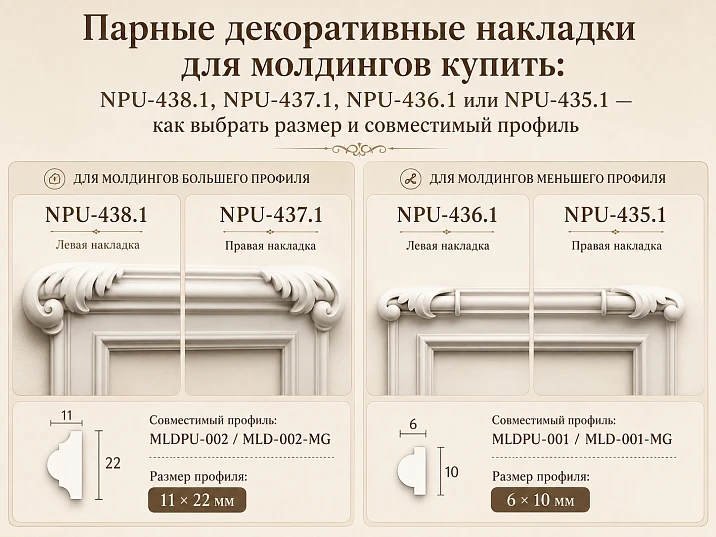
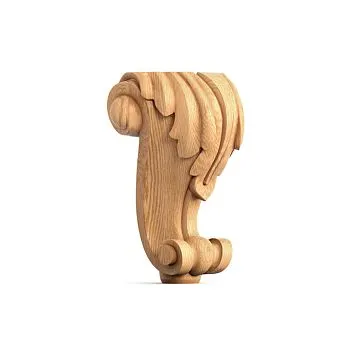
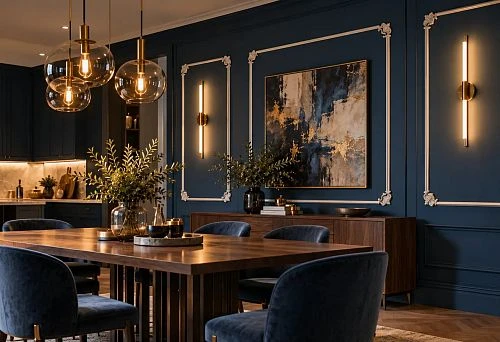
Paired decorative overlays for moldings are not purchased as a separate ornament, but as part of a ready-made symmetrical system. One piece is installed to the left of the center, and a mirrored piece to the right. A straight molding runs between them, setting the frame line, dividing the facade, or completing a decorative panel. A mistake in even one link is immediately noticeable: the left overlay is turned the wrong way, the large relief overloads a small door, and the chosen profile does not match the mounting geometry of the decor.
The STAVROS catalog features four pairs of different scales. NPU-438.1L/R, measuring 46 × 16 × 9 mm, are designed for a thin profile of 10 × 6 mm. NPU-437.1L/R, measuring 74 × 26 × 12 mm, connect with a molding of 15 × 8 mm. NPU-436.1L/R, measuring 85 × 34 × 16 mm, fit a profile of 22 × 11 mm. The largest series, NPU-435.1L/R, measuring 135 × 53 × 19 mm, works with a molding of 35 × 12 mm and is suitable for wide furniture facades, tall doors, and large wall panels.
Left and right versions are placed in separate product cards. Therefore, the word "pair" describes a compositional system but should not automatically be perceived as one package of two pieces. Before ordering, you need to check that both SKUs, L and R, are added to the cart. Simultaneously, select a compatible molding made of polyurethane MLDPU or primed MDF MLD-MG, calculate the length of the profile, determine the distance between the overlays, and choose mounting materials.
This article helps you navigate the entire route without accidental configuration: from the compact NPU-438.1 to the large NPU-435.1, from a furniture door to boiserie, from one mirror pair to an extended composition with the central overlay NPU-434.1. Below, we break down exact dimensions, factory compatibility, proportions, marking, painting, installation, and practical scenarios for furniture, doors, and walls.
Short answer. Choose NPU-438.1L/R for a thin molding of 10 × 6 mm and small frames. NPU-437.1L/R is a universal pair for a profile of 15 × 8 mm. NPU-436.1L/R is suitable for a more noticeable molding of 22 × 11 mm and classic facades of medium or large size. NPU-435.1L/R works with a profile of 35 × 12 mm and creates the largest decorative accent.
For a symmetrical composition, both pieces—left and right—are usually needed. Each side has a separate card. The molding is selected strictly according to confirmed compatibility: MLDPU-001 or MLD-001-MG, MLDPU-004 or MLD-004-MG, MLDPU-002 or MLD-002-MG, MLDPU-003 or MLD-003-MG.
NPU-438.1L NPU-438.1R NPU-437.1L NPU-437.1R NPU-436.1L NPU-436.1R NPU-435.1L NPU-435.1R View all decor for moldings
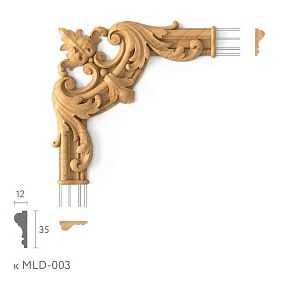
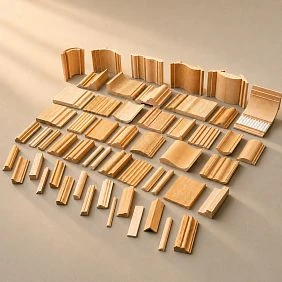
Four sizes of paired pads: main comparison
| Series | Size of one overlay | Compatible profile | Confirmed moldings | Main scenario |
|---|---|---|---|---|
| NPU-438.1L/R | 46 × 16 × 9 mm | 10 × 6 mm | MLDPU-001 or MLD-001-MG | Thin frame, small door, delicate finish |
| NPU-437.1L/R | 74 × 26 × 12 mm | 15 × 8 mm | MLDPU-004 or MLD-004-MG | Medium-sized facade, door, panel |
| NPU-436.1L/R | 85 × 34 × 16 mm | 22 × 11 mm | MLDPU-002 or MLD-002-MG | Expressive frame, classic panel, wall panel |
| NPU-435.1L/R | 135 × 53 × 19 mm | 35 × 12 mm | MLDPU-003 or MLD-003-MG | Wide facade, tall door, large boiserie |
The series number does not obviously show the size, so remembering article numbers without a table is inconvenient. It is safer to start from the molding. If the profile is already selected, the compatible pair is determined immediately. If you first liked the overlays, one of two confirmed profile options is selected for them: polyurethane MLDPU or primed MDF MLD-MG.




What are left and right molding overlays
Paired decor is based on a mirror pattern. The left part directs the ornament towards or away from the center on one side, the right part mirrors the same movement. Identical overlays instead of L and R will not create a symmetrical composition: the pattern will unfold in one direction.
The letters L and R refer to a specific product card. They help the installer not to confuse the sides, but the final position is checked during dry layout. The parts are placed next to the molding, rotated relative to the center, and only after a visual check are the installation points marked.
Most often, both overlays are used together, especially on the top line of a furniture panel, door, or wall panel. One part is acceptable as an asymmetrical accent, but then the buyer consciously abandons the paired logic and must check whether the finish looks convincing.
For a double-door cabinet, one pair may be required for the overall composition or a pair for each door. The quantity depends not on the number of doors itself, but on the chosen frame pattern.
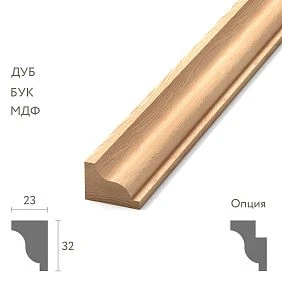
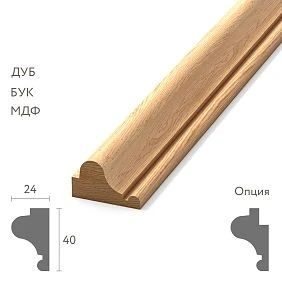
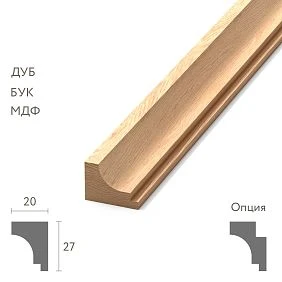
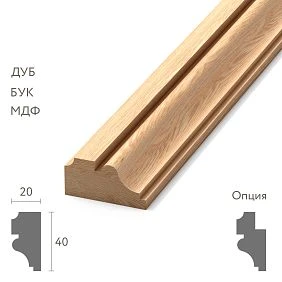
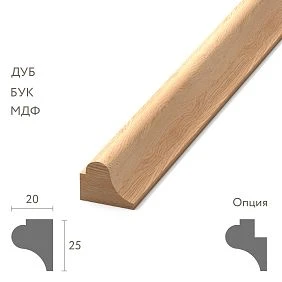
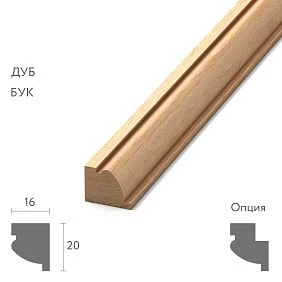
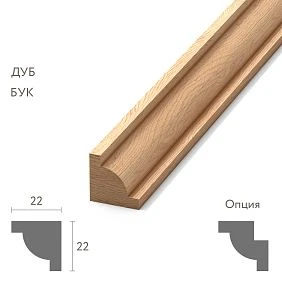
Our factory also produces:
Why a compatible profile is more important than a similar size
The molding and overlay must connect not only in width but also in relief. The profile defines the height, protrusion, transition shape, and position of the decorative line. A random molding of a similar size may leave a step, gap, or mismatched curvature.
For NPU-438.1, MLDPU-001 and MLD-001-MG are confirmed. For NPU-437.1 — MLDPU-004 and MLD-004-MG. For NPU-436.1 — MLDPU-002 and MLD-002-MG. For NPU-435.1 — MLDPU-003 and MLD-003-MG.
Compatibility cannot be transferred based on the principle of "just a few millimeters difference." Even a small discrepancy is noticeable after painting and side lighting. On furniture, a mismatch looks like an assembly error, and on a long wall frame, it repeats on both sides.
Before ordering, it is useful to open the overlay and molding cards simultaneously. This way, the buyer checks not only the numerical profile but also the connection pattern.
Get Consultation
When to choose the compact pair NPU-438.1L/R
NPU-438.1L/R measuring 46 × 16 × 9 mm is the most delicate option. It is suitable for a narrow molding frame, a small door, a compact dresser drawer, and a thin wall frame where a large floral ornament would look heavy.
The system works with a polyurethane profile MLDPU-001 measuring 10 × 6 mm or with a primed molding MLD-001-MG size 10 × 6 mm. The same cross-section allows you to choose the profile material according to the project without changing the scale of the pair.
For a complete mirror set, you need to buy the left overlay NPU-438.1L и right overlay NPU-438.1R. Before placing an order, check the quantity of each side separately.
The compact decor works well on small-format kitchen fronts, cabinets, and narrow wardrobe doors. It adds a finishing touch to a straight line but does not take up much space from the handle and panel.
NPU-438.1 may get lost on a tall door or wide paneling. On a large scale, it is better to switch to NPU-437.1 or more embossed series.
When to choose the universal pair NPU-437.1L/R
NPU-437.1L/R size 74 × 26 × 12 mm occupies an intermediate position. The overlays are already well readable on a medium-sized front but remain calm enough for a cabinet, chest of drawers, door, or wall panel.
Compatible profiles — MLDPU-004 size 15 × 8 mm и MLD-004-MG size 15 × 8 mm. This is more noticeable than the thin 10 × 6 mm molding, but does not yet create a heavy wide frame.
To assemble the system, you can buy NPU-437.1L и NPU-437.1R. The pair suits a buyer who finds NPU-438.1 too small and NPU-436.1 already too bulky.
On a chest of drawers, such an overlay completes the top line of the frame well. On a door, it can be placed symmetrically relative to the center of the panel. On a wall, it suits a medium-format panel without a complex central element.
Versatility does not mean compatibility with any profile. The series is tied specifically to MLDPU-004 and MLD-004-MG.
When to choose the expressive pair NPU-436.1L/R
NPU-436.1L/R measuring 85 × 34 × 16 mm creates a deeper relief. It suits a classic facade, large door panel, accent frame, and wall panel where decor should be visible from a distance.
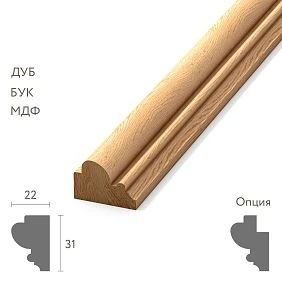
The overlays work with polyurethane molding MLDPU-002 measuring 22 × 11 mm и primed molding MLD-002-MG measuring 22 × 11 mm. The profile already forms a distinct line and requires sufficient space around it.
For a mirror solution, you need to buy an expressive overlay NPU-436.1L и corresponding right NPU-436.1R. Both cards are checked separately.
NPU-436.1 is suitable for a tall cabinet, wide chest, interior door, and medium-scale boiserie. It pairs well with the central overlay NPU-434.1 because the latter is also compatible with profiles MLDPU-002 and MLD-002-MG.
On a small kitchen door with a depth of 16 mm, the ornament size may be excessive. Before ordering, make a full-size template.
When to choose the large pair NPU-435.1L/R
NPU-435.1L/R measuring 135 × 53 × 19 mm is the largest paired decor among the four systems. It is intended for wide furniture fronts, tall doors, large wall frames, and interior panels.
Compatibility confirmed with MLDPU-003 measuring 35 × 12 mm и MLD-003-MG measuring 35 × 12 mm. The wide molding and large overlay form an architecturally noticeable frame.
For a complete solution, you need to buy the large left overlay NPU-435.1L и right overlay NPU-435.1RThe series is especially suitable for doors or facades where there is enough free space around the frame.
NPU-435.1 can be supplemented with the central overlay NPU-434.1. This scheme is suitable for an extended top line when one pair on the edges is not enough and the center looks empty.
Large decor cannot be mechanically reduced by trimming. If 135 mm does not fit in the selected field, switch to NPU-436.1 or NPU-437.1.
Polyurethane or primed MDF molding
Each pair allows two confirmed profiles of the same cross-section: MLDPU from polyurethane and MLD-MG from primed MDF. This preserves the system geometry and allows choosing the direct molding material based on the base and project technology.
A polyurethane profile logically combines with polyurethane overlays when a material-homogeneous system is required. Primed MDF molding is convenient for furniture facades and panels where the base is already made of MDF and the entire composition is prepared for painting.
It cannot be stated that one material is universally better than another. The choice depends on the base, room conditions, attachment method, preparation, and finish coating. Current recommendations are checked in product cards and with a specialist.
To compare all options, you can view MLDPU and MLD-MG moldings and select a profile by width and relief.
Why the central element NPU-434.1 is needed
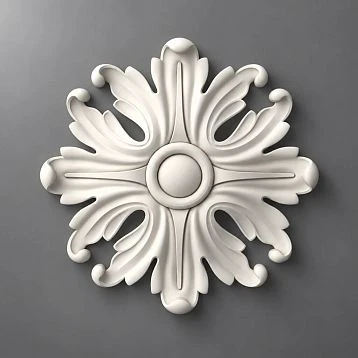
On a long facade or wide wall panel between the left and right overlays, a large empty gap may remain. In this case, the center is supplemented with a separate decorative element that holds the composition together and prevents the paired parts from being moved too close.
For this task, you can buy the central overlay NPU-434.1. The card confirms compatibility with MLDPU-003, MLD-003-MG, MLDPU-002, and MLD-002-MG.
The most obvious combination is NPU-435.1L/R with a 35 × 12 mm profile and NPU-434.1 in the center. However, the central element can also be used with the NPU-436.1 system on a 22 × 11 mm profile, if the facade proportions allow it.
The central overlay is not added automatically. On a small door, it will overload the top line. First, lay out the pair, then assess whether the center really looks empty.
How to choose the overlay size for the facade width
The overlay size is evaluated not separately, but together with the width and height of the frame. The compact NPU-438.1, 46 mm long, does not take up much space and suits a small facade. The NPU-435.1, 135 mm long, requires a noticeably wider horizontal area.
It is useful to draw the frame to scale and mark the extreme points of the left and right parts. There should be a straight section of molding between them. If the ornaments almost touch, the composition looks cramped.
On a tall narrow door, it is better to use a smaller pair, even if the NPU-435.1 fits in width. The vertical proportions of the facade can make a wide relief look heavy.
On a low wide chest, conversely, a too small NPU-438.1 will get lost. Here, NPU-437.1 or NPU-436.1 better maintains the length of the top frame.
Distance between the left and right element
There is no fixed universal distance for all facades. It depends on the total length of the molding, the presence of a central overlay, handle, panel, and the selected series.
Paired parts should be perceived as connected by one line, but not merge into a dense ornament. A section of straight profile is left between them, which emphasizes the mirroring.
If there is a handle, keyhole plate, or NPU-434.1 in the center, the distance is calculated from the central element. The left and right overlays are installed symmetrically relative to the common axis.
Before fixing, it is convenient to cut paper templates to exact dimensions and move them along the line. This method allows you to choose the proportion without the risk of damaging the facade.
How to make symmetrical markings
First, find the geometric center of the frame or facade. From it, set equal distances to the left and right. Marking each overlay separately from the edges of the door is dangerous: the actual edges may have slight deviations.
The molding is temporarily laid out together with both overlays. Check the direction of the ornament, the overall horizontal alignment, and the same transitions from profile to decor.
For a double door, the center of the entire composition can pass along the joint of the leaves. Then you need to decide whether each leaf will have its own pair or both leaves will form one common frame.
After dry layout, the contours are marked in a subtle way that does not damage the future coating. Glue is applied only after rechecking L and R.
Which side to turn the overlays
Left and right markings help identify the mirror pair, but the visual direction depends on where the center of the composition is located. The ornament can converge to the center or diverge from it according to the product's pattern.
You cannot rely only on the position of the card on the screen. On the object, the parts are applied to the molding and examined simultaneously.
If one overlay is accidentally rotated, the line of leaves or curls is disrupted. After painting, the error becomes even more noticeable because the uniform color unifies the entire relief.
For several identical facades, make one reference template and label the sides. This speeds up installation and reduces the risk of mirror error.
Pair decor for a small furniture door
A small door requires free space for the handle, hinges, and the panel itself. NPU-438.1 usually fits better than others due to its size 46 × 16 × 9 mm and molding 10 × 6 mm.
NPU-437.1 can be used if the door is not too narrow and the frame should be more noticeable. Before purchasing, check that the overlay does not take up a disproportionately large part of the top line.
NPU-436.1 and NPU-435.1 on a small facade often create overload. A deep relief can interfere with opening the adjacent door or protrude beyond the edge.
For kitchens and compact furniture, it is useful to make a mockup not only of the facade but also of adjacent doors. The decor should maintain gaps and not catch when opening.
Paired overlays for a chest of drawers and a cabinet
On a wide drawer of a chest of drawers, pair decor can complete the top or bottom line of the frame. NPU-437.1 and NPU-436.1 provide sufficient expressiveness without excessive scale.
If the handle is located in the center, the overlays are placed symmetrically on the sides, leaving a free field around the handle. The central NPU-434.1 is usually not added to avoid competing with the hardware.
On a cabinet with several drawers, repeating a full pair on each facade may look too busy. Sometimes decor is used only on the top drawer or on the doors.
Primed MDF molding is convenient to include in a painted furniture facade. But the compatibility of overlays is strictly checked according to the profile series.
Overlays for cabinet and wardrobe
A tall cabinet allows for more noticeable decor, especially if the doors are wide and have a classic frame structure. NPU-436.1 suits most medium and large-scale facades.
NPU-435.1 is appropriate on tall wide doors, where the 135mm overlay does not look excessive. The 35 × 12 mm profile forms a full architectural frame.
It is better not to repeat a large pair on each door on narrow panels. You can assemble a common composition in the center of the cabinet or switch to NPU-437.1.
For a built-in cabinet, not only the facade is checked, but also the gaps to the ceiling, walls, and adjacent panels. The relief should not interfere with opening.
Large decor for a tall door
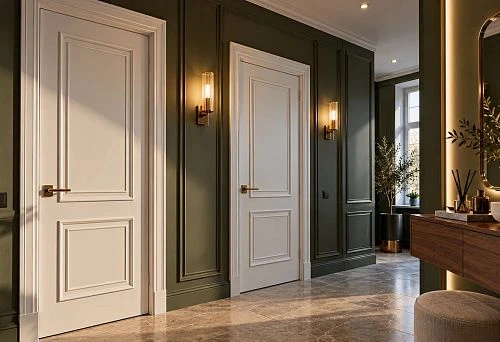
A tall door is perceived as an architectural surface, so NPU-435.1 and molding 35 × 12 mm can look proportional. The pair forms a noticeable finish of the panel and is well readable from a distance.
If the door is narrow, large overlays can visually expand the upper part and make the composition heavy. Then NPU-436.1 provides a more balanced relief.
Before installation, consider the handle, lock, hinges, and opening direction. The 19 mm deep overlay should remain in the safe zone.
Practical ideas can be compared with the article on how to use paired overlays for door decor, without repeating the general classification of door design.
Molding frame decor on the wall
On the wall, the viewing distance is greater than on furniture, so a small pair can get lost. NPU-437.1 and NPU-436.1 are suitable for most medium-sized wall panels.
NPU-435.1 works in large boiserie, a high living room, and a formal hallway. The wide profile 35 × 12 mm holds the scale of the wall and does not look like a thin random line.
NPU-438.1 is appropriate in small frames, narrow wall sections, and compositions with several thin rectangles. It does not overload the wall with relief.
Marking is done relative to the entire wall, not just one frame. The top lines of adjacent panels must align, and pairs must have the same distance from the center.
Paired elements for boiserie
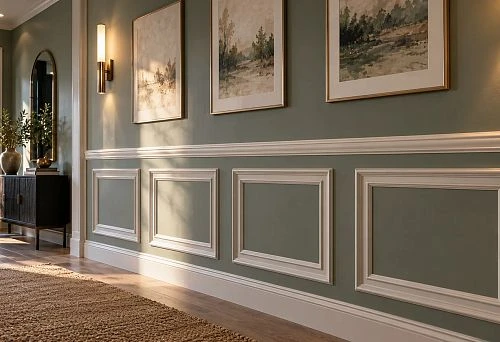
Boiserie is built on a repeating system of frames. Paired overlays allow highlighting the main panel, door portal, or central part of the wall without changing the entire grid.
On small lower panels, NPU-438.1 or NPU-437.1 are sufficient. On high upper frames, NPU-436.1 and NPU-435.1 are more readable.
It is not necessary to use a decorative pair on every frame. Alternating calm and accent panels creates a clearer hierarchy.
All moldings and overlays are painted in the same system if the project requires monolithic boiserie. Before finishing, check the joints and profile transitions.
Decor for kitchen facade
In the kitchen, the relief should account for frequent opening and cleaning. Compact NPU-438.1 is suitable for small doors, NPU-437.1 for medium-sized facades.
Large NPU-436.1 and NPU-435.1 are best used on tall cabinets, side panels, or decorative facades that are not near the work area.
A polyurethane overlay and a primed MDF molding can be painted in the same color only with a compatible preparation system. The specific technology is checked before installation.
The relief should not fall into the area of constant hand contact. The handle and paired decor are spaced apart in height and width.
Paired decor for bedroom and dressing room
In the bedroom, overlays are often used on headboards, cabinets, nightstands, and wall panels. The size is chosen based on the scale of the furniture and the number of other decorative elements.
NPU-437.1 suits calm classic furniture. NPU-436.1 makes the facade more expressive. NPU-435.1 is appropriate on a large cabinet or central panel behind the bed.
In the dressing room, repeating the decor on many panels requires precise marking. A single mistake in distance or orientation becomes noticeable in the row.
For a series of facades, it is useful to assemble a reference door and only after its approval transfer the template to the rest.
Commercial interior: salon, hotel, restaurant
In a commercial space, the decor is viewed from a greater distance and undergoes more intense contact. Large series NPU-436.1 and NPU-435.1 better maintain readability on walls and doors.
On a reception desk or furniture facade, NPU-437.1 can create a neat branded relief without excessive theatricality.
The number of identical frames is calculated in advance. Left and right cards must be ordered in equal quantities if all compositions are symmetrical.
Before serial installation, make one control section, check the glue, paint, and surface resistance to cleaning.
Is it possible to use only one overlay
One overlay is acceptable as a deliberately asymmetrical element, for example in the corner of a panel, near a handle, or at a free end of a line. But this scenario differs from a paired system.
If the buyer wants a symmetrical frame, one piece is not enough. You need to add the corresponding L or R, not a second identical side.
A single element does not automatically turn into a ready-made 90-degree corner. It remains a decorative end of a straight molding.
Before ordering, determine the composition on the drawing. This helps avoid buying one card expecting to receive two mirror-image parts.
How do paired overlays differ from ready-made corner elements?
The finished corner element forms a frame turn at a given angle and replaces the miter cut of the molding in the corner. NPU-438.1–NPU-435.1 solve a different task: they are installed mirror-wise on a straight line or along the edges of the composition.
Paired overlays do not replace the four corners of a rectangular frame. For a regular molding frame, the corners are still made in the prescribed way or with special corner pieces.
The strong point of the paired system is the free distance between L and R. The buyer can adapt the line to the width of the facade, add a central NPU-434.1, or leave a calm straight section.
This difference must be understood before purchase, so as not to expect the function of a finished corner from the overlay.
How to combine paired decor with frame corners
Paired overlays can be used inside a rectangular frame simultaneously with regular corners. For example, the corners form the perimeter, and L/R decorate the top horizontal.
The scale of all elements must be coordinated. A large NPU-435.1 next to very small corner pieces creates a break in proportions.
If the frame is small, either a paired overlay or expressive corners are sufficient. Simultaneously saturating all sides can overload the facade.
For a complex composition, it is useful to refer to the article on how to to combine overlays, moldings, and rosettes, and then return to the precise compatibility of the chosen pair.
When a straight molding without paired decor is needed
Not every frame needs overlays. On a modern facade, small door, or wall with active furniture, a straight profile can look more precise.
Paired decor is appropriate when it is necessary to emphasize the center, complete a line, or add a classic floral motif. Without this task, overlays become unnecessary relief.
If the free field is too narrow, it is better to keep a clean molding than to compress NPU-438.1 or cut the product.
An honest choice includes the option to forgo the pair and buy only the compatible profile.
How to calculate the number of pairs
For one symmetrical line, one left and one right overlay is usually required. If the decor is repeated at the top and bottom, the quantity doubles.
On a two-door cabinet, two schemes are possible: one common pair for the entire facade or a separate pair for each door. The second scheme requires two L and two R.
For a series of ten identical doors, count the number of compositions, then multiply by one left and one right piece. A small reserve is determined separately.
Molding is calculated based on the length of straight sections and frames, accounting for trimming. Central elements NPU-434.1 are counted by the number of compositions where they are actually provided.
Purchasing L and R in separate cards
Eight product cards allow ordering each side separately. This is convenient for replacing a damaged element or an asymmetrical project, but requires attention during a regular paired purchase.
Check the article suffix before adding to cart. L denotes the left part, R denotes the right part. An equal quantity of both sides protects against an incomplete set.
For a large order, create a list: series, number of L, number of R, compatible molding and its length. Specify NPU-434.1 in a separate line.
After receiving, sort the parts into pairs before starting installation. This allows you to immediately detect an error in quantity.
Polyurethane overlays and paintable system
All four pairs belong to polyurethane decor. This is convenient when the ornament needs to be integrated into a paintable frame to achieve a uniform color with the molding, facade, or wall panel.
The matching of the overlay material with MLDPU simplifies the system logic but does not eliminate surface preparation. The base, adhesive, primer, and paint must be compatible with each other.
If a primed MDF molding MLD-MG is used, the transition between the two materials is especially carefully checked before finishing. Different bases may react differently to preparation and painting.
The current finishing technology is clarified using cards and with the master. A random painting scheme from another type of stucco molding cannot be transferred.
Paint before or after installation
Painting after assembly helps to unify the molding, overlays, and base with one color. Joints are easier to make visually seamless if the preparation is done carefully.
Pre-painting is convenient when elements have a complex relief and are difficult to reach with a brush or spray after installation. But the connection points must remain suitable for assembly.
On furniture, the entire frame is often assembled first, symmetry is checked, then general preparation and finishing are performed. On a wall, both schemes are possible depending on the renovation technology.
Before work, make a test section from a piece of molding and one overlay. It will show how the seam, primer, and paint behave.
How to choose adhesive for polyurethane decor
Glue is selected not only for the overlay but also for the base: painted MDF, wood, plaster, primed wall, or other material. There is no universal composition for all situations.
To select, you can open Materials for installing and finishing molding. The specific product is chosen considering weight, vertical position, fixation time, and future painting.
The glue should not come out onto the front relief. Excess is removed according to the technology before it damages the surface or forms a noticeable bead.
On a vertical door or facade, temporary fixation may be required until strength is achieved. The method must not deform the polyurethane part.
Foundation Preparation
The surface must be flat, strong, clean, and degreased within the technology of the selected material. Weak paint or dust reduces the reliability of adhesion.
On a furniture facade, the flatness and absence of warping are checked. A paired composition is especially sensitive to level differences between the left and right sides.
On the wall, first complete the basic leveling and mark the overall grid of panels. Overlays should not be used to mask noticeable differences.
Primed MDF molding and a polyurethane overlay may have different surfaces. Preparation of each material is carried out according to separate recommendations, then the overall finish is checked.
Dry layout before installation
Dry layout is a mandatory step for paired decor. It shows whether L and R are mixed up, whether the molding matches the seating line, and whether there is enough space between elements.
On a long wall, it is convenient to lay out the layout on the floor or on a full-size template. On the facade, parts are temporarily fixed in a safe way that does not damage the surface.
If NPU-434.1 is planned, it is placed in the center simultaneously with the pair. This way, it is visible whether the composition is becoming too dense.
Only after approving the distances and orientation do they proceed to marking the adhesive area.
How to join a trim piece with a molding
The transition should look like a continuation of one line. The end or seating part of the molding is brought to the overlay without a noticeable step or misalignment.
Series compatibility simplifies this task, but the actual fitting is still checked on site. The profile cut must be even and correspond to the connection point.
Do not fill a large gap with a thick layer of glue. If the parts do not fit, first check the correctness of the profile, orientation, and size.
After assembly, the seam is prepared for finishing so that a uniform color does not emphasize the difference in materials.
Installation on a finished painted door
Overlays can be installed on a finished door only after checking the compatibility of the glue with the existing coating. A weak or glossy surface may require special preparation.
Marking must be especially careful because correction marks are visible on finished enamel. Full-size templates reduce the risk.
Large NPU-435.1 and NPU-436.1 require checking gaps when opening. The relief should not touch the wall, casing, or adjacent sash.
If the door is already covered with a complex finish, it is sometimes more rational to remove it and perform installation horizontally. The decision is made by the master.
Installation on MDF furniture
An MDF facade is suitable for a decorative frame if its structure and coating allow gluing. It is especially convenient to combine polyurethane overlays with primed MLD-MG.
Before installation, check the thickness of the facade, the position of hinges and handles. The decor should not create a load on the edge or interfere with adjustment.
If the furniture is new and will be painted, it is better to include the frame in the project in advance. Then the master can prepare the surface and apply the final finish.
On a finished laminated facade, the technology differs from painted MDF. Without a confirmed adhesive solution, installation is not started.
Use in a damp room
The question of use in a bathroom, kitchen, or other damp room cannot be decided solely by the overlay material. The base, glue, molding, coating, ventilation, and direct contact with water must be considered.
A polyurethane part alone does not make the entire system moisture-resistant. Primed MDF profile requires particularly careful protection and confirmation of application conditions.
Overlays are not placed where water or aggressive cleaning agents constantly hit the relief, unless such use is intended.
Before ordering for a wet area, coordinate the entire system with the STAVROS manager and the finisher.
How to care for relief decor
Dust is removed with a soft brush, dry cloth, or suitable attachment. Deep NPU-436.1 and NPU-435.1 require more thorough cleaning than compact series.
Abrasive sponges and hard brushes can damage the paint and smooth out small protrusions. The product is selected based on the finish coating.
On kitchen furniture, it is better to remove dirt promptly, preventing dense deposits in recesses.
In case of local damage, keep the paint code and finish scheme. Spot repair must match in color and gloss.
How not to overload the facade
Paired overlays already create a directional ornament. If there are carved handles nearby, a large central overlay, complex corners, and an additional panel, the surface may become too busy.
On the sky
How to combine decor with handles and hardware
The handle remains the functional center of the facade. Paired overlays should not block the convenient grip area or visually conflict with the hardware.
If the handle is richly decorated, choose a more compact pair. For a simple handle, an expressive NPU-436.1 or NPU-435.1 is acceptable.
The central NPU-434.1 is not placed in the same location where the handle should be. These elements are pre-separated vertically.
On the door, consider the keyhole escutcheon and peephole. The symmetry of the decorative line can only be adjusted deliberately.
How to choose decor for classic and modern interiors
In a classic interior, paired overlays naturally support panels, boiserie, and symmetry. The size is chosen according to the architectural scale of the room and furniture.
In modern classic, NPU-438.1 or NPU-437.1 are more often used, painted in the color of the facade. The relief remains noticeable due to shadow, but does not look like a historical quote.
In a minimalist interior, large floral decor may be unnecessary. Here, one thin frame without overlays or a very compact pair as a local detail is acceptable.
Modern eclecticism allows NPU-435.1 on a simple panel if the rest of the surface remains calm.
Practical selection across four scales
For a field up to several tens of centimeters wide, start with NPU-438.1 and check with a mockup. The exact limit is not set universally because the height and shape of the facade matter.
For a standard dresser or cabinet facade, NPU-437.1 is more often considered. It is noticeable enough but does not require a wide architectural frame.
For a tall door and large furniture panel, NPU-436.1 is suitable. The 16 mm depth creates an expressive shadow.
For a wide portal, boiserie, and large door, choose NPU-435.1. The size 135 × 53 × 19 mm must be justified by the scale.
How not to confuse compatible moldings
Pairs are not linked in numerical order. NPU-437.1 is compatible with MLDPU-004, and NPU-436.1 with MLDPU-002. Therefore, selecting by the adjacent number will lead to an error.
Create a simple cheat sheet: 438 → 001, 437 → 004, 436 → 002, 435 → 003. Next to it, indicate MLDPU or MLD-MG.
In the cart, check the full article number, not just the width. Two profiles of similar size may have different reliefs.
For a large order, use a specification with clickable cards so that the installer and the buyer work with the same system.
Mistakes when buying
The first mistake is buying two identical sides instead of L and R. The pattern will not become mirrored.
The second is assuming one card contains a set. The left and right parts are presented separately.
The third is choosing molding only by width. The relief and fit may not match.
The fourth is choosing a large NPU-435.1 for a small door without a mockup.
The fifth is using NPU-438.1 on a large wall panel where it gets lost.
The sixth is placing the central NPU-434.1 together with a handle in the same zone.
The seventh is mounting on an unprepared painted surface.
The eighth is considering paired overlays as ready-made corner frame elements.
The ninth is painting with a thick layer that smooths out the relief.
The tenth is not to check the amount of molding, trimming, and spare before placing an order.
Who is NPU-438.1 suitable for
NPU-438.1 is suitable for small furniture doors, thin frames, compact panels, and customers who need delicate decor.
It works well in modern classics and on facades where there is already a noticeable handle.
The series is not suitable for a large tall door if the overlays need to be read from a distance. A larger size is chosen there.
Who is NPU-437.1 suitable for
NPU-437.1 is suitable for medium-sized facades, chests of drawers, cabinets, doors, and wall panels without heavy relief.
This is a rational option between the thin NPU-438.1 and the deeper NPU-436.1.
The series may be too understated for a front door or large boiserie.
Who is NPU-436.1 suitable for
NPU-436.1 is suitable for classic furniture facades, tall doors, and expressive wall frames.
It works well with the central NPU-434.1 and the 22 × 11 mm profile.
On a small kitchen door, the size 85 × 34 × 16 mm may look excessive.
Who the NPU-435.1 is suitable for
The NPU-435.1 is suitable for large facades, tall doors, boiserie, interior panels, and extended compositions with a central element.
The wide 35 × 12 mm profile creates an architectural character and requires free space.
The series is not suitable for narrow doors or compact furniture, where the relief takes up too much area.
When to choose a different system
If you need to design four corners of the frame without miter cuts, paired overlays do not solve this problem. Special corner elements are required.
If the facade is very small, it is better to use only a straight molding or abandon the frame altogether.
If the interior is modern and the decor should be almost invisible, plant overlays may be unnecessary.
If there is no suitable compatible profile, it cannot be replaced with a random molding. It is better to choose a different series entirely.
Practical selection for specific tasks
| Task | Recommended pair | Compatible profile | What to check before ordering |
|---|---|---|---|
| Small kitchen door | NPU-438.1L/R | MLDPU-001 or MLD-001-MG | Place for handle, gaps and scale 46 × 16 × 9 mm |
| Medium-sized dresser front | NPU-437.1L/R | MLDPU-004 or MLD-004-MG | Distance from center and frame width |
| Classic wardrobe | NPU-436.1L/R | MLDPU-002 or MLD-002-MG | Depth of 16 mm and door opening |
| Tall door | NPU-435.1L/R | MLDPU-003 or MLD-003-MG | Free field, handle, lock, and 19 mm protrusion |
| Small wall panel | NPU-438.1L/R or NPU-437.1L/R | 10 × 6 or 15 × 8 mm | Viewing distance and overall wall grid |
| Accent wall panel | NPU-436.1L/R | 22 × 11 mm | Field size and side lighting |
| Large boiserie | NPU-435.1L/R | 35 × 12 mm | Is a central element NPU-434.1 needed |
| Double-door cabinet | By door scale | Strictly by the selected series | One common pair or two separate compositions |
How to assemble a kit without errors
First, choose the application location and decor size. Then find the exact compatible profile. After that, add the left and right cards, calculate the molding length, and decide if NPU-434.1 is needed.
The order is important. If you start with a random molding, the overlay you like may not fit it. If you buy only one side, the symmetrical composition will remain incomplete.
For each frame, create a specification line: NPU series, quantity L, quantity R, MLDPU or MLD-MG profile, length, and installation materials.
In a complex project, add a layout diagram. Part numbers alone are not enough if the site has multiple types of doors and panels.
What to buy together with paired overlays
The main accompanying purchase is a compatible straight molding. It connects the mirror elements into one line and determines the frame scale.
For large NPU-435.1 and expressive NPU-436.1, a central NPU-434.1 may be needed. It is added only after checking the total length.
Mounting materials are selected for the polyurethane, the chosen profile, and the base. The adhesive, primer, and paint must work as a single system.
A wide selection can be viewed in the categories: buy polyurethane decor for frames и buy compatible moldings for painting.
How to buy paired overlays for STAVROS
Open the cards of the selected series and add both sides. For NPU-438.1, these are separate NPU-438.1L and NPU-438.1R; the same principle applies for other series.
Next, open the confirmed molding. Do not replace MLDPU-001 with 004 or MLD-002-MG with 003-MG just because the profile looks similar.
Check the dimensions of the facade and do a dry layout using a template. If the composition is large, add NPU-434.1 only after a visual check.
Prices, availability, finishing options, and current installation recommendations are viewed directly in the product cards. For a complex base, it is better to contact a STAVROS manager in advance.
Why a ready-made compatible system is better than random stucco
A ready-made pair and a confirmed molding help avoid a noticeable step at the joint. The customer gets a predictable combination of dimensions and relief.
Random elements have to be trimmed, sanded, and gaps filled. After painting, such corrections often become more noticeable.
Separate L and R provide correct mirroring. Two identical overlays from a random series do not create symmetry.
The STAVROS system allows freedom in length: the molding can be adapted to the facade while maintaining compatible endings.
How to conduct a test purchase
For a large order, first assemble one set: left and right overlays, a short section of molding, and if necessary, NPU-434.1.
Lay out the system on a real facade or a full-size template. Check the scale, profile connection, orientation, and painting.
After a trial assembly, refine the length of the moldings and the number of pairs. This approach reduces the risk of mass errors on a series of doors.
The control sample is kept as a reference for installers and finishers.
Acceptance of the finished composition
Check symmetry relative to the center and equal distance from the edges. The left and right overlays should be mirror-oriented.
Inspect the connections with the molding under side light. There should be no steps, large gaps, or traces of glue.
Open all doors and drawers. The relief should not touch adjacent parts or interfere with handles.
Compare repeating frames. The dimensions, height, and direction of the decor should match across the entire series.
Table "what to buy together"
| Main pair | What to add | Why | What to pay attention to |
|---|---|---|---|
| NPU-438.1L/R | MLDPU-001 or MLD-001-MG | Assemble a thin line 10 × 6 mm | Do not confuse with profiles from other series |
| NPU-437.1L/R | MLDPU-004 or MLD-004-MG | Assemble a universal frame 15 × 8 mm | Check the facade scale |
| NPU-436.1L/R | MLDPU-002 or MLD-002-MG | Obtain a pronounced profile 22 × 11 mm | Assess depth and gaps |
| NPU-435.1L/R | MLDPU-003 or MLD-003-MG | Assemble a large frame 35 × 12 mm | Leave enough free space |
| NPU-435.1L/R or NPU-436.1L/R | Central overlay NPU-434.1 | Fill a long straight section | Do not overload the facade and avoid conflict with the handle |
| Any system | Materials for installing overlays | Select glue, preparation, and finishing | Compatibility with the base and paint |
Additional materials on molding compositions
The general principle of combining frames, rosettes, and overlays is explained in the article on combining stucco elementsFor wall solutions, the material is useful about decorative moldings and rosettes in the interiorDoor scenarios are discussed in more detail in the article on designing doorways with moldings and overlays.
These materials help to see a broad context, but a specific pair is selected only according to the compatibility table NPU-438.1–NPU-435.1 and confirmed MLDPU or MLD-MG profiles.
How to prepare a specification for a furniture maker or installer
In the specification, it is not enough to write "paired overlays for molding." Provide the full article numbers of both sides, the compatible profile, the profile material, the length of each section, and the number of compositions.
For NPU-438.1, NPU-438.1L, NPU-438.1R, and MLDPU-001 or MLD-001-MG are recorded separately. Other series are formatted similarly. This format prevents accidentally replacing the profile with a similar one.
If NPU-434.1 is used, it is highlighted in a separate line and its position on the drawing is noted. The installer must understand where the center is and where the mirror ends are.
A facade diagram with dimensions is attached to the specification. This is especially important for double-door cabinets, door series, and wall panels of different formats.
How to replace a damaged left or right part
Separate L and R cards are convenient for repairs: you can order only the damaged side without buying a second unnecessary element.
Before reordering, check the full article number and molding series. Externally similar overlays of different sizes are not interchangeable.
Keep the paint code or finish sample. The new part must be integrated into the existing frame so that the color and gloss do not differ.
Dismantling is performed safely, considering the adhesive and base. Attempting to tear off the overlay abruptly may damage the facade or molding.
How to check color and relief after painting
Before painting, white overlays may appear less noticeable than after a dark or rich finish. Color enhances shadows and the visual scale of the relief.
On a test sample, not only the shade but also the layer thickness is checked. Too dense coating smooths out fine details on NPU-438.1, and on NPU-435.1 it may accumulate in deep areas.
Side light reveals the joint with the molding and possible unevenness. Inspection is carried out before installing the entire series of facades.
If the molding is made of MDF and the overlay is made of polyurethane, the sample is especially important: both materials should look the same after the overall finishing.
How to use different sizes in one interior
In one project, you can use several series if they have different tasks. For example, NPU-435.1 on the main door and NPU-437.1 on small furniture fronts.
You cannot mix sizes within one continuous frame without a special design intent. The transition from a 35 × 12 profile to a 15 × 8 mm one will be noticeable.
Unity is created by a common paint, a repeating frame shape, and a clear hierarchy: large decor on main surfaces, compact on secondary ones.
For each size, maintain its own compatible molding system. A common color does not make profiles interchangeable.
Final cart check before ordering
Check the quantity of left and right cards. For five identical pairs, you usually need five L and five R, unless the project involves asymmetry.
Check the match: 438 — profile 001, 437 — 004, 436 — 002, 435 — 003. MLDPU or MLD-MG should be indicated nearby.
Add sufficient molding length, justified allowance for trimming and installation materials. Include NPU-434.1 only in compositions where it is shown in the layout.
Before payment, double-check the dimensions against the facade. This check takes a few minutes and protects against purchasing a fully compatible but too large or too small system.
Why the size of a pair should be evaluated together with the straight section of molding
Even a correctly chosen overlay can look unsuccessful if too little or too much straight profile is left between the left and right elements. A short section makes the ornament look compressed, while an excessively long one breaks the connection between the mirrored sides. Therefore, the scale is checked not by an individual part but along the entire horizontal line: overlay, straight molding, central element if present, and free margins to the frame edges.
A full-size template helps to see this proportion before purchase. It is especially useful for NPU-435.1 and NPU-436.1, where the large relief has a stronger impact on the entire composition.
FAQ: questions about NPU-438.1, NPU-437.1, NPU-436.1 and NPU-435.1
Why are left and right overlays produced?
So that the ornament forms mirror symmetry on both sides of the center or straight molding.
Do I need to buy L and R together?
For a regular symmetrical composition — yes. The cards are separate, so both positions need to be added manually.
Can I use only one overlay?
It is possible in an asymmetrical project, but it is no longer a paired system.
How is NPU-438.1 different from NPU-437.1?
NPU-438.1 is smaller: 46 × 16 × 9 mm with a 10 × 6 mm profile. NPU-437.1 is 74 × 26 × 12 mm with a 15 × 8 mm profile.
Which pair fits MLDPU-001?
NPU-438.1L/R.
Which overlays fit MLDPU-003?
NPU-435.1L/R. The central NPU-434.1 is also compatible with this profile.
Can I install NPU-435.1 on MLD-003-MG?
Yes, this compatibility is confirmed by the diagram.
Which decor to choose for a small door?
Usually NPU-438.1, sometimes NPU-437.1 after template check.
What should I choose for a tall cabinet?
NPU-436.1 or NPU-435.1 depending on the width of the panels and the scale of the frame.
Is a central NPU-434.1 needed?
Only if there is a long empty section between paired elements and the center is not occupied by a handle.
How to make symmetrical markings?
Find the center, set equal distances, perform a dry layout L/R, and only then fix.
When to paint the decor?
Before or after installation, depending on the project. It is important to check seams, access to the relief, and material compatibility in advance.
What to use to glue a polyurethane overlay?
Use glue compatible with the overlay and the base. The specific composition is chosen based on the category of installation materials and the master's recommendations.
Can overlays be installed on a finished door?
Yes, after checking the coating, glue, gaps, and the possibility of safe marking.
Are overlays suitable for MDF furniture?
Yes, with proper base preparation. Compatible primed MDF moldings can be used for the system.
How many pairs are needed for a double-door wardrobe?
One common pair or one pair per door — depends on the facade design.
Can the system be used in a damp room?
Only after checking the base, molding, glue, coating, and operating conditions.
How do paired overlays differ from decorative corner pieces?
They complete the straight line in a mirrored fashion and do not replace ready-made 90-degree frame corners.
What should be checked before ordering?
Overlay size, L/R, compatible profile, molding length, number of compositions, central element, adhesive, and finish.
Result: which pair of decorative overlays to choose
NPU-438.1L/R is suitable for a thin profile of 10 × 6 mm and small frames. NPU-437.1L/R is a universal system for molding 15 × 8 mm. NPU-436.1L/R creates a deeper decor with a profile of 22 × 11 mm. NPU-435.1L/R creates a large accent on molding 35 × 12 mm and is suitable for wide facades, tall doors, and boiserie.
The main rule of purchase is not to separate the overlay and molding. Each pair has exact compatible profiles, and left and right versions are in separate cards. For a long composition, you can add NPU-434.1 if the center is free and the scale of the facade allows it.
Before ordering, make a full-size layout, count L and R separately, choose MLDPU or MLD-MG, calculate the profile length, and coordinate mounting materials. On the STAVROS website, all parts of the system can be assembled using confirmed article numbers without random fitting of incompatible moldings.