Article Contents:
- Wooden finial L-104: what exactly the product card offers
- Carved pinecone L-104: why one SKU is not enough to match the pair
- Wooden post finial: what to measure on the remaining piece
- Wooden staircase finial: when ordering a single piece makes sense
- When it is better to order a new pair instead of one carved pinecone
- Beech or oak: how to choose the material for the wooden finial L-104
- "Standard" or "Prestige": what to buy for a matching finial pair
- Decorative finial and wooden post: both sides of the connection need to be checked
- How to match the color of a new wooden finial L-104
- How to accept one L-104 finial before painting and installation
- How much does it cost to order one L-104 and when is the price of a pair justified
- When you should not buy a wooden finial L-104
- How to order one wooden finial L-104 without repeating a mistake
- Frequently asked questions about the wooden finial L-104
- Can I buy one wooden L-104?
- What sizes are available for the carved finial L-104?
- Why can't I order just by the article number?
- What to choose for enamel — beech or oak?
- Will the new oak match the already installed finial?
- How does "Standard" differ from "Prestige"?
- Does the L-104 have a ready-made landing spike?
- Can a large L-104 be filed down to a smaller size?
- How long to wait for a missing configuration?
- When is it better to order two new parts instead of one?
- What should be sent to the manager before ordering?
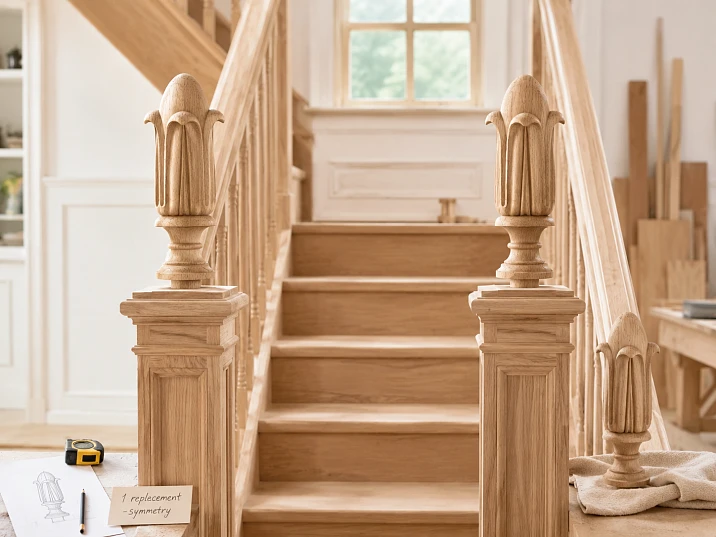
Two identical carved parts for the starting posts were delivered to the site. One was successfully fitted, the second was lost during a workshop move or damaged before finishing. The staircase is already assembled, the design is approved, and there is no desire to buy all the decor again. In such a situation, a logical question arises simply: can you order one wooden finial L-104 and get a full replacement?
Yes, you can, since STAVROS ships items from a single piece. But the ability to put one item in the cart does not mean that the new part will automatically make a perfect pair with the remaining one. The L-104 has three sizes, two materials, and two levels of sanding. Additionally, natural wood varies in grain, and the painting result depends not only on the color name but also on surface preparation, primer, composition, number of coats, and application technique.
Therefore, before buy the wooden finial L-104, you need to turn the remaining part into a sample for verification. It is not enough to remember that it is a "large carved wooden finial made of oak." You need the article number, four dimensions from the card, the wood species, sanding quality, and finishing plan. This approach saves time because errors are detected before placing the order, not after installing two visually different finials on the same staircase.
Wooden finial L-104: what exactly the product card offers
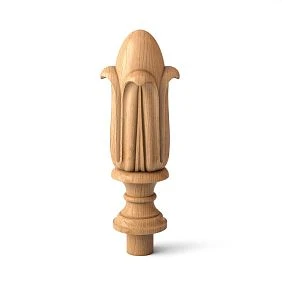
L-104 is not abstract decor or a universal cap for any post. In the product card, the item is called a wooden finial, and in the description, a carved pinecone. The ornament is based on the shape of an elongated marsh leaf. The manufacturer specifies use for wooden posts, staircases, furniture, interiors, carved cornices, and mirror frames.
The model is offered in four dimensions A × B × C × E:
-
146 × 35 × 50 × 128 mm;
-
207 × 50 × 71 × 182 mm;
-
288 × 70 × 99 × 253 mm.
For each size, beech and oak are available, as well as sanding in "Standard" or "Prestige" finish. This alone is enough to understand the main danger of piecemeal replacement: two items with the same article number can be different product configurations. The designation L-104 confirms the model's design but does not replace the choice of size, material, and surface preparation.
The product card also states that the in-stock option is shipped from the warehouse within three business days, and the average production time for custom orders is 5–10 business days. This is not a promise of the same timeframe for any combination: before payment, you need to look at the specific selected line. Prices and stock levels change, so a screenshot from a week ago should not become the basis for an estimate.




Carved finial L-104: why one article number is not enough to match a pair
Imagine a craftsman writes to a supplier: "Need one L-104, urgently." The supplier finds the product card and sees three height options A — 146, 207, and 288 mm. If the size is not specified, the probability of error is already built into the request.
Even the same overall height does not cover the entire check. The product card lists four designations — A, B, C, and E. They need to be taken from the remaining finial and matched with the drawing. Why can't you limit yourself to just one height? Because what matters to the buyer is not only the top, but also the scale of the silhouette, width, depth, and the junction area. Two finials of the same shape but different scales are especially noticeable when they stand symmetrically on either side of a stair flight.
There is also a second layer of differences — material. Beech is more often chosen for opaque enamel, while oak is chosen when you want to preserve a pronounced texture under a translucent finish. This is not a strict prohibition on other technologies, but a logic directly reflected in the manufacturer's explanations. If the remaining finial is oak, a beech replacement may match in enamel color, but it is not obliged to match in pore pattern and surface behavior. With a transparent coating, the difference will be even more noticeable.
The third layer is the quality of sanding. "Standard" means machine sanding, while "Prestige" means detailed manual preparation. These options should not be understood as two different wood species or two degrees of hardness. This is precisely the level of surface preparation. If one piece has already been finished by hand, and the second is ordered in "Standard," the painter must assess the amount of additional work in advance, otherwise the relief after painting may be perceived differently.
Our factory also produces:
Wooden post finial: what to measure on the remaining piece
A proper request starts not with a cart, but with a quick measurement. Place the remaining piece on a clean, flat surface, find card L-104, and open the drawing. Measurements should be correlated specifically with letters A, B, C, and E, not just written as four numbers in random order.
Check:
-
Overall size A.
-
Size B in the zone indicated on the drawing.
-
Size C.
-
Size E.
-
The geometry of the bottom platform.
-
Absence of a homemade tenon, bushing, or other addition made already in the workshop.
-
Traces of the original marking on the packaging, waybill, or specification.
-
Wood species.
-
Presence of primer, stain, oil, varnish, or enamel.
-
Degree of manual relief preparation.
If the part is not yet painted, it is useful to photograph it in diffused daylight from four sides and from below. A ruler or tape measure should be placed nearby, but the photo does not replace recorded dimensions. If the finial is already primed, take a separate shot of the uncovered wood area on the underside — when it exists and can be seen without damaging the item.
The species should not be determined only from a photo in a messenger. Light, white balance, and coating change the shade. If documents have not been preserved and the craftsman is not sure, it is better to provide the manager with all available information and directly note the uncertainty. An honest note "species not confirmed" is more useful than a confident but random choice.
Get Consultation
Wooden stair finial: when ordering one piece is reasonable
Piece-by-piece replacement is justified when the remaining L-104 has not yet received a finish coating, its configuration is precisely established, and both parts will be prepared and painted in the same technological cycle. Then the craftsman can compare the relief, perform identical interlayer treatment, and make a common test coat.
Another good scenario is opaque enamel. If both parts are made of an agreed material, equally prepared, and painted with one system, controlling visual unity is easier than with transparent tinting. However, the word "easier" does not mean "guaranteed": color, gloss, and relief quality are still checked on site.
One piece is also logical if the finial is used not in a mirror pair, but as an independent accent. For example, the model is installed on one central post or used in a furniture composition where there is no second identical element nearby. In this case, small natural differences in wood do not create direct comparison.
The customer can buy wooden finials in the general section and compare L-104 with other models. But in a restoration task, an exact match of article number and configuration is sought first. An alternative design makes sense only when the project is consciously changed, not when trying to pass off another model as an unnoticeable replacement.
When instead of one carved finial, it is better to order a new pair
Sometimes buying a single part is formally possible, but economically and visually risky. The first such case is when the remaining finial has been in use for a long time. Light, humidity, cleaning, and natural aging of the coating change its shade. New wood with the same varnish may look lighter, darker, or simply fresher.
The second case is transparent oak finish, when the customer cares about the wood grain. Even within the same species, each product has an individual texture. The product card confirms the material but does not promise a mirror match of the grain pattern. If two parts stand side by side and must be perceived as a strict pair, it is safer to order two new ones, select them together, and keep the surviving one in reserve.
The third case is an unknown history of the old product. If the size, species, and sanding cannot be confirmed, a single new L-104 becomes an experiment. The cost of a mistake includes not only the price of the item but also delivery, painter's work, reinstallation, and project completion delays.
The fourth case is when the old part was hand-finished. A carpenter may have modified the bottom platform, softened edges, deepened certain areas of carving, or adapted the product to a non-standard post. A new factory part with the same article number will match the product card, not the later manual modification. You should compare not the memory of the original model, but the actual condition of the remaining finial.
The decision to order a pair is especially reasonable when the cost of finishing work and technician visits exceeds the difference between one and two blanks. There is no universal formula here: you need to add up the price of parts, delivery, preparation, test coatings, installation, and the risk of reordering.
Beech or oak: how to choose the material for the wooden finial L-104
If the specification is preserved, the material is taken from it. If there are no documents, the choice is linked to the remaining part and the future coating.
Beech has a calmer, non-porous surface and is often used under dense painting. The card of the selected warehouse item 146 × 35 × 50 × 128 mm specifies beech, "Standard", for enamel. This is a specific configuration, not a characteristic of all L-104.
Oak is valued for its pronounced texture, which is usually preserved under tinting or varnish. For paired decor, the open texture is both an advantage and a source of complexity: the beautiful natural pattern is individual. You cannot order oak and demand that the fibers of the new carved finial replicate an existing product.
If both parts will be coated with covering enamel, the main question is the same technological system and surface preparation. If the coating is semi-transparent, additionally evaluate the wood tone, porosity, grain direction, and a test application. The species is not chosen solely based on price difference.
Useful before ordering to check the sanding quality of the wooden decor. This page explains the differences between "Standard" and "Prestige", as well as blanks for enamel and for tinting. For piece-by-piece replacement, this information is more important than the advertising description: it determines how much preparation will remain for the painter.
"Standard" or "Prestige": what to buy for a paired finial
If the remaining part is not painted, place it next to photos and quality descriptions, but make the final decision after inspecting the surface. "Prestige" is designed for more detailed hand sanding. "Standard" may require finishing before the final coating.
When choosing a single replacement, there are three practical approaches.
The first is to order the same level specified in the original specification. This is the most straightforward option if the documents are preserved.
The second is to order "Prestige" and still accept both parts together before painting. This choice reduces the amount of manual preparation for the new part, but does not eliminate comparison with the old one.
The third is to order "Standard" and assign the joiner or painter to jointly finish the pair. This is acceptable when the craftsman has agreed to the work in advance, sees both parts, and understands the surface requirements. You cannot assume that savings in the product card automatically translate into savings for the entire project: manual labor also costs money.
It would be a mistake to order "Standard" for urgent installation right before project handover, without leaving time for acceptance and preparation. Another mistake is to consider "Prestige" a guarantee of shade matching. Sanding affects the surface, but does not make natural wood identical in grain.
Decorative top and wooden post: both sides of the connection need to be checked
L-104 is a decorative finial, but its bottom plate must match the installation location. The category card indicates a flat plate without a mounting tenon. This is important: the buyer should not assume the presence of a ready-made universal fastening if it is not shown in the drawing and not confirmed by the kit.
Before ordering, measure the top of the post, check its flatness, and find out how the surviving finial was installed. Glue, hidden fasteners, or on-site modifications may have been used. Do not transfer the mounting method to a new part without checking the condition of the base and specialist recommendations.
If it turns out that the old post does not match the new composition, you can compare wooden stair posts in a separate section. In the L-104 card, L-075 is listed among related products, so for a stylistic check it is useful to choose the wooden post L-075 and compare the actual drawings. A link to a related product does not imply automatic geometric compatibility: dimensions and mounting solution are confirmed separately.
When the project involves not only the finial but also balusters, handrails, and posts, it is better to buy components for a wooden staircase after a general check of the specification. This way, the new decorative element will not turn out to be a random part in an already assembled system.
How to match the color of the new wooden finial L-104
A shade name like "dark walnut" or "ivory" is not enough. Different material manufacturers may use the same common names for different colors. Even a single paint changes due to the primer, layer thickness, and gloss level.
For opaque finishing, prepare:
-
exact name and code of the material;
-
manufacturer of the primer and enamel;
-
gloss level;
-
number of layers;
-
application method;
-
sample of the approved color;
-
remaining finial for joint color testing.
For transparent finishing, additionally you need a stain or tinting compound, a clear topcoat, and a test on wood of the same species. A sample on paper or MDF does not show how the compound will reveal the pores of oak and the relief of the carving.
The best time to order a single replacement is before the final painting of the surviving part. Then both L-104s go through the process simultaneously. If the first one is already coated, first do a test on an inconspicuous sample, not directly on the front side of the new finial.
Before starting work, it is worth studying tips on finishing and installing a wooden finial. The manufacturer describes the sequence of preparation, priming, matting, and application of the topcoat. Specific materials and drying modes are selected according to the coating manufacturer's instructions and workshop conditions.
How to accept one L-104 finial before painting and installation
Acceptance is performed before the product is altered by finishing or installation. First, check the invoice and the selected configuration: article number, size, material, and sanding quality. Then place the new part next to the remaining one at the same height and view it from the main viewpoints.
Check:
-
matching of overall height and ornament scale;
-
dimensions B, C, and E per the drawing;
-
geometry of the bottom platform;
-
absence of transport damage;
-
differences that will disappear after joint preparation;
-
wood differences that will remain visible under a transparent coating;
-
sufficient time for a test coat;
-
possibility of installation without altering the load-bearing column.
If the new part differs because a different size row was chosen, do not try to fix the error by sanding. The 207 mm size cannot be safely turned into the 146 mm variant by simple trimming: this will change the proportions of the ornament and does not guarantee the correct platform. The card states that the cutting-to-size service is not provided.
Before starting work, you need to check the storage rules for solid wood products. This is especially important if one part is already at the site and the other arrives later. They should not be kept in fundamentally different conditions and then immediately compared and painted without acclimatization according to the manufacturer's recommendations.
How much does it cost to order one L-104 and when is the price of a pair justified
As of 30.08.2026, the most compact L-104 made of beech in the "Standard" finish cost 2,750 RUB, and made of oak — 2,990 RUB. For the "Prestige" option, prices were 3,410 and 3,800 RUB respectively. The largest size 288 × 70 × 99 × 253 mm cost from 5,700 RUB for beech "Standard" to 9,940 RUB for oak "Prestige".
The estimate for piecemeal replacement consists not only of the card price:
total = product + delivery + preparation + test coat + finishing + installation
Estimate for a new pair:
pair total = 2 × item price + delivery + joint preparation + finishing + installation − value of the spare old part
The last term of the formula is not always expressed in rubles. The surviving old L-104 can be kept as a spare or a finishing sample. The decision to make a pair is justified if the risk of a repeat visit and rework of one mismatched part is higher than the cost of a second new item.
Delivery is calculated separately and depends on order parameters and address. Before payment, you can calculate delivery for one wooden finial. Do not transfer delivery costs from someone else's order or an old invoice.
When you should not buy the wooden finial L-104
Do not place an order if only the article number is known but the size is not selected. Postpone the purchase if the wood type of the remaining part is not confirmed and the coating will be transparent. Do not expect a perfect pair when one L-104 has been exposed to sunlight for several years and the new one is planned to be simply coated with the same composition by name.
It is too early to buy in the following situations:
-
the lower platform of the old part was modified, but the drawing of the modification is missing;
-
a new element is needed for the street, and the execution and adhesive system for outdoor conditions are not coordinated;
-
it is assumed that the finial is part of the stair's load-bearing scheme;
-
the installer has seen neither the post nor the drawing;
-
the client wants to trim the unsuitable size on site;
-
finishing will begin before the joint acceptance of the pair;
-
the difference in the natural grain of oak is unacceptable, but only one piece is being ordered;
-
the project timeline leaves no time for manufacturing the missing configuration and a test coat.
L-104 is a decorative item. The article does not replace the design of a stair railing and the calculation of its safety. If the post, fasteners, or load-bearing part change, a competent specialist must make the decision.
How to order one wooden finial L-104 without repeating the mistake
The working algorithm takes less time than a repeat order.
-
Find the remaining finial and original documents.
-
Confirm article L-104 by drawing and marking, not just from memory.
-
Take measurements A, B, C, and E according to the card drawing.
-
Determine the wood species: beech or oak.
-
Determine the sanding quality of the original part or the required amount of finishing.
-
Record the future finishing system: opaque or transparent.
-
Photograph the relief, base, and installation location.
-
Verify the selected card line, price, availability, and lead time.
-
Inform the manager that only one replacement for the existing part is needed.
-
Decide with the painter whether both parts will be prepared simultaneously.
-
Compare the cost of one piece and a new pair, including all work.
-
Place the order only after the configuration is fixed in the specification.
If L-104 does not match the pattern or scale, you can order a wooden finial for the post of a different model. But then it is more correct to change the composition deliberately — for example, install a new pair — rather than mask the mismatch as a replacement for a lost part.
Frequently asked questions about the wooden finial L-104
Can I buy one wooden L-104?
Yes. The product page indicates shipment of items from one piece. The specific configuration, availability, and lead time should be checked before ordering.
What sizes are available for the carved pinecone L-104?
The card shows three options A × B × C × E: 146 × 35 × 50 × 128 mm, 207 × 50 × 71 × 182 mm, and 288 × 70 × 99 × 253 mm.
Why can't I order by article number only?
Because one article is produced in several sizes, in beech or oak, with "Standard" or "Prestige" sanding. The request needs the full configuration.
What to choose under enamel — beech or oak?
Beech is often chosen for dense painting due to its calmer surface. But for replacement, the material of the remaining part and the agreed finishing technology are more important.
Will the new oak match the already installed top piece?
Exact matching of the natural grain cannot be guaranteed. With transparent finishing and strict symmetry, consider ordering a new pair.
How does "Standard" differ from "Prestige"?
According to the manufacturer's explanation, "Standard" is machine sanding, "Prestige" is detailed hand sanding. This is the level of surface preparation, not the name of the coating.
Does L-104 have a ready-made mounting tenon?
The wooden top piece category describes a flat platform without a mounting tenon. The specific base needs to be checked against the L-104 drawing and the installation method agreed upon.
Can a large L-104 be sawed down to a smaller size?
The manufacturer does not provide cutting-to-size service. Unauthorized modification changes the proportions and the base, so you need to choose the correct size line right away.
How long to wait for a missing configuration?
The card indicates an average production time for custom orders of 5–10 business days. The actual time is confirmed upon ordering.
When is it better to order two new parts instead of one?
When the old L-104 has already changed color, its material is unknown, the transparent finish requires visually matched oak, or manual rework of the original item is not documented.
What should I send to the manager before ordering?
Article number, four dimensions, wood species, sanding quality, photos from all sides, base type, coating information, and a note that the item must pair with the existing part.
Bottom line: one L-104 is a full order, not a random spare part
You can order one wooden finial L-104. The card allows shipment from one piece, offers three sizes, two materials, and two sanding levels. But a successful replacement starts not with a minimum batch, but with precise identification of the remaining item.
For an unpainted pair, it is enough to confirm the configuration, accept the parts together, and carry out common preparation and finishing. For an old or tinted oak finial, the risk of visual difference is higher; sometimes a new pair is cheaper than repeated delivery and rework.
The main order document should look not like "one L-104," but like a full line: article number, size A × B × C × E, beech or oak, "Standard" or "Prestige," lamination option, and coating purpose. Then a single-piece purchase truly restores the staircase symmetry, rather than creating a new problem on the eve of project completion.