Article Contents:
- N-347L and N-347R are two separate SKUs, not a single product line
- The pair shares the same size range, but the side remains an independent parameter
- The main check for a symmetrical project is the balance of left and right elements
- First choose the size of the composition, then calculate the quantity
- Why a product card photo does not show the real scale
- A full-size paper template helps you choose the size before ordering
- Finishing building materials should be assessed in the finished composition
- Beech and oak must not be mixed randomly within the same pair
- With a transparent or tinted finish, the material is especially noticeable
- "Standard" and "Prestige" are also part of the order
- You cannot accidentally order the left and right sides with different surface preparation
- Finishing materials must be linked to a specific zone
- For a symmetrical composition, the central axis is determined first
- Why marking from the edge can produce visual asymmetry
- The distance between N-347L and N-347R must be fixed as a number
- The overlay must not conflict with the handle and other elements
- A door, a chest of drawers, and a wardrobe require different layouts even with the same pair of N-347
- For a facade series, one approved map is created first
- If a module has two pairs, the quantity increases separately on each side
- It is better to build the pair list by standard modules
- If the total of left and right elements does not match, it is not always an error
- It is easier to buy finishing materials after the reference composition is approved
- What needs to be approved on the reference facade
- After approval, you cannot "slightly shift" the composition on each door
- A mounting template is more useful than re-marking twenty doors
- The template must be checked specifically on the selected overlay size
- Left and right elements must not be mixed in an unlabeled box
- For a large project, zone-based kitting is convenient
- Kit assembly by facade type is more convenient than a single bag of parts
- During acceptance, the balance of the pair is checked first
- Then the size of each side is checked
- After the size, the material and surface preparation are checked
- All four parameters of the pair must match simultaneously
- Different sizes can be used for different zones, but this must be intentional
- One size across the entire series simplifies purchasing and installation
- How to calculate the reserve for paired decor
- Why a single spare for only one side can be useless
- When a single left or right element is still useful
- Each pair benefits from its own composition code
- The composition code must not replace product SKUs
- Size selection can be verified via a free-form field
- More is not always better
- The side cannot be determined solely by its position in the box
- For serial installation, checking the first completed unit is useful
- What to do if a marking error is found on the first door
- Links to product pages are best stored alongside the exact specification
- Left and right SKUs cannot be determined from a photo from memory
- Before payment, it is useful to verify the pair using a single control line
- For different standard doors, it is better to create separate composition lines
- When paired decor is not needed at all
- Pairing is a property of the composition, not an automatic product rule
- Post-installation inspection helps verify the quality of the series
- Seven common mistakes when ordering a pair
- Final ordering algorithm for N-347L and N-347R

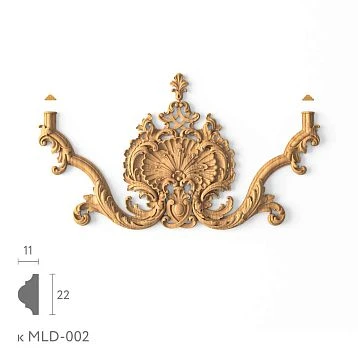
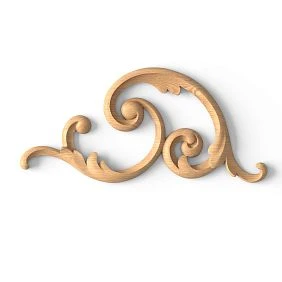
Paired carved decor is often perceived as a single composition: one element on the left, its mirrored pair on the right. Because of this, a line like “N-347 — 24 pcs.” easily appears in the specification. It has already lost half the information: it is unclear how many left and right overlays are needed, what size they are, what wood they are made of, what surface preparation they have, and which doors or facades they are intended for.
For a serial interior, this approach is dangerous. If a pair must be installed on one door, you need to purchase not abstract “24 overlays,” but specifically 12 N-347L and 12 N-347R of the same size, material, and finish.
This is exactly how you should work with finishing building materials when two separate SKUs form one symmetrical composition: first the reference layout is approved, then the left and right elements are counted separately, after which the size, material, surface preparation, and zone assignment are checked.
Main formula:
standard composition → number of left elements per composition → number of right elements → number of repetitions → separate total for N-347L and N-347R.
N-347L and N-347R are two separate SKUs, not a single product line
In the interior they work as a pair, but in purchasing they must remain separate items.
Correct:
N-347L / 180×95×23 / oak / Prestige — 12 pcs.
N-347R / 180×95×23 / oak / Prestige — 12 pcs.
Incorrect:
N-347 — 24 pcs.
In the second case, it is impossible to verify the balance of sides and the completeness of the delivery.




The pair shares the same size range, but the side remains an independent parameter
N-347L and N-347R share three size variants:
- 180 × 95 × 23 mm;
- 210 × 111 × 27 mm;
- 260 × 137 × 33 mm.
Beech and oak are available for each, as well as the surface preparation options "Standard" and "Prestige".
Matching dimensions do not turn two SKUs into one. The specification must always retain the side attribute.
Our factory also produces:

The main check for a symmetrical project is the balance of left and right elements
If each composition truly consists of one left and one right overlay, then a simple check applies to the entire series:
the quantity of N-347L = the quantity of N-347R.
For example:
| Composition | N-347L | N-347R | Size | Material | Status |
|---|---|---|---|---|---|
| Door D-01 | 1 | 1 | 180 мм | Oak | kit |
| Door D-02 | 1 | 1 | 180 мм | Oak | kit |
| Cabinet Sh-01 | 2 | 2 | 210 мм | Beech | kit |
| Panel P-03 | 1 | 0 | 260 мм | Oak | Check |
The last line may be an error, or it may be intentional asymmetry. The registry must not automatically correct it, but it must flag the discrepancy for review.
Get Consultation
First, the size of the composition is selected, then the quantity is calculated
You cannot start with the phrase “for the door, let's take the medium size.” The size depends on the specific surface and surroundings.
Need to consider:
- the width of the panel or front;
- height;
- panels;
- molding frames;
- the handle;
- lock;
- adjacent decor;
- free space around the overlay.
Only after that, choose 180, 210, or 260 mm.
Why the product card photo does not show the real scale
On the screen, all three sizes may appear almost identical because the image automatically adjusts to the browser window.
On a real door, the difference is immediately noticeable:
- 180 mm — a more compact accent;
- 210 mm — medium scale;
- 260 mm — a larger decorative element.
Therefore, the product card is needed to choose a model, but it is better to check the scale directly on the project surface.
A full-size paper template helps you choose the size before ordering
Before a bulk purchase, you can do a simple check:
- take the actual dimensions of the overlay;
- cut out the outline from paper or cardboard;
- attach it to the door or front;
- check the free margins;
- assess the distance to the handle and frame;
- compare options 180, 210, and 260 mm;
- approve one size.
It is much cheaper to fix a scale error than after manufacturing dozens of elements.
Finishing building materials should be evaluated in the finished composition
Finishing building materials do not work separately from the interior, but within a specific plane.
For N-347L and N-347R, not only the quality of the thread itself is important, but also:
- the ratio of the overlay size to the door size;
- the distance between the left and right parts;
- the common central axis;
- the connection with the frame;
- connection with the handle;
- installation height;
- repeatability across a series of identical surfaces.
The buyer is choosing not two separate parts, but the final composition made from them.
Beech and oak must not be mixed randomly within a single pair
If approved:
N-347L / oak
then the paired line must be explicitly:
N-347R / oak
The material for the second position should not be left "for later." In a single symmetrical composition, the material is part of the exact specification.
With a transparent or tinted finish, the material is especially noticeable
If the surface retains a visible wood grain, beech and oak will be perceived differently.
With opaque coating, the visual role of the wood species decreases, but this does not remove the need to specify the material in the order. The purchase must exactly match the approved specification.
“Standard” and “Prestige” are also part of the order
Both overlays offer two surface preparation options: “Standard” and “Prestige.”
Line:
N-347L / oak
is still not precise enough.
The selected surface preparation needs to be added.
For a paired composition, it is especially important that the left and right parts have the same coordinated finish.
You must not accidentally order the left and right sides with different surface preparations
For example:
N-347L / oak / Prestige
and:
N-347R / oak / Standard
At the procurement stage, these are two formally permissible item lines, but for a single symmetrical composition such a distinction requires separate confirmation.
Therefore, a control is introduced:
size L = size R; material L = material R; preparation L = preparation R.
Finishing materials must be linked to a specific zone
It is more convenient to issue finishing materials to the installer not as a total quantity, but by compositions.
For example:
D-01 / N-347L ×1 / N-347R ×1
D-02 / N-347L ×1 / N-347R ×1
W-07 / N-347L ×2 / N-347R ×2
Such a notation helps both picking and installation at the same time.
For a symmetrical composition, the central axis is determined first
Do not start marking from the left edge of the door and then "approximately repeat" on the right.
First, the central vertical axis of the leaf or front is determined.
From it, the following are set:
- position N-347L;
- position N-347R;
- equal horizontal offset;
- total installation height.
This way, both parts are controlled relative to a single base.
Why marking from the edge can cause visual asymmetry
The actual door may have:
- unequal margins;
- an offset panel;
- different widths of architraves;
- a handle that disrupts the clean geometry;
- a decorative frame that matters more than the outer edge of the door leaf.
Therefore, the design axis should be determined by the composition, not automatically by any nearest edge.
The distance between N-347L and N-347R must be fixed as a number
The phrase “install symmetrically” is too vague for a series of twenty doors.
A specific dimensional scheme must be stored:
door axis → offset to the left overlay = ___ mm
door axis → offset to the right overlay = ___ mm
top offset = ___ mm
Then installers reproduce the approved composition rather than creating it anew on each panel.
The overlay must not conflict with the handle and other elements
On a full facade, the following are checked:
- handle;
- keyhole;
- hinges;
- molding frame;
- panel;
- other overlays;
- boundaries of the finish.
This is another reason to approve the composition on a real surface, not just on a separate product photo.
A door, a chest of drawers, and a wardrobe require different layouts even with the same pair of N-347
A door typically represents one large vertical surface.
A chest of drawers may have several drawers.
A wardrobe — several identical fronts.
Therefore, the same N-347L and N-347R can be used:
- one pair for the entire door;
- one pair for each front;
- two pairs for a wide furniture module;
- one element in a deliberately asymmetrical composition.
The calculation always starts with a standard module.
For a series of fronts, one approved map is first created
For example:
Cabinet type A
Per one facade:
1 × N-347L
1 × N-347R
Facades — 18.
Therefore:
N-347L = 18 pcs.
N-347R = 18 pcs.
This calculation is easy to verify.
If a module has two pairs, the quantity increases separately for each side
Per module:
2 left + 2 right
Modules — 15.
Calculation:
2 × 15 = 30 N-347L.
2 × 15 = 30 N-347R.
The total number of parts is 60, but the order keeps two separate lines of 30.
It is better to build the pair list by standard modules
| Type | Left by one | Right by one | Number of units | Total left | Total right |
|---|---|---|---|---|---|
| Door A | 1 | 1 | 12 | 12 | 12 |
| Cabinet B | 2 | 2 | 8 | 16 | 16 |
| Panel C | 1 | 1 | 4 | 4 | 4 |
| TOTAL | — | — | — | 32 | 32 |
This table makes completeness control obvious.
If the total of left and right elements does not match, it is not always an error
Asymmetry may be specified by the design.
For example:
- the end facade uses only one overlay;
- one part of the composition abuts the adjacent element;
- a single accent is applied to the wall;
- the left and right elements are intentionally used in different quantities.
Therefore, the system should show:
PAIR MISMATCH — CHECK THE DESIGN.
But it should not automatically change the quantity.
It is easier to buy finishing materials after the reference composition is approved
If you need to buy finishing materials for a series of identical doors or facades, you should first approve one complete composition.
This could be:
- real test facade;
- full-size layout;
- sample from one pair;
- approved 1:1 template.
After that, procurement is scaled to the entire series.
What needs to be approved on the reference facade
- size N-347;
- distance between the left and right overlay;
- installation height;
- the central axis;
- the material;
- surface preparation;
- adjacent moldings;
- the handle;
- future finish.
After approval, these parameters become the standard for repeating elements.
After approval, you cannot "slightly shift" the composition on each door
If the installer evaluates the position of the overlays independently each time, the series gradually loses its consistent rhythm.
The first doors may look almost identical, but by the tenth one, a noticeable variation in height and spacing between elements will accumulate.
That is why a mounting template is needed for the series.
A mounting template is more useful than re-marking twenty doors
The template can fix:
- the central axis;
- top offset;
- position N-347L;
- position N-347R;
- reference points.
A single approved template reduces the likelihood of human variation.
The template must be checked specifically on the selected overlay size
A template for 180 × 95 × 23 mm cannot be mechanically used for the 210 × 111 × 27 mm version.
When the size changes, not only the dimensions of the part change, but also the free space around it.
If the project has changed size, the template also gets a new version.
Left and right elements must not be mixed in an unlabeled box
Order:
N-347L — 32 pcs.
N-347R — 32 pcs.
On the packaging and in the packing list, these items must remain distinguishable.
If both sides are packed in one box labeled “N-347 — 64 pcs.”, the error is carried over from the warehouse to installation.
For a large project, zone-based packing is convenient
For example:
Kit D-01–D-06
6 × N-347L
6 × N-347R
Kit D-07–D-12
6 × N-347L
6 × N-347R
This makes it easier to check both the handover to the installers and the remaining balance.
Grouping by facade type is more convenient than a single bag of parts
If the project includes doors, cabinets, and wall panels, it is better to create groups:
- door type A;
- door type B;
- cabinet A;
- panel B.
Each group has its own recorded quantity of left and right elements.
During acceptance, the pair balance is checked first
Ordered:
32 N-347L
32 N-347R
Received:
32 N-347L
29 N-347R
A total of 61 instead of 64 already indicates a shortfall, but the main issue is that the completeness of the symmetrical series is compromised.
Three doors will be left without the right-hand part.
Then the size of each side is checked
One SKU has several size variants, so it cannot be accepted:
30 pcs. of the 180 mm version
and:
2 pcs. of the 210 mm version
as a single line “N-347L — 32 pcs.”.
Size is part of the item's identity.
After the size, the material and surface preparation are checked
If approved:
N-347L / oak / Prestige
then the paired item is compared with:
N-347R / oak / Prestige
If the material or surface finish differs, the delivery must be checked before handing over for installation.
Four parameters of the pair must match simultaneously
For a typical symmetrical composition, the check can be reduced to four points:
- correct side;
- same size;
- same material;
- identical surface preparation.
The quantity is checked separately.
Different sizes can be used for different zones, but this must be intentional
For example:
Room doors — 180 mm
Lobby — 260 mm
Such a project is possible if the difference is intentional.
But the lines cannot be combined into one common order without size breakdown.
One size across the entire series simplifies purchasing and installation
If the project allows using one size version for all identical doors, several advantages appear:
- easier to calculate;
- easier to complete the set;
- easier to make a template;
- easier to control the remaining stock;
- lower risk of mixing up versions.
But uniformity should not be imposed if different surfaces require a different scale.
How to calculate reserve for paired decor
If the project includes a reserve, it also needs to be counted by sides.
For example, the main order:
32 L + 32 R
The project decided to keep one additional full pair.
Then the reserve:
1 L + 1 R
and not just “2 overlays.”
The reserve must remain complete as a set.
Why a single spare for only one side can be useless
If a typical composition always changes as a pair, having three additional N-347L with zero stock of N-347R does not provide three complete sets.
Therefore, it is useful to count:
full reserve pairs = the lesser of the quantities of L and R.
For example:
reserve L = 3
reserve R = 1
There is only one full reserve pair.
When a single left or right element is still useful
If the site has asymmetrical compositions or only the damaged side is allowed to be replaced, a separate spare may be justified.
But this should follow from the actual usage pattern, not be a random leftover after purchase.
Each pair benefits from its own composition code
For example:
DEK-01 / N-347L + N-347R / 180 mm / oak / Prestige
Then in drawings and the bill of materials, you can refer to DEK-01 instead of repeating the entire long string.
At the same time, in the purchase order both SKUs still remain separate.
The composition code must not replace product SKUs
Entry:
DEC-01 — 12 sets
convenient for the project, but the supplier needs specific items:
N-347L — 12
N-347R — 12
The project code is responsible for the composition, the SKU — for the product.
The size selection can be checked via a free field
Suppose that on the door leaf, after accounting for the frame, a decorative area 500 mm wide remains.
If the pair must be positioned symmetrically relative to the axis, it is necessary to check not only the width of one overlay, but also the distance between the two elements and the free margins on the outside.
The simplest check:
width of the left element + gap + width of the right element ≤ available decorative area.
If the composition occupies almost the entire field, even a technically fitting option may look too dense.
More is not always better
The 260 mm version may look expressive on a large panel, but overwhelm a small door.
The 180 mm version may look neat on a narrow facade, but get lost on a wide cabinet.
Therefore, choosing a size is not a ranking of "small / medium / best," but a match to the scale of the surface.
The side cannot be determined solely by its place in the box
When assembling, it is better to rely on the article number and marking, rather than the installer's assumption of "this one seems left."
If N-347L and N-347R are visually similar, the risk of error on site only increases.
Therefore, the marking must be preserved until installation.
For serial installation, checking the first completed unit is useful
Before installing the overlays on all doors, it is worth checking the first fully finished composition:
- correct side;
- height;
- distance between elements;
- connection with the handle;
- overall scale;
- quality of the future finish.
Only after that is the template used further.
What to do if a marking error is found on the first door
The template must be corrected before continuing the series.
A bad scenario is to consider the deviation "small" and continue installation. On twenty doors, the same error will become systematic.
More correctly:
- stop serial installation;
- check the reference;
- adjust the template;
- approve a new checkpoint;
- only then continue.
It is better to store links to product cards next to the exact specification
For purchasing, you can use:
A link helps open the product, but does not replace size, material, surface preparation, and quantity in the specification.
Left and right item numbers cannot be determined from a photo from memory
On site, an installer may see two mirrored parts and think they can easily distinguish them without marking. For serial purchasing, this is not enough.
It is more reliable to preserve product identity until installation:
- N-347L — separate order line;
- N-347R — separate order line;
- the article number is indicated on the box;
- the side is indicated in the packing list;
- the same code is used in the installation area.
This way, the side is determined not subjectively, but by the document.
Before payment, it is useful to check the pair against a single control line
| Parameter | N-347L | N-347R | Check |
|---|---|---|---|
| Size | 210×111×27 | 210×111×27 | Matches |
| Material | Oak | Oak | Matches |
| Preparation | Prestige | Prestige | Matches |
| Quantity | 24 | 24 | Balance |
If at least one parameter does not match, the purchaser must understand: is this a deliberate design decision or an error.
For different standard doors, it is better to create separate composition lines
For example, the site has doors 800 and 1000 mm wide. Even if the same model N-347 is used, the overlay size and the distance between the pair may differ.
Then it is useful to keep:
DEC-01 / door 800 / N-347L + N-347R / 180 mm
DEC-02 / door 1000 / N-347L + N-347R / 210 mm
This protects against a situation where the overall order is correct in quantity but incorrect in the distribution of sizes between door types.
When paired decor is not needed at all
N-347L and N-347R do not have to be used as a pair in every project. If the composition is deliberately asymmetrical, the surface is narrow, or the decorative task requires only one direction of the ornament, the project may use a single SKU.
But then this must be explicitly reflected in the specification. The missing side cannot be considered an error if the project did not initially assume a symmetrical pair.
Pairing is a property of the composition, not an automatic rule of the product
That is why the L = R check is applied only where a symmetrical scheme has been approved.
For each zone, it is better to have a field:
Composition type: symmetrical / asymmetrical / single element
After that, the program or purchaser understands whether to expect an equal number of left and right parts.
Post-installation inspection helps verify the quality of the series
After installing the first few standard doors, it is useful to measure:
- top offset;
- distance from the axis to N-347L;
- distance from the axis to N-347R;
- mutual height of the elements;
- position relative to the handle.
If the values start to "drift", the template or marking method should be checked before continuing the entire series.
Seven common mistakes when ordering a pair
- Writing "N-347 — 40 pcs." without separating L/R.
- Ordering the left and right sides in different sizes.
- Mix beech and oak within a single pair.
- Do not lock in "Standard" or "Prestige".
- Choose the size based only on the product card photo.
- Do not create a full-scale layout before the production run.
- During acceptance, check only the total number of overlays.
Final ordering algorithm for N-347L and N-347R
- Determine the surface and composition type.
- Find the central axis.
- Check the 180, 210, and 260 mm dimensions to scale.
- Make a 1:1 template.
- Approve N-347L and N-347R as separate SKUs.
- Choose beech or oak.
- Choose "Standard" or "Prestige".
- Approve one reference composition.
- Determine the number of left elements per module.
- Determine the number of right elements per module.
- Multiply by the number of doors, fronts, or panels.
- Calculate N-347L separately.
- Calculate N-347R separately.
- Check the pair balance.
- Document intentional asymmetry separately.
- Generate a statement by zones.
- If necessary, calculate the reserve by sides.
- Order.
- Upon acceptance, check the side, size, material, and preparation.
- Pass the approved template to the installers.
- Check the first finished composition before mass installation.
Paired carved decor only seems simple until a project contains dozens of repeating doors and facades. Then any inaccuracy in side, size, or execution is multiplied across the entire series.
Therefore, N-347L and N-347R should be designed as one composition, but purchased and accounted for as two separate SKUs. This logic simultaneously preserves the symmetry of the design and the accuracy of inventory accounting.
Once a single reference is approved, the task becomes simple: it is known how many left and right elements are required per module, what their size, material, and surface preparation are. All that remains is to correctly multiply this structure by the number of repetitions and check completeness upon acceptance