Article Contents:
- Move planning and warehouse checkpoint
- A warehouse move cannot be treated like ordinary room cleaning
- Why this is more dangerous than a simple shortage
- First prepare the new warehouse, then vacate the old one
- What to check in the new premises before the move
- Every old location must have a new corresponding location
- When a direct one-to-one correspondence is not suitable
- Building material depots: a short freeze period is needed before the move
- If construction cannot be stopped
- Before the move, create a baseline snapshot of the remaining stock
- Closed bundles, open bundles, and offcuts are counted differently
- Wooden skirting board: the same SKU can move in four groups
- Bulk materials: labelling must survive the move itself
- A new label must not erase the old identification
- A damaged old label is first preserved, then replaced
- Construction material depots: suspended items move in a separate flow
- The operational reserve is transferred separately from the construction stock
- The current installation queue must not be buried under future batches
- Building material wholesale: the relocation order is set by the next installation, not by the convenience of the loaders
- Long linear trim requires a separate route check
- We check not only the length, but also the method of carrying
- Do not cut the product just for ease of carrying
- Each relocation needs its own code
- If a relocation lasts two days, the total remaining stock exists in three states at once
- What should be visible in the register
- The intermediate zone must not turn into a third warehouse
- Why you can't use the buffer for a new receiving
- We transfer useful offcuts by SKU and length
- When it's better to write off an offcut before the move
- Open packages require reinforced labeling
- Unidentified material doesn't move as "free"
- How to plan a long-haul truck's route inside the building
- When it's better to change the time rather than the route
- What to do if the new warehouse is smaller than the old one
- Why you can't restrict access to each SKU for the sake of capacity
- If the new storage area is on a different floor
- Each transfer batch receives the quantity before and after the move
- Building materials in bulk: after the transfer, re-checking is required
- After the transfer, we check three different types of errors
- Location error
- Status error
- Quantity error
- The balance is checked across three coordinates: SKU + status + location
- A location error is better than a physical loss, but it cannot be ignored
- If there is a discrepancy, you must not adjust the table to match the new actuals
- Where to look for material when there is a discrepancy after the move
- Not every open exception should block the entire warehouse
- When material can be issued to installers again
- Closing the old warehouse is done separately
- Why the last visual walkthrough is more useful than a single table
- The new premises gets a new baseline accounting point
- How to carry out the move if the warehouse cannot be closed even for two hours
- The main risk of the sectional method
- What to do if a new delivery arrives on the day of the move
- What to do when the crew returns on moving day
- A move is a convenient point for cleanup, but not for hidden write-offs
- If a single SKU is stored in multiple locations of the new warehouse
- Preparation one day before the move
- Day 1: current queue and critical statuses
- Day 1: operational reserve
- End of day one: the warehouse exists in three places
- What to do if packaging or an item is damaged during the transfer
- Why you can't simply write off damage on the spot
- How to ensure installation continuity during a move
- Scenario 1. Release the current shift before the control pause
- Scenario 2. Move the current queue first
- Scenario 3. Temporary controlled installation buffer
- The digital snapshot must be immutable
- What to include in the digital snapshot
- Photos of the old and new warehouse help reconstruct the route
- What to do if the label came off during handling
- How to proceed if extra material is discovered after the move
- The first week of the new warehouse — additional quality control for the relocation
- Sign of a successful relocation
- Sign of a weak relocation
- When a full warehouse relocation is not needed at all
- How to reduce the scope of a second relocation in the future
- Warehouse relocation with multiple contractors: who has the right to move and receive material
- How to hand over each transport batch
- What to do if loaders put a pack in the wrong place
- Multiple crews must not independently take “their” packs during a relocation
- Open deliveries and additional orders need to be synchronized with the warehouse relocation
- A move should not create a false additional order
- If the additional order is already on its way on the day of the move
- How to prepare for a move if another warehouse zone change is expected in a week
- How to simplify a temporary one-week zone
- How to evaluate the result of the move through the actual operation of the warehouse
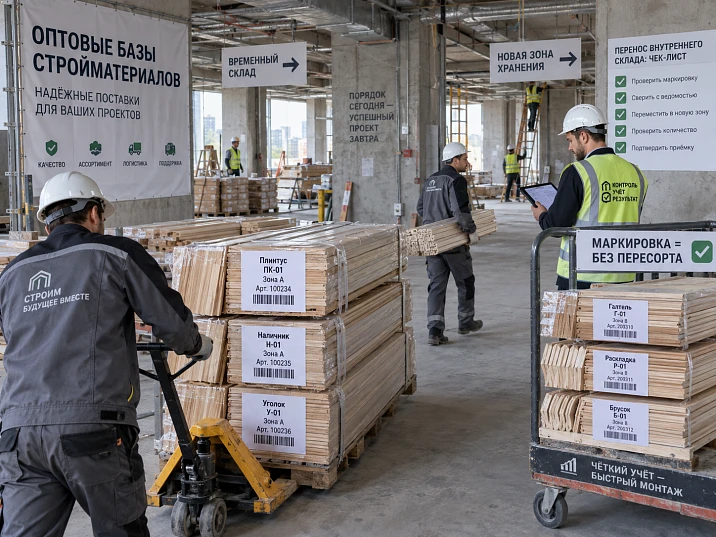
At the first stage of construction, a large room on the ground floor was allocated for the temporary warehouse. It holds wooden skirting boards, moldings, and cornices for several phases, the current installation batch, future floors, useful leftovers, the installation reserve, the operational reserve, and several packages that cannot yet be issued due to a disputed status.
Two months later, the space was needed for final finishing. The warehouse had to be moved to another wing or another floor without halting construction for long. The most dangerous option sounds simple: “today all the crews will quickly drag the bundles over, and tomorrow we’ll sort it out.”
After such a move, the questions begin: where is MLD-043, why is the bundle for the third floor lying together with the fourth, where did the eight spare PLT-A strips disappear, why did the disputed material end up in the common area, and where did the discrepancy come from between the 86 items in the table and the 81 actually found.
Therefore wholesale building materials depots within an active site, it cannot be carried out like an ordinary room clearance. A warehouse move is a separate control operation: first the state before the move is recorded, then each group gets a new location, after the move a recheck is performed, and any deviation is documented as an exception rather than hidden by editing the table.
DECISION TO CLEAR THE SPACE → NEW WAREHOUSE PLAN → MAP OF OLD AND NEW LOCATIONS → SHORT MOVEMENT PAUSE → SNAPSHOT OF THE BALANCE BEFORE THE MOVE → MARKING CHECK → CONTROLLED MOVEMENT → INTERMEDIATE ZONE IF NEEDED → NEW LOCATIONS → RECOUNT → EXCEPTIONS → CLOSING THE OLD WAREHOUSE → NEW BASELINE
Main formula:
balance before the move = verified balance after the move + documented exceptions.
There should be no category left like “two strips seem to have been lost during the transfer.”
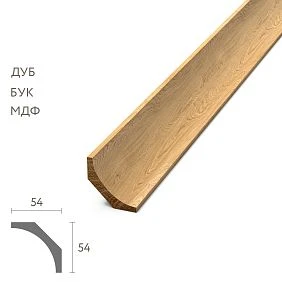
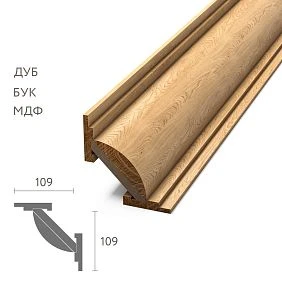
Move planning and warehouse control point




A warehouse move cannot be done like an ordinary room cleanup
Wooden moulding is not a set of identical boxes. A single temporary warehouse may simultaneously contain:
- different SKUs;
- oak, beech, MDF and other finishes;
- different commercial lengths;
- one SKU for multiple floors;
- the current installation batch;
- the next queue;
- material for later stages;
- installation reserve;
- operational reserve;
- useful offcuts;
- opened packs;
- suspended disputed items.
Physically similar items can have completely different functions. If you simply move everything into a new room and group it as "baseboards here, moldings there," the total count may add up, but the project structure will disappear.
For example, the old warehouse had:
| Article | Material | Length | Purpose | Quantity |
|---|---|---|---|---|
| PLT-A | Oak | 2400 | Floor 2 — current installation | 24 |
| PLT-A | Oak | 2400 | Floor 3 — next phase | 40 |
| PLT-A | Oak | 2400 | Free remaining stock | 18 |
| PLT-A | Oak | 2400 | operational reserve | 8 |
After an uncontrolled move, you can end up with a single combined line: PLT-A — 90 pcs.. The arithmetic is correct. The management is broken.
Our factory also produces:








Why this is more dangerous than a simple shortage
A shortage is immediately noticeable: the material is missing. The loss of status is hidden. The warehouse shows everything as "available," but the installer receives a reserved item, a later phase takes material from the current one, and a disputed batch accidentally goes into work.
Get Consultation
First we prepare the new warehouse, then we clear out the old one
You cannot begin the move if the new space has not yet been marked out and employees do not know where to place specific groups.
Before the move, at least the following must exist:
- zone for the current installation batch;
- zone for the next queue;
- zone for later batches;
- separate zone for paused material;
- installation reserve zone;
- operational reserve zone;
- space for opened packages and useful offcuts.
In practice, the following codes can be used:
| Code | Purpose |
|---|---|
| NEW-A | Current queue |
| NEW-B | next queue |
| NEW-C | Late batches |
| NEW-PR | Suspended material |
| NEW-MR | installation reserve |
| NEW-ER | operational reserve |
If the first box that gets moved in is told "just put it here for now," that temporary spot very quickly turns into its de facto permanent place. An hour later a second one appears next to it, then a third — and the new warehouse already begins with chaos.
What to check about the new space before moving
Beyond zoning, you need to make sure the space is actually suitable for finished long-length items:
- dry enough;
- no active wet processes;
- horizontal storage without bending is available;
- no risk of heavy loads on top;
- the route to the warehouse allows long items to be carried in;
- the warehouse won't block future construction work in a week;
- access can be controlled.
Moving a second time a few days later because the new space was chosen without checking is significantly worse than spending an hour on preparation.
Every old location should have a new corresponding location
Before moving, it is useful to create a map:
| Old location | What is stored there | New location |
|---|---|---|
| OLD-A01 | PLT-A / floor 2 | NEW-A01 |
| OLD-A02 | PLT-A / floor 3 | NEW-B01 |
| OLD-B03 | MLD-A / next queue | NEW-B04 |
| OLD-PR | Paused positions | NEW-PR |
| OLD-ER | operational reserve | NEW-ER |
This table serves two purposes. First, the employee does not need to decide on their own where to place each pack. Second, after the move, you can check whether all old locations have been zeroed out.
When a direct one-to-one mapping is not suitable
A new warehouse may have a different geometry. Then one old zone is split into several new ones, or several old ones are merged. But this decision must be made before the move and reflected in the map. You cannot change the structure "on the fly" without recording it.
Building material depots: a short period without movement is needed before the relocation
for building material depots within an active construction site, the main problem is parallel operations. While one person counts 48 MLD-A, an installer takes 4, another crew returns 2, and loaders are already carrying away part of the pack.
During the control reconciliation, you cannot simultaneously:
- issue linear stock;
- accept regular returns;
- move packs between zones;
- accept a new delivery without a separate scenario;
- break up the kit of the current installation queue.
It is not necessary to stop the facility for a whole day. A predefined short period or sequential blocking by sections is needed.
If construction cannot be stopped
The warehouse can be closed by sections: first skirting boards, then moldings, then cornices, reserves, and suspended groups. After recalculation, the section receives an exact closing time and goes into transfer. Any movement through an already closed section belongs to a new history and is recorded separately.
Before the move, we create an initial snapshot of the remaining stock
The initial snapshot is needed not for archival purposes, but as a control baseline. It answers: what exactly existed in the old warehouse before the first transfer.
| Article | Material | Length | Old location | Quantity | Status |
|---|---|---|---|---|---|
| PLT-A | Oak | 2400 | OLD-A01 | 82 | FREE |
| PLT-A | Oak | 2400 | OLD-ER | 8 | operational reserve |
| MLD-A | Beech | 2400 | OLD-B03 | 46 | next queue |
| MLD-B | Oak | 2400 | STAR-PR01 | 6 | ON HOLD |
| KZ-A | Oak | 2000 | STAR-V02 | 14 | Floor 4 |
After the move, the same material balance should be obtained, only with new location codes and documented exceptions.
How to preserve the structure of the trim stock, statuses, and reserves
Closed packs, open packs, and offcuts are counted differently
At the old warehouse, not all units have the same reliability.
| Category | How to check |
|---|---|
| Intact factory packaging | By labeling and the accepted packaging system, if integrity is not compromised |
| Open pack | Physical recount |
| Usable offcuts | By SKU and actual length or ranges |
| Suspended group | Physical recount + reason for restriction |
| Reserve | Physical recount + status confirmation |
It is open packs, offcuts, and constraints that most often lose their status during a move.
Wooden skirting board: the same SKU can be moved across four groups
The same one Wooden baseboard can simultaneously exist as:
- PLT-A / FLOOR 2;
- PLT-A / FLOOR 3;
- PLT-A / FREE STOCK;
- PLT-A / OPERATIONAL RESERVE.
After the move, it is impossible to get one combined stack PLT-A — 126 pcs., even if the total figure matched.
When issuing to the installer, they need not only the information that "the SKU is available," but also an understanding of how much is actually available for their queue.
Bulk materials: labeling must survive the move itself
During relocation materials in bulk most often it's not the item itself that gets lost, but the context.
On each transport unit, it's useful to have:
- article number;
- the material;
- commercial length;
- quantity;
- status;
- old location;
- new location.
For example:
MLD-050 / oak / 2400 / 12 pcs. / FLOOR 3 / OLD-B04 → NEW-B02.
Such a bundle practically leaves no room for guesswork for the loader, storekeeper, and foreman.
A new label must not erase the old identification
If the old marking contains an important SKU, material, or delivery code, the new label is added rather than replacing the technical information with a simplified note like “third floor.”
A damaged old label is first preserved, then replaced
If the old sticker is hard to read, the procedure is as follows:
- read the available data;
- take a photo;
- verify against the record;
- create a new marking;
- only after that, delete or close the old one.
You cannot first throw away the old packaging and then determine the SKU “by a profile like MLD-043.”
Construction material databases: suspended items move in a separate stream
В construction material databases within a project, disputed batches, damaged items, unknown SKUs, material after a claim, or items awaiting a decision may be included.
Key rule:
suspended material is not mixed with free material even for 15 minutes.
A separate zone is prepared in advance at the new warehouse. Each group must retain:
- SKU or “unidentified” status;
- quantity;
- reason for the restriction;
- the following action;
- responsible person.
The phrase "we'll return it to quarantine later" is one of the most common ways disputed material disappears among the ordinary.
We move the operational reserve separately from the construction stock
In the old warehouse, the reserve can be marked and protected. During the move, people start thinking with the logic of "we'll take everything out now and split it again later." It is precisely this interval that is especially dangerous.
The reserve must move as a separate flow:
OLD-RES → separate transport group → NEW-RES.
It cannot be temporarily placed in the current installation queue, even if the new reserve zone is not yet ready. In that case, the reserve remains in the old location until the destination is ready.
The current installation queue must not be buried under future batches
On the day after the move, the crew needs:
- 24 PLT-A;
- 18 MLD-B.
If these bundles arrived at the new location first, and later floors were stacked on top of and in front of them, the move is formally complete, but production is blocked.
It is convenient to use priorities:
| Priority | Meaning |
|---|---|
| P1 — CURRENT | Installers need it now |
| P2 — NEXT | Next in queue |
| P3 — LATER | Late batches |
| Reserve | Do not use in regular consumption |
| ON HOLD | Do not issue until a decision is made |
The new warehouse plan must take this order into account before the first transfer.
Route, priorities, and phased physical relocation
Building material in bulk: the relocation order is set by the next installation, not by the convenience of the loaders
When construction material wholesale they are moved within an active site, and intuitively you want to take out all the large and heavy items first, then the small ones. For linear moldings, it is more useful to build the order around the next use.
Rational sequence:
- prepare the new warehouse;
- move and confirm critical categories;
- ensure the current installation queue;
- move the next queue;
- move later batches;
- separately complete the reserve and paused groups;
- close the old premises.
This way, the move does not create artificial downtime.
Long linear trim requires a separate route check
Before moving begins, the entire path must be walked through taking into account the actual length of the items:
- doorways;
- corridors;
- elevators;
- stair flights;
- turns;
- temporary partitions;
- the entrance area of the new warehouse.
If a cornice or skirting board 2400–2600 mm long physically cannot pass along the chosen route, the problem must be discovered before dozens of packs have already been carried out of the old warehouse.
We check not only the length, but also the method of carrying
A long profile may pass through an opening diagonally, but safe carrying requires two people and free space to turn around. A geometrically possible route is not always operationally suitable.
Do not cut the product for ease of carrying
The commercial length is part of the purchasing configuration and cutting plan.
If the strip blocks passage, the following is changed:
- route;
- moving time;
- carrying arrangement;
- a temporary partition, if the project allows it to be opened.
But not the strip itself.
The solution "cut it in half, it will be installed later anyway" can destroy a long visible section and increase the number of joints.
Each move needs its own code
If the warehouse is moved in a single shift, one code is sufficient, for example:
MOVE-01.
If it takes place in several stages:
- MOVE-01 / BATCH 01;
- MOVE-01 / BATCH 02;
- MOVE-01 / BATCH 03.
The code allows intermediate recounts, photos, and exceptions to be linked to a specific event.
If the move lasts two days, the total balance exists in three states at once
By the end of the first day, part of the material is already in the new warehouse, part remains in the old one, and part is in the intermediate transfer zone.
OLD WAREHOUSE + INTERMEDIATE TRANSFER ZONE + NEW WAREHOUSE = TOTAL PROJECT BALANCE
If you look only at the new warehouse, a false shortage will appear on the evening of the first day. If you look only at the old one, the system will show a write-off of material not yet received by the new warehouse.
What should be visible in the register
| Article | Old warehouse | In transfer | New warehouse | Total |
|---|---|---|---|---|
| PLT-A | 40 | 18 | 32 | 90 |
| MLD-A | 0 | 12 | 34 | 46 |
The total for the SKU must match the initial snapshot, taking into account completed movements.
The intermediate zone must not turn into a third warehouse
For a complex route, it is convenient to use a temporary area between the old and new premises. For example, packs are first carried out into the corridor, sorted by queues, and then brought into the new warehouse.
Such a buffer is useful only under one condition: each pack already has a destination.
Working marking:
MLD-A / FLOOR 3 / OLD-B03 → NEW-B04 / MOVE-01.
Non-working:
moldings / we'll sort out later.
The intermediate zone must not live longer than the move itself. If groups remain in it by the evening of the first day, they are included in the balance as a separate state and physically protected from regular issuance.
Why the buffer cannot be used for a new intake
If a new delivery from the supplier arrives in the intermediate zone at the same time, the old warehouse material gets mixed with the new intake. The next day it is unclear which 12 planks belonged to the original move and which just arrived.
A new vehicle is either received before the control snapshot or already after the corresponding part of the move is closed.
We transfer useful offcuts by SKU and lengths
The box of "various wooden leftovers" almost always becomes useless after a move. A month later, no one knows where MLD-A is, where PLT-A is, which piece is 920 mm and which is 1240 mm.
For useful offcuts, a practical system is sufficient:
| Article | Length | Quantity | New location | Purpose |
|---|---|---|---|---|
| PLT-A | 1240 мм | 2 | NEW-SAMPLE-01 | Short walls / repair |
| PLT-A | 920 мм | 3 | NEW-SAMPLE-01 | Piers |
| MLD-A | 760 мм | 4 | NEW-SAMPLE-02 | Local frames |
It is not necessary to enter every 120 mm offcut into the table. But everything that could realistically cover a future segment must remain identifiable.
When it is better to write off an offcut before moving
If the material is too short, damaged, or has no practical purpose, there is no point in moving it to the new room. A move is a convenient point to clean up the warehouse, but write-offs are done before relocation and recorded separately so that no false discrepancy arises after the move.
Opened packages require enhanced labeling
A closed factory pack usually already has an article number and quantity. After opening, some of the information may remain only on the outer film, while individual planks are left without labeling.
Before the move, the open group receives a new permanent label:
MLD-043 / oak / 2400 / 7 pcs remaining / FLOOR 4 / NEW-B02.
If the packaging contains usable offcuts, they are listed separately. You must not write:
MLD-043 — 11 pcs.
if it contains 7 full pieces and 4 short offcuts.
Unidentified material does not move as “free”
In the old warehouse, three planks without a label may be found. In appearance they resemble MLD-043, but another similar profile was also used nearby.
Correct status:
UNIDENTIFIED / ON HOLD.
At the new warehouse, they are sent to a separate zone and checked against:
- cross-section;
- material;
- length;
- old photographs;
- packaging remnants;
- specifications;
- reference sample.
Until identification is confirmed, these three items do not reduce the shortage of the required MLD-043.
How to plan the route of a long-bed truck inside a building
Moving from the old room to the new one can be more difficult than the original delivery from the street. Over two months, temporary partitions appeared in the building, openings were closed, and doors, furniture, and equipment were installed.
Before moving, it is useful to walk the route with the longest control batten or a template of the corresponding length.
| Route section | What to Check |
|---|---|
| Exit from the old warehouse | Width and diagonal of the doorway |
| Corridor | Turns and temporary warehouse obstacles |
| Elevator | Internal length, diagonal, door |
| Stairs | Platforms and turning areas |
| New warehouse | Entrance, turning area, end zone |
When it is better to change the time rather than the route
A corridor may be geometrically suitable, but during the day it is occupied by other contractors. Sometimes it is safer to move long-length items in the evening or early morning than to try to drag them through an active flow of people and equipment.
What to do if the new warehouse is smaller than the old one
A common situation: the old warehouse occupied a large space, while the new one is significantly more compact. You cannot simply compress everything without revising the structure.
First, the volume that needs to be moved at all is reduced:
- current write-offs are closed;
- the current installation batch can be issued directly to the crew;
- unusable offcuts are written off;
- the operational reserve, where possible, is transferred to separate permanent storage;
- later batches are checked for whether they actually need to be stored on site.
Only after this is a new placement density designed.
Why you shouldn't restrict access to each SKU for the sake of capacity
If getting one pack of MLD-A requires removing four other SKUs, the warehouse is formally capacious but operationally inconvenient. The frequency of future picking should be taken into account in placement.
If the new storage area is on a different floor
Moving between floors adds constraints:
- the elevator may be limited in length and access time;
- some of the cargo will have to be carried up the stairs;
- intermediate landings need to be monitored;
- the risk of temporarily leaving a pack in the corridor increases;
- the current installation queue may be farther from the new warehouse.
In this case, the map of the old and new locations should account not only for the storage cell but also for the route of the transport batch.
Each transfer batch receives the quantity before and after the move
For example, batch TRANSFER-01/02 includes:
| Article | Old location | Transferred to the move | Received by the new warehouse | Status |
|---|---|---|---|---|
| PLT-A | OLD-A01 | 24 | 24 | CLOSED |
| MLD-A | OLD-B03 | 18 | 18 | CLOSED |
| KZ-A | STAR-V02 | 6 | 5 | EXCEPTION −1 |
If five out of six KZ-A are received at the new location, the batch is not considered fully closed. One unit remains an open exception until the cause is found.
New warehouse verification and discrepancy handling
Wholesale building materials: after the move, re-inspection is required
When wholesale building materials have already been physically moved, this does not yet mean that the new warehouse has accepted them.
The following are rechecked:
- whole items;
- open packs;
- suspended groups;
- installation reserve;
- operational reserve;
- current assembly queue;
- critical small items.
The result is a new confirmed stock snapshot.
SNAPSHOT BEFORE RELOCATION → PHYSICAL MOVEMENT → SNAPSHOT AFTER RELOCATION → COMPARISON → EXCEPTIONS → NEW BASELINE
After relocation, we check three different types of errors
Location error
The quantity is correct, the SKU is correct, but the pack is in the wrong zone.
Example:
MLD-A — 12 pcs. found in zone FLOOR 2 instead of FLOOR 4.
The overall warehouse total reconciles. In a week, the floor 4 installation will receive a false shortage.
Status error
The quantity and location may be correct, but the operational reserve was marked as free, or a suspended batch was marked as released.
This is a particularly dangerous error: the material is physically found, but it cannot be used as the new marking suggests.
Quantity error
Expected 42 PLT-A, after the move 40 were confirmed. Two units are unexplained.
Then a separate exception is created and the old warehouse, the intermediate zone, transport batches, neighboring new cells, the current issue, and quarantine are checked.
The balance is checked along three coordinates: SKU + status + location
It is not enough to obtain:
PLT-A — 90 pcs.
We need to get:
| Article | Status | New location | Quantity |
|---|---|---|---|
| PLT-A | Current queue | NEW-A01 | 24 |
| PLT-A | next queue | NEW-B01 | 40 |
| PLT-A | FREE | NOV-V01 | 18 |
| PLT-A | operational reserve | NEW-ER | 8 |
Only this structure reproduces the original state.
A location error is better than a physical loss, but it cannot be ignored.
If 12 MLD-A were found where they were not expected, the total project quantity has not changed. But for the installation queue, the error is already real.
It affects:
- issue speed;
- shortage calculation by zone;
- reorder decision;
- availability for the current crew.
Therefore, after the move, they check not only "was everything found" but also "is what was found in the correct zone."
If there is a discrepancy, the table must not be adjusted to fit the new fact.
42 PLT-A were expected. 40 were found.
Bad solution:
correct in the table from 42 to 40.
After that, no one will know whether the two planks were lost, issued without a record, or were in another transport batch.
Correct entry:
RELOCATION-01-EXCL03 / PLT-A / expected 42 / found 40 / difference −2.
Then the search for the cause begins.
Where to look for material when there is a discrepancy after relocation
Search sequence:
- old location;
- corners and empty racks of the old warehouse;
- intermediate zone;
- neighboring new location of a similar SKU;
- current assembly queue;
- suspended material;
- reserve;
- transport batches;
- recent issues and returns.
If the cause is not found immediately, the exception remains open with an owner and a deadline.
Not every open exception should block the entire warehouse
If two short useful blanks from the late queue do not match, normal work can resume for confirmed critical items.
If six PLT-A units needed by the installers in the morning are not found, it is better not to open the issue for this SKU until the facts are established.
| Exception type | Influence | Solution |
|---|---|---|
| Critical SKU of the current queue | High | Close until issue resumes |
| Late queue | Average | Work can be continued, the exception remains open |
| Small unused remainder | Low | Investigate as planned |
When can material be issued to installers again
Regular issuance resumes when critical categories:
- are physically confirmed;
- have a new location;
- have the correct status;
- are available without re-stacking the entire warehouse;
- have no unexplained critical discrepancy.
It is not necessary to wait for the completion of the investigation on a completely independent secondary item, but the exception continues to live in the register.
Closing of the old warehouse is performed separately
After everything appears to have been transferred, the old premises undergo a final walkthrough.
Checked:
- corners;
- shelving;
- space behind the packaging;
- area for suspended material;
- scrap containers;
- old labels;
- reserve;
- temporary spots near the door.
The old premises can be considered closed only when the material balance for its locations is zero or all exceptions have been documented.
OLD WAREHOUSE = 0.
Why a final visual walkthrough is more useful than a single table
The table may show zero because employees have already marked all items as transferred. A single forgotten cornice behind the shelving unit will not be detected by the table. That is why a physical walkthrough remains mandatory.
The new premises gets a new baseline inventory point
After the move is completed, a record is created:
BASELINE BALANCE OF THE NEW WAREHOUSE / MOVE-01 / 18.09.2026.
It is from this that the following are subsequently calculated:
- new issuances;
- returns;
- movements;
- inventory counts;
- additional orders;
- reserve consumption.
Old location codes cannot continue to be used in new transactions after the official closure of the old warehouse.
Boundary operations on the day of the move
How to carry out a move if the warehouse cannot be closed even for two hours
At a very active site, sequential handover of sections can be used.
For example:
| Section | Recount time | Move time | New status |
|---|---|---|---|
| Baseboards of the current queue | 14:00–14:20 | 14:20–14:40 | NEW-A confirmed |
| Moldings of the current queue | 14:40–15:10 | 15:10–15:30 | NEW-A confirmed |
| next queue | 15:30–16:00 | 16:00–16:40 | NEW-B confirmed |
After a section is closed, its issuance is already handled from the new warehouse. The old warehouse remains operational only for groups that have not yet been transferred.
The main risk of the sectional method
Material cannot be moved back between the closed and unclosed part without a record. Otherwise, the control boundary disappears.
What to do if a new delivery arrives on moving day
It is better to choose one of two scenarios in advance.
Scenario 1. Receive before the move. The vehicle is fully received, the goods are entered into the initial snapshot, then moved along with the rest of the warehouse.
Scenario 2. Receive after the move. The new vehicle becomes the first operation of the new warehouse.
An intermediate option is possible, but it requires separate accounting and creates extra risk. Therefore, it should be used only when truly necessary.
What to do with a crew return on moving day
Returns should not end up in the general "deal with it tomorrow" pile.
The following are recorded:
- floor;
- crew;
- article number;
- whole items;
- usable offcuts;
- damaged elements;
- return time.
If a return arrives after the corresponding old section has been closed, it is immediately recorded as a receipt for the new warehouse.
A move is a convenient point for cleanup, but not for hidden write-offs
During a move, a lot of trash, packaging, and short offcuts are discovered. This is a good moment to remove what is unnecessary, but every write-off must be explained.
You cannot reduce the original snapshot after the fact just to make the new balance look better.
Procedure:
- the opening balance is recorded;
- the material is deemed unusable;
- a write-off is recorded;
- the balance after the move accounts for this write-off as a documented exception.
If one SKU is stored in several locations of the new warehouse
Sometimes, due to the room geometry, one SKU has to be split.
For example:
- PLT-A / NEW-A01 — 24 pcs. current queue;
- PLT-A / NEW-B01 — 40 pcs. next queue;
- PLT-A / NEW-C03 — 18 pcs. available.
This is fine if each group has a clear status. The danger is not multiple locations, but the lack of a link between location and purpose.
Practical example: how to relocate a warehouse in an operating hotel in two days
Let's consider the full scenario. On the hotel's first floor, the temporary warehouse needs to be cleared for finishing work. The new warehouse is being prepared in another wing on the third floor. Installation on floors 4–6 is ongoing in the project, and part of the trim is already reserved for future service stock.
At the old warehouse before the move there is:
| Article | Whole products | Open packs / offcuts | Status | Old location |
|---|---|---|---|---|
| PLT-A | 90 | 12 useful segments | Current + next queue + reserve | STAR-A01 / A02 / ER |
| MLD-A | 46 | 7 segments | next queue | OLD-B03 |
| MLD-B | 18 | 0 | Paused 6, available 12 | STAR-B05 / PR |
| KZ-A | 14 | 0 | Floor 4 | STAR-V02 |
Key challenge: the current crew cannot wait two days without material, and the elevator is available for the warehouse only from 15:00 to 19:00.
Preparation the day before the move
In the new premises, zones are marked out in advance:
- NEW-A — current queue;
- NEW-B — next batch;
- NEW-C — later batches;
- NEW-HLD — on-hold groups;
- NEW-OR — operational reserve;
- NEW-REM — usable remnants.
In parallel, the route is being checked: PLT-A and MLD-A go through the freight elevator, while KZ-A needs to be carried up the stair flight by two people, because the elevator diagonal is inconvenient for it. This decision is fixed in advance, not after the cornice has already been taken out of the old room.
Day 1: current queue and critical statuses
Until 14:00, regular issuing is closed. At 14:00, the initial snapshot is recorded. First, PLT-A of the current floor is recounted: 24 whole planks. They are marked P1 / FLOOR 4 / NEW-A01 and moved as the first batch.
After acceptance at the new warehouse, 24 is reconfirmed. Only after that does the team receive permission to continue issuing from NOV-A01.
Next, MLD-B moves for the current front. Of the 18 items, 12 are free, and 6 are in a suspended status. They travel in two different batches:
MLD-B / 12 / FREE / NOV-A02
MLD-B / 6 / SUSPENDED / NOV-PR01
Even if they are physically carried by the same team, statuses must not be mixed in one unlabeled stack.
Day 1: operational reserve
Eight PLT-A units of the operational reserve are moved as a separate group after the NOV-ER zone is fully ready. They do not pass through the intermediate zone of the current queue. Marking:
PLT-A / 8 / OPERATIONAL RESERVE / DO NOT ISSUE / NOV-ER.
After acceptance at the new warehouse, the status and quantity are confirmed on a separate line.
End of the first day: the warehouse exists in three places
At 19:00 the elevator closes. Some of the goods are already in the new premises, some remain in the old one, and 10 MLD-A are in a controlled intermediate zone near the elevator and have the final destination NEW-B03.
Evening balance:
| Article | Old warehouse | Intermediate zone | New warehouse | Total | ||||||||||||||||||||||||||||||||||||||||||||||||||||||||||||||||||||||||||||
|---|---|---|---|---|---|---|---|---|---|---|---|---|---|---|---|---|---|---|---|---|---|---|---|---|---|---|---|---|---|---|---|---|---|---|---|---|---|---|---|---|---|---|---|---|---|---|---|---|---|---|---|---|---|---|---|---|---|---|---|---|---|---|---|---|---|---|---|---|---|---|---|---|---|---|---|---|---|---|---|---|
| PLT-A | 58 |
What to do if packaging or the product was damaged during transferAn internal move creates its own risk of mechanical damage: an end hitting the doorway, a pack falling, being pinched in the elevator, contamination of the front surface. Such an event must not be mixed with the original condition of the goods. Procedure:
For example, out of 12 MLD-A, one plank was chipped during carrying. The new warehouse accepts 11 as a normal group and 1 as suspended, while the total balance remains 12. Why you can't just write off the damage on sitePerhaps the element is still suitable for a short segment, repair, or requires a separate decision. Moreover, writing off without a record will create a quantitative discrepancy between the snapshot before and after. How to ensure installation continuity during relocationRelocating a temporary warehouse should not automatically halt installation for two days. There are three working scenarios. Scenario 1. Issue the current shift before the control pauseThe crew receives a pre-calculated volume for the day. After that, issuance closes and the warehouse relocates. The main thing is not to issue too large a stock "just in case," which will then fall out of the warehouse system. Scenario 2. Move the current queue firstAs soon as NEW-A is confirmed, regular issuing for this group resumes while the remaining sections continue to be relocated. Scenario 3. Temporary controlled installation bufferIf the work is very intensive, a separate set can be allocated before the checkpoint:
This volume is excluded from the original warehouse stock before relocation and is accounted for as issued to the crew. It must not exist simultaneously in both the warehouse table and with the installers. The digital snapshot must be immutableBefore the first transfer, it is useful to save a separate file or export:
After this, the working table can be updated, but the original snapshot remains unchanged. This allows you to check the next day:
If you continue editing the original table, the checkpoint disappears. What to include in the digital snapshotMinimum:
Photos of the old and new warehouse help reconstruct the routeA photo does not replace a recount, but it helps confirm the location and condition. It is useful to photograph:
It is better if the label or zone code is visible in the photo. A general shot of twenty identical unmarked bundles is of little help during an investigation. What to do if the marking came off during handlingA bundle without a label is immediately removed from the normal flow. There is no need to ask the loaders “who remembers where this was from” and, based on memory, return it to the free stock. Checked:
Until identity is restored, the status is "unidentified / suspended". What to do if extra material is found after the moveA discrepancy is not always negative. For example, according to the original PLT-A photo there should be 90, but in the new warehouse and completed movements it turned out to be 91. An extra unit may mean:
You cannot simply increase the base point to 91. A positive exception opens up:
Only after the origin is established does the material receive normal status. The first days after the relocation and alternative scenariosThe first week of the new warehouse — additional quality control for the moveEven after a good reconciliation, some errors only show up in day-to-day work. So for the first few days it's useful to monitor:
A sign of a successful moveA week later, the warehouse operator can, without a repeat full inventory, show: how much PLT-A is free, how much belongs to floor 4, where the MLD-A of the next queue is located, what is in reserve, and which positions remain suspended. A sign of a weak relocationThe new warehouse is physically tidy, but every question is met with: “we need to check, I think this pack was from the old zone B.” In that case, logistical cleanliness has not turned into reliable accounting. When a full warehouse relocation is not needed at allSometimes the premises need to be vacated partially or after a few weeks. A full relocation can create unnecessary risk. Alternatives:
A full one-time move is justified if the old premises really need to be closed and continuing the dual system longer is more dangerous than carrying out a controlled migration. How to reduce the scope of the second move in the futureIf the site is long and temporary warehouses inevitably change, you can design the system in advance so that the next migration is easier. To do this:
Then, on the next move, mainly the "location" field changes, while the technical and project identity remains unchanged. Warehouse relocation with multiple contractors: who has the right to move and receive materialOn a large site, a temporary warehouse may serve several installation crews at once, while the transfer itself is handled by a separate logistics contractor. If roles are not defined in advance, responsibility becomes blurred: loaders claim they "just moved it," installers say "their bundle had already been moved," and the storekeeper sees only the final room. Before the move, it is useful to separate four roles:
If one person combines two roles, that is not a problem. The problem begins when no role is explicitly assigned. How to transfer each transport batchFor each move batch, a short inventory list is sufficient:
Thus, between the old and new premises, there is no "unaccounted" material. What to do if the loaders put a pack in the wrong placeThere is no need to return it silently and consider the matter closed. A location error is recorded because it reveals a weak spot in the map or labeling. If such errors recur, you need to:
The goal is not to punish the loaders, but to make the system resilient to the real pace of construction. Several crews must not take “their” packs on their own during the moveEven if the installer knows MLD-A exactly, taking it without authorization disrupts the batch balance. On moving day, issuance goes only through the designated responsible person or a pre-allocated installation buffer. After the new zone is confirmed, regular fulfillment can resume for this section. Open purchase orders and additional orders need to be synchronized with the warehouse relocationWhile the warehouse is physically relocating, the supplier may prepare a new batch. If the new delivery arrives at the old address within the facility or is labeled with the old zone code, the new warehouse will start operations with additional confusion. Before the relocation, the purchaser must check all open orders:
If the supplier uses only the construction site address, the internal new location must still be known to the receiving team. A move must not create a false reorderDuring the move, PLT-A is temporarily not found in the new zone. The buyer sees zero and thinks the material has run out. In fact, 18 planks are in an intermediate batch. Therefore, during the move, the decision on a new order is made only based on the full balance: old warehouse + material in transit + new warehouse + already issued installation buffer + open orders to the supplier. Until this picture is assembled, the absence of goods in a specific bin is not proof of a shortage. If the reorder is already on its way on the day of the moveIt is better to arrange in advance: the new batch is not included in the initial move snapshot and is received by the new warehouse as a separate operation after a specific time. For example:
So a new delivery doesn't blur the before-and-after comparison. How to prepare for a move if another warehouse zone change is expected in a weekSometimes the new warehouse is also temporary by design: a permanent space will free up in a week. The question arises whether it's worth setting up a full-fledged system for seven days. The answer depends on volume and risk. If the interim site holds several labeled, sealed packs of a single SKU and access is controlled, a simplified scheme can be used. But if there are:
even a week without structure can create more discrepancies than two controlled moves. How to simplify a temporary one-week zoneYou don't have to build full-fledged permanent shelving, but keep the essential elements:
An organizational system matters more than the beauty of a temporary space. How to evaluate the result of a move through the actual operation of the warehouseA matching recount by itself does not yet mean a successful move. A few days later, it is worth looking at how the new structure works.
If, after the move, employees still think in terms of the old warehouse and constantly move stacks around, the layout of the new space needs adjustment. Checklist before resuming normal issuingBefore declaring the new warehouse fully operational, it is useful to run one final check. It does not repeat a full inventory count, but verifies that the system is ready to withstand the first normal working day.
After this check, normal issuing can resume. If, for example, the entire warehouse has already been recounted, but the current queue is physically blocked by late batches, the move is not yet operationally complete. If all items are available, but the operational reserve is not separated, the material balance also cannot be considered fully ready. A good move result can be described in one phrase: the new warehouse is able to continue working without relying on the memory of the employees from the old premises. An SKU is found by its code, the status is clear from the labeling, the current queue is accessible, the reserve is protected, and every discrepancy exists as a separate line rather than in a verbal comment. It is this moment that becomes the boundary between the relocation project and ordinary warehouse operation. After it, all new issues, returns, receipts, and additional orders are counted relative to the new baseline. 18 mistakes when relocating a temporary warehouse
Final warehouse relocation process1. DECISION TO VACATE THE OLD WAREHOUSE ↓ 2. NEW WAREHOUSE PLAN ↓ 3. MAP OF OLD AND NEW LOCATIONS ↓ 4. SHORT MOVEMENT PAUSE ↓ 5. INITIAL STOCK SNAPSHOT ↓ 6. LABELING VERIFICATION AND RECOVERY ↓ 7. SEGREGATION: CURRENT / NEXT / LATER / RESERVE / ON HOLD ↓ 8. CONTROLLED MOVEMENT ↓ 9. INTERMEDIATE ZONE IF NEEDED ↓ 10. PLACEMENT BY NEW CODES ↓ 11. RECALCULATION ↓ 12. LOCATION / STATUS / QUANTITY ERRORS ↓ 13. PROCESSED EXCEPTIONS ↓ 14. OLD WAREHOUSE = 0 ↓ 15. NEW BASELINE ↓ 16. RESUMING NORMAL ISSUE Conclusion: a warehouse move is a control inventory checkpointPhysically moving a temporary warehouse within an active site seems like a simple logistics task, until dozens of similar profiles, several installation queues, open packs, usable offcuts, reserved and on-hold material end up on the same site. If you simply move everything from room A to room B, the total volume may be preserved, but manageability may disappear. One PLT-A for the current queue will be mixed with an identical PLT-A from the operational reserve, the disputed MLD-B will end up in the free stock, and the pack for the fourth floor will end up in the second-floor zone. Therefore, the relocation begins not with the movers, but with a plan for the new warehouse and a baseline snapshot. Each significant group gets a new location before the move starts. During the relocation, movement is restricted, opened packages are recounted, reserve and suspended items go through separate flows, and the intermediate zone is used only as a controlled buffer. After the physical transfer, a new recount is performed. Not only the total SKU is compared, but the combination of SKU + status + location. Any unexplained discrepancy remains an exception until the cause is determined. The table is not adjusted to match the facts just for a nice match. The old warehouse is closed only after a final walkthrough and zeroing out of its material balance. The new one gets its own baseline point, from which regular issues, returns, inventories, and reorders continue. This way, wholesale building materials depots within a large site can change physical location without losing SKUs, installation queues, and reserves. The relocation becomes a controlled operation, not the cause of new warehouse chaos. |