Article Contents:
- What exactly we compare: one NPU-479, three NPU-479, or an entirely empty wall
- NPU-479 96 × 84 × 17 mm: which dimensions really matter for this task
- Why the composition above the desk should be tied to the desk, not to the center of the entire wall
- One or three NPU-479: two different scenarios
- When one NPU-479 is truly sufficient
- When a composition of three NPU-479 looks more convincing
- Why three identical butterflies should not be arranged in a straight line
- Soft rise
- Free triangle
- Asymmetric pair plus one accent
- How to determine the distance between three NPU-479 without a made-up "correct step"
- Painting to match the wall tone
- Contrast painting
- Why five or seven identical NPU-479s are already a different scenario.
- How to understand that one butterfly is 'lost' rather than just looking delicate.
- How to understand that three butterflies have become too active.
- Why it's better not to glue the NPU-479 directly onto relief slats without a separate check.
- Rails only on one side of the table
- Rails on both sides of the smooth field
- Is symmetry needed for three identical NPU-479
- Buying three parts before trying one on
- Centering everything on the wall, ignoring the table
- Bringing the outermost butterfly flush against the rails
- Making three identical gaps "by the ruler"
- Ignoring the 17 mm depth
- Adding a frame just because the group seems small
- Forgetting about the future use of the workspace
- Can NPU-479 be used above an adult desk, not just in a child's room?
- Can three NPU-479s be rotated at different angles?
- What to do if you like one butterfly, but it looks too small only in the photo?
- Can a fourth NPU-479 be added later?
- Should the butterflies be placed directly above the middle of the monitor?
- What to do if you change to a wider desk after installation?
- Can three NPU-479s be placed vertically one above the other?
- Is a separate base pad needed under the NPU-479?
- Can the three butterflies be painted in different colors?
- If three NPU-479s are too many, should you buy two?
- Can the NPU-479 be placed below the top line of the monitor?
- Do I need to buy mounting materials at the same time as the overlays?
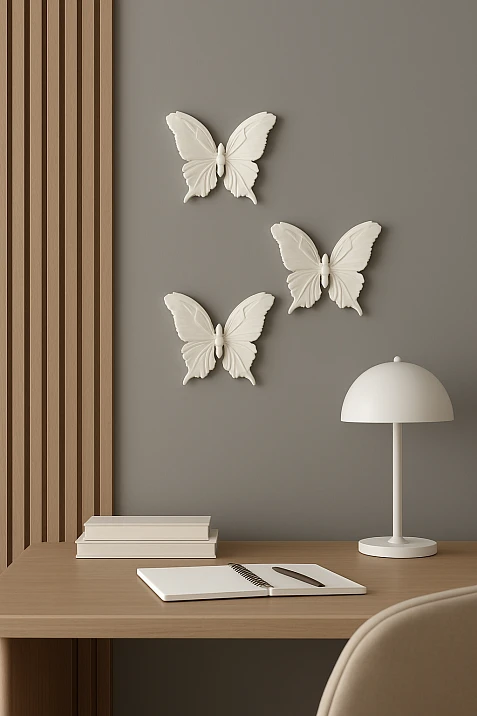
The desk already sets the lower boundary of the composition, and the slat panels nearby create a strong vertical rhythm. On the remaining smooth wall, I want to add a small relief accent — NPU-479 "Butterfly." Here, the main question is not whether you can glue a decorative overlay to the wall at all. The question is practical: is one NPU-479 enough, or is it better to order three identical pieces and assemble a small group.
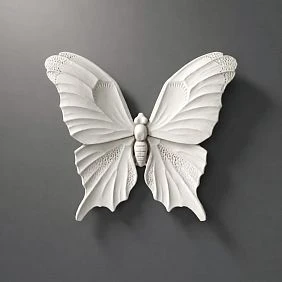
The NPU-479 measures 96 × 84 × 17 mm, and the material is polyurethane. At the time of checking the STAVROS product page, one piece costs 770 ₽. So, choosing the quantity immediately changes the cart: one overlay — 770 ₽, three — 2,310 ₽, excluding mounting and finishing materials. Therefore, it makes sense to make the decision not based on a product photo, but after a full-size mock-up on your own wall.
To start, it's enough to cut out one outline of 96 × 84 mm from paper or thin cardboard. Then make two more of the same. The first mock-up shows whether a single butterfly works as a local accent above the desk. Three templates allow you to test a free composition — diagonally, with a slight rise, or as a compact triangle. If one piece seems lost, and three gather the empty wall into a clear story, it makes sense to buy the decorative overlay NPU-479 "Butterfly" in a quantity of three pieces. If, however, the three templates conflict with the slats, shelf, lamp, or the workspace itself, there's no need to buy extra decor.
What exactly are we comparing: one NPU-479, three NPU-479s, or an empty wall altogether
Proper mock-up testing starts not with the question "how to beautifully arrange three butterflies," but with three equal options.
The first option is a smooth wall without overlays. It's needed as a control. Sometimes the slat panels, desk, desk lamp, monitor, shelf, and books already provide enough visual information. If you add another decorative theme to them, the workspace becomes restless.
The second option is one NPU-479. A single butterfly works as a point accent. It can support a small shelf, a sign, a wall lamp, or simply mark the free space above the desk without turning it into a panel.
The third option is three NPU-479 units. This is no longer a single piece, but a small composition. It occupies more visual space, reads better from a distance, and can connect the furniture with the adjacent slatted zone. However, three identical elements require more precise layout: too strict a row starts to resemble an ornamental strip, while too random a scatter looks like an installation error.
It is useful to compare these three options from the same spot—for example, from the room entrance and from the point where the work area is most often seen in full. Do not change the quantity, wall color, furniture, and lighting at the same time. First, decide only one question: is a relief accent needed here, and how many elements should form it.




NPU-479 96 × 84 × 17 mm: which dimensions are truly important for this task
The product card specifies the overall dimensions A × B × C — 96 × 84 × 17 mm. For a wall composition, these numbers are needed immediately for three reasons.
The first two dimensions define the flat contour of the template. Before ordering, you can cut out a rectangle of 96 × 84 mm and, if you have a printed image of the product to scale, additionally cut out an approximate silhouette of the butterfly. A rectangle is sufficient for an initial check of the location, but the silhouette better shows how much "air" remains around the wings.
The 17 mm dimension is important not as a contour, but as the depth of the relief. Paper does not show this. Therefore, at the second fitting stage, it is useful to make a three-dimensional mock-up: glue the paper template onto a piece of lightweight foam board or place spacer pads behind it approximately matching the product's depth. Such a mock-up allows you to see the future shadow from side lighting and understand whether the piece will appear visually too protruding next to a flat painted wall.
Do not automatically assume that the first figure, 96 mm, should always be strictly horizontal. On the wall, a decorative butterfly can be compositionally oriented with a slight rotation if this does not compromise adhesion and installation. For calculating the overall composition, it is better to work with the actual contour of the template in the chosen position, rather than trying to derive an "ideal group width" solely from the A × B × C notation.
Our factory also produces:
Why the composition above the desk should be anchored to the desk, not to the center of the entire wall
One common mistake is to look for the geometric center of the wall from corner to corner. For a work area, this is not always the correct axis.
If the desk stands on a smooth section of the wall, and slatted panels begin to the right or left, the visual system is already asymmetrical. The user first perceives the desk, chair, lamp, monitor, or laptop, then the free space above them, and only after that the neighboring texture of the slats. Therefore, the center of the decorative group is more logically determined relative to the workspace, rather than relative to the entire finished wall.
Start with the vertical axis of the table. Mark it with painter's tape. Then check the axis of the main object on the table: monitor, desk lamp, organizer, or a composition of several items. If they align, the task is simple. If the monitor is placed to the side and the table is intentionally asymmetrical, mechanically centering NPU-479 above the screen is also not necessary.
A single butterfly can sit close to the main axis of the workspace or be slightly shifted toward a smooth area. A group of three more often benefits from its own orientation: two pieces can form the base, the third can rise toward the free part of the wall. At the same time, the group should be perceived as part of the table zone, not as a random scatter between furniture and slats.
The practical check is simple: temporarily mark the outline of the tabletop on the wall with vertical marks and see if all three paper butterflies remain visually "above the table." If the top or side piece already extends into the neighboring architectural zone, the composition is too stretched.
Get Consultation
One or three NPU-479: two different scenarios
When one NPU-479 is truly enough
One overlay is not a "budget version" of three. It is an independent solution with different logic.
A single NPU-479 most often works where other objects already exist around: a wall shelf, sconce, poster, small painting, clock, child's name, notice board, wall organizer, or a tall desk lamp. In such a situation, the butterfly does not have to fill the wall. Its task is to add a small relief touch.
One element is also more reasonable on a narrow smooth wall section between the slatted area and adjacent furniture. Three identical pieces require their own "field of silence" around them. If this field is absent, the composition starts to bump into the slats, shelf, or the top line of the table.
Another scenario is active slat finishing. Dark lamellas, backlighting, pronounced contrast between wood and wall can already be the main accent. Then one butterfly, especially painted to match the smooth wall, works as a quiet detail that is not noticed immediately. Three white or contrasting butterflies next to active slats can create a second competing center.
The single option is also useful when the workspace may change over time. The table can be replaced with a wider one, the monitor with two screens, and a shelf may appear above the table. One small overlay leaves more freedom for future rearrangement.
If a full-size template of one element reads from the usual entry point into the room and doesn't look like a lonely "dot," adding two more details just for the sake of quantity isn't necessary.
When a composition of three NPU-479 looks more convincing
Three identical butterflies aren't needed because "an odd number is always beautiful." Their meaning emerges when one detail is too small relative to the free field, and the wall truly needs a separate decorative motif.
Imagine a wide smooth area above a desk without shelves, posters, or sconces. Nearby are slatted panels with a strong vertical structure. A single NPU-479 might be perceived as a randomly stuck small object. Three details already create movement and allow forming a compositional volume comparable to the furniture.
The group has another advantage: it can gently "guide" the eye from the desk to the slatted part of the wall without encroaching on it. There's no need to build a strict diagonal. It's enough for the positions of the three elements to be distinguishable in height and not repeat the spacing of the slats.
Three identical butterflies work well if a noticeable smooth field is preserved between them. Then each remains a separate form, and all together read as a group. If the overlays are brought closer to the feeling of a single clump of relief, the very idea of light individual elements is lost.
Before purchasing, check the group in at least two scales of perception: sitting at the desk and standing at the entrance. From close up, the relief and shadows matter. From afar, the overall silhouette. If only "white noise" is visible from the entrance, and from the workspace the three elements constantly distract, the composition is too active.
How to assemble a group of three NPU-479: layout and intervals
Why three identical butterflies shouldn't be arranged in a line
A strict horizontal row seems like the simplest way to place three identical elements, but precisely next to slatted panels it often produces an undesirable effect. The vertical rhythm of the slats meets a new horizontal "garland," and two independent systems start to argue.
For NPU-479, a free group is more natural. There are three basic schemes.
Soft rise
The first butterfly is lower, the second is slightly higher, and the third completes the movement even higher. This should not be a mathematically perfect diagonal. If the centers of the elements lie on a rigid line, the composition becomes a geometric pattern again.
Free triangle
Two elements form a conditional base, the third is higher and slightly offset. This scheme is compact and suitable for a field where the decor cannot be stretched too wide.
Asymmetric pair plus one accent
Two butterflies are placed closer to each other, the third is farther and higher. This solution works well when the group needs to be directed toward the slat zone but not extend onto the slats.
None of the schemes require a pre-defined universal distance in millimeters. Different walls, table width, color, lighting, and slat positions change perception. Therefore, the working distance is determined only by full-size templates.
How to determine the distance between three NPU-479 without a made-up "correct step"
For a decorative group, there is no construction standard that prescribes a fixed gap between butterflies. Therefore, phrases like "be sure to leave 120 mm" create false precision.
It's better to use a three-stage visual test.
First, place the templates relatively close together. Photograph the wall. If the three elements start to be perceived as one dense relief clump, the distance is too small.
Then spread them apart so that each one has its own zone of smooth wall around it. Take another photo. At this stage, the group connection should remain: the eye easily moves from one butterfly to another, and the composition is still perceived as a single scene.
After that, deliberately spread the templates noticeably further apart. If each element starts to 'live on its own' and the top butterfly already seems like a random separate decoration, you've gone past the working range.
Compare the three photos on a small phone screen. This is a useful trick: the reduced image removes small details and shows only the compositional silhouette. The most cohesive version is usually visible immediately.
At the same time, the distances between all three elements don't have to be equal. Slight asymmetry makes the group livelier. What matters is that it should be intentional, not look like three dots stuck on without any overall logic.
Slat panels nearby already create rhythm: where to end the group of butterflies
A slatted surface is an active background. Even if the slats themselves are a neutral color, the repetition of verticals forms a strong pattern. Therefore, the NPU-479 composition needs a boundary.
The safest place is the smooth, stationary part of the wall next to the slats. Don't automatically move one of the three butterflies onto the slats just to 'connect materials.' On a textured slatted surface, the overlay's own relief is harder to read, and the area of reliable adhesive contact may be smaller.
It's useful to mark the boundary of the slat zone in advance with painter's tape and not cross it with the templates during the first fitting. This way, you'll check whether the group can fully exist on the smooth field. If it only looks good after one butterfly 'climbs' onto the slats, perhaps the smooth field itself is too small for three elements.
To choose slat trim in another project or when extending the current wall, it makes sense to go to the section buy slat panels for walls for interior finishing. But in an already finished interior, it's better to first respect the existing material boundary, and use decorative overlays where they have a full mounting and visual plane.
A broader principle of combining two textures is covered separately in the material about how to combine slat panels and polyurethane decor. Here, we are only interested in the specific group above the desk.
How to check the scale of one and three butterflies relative to the width of the desk
The most useful reference is not the entire wall area, but the actual furniture zone.
First, mark the vertical projections of the left and right edges of the tabletop on the wall. Painter's tape or a laser level is enough for this. You'll get a working field within which decor is almost always perceived as part of the desk.
Place one NPU-479 template within this field. If it looks too small, don't rush to add two right away. Check it alongside real items on the desk: a monitor, a lamp, an organizer. Sometimes a small accent works precisely because it doesn't try to mirror the width of the furniture.
Then attach three templates. Look not at whether they "fill the entire width," but at the balance of empty and occupied space. The group shouldn't stretch from one edge of the tabletop to the other just because the desk is wide. Otherwise, the butterflies start working as a horizontal frieze.
If the group is noticeably narrower than the table, that's normal. Above furniture, a compact composition often looks more convincing than an attempt to fill every centimeter. If one butterfly seems lost even when viewed in the context of the furniture, and three form a calm center, the decision in favor of three becomes justified.
For a final assessment, take a photo from the front, then at an angle from the side of the slatted panels. The angled view makes it especially clear whether the outermost butterfly is "sticking" to the slats.
How to position NPU-479 above a monitor, shelf, or desk lamp
A workspace rarely consists only of a desk. Therefore, the layout should be checked together with everything that is actually in the field of view.
If there is a tall monitor on the desk, do not place the bottom butterfly so that it visually touches its top edge. This creates an accidental connection between two objects. Leave a noticeable calm gap between the screen and the decor, the size of which should be determined using the template in the actual interior.
With a wall shelf, the situation is different. The shelf itself forms a strong horizontal line. A single NPU-479 can become a small accent next to or above it, while a group of three should either be entirely above the shelf or be compositionally separated from it. Three butterflies "flowing around" the shelf without clear logic quickly create visual noise.
A tall desk lamp or wall sconce affects asymmetry. If the light fixture is on the left, the group can be slightly shifted to the right, maintaining overall balance above the desk. Do not try to necessarily place the central butterfly exactly above the middle of the tabletop.
If a notice board, calendar, or magnetic panel is used, first decide what is the main functional object. The decor should not interfere with its use and turn the work area into a cramped collage.
17 mm of relief: why evening light can change the decision about quantity
On a paper plan, one and three NPU-479 differ only in quantity. On the wall, another variable appears—the depth of 17 mm.
With frontal diffused light, the relief reads softly. With side light, the shadow becomes longer and more noticeable. Therefore, three identical elements can create not three, but actually six visual forms: three butterflies plus three shadows. On a light smooth wall, this effect sometimes makes the composition much more active than expected during the day.
Check the templates in the evening under the lighting that is actually used at the table. If there is a desk lamp, turn it on. If there is backlighting for the slats nearby, turn that on too. Do not evaluate the decor only under overhead technical light.
For a volumetric check, it is useful to make mockups about 17 mm thick. Even simple pieces of foam board under paper silhouettes will give a more honest idea of the shadow. If one volumetric "butterfly" already reads expressively enough, three may be redundant.
Conversely, on a matte wall with soft general light, one small element can almost disappear. Then a group of three creates sufficient light-and-shadow mass and remains noticeable without contrasting coloring.
In the color of the wall or contrasting: quantity and color need to be evaluated together
One white butterfly on a dark wall and three butterflies painted to match the wall tone are completely different in activity. Therefore, you cannot choose the quantity while completely ignoring the future color.
Painting to match the wall tone
This is the calmest scheme. The relief is read through light and shadow, not through color contrast. For a group of three, this approach is especially useful: identical shapes do not turn into a bright repeating pattern.
Tone-on-tone also helps when there are contrasting wooden slats nearby. The slats retain the role of the main material, and NPU-479 becomes a secondary tactile layer.
Contrast painting
One contrasting butterfly can work as a small graphic sign. Three contrasting shapes require much more caution. On a dark wall, three light elements quickly become the main motif of the entire work area.
It makes sense to check the contrast not only against a paint sample, but also with a digital mockup: photograph the paper templates and roughly fill them with the intended color in any editor. Even a rough visualization shows how sharply the hierarchy changes.
If you are not yet sure about the color, it is safer to first resolve the geometry of the group in neutral paper templates, and then repeat the check with colored ones.
Is a molding frame needed around the NPU-479
For this theme, the frame is not a mandatory part of the configuration. The NPU-479 can work directly on a smooth wall.
A molding frame changes the very type of composition. Without it, one or three butterflies are perceived as a free decorative accent. In a frame, they become the content of a separate panel. This is already a more formal and classic solution that requires checking the scale of the frame itself, its indents from the table, and its proximity to the slat zone.
If the interior is modern, there are already active slats nearby, and the task is to add a light motif, the absence of a frame often preserves more air. This especially applies to three NPU-479s: the group itself forms its own contour and does not necessarily need an additional border.
A frame can become useful when the smooth wall is too large and a group of three still looks lost. But in such a case, the problem is no longer just the number of butterflies — the entire wall architecture changes. You should not buy moldings solely to "justify" three small overlays.
If the project truly requires framed decor, it is better to calculate it separately and select a profile in the section where you can You can buy ready-made stucco matching the Baroque style. Calculate the quantity: linear meters of cornices and moldings, number of rosettes, pilasters, consoles, corner elements. Add a ten to fifteen percent allowance for trimming., rather than turning one product task into a random set of elements.
One NPU-479 and three NPU-479s are different costs and different risks of error
At the time of checking the STAVROS card, the price of one NPU-479 is 770 ₽.
| Option | Quantity of NPU-479 | Cost of overlays* | What we get |
|---|---|---|---|
| Without decor | 0 | 0 ₽ | Clean smooth wall, main accent — slats and workspace |
| Single accent | 1 | 770 ₽ | Small relief detail |
| Group | 3 | 2 310 ₽ | Separate composition above the table |
*Excluding glue, base preparation, primer, paint, and labor. The product price is current at the time of checking and requires re-verification in the product card before ordering.
The difference between one and three elements is 1,540 ₽. But the main risk is not in this amount. An error with three overlays affects the wall more strongly: more mounting points, more relief, more shadows, and it's harder to fix the composition after gluing.
Therefore, three elements are especially important to buy after a mockup. If one template looks convincing, there is no reason to automatically increase the quantity. If the single option clearly gets lost, and a group of three solves the scale problem, the additional cost has a specific visual justification.
Why five or seven identical NPU-479 is already a different scenario
If three elements are a small composition, then five to seven identical butterflies begin to form a pattern. This is not bad in itself, but it is a different task.
A large number of identical shapes requires designing the entire wall: the overall direction, boundaries, density, and interaction with furniture and slats. Above a regular desk, such a scatter easily turns into the main theme of the room, although initially only light decorative support was needed.
Repeating one SKU also enhances the feeling of sameness. With three elements, you can still create natural asymmetry through position and angle. With seven, the repetition becomes obvious and requires a much more thoughtful rhythm.
If you want a large natural panel, it is wiser to first look at decorative polyurethane overlays with animals and decide whether a composition of different shapes is needed, rather than just increasing the number of NPU-479.
For the current narrow scenario, comparing 0, 1, and 3 elements provides enough options to make a decision without excessive complexity.
How to fix the chosen layout and not lose it during installation
After several rearrangements of paper templates, it is easy to get a successful composition and then lose it when the paper is removed from the wall. For a single NPU-479, this is not critical: the position can be restored by the center. For three identical elements, a slight shift of one piece changes the entire silhouette of the group.
When a variant is selected, do not outline every butterfly with a bold line. It is better to create a system of control marks. Mark the vertical axis of the workspace with painter's tape and a horizontal control line, for example, along the bottom point of the group. On each paper template, put a number 1, 2, or 3 and transfer two or three inconspicuous dots to the wall that will allow its position to be restored.
Take a frontal photo with the templates and control tape. Then remove one template and try to return it to its place using only the marks. If this works unambiguously, the marking is sufficient. If not, add another control point.
For a free group, it is useful to fix not only the centers but also the orientation of each element. Two identical silhouettes, rotated slightly differently, can give a sense of movement; during installation, it is easy to accidentally align them and turn the composition into a mechanical row.
This method is especially useful if the installation is done not on the same day as the fitting, or if another person will attach the elements. The photo and simple marking system preserve the agreed layout, not an approximate memory of it.
How to distinguish a delicate accent from a group that is too active
How to understand that one butterfly is "lost" rather than just looking delicate
Small decor does not have to be noticed first. This is an important distinction.
If one NPU-479 is readable when approaching the work area, casts a nice shadow, and supports the table composition, but does not draw the eye from the other end of the room, it does not mean it is too small. Perhaps this secondary role is exactly what is needed.
A detail becomes "lost" in another case: the eye does not understand why it is located exactly here. It is not connected to the center of the table, nor to the shelf, nor to the lamp, nor to the edge of the slats. Then the problem is not necessarily solved by adding two more butterflies. First, you need to correct the position of the first one.
The check is simple: temporarily move the single template to several different positions. If none creates a connection with the work area, one element may indeed be insufficient in compositional mass. After that, move on to three.
However, if one butterfly becomes convincing after a slight shift, there is no need to buy two more just for the sake of "completeness."
How to understand that three butterflies have become too active
Overload has several signs.
The first is that you start seeing not a workspace, but only a group of decor. This is especially noticeable on a contrasting wall.
The second is that the outermost butterfly visually touches the slat zone or other furniture, and there is no longer a calm surface between the elements.
The third is that three identical silhouettes begin to be perceived as a logo, sign, or repeating pattern, although the interior does not require such graphicness.
The fourth is that with evening side lighting, shadows from the 17-millimeter relief merge and create a dark spot.
The fifth is that while sitting at the table, the top or side butterfly constantly falls into peripheral vision and distracts.
If one of these effects manifests, reduce the group or return to the single option. There is no need to try to "save" three overlays with an additional frame, another shelf, or a new wall color. Complication often only masks the original error in quantity.
Mounting on a smooth wall: why the base is checked first
NPU-479 is a decorative element, not a fastener or structural part. For a neat result, a stable, even base is important.
On a painted wall, you need to ensure the coating adheres well. If the paint is peeling, the decorative overlay may come off with the finish layer. Dust, chalk, greasy marks, and weak putty also reduce adhesion.
For a specific adhesive, follow the manufacturer's instructions and check compatibility with polyurethane and your base. The STAVROS catalog separately presents Mounting and finishing materials, but the choice of compound should account for the wall type and finish coating.
Before final fixing, transfer the position of the paper templates to the wall with light marks or painter's tape. For a group of three, it is useful to mark not only centers but also top/bottom control points. Otherwise, when gluing, one element can easily shift relative to the layout.
If painting to match the wall is planned, think through the sequence in advance: painting parts separately is more convenient for surface control, but after installation, local touch-up along the contour may be needed. The specific technique depends on the chosen paint, primer, and adhesive.
Why NPU-479 is better not glued directly onto slatted rails without separate verification
Formally, the decorative overlay can be used on various surfaces, but a slatted wall is a special case. It does not have a single continuous plane: protrusions alternate with recesses.
The small butterfly, measuring 96 × 84 mm, can land on several slats and gaps at once. As a result, part of the back surface will lack support. Besides the technical issue, there is a visual one: the butterfly's relief overlaps the slats' relief, and the two patterns compete.
For our composition, a smooth wall section is more valuable precisely because it gives NPU-479 a calm background. Next to the slats, the butterfly can complement them without being on them.
If the project initially involves installing decorative overlays directly on top of a slat system, such a joint must be considered separately: check the actual pitch, the width of the protrusions, the contact area, and the chosen mounting compound. You cannot automatically transfer a solution from a smooth wall to a textured base.
How does the layout change if the slats are on one or both sides?
Slats only on one side of the table
Asymmetry does not require artificial symmetry.
If the slats are on the right and the smooth wall continues further on the left, the group of three can be slightly directed toward the right boundary, but leave a noticeable pause before the slats. This "rise toward the texture" connects the zones without mixing them.
If the slats are on the left, the scheme changes in mirror. There is no need to try to keep the same position of the butterflies for any interior. The direction of the composition should take into account the actual side of the active finish.
One NPU-479 on an asymmetric wall can be located closer to the center of the table and does not have to "respond" to the slats directly. Sometimes it is the neutral position that prevents turning the entire decoration into a thematic connection of "butterfly flying to the slats."
For three elements, check whether the outermost butterfly creates the impression that the group is accidentally cut off by the slat panel. If so, shift the composition back onto the smooth field or reduce it to a single element.
Slats on both sides of a smooth field
Here another effect appears: the smooth part of the wall becomes a visual niche between two active textures.
In such a field, a single NPU-479 often looks more composed than on an endless smooth wall, because the slats themselves already form the side boundaries. Therefore, do not assume that "between two slatted zones, three are necessarily needed."
On the other hand, if the smooth field is wide and the table occupies a significant part of this niche, a compact group of three can create its own center without competing with the side slats.
It is especially important not to stretch the three butterflies toward both edges. Between the outer elements and the slatted panels, there should remain independent smooth pauses. Then the composition is perceived within the field, not as a bridge connecting two slatted surfaces.
In such a scheme, it is useful to take a photo strictly along the central axis of the table. It immediately shows whether one side of the group is visually "falling" toward the slats.
Is symmetry needed for three identical NPU-479s
The identity of the elements already creates a strong sense of order. Therefore, additional strict symmetry is not always necessary.
If three butterflies are placed at the same height and at equal intervals, a decorative row results. This may be appropriate in a specially designed ornamental interior, but above an ordinary desk, freer movement is usually preferred.
At the same time, "free" does not mean "random." Good asymmetry has a common vector, compactness, and a clear center of gravity.
You can choose one butterfly as the visual main one—for example, the central or upper one. The other two work as support. Although physically all items are identical, the difference in position creates hierarchy.
It is easier to check symmetry using photographs. If the composition seems tilted to one side, shift one element rather than rebuilding everything. If the asymmetry looks lively and balanced, there is no need to bring it to a ruler just because the items are identical.
The height should not be chosen based on an abstract rule like "the center of the decor should be at such-and-such distance from the floor." A workspace has its own vertical structure: the tabletop, the screen or laptop, sometimes a wall shelf, then a free zone and the ceiling. The NPU-479 should occupy exactly the free layer, not a random mark on the wall.
First, determine the upper boundary of functional items. If there is a monitor on the desk, raise it to its normal working position. If an adjustable mount is used, check not only today's height but also the upper position you actually use. For a desk lamp, account for the raised shade, and for a shelf, consider not only the shelf itself but also the items that will be placed on it.
After that, mark the lower boundary of the decorative zone with paper templates. A single butterfly can be placed lower than a group of three because it does not require space for neighboring elements. With three overlays, the top piece inevitably raises the overall silhouette of the composition, so it is important to see in advance whether the group starts to visually approach the ceiling or the cornice.
A useful test is to look at the wall while sitting at the desk. If the lower butterfly ends up directly in the constant field of view behind the monitor, the relief may distract more than expected. Then stand at the entrance: a group that is too high sometimes stops being associated with the desk and starts to be perceived as separate wall decor. The working position lies between these two extremes and is determined by the specific furniture, not by a universal number.
How to check the composition with a camera and not mistake the phone's distortion for the real scale
A photograph is convenient for comparing options, but the phone camera can noticeably change the perception of small decor. This is especially true for the wide-angle lens: it widens the wall, increases the space at the edges of the frame, and makes the NPU-479 visually smaller relative to the furniture.
Therefore, to compare one and three butterflies, shoot both options from the same point and in the same focal mode. Do not photograph a single overlay up close and a group from the doorway: such shots cannot be honestly compared.
Take at least three types of shots. The first is a frontal general shot of the work area. The second is a shot from the point where the desk is most often seen upon entering. The third is an angle from the side of the slatted panels. The latter is especially useful: it shows whether a visual pause remains between the outermost butterfly and the slats.
After that, reduce the photos to a small preview. On a small image, the details of the wings disappear, but the overall weight of the composition is clearly visible. If a single NPU-479 completely disappears, while three form a clear accent, this is an argument in favor of the group. If even in the reduced frame three white spots begin to dominate over the desk and slats, the group is too active.
After that, reduce the photos to a small preview. In the small image, the details of the wings disappear, but the overall weight of the composition is clearly visible. If one NPU-479 completely disappears, and three form a clear accent, this is an argument in favor of the group. If even in the reduced frame three white spots begin to dominate the table and the rails, the group is too active.
A photograph does not replace viewing the wall with your own eyes. It serves as a second verification tool. A decision should only be made when both an on-site check and the photo yield the same conclusion.
Cables, outlets, and future mountings: what to check before gluing the butterflies
Above a desk, more technical tasks are often hidden than it seems at first glance. There may be lighting cables, internet, monitor power, a route for a wall lamp, mountings for a future shelf, or a cable channel.
The decorative cover should not block an element that may need access. If there is a junction box cover, a removable panel, a cable outlet, or a spot for future fasteners nearby, leave that area free. Three NPU-479 units occupy more wall points, so the likelihood of intersecting with future changes is higher than with a single element.
Before installation, it is useful to photograph the wall with markings of all known utilities. If the renovation is recent, keep the wiring diagrams. Do not drill the wall for a decorative cover unnecessarily and do not make assumptions about hidden electrical work. The mounting method itself is chosen according to the instructions for the adhesive compound and the substrate.
There is also a less obvious scenario: today there is no shelf above the desk, but it may appear in a year. If three butterflies occupy all the convenient height, a future shelf will require either a complex rearrangement or removal of part of the decor. One NPU-479 leaves more free space. Therefore, with an uncertain future for the workspace, the single option often has an operational advantage, even if a group of three looks more impressive in today's photo.
What will change if the desk is later moved or replaced
Decor above a desk is usually perceived as part of the furniture composition, but furniture changes faster than wall finishes. This is especially important for a children's room, home office, and study area, where the desk may become wider, taller, or move to another part of the room.
One NPU-479 handles such a rearrangement more easily. A small single accent can remain simply a wall detail, even if the new tabletop shifts slightly relative to the old axis.
A group of three is more tied to the current geometry. If it is built exactly above the desk and directed toward the slats, after moving the furniture it may turn out that the composition "hangs" to the side. Therefore, before ordering three elements, it is useful to ask not only "how does the wall look now," but also "will the desk stay here for a long time."
If rearrangement is possible, the group can be made more compact and closer to the stable architectural axis of the smooth field, rather than stretching it across the entire tabletop. This approach reduces dependence on specific furniture.
If the work area is built-in, the table is fixed between cabinets, or the slat composition was originally designed around it, three NPU-479 can be more boldly tied to the furniture. Here, the risk of future shifting is lower, and the decorative group becomes part of the wall's permanent scenario.
How to compare one and three NPU-479 if there is already a poster or a child's drawing on the wall
The presence of an image changes the task. A poster, drawing, or photograph already contains its own shape, color, and rectangular border. In this case, NPU-479 should not automatically become a second independent panel.
If the poster is large, one butterfly can work as a small relief companion next to it. Its position is checked relative to the edge of the image and the table simultaneously. Three identical butterflies next to a bright poster often create too many focal points on a small section of the wall.
If the image is small and neutral, a group of three may be possible, but you need to decide in advance which is more important. The decor should not accidentally form a "frame" around the poster unless such a frame was intended.
For children's drawings, it is useful to consider the interchangeability of the display. Today one sheet hangs, in a month—three. Permanent polyurethane decor is better placed so that it does not limit space for new works. In this sense, one NPU-479 again provides more flexibility, while three are justified where the decorative composition itself should be the permanent center of the wall.
When it is better not to buy NPU-479 above a desk
Refusing to buy is a normal result of trying on.
NPU-479 is not needed if slat panels are already the main decorative accent, and the smooth wall works as a necessary visual pause.
You should not buy it if there are shelves, posters, a notice board, wall lamps, and other items above the table, and almost no free space remains.
One overlay is not needed if the pattern looks like a random small detail and a convincing position cannot be found for it.
Three are not needed if the group starts to argue with the width of the table, monitor, lamp, or slats.
It is better to refuse the purchase also when the mounting surface is unstable or elements that require access run through the selected area: an electrical cover, a cable channel, a removable panel, a mounting point for a future shelf.
Finally, you should not buy three pieces just because one seems "too cheap" or "too simple." The quantity should solve a compositional problem, not justify the purchase.
If NPU-479 does not fit in scale or motif, it is wiser to look Polyurethane decorative appliques and choose a different type of element rather than forcibly fit a specific butterfly onto an unsuitable wall.
When to buy one NPU-479 and when to buy three: decision table
| Situation above the table | 0 pcs. | 1 pc. | 3 pcs. |
| Slats, shelves, and lighting are already active | often the best option | A quiet accent is possible | Usually redundant |
| Small smooth field | Possible | Often suitable | May not have enough air |
| Large empty smooth area | May look too empty | Check with template | Often more logical if the group is compact |
| Need subtle tone-on-tone relief | Possible | Suitable | Only suitable with a calm layout |
| Need a separate decorative motif | Too neutral | May not be enough | Main candidate |
| Contrasting butterfly color | calmly | expressive | Requires caution |
| The work area will change | The most flexible option | Flexibly | Less freedom for future shelves and equipment |
The table does not replace trying on, but helps to understand the logic. One element is chosen not because the table is small, but because the composition needs a local accent. Three — not because it is “more beautiful,” but because a smooth field requires a group with its own movement.
Practical algorithm before ordering
Before putting the item in the cart, go through the sequence without skipping steps.
-
Measure the actual smooth area above the table.
-
Mark the projections of the tabletop edges on the wall.
-
Mark the boundary of the slat panels.
-
Record all permanent objects: monitor, shelf, sconce, organizer, board.
-
Cut out three templates 96 × 84 mm.
-
First, place one.
-
Check it from the entry point and while sitting at the table.
-
Take a photo.
-
Add two more and assemble a compact free group.
-
Do not extend the edge elements onto the rails.
-
Take photos frontally and at an angle.
-
Check both options in the evening.
-
If possible, simulate a depth of 17 mm.
-
Compare the tone-on-tone color and the contrasting option.
-
Check whether the future composition interferes with shelves, cable routes, and light fixtures.
-
Leave the best layout for a few hours.
-
Re-evaluate the wall with a fresh eye.
-
Choose 0, 1, or 3 pieces.
-
Before ordering, re-check the price and availability in the product card.
-
Select compatible mounting materials for your base.
If the result is one piece, order one. If three templates give a noticeably more cohesive wall without overload, order three. Don't complicate the decision with additional elements until this main choice is made.
What to put in the cart after trying on
If the single option wins, the basic configuration is simple: 1 × NPU-479 96 × 84 × 17 mm plus compatible materials for mounting and finishing, if not already available.
If the composition wins, you need 3 × NPU-479. At the time of checking, this is 2,310 ₽ for the overlays themselves. Before placing an order, the price and availability require re-checking in the product card.
If the templates showed that the butterfly motif fits, but NPU-479 specifically doesn't solve the scale, don't automatically increase the quantity to five or seven. First, compare other shapes in the category where you can Buy decorative polyurethane overlays.
If the wall looks better empty, that's also a complete design answer: 0 NPU-479. The slat panels remain the main accent, and the smooth area above the desk serves as a visual pause.
A broader overview of the STAVROS "butterfly" models themselves is a separate topic. If you need to compare NPU-479 with other shapes, it's worth reading the material first Buying a butterfly on the wall — how to choose STAVROS stucco decor. In the current scenario, the solution should remain narrow: one or three identical NPU-479 above a specific desk.
Mistakes that most often ruin a composition of NPU-479
Buying three pieces before trying one
If one element is already sufficient, two additional overlays will not add quality. They will only increase visual density.
Centering everything on the wall, ignoring the desk
Thus, the group may be formally centered in the room, but visually off to the side of the workspace.
Placing the edge butterfly right up against the slats
The relief shapes begin to blend together, and the necessary pause between materials disappears.
Making three equal gaps "by the ruler"
The result is a row, not a free composition. This may contradict the butterfly shape and reinforce mechanical repetition.
Ignore the 17 mm depth
During the day the composition seems calm, but in the evening three shadows make it too active.
Adding a frame only because the group seems small
If the scale doesn't work, first change the quantity and position. The frame is a separate architectural decision.
Forgetting about the future use of the workspace
A new shelf, a second monitor, a wall calendar, or a lamp may conflict with an already glued group.
Each of these mistakes is easier to spot with a paper mockup than after installation.
Result: one or three NPU-479 above the desk
There is no universal answer like "always one" or "definitely three." There is a clear way to make a decision before purchasing.
One NPU-479 is suitable when the work area already has furniture and lighting accents, the smooth field is relatively compact, or a quiet relief accent is needed.
Three NPU-479 units are justified when the wall above the desk is truly free, a single piece gets lost, and a group of three creates its own compact composition without encroaching on the slat zone.
Zero NPU-479 units is the right result if the slats, desk, and equipment already provide enough decorative information.
The main selection tool is not abstract advice, but a full-size mock-up. First make one template of 96 × 84 mm, then three, test both options during the day and in the evening, and evaluate them relative to the desk and the slat boundary. After that, you can make an informed decision to order NPU-479 96 × 84 × 17 mm in a single unit or in a quantity of three pieces, or leave the wall without additional molding.
FAQ
Can NPU-479 be used above an adult work desk, not just in a children's room?
Yes. The butterfly shape is more often associated with children's and light decorative themes, but the applicability itself is determined by the interior, color, and scale. In a monochrome finish, the relief can look significantly calmer. Before ordering, it is more important to evaluate the motif in the context of the specific room than to rely only on the name of the shape.
Can three NPU-479 units be rotated at different angles?
A slight difference in orientation helps avoid the feeling of a stamped row, provided the mounting surface of the product reliably adheres to the base. Rotations should first be tested with paper templates: too varied angles can turn the group into a chaotic scatter.
What to do if you like one butterfly, but it looks too small only in the photo?
Check it at actual size. The phone's wide-angle camera often visually shrinks small details against the whole wall. Evaluating on site from a normal viewing point is more reliable than a single photo.
Can a fourth NPU-479 be added later?
Technically, an additional element can be purchased, but compositionally it's better to keep the photo and layout of the original group in advance. Four identical elements already require different balancing and are more often perceived as more symmetrical or patterned than a free group of three.
Should the butterflies be placed directly above the center of the monitor?
Not necessarily. The monitor is just one object in the work area. If it's offset on the desk, mechanically centering the decor on the screen can disrupt the connection with the desk and the whole wall. First, determine the compositional axis of the workspace.
What to do if you replace the desk with a wider one after installation?
Re-evaluate the new composition. One NPU-479 usually adapts more easily to furniture changes. A group of three can remain appropriate if it was compactly tied to the central zone rather than to the exact edges of the old tabletop.
Can three NPU-479s be placed vertically one above another?
You can test such a layout, but next to vertical slat panels it adds another vertical line and may start competing with their rhythm. A free triangle or a soft diagonal rise usually gives a more independent composition, but the final decision is made by a real fitting.
Is a separate backing plate needed for NPU-479?
On a stable, flat, smooth wall, a separate decorative backing plate is not necessary by itself. If the base is weak, uneven, or has a complex coating, the issue is resolved by preparing the base and selecting a compatible mounting system, rather than using a decorative backing to mask the problem.
Can three butterflies be painted in different colors?
Yes, but this sharply increases visual activity and turns the relief group into a color composition. For a wall next to slatted panels, it is safer to first test one color or tone-on-tone, and model the multicolor option separately.
If three NPU-479s are too many, is it worth buying two?
Two pieces are possible, but they create a different compositional logic — a pair, rather than a free odd-numbered group. If the goal is specifically between a single accent and a small "trajectory" of butterflies, one and three options are easier to compare. Two makes sense to consider when the wall or furniture requires pairing.
Can NPU-479 be placed below the top line of the monitor?
Only if the overlay does not end up behind the screen, is not covered by furniture, and remains visually readable. Usually, it is more useful to first check the clean field above the work equipment so that the decor does not mix with functional items.
Do I need to purchase mounting materials at the same time as the overlays?
If there is no suitable compound at home, it is better to select compatible materials for polyurethane and the specific base in advance. This is more convenient than searching for random glue after receiving the overlays. However, the type of compound is chosen according to the instructions and the actual wall surface.